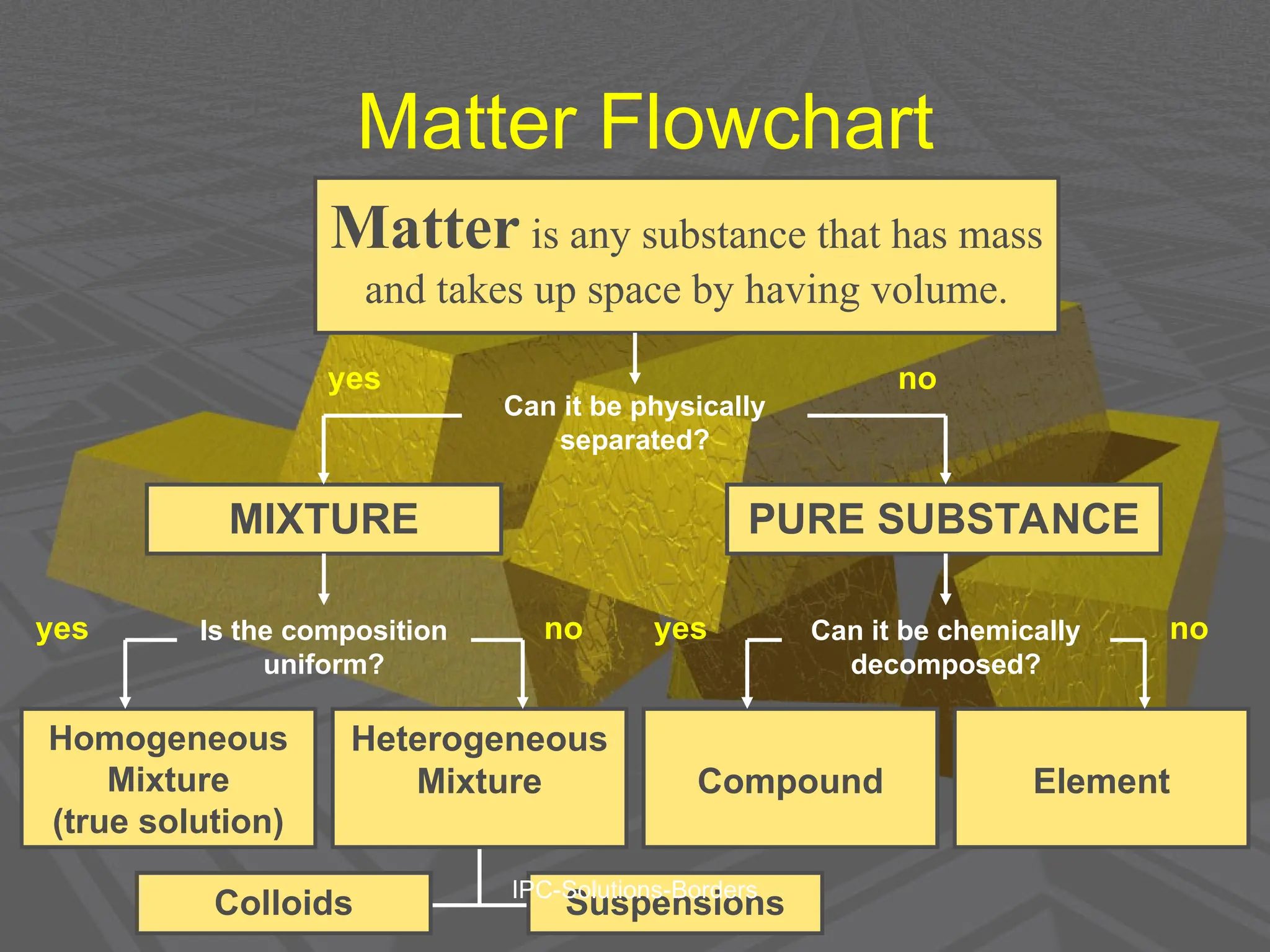
Matter Flowchart
Matter is any substance that has mass
and takes up space by having volume.
Can it be physically
separated?
Homogeneous
Mixture
(true solution)
Heterogeneous
Mixture Compound Element
MIXTURE PURE SUBSTANCE
yes no
Can it be chemically
decomposed?
no
yes
Is the composition
uniform?
no
yes
Colloids Suspensions
IPC-Solutions-Borders
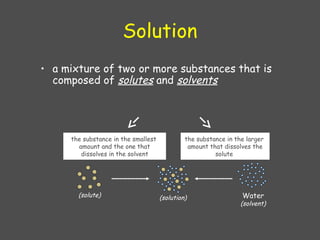
Solution
• a mixture of two or more substances that is
composed of solutes and solvents
the substance in the smallest
amount and the one that
dissolves in the solvent
the substance in the larger
amount that dissolves the
solute
(solute) Water
(solvent)
(solution)
1-True Solutions(crystalloids)
• Very small particle size: .01 nm-1 nm
• Are transparent
• Cannot be separated by filtration
2- Colloidal soultions
• A heterogeneous mixture
• May or may not be transparent
• Medium particle size: 1 nm -200 nm
• Cannot be separated by filtration
3- Suspensions
• A heterogeneous mixture
• Are not transparent
• Large particle size: over 200 nm
• Can be separated by filtration
pH
• pH is commonly expressed as –log[H+]
• the negative log (base10) of the
concentrations of hydrogen ions H+ in solution
• The pH scale
Acids and Bases
• An acid can be defined as a proton donor, a
chemical that increases the concentration of
hydrogen ions in solution.
• A base can be defined as a proton acceptor,
a chemical that reduces the concentration
of hydrogen ions in solution.
Buffers
• Definition: a solution that resists change in pH
following addition of strong acid or base.
– Typically a mixture of a weak acid with its salt of
strong base or a weak base with its salt of strong
acids.
– Can be adjusted to a particular pH value
• Why use them?
Mechanism of action of
buffers
9
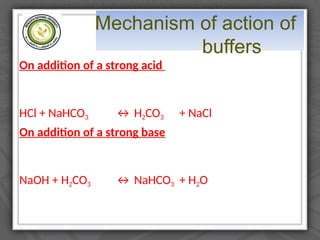
On addition of a strong acid for example to
bicarbonate buffer, a neutral salt and weakly
dissociated acid are produced
HCl + NaHCO3 ↔ H2CO3 + NaCl
On addition of a strong base e.g NaOH to bicarbonate
buffer, weakly dissociated base and water are
produced
NaOH + H2CO3 ↔ NaHCO3 + H2O
Bicarbonate buffer
-
• HCO3 /H2CO3 = 20/1 when plasma
pH=7,4
• When hydrogen ion concentration increases
in plasma, HCO3
- ions bind H+ forming H2CO3.
• H2CO3 is converted to CO2 + H2O
• CO2 is released to atmosphere by lungs
10
Buffers
• The physiologic buffer systems present in various tissues and
body fluids function to keep the pH stable as enzymes act
only within a narrow pH range.
• Plasma buffers include:
• Bicarbonate buffer (NaHCO3/H2CO3) the most important
plasma buffer
• Phosphate buffer (Na2HPO4/NaH2PO4) )main buffer of urine)
• Plasma proteins (H protein/Na proteinate)
•

physical chemistry and buffer system .ppt

  • 1.
    Matter Flowchart Matter isany substance that has mass and takes up space by having volume. Can it be physically separated? Homogeneous Mixture (true solution) Heterogeneous Mixture Compound Element MIXTURE PURE SUBSTANCE yes no Can it be chemically decomposed? no yes Is the composition uniform? no yes Colloids Suspensions IPC-Solutions-Borders
  • 2.
    Solution • a mixtureof two or more substances that is composed of solutes and solvents the substance in the smallest amount and the one that dissolves in the solvent the substance in the larger amount that dissolves the solute (solute) Water (solvent) (solution)
  • 3.
    1-True Solutions(crystalloids) • Verysmall particle size: .01 nm-1 nm • Are transparent • Cannot be separated by filtration
  • 4.
    2- Colloidal soultions •A heterogeneous mixture • May or may not be transparent • Medium particle size: 1 nm -200 nm • Cannot be separated by filtration
  • 5.
    3- Suspensions • Aheterogeneous mixture • Are not transparent • Large particle size: over 200 nm • Can be separated by filtration
  • 6.
    pH • pH iscommonly expressed as –log[H+] • the negative log (base10) of the concentrations of hydrogen ions H+ in solution • The pH scale
  • 7.
    Acids and Bases •An acid can be defined as a proton donor, a chemical that increases the concentration of hydrogen ions in solution. • A base can be defined as a proton acceptor, a chemical that reduces the concentration of hydrogen ions in solution.
  • 8.
    Buffers • Definition: asolution that resists change in pH following addition of strong acid or base. – Typically a mixture of a weak acid with its salt of strong base or a weak base with its salt of strong acids. – Can be adjusted to a particular pH value • Why use them?
  • 9.
    Mechanism of actionof buffers 9 On addition of a strong acid for example to bicarbonate buffer, a neutral salt and weakly dissociated acid are produced HCl + NaHCO3 ↔ H2CO3 + NaCl On addition of a strong base e.g NaOH to bicarbonate buffer, weakly dissociated base and water are produced NaOH + H2CO3 ↔ NaHCO3 + H2O
  • 10.
    Bicarbonate buffer - • HCO3/H2CO3 = 20/1 when plasma pH=7,4 • When hydrogen ion concentration increases in plasma, HCO3 - ions bind H+ forming H2CO3. • H2CO3 is converted to CO2 + H2O • CO2 is released to atmosphere by lungs 10
  • 11.
    Buffers • The physiologicbuffer systems present in various tissues and body fluids function to keep the pH stable as enzymes act only within a narrow pH range. • Plasma buffers include: • Bicarbonate buffer (NaHCO3/H2CO3) the most important plasma buffer • Phosphate buffer (Na2HPO4/NaH2PO4) )main buffer of urine) • Plasma proteins (H protein/Na proteinate) •