Chapter 32

The Laws of Electromagnetism
    Maxwell’s Equations
    Displacement Current
 Electromagnetic Radiation
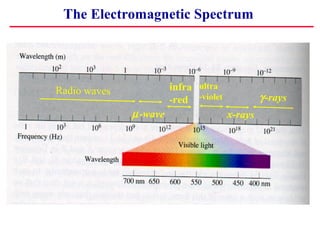
The Electromagnetic Spectrum


Radio waves             infra ultra
                        -red -violet            γ -rays
              µ -wave                  x-rays
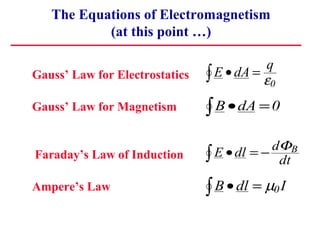
The Equations of Electromagnetism
           (at this point …)

                                           q
Gauss’ Law for Electrostatics   ∫ E • dA = ε0
Gauss’ Law for Magnetism        ∫ B • dA = 0
                                            dΦB
Faraday’s Law of Induction      ∫ E • dl = − dt
Ampere’s Law                    ∫ B • dl = µ0 I
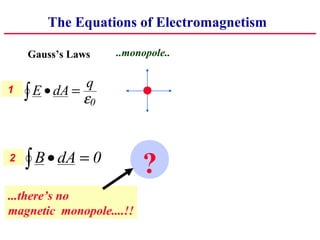
The Equations of Electromagnetism

    Gauss’s Laws    ..monopole..

               q
1
    ∫ E • dA = ε0


2
    ∫ B • dA = 0          ?
...there’s no
magnetic monopole....!!
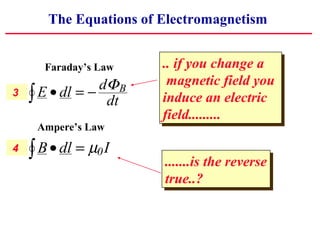
The Equations of Electromagnetism


      Faraday’s Law     .. if you change a
                         .. if you change a
                dΦ B     magnetic field you
                          magnetic field you
3   ∫ E • dl = − dt     induce an electric
                         induce an electric
                        field.........
                         field.........
     Ampere’s Law

4   ∫ B • dl = µ0 I     .......is the reverse
                         .......is the reverse
                        true..?
                         true..?
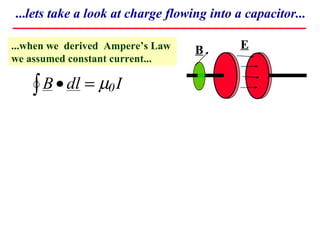
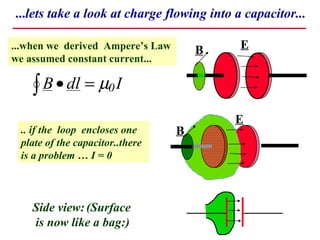
...lets take a look at charge flowing into a capacitor...

...when we derived Ampere’s Law    B        E
we assumed constant current...

    ∫ B • dl = µ0 I
...lets take a look at charge flowing into a capacitor...

...when we derived Ampere’s Law       B     E
we assumed constant current...

    ∫ B • dl = µ0 I
                                           E
 .. if the loop encloses one      B
 plate of the capacitor..there
 is a problem … I = 0


    Side view: (Surface
    is now like a bag:)
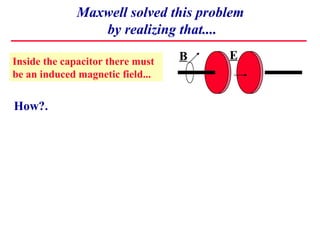
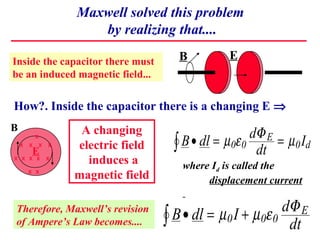
Maxwell solved this problem
                 by realizing that....

Inside the capacitor there must   B   E
be an induced magnetic field...


How?.
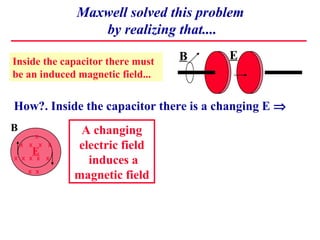
Maxwell solved this problem
                 by realizing that....

Inside the capacitor there must   B    E
be an induced magnetic field...


How?. Inside the capacitor there is a changing E ⇒
B              A changing
       x
    x x x x
      E
              electric field
x x x x x       induces a
     x x
              magnetic field
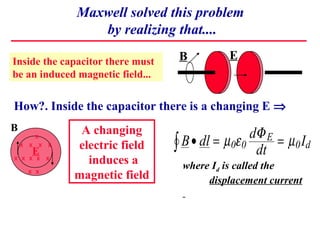
Maxwell solved this problem
                 by realizing that....

Inside the capacitor there must    B         E
be an induced magnetic field...


How?. Inside the capacitor there is a changing E ⇒
B              A changing                          dΦ E
                                  ∫ B • dl = µ 0ε 0 dt = µ 0 Id
       x
    x x x x
      E
              electric field
x x x x x       induces a          where Id is called the
     x x
              magnetic field            displacement current
Maxwell solved this problem
                 by realizing that....

Inside the capacitor there must      B         E
be an induced magnetic field...


How?. Inside the capacitor there is a changing E ⇒
B              A changing                            dΦ E
                                    ∫ B • dl = µ 0ε 0 dt = µ 0 Id
       x
    x x x x
      E
              electric field
x x x x x       induces a            where Id is called the
     x x
              magnetic field              displacement current

                                                           dΦ E
                                  ∫ B • dl = µ 0 I + µ 0ε 0 dt
Therefore, Maxwell’s revision
of Ampere’s Law becomes....
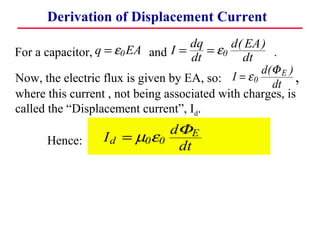
Derivation of Displacement Current
                                    dq      d( EA )
For a capacitor, q = ε0 EA and I = dt = ε0 dt        .
                                                  d(Φ E )
Now, the electric flux is given by EA, so: I = ε 0 dt ,
where this current , not being associated with charges, is
called the “Displacement current”, Id.
                              dΦ E
      Hence:      I d = µ0 ε0
                               dt
      and:       ∫ B • ds = µ0( I + Id )
                 ⇒ ∫ B • ds = µ0 I + µ0ε 0 dΦ E
                                            dt
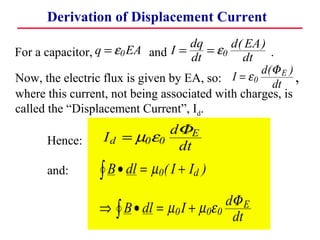
Derivation of Displacement Current
                                    dq      d( EA )
For a capacitor, q = ε0 EA and I = dt = ε0 dt .
                                                  d(Φ E )
Now, the electric flux is given by EA, so: I = ε 0 dt ,
where this current, not being associated with charges, is
called the “Displacement Current”, Id.
                             dΦ E
      Hence:     I d = µ0 ε0
                              dt
      and:       ∫ B • dl = µ0( I + Id )
                ⇒ ∫ B • dl = µ 0 I + µ 0ε 0 dΦ E
                                             dt
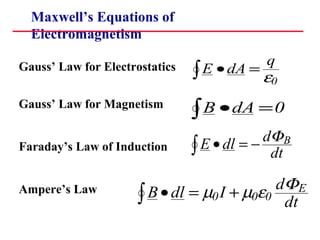
Maxwell’s Equations of
  Electromagnetism
                                            q
Gauss’ Law for Electrostatics
                                ∫ E • dA = ε0
Gauss’ Law for Magnetism
                                ∫ B • dA =0
                                            dΦ B
Faraday’s Law of Induction      ∫ E • dl = − dt
                                            dΦ E
Ampere’s Law
                      ∫ B • dl = µ0 I + µ0ε0 dt
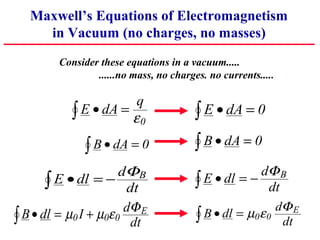
Maxwell’s Equations of Electromagnetism
     in Vacuum (no charges, no masses)
         Consider these equations in a vacuum.....
                 ......no mass, no charges. no currents.....

                        q
            ∫ E • dA = ε 0               ∫ E • dA = 0
               ∫ B • dA = 0              ∫ B • dA = 0
                       dΦB                            dΦ B
       ∫ E • dl = − dt                   ∫ E • dl = − dt
  B • dl = µ0 I + µ0ε 0 dΦ E
                                                          dΦ E
∫                        dt              ∫ B • dl = µ0ε 0      dt
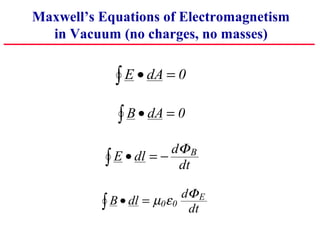
Maxwell’s Equations of Electromagnetism
  in Vacuum (no charges, no masses)


            ∫ E • dA = 0
             ∫ B • dA = 0
                       dΦ B
           ∫ E • dl = − dt
                          dΦ E
          ∫ B • dl = µ0ε 0 dt
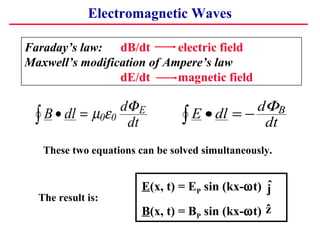
Electromagnetic Waves

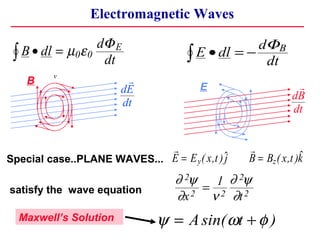
Faraday’s law: dB/dt        electric field
Maxwell’s modification of Ampere’s law
                 dE/dt      magnetic field

                 dΦ E                       dΦB
  ∫ B • dl = µ0ε0 dt            ∫ E • dl = − dt
   These two equations can be solved simultaneously.


                                                 ˆ
                        E(x, t) = EP sin (kx-ωt) j
  The result is:
                                                 ˆ
                        B(x, t) = BP sin (kx-ωt) z
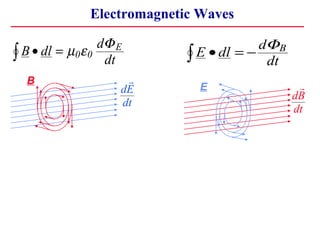
Electromagnetic Waves

                dΦ E                    dΦ B
∫ B • dl = µ0ε 0 dt         ∫ E • dl = − dt
  B                 
                   dE         E                 
                                               dB
                   dt
                                               dt
Electromagnetic Waves

                 dΦ E                             dΦ B
 ∫ B • dl = µ0ε 0 dt                  ∫ E • dl = − dt
         v
    B                    
                        dE               E                     
                                                              dB
                        dt
                                                              dt


                                                 
Special case..PLANE WAVES... E = E y ( x ,t ) 
                                              j                  
                                                  B = Bz ( x ,t )k
                                   ∂ 2ψ   1 ∂ 2ψ
satisfy the wave equation               = 2 2
                                   ∂x 2  ν ∂t
  Maxwell’s Solution           ψ = A sin( ωt + φ )
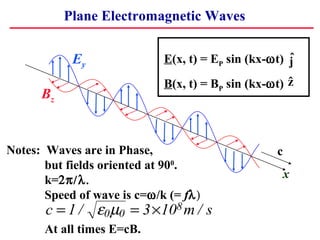
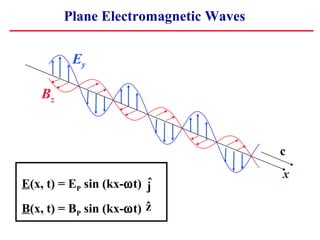
Plane Electromagnetic Waves


          Ey

   Bz


                                      c
                                      x
                         ˆ
E(x, t) = EP sin (kx-ωt) j
                         ˆ
B(x, t) = BP sin (kx-ωt) z
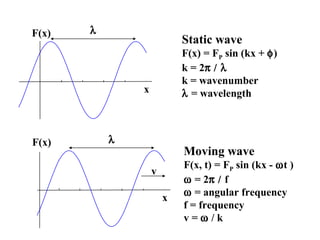
F(x)   λ
                           Static wave
                           F(x) = FP sin (kx + φ)
                           k = 2π / λ
                           k = wavenumber
               x           λ = wavelength


F(x)       λ
                           Moving wave
                           F(x, t) = FP sin (kx - ωt )
                   v
                           ω = 2π / f
                           ω = angular frequency
                       x
                           f = frequency
                           v=ω /k
F

                                    v         Moving wave
                                x         F(x, t) = FP sin (kx - ωt )


What happens at x = 0 as a function of time?

F(0, t) = FP sin (-ωt)

For x = 0 and t = 0 ⇒ F(0, 0) = FP sin (0)
For x = 0 and t = t ⇒ F (0, t) = FP sin (0 – ωt) = FP sin (– ωt)
This is equivalent to: kx = - ωt ⇒ x = - (ω/k) t
F(x=0) at time t is the same as F[x=-(ω/k)t] at time 0
The wave moves to the right with speed ω/k
Plane Electromagnetic Waves


            Ey                                        ˆ
                             E(x, t) = EP sin (kx-ωt) j
                                                      ˆ
                             B(x, t) = BP sin (kx-ωt) z
      Bz


Notes: Waves are in Phase,                         c
       but fields oriented at 900.
       k=2π/λ.                                         x
       Speed of wave is c=ω/k (= fλ)
       c = 1 / ε0µ0 = 3 ×10⁸ m / s
       At all times E=cB.

Phy electro

  • 1.
    Chapter 32 The Lawsof Electromagnetism Maxwell’s Equations Displacement Current Electromagnetic Radiation
  • 2.
    The Electromagnetic Spectrum Radiowaves infra ultra -red -violet γ -rays µ -wave x-rays
  • 3.
    The Equations ofElectromagnetism (at this point …) q Gauss’ Law for Electrostatics ∫ E • dA = ε0 Gauss’ Law for Magnetism ∫ B • dA = 0 dΦB Faraday’s Law of Induction ∫ E • dl = − dt Ampere’s Law ∫ B • dl = µ0 I
  • 4.
    The Equations ofElectromagnetism Gauss’s Laws ..monopole.. q 1 ∫ E • dA = ε0 2 ∫ B • dA = 0 ? ...there’s no magnetic monopole....!!
  • 5.
    The Equations ofElectromagnetism Faraday’s Law .. if you change a .. if you change a dΦ B magnetic field you magnetic field you 3 ∫ E • dl = − dt induce an electric induce an electric field......... field......... Ampere’s Law 4 ∫ B • dl = µ0 I .......is the reverse .......is the reverse true..? true..?
  • 6.
    ...lets take alook at charge flowing into a capacitor... ...when we derived Ampere’s Law B E we assumed constant current... ∫ B • dl = µ0 I
  • 7.
    ...lets take alook at charge flowing into a capacitor... ...when we derived Ampere’s Law B E we assumed constant current... ∫ B • dl = µ0 I E .. if the loop encloses one B plate of the capacitor..there is a problem … I = 0 Side view: (Surface is now like a bag:)
  • 8.
    Maxwell solved thisproblem by realizing that.... Inside the capacitor there must B E be an induced magnetic field... How?.
  • 9.
    Maxwell solved thisproblem by realizing that.... Inside the capacitor there must B E be an induced magnetic field... How?. Inside the capacitor there is a changing E ⇒ B A changing x x x x x E electric field x x x x x induces a x x magnetic field
  • 10.
    Maxwell solved thisproblem by realizing that.... Inside the capacitor there must B E be an induced magnetic field... How?. Inside the capacitor there is a changing E ⇒ B A changing dΦ E ∫ B • dl = µ 0ε 0 dt = µ 0 Id x x x x x E electric field x x x x x induces a where Id is called the x x magnetic field displacement current
  • 11.
    Maxwell solved thisproblem by realizing that.... Inside the capacitor there must B E be an induced magnetic field... How?. Inside the capacitor there is a changing E ⇒ B A changing dΦ E ∫ B • dl = µ 0ε 0 dt = µ 0 Id x x x x x E electric field x x x x x induces a where Id is called the x x magnetic field displacement current dΦ E ∫ B • dl = µ 0 I + µ 0ε 0 dt Therefore, Maxwell’s revision of Ampere’s Law becomes....
  • 12.
    Derivation of DisplacementCurrent dq d( EA ) For a capacitor, q = ε0 EA and I = dt = ε0 dt . d(Φ E ) Now, the electric flux is given by EA, so: I = ε 0 dt , where this current , not being associated with charges, is called the “Displacement current”, Id. dΦ E Hence: I d = µ0 ε0 dt and: ∫ B • ds = µ0( I + Id ) ⇒ ∫ B • ds = µ0 I + µ0ε 0 dΦ E dt
  • 13.
    Derivation of DisplacementCurrent dq d( EA ) For a capacitor, q = ε0 EA and I = dt = ε0 dt . d(Φ E ) Now, the electric flux is given by EA, so: I = ε 0 dt , where this current, not being associated with charges, is called the “Displacement Current”, Id. dΦ E Hence: I d = µ0 ε0 dt and: ∫ B • dl = µ0( I + Id ) ⇒ ∫ B • dl = µ 0 I + µ 0ε 0 dΦ E dt
  • 14.
    Maxwell’s Equations of Electromagnetism q Gauss’ Law for Electrostatics ∫ E • dA = ε0 Gauss’ Law for Magnetism ∫ B • dA =0 dΦ B Faraday’s Law of Induction ∫ E • dl = − dt dΦ E Ampere’s Law ∫ B • dl = µ0 I + µ0ε0 dt
  • 15.
    Maxwell’s Equations ofElectromagnetism in Vacuum (no charges, no masses) Consider these equations in a vacuum..... ......no mass, no charges. no currents..... q ∫ E • dA = ε 0 ∫ E • dA = 0 ∫ B • dA = 0 ∫ B • dA = 0 dΦB dΦ B ∫ E • dl = − dt ∫ E • dl = − dt B • dl = µ0 I + µ0ε 0 dΦ E dΦ E ∫ dt ∫ B • dl = µ0ε 0 dt
  • 16.
    Maxwell’s Equations ofElectromagnetism in Vacuum (no charges, no masses) ∫ E • dA = 0 ∫ B • dA = 0 dΦ B ∫ E • dl = − dt dΦ E ∫ B • dl = µ0ε 0 dt
  • 17.
    Electromagnetic Waves Faraday’s law:dB/dt electric field Maxwell’s modification of Ampere’s law dE/dt magnetic field dΦ E dΦB ∫ B • dl = µ0ε0 dt ∫ E • dl = − dt These two equations can be solved simultaneously. ˆ E(x, t) = EP sin (kx-ωt) j The result is: ˆ B(x, t) = BP sin (kx-ωt) z
  • 18.
    Electromagnetic Waves dΦ E dΦ B ∫ B • dl = µ0ε 0 dt ∫ E • dl = − dt B  dE E  dB dt dt
  • 19.
    Electromagnetic Waves dΦ E dΦ B ∫ B • dl = µ0ε 0 dt ∫ E • dl = − dt v B  dE E  dB dt dt   Special case..PLANE WAVES... E = E y ( x ,t )  j  B = Bz ( x ,t )k ∂ 2ψ 1 ∂ 2ψ satisfy the wave equation = 2 2 ∂x 2 ν ∂t Maxwell’s Solution ψ = A sin( ωt + φ )
  • 20.
    Plane Electromagnetic Waves Ey Bz c x ˆ E(x, t) = EP sin (kx-ωt) j ˆ B(x, t) = BP sin (kx-ωt) z
  • 21.
    F(x) λ Static wave F(x) = FP sin (kx + φ) k = 2π / λ k = wavenumber x λ = wavelength F(x) λ Moving wave F(x, t) = FP sin (kx - ωt ) v ω = 2π / f ω = angular frequency x f = frequency v=ω /k
  • 22.
    F v Moving wave x F(x, t) = FP sin (kx - ωt ) What happens at x = 0 as a function of time? F(0, t) = FP sin (-ωt) For x = 0 and t = 0 ⇒ F(0, 0) = FP sin (0) For x = 0 and t = t ⇒ F (0, t) = FP sin (0 – ωt) = FP sin (– ωt) This is equivalent to: kx = - ωt ⇒ x = - (ω/k) t F(x=0) at time t is the same as F[x=-(ω/k)t] at time 0 The wave moves to the right with speed ω/k
  • 23.
    Plane Electromagnetic Waves Ey ˆ E(x, t) = EP sin (kx-ωt) j ˆ B(x, t) = BP sin (kx-ωt) z Bz Notes: Waves are in Phase, c but fields oriented at 900. k=2π/λ. x Speed of wave is c=ω/k (= fλ) c = 1 / ε0µ0 = 3 ×10⁸ m / s At all times E=cB.

Editor's Notes