ADOBE® PHOTOSHOP 
Help and tutorials 
February 2013
Contents 
What's new....................................................................................................................................................1 
What's new in CS6..................................................................................................................................................................3 
Productivity enhancements (JDI's) in CS6..............................................................................................................................9 
New video features in CS6....................................................................................................................................................12 
Arabic and Hebrew type (CS6)..............................................................................................................................................15 
3D workflow in Photoshop Extended CS6.............................................................................................................................18 
Add Lighting Effects (CS6)....................................................................................................................................................21 
Key shortcuts for new CS6 features......................................................................................................................................24 
Supported file formats in Photoshop CS6..............................................................................................................................26 
What’s new in CS5................................................................................................................................................................28 
Photoshop getting started tutorials..............................................................................................................30 
Adobe Photoshop CS5/CS6 tutorials.....................................................................................................................................31 
Workspace and workflow.............................................................................................................................33 
Workspace basics..................................................................................................................................................................34 
Panels and menus.................................................................................................................................................................41 
Tools......................................................................................................................................................................................45 
Preferences...........................................................................................................................................................................52 
Key shortcuts for new CS6 features......................................................................................................................................53 
Plug-ins..................................................................................................................................................................................55 
Presets...................................................................................................................................................................................56 
Show or hide non-printing Extras...........................................................................................................................................59 
Position elements with snapping...........................................................................................................................................60 
Positioning with the Ruler tool...............................................................................................................................................61 
Specifying columns for an image...........................................................................................................................................62 
Rulers....................................................................................................................................................................................63 
Undo and history....................................................................................................................................................................65 
Customizing keyboard shortcuts............................................................................................................................................69 
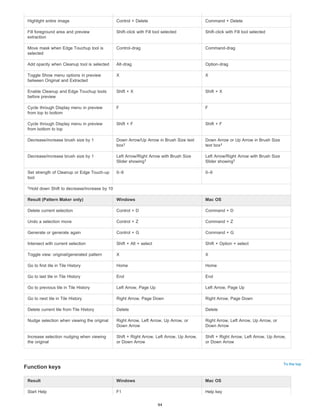
Default keyboard shortcuts....................................................................................................................................................71 
Grid and guides.....................................................................................................................................................................96 
Run Photoshop CS5 in 32-bit mode (64-bit Mac OS only)....................................................................................................98 
Image and color basics................................................................................................................................99 
Image essentials..................................................................................................................................................................100 
Image size and resolution....................................................................................................................................................102 
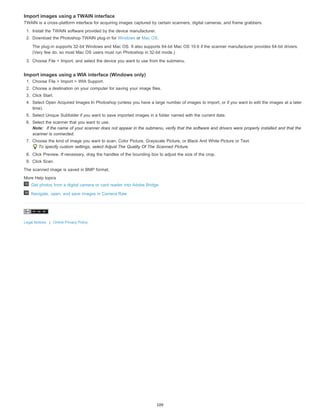
Acquiring images from cameras and scanners....................................................................................................................108 
Creating, opening, and importing images............................................................................................................................110 
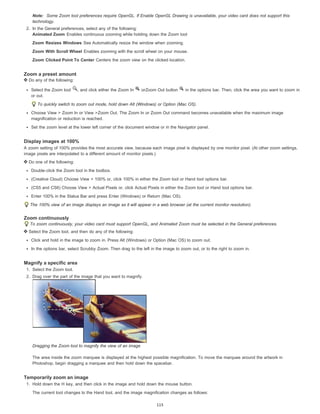
Viewing images....................................................................................................................................................................113 
Image information................................................................................................................................................................117 
Add swatches from HTML CSS and SVG | Creative Cloud.................................................................................................120 
Choosing colors in the Color and Swatches panels............................................................................................................121 
Viewing multiple images......................................................................................................................................................123 
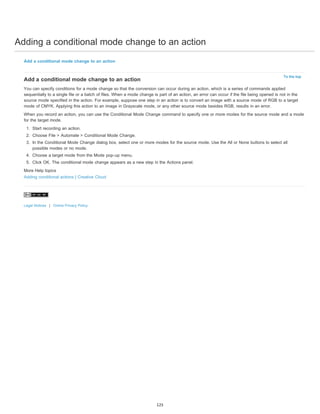
Adding a conditional mode change to an action..................................................................................................................125 
Convert an image to Bitmap mode......................................................................................................................................126 
Customizing indexed color tables........................................................................................................................................127 
About color...........................................................................................................................................................................128 
Choosing colors...................................................................................................................................................................131 
High dynamic range images................................................................................................................................................136
Blending modes...................................................................................................................................................................142 
Color modes........................................................................................................................................................................145 
Converting between color modes........................................................................................................................................147 
Customizing color pickers and swatches.............................................................................................................................151 
Understanding color management.......................................................................................................................................153 
Layers........................................................................................................................................................155 
Layer basics.........................................................................................................................................................................156 
Managing layers..................................................................................................................................................................160 
Selecting, grouping, and linking layers................................................................................................................................163 
Moving, stacking, and locking layers...................................................................................................................................165 
Nondestructive editing.........................................................................................................................................................167 
Copy CSS from layers | Creative Cloud..............................................................................................................................168 
Load selections from a layer or layer mask's boundaries....................................................................................................169 
Editing layer masks..............................................................................................................................................................170 
Masking layers with vector masks.......................................................................................................................................171 
Combining multiple images into a group portrait.................................................................................................................173 
Revealing layers with clipping masks..................................................................................................................................174 
Masking layers.....................................................................................................................................................................176 
Knockout to reveal content from other layers......................................................................................................................180 
Combine images with Auto-Blend Layers............................................................................................................................182 
Aligning layers.....................................................................................................................................................................183 
Create and manage layers and groups...............................................................................................................................185 
Applying a Smart Filter........................................................................................................................................................187 
Create Smart Objects..........................................................................................................................................................190 
Layer opacity and blending..................................................................................................................................................193 
Blending modes...................................................................................................................................................................196 
Layer comps........................................................................................................................................................................199 
Layer effects and styles.......................................................................................................................................................201 
Selecting....................................................................................................................................................208 
Making selections................................................................................................................................................................209 
Adjusting pixel selections.....................................................................................................................................................210 
Moving, copying, and deleting selected pixels.....................................................................................................................215 
Saving selections and alpha channel masks.......................................................................................................................219 
Selecting a color range in an image....................................................................................................................................222 
Making quick selections.......................................................................................................................................................224 
Selecting with the lasso tools...............................................................................................................................................226 
Selecting with the marquee tools.........................................................................................................................................229 
Duplicate split and merge channels.....................................................................................................................................231 
Creating a temporary quick mask........................................................................................................................................233 
Channel basics....................................................................................................................................................................236 
Channel calculations............................................................................................................................................................239 
Extract an object from its background.................................................................................................................................241 
Image adjustments....................................................................................................................................243 
Understanding color adjustments........................................................................................................................................244 
Viewing histograms and pixel values...................................................................................................................................249 
High dynamic range images................................................................................................................................................254 
Convert a color image to black and white............................................................................................................................260 
Adjusting image color and tone in CS6................................................................................................................................261 
Adjust HDR exposure and toning........................................................................................................................................263
Adjust color and tone with Levels and Curves eyedroppers................................................................................................264 
Curves adjustment...............................................................................................................................................................266 
Adjust shadow and highlight detail......................................................................................................................................270 
Adjusting hue and saturation...............................................................................................................................................272 
Adjusting image sharpness and blur....................................................................................................................................275 
Levels adjustment................................................................................................................................................................280 
Quickly adjust black and white points..................................................................................................................................283 
Applying Color Balance adjustment.....................................................................................................................................284 
Apply a Brightness-Contrast adjustment.............................................................................................................................286 
Dodge or burn image areas.................................................................................................................................................287 
Adjustment and fill layers.....................................................................................................................................................288 
Applying special color effects to images..............................................................................................................................291 
Making quick tonal adjustments...........................................................................................................................................293 
Matching, replacing, and mixing colors................................................................................................................................296 
Targeting images for press..................................................................................................................................................301 
Camera Raw..............................................................................................................................................303 
Introduction to Camera Raw................................................................................................................................................304 
Navigate, open, and save images in Camera Raw..............................................................................................................308 
Process versions in Camera Raw........................................................................................................................................311 
Make color and tonal adjustments in Camera Raw.............................................................................................................312 
Make local adjustments in Camera Raw.............................................................................................................................317 
Rotate, crop, and retouch images in Camera Raw..............................................................................................................321 
Correct lens distortions in Camera Raw..............................................................................................................................323 
Sharpening and noise reduction in Camera Raw................................................................................................................326 
Adjust color rendering for your camera in Camera Raw......................................................................................................328 
Manage Camera Raw settings............................................................................................................................................330 
Vignette and grain effects in Camera Raw..........................................................................................................................334 
Repair and restoration...............................................................................................................................336 
Content aware patch and move | CS6.................................................................................................................................337 
Retouching and repairing images........................................................................................................................................339 
Correcting image distortion and noise.................................................................................................................................345 
Reshaping and transforming......................................................................................................................348 
þÿ C r o p a n d s t r a i g h t e n p h o t o s 'X C S 6..................................................................................................349 
Transforming objects...........................................................................................................................................................352 
Adjusting crop, rotation, and canvas....................................................................................................................................359 
Create panoramic images with Photomerge........................................................................................................................364 
Content-aware scaling.........................................................................................................................................................367 
Liquify filter...........................................................................................................................................................................369 
Free transformations of images shapes and paths..............................................................................................................374 
Vanishing Point....................................................................................................................................................................376 
Warp images shapes and paths..........................................................................................................................................387 
Drawing and painting.................................................................................................................................394 
About drawing......................................................................................................................................................................395 
Drawing shapes...................................................................................................................................................................397 
Painting tools.......................................................................................................................................................................401 
Brush presets.......................................................................................................................................................................403 
Creating and modifying brushes..........................................................................................................................................405 
Blending modes...................................................................................................................................................................411 
Creating textured brushes...................................................................................................................................................414
Adding dynamic elements to brushes..................................................................................................................................416 
Drawing or painting with a graphics tablet...........................................................................................................................419 
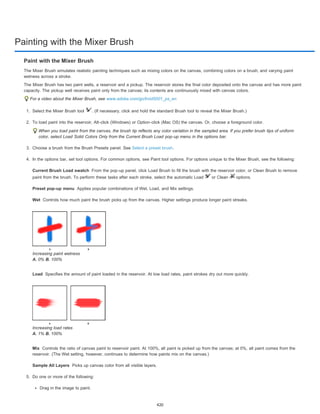
Painting with the Mixer Brush..............................................................................................................................................420 
Painting with a pattern.........................................................................................................................................................422 
Painting stylized strokes with the Art History Brush.............................................................................................................423 
Erasing parts of an image....................................................................................................................................................424 
Managing pattern libraries and presets...............................................................................................................................426 
Creating patterns.................................................................................................................................................................427 
Draw a path that snaps to defined edges............................................................................................................................428 
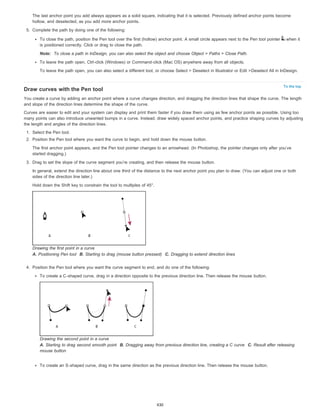
Drawing with the Pen tools..................................................................................................................................................429 
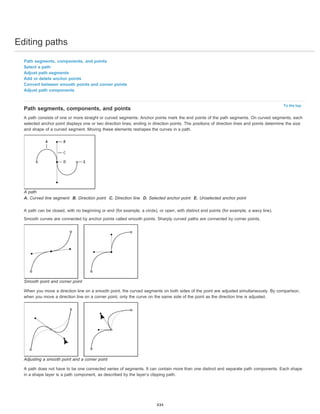
Editing paths........................................................................................................................................................................434 
Adding color to paths...........................................................................................................................................................441 
Converting between paths and selection borders................................................................................................................443 
Filling and stroking selections, layers, and paths................................................................................................................445 
Generate a pattern using the Pattern Maker.......................................................................................................................448 
Gradients.............................................................................................................................................................................450 
Managing paths...................................................................................................................................................................454 
Text............................................................................................................................................................456 
Creating type.......................................................................................................................................................................457 
Editing text...........................................................................................................................................................................461 
Creating type effects............................................................................................................................................................465 
Formatting Characters.........................................................................................................................................................469 
Line and character spacing..................................................................................................................................................474 
Formatting paragraphs........................................................................................................................................................477 
Arabic and Hebrew type (CS6)............................................................................................................................................482 
Fonts....................................................................................................................................................................................485 
Asian type............................................................................................................................................................................488 
Video and animation..................................................................................................................................493 
New video features in CS6..................................................................................................................................................494 
Video and animation overview (CS5)..................................................................................................................................497 
Creating frame animations...................................................................................................................................................502 
Creating timeline animations (Photoshop Extended)...........................................................................................................508 
Creating images for video....................................................................................................................................................513 
Saving and exporting video and animations (CS5)..............................................................................................................517 
Editing video and animation layers (Photoshop CS5 Extended).........................................................................................523 
Importing video files and image sequences (Photoshop Extended)....................................................................................527 
Painting frames in video layers (Photoshop Extended).......................................................................................................530 
Previewing video and animations........................................................................................................................................532 
Filters and effects......................................................................................................................................535 
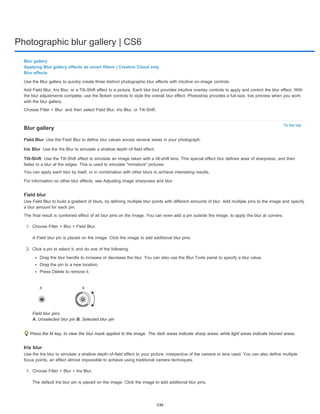
Photographic blur gallery | CS6...........................................................................................................................................536 
Adaptive wide angle filter | CS6...........................................................................................................................................539 
þÿ A d d L i g h t i n g E f f e c t s 'X C S 6....................................................................................................................541 
Filter basics..........................................................................................................................................................................544 
Filter effects reference.........................................................................................................................................................548 
Smudge image areas...........................................................................................................................................................554 
Oil Paint filter | CS6.............................................................................................................................................................555 
Add Lighting Effects (CS5)..................................................................................................................................................556 
Applying specific filters........................................................................................................................................................559 
Layer effects and styles.......................................................................................................................................................562
Saving and exporting.................................................................................................................................569 
Saving images.....................................................................................................................................................................570 
File formats..........................................................................................................................................................................573 
Supported file formats in Photoshop CS6............................................................................................................................579 
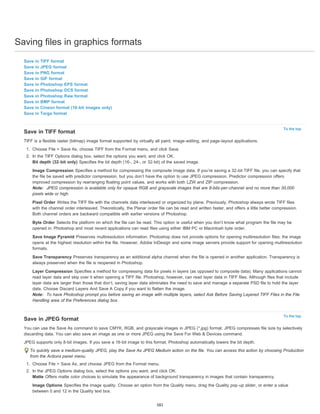
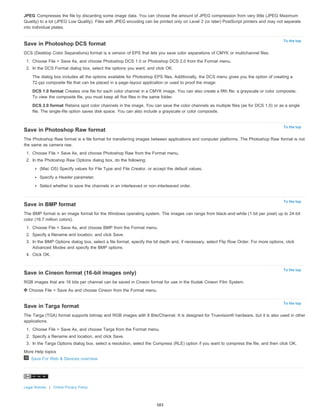
Saving files in graphics formats...........................................................................................................................................581 
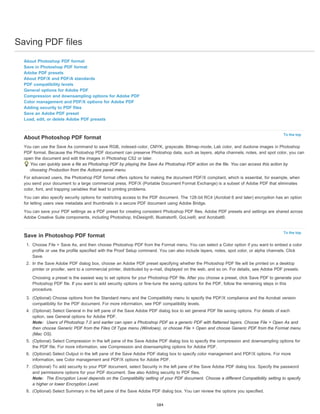
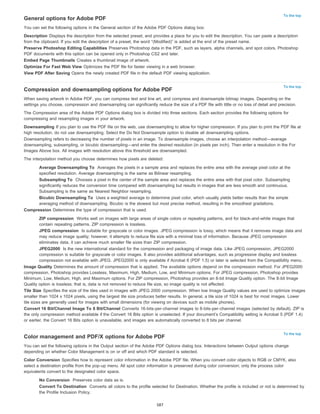
Saving PDF files..................................................................................................................................................................584 
Creating web photo galleries...............................................................................................................................................590 
Digimarc copyright protection..............................................................................................................................................595 
Printing.......................................................................................................................................................597 
Printing from Photoshop CS6..............................................................................................................................................598 
Printing from Photoshop CS5..............................................................................................................................................601 
Printing with color management in Photoshop CS6............................................................................................................604 
þÿ P r i n t i n g w i t h c o l o r m a n a g e m e n t 'X C S 5.......................................................................................606 
Contact Sheets and PDF Presentations in CS6..................................................................................................................609 
Duotones.............................................................................................................................................................................610 
Picture packages and contact sheets..................................................................................................................................613 
Printing images to a commercial printing press...................................................................................................................617 
Printing spot colors..............................................................................................................................................................621 
Automation.................................................................................................................................................624 
About actions and the Actions panel...................................................................................................................................625 
Creating actions...................................................................................................................................................................627 
Playing and managing actions.............................................................................................................................................630 
Processing a batch of files...................................................................................................................................................633 
Scripting...............................................................................................................................................................................637 
Creating data-driven graphics..............................................................................................................................................638 
Adding conditional actions | Creative Cloud........................................................................................................................642 
Recording tools in actions | CS6..........................................................................................................................................643 
Adding a conditional mode change to an action..................................................................................................................644 
Web graphics.............................................................................................................................................645 
Creating web photo galleries...............................................................................................................................................646 
Working with web graphics..................................................................................................................................................651 
Slicing web pages................................................................................................................................................................653 
Modifying slice layout...........................................................................................................................................................656 
HTML options for slices.......................................................................................................................................................659 
Optimizing images...............................................................................................................................................................662 
Copy CSS from layers | Creative Cloud..............................................................................................................................667 
Output settings for web graphics.........................................................................................................................................668 
Web graphics optimization options......................................................................................................................................670 
3D and technical imaging..........................................................................................................................679 
3D workflow in Photoshop Extended CS6...........................................................................................................................680 
Essential 3D concepts and tools (Photoshop CS5 Extended).............................................................................................683 
3D panel settings (Photoshop CS5 Extended)....................................................................................................................687 
3D rendering and saving (Photoshop CS5 Extended).........................................................................................................697 
Adjust HDR exposure and toning........................................................................................................................................701 
Creating 3D objects and animations (Photoshop CS5 Extended).......................................................................................702 
3D painting (Photoshop Extended)......................................................................................................................................707 
3D texture editing (Photoshop Extended)............................................................................................................................709 
Combining and converting 3D objects (Photoshop Extended)............................................................................................712 
Counting objects in an image (Photoshop Extended)..........................................................................................................714
DICOM files (Photoshop Extended).....................................................................................................................................716 
Image Stacks (Photoshop Extended)..................................................................................................................................719 
Measurement (Photoshop Extended)..................................................................................................................................722 
Photoshop and MATLAB (Photoshop Extended)................................................................................................................727 
Color Management....................................................................................................................................729 
Understanding color management.......................................................................................................................................730 
Keeping colors consistent....................................................................................................................................................732 
Color settings.......................................................................................................................................................................735 
Working with color profiles...................................................................................................................................................739 
Color-managing documents for online viewing....................................................................................................................743 
Color-managing documents when printing..........................................................................................................................744 
Color-managing imported images........................................................................................................................................746 
Proofing colors.....................................................................................................................................................................748
What's new 
To learn more, view these recommended resources online. 
Using Content-Aware Move and Extend 
Lynda.com (May. 7, 2012) 
video-tutorial 
Recompose images with these simple steps. 
Vector Shapes 
Infinite Skills (Oct. 7, 2012) 
video-tutorial 
Drawing shapes in CS6 
Wide-angle lens correction 
Kelby (Oct. 7, 2012) 
video-tutorial 
Quickly compensate for lens quirks, drawing from a detailed database. 
Using the new three-part Blur Gallery 
Lynda.com (May. 7, 2012) 
video-tutorial 
Focus the eye with precisely placed blurs. 
New Crop tool 
Lynda.com (Oct. 7, 2012) 
video-tutorial 
Interactive previews help you precisely trim images down to size. 
Auto color corrections 
Kelby (May. 7, 2012) 
video-tutorial 
One-click corrections to common image issues. 
Background-save and Auto-recover 
Kelby (May. 7, 2012) 
video-tutorial 
Protect precious image data. 
Blur gallery overview 
Kelby (May. 7, 2012) 
video-tutorial 
Quick, creative control in a dedicated blur workspace. 
Camera Raw 7 plug-in 
Kelby (May. 7, 2012) 
video-tutorial 
Tap into the latest noise, color, and dynamic range controls. 
New 3D reflections and dragable shadows 
Lynda.com (May. 7, 2012) 
video-tutorial 
Add realism with ease. 
New shape, type, and design tools 
Lynda.com (May. 7, 2012) 
1
video-tutorial 
Genuine vector shapes, type styles, and more. 
Preset migration and sharing 
Kelby (May. 7, 2012) 
video-tutorial 
Apply common settings across workgroups. 
Streamlined 3d controls 
Lynda.com (May. 7, 2012) 
video-tutorial 
Expand creative possibilities into another dimension. 
Using Content-Aware Patch 
Lynda.com (May. 7, 2012) 
video-tutorial 
Seamlessly repair imperfections. 
Video workflow 
Kelby (May. 7, 2012) 
video-tutorial 
Intuitive editing for video DSLRs and other sources. 
2
What's new in CS6 
To the top 
Adobe Creative Cloud only 
New features for all Photoshop CS6 users 
Retouching and transforming 
Filters 
Video 
Color and tonal adjustments 
3D (Photoshop Extended only) 
Automation 
Painting and patterns 
Drawing 
Workspace and workflow 
Type 
Compatibility with Adobe Touch and Photoshop companion apps 
Camera Raw 7 
To highlight new features throughout Photoshop menus, choose Window > Workspace > New in CS6. 
Adobe Creative Cloud only 
If you're a subscriber to Adobe Creative Cloud, the following additional features are available. For new CS6 features that are not Adobe Creative 
Cloud only, scroll down the page. 
Click the following link to view a video on the new Creative Cloud features by Adobe evangelist, Julieanne Kost. 
Liquify filter enhancements 
In the Creative Cloud update for Photoshop, the Liquify filter is significantly faster than previous versions. The Liquify filter now supports Smart 
Objects, including Smart Object video layers, and is applied as a smart filter. 
Another enhancement to the Liquify filter is an added behavior for the Reconstruct tool. If you hold down the Alt (Windows) or Option (Mac OS) 
key while dragging the tool across a warp, the Reconstruct tool smooths a warp rather than scaling back or removing it. 
For more information, see Liquify filter and view a video on Smart Object Support for Blur Gallery and Liquify. 
Apply Blur gallery effects as smart filters 
The photographic blur effects in the Blur gallery now support Smart Objects and can be applied non-destructively as smart filters. This feature also 
supports Smart Object video layers. 
For more information, see Photographic blur gallery | CS6, About Smart Filters, and view a video on Smart Object Support for Blur Gallery and 
Liquify. 
Copy CSS properties from shape or text layers 
Copy CSS generates Cascading Style Sheet (CSS) properties from shape or text layers. It captures values for size, position, fill color (including 
gradients), stroke color, and drop shadow. For text layers, Copy CSS also captures values for font family, font size, font weight, line height, 
underline, strikethrough, superscript, subscript, and text alignment. The CSS is copied to the clipboard and can be pasted into a style sheet. 
For more information, see Copy CSS from layers | Creative Cloud Only and view a video on New CSS Support in Photoshop. 
Conditional actions 
Conditional actions let you build actions that choose what to do based on one of several different conditions. First, you choose a condition and 
then, optionally specify an action that plays if the document meets the condition. Then, you optionally specify an action that plays if the document 
does not meet the condition. 
For more information, see Adding conditional actions | Creative Cloud, About actions and the Actions panel, and Creating actions. 
High dpi display support 
Photoshop adds support for high dpi displays such as Retina Displays. Among the enhancements for working with higher resolution displays, 
documents can be quickly viewed at 200%. To view a document at 200%, do any of the following: 
Choose View > 200%. 
3
To the top 
Ctrl-double click (Windows) or Cmd-double click (Mac OS) the Zoom tool icon. 
Shift-Ctrl-double click (Windows) or Shift-Cmd-double click (Mac OS) the Zoom tool icon to view all open documents at 200%. 
Changes in view options 
In the Zoom tool options bar and the Hand tool options bar, the button for viewing an image at its actual size has been renamed as 100%. 
Additionally, both tool options bars no longer have a Print Size button. Additionally, the Actual Pixels command in the View menu has been 
changed to 100%. 
Crop tool changes and enhancements 
Updates to the Crop tool include numerous bug fixes and enhancements, including: 
Front Image and new presets in the Aspect Ratio menu. 
Clicking the double-arrow icon changes the crop orientation by swapping the Width and Height values. This replaces the Rotate Crop Box 
button. 
Choosing W x H x Resolution from the Aspect Ratio menu displays a Resolution field in the options bar and auto-fills the Width and 
Height values. 
Clicking the Clear button clears the values in the Width and Height fields in the option bar. If displayed, the value in the Resolution field is 
also cleared. 
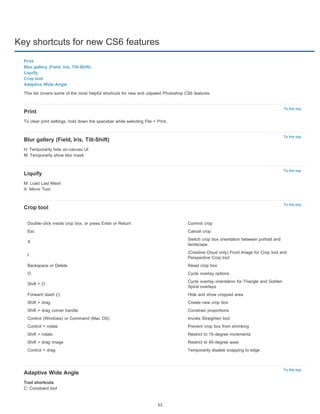
The keyboard shortcut for Front Image has changed from F to I for both the Crop tool and the Perspective Crop tool. 
CS6 Creative Cloud Crop tool options bar 
A. Aspect Ratio menu B. Swap Width and Height values C. Overlay Options 
For more information, see Using the new crop tool and Crop and straighten photos | CS6. 
Default type styles 
The character and paragraph styles of a document can be saved as the default type styles. These default styles are automatically loaded in the 
Character Style and Paragraph Style panels when a new Photoshop document is created. The default styles can also be loaded into any 
existing document using the Load Type Styles command. 
For more information see Specifying default type styles | Creative Cloud only, Character styles | CS6, and Paragraph styles | CS6. You can also 
watch a video about Type Styles in Photoshop by Adobe evangelist Julieanne Kost. 
Face detection enhancements in Color Range 
The Color Range selections command now saves Skin Tones selections as a preset. It can also save the setting for the Detect Faces option 
when Skin Tones or Sampled Colors are selected. 
For more information, see Saving Skin Tones settings as a preset | Creative Cloud only, Selecting a color range in an image, or watch the video, 
Selecting Skin Tones in Photoshop CS6, with Photoshop expert Matt Kloskowski. 
Read swatches from HTML, CSS, and SVG files 
You can add colors specified in an HTML, CSS, or SVG document to the Swatches panel. If a color value is repeated in a document, only one 
instance of the color is added not duplicates. This feature recognizes the following HTML/CSS color syntax: #112233, #123, rgb(1,2,3), 
rgba(1,2,3,4), hsb(1,2,3), and hsba(1,2,3,4). 
For more information, see Add swatches from HTML CSS and SVG | Creative Cloud and Customizing color pickers and swatches. 
3D enhancements and changes 
There are numerous new 3D features and enhancements in the Creative Cloud version of Photoshop CS6. For information about the updates, see 
3D workflow in Photoshop Extended CS6 and view a video on New Possibilities in 3D. 
Support for big JPEGs 
Photoshop can now open and save JPEG documents up to 65,535 pixels in width or height. 
Resizable Color panel 
The Color panel is now resizable. 
New features for all Photoshop CS6 users 
4
To the top 
To the top 
To the top 
The following new features are available to all Photoshop CS6 users and are not Adobe Creative Cloud only. 
Retouching and transforming 
Content-Aware Move tool 
The Content-Aware Move tool lets you quickly recompose images without complex layering or slow, precise selections. Extend mode convincingly 
expands or contracts objects such as hair, trees, or buildings. Move mode lets you place objects in different locations (most effectively when the 
background remains similar). In the toolbar, hold down the Spot Healing Brush and select the Content-Aware Move tool . 
For more information, see Content-Aware Move. 
Content-Aware Patch tool 
The updated Patch tool includes a Content-Aware option that seamlessly replaces unwanted image elements by synthesizing nearby content. The 
natural-looking results are similar to Content-Aware Fill, but the Patch tool lets you select the area from which the fill is drawn. In the toolbar, hold 
down the Spot Healing Brush and select the Patch tool . 
For more information, see Content-Aware Patch. 
Redesigned Crop tools 
The redesigned Crop tool provides an interactive preview so you can better visualize results. A streamlined set of toolbar options includes a helpful 
Straighten tool, and aspect ratio controls you can adjust while a crop is active in the image window. (To maintain the current aspect ratio or 
resolution, right-click the image to access additional options.) 
To crop an image, click the Crop tool in the toolbar. Then either adjust default crop borders in the image window, or drag in the window 
to start with specific borders. 
To correct image perspective, hold down the Crop tool and select the Perspective Crop tool 
Learn More: Crop and straighten photos or watch Crop tool video tutorial. 
Filters 
Correcting wide-angle lenses 
Choose Filter > Adaptive Wide Angle to quickly straighten lines that appear curved in panoramas or photos shot with fisheye and wide-angle 
lenses. The filter uses the physical characteristics of individual lenses to automatically correct images. 
For more information, see Adaptive Wide-Angle Filter or watch Lens Aware Adjustments video tutorial by RC Conception. 
Photographic blur gallery 
Choose Filter > Field Blur, Iris Blur, or Tilt-Shift to quickly create three distinct photographic blur effects with intuitive on-image controls. Use the 
Blur Effects controls to add Bokeh effects to the images. 
For more information, see Photographic blur gallery. 
Lighting Effects gallery 
Get better performance and results with the new, 64-bit Lighting Effects gallery. A dedicated workspace provides on-canvas controls and previews 
that make it easier to visualize your lighting enhancements. 
For more information, see Apply lighting effects. 
Oil Paint filter 
Choose Filter > Oil Paint to easily create the look of a classic painting. 
For more information, see Oil Paint Filter. 
Video 
The redesigned, clip-based Timeline panel includes transitions and effects that give finished videos professional polish. Easily change clip duration 
and speed, and apply motion effects to text, still images, and Smart Objects. 
Video Groups combine multiple video clips and content such as text, images, and shapes on a single Timeline track. Separate audio tracks allow 
for easy editing and adjusting. 
5
The redesigned video engine also supports a wider range of import formats. When you're ready to export final video, Photoshop provides helpful 
presets and options for the DPX, H.264, and QuickTime formats. 
Note: In Windows, you install QuickTime separately. 
For detailed instructions, see New video features in Photoshop CS6. For a quick video overview, watch Intuitive Video Features by RC 
Conception. 
To the top 
To the top 
To the top 
To the top 
Color and tonal adjustments 
Skin tone selection and face detection 
Choose Select > Color Range. Then, from the Select pop-up menu in the Color Range dialog box, choose Skin Tones to isolate those tones. For 
more accurate skin tone selection, select Detect Faces and then, adjust Fuzziness to specify how low or high the range of colors will be in the 
selection. 
Watch Color range changes in CS6 for a video overview. For more information, see Select a Color Range. 
Improved auto corrections 
Perfectly enhance your images in a single step with improved Auto options for the Levels, Curves, and Brightness/Contrast adjustments. 
To customize Auto corrections, Alt-click (Windows) or Option-click (Mac OS) the Auto button. For details about each setting, see Set Auto 
adjustment options. For a video overview, see Auto Corrections. 
3D (Photoshop Extended only) 
Intuitively create 3D artwork with a simplified interface that offers on-canvas scene editing. Easily drag shadows into place, animate 3D objects, 
give 3D objects the look of sketches or cartoons, and more. 
For detailed instructions, see 3D workflow in Photoshop CS6. 
Automation 
Photoshop CS6 lets you record tools such as the brush tool in your action. To enable this feature, choose Allow Tool Recording from the Actions 
panel menu. 
For more information, see Recording tools in actions. 
Painting and patterns 
Erodible brush tips 
Erodible pencils and pastels wear down naturally with use. Customize Brush Tip Shape options: Softness controls the rate of 
wear, Shape provides settings from flat to round, and Sharpen Tip returns to original crispness. As you paint, watch the amount of wear with the 
Live Brush Tip Preview to the upper left of the image. 
Choose Window > Brush Presets to quickly access new erodible tips, or Window > Brush to customize them. For more information, 
see Erodible Tip options. 
Airbrush tips 
Airbrush tips replicate spray cans with a 3D conical spray. Customize Brush Tip Shape options like Granularity, Spatter, Hardness, 
and Distortion controls. With a stylus, alter the spread of sprayed strokes by changing pen pressure. 
Choose Window > Brush Presets to quickly access new airbrush tips, or Window > Brush to customize them. For more information 
see, Airbrush Tip options. 
Brush pose 
Specify the stylus tilt, rotation, and pressure. Choose Window > Brush, and select Brush Pose to paint with a specified tilt, rotation, and 
pressure. Use a stylus to change the stroke relative to the default pose, or select Override options to maintain a static pose. For more information, 
see Brush pose options. 
Brush projection 
Use Brush Projection to apply stylus tilt and rotation to tip shapes. Choose Window > Brush, and select Shape Dynamics from the list at left. At 
the bottom of the options at right, select Brush Projection. As you paint with a stylus, changes to tilt and rotation alter the tip shape. See Brush 
shape dynamics options. 
6
Brush color dynamics 
Color Dynamics remain consistent for each stroke by default. Color Dynamics settings automatically vary color as you paint. In previous versions 
of Photoshop, dynamics settings changed color for each distinct tip stamp in a stroke. In Photoshop CS6, however, dynamic changes occur once 
at the beginning of each stroke. This feature lets you vary color between strokes, rather than within each individual stroke. 
To revert to the behavior of previous versions, choose Window > Brush, and select Color Dynamics from the list at left. At the top of the options 
at right, select Apply Per Tip. See Color Dynamics brush options. 
Scripted patterns 
Select Edit > Fill, choose Pattern from the Use menu, and then select Scripted Patterns to choose from several geometric options. Build 
sophisticated designs by combining these scripts with Custom Pattern presets and blending modes. 
To the top 
Vector layers 
Intuitive path editing 
To the top 
Drawing 
The Line and Shape tools now create fully vector-based objects. Apply strokes and fills using the options bar. Stroke objects with 
dashed lines and other designs. Fill objects with preset or user-defined gradients, colors, and patterns. 
To later revise stroke and fill settings, simply select the object layer, and then select the Path Selection or Direct Selection tool. 
Learn More: Vector based shape layers video. 
By default, dragging with the Direct Selection tool adjusts multiple related segments, letting you quickly transform path 
shapes. To edit only segments between selected anchor points, reflecting previous Photoshop versions, select Constrain Path Dragging in the 
options bar. 
To reduce anti-aliased edges, ensuring that vector objects look as sharp as possible, select Align Edges in the options bar. 
Workspace and workflow 
Numerous enhancements help you complete common tasks more efficiently. 
Mercury Graphics Engine 
Experience blazing-fast interactions with processor-intensive commands such as Liquify, Warp, Puppet Warp, and Crop. 
Fresh new look 
Work with a fresh, elegant interface with design enhancements like the following: 
Select from four different brightness levels: Choose Edit > Preferences (Windows) or Photoshop > Preferences (Mac OS). In 
the Interface section, select a Color Theme swatch. 
Note: To quickly decrease interface brightness, press Shift + F1. To increase brightness, press Shift + F2. (Mac laptop users must also 
press the FN key.) 
On-image displays keep you informed as you use your favorite tools, showing dimensions for selections, angles for transformations, and 
more. To adjust the placement of these values, in the Interface preferences, choose an option from the Show Transformation 
Values menu. 
A new Mini Bridge gallery offers easier access to images and documents. Choose Window > Extensions > Mini Bridge. 
To maximize screen space, functions formerly in the application bar have moved elsewhere. To switch between Standard and Full Screen 
display modes, click the button at the bottom of the toolbar. 
Layers enhancements 
At the top of the Layers panel, new filtering options help you find key layers in complex documents quickly. Display subsets of layers based on 
name, kind, effect, mode, attribute, or color label. You can use the Properties panel to quickly modify the layer components selected in the Layers 
panel. 
See a short video on Top 10 time saving enhancements to Layers in Photoshop CS6. 
Migrate and share Presets 
Choose Edit > Presets > Migrate to easily move presets, workspaces, preferences, and settings from Photoshop CS3 and later to Photoshop 
CS6. Choose Edit > Presets > Export/Import Presets to share a custom setup across all computers in a workgroup. 
For more information, see Migrating presets from earlier versions of Photoshop (CS6). 
7
Background save 
Background saving lets you keep working after you choose Save commands, instead of waiting for saving to complete. 
Note: If you regularly save large files and want the most consistent performance from Photoshop, disable Save In Background in the File 
Handling preferences. 
Auto recover 
Auto-recover stores crash-recovery information at specified intervals. The default is ten minutes. In case the application crashes, your work is 
recovered the next time you start the application. 
To customize the time intervals between auto-recovery storage, choose Edit > Preferences > File Handling (Windows) 
or Photoshop > Preferences > File Handling (Mac OS). Select Save In Background, and then select an interval from the Automatically Save 
Recovery Information menu. 
Twitter™ and Facebook posts are not covered under the terms of Creative Commons. 
Legal Notices | Online Privacy Policy 
To the top 
To the top 
To the top 
Type 
Paragraph and character styles 
In the Window > Paragraph Styles panel, create, store, and reapply the characteristics of groups of highlighted sentences. In 
the Window > Character Styles panel, specify the look of selected letters, words, or phrases. 
For more information, see Paragraph Styles and Character Styles. 
For a video overview, see Paragraph and Character Styles in Photoshop CS6 by Julieanne Kost. 
Type menu 
A new Type menu has been added, and most of the text and type related functionality is available from the Type menu. For example, you can 
access the Character and Paragraph panels from the Type > Panels menu. 
Compatibility with Adobe Touch and Photoshop companion apps 
Extend your creativity beyond Photoshop CS6 with Adobe Touch and Photoshop companion apps (sold separately). Design, edit, and elegantly 
present your work using six Adobe Touch apps designed for your tablet, including Photoshop Touch, Adobe Kuler, and Adobe Debut. Transfer files 
through Adobe Creative Cloud for further refinement in Photoshop CS6—or to view, access, and share from almost anywhere. Or, interact directly 
with Photoshop CS6 wirelessly with Photoshop companion apps from Adobe and the developer community. 
Camera Raw 7 
Simplified Basic controls in the Develop tab improve highlight and shadow rendering. New local corrections are available for white balance, 
highlights, shadows, noise reduction, and moiré. 
The new Basic sliders and new local adjustments options appear when you process new images or convert previously processed images to 
Process Version 2012 (PV2012). To convert an image, click the exclamation-point icon in the lower-right corner of the image preview area. 
For more information, see Make color and tonal adjustments in Camera Raw and Make local adjustments in Camera Raw. 
For a video overview, see this tutorial from Iceflow Studios. 
8
Productivity enhancements (JDI's) in CS6 
Photoshop CS6 contains over 60 productivity enhancements, also known as Just Do It (JDI) features. These small improvements address longtime 
customer requests and collectively can greatly increase your productivity. 
For information on major Photoshop CS6 new features, see What's New in CS6. 
To the top 
To the top 
To the top 
To the top 
To the top 
To the top 
To the top 
Automation 
Contact Sheet II restored as an Automate option 
PDF Presentation restored as an Automate option 
Layer Comps to PDF restored as a Scripts option 
Brushes 
Record brush strokes in actions with Allow Tool Recording option in Actions panel menu. (Because brush strokes are often unique to each 
project, be sure to disable this option after recording actions that require it.) 
Brightness/contrast slider for textures when painting 
Brush tip cursor reflects brush pose and jitter for round and captured tips 
Brush projection for static tips 
Color dynamics remain consistent for each stroke by default 
Note: For details about brush pose, projection, and color dynamics options, see Painting and patterns. 
The heads-up display (HUD) for changing brush size and hardness can also change opacity: Press Control+Alt (Windows) or 
Command+Option (Mac OS), and drag up or down. (In the General preferences, you must deselect Vary Round Brush Hardness Based on 
HUD Vertical Movement.) 
Increased maximum brush size to 5000 pixels 
Channels 
Enabled Split Channels for documents with single layer (so you can split simple transparency) 
Color Picker 
Allows pasting into hexadecimal field with # (for example, #aabbcc) or 0x (for example, 0xAABBCC) 
Allows shortcut hexadecimal values (for example, #123) 
Eyedropper 
Added option to ignore adjustment layers to Sample menu in options bar 
Added option to sample from current layer and below to Sample menu 
Sample size options now appear in context menu for various Eyedropper tools (black point and white point in Levels, and so forth) 
File formats 
Reads more bit depths in TIFF files 
Adds options for addressing OpenEXR transparency when opening and saving 
Reads BIGTIFF format (TIFF files over 4 Gig) 
Reads common stereo image pair formats (JPS, MPO, PNS) 
9
To the top 
To the top 
To the top 
To the top 
To the top 
To the top 
To the top 
GPU 
Increased stability by prequalifying detected GPUs before use 
Image resizing 
Bicubic Automatic option auto-selects the best resample method based on the type of resize 
Importing 
(Mac OS) ImageKit scanner and camera support to import images from more devices 
Layers 
Added Interpolation menu to options bar for Free Transform command 
Added dither option to Gradient Overlay and Gradient Stroke layer styles 
Added 00 and Shift + 00 shortcuts to set layer and fill opacity to 0% 
Simultaneously change locking, blend mode, or color label for multiple selected layers 
Ctrl/Command + J duplicates selected layer groups (in addition to layers) 
Layer tool tips include layer name 
New Rasterize Layer Style command merges layer effects into layer 
Reordered layer styles to reflect the order in which they are applied (placing drop shadow, for example, below the other effects) 
Show Blend If/Blending Options badge on layer if Layer Style blending options have been customized 
Alt/Opt + click FX toggle arrows shows or hides all layer effects 
Correct opacity and blend mode displayed for hidden layers 
When renaming layers, pressing Tab goes to next layer; Shift + Tab goes to previous. 
Shape layer names reflect the tool name (for example, "Rectangle 1") 
Liquify 
Added GPU video card acceleration 
Added Basic and Advanced user interface modes 
Improved Mac cursor visibility 
Added option to load last mesh 
Increased maximum Liquify brush size to 15,000 
(English only) Resize Liquify brush with bracket-key [ ] shortcuts, which now match increments elsewhere in Photoshop 
Ctrl (Windows) / Command (Mac OS) switches to magnifying glass 
Alt + right click + drag changes brush size (Windows) 
Ctrl + Alt + click + drag changes brush size (Mac OS) 
Masks 
Enable Invert and Threshold adjustments for masks in 32-bit/channel images 
Plug-ins 
Hold down Shift during startup to disable Optional and 3rd party plug-ins 
Presets 
Added New Document presets for common devices (for example, iPhone, iPad, and so forth) 
Added new Gradient Map presets for traditional print toning and split-toning 
Reorganized tool presets remain after restart 
New HDR Pro presets from RC Concepcion and Scott Kelby 
10
Twitter™ and Facebook posts are not covered under the terms of Creative Commons. 
Legal Notices | Online Privacy Policy 
To the top 
To the top 
To the top 
To the top 
To the top 
To the top 
To the top 
Printing 
Added Edit button for description field in Print dialog 
Allow Print dialog and print preview window to be resized 
Allow customizable preview background color in the Print dialog 
Allow manual repositioning of the printed area on page 
Hide color profiles that are inappropriate for currently selected printer when using Photoshop Manages Color 
Reintroduced Print Selected Area; you can modify selection in Print dialog 
Saving 
Warning message indicates that 16-bit images cannot display their file size in the Save as JPEG dialog 
SDK 
Added ability to access tool name associated with the tool preset name via scripting 
Added the ability to return an array of guides in a document from the scripting SDK 
Selections 
Support for decimal feather values for Marquee tool, Lasso tool, and Mask panel (like the Feather dialog) 
Feather radius recalled in Make Selection from path dialog 
Transform 
Layer thumbnail continues to show Smart Object icon when transforming a layer 
Improved dragging of vector curves 
Can rotate 90 degrees with even x odd pixel dimension to avoid landing on a half-pixel position. (To enable this behavior, Snap Vector Tools 
And Transforms To Pixel Grid must be selected in the General preferences.) 
Added File Handling > Ignore Rotation Metadata preference to disable automatic rotation of images based on file metadata 
Type 
Added Type > Paste Lorem Ipsum command to quickly insert placeholder text 
Added Blend Text Colors Using Gamma setting to blend text layers using a gamma setting distinct from the document color space. To 
access this option, choose Edit > Color Settings, and click More Options at right. The default setting, 1.45, blends text more correctly than 
previous Photoshop versions, better matching other applications. 
Note: When you select Blend Text Colors Using Gamma, text layers from Photoshop CS6 will look different in earlier versions of Photoshop. 
User interface 
New/Open document commands available by context-clicking document tabs (longtime Mac OS feature now on Windows too) 
Added "Don't show again" checkbox to Purge warnings 
Removed the app bar and reduced the draggable title bar over 30% 
11
New video features in CS6 
To the top 
To the top 
Tutorials from the experts 
Intuitive video creation 
Import a wider range of file formats 
Export final video with the Adobe Media Encoder 
Video Groups 
Audio tracks and controls 
Video transitions 
Change video clip duration and speed 
Apply filters to video layers 
Apply motion effects to text, still images, and Smart Objects 
Tutorials from the experts 
To explore the new video features in depth, check out the following tutorials: 
Adobe evangelist Julieanne Kost walks though the complete workflow. 
Photoshop QE engineer Meredith Payne-Stotzner explains slip editing and frame skipping and caching. 
Adobe expert Rafiq Elmansy shows you how to create animations with audio. 
Intuitive video creation 
The redesigned, clip-based Timeline panel reflects video editors like Adobe Premiere, including transitions and effects that give finished videos 
professional polish. 
Import a wider range of file formats 
With a redesigned video engine, you can import a wider range of video, audio, and image sequence files. Easily work with file types such as the 
following: 
3GP, 3G2 
AVI 
DV 
FLV and F4V 
MPEG-1 
MPEG-4 
QuickTime MOV (in Windows, full support requires separate QuickTime installation) 
WAV 
For the complete list, see Supported file formats in Photoshop CS6. 
Export final video with the Adobe Media Encoder 
Choose File > Export > Render Video. From the first pop-up menu, select Adobe Media Encoder to choose from the following Format options: 
DPX (Digital Picture Exchange) format is designed primarily for frame sequences that you plan to incorporate into professional video projects 
using an editor such as Adobe Premiere Pro. 
H.264 (MPEG-4) format is the most versatile, including presets for high-definition and widescreen video, and output optimized for tablet 
devices or web delivery. 
QuickTime (MOV) format is required for export of alpha channels and uncompressed video. The Preset menu provides additional 
compression options. 
Video Groups 
Video Groups combine multiple video clips and other content such as text, images, and shapes on a single track in the Timeline. 
Create a Video Group 
12
Import a video file; it's automatically added as a new Video Group. 
To create an empty group for adding content to, click a filmstrip icon on the left of the Timeline panel, and choose New Video Group from 
the pop-up menu. 
To the top 
Edit a Video Group 
To reposition clips, drag them in the Timeline. 
To change in and out points, drag clip borders in the Timeline. 
To move items from one group to another, drag them up or down in the Timeline or Layers panel. 
To divide a selected clip and edit the resulting parts separately, position the Timeline playhead where you want to split the clip. Then click 
the Split At Playhead button in the upper-left corner of the Timeline panel. 
Audio tracks and controls 
Separate audio tracks in the Timeline allow for easy editing and adjusting. 
Adjust audio in clips 
Right-click audio clips to mute them, adjust volume, or fade in and out. 
Right-click video clips, and click the musical notes to adjust audio they contain. 
Create or delete audio tracks 
To the right of audio track names in the Timeline, click the musical notes , and select either New Audio Track or Delete Track. 
Add, duplicate, delete, or replace audio clips 
To the right of audio track names in the Timeline, click the musical notes . Then select Add Audio to place another clip on the track. 
Select an audio clip in the Timeline, and click the musical notes to the right of the track name. Then select Duplicate, Delete, or Replace 
Audio Clip. 
Video transitions 
Transitions create professional fade and cross-fade effects. Click the transitions icon in the upper left of the Timeline panel. Then choose a 
duration, and drag a transition type to the start or end of clips. (Place the transition between clips to crossfade.) Drag the edges of the transition 
preview in the Timeline to precisely set in and out points. 
Right-click transitions in the Timeline to replace them with another transition type or specify a precise numeric duration. 
Change video clip duration and speed 
Right-click video clips to access Duration and Speed sliders. These controls interact; for example, a Speed of 400% limits the maximum duration to 
one-quarter of the original. 
Apply filters to video layers 
To apply filters across all frames in a video layer, first convert the layer into a Smart Object. Any subsequent filters you apply become Smart 
Filters, which provide total flexibility, letting you readjust filter settings at any time. 
1. Select the video layer in the Timeline or Layers panel. 
2. Choose Layer > Smart Objects > Convert to Smart Object. 
3. Apply filters from the Filter menu. To later readjust settings, view the Layers panel, and double-click the filter in the Smart Filters list for the 
video layer. 
For more information, see Nondestructive editing. 
Apply motion effects to text, still images, and Smart Objects 
Right-click text, still-image, and Smart Object clips to access pan, zoom, and rotate presets, quickly applying sophisticated animation. Drag the 
resulting Transform keyframes in the Timeline to fine-tune the results. 
To create dramatic effects as you pan, scale, and rotate clips over time, convert your clip to a Smart Object and use Transform keyframes with 
the Free Transform tool. 
13
Twitter™ and Facebook posts are not covered under the terms of Creative Commons. 
Legal Notices | Online Privacy Policy 
14
Arabic and Hebrew type (CS6) 
To the top 
To the top 
To the top 
Enable Middle Eastern features 
Text direction 
Digit Types 
Legacy font support 
Default fonts 
Automatic Kashida insertion 
Ligatures (OpenType fonts) 
Hyphenation 
Diacritical marks 
Justification alternates 
For a tutorial on Arabic and Hebrew type features, see this video from Photoshop expert David Mohr. 
Enable Middle Eastern features 
To reveal Middle Eastern type options in the Photoshop interface, do the following: 
1. Choose Edit > Preferences > Type (Windows) or Photoshop > Preferences > Type (Mac OS). 
2. In the Choose Text Engine Options section, select Middle Eastern. 
3. Click OK, and restart Photoshop. 
4. Choose Type > Language Options > Middle Eastern features. 
Text direction 
To create content in Arabic and Hebrew, enable right-to-left (RTL) text direction. While RTL is the default direction of text, many documents also 
include left-to-right (LTR) text. You can seamlessly switch between the two directions. 
Select the paragraph direction from the Paragraph panel. 
Paragraph direction selection (InDesign panel shown) 
Digit Types 
When you are working in Arabic or Hebrew, you can select the type of digits you want to use. You can choose between Arabic, Hindi, and Farsi. 
By default, in Arabic versions of Photoshop, Hindi digits are auto-selected; in Hebrew versions, Arabic digits are selected. However, you can 
manually change digit types if necessary: 
1. Select the digits in the text. 
2. In the Character panel, use the Digits menu to select the appropriate font. 
15
To the top 
To the top 
To the top 
To the top 
To the top 
Digit type selection (InDesign panel shown) 
Legacy font support 
Fonts that have been traditionally used (for example, AXT fonts) can continue to be used in this release of the software. However, it is 
recommended that newer Open Type fonts be used for text-based elements. 
Missing Glyph Protection (Edit > Preferences > Advanced Type) is enabled by default. Text is handled automatically, where glyphs are not 
available in the font you are using. 
Default fonts 
When you install a Middle Eastern or North African version, the default typing font is set to the installation-specific language, by default. For 
example, if you have installed the English/Arabic-enabled version, the default typing font is set to Adobe Arabic. Similarly, if you have installed the 
English/Hebrew-enabled version, the default typing font is set to Adobe Hebrew (or Myriad Hebrew in Photoshop). 
Automatic Kashida insertion 
In Arabic, text is justified by adding Kashidas. Kashidas are added to arabic characters to lengthen them. Whitespace is not modified. Use 
automatic Kashida insertion to justify paragraphs of arabic text. 
Select the paragraph, and at the lower-right of the Paragraph panel, choose an option from the Insert Kashidas pop-up menu: None, Short, 
Medium, Long, or Stylistic. 
Note: Kashidas are inserted only in paragraphs with fully justified margins. 
To apply Kashidas to a group of characters, select the characters in the document, and then choose Type > Language Options > Kashidas. 
Ligatures (OpenType fonts) 
With some OpenType fonts, you can automatically apply ligatures to character pairs in Arabic and Hebrew. Ligatures are typographic replacement 
characters for certain letter pairs. 
1. Select text. 
2. In the Character panel, above the language and anti-aliasing menus, click the Standard or Discretionary Ligatures icon. 
Discretionary ligatures provide more ornate options that some fonts support. 
Hyphenation 
Sentences that have more words that can fit into one line of text automatically wrap into the next line. The type of text justification when wrapping 
occurs sometimes causes unnecessary spaces to appear in the line that are not aesthetically pleasing or linguistically correct. Hyphenation 
enables you to split the word at the end of a line, using a hyphen. This fragmentation causes the sentence to wrap into the next line in a better 
way. 
Mixed text: The Kashida insertion feature affects how hyphenation occurs in mixed text. When enabled, Kashidas are inserted where applicable, 
and non-Arabic text is not hyphenated. When the Kashida feature is disabled, only non-Arabic text is considered for hyphenation. 
Hebrew text: Hyphenation is allowed. To enable hyphenation and customize settings, choose Paragraph panel > Panel menu > Hyphenation 
Settings. 
16
Twitter™ and Facebook posts are not covered under the terms of Creative Commons. 
Legal Notices | Online Privacy Policy 
To the top 
To the top 
Hyphenation options (InDesign panel shown) 
Diacritical marks 
In the Arabic script, a diacritic or a diacritical mark is a glyph used to indicate consonant length or short vowels. A diacritical mark is placed above 
or below the script. For better styling of text, or improved readability of certain fonts, you can control the vertical or horizontal position of diacritical 
marks: 
1. Select text that has diacritical marks 
2. In the Character panel, modify the position of the diacritic marks relative to the script. Values you can change are, Adjust Horizontal Diacritic 
Position, and the Adjust Vertical Diacritic Position. 
Justification alternates 
A font can provide alternative shapes for certain letters, typically for stylistic or calligraphy purposes. In rare cases, justification alternates are used 
to justify and align paragraphs containing these shapes. 
Justification alternates can be turned on at a character level, but only if a font supports this feature. At the bottom of the Character panel, select 
Justification Alternates. 
These Arabic fonts contain justification alternates: Adobe Arabic, Myriad Arabic, and Adobe Naskh. 
These Hebrew fonts contain justification alternates: Adobe Hebrew and Myriad Hebrew. 
17
3D workflow in Photoshop Extended CS6 
From an expert: 3D in CS6 - a video tour 
Updated 3D features for Creative Cloud only 
3D panel targets scene elements 
Properties panel provides contextual settings 
Move tool consolidates object and camera adjustments 
On-image controls directly edit elements 
Create and adjust 3D extrusions 
Define ground planes for imported objects 
Make paths from 3D layers 
Merge multiple 3D layers 
Photoshop CS6 introduces a more intuitive 3D workflow, with consolidated tools and contextual on-image controls. Additional 3D features and 
enhancements are available in the Creative Cloud version of Photoshop, see the Adobe Creative Cloud Only section of What's New in CS6. 
To the top 
To the top 
Note: 
To the top 
From an expert: 3D in CS6 - a video tour 
Explore all the new 3D features with this 
series of quick videos.... Read More 
http://www.youtube.com/user/dramenon/videos 
Updated 3D features for Creative Cloud only 
In addition to the 3D features in Photoshop CS6 described in the following sections, there are these additional 3D enhancements in the Creative 
Cloud version: 
32-bit color pickers can now be used when specifying colors for materials, lines, surfaces, or lights in the Properties panel. 
Normal maps can be generated from Diffuse maps. In the 3D panel, select the 3D object you want to affect and then, click the Filter By 
Materials icon in the top area of the panel. Then, in the Properties panel, click the folder icon next to Normal: and choose Generate Normals 
From Diffuse from the menu. 
If you pause a rendering and make one or more selections, resuming the rendering will be applied to the selections. Resuming a rendering 
also works even after saving your document as a PSD. 
Cross Section now works with reflective surfaces and other surface styles such as Constant, Cartoon, and Sketch. 
By default, an Image-Based Light (IBL) is added your 3D environment. Adobe offers other IBLs for download from Adobe® Photoshop® 
Extended 3D Content. 
You can change the Ray Trace rendering tile size from its default, which is set based on how many cores are in your computer. Choose Edit 
> Preferences > 3D (Windows) or Photoshop > Preferences > 3D (Mac OS) and then, choose a size from the Render Tile Size menu in the 
Ray Tracer section of the Preferences dialog box. 
During rendering, both the time remaining and percentage rendered are displayed in the Status Bar at the bottom of the document window. 
Photoshop now offers better OpenGL shadows. To specify the shadow quality that works best with your computer, choose Edit > 
Preferences > 3D (Windows) or Photoshop > Preferences > 3D (Mac OS). Then, choose an option from the Shadow Quality menu in the 
Interactive Rendering section of the Preferences dialog box. 
Click the following link to view a video of Photoshop Senior Product Manager, Zorana Gee, presenting the new 3D features in the Creative Cloud 
version of Photoshop. 
A minimum of 512 MB of VRAM is required for the 3D features in the Creative Cloud version of Photoshop. 
3D panel targets scene elements 
by Daniel Presedo 
Adobe's in-house Photoshop 3D expert 
Contribute your expertise to 
Adobe Community Help 
18
In the streamlined 3D panel, select specific elements you want to edit: 
1. At the top of the 3D panel, select Scene , Meshes , Materials , or Lights . 
2. Select an individual element (such as Current View in the Scene section). Or select multiple elements to apply uniform properties. 
3. Adjust settings in the Properties panel, or drag in the document window. (If you drag a specific object or light, the 3D panel then selects that 
To the top 
To the top 
To the top 
To the top 
element.) 
Note: To add new lights, click the document icon at the bottom of the Scene and Lights sections. Or click the panel menu to save and load 
groups of lights as a preset. 
Properties panel provides contextual settings 
After you select individual elements in the 3D panel or document window, the Properties panel displays related settings. When you finish adjusting, 
click the Render icon at the bottom of the panel. 
Note: Click the Coordinates icon at the top of the panel to enter precise numerical locations for objects, cameras, and lights. To quickly cycle 
between properties and coordinates, press the V key. 
Environment settings include global ambient and image-based lights, and ground plane shadows and reflections. 
Scene settings include render presets such as Bounding Box and Wireframe, and custom render options for cross-sections, surfaces, and points. 
Camera settings include field of view (FOV), depth of field, and stereo options for anaglyph, lenticular, or side-by-side viewing. 
Mesh settings let you catch and cast shadows, adjust 3D extrusions, and edit source text and paths. 
Note: To hide an object, but retain its shadows for compositing with 2D images, select Invisible. 
Materials settings include texture and bump map settings such as the new Roughness option. 
Light settings let you choose from infinite, spot, and point types, and adjust color, intensity, and shadows. 
Move tool consolidates object and camera adjustments 
The Move tool lets you adjust the placement of objects and camera: 
In the options bar, choose between Rotate , Roll , Drag , Slide , and Scale modes. 
To quickly cycle through these modes, press Shift + V. 
To quickly switch between camera and Environment controls, click away from 3D objects. 
Note: In the document window, a gold document border indicates camera control, a blue border Environment control, a green border Scene 
control, and no border Mesh control. 
On-image controls directly edit elements 
With on-image controls, you can often edit an entire 3D scene without accessing any workspace panels. To maximize your view, press the F key 
to cycle between full screen and standard screen modes. 
In the document window, you can directly interact with the following elements: 
Scene, Mesh, and Light settings To quickly access Scene properties in the document window, right-click the canvas away from 3D objects. Or 
right-click meshes and lights to access their properties. 
Shadows Shift-click them, and then drag to reposition the related light. 
Object bounding box controls Click an object once to activate, and then position mouse over various planes; when a plane is shaded yellow, 
drag to adjust the object along that axis. Or drag corners to rotate on the X or Y axis. 
Create and adjust 3D extrusions 
3D extrusion lets you extend type, selections, closed paths, shapes, and image layers into three dimensions. 
1. Select a path, shape layer, type layer, image layer, or specific pixel areas. 
2. Choose 3D > New 3D Extrusion From Selected Path, Layer, or Current Selection. 
Note: To quickly extrude type while editing with the Type tool, click the 3D button in the options bar. 
3. With the mesh selected in the 3D panel, select the Deform or Cap icons at the top of the Properties panel. 
4. Edit numerical settings in the Properties panel, or drag the interactive extrusion controls in the document window. 
19
Twitter™ and Facebook posts are not covered under the terms of Creative Commons. 
Legal Notices | Online Privacy Policy 
To the top 
To the top 
To the top 
To edit the original path, type, or image layer, selected the related mesh in the 3D panel, and click Edit Source in the Properties panel. 
Note: The Photoshop Extended CS5 Repousse feature is called 3D Extrusion in CS6. 
Define ground planes for imported objects 
Quickly create perspective planes with the Vanishing Point filter, and snap an imported object to them. 
1. Select an image layer, and choose Filter > Vanishing Point. 
2. Using the Create Plane and Edit Plane tools, create a grid to define a ground plane. Then click OK. 
3. Choose 3D > New 3D Layer from File. 
The imported object is placed on the ground plane you defined. 
Make paths from 3D layers 
Choose 3D > Make Work Path from 3D Layer to convert the current rendering into a Work Path. This command traces a path over the alpha 
channel of the layer. 
If you render in wireframe mode and adjust the crease threshold value to eliminate some unnecessary lines, you can create a rendering that looks 
hand drawn when stroked with a Photoshop brush. 
Merge multiple 3D layers 
To improve performance and interact shadows and reflections for multiple objects, merge as many 3D layers as you need. (Previous Photoshop 
versions required you to merge two 3D layers at a time.) 
Before merging 3D layers, use the Orthographic camera view to position meshes with maximum precision: 
1. At the top of the 3D panel, click the Scene icon , and select Current View. 
2. In the Properties panel, select Orthographic. 
20
Add Lighting Effects | CS6 
To the top 
Apply the Lighting Effects filter 
From an Expert: Lighting Effects tutorials 
Lighting Effects types 
Adjust a Point light in the preview window 
Adjust an Infinite light in the preview window 
Adjust a Spot light in the preview window 
Lighting Effects presets 
Add or delete a light 
Create, save, or delete a Lighting Effects preset 
Apply a Texture channel 
Apply the Lighting Effects filter 
The Lighting Effects filter lets you produce myriad lighting effects on RGB images. You can also use textures from grayscale files (called bump 
maps) to produce 3D-like effects and save your own styles for use in other images. 
Note: 
The Lighting Effects filter works only on RGB images. You must have a supported video card to use Lighting Effects. For more information, 
see Photoshop CS6 GPU FAQ. 
1. Choose Filter > Render > Lighting Effects. 
2. From the Presets menu at upper left, choose a style. 
3. In the preview window, select individual lights you want to adjust. Then, in the upper half of the Properties panel, do any of the following: 
Colorize 
Exposure 
Gloss 
Metallic 
Ambience 
Texture 
To the top 
To the top 
Point 
Infinite 
Choose a light type (Spot, Infinite, or Point) from the top menu. 
Adjust color, intensity, and hotspot size. 
To duplicate a light, Alt-drag (Windows) or Option-drag (Mac OS) the light within the preview window. 
4. In the lower half of the Properties panel, adjust the entire set of lights with these options: 
Click to tint the overall lighting. 
Controls highlight and shadow detail. 
Determines how much surfaces reflects light. 
Determines which is more reflective: the light or the object on which the light is cast. 
Diffuses the light as if it were combined with other light in a room, such as sunlight or fluorescent light. Choose a value of 100 to 
use only the light source, or a value of –100 to remove the light source. 
Applies a texture channel. 
From an Expert: Lighting Effects tutorials 
Quickly master the dedicated Lighting Effects workspace. This tutorial from Dan Moughamian gives you a step-by-step tour. 
Also, see this CS6 Lighting Effects overview video by Matt Kloskowski. 
Lighting Effects types 
You can choose from several lighting types: 
Shines light in all directions from directly above the image—like a light bulb. 
Shines light across an entire plane—like the sun. 
21
Spot 
Casts an elliptical beam of light. The line in the preview window defines the light direction and angle, and the handles define the edges of 
To the top 
To move the light, drag anywhere on the canvas. 
To change the spread of light (reflecting a light moving closer or farther away), drag the white section of the Intensity ring at the center. 
An Intensity value of 100 is brightest, normal lighting is about 50, negative intensity takes away light, and –100 intensity produces no 
light. 
To the top 
To the top 
To the top 
the ellipse. 
Adjust a Point light in the preview window 
1. In the Properties panel, choose Point from the top menu. 
2. In the preview window, adjust the light: 
Adjust an Infinite light in the preview window 
1. In the Properties panel, choose Infinite from the top menu. 
2. Adjust the light: 
To change the direction, drag the handle at the end of the line. 
To change brightness, drag the white section of the Intensity ring at the center of the light controls. 
Adjust a Spot light in the preview window 
1. At the top of the Properties panel, choose Spot. 
2. In the preview window, adjust the light: 
To move the light, drag within the outer ellipse. 
To rotate the light, drag beyond the outer ellipse. 
To change the hotspot angle, drag the edge of the interior ellipse. 
To extend or shrink the ellipse, drag one of the four outer handles. 
To change how much of the ellipse is filled with light, drag the white section of the Intensity ring in the center. 
Lighting Effects presets 
Use the Presets menu in the Lighting Effects workspace to choose from 17 light styles. You can also create your own presets by adding lights to 
the Default setting. The Lighting Effects filter requires at least one light source. Only one light can be edited at a time, but all added lights are used 
to create the effect. 
2 o’clock Spotlight 
Blue Omni 
Circle Of Light 
A yellow spotlight of medium (17) intensity with a wide (91) focus. 
A blue overhead omni light of full (85) intensity with no focus. 
Four spotlights. White has full (100) intensity and a concentrated (8) focus. Yellow has strong intensity (88) and a concentrated 
focus (3). Red has medium (50) intensity and a concentrated (0) focus. Blue has full (100) intensity and medium (25) focus. 
Crossing 
Crossing Down 
Default 
Five Lights Down/Five Lights Up 
Flashlight 
Flood Light 
Parallel Directional 
RGB Lights 
A white spotlight of medium (35) intensity with a wide (69) focus. 
Two white spotlights of medium (35) intensity with a wide (100) focus. 
A white spotlight of medium intensity (35) with a wide focus (69). 
Five white spotlights, down or up, of full (100) intensity with a wide (60) focus. 
An omni yellow light of medium (46) intensity. 
A white spotlight of medium (35) intensity with a wide (69) focus. 
A directional blue light of full (98) intensity with no focus. 
Red, blue, and green lights that produce a light of medium (60) intensity with a wide (96) focus. 
22
Soft Direct Lights 
Soft Omni 
Soft Spotlight 
Three Down 
Triple Spotlight 
Twitter™ and Facebook posts are not covered under the terms of Creative Commons. 
Legal Notices | Online Privacy Policy 
To the top 
To the top 
To the top 
Two unfocused white and blue directional lights. White has a soft (20) intensity. Blue has a medium (67) intensity. 
A soft omni light of medium (50) intensity. 
A white spotlight of full (98) intensity with a wide (100) focus. 
Three white spotlights of soft (35) intensity with a wide (96) focus. 
Three spotlights of slight (35) intensity with a wide (100) focus. 
Add or delete a light 
In the Lighting Effects workspace, do one of the following: 
At upper left, click the Lights icons to add Point, Spot, and Infinite types. Repeat as desired for a maximum of 16 lights. 
In the Lights panel (at lower right by default), drag a light to the Trash icon to delete it. 
Create, save, or delete a Lighting Effects preset 
In the Lighting Effects dialog box, do one of the following: 
To create a preset, choose Custom from the Preset menu, and click the Lights icons to add Point, Spot, and Infinite types. Repeat as 
desired for a maximum of 16 lights. 
To save a preset, click Save, name the style, and click OK. Saved presets include all the settings for each light and appear in the Style 
menu whenever you open the image. 
To delete a preset, choose it, and then click Delete. 
Apply a Texture channel 
In the Lighting Effects workspace, the Texture channel lets you control lighting effects using grayscale images (called bump maps). You add 
bump maps to the image as alpha channels. You can add any grayscale image to your image as an alpha channel, or create an alpha channel 
and add texture to it. For an embossed text effect, use a channel with white text on a black background, or vice versa. 
1. If necessary, add an alpha channel to your image. Do one of the following: 
To use a texture based on another image (for example, fabric or water), convert that image to grayscale, then drag the grayscale 
channel from that image into the current image. 
Drag an existing alpha channel from another image into the current image. 
Create an alpha channel in your image, then add texture to it. 
2. In the Lighting Effects workspace, choose a channel from the Texture menu in the Properties dialog box. (Choose either an alpha channel 
you’ve added or the image’s Red, Green, or Blue channel.) 
3. Drag the Height slider to vary the texture from Flat (0) to Mountainous (100). 
More Help topics 
Create and edit alpha channel masks 
23
Key shortcuts for new CS6 features 
To the top 
To the top 
To the top 
To the top 
To the top 
Print 
Blur gallery (Field, Iris, Tilt-Shift) 
Liquify 
Crop tool 
Adaptive Wide Angle 
This list covers some of the most helpful shortcuts for new and udpated Photoshop CS6 features. 
Print 
To clear print settings, hold down the spacebar while selecting File > Print. 
Blur gallery (Field, Iris, Tilt-Shift) 
H: Temporarily hide on-canvas UI 
M: Temporarily show blur mask 
Liquify 
M: Load Last Mesh 
X: Mirror Tool 
Crop tool 
Double-click inside crop box, or press Enter or Return Commit crop 
Esc Cancel crop 
X Switch crop box orientation between portrait and 
Adaptive Wide Angle 
Tool shortcuts 
C: Constraint tool 
landscape 
I (Creative Cloud only) Front Image for Crop tool and 
Perspective Crop tool 
Backspace or Delete Reset crop box 
O Cycle overlay options 
Shift + O Cycle overlay orientation for Triangle and Golden 
Spiral overlays 
Forward slash (/) Hide and show cropped area 
Shift + drag Create new crop box 
Shift + drag corner handle Constrain proportions 
Control (Windows) or Command (Mac OS) Invoke Straighten tool 
Control + rotate Prevent crop box from shrinking 
Shift + rotate Restrict to 15-degree increments 
Shift + drag image Restrict to 45-degree axes 
Control + drag Temporarily disable snapping to edge 
24
Y: Polygon Constraint tool 
M: Move tool 
H: Hand tool 
Z: Zoom tool 
Control shortcuts 
P: Preview 
W: Show Constraint 
E: Show Mesh 
T: Correction 
S: Scale 
F: Focal Length 
R: Crop Factor 
A: As Shot 
Hidden shortcuts not visible in interface 
L: Toggle transparent matte 
X: Temorary zoom 
E: Revert the last-added polygon corner 
For more keyboard shortcuts 
Default keyboard shortcuts 
Twitter™ and Facebook posts are not covered under the terms of Creative Commons. 
Legal Notices | Online Privacy Policy 
25
Supported file formats in Photoshop CS6 
Asterisks (*) indicate formats newly supported with CS6. 
Audio import formats 
The following formats can now be opened in Photoshop Standard and Extended. (In Photoshop CS5 and prior, Extended was required.) 
AAC* 
AIFF* 
M2A* 
M4A* 
MP2* 
MP3* 
Video import formats 
.264* 
3GP, 3GPP* 
AVC* 
AVI 
F4V* 
FLV* 
MOV (QuickTime) 
MPE* 
MPEG-1 
MPEG-4 
MPEG-2 if a decoder is installed (for example, with an Adobe video suite) 
MTS* 
MXF* 
R3D* 
TS* 
VOB* 
Video export formats 
DPX* 
MOV (QuickTime) 
MP4 
Graphic file formats 
Photoshop PSD 
Large Document Format PSB 
BMP 
Cineon 
CompuServe GIF 
Photoshop DCS 1.0 
Photoshop DCS 2.0 
DICOM 
Photoshop EPS 
IFF format 
JPEG 
JPEG2000 
OpenEXR 
PCX 
Photoshop PDF 
Pixar 
PNG 
Portable Bit Map 
Photoshop Raw 
Scitex CT 
Targa 
TIFF 
Wireless Bitmap 
Photoshop 2.0 (Mac only) 
PICT (read only) 
26
PICT Resource (Mac only, can open only) 
Radiance 
3D-related formats 
3D Studio (import only) 
DAE (Collada) 
Flash 3D* (export only) 
JPS* (JPEG Stereo) 
KMZ (Google Earth 4) 
MPO* (Multi-Picture format) 
U3D 
Wavefront|OBJ 
Twitter™ and Facebook posts are not covered under the terms of Creative Commons. 
Legal Notices | Online Privacy Policy 
27
What’s new in CS5 
Adobe recommends Have a tutorial you would like to share? 
Video tutorial: Content-aware fill 
Chris Orwig 
Seamlessly replace image elements. 
Video tutorial: Common-sense 
enhancements in CS5 
Deke McClelland 
Increase your efficiency with these five quick tips. 
Video tutorial: The best new feature in 
CS5: HDR Pro 
Deke McClelland 
Take image tones from vivid to surreal. 
Video tutorial: Automatic lens correction 
Chris Orwig 
Quickly correct distortion by simply specifying your lens 
model. 
Companion apps for Photoshop 12.0.4 or later 
Mix color swatches, select and manage Photoshop tools, and paint watercolor images using three iPad apps. See Using Adobe Color Lava, Using 
Adobe Nav, and Using Adobe Eazel. 
Easier interface management with live workspaces 
Automatically store task-specific workspaces that reflect your workflow, and quickly switch between them. See Save and switch workspaces. 
Intelligent selection technology 
Extract subjects from backgrounds more quickly and accurately, creating realistic composites. See Refine selection edges. 
Content-aware filling and healing 
Easily remove image elements and replace them with content that seamlessly integrates into its surroundings. See Content-aware, pattern, or 
history fills and Retouch with the Spot Healing Brush tool. 
HDR Pro 
Apply greater tone-mapping power, creating high dynamic range images that range from photorealistic to surreal. Or apply an HDR look to 
standard images with the HDR Toning adjustment. See Merge images to HDR and Adjust HDR toning. 
Extraordinary painting effects 
Take advantage of realistic painting effects, mixing colors on the canvas and simulating bristles to produce results that rival traditional painting 
media. See Paint with the Mixer Brushand Bristle tip shape options. 
Puppet Warp 
Radically transform specific image areas, while anchoring others in place. See Puppet Warp. 
Automated lens correction 
Quickly fix distortion using installed profiles of popular lenses, or custom profiles of additional models. See Correct lens distortion and adjust 
perspective. 
Easy extrusions with 3D repoussé 
Convert 2D text and artwork into 3D objects, and then extrude and inflate their surfaces. See Create 3D repoussé (Photoshop Extended). 
Enhanced 3D performance, workflow, and materials 
Quickly optimize performance with dedicated 3D preferences. Get faster previews and rendering with the improved Adobe Ray Tracer engine. 
Apply materials interactively with Material Load and Drop tools. See 3D panel overview (Photoshop Extended) and 3D Materials settings 
(Photoshop Extended). 
Integrated media management 
Take advantage of improved watermarking, web galleries, and batch processing inAdobe Bridge CS5. Access assets directly in Photoshop using 
the Mini Bridge panel. See Adobe Bridge and Mini Bridge. 
State of the art Camera Raw processing 
Remove noise in high ISO images while preserving color and detail. Add creative effects like film grain and post-crop vignettes. Or precisely 
28
sharpen images with minimal artifacts. See Correct lens distortions in Camera Raw, Sharpening, noise reduction, and process version in Camera 
Raw, and Vignette and grain effects in Camera Raw. 
Dozens of customer-inspired productivity enhancements 
Boost your efficiency with countless workflow improvements. Selected highlights let you: 
Create layers by dragging files from Windows or Mac OS. See Create layers and groups. 
Straighten images with the Ruler tool. See Straighten an image. 
Protect detail with the Sharpen tool. See Sharpen image areas. 
Apply a graduated neutral density filter. See Apply a gradient fill. 
Reverse the direction of a clone source. See Retouch with the Clone Stamp tool. 
Customize defaults for layer styles. See Change style defaults to custom values. 
Paste in the same relative location, or into or outside selections. See Understanding the copy and paste commands. 
Store image-specific print settings. See Print images. 
New GPU-accelerated features 
Harness increased hardware power with features like brush previews, a color sampler ring for the Eyedropper tool, and a Rule Of Thirds grid for 
the Crop tool. See Choose a color while painting and Crop an image using the Crop tool. 
Faster performance with cross-platform 64-bit support 
Complete day-to-day imaging tasks at least 10% faster on 64-bit versions of Mac OS and Windows. See Memory and performance. 
More Help topics 
Activation and registration 
Services, downloads, and extras 
Legal Notices | Online Privacy Policy 
29
Photoshop getting started tutorials 
To learn more, view these recommended resources online. 
Learn Photoshop CS6 video tutorials 
Adobe TV (Jul. 11, 2012) 
video-tutorial 
Layers 101 
Infinite Skills (Aug. 9, 2012) 
video-tutorial 
Introduction to layers and the Layers panel 
What is Photoshop? 
Lynda.com (May. 7, 2012) 
video-tutorial 
An introduction to the essential digital imaging application. 
Enhancing Raw images 
video2brain (May. 7, 2012) 
video-tutorial 
Draw upon the full range of image data. 
Selecting areas of a photo 
video2brain (May. 7, 2012) 
video-tutorial 
Discover the basic building block of image editing. 
Straightening a crooked image 
video2brain (May. 7, 2012) 
video-tutorial 
Define the horizon line. 
30
Adobe Photoshop CS5/CS6 tutorials 
To the top 
To the top 
To the top 
To the top 
Essential Photoshop tutorials and learning resources for getting started and new features. 
New content for CS6 
Learn Photoshop CS6 video tutorials 
Getting started and what's new content 
Getting started with CS5 
Setup 
Downloading, installing, and setting up 
Overview 
Getting Started: What is Photoshop CS5? (video 2:56) 
Image essentials (HTML) 
Tutorials 
Getting Started (GS) tutorials, Learn Photoshop CS5 show (video series) 
What's new in CS5 
What’s new in CS5 (HTML) 
Using improved selecting and masking (video 12:15) 
Create enhanced HDR images with HDR Pro (video 8:00) 
Using faux HDR toning (video 4:53) 
Using the mixer brush (video 7:19) 
Working with the new bristle brush tips (video 9:11) 
Content-aware filling and healing (video 1:36) 
Puppet warp (video 7:33) 
Go from 2D to 3D with Repousse (video 4:20) 
Automated Lens Correction (video 4:00) 
Customer-inspired workflow enhancements (HTML) 
Learn more 
Integrating with Creative Suite 5 
What is Bridge CS5? (video 2:35) 
Use Mini Bridge in CS5 applications (video 6:09) 
New Camera Raw features in CS5 (video 8:05) 
Selecting and masking 
Select parts of an image (video 6:00), CS4-CS5 
Refine edges (HTML) 
Combine multiple images with layer masks (HTML), CS4-CS5 
Changing colors 
31
Adjust colors nondestructively (video 8:04) 
Dodge, burn, and sponge colors (video 6:47), CS4-CS5 
Match, replace, and mix colors (HTML) 
Retouching and transforming 
Sharpen images (video 5:45), CS4-CS5 
Straighten an image (video 0:57) 
Correct perspective with the Crop tool (video 3:12) 
Saving and printing 
File saving options (HTML) 
Optimize web graphics (HTML) 
Optimize your prints (HTML), CS4-CS5 
All tutorials on Adobe.com 
Twitter™ and Facebook posts are not covered under the terms of Creative Commons. 
Legal Notices | Online Privacy Policy 
32
Workspace and workflow 
To learn more, view these recommended resources online. 
How to tune Photoshop CS6 for peak performance 
Jeff Tranberry (Oct. 18, 2012) 
article 
Background-save and Auto-recover 
Kelby (May. 7, 2012) 
video-tutorial 
Protect precious image data. 
Preset migration and sharing 
Kelby (May. 7, 2012) 
video-tutorial 
Apply common settings across workgroups. 
33
Workspace basics 
To the top 
To the top 
Photoshop CS6 workspace 
Workspace overview 
Manage windows and panels 
Save and switch workspaces 
Hide tool tips 
Photoshop CS6 workspace 
The Photoshop CS6 workspace is easy to use and includes a number of design enhancements. 
Different brightness levels: Choose Edit > Preference (Windows) or Photoshop > Preferences (Mac OS) and select a Color Theme swatch in 
the Interface section. 
Note: To quickly decrease brightness, press Shift + 1; to increase brightness, press Shift + 2. (On Mac OS, it’s necessary to also press the 
FN key.) 
On-image displays: Stay informed as you use your favorite tools. On-image displays show selection dimensions, transformation angles, and 
more. To change the placement of the displays, choose an option from the Show Transformation Values in the Interface preferences. 
New Mini Bridge: The new Mini Bridge gallery offers easier access to images and documents. Choose Window > Extensions > Mini Bridge. 
Maximized screen space: Click the button at the bottom of the toolbar to switch between Standard and Fullscreen display modes. 
Adobe recommends Have a tutorial you would like to share? 
Photoshop CS6's Brand New 
Interface 
Matt Kloskowski 
Photoshop expert Matt Kloskowski looks at 
how the new interface design in Photoshop 
CS6 streamlines your workflow. 
Workspace overview 
You create and manipulate your documents and files using various elements, such as panels, bars, and windows. Any arrangement of these 
elements is called a workspace. The workspaces of the different applications in Adobe® Creative Suite® 5 share the same appearance so that you 
can move between the applications easily. You can also adapt each application to the way you work by selecting from several preset workspaces 
or by creating one of your own. 
Although the default workspace layout varies in different products, you manipulate the elements much the same way in all of them. 
34
Default Illustrator workspace 
A. Tabbed Document windows B. Application bar C. Workspace switcher D. Panel title bar E. Control panel F. Tools panel G. Collapse To 
Icons button H. Four panel groups in vertical dock 
The Application bar across the top contains a workspace switcher, menus (Windows only), and other application controls. On the Mac for 
certain products, you can show or hide it using the Window menu. 
The Tools panel contains tools for creating and editing images, artwork, page elements, and so on. Related tools are grouped. 
The Control panel displays options for the currently selected tool. In Illustrator, the Control panel displays options for the currently selected 
object. (In Adobe Photoshop® this is known as the Options bar. In Adobe Flash®, Adobe Dreamweaver®, and Adobe Fireworks® this is 
known as the Property Inspector and includes properties of the currently selected element.) 
The Document window displays the file you’re working on. Document windows can be tabbed and, in certain cases, grouped and docked. 
Panels help you monitor and modify your work. Examples include the Timeline in Flash, the Brush panel in Illustrator, the Layers panel in 
Adobe Photoshop®, and the CSS Styles panel in Dreamweaver. Panels can be grouped, stacked, or docked. 
The Application frame groups all the workspace elements in a single, integrated window that lets you treat the application as a single unit. 
When you move or resize the Application frame or any of its elements, all the elements within it respond to each other so none overlap. 
Panels don’t disappear when you switch applications or when you accidentally click out of the application. If you work with two or more 
applications, you can position each application side by side on the screen or on multiple monitors. 
If you are using a Mac and prefer the traditional, free-form user interface, you can turn off the Application frame. In Adobe Illustrator®, for 
example, select Window > Application Frame to toggle it on or off. (In Flash, the Application frame is on permanently for Mac, and 
Dreamweaver for Mac does not use an Application frame.) 
Hide or show all panels 
(Illustrator, Adobe InCopy®, Adobe InDesign®, Photoshop, Fireworks)To hide or show all panels, including the Tools panel and Control 
panel, press Tab. 
(Illustrator, InCopy, InDesign, Photoshop) To hide or show all panels except the Tools panel and Control panel, press Shift+Tab. 
You can temporarily display hidden panels if Auto-Show Hidden Panels is selected in Interface preferences. It’s always on in Illustrator. 
Move the pointer to the edge of the application window (Windows®) or to the edge of the monitor (Mac OS®) and hover over the strip that 
appears. 
(Flash, Dreamweaver, Fireworks) To hide or show all panels, press F4. 
Display panel options 
Click the panel menu icon in the upper-right corner of the panel. 
You can open a panel menu even when the panel is minimized. 
In Photoshop, you can change the font size of the text in panels and tool tips. In the Interface preferences, choose a size from the UI Font Size 
menu. 
35
To the top 
(Illustrator) Adjust panel brightness 
In User Interface preferences, move the Brightness slider. This control affects all panels, including the Control panel. 
Reconfigure the Tools panel 
You can display the tools in the Tools panel in a single column, or side by side in two columns. (This feature is not available in the Tools panel in 
Fireworks and Flash.) 
In InDesign and InCopy, you also can switch from single-column to double-column (or single-row) display by setting an option in Interface 
preferences. 
Click the double arrow at the top of the Tools panel. 
Manage windows and panels 
You can create a custom workspace by moving and manipulating Document windows and panels. You can also save workspaces and switch 
among them. For Fireworks, renaming custom workspaces can lead to unexpected behavior. 
Note: The following examples use Photoshop for demonstration purposes. The workspace behaves the same in all the products. 
Rearrange, dock, or float document windows 
When you open more than one file, the Document windows are tabbed. 
To rearrange the order of tabbed Document windows, drag a window’s tab to a new location in the group. 
To undock (float or untab) a Document window from a group of windows, drag the window’s tab out of the group. 
Note: In Photoshop you can also choose Window > Arrange > Float in Window to float a single Document window, or Window > Arrange > 
Float All In Windows to float all of the Document windows at once. See tech note kb405298 for more information. 
Note: Dreamweaver does not support docking and undocking Document windows. Use the Document window’s Minimize button to create 
floating windows (Windows), or choose Window > Tile Vertically to create side-by-side Document windows. Search “Tile Vertically” in 
Dreamweaver Help for more information on this topic. The workflow is slightly different for Macintosh users. 
To dock a Document window to a separate group of Document windows, drag the window into the group. 
To create groups of stacked or tiled documents, drag the window to one of the drop zones along the top, bottom, or sides of another window. 
You can also select a layout for the group by using the Layout button on the Application bar. 
Note: Some products do not support this functionality. However, your product may have Cascade and Tile commands in the Window menu 
to help you lay out your documents. 
To switch to another document in a tabbed group when dragging a selection, drag the selection over the document’s tab for a moment. 
Note: Some products do not support this functionality. 
Dock and undock panels 
A dock is a collection of panels or panel groups displayed together, generally in a vertical orientation. You dock and undock panels by moving 
them into and out of a dock. 
To dock a panel, drag it by its tab into the dock, at the top, bottom, or in between other panels. 
To dock a panel group, drag it by its title bar (the solid empty bar above the tabs) into the dock. 
To remove a panel or panel group, drag it out of the dock by its tab or title bar. You can drag it into another dock or make it free-floating. 
Navigator panel being dragged out to new dock, indicated by blue vertical highlight 
36
Navigator panel now in its own dock 
You can prevent panels from filling all the space in a dock. Drag the bottom edge of the dock up so it no longer meets the edge of the 
workspace. 
Move panels 
As you move panels, you see blue highlighted drop zones, areas where you can move the panel. For example, you can move a panel up or down 
in a dock by dragging it to the narrow blue drop zone above or below another panel. If you drag to an area that is not a drop zone, the panel floats 
freely in the workspace. 
Note: The position of the mouse (rather than the position of the panel), activates the drop zone, so if you can’t see the drop zone, try dragging 
the mouse to the place where the drop zone should be. 
To move a panel, drag it by its tab. 
To move a panel group, drag the title bar. 
Narrow blue drop zone indicates Color panel will be docked on its own above the Layers panel group. 
A. Title bar B. Tab C. Drop zone 
Press Ctrl (Windows) or Command (Mac OS) while moving a panel to prevent it from docking. Press Esc while moving the panel to cancel the 
operation. 
Add and remove panels 
If you remove all panels from a dock, the dock disappears. You can create a dock by moving panels to the right edge of the workspace until a drop 
zone appears. 
To remove a panel, right-click (Windows) or Control-click (Mac) its tab and then select Close, or deselect it from the Window menu. 
To add a panel, select it from the Window menu and dock it wherever you want. 
Manipulate panel groups 
To move a panel into a group, drag the panel’s tab to the highlighted drop zone in the group. 
Adding a panel to a panel group 
37
To rearrange panels in a group, drag a panel’s tab to a new location in the group. 
To remove a panel from a group so that it floats freely, drag the panel by its tab outside the group. 
To move a group, drag the title bar (the area above the tabs). 
Stack floating panels 
When you drag a panel out of its dock but not into a drop zone, the panel floats freely. The floating panel allows you to position it anywhere in the 
workspace. You can stack floating panels or panel groups so that they move as a unit when you drag the topmost title bar. 
Free-floating stacked panels 
To stack floating panels, drag a panel by its tab to the drop zone at the bottom of another panel. 
To change the stacking order, drag a panel up or down by its tab. 
Note: Be sure to release the tab over the narrow drop zone between panels, rather than the broad drop zone in a title bar. 
To remove a panel or panel group from the stack, so that it floats by itself, drag it out by its tab or title bar. 
Resize panels 
To minimize or maximize a panel, panel group, or stack of panels, double-click a tab. You can also double-click the tab area (the empty 
space next to the tabs). 
To resize a panel, drag any side of the panel. Some panels, such as the Color panel in Photoshop, cannot be resized by dragging. 
Collapse and expand panel icons 
You can collapse panels to icons to reduce clutter on the workspace. In some cases, panels are collapsed to icons in the default workspace. 
Panels collapsed to icons 
Panels expanded from icons 
To collapse or expand all panel icons in a column, click the double arrow at the top of the dock. 
To expand a single panel icon, click it. 
To resize panel icons so that you see only the icons (and not the labels), adjust the width of the dock until the text disappears. To display the 
icon text again, make the dock wider. 
To collapse an expanded panel back to its icon, click its tab, its icon, or the double arrow in the panel’s title bar. 
38
In some products, if you select Auto-Collapse Icon Panels from the Interface or User Interface Options preferences, an expanded panel 
icon collapses automatically when you click away from it. 
To add a floating panel or panel group to an icon dock, drag it in by its tab or title bar. (Panels are automatically collapsed to icons when 
added to an icon dock.) 
To move a panel icon (or panel icon group), drag the icon. You can drag panel icons up and down in the dock, into other docks (where they 
appear in the panel style of that dock), or outside the dock (where they appear as floating icons). 
To the top 
Save and switch workspaces 
By saving the current size and position of panels as a named workspace, you can restore that workspace even if you move or close a panel. The 
names of saved workspaces appear in the workspace switcher in the Application bar. 
Save a custom workspace 
1. With the workspace in the configuration you want to save, do one of the following: 
(Illustrator) Choose Window > Workspace > Save Workspace. 
(Photoshop, InDesign, InCopy) Choose Window > Workspace > New Workspace. 
(Dreamweaver) Choose Window > Workspace Layout > New Workspace. 
(Flash) Choose New Workspace from the workspace switcher in the Application bar. 
(Fireworks) Choose Save Current from the workspace switcher in the Application bar. 
2. Type a name for the workspace. 
3. (Photoshop, InDesign) Under Capture, select one or more options: 
Panel Locations Saves the current panel locations (InDesign only). 
Keyboard shortcuts Saves the current set of keyboard shortcuts (Photoshop only). 
Menus or Menu Customization Saves the current set of menus. 
Display or switch workspaces 
Select a workspace from the workspace switcher in the Application bar. 
In Photoshop, you can assign keyboard shortcuts to each workspace to navigate among them quickly. 
Delete a custom workspace 
Select Manage Workspaces from the workspace switcher in the Application bar, select the workspace, and then click Delete. (The option is 
not available in Fireworks.) 
(Photoshop, InDesign, InCopy) Select Delete Workspace from the workspace switcher. 
(Illustrator) Choose Window > Workspace > Manage Workspaces, select the workspace, and then click the Delete icon. 
(Photoshop, InDesign) Choose Window > Workspace >Delete Workspace, select the workspace, and then click Delete. 
Restore the default workspace 
1. Select the Default or Essentials workspace from the workspace switcher in the application bar. For Fireworks, see the article 
http://www.adobe.com/devnet/fireworks/articles/workspace_manager_panel.html. 
Note: In Dreamweaver, Designer is the default workspace. 
2. For Fireworks (Windows), delete these folders: 
Windows Vista Users<username>AppDataRoamingAdobeFireworks CS4 
Windows XP Documents and Settings<username>Application DataAdobeFireworks CS4 
3. (Photoshop, InDesign, InCopy) Select Window > Workspace > Reset [Workspace Name]. 
(Photoshop) Restore a saved workspace arrangement 
In Photoshop, workspaces automatically appear as you last arranged them, but you can restore the original, saved arrangement of panels. 
To restore an individual workspace, choose Window > Workspace > Reset Workspace Name. 
To restore all the workspaces installed with Photoshop, click Restore Default Workspaces in the Interface preferences. 
To rearrange the order of workspaces in the application bar, drag them. 
39
To the top Hide tool tips 
When you position the pointer over most tools and options, descriptions appear in tool tips by default. If you find tool tips visually distracting, you 
can hide them. 
In the Interface preferences, deselect Show Tool Tips. 
Note: Tool tips are not available in some dialog boxes. 
More Help topics 
Adobe Bridge 
Legal Notices | Online Privacy Policy 
40
Panels and menus 
To the top 
To the top 
Enter values in panels, dialog boxes, and the options bar 
Working with sliders 
Working with pop-up panels 
Display and define menus 
Enter values in panels, dialog boxes, and the options bar 
Do any of the following: 
Type a value in the text box, and press Enter (Windows) or Return (Mac OS). 
Drag the slider. 
Move the pointer over the title of a slider or pop-up slider. When the pointer turns to a pointing finger, drag the scrubby slider to the left or 
right. This feature is available only for selected sliders and pop-up sliders. 
Drag the dial. 
Click the arrow buttons in the panel to increase or decrease the value. 
(Windows) Click the text box and then use the Up Arrow key and the Down Arrow key on the keyboard to increase or decrease the value. 
Select a value from the menu associated with the text box. 
Ways to enter values 
A. Menu arrow B. Scrubby slider C. Text box D. Dial E. Slider 
Working with sliders 
About pop-up sliders 
Some panels, dialog boxes, and options bars contain settings that use pop-up sliders (for example, the Opacity option in the Layers panel). If 
there is a triangle next to the text box, you can activate the pop-up slider by clicking the triangle. Position the pointer over the triangle next to the 
setting, hold down the mouse button, and drag the slider or angle radius to the desired value. Click outside the slider box or press Enter to close 
the slider box. To cancel changes, press the Esc key. 
To increase or decrease values in 10% increments when the pop-up slider box is open, hold down Shift and press the Up Arrow or Down Arrow 
key. 
Using different kinds of pop-up sliders 
A. Click to open pop-up slider box. B. Drag slider or angle radius. 
You can also “scrub” some pop-up sliders. For example, if you hold the pointer over the word “Fill” or “Opacity” in the Layers panel, the pointer 
changes to the Hand icon. Then you can move the pointer left or right to change the fill or opacity percentage. 
About scrubby sliders 
In some panels, dialog boxes, and options bars, you can drag scrubby sliders to change option values. Scrubby sliders are hidden until you 
position the pointer over the title of sliders and pop-up sliders. When the pointer changes to a pointing finger, you drag to the left or right. Holding 
41
To the top 
To the top 
down the Shift key while dragging accelerates the scrubbing by a factor of 10. 
Hovering over the title of a slider or pop-up slider shows the scrubby slider 
Working with pop-up panels 
Pop-up panels provide easy access to available options for brushes, swatches, gradients, styles, patterns, contours, and shapes. You can 
customize pop-up panels by renaming and deleting items and by loading, saving, and replacing libraries. You can also change the display of a 
pop-up panel to view items by their names, as thumbnail icons, or with both names and icons. 
Click a tool thumbnail in the options bar to show its pop-up panel. Click an item in the pop-up panel to select it. 
Viewing the Brush pop-up panel in the options bar 
A. Click to show the pop-up panel. B. Click to view the pop-up panel menu. 
Rename or delete an item in a pop-up panel 
Select an item, click the triangle in the upper right corner of the pop-up panel, and choose one of the following: 
Rename Tool Preset Lets you enter a new name for the item. 
Delete Tool Preset Deletes an item in the pop-up panel. 
Note: You can also delete an item in a pop-up panel by holding down Alt (Windows) or Option (Mac OS) and clicking the item. 
Customize the list of items in a pop-up panel 
1. Click the triangle in the upper right corner of the pop-up panel to view the panel menu. 
2. To return to the default library, choose the Reset Tool Presets command. You can either replace the current list or add the default library to 
the current list. 
3. To load a different library, do one of the following: 
Choose the Load Tool Presets command to add a library to the current list. Then select the library file you want to use, and click Load. 
Choose the Replace Tool Presets command to replace the current list with a different library. Then select the library file you want to use, 
and click Load. 
Choose a library file (displayed at the bottom of the panel menu). Then click OK to replace the current list, or click Append to add it to 
the current list. 
4. To save the current list as a library for later use, choose the Save Tool Presets command. Then enter a name for the library file, and click 
Save. 
(Mac OS) Include the extension of the library file name so that you can easily share the libraries across operating systems. Select 
Append File Extension Always in the File Handling Preferences to append extensions to file names. 
Change the display of items in a pop-up panel 
1. Click the triangle in the upper right corner of the pop-up panel to view the panel menu. 
2. Select a view option: Text Only, Small List, and Large List. 
Display and define menus 
42
Display context menus 
Context menus display commands relevant to the active tool, selection, or panel. They are distinct from the menus across the top of the 
workspace. 
Viewing the context menu for the Eyedropper tool 
1. Position the pointer over an image or panel item. 
2. Right-click (Windows) or Control-click (Mac OS). 
Define a set of menus 
1. Do one of the following: 
Choose Edit > Menus. 
Choose Window > Workspace > Keyboard Shortcuts & Menus and click the Menus tab. 
2. In the Keyboard Shortcuts and Menus dialog box, choose a set of menus from the Set drop-down menu. 
3. Choose a type from the Menu For menu: 
Application Menus Lets you show, hide, or add color to items in the application menus. 
Panel Menus Lets you show, hide, or add color to items in panel menus. 
4. Click the triangle next to a menu or panel name. 
5. Do one of the following: 
To hide a menu item, click the Visibility button . 
To show a menu item, click the empty Visibility button. 
To add color to a menu item, click the color swatch (if no color is assigned, it will say None) and choose a color. 
6. When you finish changing the menus, do one of the following: 
To save all changes to the current set of menus, click the Save Set button . Changes to a custom set are saved. If you’re saving 
changes to the Photoshop Defaults set, the Save dialog box opens. Enter a name for the new set and click Save. 
To create a new set based on the current set of menus, click the Save Set As button . 
Note: If you haven’t saved the current set of changes, you can click Cancel to discard all changes and close the dialog box. 
7. In the Save dialog box, enter a name for the set and click Save. 
Choosing a color for a menu item using the Keyboard Shortcuts & Menus dialog box 
Delete a set of menus 
1. Do one of the following: 
Choose Edit > Menus. 
Choose Window > Workspace > Keyboard Shortcuts & Menus and click the Menu tab. 
43
2. In the Keyboard Shortcuts & Menus dialog box, choose a set of menus from the Set menu. 
3. Click the Delete Set icon . 
Temporarily show hidden menu items 
It’s possible to temporarily show items that you’ve hidden in a menu. After the menu closes, the items return to their hidden state. 
Do one of the following: 
From a menu with hidden items, choose Show All Menu Items. 
Ctrl-click (Windows) or Command-click (Mac OS) a menu with hidden items. 
To permanently reveal all menu items, select Window > Workspace > Essentials. 
Turn menu colors on or off 
In Interface preferences, select or deselect Show Menu Colors. 
Legal Notices | Online Privacy Policy 
44
Tools 
Tool galleries 
Selecting and displaying tools 
Using the options bar 
Tool presets 
When you start Photoshop, the Tools panel appears at the left of the screen. Some tools in the Tools panel have options that appear in the 
context-sensitive options bar. 
You can expand some tools to show hidden tools beneath them. A small triangle at the lower right of the tool icon signals the presence of hidden 
tools. 
You can view information about any tool by positioning the pointer over it. The name of the tool appears in a tool tip below the pointer. 
To the top 
Tool galleries 
Selection tools gallery 
The marquee tools make 
rectangular, elliptical, single 
The Move tool moves 
selections, layers, and guides. 
The lasso tools make 
freehand, polygonal (straight- 
The Quick Selection tool lets 
you quickly “paint” a selection 
45
row, and single column 
selections. 
Crop and slice tools gallery 
Retouching tools gallery 
edged), and magnetic (snap-to) 
selections. 
using an adjustable round 
brush tip 
The Magic Wand tool selects 
similarly colored areas. 
The Crop tool trims images. The Slice tool creates slices. The Slice Select tool selects slices. 
The Spot Healing Brush tool 
removes blemishes and 
objects 
The Healing Brush tool 
paints with a sample or pattern 
to repair imperfections in a 
image. 
The Patch tool repairs 
imperfections in a selected 
area of an image using a 
sample or pattern. 
The Red Eye tool removes 
the red reflection caused by a 
flash. 
The Clone Stamp tool paints 
with a sample of an image. 
The Pattern Stamp tool 
paints with part of an image as 
a pattern. 
The Eraser tool erases pixels 
and restores parts of an image 
to a previously saved state. 
The Background Eraser tool 
erases areas to transparency 
by dragging. 
46
The Magic Eraser tool erases 
solid-colored areas to 
transparency with a single 
click. 
Painting tools gallery 
The Blur tool blurs hard 
edges in an image. 
Drawing and type tools gallery 
The Sharpen tool sharpens 
soft edges in an image. 
The Smudge tool smudges 
data in an image. 
The Dodge tool lightens 
areas in an image. 
The Burn tool darkens areas 
in an image. 
The Sponge tool changes the 
color saturation of an area. 
The Brush tool paints brush 
strokes. 
The Pencil tool paints hard-edged 
strokes. 
The Color Replacement tool 
replaces a selected color with 
a new color. 
The Mixer Brush tool 
Simulates realistic painting 
techniques such as blending 
canvas colors and varying 
paint wetness. 
The History Brush tool paints 
a copy of the selected state or 
snapshot into the current 
image window. 
The Art History brush tool 
paints with stylized strokes 
that simulate the look of 
different paint styles, using a 
selected state or snapshot. 
The gradient tools create 
straight-line, radial, angle, 
reflected, and diamond blends 
between colors. 
The Paint Bucket tool fills 
similarly colored areas with the 
foreground color. 
47
The path selection tools 
make shape or segment 
selections showing anchor 
points, direction lines, and 
direction points. 
The type tools create type on 
an image. 
Navigation, notes, and measuring tools gallery 
3D tools gallery (Photoshop Extended) 
The type mask tools create a 
selection in the shape of type. 
The pen tools let you draw 
smooth-edged paths. 
The shape tools and Line 
tool draw shapes and lines in 
a normal layer or a shape 
layer. 
The Custom Shape tool 
makes customized shapes 
selected from a custom shape 
list. 
The Hand tool moves an 
image within its window. 
The Rotate View tool non-destructively 
rotates the 
canvas. 
The Zoom tool magnifies and 
reduces the view of an image. 
The Note tool makes notes 
that can be attached to an 
image. 
The Eyedropper tool samples 
colors in an image. 
The Color Sampler tool 
displays color values for up to 
four areas. 
The Ruler tool measures 
distances, locations, and 
angles. 
The Count tool counts objects 
in an image. (Photoshop 
Extended only) 
The 3D Object Rotate tool The 3D Object Roll tool The 3D Object Pan tool pans The 3D Object Slide tool 
moves the object laterally 
48
rotates the object around its x-axis. 
rotates the object around its z-axis. 
To the top Selecting and displaying tools 
Select a tool 
Do one of the following: 
Click a tool in the Tools panel. If there is a small triangle at a tool’s lower right corner, hold down the mouse button to view the hidden 
tools. Then click the tool you want to select. 
Press the tool’s keyboard shortcut. The keyboard shortcut is displayed in its tool tip. For example, you can select the Move tool by 
pressing the V key. 
Pressing and holding a keyboard shortcut key lets you temporarily switch to a tool. When you let go of the shortcut key, Photoshop returns 
to the tool you were using before the temporary switch. 
Accessing tools 
A. Tools panel B. Active tool C. Hidden tools D. Tool name E. Tool shortcut F. Hidden tool triangle 
Cycle through hidden tools 
By default, you cycle through a set of hidden tools by holding down Shift and repeatedly pressing a tool shortcut key. If you prefer to cycle through 
tools without holding down Shift, you can disable this preference. 
1. Choose Edit > Preferences > General (Windows) or Photoshop > Preferences > General (Mac OS). 
2. Deselect Use Shift Key For Tool Switch. 
Change tool pointers 
the object in the x or y 
direction. when you drag horizontally, or 
forward and back when you 
drag vertically. 
The 3D Object Scale tool 
scales the object larger or 
smaller. 
The 3D Rotate Camera tool 
orbits the camera in the x or y 
direction. 
The 3D Roll Camera tool 
rotates the camera around the 
z-axis. 
The 3D Pan Camera tool 
pans the camera in the x or y 
direction. 
The 3D Walk Camera tool 
moves laterally when you drag 
horizontally, or forward and 
back when you drag vertically. 
The 3D Zoom Camera tool 
changes the field of view 
closer or farther away. 
49
Each default pointer has a different hotspot, where an effect or action in the image begins. With most tools, you can switch to precise cursors, 
which appear as cross hairs centered around the hotspot. 
In most cases, the pointer for a tool is the same as the icon for that tool; you see that pointer when you select the tool. The default pointer for the 
marquee tools is the cross-hair pointer ; for the text tool, the default pointer is the I-beam ; and for the painting tools the default pointer is the 
Brush Size icon. 
1. Choose Edit > Preferences > Cursors (Windows) or choose Photoshop > Preferences > Cursors (Mac OS). 
2. Choose tool pointer settings under Painting Cursors or Other Cursors: 
Standard 
Precise 
Normal Brush Tip 
Full Size Brush Tip 
Show Crosshair In Brush Tip 
Show Only Crosshair While Painting 
To the top 
To the top 
Displays pointers as tool icons. 
Displays pointers as cross hairs. 
The pointer outline corresponds to approximately 50% of the area that the tool will affect. This option shows the pixels 
that would be most visibly affected. 
The pointer outline corresponds to nearly 100% of the area that the tool will affect, or nearly all the pixels that would 
be affected. 
Displays cross hairs in the center of the brush shape. 
Improves performance with large brushes. 
3. Click OK. 
The Painting Cursors options control the pointers for the following tools: 
Eraser, Pencil, Paintbrush, Healing Brush, Rubber Stamp, Pattern Stamp, Quick Selection, Smudge, Blur, Sharpen, Dodge, Burn, and Sponge 
tools 
The Other Cursors options control the pointers for the following tools: 
Marquee, Lasso, Polygonal Lasso, Magic Wand, Crop, Slice, Patch, Eyedropper, Pen, Gradient, Line, Paint Bucket, Magnetic Lasso, Magnetic 
Pen, Freeform Pen, Measure, and Color Sampler tools 
To toggle between standard and precise cursors in some tool pointers, press Caps Lock. 
Visually resize or change hardness of painting cursors 
You can resize or change the hardness of a painting cursor by dragging in the image. As you drag, the painting cursor previews your changes. 
(Previews require OpenGL. See GPU, OpenGL support. 
To resize a cursor, press Alt + right-click (Windows) or Control + Option (Mac OS), and drag left or right. To change hardness, drag up or 
down. 
Using the options bar 
The options bar appears below the menu bar at the top of the workspace. The options bar is context sensitive—it changes as you select different 
tools. Some settings in the options bar (such as painting modes and opacity) are common to several tools, and some are specific to one tool. 
You can move the options bar in the workspace by using the gripper bar, and you can dock it at the top or bottom of the screen. Tool tips appear 
when you position the pointer over a tool. To show or hide the options bar, choose Window > Options. 
Lasso options bar 
A. Gripper bar B. Tool tip 
To return tools to their default settings, right-click (Windows) or Control-click (Mac OS) the tool icon in the options bar, and then choose Reset 
Tool or Reset All Tools from the context menu. 
For more information on setting options for a specific tool, search for the tool’s name in Photoshop Help. 
Tool presets 
Tool presets let you save and reuse tool settings. You can load, edit, and create libraries of tool presets using the Tool Preset picker in the options 
bar, the Tool Presets panel, and the Preset Manager. 
50
To choose a tool preset, click the Tool Preset picker in the options bar, and select a preset from the pop-up panel. You can also choose Window > 
Tool Presets and select a preset in the Tools Presets panel. 
Viewing the Tool Preset picker 
A. Click the Tool Preset picker in the options bar to show the Tool Preset pop-up panel. B. Select a preset to change the tool’s options to the 
preset, which applies each time you select the tool until you choose Reset Tool from the panel menu. C. Deselect to show all tool presets; select to 
show presets for only the tool selected in the toolbox. 
Create a tool preset 
1. Choose a tool, and set the options you want to save as a tool preset in the options bar. 
2. Do one of the following: 
Click the Tool Preset button next to the tool at the left of the options bar. 
Choose Window > Tool Presets to display the Tool Presets panel. 
3. Do one of the following: 
Click the Create New Tool Preset button . 
Choose New Tool Preset from the panel menu. 
4. Enter a name for the tool preset, and click OK. 
Change the list of tool presets 
Click the triangle to open the Tool Presets pop-up panel menu and choose one of the following: 
Show All Tool Presets 
Sort By Tool 
Show Current Tool Presets 
Shows all loaded presets. 
Sorts the presets by tool. 
Text Only, Small List, or Large List 
Note: 
Twitter™ and Facebook posts are not covered under the terms of Creative Commons. 
Legal Notices | Online Privacy Policy 
Shows only the loaded presets for the active tool. You can also select the Current Tool Only option in the Tool 
Presets pop-up panel. 
Determines how presets are displayed in the pop-up panel. 
To create, load, and manage libraries of tool presets, see Work with the Preset Manager. 
51
Preferences 
About preferences 
Numerous program settings are stored in the Adobe Photoshop CS5 Prefs file, including general display options, file-saving options, performance 
options, cursor options, transparency options, type options, and options for plug-ins and scratch disks. Most of these options are set in the 
Preferences dialog box. Preference settings are saved each time you quit the application. 
Unexpected behavior may indicate damaged preferences. If you suspect damage to preferences, restore preferences to their default settings. 
Detailed information about specific preference settings appears in task-specific topics. For example, search Help for “Transparency 
preferences” to see those settings discussed in the context of related features such as layers. 
Open a preferences dialog box 
1. Do one of the following: 
(Windows) Choose Edit > Preferences and choose the desired preference set from the submenu. 
(Mac OS) Choose Photoshop > Preferences, and then choose the desired preference set from the submenu. 
2. To switch to a different preference set, do one of the following: 
Choose the preference set from the menu at the left of the dialog box. 
Click Next to display the next preference set in the list; click Prev to display the previous set. 
For information on a specific preference option, search Help. 
To manually restore preferences to default: 
Find the preference file that you want to reset and move it to another location. When you restart Photoshop a new preference file will be 
created in the original location. See Preference filenames and locations in CS6. 
To restore preferences quickly using a keyboard short cut: 
Press and hold Alt+Control+Shift (Windows) or Option+Command+Shift (Mac OS) as you start Photoshop. You are prompted to delete the 
current settings. The new preferences files are created the next time you start Photoshop. 
Note: Using the keyboard shortcut, preference files for custom shortcuts, workspaces, and color setings will also be reset to default. 
Disable and enable warning messages 
Sometimes you will see messages containing warnings or prompts. You can suppress the display of these messages by selecting the Don’t Show 
Again option in the message. You can also globally redisplay all messages that have been suppressed. 
1. Do one of the following: 
(Windows) Choose Edit > Preferences > General. 
(Mac OS) Choose Photoshop > Preferences > General. 
2. Click Reset All Warning Dialogs, and click OK. 
More Help Topics 
Twitter™ and Facebook posts are not covered under the terms of Creative Commons. 
Legal Notices | Online Privacy Policy 
52
Key shortcuts for new CS6 features 
To the top 
To the top 
To the top 
To the top 
To the top 
Print 
Blur gallery (Field, Iris, Tilt-Shift) 
Liquify 
Crop tool 
Adaptive Wide Angle 
This list covers some of the most helpful shortcuts for new and udpated Photoshop CS6 features. 
Print 
To clear print settings, hold down the spacebar while selecting File > Print. 
Blur gallery (Field, Iris, Tilt-Shift) 
H: Temporarily hide on-canvas UI 
M: Temporarily show blur mask 
Liquify 
M: Load Last Mesh 
X: Mirror Tool 
Crop tool 
Double-click inside crop box, or press Enter or Return Commit crop 
Esc Cancel crop 
X Switch crop box orientation between portrait and 
Adaptive Wide Angle 
Tool shortcuts 
C: Constraint tool 
landscape 
I (Creative Cloud only) Front Image for Crop tool and 
Perspective Crop tool 
Backspace or Delete Reset crop box 
O Cycle overlay options 
Shift + O Cycle overlay orientation for Triangle and Golden 
Spiral overlays 
Forward slash (/) Hide and show cropped area 
Shift + drag Create new crop box 
Shift + drag corner handle Constrain proportions 
Control (Windows) or Command (Mac OS) Invoke Straighten tool 
Control + rotate Prevent crop box from shrinking 
Shift + rotate Restrict to 15-degree increments 
Shift + drag image Restrict to 45-degree axes 
Control + drag Temporarily disable snapping to edge 
53
Y: Polygon Constraint tool 
M: Move tool 
H: Hand tool 
Z: Zoom tool 
Control shortcuts 
P: Preview 
W: Show Constraint 
E: Show Mesh 
T: Correction 
S: Scale 
F: Focal Length 
R: Crop Factor 
A: As Shot 
Hidden shortcuts not visible in interface 
L: Toggle transparent matte 
X: Temorary zoom 
E: Revert the last-added polygon corner 
For more keyboard shortcuts 
Default keyboard shortcuts 
Twitter™ and Facebook posts are not covered under the terms of Creative Commons. 
Legal Notices | Online Privacy Policy 
54
Plug-ins 
About plug-in modules 
Plug-in modules are software programs developed by Adobe Systems and by other software developers in conjunction with Adobe Systems to add 
features to Photoshop. A number of importing, exporting, and special-effects plug-ins come with your program. They are automatically installed in 
folders inside the Photoshop Plug-ins folder. 
You can select an additional Plug-ins folder for compatible plug-ins stored with another application. You can also create a shortcut (Windows) or an 
alias (Mac OS) for a plug-in stored in another folder on your system. You can then add the shortcut or alias to the plug-ins folder and use that 
plug-in with Photoshop. 
Once installed, plug-in modules appear as options in the Import or Export menu; as file formats in the Open, and Save As dialog boxes; or as 
filters in the Filter submenus. Photoshop can accommodate a large number of plug-ins. However, if the list of installed plug-in modules becomes 
too long, Photoshop may not be able to display all the plug-ins in their appropriate menus. If so, newly installed plug-ins appear in the Filter > 
Other submenu. 
Install a plug-in module 
In Mac OS, you cannot run Photoshop in the Classic environment. Plug-ins originally intended to work on Mac OS 9 won’t appear. 
Do one of the following: 
To install an Adobe Systems plug-in module, use the plug-in installer, if provided. In Windows, you can also install or copy the module 
into the appropriate Plug-ins folder in the Photoshop program folder. In Mac OS, drag a copy of the module to the appropriate Plug-Ins 
folder in the Photoshop program folder. Make sure that the files are uncompressed. 
To install a third-party plug-in module, follow the installation instructions that came with the plug-in module. If you cannot run a third-party 
plug-in, it may require a legacy Photoshop serial number. 
Select an additional plug-ins folder 
1. Choose Edit > Preferences > Plug-ins (Windows) or choose Photoshop > Preferences > Plug-ins (Mac OS). 
2. Select Additional Plug-ins Folder. 
3. Click Choose, and select a folder or directory from the list. Make sure that you do not select a location inside the Plug-ins folder. To display 
the contents of a folder, double-click the directory (Windows) or click Open (Mac OS). 
4. When you have highlighted the additional plug-ins folder, click OK (Windows) or Choose (Mac OS). 
5. Restart Photoshop for the plug-ins to take effect. 
Suppress the loading of plug-ins 
Add a tilde ~ character at the beginning of the plug-in name, folder, or directory. That file (or all files in the folder) will be ignored by the 
application. 
View information about installed plug-ins 
Do one of the following: 
(Windows) Choose Help > About Plug-in and choose a plug-in from the submenu. 
(Mac OS) Choose Photoshop > About Plug-in, and then choose a plug-in from the submenu. 
More Help Topics 
Twitter™ and Facebook posts are not covered under the terms of Creative Commons. 
Legal Notices | Online Privacy Policy 
55
Presets 
To the top 
Migrate presets from earlier versions of Photoshop (CS6) 
If you've created presets in Photoshop CS3 or later, you can migrate those presets into Photoshop CS6. The Migrate Presets command lets you 
automatically move brushes, swatches, gradients, patterns, and more into Photoshop CS6. 
1. Choose Edit > Presets > Migrate Presets. 
2. Click Yes when prompted to import presets from Photoshop CS4 or Photoshop CS5. 
3. Click OK. 
To the top 
Migrate presets from earlier versions of Photoshop (CS6) 
From an expert: Migrating presets into Photoshop CS6 
Work with the Preset Manager 
About the Preset Manager 
The Preset Manager lets you manage the libraries of preset brushes, swatches, gradients, styles, patterns, contours, custom shapes, and preset 
tools that come with Photoshop. For example, you can use the Preset Manager to change the current set of preset items or create new libraries. 
After you load a library in the Preset Manager, you can access the library’s items in locations such as the options bar, panels, dialog boxes, and 
so on. 
In general, when you change a preset, Photoshop prompts you to save the changes as a new preset so that both the original and changed preset 
remain available. 
Each type of library has its own file extension and default folder. Preset files are installed on your computer inside the Presets folder in the Adobe 
Photoshop application folder. 
To open the Preset Manager, choose Edit > Preset Manager (CS5) or Edit > Presets > Preset Manager (CS6). Choose an option from the Preset 
Type menu to switch to a specific preset type. 
You can adjust the configuration of presets by clicking the panel menu button and choosing a display mode from the top section of the menu: 
Text Only 
Small Thumbnail or Large Thumbnail 
Small List or Large List 
Stroke Thumbnail 
Displays the name of each preset item. 
Displays a thumbnail of each preset item. 
Displays the name and thumbnail of each preset item. 
Displays a sample brush stroke and brush thumbnail of each brush preset. (This option is available for brush presets only.) 
To rearrange the list of items, drag an item up or down in the list. 
Rearranging tool presets in the Preset Manager 
56
Note: 
To delete a preset in the Preset Manager, select the preset and click Delete. You can always use the Reset command to restore the default 
items in a library. 
Load a library of preset items 
Do one of the following: 
Click the triangle to the right of the Preset Type pop-up menu and then choose a library file from the bottom of the panel menu. Click OK 
to replace the current list, or click Append to add the current list. 
To add a library to the current list, click Load, select the library file you want to add, and click Load. 
To replace the current list with a different library, choose Replace [Preset Type] from the panel menu. Select the library file you want to 
use, and click Load. 
Note: 
Each type of library has its own file extension and default folder. 
Manage preset items 
You can rename or delete preset items, as well as create or restore libraries of presets. 
Rename preset items 
1. Select a preset item. Shift-click to select multiple items. 
2. Do one of the following: 
Click Rename, and then enter a new name for the brush, swatch, and so on. 
If the Preset Manager currently displays presets as thumbnails, double-click a preset, enter a new name, and click OK. 
If the Preset Manager currently displays presets as a list or text only, double-click a preset, enter a new name inline, and press Enter 
(Windows) or Return (Mac OS). 
Delete preset items 
Do one of the following: 
Select a preset item, and click Delete. 
Alt-click (Windows) or Option-click (Mac OS) the items you want to delete. 
Create a new library of presets 
1. Do one of the following: 
To save all the presets in the list as a library, make sure that all items are selected. 
To save a subset of the current list as a library, hold down Shift, and select the items you want to save. 
2. Click Save Set, choose a location for the library, enter a file name, and click Save. 
You can save the library anywhere. However, if you place the library file in the appropriate Presets folder in the default preset location, the 
library name will appear at the bottom of the panel menu after you restart Photoshop. 
Restore the default library of preset items 
Choose Reset from the panel menu. You can either replace the current list or append the default library to the current list. 
Default preset locations 
1. The default location for saving/loading/replacing presets depends on your operating system. 
Mac: <User>/Library/Application Support/Adobe/AdobePhotoshop CS5/Presets. 
Windows XP: [Drive]:Document and Settings<user>Application DataAdobeAdobePhotoshop CS5Presets. 
Windows Vista: [Drive]:Users<user>AppDataRoamingAdobeAdobe Photoshop CS5Presets. 
2. Presets that ship with Adobe Photoshop are stored in the Photoshop program folder. 
Displaying Hidden Files in Windows 
The default locations for saving/loading/replacing presets are hidden by default in Windows. 
1. To display hidden files in Windows XP: 
a. Go to Start > Control Panel > Folder Options. 
b. In the View tab, under Hidden files and folders, select Show hidden files and folders. 
57
c. Click OK. 
2. To display hidden files in Windows Vista: 
a. Go to Start > Control Panel > Appearance and Personalization > Folder Options. 
b. In the View tab, under Hidden files and folders, select Show hidden files and folders. 
c. Click OK. 
Twitter™ and Facebook posts are not covered under the terms of Creative Commons. 
Legal Notices | Online Privacy Policy 
58
Show or hide non-printing Extras 
To the top 
Show or hide Extras 
Show or hide Extras 
Guides, grids, selection edges, slices, and text baselines are examples of nonprinting Extras that help you select, move, or edit objects. You can 
enable or disable any combination of Extras without affecting the image. You can also show or hide enabled Extras to clean up the workspace. 
Do one of the following: 
To show or hide all enabled Extras, choose View > Extras. (A check mark appears next to enabled Extras in the Show submenu.) 
To enable and show an individual Extra, choose View > Show, and select the Extra from the submenu. 
To enable and show all available Extras, choose View > Show > All. 
To disable and hide all Extras, choose View > Show > None. 
To enable or disable groups of Extras, choose View > Show > Show Extra Options. 
Note: Color samplers are affected by the Extras, All, and None commands, though they are not an option in the Show submenu. 
More Help topics 
Legal Notices | Online Privacy Policy 
59
Positioning elements with snapping 
To the top 
Use snapping 
Use snapping 
Snapping helps with precise placement of selection edges, cropping marquees, slices, shapes, and paths. However, if snapping prevents you from 
correctly placing elements, you can disable it. 
Enable or disable snapping 
Choose View > Snap. A check mark indicates that snapping is enabled. 
To temporarily disable snapping while using the Move tool, hold down Ctrl. 
Specify what to snap to 
Choose View > Snap To, and choose one or more options from the submenu: 
Guides Snaps to guides. 
Grid Snaps to the grid. You cannot select this option when the grid is hidden. 
Layer Snaps to the content in the layer. 
Slices Snaps to slice boundaries. You cannot select this option when slices are hidden. 
Document Bounds Snaps to the edges of the document. 
All Selects all Snap To options. 
None Deselects all Snap To options. 
A check mark indicates that the option is selected and snapping is enabled. 
If you want to enable snapping for only one option, make sure the Snap command is disabled, and then choose View > Snap To and choose 
an option. This automatically enables snapping for the selected option, and deselects all other Snap To options. 
More Help topics 
Legal Notices | Online Privacy Policy 
60
Positioning with the Ruler tool 
To the top 
Position with the Ruler tool 
The Ruler tool helps you position images or elements precisely. The Ruler tool calculates the distance between any two points in the 
workspace. When you measure from one point to another, a nonprinting line is drawn, and the options bar and Info panel show the following 
information: 
The starting location (X and Y) 
The horizontal (W) and vertical (H) distances traveled from the x and y axes 
The angle measured relative to the axis (A) 
The total length traveled (D1) 
The two lengths traveled (D1 and D2), when you use a protractor 
All measurements except the angle are calculated in the unit of measure currently set in the Units & Rulers preference dialog box. 
If your document has an existing measuring line, selecting the Ruler tool causes it to be displayed. 
Measure between two points 
1. Select the Ruler tool . (If the Ruler isn’t visible, hold down the Eyedropper tool.) 
2. Drag from the starting point to the ending point. Hold down the Shift key to constrain the tool to 45° increments. 
3. To create a protractor from an existing measuring line, Alt-drag (Windows) or Option-drag (Mac OS) at an angle from one end of the 
measuring line, or double-click the line and drag. Hold down the Shift key to constrain the tool to multiples of 45°. 
Edit a measuring line 
1. Select the Ruler tool . 
2. Do one of the following: 
To resize the line, drag one end of an existing measuring line. 
To move the line, place the pointer on the line away from either endpoint, and drag the line. 
To remove the line, place the pointer on the line away from either endpoint, and drag the line out of the image, or click Clear in the tool 
options bar. 
Note: You can drag out a measure line on an image feature that should be horizontal or vertical, and then choose Image > Image 
Rotation > Arbitrary. The correct angle of rotation required to straighten the image is automatically entered into the Rotate Canvas dialog 
box. 
More Help topics 
Legal Notices | Online Privacy Policy 
61
Specifying columns for an image 
To the top 
Specify columns for an image 
Columns help you position images or elements precisely. The New, Image Size, and Canvas Size commands let you specify image width in terms 
of columns. Using columns is convenient when you plan to import an image into a page-layout program, such as Adobe InDesign®, and you want 
the image to fit exactly within a certain number of columns. 
1. Choose Edit > Preferences > Units & Rulers (Windows) or Photoshop > Preferences > Units & Rulers (Mac OS). 
2. Enter values for Width and Gutter. 
More Help topics 
Legal Notices | Online Privacy Policy 
62
Rulers 
To the top 
To the top 
To the top 
About rulers 
Change a ruler’s zero origin 
Change the unit of measurement 
About rulers 
Rulers help you position images or elements precisely. When visible, rulers appear along the top and left side of the active window. Markers in the 
ruler display the pointer’s position when you move it. Changing the ruler origin (the (0, 0) mark on the top and left rulers) lets you measure from a 
specific point on the image. The ruler origin also determines the grid’s point of origin. 
To show or hide rulers, choose View > Rulers. 
Change a ruler’s zero origin 
1. (Optional) Choose View > Snap To, then choose any combination of options from the submenu. This snaps the ruler origin to guides, slices, 
or document bounds. You can also snap to the grid. 
2. Position the pointer over the intersection of the rulers in the upper-left corner of the window, and drag diagonally down onto the image. A set 
of cross hairs appears, marking the new origin on the rulers. 
You can hold down Shift as you drag to make the ruler origin snap to the ruler ticks. 
To reset a ruler’s origin to its default value, double-click the upper-left corner of the ruler. 
Dragging to create new ruler origin 
Change the unit of measurement 
1. Do one of the following: 
Double-click a ruler. 
(Windows) Choose Edit > Preferences > Units & Rulers, or right-click the ruler and then choose a new unit from the context menu. 
(Mac OS) Choose Photoshop > Preferences > Units & Rulers, or Control-click the ruler and then choose a new unit from the context 
menu. 
2. For Rulers, choose a unit of measurement. 
Note: Changing the units on the Info panel automatically changes the units on the rulers. 
3. For Point/Pica Size, choose from the following options: 
PostScript (72 points per inch) Sets a unit size compatible for printing to a PostScript device. 
Traditional Uses 72.27 points per inch, as traditionally used in printing. 
4. Click OK. 
More Help topics 
63
Legal Notices | Online Privacy Policy 
64
Undo and history 
To the top 
To the top 
To the top 
To the top 
To the top 
To the top 
Use the Undo or Redo commands 
Revert to the last saved version 
Restore part of an image to its previously saved version 
Cancel an operation 
Receive notification when an operation is completed 
Using the History panel 
Make a snapshot of an image 
Paint with a state or snapshot of an image 
Use the Undo or Redo commands 
The Undo and Redo commands let you undo or redo operations. You can also use the History panel to undo or redo operations. 
Choose Edit > Undo or Edit > Redo. 
If an operation can’t be undone, the command is dimmed and changes to Can’t Undo. 
Revert to the last saved version 
Choose File > Revert. 
Note: Revert is added as a history state in the History panel and can be undone. 
Restore part of an image to its previously saved version 
Do one of the following: 
Use the History Brush tool to paint with the selected state or snapshot on the History panel. 
Use the Eraser tool with the Erase To History option selected. 
Select the area you want to restore, and choose Edit > Fill. For Use, choose History, and click OK. 
Note: To restore the image with a snapshot of the initial state of the document, choose History Options from the Panel menu and make sure that 
the Automatically Create First Snapshot option is selected. 
Cancel an operation 
Hold down Esc until the operation in progress has stopped. In Mac OS, you can also press Command+period. 
Receive notification when an operation is completed 
A progress bar indicates that an operation is being performed. You can interrupt the operation or have the program notify you when it has finished 
the operation. 
1. Do one of the following: 
(Windows) choose Edit > Preferences > General. 
(Mac OS) choose Photoshop > Preferences > General. 
2. Select Beep When Done. 
3. Click OK. 
Using the History panel 
You can use the History panel to jump to any recent state of the image created during the current working session. Each time you apply a change 
to an image, the new state of that image is added to the panel. 
For example, if you select, paint, and rotate part of an image, each of those states is listed separately in the panel. When you select one of the 
states, the image reverts to how it looked when that change was first applied. You can then work from that state. 
65
You can also use the History panel to delete image states and, in Photoshop, to create a document from a state or snapshot. 
To display the History panel, choose Window > History, or click the History panel tab. 
Photoshop History panel 
A. Sets the source for the history brush B. Thumbnail of a snapshot C. History state D. History state slider 
Keep the following in mind when using the History panel: 
Program-wide changes, such as changes to panels, color settings, actions, and preferences, are not reflected in the History panel, because 
they are not changes to a particular image. 
By default, the History panel lists the previous 20 states. You can change the number of remembered states by setting a preference. Older 
states are automatically deleted to free more memory for Photoshop. To keep a particular state throughout your work session, make a 
snapshot of the state. 
Once you close and reopen the document, all states and snapshots from the last working session are cleared from the panel. 
By default, a snapshot of the initial state of the document is displayed at the top of the panel. 
States are added to the bottom of the list. That is, the oldest state is at the top of the list, the most recent one at the bottom. 
Each state is listed with the name of the tool or command used to change the image. 
By default, when you select a state, the states below it are dimmed. This way you can easily see which changes will be discarded if you 
continue working from the selected state. 
By default, selecting a state and then changing the image eliminates all states that come after it. 
If you select a state and then change the image, eliminating the states that came after, you can use the Undo command to undo the last 
change and restore the eliminated states. 
By default, deleting a state deletes that state and those that came after it. If you choose the Allow Non-Linear History option, deleting a state 
deletes only that state. 
Revert to a previous image state 
Do any of the following: 
Click the name of the state. 
Choose Step Forward or Step Backward from the History panel menu or the Edit menu to move to the next or previous state. 
Delete one or more image states 
Do one of the following: 
Click the name of the state, and choose Delete from the History panel menu to delete that change and those that came after it. 
Drag the state to the Delete icon to delete that change and those that came after it. 
Choose Clear History from the panel menu to delete the list of states from the History panel, without changing the image. This option doesn’t 
reduce the amount of memory used by Photoshop. 
Hold down Alt (Windows) or Option (Mac OS), and choose Clear History from the panel menu to purge the list of states without changing the 
image. If you get a message that Photoshop is low on memory, purging states is useful, because the command deletes the states from the 
Undo buffer and frees up memory. You can’t undo the Clear History command. 
Choose Edit > Purge > Histories to purge the list of states for all open documents. You can’t undo this action. 
66
To the top 
Create or replace a document with an image state 
Do one of the following: 
Drag a state or snapshot onto the Create a New Document From Current State button in the History panel. The history list for the newly 
created document contains only the Duplicate State entry. 
Select a state or snapshot, and click the Create a New Document From Current State button . The history list for the newly created 
document contains only the Duplicate State entry. 
Select a state or snapshot, and choose New Document from the History panel menu. The history list for the newly created document 
contains only the Duplicate State entry. 
Drag a state onto an existing document. 
To save one or more snapshots or image states for use in a later editing session, create a new file for each state you save, and save each in a 
separate file. When you reopen your original file, plan to open the other saved files also. You can drag each file’s initial snapshot to the original 
image to access the snapshots again from the original image’s History panel. 
Set history options 
You can specify the maximum number of items to include in the History panel and set other options to customize the panel. 
1. Choose History Options from the History panel menu. 
2. Select an option: 
Automatically Create First Snapshot Automatically creates a snapshot of the initial state of the image when the document is opened. 
Automatically Create New Snapshot When Saving Generates a snapshot every time you save. 
Allow Non-Linear History Makes changes to a selected state without deleting the states that come after. Normally, when you select a state 
and change the image, all states that come after the selected one are deleted. In this way, the History panel can display a list of the editing 
steps in the order that they were made. By recording states in a nonlinear way, you can select a state, make a change to the image, and 
delete just that state. The change is appended at the end of the list. 
Show New Snapshot Dialog By Default Forces Photoshop to prompt you for snapshot names even when you use the buttons on the 
panel. 
Make Layer Visibility Changes Undoable By default, turning layer visibility on or off is not recorded as a history step and therefore can’t 
be undone. Select this option to include layer visibility changes in history steps. 
Set Edit History Log options 
You may need to keep careful track of what’s been done to a file in Photoshop, either for your own records, client records, or legal purposes. The 
Edit History Log helps you keep a textual history of changes made to an image. You can view the Edit History Log metadata using Adobe Bridge 
or the File Info dialog box. 
You can choose to export the text to an external log file, or you can store the information in the metadata of edited files. Storing many editing 
operations as file metadata increases file size; such files may take longer than usual to open and save. 
If you need to prove that the log file hasn’t been tampered with, keep the edit log in the file’s metadata, and then use Adobe Acrobat to digitally 
sign the log file. 
By default, history log data about each session is saved as metadata embedded in the image file. You can specify where the history log data is 
saved and the level of detail contained in the history log. 
1. Choose Edit > Preferences > General (Windows) or Photoshop > Preferences > General (Mac OS). 
2. Click the History Log preference to toggle from on to off or vice versa. 
3. For the Save Log Items To option, choose one of the following: 
Metadata Saves the history log as metadata embedded in each file. 
Text File Exports the history log to a text file. You are prompted to name the text file and choose a location in which to store it. 
Both Stores metadata in the file and creates a text file. 
Note: If you want to save the text file in a different location or save another text file, click the Choose button, specify where to save the text 
file, name the file if necessary, and click Save. 
4. From the Edit Log Items menu, choose one of the following options: 
Sessions Only Keeps a record of each time your start or quit Photoshop and each time you open and close files (each image’s filename is 
included). Does not include any information about edits made to the file. 
Concise Includes the text that appears in the History panel in addition to the Sessions information. 
Detailed Includes the text that appears in the Actions panel in addition to the Concise information. If you need a complete history of all 
changes made to files, choose Detailed. 
67
Make a snapshot of an image 
The Snapshot command lets you make a temporary copy (or snapshot) of any state of the image. The new snapshot is added to the list of 
snapshots at the top of the History panel. Selecting a snapshot lets you work from that version of the image. 
Snapshots are similar to the states listed in the History panel, but they offer additional advantages: 
You can name a snapshot to make it easy to identify. 
Snapshots can be stored for an entire work session. 
You can compare effects easily. For example, you can take a snapshot before and after applying a filter. Then select the first snapshot, and 
try the same filter with different settings. Switch between the snapshots to find the settings you like best. 
With snapshots, you can recover your work easily. When you experiment with a complex technique or apply an action, take a snapshot first. If 
you’re not satisfied with the results, you can select the snapshot to undo all the steps. 
Note: Snapshots are not saved with the image—closing an image deletes its snapshots. Also, unless you select the Allow Non-Linear 
History option, selecting a snapshot and changing the image deletes all of the states currently listed in the History panel. 
To the top 
Create a snapshot 
1. Select a state and do one of the following: 
To automatically create a snapshot, click the Create New Snapshot button on the History panel, or if Automatically Create New 
Snapshot When Saving is selected in the history options, choose New Snapshot from the History panel menu. 
To set options when creating a snapshot, choose New Snapshot from the History panel menu, or Alt-click (Windows) or Option-click 
(Mac OS) the Create New Snapshot button. 
2. Enter the name of the Snapshot in the Name text box. 
3. Choose the snapshot contents from the From menu: 
Full Document Makes a snapshot of all layers in the image at that state 
Merged Layers Makes a snapshot that merges all layers in the image at that state 
Current Layer Makes a snapshot of only the currently selected layer at that state 
Work with snapshots 
Do one of the following: 
To select a snapshot, click the name of the snapshot or drag the slider at the left of the snapshot up or down to a different snapshot. 
To rename a snapshot, double-click the snapshot and enter a name. 
To delete a snapshot, select the snapshot and either choose Delete from the panel menu, click the Delete icon , or drag the snapshot to 
the Delete icon. 
Paint with a state or snapshot of an image 
The History Brush tool lets you paint a copy of one image state or snapshot into the current image window. This tool makes a copy, or sample, 
of the image and then paints with it. 
For example, you might make a snapshot of a change you made with a painting tool or filter (with the Full Document option selected when you 
create the snapshot). After undoing the change to the image, you could use the History Brush tool to apply the change selectively to areas of the 
image. Unless you select a merged snapshot, the History Brush tool paints from a layer in the selected state to the same layer in another state. 
The History Brush tool copies from one state or snapshot to another, but only at the same location. In Photoshop, you can also paint with the Art 
History Brush tool to create special effects. 
1. Select the History Brush tool . 
2. Do one of the following in the options bar: 
Specify the opacity and blending mode. 
Choose a brush and set brush options. 
3. In the History panel, click the left column of the state or snapshot to be used as the source for the History Brush tool. 
4. Drag to paint with the History Brush tool. 
More Help topics 
Legal Notices | Online Privacy Policy 
68
Customizing keyboard shortcuts 
Define new keyboard shortcuts 
Clear shortcuts from a command or tool 
Delete a set of shortcuts 
View a list of current shortcuts 
Photoshop lets you view a list of all shortcuts, and edit or create shortcuts. The Keyboard Shortcuts dialog box serves as a shortcut editor, and 
includes all commands that support shortcuts, some of which aren’t addressed in the default shortcut set. 
In addition to using keyboard shortcuts, you can access many commands using context-sensitive menus that are relevant to the active tool, 
selection, or panel. To display a context-sensitive menu, right-click in the document window or panel. 
To the top 
To the top 
To the top 
Define new keyboard shortcuts 
1. Do one of the following: 
Choose Edit > Keyboard Shortcuts. 
Choose Window > Workspace > Keyboard Shortcuts & Menus and click the Keyboard Shortcuts tab. 
2. Choose a set of shortcuts from the Set menu at the top of the Keyboard Shortcuts & Menus dialog box. 
3. Choose a shortcut type from the Shortcuts For menu: 
Application Menus Lets you customize keyboard shortcuts for items in the menu bar. 
Panel Menus Lets you customize keyboard shortcuts for items in panel menus. 
Tools Lets you customize keyboard shortcuts for tools in the toolbox. 
4. In the Shortcut column of the scroll list, select the shortcut you want to modify. 
5. Type a new shortcut. 
If the keyboard shortcut is already assigned to another command or tool in the set, an alert appears. Click Accept to assign the shortcut to 
the new command or tool and erase the previously assigned shortcut. After you reassign a shortcut, you can click Undo Changes to undo 
the change, or click Accept and Go To Conflict to assign a new shortcut to the other command or tool. 
6. When you’re finished changing shortcuts, do one of the following: 
To save all changes to the current set of keyboard shortcuts, click the Save Set button . Changes to a custom set are saved. If you’re 
saving changes to the Photoshop Defaults set, the Save dialog box opens. Enter a name for the new set and click Save. 
To create a new set based on the current set of shortcuts, click the Save Set As button . In the Save dialog box, enter a name for the 
new set in the Name text box, and click Save. The new keyboard shortcut set will appear in the pop-up menu under the new name. 
To discard the last saved change without closing the dialog box, click Undo. 
To return a new shortcut to the default, click Use Default. 
To discard all changes and exit the dialog box, click Cancel. 
Note: If you haven’t saved the current set of changes, you can click Cancel to discard all changes and exit the dialog box. 
Clear shortcuts from a command or tool 
1. Choose Edit > Keyboard Shortcuts. 
2. In the Keyboard Shortcuts dialog box, select the command or tool name whose shortcut you want to delete. 
3. Click Delete Shortcut. 
Delete a set of shortcuts 
1. Choose Edit > Keyboard Shortcuts. 
2. In the Set pop-up menu, choose the shortcut set that you want to delete. 
3. Click the Delete icon and then click OK to exit the dialog box. 
69
To the top View a list of current shortcuts 
To view a list of current shortcuts, export them to an HTML file, which you can display or print with a web browser. 
1. Choose Edit > Keyboard Shortcuts. 
2. From the Shortcuts For menu, choose a shortcut type: Application Menus, Panel Menus, or Tools. 
3. Click Summarize. 
Legal Notices | Online Privacy Policy 
70
Default keyboard shortcuts 
To the top 
Keys for selecting tools 
Keys for viewing images 
Keys for Puppet Warp 
Keys for Refine Edge 
Keys for the Filter Gallery 
Keys for Liquify 
Keys for Vanishing Point 
Keys for the Camera Raw dialog box 
Keys for the Black-and-White dialog box 
Keys for Curves 
Keys for selecting and moving objects 
Keys for transforming selections, selection borders, and paths 
Keys for editing paths 
Keys for painting 
Keys for blending modes 
Keys for selecting and editing text 
Keys for formatting type 
Keys for slicing and optimizing 
Keys for using panels 
Keys for the Actions panel 
Keys for adjustment layers 
Keys for the Animation panel in Frames mode 
Keys for the Animation panel in Timeline Mode (Photoshop Extended) 
Keys for the Brush panel 
Keys for the Channels panel 
Keys for the Clone Source panel 
Keys for the Color panel 
Keys for the History panel 
Keys for the Info panel 
Keys for the Layers panel 
Keys for the Layer Comps panel 
Keys for the Paths panel 
Keys for the Swatches panel 
Keys for 3D tools (Photoshop Extended) 
Keys for measurement (Photoshop Extended) 
Keys for DICOM files (Photoshop Extended) 
Keys for Extract and Pattern Maker (optional plug-ins) 
Function keys 
Keys for selecting tools 
Holding down a key temporarily activates a tool. Letting go of the key returns to the previous tool. (To customize shortcuts, see Define new 
keyboard shortcuts.) 
Note: In rows with multiple tools, repeatedly press the same shortcut to toggle through the group. 
Result Windows Mac OS 
Cycle through tools with the same shortcut 
Shift-press shortcut key (if Use Shift Key 
key 
for Tool Switch preference is selected) 
Shift-press shortcut key (if Use Shift Key 
for Tool Switch preference is selected) 
Cycle through hidden tools Alt-click + tool (except add anchor point, 
delete anchor point, and convert point 
tools) 
Option-click + tool (except add anchor 
point, delete anchor point, and convert 
point tools) 
Move tool V V 
Rectangular Marquee tool† M M 
71
Elliptical Marquee tool 
Lasso tool 
Polygonal Lasso tool 
Magnetic Lasso tool 
L L 
Magic Wand tool 
Quick Selection tool 
W W 
Crop tool 
Slice tool 
Slice Select tool 
C C 
† 
Eyedropper tool 
Color Sampler tool 
Ruler tool 
Note tool 
Count tool 
I I 
* 
Spot Healing Brush tool 
Healing Brush tool 
Patch tool 
Red Eye tool 
J J 
Brush tool 
Pencil tool 
Color Replacement tool 
Mixer Brush tool 
B B 
Clone Stamp tool 
Pattern Stamp tool 
S S 
History Brush tool 
Art History Brush tool 
Y Y 
† 
Eraser tool 
Background Eraser tool 
Magic Eraser tool 
E E 
Gradient tool 
Paint Bucket tool 
G G 
Dodge tool 
Burn tool 
Sponge tool 
O O 
Pen tool 
Freeform Pen tool 
P P 
Horizontal Type tool 
Vertical Type tool 
Horizontal Type mask tool 
Vertical Type mask tool 
T T 
Path Selection tool 
Direct Selection tool 
A A 
Rectangle tool U U 
72
To the top 
Rounded Rectangle tool 
Ellipse tool 
Polygon tool 
Line tool 
Custom Shape tool 
3D Object Rotate tool* 
3D Object Roll tool* 
3D Object Pan tool* 
3D Object Slide tool* 
3D Object Scale tool* 
K K 
3D Camera Rotate tool* 
3D Camera Roll tool* 
3D Camera Pan tool* 
3D Camera Walk tool* 
3D Camera Zoom* 
N N 
† 
Hand tool H H 
Rotate View tool R R 
Zoom tool † 
Z Z 
Use same shortcut key for Liquify 
Photoshop Extended only 
† 
* 
Keys for viewing images 
This partial list provides shortcuts that don’t appear in menu commands or tool tips. 
Result Windows Mac OS 
Cycle through open documents Control + Tab Control + Tab 
Switch to previous document Shift + Control + Tab Shift + Command + ` 
Close a file in Photoshop and open Bridge Shift-Control-W Shift-Command-W 
Toggle between Standard mode and 
Q Q 
Quick Mask mode 
Toggle (forward) between Standard 
screen mode, Full screen mode with 
menu bar, and Full screen mode 
F F 
Toggle (backward) between Standard 
screen mode, Full screen mode with 
menu bar, and Full screen mode 
Shift + F Shift + F 
Toggle (forward) canvas color Space + F (or right-click canvas 
background and select color) 
Space + F (or Control-click canvas 
background and select color) 
Toggle (backward) canvas color Space + Shift + F Space + Shift + F 
Fit image in window Double-click Hand tool Double-click Hand tool 
Magnify 100% Double-click Zoom tool or 
Ctrl + 1 
Double-click Zoom tool or 
Command + 1 
Switch to Hand tool (when not in text-edit Spacebar Spacebar 
73
To the top 
To the top 
mode) 
Simultaneously pan multiple documents 
simultaneously with Hand tool 
Shift-drag Shift-drag 
Switch to Zoom In tool Control + spacebar Command + spacebar 
Switch to Zoom Out tool Alt + spacebar Option + spacebar 
Move Zoom marquee while dragging with 
Spacebar-drag Spacebar-drag 
the Zoom tool 
Apply zoom percentage, and keep zoom 
percentage box active 
Shift + Enter in Navigator panel zoom 
percentage box 
Shift + Return in Navigator panel zoom 
percentage box 
Zoom in on specified area of an image Control-drag over preview in Navigator 
panel 
Command-drag over preview in Navigator 
panel 
Temporarily zoom into an image Hold down H and then click in the image 
and hold down the mouse button 
Hold down H and then click in the image 
and hold down the mouse button 
Scroll image with Hand tool Spacebar-drag, or drag view area box in 
Navigator panel 
Spacebar-drag, or drag view area box in 
Navigator panel 
Scroll up or down 1 screen Page Up or Page Down † Page Up or Page Down 
† 
Scroll up or down 10 units Shift + Page Up or Page Down Shift + Page Up or Page Down 
Move view to upper-left corner or lower 
right corner 
† † 
Home or End Home or End 
Toggle layer mask on/off as rubylith (layer 
mask must be selected) 
 (backslash)  (backslash) 
Hold down Ctrl (Windows) or Command (Mac OS) to scroll left (Page Up) or right (Page Down) 
† 
Keys for Puppet Warp 
This partial list provides shortcuts that don’t appear in menu commands or tool tips. 
Result Windows Mac OS 
Cancel completely Esc Esc 
Undo last pin adjustment Ctrl + Z Command + Z 
Select all pins Ctrl + A Command + A 
Deselect all pins Ctrl + D Command + D 
Select multiple pins Shift-click Shift-click 
Move multiple selected pins Shift-drag Shift-drag 
Temporarily hide pins H H 
Keys for Refine Edge 
Result Windows Mac OS 
Open the Refine Edge dialog box Control + Alt + R Command + Option + R 
Cycle (forward) through preview modes F F 
74
To the top 
To the top 
Cycle (backward) through preview modes Shift + F Shift + F 
Toggle between original image and 
X X 
selection preview 
Toggle between original selection and 
refined version 
P P 
Toggle radius preview on and off J J 
Toggle between Refine Radius and Erase 
Refinements tools 
Shift + E Shift + E 
Keys for the Filter Gallery 
Result Windows Mac OS 
Apply a new filter on top of selected Alt-click a filter Option-click a filter 
Open/close all disclosure triangles Alt-click a disclosure triangle Option-click a disclosure triangle 
Change Cancel button to Default Control Command 
Change Cancel button to Reset Alt Option 
Undo/Redo Control + Z Command + Z 
Step forward Control + Shift + Z Command + Shift + Z 
Step backward Control + Alt + Z Command + Option + Z 
Keys for Liquify 
Result Windows Mac OS 
Forward Warp tool W W 
Reconstruct tool R R 
Twirl Clockwise tool C C 
Pucker tool S S 
Bloat tool B B 
Push Left tool O O 
Mirror tool M M 
Turbulence tool T T 
Freeze Mask tool F F 
Thaw Mask tool D D 
Reverse direction for Bloat, Pucker, Push 
Left, and Mirror tools 
Alt + tool Option + tool 
Continually sample the distortion Alt-drag in preview with Reconstruct tool, 
Displace, Amplitwist, or Affine mode 
selected 
Option-drag in preview with reconstruct 
tool, Displace, Amplitwist, or Affine mode 
selected 
Decrease/increase brush size by 2, or Down Arrow/Up Arrow in Brush Size, Down Arrow/Up Arrow in Brush Size, 
75
To the top 
density, pressure, rate, or turbulent jitter 
by 1 
Density, Pressure, Rate, or Turbulent 
Jitter text box 
Density, Pressure, Rate, or Turbulent 
Jittertext box 
Decrease/increase brush size by 2, or 
density, pressure, rate, or turbulent jitter 
by 1 
† † 
Left Arrow/Right Arrow with Brush Size, 
Density, Pressure, Rate, or Turbulent 
Jitter slider showing 
Left Arrow/Right Arrow with Brush Size, 
Density, Pressure, Rate, or Turbulent Jitter 
slider showing 
† † 
Cycle through controls on right from top Tab Tab 
Cycle through controls on right from 
bottom 
Shift + Tab Shift + Tab 
Change Cancel to Reset Alt Option 
Hold down Shift to decrease/increase by 10 
Keys for Vanishing Point 
Result Windows Mac OS 
Zoom 2x (temporary) X X 
Zoom in Control + + (plus) Command + + (plus) 
Zoom out Control + - (hyphen) Command + - (hyphen) 
Fit in view Control + 0 (zero), Double-click Hand tool Command + 0 (zero), Double-click Hand 
tool 
Zoom to center at 100% Double-click Zoom tool Double-click Zoom tool 
Increase brush size (Brush, Stamp tools) ] ] 
Decrease brush size (Brush, Stamp tools) [ [ 
Increase brush hardness (Brush, Stamp 
Shift + ] Shift + ] 
tools) 
Decrease brush hardness (Brush, Stamp 
tools) 
Shift + [ Shift + [ 
Undo last action Control + Z Command + Z 
Redo last action Control + Shift + Z Command + Shift + Z 
Deselect all Control + D Command + D 
Hide selection and planes Control + H Command + H 
Move selection 1 pixel Arrow keys Arrow keys 
Move selection 10 pixels Shift + arrow keys Shift + arrow keys 
Copy Control + C Command + C 
Paste Control + V Command + V 
Repeat last duplicate and move Control + Shift + T Command + Shift + T 
Create a floating selection from the 
Control + Alt + T 
current selection 
Fill a selection with image under the 
pointer 
Control-drag Command-drag 
Create a duplicate of the selection as a 
floating selection 
Control + Alt-drag Command + Option-drag 
† 
76
To the top 
Constrain selection to a 15° rotation Alt + Shift to rotate Option + Shift to rotate 
Select a plane under another selected 
plane 
Control-click the plane Command-click the plane 
Create 90 degree plane off parent plane Control-drag Command-drag 
Delete last node while creating plane Backspace Delete 
Make a full canvas plane, square to the 
camera 
Double-click the Create Plane tool Double-click the Create Plane tool 
Show/hide measurements (Photoshop 
Extended only) 
Control + Shift + H Command + Shift + H 
Export to a DFX file (Photoshop Extended 
only) 
Control + E Command + E 
Export to a 3DS file (Photoshop Extended 
only) 
Control + Shift + E Command + Shift + E 
Keys for the Camera Raw dialog box 
Note: Holding down a key temporarily activates a tool. Letting go of the key returns to the previous tool. 
Result Windows Mac OS 
Zoom tool Z Z 
Hand tool H H 
White Balance tool I I 
Color Sampler tool S S 
Crop tool C C 
Straighten tool A A 
Spot Removal tool B B 
Red Eye Removal tool E E 
Basic panel Ctrl+Alt+1 Command+Option+1 
Tone Curve panel Ctrl+Alt+2 Command+Option+2 
Detail panel Ctrl+Alt+3 Command+Option+3 
HSL/Grayscale panel Ctrl+Alt+4 Command+Option+4 
Split Toning panel Ctrl+Alt+5 Command+Option+5 
Lens Corrections panel Ctrl+Alt+6 Command+Option+6 
Camera Calibration panel Ctrl+Alt+7 Command+Option+7 
Presets panel Ctrl+Alt+8 Command+Option+8 (Mac OS Universal 
Access zoom shortcut must be disabled in 
System Preferences) 
Open Snapshots panel Ctrl+Alt+9 Command+Option+9 
Parametric Curve Targeted Adjustment 
tool 
Ctrl+Alt+Shift+T Command+Option+Shift+T 
77
Hue Targeted Adjustment tool Ctrl+Alt+Shift+H Command+Option+Shift+H 
Saturation Targeted Adjustment tool Ctrl+Alt+Shift+S Command+Option+Shift+S 
Luminance Targeted Adjustment tool Ctrl+Alt+Shift+L Command+Option+Shift+L 
Grayscale Mix Targeted Adjustment tool Ctrl+Alt+Shift+G Command+Option+Shift+G 
Last-used Targeted Adjustment tool T T 
Adjustment Brush tool K K 
Graduated Filter tool G G 
Increase/decrease brush size ] / [ ] / [ 
Increase/decrease brush feather Shift + ] / Shift + [ Shift + ] / Shift + [ 
Increase/decrease Adjustment Brush tool 
= (equal sign) / - (hyphen) = (equal sign) / - (hyphen) 
flow in increments of 10 
Temporarily switch from Add to Erase 
mode for the Adjustment Brush tool, or 
from Erase to Add mode 
Alt Option 
Increase/decrease temporary Adjustment 
Brushtool size 
Alt + ] / Alt + [ Option + ] / Option + [ 
Increase/decrease temporary Adjustment 
Brushtool feather 
Alt + Shift + ] / Alt + Shift + [ Option + Shift + ] / Option + Shift + [ 
Increase/decrease temporary Adjustment 
Brushtool flow in increments of 10 
Alt + = / Alt + - Option = / Option + - 
Switch to New mode from Add or Erase 
mode of the Adjustment Brush tool or the 
Graduated Filter 
N N 
Toggle Auto Mask for Adjustment Brush 
tool 
M M 
Toggle Show Mask for Adjustment Brush 
tool 
Y Y 
Toggle pins for Adjustment Brush tool V V 
Toggle overlay for Graduated Filter, Spot 
Removaltool, or Red Eye Removal tool. 
V V 
Rotate image left L or Ctrl + ] L or Command + ] 
Rotate image right R or Ctrl + [ R or Command + [ 
Zoom in Ctrl + + (plus) Command + + (plus) 
Zoom out Ctrl + - (hyphen) Command + - (hyphen) 
Temporarily switch to Zoom In tool 
Ctrl Command 
(Doesn’t work when Straighten tool is 
selected. If Crop tool is active, temporarily 
switches to Straighten tool.) 
Temporarily switch to Zoom Out tool and 
change the Open Image button to Open 
Copy and the Cancel button to Reset. 
Alt Option 
Toggle preview P P 
Full screen mode F F 
78
To the top 
To the top 
Temporarily activate the White Balance 
tool and change the Open Image button to 
Open Object. 
(Does not work if Crop tool is active.) 
Shift Shift 
Select multiple points in Curves panel Click the first point; Shift-click additional 
points 
Click the first point; Shift-click additional 
points 
Add point to curve in Curves panel Control-click in preview Command-click in preview 
Move selected point in Curves panel (1 
Arrow keys Arrow keys 
unit) 
Move selected point in Curves panel (10 
units) 
Shift-arrow Shift-arrow 
Open selected images in Camera Raw 
dialog box from Bridge 
Ctrl + R Command + R 
Open selected images from Bridge 
bypassing Camera Raw dialog box 
Shift + double-click image Shift + double-click image 
Display highlights that will be clipped in 
Preview 
Alt-drag Exposure, Recovery, or Black 
sliders 
Option-drag Exposure, Recovery, or Black 
sliders 
Highlight clipping warning O O 
Shadows clipping warning U U 
(Filmstrip mode) Add 1 - 5 star rating Ctrl+1 - 5 Command+1 - 5 
(Filmstrip mode) Increase/decrease rating Ctrl+. (period) / Ctrl+, (comma) Command+. (period) / Command+, 
(comma) 
(Filmstrip mode) Add red label Ctrl+6 Command+6 
(Filmstrip mode) Add yellow label Ctrl+7 Command+7 
(Filmstrip mode) Add green label Ctrl+8 Command+8 
(Filmstrip mode) Add blue label Ctrl+9 Command+9 
(Filmstrip mode) Add purple label Ctrl+Shift+0 Command+Shift+0 
Camera Raw preferences Ctrl + K Command + K 
Deletes Adobe Camera Raw preferences Ctrl + Alt (on open) Option + Shift (on open) 
Keys for the Black-and-White dialog box 
Result Windows Mac OS 
Open the Black-and-White dialog box Shift + Control + Alt + B Shift + Command + Option+ B 
Increase/decrease selected value by 1% Up Arrow/Down Arrow Up Arrow/Down Arrow 
Increase/decrease selected value by 10% Shift + Up Arrow/Down Arrow Shift + Up Arrow/Down Arrow 
Change the values of the closest color 
Click-drag on the image Click-drag on the image 
slider 
Keys for Curves 
79
To the top 
Result Windows Mac OS 
Open the Curves dialog box Control + M Command + M 
Select next point on the curve + (plus) + (plus) 
Select the previous point on the curve - (minus) - (minus) 
Select multiple points on the curve Shift-click the points Shift-click the points 
Deselect a point Control + D Command + D 
To delete a point on the curve Select a point and press Delete Select a point and press Delete. 
Move the selected point 1 unit Arrow keys Arrow keys 
Move the selected point 10 units Shift + Arrow keys Shift + Arrow keys 
Display highlights and shadows that will 
be clipped 
Alt-drag black/white point sliders Option-drag black/white point sliders 
Set a point to the composite curve Control-click the image Command-click the image 
Set a point to the channel curves Shift + Control-click the image Shift + Command-click the image 
Toggle grid size Alt-click the field Option-click the field 
Keys for selecting and moving objects 
This partial list provides shortcuts that don’t appear in menu commands or tool tips. 
Result Windows Mac OS 
Reposition marquee while selecting Any marquee tool (except single column 
and single row) + spacebar-drag 
Any marquee tool (except single column 
and single row) + spacebar-drag 
‡ 
Add to a selection Any selection tool + Shift-drag Any selection tool + Shift-drag 
Subtract from a selection Any selection tool + Alt-drag Any selection tool + Option-drag 
Intersect a selection Any selection tool (except Quick Selection 
tool) + Shift-Alt-drag 
Any selection tool (except Quick Selection 
tool) + Shift-Option-drag 
Constrain marquee to square or circle (if 
no other selections are active) 
Shift-drag Shift-drag 
‡ 
Draw marquee from center (if no other 
selections are active) 
Alt-drag Option-drag 
‡ 
Constrain shape and draw marquee from 
center 
Shift + Alt-drag Shift + Option-drag 
‡ 
Switch to Move tool Control (except when Hand, Slice, Path, 
Shape, or any Pen tool is selected) 
Command (except when Hand, Slice, 
Path, Shape, or any Pen tool is selected) 
Switch from Magnetic Lasso tool to Lasso 
tool 
Alt-drag Option-drag 
Switch from Magnetic Lasso tool to 
polygonal Lasso tool 
Alt-click Option-click 
Apply/cancel an operation of the Magnetic 
Lasso 
Enter/Esc or Control + . (period) Return/Esc or Command + . (period) 
Move copy of selection Move tool + Alt-drag selection ‡ 
Move tool + Option-drag selection‡ 
Move selection area 1 pixel Any selection + Right Arrow, Left Arrow, Any selection + Right Arrow, Left Arrow, 
80
To the top 
To the top 
Up Arrow, or Down Arrow Up Arrow, or Down Arrow 
† † 
Move selection 1 pixel Move tool + Right Arrow, Left Arrow, Up 
Arrow, or Down Arrow 
Move tool + Right Arrow, Left Arrow, Up 
Arrow, or Down Arrow 
Move layer 1 pixel when nothing selected 
on layer 
†‡ †‡ 
Control + Right Arrow, Left Arrow, Up 
Arrow, or Down Arrow 
Command + Right Arrow, Left Arrow, Up 
Arrow, or Down Arrow 
† † 
Increase/decrease detection width Magnetic Lasso tool + [ or ] Magnetic Lasso tool + [ or ] 
Accept cropping or exit cropping Crop tool + Enter or Esc Crop tool + Return or Esc 
Toggle crop shield off and on / (forward slash) / (forward slash) 
Make protractor Ruler tool + Alt-drag end point Ruler tool + Option-drag end point 
Snap guide to ruler ticks (except when 
Shift-drag guide Shift-drag guide 
View > Snap is unchecked) 
Convert between horizontal and vertical 
guide 
Alt-drag guide Option-drag guide 
Hold down Shift to move 10 pixels 
Applies to shape tools 
Keys for transforming selections, selection borders, and paths 
This partial list provides shortcuts that don’t appear in menu commands or tool tips. 
Result Windows Mac OS 
Transform from center or reflect Alt Option 
Constrain Shift Shift 
Distort Control Command 
Apply Enter Return 
Cancel Control + . (period) or Esc Command + . (period) or Esc 
Free transform with duplicate data Control + Alt + T Command + Option + T 
Transform again with duplicate data Control + Shift + Alt + T Command + Shift + Option + T 
Keys for editing paths 
This partial list provides shortcuts that don’t appear in menu commands or tool tips. 
Result Windows Mac OS 
Select multiple anchor points Direct selection tool + Shift-click Direct selection tool + Shift-click 
Select entire path Direct selection tool + Alt-click Direct selection tool + Option-click 
Duplicate a path Pen (any Pen tool), Path Selection or 
Direct Selection tool + Control + Alt-drag 
Pen (any Pen tool), Path Selection or 
Direct Selection tool+ Command + Option-drag 
Switch from Path Selection, Pen, Add 
Anchor Point, Delete Anchor Point, or 
Convert Point tools, to Direct Selection 
tool 
Control Command 
† 
‡ 
81
To the top 
To the top 
Switch from Pen tool or Freeform Pen tool 
to Convert Point tool when pointer is over 
anchor or direction point 
Alt Option 
Close path Magnetic Pen tool-double-click Magnetic Pen tool-double-click 
Close path with straight-line segment Magnetic Pen tool + Alt-double-click Magnetic Pen tool + Option-double-click 
Keys for painting 
This partial list provides shortcuts that don’t appear in menu commands or tool tips. 
Result Windows Mac OS 
Select foreground color from color picker Any painting tool + Shift + Alt + right-click 
and drag 
Any painting tool + Control + Option + 
Command and drag 
Select foreground color from image with 
Eyedropper tool 
Any painting tool + Alt or any shape tool + 
Alt (except when Paths option is selected) 
Any painting tool + Option or any shape 
tool + Option (except when Paths option is 
selected) 
Select background color Eyedropper tool + Alt-click Eyedropper tool + Option-click 
Color sampler tool Eyedropper tool + Shift Eyedropper tool + Shift 
Deletes color sampler Color sampler tool + Alt-click Color sampler tool + Option-click 
Sets opacity, tolerance, strength, or 
exposure for painting mode 
Any painting or editing tool + number keys 
(e.g., 0 = 100%, 1 = 10%, 4 then 5 in 
quick succession = 45%) (When airbrush 
option is enabled, use Shift + number 
keys) 
Any painting or editing tool + number keys 
(e.g., 0 = 100%, 1 = 10%, 4 then 5 in 
quick succession = 45%) (When airbrush 
option is enabled, use Shift + number 
keys) 
Sets flow for painting mode Any painting or editing tool + Shift + 
number keys (e.g., 0 = 100%, 1 = 10%, 4 
then 5 in quick succession = 45%) (When 
airbrush option is enabled, omit Shift) 
Any painting or editing tool + Shift + 
number keys (e.g., 0 = 100%, 1 = 10%, 4 
then 5 in quick succession = 45%) (When 
airbrush option is enabled, omit Shift) 
Mixer Brush changes Mix setting Alt + Shift + number Option + Shift + number 
Mixer Brush changes Wet setting Number keys Number key 
Mixer Brush changes Wet and Mix to zero 00 00 
Cycle through blending modes Shift + + (plus) or – (minus) Shift + + (plus) or – (minus) 
Open Fill dialog box on background or 
Backspace or Shift + Backspace Delete or Shift + Delete 
standard layer 
Fill with foreground or background color Alt + Backspace or Control + Backspace Option + Delete or Command + Delete 
Fill from history Control + Alt + Backspace Command + Option + Delete 
Displays Fill dialog box Shift + Backspace Shift + Delete 
Lock transparent pixels on/off / (forward slash) / (forward slash) 
Connects points with a straight line Any painting tool + Shift-click Any painting tool + Shift-click 
Hold down Shift to preserve transparency 
† 
Keys for blending modes 
† † 
† † 
Result Windows Mac OS 
82
Cycle through blending modes Shift + + (plus) or – (minus) Shift + + (plus) or – (minus) 
Normal Shift + Alt + N Shift + Option + N 
Dissolve Shift + Alt + I Shift + Option + I 
Behind (Brush tool only) Shift + Alt + Q Shift + Option + Q 
Clear (Brush tool only) Shift + Alt + R Shift + Option + R 
Darken Shift + Alt + K Shift + Option + K 
Multiply Shift + Alt + M Shift + Option + M 
Color Burn Shift + Alt + B Shift + Option + B 
Linear Burn Shift + Alt + A Shift + Option + A 
Lighten Shift + Alt + G Shift + Option + G 
Screen Shift + Alt + S Shift + Option + S 
Color Dodge Shift + Alt + D Shift + Option + D 
Linear Dodge Shift + Alt + W Shift + Option + W 
Overlay Shift + Alt + O Shift + Option + O 
Soft Light Shift + Alt + F Shift + Option + F 
Hard Light Shift + Alt + H Shift + Option + H 
Vivid Light Shift + Alt + V Shift + Option + V 
Linear Light Shift + Alt + J Shift + Option + J 
Pin Light Shift + Alt + Z Shift + Option + Z 
Hard Mix Shift + Alt + L Shift + Option + L 
Difference Shift + Alt + E Shift + Option + E 
Exclusion Shift + Alt + X Shift + Option + X 
Hue Shift + Alt + U Shift + Option + U 
Saturation Shift + Alt + T Shift + Option + T 
Color Shift + Alt + C Shift + Option + C 
Luminosity Shift + Alt + Y Shift + Option + Y 
Desaturate Sponge tool + Shift + Alt + D Sponge tool + Shift + Option + D 
Saturate Sponge tool + Shift + Alt + S Sponge tool + Shift + Option + S 
Dodge/burn shadows Dodge tool/Burn tool + Shift + Alt + S Dodge tool/Burn tool + Shift + Option + S 
Dodge/burn midtones Dodge tool/Burn tool + Shift + Alt + M Dodge tool/Burn tool + Shift + Option + M 
Dodge/burn highlights Dodge tool/Burn tool + Shift + Alt + H Dodge tool/Burn tool + Shift + Option + H 
Set blending mode to Threshold for 
bitmap images, Normal for all other 
images 
To the top 
Shift + Alt + N Shift + Option + N 
83
To the top 
Keys for selecting and editing text 
This partial list provides shortcuts that don’t appear in menu commands or tool tips. 
Result Windows Mac OS 
Move type in image Control-drag type when Type layer is 
selected 
Command-drag type when Type layer is 
selected 
Select 1 character left/right or 1 line 
down/up, or 1 word left/right 
Shift + Left Arrow/Right Arrow or Down 
Arrow/Up Arrow, or Control + Shift + Left 
Arrow/Right Arrow 
Shift + Left Arrow/Right Arrow or Down 
Arrow/Up Arrow, or Command + Shift + 
Left Arrow/Right Arrow 
Select characters from insertion point to 
mouse click point 
Shift-click Shift-click 
Move 1 character left/right, 1 line down/up, 
or 1 word left/right 
Left Arrow/Right Arrow, Down Arrow/Up 
Arrow, or Control + Left Arrow/Right Arrow 
Left Arrow/Right Arrow, Down Arrow/Up 
Arrow, or Command + Left Arrow/Right 
Arrow 
Create a new text layer, when a text layer 
is selected in the Layers panel 
Shift-click Shift-click 
Select a word, line, paragraph, or story Double-click, triple-click, quadruple-click, 
or quintuple-click 
Double-click, triple-click, quadruple-click, 
or quintuple-click 
Show/Hide selection on selected type Control + H Command + H 
Display the bounding box for transforming 
Control Command 
text when editing text, or activate Move 
tool if cursor is inside the bounding box 
Scale text within a bounding box when 
resizing the bounding box 
Control-drag a bounding box handle Command-drag a bounding box handle 
Move text box while creating text box Spacebar-drag Spacebar-drag 
Keys for formatting type 
This partial list provides shortcuts that don’t appear in menu commands or tool tips. 
Result Windows Mac OS 
Align left, center, or right Horizontal Type tool + Control + Shift + L, 
C, or R 
Horizontal Type tool + Command + Shift + 
L, C, or R 
Align top, center, or bottom Vertical Type tool + Control + Shift + L, C, 
or R 
Vertical Type tool + Command + Shift + L, 
C, or R 
Choose 100% horizontal scale Control + Shift + X Command + Shift + X 
Choose 100% vertical scale Control + Shift + Alt + X Command + Shift + Option + X 
Choose Auto leading Control + Shift + Alt + A Command + Shift + Option + A 
Choose 0 for tracking Control + Shift + Q Command + Control + Shift + Q 
Justify paragraph, left aligns last line Control + Shift + J Command + Shift + J 
Justify paragraph, justifies all Control + Shift + F Command + Shift + F 
Toggle paragraph hyphenation on/off Control + Shift + Alt + H Command + Control + Shift + Option + H 
Toggle single/every-line composer on/off Control + Shift + Alt + T Command + Shift + Option + T 
Decrease or increase type size of selected 
Control + Shift + < or >† Command + Shift + < or >† 
text 2 points or pixels 
84
To the top 
To the top 
To the top 
Decrease or increase leading 2 points or 
pixels 
Alt + Down Arrow or Up Arrow Option + Down Arrow or Up Arrow 
Decrease or increase baseline shift 2 
points or pixels 
†† †† 
Shift + Alt + Down Arrow or Up Arrow Shift + Option + Down Arrow or Up 
Arrow 
Decrease or increase kerning/tracking 
20/1000 ems 
Alt + Left Arrow or Right Arrow Option + Left Arrow or Right Arrow 
Hold down Alt (Win) or Option (Mac OS) to decrease/increase by 10 
Hold down Ctrl (Windows) or Command (Mac OS) to decrease/increase by 10 
Keys for slicing and optimizing 
Result Windows Mac OS 
Toggle between Slice tool and Slice 
Selection tool 
Control Command 
Draw square slice Shift-drag Shift-drag 
Draw from center outward Alt-drag Option-drag 
Draw square slice from center outward Shift + Alt-drag Shift + Option-drag 
Reposition slice while creating slice Spacebar-drag Spacebar-drag 
Open context-sensitive menu Right-click slice Control-click slice 
Keys for using panels 
This partial list provides shortcuts that don’t appear in menu commands or tool tips. 
Result Windows Mac OS 
Set options for new items (except for 
Actions, Animation, Styles, Brushes, Tool 
Presets, and Layer Comps panels) 
Alt-click New button Option-click New button 
Delete without confirmation (except for the 
Brush panel) 
Alt-click Delete button Option-click Delete button 
Apply value and keep text box active Shift + Enter Shift + Return 
Show/Hide all panels Tab Tab 
Show/Hide all panels except the toolbox 
Shift + Tab Shift + Tab 
and options bar 
Highlight options bar Select tool and press Enter Select tool and press Return 
Increase/decrease selected values by 10 Shift + Up Arrow/Down Arrow Shift + Up Arrow/Down Arrow 
Keys for the Actions panel 
Result Windows Mac OS 
Turn command on and all others off, or 
Alt-click the check mark next to a 
turns all commands on 
command. 
Option-click the check mark next to a 
command. 
†† 
†† 
†† †† 
† 
†† 
85
To the top 
To the top 
To the top 
Turn current modal control on and toggle 
all other modal controls 
Alt-click Option-click 
Change action or action set options Alt + double-click action or action set Option + double-click action or action set 
Display Options dialog box for recorded 
Double-click recorded command Double-click recorded command 
command 
Play entire action Control + double-click an action Command + double-click an action 
Collapse/expand all components of an 
Alt-click the triangle Option-click the triangle 
action 
Play a command Control-click the Play button Command-click the Play button 
Create new action and begin recording 
without confirmation 
Alt-click the New Action button Option-click the New Action button 
Select contiguous items of the same kind Shift-click the action/command Shift-click the action/command 
Select discontiguous items of the same 
kind 
Control-click the action/command Command-click the action/command 
Keys for adjustment layers 
If you prefer channel shortcuts starting with Alt/Option + 1 for red, choose Edit > Keyboard Shortcuts, and select Use Legacy Channel 
Shortcuts. Then restart Photoshop. 
Result Windows Mac OS 
Choose specific channel for adjustment Alt + 3 (red), 4 (green), 5 (blue) Option + 3 (red), 4 (green), 5 (blue) 
Choose composite channel for adjustment Alt + 2 Option + 2 
Delete adjustment layer Delete or Backspace Delete 
Define Auto options for Levels or Curves Alt-click Auto button Option-click Auto button 
Keys for the Animation panel in Frames mode 
Result Windows Mac OS 
Select/deselect multiple contiguous frames Shift-click second frame Shift-click second frame 
Select/deselect multiple discontiguous 
frames 
Control-click multiple frames Command-click multiple frames 
Paste using previous settings without 
displaying the dialog box 
Alt + Paste Frames command from the 
Panel pop-up menu 
Option + Paste Frames command from the 
Panel pop-up menu 
Keys for the Animation panel in Timeline Mode (Photoshop Extended) 
Note: To enable all shortcuts, choose Enable Timeline Shortcut Keys from the Animation (Timeline) panel menu. 
Result Windows Mac OS 
Start playing the timeline or Animation 
panel 
Spacebar Spacebar 
Switch between timecode and frame 
numbers (current time view) 
Alt + click the current-time display in the 
upper-left corner of the timeline. 
Option + click the current-time display in 
the upper-left corner of the timeline. 
86
To the top 
Expand and collapse list of layers Alt + click Option + click on list triangles 
Jump to the next/previous whole second 
in timeline 
Hold down the Shift key when clicking the 
Next/Previous Frame buttons (on either 
side of the Play button). 
Hold down the Shift key when clicking the 
Next/Previous Frame buttons (on either 
side of the Play button) 
Increase playback speed Hold down the Shift key while dragging 
the current time. 
Hold down the Shift key while dragging the 
current time. 
Decrease playback speed Hold down the Control key while dragging 
the current time. 
Hold down the Command key while 
dragging the current time. 
Snap an object (keyframe, the current 
time, layer in point, and so on) to the 
nearest object in timeline 
Shift-drag Shift-drag 
Scale (evenly distribute to condensed or 
extended length) a selected group of 
multiple keyframes 
Alt-drag (first or last keyframe in the 
selection) 
Option-drag (first or last keyframe in the 
group) 
Back one frame Left Arrow or Page Up Left Arrow or Page Up 
Forward one frame Right Arrow or Page Down Right Arrow or Page Down 
Back ten frames Shift + Left Arrow or Shift + Page Up Shift + Left Arrow or Shift Page Up 
Forward ten frames Shift + Right Arrow or Shift + Page Down Shift + Right Arrow or Shift + Page Down 
Move to the beginning of the timeline Home Home 
Move to the end of the timeline End End 
Move to the beginning of the work area Shift + Home Shift + Home 
Move to the end of the work area Shift + End Shift + End 
Move to In point of the current layer Up Arrow Up Arrow 
Move to the Out point of the current layer Down Arrow Down Arrow 
Back 1 second Shift + Up Arrow Shift + Up Arrow 
Foward 1 second Shift + Down Arrow Shift + Down Arrow 
Return a rotated document to its original 
Esc Esc 
orientation 
Keys for the Brush panel 
Result Windows Mac OS 
Delete brush Alt-click brush Option-click brush 
Rename brush Double-click brush Double-click brush 
Change brush size Alt + right click + drag left or right Ctrl + Option + drag left or right 
Decrease/increase brush 
softness/hardness 
Alt + right click + drag up or down Ctrl + Option + drag up or down 
Select previous/next brush size , (comma) or . (period) , (comma) or . (period) 
Select first/last brush Shift + , (comma) or . (period) Shift + , (comma) or . (period) 
Display precise cross hair for brushes Caps Lock or Shift + Caps Lock Caps Lock 
87
To the top 
To the top 
To the top 
Toggle airbrush option Shift + Alt + P Shift + Option + P 
Keys for the Channels panel 
If you prefer channel shortcuts starting with Ctrl/Command + 1 for red, choose Edit > Keyboard Shortcuts, and select Use Legacy Channel 
Shortcuts. 
Result Windows Mac OS 
Select individual channels Ctrl + 3 (red), 4 (green), 5 (blue) Command + 3 (red), 4 (green), 5 (blue) 
Select composite channel Ctrl + 2 Command + 2 
Load channel as selection Control-click channel thumbnail, or Alt + 
Ctrl + 3 (red), 4 (green), 5 (blue) 
Command-click channel thumbnail, or 
Option + Command + 3 (red), 4 (green), 5 
(blue) 
Add to current selection Control + Shift-click channel thumbnail. Command + Shift-click channel thumbnail 
Subtract from current selection Control + Alt-click channel thumbnail Command + Option-click channel 
thumbnail 
Intersect with current selection Control + Shift + Alt-click channel 
thumbnail 
Command + Shift + Option-click channel 
thumbnail 
Set options for Save Selection As 
Channel button 
Alt-click Save Selection As Channel 
button 
Option-click Save Selection As Channel 
button 
Create a new spot channel Control-click Create New Channel button Command-click Create New Channel 
button 
Select/deselect multiple color-channel 
selection 
Shift-click color channel Shift-click color channel 
Select/deselect alpha channel and 
show/hide as a rubylith overlay 
Shift-click alpha channel Shift-click alpha channel 
Display channel options Double-click alpha or spot channel 
thumbnail 
Double-click alpha or spot channel 
thumbnail 
Toggle composite and grayscale mask in 
Quick Mask mode 
~ (tilde) ~ (tilde) 
Keys for the Clone Source panel 
Result Windows Mac OS 
Show Clone Source (overlays image) Alt + Shift Opt + Shift 
Nudge Clone Source Alt + Shift + arrow keys Opt + Shift + arrow keys 
Rotate Clone Source Alt + Shift + < or > Opt + Shift + < or > 
Scale (increase or reduce size) Clone 
Alt + Shift + [ or ] Opt + Shift + [ or ] 
Source 
Keys for the Color panel 
Result Windows Mac OS 
Select background color Alt-click color in color bar Option-click color in color bar 
88
To the top 
To the top 
To the top 
Display Color Bar menu Right-click color bar Control-click color bar 
Cycle through color choices Shift-click color bar Shift-click color bar 
Keys for the History panel 
Result Windows Mac OS 
Create a new snapshot Alt + New Snapshot Option + New Snapshot 
Rename snapshot Double-click snapshot name Double-click snapshot name 
Step forward through image states Control + Shift + Z Command + Shift + Z 
Step backward through image states Control + Alt + Z Command + Option + Z 
Duplicate any image state, except the 
Alt-click the image state Option-click the image state 
current state 
Permanently clear history (no Undo) Alt + Clear History (in History panel 
pop-up menu) 
Option + Clear History (in History panel 
pop-up menu) 
Keys for the Info panel 
Result Windows Mac OS 
Change color readout modes Click eyedropper icon Click eyedropper icon 
Change measurement units Click crosshair icon Click crosshair icon 
Keys for the Layers panel 
Result Windows Mac OS 
Load layer transparency as a selection Control-click layer thumbnail Command-click layer thumbnail 
Add to current selection Control + Shift-click layer thumbnail. Command + Shift-click layer thumbnail. 
Subtract from current selection Control + Alt-click layer thumbnail. Command + Option-click layer thumbnail. 
Intersect with current selection Control + Shift + Alt-click layer thumbnail. Command + Shift + Option-click layer 
thumbnail. 
Load filter mask as a selection Control-click filter mask thumbnail Command-click filter mask thumbnail 
Group layers Control + G Command + G 
Ungroup layers Control + Shift + G Command-Shift + G 
Create/release clipping mask Control + Alt + G Command-Option + G 
Select all layers Control + Alt + A Command + Option + A 
Merge visible layers Control + Shift + E Command + Shift + E 
Create new empty layer with dialog box Alt-click New Layer button Option-click New Layer button 
Create new layer below target layer Control-click New Layer button Command-click New Layer button 
89
Select top layer Alt + . (period) Option + . (period) 
Select bottom layer Alt + , (comma) Option + , (comma) 
Add to layer selection in Layers panel Shift + Alt + [ or ] Shift + Option + [ or ] 
Select next layer down/up Alt + [ or ] Option + [ or ] 
Move target layer down/up Control + [ or ] Command + [ or ] 
Merge a copy of all visible layers into 
target layer 
Control + Shift + Alt + E Command + Shift + Option + E 
Merge layers Highlight layers you want to merge, then 
Control + E 
Highlight the layers you want to merge, 
then Command + E 
Move layer to bottom or top Control + Shift + [ or ] Command + Shift + [ or ] 
Copy current layer to layer below Alt + Merge Down command from the 
Panel pop-up menu 
Option + Merge Down command from the 
Panel pop-up menu 
Merge all visible layers to a new layer 
above the currently selected layer 
Alt + Merge Visible command from the 
Panel pop-up menu 
Option + Merge Visible command from the 
Panel pop-up menu 
Show/hide this layer/layer group only or all 
layers/layer groups 
Right-click the eye icon Control-click the eye icon 
Show/hide all other currently visible layers Alt-click the eye icon Option-click the eye icon 
Toggle lock transparency for target layer, 
/ (forward slash) / (forward slash) 
or last applied lock 
Edit layer effect/style, options Double-click layer effect/style Double-click layer effect/style 
Hide layer effect/style Alt-double-click layer effect/style Option-double-click layer effect/style 
Edit layer style Double-click layer Double-click layer 
Disable/enable vector mask Shift-click vector mask thumbnail Shift-click vector mask thumbnail 
Open Layer Mask Display Options dialog 
Double-click layer mask thumbnail Double-click layer mask thumbnail 
box 
Toggle layer mask on/off Shift-click layer mask thumbnail Shift-click layer mask thumbnail 
Toggle filter mask on/off Shift-click filter mask thumbnail Shift-click filter mask thumbnail 
Toggle between layer mask/composite 
image 
Alt-click layer mask thumbnail Option-click layer mask thumbnail 
Toggle between filter mask/composite 
image 
Alt-click filter mask thumbnail Option-click filter mask thumbnail 
Toggle rubylith mode for layer mask on/off  (backslash), or Shift + Alt-click  (backslash), or Shift + Option-click 
Select all type; temporarily select Type 
Double-click type layer thumbnail Double-click type layer thumbnail 
tool 
Create a clipping mask Alt-click the line dividing two layers Option-click the line dividing two layers 
Rename layer Double-click the layer name Double-click the layer name 
Edit filter settings Double-click the filter effect Double-click the filter effect 
Edit the Filter Blending options Double-click the Filter Blending icon Double-click the Filter Blending icon 
Create new layer group below current 
Control-click New Group button Command-click New Group button 
layer/layer set 
Create new layer group with dialog box Alt-click New Group button Option-click New Group button 
90
To the top 
To the top 
To the top 
Create layer mask that hides all/selection Alt-click Add Layer Mask button Option-click Add Layer Mask button 
Create vector mask that reveals all/path 
area 
Control-click Add Layer Mask button Command-click Add Layer Mask button 
Create vector mask that hides all or 
displays path area 
Control + Alt-click Add Layer Mask button Command + Option-click Add Layer Mask 
button 
Display layer group properties Right-click layer group and choose Group 
Properties, or double-click group 
Control-click the layer group and choose 
Group Properties, or double-click group 
Select/deselect multiple contiguous layers Shift-click Shift-click 
Select/deselect multiple discontiguous 
layers 
Control-click Command-click 
Keys for the Layer Comps panel 
Result Windows Mac OS 
Create new layer comp without the New 
Layer Comp box 
Alt-click Create New Layer Comp button Option-click Create New Layer Comp 
button 
Open Layer Comp Options dialog box Double-click layer comp Double-click layer comp 
Rename in-line Double-click layer comp name Double-click layer comp name 
Select/deselect multiple contiguous layer 
Shift-click Shift-click 
comps 
Select/deselect multiple discontiguous 
layer comps 
Control-click Command-click 
Keys for the Paths panel 
Result Windows Mac OS 
Load path as selection Control-click pathname Command-click pathname 
Add path to selection Control + Shift-click pathname Command + Shift-click pathname 
Subtract path from selection Control + Alt-click pathname Command + Option-click pathname 
Retain intersection of path as selection Control + Shift + Alt-click pathname Command + Shift + Option-click 
pathname 
Hide path Control + Shift + H Command + Shift + H 
Set options for Fill Path with Foreground 
Alt-click button Option-click button 
Colorbutton, Stroke Path with Brush 
button, Load Path as a Selection button, 
Make Work Path from Selection button, 
and Create New Path button 
Keys for the Swatches panel 
Result Windows Mac OS 
Create new swatch from foreground color Click in empty area of panel Click in empty area of panel 
91
To the top 
To the top 
Set swatch color as background color Control-click swatch Command-click swatch 
Delete swatch Alt-click swatch Option-click swatch 
Keys for 3D tools (Photoshop Extended) 
Result Windows Mac OS 
Enable 3D object tools K K 
Enable 3D camera tools N N 
Hide nearest surface Alt + Ctrl + X Option + Command + X 
Show all surfaces Alt + Shift + Ctrl + X Option + Shift + Command + X 
3D Object Tool Right-click (Windows) / Control-click 
(Mac OS) 
Alt (Windows) / Option (Mac OS ) 
Rotate Changes to Drag tool Changes to Roll tool 
Roll Changes to Slide tool Changes to Rotate tool 
Drag Changes to Orbit tool Changes to Slide tool 
Slide Changes to Roll tool Changes to Drag tool 
Scale Scales on the Z plane Scales on the Z plane 
To scale on the Y plane, hold down the Shift key. 
Camera Tool Right-click (Windows) / Control-click 
(Mac OS) 
Alt (Windows) / Option (Mac OS ) 
Orbit Changes to Drag tool Changes to Roll tool 
Roll Changes to Slide tool Changes to Rotate tool 
Pan Changes to Orbit tool Changes to Slide tool 
Walk Changes to Roll tool Changes to Drag tool 
Keys for measurement (Photoshop Extended) 
Result Windows Mac OS 
Record a measurement Shift + Control + M Shift + Command + M 
Deselects all measurements Control + D Command + D 
Selects all measurements Control + A Command + A 
Hide/show all measurements Shift + Control + H Shift + Command + H 
Removes a measurement Backspace Delete 
Nudge the measurement Arrow keys Arrow keys 
Nudge the measurement in increments Shift + arrow keys Shift + arrow keys 
Extend/shorten selected measurement Ctrl + left/right arrow key Command + left/right arrow key 
92
To the top 
To the top 
Extend/shorten selected measurement in 
increments 
Shift + Ctrl + left/right arrow key Shift +Command + left/right arrow key 
Rotate selected measurement Ctrl + up/down arrow key Command + up/down arrow key 
Rotate selected measurement in 
increments 
Shift + Ctrl + up/down arrow key Shift + Command + up/down arrow key 
Keys for DICOM files (Photoshop Extended) 
Result Windows Mac OS 
Zoom tool Z Z 
Hand tool H H 
Window Level tool W W 
Select all frames Control + A Command + A 
Deselect all frames except the current 
frame 
Control + D Command + D 
Navigate through frames Arrow keys Arrow keys 
Keys for Extract and Pattern Maker (optional plug-ins) 
Result (Extract and Pattern Maker) Windows Mac OS 
Fit in window Control + 0 Command + 0 
Zoom in Control + + (plus) Command + + (plus) 
Zoom out Control + - (hyphen) Command + - (hyphen) 
Cycle through controls on right from top Tab Tab 
Cycle through controls on right from 
Shift + Tab Shift + Tab 
bottom 
Temporarily activate Hand tool Spacebar Spacebar 
Change Cancel to Reset Alt Option 
Result (Extract only) Windows Mac OS 
Edge Highlighter tool B B 
Fill tool G G 
Eyedropper tool I I 
Cleanup tool C C 
Edge Touchup tool T T 
Toggle between Edge Highlighter tool and 
Eraser tool 
Alt + Edge Highlighter/Eraser tool Option + Edge Highlighter/Eraser tool 
Toggle Smart Highlighting Control with Edge Highlighter tool selected Command with Edge Highlighter tool 
selected 
Remove current highlight Alt + Delete Option + Delete 
93
To the top 
Highlight entire image Control + Delete Command + Delete 
Fill foreground area and preview 
extraction 
Shift-click with Fill tool selected Shift-click with Fill tool selected 
Move mask when Edge Touchup tool is 
selected 
Control-drag Command-drag 
Add opacity when Cleanup tool is selected Alt-drag Option-drag 
Toggle Show menu options in preview 
X X 
between Original and Extracted 
Enable Cleanup and Edge Touchup tools 
before preview 
Shift + X Shift + X 
Cycle through Display menu in preview 
from top to bottom 
F F 
Cycle through Display menu in preview 
from bottom to top 
Shift + F Shift + F 
Decrease/increase brush size by 1 Down Arrow/Up Arrow in Brush Size text 
box 
Down Arrow or Up Arrow in Brush Size 
text box 
† † 
Decrease/increase brush size by 1 Left Arrow/Right Arrow with Brush Size 
Slider showing 
Left Arrow/Right Arrow with Brush Size 
Slider showing 
Set strength of Cleanup or Edge Touch-up 
tool 
† † 
0–9 0–9 
Hold down Shift to decrease/increase by 10 
Result (Pattern Maker only) Windows Mac OS 
Delete current selection Control + D Command + D 
Undo a selection move Control + Z Command + Z 
Generate or generate again Control + G Command + G 
Intersect with current selection Shift + Alt + select Shift + Option + select 
Toggle view: original/generated pattern X X 
Go to first tile in Tile History Home Home 
Go to last tile in Tile History End End 
Go to previous tile in Tile History Left Arrow, Page Up Left Arrow, Page Up 
Go to next tile in Tile History Right Arrow, Page Down Right Arrow, Page Down 
Delete current tile from Tile History Delete Delete 
Nudge selection when viewing the original Right Arrow, Left Arrow, Up Arrow, or 
Down Arrow 
Right Arrow, Left Arrow, Up Arrow, or 
Down Arrow 
† 
Increase selection nudging when viewing 
the original 
Shift + Right Arrow, Left Arrow, Up Arrow, 
or Down Arrow 
Shift + Right Arrow, Left Arrow, Up Arrow, 
or Down Arrow 
Function keys 
Result Windows Mac OS 
Start Help F1 Help key 
94
Undo/Redo F1 
Cut F2 F2 
Copy F3 F3 
Paste F4 F4 
Show/Hide Brush panel F5 F5 
Show/Hide Color panel F6 F6 
Show/Hide Layers panel F7 F7 
Show/Hide Info panel F8 F8 
Show/Hide Actions panel F9 Option + F9 
Revert F12 F12 
Fill Shift + F5 Shift + F5 
Feather Selection Shift + F6 Shift + F6 
Inverse Selection Shift + F7 Shift + F7 
Legal Notices | Online Privacy Policy 
95
Grid and guides 
To the top 
Position with guides and the grid 
Guides and the grid help you position images or elements precisely. Guides appear as nonprinting lines that float over the image. You can move 
and remove guides. You can also lock them so that you don’t move them by accident. 
Smart Guides help you align shapes, slices, and selections. They appear automatically when you draw a shape, or create a selection or slide. You 
can hide Smart Guides if you need to. 
The grid is useful for laying out elements symmetrically. The grid appears by default as nonprinting lines but can also be displayed as dots. 
Guides and grids behave in similar ways: 
Selections, selection borders, and tools snap to a guide or the grid when dragged within 8 screen (not image) pixels. Guides also snap to the 
grid when moved. You can turn this feature on and off. 
Guide spacing, along with guide and grid visibility and snapping, is specific to an image. 
Grid spacing, along with guide and grid color and style, is the same for all images. 
Show or hide a grid, guides, or smart guides 
Do one of the following: 
Choose View > Show > Grid. 
Choose View > Show > Guides. 
View > Show > Smart Guides. 
Choose View > Extras. This command also shows or hides layer edges, selection edges, target paths, and slices. 
Place a guide 
1. If the rulers are not visible, choose View > Rulers. 
Note: For the most accurate readings, view the image at 100% magnification or use the Info panel. 
2. Do one of the following to create a guide: 
Choose View > New Guide. In the dialog box, select Horizontal or Vertical orientation, enter a position, and click OK. 
Drag from the horizontal ruler to create a horizontal guide. 
Dragging to create a horizontal guide 
Hold down Alt (Windows) or Option (Mac OS), and drag from the vertical ruler to create a horizontal guide. 
Drag from the vertical ruler to create a vertical guide. 
Hold down Alt (Windows) or Option (Mac OS), and drag from the horizontal ruler to create a vertical guide. 
Hold down Shift and drag from the horizontal or vertical ruler to create a guide that snaps to the ruler ticks. The pointer changes to a 
double-headed arrow when you drag a guide. 
3. (Optional) If you want to lock all guides, choose View > Lock Guides. 
96
Move a guide 
1. Select the Move tool , or hold down Ctrl (Windows) or Command (Mac OS) to activate the Move tool. 
2. Position the pointer over the guide (the pointer turns into a double-headed arrow). 
3. Move the guide in any of the following ways: 
Drag the guide to move it. 
Change the guide from horizontal to vertical, or vice versa, by holding down Alt (Windows) or Option (Mac OS) as you click or drag the 
guide. 
Align the guide with the ruler ticks by holding down Shift as you drag the guide. The guide snaps to the grid if the grid is visible and 
View > Snap To > Grid is selected. 
Remove guides from the image 
Do one of the following: 
To remove a single guide, drag the guide outside the image window. 
To remove all guides, choose View > Clear Guides. 
Set guide and grid preferences 
1. Do one of the following: 
(Windows) Choose Edit > Preferences > Guides, Grid, & Slices. 
(Mac OS) Choose Photoshop > Preferences > Guides, Grid, & Slices. 
2. For Color, choose a color for the guides, the grid, or both. If you choose Custom, click the color box, choose a color, and click OK. 
3. For Style, choose a display option for guides or the grid, or both. 
4. For Gridline Every, enter a value for the grid spacing. For Subdivisions, enter a value by which to subdivide the grid. 
If desired, change the units for this option. The Percent option creates a grid that divides the image into even sections. For example, 
choosing 25 for the Percent option creates an evenly divided 4-by-4 grid. 
5. Click OK. 
More Help topics 
Legal Notices | Online Privacy Policy 
97
Run Photoshop in 32-bit mode (64-bit Mac OS only) 
In 64-bit versions of Mac OS 10.5 and later, some older, optional plug-ins are available only if Photoshop is running in 32-bit mode: 
1. In the Finder, choose Go > Applications. 
2. Expand the Photoshop folder. Then right-click the Photoshop application icon, and choose Get Info. 
3. In the General section of the Info window, select Open In 32-bit Mode. 
4. Close the Info window, and restart Photoshop. 
For more information, see 64-bit operating system benefits and limitations in Photoshop. 
Legal Notices | Online Privacy Policy 
98
Image and color basics 
99
Image essentials 
To the top 
To the top 
To the top 
About bitmap images 
About vector graphics 
Combining vector graphics and bitmap images 
Color channels 
Bit depth 
Convert between bit depths 
About bitmap images 
Bitmap images—technically called raster images—use a rectangular grid of picture elements (pixels) to represent images. Each pixel is assigned a 
specific location and color value. When working with bitmap images, you edit pixels rather than objects or shapes. Bitmap images are the most 
common electronic medium for continuous-tone images, such as photographs or digital paintings, because they can more efficiently represent 
subtle gradations of shades and color. 
Bitmap images are resolution-dependent—that is, they contain a fixed number of pixels. As a result, they can lose detail and appear jagged if they 
are scaled to high magnifications on-screen or if they are printed at a lower resolution than they were created for. 
Example of a bitmap image at different levels of magnification 
Bitmap images sometimes require large amounts of storage space, and often need to be compressed to keep file sizes down when used in certain 
Creative Suite components. For instance, you compress an image file in its original application before you import it into a layout. 
Note: In Adobe Illustrator, you can create bitmap effects in your artwork using effects and graphic styles. 
About vector graphics 
Vector graphics (sometimes called vector shapes or vector objects) are made up of lines and curves defined by mathematical objects called 
vectors, which describe an image according to its geometric characteristics. 
You can freely move or modify vector graphics without losing detail or clarity, because they are resolution-independent—they maintain crisp edges 
when resized, printed to a PostScript printer, saved in a PDF file, or imported into a vector-based graphics application. As a result, vector graphics 
are the best choice for artwork, such as logos, that will be used at various sizes and in various output media. 
The vector objects you create using the drawing and shape tools in Adobe Creative Suite are examples of vector graphics. You can use the Copy 
and Paste commands to duplicate vector graphics betweenCreative Suite components. 
Combining vector graphics and bitmap images 
When combining vector graphics and bitmap images in a document, it’s important to remember that how your artwork looks on-screen isn’t always 
how it will look in its final medium (whether commercially printed, printed on a desktop printer, or viewed on the web). The following factors 
influence the quality of your final artwork: 
Transparency Many effects add partially transparent pixels to your artwork. When your artwork contains transparency, Photoshop performs a 
process called flattening before printing or exporting. In most cases, the default flattening process produces excellent results. However, if your 
artwork contains complex, overlapping areas and you require high-resolution output, you will probably want to preview the effects of flattening. 
Image Resolution The number of pixels per inch (ppi) in a bitmap image. Using too low a resolution for a printed image results in pixelation— 
output with large, coarse-looking pixels. Using too high a resolution (pixels smaller than what the output device can produce) increases the file size 
without increasing the quality of the printed output, and slows the printing of the artwork. 
Printer resolution and screen frequency The number of ink dots produced per inch (dpi) and the number of lines per inch (lpi) in a halftone 
screen. The relationship between image resolution, printer resolution, and screen frequency determines the quality of detail in the printed image. 
100
To the top 
Color channels 
Every Photoshop image has one or more channels, each storing information about color elements in the image. The number of default color 
channels in an image depends on its color mode. By default, images in Bitmap, Grayscale, Duotone, and Indexed Color mode have one channel; 
RGB and Lab images have three; and CMYK images have four. You can add channels to all image types except Bitmap mode images. For more 
information, see Color modes. 
Channels in color images are actually grayscale images that represent each of the color components of an image. For example, an RGB image 
has separate channels for red, green, and blues color values. 
In addition to color channels, alpha channels, can be added to an image for storing and editing selections as masks, and spot color channels can 
be added to add spot color plates for printing. For more information, see Channel basics. 
To the top 
Bit depth 
Bit depth specifies how much color information is available for each pixel in an image. The more bits of information per pixel, the more available 
colors and more accurate color representation. For example, an image with a bit depth of 1 has pixels with two possible values: black and white. 
An image with a bit depth of 8 has 2 , or 256, possible values. Grayscale mode images with a bit depth of 8 have 256 possible gray values. 
RGB images are made of three color channels. An 8-bit per pixel RGB image has 256 possible values for each channel which means it has over 
16 million possible color values. RGB images with 8-bits per channel (bpc) are sometimes called 24-bit images (8 bits x 3 channels = 24 bits of 
data for each pixel). 
In addition to 8-bpc images, Photoshop can also work with images that contain 16-bpc or 32-bpc. Images with 32-bpc are also known as high 
dynamic range (HDR) images. 
Photoshop support for 16-bit images 
Photoshop provides the following support for working with 16-bpc images: 
Working in Grayscale, RGB Color, CMYK Color, Lab Color, and Multichannel, modes. 
All tools in the toolbox, except the Art History Brush tool, can be used with 16-bpc images. 
All color and tonal adjustment commands, except Variations, are available 
You can work with layers, including adjustment layers, in 16-bpc images. 
Some filters, including Liquify, can be used with 16-bpc images. 
To take advantage of certain Photoshop features, such as some filters, you can convert a 16-bpc image to an 8-bpc image. It’s best if you do 
a Save As and convert a copy of the image file so the original file retains the full 16-bpc image data. 
Adobe recommends Have a tutorial you would like to share? 
To the top 
Understanding bit depth 
Martin Evening 
Learn more with this excerpt from Adobe 
Photoshop for Photographers. 
Convert between bit depths 
Do any of the following: 
To convert between 8 bpc and 16 bpc, Choose Image > Mode > 16 Bits/Channel or 8 Bits/Channel. 
To convert from 8 bpc or 16 bits to 32 bpc, choose Image > Mode > 32 Bits/Channel. 
More Help topics 
Legal Notices | Online Privacy Policy 
8 
101
Image size and resolution 
To the top 
About pixel dimensions and printed image resolution 
File size 
About monitor resolution 
About printer resolution 
Determine a suggested resolution for an image 
View the print size on-screen | CS5 and CS6 
Resampling 
Change pixel dimensions of an image 
Change the print dimensions and resolution 
What affects file size? 
Adobe recommends Have a tutorial you would like to share? 
Video tutorial: Resizing images 
Chris Orwig 
These key concepts help you produce 
optimal results. 
For detailed instructions, click the links below. To ask questions, request features, or report problems, visit feedback.photoshop.com. 
About pixel dimensions and printed image resolution 
Pixel dimensions measure the total number of pixels along an image’s width and height. Resolution is the fineness of detail in a bitmap image and 
is measured in pixels per inch (ppi). The more pixels per inch, the greater the resolution. Generally, an image with a higher resolution produces a 
better printed image quality. 
Same image at 72-ppi and 300-ppi; inset zoom 200% 
Unless an image is resampled (see Resampling), the amount of image data remains constant as you change either the print dimensions or 
resolution. For example, if you change the resolution of a file, its width and height change accordingly to maintain the same amount of image data. 
In Photoshop, you can see the relationship between image size and resolution in the Image Size dialog box (choose Image >Image Size). Deselect 
Resample Image, because you don’t want to change the amount of image data in your photo. Then change width, height, or resolution. As you 
change one value, the other two values change accordingly. 
102
Pixel dimensions equal document (output) size times resolution. 
A. Original dimensions and resolution B. Decreasing the resolution without changing pixel dimensions (no resampling) C. Decreasing the 
resolution at same document size decreases pixel dimensions (resampling). 
To the top 
To the top 
Quickly display the current image size 
If you want to quickly display a document’s current image size, use the information box at the bottom of the document window. 
Position the pointer over the file information box, and hold down the mouse button. 
File size 
The file size of an image is the digital size of the image file, measured in kilobytes (K), megabytes (MB), or gigabytes (GB). File size is proportional 
to the pixel dimensions of the image. Images with more pixels may produce more detail at a given printed size, but they require more disk space to 
store and may be slower to edit and print. Image resolution thus becomes a compromise between image quality (capturing all the data you need) 
and file size. 
Another factor that affects file size is file format. Because of the varying compression methods used by GIF, JPEG, and PNG file formats, file sizes 
can vary considerably for the same pixel dimensions. Similarly, color bit-depth and the number of layers and channels in an image affect file size. 
Photoshop supports a maximum pixel dimension of 300,000 by 300,000 pixels per image. This restriction places limits on the print size and 
resolution available to an image. 
About monitor resolution 
Your monitor’s resolution is described in pixel dimensions. For example, if your monitor resolution and your photo’s pixel dimensions are the same 
size, the photo will fill the screen when viewed at 100%. How large an image appears on-screen depends on a combination of factors—the pixel 
dimensions of the image, the monitor size, and the monitor resolution setting. In Photoshop, you can change the image magnification on-screen, 
so you can easily work with images of any pixel dimensions. 
103
A 620- by 400-pixel image displayed on monitors of various sizes and resolutions. 
When preparing images for viewing on-screen, you should consider the lowest monitor resolution that your photo is likely to be viewed on. 
To the top 
About printer resolution 
Printer resolution is measured in ink dots per inch, also known as dpi. Generally, the more dots per inch, the finer the printed output you’ll get. 
Most inkjet printers have a resolution of approximately 720 to 2880 dpi. (Technically, inkjet printers produce a microscopic spray of ink, not actual 
dots like imagesetters or laser printers.) 
Printer resolution is different from, but related to image resolution. To print a high quality photo on an inkjet printer, an image resolution of at least 
220 ppi should provide good results. 
Screen frequency is the number of printer dots or halftone cells per inch used to print grayscale images or color separations. Also known as 
screen ruling or line screen, screen frequency is measured in lines per inch (lpi)—or lines of cells per inch in a halftone screen. The higher the 
resolution of the output device, the finer (higher) a screen ruling you can use. 
The relationship between image resolution and screen frequency determines the quality of detail in the printed image. To produce a halftone image 
of the highest quality, you generally use an image resolution that is from 1.5 to at most 2 times the screen frequency. But with some images and 
output devices, a lower resolution can produce good results. To determine your printer’s screen frequency, check your printer documentation or 
consult your service provider. 
Note: Some imagesetters and 600-dpi laser printers use screening technologies other than halftoning. If you are printing an image on a 
nonhalftone printer, consult your service provider or your printer documentation for the recommended image resolutions. 
Screen frequency examples 
A. 65 lpi: Coarse screen typically used to print newsletters and grocery coupons B. 85 lpi: Average screen typically used to print 
newspapers C. 133 lpi: High-quality screen typically used to print four-color magazines D. 177 lpi: Very fine screen typically used for annual 
reports and images in art books 
To the top 
Determine a suggested resolution for an image 
If you plan to print your image using a halftone screen, the range of suitable image resolutions depends on the screen frequency of your output 
device. Photoshop can determine a recommended image resolution based on the screen frequency of your output device. 
Note: If your image resolution is more than 2.5 times the screen ruling, an alert message appears when you try to print the image. This means 
that the image resolution is higher than necessary for the printer. Save a copy of the file, and then reduce the resolution. 
1. Choose Image > Image Size. 
2. Click Auto. 
3. For Screen, enter the screen frequency for the output device. If necessary, choose a different unit of measurement. Note that the screen 
value is used only to calculate the image resolution, not to set the screen for printing. 
4. For Quality, select an option: 
104
To the top 
To the top 
Draft Produces a resolution that is the same as the screen frequency (no lower than 72 pixels per inch). 
Good Produces a resolution 1.5 times the screen frequency. 
Best Produces a resolution 2 times the screen frequency. 
View the print size on-screen | CS5 and CS6 
Do one of the following: 
Choose View > Print Size. 
Select the Hand tool or Zoom tool, and click Print Size in the options bar. 
The image is redisplayed in its approximate printed size, as specified in the Document Size area of the Image Size dialog box. The size and 
resolution of your monitor affect the on-screen print size. 
Note: The Print Size command is not available in the Creative Cloud version. 
Resampling 
Resampling is changing the amount of image data as you change either the pixel dimensions or the resolution of an image. When you 
downsample (decrease the number of pixels), information is deleted from the image. When you resample up (increase the number of pixels, or 
upsample), new pixels are added. You specify an interpolation method to determine how pixels are added or deleted. 
Resampling pixels 
A. Downsampled B. Original C. Resampled up (selected pixels displayed for each set of images) 
Keep in mind that resampling can result in poorer image quality. For example, when you resample an image to larger pixel dimensions, the image 
loses some detail and sharpness. Applying the Unsharp Mask filter to a resampled image can help refocus the image details. 
You can avoid the need for resampling by scanning or creating the image at a sufficiently high resolution. If you want to preview the effects of 
changing pixel dimensions on-screen or to print proofs at different resolutions, resample a duplicate of your file. 
Photoshop resamples images using an interpolation method to assign color values to any new pixels based on the color values of existing pixels. 
You can choose which method to use in the Image Size dialog box. 
Nearest Neighbor A fast but less precise method that replicates the pixels in an image. This method is for use with illustrations containing edges 
that are not anti-aliased, to preserve hard edges and produce a smaller file. However, this method can produce jagged effects, which become 
apparent when you distort or scale an image or perform multiple manipulations on a selection. 
Bilinear A method that adds pixels by averaging the color values of surrounding pixels. It produces medium-quality results. 
Bicubic A slower but more precise method based on an examination of the values of surrounding pixels. Using more complex calculations, 
Bicubic produces smoother tonal gradations than Nearest Neighbor or Bilinear. 
105
Bicubic Smoother A good method for enlarging images based on Bicubic interpolation but designed to produce smoother results. 
Bicubic Sharper A good method for reducing the size of an image based on Bicubic interpolation with enhanced sharpening. This method 
maintains the detail in a resampled image. If Bicubic Sharper oversharpens some areas of an image, try using Bicubic. 
You can specify a default interpolation method to use whenever Photoshop resamples image data. Choose Edit > Preferences > General 
(Windows) or Photoshop > Preferences > General (Mac OS), and then choose a method from the Image Interpolation Methods menu. 
To the top 
Change pixel dimensions of an image 
Changing an image’s pixel dimensions affects not only its on-screen size but also its image quality and its printed characteristics—either its printed 
dimensions or its image resolution. 
1. Choose Image > Image Size. 
2. To maintain the current ratio of pixel width to pixel height, select Constrain Proportions. This option automatically updates the width as you 
To the top 
To the top 
change the height, and vice versa. 
3. Under Pixel Dimensions, enter values for Width and Height. To enter values as percentages of the current dimensions, choose Percent as 
the unit of measurement. The new file size for the image appears at the top of the Image Size dialog box, with the old file size in 
parentheses. 
4. Make sure that Resample Image is selected, and choose an interpolation method. 
5. If your image has layers with styles applied to them, select Scale Styles to scale the effects in the resized image. This option is available 
only if you selected Constrain Proportions. 
6. When you finish setting options, click OK. 
For best results when you produce a smaller image, downsample and apply the Unsharp Mask filter. To produce a larger image, rescan 
the image at a higher resolution. 
Change the print dimensions and resolution 
When creating an image for print media, it’s useful to specify image size in terms of the printed dimensions and the image resolution. These two 
measurements, referred to as the document size, determine the total pixel count and therefore the file size of the image; document size also 
determines the base size at which an image is placed into another application. You can further manipulate the scale of the printed image using the 
Print command; however, changes you make using the Print command affect only the printed image, not the document size of the image file. 
If you turn on resampling for the image, you can change print dimensions and resolution independently (and change the total number of pixels in 
the image). If you turn off resampling, you can change either the dimensions or the resolution—Photoshop adjusts the other value automatically to 
preserve the total pixel count. For the highest print quality, it’s generally best to change the dimensions and resolution first, without resampling. 
Then resample only as necessary. 
1. Choose Image > Image Size. 
2. Change the print dimensions, image resolution, or both: 
To change only the print dimensions or only the resolution and adjust the total number of pixels in the image proportionately, select 
Resample Image and then choose an interpolation method. 
To change the print dimensions and resolution without changing the total number of pixels in the image, deselect Resample Image. 
3. To maintain the current ratio of image width to image height, select Constrain Proportions. This option automatically changes the width as 
you change the height, and vice versa. 
4. Under Document Size, enter new values for the height and width. If desired, choose a new unit of measurement. Note that for Width, the 
Columns option uses the width and gutter sizes specified in the Units & Rulers preferences. 
5. For Resolution, enter a new value. If desired, choose a new unit of measurement. 
To restore the initial values displayed in the Image Size dialog box, hold down Alt (Windows) or Option (Mac OS), and click Reset. 
What affects file size? 
File size depends on the pixel dimensions of an image and the number of layers it contains. Images with more pixels may produce more detail 
when printed, but they require more disk space to store and may be slower to edit and print. You should keep track of your file sizes to make sure 
the files are not becoming too large for your purposes. If the file is becoming too large, reduce the number of layers in the image or change the 
image size. 
You can view the file size information for an image at the bottom of the application window. 
More Help topics 
Managing layers 
Image information 
106
Legal Notices | Online Privacy Policy 
107
Acquiring images from cameras and scanners 
To the top 
To the top 
To the top 
Acquiring digital images from cameras 
Import images from a digital camera using WIA (Windows only) 
Importing scanned images 
Acquiring digital images from cameras 
You can copy images to your computer by connecting your camera or a media card reader to your computer. 
Use theGet Photos From Camera command in Adobe® Bridge® to download photos, and to organize, rename, and apply metadata to them. 
If your camera or the card reader appears as a drive on your computer, copy images directly to your hard disk or into Adobe Bridge. 
Use the software that came with your camera, Windows Image Acquisition (WIA), or Image Capture (Mac OS). For more information on using 
Windows Image Acquisition or Image Capture, see your computer documentation. 
Import images from a digital camera using WIA (Windows only) 
Certain digital cameras import images using Windows Image Acquisition (WIA) support. When you use WIA, Photoshop works with Windows and 
your digital camera or scanner software to import images directly into Photoshop. 
1. Choose File > Import > WIA Support. 
2. Choose a destination in which to save your image files on your computer. 
3. Make sure that Open Acquired Images in Photoshop is selected. If you are importing a large number of images, or if you want to edit the 
images later, deselect Open Acquired Images. 
4. To save the imported images directly into a folder whose name is the current date, select Unique Subfolder. 
5. Click Start. 
6. Select the digital camera from which to import images. 
Note: If the name of your camera does not appear in the submenu, verify that the software and drivers were properly installed and that the 
camera is connected. 
7. Choose the image or images you want to import: 
Click the image from the list of thumbnails to import the image. 
Hold down Shift and click multiple images to import them at the same time. 
Click Select All to import all available images. 
8. Click Get Picture to import the image. 
Importing scanned images 
To import scanned images, either open TIFF files saved from separate scanning software, or use a TWAIN or WIA interface directly in Photoshop. 
In either case, make sure to install the software necessary for your scanner. For installation instructions, see the documentation provided by the 
scanner manufacturer. 
Note: Scanner drivers are supported by the scanner manufacturer, not Adobe. If you have problems with scanning, make sure that you are using 
the latest version of the scanner driver and software. 
Import images from a separate scanning application 
Most scanners come with software you can run outside of Photoshop, providing identical scanning options and quality. This method avoids issues 
caused by outdated TWAIN drivers. It can also improve efficiency, letting you edit images in Photoshop while scanning continues in the 
background. 
1. Start the scanning software, and set options as desired. (In Mac OS, you can also use the Image Capture utility.) 
2. Save scanned images in TIFF format. 
3. In Photoshop, open the saved TIFF files. 
Some scanner software lets you designate Photoshop as the external editor for an image after a scanning is completed. 
108
Import images using a TWAIN interface 
TWAIN is a cross-platform interface for acquiring images captured by certain scanners, digital cameras, and frame grabbers. 
1. Install the TWAIN software provided by the device manufacturer. 
2. Download the Photoshop TWAIN plug-in for Windows or Mac OS. 
The plug-in supports 32-bit Windows and Mac OS. It also supports 64-bit Mac OS 10.6 if the scanner manufacturer provides 64-bit drivers. 
(Very few do, so most Mac OS users must run Photoshop in 32-bit mode.) 
3. Choose File > Import, and select the device you want to use from the submenu. 
Import images using a WIA interface (Windows only) 
1. Choose File > Import > WIA Support. 
2. Choose a destination on your computer for saving your image files. 
3. Click Start. 
4. Select Open Acquired Images In Photoshop (unless you have a large number of images to import, or if you want to edit the images at a later 
time). 
5. Select Unique Subfolder if you want to save imported images in a folder named with the current date. 
6. Select the scanner that you want to use. 
Note: If the name of your scanner does not appear in the submenu, verify that the software and drivers were properly installed and that the 
scanner is connected. 
7. Choose the kind of image you want to scan: Color Picture, Grayscale Picture, or Black And White Picture or Text. 
To specify custom settings, select Adjust The Quality Of The Scanned Picture. 
8. Click Preview. If necessary, drag the handles of the bounding box to adjust the size of the crop. 
9. Click Scan. 
The scanned image is saved in BMP format. 
More Help topics 
Get photos from a digital camera or card reader into Adobe Bridge 
Navigate, open, and save images in Camera Raw 
Legal Notices | Online Privacy Policy 
109
Creating, opening, and importing images 
To the top 
To the top 
To the top 
Create an image 
Duplicate an image 
Open files 
Open PDF files 
Open an EPS file 
For detailed instructions, click the links below. To ask questions, request features, or report problems, visit feedback.photoshop.com. 
Create an image 
1. Choose File > New. 
2. In the New dialog box, type a name for the image. 
3. (Optional) Choose document size from the Preset menu. 
Note: To create a document with the pixel dimensions set for a specific device, click the Device Central button. 
4. Set the width and height by choosing a preset from the Size menu or entering values in the Width and Height text boxes. 
To match the width, height, resolution, color mode, and bit depth of the new image to that of any open image, choose a filename from the 
bottom section of the Preset menu. 
5. Set the Resolution, Color Mode, and bit depth. 
If you’ve copied a selection to the clipboard, the image dimensions and resolution are automatically based on that image data. 
6. Select a canvas color option: 
White Fills the background layer with white, the default background color. 
Background Color Fills the background layer with the current background color. 
Transparent Makes the first layer transparent, with no color values. The resulting document has a single, transparent layer as its contents. 
7. (Optional) If necessary, click the Advanced button to display more options. 
8. (Optional) Under Advanced, choose a color profile, or choose Don’t Color Manage This Document. For Pixel Aspect Ratio, choose Square 
unless you’re using the image for video. In that case, choose another option to use non-square pixels. 
9. When you finish, you can save the settings as a preset by clicking Save Preset, or you can click OK to open the new file. 
Duplicate an image 
You can duplicate an entire image (including all layers, layer masks, and channels) into available memory without saving to disk. 
1. Open the image you want to duplicate. 
2. Choose Image > Duplicate. 
3. Enter a name for the duplicated image. 
4. If you want to duplicate the image and merge the layers, select Duplicate Merged Layers Only. To preserve the layers, make sure this 
option is deselected. 
5. Click OK. 
Open files 
You can open files using the Open command and Open Recent command. You can also open files into Photoshop from Adobe Bridge or Adobe® 
Photoshop® Lightroom™. 
When opening certain files, such as camera raw and PDF, you specify settings and options in a dialog box before the files completely open in 
Photoshop. 
In addition to still images, Photoshop® Extended users can open and edit 3D files, video and image sequence files. For more information, see 
Importing video files and image sequences (Photoshop Extended). 
Note: Photoshop uses plug-in modules to open and import many file formats. If a file format does not appear in the Open dialog box or in the 
File > Import submenu, you may need to install the format’s plug-in module. 
Sometimes Photoshop may not be able to determine the correct format for a file. This can happen, for example, because the file has been 
transferred between two operating systems. Sometimes a transfer between Mac OS and Windows can cause the file format to be mislabeled. 
110
To the top 
In such cases, you must specify the correct format in which to open the file. 
You can retain (where possible) layers, masks, transparency, compound shapes, slices, image maps, and editable type when bringing your 
Illustrator art into Photoshop. In Illustrator, export the art in the Photoshop (PSD) file format. If your Illustrator art contains elements that 
Photoshop doesn’t support, the appearance of the artwork is preserved, but the layers are merged and the artwork is rasterized. 
Open a file using the Open command 
1. Choose File > Open. 
2. Select the name of the file you want to open. If the file does not appear, select the option for showing all files from the Files Of Type 
(Windows) or Enable (Mac OS) pop-up menu. 
3. Click Open. In some cases, a dialog box appears, letting you set format-specific options. 
Note: If a color profile warning message appears, specify whether to use embedded profile as the working space, convert the document 
color to working space, or reverse the embedded profile. For more information, see Color-managing imported images. 
Open a recently used file 
Choose File > Open Recent, and select a file from the submenu. 
Note: To specify the number of files listed in the Open Recent menu, change the Recent File List Contains option in the File Handling 
preferences. Choose Edit > Preferences > File Handling (Windows), or Photoshop > Preferences > File Handling (Mac OS). 
Specify the file format in which to open a file 
If a file was saved with an extension that doesn’t match its true format (for example, a PSD file saved with a .gif extension), or has no extension, 
Photoshop may not be able to open the file. Selecting the correct format will allow Photoshop to recognize and open the file. 
Do one of the following: 
(Windows) Choose File > Open As, and select the file you want to open. Then choose the desired format from the Open As pop-up menu, 
and click Open. 
(Mac OS) Choose File > Open, and choose All Documents from the Show pop-up menu. Then select the file you want to open, choose the 
desired file format from the Format pop-up menu, and click Open. 
Note: If the file does not open, then the chosen format may not match the file’s true format, or the file may be damaged. 
Open PDF files 
Adobe Portable Document Format (PDF) is a versatile file format that can represent both vector and bitmap data. It has electronic document 
search and navigation features. PDF is the primary format for Adobe Illustrator and Adobe Acrobat. 
Some PDF files contain a single image, and others contain multiple pages and images. When you open a PDF file in Photoshop, you can choose 
which pages or images to open and specify rasterization options. 
You can also import PDF data using the Place command, the Paste command, and the drag-and-drop feature. The page or image is placed on a 
separate layer as a Smart Object. 
Note: The following procedure is only for opening generic PDF files in Photoshop. You don’t need to specify options in the Import PDF dialog box, 
when opening Photoshop PDF files. 
1. Do one of the following: 
(Photoshop) Choose File > Open. 
(Bridge) Select the PDF file and choose File >Open With > Adobe Photoshop. Skip to step 3. 
2. In the Open dialog box, select the name of the file, and click Open. 
3. Under Select in the Import PDF dialog box, select Pages or Images, depending on what elements of the PDF document you want to import. 
4. Click the thumbnails to select the pages or images you want to open. Shift-click to select more than one page or image. The number of 
selected items appears under the preview window. If you’re importing images, skip to step 8. 
Note: Use the Thumbnail Size menu to adjust the thumbnail view in the preview window. The Fit Page option fits one thumbnail in the 
preview window. A scroll bar appears if there are multiple items. 
5. To give the new document a name, type it in the Name text box. If you’re importing more than one page or image, multiple documents open 
with the base name followed by a number. 
6. Under Page Options, choose from the Crop To menu to specify what part of the PDF document to include: 
Bounding Box Crops to the smallest rectangular region that includes all the text and graphics of the page. This option eliminates 
extraneous white space and any document elements outside the Trim Box. 
Note: Bounding Box will not crop white space that is part of a background created by the source application. 
Media Box Crops to the original size of the page. 
Crop Box Crops to the clipping region (crop margins) of the PDF file. 
Bleed Box Crops to the region specified in the PDF file for accommodating limitations inherent in production processes such as cutting, 
folding, and trimming. 
111
To the top 
Trim Box Crops to the region specified for the intended finished size of the page. 
Art Box Crops to the region specified in the PDF file for placing the PDF data into another application. 
7. Under Image Size, enter values (if necessary) for Width and Height: 
To preserve the aspect ratio of the pages as they’re scaled to fit within the rectangle defined by the Width and Height values, select 
Constrain Proportions. 
To scale the pages exactly to the Width and Height values, deselect Constrain Proportions. Some distortion might occur when the pages 
are scaled. 
When more than one page is selected, the Width and Height text boxes display the maximum width and height values of the selected 
pages. All pages are rendered at their original size if Constrain Proportions is selected and you don’t change the Width and Height values. 
Changing the values will scale all pages proportionately as they're rasterized. 
8. Specify the following options under Image Size: 
Resolution Sets the resolution for the new document. See also About pixel dimensions and printed image resolution. 
Mode Sets the color mode for the new document. See also Color modes. 
Bit Depth Sets the bit depth for the new document. See also Bit depth. 
The Width and Height values plus the Resolution determine the final pixel dimension of resulting document. 
9. To suppress color profile warnings, select Suppress Warning. 
10. Click OK. 
Open an EPS file 
Encapsulated PostScript (EPS) can represent both vector and bitmap data and is supported by virtually all graphic, illustration, and page-layout 
programs. The Adobe application that primarily produces PostScript artwork is Adobe Illustrator. When you open an EPS file containing vector art, 
it is rasterized—the mathematically defined lines and curves of the vector artwork are converted into the pixels or bits of a bitmap image. 
You can also bring PostScript artwork into Photoshop using the Place command, the Paste command, and the drag-and-drop feature. 
1. Choose File > Open. 
2. Select the file you want to open, and click Open. 
3. Indicate the desired dimensions, resolution, and mode. To maintain the same height-to-width ratio, select Constrain Proportions. 
4. To minimize jagged lines at the edges of artwork, select Anti-aliased. 
More Help topics 
Adobe Bridge 
Mini Bridge 
Processing images with Camera Raw 
Legal Notices | Online Privacy Policy 
112
Viewing images 
To the top 
To the top 
To the top 
Change the screen mode 
View another area of an image 
Use the Rotate View tool 
Disable trackpad gestures (Mac OS) 
Use the Navigator panel 
Zoom in or out 
Change the screen mode 
You can use the screen mode options to view images on your entire screen. You can show or hide the menu bar, title bar, and scroll bars. 
Press the F key to quickly cycle through screen modes. 
Do one of the following: 
To display the default mode (menu bar at the top and scroll bars on the side), choose View > Screen Mode > Standard Screen Mode. Or, 
click the Screen Mode button in the Application bar, and select Standard Screen Mode from the pop-up menu. 
To display a full-screen window with a menu bar and a 50% gray background, but no title bar or scroll bars, choose View > Screen Mode > 
Full Screen Mode With Menu Bar. Or, click the Screen Mode button in the Application bar, and select Full Screen Mode With Menu Bar from 
the pop-up menu. 
To display a full-screen window with only a black background (no title bar, menu bar, or scroll bars), choose View > Screen Mode > Full 
Screen Mode. Or, click the Screen Mode button in the Application bar, and select Full Screen Mode from the pop-up menu. 
View another area of an image 
Do one of the following: 
Use the window scroll bars. 
Select the Hand tool and drag to pan over the image. To use the Hand tool while another tool is selected, hold down the spacebar as you 
drag in the image. 
If your computer has OpenGL, you can use the Hand tool to flick the image in the direction you want to view. After a quick mouse gesture, 
the image will move as if you were continuously dragging. Enable this feature by choosing Edit > Preferences > General (Windows) or 
Photoshop > Preferences > General (Mac OS) and then select Enable Flick Panning. 
Dragging the Hand tool to view another area of an image 
Drag the colored box (proxy view area) in the Navigator panel. 
Use the Rotate View tool 
You use the Rotate View tool to rotate the canvas non-destructively; it does not transform the image. Rotating the canvas can be useful for any 
number of reasons, including facilitating easier painting or drawing. (OpenGL is required.) 
You can also use rotate gestures on MacBook computers with multi-touch trackpads. 
1. In the toolbox, select the Rotate View tool . (If the tool isn’t visible, hold down the Hand tool.) 
113
To the top 
To the top 
To the top 
2. Do any of the following: 
Drag in the image. A compass will indicate north in the image, regardless of the current canvas angle. 
In the options bar, enter degrees in the Rotation Angle field. 
Click or drag the circular Set Angle of Rotation control. 
3. To restore the canvas to the original angle, click Reset View. 
For a video on the Rotate View tool and other workspace tips, see www.adobe.com/go/lrvid4001_ps. (Discussion of the Rotate View tool begins at 
the 5:10 mark.) 
Disable trackpad gestures (Mac OS) 
If you have a MacBook computer with a multi-touch trackpad, you can use the trackpad to flick, rotate, or zoom images. This functionality can 
greatly increase your efficiency, but you can disable it if inadvertent changes occur. 
1. Choose Photoshop > Preferences > Interface (Mac OS). 
2. In the General section, deselect Enable Gestures. 
Use the Navigator panel 
You use the Navigator panel to quickly change the view of your artwork using a thumbnail display. The colored box in the Navigator (called the 
proxy view area) corresponds to the currently viewable area in the window. 
Do one or more of the following: 
To display the Navigator panel, select Window > Navigator. 
To change the magnification, type a value in the text box, click the Zoom Out or Zoom In button, or drag the zoom slider. 
To move the view of an image, drag the proxy view area in the image thumbnail. You can also click the image thumbnail to designate the 
viewable area. 
To simultaneously set the size and position of the proxy area, Control-drag (Windows) or Command-drag (Mac OS) in the image 
thumbnail. 
To change the color of the proxy view area, select Panel Options from the panel menu. Select a preset color from the Color pop-up menu, or 
click the color box to choose a custom color. 
Navigator panel 
A. Panel menu button B. Thumbnail display of artwork C. Proxy preview area D. Zoom text box E. Zoom Outbutton F. Zoom slider G. Zoom 
Inbutton 
Zoom in or out 
Use the Zoom tool or the View menu commands to zoom in or zoom out of an image. When you use the Zoom tool, each click magnifies or 
reduces the image to the next preset percentage and centers the display around the point you click. When the image has reached its maximum 
magnification level of 3200% or minimum size of 1 pixel, the magnifying glass appears empty. 
To view images most accurately, precisely revealing sharpening, layer effects, and other adjustments, see Display images at 100%. 
Set Zoom tool preferences 
1. Choose Edit > Preferences > Performance (Windows) or Photoshop > Preferences > Performance (Mac OS). In the GPU Settings section, 
select Enable OpenGL Drawing. 
114
Note: Some Zoom tool preferences require OpenGL. If Enable OpenGL Drawing is unavailable, your video card does not support this 
technology. 
2. In the General preferences, select any of the following: 
Animated Zoom Enables continuous zooming while holding down the Zoom tool 
Zoom Resizes Windows See Automatically resize the window when zooming. 
Zoom With Scroll Wheel Enables zooming with the scroll wheel on your mouse. 
Zoom Clicked Point To Center Centers the zoom view on the clicked location. 
Zoom a preset amount 
Do any of the following: 
Select the Zoom tool , and click either the Zoom In orZoom Out button in the options bar. Then, click the area you want to zoom in 
or out. 
To quickly switch to zoom out mode, hold down Alt (Windows) or Option (Mac OS). 
Choose View > Zoom In or View >Zoom Out. The Zoom In or Zoom Out command becomes unavailable when the maximum image 
magnification or reduction is reached. 
Set the zoom level at the lower left corner of the document window or in the Navigator panel. 
Display images at 100% 
A zoom setting of 100% provides the most accurate view, because each image pixel is displayed by one monitor pixel. (At other zoom settings, 
image pixels are interpolated to a different amount of monitor pixels.) 
Do one of the following: 
Double-click the Zoom tool in the toolbox. 
(Creative Cloud) Choose View > 100% or, click 100% in either the Zoom tool or Hand tool options bar. 
(CS5 and CS6) Choose View > Actual Pixels or, click Actual Pixels in either the Zoom tool or Hand tool options bar. 
Enter 100% in the Status Bar and press Enter (Windows) or Return (Mac OS). 
The 100% view of an image displays an image as it will appear in a web browser (at the current monitor resolution). 
Zoom continuously 
To zoom continuously, your video card must support OpenGL, and Animated Zoom must be selected in the General preferences. 
Select the Zoom tool, and then do any of the following: 
Click and hold in the image to zoom in. Press Alt (Windows) or Option (Mac OS) to zoom out. 
In the options bar, select Scrubby Zoom. Then drag to the left in the image to zoom out, or to the right to zoom in. 
Magnify a specific area 
1. Select the Zoom tool. 
2. Drag over the part of the image that you want to magnify. 
Dragging the Zoom tool to magnify the view of an image 
The area inside the zoom marquee is displayed at the highest possible magnification. To move the marquee around the artwork in 
Photoshop, begin dragging a marquee and then hold down the spacebar. 
Temporarily zoom an image 
1. Hold down the H key, and then click in the image and hold down the mouse button. 
The current tool changes to the Hand tool, and the image magnification changes as follows: 
115
If the entire image originally fit within the document window, the image zooms in to fit the window. 
If only a portion of the image was originally visible, the image zooms out. Drag the zoom marquee to magnify a different part of the 
image. 
2. Release the mouse button and then the H key. 
The image returns to the previous magnification and tool. 
Automatically resize the window when zooming 
With the Zoom tool active, select Resize Windows To Fit in the options bar. The window is resized when you magnify or reduce the view of the 
image. 
When Resize Windows To Fit is deselected (the default), the window maintains a constant size regardless of the image magnification. This can be 
helpful when using smaller monitors or working with tiled views. 
Note: To automatically resize the window when using keyboard shortcuts for zooming, choose Edit > Preferences > General (Windows) or 
Photoshop > Preferences > General (Mac OS). Then select the Zoom Resizes Windows. 
Fit an image to the screen 
Do one of the following: 
Double-click the Hand tool in the toolbox. 
Choose View > Fit On Screen. 
Select a zoom tool or the Hand tool, and click the Fit On Screen button in the options bar. 
These options scale both the zoom level and the window size to fit the available screen space. 
Hide the pixel grid 
Over 500% magnification, the image’s pixel grid becomes visible by default. To hide the grid, do the following. 
Choose View > Show, and deselect Pixel Grid. 
More Help topics 
Legal Notices | Online Privacy Policy 
116
Image information 
To the top 
Work with the Info panel 
Display file information in the document window 
Work with the Info panel 
The Info panel shows the color values beneath the pointer and, depending on the tool in use, gives other useful information. The Info panel also 
displays a hint on using the selected tool, gives document status information, and can display 8-bit, 16-bit, or 32-bit values. 
The Info panel displays the following information: 
Depending on the option you specify, the Info panel displays 8-bit, 16-bit, or 32-bit values. 
When displaying CMYK values, the Info panel displays an exclamation point next to the CMYK values if the color beneath the pointer or color 
sampler is out of the printable CMYK color gamut. 
When a marquee tool is being used, the Info panel displays the x and y coordinates of the pointer position and the width (W) and height (H) 
of the marquee as you drag. 
When the Crop tool or Zoom tool is being used, the Info panel displays the width (W) and height (H) of the marquee as you drag. The panel 
also shows the angle of rotation of the crop marquee. 
When the Line tool, the Pen tool, or Gradient tool is being used, or when a selection is being moved, the Info panel displays the x and y 
coordinates of your starting position, the change in X (DX), the change in Y (DY), the angle (A), and the length (D) as you drag. 
When a two-dimensional transformation command is being used, the Info panel displays the percentage change in width (W) and height (H), 
the angle of rotation (A), and the angle of horizontal skew (H) or vertical skew (V). 
When any color adjustment dialog box (for example, Curves) is being used, the Info panel displays before-and-after color values for the 
pixels beneath the pointer and beneath color samplers. 
If the Show Tool Hints option is enabled, you see hints for using the tool selected in the toolbox. 
Depending on the options selected, the Info panel displays status information, such as document size, document profile, document 
dimensions, scratch sizes, efficiency, timing, and current tool. 
Use the Info panel 
The Info panel displays file information about an image and also provides feedback about the color values as you move a tool pointer over an 
image. Make sure the Info panel is visible in your workspace if you want to view information while dragging in the image. 
1. (Optional) Do one of the following if you need to display the Info panel: 
Click the Info panel tab if it’s docked with other panels. 
Choose Window > Info. File information about the image is displayed at the bottom of the Info panel. You can change the information 
displayed by clicking the triangle in the upper right corner of the panel and choosing Panel Options from the panel menu. 
2. Set the options for the information you want displayed in the Info Panel by doing any of the following: 
Choose Panel Options from the Info panel menu and specify options in the Info Panel Options dialog box. 
Click an eyedropper icon and choose display options from the pop-up menu. You can also use the pop-up menu to specify whether the 
Info panel displays 8-bit, 16-bit, or 32-bit values. 
Click the cursor coordinates icon and choose a unit of measurement. 
3. Select a tool. 
4. Move the pointer in the image, or drag in the image to use the tool. The following information may appear, depending on which tool you’re 
using: 
Displays the numeric values for the color beneath the pointer. 
Displays the x and y coordinates of the pointer. 
Displays the width (W) and height (H) of a marquee or shape as you drag, or the width and height of an active selection. 
Change the Info panel options 
1. Click the triangle in the upper right corner to open the Info panel menu and choose Panel Options. 
117
To the top 
2. In the Info Panel Options dialog box, for First Color Readout, choose one of the following display options: 
Actual Color Displays values in the current color mode of the image. 
Proof Color Displays values for the output color space of the image. 
A color mode Displays the color values in that color mode. 
Total Ink Displays the total percentage of all CMYK ink at the pointer’s current location, based on the values set in the CMYK Setup dialog 
box. 
Opacity Displays the opacity of the current layer. This option does not apply to the background. 
You can also set the readout options by clicking the eyedropper icon in the Info panel. In addition to the First Color Readout options, you 
can also display 8-bit, 16-bit, or 32-bit values. 
3. For Second Color Readout, choose a display option from the list in step 2. For the second readout, you can also click the eyedropper icon in 
the Info panel and choose readout options from the pop-up menu. 
Clicking an eyedropper icon and choosing a readout mode from the pop-up menu 
4. For Ruler Units, choose a unit of measurement. 
5. Under Status information, select from the following to display file information in the Info panel: 
Document Sizes Displays information on the amount of data in the image. The number on the left represents the printing size of the image 
—approximately the size of the saved, flattened file in Adobe Photoshop format. The number on the right indicates the file’s approximate 
size including layers and channels. 
Document Profile Displays the name of the color profile used by the image. 
Document Dimensions Displays the dimensions of the image. 
Scratch Sizes Displays information on the amount of RAM and the scratch disk used to process the image. The number on the left 
represents the amount of memory that is currently being used by the program to display all open images. The number on the right 
represents the total amount of RAM available for processing images. 
Efficiency Displays the percentage of time spent performing an operation instead of reading or writing to the scratch disk. If the value is 
below 100%, Photoshop is using the scratch disk and is therefore operating more slowly. 
Timing Displays the amount of time it took to complete the last operation. 
Current Tool Displays the name of the active tool. 
Measurement Scale Displays the scale of the document. 
6. (Optional) Select Show Tool Hints to display a hint for using a selected tool at the bottom of the Info panel. 
7. Click OK. 
To change measurement units, click the crosshair icon in the Info panel and choose from the menu. 
Display file information in the document window 
The status bar is located at the bottom of every document window and displays useful information—such as the current magnification and file size 
of the active image, and brief instructions for using the active tool. 
Note: You can also view copyright and authorship information that has been added to the file. This information includes standard file information 
and Digimarc watermarks. Photoshop automatically scans opened images for watermarks using the Digimarc Detect Watermark plug-in. If a 
watermark is detected, Photoshop displays a copyright symbol in the image window’s title bar and updates the Copyright fields of the File Info 
dialog box. 
1. Click the triangle in the bottom border of the document window. 
118
File information view options when Version Cue is enabled 
2. Choose a view option from the pop-up menu: 
Note: If you have Version Cue enabled, choose from the Show submenu. 
Version Cue Displays the Version Cue workgroup status of your document, such as open, unmanaged, unsaved, and so forth. This option 
is available only if you have Version Cue enabled. 
Document Sizes Information on the amount of data in the image. The number on the left represents the printing size of the image— 
approximately the size of the saved, flattened file in Adobe Photoshop format. The number on the right indicates the file’s approximate size, 
including layers and channels. 
Document Profile The name of the color profile used by the image. 
Document Dimensions The dimensions of the image. 
Measurement Scale The scale of the document. 
Scratch Sizes Information on the amount of RAM and the scratch disk used to process the image. The number on the left represents the 
amount of memory currently being used by the program to display all open images. The number on the right represents the total amount of 
RAM available for processing images. 
Efficiency The percentage of time actually spent performing an operation instead of reading or writing to the scratch disk. If the value is 
below 100%, Photoshop is using the scratch disk and is therefore operating more slowly. 
Timing The time it took to complete the last operation. 
Current Tool The name of the active tool. 
32-bit Exposure Option for adjusting the preview image for viewing 32-bits-per-channel high dynamic range (HDR) images on your 
computer monitor. The slider is available only when the document window displays an HDR image. 
Click the file information area of the status bar to display document width, height, channels, and resolution. Control-click (Windows) or 
Command-click (Mac OS), to display tile width and height. 
More Help topics 
Legal Notices | Online Privacy Policy 
119
Add swatches from HTML CSS and SVG | Creative Cloud 
You can add colors specified in an HTML, CSS, or SVG document to the Swatches panel. If a color value is repeated in a document, only one 
instance of the color is added not duplicates. This feature recognizes the following HTML/CSS color syntax: #112233, #123, rgb(1,2,3), 
rgba(1,2,3,4), hsb(1,2,3), and hsba(1,2,3,4). 
To add colors from an HTML, CSS, or SVG file: 
1. In the Swatches panel, do one of the following: 
Choose Load Swatches from the panel menu. 
Choose Replace Swatches from the panel menu. 
2. In the Load window, navigate to the HTML, CSS, or SVG file, select it, and then, click Load. 
For more information, see Customizing color pickers and swatches. 
Twitter™ and Facebook posts are not covered under the terms of Creative Commons. 
Legal Notices | Online Privacy Policy 
120
Choosing colors in the Color and Swatches panels 
To the top 
To the top 
To the top 
Color panel overview 
Select a color in the Color panel 
Select a color in the Swatches panel 
Color panel overview 
The Color panel (Window > Color) displays the color values for the current foreground and background colors. Using the sliders in the Color panel, 
you can edit the foreground and background colors using different color models. You can also choose a foreground or background color from the 
spectrum of colors displayed in the color ramp at the bottom of the panel. 
Color panel 
A. Foreground color B. Background color C. Slider D. Color ramp 
The Color panel may display the following alerts when you select a color: 
An exclamation point inside a triangle appears above the left side of the color ramp when you choose a color that cannot be printed using 
CMYK inks. 
A square appears above the left side of the color ramp when you choose a color that is not web-safe. 
Change the color model of the Color panel sliders 
Choose a Sliders option from the Color panel menu. 
Change the spectrum displayed in the Color panel 
1. Choose an option from the Color panel menu: 
RGB Spectrum, CMYK Spectrum, or Grayscale Ramp to display the spectrum of the specified color model. 
Current Colors to display the spectrum of colors between the current foreground color and the current background color. 
2. To display only web-safe colors, choose Make Ramp Web Safe. 
To change the spectrum of the color ramp quickly, Shift-click in the color ramp until you see the spectrum you want. 
Select a color in the Color panel 
1. In the Color panel, click the foreground or background color box to make it active (outlined in black). 
When the background color box is active in the Color panel, the Eyedropper tool changes the background color by default. 
2. Do one of the following: 
Drag the color sliders. By default, the slider colors change as you drag. You can turn off this feature to improve performance by 
deselecting Dynamic Color Sliders in the General section of the Preferences dialog box. 
Enter values next to the color sliders. 
Click the color selection box, choose a color using the Color Picker and click OK. 
Position the pointer over the color ramp (the pointer becomes the eyedropper), and click to sample a color. Alt-click to apply the sample 
to the non-active color selection box. 
Select a color in the Swatches panel 
The Swatches panel (Window > Swatches) stores colors that you use often. You can add or delete colors from the panel or display different 
libraries of colors for different projects. 
121
To choose a foreground color, click a color in the Swatches panel. 
To choose a background color, Ctrl-click (Windows) or Command-click (Mac OS) a color in the Swatches panel. 
Note: Change how swatches are displayed by choosing an option from the Swatches panel menu. 
More Help topics 
Legal Notices | Online Privacy Policy 
122
Viewing multiple images 
To the top 
To the top 
View images in multiple windows 
Match zoom and location in multiple images 
View images in multiple windows 
The document window is where your images appear. You can open multiple windows to display different images or different views of the same 
one. A list of open windows appears in the Window menu. To bring an open image to the front, choose the file name from the bottom of the 
Window menu. Available memory may limit the number of windows per image. 
1. Choose Window > Arrange > New Window For [Image File Name]. 
2. If you want to arrange the windows, choose Window > Arrange and then choose one of the following: 
Cascade Displays undocked windows stacked and cascading from the upper-left to the lower right of the screen. 
Tile Displays windows edge to edge. As you close images, the open windows are resized to fill the available space. 
Float in Window Allows image to float freely. 
Float All in Windows Floats all images. 
Consolidate All to Tabs Shows one image in full screen and minimizes the other images to tabs. 
You can use the Hand tool’s Scroll All Windows option to scroll through all open images. Select it in the options bar and drag in one 
image to scroll through all visible images. 
Match zoom and location in multiple images 
Match only zoom 
1. Open one or more images, or open one image in multiple windows. 
2. Choose Window > Arrange > Tile to display the images edge to edge. 
3. Select the Zoom tool, and then do one of the following: 
Select Zoom All Windows in the options bar, and then click one of the images. The other images zoom in or out the same relative 
amount. 
Choose Window > Arrange > Match Zoom. Hold down the Shift key and click one of the images. The other images zoom in or out at the 
same magnification. 
Match only location 
1. Open one or more images, or open one image in multiple windows. 
2. Choose Window > Arrange > Tile. 
3. Do either of the following: 
Choose Window > Arrange > Match Location. 
Select the Hand tool, select Scroll All Windows in the options bar, and then drag to view another area in one of the images. (To 
temporarily enable this option, hold down the Shift key while dragging with the Hand tool.) 
Note: Photoshop automatically scrolls to the same relative location on the horizontal and vertical axes. You may need to manually scroll to reveal 
the edges of images. 
Match zoom and location 
1. Open one or more images, or open one image in multiple windows. 
2. Choose Window > Arrange > Tile. 
3. Choose Window > Arrange > Match All. 
123
Without Match All command (top), and with Match All command (bottom) selected 
4. Select the Zoom tool or the Hand tool. 
5. Select one of the images, hold down the Shift key, and click in or drag an area of an image. The other images are magnified to the same 
percentage and snap to the area you clicked. 
More Help topics 
Legal Notices | Online Privacy Policy 
124
Adding a conditional mode change to an action 
To the top 
Add a conditional mode change to an action 
You can specify conditions for a mode change so that the conversion can occur during an action, which is a series of commands applied 
sequentially to a single file or a batch of files. When a mode change is part of an action, an error can occur if the file being opened is not in the 
source mode specified in the action. For example, suppose one step in an action is to convert an image with a source mode of RGB to a target 
mode of CMYK. Applying this action to an image in Grayscale mode, or any other source mode besides RGB, results in an error. 
When you record an action, you can use the Conditional Mode Change command to specify one or more modes for the source mode and a mode 
for the target mode. 
1. Start recording an action. 
2. Choose File > Automate > Conditional Mode Change. 
3. In the Conditional Mode Change dialog box, select one or more modes for the source mode. Use the All or None buttons to select all 
possible modes or no mode. 
4. Choose a target mode from the Mode pop-up menu. 
5. Click OK. The conditional mode change appears as a new step in the Actions panel. 
More Help topics 
Adding conditional actions | Creative Cloud 
Legal Notices | Online Privacy Policy 
125
Customizing indexed color tables 
To the top 
Customize indexed color tables 
The Color Table command lets you make changes to the color table of an indexed-color image. These customization features are particularly 
useful with pseudocolor images—images displaying variations in gray levels with color rather than shades of gray, often used in scientific and 
medical applications. However, customizing the color table can also produce special effects with indexed-color images that have a limited number 
of colors. 
Note: To shift colors simply in a pseudocolor image, choose Image > Adjustments, and use the color adjustment commands in the submenu. 
Edit colors and assign transparency with a color table 
You can edit colors in the color table to produce special effects, or assign transparency in the image to a single color in the table. 
1. Open the indexed-color image. 
2. Choose Image > Mode > Color Table. 
3. To change a single color, click the color and choose a new color in the Color Picker. 
4. To change a range of colors, drag in the table to choose the range of colors you want to change. In the Color Picker, choose the first color 
you want in the range and click OK. When the color picker redisplays, choose the last color you want in the range and click OK. 
The colors you selected in the Color Picker are placed in the range you selected in the Color Table dialog box. 
5. To assign transparency to a color, select the Eyedropper tool in the Color Table dialog box, and click the color in the table or in the image. 
The sampled color is replaced with transparency in the image. 
6. Click OK in the Color Table dialog box to apply the new colors to the indexed-color image. 
Choose a predefined color table 
1. Open the indexed-color image. 
2. Do one of the following: 
Choose Image > Mode >Color Table. 
Choose Image > Mode > Indexed Color. In the Indexed Color dialog box, choose Custom from the Panel pop-up menu. This opens the 
Color Table dialog box. 
3. In the Color Table dialog box, choose a predefined table from the Table menu. 
Custom Creates a palette you specify. 
Black Body Displays a palette based on the different colors a black body radiator emits as it is heated—from black to red, orange, yellow, 
and white. 
Grayscale Displays a palette based on 256 levels of gray—from black to white. 
Spectrum Displays a palette based on the colors produced as white light passes through a prism—from violet, blue, and green to yellow, 
orange, and red. 
System (Mac OS) Displays the standard Mac OS 256-color system palette. 
System (Windows) Displays the standard Windows 256-color system palette. 
Save and load color tables 
You use the Save and Load buttons in the Color Table dialog box to save your indexed color tables for use with other Adobe Photoshop images. 
After you load a color table into an image, the colors in the image change to reflect the color positions they reference in the new color table. 
Note: You can also load saved color tables into the Swatches panel. 
More Help topics 
Legal Notices | Online Privacy Policy 
126
Customizing indexed color tables 
To the top 
Customize indexed color tables 
The Color Table command lets you make changes to the color table of an indexed-color image. These customization features are particularly 
useful with pseudocolor images—images displaying variations in gray levels with color rather than shades of gray, often used in scientific and 
medical applications. However, customizing the color table can also produce special effects with indexed-color images that have a limited number 
of colors. 
Note: To shift colors simply in a pseudocolor image, choose Image > Adjustments, and use the color adjustment commands in the submenu. 
Edit colors and assign transparency with a color table 
You can edit colors in the color table to produce special effects, or assign transparency in the image to a single color in the table. 
1. Open the indexed-color image. 
2. Choose Image > Mode > Color Table. 
3. To change a single color, click the color and choose a new color in the Color Picker. 
4. To change a range of colors, drag in the table to choose the range of colors you want to change. In the Color Picker, choose the first color 
you want in the range and click OK. When the color picker redisplays, choose the last color you want in the range and click OK. 
The colors you selected in the Color Picker are placed in the range you selected in the Color Table dialog box. 
5. To assign transparency to a color, select the Eyedropper tool in the Color Table dialog box, and click the color in the table or in the image. 
The sampled color is replaced with transparency in the image. 
6. Click OK in the Color Table dialog box to apply the new colors to the indexed-color image. 
Choose a predefined color table 
1. Open the indexed-color image. 
2. Do one of the following: 
Choose Image > Mode >Color Table. 
Choose Image > Mode > Indexed Color. In the Indexed Color dialog box, choose Custom from the Panel pop-up menu. This opens the 
Color Table dialog box. 
3. In the Color Table dialog box, choose a predefined table from the Table menu. 
Custom Creates a palette you specify. 
Black Body Displays a palette based on the different colors a black body radiator emits as it is heated—from black to red, orange, yellow, 
and white. 
Grayscale Displays a palette based on 256 levels of gray—from black to white. 
Spectrum Displays a palette based on the colors produced as white light passes through a prism—from violet, blue, and green to yellow, 
orange, and red. 
System (Mac OS) Displays the standard Mac OS 256-color system palette. 
System (Windows) Displays the standard Windows 256-color system palette. 
Save and load color tables 
You use the Save and Load buttons in the Color Table dialog box to save your indexed color tables for use with other Adobe Photoshop images. 
After you load a color table into an image, the colors in the image change to reflect the color positions they reference in the new color table. 
Note: You can also load saved color tables into the Swatches panel. 
More Help topics 
Legal Notices | Online Privacy Policy 
127
About color 
To the top 
Understanding color 
Color models, spaces, and modes 
Adjusting color hue, saturation, and brightness 
Understanding color 
Knowing how colors are created and how they relate to each other lets you work more effectively in Photoshop. Instead of achieving an effect by 
accident, you’ll produce consistent results thanks to an understanding of basic color theory. 
Primary colors 
Additive primaries are the three colors of light (red, green, and blue) that produce all the colors in the visible spectrum when added together in 
different combinations. Adding equal parts of red, blue, and green light produces white. The complete absence of red, blue, and green light results 
in black. Computer monitors are devices that use the additive primaries to create color. 
Additive colors (RGB) 
R. Red G. Green B. Blue 
Subtractive primaries are pigments, which create a spectrum of colors in different combinations. Unlike monitors, printers use subtractive primaries 
(cyan, magenta, yellow, and black pigments) to produce colors through subtractive mixing. The term “subtractive” is used because the primary 
colors are pure until you begin mixing them together, resulting in colors that are less pure versions of the primaries. For example, orange is 
created through the subtractive mixing of magenta and yellow together. 
Subtractive colors (CMYK) 
C. Cyan M. Magenta Y. Yellow K. Black 
The color wheel 
If you’re new to adjusting color components, it helps to keep a standard color wheel diagram on hand when you work on color balance. You can 
use the color wheel to predict how a change in one color component affects other colors and also how changes translate between RGB and CMYK 
color models. 
128
To the top 
To the top 
Color wheel 
R. Red Y. Yellow G. Green C. Cyan B. Blue M. Magenta 
For example, you can decrease the amount of any color in an image by increasing the amount of its opposite on the color wheel—and vice versa. 
Colors that lie opposite each other on the standard color wheel are known as complementary colors. Similarly, you can increase and decrease a 
color by adjusting the two adjacent colors on the wheel, or even by adjusting the two colors adjacent to its opposite. 
In a CMYK image, you can decrease magenta either by decreasing the amount of magenta or by increasing its complement, which is green (the 
color on the opposite side of the color wheel from magenta). In an RGB image, you can decrease magenta by removing red and blue or by adding 
green. All of these adjustments result in an overall color balance containing less magenta. 
Color models, spaces, and modes 
A color model describes the colors we see and work with in digital images. Each color model, such as RGB, CMYK, or HSB, represents a different 
method (usually numeric) for describing color. 
A color space is a variant of a color model and has a specific gamut (range) of colors. For example, within the RGB color model are a number of 
color spaces: Adobe RGB, sRGB, ProPhoto RGB, and so on. 
Each device, like your monitor or printer, has its own color space and can only reproduce colors in its gamut. When an image moves from one 
device to another, image colors may change because each device interprets the RGB or CMYK values according to its own color space. You can 
use color management when moving images to ensure that most colors are the same or similar enough so they appear consistent. See Why 
colors sometimes don’t match. 
In Photoshop, a document’s color mode determines which color model is used to display and print the image you’re working on. Photoshop bases 
its color modes on the color models that are useful for images used in publishing. You can choose from RGB (Red, Green, Blue), CMYK (Cyan, 
Magenta, Yellow, Black), Lab Color (based on CIE L* a* b*), and Grayscale. Photoshop also includes modes for specialized color output such as 
Indexed Color and Duotone. Color modes determine the number of colors, the number of channels, and the file size of an image. Choosing a color 
mode also determines which tools and file formats are available. See Color modes. 
When you work with the colors in an image, you are adjusting numerical values in the file. It’s easy to think of a number as a color, but these 
numerical values are not absolute colors in themselves—they only have a color meaning within the color space of the device that is producing the 
color. 
Adjusting color hue, saturation, and brightness 
Based on the human perception of color, the HSB model describes three fundamental characteristics of color: 
Hue Color reflected from or transmitted through an object. It is measured as a location on the standard color wheel, expressed as a degree 
between 0° and 360°. In common use, hue is identified by the name of the color, such as red, orange, or green. 
Saturation Strength or purity of the color (sometimes called chroma). Saturation represents the amount of gray in proportion to the hue, measured 
as a percentage from 0% (gray) to 100% (fully saturated). On the standard color wheel, saturation increases from the center to the edge. 
Brightness Relative lightness or darkness of the color, usually measured as a percentage from 0% (black) to 100% (white). 
129
HSB color model 
H. Hue S. Saturation B. Brightness 
More Help topics 
Understanding color management 
Legal Notices | Online Privacy Policy 
130
Choosing colors 
To the top 
To the top 
To the top 
About foreground and background colors 
Choose colors in the toolbox 
Choose colors with the Eyedropper tool 
Adobe Color Picker overview 
Choose a color with the Adobe Color Picker 
Choose a color while painting 
Choose web-safe colors 
Choose a CMYK equivalent for a non-printable color 
Choose a spot color 
About foreground and background colors 
Photoshop uses the foreground color to paint, fill, and stroke selections and the background color to make gradient fills and fill in the erased areas 
of an image. The foreground and background colors are also used by some special effects filters. 
You can designate a new foreground or background color using the Eyedropper tool, the Color panel, the Swatches panel, or the Adobe Color 
Picker. 
The default foreground color is black, and the default background color is white. (In an alpha channel, the default foreground is white, and the 
background is black.) 
Choose colors in the toolbox 
The current foreground color appears in the upper color selection box in the toolbox; the current background color appears in the lower box. 
Foreground and background color boxes in toolbox 
A. Default Colors icon B. Switch Colors icon C. Foreground color box D. Background color box 
To change the foreground color, click the upper color selection box in the toolbox, and then choose a color in the Adobe Color Picker. 
To change the background color, click the lower color selection box in the toolbox, and then choose a color in the Adobe Color Picker. 
To reverse the foreground and background colors, click the Switch Colors icon in the toolbox. 
To restore the default foreground and background colors, click the Default Colors icon in the toolbox. 
Choose colors with the Eyedropper tool 
The Eyedropper tool samples color to designate a new foreground or background color. You can sample from the active image or from anywhere 
else on the screen. 
1. Select the Eyedropper tool . 
2. In the options bar, change the sample size of the eyedropper by choosing an option from the Sample Size menu: 
Point Sample Reads the precise value of the pixel you click. 
3 by 3 Average, 5 by 5 Average, 11 by 11 Average, 31 by 31 Average, 51 by 51 Average, 101 by 101 Average Reads the average 
value of the specified number of pixels within the area you click. 
Selecting a foreground color with the Eyedropper tool 
131
To the top 
A. Point sample B. 5 x 5 average sample 
3. Choose one of the following from the Sample menu: 
All Layers Samples color from all layers in the document. 
Current Layer Samples color from the currently active layer. 
4. To circle the Eyedropper tool with a ring that previews the sampled color above the current foreground color, select Show Sampling Ring. 
(This option requires OpenGL. See Enable OpenGL and optimize GPU settings.) 
5. Do one of the following: 
To select a new foreground color, click in the image. Alternatively, position the pointer over the image, press the mouse button, and drag 
anywhere on the screen. The foreground color selection box changes dynamically as you drag. Release the mouse button to pick the 
new color. 
To select a new background color, Alt-click (Windows) or Option-click (Mac OS) in the image. Alternatively, position the pointer over the 
image, press Alt (Windows) or Options (Mac OS), press the mouse button, and drag anywhere on the screen. The background color 
selection box changes dynamically as you drag. Release the mouse button to pick the new color. 
To use the Eyedropper tool temporarily to select a foreground color while using any painting tool, hold down Alt (Windows) or Option 
(Mac OS). 
Adobe Color Picker overview 
In the Adobe Color Picker, you choose colors using four color models: HSB, RGB, Lab, and CMYK. Use the Adobe Color Picker to set the 
foreground color, background color, and text color. You can also set target colors for different tools, commands, and options. 
You can configure the Adobe Color Picker to let you choose only colors that are part of the web-safe palette or choose from specific color 
systems. Photoshop Extended users can access an HDR (high dynamic range) picker to choose colors for use in HDR images. 
The Color field in the Adobe Color Picker displays color components in HSB color mode, RGB color mode, and Lab color mode. If you know the 
numeric value of the color you want, you can enter it into the text fields. You can also use the color slider and the color field to preview a color to 
choose. As you adjust the color using the color field and color slider, the numeric values are adjusted accordingly. The color box to the right of the 
color slider displays the adjusted color in the top section and the original color in the bottom section. Alerts appear if the color is not a web-safe 
color or is out of gamut for printing (non-printable) . 
Adobe Color Picker 
A. Picked color B. Original color C. Adjusted color D. Out-of-gamut alert icon E. Not a web-safe color alert icon F. Displays only web-safe 
colors G. Color field H. Color slider I. Color values 
When you select a color in the Adobe Color Picker, it simultaneously displays the numeric values for HSB, RGB, Lab, CMYK, and hexadecimal 
numbers. This is useful for viewing how the different color models describe a color. 
Although Photoshop uses the Adobe Color Picker by default, you can use a different Color Picker than the Adobe Color Picker by setting a 
preference. For example, you can use the built-in color picker of your computer’s operating system or a third-party plug-in Color Picker. 
Display the Color Picker 
In the toolbox, click the foreground or background color selection box. 
In the Color panel, click the Set Foreground Color or Set Background Color selection box. 
The Color Picker is also available when features let you choose a color. For example, by clicking the color swatch in the options bar for some 
tools, or the eyedroppers in some color adjustment dialog boxes. 
132
To the top 
Choose a color with the Adobe Color Picker 
You can choose a color by entering color component values in HSB, RGB, and Lab text boxes, or by using the color slider and the color field. 
To choose a color with the color slider and color field, click in the color slider or move the color slider triangle to set one color component. Then 
move the circular marker or click in the color field. This sets the other two color components. 
As you adjust the color using the color field and color slider, the numeric values for the different color models adjust accordingly. The rectangle to 
the right of the color slider displays the new color in the top half and the original color in the bottom. Alerts appear if the color is not a web-safe 
color or is out of gamut . 
You can choose a color outside the Adobe Color Picker window. Moving the pointer over the document window changes it to the Eyedropper 
tool. You can then select a color by clicking in the image. The selected color is displayed in the Adobe Color Picker. You can move the 
Eyedropper tool anywhere on your desktop by clicking in the image and then holding down the mouse button. You can select a color by 
releasing the mouse button. 
Choose a color using the HSB model 
Using the HSB color model, the hue is specified in the color field, as an angle from 0° to 360° that corresponds to a location on the color wheel. 
Saturation and brightness are specified as percentages. In the color field, the hue saturation increases from left to right and the brightness 
increases from the bottom to top. 
1. In the Adobe Color Picker, select the H option and then enter a numeric value in the H text box or select a hue in the color slider. 
2. Adjust the saturation and brightness by clicking in the color field, moving the circular maker, or entering numeric values in the S and B text 
To the top 
boxes. 
3. (Optional) Select either the S option or B option to display the color’s saturation or brightness in the color field for making further 
adjustments. 
Choose a color using the RGB model 
Choose a color by specifying its red, green, and blue components. 
1. In the Adobe Color Picker, enter numeric values in the R, G, and B text boxes. Specify component values from 0 to 255 (0 is no color, and 
255 is the pure color). 
2. To visually select a color using the color slider and color field, click either R, G, or B and then adjust the slider and color field. 
The color you click appears in the color slider with 0 (none of that color) at the bottom and 255 (maximum amount of that color) at the top. 
The color field displays the range of the other two components, one on the horizontal axis and one on the vertical axis. 
Choose a color using the Lab model 
When choosing a color based on the Lab color model, the L value specifies the luminance of a color. The A value specifies how red or green a 
color is. The B value specifies how blue or yellow a color is. 
1. In the Adobe Color Picker, enter values for L (from 0 to 100), and for A and B (from -128 to +127). 
2. (Optional) Use the color slider or color field to adjust the color. 
Choose a color using the CMYK model 
You can choose a color by specifying each component value as a percentage of cyan, magenta, yellow, and black. 
In the Adobe Color Picker, enter percentage values for C, M, Y, and K, or use the color slider and color field to choose a color. 
Choose a color by specifying a hexadecimal value 
You can choose a color by specifying a hexadecimal value that defines the R, G, and B components in a color. The three pairs of numbers are 
expressed in values from 00 (minimum luminance) to ff (maximum luminance). For example, 000000 is black, ffffff is white, and ff0000 is red. 
In the Adobe Color Picker, enter a hexadecimal value in the # text box. 
Choose a color while painting 
The heads-up-display (HUD) color picker lets you quickly choose colors while painting in the document window, where image colors provide 
helpful context. 
Note: The HUD color picker requires OpenGL. (See Enable OpenGL and optimize GPU settings.) 
Choose the type of HUD color picker 
1. Choose Edit > Preferences > General (Windows) or Photoshop > Preferences > General (Mac OS). 
2. From the HUD Color Picker menu, choose Hue Strip to display a vertical picker or Hue Wheel to display a circular one. 
133
To the top 
To the top 
To the top 
Choose a color from the HUD color picker 
1. Select a painting tool. 
2. Press Shift + Alt + right-click (Windows) or Control + Option + Command (Mac OS). 
3. Click in the document window to display the picker. Then drag to select a color hue and shade. 
After clicking in the document window, you can release the pressed keys. Temporarily press the spacebar to maintain the selected shade 
while you select another hue, or vice versa. 
Choosing color with HUD picker 
A. Shade B. Hue 
To instead select a color from the image, hold down Alt (Windows) or Option (Mac OS) to access the Eyedropper tool. 
Choose web-safe colors 
The web-safe colors are the 216 colors used by browsers regardless of the platform. The browser changes all colors in the image to these colors 
when displaying the image on an 8-bit screen. The 216 colors are a subset of the Mac OS 8-bit color palettes. By working only with these colors, 
you can be sure that art you prepare for the web will not dither on a system set to display 256 colors. 
Select web-safe colors in the Adobe Color Picker 
Select the Only Web Colors option in the lower left corner of the Adobe Color Picker. Any color you pick with this option selected is web-safe. 
Change a non-web color to a web-safe color 
If you select a non-web color, an alert cube appears next to the color rectangle in the Adobe Color Picker. 
Click the alert cube to select the closest web color. (If no alert cube appears, the color you chose is web-safe.) 
Select a web-safe color using the Color panel 
1. Click the Color panel tab, or choose Window > Color to view the Color panel. 
2. Choose an option for selecting a web-safe color: 
Choose Make Ramp Web Safe from the Color panel menu. Any color you pick with this option selected is web-safe. 
Choose Web Color Sliders from the Color panel menu. By default, web color sliders snap to web-safe colors (indicated by tick marks) 
when you drag them. To override web-safe color selection, Alt-drag (Windows) or Option-drag (Mac OS) the sliders. 
If you choose a non-web color, an alert cube appears above the color ramp on the left side of the Color panel. Click the alert cube to 
select the closest web color. 
Choose a CMYK equivalent for a non-printable color 
Some colors in the RGB, HSB, and Lab color models cannot be printed because they are out-of-gamut and have no equivalents in the CMYK 
model. When you choose a non-printable color in either the Adobe Color Picker or the Color panel, a warning alert triangle appears. A swatch 
below the triangle displays the closest CMYK equivalent. 
Note: In the Color panel, the alert triangle is not available if you are using Web Color Sliders. 
To choose the closest CMYK equivalent, click the alert triangle in the Color Picker dialog box or the Color panel. 
Printable colors are determined by the current CMYK working space defined in the Color Settings dialog box. 
Choose a spot color 
The Adobe Color Picker lets you choose colors from the PANTONE MATCHING SYSTEM®, the Trumatch® Swatching System™, the Focoltone® 
Colour System, the Toyo Color Finder™ 1050 system, the ANPA-Color™ system, the HKS® color system, and the DIC Color Guide. 
134
To ensure that the final printed output is the color you want, consult your printer or service bureau and choose your color based on a printed color 
swatch. Manufacturers recommend that you get a new swatch book each year to compensate for fading inks and other damage. 
Important: Photoshop prints spot colors to CMYK (process color) plates in every image mode except Duotone. To print true spot color plates, 
create spot color channels. 
1. Open the Adobe Color Picker, and click Color Libraries. 
The Custom Colors dialog box displays the color closest to the color currently selected in the Adobe Color Picker. 
2. For Book, choose a color library. See below for descriptions of the color libraries. 
3. Locate the color you want by entering the ink number or by dragging the triangles along the scroll bar. 
4. Click the desired color patch in the list. 
Spot color libraries 
The Adobe Color Picker supports the following color systems: 
ANPA-COLOR Commonly used for newspaper applications. The ANPA-COLOR ROP Newspaper Color Ink Book contains samples of the ANPA 
colors. 
DIC Color Guide Commonly used for printing projects in Japan. For more information, contact Dainippon Ink & Chemicals, Inc., in Tokyo, Japan. 
FOCOLTONE Consists of 763 CMYK colors. Focoltone colors help avoid prepress trapping and registration problems by showing the overprints 
that make up the colors. A swatch book with specifications for process and spot colors, overprint charts, and a chip book for marking up layouts 
are available from Focoltone. For more information, contact Focoltone International, Ltd., in Stafford, United Kingdom. 
HKS swatches Used for printing projects in Europe. Each color has a specified CMYK equivalent. You can select from HKS E (for continuous 
stationery), HKS K (for gloss art paper), HKS N (for natural paper), and HKS Z (for newsprint). Color samplers for each scale are available. HKS 
Process books and swatches have been added to the color system menu. 
PANTONE® Colors used for spot-color reproduction. The PANTONE MATCHING SYSTEM can render 1,114 colors. PANTONE color guides and 
chip books are printed on coated, uncoated, and matte paper stocks to ensure accurate visualization of the printed result and better on-press 
control. You can print a solid PANTONE color in CMYK. To compare a solid PANTONE color to its closest process color match, use the 
PANTONE solid to process guide. The CMYK screen tint percentages are printed under each color. For more information, contact Pantone, Inc., 
Carlstadt, NJ (www.pantone.com). 
TOYO Color Finder 1050 Consists of more than 1000 colors based on the most common printing inks used in Japan. The TOYO Process Color 
Finder book and swatches have been added to the color system menu. The TOYO Color Finder 1050 Book contains printed samples of Toyo 
colors and is available from printers and graphic arts supply stores. For more information, contact Toyo Ink Manufacturing Co., Ltd., in Tokyo, 
Japan. 
TRUMATCH Provides predictable CMYK color matching with more than 2000 achievable, computer-generated colors. Trumatch colors cover the 
visible spectrum of the CMYK gamut in even steps. The Trumatch Color displays up to 40 tints and shades of each hue, each originally created in 
four-color process and each reproducible in four colors on electronic imagesetters. In addition, four-color grays using different hues are included. 
For more information, contact Trumatch Inc., in New York City, New York. 
More Help topics 
Customize color settings 
Legal Notices | Online Privacy Policy 
135
High dynamic range images 
To the top 
To the top 
About high dynamic range images 
Take photos for HDR images 
Features that support 32-bpc HDR images 
Merge images to HDR 
Adjust displayed dynamic range for 32-bit HDR images 
About the HDR Color Picker 
Paint on HDR images 
About high dynamic range images 
The dynamic range (ratio between dark and bright regions) in the visible world far exceeds the range of human vision and of images that are 
displayed on a monitor or printed. But whereas human eyes can adapt to very different brightness levels, most cameras and computer monitors 
can reproduce only a fixed dynamic range. Photographers, motion picture artists, and others working with digital images must be selective about 
what’s important in a scene because they are working with a limited dynamic range. 
High dynamic range (HDR) images open up a world of possibilities because they can represent the entire dynamic range of the visible world. 
Because all the luminance values in a real-world scene are represented proportionately and stored in an HDR image, adjusting the exposure of an 
HDR image is like adjusting the exposure when photographing a scene in the real world. 
Merging images of different exposures to create an HDR image 
A. Image with shadow detail but highlights clipped B. Image with highlight detail but shadows clipped C. HDR image containing the dynamic 
range of the scene 
In Photoshop, the luminance values of an HDR image are stored using a floating-point numeric representation that’s 32 bits long (32-bits-per-channel). 
The luminance values in an HDR image are directly related to the amount of light in a scene. By contrast, non-floating point 16- and 
8-bpc image files store luminance values only from black to paper white, reflecting an extremely small segment of dynamic range in the real world. 
In Photoshop, the Merge To HDR Pro command lets you create HDR images by combining multiple photographs captured at different exposures. 
Because an HDR image contains brightness levels that far exceed the display capabilities of a standard 24-bit monitor, Photoshop lets you adjust 
the HDR preview. If you need to print or use tools and filters that don’t work with HDR images, you can convert them to 16- or 8-bpc images. 
Take photos for HDR images 
Keep the following tips in mind when you take photos to be combined with the Merge To HDR Pro command: 
136
Secure the camera to a tripod. 
Take enough photos to cover the full dynamic range of the scene. You can try taking at least five to seven photos, but you might need to 
take more exposures depending on the dynamic range of the scene. The minimum number of photos should be three. 
Vary the shutter speed to create different exposures. Changing the aperture changes the depth of field in each exposure and can produce 
lower-quality results. Changing the ISO or aperture may also cause noise or vignetting in the image. 
In general, don’t use your camera’s auto-bracket feature, because the exposure changes are usually too small. 
The exposure differences between the photos should be one or two EV (exposure value) steps apart (equivalent to about one or two f-stops 
apart). 
Don’t vary the lighting; for instance, don’t use a flash in one exposure but not the next. 
Make sure that nothing is moving in the scene. Exposure Merge works only with differently exposed images of the identical scene. 
To the top 
Features that support 32-bpc HDR images 
You can use the following tools, adjustments, and filters with 32-bpc HDR images. (To work with more Photoshop features, convert a 32-bpc 
image to a 16-bpc or an 8-bpc image. To preserve the original image, create a copy with the Save As command.) 
Adjustments Levels, Exposure, Hue/Saturation, Channel Mixer, Photo Filter. 
Note: Although the Exposure command can be used with 8- and 16-bpc images, it is designed for making exposure adjustments to 32-bpc HDR 
images. 
Blend Modes Normal, Dissolve, Darken, Multiply, Lighten, Darker Color, Linear Dodge (Add), Lighter Color, Difference, Subtract, Divide, Hue, 
Saturation, Color, and Luminosity. 
Create new 32-bpc documents In the New dialog box, 32 bit is an option in the bit depth pop-up menu to the right of the Color Mode pop-up 
menu. 
Edit menu commands All commands including Fill, Stroke, Free Transform, and Transform. 
File Formats Photoshop (PSD, PSB), Radiance (HDR), Portable Bit Map (PBM), OpenEXR, and TIFF. 
Note: Although Photoshop cannot save an HDR image in the LogLuv TIFF file format, it can open and read a LogLuv TIFF file. 
Filters Average, Box Blur, Gaussian Blur, Motion Blur, Radial Blur, Shape Blur, Surface Blur, Add Noise, Clouds, Difference Clouds, Lens Flare, 
Smart Sharpen, Unsharp Mask, Emboss, De-Interlace, NTSC Colors, High Pass, Maximum, Minimum, and Offset. 
Image commands Image Size, Canvas Size, Image Rotation, Crop, Trim, Duplicate, Apply Image, Calculations, and Variables. 
View Pixel Aspect Ratio (Custom Pixel Aspect Ratio, Delete Pixel Aspect Ratio, Reset Pixel Aspect Ratio, etc.) 
Layers New layers, duplicate layers, adjustment layers (Levels, Vibrance, Hue/Saturation, Channel Mixer, Photo Filter, and Exposure), fill layers, 
layer masks, layer styles, supported blending modes, and Smart Objects. 
Modes RGB Color, Grayscale, conversion to 8 Bits/Channel or 16 Bits/Channel. 
Pixel Aspect Ratio Support for square and non-square documents. 
Selections Invert, Modify Border, Transform Selection, Save Selection and Load Selection. 
Tools All tools in the toolbox except: Magnetic Lasso, Magic Wand, Spot Healing Brush, Healing Brush, Red Eye, Color Replacement, Art History 
Brush, Magic Eraser, Background Eraser, Paint Bucket, Dodge, Burn, and Sponge. Some tools work with supported blend modes only. 
To the top 
Merge images to HDR 
The Merge To HDR Pro command combines multiple images with different exposures of the same scene, capturing the full dynamic range in a 
single HDR image. You can output the merged image as a 32-, 16-, or 8-bpc file. However, only a 32-bpc file can store all the HDR image data. 
HDR merging works best when photos are optimized for the process. For recommendations, see Take photos for HDR images. 
Adobe recommends Have a tutorial you would like to share? 
Video tutorial: The best new feature in CS5: 
HDR Pro 
Deke McClelland 
Take image tones from vivid to surreal. 
Book excerpt: Create HDR images from 
bracketed exposures 
Conrad Chavez 
Walk through the HDR process from camera to 
computer. 
Book excerpt: Remove ghosting from HDR 
images 
Scott Kelby 
Eliminate blur from moving objects in a scene. 
Video tutorial: Explore the enhancements to 
HDR Pro 
Jan Kabili 
Take a tour through all the new features. 
137
1. Do one of the following: 
(Photoshop) Choose File > Automate > Merge To HDR Pro. 
(Bridge) Select the images you want to use and choose Tools > Photoshop > Merge To HDR Pro. Skip to step 5. 
2. In the Merge To HDR Pro dialog box, click Browse to select specific images, click Add Open Files, or choose Use > Folder. (To remove a 
particular item, select it in files list, and click Remove.) 
3. (Optional) Select Attempt To Automatically Align Source Images if you held the camera in your hands when you photographed the images. 
4. Click OK. 
Note: If images lack exposure metadata, enter values in the Manually Set EV dialog box. 
A second Merge To HDR Pro dialog box displays thumbnails of the source images, and a preview of the merged result. 
5. To the upper right of the preview, choose a bit depth for the merged image. 
Choose 32 Bit if you want the merged image to store the entire dynamic range of the HDR image. 8-bit and (non-floating point) 16-bit 
image files cannot store the entire range of luminance values in an HDR image. 
6. To adjust the tonal range, see Options for 32-bit images or Options for 16- or 8-bit images. 
7. (Optional) To save your tonal settings for future use, choose Preset > Save Preset. (To later reapply the settings, choose Load Preset.) 
Options for 32-bit images 
Move the slider below the histogram to adjust the white point preview of the merged image. Moving the slider adjusts the image preview only; all 
HDR image data remains in the merged file. 
The preview adjustment is stored in the HDR file and applied whenever you open the file in Photoshop. To readjust the white point preview at any 
time, choose View > 32-Bit Preview Options. 
Options for 16- or 8-bit images 
HDR images contain luminance levels that far exceed the dynamic range that 16- or 8-bpc images can store. To produce an image with the 
dynamic range you want, adjust exposure and contrast when converting from 32-bpc to lower bit depths. 
Choose one of the following tone-mapping methods: 
Local Adaptation Adjusts HDR tonality by adjusting local brightness regions throughout the image. 
Edge Glow Radius specifies the size of the local brightness regions. Strength specifies how far apart two pixels’ tonal values must be 
before they’re no longer part of the same brightness region. 
Tone and Detail Dynamic range is maximized at a Gamma setting of 1.0; lower settings emphasize midtones, while higher settings 
emphasize highlights and shadows. Exposure values reflect f-stops. Drag the Detail slider to adjust sharpness and the Shadow and 
Highlight sliders to brighten or darken these regions. 
Color Vibrance adjusts the intensity of subtle colors, while minimizing clipping of highly saturated colors. Saturation adjusts the intensity 
of all colors from –100 (monochrome) to +100 (double saturation). 
Toning Curve Displays an adjustable curve over a histogram showing luminance values in the original, 32-bit HDR image. The red tick 
marks along the horizontal axis are in one EV (approximately one f-stop) increments. 
Note: By default, the Toning Curve and Histogram limit and equalize your changes from point to point. To remove the limit and apply 
more extreme adjustments, select the Corner option after inserting a point on the curve. When you insert and move a second point, the 
curve becomes angular. 
Toning Curve and Histogram adjustment using the Corner option 
A. Inserting a point and selecting the Corner option. B. Adjusting new point makes the curve angular at the point where the 
138
To the top 
To the top 
Corner option is used. 
Equalize Histogram Compresses the dynamic range of the HDR image while trying to preserve some contrast. No further adjustments are 
necessary; this method is automatic. 
Exposure and Gamma Lets you manually adjust the brightness and contrast of the HDR image. Move the Exposure slider to adjust gain and the 
Gamma slider to adjust contrast. 
Highlight Compression Compresses the highlight values in the HDR image so they fall within the luminance values range of the 8- or 16-bpc 
image file. No further adjustments are necessary; this method is automatic. 
Compensate for moving objects 
If images have different content due to moving objects like cars, people, or foliage, select Remove Ghosts in the Merge To HDR Pro dialog box. 
Photoshop displays a green outline around the thumbnail with the best tonal balance, identifying the base image. Moving objects found in other 
images are removed. (If movement occurs in very light or dark areas, click a different thumbnail where moving objects are better exposed to 
improve results.) 
For a tutorial on the Remove Ghosts option, see this video. (Discussion of Remove Ghosts begins at 3:00.) 
Save or load camera response curves 
Response curves indicate how camera sensors interpret different levels of incoming light. By default, the Merge To HDR Pro dialog box 
automatically calculates a camera response curve based on the tonal range of images you are merging. You can save the current response curve 
and later apply it to another group of merged images. 
In the upper-right corner of the Merge to HDR Pro dialog box, click the response curve menu , and then choose Save Response Curve. (To 
later reapply the curve, choose Load Response Curve.) 
Convert from 32 bits to 16 or 8 bpc 
If you originally created a 32-bit image during the Merge to HDR Pro process, you can later convert it to a 16- or 8-bit image. 
1. Open a 32-bpc image in Photoshop, and choose Image > Mode > 16 Bits/Channel or 8 Bits/Channel. 
2. Adjust exposure and contrast to produce an image with the dynamic range you want. (See Options for 16- or 8-bit images.) 
3. Click OK to convert the 32-bit image. 
Adjust displayed dynamic range for 32-bit HDR images 
The dynamic range of HDR images exceeds the display capabilities of standard computer monitors. When you open an HDR image in Photoshop, 
it can look very dark or washed out. Photoshop lets you adjust the preview so that the monitor displays an HDR image whose highlights and 
shadows aren’t washed out or too dark. The preview settings are stored in the HDR image file (PSD, PSB, and TIFF only) and are applied 
whenever the file is opened in Photoshop. Preview adjustments don’t edit the HDR image file; all the HDR image information remains intact. Use 
the Exposure adjustment (Image > Adjustments > Exposure) to make exposure edits to the 32-bpc HDR image. 
To view 32-bit readouts in the Info panel, click the Eyedropper icon in the Info panel and choose 32-Bit from the pop-up menu. 
1. Open a 32-bpc HDR image in Photoshop, and choose View > 32-Bit Preview Options. 
2. In the 32-bit Preview Options dialog box, choose an option from the Method menu: 
Exposure And Gamma Adjusts the brightness and contrast. 
Highlight Compression Compresses the highlight values in the HDR image so they fall within the luminance values range of the 8- or 
16-bpc image file. 
3. If you chose Exposure And Gamma, move the Exposure and Gamma sliders to adjust the brightness and contrast of the image preview. 
4. Click OK. 
You can also adjust the preview of an HDR image open in Photoshop by clicking the triangle in the status bar of the document window 
and choosing 32-Bit Exposure from the pop-up menu. Move the slider to set the white point for viewing the HDR image. Double-click the 
slider to return to the default exposure setting. Since the adjustment is made per view, you can have the same HDR image open in 
multiple windows, each with a different preview adjustment. Preview adjustments made with this method are not stored in the HDR image 
file. 
About the HDR Color Picker 
The HDR Color Picker allows you to accurately view and select colors for use in 32-bit HDR images. As in the regular Adobe Color Picker, you 
select a color by clicking a color field and adjusting the color slider. The Intensity slider allows you to adjust the brightness of a color to match the 
intensity of the colors in the HDR image you’re working with. A Preview area lets you view swatches of a selected color to see how it will display at 
different exposures and intensities. 
139
HDR Color Picker 
A. Preview area B. Adjusted color C. Original color D. 32-bit floating point values E. Intensity slider F. Picked color G. Color slider H. Color 
values 
Display the HDR Color Picker 
With a 32-bpc image open, do one of the following: 
In the toolbox, click the foreground or background color selection box. 
In the Color panel, click the Set Foreground Coloror Set Background Color selection box. 
The Color Picker is also available when features let you choose a color. For example, by clicking the color swatch in the options bar for some 
tools, or the eyedroppers in some color adjustment dialog boxes. 
Choose colors for HDR images 
The lower part of the HDR Color Picker functions like the regular Color Picker does with 8- or 16-bit images. Click in the color field to select a 
color and move the color slider to change hues, or use the HSB or RGB fields to enter numeric values for a particular color. In the color field, 
brightness increases as you move from bottom to top, and saturation increases as you move from left to right. 
Use the Intensity slider to adjust the brightness of the color. The color value plus the intensity value are converted to 32-bit floating point number 
values in your HDR document. 
1. Select a color by clicking in the color field and moving the color slider, or by entering HSB or RGB numeric values, as in the Adobe Color 
Picker. 
2. Adjust the Intensity slider to boost or reduce the color’s brightness. The new color swatch in the Preview scale at the top of the Color Picker 
shows the effect of increasing or decreasing stops for the selected color. 
The Intensity Stops correspond inversely to exposure setting stops. If you boost the Exposure setting of the HDR image two stops, reducing 
the Intensity stops by two will maintain the same color appearance as if the HDR image exposure and the color intensity were both set to 0. 
If you know the exact 32-bit RGB values for the color you want, you can enter them directly in the 32-bit value RGB fields. 
3. (Optional) Adjust settings for the Preview area. 
Preview Stop Size Sets the stop increments for each preview swatch. For example, a setting of 3 results in swatches of -9, -6, -3, +3, +6, 
+9. These swatches let you preview the appearance of your selected color at different exposure settings. 
Relative to Document Select to adjust the preview swatches to reflect the current exposure setting for the image. For example, if the 
document exposure is set higher, the new preview swatch will be lighter than the color selected in the Color Picker’s color field, to show the 
effect of the higher exposure on the selected color. If the current exposure is set to 0 (the default), checking or unchecking this option will 
not change the new swatch. 
4. (Optional) Click Add to Swatches to add the selected color to the Swatches panel. 
5. Click OK. 
140
To the top Paint on HDR images 
You can edit and add effects to HDR/32-bpc images using any of the following Photoshop tools: Brush, Pencil, Pen, Shape, Clone Stamp, Pattern 
Stamp, Eraser, Gradient, Blur, Sharpen, Smudge, and History Brush. You can also use the Text tool to add 32-bpc text layers to an HDR image. 
When editing or painting on HDR images, you can preview your work at different exposure settings using either the 32-Bit Exposure slider in the 
document info area or the 32-Bit Preview Options dialog box (View > 32-Bit Preview Options). The HDR Color Picker also lets you preview your 
selected foreground color at different intensity settings, to match different exposure settings in an HDR image. 
1. Open an HDR image. 
2. (Optional) Set the exposure for the image. See Adjust displayed dynamic range for 32-bit HDR images. 
3. For the Brush or Pencil tools, click the foreground color to open the HDR Color Picker and select a color. For the Text tool, click the color 
chip in the Text tool options bar to set the text color. 
The Preview area of the HDR Color Picker helps you select and adjust a foreground color in relation to different exposure settings in the 
HDR image. See About the HDR Color Picker. 
To view the effects of painting at different HDR exposures, use the Window > Arrange > New Window command to open simultaneous 
views of the same HDR image, then set each window to a different exposure using the Exposure slider in the document status bar area. 
More Help topics 
Adjust HDR exposure and toning 
Legal Notices | Online Privacy Policy 
141
Blending modes 
Blending mode descriptions 
Blending mode examples 
The blending mode specified in the options bar controls how pixels in the image are affected by a painting or editing tool. It’s helpful to think in 
terms of the following colors when visualizing a blending mode’s effect: 
To the top 
The base color is the original color in the image. 
The blend color is the color being applied with the painting or editing tool. 
The result color is the color resulting from the blend. 
Blending mode descriptions 
Choose from the Mode pop-up menu in the options bar. 
Note: Only the Normal, Dissolve, Darken, Multiply, Lighten, Linear Dodge (Add), Difference, Hue, Saturation, Color, Luminosity, Lighter Color, and 
Darker Color blending modes are available for 32-bit images. 
Normal Edits or paints each pixel to make it the result color. This is the default mode. (Normal mode is called Threshold when you’re working with 
a bitmapped or indexed-color image.) 
Dissolve Edits or paints each pixel to make it the result color. However, the result color is a random replacement of the pixels with the base color 
or the blend color, depending on the opacity at any pixel location. 
Behind Edits or paints only on the transparent part of a layer. This mode works only in layers with Lock Transparency deselected and is 
analogous to painting on the back of transparent areas on a sheet of acetate. 
Clear Edits or paints each pixel and makes it transparent. This mode is available for the Shape tools (when fill region is selected), Paint Bucket 
tool , Brush tool , Pencil tool , Fill command, and Stroke command. You must be in a layer with Lock Transparency deselected to use this 
mode. 
Darken Looks at the color information in each channel and selects the base or blend color—whichever is darker—as the result color. Pixels 
lighter than the blend color are replaced, and pixels darker than the blend color do not change. 
Multiply Looks at the color information in each channel and multiplies the base color by the blend color. The result color is always a darker color. 
Multiplying any color with black produces black. Multiplying any color with white leaves the color unchanged. When you’re painting with a color 
other than black or white, successive strokes with a painting tool produce progressively darker colors. The effect is similar to drawing on the image 
with multiple marking pens. 
Color Burn Looks at the color information in each channel and darkens the base color to reflect the blend color by increasing the contrast 
between the two. Blending with white produces no change. 
Linear Burn Looks at the color information in each channel and darkens the base color to reflect the blend color by decreasing the brightness. 
Blending with white produces no change. 
Lighten Looks at the color information in each channel and selects the base or blend color—whichever is lighter—as the result color. Pixels 
darker than the blend color are replaced, and pixels lighter than the blend color do not change. 
Screen Looks at each channel’s color information and multiplies the inverse of the blend and base colors. The result color is always a lighter 
color. Screening with black leaves the color unchanged. Screening with white produces white. The effect is similar to projecting multiple 
photographic slides on top of each other. 
Color Dodge Looks at the color information in each channel and brightens the base color to reflect the blend color by decreasing contrast 
between the two. Blending with black produces no change. 
Linear Dodge (Add) Looks at the color information in each channel and brightens the base color to reflect the blend color by increasing the 
brightness. Blending with black produces no change. 
Overlay Multiplies or screens the colors, depending on the base color. Patterns or colors overlay the existing pixels while preserving the highlights 
and shadows of the base color. The base color is not replaced, but mixed with the blend color to reflect the lightness or darkness of the original 
color. 
Soft Light Darkens or lightens the colors, depending on the blend color. The effect is similar to shining a diffused spotlight on the image. If the 
blend color (light source) is lighter than 50% gray, the image is lightened as if it were dodged. If the blend color is darker than 50% gray, the 
image is darkened as if it were burned in. Painting with pure black or white produces a distinctly darker or lighter area, but does not result in pure 
black or white. 
Hard Light Multiplies or screens the colors, depending on the blend color. The effect is similar to shining a harsh spotlight on the image. If the 
blend color (light source) is lighter than 50% gray, the image is lightened, as if it were screened. This is useful for adding highlights to an image. If 
the blend color is darker than 50% gray, the image is darkened, as if it were multiplied. This is useful for adding shadows to an image. Painting 
with pure black or white results in pure black or white. 
Vivid Light Burns or dodges the colors by increasing or decreasing the contrast, depending on the blend color. If the blend color (light source) is 
142
lighter than 50% gray, the image is lightened by decreasing the contrast. If the blend color is darker than 50% gray, the image is darkened by 
increasing the contrast. 
Linear Light Burns or dodges the colors by decreasing or increasing the brightness, depending on the blend color. If the blend color (light source) 
is lighter than 50% gray, the image is lightened by increasing the brightness. If the blend color is darker than 50% gray, the image is darkened by 
decreasing the brightness. 
Pin Light Replaces the colors, depending on the blend color. If the blend color (light source) is lighter than 50% gray, pixels darker than the blend 
color are replaced, and pixels lighter than the blend color do not change. If the blend color is darker than 50% gray, pixels lighter than the blend 
color are replaced, and pixels darker than the blend color do not change. This is useful for adding special effects to an image. 
Hard Mix Adds the red, green and blue channel values of the blend color to the RGB values of the base color. If the resulting sum for a channel is 
255 or greater, it receives a value of 255; if less than 255, a value of 0. Therefore, all blended pixels have red, green, and blue channel values of 
either 0 or 255. This changes all pixels to primary additive colors (red, green, or blue), white, or black. 
Note: For CMYK images, Hard Mix changes all pixels to the primary subtractive colors (cyan, yellow, or magenta), white, or black. The maximum 
color value is 100. 
Difference Looks at the color information in each channel and subtracts either the blend color from the base color or the base color from the 
blend color, depending on which has the greater brightness value. Blending with white inverts the base color values; blending with black produces 
no change. 
Exclusion Creates an effect similar to but lower in contrast than the Difference mode. Blending with white inverts the base color values. Blending 
with black produces no change. 
Subtract Looks at the color information in each channel and subtracts the blend color from the base color. In 8- and 16-bit images, any resulting 
negative values are clipped to zero. 
Divide Looks at the color information in each channel and divides the blend color from the base color. 
Hue Creates a result color with the luminance and saturation of the base color and the hue of the blend color. 
Saturation Creates a result color with the luminance and hue of the base color and the saturation of the blend color. Painting with this mode in an 
area with no (0) saturation (gray) causes no change. 
Color Creates a result color with the luminance of the base color and the hue and saturation of the blend color. This preserves the gray levels in 
the image and is useful for coloring monochrome images and for tinting color images. 
Luminosity Creates a result color with the hue and saturation of the base color and the luminance of the blend color. This mode creates the 
inverse effect of Color mode. 
Lighter Color Compares the total of all channel values for the blend and base color and displays the higher value color. Lighter Color does not 
produce a third color, which can result from the Lighten blend, because it chooses the highest channel values from both the base and blend color 
to create the result color. 
Darker Color Compares the total of all channel values for the blend and base color and displays the lower value color. Darker Color does not 
produce a third color, which can result from the Darken blend, because it chooses the lowest channel values from both the base and the blend 
color to create the result color. 
To the top 
Blending mode examples 
These examples show the result of painting part of the image’s face using each blending mode. 
For a video on blending modes, see www.adobe.com/go/vid0012. 
Original Image Normal, 100% opacity Normal, 50% opacity Dissolve, 50% opacity 
Behind Clear Darken Multiply 
143
Color Burn Linear Burn Lighten Screen 
Color Dodge Linear Dodge (Add) Overlay Soft Light 
Hard Light Vivid Light Linear Light Pin Light 
Hard Mix Difference Exclusion Subtract 
Divide Hue Saturation Color 
Luminosity, 80% opacity Lighter Color Darker Color 
Legal Notices | Online Privacy Policy 
144
Color modes 
To the top 
To the top 
To the top 
To the top 
RGB Color mode 
CMYK Color mode 
Lab Color mode 
Grayscale mode 
Bitmap mode 
Duotone mode 
Indexed Color mode 
Multichannel mode 
RGB Color mode 
Photoshop RGB Color mode uses the RGB model, assigning an intensity value to each pixel. In 8-bits-per-channel images, the intensity values 
range from 0 (black) to 255 (white) for each of the RGB (red, green, blue) components in a color image. For example, a bright red color has an R 
value of 246, a G value of 20, and a B value of 50. When the values of all three components are equal, the result is a shade of neutral gray. When 
the values of all components are 255, the result is pure white; when the values are 0, pure black. 
RGB images use three colors, or channels, to reproduce colors on screen. In 8-bits-per-channel images, the three channels translate to 24 (8 bits 
x 3 channels) bits of color information per pixel. With 24-bit images, the three channels can reproduce up to 16.7 million colors per pixel. With 
48-bit (16-bits-per-channel) and 96-bit (32-bits-per-channel) images, even more colors can be reproduced per pixel. In addition to being the 
default mode for new Photoshop images, the RGB model is used by computer monitors to display colors. This means that when working in color 
modes other than RGB, such as CMYK, Photoshop converts the CMYK image to RGB for display on screen. 
Although RGB is a standard color model, the exact range of colors represented can vary, depending on the application or display device. The 
RGB Color mode in Photoshop varies according to the working space setting that you specify in the Color Settings dialog box. 
CMYK Color mode 
In the CMYK mode, each pixel is assigned a percentage value for each of the process inks. The lightest (highlight) colors are assigned small 
percentages of process ink colors; the darker (shadow) colors higher percentages. For example, a bright red might contain 2% cyan, 93% 
magenta, 90% yellow, and 0% black. In CMYK images, pure white is generated when all four components have values of 0%. 
Use the CMYK mode when preparing an image to be printed using process colors. Converting an RGB image into CMYK creates a color 
separation. If you start with an RGB image, it’s best to edit first in RGB and then convert to CMYK at the end of your editing process. In RGB 
mode, you can use the Proof Setup commands to simulate the effects of a CMYK conversion without changing the actual image data. You can 
also use CMYK mode to work directly with CMYK images scanned or imported from high-end systems. 
Although CMYK is a standard color model, the exact range of colors represented can vary, depending on the press and printing conditions. The 
CMYK Color mode in Photoshop varies according to the working space setting that you specify in the Color Settings dialog box. 
Lab Color mode 
The CIE L*a*b* color model (Lab) is based on the human perception of color. The numeric values in Lab describe all the colors that a person with 
normal vision sees. Because Lab describes how a color looks rather than how much of a particular colorant is needed for a device (such as a 
monitor, desktop printer, or digital camera) to produce colors, Lab is considered to be a device-independent color model. Color management 
systems use Lab as a color reference to predictably transform a color from one color space to another color space. 
The Lab Color mode has a lightness component (L) that can range from 0 to 100. In the Adobe Color Picker and Color panel, the a component 
(green-red axis) and the b component (blue-yellow axis) can range from +127 to –128. 
Lab images can be saved in Photoshop, Photoshop EPS, Large Document Format (PSB), Photoshop PDF, Photoshop Raw, TIFF, Photoshop DCS 
1.0, or Photoshop DCS 2.0 formats. You can save 48-bit (16-bits-per-channel) Lab images in Photoshop, Large Document Format (PSB), 
Photoshop PDF, Photoshop Raw, or TIFF formats. 
Note: The DCS 1.0 and DCS 2.0 formats convert the file to CMYK when opened. 
Grayscale mode 
Grayscale mode uses different shades of gray in an image. In 8-bit images, there can be up to 256 shades of gray. Every pixel of a grayscale 
image has a brightness value ranging from 0 (black) to 255 (white). In 16 and 32-bit images, the number of shades in an image is much greater 
145
To the top 
To the top 
To the top 
To the top 
than in 8-bit images. 
Grayscale values can also be measured as percentages of black ink coverage (0% is equal to white, 100% to black). 
Grayscale mode uses the range defined by the working space setting that you specify in the Color Settings dialog box. 
Bitmap mode 
Bitmap mode uses one of two color values (black or white) to represent the pixels in an image. Images in Bitmap mode are called bitmapped 1-bit 
images because they have a bit depth of 1. 
Duotone mode 
Duotone mode creates monotone, duotone (two-color), tritone (three-color), and quadtone (four-color) grayscale images using one to four custom 
inks. 
Indexed Color mode 
Indexed Color mode produces 8-bit image files with up to 256 colors. When converting to indexed color, Photoshop builds a color lookup table 
(CLUT), which stores and indexes the colors in the image. If a color in the original image does not appear in the table, the program chooses the 
closest one or uses dithering to simulate the color using available colors. 
Although its palette of colors is limited, indexed color can reduce file size yet maintain the visual quality needed for multimedia presentations, web 
pages, and the like. Limited editing is available in this mode. For extensive editing, you should convert temporarily to RGB mode. Indexed color 
files can be saved in Photoshop, BMP, DICOM (Digital Imaging and Communications in Medicine), GIF, Photoshop EPS, Large Document Format 
(PSB), PCX, Photoshop PDF, Photoshop Raw, Photoshop 2.0, PICT, PNG, Targa®, or TIFF formats. 
Multichannel mode 
Multichannel mode images contain 256 levels of gray in each channel and are useful for specialized printing. Multichannel mode images can be 
saved in Photoshop, Large Document Format (PSB), Photoshop 2.0, Photoshop Raw, or Photoshop DCS 2.0 formats. 
These guidelines apply when converting images to Multichannel mode: 
Layers are unsupported and therefore flattened. 
Color channels in the original image become spot color channels in the converted image. 
Converting a CMYK image to Multichannel mode creates cyan, magenta, yellow, and black spot channels. 
Converting an RGB image to Multichannel mode creates cyan, magenta, and yellow spot channels. 
Deleting a channel from an RGB, CMYK, or Lab image automatically converts the image to Multichannel mode, flattening layers. 
To export a multichannel image, save it in Photoshop DCS 2.0 format. 
Note: Indexed Color and 32-bit images cannot be converted to Multichannel mode. 
More Help topics 
About color working spaces 
Soft-proof colors 
Legal Notices | Online Privacy Policy 
146
Converting between color modes 
To the top 
To the top 
Convert an image to another color mode 
Convert an image to Bitmap mode 
Convert a color photo to Grayscale mode 
Convert a Bitmap mode image to Grayscale mode 
Convert a grayscale or RGB image to indexed color 
Convert an image to another color mode 
You can change an image from its original mode (source mode) to a different mode (target mode). When you choose a different color mode for an 
image, you permanently change the color values in the image. For example, when you convert an RGB image to CMYK mode, RGB color values 
outside the CMYK gamut (defined by the CMYK working space setting in the Color Settings dialog box) are adjusted to fall within gamut. As a 
result, some image data may be lost and can’t be recovered if you convert the image from CMYK back to RGB. 
Before converting images, it’s best to do the following: 
Do as much editing as possible in the original image mode (usually RGB for images from most scanners or digital cameras, or CMYK for 
images from traditional drum scanners or imported from a Scitex system). 
Save a backup copy before converting. Be sure to save a copy of your image that includes all layers so that you can edit the original version 
of the image after the conversion. 
Flatten the file before converting it. The interaction of colors between layer blending modes changes when the mode changes. 
Note: In most cases, you’ll want to flatten a file before converting it. However, it isn't required and, in some cases, it isn’t desirable (for 
example, when the file has vector text layers). 
Choose Image > Mode and the mode you want from the submenu. Modes not available for the active image appear dimmed in the menu. 
Images are flattened when converted to Multichannel, Bitmap, or Indexed Color mode, because these modes do not support layers. 
Convert an image to Bitmap mode 
Converting an image to Bitmap mode reduces the image to two colors, greatly simplifying the color information in the image and reducing its file 
size. 
When converting a color image to Bitmap mode, first convert it to Grayscale mode. This removes the hue and saturation information from the 
pixels and leaves just the brightness values. However, because only a few editing options are available for Bitmap mode images, it’s usually best 
to edit the image in Grayscale mode and then convert it to Bitmap mode. 
Note: Images in Bitmap mode are 1 bit per channel. You must convert a 16- or 32-bits-per-channel image to 8-bit Grayscale mode before 
converting it to Bitmap mode. 
1. Do one of the following: 
If the image is in color, choose Image > Mode > Grayscale. Then choose Image > Mode > Bitmap. 
If the image is grayscale, choose Image > Mode > Bitmap. 
2. For Output, enter a value for the output resolution of the Bitmap mode image, and choose a unit of measurement. By default, the current 
image resolution appears as both the input and the output resolutions. 
3. Choose one of the following bitmap conversion methods from the Use pop-up menu: 
50% Threshold Converts pixels with gray values above the middle gray level (128) to white and pixels with gray values below that level to 
black. The result is a very high-contrast, black-and-white representation of the image. 
Pattern Dither Converts an image by organizing the gray levels into geometric configurations of black and white dots. 
Diffusion Dither Converts an image by using an error-diffusion process, starting at the pixel in the upper-left corner of the image. If the 
pixel’s value is above middle gray (128), the pixel is changed to white—if below it, to black. Because the original pixel is rarely pure white or 
pure black, error is inevitably introduced. This error is transferred to surrounding pixels and diffused throughout the image, resulting in a 
grainy, film-like texture. 
Halftone Screen Simulates the appearance of halftone dots in the converted image. Enter values in the Halftone Screen dialog box: 
For Frequency, enter a value for the screen frequency, and choose a unit of measurement. Values can range from 1.000 to 999.999 for 
lines per inch and from 0.400 to 400.00 for lines per centimeter. You can enter decimal values. The screen frequency specifies the ruling 
of the halftone screen in lines per inch (lpi). The frequency depends on the paper stock and type of press used for printing. Newspapers 
147
commonly use an 85-line screen. Magazines use higher resolution screens, such as 133-lpi and 150-lpi. Check with your print shop for 
correct screen frequencies. 
Enter a value for the screen angle in degrees from -180 to +180. The screen angle refers to the orientation of the screen. Continuous-tone 
To the top 
To the top 
To the top 
and black-and-white halftone screens commonly use a 45° angle. 
For Shape, choose the dot shape you want. 
Important: The halftone screen becomes part of the image. If you print the image on a halftone printer, the printer will use its own halftone 
screen as well as the halftone screen that is part of the image. On some printers, the result is a moiré pattern. 
Custom Pattern Simulates the appearance of a custom halftone screen in the converted image. Choose a pattern that lends itself to 
thickness variations, typically one with a variety of gray shades. 
To use this option, you first define a pattern and then screen the grayscale image to apply the texture. To cover the entire image, the pattern 
must be as large as the image. Otherwise, the pattern is tiled. Photoshop comes with several self-tiling patterns that can be used as halftone 
screen patterns. 
To prepare a black-and-white pattern for conversion, first convert the image to grayscale and then apply the Blur More filter several 
times. This blurring technique creates thick lines tapering from dark gray to white. 
Original grayscale image, and 50% Threshold conversion method 
Pattern Dither conversion method, and Diffusion Dither conversion method 
Convert a color photo to Grayscale mode 
1. Open the photo you want to convert to black-and-white. 
2. Choose Image > Mode > Grayscale. 
3. Click Discard. Photoshop converts the colors in the image to black, white, and shades of gray. 
Note: The technique above minimizes file size but discards color information and can convert adjacent colors to the exact same shade of 
gray. Using a Black & White adjustment layer increases file size but retains color information, letting you map colors to shades of gray. 
Convert a Bitmap mode image to Grayscale mode 
You can convert a Bitmap mode image to Grayscale mode in order to edit it. Keep in mind that a Bitmap mode image edited in Grayscale mode 
may not look the same when you convert it back to Bitmap mode. For example, suppose a pixel that is black in Bitmap mode is edited to a shade 
of gray in Grayscale mode. When the image is converted back to Bitmap mode, that pixel is rendered as white if its gray value is above the middle 
gray value of 128. 
1. Choose Image > Mode > Grayscale. 
2. Enter a value between 1 and 16 for the size ratio. 
The size ratio is the factor for scaling down the image. For example, to reduce a grayscale image by 50%, enter 2 for the size ratio. If you 
enter a number greater than 1, the program averages multiple pixels in the Bitmap mode image to produce a single pixel in the grayscale 
image. This process lets you generate multiple shades of gray from an image scanned on a 1-bit scanner. 
Convert a grayscale or RGB image to indexed color 
148
Converting to indexed color reduces the number of colors in the image to at most 256—the standard number of colors supported by the GIF and 
PNG-8 formats and many multimedia applications. This conversion reduces file size by deleting color information from the image. 
To convert to indexed color, you must start with an image that is 8 bits per channel and in either Grayscale or RGB mode. 
1. Choose Image > Mode > Indexed Color. 
Note: All visible layers will be flattened; any hidden layers will be discarded. 
For grayscale images, the conversion happens automatically. For RGB images, the Indexed Color dialog box appears. 
2. Select Preview in the Indexed Color dialog box to display a preview of the changes. 
3. Specify conversion options. 
Conversion options for indexed-color images 
When converting an RGB image to indexed color, you can specify a number of conversion options in the Indexed Color dialog box. 
Palette Type A number of palette types are available for converting an image to indexed color. For the Perceptual, Selective, and Adaptive 
options, you can choose using a local palette based on the current image’s colors. These are the available palette types: 
Exact Creates a palette using the exact colors appearing in the RGB image—an option available only if the image uses 256 or fewer 
colors. Because the image’s palette contains all colors in the image, there is no dithering. 
System (Mac OS) Uses the Mac OS default 8-bit palette, which is based on a uniform sampling of RGB colors. 
System (Windows) Uses the Windows system’s default 8-bit palette, which is based on a uniform sampling of RGB colors. 
Web Uses the 216-color palette that web browsers, regardless of platform, use to display images on a monitor limited to 256 colors. This 
palette is a subset of the Mac OS 8-bit palette. Use this option to avoid browser dither when viewing images on a monitor display limited to 
256 colors. 
Uniform Creates a palette by uniformly sampling colors from the RGB color cube. For example, if Photoshop takes six evenly-spaced 
color levels each of red, green, and blue, the combination produces a uniform palette of 216 colors (6 cubed = 6 x 6 x 6 = 216). The total 
number of colors displayed in an image corresponds to the nearest perfect cube (8, 27, 64, 125, or 216) that is less than the value in the 
Colors text box. 
Local (Perceptual) Creates a custom palette by giving priority to colors for which the human eye has greater sensitivity. 
Local (Selective) Creates a color table similar to the Perceptual color table, but favoring broad areas of color and the preservation of web 
colors. This option usually produces images with the greatest color integrity. 
Local (Adaptive) Creates a palette by sampling the colors from the spectrum appearing most commonly in the image. For example, an 
RGB image with only the colors green and blue produces a palette made primarily of greens and blues. Most images concentrate colors in 
particular areas of the spectrum. To control a palette more precisely, first select a part of the image containing the colors you want to 
emphasize. Photoshop weights the conversion toward these colors. 
Master (Perceptual) Creates a custom palette by giving priority to colors for which the human eye has greater sensitivity. Applies when 
you have multiple documents open; takes all open documents into account. 
Master (Selective) Creates a color table similar to the Perceptual color table, but favoring broad areas of color and the preservation of 
web colors. This option usually produces images with the greatest color integrity. Applies when you have multiple documents open; takes 
all open documents into account. 
Master (Adaptive) Creates a palette by sampling the colors from the spectrum appearing most commonly in the image. For example, an 
RGB image with only the colors green and blue produces a palette made primarily of greens and blues. Most images concentrate colors in 
particular areas of the spectrum. To control a palette more precisely, first select a part of the image containing the colors you want to 
emphasize. Photoshop weights the conversion toward these colors. Applies when you have multiple documents open; takes all open 
documents into account. 
Custom Creates a custom palette using the Color Table dialog box. Either edit the color table and save it for later use or click Load to 
load a previously created color table. This option also displays the current Adaptive palette, which is useful for previewing the colors most 
often used in the image. 
Previous Uses the custom palette from the previous conversion, making it easy to convert several images with the same custom 
palette. 
Number Of Colors For the Uniform, Perceptual, Selective, or Adaptive palette, you can specify the exact number of colors to be displayed (up to 
256) by entering a value for Colors. The Colors text box controls only how the indexed color table is created. Adobe Photoshop still treats the 
image as an 8-bit, 256-color image. 
Color Inclusion And Transparency To specify colors to be included in the indexed color table or to specify transparency in the image, choose 
from the following options: 
Forced Provides options to force the inclusion of certain colors in the color table. Black And White adds a pure black and a pure white to 
the color table; Primaries adds red, green, blue, cyan, magenta, yellow, black, and white; Web adds the 216 web-safe colors; and Custom 
lets you define custom colors to add. 
Transparency Specifies whether to preserve transparent areas of the image during conversion. Selecting this option adds a special index 
entry in the color table for transparent colors. Deselecting this option fills transparent areas with the matte color, or with white if no matte 
color is chosen. 
Matte Specifies the background color used to fill anti-aliased edges that lie adjacent to transparent areas of the image. When 
Transparency is selected, the matte is applied to edge areas to help blend the edges with a web background of the same color. When 
Transparency is deselected, the matte is applied to transparent areas. Choosing None for the matte creates hard-edged transparency if 
149
Transparency is selected; otherwise, all transparent areas are filled with 100% white. The image must have transparency for the Matte 
options to be available. 
Dithering Unless you’re using the Exact color table option, the color table may not contain all the colors used in the image. To simulate colors not 
in the color table, you can dither the colors. Dithering mixes the pixels of the available colors to simulate the missing colors. Choose a dither 
option from the menu, and enter a percentage value for the dither amount. A higher amount dithers more colors but may increase file size. You 
can choose from the following dither options: 
None Does not dither colors but instead uses the color closest to the missing color. This tends to result in sharp transitions between 
shades of color in the image, creating a posterized effect. 
Diffusion Uses an error-diffusion method that produces a less-structured dither than the Pattern option. To protect colors in the image 
that contain entries in the color table from being dithered, select Preserve Exact Colors. This is useful for preserving fine lines and text for 
web images. 
Pattern Uses a halftone-like square pattern to simulate any colors not in the color table. 
Noise Helps to reduce seam patterns along the edges of image slices. Choose this option if you plan to slice the image for placement in 
an HTML table. 
More Help topics 
About color working spaces 
Legal Notices | Online Privacy Policy 
150
Customizing color pickers and swatches 
To the top 
To the top 
To the top 
Change the Color Picker 
Add and delete color swatches 
Manage swatch libraries 
Share swatches between applications 
Change the Color Picker 
Instead of using the Adobe Color Picker, you can choose colors from your computer operating system’s standard Color Picker or from a third party 
Color Picker. 
1. Choose Edit > Preferences > General (Windows) or Photoshop > Preferences > General (Mac OS). 
2. Choose a Color Picker from the Color Picker menu, and click OK. 
For more information, see your operating system documentation. 
Add and delete color swatches 
Color swatches can be added or deleted from the Swatches panel. 
You can also add a color swatch from the Color Picker by clicking the Add To Swatches button. 
Add a color to the Swatches panel 
1. Decide which color you want to add and make it the foreground color. 
2. Do one of the following: 
Click the New Swatch button in the Swatches panel. Alternatively, choose New Swatch from the Swatches panel menu. 
Position the pointer over an empty space in the bottom row of the Swatches panel (the pointer turns into the Paint Bucket tool), and click 
to add the color. Enter a name for the new color and click OK. 
Color selected from image (left), and added to Swatches panel (right) 
(Creative Cloud only) Choose Load Swatches from the panel menu. Then, in the Load window, navigate to an HTML, CSS, or SVG file 
and click OK. Photoshop will read the color values specified in the documents. 
Note: New colors are saved in the Photoshop preferences file so that they persist between editing sessions. To permanently save a color, 
save it in a library. 
Delete a color from the Swatches panel 
Do one of the following: 
Drag a swatch to the Delete icon . 
Hold down Alt (Windows) or Option (Mac OS), position the pointer over a swatch (the pointer turns into scissors), and click. 
Manage swatch libraries 
Swatch libraries provide an easy way to access different sets of colors. Custom sets of swatches can be saved as a library for reuse. Swatches 
can also be saved in a format for sharing in other applications. 
151
Load or replace a library of swatches 
Choose one of the following from the Swatches panel menu: 
Load Swatches Adds a library to the current set of swatches. Select the library file you want to use, and click Load. 
Replace Swatches Replaces the current list with a different library. Select the library file you want to use, and click Load. Photoshop gives your 
the option of saving the current set of swatches before replacing them. 
Name of a color library Loads a specific color system listed in the lower part of the Swatches panel menu. You can either replace or append the 
current set of colors with the library you’re loading. 
Save a set of swatches as a library 
1. Choose Save Swatches from the Swatches panel menu. 
2. Choose a location for the swatch library, enter a file name, and click Save. 
You can save the library anywhere. However, if you place the library file in the Presets/Swatches folder in the default presets location, the 
library name will appear at the bottom of the Swatches panel menu after you restart the application. 
Return to the default library of swatches 
Choose Reset Swatches from the Swatches panel menu. You can either replace or append the current set of colors with the default swatch 
library. 
To the top 
Share swatches between applications 
You can share the solid swatches you create in Photoshop, Illustrator, and InDesign by saving a swatch library for exchange. The colors appear 
exactly the same across applications as long as your color settings are synchronized. 
1. In the Swatches panel, create the process and spot-color swatches you want to share, and remove any swatches you don’t want to share. 
Note: You cannot share the following types of swatches between applications: patterns, gradients, and the Registration swatch from 
Illustrator or InDesign; and book color references, HSB, XYZ, duotone, monitorRGB, opacity, total ink, and webRGB swatches from 
Photoshop. These types of swatches are automatically excluded when you save swatches for exchange. 
2. Select Save Swatches For Exchange from the Swatches panel menu, and save the swatch libraries in an easily accessible location. 
3. Load the swatch library into the Swatches panel for Photoshop, Illustrator, or InDesign. 
More Help topics 
Add swatches from HTML, CSS, and SVG files | Creative Cloud 
Legal Notices | Online Privacy Policy 
152
Understanding color management 
Why colors sometimes don’t match 
What is a color management system? 
Do you need color management? 
Creating a viewing environment for color management 
A color management system reconciles color differences among devices so that you can confidently predict the colors your system ultimately 
produces. Viewing color accurately allows you to make sound color decisions throughout your workflow, from digital capture through final output. 
Color management also allows you to create output based on ISO, SWOP, and Japan Color print production standards. 
To the top 
Why colors sometimes don’t match 
No device in a publishing system is capable of reproducing the full range of colors viewable to the human eye. Each device operates within a 
specific color space that can produce a certain range, or gamut, of colors. 
A color model determines the relationship between values, and the color space defines the absolute meaning of those values as colors. Some 
color models (such as CIE L*a*b) have a fixed color space because they relate directly to the way humans perceive color. These models are 
described as being device-independent. Other color models (RGB, HSL, HSB, CMYK, and so forth) can have many different color spaces. 
Because these models vary with each associated color space or device, they are described as being device-dependent. 
Because of these varying color spaces, colors can shift in appearance as you transfer documents between different devices. Color variations can 
result from differences in image sources; the way software applications define color; print media (newsprint paper reproduces a smaller gamut than 
magazine-quality paper); and other natural variations, such as manufacturing differences in monitors or monitor age. 
To the top 
Color gamuts of various devices and documents 
A. Lab color space B. Documents (working space) C. Devices 
What is a color management system? 
Color-matching problems result from various devices and software using different color spaces. One solution is to have a system that interprets 
and translates color accurately between devices. A color management system (CMS) compares the color space in which a color was created to 
the color space in which the same color will be output, and makes the necessary adjustments to represent the color as consistently as possible 
among different devices. 
A color management system translates colors with the help of color profiles. A profile is a mathematical description of a device’s color space. For 
example, a scanner profile tells a color management system how your scanner “sees” colors. Adobe color management uses ICC profiles, a format 
defined by the International Color Consortium (ICC) as a cross-platform standard. 
Because no single color-translation method is ideal for all types of graphics, a color management system provides a choice of rendering intents, or 
translation methods, so that you can apply a method appropriate to a particular graphics element. For example, a color translation method that 
preserves correct relationships among colors in a wildlife photograph may alter the colors in a logo containing flat tints of color. 
Note: Don’t confuse color management with color correction. A color management system won’t correct an image that was saved with tonal or 
color balance problems. It provides an environment where you can evaluate images reliably in the context of your final output. 
153
To the top 
Do you need color management? 
Without a color management system, your color specifications are device-dependent. You might not need color management if your production 
process is tightly controlled for one medium only. For example, you or your print service provider can tailor CMYK images and specify color values 
for a known, specific set of printing conditions. 
The value of color management increases when you have more variables in your production process. Color management is recommended if you 
anticipate reusing color graphics for print and online media, using various kinds of devices within a single medium (such as different printing 
presses), or if you manage multiple workstations. 
You will benefit from a color management system if you need to accomplish any of the following: 
Get predictable and consistent color output on multiple output devices including color separations, your desktop printer, and your monitor. 
Color management is especially useful for adjusting color for devices with a relatively limited gamut, such as a four-color process printing 
press. 
Accurately soft-proof (preview) a color document on your monitor by making it simulate a specific output device. (Soft-proofing is subject to 
the limitations of monitor display, and other factors such as room lighting conditions.) 
Accurately evaluate and consistently incorporate color graphics from many different sources if they also use color management, and even in 
some cases if they don’t. 
Send color documents to different output devices and media without having to manually adjust colors in documents or original graphics. This 
is valuable when creating images that will eventually be used both in print and online. 
Print color correctly to an unknown color output device; for example, you could store a document online for consistently reproducible 
on-demand color printing anywhere in the world. 
To the top 
Creating a viewing environment for color management 
Your work environment influences how you see color on your monitor and on printed output. For best results, control the colors and light in your 
work environment by doing the following: 
View your documents in an environment that provides a consistent light level and color temperature. For example, the color characteristics of 
sunlight change throughout the day and alter the way colors appear on your screen, so keep shades closed or work in a windowless room. 
To eliminate the blue-green cast from fluorescent lighting, you can install D50 (5000° Kelvin) lighting. You can also view printed documents 
using a D50 lightbox. 
View your document in a room with neutral-colored walls and ceiling. A room’s color can affect the perception of both monitor color and 
printed color. The best color for a viewing room is neutral gray. Also, the color of your clothing reflecting off the glass of your monitor may 
affect the appearance of colors on-screen. 
Remove colorful background patterns on your monitor desktop. Busy or bright patterns surrounding a document interfere with accurate color 
perception. Set your desktop to display neutral grays only. 
View document proofs in the real-world conditions under which your audience will see the final piece. For example, you might want to see 
how a housewares catalog looks under the incandescent light bulbs used in homes, or view an office furniture catalog under the fluorescent 
lighting used in offices. However, always make final color judgements under the lighting conditions specified by the legal requirements for 
contract proofs in your country. 
More Help topics 
| 
154
Layers 
To learn more, view these recommended resources online. 
Layers 101 
Infinite Skills (Aug. 9, 2012) 
video-tutorial 
Introduction to layers and the Layers panel 
155
Layer basics 
To the top 
About layers 
Layers panel overview 
Convert background and layers 
Duplicate layers 
Sample from all visible layers 
Change transparency preferences 
Adobe recommends Have a tutorial you would like to share? 
Top 10 Time Saving Enhancements to 
Layers in Photoshop CS6 
Julieanne Kost 
Adobe Digital Imaging Evangelist Julieanne 
Kost shares the top 10 enhancements in the 
Layers Panel in Photoshop CS6. 
Layers 101 
Andy Anderson 
How do you use layers? Infinite Skills author, Andy 
Anderson shows you the basic options and features 
of the Layers panel. 
About layers 
Photoshop layers are like sheets of stacked acetate. You can see through transparent areas of a layer to the layers below. You move a layer to 
position the content on the layer, like sliding a sheet of acetate in a stack. You can also change the opacity of a layer to make content partially 
transparent. 
Transparent areas on a layer let you see layers below. 
You use layers to perform tasks such as compositing multiple images, adding text to an image, or adding vector graphic shapes. You can apply a 
layer style to add a special effect such as a drop shadow or a glow. 
See a Video tutorial: Understanding layers for an overview on working with Layers. 
Organizing layers 
A new image has a single layer. The number of additional layers, layer effects, and layer sets you can add to an image is limited only by your 
computer’s memory. 
You work with layers in the Layers panel. Layer groups help you organize and manage layers. You can use groups to arrange your layers in a 
logical order and to reduce clutter in the Layers panel. You can nest groups within other groups. You can also use groups to apply attributes and 
masks to multiple layers simultaneously. 
Layers for non-destructive editing 
Sometimes layers don’t contain any apparent content. For example, an adjustment layer holds color or tonal adjustments that affect the layers 
below it. Rather than edit image pixels directly, you can edit an adjustment layer and leave the underlying pixels unchanged. 
A special type of layer, called a Smart Object, contains one or more layers of content. You can transform (scale, skew, or reshape) a Smart Object 
without directly editing image pixels. Or, you can edit the Smart Object as a separate image even after placing it in a Photoshop image. Smart 
Objects can also contain smart filter effects, which allow you to apply filters non-destructively to images so that you can later tweak or remove the 
filter effect. See Nondestructive editing. 
156
Video layers 
You can use video layers to add video to an image. After importing a video clip into an image as a video layer, you can mask the layer, transform 
it, apply layer effects, paint on individual frames, or rasterize an individual frame and convert it to a standard layer. Use the Timeline panel to play 
the video within the image or to access individual frames. See Supported video and image sequence formats (Photoshop Extended). 
To the top 
Layers panel overview 
The Layers panel lists all layers, layer groups, and layer effects in an image. You can use the Layers panel to show and hide layers, create new 
layers, and work with groups of layers. You can access additional commands and options in the Layers panel menu. 
To the top 
Photoshop Layers panel 
A. Layers panel menu B. Layer Group C. Layer D. Expand/Collapse Layer effects E. Layer effect F. Layer thumbnail 
Display the Layers panel 
Choose Window > Layers. 
Choose a command from the Layers panel menu 
Click the triangle in the upper right corner of the panel. 
Change the size of layer thumbnails 
Choose Panel Options from the Layers panel menu, and select a thumbnail size. 
Change thumbnail contents 
Choose panel Options from the Layers panel menu, and select Entire Document to display the contents of the entire document. Select Layer 
Bounds to restrict the thumbnail to the object’s pixels on the layer. 
Turn off thumbnails to improve performance and save monitor space. 
Expand and collapse groups 
Click the triangle to the left of a group folder. See View layers and groups within a group. 
Filter layers (CS6) 
At the top of the Layers panel, the filtering options help you find key layers in complex documents quickly. You can display a subset of layers 
based on name, kind, effect, mode, attribute, or color label. 
Filter layers options in the Layers panel 
1. Choose a filter type from the popup menu. 
2. Select or enter the filter criteria. 
3. Click the toggle switch to switch layer filtering on or off. 
Convert background and layers 
When you create a new image with a white background or a colored background, the bottommost image in the Layers panel is called Background. 
An image can have only one background layer. You cannot change the stacking order of a background layer, its blending mode, or its opacity. 
157
However, you can convert a background into a regular layer, and then change any of these attributes. 
When you create a new image with transparent content, the image does not have a background layer. The bottommost layer is not constrained 
like the background layer; you can move it anywhere in the Layers panel and change its opacity and blending mode. 
Convert a background into a layer 
1. Double-click Background in the Layers panel, or choose Layer > New > Layer From Background. 
2. Set layer options. (See Create layers and groups.) 
3. Click OK. 
Convert a layer into a background 
1. Select a layer in the Layers panel. 
2. Choose Layer > New > Background From Layer. 
Any transparent pixels in the layer are converted to the background color, and the layer drops to the bottom of the layer stack. 
Note: You cannot create a background by giving a regular layer the name, Background—you must use the Background From Layer 
command. 
To the top 
To the top 
To the top 
Duplicate layers 
You can duplicate layers within an image or into another or a new image. 
Duplicate a layer or group within an image 
1. Select a layer or group in the Layers panel. 
2. Do one of the following: 
Drag the layer or group to the Create a New Layer button . 
Choose Duplicate Layer or Duplicate Group from the Layers menu or the Layers panel menu. Enter a name for the layer or group, and 
click OK. 
Duplicate a layer or group in another image 
1. Open the source and destination images. 
2. From the Layers panel of the source image, select one or more layers or a layer group. 
3. Do one of the following: 
Drag the layer or group from the Layers panel to the destination image. 
Select the Move tool , and drag from the source image to the destination image. The duplicate layer or group appears above the 
active layer in the Layers panel of the destination image. Shift-drag to move the image content to the same location it occupied in the 
source image (if the source and destination images have the same pixel dimensions) or to the center of the document window (if the 
source and destination images have different pixel dimensions). 
Choose Duplicate Layer or Duplicate Group from the Layers menu or the Layers panel menu. Choose the destination document from the 
Document pop-up menu, and click OK. 
Choose Select > All to select all the pixels on the layer, and choose Edit > Copy. Then choose Edit > Paste in the destination image. 
(This method copies only pixels, excluding layer properties such as blending mode.) 
Create a new document from a layer or group 
1. Select a layer or group from the Layers panel. 
2. Choose Duplicate Layer or Duplicate Group from the Layers menu or the Layers panel menu. 
3. Choose New from the Document pop-up menu, and click OK. 
Sample from all visible layers 
The default behavior of the Mixer Brush, Magic Wand, Smudge, Blur, Sharpen, Paint Bucket, Clone Stamp, and Healing Brush tools is to sample 
color only from pixels on the active layer. This means you can smudge or sample in a single layer. 
To smudge or sample pixels from all visible layers with these tools, select Sample All Layers from the options bar. 
Change transparency preferences 
158
1. In Windows, choose Edit > Preferences > Transparency & Gamut; in Mac OS, choose Photoshop > Preferences > Transparency & Gamut. 
2. Choose a size and color for the transparency checkerboard, or choose None for Grid Size to hide the transparency checkerboard. 
3. Click OK. 
More Help topics 
Legal Notices | Online Privacy Policy 
159
Managing layers 
To the top 
To the top 
To the top 
Type 
Shape 
Fill Content 
Vector Mask 
Smart Object 
Video 
3D (Extended only) 
Layer 
All Layers 
Note: 
To the top 
Rename a layer or group 
Assign a color to a layer or group 
Rasterize layers 
Delete a layer or group 
Export layers 
Merging layers 
Rename a layer or group 
As you add layers to an image, it’s helpful to give them names that reflect their content. Descriptive names make layers easy to identify in the 
panel. 
Do one of the following: 
Double-click the layer name or group name in the Layers panel, and enter a new name. 
Press Alt (Windows) or Option (Mac OS), and double-click the layer (not its name or thumbnail) in the Layers panel. Enter a new name 
in the Name text box, and click OK. 
Select a layer or group, and choose Layer Properties or Group Properties from the Layers menu or the Layers panel menu. Enter a new 
name in the Name text box, and click OK. 
Assign a color to a layer or group 
Color coding layers and groups helps you locate related layers in the Layers panel. 
(CS6) Right-click the layer or group and choose a color. 
(CS5) Select a layer or group, choose Layer Properties or Group Properties from the Layers menu. Then choose a color from the Color pop-up 
menu, and click OK. 
Rasterize layers 
You cannot use the painting tools or filters on layers that contain vector data (such as type layers, shape layers, vector masks, or Smart Objects) 
and generated data (such as fill layers). However, you can rasterize these layers to convert their contents into a flat, raster image. 
Select the layers you want to rasterize, choose Layer > Rasterize, and then choose an option from the submenu: 
Rasterizes the type on a type layer. It does not rasterize any other vector data on the layer. 
Rasterizes a shape layer. 
Rasterizes the fill of a shape layer, leaving the vector mask. 
Rasterizes the vector mask on a layer, turning it into a layer mask. 
Converts a Smart Object into a raster layer. 
Rasterizes the current video frame to an image layer. 
Rasterizes the current view of 3D data into a flat raster layer. 
Rasterizes all vector data on the selected layers. 
Rasterizes all layers that contain vector and generated data. 
To rasterize linked layers, select a linked layer, choose Layer > Select Linked Layers, and then rasterize the selected layers. 
Delete a layer or group 
160
To delete with a confirmation message, click the Delete icon . Alternatively, choose Layers > Delete > Layer or Delete Layer or Delete 
Group from the Layers panel menu. 
To delete the layer or group without confirmation, drag it to the Delete icon , Alt-click (Windows) or Option-click (Mac OS) the Delete 
icon, or press the Delete key. 
To delete hidden layers, choose Layers > Delete > Hidden Layers. 
To delete linked layers, select a linked layer, choose Layer > Select Linked Layers, and then delete the layers. 
To the top 
To the top 
Deleting layers you no longer need reduces the size of your image file. 
To quickly delete empty layers, choose File > Scripts > Delete All Empty Layers. 
1. Select one or more layers or groups from the Layers panel. 
2. Do one of the following: 
Export layers 
You can export all layers or visible layers to separate files. 
Choose File > Scripts > Export Layers To Files. 
Merging layers 
When you have finalized the content of layers, you can merge them to reduce the size of your image files. When you merge layers, the data on 
the top layers replaces any data it overlaps on the lower layers. The intersection of all transparent areas in the merged layers remains transparent. 
Note: 
In addition to merging layers, you can stamp them. Stamping allows you to merge the contents of more than one layer into a target layer while 
leaving the other layers intact. 
Note: 
Merge two layers or groups 
1. Make sure that the layers and groups you want to merge are visible. 
2. Select the layers and groups you want to merge. 
3. Choose Layer > Merge Layers. 
Note: 
You cannot use an adjustment or fill layer as the target layer for a merge. 
When you save a merged document, you cannot revert back to the unmerged state; the layers are permanently merged. 
You can merge two adjacent layers or groups by selecting the top item and then choosing Layer > Merge Layers. You can merge linked 
layers by choosing Layer > Select Linked Layers, and then merging the selected layers. You can merge two 3D layers by choosing Layer > Merge 
Layers; they will share the same scene and the top layer will inherit the bottom layer 3D properties (the camera views must be the same for this to 
be enabled). 
Merge layers in a clipping mask 
1. Hide any layers that you do not want to merge. 
2. Select the base layer in the clipping mask. The base layer must be a raster layer. 
3. Choose Merge Clipping Mask from the Layers menu or the Layers panel menu. 
For more information on clipping masks, see Mask layers with clipping masks. 
Merge all visible layers and groups in an image 
Choose Merge Visible from the Layers panel or the Layers panel menu. All layers showing an eye icon are merged. 
Note: 
A visible layer must be selected to enable the Merge Visible command. 
Stamp multiple layers or linked layers 
When you stamp multiple selected layers or linked layers, Photoshop creates a new layer containing the merged content. 
1. Select multiple layers. 
2. Press Ctrl+Alt+E (Windows) or Command+Option+E (Mac OS). 
Stamp all visible layers 
1. Turn visibility on for the layers you want to merge. 
2. Press Shift+Ctrl+Alt+E (Windows) or Shift+Command+Option+E (Mac OS). 
Photoshop creates a new layer containing the merged content. 
161
Flatten all layers 
Flattening reduces file size by merging all visible layers into the background and discarding hidden layers. Any transparent areas that remain are 
filled with white. When you save a flattened image, you cannot revert back to the unflattened state; the layers are permanently merged. 
Converting an image between some color modes flattens the file. Save a copy of your file with all layers intact if you want to edit the original 
image after the conversion. 
1. Make sure that all the layers you want to keep are visible. 
2. Choose Layer > Flatten Image, or choose Flatten Image from the Layers panel menu. 
More Help Topics 
Display file information in the document window 
Twitter™ and Facebook posts are not covered under the terms of Creative Commons. 
Note: 
Legal Notices | Online Privacy Policy 
162
Selecting, grouping, and linking layers 
To the top 
To the top 
Select layers 
Group and link layers 
Show layer edges and handles 
Select layers 
You can select one or more layers to work on them. For some activities, such as painting or making color and tonal adjustments, you can work on 
only one layer at a time. A single selected layer is called the active layer. The name of the active layer appears in the title bar of the document 
window. 
For other activities, such as moving, aligning, transforming, or applying styles from the Styles panel, you can select and work on multiple layers at 
a time. You can select layers in the Layers panel or with the Move tool . 
You can also link layers. Unlike multiple layers selected at the same time, linked layers stay linked when you change the selection in the Layers 
panel. See Link and unlink layers. 
If you don’t see the desired results when using a tool or applying a command, you may not have the correct layer selected. Check the Layers 
panel to make sure that you’re working on the correct layer. 
Select layers in the Layers panel 
Do one of the following: 
Click a layer in the Layers panel. 
To select multiple contiguous layers, click the first layer and then Shift-click the last layer. 
To select multiple noncontiguous layers, Ctrl-click (Windows) or Command-click (Mac OS) them in the Layers panel. 
Note: When selecting, Ctrl-click (Windows) or Command-click (Mac OS) the area outside the layer thumbnail. Ctrl-clicking or Command-clicking 
the layer thumbnail selects the nontransparent areas of the layer. 
To select all layers, choose Select > All Layers. 
To select all layers of a similar type (for example all type layers), select one of the layers, and choose Select > Similar Layers. 
To deselect a layer, Ctrl-click (Windows) or Command-click (Mac OS) the layer. 
To have no layer selected, click in the Layers panel below the background or bottom layer, or choose Select > Deselect Layers. 
Select layers in the document window 
1. Select the Move tool . 
2. Do one of the following: 
In the options bar, select Auto Select, then choose Layer from the drop-down menu, and click in the document on the layer you want to 
select. The top layer containing pixels under the cursor is selected. 
In the options bar, select Auto Select, then choose Group from the drop-down menu, and click in the document on the content you want 
to select. The top group containing pixels under the cursor is selected. If you click an ungrouped layer, it becomes selected. 
Right-click (Windows) or Control-click (Mac OS) in the image, and choose a layer from the context menu. The context menu lists all the 
layers that contain pixels under the current pointer location. 
Select a layer in a group 
1. Click the group in the Layers panel. 
2. Click the triangle to the left of the folder icon . 
3. Click the individual layer in the group. 
Group and link layers 
Group and ungroup layers 
163
To the top 
1. Select multiple layers in the Layers panel. 
2. Do one of the following: 
Choose Layer > Group Layers. 
Alt-drag (Windows) or Option-drag (Mac OS) layers to the folder icon at the bottom of the Layers panel to group the layers. 
3. To Ungroup the layers, select the group and choose Layer > Ungroup Layers. 
Add layers to a group 
Do one of the following: 
Select the group in the Layers panel and click the Create a New Layer button . 
Drag a layer to the group folder. 
Drag a group folder into another group folder. The group and all of its layers move. 
Drag an existing group to the New Group button . 
Link and unlink layers 
You can link two or more layers or groups. Unlike multiple layers selected at the same time, linked layers retain their relationship until you unlink 
them. You can move or apply transformations to linked layers. 
1. Select the layers or groups in the Layers panel. 
2. Click the link icon at the bottom of the Layers panel. 
3. To unlink layers do one of the following: 
Select a linked layer, and click the link icon. 
To temporarily disable the linked layer, Shift-click the Link icon for the linked layer. A red X appears. Shift-click the link icon to enable 
the link again. 
Select the linked layers and click the Link icon. To select all linked layers, select one of the layers and then choose Layer > Select 
Linked Layers. 
Show layer edges and handles 
Showing the boundary or edges of the content in a layer can help you move and align the content. You can also display the transform handles for 
selected layers and groups so that you can resize or rotate them. 
Layer content with edges showing (left) and with transform mode selected (right) 
Display the edges of content in a selected layer 
Choose View > Show > Layer Edges. 
Display transform handles in a selected layer 
1. Select the Move tool . 
2. From the options bar, select Show Transform Controls. 
You can resize and rotate layer content using the transform handles. See Transform freely. 
More Help topics 
Legal Notices | Online Privacy Policy 
164
Moving, stacking, and locking layers 
To the top 
To the top 
To the top 
To the top 
Change the stack order of layers and groups 
Move the content of layers 
Rotate a layer 
Lock layers 
Change the stack order of layers and groups 
Do one of the following: 
Drag the layer or group up or down in the Layers panel. Release the mouse button when the highlighted line appears where you want to 
place the layer or group. 
To move a layer into a group, drag a layer to the group folder . If the group is closed, the layer is placed at the bottom of the group. 
Select a layer or group, choose Layer > Arrange, and choose a command from the submenu. If the selected item is in a group, the command 
applies to the stacking order within the group. If the selected item is not in a group, the command applies to the stacking order within the 
Layers panel. 
To reverse the order of selected layers, choose Layer > Arrange > Reverse. These options appear dimmed if you do not have at least two 
layers selected. 
Note: By definition, the background layer is always at the bottom of the stacking order. Therefore, the Send To Back command places the 
selected item directly above the background layer. 
Move the content of layers 
1. From the Layers panel, select the layers containing the objects you want to move. 
2. Select the Move tool . 
You can select the layers that you want to move directly in the document window. In the Move tool’s options bar, select Auto Select, the 
choose Layer from the drop-down menu. Shift-click to select multiple layers. Select Auto Select, then choose Group, to select the entire 
group when you select one layer in the group. 
3. Do one of the following: 
In the document window, drag any object onto one of the selected layers. (All objects on the layer will move together.) 
Press an arrow key on the keyboard to nudge the objects by 1 pixel. 
Hold down Shift and press an arrow key on the keyboard to nudge the objects by 10 pixels. 
Rotate a layer 
1. From the Layers panel, select the layer you want to rotate. 
2. If anything is currently selected in the image, choose Select > Deselect. 
3. Choose Edit > Transform > Rotate. A box defining the boundaries of the layer (called a bounding box) appears. 
4. Move the pointer outside of the bounding box (the pointer becomes a curved, two-sided arrow), and then drag. Press Shift to constrain the 
rotation to 15° increments. 
5. When you’re satisfied with the results, press Enter (Windows) or Return (Mac OS), or click the check mark in the options bar. To cancel the 
rotation, press Esc, or click the Cancel Transform icon on the options bar. 
Lock layers 
You can lock layers fully or partially to protect their contents. For instance, you may want to lock a layer fully when you finish with it. You may want 
to lock a layer partially if it has the correct transparency and styles, but you are still deciding on positioning. When a layer is locked, a lock icon 
appears to the right of the layer name. The lock icon is solid when the layer is fully locked and hollow when the layer is partially locked. 
Lock all properties of a layer or group 
1. Select a layer or group. 
165
2. Click the Lock All option in the Layers panel. 
Note: Layers in a locked group display a dimmed lock icon . 
Partially lock a layer 
1. Select a layer. 
2. Click one or more lock options in the Layers panel. 
Lock Transparent Pixels Confines editing to the opaque portions of the layer. This option is equivalent to the Preserve Transparency 
option in earlier versions of Photoshop. 
Lock Image Pixels Prevents modification of the layer’s pixels using the painting tools. 
Lock Position Prevents the layer’s pixels from being moved. 
Note: For type and shape layers, Lock Transparency and Lock Image are selected by default and cannot be deselected. 
Apply lock options to selected layers or a group 
1. Select multiple layers or a group. 
2. Choose Lock Layers or Lock All Layers In Group from the Layers menu or the Layers panel menu. 
3. Select lock options, and click OK. 
More Help topics 
Legal Notices | Online Privacy Policy 
166
Nondestructive editing 
To the top 
Techniques for nondestructive editing 
Nondestructive editing allows you to make changes to an image without overwriting the original image data, which remains available in case you 
want to revert to it. Because nondestructive editing doesn’t remove data from an image, the image quality doesn’t degrade when you make edits. 
You can perform nondestructive editing in Photoshop in several ways: 
Working with adjustment layers Adjustment layers apply color and tonal adjustments to an image without permanently changing pixel values. 
Transforming with Smart Objects Smart Objects enable nondestructive scaling, rotating, and warping. 
Filtering with Smart Filters Filters applied to Smart Objects become Smart Filters and allow for nondestructive filter effects. 
Adjusting variations, shadows, and highlights with Smart Objects Shadow/Highlight and Variations commands can be applied to a Smart 
Object as Smart Filters. 
Retouching on a separate layer Clone Stamp, Healing Brush, and Spot Healing Brush tools let you retouch non-destructively on a separate 
layer. Be sure to select Sample All Layers from the options bar (select Ignore Adjustment Layers to ensure that adjustment layers won’t affect the 
separate layer twice). You can discard unsatisfactory retouching, if necessary. 
Editing in Camera Raw Adjustments to batches of raw, JPEG, or TIFF images preserve the original image data. Camera Raw stores adjustment 
settings on a per-image basis separately from the original image files. 
Opening Camera Raw files as Smart Objects Before you can edit Camera Raw files in Photoshop, you must configure settings for them with 
Camera Raw. Once you edit a Camera Raw file in Photoshop, you can’t reconfigure Camera Raw settings without losing the changes. Opening 
Camera Raw files in Photoshop as Smart Objects enables you to reconfigure Camera Raw settings at any time, even after you edit the file. 
Cropping non-destructively After you create a cropping rectangle with the Crop tool, select Hide from the options bar to preserve the cropped 
area in a layer. Restore the cropped area anytime by choosing Image > Reveal All or by dragging the Crop tool beyond the edge of the image. 
The Hide option is unavailable for images that contain only a background layer. 
Masking Layer and vector masks are nondestructive because you can re-edit the masks without losing the pixels they hide. Filter masks let you 
mask out the effects of Smart Filters on Smart Object layers. 
More Help topics 
About Camera Raw 
Adjusting image color and tone 
Legal Notices | Online Privacy Policy 
167
Copy CSS from layers | Creative Cloud 
Copy CSS generates Cascading Style Sheet (CSS) properties from shape or text layers. It captures values for size, position, fill color (including 
gradients), stroke color, and drop shadow. For text layers, Copy CSS also captures values for font family, font size, font weight, line height, 
underline, strikethrough, superscript, subscript, and text alignment. The CSS is copied to the clipboard and can be pasted into a style sheet. 
Copying CSS from a layer group containing shapes or text creates a class for each layer as well as a Group class. The Group class represents a 
parent div containing child divs that correspond to the layers in the group. The top/left values for the child divs are in relation to the parent div. 
The Copy CSS command does not work with Smart Objects or when selecting multiple shape/text layers that are not grouped. 
1. In the Layers panel, do one of the following: 
Right-click a shape/text layer or layer group and choose Copy CSS from the context menu. 
Select a shape/text layer or layer group and choose Copy CSS from the Layers panel menu. 
2. Paste the code into your style sheet document. 
For more information on creating web pages with Photoshop, see Slicing web pages. 
Twitter™ and Facebook posts are not covered under the terms of Creative Commons. 
Note: 
Legal Notices | Online Privacy Policy 
168
Load selections from a layer or layer mask's boundaries 
Loading a layer or layer mask’s boundaries as a selection 
You can select all the non-transparent areas on a layer, or, if a layer mask exists, all the unmasked areas. Selecting these areas is useful when 
you want to select text or image content that is surrounded by or contains transparent areas, or to create a selection that excludes masked areas 
on a layer. 
1. Do one of the following: 
To select only the non-transparent areas on an unmasked layer, Ctrl-click (Windows) or Command-click (Mac OS) the layer thumbnail in 
the Layers panel. 
To select the unmasked areas on a layer that has a layer mask, Ctrl-click (Windows) or Command-click (Mac OS) the layer mask 
thumbnail in the Layers panel. 
2. If a selection already exists, you can do any of the following: 
To add the pixels to an existing selection, press Ctrl+Shift (Windows) or Command+Shift (Mac OS), and click the layer thumbnail or layer 
mask thumbnail in the Layers panel. 
To subtract the pixels from an existing selection, press Ctrl+Alt (Windows) or Command+Option (Mac OS), and click the layer thumbnail 
or layer mask thumbnail in the Layers panel. 
To load the intersection of the pixels and an existing selection, press Ctrl+Alt+Shift (Windows) or Command+Option+Shift (Mac OS), 
and click the layer thumbnail or layer mask thumbnail in the Layers panel. 
If you want to move all the contents of a layer, use the Move tool without loading a transparency mask. 
More Help Topics 
About masks and alpha channels 
Applying filters video 
Twitter™ and Facebook posts are not covered under the terms of Creative Commons. 
Legal Notices | Online Privacy Policy 
169
Editing layer masks 
1. In the Layers panel, select the layer containing the mask you want to edit. 
2. Do one of the following: 
(CS6) Click the Mask thumbnail in the Layers panel 
(CS5) Click the Pixel Mask button in the Masks panel 
3. Select any of the editing or painting tools. 
The foreground and background colors assume default grayscale values when the mask is active. 
4. Do one of the following: 
To subtract from the mask and reveal the layer, paint the mask with white. 
To make the layer partially visible, paint the mask with gray. Darker grays make the level more transparent, lighter grays make it more 
opaque. 
To add to the mask and hide the layer or group, paint the mask with black. The layers below become visible. 
To edit the layer instead of the layer mask, select it by clicking its thumbnail in the Layers panel. A border appears around the layer thumbnail. 
To paste a copied selection into a layer mask, Alt-click (Windows) or Option-click (Mac OS) the layer mask thumbnail in the Layers panel to 
select and display the mask channel. Choose Edit > Paste, then Select > Deselect. The selection is converted to grayscale and added to the 
mask. Click the layer thumbnail in the Layers panel to deselect the mask channel. 
More Help Topics 
About masks and alpha channels 
Applying filters video 
Twitter™ and Facebook posts are not covered under the terms of Creative Commons. 
Note: 
Legal Notices | Online Privacy Policy 
170
Masking layers with vector masks 
Add and edit vector masks 
A vector mask is a resolution independent path that clips out the contents of the layer. You create vector masks with the pen or shapes tools. For 
more information on working with the pen or shapes tools, see Drawing. 
Add a vector mask that shows or hides the entire layer 
1. In the Layers panel, select the layer you want to add the vector mask to. 
2. Do one of the following: 
To create a vector mask that reveals the entire layer, choose Layer > Vector Mask > Reveal All. 
To create a vector mask that hides the entire layer, choose Layer > Vector Mask > Hide All. 
Add a vector mask that shows the contents of a shape 
1. In the Layers panel, select the layer to which to add a vector mask. 
2. Select a path, or use one of the shape or Pen tools to draw a work path. 
Note: 
Note: 
To create a path with a Shape tool, click the Paths icon in the Shape tool options bar. 
3. Click the Vector Mask button in the Masks panel, or choose Layer > Vector Mask > Current Path. 
Edit a vector mask 
1. In the Layers panel, select the layer containing the vector mask you want to edit. 
2. Click the Vector Mask button in the Masks panel (CS5) or Properties panel (CS6) or the thumbnail in the Paths panel. Then change the 
shape using the shape, pen, or Direct Selection tools. See Editing paths. 
Change vector mask opacity or feather mask edges 
1. In the Layers panel, select the layer containing the vector mask. 
2. In the Masks panel (CS5) or Properties panel (CS6), click the Vector Mask button. 
3. Drag the Density slider to adjust mask opacity, or the Feathering slider to feather mask edges. For more information, see Change mask 
opacity or refine edges. 
Remove a vector mask 
1. In the Layers panel, select the layer containing the vector mask. 
2. Click the Vector Mask button in the Masks panel. 
3. In the Masks panel (CS5) or Properties panel (CS6), click the Delete Mask button . 
Disable or enable a vector mask 
Do one of the following: 
Select the layer containing the vector mask you want to disable or enable, and click the Disable/Enable Mask button in the Masks 
panel (CS5) or Properties panel (CS6). 
Shift-click the vector mask thumbnail in the Layers panel. 
Select the layer containing the vector mask you want to disable or enable, and choose Layer > Vector Mask > Disable or Layer > Vector 
Mask > Enable. 
A red X appears over the mask thumbnail in the Layers panel when the mask is disabled, and the layer’s content appears without masking 
effects. 
Convert a vector mask to a layer mask 
Select the layer containing the vector mask you want to convert, and choose Layer > Rasterize > Vector Mask. 
After you rasterize a vector mask, you can’t change it back into a vector object. 
171
More Help Topics 
About masks and alpha channels 
Applying filters video 
Twitter™ and Facebook posts are not covered under the terms of Creative Commons. 
Legal Notices | Online Privacy Policy 
172
Combining multiple images into a group portrait 
You can use the Auto-Align Layers command from the Edit menu to make a composite photo from a pair of nearly identical images that may 
contain some unwanted areas. For example, one shot of a group portrait is ideal except that one of the subjects has her eyes closed. In another 
shot her eyes are open. Using Auto-Align Layers and layer masking, you can combine these shots and eliminate the flaw in the final image. 
1. Open the two images you want to combine. 
2. Create a new image (File > New) with the same dimensions as the two source images. 
3. In the Layers panel for each source image, select the layer that contains the image content, and drag it to the new image window. The 
Layers panel for the new image now contains two new layers, one for each source image. 
4. In the Layers panel of the new image, arrange the new layers so the layer that contains the content you want to correct (portrait with eyes 
closed) is on top of the layer that contains the correct content (portrait with eyes open). 
5. Select the two new layers, and choose Edit > Auto-Align Layers. 
6. Select Reposition Only, then click OK. Photoshop finds the common areas in each layer and aligns them so that identical areas overlap. 
7. Click the top layer to select only that layer. 
8. Add a blank layer mask to the layer: 
Click Add Layer Mask in the Layers panel. 
Choose Layer > Layer Mask > Reveal All. 
9. Set the foreground color to black, choose a brush tip and size, and zoom in if necessary to focus on the part of the image you want to 
10. Using the brush tool, add to the layer mask by painting over the top layer. Painting with black completely masks out the top layer, while 
grayscale creates partial transparency to the layer below, and white restores the top layer. See Edit a layer mask. Continue editing the layer 
mask until you successfully blend the two layers to create one unified image. 
Make sure that the layer mask thumbnail, not the image thumbnail, is selected in the Layers panel during the masking operation. 
11. To allow further editing, save the layered and masked version of the image, and make another copy that you can flatten to produce a single-layer 
version with a smaller file size. 
More Help Topics 
About masks and alpha channels 
Applying filters video 
Automatically align layers 
Twitter™ and Facebook posts are not covered under the terms of Creative Commons. 
correct. 
Note: 
Legal Notices | Online Privacy Policy 
173
Revealing layers with clipping masks 
A clipping mask lets you use the content of a layer to mask the layers above it. The masking is determined by the content of the bottom or base 
layer. The non-transparent content of the base layer clips (reveals), the content of the layers above it in the clipping mask. All other content in the 
clipped layers is masked out. 
Clipping mask: content of the clipped layer (Potatoes) is only visible within the content of the base layer (Logo) 
You can use multiple layers in a clipping mask, but they must be successive layers. The name of the base layer in the mask is underlined, and the 
thumbnails for the overlying layers are indented. The overlying layers display a clipping mask icon. 
The Blend Clipped Layers As Group option in the Layer Style dialog box determines whether the blending mode of the base affects the whole 
group or just the base. (See Group blend effects.) 
Create a clipping mask 
1. Arrange the layers in the Layers panel so that the base layer with the mask is below the layers that you want to mask. 
2. Do one of the following: 
Hold down Alt (Windows) or Option (Mac OS), position the pointer over the line in the Layers panel dividing the base layer and the first 
layer above it that you want to include in the clipping mask (the pointer changes to two overlapping circles ), and click. 
Select the first layer above the base layer in the Layers panel, and choose Layer > Create Clipping Mask. 
3. To add additional layers to the clipping mask, use either method in step 2, and work your way upward one level at a time in the Layers 
Twitter™ and Facebook posts are not covered under the terms of Creative Commons. 
panel. 
Note: 
If you create a new layer between layers in a clipping mask, or drag an unclipped layer between layers in a clipping mask, the layer 
becomes part of the clipping mask. 
Layers in the clipping mask are assigned the opacity and mode attributes of the base layer. 
Remove a layer from a clipping mask 
Do one of the following: 
Hold down Alt (Windows) or Option (Mac OS), position the pointer over the line separating two grouped layers in the Layers panel (the 
pointer changes to two overlapping circles ), and click. 
In the Layers panel, select a layer in the clipping mask, and choose Layer > Release Clipping Mask. This command removes the 
selected layer and any layers above it from the clipping mask. 
Release all layers in a clipping mask 
1. In the Layers panel, select the clipping mask layer just above the base layer. 
2. Choose Layer > Release Clipping Mask. 
More Help Topics 
About masks and alpha channels 
Applying filters video 
174
Legal Notices | Online Privacy Policy 
175
Masking layers 
About layer and vector masks 
Add layer masks 
Unlinking layers and masks 
Disable or enable a layer mask 
Apply or delete a layer mask 
Select and display the layer mask channel 
Change the layer mask rubylith color or opacity 
Adjusting mask opacity and edges 
You can add a mask to a layer and use the mask to hide portions of the layer and reveal the layers below. Masking layers is a valuable 
compositing technique for combining multiple photos into a single image or for making local color and tonal corrections. 
To the top 
About layer and vector masks 
You can use masks to hide portions of a layer and reveal portions of the layers below. You can create two types of masks: 
Layer masks are resolution-dependent bitmap images that are edited with the painting or selection tools. 
Vector masks are resolution independent and are created with a pen or shape tool. 
Layer and vector masks are nondestructive, which means you can go back and re-edit the masks later without losing the pixels they hide. 
In the Layers panel, both the layer and vector masks appear as an additional thumbnail to the right of the layer thumbnail. For the layer 
mask, this thumbnail represents the grayscale channel that is created when you add the layer mask. The vector mask thumbnail represents a 
path that clips out the contents of the layer. 
Note: 
To create a layer or vector mask on the Background layer, first convert it to a regular layer (Layer > New > Layer from Background). 
Masking layer 
A. Layer mask thumbnail B. Vector mask thumbnail C. Vector Mask Link icon D. Add Mask 
You can edit a layer mask to add or subtract from the masked region. A layer mask is a grayscale image, so areas you paint in black are hidden, 
areas you paint in white are visible, and areas you paint in shades of gray appear in various levels of transparency. 
Background painted with black; description card painted with gray; basket painted with white 
176
A vector mask creates a sharp-edged shape on a layer and is useful anytime you want to add a design element with clean, defined edges. After 
you create a layer with a vector mask, you can apply one or more layer styles to it, edit them if needed, and instantly have a usable button, panel, 
or other web-design element. 
The Properties panel (CS6) or the Masks panel (CS5) provide additional controls to adjust a mask. You can change the opacity of mask to let 
more or less of the masked content show through, invert the mask, or refine the mask borders, as with a selection area. 
To the top 
Masks panel (CS5) and Properties panel (CS6) 
A. Select the filter mask. B. Add a pixel mask. C. Add a vector mask. D. Panel menu. E. Apply Mask F. Layer mask G. Vector mask 
Add layer masks 
When you add a layer mask, you can hide or show all of the layer, or base the mask on a selection or transparency. Later, you’ll paint on the 
mask to precisely hide portions of the layer, revealing the layers beneath. 
Add a mask that shows or hides the entire layer 
1. Make sure that no part of your image is selected. Choose Select > Deselect. 
2. In the Layers panel, select the layer or group. 
3. Do one of the following: 
To create a mask that reveals the entire layer, click the Add Layer Mask button in the Layers panel, or choose Layer > Layer Mask > 
Reveal All. 
To create a mask that hides the entire layer, Alt-click (Windows) or Option-click (Mac OS) the Add Layer Mask button, or choose 
Layer > Layer Mask > Hide All. 
In CS5, you can also use the Masks panel (Window > Masks). 
Add a layer mask that hides part of a layer 
1. In the Layers panel, select the layer or group. 
2. Select the area in the image, and do one of the following: 
Click the New Layer Mask button in the Layers panel to create a mask that reveals the selection. 
Alt-click (Windows) or Option-click (Mac OS) the Add Layer Mask button in the Layers panel, to create a mask that hides the selection. 
Choose Layer > Layer Mask > Reveal Selection or Hide Selection. 
Create a mask from layer transparency 
If you want to directly edit layer transparency, create a mask from this data. This technique is helpful for video and 3D workflows. 
1. In the Layers panel, select the layer. 
2. Choose Layer > Layer Mask > From Transparency. 
Photoshop converts transparency into an opaque color, hidden by the newly created mask. The opaque color varies greatly, depending upon the 
filters and other processing previously applied to the layer. 
Apply a layer mask from another layer 
Do one of the following: 
To move the mask to another layer, drag the mask to the other layer. 
177
To the top 
To the top 
To the top 
Note: 
To the top 
To the top 
To duplicate the mask, Alt-drag (Windows) or Option-drag (Mac OS) the mask to other layer. 
Unlinking layers and masks 
By default, a layer or group is linked to its layer mask or vector mask, as indicated by the link icon between the thumbnails in the Layers panel. 
The layer and its mask move together in the image when you move either one with the Move tool . Unlinking them lets you move them 
independently and shift the mask’s boundaries separately from the layer. 
To unlink a layer from its mask, click the link icon in the Layers panel. 
To reestablish the link between a layer and its mask, click between the layer and mask path thumbnails in the Layers panel. 
Disable or enable a layer mask 
Do one of the following: 
Select the layer containing the layer mask you want to disable or enable, and click the Disable/Enable Mask button in the Properties 
panel (CS6) or the Masks panel (CS5). 
Shift-click the layer mask thumbnail in the Layers panel. 
Select the layer containing the layer mask you want to disable or enable, and choose Layer > Layer Mask > Disable or Layer > Layer 
Mask > Enable. 
A red X appears over the mask thumbnail in the Layers panel when the mask is disabled, and the layer’s content appears without masking 
effects. 
Apply or delete a layer mask 
You can apply a layer mask to permanently delete the hidden portions of a layer. Layer masks are stored as alpha channels, so applying and 
deleting layer masks can help reduce file size. You can also delete a layer mask without applying the changes. 
1. In the Layers panel, select the layer containing the layer mask. 
2. In the Masks panel, click the Pixel Mask button. 
3. Do one of the following: 
To remove the layer mask after applying it permanently to the layer, click the Apply Mask icon at the bottom of the Masks panel 
(CS6) or Properties panel (CS6). 
To remove the layer mask without applying it to the layer, click the Delete button at the bottom of the Masks panel, and then click 
Delete. 
You can also apply or delete layer masks using the Layer menu. 
You cannot apply a layer mask permanently to a Smart Object layer when deleting the layer mask. 
Select and display the layer mask channel 
For easier editing of a layer mask, you can display the grayscale mask by itself or as a rubylith overlay on the layer. 
In the Layers panel, do one of the following: 
Alt-click (Windows) or Option-click (Mac OS) the layer mask thumbnail to view only the grayscale mask. To redisplay the layers, Alt-click 
or Option-click the layer mask thumbnail. Alternatively, click the eye icon in the Properties panel (CS6) or the Masks panel (CS5). 
Hold down Alt+Shift (Windows) or Option+Shift (Mac OS), and click the layer mask thumbnail to view the mask on top of the layer in a 
rubylith masking color. Hold down Alt+Shift or Option+Shift, and click the thumbnail again to turn off the color display. 
Change the layer mask rubylith color or opacity 
1. Do one of the following: 
(CS5) Double-click the layer mask thumbnail. 
Double-click the layer mask channel in the Channels panel. 
2. To choose a new mask color, in the Layer Mask Display Options dialog box, click the color swatch and choose a new color. 
3. To change the opacity, enter a value between 0% and 100%. 
178
Both the color and opacity settings affect only the appearance of the mask and have no effect on how underlying areas are protected. For 
example, you may want to change these settings to make the mask more easily visible against the colors in the image. 
Twitter™ and Facebook posts are not covered under the terms of Creative Commons. 
Legal Notices | Online Privacy Policy 
To the top 
4. Click OK. 
Adjusting mask opacity and edges 
Use the Properties panel (CS6) or the Masks panel(CS5) to adjust the opacity of a selected layer or vector mask. The Density slider controls mask 
opacity. Feather lets you soften mask edges. 
Additional options are specific to layer masks. The Invert option reverses masked and unmasked areas. The Mask Edge option gives you various 
controls to modify the mask edges, such as Smooth and Contract/Expand. For information on the Color Range option, see Confine adjustment 
and fill layers to specific areas. 
Change mask density 
1. In the Layers panel, select the layer containing the mask you want to edit. 
2. Do one of the following: 
(CS6) In the Layers panel click the Mask thumbnail. A border appears around the thumbnail. 
(CS5) In the Masks panel, click the Pixel Mask button or the Vector Mask button. 
3. In the Properties panel (CS6) or the Masks panel (CS5), drag the Density slider to adjust the mask opacity. 
At 100% density, the mask is completely opaque and blocks out any underlying area of the layer. As you lower the density, more of the area 
under the mask becomes visible. 
Feather mask edges 
1. In the Layers panel, select the layer containing the mask you want to edit. 
2. Do one of the following: 
(CS6) In the Layers panel click the Mask thumbnail. A border appears around the thumbnail. 
(CS5) In the Masks panel, click the Pixel Mask button or the Vector Mask button. 
3. Drag the Feather slider to apply feathering to the mask edges. 
Feathering blurs the edges of the mask to create a softer transition between the masked and unmasked areas. Feathering is applied from 
the edges of the mask outward, within the range of pixels you set with the slider. 
Refine mask edges 
1. In the Layers panel, select the layer containing the mask you want to edit. 
2. Do one of the following: 
(CS6) In the Layers panel click the Mask thumbnail. A border appears around the thumbnail. 
(CS5) In the Masks panel, click the Pixel Mask button or the Vector Mask button. 
3. Click Mask Edge. You can modify mask edges with the options in the Refine Mask dialog box and view the mask against different 
backgrounds. For a description of options, see Refine selection edges. 
4. Click OK to close the Refine Mask dialog box and apply your changes to the layer mask. 
More Help Topics 
About masks and alpha channels 
Applying filters video 
179
Knockout to reveal content from other layers 
To the top 
Create a knockout 
Create a knockout 
Knockout options let you specify which layers “punch through” to reveal content from other layers. For example, you can use a text layer to knock 
out a color adjustment layer and reveal a portion of the image using the original colors. 
As you plan your knockout effect, you need to decide which layer will create the shape of the knockout, which layers will be punched through, and 
which layer will be revealed. If you want to reveal a layer other than the Background, you can place the layers you want to use in a group or 
clipping mask. 
Farm logo with shallow knockout to Background layer 
1. Do one of the following in the Layers panel: 
To reveal the background, position the layer that will create the knockout above the layers that will be punched through, and make sure 
the bottom layer in the image is a Background layer. (Choose Layer > New > Background From Layer to convert a regular layer into a 
Background layer.) 
To reveal a layer above the background, place the layers you want to punch through in a group. The top layer in the group will punch 
through the grouped layers to the next layer below the group. 
To reveal the base layer of a clipping mask, place the layers you want to use in a clipping mask. (See Mask layers with clipping masks.) 
Make sure that the Blend Clipped Layers As Group option is selected for the base layer. (See Group blend effects.) 
2. Select the top layer (the layer that will create the knockout). 
3. To display blending options, either double-click the layer (anywhere outside the layer name or thumbnail), choose Layer > Layer Style > 
Blending Options, or choose Blending Options from the Layers panel menu. 
Note: To view blending options for a text layer, choose Layer > Layer Style > Blending Options, or choose Blending Options from the Add 
A Layer Style button at the bottom of the Layers panel menu. 
4. Choose an option from the Knockout pop-up menu: 
Select Shallow to knock out to the first possible stopping point, such as the first layer after the layer group or the base layer of the 
clipping mask. 
Select Deep to knock out to the background. If there is no background, Deep knocks out to transparency. 
Note: If you are not using a layer group or clipping mask, either Shallow or Deep creates a knockout that reveals the background layer 
(or transparency, if the bottom layer is not a background layer). 
5. To create the knockout effect, do one of the following: 
Lower the fill opacity. 
Using the choices in the Blend Mode menu, change the blending mode to reveal the underlying pixels. 
6. Click OK. 
More Help topics 
180
Legal Notices | Online Privacy Policy 
181
Combine images with Auto-Blend Layers 
To the top 
Auto blend layers 
Auto blend layers 
Use the Auto-Blend Layers command to stitch or combine images with smooth transitions in the final composite image. Auto-Blend Layers applies 
layer masks as needed to each layer to mask out over- or underexposed areas or content differences. Auto-Blend layers is only available for RGB 
or Grayscale images. It does not work with Smart Objects, video layers, 3D layers, or background layers. 
Among the many uses of the Auto-Blend Layers command, you can blend multiple images of a scene with different areas in focus to achieve a 
composite image with an extended depth of field. Similarly, you can create a composite by blending multiple images of a scene with different 
illuminations. In addition to combining images of a scene, you can stitch together images into a panorama. (Although, it might be better to use the 
Photomerge command to produce panoramas from multiple images.) 
Auto-Blend Layers applies layer masks as needed to each layer to mask out over- or underexposed areas or content differences and create a 
seamless composite. 
Adobe recommends Have a tutorial you would like to share? 
Depth of field blending 
Martin Evening 
Learn more with this excerpt from Adobe 
Photoshop for Photographers. 
1. Copy or place the images you want to combine into the same document. 
Each image will be in a separate layer. See Duplicate layers. 
2. Select the layers you want to blend. 
3. (Optional) Align the layers. 
You can align layers manually or by using the Auto-Align Layers command. See Automatically align image layers. 
4. With the layers still selected, choose Edit > Auto-Blend Layers. 
5. Select the Auto-Blend Objective: 
Panorama Blends overlapping layers into a panorama image. 
Stack Images Blends the best details in each corresponding area. This options works best with aligned layers. 
Note: Stack Images lets you blend multiple images of a scene with different areas in focus or different illuminations, to achieve the best 
results of all the images (you must auto-align the images first). 
6. Select Seamless Tones And Colors to adjust the color and tonality for blending. 
7. Click OK. 
For a video on using Auto-Align and Auto-Blend to create a panorama and increase depth of field, see www.adobe.com/go/lrvid4120_ps. 
More Help topics 
Legal Notices | Online Privacy Policy 
182
Aligning layers 
To the top 
To the top 
To the top 
Align objects on different layers 
Distribute layers and groups evenly 
Automatically align image layers 
Align objects on different layers 
You can align the content of layers and groups using the Move tool . (See Move the content of layers.) 
1. Do one of the following: 
To align multiple layers, select the layers with the Move tool or in the Layers panel, or select a group. 
To align the content of one or more layers to a selection border, make a selection in the image, and then select the layers in the Layers 
panel. Use this method to align to any specified point in the image. 
2. Choose Layer > Align or Layer > Align Layers To Selection, and choose a command from the submenu. These same commands are 
available as Alignment buttons in the Move tool options bar. 
Top Edges Aligns the top pixel on the selected layers to the topmost pixel on all selected layers, or to the top edge of the selection 
border. 
Vertical Centers Aligns the vertical center pixel on each selected layers to the vertical center pixel of all the selected layers, or to the 
vertical center of the selection border. 
Bottom Edges Aligns the bottom pixel on the selected layers to the bottommost pixel on selected layers, or to the bottom edge of the 
selection border. 
Left Edges Aligns the left pixel on the selected layers to the left pixel on the leftmost layer, or to the left edge of the selection border. 
Horizontal Centers Aligns the horizontal center pixel on the selected layers to the horizontal center pixel of all the selected layers, or to 
the horizontal center of the selection border. 
Right Edges Aligns the right pixel on the linked layers to the rightmost pixel on all selected layers, or to the right edge of the selection 
border. 
Distribute layers and groups evenly 
1. Select three or more layers. 
2. Choose Layer > Distribute and choose a command. Alternatively, select the Move tool and click a distribution button in the options bar. 
Top Edges Spaces the layers evenly, starting from the top pixel of each layer. 
Vertical Centers Spaces the layers evenly, starting from the vertical center pixel of each layer. 
Bottom Edges Spaces the layers evenly, starting from the bottom pixel of each layer. 
Left Edges Spaces the layers evenly, starting from the left pixel of each layer. 
Horizontal Centers Spaces the layers evenly, starting from the horizontal center of each layer. 
Right Edges Spaces the layers evenly, starting from the right pixel on each layer. 
Automatically align image layers 
The Auto-Align Layers command can automatically align layers based on similar content in different layers, such as corners and edges. You 
assign one layer as a reference layer, or let Photoshop automatically choose the reference layer. Other layers are aligned to the reference layer 
so that matching content overlays itself. 
Using the Auto-Align Layers command, you can combine images in several ways: 
Replace or delete parts of images that have the same background. After aligning the images, use masking or blending effects to combine 
parts of each image into one image. 
Stitch images together that share overlapping content. 
183
For video frames shot against a static background, you can convert frames into layers, then add or delete content across multiple frames. 
1. Copy or place the images you want to align into the same document. 
Each image will be in a separate layer. See Duplicate layers. 
You can load multiple images into layers using a script. Choose File > Scripts > Load Files into Stack. 
2. (Optional) In the Layers panel, create a reference layer by locking it. See Lock layers. If you do not set a reference layer, Photoshop will 
analyze all the layers and select the one at the center of the final composition as the reference. 
3. Select the remaining layers you want to align. 
To select multiple adjacent layers from the panel, Shift-click; To select noncontiguous layers, Ctrl-Click (Windows) or Command-click 
(Mac OS). 
Note: Do not select adjustment layers, vector layers, or Smart Objects which do not contain information needed for alignment. 
4. Choose Edit > Auto-Align Layers, and choose an alignment option. For stitching together multiple images that share overlapping areas—for 
example, to create a panorama—use the Auto, Perspective, or Cylindrical options. To align scanned images with offset content, use the 
Reposition Only option. 
Auto Photoshop analyzes the source images and applies either a Perspective or Cylindrical layout, depending on which produces a better 
composite. 
Perspective Creates a consistent composition by designating one of the source images (by default, the middle image) as the reference 
image. The other images are then transformed (repositioned, stretched, or skewed, as necessary) so that overlapping content across layers 
is matched. 
Cylindrical Reduces the “bow-tie” distortion that can occur with the Perspective layout by displaying individual images as on an unfolded 
cylinder. Overlapping content across layers is still matched. The reference image is placed at the center. Best suited for creating wide 
panoramas. 
Spherical Aligns images with wide fields of view (vertical and horizontal). Designates one of the sources images (the middle image, by 
default) as the reference image and spherically transforms the other images so that overlapping content is matched. 
Scene Collage Aligns layers and matches overlapping content, without changing the shape of the objects in the image (for example, a circle 
will still be a circle). 
Reposition Only Aligns the layers and matches overlapping content, but does not transform (stretch or skew) any of the source layers. 
Lens Correction Automatically corrects for lens defects: 
Vignette Removal Compensates for a lens defect that causes the edges, especially the corners, of an image to be darker than the 
center. 
Geometric Distortion Compensates for barrel, pincushion, or fisheye distortion. 
Note: Geometric Distortion will try to take into account the radical distortion to improve the result of the alignment, except with fish 
eye lens; when fish eye metadata is detected, Geometric Distortion will align the images for fish eye 
After auto-aligning, you can use Edit > Free Transform to fine tune the alignment or make tonal adjustments to even out exposure differences 
between layers, then combine the layers into one composite image. 
For a video on using Auto-Align and Auto-Blend to create a panorama and increase depth of field, see www.adobe.com/go/lrvid4120_ps. 
More Help topics 
Legal Notices | Online Privacy Policy 
184
Create and manage layers and groups 
To the top 
Create layers and groups 
View layers and groups within a group 
Show or hide a layer, group, or style 
Create layers and groups 
A new layer appears either above the selected layer or within the selected group in the Layers panel. 
Create a new layer or group 
1. Do one of the following: 
To create a new layer or group using default options, click the Create a New Layer button or New Group button in the Layers 
panel. 
Choose Layer > New > Layer or choose Layer > New > Group. 
Choose New Layer or New Group from the Layers panel menu. 
Alt-click (Windows) or Option-click (Mac OS) the Create a New Layer button or New Group button in the Layers panel to display the 
New Layer dialog box and set layer options. 
Ctrl-click (Windows) or Command-click (Mac OS) the Create a New Layer button or New Group button in the Layers panel to add a 
layer below the currently selected layer. 
2. Set layer options, and click OK: 
Name Specifies a name for the layer or group. 
Use Previous Layer to Create Clipping Mask This option is not available for groups. (See Mask layers with clipping masks.) 
Color Assigns a color to the layer or group in the Layers panel. 
Mode Specifies a blending mode for the layer or group. (See Blending modes.) 
Opacity Specifies an opacity level for the layer or group. 
Fill With Mode-Neutral Color Fills the layer with a preset, neutral color. 
Note: To add currently selected layers to a new group, choose Layer > Group Layers, or Shift-click the New Group button at the bottom of 
the Layers Panel. 
Create a layer from an existing file 
1. Drag the file icon from Windows or Mac OS onto an open image in Photoshop. 
2. Move, scale, or rotate the imported image. (See Place a file in Photoshop.) 
3. Press Enter or Return. 
By default, Photoshop creates a Smart Object layer. To create standard layers from dragged files, deselect Place Or Drag Raster Images As 
Smart Objects in the General preferences. 
If the placed file is a multilayer image, a flattened version appears on the new layer. To instead copy separate layers, duplicate them in 
another image. (See Duplicate layers.) 
Create a layer with effects from another layer 
1. Select the existing layer in the Layers panel. 
2. Drag the layer to the Create a New Layer button at the bottom of the Layers panel. The newly created layer contains all the effects of the 
existing one. 
Convert a selection into a new layer 
1. Make a selection. 
2. Do one of the following: 
Choose Layer > New > Layer Via Copy to copy the selection into a new layer. 
185
To the top 
To the top 
Choose Layer > New > Layer Via Cut to cut the selection and paste it into a new layer. 
Note: You must rasterize Smart Objects or shape layers to enable these commands. 
View layers and groups within a group 
Do one of the following to open the group: 
Click the triangle to the left of the folder icon . 
Right-click (Windows) or Control-click (Mac OS) the triangle to the left of the folder icon and choose Open This Group. 
Alt-click (Windows) or Option-click (Mac OS) the triangle to open or close a group and the groups nested within it. 
Show or hide a layer, group, or style 
Do one of the following in the Layers panel: 
Click the eye icon next to a layer, group, or layer effect to hide its content in the document window. Click in the column again to redisplay 
the content. To view the eye icon for styles and effects, click the Reveal Effects In panel icon . 
Choose Show Layers or Hide Layers from the Layers menu. 
Alt-click (Windows) or Option-click (Mac OS) an eye icon to display only the contents of that layer or group. Photoshop remembers the 
visibility states of all layers before hiding them. If you don’t change the visibility of any other layer, Alt-clicking (Windows) or Option-clicking 
(Mac OS) the same eye icon restores the original visibility settings. 
Drag through the eye column to change the visibility of multiple items in the Layers panel. 
Note: Only visible layers are printed. 
More Help topics 
Legal Notices | Online Privacy Policy 
186
Applying Smart Filters 
To the top 
To the top 
About Smart Filters 
Apply a Smart Filter 
Edit a Smart Filter 
Hide Smart Filters 
Reorder, duplicate, or delete Smart Filters 
Mask Smart Filters 
About Smart Filters 
Any filter applied to a Smart Object is a Smart Filter. Smart Filters appear in the Layers panel below the Smart Object layer to which they are 
applied. Because you can adjust, remove, or hide Smart Filters, they are nondestructive. 
You can apply any Photoshop filter (that have been enabled to work with Smart Filters)—except for Extract, Liquify, Pattern Maker, and Vanishing 
Point—as a Smart Filter. In addition, you can apply the Shadow/Highlight and Variations adjustments as Smart Filters. 
To work with Smart Filters, select a Smart Object layer, choose a filter, and then set filter options. After you apply a Smart Filter, you can adjust, 
reorder, or delete it. 
To expand or collapse the view of Smart Filters, click the triangle next to the Smart Filter icon, displayed to the right of the Smart Object layer in 
the Layers panel. (This technique also shows or hides Layer Style.) Or, choose Layers panel Options from the Layers panel menu, then select 
Expand New Effects in the dialog box. 
Use filter masks to selectively mask Smart Filter effects. 
Adobe recommends Have a tutorial you would like to share? 
Visual examples: Smart Filters 
Martin Evening 
Learn more with this excerpt from Adobe 
Photoshop for Photographers. 
Apply a Smart Filter 
For a video on applying smart filters, see www.adobe.com/go/vid0004. 
1. Do one of the following: 
To apply a Smart Filter to an entire Smart Object layer, select the layer in the Layers panel. 
To constrain the effects of the Smart Filter to a selected area of a Smart Object layer, make a selection. 
To apply a Smart Filter to a regular layer, select the layer, and choose Filter > Convert For Smart Filters, and click OK. 
2. Do one of the following: 
Choose a filter from the Filter menu. You can choose any filter, including third-party filters that support Smart Filters, except Extract, 
Liquify, Pattern Maker, and Vanishing Point. 
Choose Image > Adjustments > Shadow/Highlight or Image > Adjustments > Variations. 
Note: If you apply one or more filters using the Filter Gallery, they appear as a group in the Layers panel named “Filter Gallery.” You can 
edit individual filters by double-clicking a Filter Gallery entry. 
3. Set filter options and click OK. 
The Smart Filter appears under the Smart Filters line in the Layers panel beneath the Smart Object layer. If you see a warning icon next to a 
Smart Filter in the Layers panel, the filter doesn’t support the image’s color mode or depth. 
After you apply a Smart Filter, you can drag it (or an entire group of Smart Filters) onto another Smart Object layer in the Layers panel; press Alt-drag 
(Windows) or Option-drag (Mac OS) Smart Filters. You can’t drag Smart Filters onto regular layers. 
187
To the top 
Edit a Smart Filter 
If a Smart Filter contains editable settings, you can edit it at any time. You can also edit blending options for Smart Filters. 
Note: When you edit a Smart Filter, you can’t preview filters stacked above it. After you finish editing the Smart Filter, Photoshop again displays 
the filters stacked above it. 
Edit Smart Filter settings 
1. Double-click the Smart Filter in the Layers panel. 
2. Set filter options, and click OK. 
To the top 
To the top 
To the top 
Edit Smart Filter blending options 
Editing Smart Filter blending options is similar to using the Fade command when applying a filter to a traditional layer. 
1. Double-click the Edit Blending Options icon next to the Filter in the Layers panel. 
2. Set blending options, and click OK. 
Hide Smart Filters 
Do one of the following: 
To hide a single Smart Filter, click the eye icon next to the Smart Filter in the Layers panel. To show the Smart Filter, click in the column 
again. 
To hide all Smart Filters applied to a Smart Object layer, click the eye icon next to the Smart Filters line in the Layers panel. To show the 
Smart Filters, click in the column again. 
Reorder, duplicate, or delete Smart Filters 
You can reorder Smart Filters in the Layers panel, duplicate them, or delete Smart Filters if you no longer want to apply them to a Smart Object. 
Reorder Smart Filters 
In the Layers panel, drag a Smart Filter up or down in the list. (Double-click Filter Gallery to reorder any gallery filters.) 
Photoshop applies Smart Filters from the bottom up. 
Duplicate Smart Filters 
In the Layers panel, Alt-drag (Windows) or Option-drag (Mac OS) the Smart Filter from one Smart Object to another, or to a new location in the 
Smart Filters list. 
Note: To duplicate all Smart Filters, Alt-drag (Windows) or Option-drag (Mac OS) the Smart Filters icon that appears next to the Smart Object 
layer. 
Delete Smart Filters 
To delete an individual Smart Filter, drag it to the Delete icon at the bottom of the Layers panel. 
To delete all Smart Filters applied to a Smart Object layer, select the Smart Object layer and choose Layer > Smart Filter > Clear Smart 
Filters. 
Mask Smart Filters 
When you apply a Smart Filter to a Smart Object, Photoshop displays an empty (white) mask thumbnail on the Smart Filters line in the Layers 
panel under the Smart Object. By default, this mask shows the entire filter effect. (If you made a selection before applying the Smart Filter, 
Photoshop displays the appropriate mask instead of an empty mask on the Smart Filters line in the Layers panel.) 
Use filter masks to selectively mask Smart Filters. When you mask Smart Filters, the masking applies to all Smart Filters—you can’t mask 
individual Smart Filters. 
Filter masks work much like layer masks, and you can use many of the same techniques with them. Like layer masks, filter masks are stored as 
alpha channels in the Channels panel, and you can load their boundaries as a selection. 
Like layer masks, you can paint on a filter mask. Areas of the filter that you paint in black are hidden; areas you paint in white are visible; and 
areas you paint in shades of gray appear in various levels of transparency. 
Use the controls in the Masks panel to change the filter mask density, add feathering to the edges of the mask, or invert the mask. 
Note: By default, layer masks are linked to regular layers or Smart Object layers. When you move the layer mask or the layer using the Move 
tool, they move as a unit. 
188
Mask Smart Filter effects 
1. Click the filter mask thumbnail in the Layers panel to make it active. 
A border appears around the mask thumbnail. 
2. Select any of the editing or painting tools. 
3. Do one of the following: 
To hide portions of the filter, paint the mask with black. 
To show portions of the filter, paint the mask with white. 
To make the filter partially visible, paint the mask with gray. 
You can also apply image adjustments and filters to filter masks. 
Change filter mask opacity or feather mask edges 
1. Click the filter mask thumbnail or select the Smart Object layer in the Layers panel, and then click the Filter Mask button in the Masks panel. 
2. In the Masks panel, drag the Density slider to adjust the mask opacity, and the Feathering slider to apply feathering to the mask edges. See 
Adjust mask opacity or edges. 
Note: The Mask Edge option is not available for filter masks. 
Invert a filter mask 
Click the filter mask thumbnail in the Layers panel, then click Invert in the Masks panel. 
Display only the filter mask 
Alt-click (Windows) or Option-click (Mac OS) the filter mask thumbnail in the Layers panel. To show the Smart Object layer, Alt-click or Option-click 
the filter mask thumbnail again. 
Move or copy filter masks 
To move the mask to another Smart Filter Effect, drag the mask to the other Smart Filter Effect. 
To copy the mask, Alt-drag (Windows) or Option-drag (Mac OS) the mask to another Smart Filter Effect. 
Disable a filter mask 
Do one of the following: 
Shift-click the filter mask thumbnail in the Layers panel. 
Click the filter mask thumbnail in the Layers panel, then click the Disable/Enable Mask button in the Masks panel. 
Choose Layer > Smart Filter > Disable Filter Mask. 
A red X appears over the filter mask thumbnail when the mask is disabled, and the Smart Filter appears without masking. To re-enable the mask, 
Shift-click the Smart Filter mask thumbnail again. 
Delete a Smart Filter mask 
Click the filter mask thumbnail in the Layers panel, then click the Delete icon in the Masks panel. 
Drag the filter mask thumbnail in the Layers panel to the Delete icon. 
Select the Smart Filter Effect, and choose Layer > Smart Filters > Delete Filter Mask. 
Add a filter mask 
If you delete a filter mask, you can subsequently add another mask. 
To add an empty mask, select the Smart Object layer, and then click the Filter Mask button in the Masks panel. 
To add a mask based on a selection, make a selection, and then right-click (Windows) or Control-click (Mac OS) the Smart Filters line in the 
Layers panel, and choose Add Filter Mask. 
More Help topics 
Legal Notices | Online Privacy Policy 
189
Create Smart Objects 
To the top 
To the top 
About Smart Objects 
Create Smart Objects 
Duplicate a Smart Object 
Edit the content of a Smart Object 
Replace the contents of a Smart Object 
Export the contents of a Smart Object 
Convert a Smart Object to a layer 
About Smart Objects 
Smart Objects are layers that contain image data from raster or vector images, such as Photoshop or Illustrator files. Smart Objects preserve an 
image’s source content with all its original characteristics, enabling you to perform nondestructive editing to the layer. 
You can create Smart objects using several methods: by using the Open As Smart Object command; placing a file, pasting data from Illustrator; or 
converting one or more Photoshop layers to Smart Objects. 
With Smart Objects, you can: 
Perform nondestructive transforms. You can scale, rotate, skew, distort, perspective transform, or warp a layer without losing original image 
data or quality because the transforms don’t affect the original data. 
Work with vector data, such as vector artwork from Illustrator, that otherwise would be rasterized in Photoshop. 
Perform nondestructive filtering. You can edit filters applied to Smart Objects at any time. 
Edit one Smart Object and automatically update all its linked instances. 
Apply a layer mask that’s either linked or unlinked to the Smart Object layer. 
Try various designs with low-resolution placeholder images that you later replace with final versions. 
You can’t perform operations that alter pixel data—such as painting, dodging, burning, or cloning—directly to a Smart Object layer, unless it is first 
converted into a regular layer, which will be rasterized. To perform operations that alter pixel data, you can edit the contents of a Smart Object, 
clone a new layer above the Smart Object layer, edit duplicates of the Smart Object, or create a new layer. 
Note: When you transform a Smart Object that has a Smart Filter applied to it, Photoshop turns off filter effects while the transform is being 
performed. Filter effects are applied again after the transform is complete. See About Smart Filters. 
Regular layer and Smart Object in Layers panel. Icon in lower right corner of thumbnail indicates Smart Object. 
Create Smart Objects 
Do any of the following: 
Choose File > Open As Smart Object, select a file, and click Open. 
Choose File > Place to import files as Smart Objects into an open Photoshop document. 
Although you can place JPEG files, it's better to place PSD, TIFF, or PSB files because you can add layers, modify pixels, and resave the 
file without loss. (Saving a modified JPEG file requires you to flatten new layers and recompress the image, causing image quality 
degradation). 
Choose Layer > Smart Object > Convert to Smart Object to convert a selected layer into a Smart Object. 
In Bridge, choose File > Place > In Photoshop to import a file as a Smart Object into an open Photoshop document. 
190
An easy way to work with camera raw files is to open them as Smart Objects. You can double-click the Smart Object layer containing the 
raw file at any time to adjust the Camera Raw settings. 
Select one or more layers and choose Layer > Smart Objects > Convert To Smart Object. The layers are bundled into one Smart Object. 
Drag PDF or Adobe Illustrator layers or objects into a Photoshop document. 
Paste artwork from Illustrator into a Photoshop document, and choose Smart Object in the Paste dialog box. For the greatest flexibility, 
enable both PDF and AICB (No Transparency Support) in the File Handling & Clipboard section of the Preferences dialog box in Adobe 
Illustrator. 
To the top 
To the top 
To the top 
To the top 
To the top 
Duplicate a Smart Object 
In the Layers panel, select a Smart Object layer, and do one of the following: 
To create a duplicate Smart Object that is linked to the original, choose Layer > New > Layer Via Copy, or drag the Smart Object layer to 
the Create A New Layer icon at the bottom of the Layers panel. Edits you make to the original affect the copy and vice versa. 
To create a duplicate Smart Object that isn’t linked to the original, choose Layer > Smart Objects > New Smart Object Via Copy. Edits you 
make to the original don’t affect the copy. 
A new Smart Object appears in the Layers panel with the same name as the original and “copy” as a suffix. 
Edit the content of a Smart Object 
When you edit a Smart Object, the source content is opened in either Photoshop (if the content is raster data or a camera raw file) or Illustrator (if 
the content is vector PDF). When you save changes to the source content, the edits appear in all linked instances of the Smart Object in the 
Photoshop document. 
1. Select the Smart Object from the Layers panel, and do one of the following: 
Choose Layer > Smart Objects > Edit Contents. 
Double-click the Smart Objects thumbnail in the Layers panel. 
2. Click OK to close the dialog box. 
3. Make edits to the source content file, then choose File > Save. 
Photoshop updates the Smart Object to reflect the changes you made. (If you don’t see the changes, make the Photoshop document 
containing the Smart Object active). 
Replace the contents of a Smart Object 
You can replace the image data in one Smart Object or multiple linked instances. This feature lets you quickly update a visual design, or replace 
low-resolution placeholder images with final versions. 
Note: When you replace a Smart Object, any scaling, warping, or effects that you applied to the first Smart Object are maintained. 
1. Select the Smart Object, and choose Layer > Smart Objects > Replace Contents. 
2. Navigate to the file you want to use, and click Place. 
3. Click OK. 
The new content is placed in the Smart Object. Linked Smart Objects are also updated. 
Export the contents of a Smart Object 
1. Select the Smart Object from the Layers panel, and choose Layer > Smart Objects > Export Contents. 
2. Choose a location for the contents of the Smart Object, then click Save. 
Photoshop exports the Smart Object in its original placed format (JPEG, AI, TIF, PDF, or other formats). If the Smart Object was created 
from layers, it is exported in PSB format. 
Convert a Smart Object to a layer 
Converting a Smart Object to a regular layer rasterizes the content at the current size. Convert a Smart Object to a regular layer only if you no 
longer need to edit the Smart Object data. Transforms, warps, and filters applied to a Smart Object are no longer editable after the Smart Object is 
rasterized. 
Select the Smart Object, and choose Layer > Rasterize > Smart Object. 
If you want to re-create the Smart Object, reselect its original layers and start from scratch. The new Smart Object won’t retain transforms you 
191
applied to the original Smart Object. 
More Help topics 
Legal Notices | Online Privacy Policy 
192
Layer opacity and blending 
To the top 
To the top 
To the top 
Specify overall and fill opacity for selected layers 
Specify a blending mode for a layer or group 
Group blend effects 
Exclude channels from blending 
Specify a tonal range for blending layers 
Filling new layers with a neutral color 
Adobe recommends Have a tutorial you would like to share? 
Blending Modes 101 
Andy Anderson 
Blending modes determine how the pixels 
in a layer blend with pixels on underlying 
layers. Infinite Skills author, Andy 
Anderson, takes you on a tour of working 
with blending modes and layers. 
Specify overall and fill opacity for selected layers 
A layer’s overall opacity determines to what degree it obscures or reveals the layer beneath it. A layer with 1% opacity appears nearly transparent, 
whereas one with 100% opacity appears completely opaque. 
In addition to overall opacity, which affects layer styles and blending modes applied to a layer, you can specify fill opacity. Fill opacity affects only 
pixels, shapes, or text on a layer without affecting the opacity of layer effects such as drop shadows. 
Note: You cannot change the opacity of a background layer or a locked layer. To convert a background layer into a regular layer that supports 
transparency, see Convert background and layers. 
1. In the Layers panel, select one or more layers or groups. 
2. Change the Opacity and Fill values. (If you selected a group, only Opacity is available.) 
To view all blending options, choose Blending Options from the Add A Layer Style icon at the bottom of the Layers panel. 
Specify a blending mode for a layer or group 
A layer’s blending mode determines how its pixels blend with underlying pixels in the image. You can create a variety of special effects using 
blending modes. 
By default, the blending mode of a layer group is Pass Through, which means that the group has no blending properties of its own. When you 
choose a different blending mode for a group, you effectively change the order in which the image components are put together. All of the layers in 
the group are put together first. The composite group is then treated as a single image and blended with the rest of the image using the selected 
blending mode. Thus, if you choose a blending mode other than Pass Through for the group, none of the adjustment layers or layer blending 
modes inside the group will apply to layers outside the group. 
Note: There is no Clear blending mode for layers. For Lab images, the Color Dodge, Color Burn, Darken, Lighten, Difference, Exclusion, 
Subtract, and Divide modes are unavailable. For HDR images, see Features that support 32-bpc HDR images. 
1. Select a layer or group from the Layers panel. 
2. Choose a blending mode: 
From the Layers panel, choose an option from the Blend Mode pop-up menu. 
Choose Layer > Layer Style > Blending Options, and then choose an option from the Blend Mode pop-up menu. 
For a video on using blending modes, see www.adobe.com/go/vid0012. 
Group blend effects 
By default, layers in a clipping mask are blended with the underlying layers using the blending mode of the bottommost layer in the group. 
193
However, you can choose to have the blending mode of the bottommost layer apply only to that layer, allowing you to preserve the original 
blending appearance of the clipped layers. (See Mask layers with clipping masks.) 
You can also apply the blending mode of a layer to layer effects that modify opaque pixels, such as Inner Glow or Color Overlay, without changing 
layer effects that modify only transparent pixels, such as Outer Glow or Drop Shadow. 
1. Select the layer that you want to affect. 
2. Double-click a layer thumbnail, choose Blending Options from the Layers panel menu, or choose Layer > Layer Style > Blending Options. 
Note: To view blending options for a text layer, choose Layer > Layer Style > Blending Options, or choose Blending Options from the Add 
A Layer Style button at the bottom of the Layers panel menu. 
To the top 
3. Specify the scope of blending options: 
Select Blend Interior Effects As Group to apply the blending mode of the layer to layer effects that modify opaque pixels, such as Inner 
Glow, Satin, Color Overlay, and Gradient Overlay. 
Select Blend Clipped Layers As Group to apply the blending mode of the base layer to all layers in the clipping mask. Deselecting this 
option, which is always selected by default, maintains the original blending mode and appearance of each layer in the group. 
Advanced blending options 
A. Farm Logo and Paint Stroke layers, each with its own blending mode B. Blend Interior Effects As Group option selected C. Blend 
Clipped Layers As Group option selected 
Select Transparency Shapes Layers to restrict layer effects and knockouts to opaque areas of the layer. Deselecting this option, which is 
always selected by default, applies these effects throughout the layer. 
Select Layer Mask Hides Effects to restrict layer effects to the area defined by the layer mask. 
Select Vector Mask Hides Effects to restrict layer effects to the area defined by the vector mask. 
4. Click OK. 
Exclude channels from blending 
You can restrict blending effects to a specified channel when you blend a layer or group. By default, all channels are included. When using an 
RGB image, for example, you can choose to exclude the red channel from blending; in the composite image, only the information in the green and 
blue channels is affected. 
1. Do one of the following: 
Double-click a layer thumbnail. 
Choose Layer > Layer Style > Blending Options. 
Choose Blending Options from the Add A Layer Style icon at the bottom of the Layers panel. 
194
Note: To view blending options for a text layer, choose Layer > Layer Style > Blending Options, or choose Blending Options from the 
Add A Layer Style button at the bottom of the Layers panel menu. 
2. From the Advanced Blending area of the Layer Style dialog box, deselect any channels you do not want to include when the layer is 
To the top 
To the top 
blended. 
Specify a tonal range for blending layers 
The sliders in the Blending Options dialog box control which pixels from the active layer and the underlying visible layers appear in the final image. 
For example, you can drop dark pixels out of the active layer or force bright pixels from the underlying layers to show through. You can also define 
a range of partially blended pixels to produce a smooth transition between blended and unblended areas. 
1. Double-click a layer thumbnail, choose Layer > Layer Style > Blending Options, or choose Add A Layer Style > Blending Options from the 
Layers panel menu. 
Note: To view blending options for a text layer, choose Layer > Layer Style > Blending Options, or choose Blending Options from the Add 
A Layer Style button at the bottom of the Layers panel menu. 
2. In the Advanced Blending area of the Layer Style dialog box, choose an option from the Blend If pop-up menu. 
Choose Gray to specify a blending range for all channels. 
Select an individual color channel (for example, red, green, or blue in an RGB image) to specify blending in that channel. 
3. Use the This Layer and Underlying Layer sliders to set the brightness range of the blended pixels—measured on a scale from 0 (black) to 
255 (white). Drag the white slider to set the high value of the range. Drag the black slider to set the low value of the range. 
To define a range of partially blended pixels, hold down Alt (Windows) or Option (Mac OS), and drag one half of a slider triangle. The two 
values that appear above the divided slider indicate the partial blending range. 
Keep the following guidelines in mind when specifying blending ranges: 
Use the This Layer sliders to specify the range of pixels on the active layer that will blend, and therefore appear, in the final image. 
For example, if you drag the white slider to 235, pixels with brightness values higher than 235 will remain unblended and will be excluded 
from the final image. 
Use the Underlying Layer sliders to specify the range of pixels in the underlying visible layers that will blend in the final image. Blended 
pixels are combined with pixels in the active layer to produce composite pixels, whereas unblended pixels show through overlying areas 
of the active layer. For example, if you drag the black slider to 19, pixels with brightness values lower than 19 will remain unblended and 
will show through the active layer in the final image. 
Filling new layers with a neutral color 
You can’t apply certain filters (such as the Lighting Effects filter) to layers with no pixels. Selecting Fill With (Mode)-Neutral Color in the New Layer 
dialog box resolves this problem by first filling the layer with a preset, neutral color. This invisible, neutral color is assigned according to the layer’s 
blending mode. If no effect is applied, filling with a neutral color has no effect on the remaining layers. The Fill With Neutral Color option is not 
available for layers that use the Normal, Dissolve, Hard Mix, Hue, Saturation, Color, or Luminosity modes. 
More Help topics 
Legal Notices | Online Privacy Policy 
195
Blending modes 
Blending mode descriptions 
Blending mode examples 
The blending mode specified in the options bar controls how pixels in the image are affected by a painting or editing tool. It’s helpful to think in 
terms of the following colors when visualizing a blending mode’s effect: 
To the top 
The base color is the original color in the image. 
The blend color is the color being applied with the painting or editing tool. 
The result color is the color resulting from the blend. 
Blending mode descriptions 
Choose from the Mode pop-up menu in the options bar. 
Note: Only the Normal, Dissolve, Darken, Multiply, Lighten, Linear Dodge (Add), Difference, Hue, Saturation, Color, Luminosity, Lighter Color, and 
Darker Color blending modes are available for 32-bit images. 
Normal Edits or paints each pixel to make it the result color. This is the default mode. (Normal mode is called Threshold when you’re working with 
a bitmapped or indexed-color image.) 
Dissolve Edits or paints each pixel to make it the result color. However, the result color is a random replacement of the pixels with the base color 
or the blend color, depending on the opacity at any pixel location. 
Behind Edits or paints only on the transparent part of a layer. This mode works only in layers with Lock Transparency deselected and is 
analogous to painting on the back of transparent areas on a sheet of acetate. 
Clear Edits or paints each pixel and makes it transparent. This mode is available for the Shape tools (when fill region is selected), Paint Bucket 
tool , Brush tool , Pencil tool , Fill command, and Stroke command. You must be in a layer with Lock Transparency deselected to use this 
mode. 
Darken Looks at the color information in each channel and selects the base or blend color—whichever is darker—as the result color. Pixels 
lighter than the blend color are replaced, and pixels darker than the blend color do not change. 
Multiply Looks at the color information in each channel and multiplies the base color by the blend color. The result color is always a darker color. 
Multiplying any color with black produces black. Multiplying any color with white leaves the color unchanged. When you’re painting with a color 
other than black or white, successive strokes with a painting tool produce progressively darker colors. The effect is similar to drawing on the image 
with multiple marking pens. 
Color Burn Looks at the color information in each channel and darkens the base color to reflect the blend color by increasing the contrast 
between the two. Blending with white produces no change. 
Linear Burn Looks at the color information in each channel and darkens the base color to reflect the blend color by decreasing the brightness. 
Blending with white produces no change. 
Lighten Looks at the color information in each channel and selects the base or blend color—whichever is lighter—as the result color. Pixels 
darker than the blend color are replaced, and pixels lighter than the blend color do not change. 
Screen Looks at each channel’s color information and multiplies the inverse of the blend and base colors. The result color is always a lighter 
color. Screening with black leaves the color unchanged. Screening with white produces white. The effect is similar to projecting multiple 
photographic slides on top of each other. 
Color Dodge Looks at the color information in each channel and brightens the base color to reflect the blend color by decreasing contrast 
between the two. Blending with black produces no change. 
Linear Dodge (Add) Looks at the color information in each channel and brightens the base color to reflect the blend color by increasing the 
brightness. Blending with black produces no change. 
Overlay Multiplies or screens the colors, depending on the base color. Patterns or colors overlay the existing pixels while preserving the highlights 
and shadows of the base color. The base color is not replaced, but mixed with the blend color to reflect the lightness or darkness of the original 
color. 
Soft Light Darkens or lightens the colors, depending on the blend color. The effect is similar to shining a diffused spotlight on the image. If the 
blend color (light source) is lighter than 50% gray, the image is lightened as if it were dodged. If the blend color is darker than 50% gray, the 
image is darkened as if it were burned in. Painting with pure black or white produces a distinctly darker or lighter area, but does not result in pure 
black or white. 
Hard Light Multiplies or screens the colors, depending on the blend color. The effect is similar to shining a harsh spotlight on the image. If the 
blend color (light source) is lighter than 50% gray, the image is lightened, as if it were screened. This is useful for adding highlights to an image. If 
the blend color is darker than 50% gray, the image is darkened, as if it were multiplied. This is useful for adding shadows to an image. Painting 
with pure black or white results in pure black or white. 
Vivid Light Burns or dodges the colors by increasing or decreasing the contrast, depending on the blend color. If the blend color (light source) is 
196
lighter than 50% gray, the image is lightened by decreasing the contrast. If the blend color is darker than 50% gray, the image is darkened by 
increasing the contrast. 
Linear Light Burns or dodges the colors by decreasing or increasing the brightness, depending on the blend color. If the blend color (light source) 
is lighter than 50% gray, the image is lightened by increasing the brightness. If the blend color is darker than 50% gray, the image is darkened by 
decreasing the brightness. 
Pin Light Replaces the colors, depending on the blend color. If the blend color (light source) is lighter than 50% gray, pixels darker than the blend 
color are replaced, and pixels lighter than the blend color do not change. If the blend color is darker than 50% gray, pixels lighter than the blend 
color are replaced, and pixels darker than the blend color do not change. This is useful for adding special effects to an image. 
Hard Mix Adds the red, green and blue channel values of the blend color to the RGB values of the base color. If the resulting sum for a channel is 
255 or greater, it receives a value of 255; if less than 255, a value of 0. Therefore, all blended pixels have red, green, and blue channel values of 
either 0 or 255. This changes all pixels to primary additive colors (red, green, or blue), white, or black. 
Note: For CMYK images, Hard Mix changes all pixels to the primary subtractive colors (cyan, yellow, or magenta), white, or black. The maximum 
color value is 100. 
Difference Looks at the color information in each channel and subtracts either the blend color from the base color or the base color from the 
blend color, depending on which has the greater brightness value. Blending with white inverts the base color values; blending with black produces 
no change. 
Exclusion Creates an effect similar to but lower in contrast than the Difference mode. Blending with white inverts the base color values. Blending 
with black produces no change. 
Subtract Looks at the color information in each channel and subtracts the blend color from the base color. In 8- and 16-bit images, any resulting 
negative values are clipped to zero. 
Divide Looks at the color information in each channel and divides the blend color from the base color. 
Hue Creates a result color with the luminance and saturation of the base color and the hue of the blend color. 
Saturation Creates a result color with the luminance and hue of the base color and the saturation of the blend color. Painting with this mode in an 
area with no (0) saturation (gray) causes no change. 
Color Creates a result color with the luminance of the base color and the hue and saturation of the blend color. This preserves the gray levels in 
the image and is useful for coloring monochrome images and for tinting color images. 
Luminosity Creates a result color with the hue and saturation of the base color and the luminance of the blend color. This mode creates the 
inverse effect of Color mode. 
Lighter Color Compares the total of all channel values for the blend and base color and displays the higher value color. Lighter Color does not 
produce a third color, which can result from the Lighten blend, because it chooses the highest channel values from both the base and blend color 
to create the result color. 
Darker Color Compares the total of all channel values for the blend and base color and displays the lower value color. Darker Color does not 
produce a third color, which can result from the Darken blend, because it chooses the lowest channel values from both the base and the blend 
color to create the result color. 
To the top 
Blending mode examples 
These examples show the result of painting part of the image’s face using each blending mode. 
For a video on blending modes, see www.adobe.com/go/vid0012. 
Original Image Normal, 100% opacity Normal, 50% opacity Dissolve, 50% opacity 
Behind Clear Darken Multiply 
197
Color Burn Linear Burn Lighten Screen 
Color Dodge Linear Dodge (Add) Overlay Soft Light 
Hard Light Vivid Light Linear Light Pin Light 
Hard Mix Difference Exclusion Subtract 
Divide Hue Saturation Color 
Luminosity, 80% opacity Lighter Color Darker Color 
Legal Notices | Online Privacy Policy 
198
Layer comps 
To the top 
To the top 
To the top 
About layer comps 
Create a layer comp 
Apply and view layer comps 
Change and update a layer comp 
Clear layer comp warnings 
Delete a layer comp 
Export layer comps 
About layer comps 
Designers often create multiple compositions or comps of a page layout to show clients. Using layer comps, you can create, manage, and view 
multiple versions of a layout in a single Photoshop file. 
A layer comp is a snapshot of a state of the Layers panel. Layer comps record three types of layer options: 
Layer visibility—whether a layer is showing or hidden. 
Layer position in the document. 
Layer appearance—whether a layer style is applied to the layer and the layer’s blending mode. 
Note: Unlike layer effects, Smart Filter settings cannot be changed across layer comps. Once a Smart Filter is applied to a layer, it appears in all 
layer comps for the image. 
Layer Comps panel 
A. Apply Layer Comp icon B. Last Document State C. Selected comps D. Layer Comp Cannot Be Fully Restored icon 
Create a layer comp 
1. Choose Window > Layer Comps to display the Layer Comps panel. 
2. Click the Create New Layer Comp button at the bottom of the Layer Comps panel. The new comp reflects the current state of layers in the 
Layers panel. 
3. In the New Layer Comp dialog box, name the comp, add descriptive comments, and choose options to apply to layers: Visibility, Position, 
and Appearance. 
4. Click OK. The options you chose are stored as defaults for your next comp. 
To duplicate a comp, select a comp in the Layer Comps panel and drag the comp to the New Comps button. 
Apply and view layer comps 
199
In the Layer Comp panel, do any of the following: 
To view a layer comp, you first need to apply it. Click the Apply Layer Comp icon next to a selected comp. 
To cycle through a view of all layer comps, use the Previous and Next buttons at the bottom of the panel. (To cycle through specific 
comps, first select them.) 
To restore the document to its state before you chose a layer comp, click the Apply Layer Comp icon next to Last Document State at the 
top of the panel. 
To the top 
Change and update a layer comp 
If you change the configuration of a layer comp, you need to update it. 
1. Select the layer comp in the Layer Comps panel. 
2. Make changes to the layer’s visibility, position, or style. You may need to change the layer comp’s options to record these changes. 
3. To change your comp options, select Layer Comp Options from the panel menu and select additional options to record layer position and 
To the top 
To the top 
To the top 
style. 
4. Click the Update Layer Comp button at the bottom of the panel. 
Clear layer comp warnings 
Certain actions create a state where the layer comp can no longer be fully restored. This happens when you delete a layer, merge a layer, or 
convert a layer to a background. In such instances, a caution icon appears next to the layer comp name. 
Do one of the following: 
Ignore the warning, which may result in the loss of one or more layers. Other saved parameters may be preserved. 
Update the comp, which results in the loss of the previously captured parameters, but brings the comp up to date. 
Click the caution icon to see the message explaining that the layer comp can’t be restored properly. Choose Clear to remove the alert icon 
and leave the remaining layers unchanged. 
Right-click (Windows) or Control-click (Mac OS) the caution icon to see the pop-up menu that lets you choose either the Clear Layer Comp 
Warning or the Clear All Layer Comp Warnings command. 
Delete a layer comp 
Do one of the following: 
Select the layer comp in the Layer Comps panel and click the Delete icon in the panel, or choose Delete Layer Comp from the panel 
menu. 
Drag it to the Delete icon in the panel. 
Export layer comps 
You can export layer comps to individual files. 
Choose File > Scripts > Layer Comps to Files and then choose the file type and set the destination. 
Note: Note, you can also export to a Web Photo Gallery (WPG), but you must have the optional Web Photo Gallery plug-in installed on your 
computer. You can find the plug-in on in the Goodies folder on your installation disc. 
Legal Notices | Online Privacy Policy 
200
Layer effects and styles 
To the top 
To the top 
About layer effects and styles 
Apply preset styles 
Layer Style dialog box overview 
Apply or edit a custom layer style 
Layer style options 
Modify layer effects with contours 
Set a global lighting angle for all layers 
Display or hide layer styles 
Copy layer styles 
Scale a layer effect 
Remove layer effects 
Convert a layer style to image layers 
Create and manage preset styles 
About layer effects and styles 
Photoshop provides a variety of effects—such as shadows, glows, and bevels—that change the appearance of a layer’s contents. Layer effects 
are linked to the layer contents. When you move or edit the contents of the layer, the same effects are applied to the modified contents. For 
example, if you apply a drop shadow to a text layer and then add new text, the shadow is added automatically to the new text. 
A layer style is one or more effects applied to a layer or layer group. You can apply one of the preset styles provided with Photoshop or create a 
custom style using the Layer Style dialog box. The layer effects icon appears to the right of the layer’s name in the Layers panel. You can 
expand the style in the Layers panel to view or edit the effects that compose the style. 
Layers panel showing layer with multiple effects applied 
A. Layer effects icon B. Click to expand and show layer effects C. Layer effects 
When you save a custom style, it becomes a preset style. Preset styles appear in the Styles panel and can be applied to a layer or group with a 
single click. 
Apply preset styles 
You can apply preset styles from the Styles panel. The layer styles that come with Photoshop are grouped into libraries by function. For example, 
one library contains styles for creating web buttons; another library contains styles adding effects to text. To access these styles, you need to load 
the appropriate library. For information on loading and saving styles, see Create and manage preset styles. 
Note: You cannot apply layer styles to a background, locked layer, or group. 
Display the Styles panel 
Choose Window > Styles. 
Apply a preset style to a layer 
Normally, applying a preset style replaces the current layer style. However, you can add the attributes of a second style to those of the current 
style. 
Do one of the following: 
201
Click a style in the Styles panel to apply it to the currently selected layers. 
Drag a style from the Styles panel onto a layer in the Layers panel. 
Drag a style from the Styles panel to the document window, and release the mouse button when the pointer is over the layer content to which 
you want to apply the style. 
Note: Hold down Shift as you click or drag to add (rather than replace) the style to any existing effects on the destination layer. 
Choose Layer > Layer Style > Blending Options, and click the word Styles in the Layer Style dialog box (top item in the list on the left side of 
the dialog box). Click the style you want to apply, and click OK. 
When using a Shape tool or Pen tool in shape layers mode, select a style from the pop-up panel in the options bar before drawing the shape. 
To the top 
To the top 
Apply a style from another layer 
In the Layers panel, Alt-drag (Windows) or Option-drag (Mac OS) the style from a layer’s effect list to copy it to another layer. 
In the Layers panel, click-drag the style from a layer’s effect list to move it to another layer. 
Change how preset styles are displayed 
1. Click the triangle in the Styles panel, Layer Style dialog box, or Layer Style pop-up panel in the options bar. 
2. Choose a display option from the panel menu: 
Text Only to view the layer styles as a list. 
Small Thumbnail or Large Thumbnail to view the layer styles as thumbnails. 
Small List or Large List to view the layer styles as a list, with a thumbnail of the selected layer style displayed. 
Layer Style dialog box overview 
You can edit styles applied to a layer or create new styles using the Layer Style dialog box. 
Layer Style dialog box. Click a check box to apply the current settings without displaying the effect’s options. Click an effect name to display its 
options. 
You can create custom styles using one or more of the following effects: 
Drop Shadow Adds a shadow that falls behind the contents on the layer. 
Inner Shadow Adds a shadow that falls just inside the edges of the layer’s content, giving the layer a recessed appearance. 
Outer Glow and Inner Glow Add glows that emanate from the outside or inside edges of the layer’s content. 
Bevel and Emboss Add various combinations of highlights and shadows to a layer. 
Satin Applies interior shading that creates a satiny finish. 
Color, Gradient, and Pattern Overlay Fills the layer’s content with a color, gradient, or pattern. 
Stroke Outlines the object on the current layer using color, a gradient, or a pattern. It is particularly useful on hard-edged shapes such as type. 
Apply or edit a custom layer style 
Note: You cannot apply layer styles to a background layer, a locked layer, or a group. To apply a layer style to a background layer, first convert it 
into a regular layer. 
1. Select a single layer from the Layers panel. 
2. Do one of the following: 
Double-click the layer, outside the layer name or thumbnail. 
Click the Add a Layer Style icon at the bottom of the Layers panel and choose an effect from the list. 
Choose an effect from the Layer > Layer Style submenu. 
202
To edit an existing style, double-click an effect displayed below the layer name in the Layers panel. (Click the triangle next to the Add a 
Layer Style icon to display the effects contained in the style.) 
3. Set effect options in the Layer Style dialog box. See Layer style options. 
4. Add other effects to the style, if desired. In the Layer Style dialog box, click the check box to the left of the effect name to add the effect 
To the top 
without selecting it. 
You can edit multiple effects without closing the Layer Style dialog box. Click the name of an effect on the left side of the dialog box to 
display its options. 
Change style defaults to custom values 
1. In the Layer Style dialog box, customize settings as desired. 
2. Click Make Default. 
When you next open the dialog box, your custom defaults are automatically applied. If you adjust settings and want to return to your custom 
defaults, click Reset To Default. 
To return to Photoshop’s original defaults, see Restore all preferences to default settings. 
Layer style options 
Altitude For the Bevel and Emboss effect, sets the height of the light source. A setting of 0 is equivalent to ground level, 90 is directly above the 
layer. 
Angle Determines the lighting angle at which the effect is applied to the layer. You can drag in the document window to adjust the angle of a Drop 
Shadow, Inner Shadow, or Satin effect. 
Anti-alias Blends the edge pixels of a contour or gloss contour. This option is most useful on small shadows with complicated contours. 
Blend Mode Determines how the layer style blends with the underlying layers, which may or may not include the active layer. For example, 
an inner shadow blends with the active layer because the effect is drawn on top of that layer, but a drop shadow blends only with the layers 
beneath the active layer. In most cases, the default mode for each effect produces the best results. See Blending modes. 
Choke Shrinks the boundaries of the matte of an Inner Shadow or Inner Glow prior to blurring. 
Color Specifies the color of a shadow, glow, or highlight. You can click the color box and choose a color. 
Contour With solid-color glows, Contour allows you to create rings of transparency. With gradient-filled glows, Contour allows you to create 
variations in the repetition of the gradient color and opacity. In beveling and embossing, Contour allows you to sculpt the ridges, valleys, and 
bumps that are shaded in the embossing process. With shadows, Contour allows you to specify the fade. For more information, see Modify layer 
effects with contours. 
Distance Specifies the offset distance for a shadow or satin effect. You can drag in the document window to adjust the offset distance. 
Depth Specifies the depth of a bevel. It also specifies the depth of a pattern. 
Use Global Light This setting allows you to set one “master” lighting angle that is then available in all the layer effects that use shading: Drop 
Shadow, Inner Shadow, and Bevel and Emboss. In any of these effects, if Use Global Light is selected and you set a lighting angle, that angle 
becomes the global lighting angle. Any other effect that has Use Global Light selected automatically inherits the same angle setting. If Use Global 
Light is deselected, the lighting angle you set is “local” and applies only to that effect. You can also set the global lighting angle by choosing Layer 
Style > Global Light. 
Gloss Contour Creates a glossy, metallic appearance. Gloss Contour is applied after shading a bevel or emboss. 
Gradient Specifies the gradient of a layer effect. Click the gradient to display the Gradient Editor, or click the inverted arrow and choose a gradient 
from the pop-up panel. You can edit a gradient or create a new gradient using the Gradient Editor. You can edit the color or opacity in the Gradient 
Overlay panel the same way you edit them in the Gradient Editor. For some effects, you can specify additional gradient options. Reverse flips the 
orientation of the gradient, Align With Layer uses the bounding box of the layer to calculate the gradient fill, and Scale scales the application of the 
gradient. You can also move the center of the gradient by clicking and dragging in the image window. Style specifies the shape of the gradient. 
Highlight or Shadow Mode Specifies the blending mode of a bevel or emboss highlight or shadow. 
Jitter Varies the application of a gradient’s color and opacity. 
Layer Knocks Out Drop Shadow Controls the drop shadow’s visibility in a semitransparent layer. 
Noise Specifies the number of random elements in the opacity of a glow or shadow. Enter a value or drag the slider. 
Opacity Sets the opacity of the layer effect. Enter a value or drag the slider. 
Pattern Specifies the pattern of a layer effect. Click the pop-up panel and choose a pattern. Click the New Preset button to create a new preset 
pattern based on the current settings. Click Snap To Origin to make the origin of the pattern the same as the origin of the document (when Link 
With Layer is selected), or to place the origin at the upper-left corner of the layer (if Link With Layer is deselected). Select Link With Layer if you 
want the pattern to move along with the layer as the layer moves. Drag the Scale slider or enter a value to specify the size of the pattern. Drag a 
pattern to position it in the layer; reset the position by using the Snap To Origin button. The Pattern option is not available if no patterns are 
loaded. 
Position Specifies the position of a stroke effect as Outside, Inside, or Center. 
Range Controls which portion or range of the glow is targeted for the contour. 
Size Specifies the radius and size of blur or the size of the shadow. 
Soften Blurs the results of shading to reduce unwanted artifacts. 
Source Specifies the source for an inner glow. Choose Center to apply a glow that emanates from the center of the layer’s content, or Edge to 
203
apply a glow that emanates from the inside edges of the layer’s content. 
Spread Expands the boundaries of the matte prior to blurring. 
Style Specifies the style of a bevel: Inner Bevel creates a bevel on the inside edges of the layer contents; Outer Bevel creates a bevel on the 
outside edges of the layer contents; Emboss simulates the effect of embossing the layer contents against the underlying layers; Pillow Emboss 
simulates the effect of stamping the edges of the layer contents into the underlying layers; and Stroke Emboss confines embossing to the 
boundaries of a stroke effect applied to the layer. (The Stroke Emboss effect is not visible if no stroke is applied to the layer.) 
Technique Smooth, Chisel Hard, and Chisel Soft are available for bevel and emboss effects; Softer and Precise apply to Inner Glow and Outer 
Glow effects. 
Smooth Blurs the edges of a matte slightly and is useful for all types of mattes, whether their edges are soft or hard. It does not preserve 
detailed features at larger sizes. 
Chisel Hard Uses a distance measurement technique and is primarily useful on hard-edged mattes from anti-aliased shapes such as 
type. It preserves detailed features better than the Smooth technique. 
Chisel Soft Uses a modified distance measurement technique and, although not as accurate as Chisel Hard, is more useful on a larger 
range of mattes. It preserves features better than the Smooth technique. 
Softer Applies a blur and is useful on all types of mattes, whether their edges are soft or hard. At larger sizes, Softer does not preserve 
detailed features. 
Precise Uses a distance measurement technique to create a glow and is primarily useful on hard-edged mattes from anti-aliased shapes 
such as type. It preserves features better than the Softer technique. 
Texture Applies a texture. Use Scale to scale the size of the texture. Select Link With Layer if you want the texture to move along with the layer as 
the layer moves. Invert inverts the texture. Depth varies the degree and direction (up/down) to which the texturing is applied. Snap To Origin 
makes the origin of the pattern the same as the origin of the document (if Link With Layer is deselected) or places the origin in the upper-left 
corner of the layer (if Link With Layer is selected). Drag the texture to position it in the layer. 
To the top 
Modify layer effects with contours 
When you create custom layer styles, you can use contours to control the shape of Drop Shadow, Inner Shadow, Inner Glow, Outer Glow, Bevel 
and Emboss, and Satin effects over a given range. For example, a Linear contour on a Drop Shadow causes the opacity to drop off in a linear 
transition. Use a Custom contour to create a unique shadow transition. 
You can select, reset, delete, or change the preview of contours in the Contour pop-up panel and Preset Manager. 
To the top 
Detail of Layer Style dialog box for Drop Shadow effect 
A. Click to display the Contour Editor dialog box. B. Click to display the pop-up panel. 
Create a custom contour 
1. Select the Drop Shadow, Inner Shadow, Inner Glow, Outer Glow, Bevel and Emboss, Contour, or Satin effect in the Layer Style dialog box. 
2. Click the contour thumbnail in the Layer Style dialog box. 
3. Click the contour to add points, and drag to adjust the contour. Or enter values for Input and Output. 
4. To create a sharp corner instead of a smooth curve, select a point and click Corner. 
5. To save the contour to a file, click Save and name the contour. 
6. To store a contour as a preset, choose New. 
7. Click OK. New contours are added at the bottom of the pop-up panel. 
Load a contour 
Click the contour in the Layer Style dialog box, and in the Contour Editor dialog box, and then choose Load. Go to the folder containing the 
contour library you want to load and click Open. 
Delete a contour 
Click the inverted arrow next to the currently selected contour to view the pop-up panel. Press Alt (Windows) or Option (Mac OS), and click the 
contour you want to delete. 
Set a global lighting angle for all layers 
204
To the top 
To the top 
To the top 
To the top 
Using global light gives the appearance of a common light source shining on the image. 
Do one of the following: 
Choose Layer > Layer Style > Global Light. In the Global Light dialog box, enter a value or drag the angle radius to set the angle and 
altitude, and click OK. 
In the Layer Style dialog box for Drop Shadow, Inner Shadow, or Bevel, select Use Global Light. For Angle, enter a value or drag the radius, 
and click OK. 
The global lighting applies to each layer effect that uses the global lighting angle. 
Display or hide layer styles 
When a layer has a style, an “fx” icon appears to the right of the layer’s name in the Layers panel. 
Hide or show all layer styles in an image 
Choose Layer > Layer Style > Hide All Effects or Show All Effects. 
Expand or collapse layer styles in the Layers panel 
Do one of the following: 
Click the triangle next to the Add a Layer Style icon to expand the list of layer effects applied to that layer. 
Click the triangle to collapse the layer effects. 
To expand or collapse all of the layer styles applied within a group, hold down Alt (Windows) or Option (Mac OS), and click the triangle or 
inverted triangle for the group. The layer styles applied to all layers within the group expand or collapse correspondingly. 
Copy layer styles 
Copying and pasting styles is an easy way to apply the same effects to multiple layers. 
Copy layer styles between layers 
1. From the Layers panel, select the layer containing the style you want to copy. 
2. Choose Layer > Layer Style > Copy Layer Style. 
3. Select the destination layer from the panel, and choose Layer > Layer Style > Paste Layer Style. 
The pasted layer style replaces the existing layer style on the destination layer or layers. 
Copy layer styles between layers by dragging 
Do one of the following: 
In the Layers panel, Alt-drag (Windows) or Option-drag (Mac OS) a single layer effect from one layer to another to duplicate the layer effect, 
or drag the Effects bar from one layer to another to duplicate the layer style. 
Drag one or more layer effects from the Layers panel to the image to apply the resulting layer style to the highest layer in the Layers panel 
that contains pixels at the drop point. 
Scale a layer effect 
A layer style may have been fine-tuned for a target resolution and features of a given size. Using Scale Effects allows you to scale the effects in 
the layer style without scaling the object to which the layer style is applied. 
1. Select the layer in the Layers panel. 
2. Choose Layer > Layer Style > Scale Effects. 
3. Enter a percentage or drag the slider. 
4. Select Preview to preview the changes in the image. 
5. Click OK. 
Remove layer effects 
You can remove an individual effect from a style applied to a layer, or remove the entire style from the layer. 
Remove an effect from a style 
205
To the top 
To the top 
1. In the Layers panel, expand the layer style to see its effects. 
2. Drag the effect to the Delete icon . 
Remove a style from a layer 
1. In the Layers panel, select the layer containing the style you want to remove. 
2. Do one of the following: 
In the Layers panel, drag the Effects bar to the Delete icon . 
Choose Layer > Layer Style > Clear Layer Style. 
Select the layer, and then click the Clear Style button at the bottom of the Styles panel. 
Convert a layer style to image layers 
To customize or fine-tune the appearance of layer styles, you can convert the layer styles to regular image layers. After you convert a layer style to 
image layers, you can enhance the result by painting or applying commands and filters. However, you can no longer edit the layer style on the 
original layer, and the layer style no longer updates as you change the original image layer. 
Note: The layers produced by this process may not result in artwork that exactly matches the version using layer styles. You may see an alert 
when you create the new layers. 
1. In the Layers panel, select the layer containing the layer style that you want to convert. 
2. Choose Layer > Layer Style > Create Layers. 
You can now modify and restack the new layers in the same way as regular layers. Some effects—for example, Inner Glow—convert to 
layers within a clipping mask. 
Create and manage preset styles 
You can create a custom style and save it as a preset, which is then available from the Styles panel. You can save preset styles in a library and 
load or remove them from the Styles panel as you need them. 
Create a new preset style 
1. From the Layers panel, select the layer containing the style that you want to save as a preset. 
2. Do one of the following: 
Click an empty area of the Styles panel. 
Click the Create New Style button at the bottom of the Styles panel. 
Choose New Style from the Styles panel menu. 
Choose Layer > Layer Style > Blending Options, and click New Style in the Layer Style dialog box. 
3. Enter a name for the preset style, set style options, and click OK. 
Rename a preset style 
Do one of the following: 
Double-click a style in the Styles panel. If the Styles panel is set to display styles as thumbnails, enter a new name in the dialog box and 
click OK. Otherwise, type a new name directly in the Styles panel and press Enter (Windows) or Return (Mac OS). 
Select a style in the Styles area of the Layer Style dialog box. Then choose Rename Style from the pop-up menu, enter a new name, and 
click OK. 
When using a shape or Pen tool, select a style from the Style pop-up panel in the options bar. Then choose Rename Style from the pop-up 
panel menu. 
Delete a preset style 
Do one of the following: 
Drag a style to the Delete icon at the bottom of the Styles panel. 
Press Alt (Windows) or Option (Mac OS), and click the layer style in the Styles panel. 
Select a style in the Styles area of the Layer Style dialog box. (See Apply preset styles.) Then choose Delete Style from the pop-up menu. 
When using a shape or Pen tool, select a style from the Layer Style pop-up panel in the options bar. Then choose Delete Style from the 
pop-up panel menu. 
206
Save a set of preset styles as a library 
1. Do one of the following: 
Choose Save Styles from the Styles panel menu. 
Select Styles on the left side of the Layer Style dialog box. Then choose Save Styles from the pop-up menu. 
When using a shape or Pen tool, click the layer style thumbnail in the options bar. Then choose Save Styles from the pop-up panel 
menu. 
2. Choose a location for the style library, enter a file name, and click Save. 
You can save the library anywhere. However, if you place the library file in the Presets/Styles folder inside the default presets location, the 
library name will appear at the bottom of the Styles panel menu when you restart the application. 
Note: You can also use the Preset Manager to rename, delete, and save libraries of preset styles. 
Load a library of preset styles 
1. Click the triangle in the Styles panel, Layer Style dialog box, or Layer Style pop-up panel in the options bar. 
2. Do one of the following: 
Choose Load Styles to add a library to the current list. Then select the library file you want to use, and click Load. 
Choose Replace Styles to replace the current list with a different library. Then select the library file you want to use, and click Load. 
Choose a library file (displayed at the bottom of the panel menu). Then click OK to replace the current list, or click Append to append the 
current list. 
3. To return to the default library of preset styles, choose Reset Styles. You can either replace the current list or append the default library to 
the current list. 
Note: You can also use the Preset Manager to load and reset style libraries. See About the Preset Manager. 
Legal Notices | Online Privacy Policy 
207
Selecting 
To learn more, view these recommended resources online. 
Selecting areas of a photo 
video2brain (May. 7, 2012) 
video-tutorial 
Discover the basic building block of image editing. 
Refine a selection 
Infinite Skills (Aug. 9, 2012) 
video-tutorial 
Refine a selection or mask edge 
208
Making selections 
Twitter™ and Facebook posts are not covered under the terms of Creative Commons. 
Legal Notices | Online Privacy Policy 
To the top 
Note: 
To the top 
About selecting pixels 
Select, deselect, and reselect pixels 
About selecting pixels 
A selection isolates one or more parts of your image. By selecting specific areas, you can edit and apply effects and filters to portions of your 
image while leaving the unselected areas untouched. 
The easiest way to select pixels in your image is to use the quick selection tools. You can also select areas of a certain shape with the marquee 
tools or use the lasso tools to make a selection by tracing an element in your image. It's also possible to make selections based on a range of 
colors in an image. There are commands in the Select menu to select, deselect, or reselect all pixels. 
In addition to pixels, vector data can be used to make selections. Use the pen or shape tools to produce precise outlines called paths. Paths can 
be converted to selections. 
Selections can be copied, moved, and pasted, or saved and stored in an alpha channel. Alpha channels store selections as grayscale images 
called masks. A mask is like the inverse of a selection: it covers the unselected part of the image and protects it from any editing or manipulations 
you apply. You can convert a stored mask back into a selection by loading the alpha channel into an image. 
While paths can be converted to selections, selections can also be converted to paths. 
Select, deselect, and reselect pixels 
If a tool is not working as expected, you may have a hidden selection. Use the Deselect command and try the tool again. 
Select all pixels on a layer within the canvas boundaries 
1. Select the layer in the Layers panel. 
2. Choose Select > All. 
Deselect selections 
Do one of the following: 
Choose Select > Deselect. 
If you are using the Rectangle Marquee tool, the Elliptical Marquee tool, or the Lasso tool, click anywhere in the image outside the 
selected area. 
Reselect the most recent selection 
Choose Select > Reselect. 
More Help Topics 
Convert paths to selection borders 
Saving selections and alpha channel masks 
209
Adjusting pixel selections 
To the top 
To the top 
Move, hide, or invert a selection 
Adjust selections manually 
Expand or contract a selection by a specific number of pixels 
Create a selection around a selection border 
Expand a selection to include areas with similar color 
Clean up stray pixels in a color-based selection 
Refine selection edges 
Soften the edges of selections 
Remove fringe pixels from a selection 
Move, hide, or invert a selection 
You can move a selection border around an image, hide a selection border, and invert a selection so that the previously unselected part of the 
image is selected. 
Note: To move the selection itself, not the selection border, use the Move tool. See Move a selection. 
Move a selection border 
1. Using any selection tool, select New Selection from the options bar, and position the pointer inside the selection border. The pointer 
changes to indicate that you can move the selection. 
2. Drag the border to enclose a different area of the image. You can drag a selection border partly beyond the canvas boundaries. When you 
drag it back, the original border reappears intact. You can also drag the selection border to another image window. 
Original selection border (left), and selection border moved (right) 
You can apply geometric transformations to change the shape of a selection border. (See Apply transformations.) 
Control the movement of a selection 
To constrain the direction to multiples of 45°, begin dragging, and then hold down Shift as you continue to drag. 
To move the selection in 1-pixel increments, use an arrow key. 
To move the selection in 10-pixel increments, hold down Shift, and use an arrow key. 
Hide or show selection edges 
Do one of the following: 
Choose View > Extras. This command shows or hides selection edges, grids, guides, target paths, slices, annotations, layer borders, count, 
and smart guide. 
Choose View > Show > Selection Edges. This toggles the view of the selection edges and affects the current selection only. The selection 
edges reappear when you make a different selection. 
Select the unselected parts of an image 
Choose Select > Inverse. 
You can use this option to select an object placed against a solid-colored background. Select the background using the Magic Wand tool and 
then invert the selection. 
Adjust selections manually 
210
You can use the selection tools to add to or subtract from existing pixel selections. 
Before manually adding to or subtracting from a selection, you may want to set the feather and anti-aliasing values in the options bar to the same 
settings used in the original selection. 
To the top 
To the top 
Add to a selection or select an additional area 
1. Make a selection. 
2. Using any selection tool, do one of the following: 
Select the Add To Selection option in the options bar, and drag to add to the selection. 
Hold down Shift, and drag to add to the selection. 
A plus sign appears next to the pointer when you’re adding to a selection. 
Subtract from a selection 
1. Make a selection. 
2. Using any selection tool, do one of the following: 
Select the Subtract From Selection option in the options bar, and drag to intersect with other selections. 
Hold down Alt (Windows) or Option (Mac OS), and drag to subtract another selection. 
A minus sign appears next to the pointer when you’re subtracting from a selection. 
Select only an area intersected by other selections 
1. Make a selection. 
2. Using any selection tool, do one of the following: 
Select the Intersect With Selection option in the options bar, and drag. 
Hold down Alt+Shift (Windows) or Option+Shift (Mac OS) and drag over the portion of the original selection that you want to select. 
An “x” appears next to the pointer when you’re selecting an intersected area. 
Intersected selections 
Expand or contract a selection by a specific number of pixels 
1. Use a selection tool to make a selection. 
2. Choose Select > Modify > Expand or Contract. 
3. For Expand By or Contract By, enter a pixel value between 1 and 100, and click OK. 
The border is increased or decreased by the specified number of pixels. (Any portion of the selection border running along the canvas’s 
edge is unaffected by the Expand command.) 
Create a selection around a selection border 
The Border command lets you select a width of pixels inside and outside an existing selection border. This can be useful when you need to select 
a border or band of pixels around an image area, rather than the area itself, for example to clean up a halo effect around a pasted object. 
211
To the top 
To the top 
To the top 
Original selection (left), and after Border command: 5 pixels (right) 
1. Use a selection tool to make a selection. 
2. Choose Select > Modify > Border. 
3. Enter a value between 1 and 200 pixels for the border width of the new selection, and click OK. 
The new selection frames the original selected area, and is centered on the original selection border. For example, a border width of 20 
pixels creates a new, soft-edged selection that extends 10 pixels inside the original selection border and 10 pixels outside it. 
Expand a selection to include areas with similar color 
Do one of the following: 
Choose Select > Grow to include all adjacent pixels falling within the tolerance range specified in the Magic Wand options. 
Choose Select > Similar to include pixels throughout the image, not just adjacent ones, falling within the tolerance range. 
To increase the selection in increments, choose either command more than once. 
Note: You cannot use the Grow and Similar commands on Bitmap mode images or 32-bits-per-channel images. 
Clean up stray pixels in a color-based selection 
1. Choose Select > Modify > Smooth. 
2. For Sample Radius, enter a pixel value between 1 and 100, and click OK. 
For each pixel in the selection, Photoshop examines the pixels around it, to the distance you specify in the radius setting. If more than half of 
these surrounding pixels are selected, the pixel remains in the selection, and the unselected pixels around it are added to the selection. If 
less than half the surrounding pixels are selected, the pixel is removed from the selection. The overall effect is to reduce patchiness and 
smooth sharp corners and jagged lines in the selection. 
Refine selection edges 
The Refine Edge option improves the quality of selection edges, letting you extract objects with ease. You can also use Refine Edge options to 
refine a layer mask. (See Adjust mask opacity or edges.) 
Adobe recommends Have a tutorial you'd like to share? 
Video tutorial: Extracting objects in 
Photoshop CS5 
Russell Brown 
Extract with speed and precision using Refine Edge. 
Video tutorial: Precisely selecting portraits 
Deke McClelland 
Easily select whispy hair to place portraits on new 
backgrounds. 
Video tutorial: Quickly creating refined 
selections 
Martin Evening 
Combine the Quick Selection and edge refinement 
tools to maximize your efficiency. 
Video tutorial: Using improved selecting and 
masking 
Jan Kabili 
Take a tour through the all the enhancements to 
selections and masks. 
1. Create a selection with any selection tool. 
2. Click Refine Edge in the options bar, or choose Select > Refine Edge. Then set the following options: 
View Mode From the pop-up menu, choose a mode to change how the selection is displayed. For information about each mode, hover the 
pointer over it until a tool tip appears. Show Original displays the original selection for comparison. Show Radius displays the selection 
212
border where edge refinement occurs. 
Refine Radius and Erase Refinements tools Let you precisely adjust the border area in which edge refinement occurs. To quickly 
toggle from one tool to the other, press Shift+E. To change the brush size, press the bracket keys. 
To the top 
Brush over soft areas such as hair or fur to add fine details to the selection. 
Smart Radius Automatically adjusts the radius for hard and soft edges found in the border region. Deselect this option if the border is 
uniformly hard- or soft-edged, or if you want to control the Radius setting and refinement brushes more precisely. 
Radius Determines the size of the selection border in which edge refinement occurs. Use a small radius for sharp edges, and a large one 
for softer edges. 
Smooth Reduces irregular areas (“hills and valleys”) in the selection border to create a smoother outline. 
Feather Blurs the transition between the selection and surrounding pixels. 
Contrast When increased, soft-edged transitions along the selection border become more abrupt. Typically, the Smart Radius option and 
refinement tools are more effective. 
Shift Edge Moves soft-edged borders inward with negative values or outward with positive ones. Shifting these borders inward can help 
remove unwanted background colors from selection edges. 
Decontaminate Colors Replaces color fringes with the color of fully selected pixels nearby. The strength of color replacement is 
proportionate to the softness of selection edges. 
Important: Because this option changes pixel color, it requires output to a new layer or document. Retain the original layer so you can 
revert back to it if needed. (To easily see changes in pixel color, choose Reveal Layer for the View Mode.) 
Amount Changes the level of decontamination and fringe replacement. 
Output To Determines whether the refined selection becomes a selection or mask on the current layer, or produces a new layer or 
document. 
Soften the edges of selections 
You can smooth the hard edges of a selection by anti-aliasing and by feathering. 
Anti-aliasing Smooths the jagged edges of a selection by softening the color transition between edge pixels and background pixels. Because only 
the edge pixels change, no detail is lost. Anti-aliasing is useful when cutting, copying, and pasting selections to create composite images. 
Anti-aliasing is available for the Lasso tool, the Polygonal Lasso tool, the Magnetic Lasso tool, the Elliptical Marquee tool, and the Magic Wand 
tool. (Select a tool to display its options bar.) 
Note: You must specify this option before using these tools. After a selection is made, you cannot add anti-aliasing. 
Feathering Blurs edges by building a transition boundary between the selection and its surrounding pixels. This blurring can cause some loss of 
detail at the edge of the selection. 
You can define feathering for the Marquee tools, the Lasso tool, the Polygonal Lasso tool, or the Magnetic Lasso tool as you use the tool, or you 
can add feathering to an existing selection. 
Note: Feathering effects become apparent only after you move, cut, copy, or fill the selection. 
Adobe recommends Have a tutorial you would like to share? 
Video tutorial: Flexible feathering 
video2brain - Tim Grey 
For superior results, feather masks rather 
than selections. 
Select pixels using anti-aliasing 
1. Select the Lasso tool, the Polygonal Lasso tool, the Magnetic Lasso tool, the Elliptical Marquee tool, or the Magic Wand tool. 
2. Select Anti-aliased in the options bar. 
Define a feathered edge for a selection tool 
1. Select any of the lasso or marquee tools. 
2. Enter a Feather value in the options bar. This value defines the width of the feathered edge and can range from 0 to 250 pixels. 
Define a feathered edge for an existing selection 
1. Choose Select > Modify > Feather. 
213
To the top 
2. Enter a value for the Feather Radius, and click OK. 
Note: A small selection made with a large feather radius may be so faint that its edges are invisible and thus not selectable. If you see the 
message “No pixels are more than 50% selected,” either decrease the feather radius or increase the size of the selection. Or click OK to 
accept the mask at its current setting and create a selection in which you cannot see the edges. 
Selection without feathering and with feathering. 
A. Selection with no feather, same selection filled with pattern B. Selection with feather, same selection filled with pattern 
Remove fringe pixels from a selection 
When you move or paste an anti-aliased selection, some of the pixels surrounding the selection border are included with the selection. This can 
result in a fringe or halo around the edges of the pasted selection. These Layer > Matting commands let you edit unwanted edge pixels: 
Color Decontaminate replaces background colors in fringe pixels with the color of fully selected pixels nearby. 
Defringe replaces the color of fringe pixels with the color of pixels farther in from the edge of the selection that lack the background color. 
Remove Black Matte and Remove White Matte are useful when a selection is anti-aliased against a white or black background and you want 
to paste it onto a different background. For example, anti-aliased black text on a white background has gray pixels at the edges, which are 
visible against a colored background. 
You can also remove fringe areas by using the Advanced Blending sliders in the Layer Styles dialog box to remove, or make transparent, 
areas from the layer. In this case, you would make the black or white areas transparent. Alt-click (Windows) or Option-click (Mac OS) the 
sliders to separate them; separating the sliders allows you to remove fringe pixels and retain a smooth edge. 
Decrease fringe on a selection 
1. Choose Layer > Matting > Defringe. 
2. Enter a value in the Width box to specify the area in which to search for replacement pixels. In most cases, a distance of 1 or 2 pixels is 
enough. 
3. Click OK. 
Remove a matte from a selection 
Choose Layer > Matting > Remove Black Matte or Layer > Matting > Remove White Matte. 
More Help topics 
Legal Notices | Online Privacy Policy 
214
Moving, copying, and deleting selected pixels 
To the top 
To the top 
Move a selection 
Copy selections 
Copy between applications 
Delete selected pixels 
Move a selection 
1. Select the Move tool . 
2. Move the pointer inside the selection border, and drag the selection to a new position. If you have selected multiple areas, all move as you 
drag. 
Original selection (left), and after the selection is moved with the Move tool (right) 
Copy selections 
You can use the Move tool to copy selections as you drag them within or between images, or you can copy and move selections using the Copy, 
Copy Merged, Cut, and Paste commands. Dragging with the Move tool saves memory because the clipboard isn’t used. 
When a selection or layer is pasted between images with different resolutions, the pasted data retains its pixel dimensions. This can make the 
pasted portion appear out of proportion to the new image. Use the Image Size command to make the source and destination images the same 
resolution before copying and pasting, or use the Free Transform command to resize the pasted content. 
Note: Depending on your color management settings and the color profile associated with the file (or imported data), you may be prompted to 
specify how to handle color information in the file (or imported data). 
Understanding the copy and paste commands 
Copy Copies the selected area on the active layer. 
Copy Merged Makes a merged copy of all the visible layers in the selected area. 
Paste Pastes a copied selection into another part of the image or into another image as a new layer. If you have a selection, the Paste command 
places the copied selection over the current selection. Without an active selection, Paste places the copied selection in the middle of the view 
area. 
Paste In Place If the clipboard contains pixels copied from another Photoshop document, pastes the selection into the same relative location in 
the target document as it occupied in the source. 
Paste Into or Paste Outside Pastes a copied selection into or outside another selection in any image. The source selection is pasted onto a new 
layer, and the destination selection border is converted into a layer mask. 
Copy a selection 
1. Select the area you want to copy. 
2. Choose Edit > Copy, or Edit > Copy Merged. 
Copy a selection while dragging 
1. Select the Move tool , or hold down Ctrl (Windows) or Command (Mac OS) to activate the Move tool. 
2. Hold down Alt (Windows) or Option (Mac OS), and drag the selection you want to copy and move. 
When copying between images, drag the selection from the active image window into the destination image window. If nothing is selected, 
the entire active layer is copied. As you drag the selection over another image window, a border highlights the window if you can drop the 
selection into it. 
215
Dragging a selection into another image 
Create multiple copies of a selection within an image 
1. Select the Move tool , or hold down Ctrl (Windows) or Command (Mac OS) to activate the Move tool. 
2. Copy the selection: 
Hold down Alt (Windows) or Option (Mac OS), and drag the selection. 
To copy the selection and offset the duplicate by 1 pixel, hold down Alt or Option, and press an arrow key. 
To copy the selection and offset the duplicate by 10 pixels, press Alt+Shift (Windows) or Option+Shift (Mac OS), and press an arrow 
key. 
As long as you hold down Alt or Option, each press of an arrow key creates a copy of the selection and offsets it by the specified 
distance from the last duplicate. In this case, the copy is made on the same layer. 
Paste one selection into or outside another 
1. Cut or copy the part of the image you want to paste. 
2. In the same image or another, select the area you want to paste into or outside. 
Note: If you’re pasting outside, select an area smaller than the copied selection. 
3. Do either of the following: 
Choose Edit > Paste Special > Paste Into. The contents of the source selection appear within the destination selection. 
Choose Edit > Paste Special > Paste Outside. The contents of the source selection appear around the destination selection. 
The Paste Into or Paste Outside command adds a layer and layer mask to the image. In the Layers panel, the new layer contains a layer 
thumbnail for the pasted selection next to a layer mask thumbnail. The layer mask is based on the selection you pasted into: the selection is 
unmasked (white), the rest of the layer is masked (black). The layer and layer mask are unlinked—that is, you can move each one 
independently. 
216
Using the Paste Into command 
A. Window panes selected B. Copied image C. Paste Into command D. Layer thumbnails and layer mask in Layers panel E. Pasted 
image repositioned 
4. Select the Move tool , or hold down the Ctrl (Windows) or Command (Mac OS) key to activate the Move tool. Then drag the source 
To the top 
contents until the part you want appears through the mask. 
5. To specify how much of the underlying image shows through, click the layer mask thumbnail in the Layers panel, select a painting tool, and 
edit the mask: 
To hide more of the image underlying the layer, paint the mask with black. 
To reveal more of the underlying image, paint the mask with white. 
To partially reveal the underlying image, paint the mask with gray. 
6. If you are satisfied with your results, you can choose Layer > Merge Down to merge the new layer and layer mask with the underlying layer 
and make the changes permanent. 
Copy between applications 
You can use the Cut, Copy, or Paste commands to copy selections from Photoshop and paste them into other applications, or to paste artwork 
from other applications into Photoshop. The cut or copied selection remains on the clipboard until you cut or copy another selection. You can also 
copy artwork between Photoshop and Illustrator by dragging and dropping. 
In some cases, the contents of the clipboard are converted to a raster image. Photoshop prompts you when vector artwork will be rasterized. 
Note: The image is rasterized at the resolution of the file into which you paste it. Vector Smart Objects are not rasterized. 
Paste PostScript artwork from another application 
1. In the supporting application, select your artwork, and choose Edit > Copy. 
2. Select the image into which you’ll paste the selection. 
3. Choose Edit > Paste. 
4. In the Paste dialog box, select from the following Paste As options: 
Smart Object Places the artwork in a new layer as a smart object. 
Pixels Rasterizes the artwork as it is pasted. Rasterizing converts mathematically-defined vector artwork to pixels. 
Paths Pastes the copy as a path in the Paths panel. When copying type from Illustrator, you must first convert it to outlines. 
217
Shape Layer Creates a new shape layer that uses the path as a vector mask. 
Note: When copying artwork from Adobe Illustrator, the default clipboard preferences in Illustrator may prevent the Paste dialog box from 
appearing in Photoshop. Select AICB in the File Handling and Clipboard area of the Preferences dialog box in Illustrator if you want the 
Paste options to appear when you paste the artwork into Photoshop. 
5. If you chose Paste As Pixels in the previous step, you can choose Anti-aliased in the options bar to make a smooth transition between the 
To the top 
edges of the selection and the surrounding pixels. 
Note: You can use the Matting commands if you have already merged data and are trying to reextract the rasterized data. 
Save clipboard contents when you quit Photoshop 
1. Do one of the following: 
(Windows) Choose Edit > Preferences > General. 
(Mac OS) Choose Photoshop > Preferences > General. 
2. Select Export Clipboard to save any Photoshop contents to the clipboard when you quit Photoshop. 
Copy artwork by dragging and dropping 
Do one of the following: 
Drag one or more Illustrator vector objects into an open image in Photoshop. This creates a vector Smart Object layer in the image. Choose 
Layer > Smart Objects > Edit Content to reopen the content in Illustrator for editing. 
To copy the vector object as a path in Photoshop, hold down Ctrl (Windows) or Command (Mac OS) as you drag from Illustrator. 
To copy the contents of the currently selected layer in Photoshop to Illustrator, use the Move tool to drag the content from the Photoshop 
window into an open Illustrator document. 
Delete selected pixels 
Choose Edit > Clear, or press Backspace (Windows) or Delete (Mac OS). To cut a selection to the clipboard, choose Edit > Cut. 
Deleting a selection on a background layer replaces the original color with the background color. Deleting a selection on a standard layer replaces 
the original color with layer transparency. 
More Help topics 
Set up color management 
Legal Notices | Online Privacy Policy 
218
Saving selections and alpha channel masks 
To the top 
To the top 
About masks and alpha channels 
Create and edit alpha channel masks 
Save and load selections 
About masks and alpha channels 
When you select part of an image, the area that is not selected is masked, or protected from editing. So, when you create a mask, you isolate and 
protect areas of an image as you apply color changes, filters, or other effects to the rest of the image. You can also use masks for complex image 
editing such as gradually applying color or filter effects to an image. 
Examples of masks 
A. Opaque mask used to protect the background and edit the butterfly B. Opaque mask used to protect the butterfly and color the 
background C. Semitransparent mask used to color the background and part of the butterfly 
Masks are stored in alpha channels. Masks and channels are grayscale images, so you can edit them like any other image with painting tools, 
editing tools and filters. Areas painted black on a mask are protected, and areas painted white are editable. 
Use Quick Mask mode to convert a selection to a temporary mask for easier editing. The Quick Mask appears as a colored overlay with adjustable 
opacity. You can edit the Quick Mask using any painting tool or modify it with a filter. Once you exit Quick Mask mode the mask is converted back 
to a selection on the image. 
To save a selection more permanently, you can store it as an alpha channel. The alpha channel stores the selection as an editable grayscale 
mask in the Channels panel. Once stored as an alpha channel, you can reload the selection at any time or even load it into another image. 
Selection saved as an alpha channel in Channels panel 
Note: You can mask or hide parts of a layer using a layer mask. 
Create and edit alpha channel masks 
You can create a new alpha channel and then use painting tools, editing tools, and filters to create a mask from the alpha channel. You can also 
save an existing selection in a Photoshop image as an alpha channel that appears in the Channels panel. See Save and load selections. 
219
Adobe recommends Have a tutorial you would like to share? 
To the top 
Book excerpt: Using the Masks 
panel 
Conrad Chavez 
Quickly fine-tune masks with one 
consolidated set of options. 
Create an alpha channel mask using current options 
1. Click the New Channel button at the bottom of the Channels panel. 
2. Paint on the new channel to mask out image areas. 
Select areas of the image before you create the channel for the mask. Then paint on the channel to refine the mask. 
Create an alpha channel mask and set options 
1. Alt-click (Windows) or Option-click (Mac OS) the New Channel button at the bottom of the Channels panel, or choose New Channel from 
the Channels panel menu. 
2. Specify options in the New Channel dialog box. 
3. Paint on the new channel to mask out image areas. 
Channel options 
To change options for an existing channel, double-click the channel thumbnail in the Channels panel or select Channel options from the Channels 
panel menu. 
Options available in the New Channel and Channel Options dialog boxes: 
Masked areas Sets masked areas to black (opaque) and selected areas to white (transparent). Painting with black increases the masked area; 
painting with white increases the selected area. When this option is selected, the Quick Mask button in the toolbox becomes a white circle on a 
gray background . 
Selected Areas Sets masked areas to white (transparent) and selected areas to black (opaque). Painting with white increases the masked area; 
painting with black increases the selected area. When this option is selected, the Quick Mask button in the toolbox becomes a gray circle on a 
white background . 
Spot Color Converts an alpha channel to a spot color channel. Only available for existing channels. 
Color Sets the color and opacity of the mask. Click the color field to change the color. The color and opacity settings affect only the appearance 
of the mask and have no effect on how underlying areas are protected. Changing these settings may make the mask more easily visible against 
the colors in the image. 
Paint on a channel to mask image areas 
When the new channel appears at the bottom of the Channels panel, it is the only channel visible in the image window. Click the eye icon for 
the composite color channel (RGB, CMYK) to display the image with a color overlay showing the mask. 
Select the brush or an editing tool and do one of the following to add or subtract from the mask created from the alpha channel: 
To remove areas in the new channel, paint with white. 
To add areas in the new channel, paint with black. 
To add or remove areas using opacities less than 100%, set the Opacity in the options bar of the painting or editing tool and then paint with 
white or black. You can also paint with a color to achieve lower opacities. 
Save and load selections 
You can save any selection as a mask in a new or existing alpha channel and later reload the selection from the mask. 
You can use a selection as a layer mask by loading the selection to make it active, then adding a new layer mask. 
Save a selection to a new channel 
1. Select the area or areas of the image you want to isolate. 
2. Click the Save Selection button at the bottom of the Channels panel. A new channel appears, named according to the sequence in which 
it was created. 
Save a selection to a new or existing channel 
1. Use a selection tool to select the area or areas of the image you want to isolate. 
220
2. Choose Select > Save Selection. 
3. Specify the following in the Save Selection dialog box, and click OK: 
Document Chooses a destination image for the selection. By default, the selection is placed in a channel in your active image. You can 
choose to save the selection to a channel in another open image with the same pixel dimensions or to a new image. 
Channel Chooses a destination channel for the selection. By default, the selection is saved in a new channel. You can choose to save the 
selection to any existing channel in the selected image or to a layer mask if the image contains layers. 
4. If you’re saving the selection as a new channel, type a name for the channel in the Name text box. 
5. If you’re saving the selection to an existing channel, select how to combine the selections: 
Replace Channel Replaces the current selection in the channel. 
Add to Channel Adds the selection to the current channel contents. 
Subtract From Channel Deletes the selection from the channel contents. 
Intersect With Channel Keeps the areas of the new selection that intersect with the channel contents. 
You can select the channel from the Channels panel to see the saved selection displayed in grayscale. 
Load a saved selection from the Channels panel 
You can reuse a previously saved selection by loading it into an image. You can also load the selection into an image after you finish modifying an 
alpha channel. 
Do one of the following in the Channels panel: 
Select the alpha channel, click the Load Selection button at the bottom of the panel, and then click the composite color channel near the 
top of the panel. 
Drag the channel containing the selection you want to load onto the Load Selection button. 
Ctrl-click (Windows) or Command-click (Mac OS) the channel containing the selection you want to load. 
To add the mask to an existing selection, press Ctrl+Shift (Windows) or Command+Shift (Mac OS), and click the channel. 
To subtract the mask from an existing selection, press Ctrl+Alt (Windows) or Command+Option (Mac OS), and click the channel. 
To load the intersection of the saved selection and an existing selection, press Ctrl+Alt+Shift (Windows) or Command+Option+Shift 
(Mac OS), and select the channel. 
You can drag a selection from one open Photoshop image into another. 
Load a saved selection 
Note: If you are loading a saved selection from another image, make sure to open it. Also, make sure your destination image is active. 
1. Choose Select > Load Selection. 
2. Specify the Source options in the Load Selection dialog box: 
Document Chooses the source to load. 
Channel Chooses the channel containing the selection you want to load. 
Invert Selects the non-selected areas. 
3. Select an Operation option to specify how to combine the selections if the image already has a selection: 
New Selection Adds the loaded selection. 
Add To Selection Adds the loaded selection to any existing selections in the image. 
Subtract From Selection Subtracts the loaded selection from existing selections in the image. 
Intersect With Selection Saves a selection from an area intersected by the loaded selection and existing selections in the image. 
You can drag a selection from one open Photoshop image into another. 
More Help topics 
Legal Notices | Online Privacy Policy 
221
Selecting a color range in an image 
The Color Range command selects a specified color or color range within an existing selection or an entire image. If you want to replace a 
selection, be sure to deselect everything before applying this command. The Color Range command is not available for 32-bits-per-channel 
images. 
To refine an existing selection, use the Color Range command repeatedly to select a subset of colors. For example, to select the green areas in a 
cyan selection, select Cyans in the Color Range dialog box, and click OK. Then reopen the Color Range dialog box, and select Greens. (The 
results are subtle because this technique selects parts of colors within a color mix.) 
In Photoshop CS6, you can also select skin tones, and automatically detect faces to select them. To create a selection that preserves skin tones 
while you adjust the color of everything else, select Invert below the eyedropper samplers. 
1. Choose Select > Color Range. 
You can also use Color Range to refine a layer mask. See Change mask opacity or refine edges. 
2. From the Select menu, choose one of the following: 
(CS6 only) Choose Skin Tones to select colors that resemble common skin tones. Enable Detect Faces for more accurate skin tone 
selection. See Selecting Skin Tones in Photoshop CS6 for a quick video demonstration by Peachpit. 
Choose Sampled Colors to enable the Eyedropper tool and pick sample colors from the image. If you are selecting multiple color ranges 
in the image, select Localized Color Clusters to build a more accurate selection. 
Choose a color or tonal range. You won’t be able to adjust the selection if you use this option. 
3. Select one of the display options: 
Selection 
Image 
Previews the selection that will result from the colors you sample in the image. By default, white areas are selected pixels, black 
areas are unselected, and gray areas are partially selected. 
Previews the entire image. For example, you might want to sample from a part of the image that isn’t on-screen. 
To toggle between the Image and Selection previews in the Color Range dialog box, press Ctrl (Windows) or Command (Mac OS). 
4. For sampled colors, position the Eyedropper pointer over the image or preview area, and click to sample the colors you want included. 
Sampling color 
To adjust the selection: 
To add colors, select the plus eyedropper, and click in the preview area or image. 
To remove colors, select the minus eyedropper, and click in the preview area or image. 
To activate the plus eyedropper temporarily, hold down Shift. Hold down Alt (Windows) or Option (Mac OS) to activate the minus 
eyedropper. 
5. Adjust the range of colors selected using the Fuzziness slider or by entering a value. The Fuzziness setting controls how wide a range of 
colors is in the selection, and increases or decreases the amount of partially selected pixels (gray areas in the selection preview). Set a low 
Fuzziness value to restrict the color range, a higher value to increase the range. 
222
None 
Grayscale 
Black Matte 
White Matte 
Quick Mask 
Twitter™ and Facebook posts are not covered under the terms of Creative Commons. 
Note: 
Legal Notices | Online Privacy Policy 
To the top 
Increasing fuzziness expands selection 
If you selected Localized Color Clusters, use the Range slider to control how far or near a color must be from the sample points to be 
included in the selection. For example, your image contains a patch of yellow flowers in both the foreground and the background, but you 
want to select just the foreground flowers. Sample the colors in the foreground flowers and reduce the Range so that the similarly colored 
flowers in the background are not selected. 
6. To preview the selection in the image window, choose a Selection Preview option: 
Shows the original image. 
shows white for completely selected pixels, gray for partially selected ones, and black for unselected ones. 
Shows the original image for selected pixels, and black for unselected ones. This option is good for bright images. 
Shows the original image for selected pixels, and white for unselected ones. This option is good for dark images. 
shows unselected areas as a rubylith overlay (or a custom color you’ve specified in the Quick Mask Options dialog box). 
7. To revert to the original selection, hold down Alt (Windows) or Option (Mac OS), and click Reset. 
8. To save and load color range settings, use the Save and Load buttons in the Color Range dialog box to save and reuse the current settings. 
(Creative Cloud only) Skin Tones selection settings can now be saved as a preset. 
If you see the message “No pixels are more than 50% selected,” the selection border will not be visible. You may have picked a color 
choice from the Select menu, such as Reds, when the image didn’t contain any red hues with high enough saturation. 
Save Skin Tones settings as a preset | Creative Cloud only 
The Color Range selections command now saves Skin Tones selections as a preset. It can also save the setting for the Detect Faces option when 
Skin Tones or Sampled Colors are selected. 
To save Skin Tones settings as a preset: 
1. Choose Select > Color Range. 
2. In the Color Range dialog box, choose Skin Tones from the Select menu. 
3. For more accurate skin tone selection, select Detect Faces and then adjust the Fuzziness slider or enter a value. To help you make your 
selections, make sure the display option is set to Selection and choose a Selection Preview to view your selections in the document window. 
4. Click the Save button and in the Save window, type a file name for the skin tone preset and then click Save. 
To load a skin tones preset: 
1. In the Color Range dialog box, click the Load button. 
2. In the Load window, select the preset file you want and then, click Load. 
More Help Topics 
Saving selections and alpha channel masks 
Convert paths to selection borders 
Selection tools gallery 
223
Making quick selections 
To the top 
Sample All Layers 
Auto-Enhance 
To the top 
Select with the Quick Selection tool 
Select with the Magic Wand tool 
Select with the Quick Selection tool 
You can use the Quick Selection tool to quickly “paint” a selection using an adjustable round brush tip. As you drag, the selection expands 
outward and automatically finds and follows defined edges in the image. 
1. Select the Quick Selection tool . (If the tool isn’t visible, hold down the Magic Wand tool .) 
2. In the options bar, click one of the selection options: New, Add To, or Subtract From. 
New is the default option if nothing is selected. After making the initial selection, the option changes automatically to Add to. 
3. To change the brush tip size, click the Brush pop-up menu in the options bar, and type in a pixel size or drag the slider. Use the Size 
pop-up menu options to make the brush tip size sensitive to pen pressure or a stylus wheel. 
When creating a selection, press the right bracket (]) to increase the Quick Selection tool brush tip size; press the left bracket ([) to 
decrease the brush tip size. 
4. Choose Quick Selection options. 
Creates a selection based on all layers instead of just the currently selected layer. 
Reduces roughness and blockiness in the selection boundary. Auto-Enhance automatically flows the selection further 
toward image edges and applies some of the edge refinement you can apply manually in the Refine Edge dialog with the Contrast and 
Radius options. 
5. Paint inside the part of the image you want to select. 
The selection grows as you paint. If updating is slow, continue to drag to allow time to complete work on the selection. As you paint near the 
edges of a shape, the selection area extends to follow the contours of the shape edge. 
Painting with the Quick Selection tool to extend the selection 
If you stop dragging and then click or drag in a nearby area, the selection will grow to include the new area. 
To subtract from a selection, click the Subtract from option in the options bar, then drag over the existing selection. 
To temporarily switch between add and subtract modes, hold down the Alt (Windows) or Option (Mac) key. 
To change the tool cursor, choose Edit > Preferences > Cursors > Painting Cursors (Windows) or Photoshop > Preferences > Cursors > 
Painting Cursors (Mac OS). Normal Brush Tip displays the standard Quick Selection cursor with a plus or minus sign to show the 
selection mode. 
6. (Optional) Click Refine Edge to further adjust the selection boundary. See Refine selection edges. 
Select with the Magic Wand tool 
The Magic Wand tool lets you select a consistently colored area (for example, a red flower) without having to trace its outline. You specify the 
selected color range, or tolerance, relative to the original color you click. 
You cannot use the Magic Wand tool on an image in Bitmap mode or on 32-bits-per-channel images. 
1. Select the Magic Wand tool . (If the tool isn’t visible, access it by holding down the Quick Selection tool .) 
224
2. Specify one of the selection options in the options bar. The Magic Wand tool’s pointer changes depending on which option is selected. 
Selection options 
A. New B. Add To C. Subtract From D. Intersect With 
3. In the options bar, specify any of the following: 
Tolerance 
Determines the color range of selected pixels. Enter a value in pixels, ranging from 0 to 255. A low value selects the few colors 
very similar to the pixel you click. A higher value selects a broader range of colors. 
Anti-aliased 
Contiguous 
Creates a smoother-edged selection. 
Selects only adjacent areas using the same colors. Otherwise, all pixels in the entire image using the same colors are 
selected. 
Sample All Layers 
Selects colors using data from all the visible layers. Otherwise, the Magic Wand tool selects colors from the active layer 
4. In the image, click the color you want to select. If Contiguous is selected, all adjacent pixels within the tolerance range are selected. 
Otherwise, all pixels in the tolerance range are selected. 
5. (Optional) Click Refine Edge to further adjust the selection boundary or view the selection against different backgrounds or as a mask. See 
Refine selection edges. 
More Help Topics 
Saving selections and alpha channel masks 
Convert paths to selection borders 
Selection tools gallery 
Twitter™ and Facebook posts are not covered under the terms of Creative Commons. 
only. 
Legal Notices | Online Privacy Policy 
225
Selecting with the lasso tools 
To the top 
To the top 
Select with the Lasso tool 
Select with the Polygonal Lasso tool 
Select with the Magnetic Lasso tool 
Select with the Lasso tool 
The Lasso tool is useful for drawing freeform segments of a selection border. 
1. Select the Lasso tool , and set feathering and anti-aliasing in the options bar. (See Soften the edges of selections.) 
2. To add to, subtract from, or intersect with an existing selection, click the corresponding button in the options bar. 
Selection options 
A. New B. Add To C. Subtract From D. Intersect With 
3. Do either of the following: 
Drag to draw a freehand selection border. 
To switch between freehand and straight-edged segments, press Alt (Windows) or Option (Mac OS), and click where segments should 
begin and end. (To erase recently drawn straight segments, hold down the Delete key.) 
4. To close the selection border, release the mouse without holding down Alt or Option. 
5. (Optional) Click Refine Edge to further adjust the selection boundary. See Refine selection edges. 
Select with the Polygonal Lasso tool 
The Polygonal Lasso tool is useful for drawing straight-edged segments of a selection border. 
1. Select the Polygonal Lasso tool , and select options. 
2. Specify one of the selection options in the options bar. 
Selection options 
A. New B. Add To C. Subtract From D. Intersect With 
3. (Optional) Set feathering and anti-aliasing in the options bar. See Soften the edges of selections. 
4. Click in the image to set the starting point. 
5. Do one or more of the following: 
To draw a straight segment, position the pointer where you want the first straight segment to end, and click. Continue clicking to set 
endpoints for subsequent segments. 
To draw a straight line at a multiple of 45°, hold down Shift as you move to click the next segment. 
To draw a freehand segment, hold down Alt (Windows) or Option (Mac OS), and drag. When you finish, release Alt or Option and the 
mouse button. 
To erase recently drawn straight segments, press the Delete key. 
6. Close the selection border: 
Position the Polygonal Lasso tool pointer over the starting point (a closed circle appears next to the pointer), and click. 
226
If the pointer is not over the starting point, double-click the Polygonal Lasso tool pointer, or Ctrl-click (Windows) or Command-click 
(Mac OS). 
To the top 
7. (Optional) Click Refine Edge to further adjust the selection boundary. See Refine selection edges. 
Select with the Magnetic Lasso tool 
When you use the Magnetic Lasso tool , the border snaps to the edges of defined areas in the image. The Magnetic Lasso tool is not available 
for 32-bits-per-channel images. 
The Magnetic Lasso tool is especially useful for quickly selecting objects with complex edges set against high-contrast backgrounds. 
1. Select the Magnetic Lasso tool. 
2. Specify one of the selection options in the options bar. 
Selection options 
A. New B. Add To C. Subtract From D. Intersect With 
3. (Optional) Set feathering and anti-aliasing in the options bar. See Soften the edges of selections. 
4. Set any of these options: 
Width 
To specify a detection width, enter a pixel value for Width. The Magnetic Lasso tool detects edges only within the specified distance 
from the pointer. 
To change the lasso pointer so that it indicates the lasso width, press the Caps Lock key. You can change the pointer while the tool is 
selected but not in use. Press the right bracket (]) to increase the Magnetic Lasso edge width by 1 pixel; press the left bracket ([) to 
decrease the width by 1 pixel. 
Contrast 
To specify the lasso’s sensitivity to edges in the image, enter a value between 1% and 100% for Contrast. A higher value detects 
only edges that contrast sharply with their surroundings; a lower value detects lower-contrast edges. 
Frequency 
To specify the rate at which the lasso sets fastening points, enter a value between 0 and 100 for Frequency. A higher value 
anchors the selection border in place more quickly. 
On an image with well-defined edges, try a higher width and higher edge contrast, and trace the border roughly. On an image with softer 
edges, try a lower width and lower edge contrast, and trace the border more precisely. 
Stylus Pressure 
If you are working with a stylus tablet, select or deselect the Stylus Pressure option. When the option is selected, an 
increase in stylus pressure decreases the edge width. 
5. Click in the image to set the first fastening point. Fastening points anchor the selection border in place. 
6. Release the mouse button or keep it depressed, and then move the pointer along the edge you want to trace. 
The most recent segment of the selection border remains active. As you move the pointer, the active segment snaps to the strongest edge 
in the image, based on the detection width set in the options bar. Periodically, the Magnetic Lasso tool adds fastening points to the selection 
border to anchor previous segments. 
7. If the border doesn’t snap to the desired edge, click once to add a fastening point manually. Continue to trace the edge, and add fastening 
points as needed. 
Fastening points anchor selection border to edges 
227
8. To switch temporarily to the other lasso tools, do one of the following: 
To activate the Lasso tool, hold down Alt (Windows) or Option (Mac OS), and drag with the mouse button depressed. 
To activate the Polygonal Lasso tool, hold down Alt (Windows) or Option (Mac OS), and click. 
9. To erase recently drawn segments and fastening points, press the Delete key until you’ve erased the fastening points for the desired 
10. Close the selection border: 
To close the border with a magnetic segment, double-click, or press Enter or Return. (To manually close the border, drag over the 
starting point and click.) 
To close the border with a straight segment, hold down Alt (Windows) or Option (Mac OS), and double-click. 
11. (Optional) Click Refine Edge to further adjust the selection boundary. See Refine selection edges. 
More Help Topics 
Saving selections and alpha channel masks 
Convert paths to selection borders 
Selection tools gallery 
Twitter™ and Facebook posts are not covered under the terms of Creative Commons. 
segment. 
Legal Notices | Online Privacy Policy 
228
Selecting with the marquee tools 
The marquee tools let you select rectangles, ellipses, and 1-pixel rows and columns. 
1. Select a marquee tool: 
Rectangular Marquee 
Elliptical Marquee 
Single Row or Single Column Marquee 
Normal 
Fixed Ratio 
Fixed Size 
Makes a rectangular selection (or a square, when used with the Shift key). 
Makes an elliptical selection (or a circle, when used with the Shift key). 
Defines the border as a 1-pixel-wide row or column. 
2. Specify one of the selection options in the options bar. 
Selection options 
A. New B. Add To C. Subtract From D. Intersect With 
3. Specify a feathering setting in the options bar. Turn anti-aliasing on or off for the Elliptical Marquee tool. See Soften the edges of selections. 
4. For the Rectangle Marquee tool or the Elliptical Marquee tool, choose a style in the options bar: 
Determines marquee proportions by dragging. 
Sets a height-to-width ratio. Enter values (decimal values are valid) for the aspect ratio. For example, to draw a marquee twice 
as wide as it is high, enter 2 for the width and 1 for the height. 
Specifies set values for the marquee’s height and width. Enter pixel values in whole numbers. 
In addition to pixels (px) you can also use specific units such as inches (in) or centimeters (cm) in height and width values. 
5. For aligning your selection to guides, a grid, slices, or document bounds, do one of the following to snap your selection: 
Choose View > Snap, or choose View > Snap To and choose a command from the submenu. The marquee selection can snap to a 
document boundary or to a variety of Photoshop Extras, controlled in the Snap To submenu. 
6. Do one of the following to make a selection: 
With the Rectangle Marquee tool or the Elliptical Marquee tool, drag over the area you want to select. 
Hold down Shift as you drag to constrain the marquee to a square or circle (release the mouse button before you release Shift to keep 
the selection shape constrained). 
To drag a marquee from its center, hold down Alt (Windows) or Option (Mac OS) after you begin dragging. 
Dragging a marquee from the corner of an image (left), and from the center of an image (right) by pressing Alt/Option as you drag 
With the Single Row or Single Column Marquee tool, click near the area you want to select, and then drag the marquee to the exact 
location. If no marquee is visible, increase the magnification of your image view. 
To reposition a rectangle or elliptical marquee, first drag to create the selection border, keeping the mouse button depressed. Then hold 
down the spacebar and continue to drag. Release the spacebar, but keep the mouse button depressed, if you need to continue adjusting 
the selection border. 
More Help Topics 
Saving selections and alpha channel masks 
Convert paths to selection borders 
Selection tools gallery 
229
Twitter™ and Facebook posts are not covered under the terms of Creative Commons. 
Legal Notices | Online Privacy Policy 
230
Duplicate, split, and merge channels 
To the top 
To the top 
To the top 
Duplicate channels 
Split channels into separate images 
Merge channels 
Duplicate channels 
You can copy a channel and use it in the current image or another image. 
Duplicate a channel 
If you are duplicating alpha channels between images, the channels must have identical pixel dimensions. You cannot duplicate a channel to a 
Bitmap-mode image. 
1. In the Channels panel, select the channel to duplicate. 
2. Choose Duplicate Channel from the Channels panel menu. 
3. Type a name for the duplicate channel. 
4. For Document, do one of the following: 
Choose a destination. Only open images with pixel dimensions identical to the current image are available. To duplicate the channel in 
the same file, select the channel’s current file. 
Choose New to copy the channel to a new image, creating a multichannel image containing a single channel. Type a name for the new 
image. 
5. To reverse the selected and masked areas in the duplicate channel, select Invert. 
Duplicate a channel in an image 
1. In the Channels panel, select the channel you want to duplicate. 
2. Drag the channel onto the Create New Channel button at the bottom of the panel. 
Duplicate a channel in another image 
1. In the Channels panel, select the channel you want to duplicate. 
2. Make sure that the destination image is open. 
Note: The destination image does not have to have the same pixel dimensions as the duplicated channel. 
3. Do one of the following: 
Drag the channel from the Channels panel into the destination image window. The duplicated channel appears at the bottom of the 
Channels panel. 
Choose Select > All, and then choose Edit > Copy. Select the channel in the destination image and choose Edit > Paste. The pasted 
channel overwrites the existing channel. 
Split channels into separate images 
You can split channels of flattened images only. Splitting channels is useful when you want to retain individual channel information in a file format 
that doesn’t preserve channels. 
To split channels into separate images, choose Split Channels from the Channels panel menu. 
The original file is closed, and the individual channels appear in separate grayscale image windows. The title bars in the new windows show the 
original filename plus the channel. You save and edit the new images separately. 
Merge channels 
Multiple grayscale images can be combined as the channels of a single image. The images you want to merge must be in grayscale mode, be 
flattened (have no layers), have the same pixel dimensions, and be open. The number of grayscale images you have open determines the color 
modes available when merging channels. For example, if you have three images open, you can merge them into an RGB image; if you have four 
images open, they can become a CMYK image. 
231
If you are working with DCS files that have accidentally lost their links (and so cannot be opened, placed, or printed), open the channel files, 
and merge them into a CMYK image. Then re-save the file as a DCS EPS file. 
1. Open the grayscale images containing the channels you want to merge, and make one of the images active. 
You must have more than one image open for the Merge Channels option to be available. 
2. Choose Merge Channels from the Channels panel menu. 
3. For Mode, choose the color mode you want to create. The number of channels appropriate for the mode appears in the Channels text box. 
4. If necessary, enter a number in the Channels text box. 
If you enter a number that is incompatible with the selected mode, Multichannel mode is automatically selected. This creates a multichannel 
image with two or more channels. 
5. Click OK. 
6. For each channel, make sure the image you want is open. If you change your mind about the image type, click Mode to return to the Merge 
Channels dialog box. 
7. If you are merging channels into a multichannel image, click Next, and select the remaining channels. 
Note: All channels of a multichannel image are alpha channels or spot channels. 
8. When you have finished selecting channels, click OK. 
The selected channels are merged into a new image of the specified type, and the original images are closed without any changes. The 
new image appears in an untitled window. 
Note: You cannot split and recombine (merge) an image with spot color channels. The spot color channel will be added as an alpha 
channel. 
More Help topics 
Legal Notices | Online Privacy Policy 
232
Create a temporary quick mask 
To the top 
Creating and editing a quick mask 
Change Quick Mask options 
Creating and editing a quick mask 
To use Quick Mask mode, start with a selection and then add to or subtract from it to make the mask. You can also create the mask entirely in 
Quick Mask mode. Color differentiates the protected and unprotected areas. When you leave Quick Mask mode, the unprotected areas become a 
selection. 
Note: A temporary Quick Mask channel appears in the Channels panel while you work in Quick Mask mode. However, you do all mask editing in 
the image window. 
1. Using any selection tool, select the part of the image you want to change. 
2. Click the Quick Mask mode button in the toolbox. 
A color overlay (similar to a rubylith) covers and protects the area outside the selection. Selected areas are left unprotected by this mask. By 
default, Quick Mask mode colors the protected area using a red, 50% opaque overlay. 
Selecting in Standard mode and Quick Mask mode 
A. Standard mode B. Quick Mask mode C. Selected pixels appear as white in channel thumbnail D. Rubylith overlay protects area 
outside selection, and unselected pixels appear as black in channel thumbnail 
3. To edit the mask, select a painting tool from the toolbox. The swatches in the toolbox automatically become black and white. 
4. Paint with white to select more of an image (the color overlay is removed from areas painted with white). To deselect areas, paint over them 
with black (the color overlay covers areas painted with black). Painting with gray or another color creates a semitransparent area, useful for 
feathering or anti-aliased effects. (Semitransparent areas may not appear to be selected when you exit Quick Mask Mode, but they are.) 
233
Painting in Quick Mask mode 
A. Original selection and Quick Mask mode with green chosen as mask color B. Painting with white in Quick Mask mode adds to the 
selection C. Painting with black in Quick Mask mode subtracts from the selection 
5. Click the Standard Mode button in the toolbox to turn off the quick mask and return to your original image. A selection border now 
surrounds the unprotected area of the quick mask. 
If a feathered mask is converted to a selection, the boundary line runs halfway between the black pixels and the white pixels of the mask 
gradient. The selection boundary indicates the transition between pixels that are less than 50% selected and those that are more than 50% 
selected. 
To the top 
6. Apply the desired changes to the image. Changes affect only the selected area. 
7. Choose Select > Deselect to deselect the selection, or save the selection by choosing Select > Save Selection. 
You can convert this temporary mask to a permanent alpha channel by switching to standard mode and choosing Select > Save 
Selection. 
Change Quick Mask options 
1. Double-click the Quick Mask Mode button in the toolbox. 
2. Choose from the following display options: 
Masked Areas Sets masked areas to black (opaque) and selected areas to white (transparent). Painting with black increases the masked 
area; painting with white increases the selected area. When this option is selected, the Quick Mask button in the toolbox becomes a white 
circle on a gray background . 
Selected Areas Sets masked areas to white (transparent) and selected areas to black (opaque). Painting with white increases the masked 
area; painting with black increases the selected area. When this option is selected, the Quick Mask button in the toolbox becomes a gray 
circle on a white background . 
To toggle between the Masked Areas and Selected Areas options for quick masks, Alt-click (Windows) or Option-click (Mac OS) the 
Quick Mask Mode button. 
3. To choose a new mask color, click the color box, and choose a new color. 
4. To change the opacity, enter a value between 0% and 100%. 
Both the color and opacity settings affect only the appearance of the mask and have no effect on how underlying areas are protected. 
Changing these settings may make the mask more easily visible against the colors in the image. 
More Help topics 
234
Legal Notices | Online Privacy Policy 
235
Channel basics 
To the top 
To the top 
About channels 
Channels panel overview 
Show or hide a channel 
Show color channels in color 
Select and edit channels 
Rearrange and rename alpha and spot channels 
Delete a channel 
About channels 
Channels are grayscale images that store different types of information: 
Color information channels are created automatically when you open a new image. The image’s color mode determines the number of color 
channels created. For example, an RGB image has a channel for each color (red, green, and blue) plus a composite channel used for editing 
the image. 
Alpha channels store selections as grayscale images. You can add alpha channels to create and store masks, which let you manipulate or 
protect parts of an image. (See About masks and alpha channels.) 
Spot color channels specify additional plates for printing with spot color inks. (See About spot colors.) 
An image can have up to 56 channels. All new channels have the same dimensions and number of pixels as the original image. 
The file size required for a channel depends on the pixel information in the channel. Certain file formats, including TIFF and Photoshop 
formats, compress channel information and can save space. The size of an uncompressed file, including alpha channels and layers, appears 
as the right-most value in the status bar at the bottom of the window when you choose Document Sizes from the pop-up menu. 
Note: As long as you save a file in a format supporting the image’s color mode, the color channels are preserved. Alpha channels are 
preserved only when you save a file in Photoshop, PDF, TIFF, PSB, or raw formats. DCS 2.0 format preserves only spot channels. Saving in 
other formats may cause channel information to be discarded. 
Channels panel overview 
The Channels panel lists all channels in the image—composite channel first (for RGB, CMYK, and Lab images). A thumbnail of the channel’s 
contents appears to the left of the channel name; the thumbnail is automatically updated as you edit the channel. 
Channel types 
A. Color channels B. Spot channels C. Alpha channels 
Display the Channels panel 
Choose Windows > Channels. 
Resize or hide channel thumbnails 
Choose Panel Options from the Channels panel menu. Click a thumbnail size or click None to turn off the display of thumbnails. 
Viewing thumbnails is a convenient way of tracking channel contents; however, turning off the display of thumbnails can improve performance. 
236
To the top 
Show or hide a channel 
You can use the Channels panel to view any combination of channels in the document window. For example, you can view an alpha channel and 
the composite channel together to see how changes made in the alpha channel relate to the entire image. 
Click in the eye column next to the channel to show or hide that channel. (Click the composite channel to view all default color channels. The 
composite channel is displayed whenever all the color channels are visible.) 
To the top 
To the top 
To the top 
To the top 
To show or hide multiple channels, drag through the eye column in the Channels panel. 
Show color channels in color 
Individual channels are displayed in grayscale. In RGB, CMYK, or Lab images, you can view the individual channels in color. (In Lab images, only 
the a and b channels appear in color.) If more than one channel is active, the channels always appear in color. 
You can change the default to show the individual color channels in color. When a channel is visible in the image, an eye icon appears to its left 
in the panel. 
1. Do one of the following: 
In Windows, choose Edit > Preferences > Interface. 
In Mac OS, choose Photoshop > Preferences > Interface. 
2. Select Show Channels in Color, and click OK. 
Select and edit channels 
You can select one or more channels in the Channels panel. The names of all selected, or active, channels are highlighted. 
Selecting multiple channels 
A. Not visible or editable B. Visible but not selected for editing C. Selected for viewing and editing D. Selected for editing but not viewing 
To select a channel, click the channel name. Shift-click to select (or deselect) multiple channels. 
To edit a channel, select it and then use a painting or editing tool to paint in the image. You can paint on only one channel at a time. Paint 
with white to add the selected channel’s color at 100% intensity. Paint with a value of gray to add the channel’s color at a lower intensity. 
Paint with black to fully remove the channel’s color. 
Rearrange and rename alpha and spot channels 
You can move alpha or spot channels above the default color channels only if the image is in Multichannel mode (Image > Mode > Multichannel). 
For information about that mode’s limitations, see Multichannel mode. 
To change the order of alpha or spot channels, drag the channel up or down in the Channels panel. When a line appears in the position you 
want, release the mouse button. 
Note: Spot colors are overprinted in the order of their appearance from top to bottom in the Channels panel. 
To rename an alpha or spot channel, double-click the channel’s name in the Channels panel, and enter a new name. 
For more information, see Create a new spot channel. 
Delete a channel 
You may want to delete spot or alpha channels you no longer need before saving an image. Complex alpha channels can substantially increase 
the disk space required for an image. 
In Photoshop, select the channel in the Channels panel and do one of the following: 
Alt-click (Windows) or Option-click (Mac OS) the Delete icon . 
237
Drag the channel name in the panel to the Delete icon. 
Choose Delete Channel from the Channels panel menu. 
Click the Delete icon at the bottom of the panel, and then click Yes. 
Note: When you delete a color channel from a file with layers, visible layers are flattened and hidden layers are discarded. This is done because 
removing a color channel converts the image to Multichannel mode, which does not support layers. An image isn’t flattened when you delete an 
alpha channel, a spot channel, or a quick mask. 
More Help topics 
Legal Notices | Online Privacy Policy 
238
Channel calculations 
To the top 
To the top 
To the top 
Blending layers and channels 
Blend channels with the Apply Image command 
Blend channels with the Calculations command 
Add and Subtract blending modes 
Blending layers and channels 
You can use the blending effects associated with layers to combine channels within and between images into new images. You can use either the 
Apply Image command (on single and composite channels) or the Calculations command (on single channels). These commands offer two 
additional blending modes not available in the Layers panel—Add and Subtract. Although it’s possible to create new combinations of channels by 
copying channels to layers in the Layers panel, you may find it quicker to use the calculation commands to blend channel information. 
The calculation commands perform mathematical operations on the corresponding pixels of two channels (the pixels with identical locations in the 
image) and then combine the results in a single channel. Two concepts are fundamental to understanding how the calculation commands work. 
Each pixel in a channel has a brightness value. The Calculations and Apply Image commands manipulate these values to produce the 
resulting composite pixels. 
These commands overlay the pixels in two or more channels. Thus, the images used for calculations must have the same pixel dimensions. 
Blend channels with the Apply Image command 
The Apply Image command lets you blend one image’s layer and channel (the source) with a layer and channel of the active image (the 
destination). 
1. Open the source and destination images, and select the desired layer and channel in the destination image. The pixel dimensions of the 
images must match for image names to appear in the Apply Image dialog box. 
Note: If the color modes of the two images differ (for example, one image is RGB and the other is CMYK), you can apply a single channel 
(but not the source’s composite) to the destination layer’s composite channel. 
2. Choose Image > Apply Image. 
3. Choose the source image, layer, and channel you want to combine with the destination. To use all layers in the source image, select 
Merged For Layer. 
4. To preview the results in the image window, select Preview. 
5. To use the negative of the channel contents in the calculation, select Invert. 
6. For Blending, choose a blending option. 
For information on the Add and Subtract options, see Add and Subtract blending modes. For information on other blending options, see 
Blending mode descriptions. 
7. Enter an Opacity value to specify the effect’s strength. 
8. To apply the results only to opaque areas in the result layer, select Preserve Transparency. 
9. If you want to apply the blending through a mask, select Mask. Then choose the image and layer containing the mask. For Channel, you can 
choose any color or alpha channel to use as the mask. You can also use a mask based on the active selection or the boundaries of the 
chosen layer (Transparency). Select Invert to reverse the masked and unmasked areas of the channel. 
Blend channels with the Calculations command 
The Calculations command lets you blend two individual channels from one or more source images. You can then apply the results to a new 
image or to a new channel or selection in the active image. You cannot apply the Calculations command to composite channels. 
1. Open the source image or images. 
Note: If you are using more than one source image, the images must have the same pixel dimensions. 
2. Choose Image > Calculations. 
3. To preview the results in the image window, select Preview. 
4. Choose the first source image, layer, and channel. To use all the layers in the source image, choose Merged For Layer. 
5. To use the negative of the channel contents in the calculation, select Invert. For Channel, choose Gray if you want to duplicate the effect of 
converting the image to grayscale. 
239
To the top 
6. Choose the second source image, layer, and channel, and specify options. 
7. For Blending, choose a blending mode. 
For information on the Add and Subtract options, see Add and Subtract blending modes. For information on other blending options, see 
Blending mode descriptions. 
8. Enter an Opacity value to specify the effect’s strength. 
9. If you want to apply the blending through a mask, select Mask. Then choose the image and layer containing the mask. For Channel, you can 
choose any color or alpha channel to use as the mask. You can also use a mask based on the active selection or the boundaries of the 
chosen layer (Transparency). Select Invert to reverse the masked and unmasked areas of the channel. 
10. For Result, specify whether to place the blending results in a new document or in a new channel or selection in the active image. 
Add and Subtract blending modes 
The Add and Subtract blending modes are available only for the Apply Image and Calculations commands. 
Add 
Adds the pixel values in two channels. This is a good way to combine non-overlapping images in two channels. 
Because higher pixel values represent lighter colors, adding channels with overlapping pixels lightens the image. Black areas in both channels 
remain black (0 + 0 = 0). White in either channel results in white (255 + any value = 255 or greater). 
Add mode divides the sum of the pixel values by the Scale amount, and then adds the Offset value to the sum. For example, to find the average of 
the pixels in two channels, add them, divide by 2, and enter no Offset value. 
The Scale factor may be any number between 1.000 and 2.000. Entering a higher Scale value darkens the image. 
The Offset value lets you lighten or darken the pixels in the destination channel by any brightness value between +255 and –255. Negative values 
darken the image; positive values lighten the image. 
Subtract 
Subtracts the pixel values in the source channel from the corresponding pixels in the target channel. As with Add mode, the result is then divided 
by the Scale factor and added to the Offset value. 
The Scale factor may be any number between 1.000 and 2.000. The Offset value lets you lighten or darken the pixels in the destination channel 
by any brightness value between +255 and –255. 
Legal Notices | Online Privacy Policy 
240
Extract an object from its background 
Use the more effective and flexible Refine Edge command 
Use the older, optional Extract plug-in (Windows only) 
When you extract an object, Photoshop erases its background to transparency. Pixels on the edge of the object lose the color components derived 
from the background, so they can blend with a new background without producing a color halo. 
To the top 
Use the more effective and flexible Refine Edge command 
For superior results and nondestructive processing, use the Select > Refine Edge command. See Refine selection edges for instructions and links 
to additional helpful tutorials. 
The Refine Edge command is particularly impressive with highly complex edge content such as wispy hair. Unlike the older Extract plug-in, which 
permanently erases pixel data, the Refine Edge command creates selection masks that you can later readjust and fine-tune. 
To the top 
Use the older, optional Extract plug-in (Windows only) 
Note: The Extract plug-in is not available for Mac OS because it is incompatible with recent versions of that operating system, and the Refine 
Edge command produces better extractions. 
Selected area highlighted and filled, and extracted object 
1. Because the Refine Edge command is superior, the Extract plug-in is not installed with Photoshop. Download the optional Windows plug-in 
here. 
2. In the Layers palette, select the layer containing the object you want to extract. If you select a background layer, it becomes a normal layer 
after the extraction. If the layer contains a selection, the extraction erases the background only in the selected area. 
To avoid losing the original image information, duplicate the layer or make a snapshot of the original image state. 
3. Choose Filter > Extract, and then specify tool options: 
Brush Size Enter a value, or drag the slider to specify the width of the Edge Highlighter tool . You also use the Brush Size option to 
specify the width of the Eraser, Cleanup, and Edge Touchup tools. 
Highlight Choose a preset color option for the highlight that appears around objects when you use the Edge Highlighter tool, or choose 
Other to pick a custom color for the highlight. 
Fill Choose a preset color option, or choose Other to pick a custom color for the area covered by the Fill tool. 
Smart Highlighting Select this option if you are highlighting a well-defined edge. The option helps you keep the highlight on the edge, and 
applies a highlight that is just wide enough to cover the edge, regardless of the current brush size. 
Note: If you use Smart Highlighting to mark an object edge that’s near another edge, decrease the brush size if conflicting edges pull the 
highlight off the object edge. If the object edge has a uniform color on one side and high-contrast edges on the other side, keep the object 
edge within the brush area but center the brush on the uniform color. 
Specify Extraction options: 
Textured Image Select this option if the foreground or background of your image contains a lot of texture. 
Smooth Enter a value or drag the slider to increase or decrease the smoothness of the outline. It’s usually best to begin with zero or a small 
value to avoid unwanted blurring of details. If there are sharp artifacts in the extraction result, you can increase the Smooth value to help 
remove them in the next extraction. 
Channel Choose the alpha channel from the Channel menu to base the highlight on a selection saved in an alpha channel. The alpha 
channel should be based on a selection from the edge boundary. If you modify a highlight based on a channel, the channel name in the 
menu changes to Custom. Your image must have an alpha channel for the Channel option to be available. 
241
Force Foreground Select this option if the object is especially intricate or lacks a clear interior. 
4. Select the Edge Highlighter tool , and draw to define the edge of the object you want to extract. Drag so that the highlight slightly 
overlaps both the foreground object and its background. Use a large brush to cover wispy, intricate edges where the foreground blends into 
the background, as with hair or trees. 
Use either the Zoom tool or the Hand tool to adjust the view as needed. 
If you need to erase the highlight, select the Eraser tool , and drag it over the highlight. To erase the entire highlight, press 
Alt+Backspace (Windows) or Option+Delete (Mac OS). 
If the object has a well-defined interior, make sure the highlight forms a complete enclosure. You do not need to highlight areas where the 
object touches the image boundaries. If the object lacks a clear interior, highlight the entire object. 
Note: You can’t highlight the entire object if you’ve selected Textured Image or Force Foreground. 
5. Define the foreground area by doing one of the following: 
If the object has a well-defined interior, select the Fill tool . Click inside the object to fill its interior. Clicking a filled area again with the 
Fill tool removes the fill. 
If you’ve selected Force Foreground, select the Eyedropper tool , and click inside the object to sample the foreground color, or click in 
the Color text box and use a Color Picker to select the foreground color. This technique works best with objects that contain tones of a 
single color. 
6. (Optional) Click Preview to preview the extracted object. Zoom in as needed. 
Show Choose a menu option to switch between views of the original and the extracted image. 
Display Choose a menu option to preview the extracted object against a colored matte background or a grayscale background. To display a 
transparent background, choose None. 
7. (Optional) Improve the extraction by doing one of the following: 
Choose new Highlight and Fill options and draw again with the Edge Highlighter tool. Define the foreground area once more, and then 
preview the extracted object. 
Specify new Extraction settings (Smooth, Force Foreground, or Color) and then preview the extracted object. 
When you are satisfied with the extraction, you can do the final touchups. 
8. Touch up the extraction results by doing one of the following: 
To erase background traces in the extracted area, use the Cleanup tool . The tool subtracts opacity and has a cumulative effect. You 
can also use the Cleanup tool to fill gaps in the extracted object. Hold down Alt (Windows) or Option (Mac OS) while dragging to add 
back opacity. 
To edit the edge of the extracted object, use the Edge Touchup tool . The tool sharpens edges and has a cumulative effect. If there is 
no clear edge, the Edge Touchup tool adds opacity to the object or subtracts opacity from the background. 
You can also clean up the image after an extraction by using the Background Eraser and History Brush tools in the toolbox. 
9. Click OK to apply the final extraction. On the layer, all pixels outside the extracted object are erased to transparency. 
After an extraction, you can add opacity back to the background and create other effects by choosing Edit > Fade Extract. 
Legal Notices | Online Privacy Policy 
242
Image adjustments 
To learn more, view these recommended resources online. 
Using adjustment layers 
video2brain (May. 7, 2012) 
video-tutorial 
Change color and tone with total flexibility. 
Auto color corrections 
Kelby (May. 7, 2012) 
video-tutorial 
One-click corrections to common image issues. 
243
Understanding color adjustments 
To the top 
To the top 
Before making color and tonal adjustments 
Correcting images 
Adjustments panel overview 
Color adjustment commands 
Make a color adjustment 
Save adjustment settings 
Reapply adjustment settings 
Correcting colors in CMYK and RGB 
Identify out-of-gamut colors 
Before making color and tonal adjustments 
The powerful tools in Photoshop can enhance, repair, and correct the color and tonality (lightness, darkness, and contrast) in an image. Here are 
some items to consider before making color and tonal adjustments. 
Work with a monitor that’s calibrated and profiled. For critical image editing, calibration and profiling are essential. Otherwise, the image you 
see on your monitor looks different on other monitors or when printed. 
Plan to use adjustment layers to adjust the tonal range and color balance of your image. Adjustment layers let you go back and make 
successive tonal adjustments without discarding or permanently modifying data from the image layer. Keep in mind that using adjustment 
layers adds to the file size of the image and demands more RAM from your computer. Accessing the color and tonal commands in the 
Adjustments panel automatically creates adjustment layers. 
If you don’t want to use adjustment layers, you can apply adjustments directly to an image layer. Remember that some image information is 
discarded, when making a color or tonal adjustment directly to an image layer. 
For critical work and maximum preservation of image data, it’s best if the image you work with is 16 bits per channel (16-bit image) rather 
than 8 bits per channel (8-bit image). Data is discarded when you make tonal and color adjustments. The loss of image information is more 
critical in an 8-bit image than a 16-bit image. Generally, 16-bit images have a larger file size than 8-bit images. 
Duplicate or make a copy of the image file. Working on a copy of your image preserves the original in the event you want to use the image in 
its original state. 
Remove any flaws such as dust spots, blemishes, and scratches from the image before making color and tonal adjustments. 
Open the Info or Histogram panel in Expanded view. As you evaluate and correct the image, both panels display invaluable feedback on your 
adjustments. 
You can make a selection or use a mask to confine your color and tonal adjustments to part of an image. Another way to apply color and 
tonal adjustments selectively is to set up your document with image components on different layers. Color and tonal adjustments are applied 
to only one layer at a time. Only the image components on the targeted layer are affected. 
Correcting images 
Here is the general workflow you follow when you correct the tonality and color of an image: 
1. Use the histogram to check the quality and tonal range of the image. 
2. Make sure that the Adjustments panel is open to access color and tonal adjustments. Click an icon to access the adjustments described in 
the following steps. Applying corrections from the Adjustments panel creates an adjustment layer, which gives you more flexibility and 
doesn’t discard image information. See Adjustments panel overview and About adjustment layers and fill layers. 
3. Adjust the color balance to remove unwanted color casts or to correct oversaturated or undersaturated colors. See Color adjustment 
commands. 
4. Adjust the tonal range, using either the Levels or Curves adjustments. 
Begin tonal corrections by adjusting the values of the extreme highlight and shadow pixels in the image, setting an overall tonal range for the 
image. This process is known as setting the highlights and shadows or setting the white and black points. Setting the highlights and 
shadows typically redistributes the midtone pixels appropriately. However, you might need to adjust your midtones manually. 
244
To adjust the tonality in just shadow and highlight areas, use the Shadow/Highlight command. See Improve shadow and highlight detail. 
To the top 
5. (Optional) Make other color adjustments. 
After you correct the overall color balance of your image, you can make optional adjustments to enhance colors or produce special effects. 
6. Sharpen the edges in the image. 
As one of the final steps, use the Unsharp Mask or the Smart Sharpen filter to sharpen the clarity of edges in the image. The amount of 
sharpening required for an image varies according to the image quality produced by the digital camera or scanner you use. See Sharpen 
images. 
7. (Optional) Target the image for printer or press characteristics. 
You can use options in the Levels or Curves adjustments to import highlight and shadow information into the gamut of an output device, like 
a desktop printer. This procedure can also be done if you are sending your image to a printing press, and know the characteristics of the 
press. 
Because sharpening increases the contrast of neighboring pixels, it’s possible that some pixels in critical areas might become unprintable on 
the printer or press that you’re using. For this reason, it’s best to fine-tune the output settings after sharpening. For more information on 
adjusting the output settings, see Setting highlight and shadow target values. 
Adjustments panel overview 
The tools for making color and tonal adjustments can be found in the Adjustments panel. Clicking a tool icon both selects an adjustment and 
automatically creates an adjustment layer. The adjustments you make using the controls and options in the Adjustments panel create 
nondestructive adjustment layers. See About adjustment layers and fill layers. 
In CS5, the Adjustments panel has a list of adjustment presets that apply common image corrections. In CS6, the Properties panel has a Presets 
menu with the adjustment presets. Presets are available for Levels, Curves, Exposure, Hue/Saturation, Black & White, Channel Mixer, and 
Selective Color. Clicking a preset applies it to the image using an adjustment layer. You can always save adjustment settings as a preset, which is 
added to the presets list. 
Clicking an adjustment icon or a preset displays the settings options for the specific adjustment. 
The Adjustments panel (CS5) 
For a video, see An Introduction to Adjustment Layers. 
Apply a correction using the Adjustments panel 
1. In the Adjustments panel, click an adjustment icon or choose an adjustment from the panel menu. In CS5, you can also click an adjustment 
preset. 
2. Use the controls and options in the Adjustments panel (CS5) or Properties panel (CS6) to apply the settings you want. 
3. (Optional) Do any of the following: 
To toggle the visibility of the adjustment, click the Toggle Layer Visibility button . 
To return the adjustment to its original settings, click the Reset button . 
To discard an adjustment, click the Delete This Adjustment Layer button . 
(CS5) To add another adjustment layer above the current one, click the arrow . This procedure returns the Adjustments panel to the 
display of adjustment icons and presets list. In CS6, the adjustment icons are always visible in the Adjustments panel. 
(CS5) To return to the current adjustments settings options from the adjustment icons and presets in the Adjustments panel, click the 
arrow . 
To expand the width of the Adjustment panel, (CS5) click the Expand View button or (CS6) drag a bottom corner of the panel. 
Apply a correction to only the layer below 
1. In the Adjustments panel, click an adjustment icon or choose an adjustment from the panel menu. In CS5, you can also click an adjustment 
preset. 
2. In the Adjustments panel (CS5) or the Properties panel (CS6), click the Clip to Layer button . Click the icon again to make the adjustment 
apply to all layers below it in the Layers panel. 
245
Save and apply adjustment presets 
In CS5, the Adjustments panel has a list of presets for common color and tonal adjustments. In CS6, the Properties panel has a Preset menu with 
the adjustment presets for the tool that you clicked in the Adjustments panel. Additionally, you can save and apply presets for Levels, Curves, 
Exposure, Hue/Saturation, Black & White, Channel Mixer, and Selective Color. When you save a preset, it’s added to the presets list. 
To save adjustment settings as a preset, choose the Save Preset option from the Adjustments panel menu (CS5) or the Properties panel 
menu (CS6). 
(CS5) To apply an adjustment preset, click the triangle to expand the list of presets for a specific adjustment and then click a preset. Alt-click 
(Windows) or Option-click (Mac OS) a triangle to expand all presets. 
(CS6) To apply an adjustment preset, choose a preset from the Preset menu in the Properties panel. 
Automatically select text fields or the targeted adjustment tool 
If you often change adjustment parameters using text fields or the targeted adjustment tool, maximize your efficiency by automatically selecting 
these items. 
From the Adjustments panel menu (CS5) or Properties panel menu (CS6), select Auto-Select Parameter or Auto-Select Targeted Adjustment 
Tool. 
To the top 
Adjust Levels Auto 
Levels command 
Curves command 
Exposure command 
Vibrance command 
Photo Filter command 
Color Balance command 
Hue/Saturation command 
Match Color command 
Replace Color command 
Selective Color command 
Channel Mixer command 
To the top 
If you prefer to select text fields as needed, press Shift-Enter (Windows) or Shift-Return (Mac OS). 
Color adjustment commands 
You can choose from the following color adjustment commands: 
Quickly corrects the color balance in an image. Although its name implies an automatic adjustment, you can fine-tune how 
the Auto Color command behaves. See Remove a color cast using Auto Color. 
Adjusts color balance by setting the pixel distribution for individual color channels. See Adjust color using Levels. 
Provides up to 14 control points for highlight, midtone, and shadow adjustments for individual channels. See Curves overview. 
Adjusts tonality by performing calculations in a linear color space. Exposure is primarily for use in HDR images. See Adjust 
Exposure for HDR images. 
Adjusts color saturation so clipping is minimized. See Adjust color saturation using Vibrance. 
Makes color adjustments by simulating the effects of using a Kodak Wratten or Fuji filter in front of a camera lens. See 
Change the color balance using the Photo Filter command. 
Changes the overall mixture of colors in an image. See Apply the Color Balance adjustment. 
Adjusts the hue, saturation, and lightness values of the entire image or of individual color components. See Adjust 
hue and saturation. 
Matches the color: from one photo to another photo, from one layer to another layer, and from a selection in an image to 
another selection in the same image or a different image. This command also adjusts the luminance and color range and neutralizes color casts in 
an image. See Match the color in different images. 
Replaces specified colors in an image with new color values. See Replace the color of objects in an image. 
Adjusts the amount of process colors in individual color components. See Make selective color adjustments. 
Modifies a color channel and makes color adjustments not easily done with other color adjustment tools. See Mix color 
channels. 
Make a color adjustment 
All Photoshop color adjustment tools work essentially the same way; they map an existing range of pixel values to a new range of values. The 
difference between the tools is the amount of control they provide. Color adjustment tools and their option settings are accessed in the 
Adjustments panel. For an overview of the color adjustment tools, see Color adjustment commands. 
You can adjust the color in an image in different ways. The most flexible method is to use an adjustment layer. When you select a color 
adjustment tool in the Adjustments panel, Photoshop automatically creates an adjustment layer. Adjustment layers let you experiment with color 
and tonal adjustments without permanently modifying the pixels in the image. The color and tonal changes reside within the adjustment layer, 
which acts as a veil through which the underlying image layers appear. 
1. If you want to make adjustments to a portion of your image, select that portion. If you make no selection, the adjustment is applied to the 
entire image. 
2. Do one of the following: 
246
Note: 
To the top 
To the top 
To the top 
Click an adjustment icon in the Adjustments panel. In CS5, you can also select an adjustment preset in the Adjustments panel. 
Create an adjustment layer. See Create and confine adjustment and fill layers. 
Double-click the thumbnail of an existing adjustment layer in the Layers panel. 
You can also choose Image > Adjustments, and choose a command from the submenu to apply adjustments directly to the image 
layer. Keep in mind that this method discards image information. 
A new adjustment layer includes a layer mask, which by default is empty (or white), meaning that your adjustment is applied to the entire 
image. (If you have an active selection on the image when you add an adjustment layer, the initial layer mask masks out the unselected 
area in black.) Using the Brush tool, you can paint black areas on the mask where you don’t want the adjustment to affect the image. See 
Edit a layer mask. 
3. To toggle the view of your image with and without adjustments, click the Toggle Layer Visibility icon in the Adjustments panel (CS5) or 
Properties panel (CS6). 
To cancel changes, click the Reset button in the Adjustments panel (CS5) or Properties panel (CS6). 
Save adjustment settings 
You can save your color adjustment settings and apply them to other images. Once a setting is saved, it can be accessed in either the presets list 
of Adjustments panel (CS5) or the Preset menu in the Properties panel (CS6). You can also choose the Load Preset option from an adjustment 
dialog box menu. If you are saving color adjustment settings using the Match Color command, see Match the color in different images. 
To save a setting in the Adjustments panel (CS5) or the Preset menu (CS6), choose the Save Preset option from the panel menu. This 
option is only available for Levels, Curves, Exposure, Hue/Saturation, Black & White, Channel Mixer, and Selective Color. 
To save a setting in the Shadows/Highlights or Replace Color image adjustment dialog box, click Save. In the Levels, Curves, Exposure, 
Hue/Saturation, Black & White, Channel Mixer, or Selective Color image adjustment dialog box, choose Save Preset from the panel menu. 
Enter a name for the setting, then click Save. 
Reapply adjustment settings 
Once an adjustment setting is saved, it’s stored as a preset and can be reapplied. 
(CS5) In the Adjustments panel, expand a set of adjustment presets and select from the menu list. 
(CS6) Choose an adjustment preset from the Preset menu in the Properties panel. 
In an adjustment dialog box, click Load. Locate and load the saved adjustment file. In the Curves, Black & White, Exposure, Hue/Saturation, 
Selective Color, Levels, or Channel Mixer dialog boxes, saved presets appear in the Presets menu. Choose Load Preset from the Preset 
option to load a preset not shown on the Preset pop-up menu from a different location. 
To remove default presets, navigate to the following folders, move the presets out of the folders, and restart Photoshop. 
Windows: [startup drive]/Program Files/Adobe/Adobe Photoshop CS5/Presets/[adjustment type]/[preset name] 
Mac OS: [startup drive]/Applications/Adobe Photoshop CS5/Presets/[adjustment type]/[preset name] 
Correcting colors in CMYK and RGB 
Although you can perform all color and tonal corrections in RGB mode and most adjustments in CMYK mode, choose a mode carefully. Avoid 
multiple conversions between modes, because color values are rounded and lost with each conversion. Don’t convert RGB images to CMYK mode 
if they are meant for on-screen display. For CMYK images that are separated and printed, do not make color corrections in RGB mode. 
If you must convert your image from one mode to another, perform most of your tonal and color corrections in RGB mode. You can then use 
CMYK mode for fine-tuning. The advantages of working in RGB mode are: 
RGB has fewer channels. As a result, your computer uses less memory. 
RGB has a wider range of colors than CMYK, and more colors are likely to be preserved after adjustments. 
You can soft proof colors to see an on-screen preview of how your document’s colors will look when reproduced on a particular output 
device. See About soft-proofing colors. 
You can edit an image in RGB mode in one window and view the same image in CMYK colors in another window. Choose Window > Arrange 
> New Window For (Filename) to open a second window. Select the Working CMYK option for Proof Setup, then choose the Proof Color 
command to turn on the CMYK preview in one of the windows. 
247
To the top Identify out-of-gamut colors 
A gamut is the range of colors that a color system can display or print. A color that can be displayed in RGB could be out of gamut, and therefore 
unprintable, for your CMYK setting. 
In RGB mode, you can tell whether a color is out of gamut in the following ways: 
In the Info panel, an exclamation point appears next to the CMYK values whenever you move the pointer over an out-of-gamut color. 
In both the Color Picker and the Color panel, an alert triangle appears. When you select an out-of-gamut color, the closest CMYK 
equivalent is displayed. To select the CMYK equivalent, click the triangle or the color patch. 
Photoshop automatically brings all colors into gamut when you convert an RGB image to CMYK. Note that some detail in the image may be 
lost, depending on your conversion options. You can identify the out-of-gamut colors in an image or correct them manually before converting 
to CMYK. You can use the Gamut Warning command to highlight out-of-gamut colors. 
Find out-of-gamut colors 
1. Choose View > Proof Setup, then choose the proof profile on which you want to base the gamut warning. 
2. Choose View > Gamut Warning. 
All pixels outside the gamut of the current proof profile space are highlighted in gray. 
Change the gamut warning color 
1. Do one of the following: 
(Windows) Choose Edit > Preferences > Transparency & Gamut. 
(Mac OS) Choose Photoshop > Preferences > Transparency & Gamut. 
2. Under Gamut Warning, click the color box to display the Color Picker. Then choose a new warning color, and click OK. 
For best results, use a color that is not already present in the image. 
3. Enter a value in the Opacity box, then click OK. 
Use this option to reveal more or less of the underlying image through the warning color. Values can range from 1 % to 100%. 
Original image, and out-of-gamut colors preview with blue selected for gamut warning color 
Twitter™ and Facebook posts are not covered under the terms of Creative Commons. 
Legal Notices | Online Privacy Policy 
248
Viewing histograms and pixel values 
To the top 
To the top 
About histograms 
Histogram panel overview 
View the histogram for a multilayered document 
Preview histogram adjustments 
Refresh the histogram display 
View color values in an image 
View color information while adjusting color 
Adjusting color samplers 
About histograms 
A histogram illustrates how pixels in an image are distributed by graphing the number of pixels at each color intensity level. The histogram shows 
detail in the shadows (shown in the left part of the histogram), midtones (shown in the middle), and highlights (shown in the right part) A histogram 
can help you determine whether an image has enough detail to make a good correction. 
The histogram also gives a quick picture of the tonal range of the image, or the image key type. A low-key image has detail concentrated in the 
shadows. A high-key image has detail concentrated in the highlights. And, an average-key image has detail concentrated in the midtones. An 
image with full tonal range has some pixels in all areas. Identifying the tonal range helps determine appropriate tonal corrections. 
How to read a histogram 
A. Overexposed photo B. Properly exposed photo with full tonality C. Underexposed photo 
The Histogram panel offers many options for viewing tonal and color information about an image. By default, the histogram displays the tonal 
range of the entire image. To display histogram data for a portion of the image, first select that portion. 
You can view an image histogram as an overlay in the Curves dialog box by selecting the histogram option under Curve Display Options, and 
in the Curves Adjustment panel (CS5) or Curves Properties panel (CS6) by choosing Curve Display Options from the panel menu, then 
Histogram. 
Histogram panel overview 
Choose Window > Histogram or click the Histogram tab to open the Histogram panel. By default, the Histogram panel opens in Compact View 
with no controls or statistics, but you can adjust the view. 
Histogram panel (Expanded view) 
A. Channel menu B. panel menu C. Uncached Refresh button D. Cached Data Warning icon E. Statistics 
249
Adjust the view of the Histogram panel 
Choose a view from the Histogram panel menu. 
Expanded View Displays the histogram with statistics. It also displays: controls for choosing the channel represented by the histogram, viewing 
options in the Histogram panel, refreshing the histogram to display uncached data, and choosing a specific layer in a multilayered document. 
Compact View Displays a histogram with no controls or statistics. The histogram represents the entire image. 
All Channels View Displays individual histograms of the channels in addition to all the options of the Expanded View. The individual histograms 
do not include alpha channels, spot channels, or masks. 
Histogram panel with all channels displayed in color and statistics hidden 
View a specific channel in the histogram 
If you chose the Expanded View or All Channels View of the Histogram panel, you can choose a setting from the Channel menu. Photoshop 
remembers the channel setting if you switch from either Expanded View or All Channels View back to Compact View. 
Choose an individual channel to display a histogram of the channel, including color channels, alpha channels, and spot channels. 
Depending on the color mode of the image, choose RGB, CMYK, or Composite to view a composite histogram of all the channels. 
If the image is RGB or CMYK, choose Luminosity to display a histogram representing the luminance or intensity values of the composite 
channel. 
If the image is RGB or CMYK, choose Colors to display a composite histogram of the individual color channels in color. This option is the 
default view for RGB and CMYK images when you first choose Expanded View or All Channels View. 
In the All Channels View, choosing from the Channels menu affects only the topmost histogram in the panel. 
View channel histograms in color 
From the Histogram panel, do one of the following: 
In the All Channels View, choose Show Channels In Color from the panel menu. 
In Expanded View or All Channels View, choose an individual channel from the Channel menu and choose Show Channels In Color from the 
panel menu. If you switch to Compact View, the channel continues to be shown in color. 
In Expanded View or All Channels View, choose Colors from the Channel menu to show a composite histogram of the channels in color. If 
you switch to Compact View, the composite histogram continues to be shown in color. 
View histogram statistics 
250
To the top 
To the top 
To the top 
By default, the Histogram panel displays statistics in the Expanded View and All Channels View. 
1. Choose Show Statistics from the Histogram panel menu. 
2. Do one of the following: 
To view information about a specific pixel value, place the pointer in the histogram. 
To view information about a range of values, drag in the histogram to highlight the range. 
The panel displays the following statistical information below the histogram: 
Mean Represents the average intensity value. 
Std Dev (Standard deviation) Represents how widely intensity values vary. 
Median Shows the middle value in the range of intensity values. 
Pixels Represents the total number of pixels used to calculate the histogram. 
Level Displays the intensity level of the area underneath the pointer. 
Count Shows the total number of pixels corresponding to the intensity level underneath the pointer. 
Percentile Displays the cumulative number of pixels at or below the level underneath the pointer. This value is expressed as a percentage of 
all the pixels in the image, from 0% at the far left to 100% at the far right. 
Cache Level Shows the current image cache used to create the histogram. When the cache level is higher than 1, the histogram is 
displayed faster. In this case, the histogram is derived from a representative sampling of pixels in the image (based on the magnification). 
The original image is cache level 1. At each level above level 1, four adjacent pixels are averaged to arrive at a single pixel value. So, each 
level is half the dimensions (has 1/4 the number of pixels) of the lower level. When Photoshop makes a quick approximation, it can use one 
of the upper levels. Click the Uncached Refresh button to redraw the histogram using the actual image layer. 
View the histogram for a multilayered document 
1. Choose Expanded View from the Histogram panel menu. 
2. Choose a setting from the Source menu. (The Source menu is not available for single-layered documents.) 
Entire Image Displays a histogram of the entire image, including all layers. 
Selected Layer Displays a histogram of the layer that’s selected in the Layers panel. 
Adjustment Composite Displays a histogram of an adjustment layer selected in the Layers panel, including all the layers below the 
adjustment layer. 
Preview histogram adjustments 
You can preview the effect on the histogram of any color and tonal adjustments. 
Select the Preview option in the dialog boxes of any color or tonal adjustment command. 
When Preview is selected, the Histogram panel shows how the adjustment affects the histogram. 
Note: When making adjustments using the Adjustments panel, changes are automatically reflected in the Histogram panel. 
Preview of histogram adjustment in the Histogram panel 
A. Original histogram B. Adjusted histogram C. Shadows D. Midtones E. Highlights 
Refresh the histogram display 
When a histogram is read from a cache instead of the current state of the document, the Cached Data Warning icon appears in the Histogram 
panel. Histograms based on the image cache are displayed faster and are based on a representative sampling of pixels in the image. You can set 
the maximum cache level (from 2 to 8) in the Performance preference. 
Note: A higher cache level setting will increase the redraw speed for large, multi-layer files, but requires additional usage of system RAM. If RAM 
is limited or you work mainly with smaller images, use lower cache level settings 
To refresh the histogram so that it displays all of the pixels of the original image in its current state, do one of the following: 
Double-click anywhere in the histogram. 
251
To the top 
To the top 
Click the Cached Data Warning icon . 
Click the Uncached Refresh button . 
Choose Uncached Refresh from the Histogram panel menu. 
For information about cache level, see Histogram panel overview. 
View color values in an image 
You can use the Info panel to see the color value of pixels as you make color corrections. When you work with the Adjustments panel (CS5) or 
Properties panel (CS6), the Info panel displays two sets of color values for the pixels under the pointer. The value in the left column is the original 
color value. The value in the right column is the color value after the adjustment is made. 
Using Levels and Info panel to neutralize the tone of an image 
You can view the color of a single location using the Eyedropper tool . You can also use up to four Color Samplers to display color 
information for one or more locations in the image. These samplers are saved in the image, so you can refer to them repeatedly as you work, even 
if you close and reopen the image. 
Color samplers and Info panel 
1. Choose Window > Info to open the Info panel. 
2. Select (then Shift-click) the Eyedropper tool or Color Sampler tool , and if necessary, choose a sample size in the options bar. Point 
Sample reads the value of a single pixel, other options read the average of a pixel area. 
3. If you selected the Color Sampler tool , place up to four color samplers on the image. Click where you want to place a sampler. 
View color information while adjusting color 
You can view color information for specific pixels in the image while adjusting color in the Adjustments panel (CS5) or Properties panel (CS6). 
1. Add an adjustment using the Adjustments panel. 
2. Make adjustments in the Adjustments panel (CS5) or the Properties panel (CS6) As you make adjustments, view the before and after color 
values in the Info panel. Move the pointer over the image to view color values at the pointer location. 
Note: If you are using a command from the Image > Adjustments menu, the Eyedropper tool is activated (and other tools temporarily 
disabled) when you move the pointer over the image. You still have access to the scroll controls and to the Hand and Zoom tools using 
keyboard shortcuts. 
3. If you’ve placed color samplers on the image, the color values under the color samplers appear in the lower half of the Info panel. To add 
new color samplers, select the Color Sampler tool and click in the image, or select the Eyedropper tool and Shift-click in the image. 
252
To the top Adjusting color samplers 
Once you’ve added a color sampler, you can move or delete it, hide it, or change the color sampler information displayed in the Info panel. 
Move or delete a color sampler 
1. Select the Color Sampler tool . 
2. Do one of the following: 
To move a color sampler, drag the sampler to the new location. 
To delete a color sampler, drag the sampler out of the document window. Alternatively, hold down Alt (Windows) or Option (Mac OS) 
until the pointer becomes a scissors and click the sampler. 
To delete all color samplers, click Clear in the options bar. 
To delete a color sampler while an adjustment dialog box is open, hold down Alt+Shift (Windows) or Option+Shift (Mac OS), and click 
the sampler. 
Hide or show color samplers in an image 
Choose View > Extras. A check mark indicates that color samplers are visible. 
Change the display of color sampler information in the Info panel 
To display or hide color sampler information in the Info panel, choose Color Samplers from the panel menu. A check mark indicates that the 
color sampler information is visible. 
To change the color space in which a color sampler displays values, move the pointer onto the color sampler icon in the Info panel. Then, 
hold down the mouse button, and choose another color space from the menu. 
Legal Notices | Online Privacy Policy 
253
High dynamic range images 
To the top 
To the top 
About high dynamic range images 
Take photos for HDR images 
Features that support 32-bpc HDR images 
Merge images to HDR 
Adjust displayed dynamic range for 32-bit HDR images 
About the HDR Color Picker 
Paint on HDR images 
About high dynamic range images 
The dynamic range (ratio between dark and bright regions) in the visible world far exceeds the range of human vision and of images that are 
displayed on a monitor or printed. But whereas human eyes can adapt to very different brightness levels, most cameras and computer monitors 
can reproduce only a fixed dynamic range. Photographers, motion picture artists, and others working with digital images must be selective about 
what’s important in a scene because they are working with a limited dynamic range. 
High dynamic range (HDR) images open up a world of possibilities because they can represent the entire dynamic range of the visible world. 
Because all the luminance values in a real-world scene are represented proportionately and stored in an HDR image, adjusting the exposure of an 
HDR image is like adjusting the exposure when photographing a scene in the real world. 
Merging images of different exposures to create an HDR image 
A. Image with shadow detail but highlights clipped B. Image with highlight detail but shadows clipped C. HDR image containing the dynamic 
range of the scene 
In Photoshop, the luminance values of an HDR image are stored using a floating-point numeric representation that’s 32 bits long (32-bits-per-channel). 
The luminance values in an HDR image are directly related to the amount of light in a scene. By contrast, non-floating point 16- and 
8-bpc image files store luminance values only from black to paper white, reflecting an extremely small segment of dynamic range in the real world. 
In Photoshop, the Merge To HDR Pro command lets you create HDR images by combining multiple photographs captured at different exposures. 
Because an HDR image contains brightness levels that far exceed the display capabilities of a standard 24-bit monitor, Photoshop lets you adjust 
the HDR preview. If you need to print or use tools and filters that don’t work with HDR images, you can convert them to 16- or 8-bpc images. 
Take photos for HDR images 
Keep the following tips in mind when you take photos to be combined with the Merge To HDR Pro command: 
254
Secure the camera to a tripod. 
Take enough photos to cover the full dynamic range of the scene. You can try taking at least five to seven photos, but you might need to 
take more exposures depending on the dynamic range of the scene. The minimum number of photos should be three. 
Vary the shutter speed to create different exposures. Changing the aperture changes the depth of field in each exposure and can produce 
lower-quality results. Changing the ISO or aperture may also cause noise or vignetting in the image. 
In general, don’t use your camera’s auto-bracket feature, because the exposure changes are usually too small. 
The exposure differences between the photos should be one or two EV (exposure value) steps apart (equivalent to about one or two f-stops 
apart). 
Don’t vary the lighting; for instance, don’t use a flash in one exposure but not the next. 
Make sure that nothing is moving in the scene. Exposure Merge works only with differently exposed images of the identical scene. 
To the top 
Features that support 32-bpc HDR images 
You can use the following tools, adjustments, and filters with 32-bpc HDR images. (To work with more Photoshop features, convert a 32-bpc 
image to a 16-bpc or an 8-bpc image. To preserve the original image, create a copy with the Save As command.) 
Adjustments Levels, Exposure, Hue/Saturation, Channel Mixer, Photo Filter. 
Note: Although the Exposure command can be used with 8- and 16-bpc images, it is designed for making exposure adjustments to 32-bpc HDR 
images. 
Blend Modes Normal, Dissolve, Darken, Multiply, Lighten, Darker Color, Linear Dodge (Add), Lighter Color, Difference, Subtract, Divide, Hue, 
Saturation, Color, and Luminosity. 
Create new 32-bpc documents In the New dialog box, 32 bit is an option in the bit depth pop-up menu to the right of the Color Mode pop-up 
menu. 
Edit menu commands All commands including Fill, Stroke, Free Transform, and Transform. 
File Formats Photoshop (PSD, PSB), Radiance (HDR), Portable Bit Map (PBM), OpenEXR, and TIFF. 
Note: Although Photoshop cannot save an HDR image in the LogLuv TIFF file format, it can open and read a LogLuv TIFF file. 
Filters Average, Box Blur, Gaussian Blur, Motion Blur, Radial Blur, Shape Blur, Surface Blur, Add Noise, Clouds, Difference Clouds, Lens Flare, 
Smart Sharpen, Unsharp Mask, Emboss, De-Interlace, NTSC Colors, High Pass, Maximum, Minimum, and Offset. 
Image commands Image Size, Canvas Size, Image Rotation, Crop, Trim, Duplicate, Apply Image, Calculations, and Variables. 
View Pixel Aspect Ratio (Custom Pixel Aspect Ratio, Delete Pixel Aspect Ratio, Reset Pixel Aspect Ratio, etc.) 
Layers New layers, duplicate layers, adjustment layers (Levels, Vibrance, Hue/Saturation, Channel Mixer, Photo Filter, and Exposure), fill layers, 
layer masks, layer styles, supported blending modes, and Smart Objects. 
Modes RGB Color, Grayscale, conversion to 8 Bits/Channel or 16 Bits/Channel. 
Pixel Aspect Ratio Support for square and non-square documents. 
Selections Invert, Modify Border, Transform Selection, Save Selection and Load Selection. 
Tools All tools in the toolbox except: Magnetic Lasso, Magic Wand, Spot Healing Brush, Healing Brush, Red Eye, Color Replacement, Art History 
Brush, Magic Eraser, Background Eraser, Paint Bucket, Dodge, Burn, and Sponge. Some tools work with supported blend modes only. 
To the top 
Merge images to HDR 
The Merge To HDR Pro command combines multiple images with different exposures of the same scene, capturing the full dynamic range in a 
single HDR image. You can output the merged image as a 32-, 16-, or 8-bpc file. However, only a 32-bpc file can store all the HDR image data. 
HDR merging works best when photos are optimized for the process. For recommendations, see Take photos for HDR images. 
Adobe recommends Have a tutorial you would like to share? 
Video tutorial: The best new feature in CS5: 
HDR Pro 
Deke McClelland 
Take image tones from vivid to surreal. 
Book excerpt: Create HDR images from 
bracketed exposures 
Conrad Chavez 
Walk through the HDR process from camera to 
computer. 
Book excerpt: Remove ghosting from HDR 
images 
Scott Kelby 
Eliminate blur from moving objects in a scene. 
Video tutorial: Explore the enhancements to 
HDR Pro 
Jan Kabili 
Take a tour through all the new features. 
255
1. Do one of the following: 
(Photoshop) Choose File > Automate > Merge To HDR Pro. 
(Bridge) Select the images you want to use and choose Tools > Photoshop > Merge To HDR Pro. Skip to step 5. 
2. In the Merge To HDR Pro dialog box, click Browse to select specific images, click Add Open Files, or choose Use > Folder. (To remove a 
particular item, select it in files list, and click Remove.) 
3. (Optional) Select Attempt To Automatically Align Source Images if you held the camera in your hands when you photographed the images. 
4. Click OK. 
Note: If images lack exposure metadata, enter values in the Manually Set EV dialog box. 
A second Merge To HDR Pro dialog box displays thumbnails of the source images, and a preview of the merged result. 
5. To the upper right of the preview, choose a bit depth for the merged image. 
Choose 32 Bit if you want the merged image to store the entire dynamic range of the HDR image. 8-bit and (non-floating point) 16-bit 
image files cannot store the entire range of luminance values in an HDR image. 
6. To adjust the tonal range, see Options for 32-bit images or Options for 16- or 8-bit images. 
7. (Optional) To save your tonal settings for future use, choose Preset > Save Preset. (To later reapply the settings, choose Load Preset.) 
Options for 32-bit images 
Move the slider below the histogram to adjust the white point preview of the merged image. Moving the slider adjusts the image preview only; all 
HDR image data remains in the merged file. 
The preview adjustment is stored in the HDR file and applied whenever you open the file in Photoshop. To readjust the white point preview at any 
time, choose View > 32-Bit Preview Options. 
Options for 16- or 8-bit images 
HDR images contain luminance levels that far exceed the dynamic range that 16- or 8-bpc images can store. To produce an image with the 
dynamic range you want, adjust exposure and contrast when converting from 32-bpc to lower bit depths. 
Choose one of the following tone-mapping methods: 
Local Adaptation Adjusts HDR tonality by adjusting local brightness regions throughout the image. 
Edge Glow Radius specifies the size of the local brightness regions. Strength specifies how far apart two pixels’ tonal values must be 
before they’re no longer part of the same brightness region. 
Tone and Detail Dynamic range is maximized at a Gamma setting of 1.0; lower settings emphasize midtones, while higher settings 
emphasize highlights and shadows. Exposure values reflect f-stops. Drag the Detail slider to adjust sharpness and the Shadow and 
Highlight sliders to brighten or darken these regions. 
Color Vibrance adjusts the intensity of subtle colors, while minimizing clipping of highly saturated colors. Saturation adjusts the intensity 
of all colors from –100 (monochrome) to +100 (double saturation). 
Toning Curve Displays an adjustable curve over a histogram showing luminance values in the original, 32-bit HDR image. The red tick 
marks along the horizontal axis are in one EV (approximately one f-stop) increments. 
Note: By default, the Toning Curve and Histogram limit and equalize your changes from point to point. To remove the limit and apply 
more extreme adjustments, select the Corner option after inserting a point on the curve. When you insert and move a second point, the 
curve becomes angular. 
Toning Curve and Histogram adjustment using the Corner option 
A. Inserting a point and selecting the Corner option. B. Adjusting new point makes the curve angular at the point where the 
256
To the top 
To the top 
Corner option is used. 
Equalize Histogram Compresses the dynamic range of the HDR image while trying to preserve some contrast. No further adjustments are 
necessary; this method is automatic. 
Exposure and Gamma Lets you manually adjust the brightness and contrast of the HDR image. Move the Exposure slider to adjust gain and the 
Gamma slider to adjust contrast. 
Highlight Compression Compresses the highlight values in the HDR image so they fall within the luminance values range of the 8- or 16-bpc 
image file. No further adjustments are necessary; this method is automatic. 
Compensate for moving objects 
If images have different content due to moving objects like cars, people, or foliage, select Remove Ghosts in the Merge To HDR Pro dialog box. 
Photoshop displays a green outline around the thumbnail with the best tonal balance, identifying the base image. Moving objects found in other 
images are removed. (If movement occurs in very light or dark areas, click a different thumbnail where moving objects are better exposed to 
improve results.) 
For a tutorial on the Remove Ghosts option, see this video. (Discussion of Remove Ghosts begins at 3:00.) 
Save or load camera response curves 
Response curves indicate how camera sensors interpret different levels of incoming light. By default, the Merge To HDR Pro dialog box 
automatically calculates a camera response curve based on the tonal range of images you are merging. You can save the current response curve 
and later apply it to another group of merged images. 
In the upper-right corner of the Merge to HDR Pro dialog box, click the response curve menu , and then choose Save Response Curve. (To 
later reapply the curve, choose Load Response Curve.) 
Convert from 32 bits to 16 or 8 bpc 
If you originally created a 32-bit image during the Merge to HDR Pro process, you can later convert it to a 16- or 8-bit image. 
1. Open a 32-bpc image in Photoshop, and choose Image > Mode > 16 Bits/Channel or 8 Bits/Channel. 
2. Adjust exposure and contrast to produce an image with the dynamic range you want. (See Options for 16- or 8-bit images.) 
3. Click OK to convert the 32-bit image. 
Adjust displayed dynamic range for 32-bit HDR images 
The dynamic range of HDR images exceeds the display capabilities of standard computer monitors. When you open an HDR image in Photoshop, 
it can look very dark or washed out. Photoshop lets you adjust the preview so that the monitor displays an HDR image whose highlights and 
shadows aren’t washed out or too dark. The preview settings are stored in the HDR image file (PSD, PSB, and TIFF only) and are applied 
whenever the file is opened in Photoshop. Preview adjustments don’t edit the HDR image file; all the HDR image information remains intact. Use 
the Exposure adjustment (Image > Adjustments > Exposure) to make exposure edits to the 32-bpc HDR image. 
To view 32-bit readouts in the Info panel, click the Eyedropper icon in the Info panel and choose 32-Bit from the pop-up menu. 
1. Open a 32-bpc HDR image in Photoshop, and choose View > 32-Bit Preview Options. 
2. In the 32-bit Preview Options dialog box, choose an option from the Method menu: 
Exposure And Gamma Adjusts the brightness and contrast. 
Highlight Compression Compresses the highlight values in the HDR image so they fall within the luminance values range of the 8- or 
16-bpc image file. 
3. If you chose Exposure And Gamma, move the Exposure and Gamma sliders to adjust the brightness and contrast of the image preview. 
4. Click OK. 
You can also adjust the preview of an HDR image open in Photoshop by clicking the triangle in the status bar of the document window 
and choosing 32-Bit Exposure from the pop-up menu. Move the slider to set the white point for viewing the HDR image. Double-click the 
slider to return to the default exposure setting. Since the adjustment is made per view, you can have the same HDR image open in 
multiple windows, each with a different preview adjustment. Preview adjustments made with this method are not stored in the HDR image 
file. 
About the HDR Color Picker 
The HDR Color Picker allows you to accurately view and select colors for use in 32-bit HDR images. As in the regular Adobe Color Picker, you 
select a color by clicking a color field and adjusting the color slider. The Intensity slider allows you to adjust the brightness of a color to match the 
intensity of the colors in the HDR image you’re working with. A Preview area lets you view swatches of a selected color to see how it will display at 
different exposures and intensities. 
257
HDR Color Picker 
A. Preview area B. Adjusted color C. Original color D. 32-bit floating point values E. Intensity slider F. Picked color G. Color slider H. Color 
values 
Display the HDR Color Picker 
With a 32-bpc image open, do one of the following: 
In the toolbox, click the foreground or background color selection box. 
In the Color panel, click the Set Foreground Coloror Set Background Color selection box. 
The Color Picker is also available when features let you choose a color. For example, by clicking the color swatch in the options bar for some 
tools, or the eyedroppers in some color adjustment dialog boxes. 
Choose colors for HDR images 
The lower part of the HDR Color Picker functions like the regular Color Picker does with 8- or 16-bit images. Click in the color field to select a 
color and move the color slider to change hues, or use the HSB or RGB fields to enter numeric values for a particular color. In the color field, 
brightness increases as you move from bottom to top, and saturation increases as you move from left to right. 
Use the Intensity slider to adjust the brightness of the color. The color value plus the intensity value are converted to 32-bit floating point number 
values in your HDR document. 
1. Select a color by clicking in the color field and moving the color slider, or by entering HSB or RGB numeric values, as in the Adobe Color 
Picker. 
2. Adjust the Intensity slider to boost or reduce the color’s brightness. The new color swatch in the Preview scale at the top of the Color Picker 
shows the effect of increasing or decreasing stops for the selected color. 
The Intensity Stops correspond inversely to exposure setting stops. If you boost the Exposure setting of the HDR image two stops, reducing 
the Intensity stops by two will maintain the same color appearance as if the HDR image exposure and the color intensity were both set to 0. 
If you know the exact 32-bit RGB values for the color you want, you can enter them directly in the 32-bit value RGB fields. 
3. (Optional) Adjust settings for the Preview area. 
Preview Stop Size Sets the stop increments for each preview swatch. For example, a setting of 3 results in swatches of -9, -6, -3, +3, +6, 
+9. These swatches let you preview the appearance of your selected color at different exposure settings. 
Relative to Document Select to adjust the preview swatches to reflect the current exposure setting for the image. For example, if the 
document exposure is set higher, the new preview swatch will be lighter than the color selected in the Color Picker’s color field, to show the 
effect of the higher exposure on the selected color. If the current exposure is set to 0 (the default), checking or unchecking this option will 
not change the new swatch. 
4. (Optional) Click Add to Swatches to add the selected color to the Swatches panel. 
5. Click OK. 
258
To the top Paint on HDR images 
You can edit and add effects to HDR/32-bpc images using any of the following Photoshop tools: Brush, Pencil, Pen, Shape, Clone Stamp, Pattern 
Stamp, Eraser, Gradient, Blur, Sharpen, Smudge, and History Brush. You can also use the Text tool to add 32-bpc text layers to an HDR image. 
When editing or painting on HDR images, you can preview your work at different exposure settings using either the 32-Bit Exposure slider in the 
document info area or the 32-Bit Preview Options dialog box (View > 32-Bit Preview Options). The HDR Color Picker also lets you preview your 
selected foreground color at different intensity settings, to match different exposure settings in an HDR image. 
1. Open an HDR image. 
2. (Optional) Set the exposure for the image. See Adjust displayed dynamic range for 32-bit HDR images. 
3. For the Brush or Pencil tools, click the foreground color to open the HDR Color Picker and select a color. For the Text tool, click the color 
chip in the Text tool options bar to set the text color. 
The Preview area of the HDR Color Picker helps you select and adjust a foreground color in relation to different exposure settings in the 
HDR image. See About the HDR Color Picker. 
To view the effects of painting at different HDR exposures, use the Window > Arrange > New Window command to open simultaneous 
views of the same HDR image, then set each window to a different exposure using the Exposure slider in the document status bar area. 
More Help topics 
Adjust HDR exposure and toning 
Legal Notices | Online Privacy Policy 
259
Convert a color image to black and white 
The Black & White adjustment lets you convert a color image to grayscale while maintaining full control over how individual colors are converted. 
You can also tint the grayscale by applying a color tone to the image, for example to create a sepia effect. Black & White functions like the 
Channel Mixer, which also converts color images to monochrome while allowing you to adjust color channel input. 
To view a video on converting color images to black & white by Adobe Senior Creative Director Russell Brown, click here. 
1. Do one of the following: 
Click the Black & White icon (CS5) or (CS6) in the Adjustments panel. 
(CS5) Click a Black & White preset in the Adjustments panel. 
Choose Layer > New Adjustment Layer > Black & White. In the New Layer dialog box, type a name for the adjustment layer and then 
click OK. 
Photoshop applies a default grayscale conversion. 
You can also choose Image > Adjustments > Black & White. But keep in mind that this method makes direct adjustments to the 
image layer and discards image information. 
2. (Optional) In CS6, choose a Black & White preset from the Preset menu in the Properties panel. 
3. In the Adjustments panel (CS5) or the Properties panel (CS6), manually adjust the conversion using the color sliders, apply an Auto 
conversion, or select a previously saved custom mix. 
Preset menu 
panel menu. 
Sets a grayscale mix based on the color values of the images, maximizing the distribution of gray values. The Auto mix often 
produces excellent results, or can be used as the starting point for tweaking gray values using the color sliders. 
Color Sliders 
Select a predefined grayscale mix or a previously saved mix. To save a mix, choose Save Black & White Preset from the 
Adjust the gray tones of specific colors in an image. Drag a slider left to darken or right to lighten the gray tones of an 
image’s original color. 
To adjust a particular color component, select the On-image adjustment tool and then click in the image. Drag left or right to modify 
the color slider for the predominant color at that location, making it darker or brighter in the image. 
Click the Reset button to reset all color sliders to the default grayscale conversion. 
Deselect to view the image in its original color mode. 
4. To apply a color tone, select Tint. To fine-tune the tint color, click the color swatch to open the Color Picker. 
For more information 
Adjusting image color and tone in CS6 
Twitter™ and Facebook posts are not covered under the terms of Creative Commons. 
Note: 
Auto 
Preview 
Legal Notices | Online Privacy Policy 
260
Adjusting image color and tone in CS6 
To the top 
Overview of adjusting image color and tone in CS6 
Adjusting image color and tone with adjustment layers 
Adjusting image color and tone in Camera Raw 
Overview of adjusting image color and tone in CS6 
Two ways to adjust image tone and color are to use adjustment layers or to edit in Adobe Camera Raw. Both offer a wide range of control and 
flexibility, without permanently altering or damaging the original image information. The integrity of your original images is preserved. This 
nondestructive editing gives you the flexibility to make further changes, start over with a different editing approach, or undo the adjustments even 
after you've saved the edits. 
With adjustment layers, you apply edits to a separate layer not the original image (the background layer). The easiest way to access the 
adjustment layer tools is in the Adjustments panel. You can add more than one adjustment layer for more complex image editing. 
Adobe Camera Raw is a Photoshop plug-in that gives you a built-in workflow for making color and tonal adjustments. In its editing window, there is 
a large preview image and the adjustment tools are laid out in the order that you would normally use them. Despite its name, Adobe Camera Raw 
can edit JPEGs and TIFFs in addition to camera raw files. If you want to apply the same adjustment to multiple images, you can save the settings 
as a preset and apply as needed. Adjustment layers can also be automated as part of an action, but, the process of recording an action is more 
complex than saving a preset in Adobe Camera Raw. 
Note: 
To the top 
To the top 
Note: 
It is recommended that you do not use the commands under the Image > Adjustments menu. These adjustments permanently alter or 
delete pixel information in your image. 
Adjusting image color and tone with adjustment layers 
1. In the Adjustments panel, click the tool icon for the adjustment you want to make: 
For tonality and color, click Levels or Curves. 
For adjusting color, click Color Balance or Hue/Saturation. 
For converting a color image to black and white, click Black & White. 
2. In the Properties panel, adjust the adjustment layer tool settings. 
For more information on adjustment layers 
Adjustment and fill layers 
Adjusting image color and tone in Camera Raw 
1. Choose File > Open. 
2. In the Open window, select one or more TIFFs, JPEGs, or camera raw files, and then choose Camera Raw from the Format menu. 
3. Click Open. 
4. Use the controls in Adobe Camera Raw to adjust the settings. For more information, see Make color and tonal adjustments in Camera Raw 
(http://helpx.adobe.com/content/help/en/creative-suite/using/make-color-tonal-adjustments-camera.html). 
You can set preferences to always open JPEGs and TIFFs in Camera Raw. 
Enable editing of JPEGs and TIFFs in Camera Raw 
1. Choose (Windows) Edit > Preferences > Camera Raw or (Mac OS) Photoshop > Preferences > Camera Raw. 
2. In the JPEG and TIFF Handling section of the Camera Raw Preferences dialog box, do any of the following: 
In the JPEG menu, choose Automatically Open All Supported JPEGs. 
In the TIFF menu, choose Automatically Open All Supported TIFFs from the TIFF menu. 
261
For more information about Adobe Camera Raw 
Adobe Camera Raw topics 
Photoshop Tutorial: Open a JPEG in Camera Raw by Brodie Butler 
Amazing Wonders of Adobe Camera Raw 7.0 in Photoshop CS6 by Russell Preston Brown 
In addition to the two workflows described above, you can also use Smart Objects for editing layers nondestructively. Watch an Introduction to 
using Smart Objects video by expert Colin Smith of the No Stupid Questions series. 
Twitter™ and Facebook posts are not covered under the terms of Creative Commons. 
Legal Notices | Online Privacy Policy 
262
Adjust HDR exposure and toning 
The Exposure and HDR Toning adjustments are primarily designed for 32-bit HDR images, but you can also apply them to 16- and 8-bit images to 
create HDR-like effects. 
For a video about applying HDR effects to16- or 8-bit images, see www.adobe.com/go/lrvid5011_ps_en 
Adjust HDR exposure 
Exposure works by performing calculations in a linear color space (gamma 1.0) rather than the current color space. 
1. Do one of the following: 
Click the Exposure icon or an Exposure preset in the Adjustments panel. 
Choose Layer > New Adjustment Layer > Exposure. 
You can also choose Image > Adjustments > Exposure. But keep in mind that this method makes direct adjustments to the image 
layer and discards image information. Adjustment layers for 32-bit images are available in Photoshop Extended only. 
2. In the Adjustments panel, set any of the following options: 
Exposure 
Adjusts the highlight end of the tonal scale with minimal effect in the extreme shadows. 
With 32-bit images, you can also access the Exposure slider at the bottom of the image window. 
Darkens the shadows and midtones with minimal effect on the highlights. 
Adjusts the image gamma, using a simple power function. Negative values are mirrored around zero (that is, they remain negative 
but still get adjusted as if they are positive). 
The eyedroppers adjust the luminance values of images (unlike the Levels eyedroppers that affect all color channels). 
The Set Black Point eyedropper sets the Offset, shifting the pixel you click to zero. 
The Set White Point eyedropper sets the Exposure, shifting the point you click to white (1.0 for HDR images). 
The Midtone eyedropper sets the Exposure, making the value you click middle gray. 
Adjust HDR toning 
The HDR Toning command lets you apply the full range of HDR contrast and exposure settings to individual images. 
HDR toning requires flattened layers. 
1. Open a 32-, 16-, or 8-bit image in RGB or Grayscale color mode. 
2. Choose Image > Adjustments > HDR Toning. 
For detailed information about each setting, see Options for 16- or 8-bit images. (In the HDR Toning dialog box, these options appy to 
images of all bit depths.) 
For more information about HDR 
High dynamic range images 
Twitter™ and Facebook posts are not covered under the terms of Creative Commons. 
Note: 
Offset 
Gamma 
Note: 
Legal Notices | Online Privacy Policy 
263
Adjust color and tone with Levels and Curves eyedroppers 
To the top 
Set black and white points using the Eyedropper tools 
Keep in mind that using the eyedroppers undoes any previous adjustment you made in Levels or Curves. If you plan to use the eyedroppers, it’s 
best to use them first and then fine-tune your adjustments with the Levels sliders or Curves points. 
1. Apply a Curves or Levels adjustment. 
2. In the Adjustments panel (CS5) or Properties panel (CS6), do any of the following: 
To the top 
Set black and white points using the Eyedropper tools 
Color correct using the eyedroppers 
Note: 
Double-click the Set Black Point eyedropper tool to set the black point. 
Double-click the Set White Point eyedropper tool to set the white point. 
3. In the Adobe Color Picker, determine the values you want for the darkest and lightest tones in the image: 
To set the black point value to pure black, type 0 for R, G, and B. 
To set the white point value to pure white, type 255 for R, G, and B. 
To specify a shade of gray for either the black or white point, type identical values (between 0 and 255) for R, G, and B . The lower the 
values, the darker the gray. The higher the values, the lighter the gray. 
4. Do one of the following to adjust the tonal areas to the black or white points you specified in Step 2: 
With the Set Black Point eyedropper, click an image area that represents the black point (area with the lowest tonal values). 
With the Set White Point eyedropper, click an image area that represents the white point (area with the lightest tonal values). 
Color correct using the eyedroppers 
You can use the eyedroppers in the Levels or Curves adjustment to correct a color cast such as an unwanted tint from an excess of color (red, 
green, blue, or cyan, magenta, yellow). It’s easier to color-balance an image by first identifying an area that you want to be neutral and then 
removing the color cast from that area. Depending on the image, you can use one or all three of the eyedroppers. The Set Gray Point eyedropper 
works best on images that don’t require large adjustments and have easily identified neutrals. 
Keep in mind that using the eyedroppers undoes any previous adjustment you made in Levels or Curves. If you plan to use the eyedroppers, it’s 
best to use them first and then fine-tune your adjustments with the Levels sliders or Curves points. 
The eyedropper tool that sets the gray point is used primarily for color correction and is unavailable when you work with grayscale 
images. 
1. Before applying an adjustment, identify an area in the image that you want to be neutral gray. For example, a paved road. 
Use a color sampler to mark a neutral area so that you can click it with an eyedropper later. 
2. Click the Levels or Curves icon in the Adjustments panel. 
3. In the Adjustments panel (CS5) or the Properties panel (CS6), double-click the Set Gray Point tool . 
4. In the Adobe Color Picker, verify that the currently selected color has identical R, G, and B values for a neutral gray (for example, 
128,128,128). If necessary, type the identical values for R, G, and B. Photoshop asks whether you want to save the new target color as a 
default. 
5. With the Set Gray Point eyedropper tool, click the neutral area that you identified in Step 1. This should reset midtones and remove the color 
cast from the image. 
6. (Optional) Make final Levels or Curves adjustments in the Adjustments panel (CS5) or Properties panel (CS6). 
For more information 
Adjusting image color and tone in CS6 
264
Twitter™ and Facebook posts are not covered under the terms of Creative Commons. 
Legal Notices | Online Privacy Policy 
265
Curves adjustment 
To the top 
Note: 
To the top 
Curves overview 
Adjust image color and tone with Curves 
Add contrast to the midtones of a photo with Curves 
Keyboard shortcuts: Curves 
Curves overview 
In the Curves adjustment, you adjust points throughout an image’s tonal range. Initially, the image’s tonality is represented as a straight diagonal 
line on a graph. When adjusting an RGB image, Curves displays light values with upper-right area of the graph represents the highlights and the 
lower-left area represents the shadows. The horizontal axis of the graph represents the input levels (original image values) and the vertical axis 
represents the output levels (new adjusted values). As you add control points to the line and move them, the shape of the curve changes, 
reflecting your image adjustments. The steeper sections of the curve represent areas of higher contrast while flatter sections represent areas of 
lower contrast. 
You can save Curves adjustment settings as presets. See Save adjustment settings and Reapply adjustment settings. 
The Curves adjustment can also be applied to CMYK, LAB, or Grayscale images. For CMYK images, the graph displays percentages of 
ink/pigment. For LAB and Grayscale images, the graph displays light values. 
Curves options in the Adjustment panel (CS5) and Properties panel (CS6) 
A. On-image adjustment tool B. Sample in image to set black point. C. Sample in image to set gray point. D. Sample in image to set white 
point. E. Edit points to modify the curve. F. Draw to modify the curve. G. Curves presets menu H. Set black point. I. Set gray point. J. Set white 
point. K. Show clipping. 
Adjust image color and tone with Curves 
Moving a point in the top portion of the curve adjusts the highlights. Moving a point in the center of the curve adjusts the midtones, and moving a 
point in the bottom section of the curve adjusts the shadows. To darken highlights, move a point near the top of the curve downward. Moving a 
point either down or to the right maps the Input value to a lower Output value, and the image darkens. To lighten the shadows, move a point near 
the bottom of the curve upward. Moving a point either up or to the left maps a lower Input value to a higher Output value, and the image lightens. 
1. To apply a Curves adjustment, do one of the following: 
Click the Curves icon in the Adjustments panel. 
Choose Layer > New Adjustment Layer > Curves. Click OK in the New Layer dialog box. 
(CS5) Select a Curves preset in the Adjustments panel. 
266
Note: 
Note: 
Choosing Image > Adjustments > Curves applies the adjustment directly to the image layer and discards image information. 
2. (Optional) To adjust the color balance, in the Adjustments panel (CS5) or the Properties panel (CS6), choose the channel you want to adjust 
from the menu to the left of the Auto button. 
3. In the Adjustments panel (CS5) or Properties panel (CS6), do any of the following: 
Click directly on the curve line and then drag the control point to adjust a tonal area. 
Select the On-image adjustment tool and then drag in the area of the image you want to adjust. 
Select the On-image adjustment tool and click the tonal areas in the image that you want to adjust. This places control points along the 
curve line. 
(CS6) Choose a preset from the Preset menu. 
Dragging a control point up or down lightens or darkens the tonal area you’re adjusting. Dragging a control point left or right increases or 
decreases the contrast. You can add up to 14 control points to the curve. To remove a control point, drag it off the graph. As you adjust the 
tonality, the graph continues displaying the original diagonal baseline and image histogram as references. These options can be turned off, 
see Set Curves Display Options. 
4. (Optional) Do any of the following to modify the adjustment: 
Add more points directly to the curve to adjust different tonal areas. 
Click the On-image adjustment tool in other areas of the image, and drag up or down. 
Move the Set Black and White Point sliders or use the Eyedropper tools to specify the darkest and lightest values in the image. 
Click a point on the curve, and enter values in the Input and Output text boxes. 
Select the pencil icon and draw a new curve over the existing one. When you have finished, click the Smooth the Curve Values icon or 
to smooth the curve you drew. Clicking more than once continues to smooth the curve further. 
Points on the curve remain anchored until you move them. You can make an adjustment in one tonal area without affecting other areas. 
Clicking the On-image adjustment tool in the image adds control points to the curve. Moving the control points adjusts the tonality of the image. 
Removing control points from a curve 
To remove a control point, do any of the following: 
Drag the control point off the graph. 
Select the control point and press Delete. 
Ctrl-click (Windows) or Command-click (Mac&nbsp;OS) the control point. 
Set Curve display options 
You can control the curve grid display using the Curve display options. 
1. Apply a Curves adjustment. 
2. In the Adjustments panel (CS5) or the Properties panel (CS6), choose Curves Display Options from the panel menu. 
If you chose Image > Adjustments > Curves, expand the Curve Display Options in the Curves dialog box. 
3. In the Curves Display Options dialog box, select any of the following: 
Light (0-255) Displays the intensity values for RGB images in a range from 0 to 255, with black (0) at the lower-left corner. 
Pigment/Ink % Displays the percentages for CMYK images are displayed in a range from 0 to 100, with highlights (0%) at the lower-left 
corner. 
Simple Grid Displays gridlines in 25% increments. 
267
Detailed Grid Displays gridlines in 10% increments. 
Show Channel Overlays Displays color channel curves superimposed on the composite curve. 
Histogram Displays a histogram of the original image tonal values behind the graph. 
Baseline Displays the original image color and tonality as a 45-degree angle line for reference, 
Intersection Line Displays horizontal and vertical lines to help you align control points as your drag them relative to the histogram or grid. 
To the top 
To the top 
To change the gridline increment, Alt-click (Windows) or Option-click (Mac OS) the grid. 
Apply an Auto correction in Curves 
Click Auto in the Adjustments panel (CS5) or the Properties panel (CS6). 
Auto applies an automatic color correction using the current default setting. To change the default setting, choose Auto Options from the 
Adjustment panel menu (CS5) or Properties panel menu (CS6) and set the options in the Auto Color Correction Options dialog box. You can apply 
an Auto Color, Auto Contrast, or Auto Tone correction to an image. For more information on these options, see Set Auto adjustment options. 
Set black and white points using the black point and white point sliders 
When applying a Curves adjustment, use the black and white sliders to quickly set the black and white points (pure black and pure white values) in 
the image. 
1. Drag the black and white point sliders to any point along the horizontal axis. Note that the Input value changes as your drag. 
2. To preview clipping as you adjust black and white points, do one of the following: 
Hold down Alt (Windows) or Option (Mac OS). 
Choose Show Clipping For Black/White Points from the panel menu. 
Add contrast to the midtones of a photo with Curves 
If the image uses the full tonal range, but needs midtone contrast, Click the Curves icon in the Adjustments panel. Drag the curve into an S 
shape. 
Increasing the slope in the middle of the curve increases contrast in the midtones. 
Keyboard shortcuts: Curves 
You can use these keyboard shortcuts for Curves: 
To set a point on the curve for the selected color in each color component channel (but not in the composite channel), Shift+Ctrl-click 
(Windows) or Shift+Command-click (Mac OS) in the image. 
To select multiple points, Shift-click points on the curve. Selected points are filled with black. 
To deselect all points on the curve, click in the grid, or press Ctrl-D (Windows) or Command-D (Mac OS). 
To select the next higher point on the curve, press the plus key; to select the next lowest, press the minus key. 
To move selected points on the curve, press the arrow keys. 
(Curves dialog box) To set a point on the curve for the current channel, Ctrl-click (Windows) or Command-click (Mac OS) in the image. 
If you’re instead using the Curves adjustment, simply click in the image with the On-image adjustment tool . 
For more information 
Adjusting image color and tone in CS6 
268
Twitter™ and Facebook posts are not covered under the terms of Creative Commons. 
Legal Notices | Online Privacy Policy 
269
Adjust shadow and highlight detail 
To the top 
Improve shadow and highlight detail 
The Shadow/Highlight command is one method for correcting photos with silhouetted images due to strong backlighting or correcting subjects that 
have been slightly washed out because they were too close to the camera flash. The adjustment can also be used for brightening areas of shadow 
in an otherwise well-lit image. The Shadow/Highlight command does not simply lighten or darken an image; it lightens or darkens based on the 
surrounding pixels (local neighborhood) in the shadows or highlights. For this reason, there are separate controls of the shadows and the 
highlights. The defaults are set to fix images with backlighting problems. 
The Shadow/Highlight command also has a Midtone Contrast slider, Black Clip option, and White Clip option for adjusting the overall contrast of 
the image, and a Color Correction slider for adjusting saturation. 
Note: 
Keep in mind that the Shadow/Highlight command applies adjustments directly to the image and will discard image information. For 
nondestructive image editing, it is recommended that you use adjustment layers or Camera Raw. See Adjustment and fill layers and Introduction 
to Camera Raw. 
Original image, and Shadow/Highlight Correction applied 
Adjust image shadows and highlights 
1. Choose Image > Adjustments > Shadow/Highlight. 
Make sure that the Preview option is selected in the dialog box if you want the image to be updated as you make adjustments. 
2. Adjust the amount of lighting correction by moving the Amount slider or entering a value in the Shadows or Highlights percentage box. 
Larger values provide either greater lightening of shadows or greater darkening of highlights. You can adjust both Shadows and Highlights in 
an image. 
3. For finer control, select Show More Options to make the additional adjustments. 
Note: 
Tonal Width. 
4. (Optional) Click the Save As Defaults button to save your current settings and make them the default settings for the Shadow/Highlights 
command. To restore the original default settings, hold down the Shift key while clicking the Save As Defaults button. 
Note: 
button to reload them. For more information on saving and loading settings, see Save adjustment settings. 
5. Click OK. 
Shadow/Highlight command options 
Amount 
Note: 
To increase shadow detail in an otherwise well-exposed image, try values in the 0-25% range for Shadows Amount and Shadows 
You can reuse Shadow/Highlight settings by clicking the Save button to save the current settings to a file and later using the Load 
Controls (separately for the highlight and shadow values in the image) how much of a correction to make. 
Extreme Amount values may lead to a crossover, where what started as a highlight becomes darker than something that started as a 
shadow; this can make the adjusted images look ‘unnatural’. 
Tonal Width 
Controls the range of tones in the shadows or highlights that are modified. Smaller values restrict the adjustments to the darker 
regions for shadow correction and the lighter regions for highlight correction. Larger values increase the range of tones that are adjusted further 
into the midtones. For example, at 100% the shadow tonal width slider affects the shadows the most, the midtones are partially affected, but the 
brightest highlights are not affected. Tonal width varies from image to image. Too large a value may introduce halos around dark or light edges. 
The default settings attempt to reduce these artifacts. Halos may also occur when the Shadow or Highlight Amount values are too large. 
Tonal Width is set to 50% by default. If you find that you are trying to lighten a dark subject but the midtones or lighter regions are changing too 
270
much, try reducing Shadow Tone Width toward zero so that only the darkest regions are lightened. If, however, you want to brighten the 
midtones as well as the shadows, increase Shadows Tonal Width toward 100% 
Controls the size of the local neighborhood around each pixel. Neighboring pixels are used to determine whether a pixel is in the shadows 
or highlights. Moving the slider to the left specifies a smaller area, and moving it to the right specifies a larger area. The optimum local 
neighborhood size depends on the image. It’s best to experiment with the adjustment. If the radius is too large, the adjustment tends to brighten 
(or darken) the whole image rather than brightening the subject only. It’s best to set the radius to roughly the size of the subjects of interest in the 
image. Experiment with different Radius settings to obtain the best balance between subject contrast and differential brightening (or darkening) of 
the subject compared to the background. 
Adjusts the brightness in a grayscale image. This adjustment is available only for grayscale images. Moving the Brightness slider to 
the left darkens a grayscale image, and moving the slider to the right lightens a grayscale image. 
Midtone Contrast 
Adjusts the contrast in the midtones. Move the slider to the left to reduce the contrast and to the right to increase the contrast. 
You can also enter a value in the Midtone Contrast box. A negative value reduces contrast, and a positive value increases contrast. Increasing 
midtone contrast produces greater contrast in the midtones while tending to darken the shadows and lighten the highlights. 
Black Clip And White Clip 
Specifies how greatly the shadows and highlights are clipped to the new extreme shadow (level 0) and highlight 
(level 255) colors in the image. Larger values produce an image with greater contrast. Be careful not to make the clipping values too large, 
because doing so reduces detail in the shadows or highlights (the intensity values are clipped and rendered as pure black or pure white). 
For more information 
Twitter™ and Facebook posts are not covered under the terms of Creative Commons. 
Radius 
Brightness 
Legal Notices | Online Privacy Policy 
271
Adjusting hue and saturation 
Apply a Hue/Saturation adjustment 
Adjust color saturation using Vibrance 
Adjust color saturation in image areas 
Hue/Saturation lets you adjust the hue, saturation, and lightness of a specific range of colors in an image or simultaneously adjust all the colors in 
an image. This adjustment is especially good for fine-tuning colors in a CMYK image so that they are in the gamut of an output device. 
You can save Hue/Saturation settings in the Adjustments panel (CS5) or the Properties panel (CS6), and then load them for reuse in other 
images. For more information, see Save adjustment settings and Reapply adjustment settings. 
For more information on image adjustments, see Adjusting image color and tone in CS6. 
To the top 
Apply a Hue/Saturation adjustment 
1. Do one of the following: 
Click the Hue/Saturation icon in the Adjustments panel. 
(CS5) Click a Hue/Saturation preset in the Adjustments panel. 
Choose Layer > New Adjustment Layer > Hue/Saturation. Click OK in the New Layer dialog box. 
The two color bars in the dialog box represent the colors in their order on the color wheel. The upper color bar shows the color before the 
adjustment; the lower bar shows how the adjustment affects all of the hues at full saturation. 
Note: 
You can also choose Image > Adjustments > Hue/Saturation. But keep in mind that this method makes direct adjustments to the 
image layer and discards image information. 
2. In the Adjustments panel (CS5) or the Properties panel (CS6), choose from the menu to the right of the On-image adjustment tool : 
Choose Master to adjust all colors at once. 
Choose one of the other preset color ranges listed for the color you want to adjust. To modify the color range, see Specify the range of 
colors adjusted using Hue/Saturation. 
(CS6) Choose a Hue/Saturation preset from the Preset menu. 
3. For Hue, enter a value or drag the slider until you are satisfied with the colors. 
The values displayed in the box reflect the number of degrees of rotation around the wheel from the original color of the pixel. A positive 
value indicates clockwise rotation; a negative value, counterclockwise rotation. Values can range from -180 to +180. 
Color wheel 
A. Saturation B. Hue 
You can also select the On-image adjustment tool in the Adjustments panel (CS5) or the Properties panel (CS6), and then Ctrl-click 
(Windows) or Command-click (Mac OS) a color in the image. Drag left or right in the image to modify the hue value. 
4. For Saturation, enter a value or drag the slider to the right to increase the saturation or to the left to decrease it. 
The color shifts away from or toward the center of the color wheel. Values can range from -100 (percentage of desaturation, duller colors) to 
+100 (percentage of saturation increase). 
You can also , select the On-image adjustment tool in the Adjustments panel (CS5) or the Properties panel (CS6), and click a color in the 
image. Drag left or right in the image to decrease or increase saturation of the color range that includes the pixel you clicked. 
5. For Lightness, enter a value or drag the slider to the right to increase the lightness (add white to a color) or to the left to decrease it (add 
272
black to a color). Values can range from -100 (percentage of black) to +100 (percentage of white). 
Click the Reset button to undo a Hue/Saturation setting in the Adjustments panel (CS5) or the Properties panel (CS6). 
Note: 
Specify the range of colors adjusted using Hue/Saturation 
1. Apply a Hue/Saturation adjustment. 
2. In the Adjustments panel (CS5) or the Properties panel (CS6), choose a color from the menu to the right of the On-image adjustment button 
. 
Four color wheel values (in degrees) appear in the Adjustments panel (CS5) or the Properties panel (CS6). They correspond to the 
adjustment sliders that appear between the color bars. The two inner vertical sliders define the color range. The two outer triangle sliders 
show where the adjustments on a color range “fall off” (fall-off is a feathering or tapering of the adjustments instead of a sharply defined 
on/off application of the adjustments). 
3. Use either the eyedropper tools or the adjustment sliders to modify the range of colors. 
Click or drag in the image with the Eyedropper tool to select a color range. To expand the range, click or drag in the image with the 
Add To Sample Eyedropper tool . To reduce the range of color, click or drag in the image with the Subtract From Sample Eyedropper 
tool . While an eyedropper tool is selected, you can also press Shift to add to the range, or Alt (Windows) or Option (Mac OS) to 
subtract from it. 
Drag one of the white triangle sliders to adjust the amount of color fall-off (feathering of adjustment) without affecting the range. 
Drag the area between the triangle and the vertical bar to adjust the range without affecting the amount of fall-off. 
Drag the center area to move the entire adjustment slider (which includes the triangles and vertical bars) to select a different color area. 
Drag one of the vertical white bars to adjust the range of the color component. Moving a vertical bar from the center of the adjustment 
slider and closer to a triangle increases the color range and decreases the fall-off. Moving a vertical bar closer to the center of the 
adjustment slider and away from a triangle decreases the color range and increases the fall-off. 
Ctrl-drag (Windows) or Command-drag (Mac OS) the color bar so that a different color is in the center of the bar. 
Hue/Saturation adjustment slider 
A. Hue slider values B. Adjusts fall-off without affecting range C. Adjusts range without affecting fall-off D. Adjusts range of color and 
fall-off E. Moves entire slider 
If you modify the adjustment slider so that it falls into a different color range, the name in the Edit menu changes to reflect this change. For 
example, if you choose Yellow and alter its range so that it falls in the red part of the color bar, the name changes to Red 2. You can convert 
up to six of the individual color ranges to varieties of the same color range (for example, Red through Red 6). 
By default, the range of color selected when you choose a color component is 30° wide, with 30° of fall-off on either side. Setting the fall-off 
too low can produce banding in the image. 
Colorize a grayscale image or create a monotone effect 
1. (Optional) If you are colorizing a grayscale image, choose Image > Mode > RGB Color to convert the image to RGB. 
2. Apply a Hue/Saturation adjustment. 
3. In the Adjustments panel (CS5) or the Properties panel (CS6), select the Colorize option. If the foreground color is black or white, the image 
is converted to a red hue (0°). If the foreground color is not black or white, the image is converted to the hue of the current foreground color. 
The lightness value of each pixel does not change. 
4. (Optional) Use the Hue slider to select a new color. Use the Saturation and Lightness sliders to adjust the saturation and lightness of the 
pixels. 
273
Adjust color saturation using Vibrance 
Vibrance adjusts the saturation so that clipping is minimized as colors approach full saturation. This adjustment increases the saturation of less-saturated 
colors more than the colors that are already saturated. Vibrance also prevents skintones from becoming over saturated. 
1. Do one of the following: 
In the Adjustments panel, click the Vibrance icon . 
Choose Layer > New Adjustment Layer > Vibrance. In the New Layer dialog box, type a name for the Vibrance adjustment layer and 
click OK. 
You can also choose Image > Adjustments > Vibrance. But keep in mind that this method makes direct adjustments to the image 
layer and discards image information. 
2. In the Adjustments panel (CS5) or the Properties panel (CS6), drag the Vibrance slider to increase or decrease color saturation without 
clipping when colors become more saturated. Then, do one of the following: 
To apply more adjustment to less saturated colors and prevent colors clipping as they reach total saturation, move the Vibrance slider to 
the right. 
To apply the same amount of saturation adjustment to all colors regardless of their current saturation, move the Saturation slider. In 
some situations, this may produce less banding than the Saturation slider in the Hue/Saturation Adjustments panel or Hue/Saturation 
dialog box. 
To decrease saturation, move either the Vibrance or the Saturation slider to the left. 
Adjust color saturation in image areas 
The Sponge tool subtly changes the color saturation of an area. When an image is in Grayscale mode, the tool increases or decreases contrast by 
moving gray levels away from or toward the middle gray. 
1. Select the Sponge tool . 
2. Choose a brush tip and set brush options in the options bar. 
3. In the options bar, choose the way you want to change the color from the Mode menu: 
Twitter™ and Facebook posts are not covered under the terms of Creative Commons. 
Legal Notices | Online Privacy Policy 
To the top 
Note: 
To the top 
Saturate 
Desaturate 
Intensifies the color’s saturation 
Dilutes the color’s saturation 
4. Specify the flow for the Sponge tool. 
5. Select the Vibrance option to minimize clipping for fully saturated or desaturated colors. 
6. Drag over the part of the image you want to modify. 
For more information 
Applying the Color Balance adjustment 
274
Adjusting image sharpness and blur 
To the top 
Sharpening recommendations 
Sharpen using Smart Sharpen 
Sharpen using Unsharp Mask 
Sharpen selectively 
Add lens blur 
Blur image areas 
Sharpen image areas 
Sharpening recommendations 
Sharpening enhances the definition of edges in an image. Whether your images come from a digital camera or a scanner, most images can 
benefit from sharpening. The degree of sharpening needed varies depending on the quality of the digital camera or scanner. Keep in mind that 
sharpening cannot correct a severely blurred image. 
Tips for better sharpening: 
Sharpen your image on a separate layer so that you can resharpen it later to output to a different medium. 
If you sharpen your image on a separate layer, set the layer’s blending mode to Luminosity to avoid color shifts along edges. 
Sharpening increases image contrast. If you find that highlights or shadows are clipped after you sharpen, use the layer blending controls (if 
you sharpen a separate layer) to prevent sharpening in highlights and shadows. See Specify a tonal range for blending layers. 
Reduce image noise before sharpening so that you don’t intensify the noise. 
Sharpen your image multiple times in small amounts. Sharpen the first time to correct blur caused by capturing your image (scanning it or 
taking it with your digital camera). After you’ve color corrected and sized your image, sharpen it again (or a copy of it) to add the appropriate 
amount of sharpening for your output medium. 
If possible, judge your sharpening by outputting it to the final medium. The amount of sharpening needed varies among output media. 
Use the Unsharp Mask (USM) filter or the Smart Sharpen filter for better control when sharpening your images. Although Photoshop also has the 
Sharpen, Sharpen Edges, and Sharpen More filter options, these filters are automatic and do not provide controls and options. 
You can sharpen your entire image or just a portion using a selection or mask. Because the Unsharp Mask and Smart Sharpen filters can be 
applied to only one layer at a time, you might need to merge layers or flatten your file to sharpen all image layers in a multilayered file. 
Note: 
The name Unsharp Mask comes from a darkroom technique used in traditional film-based photography. The filter sharpens images rather 
To the top 
than the opposite. 
Sharpen using Smart Sharpen 
The Smart Sharpen filter has sharpening controls not available with the Unsharp Mask filter. You can set the sharpening algorithm or control the 
amount of sharpening that occurs in shadow and highlight areas. 
1. Zoom the document window to 100% to get an accurate view of the sharpening. 
2. Choose Filter > Sharpen > Smart Sharpen. 
3. Set the controls in the Sharpen tabs: 
Amount 
sharpness. 
Radius 
the edge effects and the more obvious the sharpening. 
Remove 
Sets the amount of sharpening. A higher value increases the contrast between edge pixels, giving the appearance of greater 
Determines the number of pixels surrounding the edge pixels affected by the sharpening. The greater the radius value, the wider 
Sets the sharpening algorithm used to sharpen the image. Gaussian Blur is the method used by the Unsharp Mask filter. Lens Blur 
detects the edges and detail in an image, and provides finer sharpening of detail and reduced sharpening halos. Motion Blur attempts to 
reduce the effects of blur due to camera or subject movement. Set the Angle control if you choose Motion Blur. 
Angle 
More Accurate 
Sets the direction of motion for the Motion Blur option of the Remove control. 
Processes the file more slowly for a more accurate removal of blurring. 
275
4. Adjust sharpening of dark and light areas using in the Shadow and Highlight tabs. (Click the Advanced button to display the tabs). If the dark 
or light sharpening halos appear too strong you can reduce them with these controls, which are only available for 8-bits and 16-bits-per-channel 
Fade Amount 
Tonal Width 
Radius 
To the top 
images: 
Adjusts the amount of sharpening in the highlights or shadows. 
Controls the range of tones in the shadows or highlights that are modified. Move the slider to the left or right to decrease or 
increase the Tonal Width value. Smaller values restrict the adjustments to only the darker regions for shadow correction and only the lighter 
regions for highlight correction. 
Controls the size of the area around each pixel that is used to determine whether a pixel is in the shadows or highlights. Moving the 
slider to the left specifies a smaller area, and moving it to the right specifies a larger area. 
5. Click OK. 
Sharpen using Unsharp Mask 
The Unsharp Mask sharpens an image by increasing contrast along the edges in an image. The Unsharp Mask does not detect edges in an 
image. Instead, it locates pixels that differ in value from surrounding pixels by the threshold you specify. It then increases the contrast of 
neighboring pixels by the amount you specify. So, for neighboring pixels the lighter pixels get lighter and the darker pixels get darker. 
In addition, you specify the radius of the region to which each pixel is compared. The greater the radius, the larger the edge effects. 
Original image, and Unsharp Mask applied 
The degree of sharpening applied to an image is often a matter of personal choice. Keep in mind that oversharpening an image produces a halo 
effect around the edges. 
Oversharpening an image produces a halo effect around the edges. 
The effects of the Unsharp Mask filter are more pronounced on-screen than in high-resolution output. If your final destination is print, experiment to 
determine what settings work best for your image. 
1. (Optional) If your image is multilayered, select the layer containing the image you want to sharpen. You can apply Unsharp Mask to only one 
layer at a time, even if layers are linked or grouped. You can merge the layers before applying the Unsharp Mask filter. 
2. Choose Filter > Sharpen > Unsharp Mask. Make sure the Preview option is selected. 
Click the image in the preview window and hold down the mouse to see how the image looks without the sharpening. Drag in the preview 
window to see different parts of the image, and click + or – to zoom in or out. 
Although there is a preview window in the Unsharp Mask dialog box, it’s best to move the dialog box so you can preview the effects of the 
filter in the document window. 
3. Drag the Radius slider or enter a value to determine the number of pixels surrounding the edge pixels that affect the sharpening. The greater 
the radius value, the wider the edge effects. And the wider the edge effects, the more obvious the sharpening. 
The Radius value varies according to the subject matter, the size of the final reproduction, and the output method. For high-resolution 
images, a Radius value between 1 and 2 is usually recommended. A lower value sharpens only the edge pixels, whereas a higher value 
sharpens a wider band of pixels. This effect is much less noticeable in print than on-screen, because a 2-pixel radius represents a smaller 
area in a high-resolution printed image. 
4. Drag the Amount slider or enter a value to determine how much to increase the contrast of pixels. For high-resolution printed images, an 
amount between 150% and 200% is usually recommended. 
5. Drag the Threshold slider or enter a value to determine how different the sharpened pixels must be from the surrounding area before they 
are considered edge pixels and sharpened by the filter. For instance, a threshold of 4 affects all pixels that have tonal values that differ by a 
276
value of 4 or more, on a scale of 0 to 255. So, if adjacent pixels have tonal values of 128 and 129, they are not affected. To avoid 
introducing noise or posterization (in images with flesh tones, for example), use an edge mask or try experimenting with Threshold values 
between 2 and 20. The default Threshold value (0) sharpens all pixels in the image. 
If applying Unsharp Mask makes already bright colors appear overly saturated, choose Edit > Fade Unsharp Mask and choose Luminosity from 
the Mode menu. 
To the top 
Sharpen selectively 
You can sharpen parts of your image by using a mask or a selection to prevent sharpening in certain parts of your image. For example, you can 
use an edge mask with the Unsharp Mask filter on a portrait to sharpen the eyes, mouth, nose, and outline of the head, but not the texture of the 
skin. 
Using an edge mask to apply the Unsharp Mask only to specific features in an image 
Sharpen a selection 
1. With the image layer selected in the Layers panel, draw a selection. 
2. Choose Filter > Sharpen > Unsharp Mask. Adjust the options and click OK. 
Only the selection is sharpened, leaving the rest of the image untouched. 
Sharpen an image using an edge mask 
1. Create a mask to apply sharpening selectively. There are many ways to create an edge mask. Use your favorite method, or try this one: 
Open the Channels panel and select the channel that displays the grayscale image with the greatest contrast in the document window. 
Often, this is the green or the red channel. 
Selecting a channel with the greatest contrast 
Duplicate the selected channel. 
With the duplicate channel selected, choose Filter > Stylize > Find Edges. 
Choose Image > Adjustments > Invert to invert the image. 
Find Edges filter applied and image inverted 
With the inverted image still selected, choose Filter > Other > Maximum. Set the radius to a low number and click OK to thicken the 
edges and randomize the pixels. 
Choose Filter > Noise > Median. Set the radius to a low number and click OK. This averages the neighboring pixels. 
Choose Image > Adjustment > Levels and set the black point high to get rid of random pixels. If necessary, you can also paint with black 
277
Note: 
To the top 
To the top 
to retouch the final edge mask. 
Setting the black point high in Levels to eliminate random pixels in the edge mask 
Choose Filter > Blur > Gaussian Blur to feather the edges. 
The Maximum, the Median, and the Gaussian Blur filters soften the edge mask so that the sharpening effects blend better in the final 
image. Although all three filters are used in this procedure, you can experiment using only one or two. 
2. In the Channels panel, Ctrl-click (Windows) or Command-click (Mac OS) the duplicate channel to make the edge mask a selection. 
3. In the Layers panel, select the image layer. Make sure the selection is still visible on the image. 
4. Choose Select > Inverse. 
5. With the selection active on the image layer, choose Filter > Sharpen > Unsharp Mask. Set the desired options and click OK. 
To view your results, select the RGB channel in the Channels panel and deselect the selection in the image. 
You can create an action to conveniently apply all the steps in the procedure. 
Add lens blur 
Adds blur to an image to give the effect of a narrower depth of field so that some objects in the image stay in focus and others areas are blurred. 
You can use a simple selection to determine which areas are blurred, or you can provide a separate alpha channel depth map to describe exactly 
how you want the blur added. 
The Lens Blur filter uses the depth map to determine the position of pixels in an image. With a depth map selected, you can also use the crosshair 
cursor to set the starting point of a given blur. You can use alpha channels and layer masks to create depth maps; black areas in an alpha 
channel are treated as though they’re at the front of the photo, and white areas are treated as if they’re far in the distance. 
For a gradual blurring effect (none at the bottom to maximum at the top), create a new alpha channel and apply a gradient so that the channel 
is white at the top of the image and black at the bottom. Then select the Lens Blur filter and choose the alpha channel from the Source pop-up 
menu. To change the direction of the gradient, select the Invert check box. 
The way the blur appears depends on the iris shape you choose. The number of blades determines the iris shape. You can change blades of an 
iris by curving them (making them more circular) or rotating them. You can also reduce or magnify the preview by clicking the minus button or the 
plus button. 
1. Choose Filter > Blur > Lens Blur. 
2. For Preview, Choose Faster to generate quicker previews. Choose More Accurate to view the final version of the image. More Accurate 
previews take longer to generate. 
3. For Depth Map, choose a source (if you have one) from the Source pop-up menu. Drag the Blur Focal Distance slider to set the depth at 
which pixels are in focus. For example, if you set focal distance to 100, pixels at 1 and at 255 are completely blurred, and pixels closer to 
100 are blurred less. If you click in the preview image, the Blur Focal Distance slider changes to reflect the clicked location and brings the 
depth of the clicked location into focus. 
4. To invert the selection or alpha channel you’re using as the depth map source, select Invert. 
5. Choose an iris from the Shape pop-up menu. If you wish, drag the Blade Curvature slider to smooth the edges of the iris, or drag the 
Rotation slider to rotate it. To add more blur, drag the Radius slider. 
6. For Specular Highlight, drag the Threshold slider to select a brightness cutoff; all pixels brighter than the cutoff value are treated as specular 
highlights. To increase the brightness of the highlights, drag the Brightness slider. 
7. To add noise to an image, choose Uniform or Gaussian. To add noise without affecting color. choose Monochromatic. Drag the Amount 
slider to increase or decrease noise. 
Blurring removes film grain and noise from the original image. To make the image look realistic and unretouched, you can return some of 
the removed noise to the image. 
8. Click OK to apply the changes to your image. 
Blur image areas 
The Blur tool softens hard edges or reduces detail in an image. The more you paint over an area with the tool, the blurrier it becomes. 
1. Select the Blur tool . 
278
Twitter™ and Facebook posts are not covered under the terms of Creative Commons. 
Legal Notices | Online Privacy Policy 
To the top 
2. Do the following in the options bar: 
Choose a brush tip and set options for the blending mode and strength in the options bar. 
Select Sample All Layers in the options bar to blur using data from all visible layers. Deselect this option and the tool uses data from 
only the active layer. 
3. Drag over the part of the image you want to blur. 
Sharpen image areas 
The Sharpen tool increases contrast along edges to increase apparent sharpness. The more you paint over an area with the tool, the more 
sharpening increases. 
1. Select the Sharpen tool . (If the tool isn’t visible, hold down the Blur tool.) 
2. Do the following in the options bar: 
Choose a brush tip and set options for the blending mode and strength. 
Select Sample All Layers to sharpen using data from all visible layers. If this is deselected, the tool uses data from only the active layer. 
Select Protect Detail to enhance details and minimize pixelated artifacts. Deselect this option if you want to produce more exaggerated 
sharpening effects. 
3. Drag over the part of the image you want to sharpen. 
279
Levels adjustment 
To the top 
Levels overview 
You use the Levels adjustment to correct the tonal range and color balance of an image by adjusting intensity levels of image shadows, midtones, 
and highlights. The Levels histogram is a visual guide for adjusting the image key tones. For more information on how to read a histogram, see 
About histograms. 
You can save Levels settings as a preset, then apply them to other images. See Save adjustment settings and Reapply adjustment settings. 
To the top 
Levels overview 
Adjust tonal range using Levels 
Adjust color using Levels 
Add contrast to a photo with Levels 
Adjusting Levels in CS5 and CS6 
A. Shadows B. Midtones C. Highlights D. Output Level sliders 
Adjust tonal range using Levels 
The outer two Input Levels sliders map the black point and white point to the settings of the Output sliders. By default, the Output sliders are at 
level 0, where the pixels are black, and level 255, where the pixels are white. With the Output sliders in the default positions, moving the black 
input slider maps the pixel value to level 0 and moving the white point slider maps the pixel value to level 255. The remaining levels are 
redistributed between levels 0 and 255. This redistribution increases the tonal range of the image, in effect increasing the overall contrast of the 
image. 
Note: 
When shadows are clipped, the pixels are black, with no detail. When highlights are clipped, the pixels are white, with no detail. 
The middle Input slider adjusts the gamma in the image. It moves the midtone (level 128) and changes the intensity values of the middle range of 
gray tones without dramatically altering the highlights and shadows. 
1. Do one of the following: 
Click the Levels icon in the Adjustments panel, or choose Levels from the panel menu. 
(CS5) Click a Levels preset in the Adjustments panel. 
Choose Layer > New Adjustment Layer > Levels. Click OK in the New Layer dialog box. 
Note: 
Choosing Image > Adjustments > Levels makes direct adjustments to the image layer and discards image information. 
280
2. (Optional) To adjust tones for a specific color channel, choose an option from the Channel menu. 
3. (Optional) To edit a combination of color channels at the same time, Shift-select the channels in the Channels panel before choosing the 
Image > Adjustments > Levels command. (This method does not work in a Levels adjustment layer.) The Channel menu then displays the 
abbreviations for the target channels—for example, CM for cyan and magenta. The menu also contains the individual channels for the 
selected combination. Edit spot channels and alpha channels individually. 
4. To adjust the shadows and highlights manually, drag the black and white Input Levels sliders to the edge of the first group of pixels at either 
end of the histogram. 
For example, if you move the black point slider to the right at level 5, Photoshop maps all the pixels at level 5 and lower to level 0. Similarly, 
if you move the white point slider to the left at level 243, Photoshop maps all pixels at level 243 and higher to level 255. The mapping affects 
the darkest and lightest pixels in each channel. The corresponding pixels in the other channels are adjusted proportionately to avoid altering 
the color balance. 
Note: 
Note: 
To the top 
To the top 
You can also enter values directly into the first and third Input Levels text boxes. 
Adjusting black and white points with Levels Input sliders 
5. (Optional) To identify areas in the image that are being clipped (completely black or completely white), do one of the following: 
Hold down Alt (Windows) or Option (Mac OS) as you drag the black point and white point sliders. 
Choose Show Clipping For Black/White Points from the panel menu. 
6. To adjust midtones, use the middle Input slider to make a gamma adjustment. 
Moving the middle Input slider to the left makes the overall image lighter. This slider adjustment maps a lower (darker) level up to the 
midpoint level between the Output sliders. If the Output sliders are in their default position (0 and 255), the midpoint is level 128. In this 
example, the shadows expand to fill the tonal range from 0 to 128, and the highlights are compressed. Moving the middle Input slider to the 
right has the opposite effect, making the image darker. 
You can also enter a gamma adjustment value directly in the middle Input Levels box. 
You can view the adjusted histogram in the Histogram panel. 
Adjust color using Levels 
1. In the Adjustments panel, click the Levels icon or choose Levels from the panel menu. 
2. In the Adjustments panel (CS5) or Properties panel (CS6), do one of the following to neutralize a color cast: 
Click the eyedropper tool to set the gray point . Then click in a part of the image that is neutral gray. 
Click Auto to apply the default automatic levels adjustment. To experiment with other automatic adjustment options, choose Auto Options 
from the Adjustments panel menu (CS5) or Properties panel menu (CS6), then change Algorithms in the Auto Color Corrections Options 
dialog box. 
In general, assign equal color component values to achieve a neutral gray. For example, assign equal red, green, and blue values to 
produce a neutral gray in an RGB image. 
Add contrast to a photo with Levels 
If the image needs overall contrast because it doesn’t use the full tonal range, click the Levels icon in the Adjustments panel. Then drag the 
Shadow and Highlight input sliders inward until they touch the ends of the histogram. 
281
Image layer doesn’t extend to the ends of the graph, indicating that the image is not using the full tonal range. 
A. Shadow Input slider B. Highlight Input slider 
For more information 
Adjusting image tone and color in CS6 
Twitter™ and Facebook posts are not covered under the terms of Creative Commons. 
Legal Notices | Online Privacy Policy 
282
Quickly adjust black and white points 
To the top 
Adjust black and white points with the Auto option 
The Auto option for Levels and Curves and the Auto Tone command automatically adjust the black point and white point in an image. This clips a 
portion of the shadows and highlights in each channel and maps the lightest and darkest pixels in each color channel to pure white (level 255) and 
pure black (level 0). The intermediate pixel values are redistributed proportionately. As a result, using the Auto option or Auto Tone increases the 
contrast in an image because the pixel values are expanded. Because the Auto option and Auto Tone adjust each color channel individually, it 
may remove color or introduce color casts. 
The Auto option and Auto Tone give good results in certain images with an average distribution of pixel values that need a simple increase in 
contrast. 
By default, the Auto option and the Auto Tone command clip the white and black pixels by 0.1%—that is, it ignores the first 0.1% of either extreme 
when identifying the lightest and darkest pixels in the image. The default settings for the Auto option can be changed in the Auto Color Correction 
Options dialog box. 
1. Do one of the following: 
Click the Levels or Curves icon in the Adjustments panel. 
Choose Layer > New Adjustment Layer and choose either Levels or Curves. Click OK in the New Layer dialog box. 
Note: You can choose Image > Auto Tone to apply the adjustment directly to the image layer. Keep in mind that this method discards 
image information and is automatic. You cannot adjust any of the options in the following steps. 
2. In the Adjustments panel, Alt-click (Windows) or Option-click (Mac OS) the Auto button. 
3. Under Algorithms in the Auto Color Correction Options dialog box, select Enhance Per Channel Contrast. 
4. Adjust the amount of shadow and highlight values that are clipped, and adjust the target color for the midtones. 
5. Click OK to apply the Auto option settings. 
More Help topics 
Legal Notices | Online Privacy Policy 
283
Applying the Color Balance adjustment 
To the top 
To the top 
Apply the Color Balance adjustment 
Change the color balance using the Photo Filter command 
Apply the Color Balance adjustment 
The Color Balance command changes the overall mixture of colors in an image for generalized color correction. 
1. Make sure that the composite channel is selected in the Channels panel. This command is available only when you’re viewing the 
composite channel. 
2. Do one of the following: 
Click the Color Balance icon in the Adjustments panel. 
Choose Layer > New Adjustment Layer > Color Balance. Click OK in the New Layer dialog box. 
Note: You can also choose Image > Adjustments > Color Balance. But keep in mind that this method makes direct adjustments to the 
image layer and discards image information. 
3. In the Adjustments panel (CS5) or Properties panel (CS6), select Shadows, Midtones, or Highlights to select the tonal range in which you 
want to focus the changes. 
4. (Optional) Select Preserve Luminosity to prevent changing the luminosity values in the image while changing the color. This option maintains 
the tonal balance in the image. 
5. Drag a slider toward a color that you want to increase in the image; drag a slider away from a color that you want to decrease in the image. 
The values above the color bars show the color changes for the red, green, and blue channels. (For Lab images, the values are for the A 
and B channels.) Values can range from -100 to +100. 
Change the color balance using the Photo Filter command 
The Photo Filter adjustment mimics the technique of placing a colored filter in front of the camera lens to adjust the color balance and color 
temperature of the light transmitted through the lens and exposing the film. Photo Filter also lets you choose a color preset to apply a hue 
adjustment to an image. If you want to apply a custom color adjustment, the Photo Filter adjustment lets you specify a color using the Adobe Color 
Picker. 
1. Do one of the following: 
Click the Photo Filter icon (CS5) or (CS6) in the Adjustments panel. 
Choose Layer > New Adjustment Layer > Photo Filter. Click OK in the New Layer dialog box. 
Note: You can also choose Image > Adjustments > Photo Filter. But keep in mind that this method makes direct adjustments to the image 
layer and discards image information. 
2. In the Adjustments panel (CS5) or Properties panel (CS6), choose the filter color, either a custom filter or a preset. For a custom filter, select 
the Color option, click the color square, and use the Adobe Color Picker to specify a color for a custom color filter. For a preset filter, select 
the Filter option and choose one of the following presets from the Filter menu: 
Warming Filter (85 and LBA) and Cooling Filter (80 and LBB) Color conversion filters that tune the white balance in an image. If an 
image was photographed with a lower color temperature of light (yellowish), the Cooling Filter (80) makes the image colors bluer to 
compensate for the lower color temperature of the ambient light. Conversely, if the photo was taken with a higher color temperature of light 
(bluish), the Warming Filter (85) makes the image colors warmer to compensate for the higher color temperature of the ambient light. 
Warming Filter (81) and Cooling Filter (82) Use light-balancing filters for minor adjustments in the color quality of an image. The Warming 
Filter (81) makes the image warmer (more yellow), and the Cooling Filter (82) makes the image cooler (bluer). 
Individual Colors Apply a hue adjustment to the image depending on the color preset you choose. Your choice of color depends on how 
you’re using the Photo Filter adjustment. If your photo has a color cast, you can choose a complementary color to neutralize the color cast. 
You can also apply colors for special color effects or enhancements. For example, the Underwater color simulates the greenish blue color 
cast in underwater photos. 
Make sure that Preview is selected to view the results of using a color filter. If you don’t want the image darkened by adding the color filter, 
be sure that the Preserve Luminosity option is selected. 
3. To adjust the amount of color applied to the image, use the Density slider or enter a percentage in the Density box. A higher density results 
in a stronger color adjustment. 
284
More Help topics 
Adjusting image color and tone in CS6 
Legal Notices | Online Privacy Policy 
285
Apply a Brightness/Contrast adjustment 
To the top 
Apply the Brightness/Contrast adjustment 
The Brightness/Contrast adjustment lets you make simple adjustments to the tonal range of an image. Moving the brightness slider to the right 
increases tonal values and expands image highlights, to the left decreases values and expands shadows. The contrast slider expands or shrinks 
the overall range of tonal values in the image. 
In normal mode, Brightness/Contrast applies proportionate (nonlinear) adjustments to image layer, as with Levels and Curves adjustments. When 
Use Legacy is selected, Brightness/Contrast simply shifts all pixel values higher or lower when adjusting brightness. Since this can cause clipping 
or loss of image detail in highlight or shadow areas, using Brightness/Contrast in Legacy mode is not recommended for photographic images (but 
can be useful for editing masks or scientific imagery). 
Note: Use Legacy is automatically selected when editing Brightness/Contrast adjustment layers created with previous versions of Photoshop. 
1. Do one of the following: 
Click the Brightness/Contrast icon in the Adjustments panel. 
Choose Layer > New Adjustment Layer > Brightness/Contrast. Click OK in the New Layer dialog box. 
Note: You can also choose Image > Adjustments > Brightness/Contrast. But keep in mind that this method makes direct adjustments to the 
image layer and discards image information. 
2. In the Adjustments panel (CS5) or Properties panel (CS6), drag the sliders to adjust the brightness and contrast. 
Dragging to the left decreases the level, and dragging to the right increases it. The number at the right of each slider reflects the brightness 
or contrast value. Values can range from -150 to +150 for Brightness, -50 to +100 for Contrast. 
More Help topics 
Adjusting image color and tone in CS6 
Legal Notices | Online Privacy Policy 
286
Dodge or burn image areas 
The Dodge tool and the Burn tool lighten or darken areas of the image. These tools are based on a traditional darkroom technique for regulating 
exposure on specific areas of a print. Photographers hold back light to lighten an area on the print (dodging) or increase the exposure to darken 
areas on a print (burning). The more you paint over an area with the Dodge or Burn tool, the lighter or darker it becomes. 
Applying the Dodge tool or Burn tool to the background layer permanently alters the image information. To edit your images 
nondestructively, work on a duplicate layer. For information on duplicating layers, see Layer Basics. 
1. Select the Dodge tool or the Burn tool . 
2. Choose a brush tip and set brush options in the options bar. 
3. In the options bar, select one of the following from the Range menu: 
Midtones 
Shadows 
Highlights 
Changes the middle range of grays 
Changes the dark areas 
Changes the light areas 
4. Specify the exposure for the Dodge tool or the Burn tool. 
5. Click the airbrush button to use the brush as an airbrush. Alternatively, select the Airbrush option in the Brush panel. 
6. Select the Protect Tones option to minimize clipping in the shadows and highlights. This option also tries to keep colors from shifting hue. 
7. Drag over the part of the image you want to lighten or darken. 
For more information 
Twitter™ and Facebook posts are not covered under the terms of Creative Commons. 
Note: 
Legal Notices | Online Privacy Policy 
287
Adjustment and fill layers 
To the top 
To the top 
About adjustment and fill layers 
Create and confine adjustment and fill layers 
Edit or merge adjustment and fill layers 
About adjustment and fill layers 
An adjustment layer applies color and tonal adjustments to your image without permanently changing pixel values. For example, rather than 
making a Levels or Curves adjustment directly to your image, you can create a Levels or Curves adjustment layer. The color and tonal 
adjustments are stored in the adjustment layer and apply to all the layers below it; you can correct multiple layers by making a single adjustment, 
rather than adjusting each layer separately. You can discard your changes and restore the original image at any time. 
Fill layers let you fill a layer with a solid color, a gradient, or a pattern. Unlike adjustment layers, fill layers do not affect the layers underneath them. 
Adjustment layers provide the following advantages: 
Nondestructive edits. You can try different settings and re-edit the adjustment layer at any time. You can also reduce the effect of the 
adjustment by lowering the opacity of the layer. 
Selective editing. Paint on the adjustment layer’s image mask to apply an adjustment to part of an image. Later you can control which parts 
of the image are adjusted by re-editing the layer mask. You can vary the adjustment by painting on the mask with different tones of gray. 
Ability to apply adjustments to multiple images. Copy and paste adjustment layers between images to apply the same color and tonal 
adjustments. 
Adjustment layers have many of the same characteristics as other layers. You can adjust their opacity and blending mode, and you can group 
them to apply the adjustment to specific layers. Likewise, you can turn their visibility on and off to apply or preview the effect. 
Original (left); adjustment layer applied to barn only (center), which brings out detail in the barn; and adjustment layer applied to entire image 
(right), which lightens the entire image and pixelates the clouds 
Because adjustment layers contain adjustment data rather than pixels, they increase file size far less than standard pixel layers. If you are 
working with an unusually large file, however, you may want to reduce file size by merging adjustment layers into pixel layers. 
Create and confine adjustment and fill layers 
Adjustment and fill layers have the same opacity and blending mode options as image layers. You can rearrange, delete, hide, and duplicate them 
just as you do image layers. 
Adjustment and fill layers 
A. Adjustment layer confined to “Log home” layer only B. Layer thumbnail C. Fill layer D. Layer mask 
288
Create an adjustment layer 
Do one of the following: 
Click the New Adjustment Layer button at the bottom of the Layers panel, and choose an adjustment layer type. 
Choose Layer > New Adjustment Layer, and choose an option. Name the layer, set layer options, and click OK. 
(Photoshop CS5) Click an adjustment icon or select an adjustment preset in the Adjustments panel. 
To confine the effects of an adjustment layer to specific image layers, select the image layers, choose Layer > New > Group From Layers, and 
change the Mode from Pass Through to any other blending mode. Then place the adjustment layer at the top of the layer group. 
Create a fill layer 
Do one of the following: 
Choose Layer > New Fill Layer, and choose an option. Name the layer, set layer options, and click OK. 
Click the New Adjustment Layer button at the bottom of the Layers panel, and choose a fill layer type. 
Solid Color Fills the adjustment layer with the current foreground color. Use the Color Picker to select a different a fill color. 
Gradient Click the gradient to display the Gradient Editor, or click the inverted arrow and choose a gradient from the pop-up panel. Set 
additional options if desired. Style specifies the shape of the gradient. Angle specifies the angle at which the gradient is applied. Scale 
changes the size of the gradient. Reverse flips the orientation of the gradient. Dither reduces banding by applying dithering to the gradient. 
Align With Layer uses the bounding box of the layer to calculate the gradient fill. You can drag in the image window to move the center of the 
gradient. 
Pattern Click the pattern, and choose a pattern from the pop-up panel. Click Scale, and enter a value or drag the slider. Click Snap To 
Origin to make the origin of the pattern the same as the origin of the document. Select Link With Layer if you want the pattern to move along 
with the layer as the layer moves. When Link With Layer is selected, you can drag in the image to position the pattern while the Pattern Fill 
dialog box is open. 
Confine adjustment and fill layers to specific areas 
To confine adjustment and fill layers to specific areas, use layer masks. By default, adjustment and fill layers automatically have layer masks, 
indicated by the mask icon to the right of the layer thumbnail. (To create adjustment layers without masks, deselect Add Mask by Default in the 
Adjustments panel menu.) 
To change the shape of a mask on an existing layer, see Edit a layer mask. To create a new adjustment or fill layer with a mask of specific shape, 
complete one of the following procedures. 
Create an adjustment or fill layer mask using a selection or path 
1. In the Layers panel, select the layer to which you want to apply the adjustment or fill layer. 
2. In the image, create a pixel selection, or create and select a closed path. 
A selection confines the new adjustment or fill layer with a layer mask. A path confines the new adjustment or fill layer with a vector mask. 
3. Create an adjustment or fill layer. 
Create an adjustment layer mask using a color range 
The Color Range feature, which is useful for creating a selection area based on sampled colors in an image, can also be used to create an 
adjustment layer mask. For more information, see Select a color range. 
1. In the Layers panel, select the layer to which you want to apply the adjustment layer. 
2. Choose Layer > New Adjustment Layer, and choose an adjustment type. 
3. In the Masks panel (CS5) or the Masks section of the Properties panel (CS6), click Color Range. 
4. In the Color Range dialog box, choose Sampled Colors from the Select menu. 
5. Select Localized Color Clusters to build a mask based on different color ranges in the image. 
6. Set the display option to Selection, and Selection Preview to None. 
7. Click on a color area in the image. 
To sample multiple areas, hold down Shift to activate the plus eyedropper. Hold down Alt (Windows) or Option (Mac OS) to activate the 
minus eyedropper. 
As you click on image areas, you can preview the mask in the Color Range dialog box. White areas are unmasked pixels, black areas 
masked, and gray areas partially masked. 
8. Use the Fuzziness slider to increase or decrease the range of colors around your sample colors that are included in the masked area. Use 
the Range slider to control how far or near a color must be from the sample points to be included in the mask. After adjusting the mask, 
click OK to close the Color Range dialog box. 
289
To the top 
9. Modify the adjustment as needed in the Adjustments panel (CS5) or Properties panel (CS6). 
The adjustment is only applied to the unmasked (or partially masked) areas of the image. If necessary click Color Range again to make 
further adjustments to the adjustment layer mask. 
Edit or merge adjustment and fill layers 
Editing adjustment and fill layers 
You can edit an adjustment or fill-layer setting. You can also edit the mask of an adjustment or fill layer to control the effect that the layer has on 
the image. By default, all areas of an adjustment or fill layer are “unmasked” and are therefore visible. (See About layer and vector masks.) 
Change adjustment and fill layer options 
1. Do one of the following: 
Double-click the adjustment or fill-layer thumbnail in the Layers panel. 
Choose Layer > Layer Content Options. 
2. Make the desired changes in the Adjustments panel (CS5) or Properties panel (CS6). 
Note: Inverted adjustment layers do not have editable settings. 
Merging adjustment or fill layers 
You can merge an adjustment or fill layer several ways: with the layer below it, with the layers in its own grouped layer, with other selected layers, 
and with all other visible layers. You cannot, however, use an adjustment or fill layer as the target layer for a merge. When you merge an 
adjustment or fill layer with the layer below it, the adjustments are rasterized and become permanently applied within the merged layer. You can 
also rasterize a fill layer without merging it. (See Rasterize layers.) 
Adjustment and fill layers whose masks contain only white values do not add significantly to the file size, so it is not necessary to merge these 
adjustment layers to conserve file space. 
More Help topics 
Make local adjustments in Camera Raw 
Adjusting image color and tone 
Legal Notices | Online Privacy Policy 
290
Applying special color effects to images 
To the top 
To the top 
To the top 
To the top 
Desaturate colors 
Invert colors 
Create a two-valued black and white image 
Posterize an image 
Apply a gradient map to an image 
Desaturate colors 
The Desaturate command converts a color image to grayscale values, but leaves the image in the same color mode. For example, it assigns equal 
red, green, and blue values to each pixel in an RGB image. The lightness value of each pixel does not change. 
Keep in mind that the Desaturate command permanently alters the original image information in the background layer. This command has the 
same effect as setting Saturation to -100 in the Hue/Saturation adjustment. For nondestructive editing, use a Hue/Saturation adjustment layer. 
Note: If you are working with a multilayer image, Desaturate converts the selected layer only. 
Choose Image > Adjustments > Desaturate. 
Invert colors 
The Invert adjustment inverts the colors in an image. You can use Invert as part of the process of making an edge mask to apply sharpening and 
other adjustments to selected areas of an image. 
Note: Because color print film contains an orange mask in its base, the Invert adjustment cannot make accurate positive images from scanned 
color negatives. Be sure to use the proper settings for color negatives when scanning film. 
When you invert an image, the brightness value of each pixel in the channels is converted to the inverse value on the 256-step color-values scale. 
For example, a pixel in a positive image with a value of 255 is changed to 0, and a pixel with a value of 5 is changed to 250. 
Do one of the following: 
Click the Invert icon (CS5) or (CS6) in the Adjustments panel. 
Choose Layer > New Adjustment Layer > Invert. Click OK in the New Layer dialog box. 
Note: You can also choose Image > Adjustments > Invert. But keep in mind that this method makes direct adjustments to the image layer 
and discards image information. 
Create a two-valued black and white image 
The Threshold adjustment converts grayscale or color images to high-contrast, black-and-white images. You can specify a certain level as a 
threshold. All pixels lighter than the threshold are converted to white; all pixels darker are converted to black. 
1. Do one of the following: 
Click the Threshold icon in the Adjustments panel. 
Choose Layer > New Adjustment Layer > Threshold. Click OK in the New Layer dialog box. 
The Adjustments panel (CS5) or Properties panel (CS6) displays a histogram of the luminance levels of the pixels in the current selection. 
Note: You can also choose Image > Adjustments > Threshold. But keep in mind that this method makes direct adjustments to the image 
layer and discards image information. 
2. In the Adjustments panel (CS5) or Properties panel (CS6), drag the slider below the histogram until the threshold level you want appears. As 
you drag, the image changes to reflect the new threshold setting. 
Posterize an image 
The Posterize adjustment lets you specify the number of tonal levels (or brightness values) for each channel in an image and then maps pixels to 
the closest matching level. For example, choosing two tonal levels in an RGB image gives six colors: two for red, two for green, and two for blue. 
This adjustment is useful for creating special effects, such as large, flat areas in a photograph. Its effects are most evident when you reduce the 
number of gray levels in a grayscale image, but it also produces interesting effects in color images. 
If you want a specific number of colors in your image, convert the image to grayscale and specify the number of levels you want. Then convert 
291
To the top 
the image back to the previous color mode, and replace the various gray tones with the colors you want. 
1. Do one of the following: 
Click the Posterize icon in the Adjustments panel. 
Choose Layer > New Adjustment Layer > Posterize. 
Note: You can also choose Image > Adjustments > Posterize. But keep in mind that this method makes direct adjustments to the image 
layer and discards image information. 
2. In the Adjustments panel (CS5) or Properties panel (CS6), move the Levels slider or enter the number of tonal levels you want. 
Apply a gradient map to an image 
The Gradient Map adjustment maps the equivalent grayscale range of an image to the colors of a specified gradient fill. If you specify a two-color 
gradient fill, for example, shadows in the image are mapped to one of the endpoint colors of the gradient fill, highlights are mapped to the other 
endpoint color, and midtones are mapped to the gradations in between. 
1. Do one of the following: 
Click the Gradient Map icon in the Adjustments panel. 
Choose Layer > New Adjustment Layer > Gradient Map. Click OK in the New Layer dialog box. 
Note: You can also choose Image > Adjustments > Gradient Map. But keep in mind that this method applies the adjustment directly to the 
image layer and discards image information. 
2. In the Adjustments panel (CS5) or Properties panel (CS6), specify the gradient fill you want to use: 
To choose from a list of gradient fills, click the triangle to the right of the gradient fill. Click to select the desired gradient fill, and then 
click in a blank area of the Adjustments panel (CS5) or Properties panel (CS6) to dismiss the list. For information on customizing the 
gradient fill list, see Work with the Preset Manager. 
To edit the currently-displayed gradient fill, click the gradient fill, and then modify the existing gradient fill or create a gradient fill in the 
Gradient Editor. (See Create a smooth gradient.) 
By default, the shadows, midtones, and highlights of the image are mapped respectively to the starting (left) color, midpoint, and ending 
(right) color of the gradient fill. 
3. Select either, none, or both of the Gradient options: 
Dither Adds random noise to smooth the appearance of the gradient fill and reduces banding effects. 
Reverse Switches the direction of the gradient fill, reversing the gradient map. 
More Help topics 
Adjusting hue and saturation 
Legal Notices | Online Privacy Policy 
292
Making quick tonal adjustments 
To the top 
To the top 
To the top 
Apply the Auto Contrast adjustment 
Remove a color cast using Auto Color 
Set Auto adjustment options 
Using the Equalize command 
Adjust black and white points with the Auto option 
Apply the Auto Contrast adjustment 
The Auto Contrast command adjusts image contrast automatically. Because Auto Contrast does not adjust channels individually, it does not 
introduce or remove color casts. It clips the shadow and highlight values in an image and then maps the remaining lightest and darkest pixels in 
the image to pure white (level 255) and pure black (level 0). This makes the highlights appear lighter and shadows appear darker. 
By default, when identifying the lightest and darkest pixels in an image, Auto Contrast clips the white and black pixels by 0.5%—that is, it ignores 
the first 0.5% of either extreme. You can change this default using the Auto Color Correction Options found in the Levels and the Curves dialog 
boxes. 
Auto Contrast can improve the appearance of many photographic or continuous-tone images. It does not improve flat-color images. 
1. Do one of the following: 
Click the Levels or Curves icon in the Adjustments panel. 
Choose Layer > New Adjustment Layer and choose either Levels or Curves. Click OK in the New Layer dialog box. 
Note: You can also choose Image > Auto Contrast to apply the adjustment directly to the image layer. Keep in mind that this method 
discards image information and its application is automatic. You cannot adjust any of the options in the following steps. 
2. In the Adjustments panel (CS5) or Properties panel (CS6), Alt-click (Windows) or Option-click (Mac OS) the Auto button. 
3. Under Algorithms in the Auto Color Correction Options dialog box, select the Enhance Monochromatic Contrast option. 
4. Specify the shadows and highlights that are clipped, and adjust the target color for the midtones. 
5. Click OK to apply Auto Contrast. 
Remove a color cast using Auto Color 
Auto Color adjusts the contrast and color of an image by searching the image to identify shadows, midtones, and highlights. By default, Auto Color 
neutralizes the midtones using a target color of RGB 128 gray and clips the shadows and highlight pixels by 0.5%. You can change these defaults 
in the Auto Color Correction Options dialog box. 
1. Do one of the following: 
Click the Levels or Curves icon in the Adjustments panel. 
Choose Layer > New Adjustment Layer and choose either Levels or Curves. Click OK in the New Layer dialog box. 
Note: You can also choose Image > Auto Color to apply the adjustment directly to the image layer. Keep in mind that this method discards 
image information and is automatic. You cannot adjust any of the options in the following steps. 
2. In the Adjustments panel (CS5) or Properties panel (CS6), Alt-click (Windows) or Option-click (Mac OS) the Auto button. 
3. Under Algorithms in the Auto Color Correction Options dialog box, select the Find Dark & Light colors option. 
4. Select the Snap Neutral Midtones option. 
5. Specify the shadows and highlights that are clipped, and adjust the target color for the midtones. 
6. Click OK to apply Auto Color. 
Set Auto adjustment options 
The Auto Color Correction options control the automatic tone and color corrections available in both Levels and Curves. It also controls the 
settings for the Auto Tone, Auto Contrast, and Auto Color commands. The Auto Color Correction options let you specify shadow and highlight 
clipping percentages, and assign color values to shadows, midtones, and highlights. 
You can apply the settings during a single use of the Levels or Curves adjustment, or you can save the settings as default values when applying 
Auto Tone, Auto Contrast, Auto Color, and the Auto option for Levels and Curves. 
293
To the top 
Auto Color Correction Options dialog box 
A. Auto Contrast option B. Auto Levels option C. Auto Color option D. Set target colors, black point, and white point 
1. Click the Levels or Curves icon in the Adjustments panel. 
2. Alt-click (Windows) or Option-click (Mac OS) the Auto button in the Adjustments panel (CS5) or Properties panel (CS6). 
3. Specify the algorithm you want Photoshop to use to adjust the overall tonal range of an image: 
Enhance Monochromatic Contrast Clips all channels identically. This preserves the overall color relationship while making highlights 
appear lighter and shadows appear darker. The Auto Contrast command uses this algorithm. 
Enhance Per Channel Contrast Maximizes the tonal range in each channel to produce a more dramatic correction. Because each channel 
is adjusted individually, Enhance Per Channel Contrast may remove or introduce color casts. The Auto Tone command uses this algorithm. 
Find Dark & Light Colors Finds the average lightest and darkest pixels in an image and uses them to maximize contrast while minimizing 
clipping. The Auto Color command uses this algorithm. 
4. Select Snap Neutral Midtones if you want Photoshop to find an average nearly-neutral color in an image and then adjust the gamma 
(midtone) values to make the color neutral. The Auto Color command uses this algorithm. 
5. To specify how much to clip black and white pixels, enter percentages in the Clip text boxes. A value between 0.0% and 1% is 
recommended. 
By default, Photoshop clips the black and white pixels by 0.1%—that is, it ignores the first 0.1% of either extreme when identifying the 
lightest and darkest pixels in the image. Because of the better output quality of modern scanners and digital cameras, these default clipping 
percentages might be too high. 
6. To assign (target) color values to the darkest, neutral, and lightest areas of an image, click a color swatch. 
7. Do one of the following: 
To use the settings in the current Levels or Curves adjustment, click OK. If you then click the Auto button, Photoshop reapplies the same 
settings to the image. 
To save the settings as the default, select Save as Defaults, and then click OK. The next time you access Levels or Curves in the 
Adjustments panel, you can apply the same setting by clicking the Auto button. The Auto Tone, Auto Contrast, and Auto Color 
commands also use the default clipping percentages. 
Note: When you save the Auto Color Correction options as defaults for Auto Color, Auto Tone, and Auto Contrast, it does not matter what 
algorithm you select in step 2. The three auto-correction commands use only those values that you set for the target colors and clipping. The 
only exception is that the Auto Color command also uses the Snap Neutral Midtones option. 
Adobe recommends Have a tutorial you would like to share? 
Auto Corrections 
Corey Barker 
Photoshop expert Corey Barker explains how 
to use Auto Corrections in Photoshop CS6 to 
process your images faster. 
Using the Equalize command 
294
The Equalize command redistributes the brightness values of the pixels in an image so that they more evenly represent the entire range of 
brightness levels. Equalize remaps pixel values in the composite image so that the brightest value represents white, the darkest value represents 
black, and intermediate values are evenly distributed throughout the grayscale. 
You can use the Equalize command when a scanned image appears darker than the original and you want to balance the values to produce a 
lighter image. Using Equalize together with the Histogram panel lets you see before-and-after brightness comparisons. 
Keep in mind that the Equalize command applies adjustments directly to the image layer and deletes image information. For nondestructive 
adjustments, use adjustment layers or edit in Adobe Camera Raw. 
1. (Optional) Select an area of the image to equalize. 
2. Choose Image > Adjustments > Equalize. 
3. If you selected an area of the image, select what to equalize in the dialog box, and click OK: 
To the top 
Equalize Selected Area Only Evenly distributes only the pixels in the selection. 
Equalize Entire Image Based On Selected Area Evenly distributes all image layers based on those in the selection. 
Adjust black and white points with the Auto option 
The Auto option for Levels and Curves and the Auto Tone command automatically adjust the black point and white point in an image. This clips a 
portion of the shadows and highlights in each channel and maps the lightest and darkest pixels in each color channel to pure white (level 255) and 
pure black (level 0). The intermediate pixel values are redistributed proportionately. As a result, using the Auto option or Auto Tone increases the 
contrast in an image because the pixel values are expanded. Because the Auto option and Auto Tone adjust each color channel individually, it 
may remove color or introduce color casts. 
The Auto option and Auto Tone give good results in certain images with an average distribution of pixel values that need a simple increase in 
contrast. 
By default, the Auto option and the Auto Tone command clip the white and black pixels by 0.1%—that is, it ignores the first 0.1% of either extreme 
when identifying the lightest and darkest pixels in the image. The default settings for the Auto option can be changed in the Auto Color Correction 
Options dialog box. 
1. Do one of the following: 
Click the Levels or Curves icon in the Adjustments panel. 
Choose Layer > New Adjustment Layer and choose either Levels or Curves. Click OK in the New Layer dialog box. 
Note: You can choose Image > Auto Tone to apply the adjustment directly to the image layer. Keep in mind that this method discards 
image information and is automatic. You cannot adjust any of the options in the following steps. 
2. In the Adjustments panel (CS5) or Properties panel (CS6), Alt-click (Windows) or Option-click (Mac OS) the Auto button. 
3. Under Algorithms in the Auto Color Correction Options dialog box, select Enhance Per Channel Contrast. 
4. Adjust the amount of shadow and highlight values that are clipped, and adjust the target color for the midtones. 
5. Click OK to apply the Auto option settings. 
More Help topics 
Adjusting image color and tone in CS6 
Legal Notices | Online Privacy Policy 
295
Matching, replacing, and mixing colors 
To the top 
Matching colors 
Replacing colors 
Mixing colors selectively 
Matching colors 
Match the color in different images 
The Match Color command matches colors between multiple images, between multiple layers, or between multiple selections. It also lets you 
adjust the colors in an image by changing the luminance, changing the color range, and neutralizing a color cast. The Match Color command 
works only in RGB mode. 
When you use the Match Color command, the pointer becomes the Eyedropper tool. Use the Eyedropper tool while adjusting the image to view 
the color pixel values in the Info panel. This panel gives you feedback about changes in color values as you use the Match Color command. 
See View color values in an image. 
The Match Color command matches the colors in one image (the source image) with colors in another image (the target image). Match Color is 
useful when you’re trying to make the colors in different photos consistent, or when certain colors (such as skin tones) in one image must match 
the colors in another image. 
In addition to matching the color between two images, the Match Color command can match the color between different layers in the same image. 
Match the color between two images 
1. (Optional) Make a selection in the source and target images. 
If you don’t make a selection, then the Match Color command matches the overall image statistics between images. 
2. Make the image that you want to change active, and then choose Image > Adjustments > Match Color. 
If you’re applying the Match Color command to a specific layer in the target image, make sure that layer is active when you choose the 
Match Color command. 
3. From the Source menu in the Image Statistics area of the Match Color dialog box, choose the source image whose colors you’ll be matching 
in the target image. Choose None when you don’t want to reference a different image to calculate the color adjustment. With None chosen, 
the target image and the source image are the same. 
If necessary, use the Layer menu to choose the layer from the source image whose colors you want to match. You can also choose Merged 
from the Layer menu to match the colors from all the layers in the source image. 
4. If you made a selection in the image, do one or more of the following: 
In the Destination Image area, select Ignore Selection When Applying Adjustment if you’re applying the adjustment to the entire target 
image. This option ignores the selection in the target image and applies the adjustment to the entire target image. 
In the Image Statistics area, select Use Selection In Source To Calculate Colors if you made a selection in the source image and want to 
use the colors in the selection to compute the adjustment. Deselect this option to ignore the selection in the source image, and use the 
colors from the entire source image to compute the adjustment. 
In the Image Statistics area, select Use Selection In Target To Calculate Adjustment if you made a selection in the target image and 
want to use the colors in the selection to calculate the adjustment. Deselect this option to ignore the selection in the target image and 
compute the adjustment by using the colors of the entire target image. 
5. To automatically remove a color cast in the target image, select the Neutralize option. Make sure that the Preview option is selected so that 
your image is updated as you make adjustments. 
6. To increase or decrease the brightness in the target image, move the Luminance slider. Alternatively, enter a value in the Luminance box. 
The maximum value is 200, the minimum is 1, and the default is 100. 
7. To adjust the color saturation in the target image, adjust the Color Intensity slider. Alternatively, enter a value in the Color Intensity box. The 
maximum value is 200, the minimum is 1 (which produces a grayscale image), and the default is 100. 
8. To control the amount of adjustment applied to the image, move the Fade slider. Moving the slider to the right reduces the adjustment. 
9. Click OK. 
Match the color of two layers in the same image 
296
1. (Optional) Make a selection in the layer you want to match. Use this method when matching a color region (for example, facial skin tones) in 
To the top 
one layer with a region in another. 
If you don’t make a selection, then the Match Color matches the colors of the entire source layer. 
2. Make sure that the layer you want to target (apply the color adjustment to) is active, and then choose Image > Adjustments > Match Color. 
3. From the Source menu in the Image Statistics area of the Match Color dialog box, make sure that the image in the Source menu is the 
same as the target image. 
4. Use the Layer menu to choose the layer whose colors you want to match. You can also choose Merged from the Layer menu to match the 
colors from all the layers. 
5. If you made a selection in the image, do one or more of the following: 
In the Destination Image area, select Ignore Selection When Applying Adjustment if you’re applying the adjustment to the entire target 
layer. This option ignores the selection in the target layer and applies the adjustment to the entire target layer. 
In the Image Statistics area, select Use Selection In Source To Calculate Colors if you made a selection in the source image and want to 
use the color in the selection to compute the adjustment. Deselect this option to ignore the selection in the source layer and use the 
colors in the entire source layer to compute the adjustment. 
In the Image Statistics area, select Use Selection In Target To Calculate Adjustment if you want to use only the colors in the selected 
area of the target layer to compute the adjustment. Deselect this option to ignore the selection and use the colors of the entire target 
layer to compute the adjustment. 
6. To automatically remove a color cast in the target layer, Select the Neutralize option. Make sure that the Preview option is selected so that 
your image is updated as you make adjustments. 
7. To increase or decrease the brightness in the target layer, move the Luminance slider. Alternatively, enter a value in the Luminance box. 
The maximum value is 200, the minimum is 1, and the default is 100. 
8. To adjust the range of color pixel values in the target layer, adjust the Color Intensity slider. Alternatively, enter a value in the Color Intensity 
box. The maximum value is 200, the minimum is 1 (which produces a grayscale image), and the default is 100. 
9. To control the amount of adjustment applied to the image, adjust the Fade slider. Moving the slider to the right reduces the amount of 
adjustment. 
10. Click OK. 
Save and apply settings in the Match Color command 
In the Image Statistics area of the Match Color dialog box, click the Save Statistics button. Name and save the settings. 
In the Image Statistics area of the Match Color dialog box, click the Load Statistics button. Locate and load the saved settings file. 
Replacing colors 
Replace the color of objects in an image 
Photoshop provides several techniques that let you replace the colors of objects. For great flexibility and results, apply a Hue/Saturation adjustment 
to selected objects. For less flexibility but a convenient grouping of options, use the Replace Color dialog box. For speed but less precision, try the 
Color Replacement tool. 
Adobe recommends Have a tutorial you would like to share? 
Video tutorial: Comparing color 
replacement techniques 
Dave Cross 
See two approaches for convincing color changes. 
Video tutorial: Precisely select and replace 
colors 
Deke McClelland 
Target and tweak a specific color range. 
Apply a Hue/Saturation adjustment to selected objects 
In most cases, this flexible technique best replaces colors. Because masks and adjustment layers are non-destructive, you can later fine-tune the 
results with complete freedom. A unique Colorize option makes absolute, rather than relative, color changes (avoiding tinting from original colors). 
1. Select the object you want to change. The Quick Selection tool often produces good results. For additional techniques, see Select a color 
range and Refine selection edges. 
2. In the Adjustments panel, click the Hue/Saturation icon. 
The selection becomes a mask on the adjustment layer. 
3. In the Adjustments panel (CS5) or Properties panel (CS6), change Hue and Saturation settings to replace the object’s color. If original color 
tints the new color, select Colorize, and readjust settings. (See Adjust hue and saturation.) 
297
Leave the Lightness setting at zero to maintain contrast. To maintain both contrast and saturation, select the Hue blending mode for the 
adjustment layer. 
4. If necessary, enlarge or reduce the affected area by painting on the mask with white or black. (See Edit a layer mask.) 
For more information, see Adjustments panel overview. 
Use the Replace Color dialog box 
The Replace Color dialog box combines tools for selecting a color range with HSL sliders for replacing that color. You can also choose the 
replacement color in the Color Picker. 
Replace Color lacks the Colorize option from the Hue/Saturation adjustment, which may be needed for a complete color change. You may also find 
the adjustment layer technique easier for changing specific objects. However, the Replace Color command is good for global color changes— 
especially changing out-of-gamut colors for printing. 
Adobe recommends Have a tutorial you would like to share? 
Book excerpt: Using the Replace 
Color command 
Elaine Weinmann and Peter Lourekas 
Learn with examples from the Photoshop 
Visual QuickStart Guide. 
1. Choose Image > Adjustments > Replace Color. 
2. (Optional) If you are selecting similar, contiguuous colors in the image, select Localized Color Clusters to build a more accurate mask. 
3. Select a preview option: 
Selection Displays the mask in the preview box. Masked areas are black, and unmasked areas are white. Partially masked areas (areas 
covered with a semitransparent mask) appear as varying levels of gray according to their opacity. 
Image Displays the image in the preview box. This option is useful when you are working with a magnified image or have limited screen 
space. 
4. To select the colors that you want to replace, use the Eyedropper tool to click in the image or in the preview box to select the areas 
exposed by the mask. 
5. To refine the selection, do any of the following: 
Shift-click or use the Add To Sample Eyedropper tool to add areas. 
Alt-click (Windows), Option-click (Mac OS), or use the Subtract From Sample Eyedropper tool to remove areas. 
Click the Selection Color swatch to open the Color Picker. Use the Color Picker to target the color you want replaced. As you select a 
color in the Color Picker, the mask in the preview box is updated. 
6. Drag the Fuzziness slider or enter a Fuzziness value to control the degree to which related colors are included in the selection. 
7. Specify a Replacement color by doing either of the following: 
Drag the Hue, Saturation, and Lightness sliders (or enter values in the text boxes). 
Double-click the Result swatch and use the Color Picker to select the replacement color. 
Important: You cannot replace pure gray, black, or white with a color. However, you can change the Lightness setting. (The Hue and 
Saturation settings are relative to existing color, so they have no effect.) 
8. (Optional) Click Save to store settings you will later load for other images. 
For a video on dodging and burning with the Replace Color command, see www.adobe.com/go/lrvid4119_ps. (Discussion of Replace Color 
begins at the 5:30 mark.) 
Use the Color Replacement tool 
The Color Replacement tool paints over a targeted color with a replacement color. While this tool is good for quick edits, it often proves 
unsatisfactory, particularly with dark colors and black. If you don’t get good results after experimenting with tool options, see Apply a 
Hue/Saturation adjustment to selected objects. 
The Color Replacement tool doesn’t work in Bitmap, Indexed, or Multichannel color mode. 
Adobe recommends Have a tutorial you would like to share? 
298
To the top 
Book excerpt: Using the Color 
Replacement tool 
Elaine Weinmann and Peter Lourekas 
Walk through the process step by step. 
1. Select the Color Replacement tool . (If the tool isn’t visible, access it by holding down the Brush tool.) 
2. In the options bar, choose a brush tip. Generally, you should keep the blending mode set to Color. 
3. For the Sampling option, choose one of the following: 
Continuous Samples colors continuously as you drag. 
Once Replaces the targeted color only in areas containing the color that you first click 
Background Swatch Replaces only areas containing the current background color. 
4. From the Limits menu, select one of the following: 
Discontiguous Replaces the sampled color wherever it occurs under the pointer. 
Contiguous Replaces colors that are contiguous with the color immediately under the pointer 
Find Edges Replaces connected areas containing the sampled color while better preserving the sharpness of shape edges. 
5. For Tolerance, choose a low percentage to replace colors very similar to the pixel you click, or raise the percentage to replace a broader 
range of colors. 
6. To produce a smooth edge in the corrected areas, select Anti-aliased. 
7. Choose a foreground color to replace the unwanted color. (See Choose colors in the toolbox.) 
8. Click the color you want to replace in the image. 
9. Drag in the image to replace the targeted color. 
If the range of replaced colors is too small, increase the Tolerance setting in the options bar. 
Mixing colors selectively 
Make selective color adjustments 
Selective color correction is a technique used by high-end scanners and separation programs to change the amount of process colors in each of 
the primary color components in an image. You can modify the amount of a process color in any primary color selectively—without affecting the 
other primary colors. For example, you can use selective color correction to dramatically decrease the cyan in the green component of an image 
while leaving the cyan in the blue component unaltered. 
Even though Selective Color uses CMYK colors to correct an image, you can use it on RGB images. 
1. Make sure that the composite channel is selected in the Channels panel. The Selective Color adjustment is available only when you’re 
viewing the composite channel. 
2. Do one of the following: 
Click the Selective Color icon in the Adjustments panel. 
Choose Layer > New Adjustment Layer > Selective Color. Click OK in the New Layer dialog box. 
(CS5) Click a Selective Color preset in the Adjustments panel. 
Note: You can also choose Image > Adjustments > Selective Color. But keep in mind that this method makes direct adjustments to the 
image layer and discards image information. 
3. Do one of the following: 
In CS6, choose the color you want to adjust from the Colors menu in the Properties panel. You can also choose a Preset that you’ve 
saved. 
In CS5, choose the color you want to adjust from the Colors menu in the Adjustments panel. 
(CS6) In the Properties panel, choose a Selective Color preset from the Preset menu. 
4. Select a method in the Properties panel (CS6) or choose a method from the Adjustments panel menu (CS5): 
Relative Changes the existing amount of cyan, magenta, yellow, or black by its percentage of the total. For example, if you start with a pixel 
that is 50% magenta and add 10%, 5% is added to the magenta (10% of 50% = 5%) for a total of 55% magenta. (This option cannot adjust 
pure specular white, which contains no color components.) 
Absolute Adjusts the color in absolute values. For example, if you start with a pixel that is 50% magenta and add 10%, the magenta ink is 
set to a total of 60%. 
Note: The adjustment is based on how close a color is to one of the options in the Colors menu. For example, 50% magenta is midway 
between white and pure magenta and receives a proportionate mix of corrections defined for the two colors. 
299
5. Drag the sliders to increase or decrease the components in the selected color. 
You can also save the settings you make for the Selective Color adjustment and reuse the settings on other images. 
More Help topics 
Legal Notices | Online Privacy Policy 
300
Targeting images for press 
To the top 
To the top 
To the top 
Setting highlight and shadow target values 
Using Levels to preserve highlight and shadow details for printing 
Set target values using the eyedroppers 
Setting highlight and shadow target values 
Assigning (targeting) highlight and shadow values of an image is necessary because most output devices (usually printing presses) cannot print 
detail in the blackest shadow values (near level 0) or the whitest highlight values (near level 255). Specifying the minimum shadow level and 
maximum highlight level helps to bring the important shadow and highlight details within the gamut of the output device. 
If you are printing an image on a desktop printer and your system is color-managed, don’t set target values. The Photoshop color management 
system automatically makes adjustments to the image you see on the screen so that it prints properly on your profiled desktop printer. 
Using Levels to preserve highlight and shadow details for printing 
The Output Levels sliders let you set the shadow and highlight levels to compress the image into a range less than 0 to 255. Use this adjustment 
to preserve the shadow and highlight details when an image is being printed on a press whose characteristics you know. For example, suppose 
there are important image details in the highlights with a value of 245, and the printing press that you’re using won’t hold a dot smaller than 5%. 
You can pull the highlight slider to level 242 (which is a 5% dot on the press) to shift the highlight detail from 245 to 242. Now, the highlight detail 
can safely print on that press. 
Generally, it is not a good idea to use the Output Levels sliders to target images with specular highlights. Your specular highlight will look gray 
rather than blow out to pure white. Use the highlight eyedropper for images with specular highlights. 
Targeting shadows and highlights with Output Levels sliders 
Set target values using the eyedroppers 
1. Select the Eyedropper tool in the toolbox. You can choose 3 by 3 Average from the Sample Size menu in the Eyedropper tool options. 
This ensures a representative sample of an area rather than the value of a single screen pixel. 
2. Click the Levels or Curves icon in the Adjustments panel. 
When you select Levels or Curves, the Eyedropper tool is active outside the Adjustments panel (CS5) or Properties panel (CS6). You still 
have access to the scroll controls, the Hand tool, and the Zoom tool through keyboard shortcuts. 
3. Do one of the following to identify areas of highlights and shadows that you want to preserve in the image: 
Move the pointer around the image, and look at the Info panel to find the lightest and darkest areas that you want preserved (not clipped 
to pure black or white). (See View color values in an image.) 
Drag the pointer in the image, and look at Curves in the Adjustments panel (CS5) or Properties panel (CS6) to find the lightest and 
301
darkest points you want to preserve. This method does not work if the Curves adjustment is set to the CMYK composite channel. 
When identifying the lightest highlight details that you want targeted to a printable (lower) value, don’t include specular highlights. Specular 
highlights such as the highlight glint in jewelry or a spot of glare are meant to be the brightest points in an image. It’s desirable to clip 
specular highlight pixels (pure white, no detail) so that no ink is printed on the paper. 
You can also use the Threshold command to identify representative highlights and shadows before accessing Levels or Curves. (See 
Create a two-valued black and white image.) 
4. To assign highlight values to the lightest area of the image, double-click the Set White Point Eyedropper tool in the Levels or Curves 
adjustment to display the Color Picker. Enter the values you want to assign to the lightest area in the image, and click OK. Then click the 
highlight you identified in step 3. 
If you accidentally click the wrong highlight, click the Reset button in the Adjustments panel. 
Depending on the output device, you can achieve a good highlight in an average-key image using CMYK values of 5, 3, 3, and 0, 
respectively, when you are printing on white paper. An approximate RGB equivalent is 244, 244, 244, and an approximate grayscale 
equivalent is a 4% dot. You can approximate these target values quickly by entering 96 in the Brightness (B) box under the HSB area of the 
Color Picker. 
With a low-key image, you may want to set the highlight to a lower value to avoid too much contrast. Experiment with Brightness values 
from 96 through 80. 
The pixel values are adjusted throughout the image proportionately to the new highlight values. Any pixels lighter than the area you clicked 
are clipped (adjusted to level 255, pure white). The Info panel shows the values both before and after the color adjustment. 
Setting the target value for the Set White Point Eyedropper tool and then clicking a highlight to assign it the target value 
5. To assign shadow values to the darkest area of the image that you want preserved, double-click the Set Black Point Eyedropper tool in 
the Adjustments panel (CS5) or Properties panel (CS6) to display the Color Picker. Enter the values you want to assign to the darkest area 
in the image, and click OK. Then click the shadow you identified in step 3. 
When you’re printing on white paper, you can usually achieve a good shadow in an average-key image using CMYK values of 65, 53, 51, 
and 95. An approximate RGB equivalent is 10, 10, 10, and an approximate grayscale equivalent is a 96% dot. You can approximate these 
values quickly by entering 4 in the Brightness (B) box under the HSB area of the Color Picker. 
With a high-key image, you may want to set the shadow to a higher value to maintain detail in the highlights. Experiment with Brightness 
values from 4 through 20. 
More Help topics 
Legal Notices | Online Privacy Policy 
302
Camera Raw 
To learn more, view these recommended resources online. 
Camera Raw 7 plug-in 
Kelby (May. 7, 2012) 
video-tutorial 
Tap into the latest noise, color, and dynamic range controls. 
Enhancing Raw images 
video2brain (May. 7, 2012) 
video-tutorial 
Draw upon the full range of image data. 
303
Introduction to Camera Raw 
To the top 
To the top 
About camera raw files 
About Camera Raw 
About the Digital Negative (DNG) format 
Processing images with Camera Raw 
Camera Raw dialog box overview 
Work with the Camera Raw cache in Adobe Bridge 
Work with Camera Raw and Lightroom 
About camera raw files 
A camera raw file contains unprocessed, uncompressed grayscale picture data from a digital camera’s image sensor, along with information about 
how the image was captured (metadata). Photoshop® Camera Raw software interprets the camera raw file, using information about the camera 
and the image’s metadata to construct and process a color image. 
Think of a camera raw file as your photo negative. You can reprocess the file at any time, achieving the results that you want by making 
adjustments for white balance, tonal range, contrast, color saturation, and sharpening. When you adjust a camera raw image, the original camera 
raw data is preserved. Adjustments are stored as metadata in an accompanying sidecar file, in a database, or in the file itself (in the case of DNG 
format). 
When you shoot JPEG files with your camera, the camera automatically processes the JPEG file to enhance and compress the image. You 
generally have little control over how this processing occurs. Shooting camera raw images with your camera gives you greater control than 
shooting JPEG images, because camera raw does not lock you into processing done by your camera. You can still edit JPEG and TIFF images in 
Camera Raw, but you will be editing pixels that were already processed by the camera. Camera raw files always contain the original, unprocessed 
pixels from the camera. 
To shoot camera raw images, you must set your camera to save files in its own camera raw file format. 
Note: The Photoshop Raw format (.raw) is a file format for transferring images between applications and computer platforms. Don’t confuse 
Photoshop raw with camera raw file formats. File extensions for camera raw files vary depending on the camera manufacturer. 
Digital cameras capture and store camera raw data with a linear tone response curve (gamma 1.0). Both film and the human eye have a nonlinear, 
logarithmic response to light (gamma greater than 2). An unprocessed camera raw image viewed as a grayscale image would seem very dark, 
because what appears twice as bright to the photosensor and computer seems less than twice as bright to the human eye. 
For a list of supported cameras and for more information about Camera Raw, see Digital camera raw file support. 
To see a list of cameras and which version of Camera Raw each camera requires, see Camera Raw plug-in | Supported cameras. 
About Camera Raw 
Camera Raw software is included as a plug-in with Adobe After Effects® and Adobe Photoshop, and also adds functionality to Adobe Bridge. 
Camera Raw gives each of these applications the ability to import and work with camera raw files. You can also use Camera Raw to work with 
JPEG and TIFF files. 
Note: Camera Raw supports images up to 65,000 pixels long or wide and up to 512 megapixels. Camera Raw converts CMYK images to RGB 
upon opening. For a list of supported cameras, see Digital camera raw file support. 
You must have Photoshop or After Effects installed to open files in the Camera Raw dialog box from Adobe Bridge. However, if Photoshop or After 
Effects is not installed, you can still preview the images and see their metadata in Adobe Bridge. If another application is associated with the 
image file type, it’s possible to open the file in that application from Adobe Bridge. 
Using Adobe Bridge, you can apply, copy, and clear image settings, and you can see previews and metadata for camera raw files without opening 
them in the Camera Raw dialog box. The preview in Adobe Bridge is a JPEG image generated using the current image settings; the preview is 
not the raw camera data itself, which would appear as a very dark grayscale image. 
Note: A caution icon appears in the thumbnails and preview image in the Camera Raw dialog box while the preview is generated from the 
camera raw image. 
You can modify the default settings that Camera Raw uses for a particular model of camera. For each camera model, you can also modify the 
defaults for a particular ISO setting or a particular camera (by serial number). You can modify and save image settings as presets for use with 
other images. 
When you use Camera Raw to make adjustments (including straightening and cropping) to a camera raw image, the image’s original camera raw 
data is preserved. The adjustments are stored in either the Camera Raw database, as metadata embedded in the image file, or in a sidecar XMP 
file (a metadata file that accompanies a camera raw file). For more information, see Specify where Camera Raw settings are stored. 
304
After you process and edit a camera raw file using the Camera Raw plug-in, an icon appears in the image thumbnail in Adobe Bridge. 
If you open a camera raw file in Photoshop, you can save the image in other image formats, such as PSD, JPEG, Large Document Format (PSB), 
TIFF, Cineon, Photoshop Raw, PNG, or PBM. From the Camera Raw dialog box in Photoshop, you can save the processed files in Digital 
Negative (DNG), JPEG, TIFF, or Photoshop (PSD) formats. Although Photoshop Camera Raw software can open and edit a camera raw image 
file, it cannot save an image in a camera raw format. 
As new versions of Camera Raw become available, you can update this software by installing a new version of the plug-in. You can check for 
updates to Adobe software by choosing Help > Updates. 
Different camera models save camera raw images in many different formats, and the data must be interpreted differently for these formats. 
Camera Raw includes support for many camera models, and it can interpret many camera raw formats. 
To the top 
To the top 
If you have trouble opening Camera Raw files, see Why doesn't my version of Photoshop or Lightroom support my camera? 
About the Digital Negative (DNG) format 
The Digital Negative (DNG) format is a non-proprietary, publicly documented, and widely supported format for storing raw camera data. Hardware 
and software developers use DNG because it results in a flexible workflow for processing and archiving camera raw data. You may also use DNG 
as an intermediate format for storing images that were originally captured using a proprietary camera raw format. 
Because DNG metadata is publicly documented, software readers such as Camera Raw do not need camera-specific knowledge to decode and 
process files created by a camera that supports DNG. If support for a proprietary format is discontinued, users may not be able to access images 
stored in that format, and the images may be lost forever. Because DNG is publicly documented, it is far more likely that raw images stored as 
DNG files will be readable by software in the distant future, making DNG a safer choice for archival storage. 
Metadata for adjustments made to images stored as DNG files can be embedded in the DNG file itself instead of in a sidecar XMP file or in the 
Camera Raw database. 
You can convert camera raw files to the DNG format by using theAdobe DNG Converter or the Camera Raw dialog box. For more information on 
the DNG format and DNG Converter, see the Digital Negative (DNG) product page. To download the latest DNG Converter, go to the Adobe 
downloads page. 
Processing images with Camera Raw 
1. Copy camera raw files to your hard disk, organize them, and (optionally) convert them to DNG. 
Before you do any work on the images that your camera raw files represent, transfer them from the camera’s memory card, organize them, give 
them useful names, and otherwise prepare them for use. Use the Get Photos From Camera command in Adobe Bridge to accomplish these tasks 
automatically. 
2. Open the image files in Camera Raw. 
You can open camera raw files in Camera Raw from Adobe Bridge, After Effects, or Photoshop. You can also open JPEG and TIFF files in 
Camera Raw from Adobe Bridge. (See Open images.) 
For a video tutorial on importing raw images from a digital camera into Adobe Bridge CS4 or CS5 using Adobe Photo Downloader, watch 
Download photos from a camera into Adobe Bridge by Lynda.com. 
3. Adjust color. 
Color adjustments include white balance, tone, and saturation. You can make most adjustments on the Basic tab, and then use controls on the 
other tabs to fine-tune the results. If you want Camera Raw to analyze your image and apply approximate tonal adjustments, click Auto on the 
Basic tab. 
To apply the settings used for the previous image, or to apply the default settings for the camera model, camera, or ISO settings, choose the 
appropriate command from the Camera Raw Settings menu . (See Apply saved Camera Raw settings.) 
For a video tutorial on making nondestructive color adjustments to photos in Camera Raw, watch Recovering detail in raw images by Richard 
Harrington or Adobe Camera Raw workflow by Russell Brown. 
4. Make other adjustments and image corrections. 
Use other tools and controls in the Camera Raw dialog box to perform such tasks as sharpening the image, reducing noise, correcting for lens 
defects, and retouching. 
5. (Optional) Save image settings as a preset or as default image settings. 
To apply the same adjustments to other images later, save the settings as a preset. To save the adjustments as the defaults to be applied to all 
images from a specific camera model, a specific camera, or a specific ISO setting, save the image settings as the new Camera Raw defaults. (See 
Save, reset, and load Camera Raw settings.) 
6. Set workflow options for Photoshop. 
Set options to specify how images are saved from Camera Raw and how Photoshop should open them. You can access the Workflow Options 
305
settings by clicking the link beneath the image preview in the Camera Raw dialog box. 
7. Save the image, or open it in Photoshop or After Effects. 
When you finish adjusting the image in Camera Raw, you can apply the adjustments to the camera raw file, open the adjusted image in Photoshop 
or After Effects, save the adjusted image to another format, or cancel and discard adjustments. If you open the Camera Raw dialog box from After 
Effects, the Save Image and Done buttons are unavailable. 
Save Image Applies the Camera Raw settings to the images and saves copies of them in JPEG, PSD, TIFF, or DNG format. Press Alt (Windows) 
or Option (Mac OS) to suppress the Camera Raw Save Optionsdialog box and save the files using the last set of save options. (See Save a 
camera raw image in another format.) 
Open Image or OK Opens copies of the camera raw image files (with the Camera Raw settings applied) in Photoshop or After Effects. The 
original camera raw image file remains unaltered. Press Shift while clickingOpen Image to open the raw file in Photoshop as a Smart Object. At 
any time, you can double-click the Smart Object layer that contains the raw file to adjust the Camera Raw settings. 
Done Closes the Camera Raw dialog box and stores file settings either in the camera raw database file, in the sidecar XMP file, or in the DNG 
file. 
Cancel Cancels the adjustments specified in the Camera Raw dialog box. 
To the top 
Camera Raw dialog box overview 
Camera Raw dialog box 
A. Filmstrip B. Toggle Filmstrip C. Camera name or file format D. Toggle full-screen mode E. Image adjustment 
tabs F. Histogram G. Camera Raw Settings menu H. Zoom levels I. Workflow options J. Navigation arrows K. Adjustment sliders 
Note: Some controls, such as the Workflow Options link, that are available when you open the Camera Raw dialog box from Adobe Bridge or 
Photoshop are not available when you open the Camera Raw dialog box from After Effects. 
To open the Camera Raw Settings menu, click the button in the upper-right corner of any of the image adjustment tabs. Several of the 
commands in this menu are also available from the Edit >Develop Settings menu in Adobe Bridge. 
The Camera Raw zoom controls are: 
Zoom tool Sets the preview zoom to the next higher preset value when you click the preview image. Alt-click (Windows) or Option-click 
(Mac OS) to use the next lower zoom value. Drag the Zoom tool in the preview image to zoom in on a selected area. To return to 100%, 
double-click the Zoom tool. 
Hand tool Moves the image in the preview window if the preview image is set at a zoom level higher than 100%. Hold down the 
spacebar to temporarily activate the Hand tool while using another tool. Double-click the Hand tool to fit the preview image to the window. 
Select Zoom Level Choose a magnification setting from the menu or click theSelect Zoom Level buttons. 
Preview Displays a preview of the image adjustments made in the current tab, combined with the settings in the other tabs. Deselect to show 
the image with the original settings of the current tab combined with the settings in the other tabs. 
RGB Shows the red, green, and blue values of the pixel under the pointer in the preview image. 
306
Shadows and Highlights Displays shadow and highlight clipping using the buttons at the top of the Histogram. Clipped shadows appear in 
blue, and clipped highlights appear in red. Highlight clipping is shown if any one of the three RGB channels is clipped (fully saturated with no 
detail). Shadow clipping is shown if all three RGB channels are clipped (black with no detail). 
The Camera Raw image adjustment tabs are: 
Basic Adjust white balance, color saturation, and tonality. 
Tone Curve Fine-tune tonality using a Parametric curve and a Point curve. 
Detail Sharpen images or reduce noise. 
HSL / Grayscale Fine-tune colors using Hue, Saturation, and Luminance adjustments. 
Split Toning Color monochrome images or create special effects with color images. 
Lens Corrections Compensate for chromatic aberration, geometric distortions, and vignetting caused by the camera lens. 
Effects Simulate film grain or apply a postcrop vignette. 
Camera Calibration Apply camera profiles to raw images to correct color casts and adjust non-neutral colors to compensate for the 
behavior of a camera’s image sensor. 
Presets Save and apply sets of image adjustments as presets. 
Snapshots Create versions of a photo that record its state at any point during the editing process. 
To the top 
Work with the Camera Raw cache in Adobe Bridge 
When you view camera raw files in Adobe Bridge, the thumbnails and previews use either the default settings or your adjusted settings. The 
Adobe Bridge cache stores data for the file thumbnails, metadata, and file information. Caching this data shortens the loading time when you 
return to a previously viewed folder in Adobe Bridge. The Camera Raw cache speeds the opening of images in Camera Raw and rebuilds of 
previews in Adobe Bridge when image settings change in Camera Raw. 
Because caches can become very large, you may want to purge the Camera Raw cache or limit its size. You can also purge and regenerate the 
cache if you suspect that it is corrupted or old. 
Note: The Camera Raw cache holds data for about 200 images for each gigabyte of disk storage allocated to it. By default, the Camera Raw 
cache is set to a maximum size of 1 GB. You can increase its limit in the Camera Raw preferences. 
1. In Adobe Bridge, choose Edit >Camera Raw Preferences (Windows) or Bridge > Camera Raw Preferences (Mac OS). Or, with the Camera 
To the top 
Raw dialog box open, click the Open Preferences Dialog button . 
2. Do any of the following: 
To change the cache size, enter a Maximum Size value. 
To purge the camera raw cache, click the Purge Cachebutton. 
To change the location of the camera raw cache, click Select Location. 
Work with Camera Raw and Lightroom 
Camera Raw and Lightroom share the same image-processing technology to ensure consistent and compatible results across applications. For 
Camera Raw to view image adjustments made in the Develop module of Lightroom, metadata changes must be saved to XMP in Lightroom. 
Adjustments made in Camera Raw are also displayed in the Adobe Bridge Content and Preview panels. 
To view Lightroom changes in Camera Raw, and to ensure that Camera Raw adjustments can be viewed in Lightroom and Adobe Bridge, do the 
following: 
1. In Adobe Bridge, choose Edit >Camera Raw Preferences (Windows) or Bridge > Camera Raw Preferences (Mac OS). Or, with the Camera 
Raw dialog box open, click the Open Preferences Dialog button . 
2. Choose Save Image Settings In > Sidecar “.XMP” Files, and deselect Ignore Sidecar “.XMP” Files. 
3. After applying adjustments to a photo in Camera Raw, save them by clicking Done or Open Image. 
Note: Camera Raw reads only the current settings for the primary image in the Lightroom catalog. Adjustments made to virtual copies are not 
displayed or available in Camera Raw. 
| 
307
Navigate, open, and save images in Camera Raw 
To the top 
To the top 
Process, compare, and rate multiple images 
Automating image processing 
Open images 
Save a camera raw image in another format 
Process, compare, and rate multiple images 
The most convenient way to work with multiple camera raw images is to use the Filmstrip view in Camera Raw. Filmstrip view opens by default 
when you open multiple images in Camera Raw from Adobe Bridge. 
Note: The Filmstrip view is not available when importing multiple images into After Effects. 
Images can have three states in Filmstrip pane: deselected, selected (but not active), and active (also selected). In general, adjustments are 
applied to all selected images. 
You can also synchronize settings to apply settings from the active image to all selected images. You can quickly apply a set of adjustments to an 
entire set of images—such as all shots taken under the same conditions—and then fine-tune the individual shots later, after you’ve determined 
which you’ll use for your final output. You can synchronize both global and local adjustment settings. 
To select an image, click its thumbnail. To select a range of images, Shift-click two thumbnails. To add an image to a selection, Ctrl-click 
(Windows) or Command-click (Mac OS) its thumbnail. 
To change which image is active without changing which images are selected, click a navigation arrow at the bottom of the preview 
pane. 
To apply settings from the active image to all selected images, click the Synchronize button at the top of the Filmstrip pane and choose 
which settings to synchronize. 
To apply a star rating, click a rating under the image thumbnail. 
To mark selected images for deletion, click Mark For Deletion . 
A red X appears in the thumbnail of an image marked for deletion. The file is sent to the Recycle Bin (Windows) or Trash (Mac OS) when 
you close the Camera Raw dialog box. (If you decide to keep an image that you marked for deletion, select it in the Filmstrip pane and click 
Mark For Deletion again, before you close the Camera Raw dialog box.) 
For a tutorial on synchronizing edits across multiple Camera Raw photos, see Synchronizing edits in Adobe Camera Raw byDan Moughamian. 
Automating image processing 
You can create an action to automate the processing of image files with Camera Raw. You can automate the editing process, and the process of 
saving the files in formats such as PSD, DNG, JPEG, Large Document Format (PSB), TIFF, and PDF. In Photoshop, you can also use the Batch 
command, the Image Processor, or the Create Droplet command to process one or more image files. The Image Processoris especially useful for 
saving image files in different file formats during the same processing session. 
Here are some tips for automating the processing of camera raw image files: 
When you record an action, first select Image Settings from the Camera Raw Settings menu in the Camera Raw dialog box. In this way, 
the settings particular to each image (from the Camera Raw database or sidecar XMP files) are used to play back the action. 
If you plan to use the action with the Batch command, you may want to use the Save As command and choose the file format when saving 
the camera raw image. 
When you use an action to open a camera raw file, the Camera Raw dialog box reflects the settings that were in effect when the action was 
recorded. You may want to create different actions for opening camera raw image files with different settings. 
When using the Batch command, select Override Action “Open” Commands. Any Open commands in the action will then operate on the 
batched files rather than the files specified by name in the action.Deselect Override Action “Open” Commands only if you want the action to 
operate on open files or if the action uses the Open command to retrieve needed information. 
When using the Batch command, select Suppress File Open Options Dialogs to prevent the display of the Camera Raw dialog box as each 
camera raw image is processed. 
When using the Batch command, select Override Action “Save As” Commands if you want to use the Save As instructions from the Batch 
command instead of the Save As instructions in the action. If you select this option, the action must contain a Save As command, because 
the Batch command does not automatically save the source files. Deselect Override Action “Save As” Commands to save the files processed 
by the Batch command in the location specified in the Batch dialog box. 
308
When creating a droplet, select Suppress File Open Options Dialogs in the Play area of the Create Droplet dialog box. This prevents the 
display of the Camera Raw dialog box as each camera raw image is processed. 
To the top 
To the top 
Open images 
To process raw images in Camera Raw, select one or more camera raw files in Adobe Bridge, and then choose File > Open In Camera Raw 
or press Ctrl+R (Windows) or Command+R (Mac OS). When you finish making adjustments in the Camera Raw dialog box, click Done to 
accept changes and close the dialog box. You can also click Open Image to open a copy of the adjusted image in Photoshop. 
To process JPEG or TIFF images in Camera Raw, select one or more JPEG or TIFF files in Adobe Bridge, and then choose File > Open In 
Camera Raw or press Ctrl+R (Windows) or Command+R (Mac OS). When you finish making adjustments in the Camera Raw dialog box, 
click Done to accept changes and close the dialog box. You can specify whether JPEG or TIFF images with Camera Raw settings are 
automatically opened in Camera Raw in the JPEG and TIFF Handling section of the Camera Raw preferences. 
To import camera raw images in Photoshop, select one or more camera raw files in Adobe Bridge, and then choose File > Open With > 
Adobe Photoshop CS5. (You can also choose the File > Open command in Photoshop, and browse to select camera raw files.) When you 
finish making adjustments in the Camera Raw dialog box, click Open Image to accept changes and open the adjusted image in Photoshop. 
Press Alt (Windows) or Option (Mac OS) to open a copy of the adjusted image and not save the adjustments to the original image’s 
metadata. Press Shift while clicking Open Image to open the image as a Smart Object in Photoshop. At any time, you can double-click the 
Smart Object layer that contains the raw file to adjust the Camera Raw settings. 
Shift-double-click a thumbnail in Adobe Bridge to open a camera raw image in Photoshop without opening the Camera Raw dialog box. 
Hold down Shift while choosing File > Open to open multiple selected images. 
To import camera raw images in After Effects using Adobe Bridge, select one or more camera raw files in Adobe Bridge, and then choose 
File > Open With > Adobe After Effects CS5. (You can also choose a File > Import command in After Effects and browse to select camera 
raw files.) When you finish making adjustments in the Camera Raw dialog box, click OK to accept changes. 
To import TIFF and JPEG files into After Effects using Camera Raw, select the File > Import command in After Effects, and then select All 
Files from the Enable menu (Mac OS) or Files Of Type menu (Windows) in the After Effects Import File dialog box. Select the file to import, 
select Camera Raw from the Format menu, and click Open. 
To import Camera Raw images into After Effects as a sequence, choose File > Import in After Effects. Select the images, check the Camera 
Raw Sequence box, and click Open. Camera Raw settings applied to the first camera raw file upon import are applied to the remaining files 
in the sequence unless an XMP sidecar file is present for any subsequent file in the sequence. In that case, the settings in the XMP file or in 
the DNG file are applied to that specific frame in the sequence. All other frames use the settings that the first file in the sequence specifies. 
If you have trouble opening Camera Raw files, see Why doesn't my version of Photoshop or Lightroom support my camera? 
Save a camera raw image in another format 
You can save camera raw files from the Camera Raw dialog box in PSD, TIFF, JPEG, or DNG format. 
When you use the Save Image command in the Camera Raw dialog box, files are placed in a queue to be processed and saved. This is useful if 
you are processing several files in the Camera Raw dialog box and saving them in the same format. 
1. In the Camera Raw dialog box, click the Save Imagebutton in the lower-left corner of the dialog box. 
Alt-click (Windows) or Option-click (Mac OS) Save to suppress the Camera Raw Save Options dialog box when saving a file. 
2. In the Save Options dialog box, specify the following options: 
Destination Specifies where to save the file. If necessary, click the Select Folder button and navigate to the location. 
File Naming Specifies the filename using a naming convention that includes elements such as date and camera serial number. Using 
informative filenames based on a naming convention helps you keep image files organized. 
3. Choose a file format from the Format menu. 
Digital Negative Saves a copy of the camera raw file in the DNG file format. 
Compatibility Specifies the versions of Camera Raw and Lightroom that can read the file. 
If you choose Custom, specify whether you want compatibility with DNG 1.1 or DNG 1.3. By default, the conversion uses lossless 
compression, which means no information is lost while reducing file size. Choosing Linear (Demosaiced) stores the image data in an 
interpolated format. That means other software can read the file even if that software does not have a profile for the digital camera 
that captured the image. 
JPEG Preview Embeds a JPEG preview in the DNG file. If you decide to embed a JPEG preview, you can choose the preview 
size. If you embed JPEG previews, other applications can view the contents of the DNG file without parsing the camera raw data. 
Embed Original Raw File Stores all of the original camera raw image data in the DNG file. 
JPEG Saves copies of the camera raw files in JPEG (Joint Photographic Experts Group) format. To specify the amount of compression, 
enter a value from 0 to 12 or choose from the menu. Entering a higher value, or choosing High or Maximum, applies less compression and 
increases file size and image quality. JPEG format is commonly used to display photographs and other continuous-tone images in web photo 
galleries, slide shows, presentations, and other online services. 
309
TIFF Saves copies of the camera raw files as TIFF (Tagged-ImageFile Format) files. Specify whether to apply no compression, or LZW or 
ZIP file compression. TIFF is a flexible bitmap image format supported by virtually all paint, image-editing, and page-layout applications. 
TIFF provides greater compression and compatibility with other applications than does PSD format. 
Photoshop Saves copies of the camera raw files in the PSD file format. You can specify whether to preserve cropped pixel data in the PSD 
file. 
4. Click Save. 
| 
310
Process versions in Camera Raw 
The process version is the technology that Camera Raw uses to adjust and render photos. Depending on which process version you use, different 
options and settings area available to you in the Basic tab and when you make local adjustments. 
Process Version 2012 
tone-mapping algorithms for high-contrast images. With PV2012, you can adjust Highlights, Shadows, Whites, Blacks, Exposure, and Contrast in 
the Basic panel. You can also apply local corrections for white balance (Temp and Tint), Highlights, Shadows, Noise, and Moiré. 
Process Version 2010 
the previous process version, PV2003. 
Process Version 2003 
Images edited for the first time in Camera Raw 7 use process version 2012. PV2012 offers new tone controls and new 
Images edited in Camera Raw 6 used PV2010 by default. PV2010 offers improved sharpening and noise-reduction from 
The original processing engine, used by Camera Raw versions 5.x and earlier. 
To take advantage of the newer processing, you can update previously edited photos to the current process version. 
To update a photo to the Camera Raw 7 process (PV2012), do either of the following: 
Click the Update to Current Process button (the exclamation-point icon) in the lower-right corner of the image preview. 
In the Camera Calibration tab, choose Process > 2012 (Current). 
To apply an older process version to a photo, go to the Camera Calibration tab and choose Process > 2010 or Process > 2003. 
Video tutorial 
What's new in Camera Raw 7 
Twitter™ and Facebook posts are not covered under the terms of Creative Commons. 
Legal Notices | Online Privacy Policy 
311
Make color and tonal adjustments in Camera Raw 
To the top 
Histogram and RGB levels 
Preview highlight and shadow clipping 
White balance controls 
Adjust tone 
Fine-tune tone curves 
Clarity, Vibrance, and Saturation controls 
HSL / Grayscale controls 
Adjust color or tone using the Targeted Adjustment tool 
Tone a grayscale image 
Editing HDR images in Camera Raw 
Histogram and RGB levels 
A histogram is a representation of the number of pixels at each luminance value in an image. A histogram that has nonzero values for each 
luminance value indicates an image that takes advantage of the full tonal scale. A histogram that doesn’t use the full tonal range corresponds to a 
dull image that lacks contrast. A histogram with a spike at the left side indicates shadow clipping; a histogram with a spike on the right side 
indicates highlight clipping. 
Select Shadows or Highlights to see in the preview image which pixels are being clipped. For more information, see Preview highlight and 
shadow clipping in Camera Raw. 
One common task for adjusting an image is to spread out the pixel values more evenly from left to right on the histogram, instead of having them 
bunched up at one end or the other. 
A histogram is made up of three layers of color that represent the red, green, and blue color channels. White appears when all three channels 
overlap. Yellow, magenta, and cyan appear when two of the RGB channels overlap (yellow equals the red + green channels, magenta equals the 
red + blue channels, and cyan equals the green + blue channels). 
The histogram changes automatically as you adjust the settings in the Camera Raw dialog box. 
The RGB values of the pixel under the pointer (in the preview image) appear below the histogram. 
Note: 
To the top 
Note: 
You can also use the Color Sampler tool to place up to nine color samplers in the preview image. The RGB values appear above the 
preview image. To remove a color sampler, Alt-click (Windows) or Option-click (Mac OS) it. To clear the color samplers, click Clear Samplers. 
The Camera Raw dialog box displays the RGB values of the pixel under the pointer. 
Preview highlight and shadow clipping 
Clipping occurs when the color values of a pixel are higher than the highest value or lower than the lowest value that can be represented in the 
image. Over bright values are clipped to output white, and over dark values are clipped to output black. The result is a loss of image detail. 
To see which pixels are being clipped with the rest of the preview image, select Shadows or Highlights options at the top of the histogram. Or 
press U to see shadow clipping, O to see highlight clipping. 
To see only the pixels that are being clipped, press Alt (Windows) or Option (Mac OS) while dragging the Exposure, Recovery, or Blacks 
sliders. 
For the Exposure and Recovery sliders, the image turns black, and clipped areas appear white. For the Blacks slider, the image turns white and 
clipped areas appear black. Colored areas indicate clipping in one color channel (red, green, blue) or two color channels (cyan, magenta, yellow). 
In some cases, clipping occurs because the color space that you are working in has a gamut that is too small. If your colors are being 
clipped, consider working in a color space with a large gamut, such as ProPhoto RGB. 
312
To the top 
White balance controls 
To adjust the white balance, identify which objects in the image you want to be neutral-colored (white or gray), and then adjust the colors to make 
those objects neutral. A white or gray object in a scene takes on the color cast by the ambient light or flash used to shoot the picture. When you 
use the White Balance tool to specify an object that you want white or gray, Camera Raw can determine the color of the light in which the 
scene was shot and then adjust for scene lighting automatically. 
Color temperature (in Kelvins) is used as a measure of scene lighting. Natural and incandescent light sources give off light in a predictable 
distribution according to their temperature. 
A digital camera records the white balance at the time of exposure as a metadata entry. The Camera Raw plug-in reads this value and makes it 
the initial setting when you open the file in the Camera Raw dialog box. This setting usually yields the correct color temperature, or nearly so. You 
can adjust the white balance if it is not right. 
Note: 
White Balance 
As Shot 
Auto 
Note: 
Temperature 
Note: 
Tint 
Not all color casts are a result of incorrect white balance. Use the DNG Profile Editor to correct a color cast that remains after the white 
balance is adjusted. See Adjust color rendering for your camera in Camera Raw. 
The Basic tab in the Camera Raw dialog box has three controls for correcting a color cast in an image: 
Camera Raw applies the white balance setting and changes the Temperature and Tint properties in the Basic tab accordingly. 
Use these controls to fine-tune the color balance. 
Uses the camera’s white balance settings, if they are available. 
Calculates the white balance based on the image data. 
Camera raw and DNG files also have the following white balance settings: Daylight, Cloudy, Shade, Tungsten, Fluorescent, and Flash. 
If Camera Raw doesn’t recognize the white balance setting of a camera, choosing As Shot is the same as choosing Auto. 
Sets the white balance to a custom color temperature. Decrease Temperature to correct a photo taken with a lower color 
temperature of light; the Camera Raw plug-in makes the image colors bluer to compensate for the lower color temperature (yellowish) of the 
ambient light. Conversely, increase Temperature to correct a photo taken with a higher color temperature of light; the image colors become warmer 
(yellowish) to compensate for the higher color temperature (bluish) of the ambient light. 
The range and units for the Temperature and Tint controls are different when you are adjusting a TIFF or JPEG image. For example, 
Camera Raw provides a true-temperature adjustment slider for raw files from 2,000 Kelvin to 50,000 Kelvin. For JPEG or TIFF files, Camera Raw 
attempts to approximate a different color temperature or white balance. Because the original value was already used to alter the pixel data in the 
file, Camera Raw does not provide the true Kelvin temperature scale. In these instances, an approximate scale of -100 to 100 is used in place of 
the temperature scale. 
Correcting the white balance 
A. Moving the Temperature slider to the right corrects a photo taken with a higher color temperature of light B. Moving the Temperature slider to 
the left corrects a photo taken with a lower color temperature of light C. Photo after color temperature adjustment 
Sets the white balance to compensate for a green or magenta tint. Decrease Tint to add green to the image; increase Tint to add magenta. 
To adjust the white balance quickly, select the White Balance tool and then click an area in the image that you want to be a neutral gray. The 
Temperature and Tint properties adjust to make the selected color exactly neutral (if possible). If you’re clicking whites, choose a highlight area 
that contains significant white detail rather than a specular highlight. You can double-click theWhite Balance tool to reset White Balance to As 
Shot. 
313
To the top 
Adjust tone 
You adjust the image tonal scale using the tone controls in the Basic tab. 
When you click Auto at the top of the tone controls section of the Basic tab, Camera Raw analyzes the image and makes automatic adjustments 
to the tone controls. 
You can also apply automatic settings separately for individual tone controls. To apply an automatic adjustment to an individual tone control, such 
as Exposure or Contrast, press Shift and double-click the slider. To return an individual tone control to its original value, double-click its slider. 
When you adjust tone automatically, Camera Raw ignores any adjustments previously made in other tabs (such as fine-tuning of tone in the Tone 
Curves tab). For this reason, apply automatic tone adjustments first—if at all—to get an initial approximation of the best settings for your image. If 
you are careful during shooting and have deliberately shot with different exposures, you probably don’t want to undo that work by applying 
automatic tone adjustments. On the other hand, you can always try clicking Auto and then undo the adjustments if you don’t like them. 
Previews in Adobe® Bridge use the default image settings. If you want the default image settings to include automatic tone adjustments, select 
Apply Auto Tone Adjustments in the Default Image settings section of the Camera Raw preferences. 
Note: 
which is the default. Otherwise, you’ll be comparing images that have already been adjusted. 
As you make adjustments, keep an eye on the end points of the histogram, or use the shadow and highlight clipping previews. 
While moving the tone controls sliders, hold down Alt (Windows) or Option (Mac OS) to preview where highlights or shadows are clipped. 
Move the slider until clipping begins, and then reverse the adjustment slightly. (For more information, see Preview highlight and shadow 
clipping in Camera Raw.) 
To manually adjust a tone control, drag the slider, type a number in the box, or select the value in the box and press the Up or Down arrow 
key. 
To reset a value to its default, double-click the slider control. 
Note: 
If you are comparing images based on their previews in Adobe Bridge, leave the Apply Auto Tone Adjustments preference deselected, 
The tone controls that appear in the Basic panel depend on whether you are working in Process Version PV2012, PV2010, or PV2003, as 
noted. 
Exposure (All) 
Exposure values are in increments equivalent to aperture values (f-stops) on a camera. An adjustment of +1.00 is similar to opening the aperture 1 
stop. Similarly, an adjustment of -1.00 is like closing the aperture 1 stop. 
Contrast (All) 
Adjusts the overall image brightness. Adjust the slider until the photo looks good and the image is the desired brightness. 
Increases or decreases image contrast, mainly affecting midtones. When you increase contrast, the middle-to-dark image areas 
become darker, and the middle-to-light image areas become lighter. The image tones are inversely affected as you decrease contrast. 
Highlights (PV2012) 
brighten highlights while minimizing clipping. 
Shadows (PV2012) 
and recover shadow details. 
Whites (PV2012) 
clipping may be desirable for specular highlights, such as metallic surfaces.) 
Blacks (PV2012) 
Adjusts bright image areas. Drag to the left to darken highlights and recover “blown out” highlight details. Drag to the right to 
Adjusts dark image areas. Drag to the left to darken shadows while minimizing clipping. Drag to the right to brighten shadows 
Adjusts white clipping. Drag to the left to reduce clipping in highlights. Drag to the right to increase highlight clipping. (Increased 
Adjusts black clipping. Drag to the left to increase black clipping (map more shadows to pure black). Drag to the right to reduce 
shadow clipping. 
Blacks (PV2010 and PV2003) 
Specifies which image values map to black. Moving the slider to the right increases the areas that become black, 
sometimes creating the impression of increased image contrast. The greatest effect is in the shadows, with much less change in the midtones and 
highlights. 
Recovery (PV2010 and PV2003) 
or two color channels are clipped to white. 
Fill Light (PV2010 and PV2003) 
Attempts to recover details from highlights. Camera Raw can reconstruct some details from areas in which one 
Attempts to recover details from shadows, without brightening blacks. Camera Raw can reconstruct some details 
from areas in which one or two color channels are clipped to black. Using Fill Light is like using the shadows portion of the Photoshop® 
Shadow/Highlight filter or the After Effects® Shadow/Highlight effect. 
Brightness (PV2010 and PV2003) 
Adjusts the brightness or darkness of the image, much as the Exposure property does. However, instead of 
clipping the image in the highlights or shadows, Brightness compresses the highlights and expands the shadows when you move the slider to the 
right. Often, the best way to use this control is to set the overall tonal scale by first setting Exposure, Recovery, and Blacks; then set Brightness. 
Large Brightness adjustments can affect shadow or highlight clipping, so you may want to readjust the Exposure, Recovery, or Blacks property 
after adjusting Brightness. 
Learn More: Watch the video tutorial What's New in Camera Raw by Matt Kloskowski. 
314
To the top 
Fine-tune tone curves 
Use the controls in the Tone Curve tab to fine-tune images after you’ve made tone adjustments in the Basic tab. The tone curves represent 
changes made to the tonal scale of an image. The horizontal axis represents the original tone values of the image (input values), with black on the 
left and progressively lighter values toward the right. The vertical axis represents the changed tone values (output values), with black on the 
bottom and progressing to white at the top. 
If a point on the curve moves up, the output is a lighter tone; if it moves down, the output is a darker tone. A straight, 45-degree line indicates no 
changes to the tone response curve: the original input values exactly match the output values. 
Use the tone curve in the nested Parametric tab to adjust the values in specific tonal ranges in the image. The areas of the curve affected by the 
region properties (Highlights, Lights, Darks, or Shadows) depend on where you set the split controls at the bottom of the graph. The middle region 
properties (Darks and Lights) mostly affect the middle region of the curve. The Highlight and Shadows properties mostly affect the ends of the 
tonal range. 
Note: 
To the top 
Clarity 
Vibrance 
Saturation 
To the top 
Hue 
Saturation 
Luminance 
Grayscale Mix 
To the top 
To adjust tone curves, do any of the following: 
Drag the Highlights, Lights, Darks, or Shadows slider in the nested Parametric tab. You can expand or contract the curve regions that the 
sliders affect by dragging the region divider controls along the horizontal axis of the graph. 
Drag a point on the curve in the nested Point tab. As you drag the point, the Input and Output tonal values are displayed beneath the 
tone curve. 
Choose an option from the Curve menu in the nested Point tab. The setting you choose is reflected in the Point tab, but not in the 
settings in the Parametric tab. Medium Contrast is the default setting. 
Select the Parametric Curve Targeted Adjustment tool in the toolbar and drag in the image. The Parametric Curve Targeted 
Adjustment tool adjusts the Highlights, Lights, Darks, or Shadows curve region based on the values in the image where you click. 
The Targeted Adjustment tool does not affect point curves. 
Clarity, Vibrance, and Saturation controls 
You can change the color saturation of all colors by adjusting the Clarity, Vibrance, and Saturation controls on the Basic tab. (To adjust saturation 
for a specific range of colors, use the controls on the HSL / Grayscale tab.) 
Adds depth to an image by increasing local contrast, with greatest effect on the midtones. This setting is like a large-radius unsharp mask. 
When using this setting, it is best to zoom in to 100% or greater. To maximize the effect, increase the setting until you see halos near the edge 
details of the image and then reduce the setting slightly. 
Adjusts the saturation so that clipping is minimized as colors approach full saturation. This setting changes the saturation of all lower-saturated 
colors with less effect on the higher-saturated colors. Vibrance also prevents skin tones from becoming oversaturated. 
Adjusts the saturation of all image colors equally from -100 (monochrome) to +100 (double the saturation). 
HSL / Grayscale controls 
You can use the controls in the HSL / Grayscale tab to adjust individual color ranges. For example, if a red object looks too vivid and distracting, 
you can decrease the Reds values in the nested Saturation tab. 
The following nested tabs contain controls for adjusting a color component for a specific color range: 
Changes the color. For example, you can change a blue sky (and all other blue objects) from cyan to purple. 
Changes how vivid or pure the color. For example, you can change a blue sky from gray to highly saturated blue. 
Changes the brightness of the color range. 
If you select Convert To Grayscale, you see only one nested tab: 
Use controls in this tab to specify the contribution of each color range to the grayscale version of the image. 
Adjust color or tone using the Targeted Adjustment tool 
The Targeted Adjustment tool allows you to make tonal and color corrections by dragging directly on a photo. Using the Targeted Adjustment tool, 
you can drag down on a blue sky to desaturate it, for example, or drag up on a red jacket to intensify its hue. 
1. To make color adjustments with the Targeted Adjustment tool , click it in the toolbar and choose the type of correction you want to make: 
Hue, Saturation, Luminance, or Grayscale Mix. Then, drag in the image. 
315
Dragging up or right increases values; dragging down or left decreases values. Sliders for more than one color may be affected when you 
drag with the Targeted Adjustment tool. Selecting the Grayscale Mix Targeted Adjustment tool converts the image to grayscale. 
2. To make tone curve adjustments using the Targeted Adjustmenttool , click it in the toolbar and choose Parametric Curve. Then, drag in 
the image. 
The Parametric Curve Targeted Adjustment tool adjusts the Highlights, Lights, Darks, or Shadows curve region based on the values in the 
image where you click. 
Twitter™ and Facebook posts are not covered under the terms of Creative Commons. 
Legal Notices | Online Privacy Policy 
To the top 
To the top 
The keyboard shortcut T toggles the last Targeted Adjustment tool you used. 
Tone a grayscale image 
Use the controls in the Split Toning tab to color a grayscale image. You can add one color throughout the tonal range, such as a sepia 
appearance, or create a split tone result, in which a different color is applied to the shadows and the highlights. The extreme shadows and 
highlights remain black and white. 
You can also apply special treatments, such as a cross-processed look, to a color image. 
1. Select a grayscale image. (It can be an image that you converted to grayscale by selecting Convert To Grayscale in the HSL / Grayscale 
tab.) 
2. In the Split Toning tab, adjust the Hue and Saturation properties for the highlights and shadows. Hue sets the color of the tone; Saturation 
sets the magnitude of the result. 
3. Adjust the Balance control to balance the influence between the Highlight and Shadow controls. Positive values increase the influence of the 
Highlight controls; negative values increase the influence of the Shadow controls. 
Editing HDR images in Camera Raw 
In Camera Raw 7.1 or later, you can work with 16-, 24-, and 32-bit floating point images--often referred to as HDR (high dynamic range images). 
Camera Raw opens TIFF and DNG format HDR images. Make sure that the images are in process version 2012. (See Process Versions.) 
You can use the Basic tab controls to edit HDR images. The Basic tab Exposure control has an expanded range when working with HDR images 
(+10 to -10). 
When you are done editing, click Done or Open Image to open the image in Photoshop. The image opens as a 16-bit or 8-bit image, depending 
on how you have the Workflow Options set. 
To open an HDR image in Camera Raw: 
In Bridge, select the image and choose File > Open In Camera Raw. In mini-Bridge, right-click the image (Ctlr-click on Mac) and choose 
Open With > Camera Raw. 
For more information about HDR images, see High dynamic range images in Photoshop Help. 
316
Make local adjustments in Camera Raw 
To the top 
About local adjustments 
The controls in the image adjustment tabs of Camera Raw affect the color and tone of an entire photo. To adjust a specific area of a photo, like 
dodging and burning, use the Adjustment Brush tool and the Graduated Filter tool in Camera Raw. 
The Adjustment Brush tool lets you selectively apply Exposure, Brightness, Clarity, and other adjustments by “painting” them onto the photo. 
The Graduated Filter tool lets you apply the same types of adjustments gradually across a region of a photo. You can make the region as wide or 
as narrow as you like. 
You can apply both types of local adjustments to any photo. You can synchronize local adjustment settings across multiple selected images. You 
can also create local adjustment presets so that you can quickly reapply an effect that you use frequently. 
Getting local adjustments “right” in Camera Raw takes some experimentation. The recommended workflow is to select a tool and specify its 
options, and then apply the adjustment to the photo. Then you can go back and edit that adjustment, or apply a new one. 
As with all other adjustments applied in Camera Raw, local adjustments are nondestructive. They are never permanently applied to the photo. 
Local adjustments are saved with an image in an XMP sidecar file or in the Camera Raw database, depending on what’s specified in Camera Raw 
preferences. 
To the top 
About local adjustments 
Apply local adjustments with the Adjustment Brush tool in Camera Raw 
Apply local adjustments with the Graduated Filter tool in Camera Raw 
Save and apply local adjustment presets 
Apply local adjustments with the Adjustment Brush tool in Camera Raw 
1. Select the Adjustment Brush tool from the toolbar (or press K). 
Camera Raw opens the Adjustment Brush tool options under the Histogram and sets the mask mode to New. 
2. Choose the type of adjustment you want to make in the Adjustment Brush tool options by dragging an effects slider. 
Note: 
The effects that are available depend on whether you are working in Process Version 2012, 2010, or 2003, as noted. To update a 
photo to PV2012, click the exclamation-point icon in the lower-right corner of the image preview. 
Temp (PV2012) 
can improve images captured in mixed-lighting conditions. 
Tint (PV2012) 
Exposure (All) 
Adjusts the color temperature of an area of the image, making it warmer or cooler. A graduated filter temperature effect 
Compensates for a green or magenta color cast. 
Sets the overall image brightness. Applying an Exposure local correction can achieve results similar to traditional dodging 
and burning. 
Highlights (PV2012) 
Shadows (PV2012) 
Brightness (PV2010 and PV2003) 
Contrast (All) 
Saturation (All) 
Clarity (All) 
Sharpness (All) 
Noise Reduction (PV2012) 
Recovers detail in overexposed highlight areas of an image. 
Recovers detail in underexposed shadow areas of an image. 
Adjusts the image brightness, with a greater effect in the midtones. 
Adjusts the image contrast, with a greater effect in the midtones. 
Changes the vividness or purity of the color. 
Adds depth to an image by increasing local contrast. 
Enhances edge definition to bring out details in a photo. A negative value blurs details. 
Reduces luminance noise, which can become apparent when shadow areas are opened. 
317
Moiré Reduction (PV2012) 
Defringe (PV2012) 
Color (All) 
Size 
Feather 
Flow 
Density 
Auto Mask 
Show Mask 
Note: 
Note: 
To the top 
Note: 
Temp (PV2012) 
Removes moiré artifacts, or color aliasing. 
Removes fringe colors along edges. See Remove local color fringes. 
Applies a tint to the selected area. Select the hue by clicking the color sample box to the right of the effect name. 
Click the Plus icons (+) or the Minus icons (-) to increase or decrease the effect by a preset amount. Click multiple times to select a 
stronger adjustment. Double-click the slider to reset the effect to zero. 
3. Specify brush options: 
Specifies the diameter of the brush tip, in pixels. 
Controls the hardness of the brush stroke. 
Controls the rate of application of the adjustment. 
Controls the amount of transparency in the stroke. 
Confines brush strokes to areas of similar color. 
Toggles visibility of the mask overlay in the image preview. 
4. Move the Adjustment Brush tool over the image. 
The cross hair indicates the application point. The solid circle indicates the brush size. The black-and-white dashed circle indicates the 
feather amount. 
If the Feather is set to 0, the black-and-white circle indicates the brush size. With very small feather amounts, the solid circle may not 
be visible. 
5. Paint with the Adjustment Brush tool in the area of the image that you want to adjust. 
When you release the mouse, a pin icon appears at the application point. In the Adjustment Brush tool options, the mask mode changes 
to Add. 
6. (Optional) Refine the adjustment by doing any of the following: 
Drag any of the effect sliders in the Adjustment Brush tool options to customize the effect in the image. 
Press V to hide or show the pin icon. 
To toggle visibility of the mask overlay, use the Show Mask option, press Y, or position the pointer over the pin icon. 
To customize the color of the mask overlay, click the color swatch next to the Show Mask option. Then, choose a new color from the 
Color Picker. 
To undo part of the adjustment, click Erase in the Adjustment Brush tool options and paint over the adjustment. 
To create an eraser brush that has different characteristics from the current Adjustment Brush tool, click the Local Adjustment Settings 
menu button and choose Separate Eraser Size. Then, specify the Size, Feather, Flow, and Density you want for the eraser. 
Remove the adjustment completely by selecting the pin and pressing Delete. 
Press Ctrl+Z (Windows) or Command+Z (Mac OS) to undo your last adjustment. 
Click Clear All at the bottom of the tool options to remove all Adjustment Brush tool adjustments and set the mask mode to New. 
7. (Optional) Click New to apply an additional Adjustment Brush tool adjustment, and refine it as desired using the techniques in step 6. 
When working with multiple Adjustment Brush adjustments, make sure you’re in Add mode to switch between them. Click a pin icon 
to select that adjustment and refine it. 
Apply local adjustments with the Graduated Filter tool in Camera Raw 
1. Select the Graduated Filter tool from the toolbar (or press G). 
Camera Raw opens the Graduated Filter tool options under the Histogram and sets the mask mode to New. 
2. Choose the type of adjustment you want to make in the Graduated Filter tool options by dragging the slider for any of the following effects: 
The effects that are available depend on whether you are working in Process Version 2012, 2010, or 2003, as noted. To update a 
photo to PV2012, click the exclamation-point icon in the lower-right corner of the image preview. 
Adjusts the color temperature of an area of the image, making it warmer or cooler. A graduated filter temperature effect 
can improve images captured in mixed-lighting conditions. 
318
Tint (PV2012) 
Exposure (All) 
Compensates for a green or magenta color cast. 
Sets the overall image brightness. Applying an Exposure graduated filter can achieve results similar to traditional dodging 
and burning. 
Highlights (PV2012) 
Shadows (PV2012) 
Brightness (PV2010 and PV2003) 
Contrast (All) 
Saturation (All) 
Clarity (All) 
Sharpness (All) 
Noise Reduction (PV2012) 
Moiré Reduction (PV2012) 
Defringe (PV 2012) 
Color (All) 
Note: 
To the top 
Note: 
Recovers detail in overexposed highlight areas of an image. 
Recovers detail in underexposed shadow areas of an image. 
New Local Correction Setting 
Adjusts the image brightness, with a greater effect in the midtones. 
Adjusts the image contrast, with a greater effect in the midtones. 
Changes the vividness or purity of the color. 
Adds depth to an image by increasing local contrast. 
Enhances edge definition to bring out details in the photo. A negative value blurs details. 
Reduces luminance noise, which can become apparent when shadow areas are opened. 
Removes moiré artifacts, or color aliasing. 
Removes fringe color along edges. See Remove local color fringes. 
Applies a tint to the selected area. Select the hue by clicking the color sample box to the right of the effect name. 
Click the Plus icon (+) or the Minus icon (-) to increase or decrease the effect by a preset amount. Double-click the slider to reset the 
effect to zero. 
3. Drag in the photo to apply a graduated filter across a region of the photo. 
The filter starts at the red dot and red dotted line, and it continues past the green dot and green dotted line. 
The mask mode switches to Edit in the Graduated Filter tool options. 
4. (Optional) Refine the filter by doing any of the following: 
Drag any of the effect sliders in the Graduated Filter tool options to customize the filter. 
Toggle visibility of the guide overlays by selecting the Show Overlay option (or press V). 
Drag the green or red dot to freely expand, contract, and rotate the effect. 
Drag the black-and-white dotted line to shift the effect. 
Position the pointer over the green-and-white or red-and-white dotted line, near the green or red dot, until a double-pointing arrow 
appears. Then, drag to expand or contract the effect at that end of the range. 
Position the pointer over the green-and-white or red-and-white dotted line, away from the green or red dot, until a curved double-pointing 
arrow appears. Then, drag to rotate the effect. 
Remove the filter by pressing Delete. 
Press Ctrl+Z (Windows) or Command+Z (Mac OS) to undo your last adjustment. 
Click Clear All at the bottom of the tool options to remove all Graduated Filter tool effects and set the mask mode to New. 
5. (Optional) Click New to apply an additional Graduated Filter tool effect, and refine it as desired using the techniques in step 4. 
When working with multiple Graduated Filter effects, click an overlay to select that effect and refine it. 
Save and apply local adjustment presets 
You can save local adjustments as presets so that you can quickly apply the effects to other images. You create, select, and manage local 
adjustment presets using the Camera Raw Settings menu in the Adjustment Brush or Graduated Filter tool options. You apply local adjustment 
presets using the Adjustment Brush tool or the Graduated Filter tool . 
Local adjustments cannot be saved with Camera Raw image presets. 
In the Adjustment Brush or Graduated Filter tool options in the Camera Raw dialog box, click the Camera Raw Settings menu button . 
Then, choose one of the following commands: 
Saves the current local adjustment effect settings as a preset. Type a name and click OK. Saved presets 
319
appear in the Local Adjustment Settings menu and can be applied to any image that is opened in Camera Raw. 
Delete “preset name” 
Rename “preset name” 
Preset name 
Deletes the selected local adjustment preset. 
Renames the selected local adjustment preset. Type a name and click OK. 
Select a preset to apply its settings with the Adjustment Brush tool or the Graduated Filter tool. 
When using local adjustment presets, keep in mind the following: 
Only one local adjustment preset can be selected at a time. 
When applying a local adjustment preset with the Adjustment Brush tool, you can still customize the brush options, including Size, Feather, 
Flow, and Density. The preset applies the effect settings at the specified brush size. 
After a local adjustment preset is applied, you can refine it as desired. 
The same effect settings are available for the Adjustment Brush tool and the Graduated Filter tool. As a result, local adjustment presets can 
be applied using either tool, regardless of which tool was used to create the preset. 
Video tutorial 
What's new in Camera Raw 7 
Twitter™ and Facebook posts are not covered under the terms of Creative Commons. 
Legal Notices | Online Privacy Policy 
320
Rotate, crop, and retouch images in Camera Raw 
To the top 
To the top 
To the top 
To the top 
To the top 
Rotate images 
Straighten images 
Crop images 
Remove red-eye 
Remove spots 
Rotate images 
Click the Rotate Image 90° Counter Clockwise button (or press L). 
Click the Rotate Image 90° Clockwise button (or press R). 
Note: Using commands in the Edit menu, you can also rotate images in Adobe Bridge without opening the Camera Raw dialog box. 
Straighten images 
1. In the Camera Raw dialog box, select the Straighten tool (or press A). 
2. Drag the Straighten tool in the preview image to establish what’s horizontal or vertical. 
Note: The Crop tool is active immediately after you use the Straighten tool. 
Crop images 
1. In the Camera Raw dialog box, select the Crop tool (or press C). 
To constrain the initial crop area to a specific aspect ratio, hold the mouse button down as you select the Crop tool and choose an option 
from the menu. To apply a constraint to a previously applied crop, Ctrl-click (Mac OS) or right-click (Windows) on the crop. 
2. Drag in the preview image to draw the crop area box. 
3. To move, scale, or rotate the crop area, drag the crop area or its handles. 
Note: To cancel the crop operation, press Esc with the Crop tool active, or click and hold the Crop tool button and choose Clear Crop from 
the menu. To cancel the crop and close the Camera Raw dialog box without processing the camera raw image file, click the Cancel button 
or deselect the Crop tool and press Esc. 
4. When you are satisfied with the crop, press Enter (Windows) or Return (Mac OS). 
The cropped image resizes to fill the preview area, and the workflow options link under the preview area displays the updated image size and 
dimensions. 
Remove red-eye 
1. Zoom the image in to at least 100%. 
2. In the toolbar, select the Red Eye Removal tool (or press E). 
3. Drag a selection in the photo around the red eye. 
Camera Raw sizes the selection to match the pupil. You can adjust the size of the selection by dragging its edges. 
4. In the tool options under the Histogram, drag the Pupil Size slider to the right to increase the size of the area corrected. 
5. Drag the Darken slider to the right to darken the pupil area within the selection and the iris area outside the selection. 
Deselect Show Overlay to turn off the selection and check your correction. 
Note: Move between multiple selected red eye areas by clicking the selection. 
Remove spots 
The Spot Removal tool lets you repair a selected area of an image with a sample from another area. 
1. Select the Spot Removal tool from the toolbar. 
321
2. Select one of the following from the Type menu: 
Heal Matches the texture, lighting, and shading of the sampled area to the selected area. 
Clone Applies the sampled area of the image to the selected area. 
3. (Optional) In the tool options under the Histogram, drag the Radius slider to specify the size of the area that the Spot Removal tool affects. 
4. Move the Spot Removal tool into the photo and click the part of the photo to retouch. A red-and-white dashed circle appears over the 
selected area. The green-and-white dashed circle designates the sampled area of the photo used to clone or heal. 
5. Do any of the following: 
To specify the sampled area, drag inside the green-and-white circle to move it to another area of the image. 
To specify the selected area being cloned or healed, drag inside the red-and-white circle. 
To adjust the size of the circles, move the pointer over the edge of either circle until it changes to a double-pointing arrow, and then drag 
to make both circles larger or smaller. 
To cancel the operation, press Backspace (Windows) or Delete (Mac OS). 
Repeat this procedure for each area of the image that needs retouching. To remove all sample areas and start over, click the Clear All button in 
the tool options. 
| 
322
Correct lens distortions in Camera Raw 
To the top 
To the top 
To the top 
About lens corrections 
Correct image perspective and lens flaws automatically 
From an expert: 
Correct image perspective and lens flaws manually 
Correcting Chromatic Aberration in Camera Raw 7.1 
About lens corrections 
Camera lenses can exhibit different types of defects at certain focal lengths, f-stops, and focus distances. You can correct for these apparent 
distortions and aberrations using the Lens Corrections tab of the Camera Raw dialog box. 
Vignetting causes the edges, especially the corners, of an image to be darker than the center. Use controls in the Lens Vignetting section of the 
Lens Corrections tab to compensate for vignetting. 
Barrel distortion causes straight lines to appear to bow outward. 
Pincushion distortion causes straight lines to appear to bend inward. 
Chromatic aberration is caused by the failure of the lens to focus different colors to the same spot. In one type of chromatic aberration, the image 
from each color of light is in focus, but each image is a slightly different size. Another type of chromatic artifact affects the edges of specular 
highlights, such as those found when light reflects off water or polished metal. This situation usually results in a purple fringe around each specular 
highlight. 
Original image (top), and after fixing chromatic aberration (bottom) 
Correct image perspective and lens flaws automatically 
The options in the nested Profile tab of the Lens Corrections tab of the Camera Raw dialog box correct distortions in common camera lenses. The 
profiles are based on Exif metadata that identifies the camera and lens that captured the photo, and the profiles compensate accordingly. 
From an expert: 
Russell Brown demonstrates how to apply 
lens corrections and noise reduction in 
Camera Raw 6 (05:55).... Read More 
http://av.adobe.com/russellbrown/ACRWhatsNew_... 
by Russell Brown 
Contribute your expertise to 
Adobe Community Help 
323
Note: 
Distortion 
Chromatic Aberration 
Vignetting 
To the top 
Distortion 
Vertical 
Horizontal 
Rotate 
Scale 
Fix Red/Cyan Fringe 
Fix Blue/Yellow Fringe 
Defringe 
Amount 
Midpoint 
To the top 
1. In the nested Profile tab of the Lens Corrections tab, select Enable Lens Profile Corrections. 
2. If Camera Raw does not find a suitable profile automatically, selecte a Make, Model, and Profile. 
Some cameras have only one lens, and some lenses have only one profile. The lenses that are available depend on whether you’re 
adjusting a raw or a non-raw file. For a list of supported lenses, see the support article Lens profile support | Lightroom 3, Photoshop CS5, 
Camera Raw 6. To create custom profiles, use the Adobe Lens Profile Creator. 
3. If desired, customize the correction applied by the profile by using the Amount sliders: 
The default value 100 applies 100% of the distortion correction in the profile. Values over 100 apply greater correction to the 
distortion; values under 100 apply less correction to the distortion. 
The default value 100 applies 100% of the chromatic aberration correction in the profile. Values over 100 apply 
greater correction to color fringing; values under 100 apply less correction to color fringing. 
The default value 100 applies 100% of the vignetting correction in the profile. Values over 100 apply greater correction to 
vignetting; values under 100 apply less correction to vignetting. 
4. (Optional) To apply your changes to the default profile, choose Setup > Save New Lens Profile Defaults. 
Correct image perspective and lens flaws manually 
Transform and vignette corrections can be applied to original and cropped photos. Lens vignettes adjust exposure values to brighten dark corners. 
1. Click the nested Manual tab of the Lens Corrections tab of the Camera Raw dialog box. 
2. Under Transform, adjust any of the following: 
Drag to the right to correct barrel distortion and straighten lines that bend away from the center. Drag to the left to correct 
pincushion distortion and straighten lines that bend toward the center. 
Corrects perspective caused by tilting the camera up or down. Makes vertical lines appear parallel. 
Corrects perspective caused by angling the camera left or right. Makes horizontal lines parallel. 
Corrects for camera tilt. 
Adjusts the image scale up or down. Helps to remove empty areas caused by perspective corrections and distortions. Displays areas 
of the image that extend beyond the crop boundary. 
3. Under Chromatic Aberration, adjust any of the following: 
Adjusts the size of the red channel relative to the green channel. 
Adjusts the size of the blue channel relative to the green channel. 
Zoom in on an area that contains very dark or black detail against a very light or white background. Look for color fringing. To more 
clearly see the color fringing, press Alt (Windows) or Option (Mac OS) as you move a slider to hide any color fringe corrected by the 
other color slider. 
Choose All Edges to correct color fringing for all edges, including any sharp change in color values. If choosing All Edgesresults in 
thin gray lines or other undesired effects, choose Highlight Edges to correct color fringing only in the edges of highlighting where fringing is 
most likely to occur. Choose Off to turn off defringing. 
4. Under Lens Vignetting adjust the following: 
Move the Amount slider to the right (positive values) to lighten the corners of the photo. Move the slider to the left (negative 
values) to darken the corners of the photo. 
Drag the Midpoint slider to the left (lower value) to apply the Amount adjustment to a larger area away from the corners. Drag the 
slider to the right (higher value) to restrict the adjustment to an area closer to the corners. 
Correcting Chromatic Aberration in Camera Raw 7.1 
Camera Raw 7.1 provides a checkbox to automatically correct blue-yellow and red-green fringes (lateral chromatic aberration). Slider controls 
correct purple/magenta and green aberration (axial chromatic aberration). Axial chromatic aberration often occurs in images made with large 
apertures. 
Remove red-green and blue-yellow color shifts 
324
In the Color tab of the Lens Correction panel, select the Remove Chromatic Aberration checkbox. 
Remove global purple/magenta and green fringes 
In the Color tab of the Lens Correction panel, adjust the purple and green Amount sliders. The higher the amount, the more color defringing. Take 
care not apply an adjustment that affects purple or green objects in your image. 
You can adjust the affected purple or green hue range using the Purple Hue and the Green Hue sliders. Drag either end-point control to expand or 
decrease the range of affected colors. Drag between the end point controls to move the hue range. The minimum space between end points is ten 
units. The default spacing for the green sliders is narrow to protect green/yellow image colors, like foliage. 
You can protect edges of purple and green objects using the local adjustment brush. 
Press the Alt/Option key as you drag any of the sliders to help visualize the adjustment. The fringe color becomes neutral as you drag to remove 
the color. 
Remove local color fringes 
Local brush and gradient adjustments remove fringes of all colors. Local defringe is available for Process Version 2012 only. 
Select the brush or gradient tools and drag in the image. 
Adjust the Defringe slider. A plus value removes the color fringe. Minus values protect image areas from defringing that you apply globally. 
Minus 100 protects the area from any defringing. For example, applying a strong global purple defringe can desaturate or alter edges of 
purple objects in your image. Painting with Defringe -100 over those areas protects them and keep them at their original color. 
For best results, perform any Transform lens corrections before applying local color defringe adjustments. 
Twitter™ and Facebook posts are not covered under the terms of Creative Commons. 
Note: 
Legal Notices | Online Privacy Policy 
325
Sharpening and noise reduction in Camera Raw 
To the top 
Sharpen photos 
Reduce noise 
Sharpen photos 
The sharpening controls on the Detail tab adjust edge definition in the image. The Adjustment Brush tool and Graduated Filter tool use the 
Radius, Detail, and Masking values when local sharpening is applied. 
Use the Apply Sharpening To option in the Camera Raw preferences to specify whether sharpening is applied to all images or just to previews. 
To open preferences from within Camera Raw, click the Open Preferences Dialog button in the toolbar. 
1. Zoom the preview image to at least 100%. 
2. In the Detail tab, adjust any of these controls: 
Amount 
Radius 
Detail 
Masking 
To the top 
Note: 
Note: 
Adjusts edge definition. Increase the Amount value to increase sharpening. A value of zero (0) turns off sharpening. In general, set 
Amount to a lower value for cleaner images. The adjustment is a variation of Unsharp Mask, which locates pixels that differ from surrounding 
pixels based on the threshold you specify and increases the pixels’ contrast by the amount you specify. When opening a camera raw image 
file, the Camera Raw plug-in calculates the threshold to use based on camera model, ISO, and exposure compensation. 
Adjusts the size of the details that sharpening is applied to. Photos with fine details generally need a lower setting. Photos with 
larger details can use a larger radius. Using too large a radius generally results in unnatural-looking results. 
Adjusts how much high-frequency information is sharpened in the image and how much the sharpening process emphasizes edges. 
Lower settings primarily sharpen edges to remove blurring. Higher values are useful for making the textures in the image more pronounced. 
Controls an edge mask. With a setting of zero (0), everything in the image receives the same amount of sharpening. With a 
setting of 100, sharpening is mostly restricted to those areas near the strongest edges. Press Alt (Windows) or Option (Mac OS) while 
dragging this slider to see the areas to be sharpened (white) versus the areas masked out (black). 
3. (Optional) To apply the newest sharpening algorithms to images, click the Update To Current Process (2012) button in the lower-right 
corner of the image preview. 
Reduce noise 
The Noise Reduction section of the Detail tab has controls for reducing image noise, the extraneous visible artifacts that degrade image quality. 
Image noise includes luminance (grayscale) noise, which makes an image look grainy, and chroma (color) noise, which is visible as colored 
artifacts in the image. Photos taken with high ISO speeds or less-sophisticated digital cameras can have noticeable noise. 
When making noise reduction adjustments, first zoom in on the preview image to at least 100% to see the noise reduction previewed. 
Adjusting the Color and Color Detail sliders reduces chroma noise while preserving color detail (lower right). 
If the Luminance Detail, Luminance Contrast, and Color Detail sliders are dimmed, click the Update To Current Process (2012) button in 
the lower-right corner of the image. 
326
Luminance 
Luminance Detail 
Reduces luminance noise. 
Controls the luminance noise threshold. Useful for noisy photos. Higher values preserve more detail but can produce noisier 
results. Lower values produce cleaner results but also remove some detail. 
Luminance Contrast 
Controls the luminance contrast. Useful for noisy photos. Higher values preserve contrast but can produce noisy blotches or 
mottling. Lower values produce smoother results but can also have less contrast. 
Reduces color noise. 
Controls the color noise threshold. Higher values protect thin, detailed color edges but can result in color specking. Lower values 
remove color speckles but can result in color bleeding. 
For video tutorials about reducing noise in Camera Raw, see: 
Better noise reduction in Photoshop® CS5 by Matt Kloskowski 
Lens correction and noise reduction with Adobe® Camera Raw by Russell Brown 
Photoshop CS5 - Camera Raw 6.0 by Justin Seeley 
Twitter™ and Facebook posts are not covered under the terms of Creative Commons. 
Color 
Color Detail 
Legal Notices | Online Privacy Policy 
327
Adjust color rendering for your camera in Camera Raw 
Apply a camera profile 
Specify a default camera profile 
Apply a profile to a group of images 
Create a camera profile preset 
Customize profiles using the DNG Profile Editor 
For each camera model it supports, Camera Raw uses color profiles to process raw images. These profiles are produced by photographing color 
targets under standardized lighting conditions and are not ICC color profiles. 
ACR version These profiles are compatible with older versions of Camera Raw and Lightroom. The version corresponds to the version of Camera 
Raw in which the profile first appeared. ACR profiles offer consistent behavior with legacy photos. 
Adobe Standard Standard profiles significantly improve color rendering, especially in warm tones such as reds, yellows, and oranges, from earlier 
Adobe camera profiles. 
Camera Matching Camera Matching profiles attempt to match the camera manufacturer’s color appearance under specific settings. Use Camera 
Matching profiles if you prefer the color rendering offered by your camera manufacturer’s software. 
BothAdobe Standard and Camera Matching camera profiles are intended to serve as a starting point for further image adjustments. Therefore, use 
the profiles in conjunction with the color and tone controls in the Basic, Tone Curve, HSL / Grayscale, and other image adjustment tabs. 
To manually install camera profiles, place them in the following locations: 
Windows XP C:Documents and SettingsAll UsersApplication DataAdobeCameraRawCameraProfiles 
Windows Vista C:ProgramDataAdobeCameraRawCameraProfiles 
Windows 7 C:ProgramDataAdobeCameraRawCameraProfiles 
Mac OS /Library/Application Support/Adobe/CameraRaw/CameraProfiles 
To the top 
Apply a camera profile 
To apply a camera profile, select it from the Camera Profile pop-up menu in the Camera Calibration tab of the Camera Raw dialog box. 
The Adobe Standard profile for a camera is named Adobe Standard. Camera Matching profiles include the prefix Camera in the profile name. The 
Camera Profile pop-up menu displays only profiles for your camera. 
If the only profile in the Camera Profilemenu is Embedded, it means that you have selected a TIFF or JPEG image. Adobe Standard and Camera 
Matching profiles work only with raw images. 
Note: If you have selected a raw file and Adobe Standardand Camera Matching profiles do not appear in the Camera Profilepop-up menu, 
download the latest Camera Raw update from the Digital camera raw file support page. 
To the top 
To the top 
To the top 
Specify a default camera profile 
1. Select a profile from the Camera Profilepop-up menu in the Camera Calibration tab of the Camera Raw dialog box. 
2. Click the Camera Raw Settings menu button and choose Save New Camera Raw Defaults from the menu. 
Apply a profile to a group of images 
1. Select the images in the Filmstrip. 
2. Choose a profile from the Camera Profile pop-up menu in the Camera Calibration tab of the Camera Raw dialog box. 
3. Click the Synchronize button. 
4. In the Synchronize dialog box, choose Synchronize >Camera Calibration, and then click OK. 
Create a camera profile preset 
If you find yourself often applying the same profile, you can work more efficiently by creating and applying a preset. 
1. Choose a profile from the Camera Profile pop-up menu in the Camera Calibration tab of the Camera Raw dialog box. 
2. Click the Camera Raw Settings menu button and choose Save Settings from the menu. 
3. In the Save Settings dialog box, choose Subset >Camera Calibration, and then click OK. 
4. Name your preset and click Save. 
328
5. To apply the preset to a group of images, select the images and then choose Apply Preset > Preset Name from the Camera Raw Settings 
To the top 
menu. 
Customize profiles using the DNG Profile Editor 
To improve color rendering or customize a camera profile, use the standalone DNG Profile Editor utility. For example, use the DNG Profile Editor 
to correct an unwanted color cast in a profile or to optimize colors for a specific application, such as studio portraits or fall foliage. 
The DNG Profile Editorand documentation for it are available on Adobe Labs. 
Important: Leave the Camera Calibration tab sliders set to 0 when adjusting camera profiles with the DNG Profile Editor. 
More Help topics 
| 
329
Manage Camera Raw settings 
To the top 
To the top 
To the top 
Save image states as snapshots 
Save, reset, and load Camera Raw settings 
Specify where Camera Raw settings are stored 
Copy and paste Camera Raw settings 
Apply saved Camera Raw settings 
Export Camera Raw settings and DNG previews 
Specify Camera Raw workflow options 
Save image states as snapshots 
You can record the state of an image at any time by creating a snapshot. Snapshots are stored renditions of an image that contain the complete 
set of edits made up until the time the snapshot is created. By creating snapshots of an image at various times during the editing process, you can 
easily compare the effects of the adjustments that you make. You can also return to an earlier state if you want to use it at another time. Another 
benefit of snapshots is that you can work from multiple versions of an image without having to duplicate the original. 
Snapshots are created and managed using the Snapshots tab of the Camera Raw dialog box. 
1. Click the New Snapshot button at the bottom of the Snapshots tab to create a snapshot. 
2. Type a name in the New Snapshot dialog box and click OK. 
The snapshot appears in the Snapshots tab list. 
When working with snapshots, you can do any of the following: 
To rename a snapshot, right-click (Windows) or Control-click (Mac OS) it and choose Rename. 
Click a snapshot to change the current image settings to those of the selected snapshot. The image preview updates accordingly. 
To update, or overwrite, an existing snapshot with the current image settings, right-click (Windows) or Control-click (Mac OS) the snapshot 
and choose Update With Current Settings. 
To undo changes made to a snapshot, click Cancel. 
Important: Use caution when clicking Cancel to undo snapshot changes. All image adjustments made during the current editing session are 
also lost. 
To delete a snapshot, select it and click the Trash button at the bottom of the tab. Or, right-click (Windows) or Control-click (Mac OS) the 
snapshot and choose Delete. 
Snapshots applied in Photoshop Lightroom appear and can be edited in the Camera Raw dialog box. Similarly, snapshots created in Camera 
Raw appear and can be edited in Lightroom. 
Save, reset, and load Camera Raw settings 
You can reuse the adjustments that you’ve made to an image. You can save all of the current Camera Raw image settings, or any subset of them, 
as a preset or as a new set of defaults. The default settings apply to a specific camera model, a specific camera serial number, or a specific ISO 
setting, depending on the settings in the Default Image Settings section of the Camera Raw preferences. 
Presets appear by name in the Presets tab, in the Edit > Develop Settings menu in Adobe Bridge, in the context menu for camera raw images in 
Adobe Bridge, and in the Apply Presets submenu of the Camera Raw Settings menu in the Camera Raw dialog box. Presets are not listed in 
these locations if you don’t save them to the Camera Raw settings folder. However, you can use the Load Settings command to browse for and 
apply settings saved elsewhere. 
You can save and delete presets using the buttons at the bottom of the Presets tab. 
Click the Camera Raw Settings menu button and choose a command from the menu: 
Save Settings Saves the current settings as a preset. Choose which settings to save in the preset, and then name and save the preset. 
Save New Camera Raw Defaults Saves the current settings as the new default settings for other images taken with the same camera, with the 
same camera model, or with the same ISO setting. Select the appropriate options in the Default Image Settings section of the Camera Raw 
preferences to specify whether to associate the defaults with a specific camera’s serial number or with an ISO setting. 
Reset Camera Raw Defaults Restores the original default settings for the current camera, camera model, or ISO setting. 
Load Settings Opens the Load Raw Conversion Settings dialog box, in which you browse to the settings file, select it, and then click Load. 
330
Specify where Camera Raw settings are stored 
Choose a preference to specify where the settings are stored. The XMP files are useful if you plan to move or store the image files and want to 
retain the camera raw settings. You can use the Export Settings command to copy the settings in the Camera Raw database to sidecar XMP files 
or embed the settings in Digital Negative (DNG) files. 
When a camera raw image file is processed with Camera Raw, the image settings are stored in one of two places: the Camera Raw database file 
or a sidecar XMP file. When a DNG file is processed in Camera Raw, the settings are stored in the DNG file itself, but they can be stored in a 
sidecar XMP file instead. Settings for TIFF and JPEG files are always stored in the file itself. 
Note: When you import a sequence of camera raw files in After Effects, the settings for the first file are applied to all files in the sequence that do 
not have their own XMP sidecar files. After Effects does not check the Camera Raw database. 
You can set a preference to determine where settings are stored. When you reopen a camera raw image, all settings default to the values used 
when the file was last opened. Image attributes (target color space profile, bit depth, pixel size, and resolution) are not stored with the settings. 
1. In Adobe Bridge, choose Edit > Camera Raw Preferences (Windows) or Bridge > Camera Raw Preferences(Mac OS). Or, in the Camera 
Raw dialog box, click the Open Preferences Dialog button . Or, in Photoshop, choose Edit >Preferences > Camera Raw (Windows) or 
Photoshop > Preferences > Camera Raw (Mac OS). 
To the top 
To the top 
2. In the Camera Raw Preferences dialog box, choose one of the following from the Save Image Settings In menu: 
Camera Raw Database Stores the settings in a Camera Raw database file in the folder Document and Settings/[user name]/Application 
Data/Adobe/CameraRaw (Windows) or Users/[user name]/Library/Preferences (Mac OS). This database is indexed by file content, so the 
image retains camera raw settings even if the camera raw image file is moved or renamed. 
Sidecar “.XMP” Files Stores the settings in a separate file, in the same folder as the camera raw file, with the same base name and an 
.xmp extension. This option is useful for long-term archiving of raw files with their associated settings, and for the exchange of camera raw 
files with associated settings in multiuser workflows. These same sidecar XMP files can store IPTC (International Press Telecommunications 
Council) data or other metadata associated with a camera raw image file. If you open files from a read-only volume such as a CD or DVD, 
be sure to copy the files to your hard disk before opening them. The Camera Raw plug-in cannot write an XMP file to a read-only volume 
and writes the settings to the Camera Raw database file instead. You can view XMP files in Adobe Bridge by choosing View >Show Hidden 
Files. 
Important: If you are using a revision control system to manage your files and are storing settings in sidecar XMP files, keep in mind that 
you must check your sidecar files in and out to change camera raw images; similarly, you must manage (e.g., rename, move, delete) XMP 
sidecar files together with their camera raw files. Adobe Bridge, Photoshop, After Effects, and Camera Raw take care of this file 
synchronization when you work with files locally. 
If you store the camera raw settings in the Camera Raw database and plan to move the files to a different location (CD, DVD, another 
computer, and so forth), you can use the Export Settings To XMP command to export the settings to sidecar XMP files. 
3. If you want to store all adjustments to DNG files in the DNG files themselves, select Ignore Sidecar “.XMP” Files in the DNG File Handling 
section of the Camera Raw Preferences dialog box. 
Copy and paste Camera Raw settings 
In Adobe Bridge, you can copy and paste the Camera Raw settings from one image file to another. 
1. In Adobe Bridge, select a file and choose Edit >Develop Settings > Copy Camera Raw Settings. 
2. Select one or more files and choose Edit >Develop Settings > Paste Camera Raw Settings. 
You can also right-click (Windows) or Control-click (Mac OS) image files to copy and paste using the context menu. 
3. In the Paste Camera Raw Settings dialog box, choose which settings to apply. 
Apply saved Camera Raw settings 
1. In Adobe Bridge or in the Camera Raw dialog box, select one or more files. 
2. In Adobe Bridge, choose Edit > Develop Settings, or right-click a selected file. Or, in the Camera Raw dialog box, click the Camera Raw 
Settings menu . 
3. Choose one of the following: 
Image Settings Uses the settings from the selected camera raw image. This option is available only from the Camera Raw Settings menu 
in the Camera Raw dialog box. 
Camera Raw Defaults Uses the saved default settings for a specific camera, camera model, or ISO setting. 
Previous Conversion Uses the settings from the previous image of the same camera, camera model, or ISO setting. 
Preset name Uses the settings (which can be a subset of all image settings) saved as a preset. 
331
To the top 
To the top 
Applying a preset 
Note: You can also apply presets from the Presets tab. 
Export Camera Raw settings and DNG previews 
If you store file settings in the Camera Raw database, you can use the Export Settings To XMP command to copy the settings to sidecar XMP files 
or embed them in DNG files. This is useful for preserving the image settings with your camera raw files when you move them. 
You can also update the JPEG previews embedded in DNG files. 
1. Open the files in the Camera Raw dialog box. 
2. If you are exporting settings or previews for multiple files, select their thumbnails in the Filmstrip view. 
3. In the Camera Raw Settings menu , chooseExport Settings To XMP or Update DNG Previews. 
The sidecar XMP files are created in the same folder as the camera raw image files. If you saved the camera raw image files in DNG format, 
the settings are embedded in the DNG files themselves. 
Specify Camera Raw workflow options 
Workflow options specify settings for all files output from Camera Raw, including the color bit depth, color space, output sharpening, and pixel 
dimensions. Workflow options determine how Photoshop opens these files but not how After Effects imports a camera raw file. Workflow options 
settings do not affect the camera raw data itself. 
You can specify workflow options settings by clicking the underlined text at the bottom of the Camera Raw dialog box. 
Space Specifies the target color profile. Generally, set Space to the color profile you use for your Photoshop RGB working space. The source 
profile for camera raw image files is usually the camera-native color space. The profiles listed in the Space menu are built in to Camera Raw. To 
use a color space that’s not listed in the Space menu, choose ProPhoto RGB, and then convert to the working space of your choice when the file 
opens in Photoshop. 
Depth Specifies whether the file opens as an 8-bpc or 16-bpc image in Photoshop. 
Size Specifies the pixel dimensions of the image when imported into Photoshop. The default pixel dimensions are those used to photograph the 
image. To resample the image, use the Crop Size menu. 
For square-pixel cameras, choosing a smaller-than-native size can speed processing when you are planning a smaller final image. Picking a larger 
size is like upsampling in Photoshop. 
For non-square pixel cameras, the native size is the size that most closely preserves the total pixel count. Selecting a different size minimizes the 
resampling that Camera Raw performs, resulting in slightly higher image quality. The best quality size is marked with an asterisk (*) in the Size 
menu. 
Note: You can always change the pixel size of the image after it opens in Photoshop. 
Resolution Specifies the resolution at which the image is printed. This setting does not affect the pixel dimensions. For example, a 2048 x 1536 
pixel image, when printed at 72 dpi, is approximately 28-1/2 x 21-1/4 inches. When printed at 300 dpi, the same image is approximately 6-3/4 x 
332
5-1/8 inches. You can also use the Image Size command to adjust resolution in Photoshop. 
Sharpen For Allows you to apply output sharpening for Screen, Matte Paper, or Glossy Paper. If you apply output sharpening, you can change 
the Amount pop-up menu to Low or High to decrease or increase the amount of sharpening applied. In most cases, you can leave the Amount set 
to the default option, Standard. 
Open In Photoshop As Smart Objects Causes Camera Raw images to open in Photoshop as a Smart Object layer instead of a background 
layer when you click the Open button. To override this preference for selected images, press Shift when clicking Open. 
| 
333
Vignette and grain effects in Camera Raw 
To the top 
To the top 
Simulate film grain 
Apply a postcrop vignette 
Simulate film grain 
The Grain section of the Effects tab has controls for simulating film grain for a stylistic effect reminiscent of particular film stocks. You can also use 
the Grain effect to mask enlargement artifacts when making large prints. 
Together, the Size and Roughness controls determine the character of the grain. Check grain at varying zoom levels to ensure that the character 
appears as desired. 
For a video tutorial about using the Grain effect in Camera Raw, see The new Grain feature in CS5 by Matt Kloskowski or Black and white film 
grain in Photoshop and Lightroom by Dan Moughamian. 
No grain applied (top), grain effect applied (bottom). 
Amount Controls the amount of grain applied to the image. Drag to the right to increase the amount. Set to zero to disable grain. 
Size Controls grain particle size. At sizes of 25 or greater, the image may appear slightly blurred. 
Roughness Controls the regularity of the grain. Drag to the left to make the grain more uniform; drag to the right to make the grain more 
uneven. 
Apply a postcrop vignette 
To apply a vignette to a cropped image for artistic effect, use the Post Crop Vignetting feature. 
For a video tutorial about creating postcrop vignettes in Camera Raw, see Vignetting in Camera Raw CS5 by Matt Kloskowski. 
1. Crop your image. See Crop images. 
2. In the Post Crop Vignetting area of the Effects tab, choose a Style. 
Highlight Priority Applies the postcrop vignette while protecting highlight contrast but may lead to color shifts in darkened areas of an 
image. Appropriate for images with important highlight areas. 
Color Priority Applies the postcrop vignette while preserving color hues but may lead to loss of detail in bright highlights. 
334
Paint Overlay Applies the postcrop vignette by blending original image colors with black or white. Appropriate when a soft effect is desired 
but may reduce highlight contrast. 
3. Refine the effect by adjusting any of the following sliders: 
Amount Positive values lighten the corners, negative values darken them. 
Midpoint Higher values restrict the adjustment to the area closer to the corners, lower values apply the adjustment to a larger area away 
from the corners. 
Roundness Positive values make the effect more circular, negative values make the effect more oval. 
Feather Higher values increase the softening between the effect and its surrounding pixels, lower values reduce the softening between the 
effect and its surrounding pixels. 
Highlights (Available for a Highlight Priority or Color Priorityeffect when Amount is a negative value) Controls the degree of highlight 
“punch” in bright areas of an image, such as in the glow of a streetlight or other bright light source. 
| 
335
Repair and restoration 
To learn more, view these recommended resources online. 
Using Content-Aware Move and Extend 
Lynda.com (May. 7, 2012) 
video-tutorial 
Recompose images with these simple steps. 
Using Content-Aware Patch 
Lynda.com (May. 7, 2012) 
video-tutorial 
Seamlessly repair imperfections. 
336
Content aware patch and move | CS6 
To the top 
Content-Aware Patch 
Content-Aware Move 
For information about using the Patch tool in previous versions, see Patch an area. 
Content-Aware Patch 
The patch tool is used to remove unwanted image elements. The Content-Aware option in the Patch tool synthesizes nearby content for seamless 
blending with the surrounding content. 
The results are similar to content-aware fill, but using this tool gives you the flexibility to choose the source area. 
1. In the toolbar, hold down the Spot Healing Brush and select the Patch tool . 
2. In the options bar, do the following: 
Content-aware Patch options 
Patch 
Adaptation 
Sample All Layers 
To the top 
Choose Content-aware to select the content-aware option 
Choose a value for how closely the patch reflects the existing image patterns. 
Mode 
Adaptation 
Sample All Layers 
Enable this option to create the result of the move in another layer. Select the target layer in the Layers panel. 
3. Select an area to replace on the image. You can use the Patch tool to draw a selection, or use any of the other Selection tools as well. 
4. Drag the selection over the area you want to generate a fill from. 
Content-Aware Move 
Use the Content-Aware Move tool to select and move a part of a picture. The image is recomposed and the hole left behind is filled using 
matching elements from the picture. You do not need to carry out intensive edits involving layers and complex selections. 
You can use the Content-Aware Move tool in two modes: 
Use the Move mode to place objects in different locations (most effectively when the background remains similar). 
Use the Extend mode to expand or contract objects such as hair, trees, or buildings. To best extend architectural objects, use photos shot on 
a parallel plane, rather than at an angle. 
1. In the toolbar, hold down the Spot Healing Brush and select the Content-Aware Move tool . 
2. In the options bar, do the following: 
Content-Aware Move Options 
Use the Move mode to place selected objects at at a different location. Use the Extend mode to expand or contract objects. 
Choose a value for how closely the results reflect the existing image patterns. 
Enable this option to look through all the layers and create the result of the move in the selected layer. Select the target 
layer in the Layers panel. 
337
3. Select an area to move or extend. You can use the Move tool to draw a selection, or use any of the other Selection tools as well. 
4. Drag the selection over to the area you want to place the object. 
Learn More: 
Content-Aware Move video tutorial by Lesa Snider. 
Recomposing Picture Elements with Content-Aware Move and Patch tools by Dan Moughamian 
Twitter™ and Facebook posts are not covered under the terms of Creative Commons. 
Legal Notices | Online Privacy Policy 
338
Retouching and repairing images 
To the top 
About the Clone Source panel 
The Clone Source panel (Window > Clone Source) has options for the Clone Stamp tools or Healing Brush tools. You can set up to five different 
sample sources and quickly select the one you need without resampling each time you change to a different source. You can view an overlay of 
your sample source to make it easier to clone the source in a specific location. You can also scale or rotate the sample source to better match the 
size and orientation of the cloning destination. 
(Photoshop Extended) For timeline-based animations, the Clone Source panel also has options for specifying the frame relationship between the 
sample source video/animation frame and the target video/animation frame. See also Cloning content in video and animation frames (Photoshop 
Extended) 
For a video on the Clone Source panel, see www.adobe.com/go/vid0011. 
To the top 
About the Clone Source panel 
Retouch with the Clone Stamp tool 
Set sample sources for cloning and healing 
Retouch with the Healing Brush tool 
Retouch with the Spot Healing Brush tool 
Patch an area 
Remove red eye 
Retouch with the Clone Stamp tool 
The Clone Stamp tool paints one part of an image over another part of the same image or over another part of any open document that has 
the same color mode. You can also paint part of one layer over another layer. The Clone Stamp tool is useful for duplicating objects or removing a 
defect in an image. 
(Photoshop Extended) You can also use the Clone Stamp tool to paint content on video or animation frames. See also Cloning content in video 
and animation frames (Photoshop Extended). 
To use the Clone Stamp tool, you set a sampling point on the area you want to copy (clone) the pixels from and paint over another area. To paint 
with the most current sampling point whenever you stop and resume painting, select the Aligned option. Deselect the Aligned option to paint 
starting from the initial sampling point no matter how many times you stop and resume painting. 
You can use any brush tip with the Clone Stamp tool, which gives you precise control over the size of the clone area. You can also use opacity 
and flow settings to control the paint application to the cloned area. 
Altering an image with the Clone Stamp tool 
1. Select the Clone Stamp tool . 
2. Choose a brush tip and set brush options for the blending mode, opacity, and flow in the options bar. 
3. To specify how you want to align the sampled pixels and how to sample data from the layers in your document, set any of the following in 
the options bar: 
Aligned 
Sample 
Samples pixels continuously, without losing the current sampling point, even if you release the mouse button. Deselect Aligned to 
continue to use the sampled pixels from the initial sampling point each time you stop and resume painting. 
Samples data from the layers you specify. To sample from the active layer and visible layers below it, choose Current And Below. 
To sample only from the active layer, choose Current Layer. To sample from all visible layers, choose All Layers. To sample from all visible 
layers except adjustment layers, choose All Layers and click the Ignore Adjustment Layers icon to the right of the Sample pop-up menu. 
339
Note: 
Note: 
To the top 
4. Set the sampling point by positioning the pointer in any open image and Alt-clicking (Windows) or Option-clicking (Mac OS). 
Make sure you are not working on an adjustment layer. The Clone Stamp tool does not work on adjustment layers. 
5. (Optional) In the Clone Source panel, click a clone source button and set an additional sampling point. 
You can set up to five different sampling sources. The Clone Source panel saves the sampled sources until you close the document. 
6. (Optional) Do any of the following in the Clone Source panel: 
To scale or rotate the source that you’re cloning, enter a value for W (width), H (height), or the rotation in degrees . 
To reverse the direction of the source (good for mirroring features like eyes), click the Flip Horizontal or Flip Vertical buttons. 
To show an overlay of the source that you’re cloning, select Show Overlay and specify the overlay options. 
Select Clipped to clip the overlay to the brush size. 
7. Drag over the area of the image you want to correct. 
Set sample sources for cloning and healing 
Using the Clone Stamp or Healing Brush tool, you can sample sources in the current document or any open document in Photoshop. 
(Photoshop Extended) When cloning video or animation, you can set sampling points in the current frame you’re painting or sample sources in a 
different frame, even if the frame is in a different video layer or in a different open document. 
You can set up to five different sampling sources at a time in the Clone Source panel. The Clone Source panel saves the sampling sources until 
you close the document. 
1. (Photoshop Extended only) To clone video or animation frames, open the Animation panel (if you’re not cloning video or animation frames, 
skip to step 2). Select the timeline animation option and move the current-time indicator to the frame with the source you want to sample. 
2. To set the sampling point, select the Clone Stamp tool and Alt-click (Windows) or Option-click (Mac OS) in any open document window. 
3. (Optional) To set another sampling point, click a different Clone Source button in the Clone Source panel. 
You can change the sampling source for a Clone Source button by setting a different sampling point. 
Scale or rotate the sample source 
1. Select the Clone Stamp or Healing Brush tool and set one or more source samples. 
2. In the Clone Source panel, select a clone source and then do any of the following: 
To scale the sample source, enter a percentage value for W (width) or H (height) or scrub W or H. The default is to constrain 
proportions. To adjust the dimensions independently or restore the constrain option, click the Maintain Aspect Ratio button . 
To rotate the sample source, enter a degree value or scrub the Rotate The Clone Source icon . 
To reset the sample source to its original size and orientation, click the Reset Transform button . 
Adjust the sample source overlay options 
Adjust the sample source overlay options to see the overlay and underlying images better when painting with the Clone Stamp and Healing Brush 
tools. 
To temporarily display the overlay while painting with the Clone Stamp tool, press Alt+Shift (Windows) or Option+Shift (Mac OS). The brush 
changes temporarily to the Move Source Overlay tool. Drag to move the overlay to another location. 
In the Clone Source panel, select Show Overlay and do any of the following: 
To hide the overlay while you apply the paint strokes, select Auto Hide. 
To clip overlay to the brush size, enable the Clipped option. 
To set the opacity of the overlay, enter a percentage value in the Opacity text box. 
To set the appearance of the overlay, choose either the Normal, Darken, Lighten, or Difference blending mode from the pop-up menu at 
the bottom of the Clone Source panel. 
To invert the colors in the overlay, select Invert. 
To help align identical areas in the source overlay and underlying image, set Opacity to 50%, select Invert, and deselect Clipped. 
Matching image areas will appear solid gray when aligned. 
Specify the clone source offset 
When using the Clone Stamp tool or Healing Brush tool, you can paint with the sampled source anywhere in the target image. The overlay options 
help you visualize where you want to paint. However, if you paint in a specific location relative to the sampling point, you can specify the x and y 
pixel offset. 
340
To the top 
Note: 
Mode 
Source 
Aligned 
Sample 
Note: 
To the top 
In the Clone Source panel, select the source you want to use and enter the x and y pixel values for the Offset option. 
Retouch with the Healing Brush tool 
The Healing Brush tool lets you correct imperfections, causing them to disappear into the surrounding image. Like the cloning tools, you use the 
Healing Brush tool to paint with sampled pixels from an image or pattern. However, the Healing Brush tool also matches the texture, lighting, 
transparency, and shading of the sampled pixels to the pixels being healed. As a result, the repaired pixels blend seamlessly into the rest of the 
image. 
(Photoshop Extended) The Healing Brush tool can be applied to video or animation frames. 
Sampled pixels and healed image 
1. Select the Healing Brush tool . 
2. Click the brush sample in the options bar and set brush options in the pop-up panel: 
If you’re using a pressure-sensitive digitizing tablet, choose an option from the Size menu to vary the size of the healing brush over 
the course of a stroke. Choose Pen Pressure to base the variation on the pen pressure. Choose Stylus Wheel to base the variation on the 
position of the pen thumbwheel. Choose Off if you don’t want to vary the size. 
Specifies the blending mode. Choose Replace to preserve noise, film grain, and texture at the edges of the brush stroke when using 
a soft-edge brush. 
Specifies the source to use for repairing pixels. Sampled to use pixels from the current image, or Pattern to use pixels from a 
pattern. If you chose Pattern, select a pattern from the Pattern pop-up panel. 
Samples pixels continuously, without losing the current sampling point, even if you release the mouse button. Deselect Aligned to 
continue to use the sampled pixels from the initial sampling point each time you stop and resume painting. 
Samples data from the layers you specify. To sample from the active layer and visible layers below it, choose Current And Below. 
To sample only from the active layer, choose Current Layer. To sample from all visible layers, choose All Layers. To sample from all visible 
layers except adjustment layers, choose All Layers and click the Ignore Adjustment Layers icon to the right of the Sample pop-up menu. 
3. Set the sampling point by positioning the pointer over an area of the image and Alt-clicking (Windows) or Option-clicking (Mac OS). 
If you are sampling from one image and applying to another, both images must be in the same color mode unless one of the images 
is in Grayscale mode. 
4. (Optional) In the Clone Source panel, click a clone source button and set an additional sampling point. 
You can set up to 5 different sampling sources. The Clone Source panel remembers the sampled sources until you close the document 
you’re editing. 
5. (Optional) In the Clone Source panel, click a clone source button to select the sampled source you want. 
6. (Optional) Do any of the following in the Clone Source panel: 
To scale or rotate the source that you’re cloning, enter a value for W (width), H (height), or the rotation in degrees . 
To show an overlay of the source that you’re cloning, select Show Overlay and specify the overlay options. 
7. Drag in the image. 
The sampled pixels are melded with the existing pixels each time you release the mouse button. 
If there is a strong contrast at the edges of the area you want to heal, make a selection before you use the Healing Brush tool. The selection 
should be bigger than the area you want to heal and precisely follow the boundary of contrasting pixels. When you paint with the Healing Brush 
tool, the selection prevents colors from bleeding in from the outside. 
Retouch with the Spot Healing Brush tool 
The Spot Healing Brush tool quickly removes blemishes and other imperfections in your photos. The Spot Healing Brush works similarly to the 
Healing Brush: it paints with sampled pixels from an image or pattern and matches the texture, lighting, transparency, and shading of the sampled 
pixels to the pixels being healed. Unlike the Healing Brush, the Spot Healing Brush doesn’t require you to specify a sample spot. The Spot Healing 
341
Proximity Match 
Create Texture 
Content-Aware 
To the top 
Brush automatically samples from around the retouched area. 
Using the Spot Healing Brush to remove a blemish 
For retouching a large area or for more control over the source sampling, you can use the Healing Brush instead of the Spot Healing Brush. 
1. Select the Spot Healing Brush tool from the toolbox. If necessary, click either the Healing Brush tool, Patch tool, or Red Eye tool to show 
the hidden tools and make your selection. 
2. Choose a brush size in the options bar. A brush that is slightly larger than the area you want to fix works best so that you can cover the 
entire area with one click. 
3. (Optional) Choose a blending mode from the Mode menu in the options bar. Choose Replace to preserve noise, film grain, and texture at 
the edges of the brush stroke when using a soft-edge brush. 
4. Choose a Type option in the options bar: 
Uses pixels around the edge of the selection to find an area to use as a patch. 
Uses pixels in the selection to create a texture. If the texture doesn’t work, try dragging through the area a second time. 
Compares nearby image content to seamlessly fill the selection, realistically maintaining key details such as shadows and 
object edges. 
The create a larger or more precise selection for the Content-Aware option, use the Edit > Fill command. (See Content-aware, pattern, or 
history fills.) 
5. Select Sample All Layers in the options bar to sample data from all visible layers. Deselect Sample All Layers to sample only from the active 
layer. 
6. Click the area you want to fix, or click and drag to smooth over imperfections in a larger area. 
Patch an area 
The Patch tool lets you repair a selected area with pixels from another area or a pattern. Like the Healing Brush tool, the Patch tool matches the 
texture, lighting, and shading of the sampled pixels to the source pixels. You can also use the Patch tool to clone isolated areas of an image. The 
Patch tool works with 8-bits or 16-bits-per-channel images. 
When repairing with pixels from the image, select a small area to produce the best result. 
For information about using the Content-Aware Patch tool options, see Content-Aware Patch and Move. 
Using the Patch tool to replace pixels 
342
Patched image 
Repair an area using sampled pixels 
1. Select the Patch tool . 
2. Do one of the following: 
Drag in the image to select the area you want to repair, and select Source in the options bar. 
Drag in the image to select the area from which you want to sample, and select Destination in the options bar. 
Note: 
3. To adjust the selection, do one of the following: 
Shift-drag in the image to add to the existing selection. 
Alt-drag (Windows) or Option-drag (Mac OS) in the image to subtract from the existing selection. 
Alt+Shift-drag (Windows) or Option+Shift-drag (Mac OS) in the image to select an area intersected by the existing selection. 
4. To extract texture with a transparent background from the sampled area, select Transparent. Deselect this option if you want to fully replace 
the target area with the sampled area. 
The Transparent option works best for solid or gradient backgrounds with clearly distinct textures (such as a bird in a blue sky). 
5. Position the pointer inside the selection, and do one of the following: 
If Source is selected in the options bar, drag the selection border to the area from which you want to sample. When you release the 
mouse button, the originally selected area is patched with the sampled pixels. 
If Destination is selected in the options bar, drag the selection border to the area you want to patch. When you release the mouse 
button, the newly selected area is patched with the sampled pixels. 
Repair an area using a pattern 
1. Select the Patch tool . 
2. Drag in the image to select the area you want to repair. 
Note: 
To the top 
You can also make a selection prior to selecting the Patch tool. 
3. If desired, complete steps 3-4 above to adjust the selection and apply pattern texture with a transparent background. 
4. Select a pattern from the Pattern panel in the options bar, and click Use Pattern. 
Remove red eye 
The Red Eye tool removes red eye in flash photos of people or animals. 
1. In RGB Color mode, select the Red Eye tool . (The Red Eye tool is in the same group as the Spot Healing Brush tool . Hold down a 
tool to display additional tools in the group.) 
2. Click in the red eye. If you are not satisfied with the result, undo the correction, set one or more of the following options in the options bar, 
and click the red eye again: 
Pupil Size 
Darken Amount 
Increases or decreases the area affected by the Red Eye tool. 
Sets the darkness of the correction. 
A reflection of the camera flash in the subject’s retina causes red eye. You’ll see it more often when taking pictures in a darkened room 
because the subject’s iris is wide open. To avoid red eye, use the camera’s red eye reduction feature. Or, better yet, use a separate flash unit 
that you can mount on the camera farther away from the camera’s lens. 
For more information 
Blending modes 
Blur filters 
Sharpen filters 
Select a preset brush 
343
Twitter™ and Facebook posts are not covered under the terms of Creative Commons. 
Legal Notices | Online Privacy Policy 
344
Correcting image distortion and noise 
To the top 
About lens distortion 
Barrel distortion is a lens defect that causes straight lines to bow out toward the edges of the image. Pincushion distortion is the opposite effect, 
where straight lines bend inward. 
Vignetting is a defect that darkens the corners of an image due to light falloff around the perimeter of the lens. Chromatic aberration appears as a 
color fringe along the edges of objects, caused by the lens focusing on different colors of light in different planes. 
Some lenses exhibit different defects at certain focal lengths, f-stops, and focus distances. With the Lens Correction filter, you can specify the 
combination of settings used to make the image. 
To the top 
About lens distortion 
Correct lens distortion and adjust perspective 
Reduce image noise and JPEG artifacts 
Examples of barrel distortion (left) and pincushion distortion (right) 
Correct lens distortion and adjust perspective 
The Lens Correction filter fixes common lens flaws such as barrel and pincushion distortion, vignetting, and chromatic aberration. The filter works 
only with 8- and 16-bit-per-channel images in RGB or Grayscale mode. 
You can also use the filter to rotate an image or fix image perspective caused by vertical or horizontal camera tilt. The filter’s image grid makes 
these adjustments easier and more accurate than using the Transform command. 
Automatically correct image perspective and lens flaws 
Using lens profiles, the default Auto Correction option quickly and accurately fixes distortion. For proper automatic correction, Photoshop requires 
Exif metadata that identifies the camera and lens that created the image, and a matching lens profile on your system. 
1. Choose Filter > Lens Correction. 
2. Set the following options: 
Correction 
Select the problems you want to fix. If corrections undesirably extend or contract the image beyond original dimensions, select 
Auto Scale Image. 
The Edge menu specifies how to handle blank areas that result from pincushion, rotation, or perspective corrections. You can fill blank areas 
with transparency or a color, or you can extend the edge pixels of the image. 
Search Criteria 
Lens Profiles 
Filters the Lens Profiles list. By default, profiles based on image sensor size appear first. To list RAW profiles first, click the 
pop-up menu , and select Prefer RAW Profiles. 
Select a matching profile. By default, Photoshop displays only profiles that match the camera and lens used to create the 
image. (The camera model does not have to match perfectly.) Photoshop also automatically selects a matching sub-profile for the selected 
lens based on focal length, f-stop and focus distance. To change the automatic selection, right-click the current lens profile, and select a 
different sub-profile. 
If you find no matching lens profile, click Search Online to acquire additional profiles created by the Photoshop community. To store online 
profiles for future use, click the pop-up menu , and choose Save Online Profile Locally. 
To create your own profiles, download the free Adobe Lens Profile Creator from the Adobe website. 
345
Manually correct image perspective and lens flaws 
You can apply manual correction alone or use it to refine automatic lens correction. 
1. Choose Filter > Lens Correction. 
2. In the upper-right corner of the dialog box, click the Custom tab. 
3. (Optional) Choose a preset list of settings from the Settings menu. Lens Default uses settings that you previously saved for the camera, 
lens, focal length, f-stop, and focus distance used to create the image. Previous Conversion uses the settings used in your last lens 
correction. Any group of custom settings you saved are listed at the bottom of the menu. (See Save settings and set camera and lens 
defaults.) 
4. Set any of the following options to correct your image. 
Remove Distortion 
Fix Fringe settings 
Vignette Amount 
Vignette Midpoint 
Vertical Perspective 
Horizontal Perspective 
Angle 
Note: 
Scale 
Corrects lens barrel or pincushion distortion. Move the slider to straighten horizontal and vertical lines that bend either 
away from or toward the center of the image. You can also use the Remove Distortion tool to make this correction. Drag toward the 
center of the image to correct for barrel distortion and toward the edge of the image to correct for pincushion distortion. To compensate for 
any blank image edges that result, adjust the Edge option on the Auto Correction tab. 
Compensate for fringing by adjusting the size of one color channel relative to another. 
Zoom in on the image preview to get a closer view of the fringing as you make the correction. 
Sets the amount of lightening or darkening along the edges of an image. Corrects images that have darkened corners 
caused by lens faults or improper lens shading. 
You can also apply vignetting for a creative effect. 
Specifies the width of area affected by the Amount slider. Specify a lower number to affect more of the image. Specify a 
higher number to restrict the effect to the edges of the image. 
Corrects image perspective caused by tilting the camera up or down. Makes vertical lines in an image parallel. 
Corrects image perspective, making horizontal lines parallel. 
Rotates the image to correct for camera tilt or to make adjustments after correcting perspective. You can also use the Straighten tool 
to make this correction. Drag along a line in the image that you want to make vertical or horizontal. 
To avoid unintended scaling when adjusting perspective or angle settings, deselect Auto Scale Image on the Auto Correction tab. 
Adjusts the image scale up or down. The image pixel dimensions aren’t changed. The main use is to remove blank areas of the 
image caused by pincushion, rotation, or perspective corrections. Scaling up effectively results in cropping the image and interpolating up to 
the original pixel dimensions. 
Adjust the Lens Correction preview and grid 
Adjust the preview magnification and grid lines to better judge the necessary amount of correction. 
To change the image preview magnification, use the Zoom tool or the zoom controls in the lower left side of the preview image. 
To move the image in the preview window, select the Hand tool and drag in the image preview. 
To use the grid, select Show Grid at the bottom of the dialog box. Use the Size control to adjust the grid spacing and the Color control to 
change the color of the grid. You can move the grid to line it up with your image using the Move Grid tool . 
Save settings and set camera and lens defaults 
You can save the settings in the Lens Correction dialog box to reuse with other images made with the same camera, lens, and focal length. 
Photoshop saves both Auto Correction settings and Custom settings for distortion, chromatic aberration, and vignetting. Perspective correction 
settings are not saved because they typically vary from one image to another. 
You can save and reuse settings in two ways: 
Manually save and load settings. Set options in the dialog box, and then choose Save Settings from the Settings menu . To use the saved 
settings, choose them from the Settings menu. (If you save settings outside the default folder, they don’t appear in the menu; use the Load 
Settings command to access them.) 
346
Set a lens default. If your image has EXIF metadata for the camera, lens, focal length, and f-stop, you can save the current settings as a lens 
default. To save the settings, click the Set Lens Default button. When you correct an image that matches the camera, lens, focal length, and 
f-stop, the Lens Default option becomes available in the Settings menu. This option is not available if your image doesn’t have EXIF 
metadata. 
Reduce image noise and JPEG artifacts 
Image noise appears as random extraneous pixels that aren’t part of the image detail. Noise can be caused by photographing with a high ISO 
setting on a digital camera, underexposure, or shooting in a dark area with a long shutter speed. Low-end consumer cameras usually exhibit more 
image noise than high-end cameras. Scanned images may have image noise caused by the scanning sensor. Often, the film’s grain pattern 
appears in the scanned image. 
Image noise can appear in two forms: luminance (grayscale) noise, which makes an image look grainy or patchy, and color noise, which is usually 
visible as colored artifacts in the image. 
Luminance noise may be more pronounced in one channel of the image, usually the blue channel. You can adjust the noise for each channel 
separately in Advanced mode. Before opening the filter, examine each channel in your image separately to see if noise is prevalent in one 
channel. You preserve more image detail by correcting one channel rather than making an overall correction to all channels. 
1. Choose Filter > Noise > Reduce Noise. 
2. Zoom in on the preview image to get a better view of image noise. 
3. Set options: 
Controls the amount of luminance noise reduction applied to all image channels. 
Preserves edges and image details such as hair or texture objects. A value of 100 preserves the most image detail, but 
reduces luminance noise the least. Balance the Strength and Preserve Details controls to fine-tune noise reduction. 
Removes random color pixels. A higher value reduces more color noise. 
Sharpens the image. Removing noise reduces image sharpness. Use the sharpening control in the dialog box or use one 
of the other Photoshop sharpening filters later to restore sharpness. 
Twitter™ and Facebook posts are not covered under the terms of Creative Commons. 
Legal Notices | Online Privacy Policy 
To the top 
Strength 
Preserve Details 
Reduce Color Noise 
Sharpen Details 
Remove JPEG Artifacts 
Removes blocky image artifacts and halos caused by saving a image using a low JPEG quality setting. 
4. If luminance noise is more prevalent in one or two color channels, click the Advanced button and then choose the color channel from the 
Channel menu. Use the Strength and Preserve Details controls to reduce noise in that channel. 
More Help Topics 
Correct lens distortion and noise in Camera Raw 
347
Reshaping and transforming 
To learn more, view these recommended resources online. 
Correcting perspective 
video2brain (May. 7, 2012) 
video-tutorial 
Fix photo angles fast. 
Straightening a crooked image 
video2brain (May. 7, 2012) 
video-tutorial 
Define the horizon line. 
New Crop tool 
Lynda.com (Oct. 7, 2012) 
video-tutorial 
Interactive previews help you precisely trim images down to size. 
Wide-angle lens correction 
Kelby (Oct. 7, 2012) 
video-tutorial 
Quickly compensate for lens quirks, drawing from a detailed database. 
348
Crop and straighten photos | CS6 
Crop or remove part of an image | CS6 
Crop tool updates | Creative Cloud only 
Straighten an image | CS6 
Transform perspective while cropping | CS6 
Resize the canvas using the Crop tool | CS6 
Cropping is the process of removing portions of an image to create focus or strengthen the composition. Use the Crop tool to crop and straighten 
images in Photoshop. The Crop tools in CS6 are non-destructive and you can choose to retain the cropped pixels to optimize the crop boundaries 
later. The Crop tool also provides intuitive methods to straighten the image while cropping. 
For all operations, visual guides provide an interactive preview. When you crop or straighten photos, real-time feedback helps you visualize the 
final result. 
To the top 
Size and proportions 
View 
Crop Options 
Use Classic mode 
Auto-center preview 
Show Cropped Area 
Enable crop shield 
Delete cropped pixels 
To the top 
Crop or remove part of an image | CS6 
1. From the toolbar, select the Crop Tool . Crop borders display on the edges of the image. 
2. Draw a new cropping area or drag the corner and edge handles to specify the crop boundaries in your image. 
3. (Optional) Specify the Crop options using the Control bar. 
A. Active tool B. Size and proportions C. Rotate crop box D. Straighten image E. View F. Crop options G. Delete Cropped Pixels 
Choose a ratio or size for the crop box. You can also choose a preset, enter your own, or even define your own 
preset values for later use. 
Choose a view to display overlay guides while cropping. Guides such as Rule of Thirds, Grid, and Golden Ratio are available. To 
cycle through all the options, press O. 
Click the Settings menu to specify additional crop options. 
Enable this option if you want to use the Crop tool like it was in previous versions of Photoshop. See Adjusting 
crop, rotation, and canvas for information on using the Crop tool in classic mode. 
Enable this option to place the preview in the center of the canvas. 
Enable this option to display the area that is cropped. If this option is disabled, only the final area is 
previewed. 
Use the crop shield to overlay the cropped areas with a tint. You can specify a color and opacity. If you Enable 
Auto Adjust Opacity, the opacity is reduces when you edit the crop boundaries. 
Disable this option to apply a non-destructive crop and retain pixels outside the crop boundaries. Non-destructive 
cropping does not remove any pixels. You can later click the image to see areas outside current crop borders. 
Enable this option to delete any pixels that are outside the crop area. These pixels are lost and are not available for future adjustments. 
Right-click the Crop box and access common crop options from the context menu. 
4. Press Enter (Windows) or Return (Mac OS) to crop the photo. 
For information on cropping and straightening, see Newly redesigned Crop tool in Photoshop CS6 by Julieanne Kost. 
Crop tool updates | Creative Cloud only 
349
To the top 
To the top 
Updates to the Crop tool include numerous bug fixes and enhancements, including: 
Front Image and new presets in the Aspect Ratio menu. 
Clicking the double-arrow icon changes the crop orientation by swapping the Width and Height values. This icon replaces the Rotate Crop 
Box button. 
Choosing W x H x Resolution from the Aspect Ratio menu displays a Resolution field in the options bar and auto-fills the Width and 
Height values. 
Clicking the Clear button clears the values in the Width and Height fields in the option bar. If displayed, the value in the Resolution field is 
also cleared. 
The keyboard shortcut for Front Image has changed from F to I for both the Crop tool and the Perspective Crop tool. 
CS6 Creative Cloud Crop tool options bar 
A. Aspect Ratio menu B. Swap Width and Height values C. Overlay Options 
Straighten an image | CS6 
You can straighten an image while cropping. The image is rotated and aligned to straighten it. The image canvas is automatically resized to 
accommodate the rotated pixels. 
Rotate the image using the crop tool to straighten it 
To straighten an image do one of the following: 
Place the pointer a little outside the corner handles and drag to rotate the image. A grid displays inside the crop box and the image 
rotates behind it. 
Click Straighten in the control bar and then using the Straighten tool, draw a reference line to straighten the photo. For example, draw a 
line along the horizon or an edge to straighten the image along it. 
See Straightening a Crooked Image to watch a video explaining straightening an image using the Crop tool. 
Transform perspective while cropping | CS6 
The Perspective Crop tool lets you transform the perspective in an image while cropping. Use the Perspective Crop tool when working with images 
that contain keystone distortion. Keystone distortion occurs when an object is photographed from an angle rather than from a straight-on view. For 
example, if you take a picture of a tall building from ground level, the edges of the building appear closer to each other at the top than they do at 
the bottom. 
350
Twitter™ and Facebook posts are not covered under the terms of Creative Commons. 
Legal Notices | Online Privacy Policy 
To the top 
Steps to transform perspective 
A. Original image B. Adjust cropping marquee to match the object’s edges C. Final image 
1. To correct image perspective, hold down the Crop tool and select the Perspective Crop tool . 
2. Draw a marquee around the distorted object. Match the edges of the marquee to the rectangular edges of the object. 
3. Press Enter (Windows) or Return (Mac OS) to complete the perspective crop. 
Resize the canvas using the Crop tool | CS6 
You can use the Crop tool to resize the image canvas. 
1. From the toolbar, select the Crop Tool . Crop borders display on the edges of the image. 
2. Drag the crop handles outwards to enlarge the canvas. Use the Alt/Option modifier key to enlarge from all sides. 
3. Press Enter (Windows) or Return (Mac OS) to confirm the action. 
To resize the canvas, you can also choose Image > Canvas Size. See Change the Canvas size. 
351
Transforming objects 
To the top 
Apply transformations 
Select an item to transform 
Set or move the reference point for a transformation 
Scale, rotate, skew, distort, apply perspective, or warp 
Flip or rotate precisely 
Repeat a transformation 
Duplicate an item when transforming it 
Transform freely 
Warp an item 
Puppet Warp 
Apply transformations 
Transforming scales, rotates, skews, stretches, or warps an image. You can apply transformations to a selection, an entire layer, multiple layers, or 
a layer mask. You can also apply transformations to a path, a vector shape, a vector mask, a selection border, or an alpha channel. Transforming 
affects image quality when you manipulate the pixels. To apply non-destructive transformations to raster images, use Smart Objects. (See About 
Smart Objects.) Transforming a vector shape or path is always non-destructive because you’re only changing the mathematical calculations 
producing the object. 
To make a transformation, first select an item to transform and then choose a transformation command. If necessary, adjust the reference point 
before manipulating the transformation. You can perform several manipulations in succession before applying the cumulative transformation. For 
example, you can choose Scale and drag a handle to scale, and then choose Distort and drag a handle to distort. Then press Enter or Return to 
apply both transformations. 
Photoshop uses the interpolation method selected in the General area of the Preferences dialog box to calculate the color values of pixels that are 
added or deleted during transformations. This interpolation setting directly affects the speed and quality of the transformation. Bicubic interpolation, 
the default, is slowest but yields the best results. 
Note: 
Scale 
You can also warp and distort raster images using the Liquify filter. 
Transforming an image 
A. Original image B. Layer flipped C. Selection border rotated D. Part of object scaled 
Transform submenu commands 
Enlarges or reduces an item relative to its reference point, the fixed point around which transformations are performed. You can scale 
352
horizontally, vertically, or both horizontally and vertically. 
Rotate 
Skew 
Distort 
Perspective 
Warp 
Rotate 180, Rotate 90 CW, Rotate 90 CCW 
Flip 
Turns an item around a reference point. By default, this point is at the center of the object; however, you can move it to another location. 
Slants an item vertically and horizontally. 
Stretches an item in all directions. 
To the top 
Note: 
To the top 
To the top 
Note: 
Applies one-point perspective to an item. 
Manipulates the shape of an item. 
Rotates the item by the specified number of degrees, either clockwise or counterclockwise. 
Flips the item vertically or horizontally. 
Select an item to transform 
Do one of the following: 
To transform an entire layer, make the layer active, and make sure nothing is selected. 
You cannot transform the background layer. To transform it, first convert it to a regular layer. 
To transform part of a layer, select the layer in the Layers panel, and then select part of the image on that layer. 
To transform multiple layers, do either of the following in the Layers panel: link the layers together, or select multiple layers by Ctrl-clicking 
(Windows) or Command-clicking (Mac OS) more than one layer. In the Layers panel, you can also Shift-click to select 
continguous layers. (See Selecting, grouping, and linking layers.) 
To transform a layer mask or a vector mask, unlink the mask and select the mask thumbnail in the Layers panel. 
To transform a path or vector shape, use the Path Selection tool to select the entire path or the Direct Selection tool to select part of 
the path. If you select one or more points on a path, only those path segments connected to the points are transformed. (See Select a 
path.) 
To transform a selection border, make or load a selection. Then choose Select > Transform Selection. 
To transform an alpha channel, select the channel in the Channels panel. 
Set or move the reference point for a transformation 
All transformations are performed around a fixed point called the reference point. By default, this point is at the center of the item you are 
transforming. However, you can change the reference point or move the center point to a different location using the reference point locator in the 
options bar. 
1. Choose a transformation command. A bounding box appears in the image. 
2. Do one of the following: 
In the options bar, click a square on the reference point locator . Each square represents a point on the bounding box. For example, 
to move the reference point to the upper-left corner of the bounding box, click the top left square on the reference point locator. 
In the transform bounding box that appears in the image, drag the reference point . The reference point can be outside the item you 
want to transform. 
Scale, rotate, skew, distort, apply perspective, or warp 
1. Select what you want to transform. 
2. Choose Edit > Transform > Scale, Rotate, Skew, Distort, Perspective, or Warp. 
If you are transforming a shape or entire path, the Transform menu becomes the Transform Path menu. If you are transforming 
multiple path segments (but not the entire path), the Transform menu becomes the Transform Points menu. 
3. (Optional) In the options bar, click a square on the reference point locator . 
4. Do one or more of the following: 
If you chose Scale, drag a handle on the bounding box. Press Shift as you drag a corner handle to scale proportionately. When 
positioned over a handle, the pointer becomes a double arrow. 
If you chose Rotate, move the pointer outside the bounding border (it becomes a curved, two-sided arrow), and then drag. Press Shift to 
constrain the rotation to 15° increments. 
If you chose Skew, drag a side handle to slant the bounding box. 
353
Note: 
To the top 
Note: 
To the top 
To the top 
To the top 
Note: 
If you chose Distort, drag a corner handle to stretch the bounding box. 
If you chose Perspective, drag a corner handle to apply perspective to the bounding box. 
If you chose Warp, choose a warp from the Warp Style pop-up menu in the options bar, or to perform a custom warp, drag the control 
points, a line, or an area within the mesh to change the shape of the bounding box and mesh. 
For all types of transformations, enter a value in the options bar. For example, to rotate an item, specify degrees in the rotation text 
box. 
5. (Optional) If desired, switch to a different type of transformation by selecting a command from the Edit > Transform submenu. 
When you transform a bitmap image (versus a shape or path), the image becomes slightly less sharp each time you commit a 
transformation; therefore, performing multiple commands before applying the cumulative transformation is preferable to applying each 
transformation separately. 
6. (Optional) If you want to warp the image, click the Switch Between Free Transform And Warp Mode button in the options bar. 
7. When you finish, do one of the following: 
Press Enter (Windows) or Return (Mac OS), click the Commit button in the options bar, or double-click inside the transformation 
marquee. 
To cancel the transformation, press Esc or click the Cancel button in the options bar. 
Flip or rotate precisely 
1. Select what you want to transform. 
2. Choose Edit > Transform and choose one of the following commands from the submenu: 
Rotate to specify degrees in the options bar 
Rotate 180° to rotate by a half-turn 
Rotate 90° CW to rotate clockwise by a quarter-turn 
Rotate 90° CCW to rotate counterclockwise by a quarter-turn 
Flip Horizontal to flip horizontally, along the vertical axis 
Flip Vertical to flip vertically, along the horizontal axis 
If you are transforming a shape or entire path, the Transform command becomes the Transform Path command. If you are 
transforming multiple path segments (but not the entire path), the Transform command becomes the Transform Points command. 
Repeat a transformation 
Choose Edit > Transform > Again, Edit > Transform Path > Again, or Edit > Transform Points > Again. 
Duplicate an item when transforming it 
Hold down Alt (Windows) or Option (Mac OS) when selecting the Transform command. 
Transform freely 
The Free Transform command lets you apply transformations (rotate, scale, skew, distort, and perspective) in one continuous operation. You can 
also apply a warp transformation. Instead of choosing different commands, you simply hold down a key on your keyboard to switch between 
transformation types. 
If you are transforming a shape or entire path, the Transform command becomes the Transform Path command. If you are transforming 
multiple path segments (but not the entire path), the Transform command becomes the Transform Points command. 
1. Select what you want to transform. 
2. Do one of the following: 
Choose Edit > Free Transform. 
If you are transforming a selection, pixel-based layer, or selection border, choose the Move tool . Then select Show Transform 
Controls in the options bar. 
If you are transforming a vector shape or path, select the Path Selection tool . Then select Show Transform Controls in the options bar. 
354
Note: 
To the top 
3. Do one or more of the following: 
To scale by dragging, drag a handle. Press Shift as you drag a corner handle to scale proportionately. 
To scale numerically, enter percentages in the Width and Height text boxes in the options bar. Click the Link icon to maintain the 
aspect ratio. 
To rotate by dragging, move the pointer outside the bounding border (it becomes a curved, two-sided arrow), and then drag. Press Shift 
to constrain the rotation to 15° increments. 
To rotate numerically, enter degrees in the rotation text box in the options bar. 
To distort relative to the center point of the bounding border, press Alt (Windows) or Option (Mac OS), and drag a handle. 
To distort freely, press Ctrl (Windows) or Command (Mac OS), and drag a handle. 
To skew, press Ctrl+Shift (Windows) or Command+Shift (Mac OS), and drag a side handle. When positioned over a side handle, the 
pointer becomes a white arrowhead with a small double arrow. 
To skew numerically, enter degrees in the H (horizontal skew) and V (vertical skew) text boxes in the options bar. 
To apply perspective, press Ctrl+Alt+Shift (Windows) or Command+Option+Shift (Mac OS), and drag a corner handle. When positioned 
over a corner handle, the pointer becomes a gray arrowhead. 
To warp, click the Switch Between Free Transform And Warp Modes button in the options bar. Drag control points to manipulate the 
shape of the item or choose a warp style from the Warp pop-up menu in the options bar. After choosing from the Warp pop-up menu, a 
square handle is available for adjusting the shape of the warp. 
To change the reference point, click a square on the reference point locator in the options bar. 
To move an item, enter values for the new location of the reference in the X (horizontal position) and Y (vertical position) text boxes in 
the options bar. Click the Relative Positioning button to specify the new position in relation to the current position. 
To undo the last handle adjustment, choose Edit > Undo. 
4. Do one of the following: 
Press Enter (Windows) or Return (Mac OS), click the Commit button in the options bar, or double-click inside the transformation 
marquee. 
To cancel the transformation, press Esc or click the Cancel button in the options bar. 
When you transform a bitmap image (versus a shape or path), the image becomes slightly less sharp each time you commit a 
transformation; therefore, performing multiple commands before applying the cumulative transformation is preferable to applying each 
transformation separately. 
Warp an item 
The Warp command lets you drag control points to manipulate the shape of images, shapes, or paths, and so on. You can also warp using a 
shape in the Warp Style pop-up menu in the options bar. Shapes in the Warp Style pop-up menu are also malleable; drag their control points. 
When using the control points to distort an item, choosing View > Extras shows or hides the warp mesh and control points. 
Using Warp 
A. Selecting the shape to be warped B. Choosing a warp from the Warp Style pop-up menu in the options bar C. Result using several warp 
options 
355
Note: 
To the top 
1. Select what you want to warp. 
2. Do one of the following: 
Choose Edit > Transform > Warp. 
If you chose a different transform command or the Free Transform command, click the Switch Between Free Transform And Warp 
Modes button in the options bar. 
3. Do one or more of the following: 
To warp using a specific shape, choose a warp style from the Warp pop-up menu in the options bar. 
Dragging a control point to warp the mesh 
To the manipulate the shape, drag the control points, a segment of the bounding box or mesh, or an area within the mesh. When 
adjusting a curve, use the control point handles. This is similar to adjusting the handles in the curved segment of a vector graphic. 
To undo the last handle adjustment, choose Edit > Undo. 
Manipulating the shape of a warp 
A. Original warp mesh B. Adjusting the handles, mesh segments, and areas within the mesh 
To change the orientation of a warp style that you chose from the Warp menu, click the Change The Warp Orientation button in the 
options bar. 
To change the reference point, click a square on the Reference point locator in the options bar. 
To specify the amount of warp using numeric values, enter the values in the Bend (set bend), X (set horizontal distortion) and Y (set 
vertical distortion) text boxes in the options bar. You can’t enter numeric values if you have chosen None or Custom from the Warp Style 
pop-up menu. 
4. Do one of the following: 
Press Enter (Windows) or Return (Mac OS), or click the Commit button in the options bar. 
To cancel the transformation, press Esc or click the Cancel button in the options bar. 
When you warp a bitmap image (versus a shape or path), the image becomes slightly less sharp each time you commit a transformation; 
therefore, performing multiple commands before applying the cumulative transformation is preferable to applying each transformation separately. 
Puppet Warp 
Puppet Warp provides a visual mesh that lets you drastically distort specific image areas, while leaving other areas intact. Applications range from 
subtle image retouching (such as shaping hair) to total transformations (such as repositioning arms or legs). 
In addition to image layers, you can apply Puppet Warp to layer and vector masks. To nondestructively distort images, use Smart Objects. (See 
Create Smart Objects.) 
1. In the Layers panel, select the layer or mask you want to transform. 
2. Choose Edit > Puppet Warp. 
356
3. In the options bar, adjust the following mesh settings: 
Mode 
Determines the overall elasticity of the mesh. 
Choose Distort for a highly elastic mesh good for warping wide-angle images or texture maps. 
Density 
Determines the spacing of mesh points. More Points increases precision but requires more processing time; Fewer Points does the 
opposite. 
Expansion 
Show Mesh 
Expands or contracts the outer edge of the mesh. 
Deselect to show only adjustment pins, providing a clearer preview of your transformations. 
To temporarily hide adjustment pins, press the H key. 
4. In the image window, click to add pins to areas you want to transform and areas you want to anchor in place. 
Moving a pin on the puppet mesh. Adjoining pins keep nearby areas intact. 
5. To reposition or remove pins, do any of the following: 
Drag pins to warp the mesh. 
To reveal a mesh area you’ve overlapped with another, click the Pin Depth buttons in the options bar. 
To remove selected pins, press Delete. To remove other individual pins, place the cursor directly over them, and press Alt (Windows) or 
Option (Mac OS); when the scissors icon appears, click. 
Click the Remove All Pins button in the options bar. 
To select multiple pins, Shift-click them or choose Select All Pins from the context menu. 
6. To rotate the mesh around a pin, select it, and then do either of the following: 
To rotate the mesh a fixed number of degrees, press Alt (Windows) or Option (Mac OS), and position the cursor near to, but not over 
the pins. When a circle appears, drag to visually rotate the mesh. 
The degree of rotation appears in the options bar. 
To rotate the mesh automatically based on the selected Mode option, choose Auto from the Rotate menu in the options bar. 
7. When your transformation is complete, press Enter or Return. 
357
Press Alt (Windows) or Option (Mac OS) to rotate the mesh around a selected pin. 
Twitter™ and Facebook posts are not covered under the terms of Creative Commons. 
Legal Notices | Online Privacy Policy 
358
Adjusting crop, rotation, and canvas 
To the top 
Crop images 
Transform perspective while cropping | CS5 
Crop and straighten scanned photos 
Straighten an image 
Rotate or flip an entire image 
Change the canvas size 
Make a frame 
Crop images 
Cropping is the process of removing portions of an image to create focus or strengthen the composition. You can crop an image using the Crop 
tool and the Crop command. You can also trim pixels using the Crop And Straighten and the Trim commands. 
To learn how to use the new Cropping tools in CS6, see Crop and Straighten Photos in CS6. 
Using the Crop tool 
Crop an image using the Crop tool | CS5 
1. Select the Crop tool . 
2. (Optional) Set resample options in the options bar. 
To crop the image without resampling (default), make sure that the Resolution text box in the options bar is empty. You can click the 
Clear button to quickly clear all text boxes. 
To resample the image during cropping, enter values for height, width, and resolution in the options bar. To switch the height and width 
dimensions, click the Swaps Height And Width icon . 
To resample an image based on the dimensions and resolution of another image, open the other image, select the Crop tool, and click 
Front Image in the options bar. Then make the image you want to crop active. 
Resampling while cropping uses the default interpolation method set in the General preferences. 
To select or create a resampling preset, click the triangle next to the Crop tool icon in the options bar. (See Create and use tool presets.) 
3. Drag over the part of the image you want to keep to create a marquee. 
4. If necessary, adjust the cropping marquee: 
To move the marquee to another position, place the pointer inside the bounding box and drag. 
To scale the marquee, drag a handle. To constrain the proportions, hold down Shift as you drag a corner handle. 
To rotate the marquee, position the pointer outside the bounding box (the pointer turns into a curved arrow), and drag. To move the 
center point around which the marquee rotates, drag the circle at the center of the bounding box. (The marquee can’t be rotated in 
Bitmap mode.) 
5. In the options bar, set the following: 
Cropped Area 
the Move tool . Select Delete to discard the cropped area. 
Note: 
Select Hide to preserve the cropped area in the image file. You can make the hidden area visible by moving the image with 
The Hide option is not available for images that contain only a background layer; you must convert the background to a regular layer. 
Crop Guide Overlay 
Select Rule Of Thirds to add guides that help you place compostional elements at 1/3 increments. Select Grid to 
display fixed guidelines with spacing that depends upon crop size. 
359
Shield 
To the top 
Note: 
The cropping shield shades the image area that will be deleted or hidden. When Shield is selected, you can specify color and 
opacity for the shield. When Shield is deselected, the area outside the cropping marquee is revealed. 
6. Do one of the following: 
To complete the crop, press Enter (Windows) or Return (Mac OS), click the Commit button in the options bar, or double-click inside 
the cropping marquee. 
To cancel the cropping operation, press Esc or click the Cancel button in the options bar. 
Crop an image using the Crop command 
1. Use a selection tool to select the part of the image you want to keep. 
2. Choose Image > Crop. 
Crop an image using the Trim command 
The Trim command crops an image by removing unwanted image data in different ways than the Crop command. You can crop an image by 
trimming surrounding transparent pixels, or background pixels of the color you specify. 
1. Choose Image > Trim. 
2. In the Trim dialog box, select an option: 
Transparent Pixels to trim away transparency at the edges of the image, leaving the smallest image containing nontransparent pixels. 
Top Left Pixel Color to remove an area the color of the upper-left pixel from the image. 
Bottom Right Pixel Color to remove an area the color of the lower right pixel from the image. 
3. Select one or more areas of the image to trim away: Top, Bottom, Left, or Right. 
Transform perspective while cropping | CS5 
To learn how to transform perspective in CS6, see Transform perspective while cropping | CS6. 
The Crop tool has an option that lets you transform the perspective in an image. Transforming the perspective is useful when working with images 
that contain keystone distortion. Keystone distortion occurs when an object is photographed from an angle rather than from a straight-on view. For 
example, if you take a picture of a tall building from ground level, the edges of the building appear closer to each other at the top than they do at 
the bottom. 
Steps to transform perspective 
A. Draw initial cropping marquee B. Adjust cropping marquee to match the object’s edges C. Extend the cropping bounds D. Final image 
1. Select the Crop tool and set the crop mode. 
2. Drag the cropping marquee around an object that was rectangular in the original scene (although it doesn’t appear rectangular in the image). 
You’ll use the edges of this object to define the perspective in the image. The marquee doesn’t have to be precise—you’ll adjust it later. 
You must select an object that was rectangular in the original scene or Photoshop might not produce the perspective transformation 
you expected. 
3. Select Perspective in the options bar, and set the other options as desired. 
4. Move the corner handles of the cropping marquee to match the object’s edges. This defines the perspective in the image, so it is important 
360
To the top 
To the top 
To the top 
to precisely match the object’s edges. 
5. Drag the side handles to extend the cropping bounds while preserving the perspective. 
Do not move the center point of the cropping marquee. The center point needs to be in its original position in order to perform perspective 
correction. 
6. Do one of the following: 
Press Enter (Windows) or Return (Mac OS), click the Commit button in the options bar, or double-click inside the cropping marquee. 
To cancel the cropping operation, press Esc or click the Cancel button in the options bar. 
Crop and straighten scanned photos 
You can place several photos on your scanner and scan them in one pass, which creates a single image file. The Crop and Straighten Photos 
command is an automated feature that can create separate image files from the multiple-image scan. 
For best results, keep 1/8 inch between the images in your scan, and the background (typically the scanner bed) should be a uniform color with 
little noise. The Crop and Straighten Photos command works best on images with clearly delineated outlines. If the Crop and Straighten Photos 
command cannot properly process the image file, use the Crop tool. 
1. Open the scanned file that contains the images you want to separate. 
2. Select the layer that contains the images. 
3. (Optional) Draw a selection around the images you want to process. 
4. Choose File > Automate > Crop And Straighten Photos. The scanned images are processed, and then each image opens in its own window. 
If the Crop And Straighten Photos command incorrectly splits one of your images, make a selection border around the image and some 
background, and then hold down Alt (Windows) or Option (Mac OS) as you choose the command. The modifier key indicates that only 
one image should be separated from the background. 
Straighten an image 
The Ruler tool provides a Straighten option that quickly aligns images with horizon lines, building walls, and other key elements. 
1. Select the Ruler tool . (If necessary, click and hold the Eyedropper tool to reveal the Ruler.) 
2. In the image, drag across a key horizontal or vertical element. 
3. In the options bar, click Straighten. 
Photoshop straightens the image and automatically crops it. To reveal image areas that extend beyond the new document boundaries, 
choose Edit > Undo. 
To entirely avoid automatic cropping, hold down Alt (Windows) or Option (Mac OS) when you click Straighten. 
Rotate or flip an entire image 
The Image Rotation commands let you rotate or flip an entire image. The commands do not work on individual layers or parts of layers, paths, or 
selection borders. If you want to rotate a selection or layer, use the Transform or Free Transform commands. 
Rotating images 
A. Flip Horizontal B. Original image C. Flip Vertical D. Rotate 90° CCW E. Rotate 180° F. Rotate 90° CW 
361
180° 
90° CW 
90° CCW 
Arbitrary 
Flip Canvas Horizontal or Vertical 
Note: 
To the top 
Note: 
To the top 
Choose Image > Image Rotation, and choose one of the following commands from the submenu: 
Rotates the image by a half-turn. 
Rotates the image clockwise by a quarter-turn. 
Rotates the image counterclockwise by a quarter-turn. 
Rotates the image by the angle you specify. If you choose this option, enter an angle between -359.99 and 359.99 in the angle 
text box. (In Photoshop, you can select °CW or °CCW to rotate clockwise or counterclockwise.) Then click OK. 
Flips the image along the corresponding axis. 
Image Rotation is destructive editing and actually modifies the file information. If you want to non-destructively rotate the image for 
viewing, use the Rotation tool. 
Change the canvas size 
The canvas size is the full editable area of an image. The Canvas Size command lets you increase or decrease an image’s canvas size. 
Increasing the canvas size adds space around an existing image. Decreasing an image’s canvas size crops into the image. If you increase the 
canvas size of an image with a transparent background, the added canvas is transparent. If the image doesn’t have a transparent background, 
there are several options for determining the color of the added canvas. 
1. Choose Image > Canvas Size. 
2. Do one of the following: 
Enter the dimensions for the canvas in the Width and Height boxes. Choose the units of measurement you want from the pop-up menus 
next to the Width and Height boxes. 
Select Relative, and enter the amount you want to add or subtract from the image’s current canvas size. Enter a positive number to add 
to the canvas, and enter a negative number to subtract from the canvas. 
3. For Anchor, click a square to indicate where to position the existing image on the new canvas. 
4. Choose an option from the Canvas Extension Color menu: 
Foreground to fill the new canvas with the current foreground color 
Background to fill the new canvas with the current background color 
White, Black, or Gray to fill the new canvas with that color 
Other to select a new canvas color using the Color Picker 
You can also click the white square to the right of the Canvas Extension Color menu to open the Color Picker. 
The Canvas Extension Color menu isn’t available if an image doesn’t contain a background layer. 
5. Click OK. 
Original canvas, and canvas added to right side of image using the foreground color 
362
Make a frame 
You can make a photo frame by increasing the canvas size and filling it with a color. 
You can also use one of the prerecorded actions to make a styled photo frame. It’s best work on a copy of your photo. 
1. Open the Actions panel. Choose Window > Actions. 
2. Choose Frames from the Actions panel menu. 
3. Choose one of the frame actions from the list. 
4. Click the Play Selection button. 
The action plays, creating the frame around your photo. 
More Help Topics 
Rotate, Crop, and retouch images in Camera Raw 
Twitter™ and Facebook posts are not covered under the terms of Creative Commons. 
Legal Notices | Online Privacy Policy 
363
Create panoramic images with Photomerge 
To the top 
To the top 
About Photomerge 
Take pictures for Photomerge 
Create a Photomerge composition 
Create 360-degree panoramas (Photoshop Extended) 
Adobe recommends Have a tutorial you'd like to share? 
Book excerpt: Panoramas made easy 
Scott Kelby 
Quickly master Photomerge with this excerpt 
from the Adobe Photoshop Book for Digital 
Photographers. 
About Photomerge 
The Photomerge™ command combines several photographs into one continuous image. For example, you can take five overlapping photographs 
of a city skyline, and then merge them into a panorama. The Photomerge command can assemble photos that are tiled horizontally as well as 
vertically. 
Source images (top), and completed Photomerge composition (bottom) 
To create Photomerge compositions, choose File > Automate > Photomerge and then choose your source files and then specify layout and 
blending options. Your option choice depends on how you photographed the panorama. For example, if you’ve photographed images for a 360 
degree panorama, the Spherical layout option is recommended. This option stitches the images and transforms them as if they were mapped to 
the inside of a sphere, which simulates the experience of viewing a 360 degree panorama. 
For a video overview of Photomerge, see www.adobe.com/go/vid0013. 
Take pictures for Photomerge 
Your source photographs play a large role in panoramic compositions. To avoid problems, follow these guidelines when taking pictures for use 
with Photomerge: 
Overlap images sufficiently Images should overlap by approximately 40%. If the overlap is less, Photomerge may not be able to automatically 
assemble the panorama. However, keep in mind that the images shouldn’t overlap too much. If images overlap by 70% or more, Photomerge may 
not be able to blend the images. Try to keep the individual photos at least somewhat distinct from each other. 
Use one focal length If you use a zoom lens, don’t change the focal length (zoom in or out) while taking your pictures. 
Keep the camera level Although Photomerge can process slight rotations between pictures, a tilt of more than a few degrees can result in errors 
when the panorama is assembled. Using a tripod with a rotating head helps maintain camera alignment and viewpoint. 
Stay in the same position Try not to change your position as you take a series of photographs, so that the pictures are from the same viewpoint. 
Using the optical viewfinder with the camera held close to the eye helps keep the viewpoint consistent. Or try using a tripod to keep the camera in 
the same place. 
Avoid using distortion lenses Distortion lenses can interfere with Photomerge. However, the Auto option adjusts for images taken with fish-eye 
lenses. 
Maintain the same exposure Avoid using the flash in some pictures and not in others. The blending features in Photomerge helps smooth out 
364
different exposures, but extreme differences make alignment difficult. Some digital cameras change exposure settings automatically as you take 
pictures, so you may need to check your camera settings to be sure that all the images have the same exposure. 
To the top 
Create a Photomerge composition 
1. Do one of the following: 
Choose File > Automate > Photomerge. 
In Adobe® Bridge, choose Tools > Photoshop > Photomerge from the Bridge menu bar. Skip to step 5. 
Note: In Bridge, choosing the Photomerge command uses all images currently displayed in Bridge. If you only want specific images 
used, select them before choosing the Photomerge command. 
2. Under Source Files in the Photomerge dialog box, choose one of the following from the Use menu: 
Files Generates the Photomerge composition using individual files. 
Folders Uses all the images stored in a folder to create the Photomerge composition. 
3. Specify which images to use by doing one of the following: 
To select image files or a folder of images, click the Browse button and navigate to the files or folder. 
To use the images currently open in Photoshop, click Add Open Files. 
To remove images from the Source File list, select the file and click the Remove button. 
4. Select a Layout option: 
For a video that shows the effect of each Layout option, see www.layersmagazine.com/photoshop-cs4-photomerge.html. 
Auto Photoshop analyzes the source images and applies either a Perspective, Cylindrical, and Spherical layout, depending on which 
produces a better photomerge. 
Perspective Creates a consistent composition by designating one of the source images (by default, the middle image) as the reference 
image. The other images are then transformed (repositioned, stretched or skewed as necessary) so that overlapping content across layers is 
matched. 
Cylindrical Reduces the “bow-tie” distortion that can occur with the Perspective layout by displaying individual images as on an unfolded 
cylinder. Overlapping content across files is still matched. The reference image is placed at the center. Best suited for creating wide 
panoramas. 
Applying Cylindrical Mapping 
A. Original B. Cylindrical Mapping applied 
Spherical Aligns and transforms the images as if they were for mapping the inside of a sphere. If you have taken a set of images that cover 
360 degrees, use this for 360 degree panoramas. You might also use Spherical to produce nice panoramic results with other file sets. 
Collage Aligns the layers and matches overlapping content and transforms (rotate or scale) any of the source layers. 
Reposition Aligns the layers and matches overlapping content, but does not transform (stretch or skew) any of the source layers. 
5. Select any of the following options: 
Blend Images Together Finds the optimal borders between the images and create seams based on those borders, and to color match the 
images. With Blend Images Together turned off, a simple rectangular blend is performed. This may be preferable if you intend to retouch the 
blending masks by hand. 
Vignette Removal Removes and performs exposure compensation in images that have darkened edges caused by lens flaws or improper 
lens shading. 
Geometric Distortion Correction Compensates for barrel, pincushion, or fisheye distortion. 
6. Click OK. 
365
Photoshop creates one multi-layer image from the source images, adding layer masks as needed to create optimal blending where the images 
overlap. You can edit the layer masks or add adjustment layers to further fine tune the different areas of the panorama. 
To the top 
To replace empty areas around image borders, use a content-aware fill. (See Content-aware, pattern, or history fills.) 
Create 360-degree panoramas (Photoshop Extended) 
Combine Photomerge with 3D features to create a 360-degree panorama. First, you stitch together the images to create a panorama; then you use 
the Spherical Panorama command to wrap the panorama so it’s continuous. 
Be sure to photograph a full circle of images with sufficient overlap. Photographing with a pano head on a tripod helps produce better results. 
For a video on creating a 360-degree panorama, see http://tv.adobe.com/#vi+f1577v1001. 
1. Choose File > Automate > Photomerge. 
2. In the Photomerge dialog box, add the images you want to use. 
Do not include images that cover the top (zenith) or bottom (nadir) of the scene. You’ll add these images later. 
3. Select Spherical for the Layout. 
If you photographed with a fisheye lens, select the Auto layout and Geometric Distortion Correction. If Photoshop cannot automatically 
identify your lens, download the free Adobe Lens Profile Creator from the Adobe website. 
4. (Optional) Select Vignette Removal or Geometric Distortion for the Lens Correction. 
5. Click OK. 
There might be transparent pixels on the edges of the panoramic image. These can prevent the final 360 panorama from wrapping correctly. 
You can either crop the pixels out or use the Offset filter to identify and remove the pixels. 
6. Choose 3D > New Shape From Layer > Spherical Panorama. 
7. (Optional) Manually add the top and bottom images into the sphere. You could also paint out any remaining transparent pixels in the 3D 
spherical panorama layer. 
More Help topics 
Legal Notices | Online Privacy Policy 
366
Content-aware scaling 
To the top 
To the top 
To the top 
Resize images and protect content 
Preserve visual content when scaling images 
Specify content to protect when scaling 
Resize images and protect content 
Content-Aware Scale resizes an image without changing important visual content such as people, buildings, animals, and so forth. While normal 
scaling affects all pixels uniformly when resizing an image, content-aware scaling mostly affects pixels in areas that don’t have important visual 
content. Content-Aware Scale lets you upscale or downscale images to improve a composition, fit a layout, or change the orientation. If you want 
to use some normal scaling when resizing your image, there is an option for specifying a ratio of content-aware scaling to normal scaling. 
If you want to preserve specific areas when scaling an image, Content-Aware Scale lets you use an alpha channel to protect content during 
resizing. 
Content-Aware Scaling works on layers and selections. Images can be in RGB, CMYK, Lab, and Grayscale color modes as well as all bit depths. 
Content-Aware Scaling doesn’t work on adjustment layers, layer masks, individual channels, Smart Objects, 3D layers, Video layers, multiple 
layers simultaneously, or layer groups. 
A. Original image B. Scaled narrower C. Scaled narrower, using content-aware scaling 
For a video on content-aware scaling, see www.adobe.com/go/lrvid4120_ps. (Discussion of this feature begins at the four-minute mark.) 
Preserve visual content when scaling images 
1. (Optional) Choose Select > All if you’re scaling a Background layer. 
2. Choose Edit > Content-Aware Scale. 
3. Specify any of the following in the options bar: 
Reference Point Location Click a square on the reference point locator to specify the fixed point around which the image is scaled. 
By default this point is at the center of the image. 
Use Relative Positioning For Reference Point Click the button to specify the new position of the reference point in relation to its current 
position. 
Reference Point Position Positions the reference point at the specific location. Enter X-axis and Y-axis pixel dimensions. 
Scaling Percentage Specifies the image scaling as a percentage of the original size. Enter a percentage for the width (W) and height (H). If 
desired, click Maintain Aspect Ratio . 
Amount Specifies the ratio of content-aware scaling to normal scaling. Specify a percentage for content-aware scaling by typing in the text 
box or clicking the arrow and moving the slider. 
Protect Chooses an alpha channel that specifies an area to protect. 
Protect Skin Tones Attempts to preserve regions that contain skin-tones. 
4. Drag a handle on the bounding box to scale the image. Press Shift as you drag a corner handle to scale proportionately. When positioned 
over a handle, the pointer becomes a double arrow. 
5. Click either Cancel Transform or Commit Transform . 
Specify content to protect when scaling 
367
1. Make a selection around the content you want to protect and then, in the Channels panel, click Save Selection As Channel . 
2. (Optional) Choose Select > All if you’re scaling a Background layer. 
3. Choose Edit > Content-Aware Scale. 
4. In the options bar, choose the alpha channel you created. 
5. Drag a handle on the bounding border to scale the image. 
Legal Notices | Online Privacy Policy 
368
Liquify filter 
To the top 
To the top 
Liquify filter overview 
Liquify filter enhancements | Creative Cloud only 
Applying Liquify as a smart filter | Creative Cloud only 
Distortion tools 
Distort an image 
Freeze and thaw areas 
Work with meshes 
Work with backdrops 
Reconstruct distortions 
Liquify filter overview 
The Liquify filter lets you push, pull, rotate, reflect, pucker, and bloat any area of an image. The distortions you create can be subtle or drastic, 
which makes the Liquify command a powerful tool for retouching images as well as creating artistic effects. The Liquify filter can be applied to 
8-bits-per-channel or 16-bits per-channel images. 
Distorting an image using the Liquify filter 
Tools, options, and an image preview for the Liquify filter are available in the Liquify dialog box. To display the dialog box, choose Filter > Liquify. 
In CS6, select Advanced Mode to access more options. 
Adobe recommends Have a tutorial you would like to share? 
Using the Liquify filter to fix 
imperfections 
Eddie Tapp, Software Cinema for 
Photographers 
Professional photographer and educator, 
Eddie Tapp, walks you through the basic 
tools and options of the Liquify filter as he 
fixes imperfections in a clothing photo. 
Magnify or reduce the preview image 
Select the Zoom tool in the Liquify dialog box, and click or drag in the preview image to zoom in; hold down Alt (Windows) or Option (Mac OS), 
and click or drag in the preview image to zoom out. Alternatively, you can specify a magnification level in the Zoom text box at the bottom of the 
dialog box. 
Navigate in the preview image 
Select the Hand tool in the Liquify dialog box, and drag in the preview image. Alternatively, hold down the spacebar with any tool selected, and 
drag in the preview image. 
Liquify filter enhancements | Creative Cloud only 
In the Creative Cloud version of Photoshop, the Liquify filter is significantly faster than previous versions.The Liquify filter now supports Smart 
Objects, including Smart Object video layers, and is applied as a smart filter. 
369
Another enhancement to the Liquify filter is an added behavior for the Reconstruct tool. If you hold down the alt (Windows) or Option (Mac OS) key 
while dragging the tool across a warp, the Reconstruct tool smooths a warp rather than scaling back or removing it. 
To the top 
Applying Liquify as a smart filter | Creative Cloud only 
The Liquify filter supports Smart Objects, including Smart Object video layers, and is applied as a smart filter. When applying the Liquify filter to a 
Smart Object, meshes are now automatically saved into your document. Meshes applied to Smart Objects are compressed and re-editable when 
reapplying the Liquify filter. Keep in mind that the embedded meshes, even compressed ones, increase the file size. 
To apply the Liquify filter as a smart filter: 
1. In the Layers panel, select a Smart Object layer. 
2. Choose Filter > Liquify. 
To the top 
Distortion tools 
Several tools in the Liquify dialog box distort the brush area when you hold down the mouse button or drag. The distortion is concentrated at the 
center of the brush area, and the effect intensifies as you hold down the mouse button or repeatedly drag over an area. 
Forward Warp tool Pushes pixels forward as you drag. 
Shift-click with the Warp tool, the Push Left tool, or the Mirror tool to create the effect of dragging in a straight line from the previous point you 
clicked. 
Reconstruct tool Reverses the distortion you’ve already added, as you hold down the mouse button and drag. 
Twirl Clockwise tool Rotates pixels clockwise as you hold down the mouse button or drag. To twirl pixels counterclockwise, hold down Alt 
(Windows) or Option (Mac OS) as you hold down the mouse button or drag. 
Pucker tool Moves pixels toward the center of the brush area as you hold down the mouse button or drag. 
Bloat tool Moves pixels away from the center of the brush area as you hold down the mouse button or drag. 
Push Left tool Moves pixels to the left when you drag the tool straight up (pixels move to the right if you drag down). You can also drag 
clockwise around an object to increase its size, or drag counterclockwise to decrease its size. To push pixels right when you drag straight up (or to 
move pixels left when you drag down), hold down Alt (Windows) or Option (Mac OS) as you drag. 
(CS5) Mirror tool Copies pixels to the brush area. Drag to mirror the area perpendicular to the direction of the stroke (to the left of the stroke). 
Alt-drag (Windows) or Option-drag (Mac OS) to mirror the area in the direction opposite to that of the stroke (for example, the area above a 
downward stroke). Usually, Alt-dragging or Option-dragging gives better results when you have frozen the area you want to reflect. Use 
overlapping strokes to create an effect similar to a reflection in water. 
(CS5) Turbulence tool Smoothly scrambles pixels. It is useful for creating fire, clouds, waves, and similar effects. 
Distortion tool options 
In the tool options area of the dialog box, set the following options: 
Brush Size Sets the width of the brush you’ll use to distort the image. 
Brush Density Controls how a brush feathers at the edge. An effect is strongest in the center of the brush and lighter at the edge. 
Brush Pressure Sets the speed at which distortions are made when you drag a tool in the preview image. Using a low brush pressure makes 
changes occur more slowly, so it’s easier to stop them at exactly the right moment. 
Brush Rate Sets the speed at which distortions are applied when you keep a tool (such as the Twirl tool) stationary in the preview image. The 
higher the setting, the greater the speed at which distortions are applied. 
(CS5) Turbulent Jitter Control how tightly the Turbulence tool scrambles pixels. 
(CS5) Reconstruct Mode Used for the Reconstruct tool, the mode you choose determines how the tool reconstructs an area of the preview 
image. 
Stylus Pressure Uses pressure readings from a stylus tablet. (This option is available only when you are working with a stylus tablet.) When 
selected, the brush pressure for the tools is the stylus pressure multiplied by the Brush Pressure value. 
To the top 
Distort an image 
Note: If a type layer or a shape layer is selected, you must rasterize the layer before proceeding, making the type or shape editable by the 
Liquify filter. To distort type without rasterizing the type layer, use the Warp options for the Type tool. 
1. Select the layer you want to distort. To change only part of the current layer, select that area. 
2. Choose Filter > Liquify. 
3. Freeze areas of the image that you don’t want to alter. 
4. Choose any of the liquify tools to distort the preview image. Drag in the preview image to distort the image. 
5. After distorting the preview image, you can: 
Use the Reconstruct tool or Reconstruct Options to fully or partially reverse the changes. 
370
To the top 
To the top 
Use other tools to change the image in new ways. 
6. Do one of the following: 
Click OK to close the Liquify dialog box and apply the changes to the active layer. 
Click Cancel to close the Liquify dialog box without applying changes to the layer. 
Hold down Alt (Windows) or Option (Mac OS) and click Reset to revert all distortions to the preview image and reset all options to their 
defaults. 
You can use the Edit > Fade command to create additional effects. 
Freeze and thaw areas 
You can freeze areas that you don’t want to modify or thaw frozen areas to make them editable again. You can also invert both frozen and thawed 
areas. 
Freeze areas 
By freezing areas of the preview image, you protect those areas from changes. Frozen areas are covered by a mask that you paint using the 
Freeze Mask tool . You can also use an existing mask, selection, or transparency to freeze areas. You can view the mask in the preview image 
to help you apply distortions. 
Using the Freeze Mask tool Select the Freeze Mask tool and drag over the area you want to protect. Shift-click to freeze in a straight line 
between the current point and the previously clicked point. 
Using an existing selection, mask, or transparency channel If you’re applying the Liquify filter to a layer with a selection, layer mask, 
transparency, or alpha channel, choose Selection, Layer Mask, Transparency, or Quick Mask from any of the five icons’ pop-up menu in the Mask 
Options area of the dialog box. This determines how areas of the preview image are frozen or masked. 
Freezing all thawed areas Click Mask All in the Mask Options area of the dialog box. 
Inverting thawed and frozen areas Click Invert All in the Mask Options area of the dialog box. 
Showing or hiding frozen areas Select or deselect Show Mask in the View Options area of the dialog box. 
Changing the color of frozen areas Choose a color from the Mask Color pop-up menu in the View Options area of the dialog box. 
Mask options with the Liquify filter 
When you have an existing selection, transparency, or mask in an image, that information is retained when the Liquify dialog box opens. You can 
choose one of the following mask options: 
Replace Selection Shows the selection, mask, or transparency in the original image. 
Add To Selection Shows the mask in the original image, so that you can add to the selection using the Freeze Mask tool. Adds selected 
pixels in channel to the current frozen area. 
Subtract From Selection Subtracts pixels in channel from the current frozen area. 
Intersect With Selection Uses only pixels that are selected and currently frozen. 
Invert Selection Uses selected pixels to invert the current frozen area. 
Note: If a selection exists, the filter limits the preview and processing to the rectangular area containing that selection. (For rectangular marquee 
selections, the selected area and preview are identical, so choosing Selection from the mask option menus above has no effect.) 
Thaw areas 
To thaw frozen areas so they’re editable, do any of the following: 
Select the Thaw Mask tool , and drag over the area. Shift-click to thaw in a straight line between the current point and the previously 
clicked point. 
To thaw all frozen areas, click the None button in the Mask Options area of the dialog box. 
To invert frozen and thawed areas, click Invert All in the Mask Options area of the dialog box. 
Work with meshes 
Using a mesh helps you see and keep track of distortions. You can choose the size and color of a mesh, and save the mesh from one image and 
apply it to other images. 
To show a mesh, select Show Mesh in the View Options area of the dialog box, and choose a mesh size and mesh color. 
To only show a mesh, select Show Mesh and then deselect Show Image. 
To save a distortion mesh, after distorting the preview image, click Save Mesh. Specify a name and location for the mesh file, and click 
Save. 
371
To apply a saved distortion mesh, click Load Mesh, select the mesh file you want to apply, and click Open. If the image and distortion mesh 
aren’t the same size, the mesh is scaled to fit the image. 
(CS6) To apply the last saved distortion mesh, click Load Last Mesh. 
(Creative Cloud) Meshes are automatically saved in your document. Meshes applied to Smart Objects are compressed and re-editable. 
To the top 
To the top 
Note: (Creative Cloud) Embedded meshes, even compressed ones, increase file size. 
Work with backdrops 
You can choose to show only the active layer in the preview image, or you can show additional layers in the preview image as a backdrop. Using 
the Mode options, you can position the backdrop in front of or behind the active layer to keep track of your changes, or to line up a distortion with 
another distortion made in a different layer. 
Important: Only the active layer is distorted, even if other layers are displayed. 
Showing the backdrop Select Show Backdrop, and then choose Background from the Use menu and an option from the Mode menu. 
Showing changes to the target layer without showing the backdrop Select All Layers from the Use menu. Setting the Opacity to 0 shows only 
the target layer with the full effects of the Liquify filter. Setting the Opacity to a higher value shows less of the Liquify filter’s effect on the target 
layer. 
Changing the blending between the target layer and the backdrop Specify a Opacity value. 
Determining how the target layer and the backdrop are combined in the image preview Choose an option from the Mode menu. 
Hiding the backdrop Deselect Show Backdrop in the View Options area of the dialog box. 
Reconstruct distortions 
After you distort the preview image, you can use a variety of controls and reconstruction modes to reverse changes or redo the changes in new 
ways. Reconstructions can be applied two ways. You can apply a reconstruction to the entire image, smoothing out the distortion in unfrozen 
areas, or you can use the reconstruction tool to reconstruct specific areas. If you want to prevent reconstruction of distorted areas, you can use the 
Freeze Mask tool. 
Reconstruction based on distortions in frozen areas. 
A. Original image B. Distorted with frozen areas C. Reconstructed in Rigid mode (using button) D. Thawed, edges reconstructed in Smooth 
mode (using tool) 
Reconstruct an entire image 
Do the following: 
(CS6) Click Reconstruct in the Reconstruct Options area of the dialog box. Then, in the Revert Reconstruction dialog box, specify an amount 
and click OK. 
(CS5) Select a reconstruction mode from the Reconstruct Options area of the dialog box. Then, click Reconstruct in the Reconstruction 
Options area to apply the effect once. You can apply the reconstruction more than once to create a less distorted appearance. 
372
Remove all distortions 
Click Restore All in the Reconstruct Option area of the dialog box. This removes distortions even in frozen areas. 
Reconstruct part of a distorted image 
1. Freeze areas you want to keep distorted. 
2. Select the Reconstruct tool and specify brush options in the Tool Options area of the dialog box. 
3. (CS5 only) Choose an option from the Reconstruct Mode menu in the Tool Options area of the dialog box. 
4. Drag over the area you want to reconstruct. Pixels move more quickly at the brush center. Shift-click to reconstruct in a straight line between 
the current point and the previously clicked point. 
(CS5 only) Repeat distortions sampled from a starting point 
1. After distorting the preview image, choose one of these reconstruction modes from the Mode menu in the Tool Options area of the 
dialog box. 
2. Select the Reconstruct tool , and drag from a starting point in the preview image. 
This creates a copy of the distortion sampled at the starting point, much as the Clone tool does when you use it to paint a copy of an area. If 
there is no distortion, the effect is the same as using Revert mode. You can set new starting points and use the Reconstruct tool repeatedly 
to create a variety of effects. 
(CS 5 only) Reconstruction modes 
You can choose one of the following reconstruction modes: 
Revert Scales back distortions uniformly without any kind of smoothing. 
Rigid Maintains right angles in the pixel grid (as shown by the mesh) at the edges between frozen and unfrozen areas, sometimes producing near-discontinuities 
at the edges. This restores the unfrozen areas so that they approximate their original appearance. (To restore their original 
appearance, use Revert reconstruction mode.) 
Stiff Acts like a weak magnetic field. At the edges between frozen and unfrozen areas, the unfrozen areas take on the distortions of the frozen 
areas. As the distance from frozen areas increases, the distortions lessen. 
Smooth Propagates the distortions in frozen areas throughout unfrozen areas, with smoothly continuous distortions. 
Loose Produces effects similar to Smooth, with even greater continuity between distortions in frozen and unfrozen areas. 
To adjust the intensity of a reconstruction mode, select it from the unlabeled pop-up menu above the Mode menu. As you adjust intensity, the 
image previews your changes. 
(CS5 only) Additional modes for the Reconstruct tool 
The Reconstruct tool has three additional modes that use the distortion at the point where you first clicked the tool (start point) to reconstruct the 
area over which you use the tool. Every time you click, you set a new start point; so, if you want to extend an effect from one start point, don’t 
release the mouse button until you finish using the Reconstruct tool. 
Displace Reconstructs unfrozen areas to match the displacement at the start point for the reconstruction. You can use Displace to move all or 
part of the preview image to a different location. If you click and gradually spiral out from the start point, you displace or move a portion of the 
image to the area you brush over. 
Amplitwist Reconstructs unfrozen areas to match the displacement, rotation, and overall scaling that exist at the start point. 
Affine Reconstructs unfrozen areas to match all distortions that exist at the start point, including displacement, rotation, horizontal and vertical 
scaling, and skew. 
More Help topics 
Video on "Smart Object Support for Blur Gallery and Liquify" 
Legal Notices | Online Privacy Policy 
373
Free transformations of images, shapes, and paths 
To the top 
Transform freely 
Transform freely 
The Free Transform command lets you apply transformations (rotate, scale, skew, distort, and perspective) in one continuous operation. You can 
also apply a warp transformation. Instead of choosing different commands, you simply hold down a key on your keyboard to switch between 
transformation types. 
Note: If you are transforming a shape or entire path, the Transform command becomes the Transform Path command. If you are transforming 
multiple path segments (but not the entire path), the Transform command becomes the Transform Points command. 
1. Select what you want to transform. 
2. Do one of the following: 
Choose Edit > Free Transform. 
If you are transforming a selection, pixel-based layer, or selection border, choose the Move tool . Then select Show Transform 
Controls in the options bar. 
If you are transforming a vector shape or path, select the Path Selection tool . Then select Show Transform Controls in the options bar. 
3. Do one or more of the following: 
To scale by dragging, drag a handle. Press Shift as you drag a corner handle to scale proportionately. 
To scale numerically, enter percentages in the Width and Height text boxes in the options bar. Click the Link icon to maintain the 
aspect ratio. 
To rotate by dragging, move the pointer outside the bounding border (it becomes a curved, two-sided arrow), and then drag. Press Shift 
to constrain the rotation to 15° increments. 
To rotate numerically, enter degrees in the rotation text box in the options bar. 
To distort relative to the center point of the bounding border, press Alt (Windows) or Option (Mac OS), and drag a handle. 
To distort freely, press Ctrl (Windows) or Command (Mac OS), and drag a handle. 
To skew, press Ctrl+Shift (Windows) or Command+Shift (Mac OS), and drag a side handle. When positioned over a side handle, the 
pointer becomes a white arrowhead with a small double arrow. 
To skew numerically, enter degrees in the H (horizontal skew) and V (vertical skew) text boxes in the options bar. 
To apply perspective, press Ctrl+Alt+Shift (Windows) or Command+Option+Shift (Mac OS), and drag a corner handle. When positioned 
over a corner handle, the pointer becomes a gray arrowhead. 
To warp, click the Switch Between Free Transform And Warp Modes button in the options bar. Drag control points to manipulate the 
shape of the item or choose a warp style from the Warp pop-up menu in the options bar. After choosing from the Warp pop-up menu, a 
square handle is available for adjusting the shape of the warp. 
To change the reference point, click a square on the reference point locator in the options bar. 
To move an item, enter values for the new location of the reference in the X (horizontal position) and Y (vertical position) text boxes in 
the options bar. Click the Relative Positioning button to specify the new position in relation to the current position. 
To undo the last handle adjustment, choose Edit > Undo. 
4. Do one of the following: 
Press Enter (Windows) or Return (Mac OS), click the Commit button in the options bar, or double-click inside the transformation 
marquee. 
To cancel the transformation, press Esc or click the Cancel button in the options bar. 
Important: When you transform a bitmap image (versus a shape or path), the image becomes slightly less sharp each time you commit a 
transformation; therefore, performing multiple commands before applying the cumulative transformation is preferable to applying each 
transformation separately. 
More Help topics 
374
Legal Notices | Online Privacy Policy 
375
Vanishing Point 
Vanishing Point dialog box overview 
Work in Vanishing Point 
Export measurements, textures, and 3D information 
About perspective planes and the grid 
Define and adjust perspective planes in Vanishing Point 
Render grids to Photoshop 
About selections in Vanishing Point 
Fill selections with another area of an image 
Copy selections in Vanishing Point 
Paste an item into Vanishing Point 
Paint with a color in Vanishing Point 
Paint with sampled pixels in Vanishing Point 
Measure in Vanishing Point (Photoshop Extended) 
Vanishing Point simplifies perspective-correct editing in images that contain perspective planes—for example, the sides of a building, walls, floors, 
or any rectangular object. In Vanishing Point, you specify the planes in an image, and then apply edits such as painting, cloning, copying or 
pasting, and transforming. All your edits honor the perspective of the plane you’re working in. When you retouch, add, or remove content in an 
image, the results are more realistic because the edits are properly oriented and scaled to the perspective planes. After you finish working in 
Vanishing Point, you can continue editing the image in Photoshop. To preserve the perspective plane information in an image, save your 
document in PSD, TIFF, or JPEG format. 
Making edits on the perspective planes in an image 
Photoshop Extended users can also measure objects in an image, and export 3D information and measurements to DXF and 3DS formats for use 
in 3D applications. 
For a video on using Vanishing Point, see www.adobe.com/go/vid0019. 
To the top 
Vanishing Point dialog box overview 
The Vanishing Point dialog box (Filter > Vanishing Point) contains tools for defining the perspective planes, tools for editing the image, a measure 
tool (Photoshop Extended only), and an image preview. The Vanishing Point tools (Marquee, Stamp, Brush, and others) behave similarly to their 
counterparts in the main Photoshop toolbox. You can use the same keyboard shortcuts to set the tool options. Opening the Vanishing Point menu 
displays additional tool settings and commands. 
376
Vanishing Point dialog box 
A. Vanishing Point menu B. Options C. Toolbox D. Preview of vanishing point session E. Zoom options 
Vanishing Point tools 
Vanishing Point tools behave like their counterparts in the main Photoshop toolbox. You can use the same keyboard shortcuts for setting tool 
options. Selecting a tool changes the available options in the Vanishing Point dialog box. 
Edit Plane tool Selects, edits, moves, and resizes planes. 
Create Plane tool Defines the four corner nodes of a plane, adjusts the size and shape of the plane, and tears off a new plane. 
Marquee tool Makes square or rectangular selections, and also moves or clones selections. 
Double-clicking the Marquee tool in a plane selects the entire plane. 
Stamp tool Paints with a sample of the image. Unlike the Clone Stamp tool, the Stamp tool in Vanishing Point can’t clone elements from 
another image. See also Paint with sampled pixels in Vanishing Point and Retouch with the Clone Stamp tool. 
Brush tool Paints a selected color in a plane. 
Transform tool Scales, rotates, and moves a floating selection by moving the bounding box handles. Its behavior is similar to using the Free 
Transform command on a rectangle selection. See also Transform freely. 
Eyedropper tool Selects a color for painting when you click in the preview image. 
Measure tool Measures distances and angles of an item in a plane. See also Measure in Vanishing Point (Photoshop Extended) 
Zoom tool Magnifies or reduces the view of the image in the preview window. 
Hand tool Moves the image in the preview window. 
Magnify or reduce the preview image 
Do any of the following: 
Select the Zoom tool in the Vanishing Point dialog box, and click or drag in the preview image to zoom in; hold down Alt (Windows) or 
Option (Mac OS), and click or drag to zoom out. 
Specify a magnification level in the Zoom text box at the bottom of the dialog box. 
Click the Plus sign (+) or Minus sign (-) button to zoom in or out, respectively. 
To temporarily zoom into the preview image, hold down the “x” key. This is especially helpful for placing the corner nodes when defining a 
plane, and for working on details. 
Move the image in the preview window 
Do any of the following: 
Select the Hand tool in the Vanishing Point dialog box, and drag in the preview image. 
Hold down the spacebar with any tool selected, and drag in the preview image. 
377
To the top Work in Vanishing Point 
1. (Optional) Prepare your image for work in Vanishing Point. 
Before choosing the Vanishing Point command, do any of the following: 
To place the results of your Vanishing Point work in a separate layer, first create a new layer before choosing the Vanishing Point command. 
Placing the Vanishing Point results in a separate layer preserves your original image and you can use the layer opacity control, styles, and 
blending modes. 
If you plan to clone the content in your image beyond the boundaries of the current image size, increase the canvas size to accommodate the 
additional content. See also Change the canvas size 
If you plan to paste an item from the Photoshop clipboard into Vanishing Point, copy the item before choosing the Vanishing Point command. 
The copied item can be from a different Photoshop document. If you’re copying type, you must rasterize the text layer before copying to the 
clipboard. 
To confine the Vanishing Point results to specific areas of your image, either make a selection or add a mask to your image before choosing 
the Vanishing Point command. See also Select with the marquee tools and About masks and alpha channels. 
To copy something in perspective from one Photoshop document to another, first copy the item while in Vanishing Point in one document. 
When you paste the item in another document while in Vanishing Point, the item’s perspective is preserved. 
2. Choose Filter > Vanishing Point. 
3. Define the four corner nodes of the plane surface. 
By default, the Create Plane tool is selected. Click in the preview image to define the corner nodes. Try to use a rectangle object in the image 
as a guide when creating the plane. 
Defining the four corner nodes with the Create Plane tool 
To tear off additional planes, use the Create Plane tool and Ctrl-drag (Windows) or Command-drag (Mac OS) an edge node. 
Ctrl-drag (Windows) or Command-drag (Mac OS) an edge node to tear off a plane. 
For more information, see Define and adjust perspective planes in Vanishing Point. 
4. Edit the image. 
Do any of the following: 
Make a selection. Once drawn, a selection can be cloned, moved, rotated, scaled, filled, or transformed. For detailed information, see About 
selections in Vanishing Point. 
Paste an item from the clipboard. The pasted item becomes a floating selection, which conforms to the perspective of any plane that it’s 
moved into. For detailed information, see also Paste an item into Vanishing Point. 
Paint with color or sampled pixels. For detailed information, see Paint with a color in Vanishing Point or Paint with sampled pixels in Vanishing 
Point. 
Scale, rotate, flip, flop, or move a floating selection. For detailed information, see About selections in Vanishing Point. 
Measure an item in a plane. Measurements can be rendered in Photoshop by choosing Render Measurements To Photoshop from the 
Vanishing Point menu. For detailed information, see Measure in Vanishing Point (Photoshop Extended). 
5. (Photoshop Extended only) Export 3D information and measurements to DXF or 3DS format. 
Textures are also exported to 3DS format. For detailed information, see Export measurements, textures, and 3D information. 
378
6. Click OK. 
Grids can be rendered to Photoshop by choosing Render Grids To Photoshop from the Vanishing Point menu before you click OK. For detailed 
information, see Render grids to Photoshop. 
To the top 
Export measurements, textures, and 3D information 
3D information (planes), textures, and measurements created in Vanishing Point can be exported to a format for use in CAD, modeling, animation, 
and special effects applications. Exporting to DXF creates a file with 3D information and any measurements. Exported 3DS files contain rendered 
textures in addition to the geometric information. 
1. Open the Vanishing Point menu and choose either Export to DXF or Export To 3DS. 
2. In the Export DXF or Export 3DS dialog box, select a location for the saved file and click Save. 
To the top 
About perspective planes and the grid 
Before you can make edits in Vanishing Point, you define rectangular planes that line up with the perspective in an image. The accuracy of the 
plane determines whether any edits or adjustments are properly scaled and oriented in your image. 
After you establish the four corner nodes, the perspective plane is active and displays a bounding box and a grid. You can scale, move, or 
reshape to fine-tune the perspective plane. You can also change the grid size so it lines up with elements in the image. Sometimes, lining up the 
bounding box and grid with a texture or pattern in your image helps you accurately match the image’s perspective. Adjusting the grid size can also 
make it easier for you to count items in the image. 
Besides helping to line up the perspective planes with image elements, the grid is helpful for visualizing measurements when used with the 
Measure tool. An option is available to link the grid size to measurements you make with the Measure tool. 
To the top 
Define and adjust perspective planes in Vanishing Point 
1. In the Vanishing Point dialog box, select the Create Plane tool and click in the preview image to add the four corner nodes. 
Try to use a rectangular object or a plane area in the image as a guide when creating the perspective plane. To help with node placement, 
hold down the “x” key to zoom into the preview image. As you add corner nodes, you can delete the last node if it’s not correct by pressing 
the Backspace key (Windows) or Delete key (Mac OS). You can also reposition a node by dragging it. 
2. Select the Edit Plane tool and do one or more of the following: 
To reshape the perspective plane, drag a corner node. 
To adjust the grid, enter a value in the Grid Size text box or click the down arrow and move the slider. You can also adjust the grid size 
when the Create Plane tool is selected. 
To move the plane, click inside the plane and drag. 
To scale the plane, drag an edge node in a segment of the bounding box. 
Dragging an edge node to increase the size of a plane to accommodate your edits 
The bounding box and grid of a perspective plane is normally blue. If there’s a problem with the placement of the corner nodes, the 
plane is invalid, and the bounding box and grid turn either red or yellow. When your plane is invalid, move the corner nodes until the 
bounding box and grid are blue. 
If you have overlapping planes, Ctrl-click (Windows) or Command-click (Mac OS) to cycle through the overlapping planes. 
Overlapping planes 
379
Create related perspective planes 
After creating a plane in Vanishing Point, you can create (tear off) additional planes that share the same perspective. Once a second plane is torn 
off from the initial perspective plane, you can tear off additional planes from the second plane and so forth. You can tear off as many planes as 
you want. Although new planes tear off at 90° angles, you can adjust them to any angle. This is useful for making seamless edits between 
surfaces, matching the geometry of a complex scene. For example, corner cabinets in a kitchen can be part of a continuous surface. In addition to 
adjusting the angles of a related perspective plane, you can always resize the plane using the Edit Plane tool. 
1. Select the Create Plane tool or Edit Plane tool and Ctrl-drag (Windows) or Command-drag (Mac OS) an edge node of an existing plane’s 
bounding box (not a corner node). 
The new plane is torn off at a 90° angle to the original plane. 
Note: If a newly created plane does not properly line up with the image, select the Edit Plane tool and adjust a corner node. When you 
adjust one plane, a connected plane is affected. (Corner nodes are unavailable if more than two planes are connected.) 
Tearing off multiple planes keeps the planes related to each other so your edits are scaled and oriented in the proper perspective. 
2. (Optional) Do one of the following to change the angle of the newly torn off plane: 
With either the Edit Plane tool or Create Plane tool selected, Alt-drag (Windows) or Option-drag (Mac OS) the center edge node on the 
side that’s opposite from the axis of rotation. 
Enter a value in the Angle text box. 
Move the Angle slider. 
Changed plane angle. 
Note: Once you create a new (child) plane from an existing (parent) plane, you can no longer adjust the angle of the parent plane. 
Bounding box and grid alerts in Vanishing Point 
The bounding box and grid change colors to indicate the plane’s current condition. If your plane is invalid, move a corner node until the bounding 
box and grid are blue. 
Blue Indicates a valid plane. Keep in mind that a valid plane doesn’t guarantee results with the proper perspective. You must make sure that the 
bounding box and grid accurately line up with geometric elements or a plane area in the image. 
Red Indicates an invalid plane. Vanishing Point cannot calculate the plane’s aspect ratio. 
Yellow Indicates an invalid plane. Some vanishing points of the plane cannot be resolved. 
Important: Although it’s possible to edit an invalid red or yellow plane, including tearing off perpendicular planes, the results will not be oriented 
properly. 
Show or hide the grid, active selections, and perspective plane boundaries 
Choose Show Edges from the Vanishing Point menu. 
380
To the top 
To the top 
Note: Selections temporarily show when they are resized or repositioned even if Show Edges is turned off. 
Adjust the spacing of the perspective plane grid 
Do any of the following: 
Select the Edit Plane or the Create Plane tool, and then enter a Grid Size value in the tool options area. 
(Photoshop Extended only) Select the Measure tool and then select Link Measurements To Grid in the tool options area. Drag the 
Measure tool in a plane and enter a Length value in the tool options area. 
Render grids to Photoshop 
By default, the Vanishing Point grids are invisible when viewing an image in the Photoshop document window, even though the grids are 
preserved in the image and appear whenever you launch Vanishing Point. Grids can be rendered so when you finish working in Vanishing Point, 
they’re visible in the Photoshop document window. The rendered grids are raster not vector. 
Open the Vanishing Point menu and choose Render Grids To Photoshop. 
The Render Grids To Photoshop command must be chosen for each Vanishing Point session. 
Create a new layer for your Vanishing Point results if you plan to render the grids to Photoshop. This keeps the grids on a separate layer from 
the main image. 
About selections in Vanishing Point 
Selections can be helpful when you’re painting or retouching to correct flaws, add elements, or enhance an image. In Vanishing Point, making 
selections let you paint or fill specific areas in an image while honoring the perspective defined by the planes in the image. Selections can also be 
used to clone and move specific image content in perspective. 
Using the Marquee tool in Vanishing Point, you draw a selection within a perspective plane. If you draw a selection that spans more than one 
plane, it wraps to conform to the perspective of each plane. 
Once a selection is drawn, you can move it anywhere in the image and maintain the perspective established by the plane. If your image has 
multiple planes, the selection conforms to the perspective of the plane it’s moved through. 
Vanishing Point also lets you clone the image pixels in a selection as it is moved in an image. In Vanishing Point, a selection containing image 
pixels that you can move anywhere in the image is called a floating selection. Although not on a separate layer, the pixels in a floating selection 
seem to be a separate layer hovering above the main image. While active, a floating selection can be moved, rotated, or scaled. 
Note: When you paste an item into Vanishing Point, the pasted pixels are in a floating selection. 
Clicking outside a floating selection deselects it. Once deselected, a floating selection’s content is pasted into the image, replacing the pixels that 
were below it. Cloning a copy of a floating selection also deselects the original. 
Pasted item in Vanishing Point. 
Vanishing Point has another move option for selections. You can fill the selection with pixels from the area where the pointer is moved. 
381
Copying a selection and moving a selection from one perspective plane to another 
Make selections in Vanishing Point 
1. Select the Marquee tool. 
2. (Optional) In the tool options area, enter values for any of the following settings before making the selection: 
Feather Specifies how much to blur the edges of the selection. 
Opacity Specify this value if you plan to use the selection to move image content. This option determines how much the moved pixels 
obscure or reveal the image underneath. 
Heal menu Choose a blending mode if you plan to use a selection to move image content. This option determines how the moved pixels 
blend with the surrounding image: 
Choose Off so the selection doesn’t blend with the colors, shadows, and textures of the surrounding pixels. 
Choose Luminance to blend the selection with the lighting of the surrounding pixels. 
Choose On to blend the selection with the color, lighting, and shading of surrounding pixels. 
3. Drag the tool in a plane. You can make a selection that spans more than one plane. Hold the Shift key to constrain the selection to a square 
that’s in perspective. 
Selection spanning more than one plane 
Note: To select an entire plane, double-click the Marquee tool in the plane. 
Move selections in Vanishing Point 
1. Make a selection in a perspective plane. 
2. Choose one of the following from the Move Mode menu to determine the behavior when you move a selection: 
To select the area you move the selection marquee to, choose Destination. 
To fill the selection with the image pixels in the area where you drag the Selection tool pointer to (same as Ctrl-dragging or Command-dragging 
a selection), choose Source. 
3. Drag the selection. Hold down the Shift key to constrain the move so it is aligned with the grid of the perspective plane. 
Move, rotate and scale floating selections 
Do any of the following: 
To move a floating selection, select the Marquee or Transform tool, click inside the selection and drag. 
382
To rotate a floating selection, select the Transform tool and move the pointer near a node. When the pointer changes to a curved double 
arrow, drag to rotate the selection. You can also select the Flip option to flip the selection horizontally along the vertical axis of the plane or 
select the Flop option to flip the selection vertically along the horizontal axis of the plane. 
To the top 
To the top 
Transform tool options 
A. Original selection B. Flop C. Flip 
To scale a floating selection, make sure that it is in a perspective plane. Select the Transform tool and move the pointer on top of a node. 
When the pointer changes to a straight double arrow drag to scale the selection. Press the Shift key to constrain the aspect ratio as you 
scale. Press Alt (Windows) or Option (Mac OS) to scale from the center. 
Fill selections with another area of an image 
1. Make a selection in a perspective plane. 
2. (Optional) Move the selection where you want it. Make sure the Move Mode is set to Destination, when you move the selection. 
3. Do one of the following: 
Ctrl-drag (Windows) or Command-drag (Mac OS) the pointer from inside the selection to the image area that you want to fill the 
selection. 
Choose Source from the Move Mode menu and drag the pointer from inside the selection to the image area that you want to fill the 
selection. 
The filled selection becomes a floating selection that you can scale, rotate, move, or clone using the Transform tool, or move or clone using 
the Marquee tool. 
Ctrl-dragging (Windows) or Command-dragging (Mac OS) a selection 
A. Original selection B. Moving the selection to the source image C. The source image fills the original selection 
Copy selections in Vanishing Point 
1. Make a selection in a perspective plane. 
383
2. Alt-drag (Windows) or Option-drag (Mac OS) the selection with the Marquee tool to create a copy of the selection and its image pixels. 
The copy becomes a floating selection, which seems to hover above the main image. You can move a floating selection, or you can select 
the Transform tool to scale or rotate the floating selection. 
To the top 
To the top 
3. Do one of the following: 
Click outside the floating selection to deselect it. The selection’s content is pasted into the image, replacing the pixels that were below it. 
Click in the floating selection with either the Marquee or Transform tool and Alt-drag (Windows) or Option-drag (Mac OS) to make 
another copy. Once copied, the original floating selection is deselected and replaces the pixels that were below it. 
Pressing Control+Shift+T (Windows) or Command+Shift+T (Mac OS) duplicates your last duplicating move. This is an easy way to 
clone content multiple times. 
Paste an item into Vanishing Point 
You can paste an item from the clipboard in Vanishing Point. The copied item can be from the same document or a different one. Once pasted into 
Vanishing Point, the item becomes a floating selection that you can scale, rotate, move or clone. When the floating selection moves into a selected 
plane, it conforms to the plane’s perspective. 
Pasting an item into Vanishing Point 
A. Copied pattern from a separate document B. Image with selection (to confine results) created in Photoshop before opening Vanishing 
Point C. Pasted pattern in Vanishing Point is moved into the plane and honors the selection 
For convenience, it’s recommended that you create perspective planes in a previous Vanishing Point session. 
1. Copy an item to the clipboard. The copied item can be from the same or different document. Keep in mind that you can paste only a raster 
(not vector) item. 
Note: If you’re copying type, you must first rasterize it. Right-click the text layer, and choose Rasterize. Then choose Select > All and copy 
to the clipboard. 
2. (Optional) Create a new layer. 
3. Choose Filter > Vanishing Point. 
4. If necessary, create one or more planes in the image. 
5. Press Ctrl-V (Windows) or Command-V (Mac OS) to paste the item. 
The pasted item is now a floating selection in the upper left corner of the preview image. By default, the Marquee tool is selected. 
6. Use the Marquee tool to drag the pasted image to a plane. 
The image conforms to the perspective of the plane. 
Important: After pasting the image in Vanishing Point, do not click anywhere in the image with the Marquee tool except to drag the pasted 
image to a perspective plane. Clicking anywhere else deselects the floating selection and permanently pastes the pixels into the image. 
Paint with a color in Vanishing Point 
1. Select the Brush tool. 
2. Specify a brush color by doing one of the following: 
Select the Eyedropper tool and click a color in the preview image. 
Click the Brush Color box to open the Color Picker to select a color. 
3. In the tool options area, set the Diameter (brush size), Hardness (edge smoothness), and Opacity (the degree to which painting obscures the 
image below). 
4. Choose a Healing mode: 
To paint without blending with the color, lighting, and shading of the surrounding pixels, choose Off. 
384
To the top 
To the top 
To paint and blend the strokes with the lighting of the surrounding pixels while retaining the selected color, choose Luminance. 
To paint and blend with the colors, lighting, and shading of the surrounding pixels, choose On. 
5. (Optional) Specify the paint application options: 
To paint continuously, automatically conforming to the perspective from one plane to another, open the Vanishing Point menu and 
choose Allow Multi-Surface Operations. Turning this option off lets you paint in the perspective of one plane at a time. You need to stop 
and then start painting in a different plane to switch perspective. 
To confine painting to the active plane only, open the Vanishing Point menu and choose Clip Operations To Surface Edges. Turning this 
option off lets you paint in perspective beyond the boundaries of the active plane. 
6. Drag in the image to paint. When painting in a plane, the brush size and shape scales and orients properly to the plane’s perspective. Shift-drag 
constrains the stroke to a straight line that conforms to the plane’s perspective. You can also click a point with the Brush tool and then 
Shift-click another point to paint a straight line in perspective. 
The Brush tool honors marquee selections and can be used to paint a hard line along the edge of the selection. For example, if you 
select an entire plane, you can paint a line along the perimeter of the plane. 
Paint with sampled pixels in Vanishing Point 
In Vanishing Point, the Stamp tool paints with sampled pixels. The cloned image is oriented to the perspective of the plane you’re painting in. The 
Stamp tool is useful for such tasks as blending and retouching image areas, cloning portions of a surface to “paint out” an object, or cloning an 
image area to duplicate an object or extend a texture or pattern. 
1. In Vanishing Point, select the Stamp tool . 
2. In the tool options area, set the Diameter (brush size), Hardness (the amount of feathering on the brush), and Opacity (the degree that the 
painting obscures or reveals the image beneath it). 
3. Choose a blending mode from the Heal menu: 
To prevent the strokes from blending with the colors, shadows, and textures of the surrounding pixels, choose Off. 
To blend the strokes with the lighting of the surrounding pixels, choose Luminance. 
To blend the strokes with the color, lighting, and shading of surrounding pixels, choose On. 
4. To determine the sampling behavior of the Stamp tool: 
Select Aligned to sample pixels continuously, without losing the current sampling point even when you release the mouse button. 
Deselect Aligned to continue using the sampled pixels from the initial sampling point each time you stop and resume painting. 
5. (Optional) Specify the paint application options: 
To paint continuously from one plane to another, open the Vanishing Point menu and choose Allow Multi-Surface Operations. 
To confine painting to the active plane only, open the Vanishing Point menu and choose Clip Operations To Surface Edges. 
6. Move the pointer into a plane and Alt-click (Windows) or Option-click (Mac OS) to set the sampling point. 
7. Drag over the area of the image you want to paint. Hold the Shift key down to drag a straight line that conforms to the plane’s perspective. 
You can also click a point with the Stamp tool and then Shift-click another point to paint a straight line in perspective. 
Measure in Vanishing Point (Photoshop Extended) 
Users ranging from architects and interior decorators to forensic scientists and woodworkers often need to know the size of objects in an image. In 
Vanishing Point, the Measure tool lets you draw a measurement line over an object in a perspective plane that you know the size of. The Measure 
tool has an option for entering a length for the measurement. The measurement line displays two text boxes: one for the length and one showing 
the angle that the line was drawn relative to the perspective plane. Once the measurement and its length have been set, all subsequent 
measurements correctly scale to your initial measurement. 
There’s an option for linking the line’s measurement length with the grid spacing of the perspective plane. For example, a measurement length of 5 
causes the grid to display 5 spaces, when the link option is selected. This might be useful for visualizing sizes in the image or for counting objects 
in an image. When unlinked, the grid spacing can be adjusted independent of the measurement. This option is useful in such instances where you 
find that the grid spacing is too small and visually confusing when linked to the measurement. 
The measurements you create can be rendered so they appear in the image after you close the Vanishing Point dialog box. You can also export 
your measurements and geometric information to formats that can be read by CAD applications. 
Measure objects in an image 
1. In Vanishing Point, select the Measure tool and then click and drag over an object in a plane. 
It’s best to make your initial measurement of an object that you know the size of. 
385
Note: Once you start creating a measurement from within a plane, it’s possible to continue drawing the measurement beyond the plane 
boundaries. 
2. With a measurement selected, enter a Length value to set its measured length. 
3. (Optional) Draw additional measurements. 
The size of these measurements are scaled to the size of your initial measurement. 
4. (Optional) Do one of the following: 
If you want the size of the grid to be independent of the Length value you assigned to the initial measurement, make sure Link 
Measurements To Grid is deselected. This is the default setting. 
If you want the size of the grid to adjust according to the Length value you assigned to the initial measurement, select Link 
Measurements To Grid. 
Vanishing Point measurements in an image are preserved after closing the dialog box. They appear when you launch Vanishing Point again. 
Automatically drawing a measurement in Vanishing Point 
The Measure tool can automatically draw the length and width measurements of a surface that’s defined by a perspective plane. 
Double-click the Measure tool in a perspective plane. 
Move a measurement in Vanishing Point 
In Vanishing Point, you can move a measurement line without changing its orientation (angle) or length. 
1. Select the Measure tool. 
2. Click anywhere along the length of an existing measurement and drag. 
Change the length or orientation of a measurement 
You can change the length or orientation (angle) of an existing measurement. 
1. Select the Measure tool and move it over the end point of an existing measurement line. 
2. Do any of the following: 
To change the orientation and length of a measurement, drag an end point. 
To change the length of a measurement and constrain its angle changes to 15 degree increments, Ctrl-drag (Windows) or Command-drag 
(Mac OS) an end point. 
To change the length of a measurement without changing its orientation, Alt-drag (Windows) or Option-drag (Mac OS) an end point. 
To change the orientation of a measurement without changing its length, Shift-drag an end point. 
Delete a measurement in Vanishing Point 
Select a measurement and press Backspace (Windows only) or Delete. 
Show or hide measurements in Vanishing Point 
Open the Vanishing Point menu and choose Show Measurements. 
Render measurements in Photoshop 
The Vanishing Point measurements are invisible when viewing an image in the Photoshop document window, even though the measurements are 
preserved in the image and appear whenever you launch Vanishing Point. Measurements can be rendered so when you finish working in 
Vanishing Point, they’re visible in the Photoshop document window. The rendered measurements are raster not vector. 
Open the Vanishing Point menu and choose Render Measurements To Photoshop. 
The Render Measurements To Photoshop command must be chosen for each Vanishing Point session. 
Create a new layer for your Vanishing Point results if you plan to render the measurements to Photoshop. This keeps the measurements on a 
separate layer from the main image. 
More Help topics 
Legal Notices | Online Privacy Policy 
386
Transforming objects 
To the top 
Apply transformations 
Select an item to transform 
Set or move the reference point for a transformation 
Scale, rotate, skew, distort, apply perspective, or warp 
Flip or rotate precisely 
Repeat a transformation 
Duplicate an item when transforming it 
Transform freely 
Warp an item 
Puppet Warp 
Apply transformations 
Transforming scales, rotates, skews, stretches, or warps an image. You can apply transformations to a selection, an entire layer, multiple layers, or 
a layer mask. You can also apply transformations to a path, a vector shape, a vector mask, a selection border, or an alpha channel. Transforming 
affects image quality when you manipulate the pixels. To apply non-destructive transformations to raster images, use Smart Objects. (See About 
Smart Objects.) Transforming a vector shape or path is always non-destructive because you’re only changing the mathematical calculations 
producing the object. 
To make a transformation, first select an item to transform and then choose a transformation command. If necessary, adjust the reference point 
before manipulating the transformation. You can perform several manipulations in succession before applying the cumulative transformation. For 
example, you can choose Scale and drag a handle to scale, and then choose Distort and drag a handle to distort. Then press Enter or Return to 
apply both transformations. 
Photoshop uses the interpolation method selected in the General area of the Preferences dialog box to calculate the color values of pixels that are 
added or deleted during transformations. This interpolation setting directly affects the speed and quality of the transformation. Bicubic interpolation, 
the default, is slowest but yields the best results. 
Note: 
Scale 
You can also warp and distort raster images using the Liquify filter. 
Transforming an image 
A. Original image B. Layer flipped C. Selection border rotated D. Part of object scaled 
Transform submenu commands 
Enlarges or reduces an item relative to its reference point, the fixed point around which transformations are performed. You can scale 
387
horizontally, vertically, or both horizontally and vertically. 
Rotate 
Skew 
Distort 
Perspective 
Warp 
Rotate 180, Rotate 90 CW, Rotate 90 CCW 
Flip 
Turns an item around a reference point. By default, this point is at the center of the object; however, you can move it to another location. 
Slants an item vertically and horizontally. 
Stretches an item in all directions. 
To the top 
Note: 
To the top 
To the top 
Note: 
Applies one-point perspective to an item. 
Manipulates the shape of an item. 
Rotates the item by the specified number of degrees, either clockwise or counterclockwise. 
Flips the item vertically or horizontally. 
Select an item to transform 
Do one of the following: 
To transform an entire layer, make the layer active, and make sure nothing is selected. 
You cannot transform the background layer. To transform it, first convert it to a regular layer. 
To transform part of a layer, select the layer in the Layers panel, and then select part of the image on that layer. 
To transform multiple layers, do either of the following in the Layers panel: link the layers together, or select multiple layers by Ctrl-clicking 
(Windows) or Command-clicking (Mac OS) more than one layer. In the Layers panel, you can also Shift-click to select 
continguous layers. (See Selecting, grouping, and linking layers.) 
To transform a layer mask or a vector mask, unlink the mask and select the mask thumbnail in the Layers panel. 
To transform a path or vector shape, use the Path Selection tool to select the entire path or the Direct Selection tool to select part of 
the path. If you select one or more points on a path, only those path segments connected to the points are transformed. (See Select a 
path.) 
To transform a selection border, make or load a selection. Then choose Select > Transform Selection. 
To transform an alpha channel, select the channel in the Channels panel. 
Set or move the reference point for a transformation 
All transformations are performed around a fixed point called the reference point. By default, this point is at the center of the item you are 
transforming. However, you can change the reference point or move the center point to a different location using the reference point locator in the 
options bar. 
1. Choose a transformation command. A bounding box appears in the image. 
2. Do one of the following: 
In the options bar, click a square on the reference point locator . Each square represents a point on the bounding box. For example, 
to move the reference point to the upper-left corner of the bounding box, click the top left square on the reference point locator. 
In the transform bounding box that appears in the image, drag the reference point . The reference point can be outside the item you 
want to transform. 
Scale, rotate, skew, distort, apply perspective, or warp 
1. Select what you want to transform. 
2. Choose Edit > Transform > Scale, Rotate, Skew, Distort, Perspective, or Warp. 
If you are transforming a shape or entire path, the Transform menu becomes the Transform Path menu. If you are transforming 
multiple path segments (but not the entire path), the Transform menu becomes the Transform Points menu. 
3. (Optional) In the options bar, click a square on the reference point locator . 
4. Do one or more of the following: 
If you chose Scale, drag a handle on the bounding box. Press Shift as you drag a corner handle to scale proportionately. When 
positioned over a handle, the pointer becomes a double arrow. 
If you chose Rotate, move the pointer outside the bounding border (it becomes a curved, two-sided arrow), and then drag. Press Shift to 
constrain the rotation to 15° increments. 
If you chose Skew, drag a side handle to slant the bounding box. 
388
Note: 
To the top 
Note: 
To the top 
To the top 
To the top 
Note: 
If you chose Distort, drag a corner handle to stretch the bounding box. 
If you chose Perspective, drag a corner handle to apply perspective to the bounding box. 
If you chose Warp, choose a warp from the Warp Style pop-up menu in the options bar, or to perform a custom warp, drag the control 
points, a line, or an area within the mesh to change the shape of the bounding box and mesh. 
For all types of transformations, enter a value in the options bar. For example, to rotate an item, specify degrees in the rotation text 
box. 
5. (Optional) If desired, switch to a different type of transformation by selecting a command from the Edit > Transform submenu. 
When you transform a bitmap image (versus a shape or path), the image becomes slightly less sharp each time you commit a 
transformation; therefore, performing multiple commands before applying the cumulative transformation is preferable to applying each 
transformation separately. 
6. (Optional) If you want to warp the image, click the Switch Between Free Transform And Warp Mode button in the options bar. 
7. When you finish, do one of the following: 
Press Enter (Windows) or Return (Mac OS), click the Commit button in the options bar, or double-click inside the transformation 
marquee. 
To cancel the transformation, press Esc or click the Cancel button in the options bar. 
Flip or rotate precisely 
1. Select what you want to transform. 
2. Choose Edit > Transform and choose one of the following commands from the submenu: 
Rotate to specify degrees in the options bar 
Rotate 180° to rotate by a half-turn 
Rotate 90° CW to rotate clockwise by a quarter-turn 
Rotate 90° CCW to rotate counterclockwise by a quarter-turn 
Flip Horizontal to flip horizontally, along the vertical axis 
Flip Vertical to flip vertically, along the horizontal axis 
If you are transforming a shape or entire path, the Transform command becomes the Transform Path command. If you are 
transforming multiple path segments (but not the entire path), the Transform command becomes the Transform Points command. 
Repeat a transformation 
Choose Edit > Transform > Again, Edit > Transform Path > Again, or Edit > Transform Points > Again. 
Duplicate an item when transforming it 
Hold down Alt (Windows) or Option (Mac OS) when selecting the Transform command. 
Transform freely 
The Free Transform command lets you apply transformations (rotate, scale, skew, distort, and perspective) in one continuous operation. You can 
also apply a warp transformation. Instead of choosing different commands, you simply hold down a key on your keyboard to switch between 
transformation types. 
If you are transforming a shape or entire path, the Transform command becomes the Transform Path command. If you are transforming 
multiple path segments (but not the entire path), the Transform command becomes the Transform Points command. 
1. Select what you want to transform. 
2. Do one of the following: 
Choose Edit > Free Transform. 
If you are transforming a selection, pixel-based layer, or selection border, choose the Move tool . Then select Show Transform 
Controls in the options bar. 
If you are transforming a vector shape or path, select the Path Selection tool . Then select Show Transform Controls in the options bar. 
389
Note: 
To the top 
3. Do one or more of the following: 
To scale by dragging, drag a handle. Press Shift as you drag a corner handle to scale proportionately. 
To scale numerically, enter percentages in the Width and Height text boxes in the options bar. Click the Link icon to maintain the 
aspect ratio. 
To rotate by dragging, move the pointer outside the bounding border (it becomes a curved, two-sided arrow), and then drag. Press Shift 
to constrain the rotation to 15° increments. 
To rotate numerically, enter degrees in the rotation text box in the options bar. 
To distort relative to the center point of the bounding border, press Alt (Windows) or Option (Mac OS), and drag a handle. 
To distort freely, press Ctrl (Windows) or Command (Mac OS), and drag a handle. 
To skew, press Ctrl+Shift (Windows) or Command+Shift (Mac OS), and drag a side handle. When positioned over a side handle, the 
pointer becomes a white arrowhead with a small double arrow. 
To skew numerically, enter degrees in the H (horizontal skew) and V (vertical skew) text boxes in the options bar. 
To apply perspective, press Ctrl+Alt+Shift (Windows) or Command+Option+Shift (Mac OS), and drag a corner handle. When positioned 
over a corner handle, the pointer becomes a gray arrowhead. 
To warp, click the Switch Between Free Transform And Warp Modes button in the options bar. Drag control points to manipulate the 
shape of the item or choose a warp style from the Warp pop-up menu in the options bar. After choosing from the Warp pop-up menu, a 
square handle is available for adjusting the shape of the warp. 
To change the reference point, click a square on the reference point locator in the options bar. 
To move an item, enter values for the new location of the reference in the X (horizontal position) and Y (vertical position) text boxes in 
the options bar. Click the Relative Positioning button to specify the new position in relation to the current position. 
To undo the last handle adjustment, choose Edit > Undo. 
4. Do one of the following: 
Press Enter (Windows) or Return (Mac OS), click the Commit button in the options bar, or double-click inside the transformation 
marquee. 
To cancel the transformation, press Esc or click the Cancel button in the options bar. 
When you transform a bitmap image (versus a shape or path), the image becomes slightly less sharp each time you commit a 
transformation; therefore, performing multiple commands before applying the cumulative transformation is preferable to applying each 
transformation separately. 
Warp an item 
The Warp command lets you drag control points to manipulate the shape of images, shapes, or paths, and so on. You can also warp using a 
shape in the Warp Style pop-up menu in the options bar. Shapes in the Warp Style pop-up menu are also malleable; drag their control points. 
When using the control points to distort an item, choosing View > Extras shows or hides the warp mesh and control points. 
Using Warp 
A. Selecting the shape to be warped B. Choosing a warp from the Warp Style pop-up menu in the options bar C. Result using several warp 
options 
390
Note: 
To the top 
1. Select what you want to warp. 
2. Do one of the following: 
Choose Edit > Transform > Warp. 
If you chose a different transform command or the Free Transform command, click the Switch Between Free Transform And Warp 
Modes button in the options bar. 
3. Do one or more of the following: 
To warp using a specific shape, choose a warp style from the Warp pop-up menu in the options bar. 
Dragging a control point to warp the mesh 
To the manipulate the shape, drag the control points, a segment of the bounding box or mesh, or an area within the mesh. When 
adjusting a curve, use the control point handles. This is similar to adjusting the handles in the curved segment of a vector graphic. 
To undo the last handle adjustment, choose Edit > Undo. 
Manipulating the shape of a warp 
A. Original warp mesh B. Adjusting the handles, mesh segments, and areas within the mesh 
To change the orientation of a warp style that you chose from the Warp menu, click the Change The Warp Orientation button in the 
options bar. 
To change the reference point, click a square on the Reference point locator in the options bar. 
To specify the amount of warp using numeric values, enter the values in the Bend (set bend), X (set horizontal distortion) and Y (set 
vertical distortion) text boxes in the options bar. You can’t enter numeric values if you have chosen None or Custom from the Warp Style 
pop-up menu. 
4. Do one of the following: 
Press Enter (Windows) or Return (Mac OS), or click the Commit button in the options bar. 
To cancel the transformation, press Esc or click the Cancel button in the options bar. 
When you warp a bitmap image (versus a shape or path), the image becomes slightly less sharp each time you commit a transformation; 
therefore, performing multiple commands before applying the cumulative transformation is preferable to applying each transformation separately. 
Puppet Warp 
Puppet Warp provides a visual mesh that lets you drastically distort specific image areas, while leaving other areas intact. Applications range from 
subtle image retouching (such as shaping hair) to total transformations (such as repositioning arms or legs). 
In addition to image layers, you can apply Puppet Warp to layer and vector masks. To nondestructively distort images, use Smart Objects. (See 
Create Smart Objects.) 
1. In the Layers panel, select the layer or mask you want to transform. 
2. Choose Edit > Puppet Warp. 
391
3. In the options bar, adjust the following mesh settings: 
Mode 
Determines the overall elasticity of the mesh. 
Choose Distort for a highly elastic mesh good for warping wide-angle images or texture maps. 
Density 
Determines the spacing of mesh points. More Points increases precision but requires more processing time; Fewer Points does the 
opposite. 
Expansion 
Show Mesh 
Expands or contracts the outer edge of the mesh. 
Deselect to show only adjustment pins, providing a clearer preview of your transformations. 
To temporarily hide adjustment pins, press the H key. 
4. In the image window, click to add pins to areas you want to transform and areas you want to anchor in place. 
Moving a pin on the puppet mesh. Adjoining pins keep nearby areas intact. 
5. To reposition or remove pins, do any of the following: 
Drag pins to warp the mesh. 
To reveal a mesh area you’ve overlapped with another, click the Pin Depth buttons in the options bar. 
To remove selected pins, press Delete. To remove other individual pins, place the cursor directly over them, and press Alt (Windows) or 
Option (Mac OS); when the scissors icon appears, click. 
Click the Remove All Pins button in the options bar. 
To select multiple pins, Shift-click them or choose Select All Pins from the context menu. 
6. To rotate the mesh around a pin, select it, and then do either of the following: 
To rotate the mesh a fixed number of degrees, press Alt (Windows) or Option (Mac OS), and position the cursor near to, but not over 
the pins. When a circle appears, drag to visually rotate the mesh. 
The degree of rotation appears in the options bar. 
To rotate the mesh automatically based on the selected Mode option, choose Auto from the Rotate menu in the options bar. 
7. When your transformation is complete, press Enter or Return. 
392
Press Alt (Windows) or Option (Mac OS) to rotate the mesh around a selected pin. 
Twitter™ and Facebook posts are not covered under the terms of Creative Commons. 
Legal Notices | Online Privacy Policy 
393
Drawing and painting 
To learn more, view these recommended resources online. 
Vector Shapes 
Infinite Skills (Oct. 7, 2012) 
video-tutorial 
Drawing shapes in CS6 
394
About drawing 
To the top 
Understanding shapes and paths 
Drawing in Adobe Photoshop involves creating vector shapes and paths. In Photoshop, you can draw with any of the shape tools, the Pen tool, or 
the Freeform Pen tool. Options for each tool are available in the options bar. 
Before you begin drawing in Photoshop, you must choose a drawing mode from the options bar. The mode you choose to draw in determines 
whether you create a vector shape on its own layer, a work path on an existing layer, or a rasterized shape on an existing layer. 
Vector shapes are lines and curves you draw using the shape or pen tools. (See Drawing shapes and Drawing with the Pen tools.) Vector shapes 
are resolution-independent—they maintain crisp edges when resized, printed to a PostScript printer, saved in a PDF file, or imported into a vector-based 
graphics application. You can create libraries of custom shapes and edit a shape’s outline (called a path) and attributes (such as stroke, fill 
color, and style). 
Paths are outlines that you can turn into selections, or fill and stroke with color. You can easily change the shape of a path by editing its anchor 
points. 
A work path is a temporary path that appears in the Paths panel and defines the outline of a shape. 
You can use paths in several ways: 
Use a path as a vector mask to hide areas of a layer. (See About layer and vector masks.) 
Convert a path to a selection. (See Convert paths to selection borders.) 
Fill or stroke a path with color. (See Fill paths with color.) 
Designate a saved path as a clipping path to make part of an image transparent when exporting the image to a page-layout or vector-editing 
application. (See Create transparency using image clipping paths.) 
To the top 
Understanding shapes and paths 
Drawing modes 
Drawing modes 
When you work with the shape or pen tools, you can draw in three different modes. You choose a mode by selecting an icon in the options bar 
when you have a shape or pen tool selected. 
Shape Layers 
Paths 
Fill Pixels 
Creates a shape on a separate layer. You can use either the shape tools or the pen tools to create shape layers. Because they 
are easily moved, resized, aligned, and distributed, shape layers are ideal for making graphics for web pages. You can choose to draw multiple 
shapes on a layer. A shape layer consists of a fill layer that defines the shape color and a linked vector mask that defines the shape outline. The 
outline of a shape is a path, which appears in the Paths panel. 
Draws a work path on the current layer that you can then use to make a selection, create a vector mask, or fill and stroke with color to 
create raster graphics (much as you would using a painting tool). A work path is temporary unless you save it. Paths appear in the Paths panel. 
Paints directly on a layer—much as a painting tool does. When you work in this mode, you’re creating raster images—not vector 
graphics. You work with the shapes you paint just as you do with any raster image. Only the shape tools work in this mode. 
Drawing options 
395
A. Shape Layers B. Paths C. Fill Pixels 
More Help Topics 
Twitter™ and Facebook posts are not covered under the terms of Creative Commons. 
Legal Notices | Online Privacy Policy 
396
Drawing shapes 
To the top 
Note: 
To the top 
Create a shape on a shape layer 
Creating, editing, and working with shape layers 
Draw multiple shapes in a layer 
Draw a wheel shape 
Draw a custom shape 
Save a shape or path as a custom shape 
Create a rasterized shape 
Shape tool options 
Edit shapes 
The shape tools provide an easy way to create buttons, navigation bars, and other items used on web pages. For an overview of all drawing 
features in Photoshop, see About drawing. 
Create a shape on a shape layer 
1. Select a shape tool or a Pen tool. In CS6, make sure Shape is chosen from the menu in the options bar. In CS5, make sure that the Shape 
Layers button is selected. 
2. To choose the color of the shape, click the color swatch in the options bar, and then choose a color from the Color Picker. 
3. (Optional) Set tool options in the options bar. Click the inverted arrow next to the shape buttons to view additional options for each tool. (See 
Shape tool options .) 
4. (Optional) To apply a style to the shape, select a preset style from the Style pop-up menu in the options bar. (See Apply preset styles.) 
5. Drag in your image to draw a shape: 
To constrain a rectangle or rounded rectangle to a square, to constrain an ellipse to a circle, or to constrain the line angle to a multiple of 
45 degrees, hold down Shift. 
To draw from the center out, position the pointer where you want the center of the shape to be, press Alt (Windows) or Option (Mac OS), 
and then drag diagonally to any corner or edge until the shape is the desired size. 
Drawing from the corner (left) and drawing from the center (right) 
Drawing from the center out is the default behavior of the Star tool in Illustrator and the Polygon tool in Illustrator and Photoshop. 
Creating, editing, and working with shape layers 
Photoshop team member Jeanne Rubbo shows you how to create, edit, and work with shape layers in a series of informative videos. Learn how 
to: 
Create a shape layer 
Edit the stroke and fill of a shape layer 
Edit multiple shape layers 
Drag shape paths between layers 
Combine shapes 
Work with subpaths 
Order subpaths 
Align subpaths 
397
To the top 
Add To Shape Area 
Subtract From Shape Area 
Intersect Shape Areas 
Exclude Overlapping Shape Areas 
To the top 
To the top 
To the top 
To the top 
For more information, see Drawing and type tools gallery. 
Draw multiple shapes in a layer 
You can draw separate shapes on a layer, or use the Add, Subtract, Intersect, or Exclude options to modify the current shape on a layer. 
1. Select the layer to which you want to add shapes. 
2. Select a drawing tool and set tool-specific options (see Shape tool options ). 
3. Choose one of the following in the options bar: 
Adds the new area to the existing shapes or path. 
Removes the overlapping area from the existing shapes or path. 
Restricts the area to the intersection of the new area and the existing shapes or path. 
Excludes the overlap area in the consolidated new and existing areas. 
4. Draw in the image. You can easily switch between drawing tools by clicking a tool button in the options bar. 
Draw a wheel shape 
You cut out a shape within an existing shape so that the layers underneath show through. This procedure shows you how to create a doughnut 
shape, but you can use this technique with any combination of the shape tools, including custom shapes. 
1. Select the Ellipse tool in the toolbox. It may be hidden by one of the other shape tools or the Line tool . 
2. In the options bar at the top of the work area, select the Shape Layer button . 
3. Drag in the document window to draw the shape. Hold down the Shift key while dragging to constrain the ellipse to a circle. 
4. In the options bar, select the Subtract From Shape Area button . 
5. Drag within the new shape to create the cutout. When you release the mouse, the image underneath the new shape shows through. 
6. To reposition either shape, click the Path Selection tool in the toolbox (it may be hidden by the Direct Selection tool ), and select the 
path. Drag it to its new location or use the arrow keys on the keyboard to nudge it a pixel at a time. 
Shift-click to select more than one path. 
Draw a custom shape 
You can draw custom shapes by using shapes from the Custom Shape pop-up panel, or save a shape or path to use as a custom shape. 
1. Select the Custom Shape tool . (If the tool isn’t visible, hold down the Rectangle tool near the bottom of the toolbox.) 
2. Select a shape from the Custom Shape pop-up panel in the options bar. 
If you don’t find a shape you want in the panel, click the arrow in the upper right corner of the panel, and choose a different category of 
shapes. When asked to replace current shapes, click either Replace to view only the shapes in the new category or Append to add to the 
shapes already displayed. 
3. Drag in your image to draw the shape. 
Save a shape or path as a custom shape 
1. In the Paths panel, select a path—either a vector mask for a shape layer, a work path, or a saved path. 
2. Choose Edit > Define Custom Shape, and enter a name for the new custom shape in the Shape Name dialog box. The new shape appears 
in the Shape pop-up panel in the options bar. 
3. To save the new custom shape as part of a new library, select Save Shapes from the pop-up panel menu. 
For more information, see Work with the Preset Manager. 
Create a rasterized shape 
When you create a rasterized shape, you’re drawing and rasterizing a shape and filling it with the foreground color. You cannot edit a rasterized 
shape as a vector object. Raster shapes are created using the current foreground color. 
398
1. Select a layer. You cannot create a rasterized shape on a vector-based layer (for example, a type layer). 
2. Select a shape tool, and click the Fill Pixels button in the options bar. 
3. Set the following options in the options bar: 
Mode 
Opacity 
Controls how the shape will affect the existing pixels in the image. (See Blending modes.) 
Determines to what degree the shape will obscure or reveal the pixels beneath it. A shape with 1% opacity appears nearly 
transparent, while one with 100% opacity appears completely opaque. 
Anti-Aliased 
To the top 
Smooths and blends the edge pixels with the surrounding pixels. 
4. Set additional tool-specific options. See Shape tool options. 
5. Draw the shape. 
Shape tool options 
Each shape tool provides a unique subset of the options below. To access these options, click the arrow to the right of the row of shape buttons in 
the options bar. 
Accessing shape tool options in the options bar (Line options shown) 
Arrowheads Start And End 
select End to add an arrow to the end of the line. Select both options to add arrows to both ends. The shape options appear in the pop-up dialog 
box. Enter values for Width and Length to specify the proportions of the arrowhead as a percentage of the line width (10% to 1000% for Width, 
and 10% to 5000% for Length). Enter a value for the concavity of the arrowhead (from –50% to +50%). The concavity value defines the amount of 
curvature on the widest part of the arrowhead, where the arrowhead meets the line. 
Note: 
You can also edit an arrowhead directly using the vector selection and drawing tools. 
Circle 
Defined Proportions 
Defined Size 
Fixed Size 
Constrains an ellipse to a circle. 
Renders a custom shape based on the size at which it was created. 
Renders a rectangle, rounded rectangle, ellipse, or custom shape as a fixed shape based on the values you enter in the Width and 
Height text boxes. 
From Center 
Indent Sides By 
A 50% setting creates points that are half the total radius of the star; a larger value creates sharper, thinner points; a smaller value creates fuller 
points. 
Proportional 
Adds arrowheads to a line. Select the Line tool and then select Start to add an arrow to the beginning of the line; 
Renders a custom shape based on the proportions with which it was created. 
Renders a rectangle, rounded rectangle, ellipse, or custom shape from the center. 
Renders a polygon as a star. Enter a percentage in the text box to specify the portion of the star’s radius taken up by the points. 
Renders a rectangle, rounded rectangle, or ellipse as a proportional shape based on the values you enter in the Width and Height 
text boxes. 
Radius 
Sides 
Smooth Corners or Smooth Indents 
Snap To Pixels 
Square 
Unconstrained 
Weight 
For rounded rectangles, specifies the corner radius. For polygons, specifies the distance from the center of a polygon to the outer points. 
Specifies the number of sides in a polygon. 
Renders a polygon with smooth corners or indents. 
Snaps edges of a rectangle or rounded rectangle to the pixel boundaries. 
Constrains a rectangle or rounded rectangle to a square. 
Lets you set the width and height of a rectangle, rounded rectangle, ellipse, or custom shape by dragging. 
Determines width, in pixels, for the Line tool. 
399
Twitter™ and Facebook posts are not covered under the terms of Creative Commons. 
Legal Notices | Online Privacy Policy 
To the top 
To change stroke width for other shape tools, choose Layer > Layer Style > Stroke. (See Apply or edit a custom layer style.) 
Edit shapes 
A shape is a fill layer linked to a vector mask. You can easily change the fill to a different color, a gradient, or a pattern by editing the shape’s fill 
layer. You can also edit the shape’s vector mask to modify the shape outline, and apply a style to the layer. 
To change the color of a shape, double-click the shape layer’s thumbnail in the Layers panel, and choose a different color using the Color 
Picker. 
To fill a shape with a pattern or gradient, select the shape layer in the Layers panel and choose Layer > Layer Style > Gradient Overlay. 
To change stroke width, select the shape layer in the Layers panel, and choose Layer >Layer Style > Stroke. 
To modify the outline of a shape, click the shape layer’s vector mask thumbnail in the Layers panel or Paths panel. Then change the shape 
using the Direct Selection and pen tools. 
To move a shape without changing its size or proportions, use the Move tool. 
For more information, see Adjust path components and Transform freely. 
400
Painting tools 
To the top 
About painting tools, presets, and options 
Adobe Photoshop provides several tools for painting and editing image color. The Brush tool and the Pencil tool work like a traditional drawing tool 
applying color with brush strokes. Tools like the Eraser tool, Blur tool, and Smudge tool modify the existing colors in the image. In the options bar 
for each of these painting tools, you can set how color is applied to an image and choose from preset brush tips. See Painting tools gallery. 
Brush and tool presets 
You can save a set of brush options as a preset so you can quickly access brush characteristics you use frequently. Photoshop includes several 
sample brush presets. You can start with these presets and modify them to produce new effects. Many original brush presets are available for 
download on the web. 
You can quickly choose presets from the Brush Preset picker in the options bar, which lets you temporarily modify the size and hardness of a 
brush preset. 
Save tool presets when you want to store customized brush tip characteristics along with settings from the options bar such as opacity, flow, and 
color. To learn more about tool presets, see Create and use tool presets. 
Brush tip options 
Along with settings in the options bar, brush tip options control how color is applied. You can apply color gradually, with soft edges, with large 
brush strokes, with various brush dynamics, with different blending properties, and with brushes of different shapes. You can apply a texture with 
your brush strokes to simulate painting on canvas or art papers. You can also simulate spraying paint with an airbrush. You use the Brush panel to 
set brush tip options. See Brush panel overview. 
If you work with a drawing tablet, you can control how color is applied using pen pressure, angle, rotation, or a stylus wheel. You set options for 
drawing tablets in the Brush panel and options bar. 
To the top 
About painting tools, presets, and options 
Paint with the Brush tool or Pencil tool 
Paint tool options 
Selecting a cursor preference 
Paint with the Brush tool or Pencil tool 
The Brush tool and the Pencil tool paint the current foreground color on an image. The Brush tool creates soft strokes of color. The Pencil tool 
creates hard-edged lines. 
Note: 
To the top 
Mode 
The Rotation tool rotates the canvas, which can facilitate easier painting. See Use the Rotate View tool. 
1. Choose a foreground color. (See Choose colors in the toolbox.) 
2. Select the Brush tool or Pencil tool . 
3. Choose a brush from the Brush Presets panel. See Select a preset brush. 
4. Set tool options for mode, opacity, and so on, in the options bar. 
5. Do one or more of the following: 
Click and drag in the image to paint. 
To draw a straight line, click a starting point in the image. Then hold down Shift, and click an ending point. 
When using the Brush tool as an airbrush, hold down the mouse button without dragging to build up color. 
Paint tool options 
Set the following in the options bar. Options available vary with each tool. 
Sets the method for blending the color you paint with the underlying existing pixels. Available modes change with the currently selected 
tool. Paint modes are similar to layer blending modes. See Blending modes. 
401
Sets the transparency of color you apply. As you paint over an area, the opacity does not exceed the set level no matter how many times 
you move the pointer over the area, until you release the mouse button. If you stroke over the area again, you apply additional color, equivalent to 
the set opacity. Opacity of 100 percent is opaque. 
Sets the rate at which color is applied as you move the pointer over an area. As you paint over an area, keeping the mouse button down, 
the amount of color builds up based on the flow rate, up to the opacity setting. For example, if you set the opacity to 33% and the flow to 33%, 
each time you move over an area, its color moves 33% toward the brush color. The total will not exceed 33% opacity unless you release the 
mouse button and stroke over the area again. 
Press a single number key to set a tool’s opacity in multiples of 10% (pressing 1 sets it to 10%; pressing 0 sets it to 100%). Press two number 
keys to set a specific opacity. To set Flow, press Shift and number keys. 
Simulates painting with an airbrush. As you move the pointer over an area, paint builds up as you hold down the mouse button. Brush hardness, 
opacity, and flow options control how fast and how much the paint is applied. Click the button to turn on or off this option. 
(Pencil tool only) Paints the background color over areas containing the foreground color. Select the foreground color you want to 
Tablet pressure buttons 
Twitter™ and Facebook posts are not covered under the terms of Creative Commons. 
Opacity 
Flow 
Airbrush 
Auto erase 
Legal Notices | Online Privacy Policy 
To the top 
erase and the background color you want to change to. (See Auto Erase with the Pencil tool.) 
Use stylus pressure to override opacity and size settings in the Brush panel. 
Selecting a cursor preference 
The painting tools have three possible cursors: the standard cursor (the icon from the toolbox), a cross hair , and a cursor that matches the size 
and shape of the currently selected brush tip. 
1. Choose Edit > Preferences > Cursors (Windows) or Photoshop > Preferences > Cursors (Mac OS). 
2. Select the desired cursors in both the Painting Cursors area and the Other Cursors area. The sample cursors change to reflect your choices. 
For a Brush Tip cursor, choose a size and whether to include a cross hair in the cursor. 
Normal Brush Tip restricts the cursor size to areas of the brush stroke that have 50% or more opacity. 
Full Size Brush Tip sizes the cursor to the entire area affected by the brush stroke. For soft brushes, this produces a larger cursor size 
than the Normal setting, to include the areas of the brush stroke with lighter opacity. 
To combine different types of cursors, select Show Crosshair in Brush Tip or Show Only Crosshair While Painting. Or, for the Pen and Brush 
tools, press the Caps Lock to toggle between the standard cursor and the cross hair. 
More Help Topics 
402
Brush presets 
Select a preset brush 
Change how preset brushes are displayed 
Load, save, and manage brush presets 
Create a new preset brush 
A preset brush is a saved brush tip with defined characteristics, such as size, shape, and hardness. You can save preset brushes with the 
characteristics you use often. You can also save tool presets for the Brush tool that you can select from the Tool Preset menu in the options bar. 
When you change the size, shape, or hardness of a preset brush, the change is temporary. The next time you choose that preset, the brush uses 
its original settings. To make your changes permanent, you need to create a new preset. See Create a new preset brush. 
To the top 
To the top 
To the top 
Select a preset brush 
1. Select a painting or editing tool, and click the Brush pop-up menu in the options bar. 
2. Select a brush. 
Note: You can also select a brush from the Brush panel. To view the loaded presets, click Brush Presets in the upper left of the panel. 
3. Change options for the preset brush. 
Diameter Temporarily changes the brush size. Drag the slider or enter a value. If the brush has a dual tip, both the primary and dual brush 
tips are scaled. 
Use Sample Size Uses the original diameter of the brush tip if the brush tip shape is based on a sample. (Not available for round 
brushes.) 
Hardness (Available only for round and square brushes.) Temporarily changes the amount of anti-aliasing for the brush tool. At 100%, the 
brush tool paints with the hardest brush tip, but is still anti-aliased. The Pencil always paints a hard edge that is not anti-aliased. 
Change how preset brushes are displayed 
Choose a display option from the Brush Presets panel menu : 
Text Only to view the brushes as a list. 
Small or Large Thumbnail to view the brushes as thumbnails. 
Small or Large List to view the brushes as a list with thumbnails. 
Stroke Thumbnail to view a sample brush stroke with each brush thumbnail. 
To dynamically preview brush strokes in the Brush panel, position the pointer over a brush in the Brush Presets panel until the tool tip 
appears. As you move the pointer over different brushes, the preview area at the bottom of the Brush panel will display sample brush 
strokes. 
Load, save, and manage brush presets 
You can manage libraries of preset brushes to keep your brushes organized. 
Change the displayed library of preset brushes 
1. To load a library of preset brushes, choose one of the following from the Brush Presets panel menu. 
Load Brushes to add a library to the current list. 
Replace Brushes to replace the current list with a different library. 
A library file (displayed at the bottom of the panel menu). Click OK to replace the current list, or click Append to append the current list. 
2. To return to the default library of preset brushes, choose Reset Brushes from the Brush Presets panel menu. You can either replace the 
current list or append the default library to the current list. 
You can also use the Preset Manager to load and reset brush libraries. For more information, see Work with the Preset Manager. 
Save a set of preset brushes as a library 
1. Choose Save Brushes from the Brush Presets panel menu. 
2. Choose a location for the brush library, enter a file name, and click Save. 
403
You can save the library anywhere. However, if you place the library file in the Presets/Brushes folder in the default preset location, the 
library name will appear at the bottom of the Brush Presets panel menu after you restart Photoshop. 
To the top 
Rename a preset brush 
Do one of the following: 
Select a brush in the Brush Presets panel, and choose Rename Brush from the panel menu. Enter a new name, and click OK. 
In the Brush panel, double-click a brush tip, enter a new name, and click OK. 
Delete a preset brush 
In the Brush Presets panel, do any of the following: 
Alt-click (Windows) or Option-click (Mac OS) the brush you want to delete. 
Select a brush, and choose Delete Brush from the panel menu, or click the Delete icon . 
Create a new preset brush 
You can save a customized brush as a preset brush that appears in the Brush Presets panel and Preset Manager. 
Note: New preset brushes are saved in a Preferences file. If this file is deleted or damaged, or if you reset brushes to the default library, the new 
presets will be lost. To permanently save new preset brushes, save them in a library. 
1. Customize a brush. 
2. Do one of the following in the Brush Presets panel: 
Choose New Brush Preset from the panel menu, enter a name for the preset brush, and click OK. 
Click the Create New Brush button . 
More Help topics 
Legal Notices | Online Privacy Policy 
404
Creating and modifying brushes 
Brush panel overview 
Create a brush tip from an image 
Create a brush and set painting options 
Standard brush tip shape options 
Bristle tip shape options 
Erodible tip options | CS6 
Airbrush tip options | CS6 
Brush pose options | CS6 
Other brush options 
Brush scattering 
Clear brush options 
You can create brushes that apply paint to images in a variety of ways. You select an existing preset brush, a brush tip shape, or create a unique 
brush tip from part of an image. You choose options from the Brush panel to specify how the paint is applied. 
To the top 
Brush panel overview 
In the Brush panel, you can select preset brushes from the Brush Presets panel, but you can also modify existing brushes and design new custom 
brushes. The Brush panel contains the brush tip options that determine how paint is applied to an image. 
The brush stroke preview at the bottom of the panel shows how paint strokes look with the current brush options. 
Brush panel with Brush Tip Shape options displayed 
A. Locked B. Unlocked C. Selected brush tip D. Brush settings E. Brush stroke preview F. pop-up menu G. Brush tip shapes (available when 
Brush Tip Shape option is selected) H. Brush options 
Display the Brush panel and brush options 
1. Choose Window > Brush. Or, select a painting, erasing, toning, or focus tool, and click the panel button on the left side of the options 
bar. 
405
To the top 
2. Select an option set on the left side of the panel. The available options for the set appear on the right side of the panel. 
Note: 
To the top 
Note: 
To the top 
Size 
Use Sample Size 
Flip X 
Click the check box to the left of the option set to enable or disable the options without viewing them. 
Create a brush tip from an image 
1. Using any selection tool, select the image area you want to use as a custom brush. The brush shape can be up to 2500 pixels by 2500 
pixels in size. 
When painting, you can’t adjust the hardness of sampled brushes. To create a brush with sharp edges, set Feather to zero pixels. To create 
a brush with soft edges, increase the Feather setting. 
If you select a color image, the brush tip image is converted to grayscale. Any layer mask applied to the image doesn’t affect the 
definition of the brush tip. 
2. Choose Edit > Define Brush Preset. 
3. Name the brush, and click OK. 
Create a brush and set painting options 
1. Select a painting, erasing, toning, or focus tool. Then choose Window > Brush. 
2. In the Brush panel, select a brush tip shape, or click Brush Presets to choose an existing preset. 
3. Select Brush Tip Shape on the left side of the Brush panel, and set options. 
4. To set other options for the brush, see the following topics: 
Adding dynamic elements to brushes 
Determining the scattering in a stroke 
Creating textured brushes 
Determine how a brush changes dynamically 
Drawing or painting with a graphics tablet 
5. To lock brush tip shape attributes (retaining them if you select another brush preset), click the unlock icon . To unlock the tip, click the lock 
icon . 
6. To save the brush for use later, choose New Brush Preset from the Brush panel menu. 
To save your new brush permanently or distribute it to other users, you must save the brush as part of a set of brushes. Choose 
Save Brushes from the Brush Presets panel menu, and then save to a new set or overwrite an existing set. If you reset or replace the 
brushes in the Brush Presets panel without saving it in a set, you could lose your new brush. 
Standard brush tip shape options 
For standard brush tips, you can set the following options in the Brush panel: 
Controls the size of the brush. Enter a value in pixels or drag the slider. 
Brush strokes with different diameter values 
Resets the brush to its original diameter. This option is available only if the brush tip shape was created by sampling pixels in 
an image. 
Changes the direction of a brush tip on its x axis. 
406
Flipping a brush tip on its x axis. 
A. Brush tip in its default position B. Flip X selected C. Flip X and Flip Y selected 
Flip Y 
Flipping a brush tip on its y axis. 
A. Brush tip in its default position B. Flip Y selected C. Flip Y and Flip X selected 
Angle 
Changes the direction of a brush tip on its y axis. 
Specifies the angle by which an elliptical or sampled brush’s long axis is rotated from horizontal. Type a value in degrees, or drag the 
horizontal axis in the preview box. 
Angled brushes create a chiseled stroke 
Roundness 
Hardness 
Spacing 
Specifies the ratio between the brush’s short and long axes. Enter a percentage value, or drag the points in the preview box. A value 
of 100% indicates a circular brush, a value of 0% indicates a linear brush, and intermediate values indicate elliptical brushes. 
Adjusting roundness to compress a brush tip shape 
Controls the size of the brush’s hard center. Type a number, or use the slider to enter a value that is a percentage of the brush 
diameter. You can’t change the hardness of sampled brushes. 
Brush strokes with different hardness values 
Controls the distance between the brush marks in a stroke. To change the spacing, type a number, or use the slider to enter a value that 
is a percentage of the brush diameter. When this option is deselected, the speed of the cursor determines the spacing. 
407
While using a preset brush, press the [ key to decrease the brush width; press the ] key to increase the width. For hard round, soft round, and 
calligraphic brushes, press Shift+[ to decrease the brush hardness; press Shift+] to increase the brush hardness. 
To the top 
Increasing the spacing makes the brush skip 
Bristle tip shape options 
For a video about bristle tips, see www.adobe.com/go/lrvid5009_ps_en 
Bristle tips let you specify precise bristle characteristics, creating highly realistic, natural-looking strokes. Set the following brush tip shape options 
in the Brush panel: 
Shape 
Bristles 
Length 
Thickness 
Stiffness 
Determines the overall arrangement of bristles. 
Controls overall bristle density. 
Changes bristle length. 
Spacing 
Angle 
Brush preview 
Note: 
To the top 
Size 
Softness 
Shape 
Sharpen Tip 
Spacing 
Brush preview 
To the top 
Size 
Hardness 
Distortion 
Controls the width of individual bristles. 
Controls bristle flexibility. At low settings, brush shape deforms easily. 
To vary stroke creation when using a mouse, adjust the stiffness setting. 
Controls the distance between the brush marks in a stroke. To change the spacing, type a number or use the slider to specify a 
percentage of the brush diameter. When this option is deselected, the speed of the cursor determines the spacing. 
When painting with a mouse, determines the brush tip angle. 
Shows brush tip that reflects changes to settings above, as well as current pressure and stroke angle. Click the preview window 
to see the brush from different sides. 
Bristle Brush previews require OpenGL. (See Enable OpenGL and optimize GPU settings.) 
Erodible tip options | CS6 
Erodible tip brushes behave similar to pencils and crayons, and wear down
Photoshop reference
Photoshop reference
Photoshop reference
Photoshop reference
Photoshop reference
Photoshop reference
Photoshop reference
Photoshop reference
Photoshop reference
Photoshop reference
Photoshop reference
Photoshop reference
Photoshop reference
Photoshop reference
Photoshop reference
Photoshop reference
Photoshop reference
Photoshop reference
Photoshop reference
Photoshop reference
Photoshop reference
Photoshop reference
Photoshop reference
Photoshop reference
Photoshop reference
Photoshop reference
Photoshop reference
Photoshop reference
Photoshop reference
Photoshop reference
Photoshop reference
Photoshop reference
Photoshop reference
Photoshop reference
Photoshop reference
Photoshop reference
Photoshop reference
Photoshop reference
Photoshop reference
Photoshop reference
Photoshop reference
Photoshop reference
Photoshop reference
Photoshop reference
Photoshop reference
Photoshop reference
Photoshop reference
Photoshop reference
Photoshop reference
Photoshop reference
Photoshop reference
Photoshop reference
Photoshop reference
Photoshop reference
Photoshop reference
Photoshop reference
Photoshop reference
Photoshop reference
Photoshop reference
Photoshop reference
Photoshop reference
Photoshop reference
Photoshop reference
Photoshop reference
Photoshop reference
Photoshop reference
Photoshop reference
Photoshop reference
Photoshop reference
Photoshop reference
Photoshop reference
Photoshop reference
Photoshop reference
Photoshop reference
Photoshop reference
Photoshop reference
Photoshop reference
Photoshop reference
Photoshop reference
Photoshop reference
Photoshop reference
Photoshop reference
Photoshop reference
Photoshop reference
Photoshop reference
Photoshop reference
Photoshop reference
Photoshop reference
Photoshop reference
Photoshop reference
Photoshop reference
Photoshop reference
Photoshop reference
Photoshop reference
Photoshop reference
Photoshop reference
Photoshop reference
Photoshop reference
Photoshop reference
Photoshop reference
Photoshop reference
Photoshop reference
Photoshop reference
Photoshop reference
Photoshop reference
Photoshop reference
Photoshop reference
Photoshop reference
Photoshop reference
Photoshop reference
Photoshop reference
Photoshop reference
Photoshop reference
Photoshop reference
Photoshop reference
Photoshop reference
Photoshop reference
Photoshop reference
Photoshop reference
Photoshop reference
Photoshop reference
Photoshop reference
Photoshop reference
Photoshop reference
Photoshop reference
Photoshop reference
Photoshop reference
Photoshop reference
Photoshop reference
Photoshop reference
Photoshop reference
Photoshop reference
Photoshop reference
Photoshop reference
Photoshop reference
Photoshop reference
Photoshop reference
Photoshop reference
Photoshop reference
Photoshop reference
Photoshop reference
Photoshop reference
Photoshop reference
Photoshop reference
Photoshop reference
Photoshop reference
Photoshop reference
Photoshop reference
Photoshop reference
Photoshop reference
Photoshop reference
Photoshop reference
Photoshop reference
Photoshop reference
Photoshop reference
Photoshop reference
Photoshop reference
Photoshop reference
Photoshop reference
Photoshop reference
Photoshop reference
Photoshop reference
Photoshop reference
Photoshop reference
Photoshop reference
Photoshop reference
Photoshop reference
Photoshop reference
Photoshop reference
Photoshop reference
Photoshop reference
Photoshop reference
Photoshop reference
Photoshop reference
Photoshop reference
Photoshop reference
Photoshop reference
Photoshop reference
Photoshop reference
Photoshop reference
Photoshop reference
Photoshop reference
Photoshop reference
Photoshop reference
Photoshop reference
Photoshop reference
Photoshop reference
Photoshop reference
Photoshop reference
Photoshop reference
Photoshop reference
Photoshop reference
Photoshop reference
Photoshop reference
Photoshop reference
Photoshop reference
Photoshop reference
Photoshop reference
Photoshop reference
Photoshop reference
Photoshop reference
Photoshop reference
Photoshop reference
Photoshop reference
Photoshop reference
Photoshop reference
Photoshop reference
Photoshop reference
Photoshop reference
Photoshop reference
Photoshop reference
Photoshop reference
Photoshop reference
Photoshop reference
Photoshop reference
Photoshop reference
Photoshop reference
Photoshop reference
Photoshop reference
Photoshop reference
Photoshop reference
Photoshop reference
Photoshop reference
Photoshop reference
Photoshop reference
Photoshop reference
Photoshop reference
Photoshop reference
Photoshop reference
Photoshop reference
Photoshop reference
Photoshop reference
Photoshop reference
Photoshop reference
Photoshop reference
Photoshop reference
Photoshop reference
Photoshop reference
Photoshop reference
Photoshop reference
Photoshop reference
Photoshop reference
Photoshop reference
Photoshop reference
Photoshop reference
Photoshop reference
Photoshop reference
Photoshop reference
Photoshop reference
Photoshop reference
Photoshop reference
Photoshop reference
Photoshop reference
Photoshop reference
Photoshop reference
Photoshop reference
Photoshop reference
Photoshop reference
Photoshop reference
Photoshop reference
Photoshop reference
Photoshop reference
Photoshop reference
Photoshop reference
Photoshop reference
Photoshop reference
Photoshop reference
Photoshop reference
Photoshop reference
Photoshop reference
Photoshop reference
Photoshop reference
Photoshop reference
Photoshop reference
Photoshop reference
Photoshop reference
Photoshop reference
Photoshop reference
Photoshop reference
Photoshop reference
Photoshop reference
Photoshop reference
Photoshop reference
Photoshop reference
Photoshop reference
Photoshop reference
Photoshop reference
Photoshop reference
Photoshop reference
Photoshop reference
Photoshop reference
Photoshop reference
Photoshop reference
Photoshop reference
Photoshop reference
Photoshop reference
Photoshop reference
Photoshop reference
Photoshop reference
Photoshop reference
Photoshop reference
Photoshop reference
Photoshop reference
Photoshop reference
Photoshop reference
Photoshop reference
Photoshop reference
Photoshop reference
Photoshop reference
Photoshop reference
Photoshop reference
Photoshop reference
Photoshop reference
Photoshop reference
Photoshop reference
Photoshop reference
Photoshop reference
Photoshop reference
Photoshop reference
Photoshop reference
Photoshop reference
Photoshop reference
Photoshop reference
Photoshop reference
Photoshop reference
Photoshop reference
Photoshop reference
Photoshop reference
Photoshop reference
Photoshop reference
Photoshop reference
Photoshop reference
Photoshop reference
Photoshop reference
Photoshop reference
Photoshop reference
Photoshop reference
Photoshop reference
Photoshop reference
Photoshop reference
Photoshop reference
Photoshop reference

Photoshop reference

  • 1.
    ADOBE® PHOTOSHOP Helpand tutorials February 2013
  • 2.
    Contents What's new....................................................................................................................................................1 What's new in CS6..................................................................................................................................................................3 Productivity enhancements (JDI's) in CS6..............................................................................................................................9 New video features in CS6....................................................................................................................................................12 Arabic and Hebrew type (CS6)..............................................................................................................................................15 3D workflow in Photoshop Extended CS6.............................................................................................................................18 Add Lighting Effects (CS6)....................................................................................................................................................21 Key shortcuts for new CS6 features......................................................................................................................................24 Supported file formats in Photoshop CS6..............................................................................................................................26 What’s new in CS5................................................................................................................................................................28 Photoshop getting started tutorials..............................................................................................................30 Adobe Photoshop CS5/CS6 tutorials.....................................................................................................................................31 Workspace and workflow.............................................................................................................................33 Workspace basics..................................................................................................................................................................34 Panels and menus.................................................................................................................................................................41 Tools......................................................................................................................................................................................45 Preferences...........................................................................................................................................................................52 Key shortcuts for new CS6 features......................................................................................................................................53 Plug-ins..................................................................................................................................................................................55 Presets...................................................................................................................................................................................56 Show or hide non-printing Extras...........................................................................................................................................59 Position elements with snapping...........................................................................................................................................60 Positioning with the Ruler tool...............................................................................................................................................61 Specifying columns for an image...........................................................................................................................................62 Rulers....................................................................................................................................................................................63 Undo and history....................................................................................................................................................................65 Customizing keyboard shortcuts............................................................................................................................................69 Default keyboard shortcuts....................................................................................................................................................71 Grid and guides.....................................................................................................................................................................96 Run Photoshop CS5 in 32-bit mode (64-bit Mac OS only)....................................................................................................98 Image and color basics................................................................................................................................99 Image essentials..................................................................................................................................................................100 Image size and resolution....................................................................................................................................................102 Acquiring images from cameras and scanners....................................................................................................................108 Creating, opening, and importing images............................................................................................................................110 Viewing images....................................................................................................................................................................113 Image information................................................................................................................................................................117 Add swatches from HTML CSS and SVG | Creative Cloud.................................................................................................120 Choosing colors in the Color and Swatches panels............................................................................................................121 Viewing multiple images......................................................................................................................................................123 Adding a conditional mode change to an action..................................................................................................................125 Convert an image to Bitmap mode......................................................................................................................................126 Customizing indexed color tables........................................................................................................................................127 About color...........................................................................................................................................................................128 Choosing colors...................................................................................................................................................................131 High dynamic range images................................................................................................................................................136
  • 3.
    Blending modes...................................................................................................................................................................142 Colormodes........................................................................................................................................................................145 Converting between color modes........................................................................................................................................147 Customizing color pickers and swatches.............................................................................................................................151 Understanding color management.......................................................................................................................................153 Layers........................................................................................................................................................155 Layer basics.........................................................................................................................................................................156 Managing layers..................................................................................................................................................................160 Selecting, grouping, and linking layers................................................................................................................................163 Moving, stacking, and locking layers...................................................................................................................................165 Nondestructive editing.........................................................................................................................................................167 Copy CSS from layers | Creative Cloud..............................................................................................................................168 Load selections from a layer or layer mask's boundaries....................................................................................................169 Editing layer masks..............................................................................................................................................................170 Masking layers with vector masks.......................................................................................................................................171 Combining multiple images into a group portrait.................................................................................................................173 Revealing layers with clipping masks..................................................................................................................................174 Masking layers.....................................................................................................................................................................176 Knockout to reveal content from other layers......................................................................................................................180 Combine images with Auto-Blend Layers............................................................................................................................182 Aligning layers.....................................................................................................................................................................183 Create and manage layers and groups...............................................................................................................................185 Applying a Smart Filter........................................................................................................................................................187 Create Smart Objects..........................................................................................................................................................190 Layer opacity and blending..................................................................................................................................................193 Blending modes...................................................................................................................................................................196 Layer comps........................................................................................................................................................................199 Layer effects and styles.......................................................................................................................................................201 Selecting....................................................................................................................................................208 Making selections................................................................................................................................................................209 Adjusting pixel selections.....................................................................................................................................................210 Moving, copying, and deleting selected pixels.....................................................................................................................215 Saving selections and alpha channel masks.......................................................................................................................219 Selecting a color range in an image....................................................................................................................................222 Making quick selections.......................................................................................................................................................224 Selecting with the lasso tools...............................................................................................................................................226 Selecting with the marquee tools.........................................................................................................................................229 Duplicate split and merge channels.....................................................................................................................................231 Creating a temporary quick mask........................................................................................................................................233 Channel basics....................................................................................................................................................................236 Channel calculations............................................................................................................................................................239 Extract an object from its background.................................................................................................................................241 Image adjustments....................................................................................................................................243 Understanding color adjustments........................................................................................................................................244 Viewing histograms and pixel values...................................................................................................................................249 High dynamic range images................................................................................................................................................254 Convert a color image to black and white............................................................................................................................260 Adjusting image color and tone in CS6................................................................................................................................261 Adjust HDR exposure and toning........................................................................................................................................263
  • 4.
    Adjust color andtone with Levels and Curves eyedroppers................................................................................................264 Curves adjustment...............................................................................................................................................................266 Adjust shadow and highlight detail......................................................................................................................................270 Adjusting hue and saturation...............................................................................................................................................272 Adjusting image sharpness and blur....................................................................................................................................275 Levels adjustment................................................................................................................................................................280 Quickly adjust black and white points..................................................................................................................................283 Applying Color Balance adjustment.....................................................................................................................................284 Apply a Brightness-Contrast adjustment.............................................................................................................................286 Dodge or burn image areas.................................................................................................................................................287 Adjustment and fill layers.....................................................................................................................................................288 Applying special color effects to images..............................................................................................................................291 Making quick tonal adjustments...........................................................................................................................................293 Matching, replacing, and mixing colors................................................................................................................................296 Targeting images for press..................................................................................................................................................301 Camera Raw..............................................................................................................................................303 Introduction to Camera Raw................................................................................................................................................304 Navigate, open, and save images in Camera Raw..............................................................................................................308 Process versions in Camera Raw........................................................................................................................................311 Make color and tonal adjustments in Camera Raw.............................................................................................................312 Make local adjustments in Camera Raw.............................................................................................................................317 Rotate, crop, and retouch images in Camera Raw..............................................................................................................321 Correct lens distortions in Camera Raw..............................................................................................................................323 Sharpening and noise reduction in Camera Raw................................................................................................................326 Adjust color rendering for your camera in Camera Raw......................................................................................................328 Manage Camera Raw settings............................................................................................................................................330 Vignette and grain effects in Camera Raw..........................................................................................................................334 Repair and restoration...............................................................................................................................336 Content aware patch and move | CS6.................................................................................................................................337 Retouching and repairing images........................................................................................................................................339 Correcting image distortion and noise.................................................................................................................................345 Reshaping and transforming......................................................................................................................348 þÿ C r o p a n d s t r a i g h t e n p h o t o s 'X C S 6..................................................................................................349 Transforming objects...........................................................................................................................................................352 Adjusting crop, rotation, and canvas....................................................................................................................................359 Create panoramic images with Photomerge........................................................................................................................364 Content-aware scaling.........................................................................................................................................................367 Liquify filter...........................................................................................................................................................................369 Free transformations of images shapes and paths..............................................................................................................374 Vanishing Point....................................................................................................................................................................376 Warp images shapes and paths..........................................................................................................................................387 Drawing and painting.................................................................................................................................394 About drawing......................................................................................................................................................................395 Drawing shapes...................................................................................................................................................................397 Painting tools.......................................................................................................................................................................401 Brush presets.......................................................................................................................................................................403 Creating and modifying brushes..........................................................................................................................................405 Blending modes...................................................................................................................................................................411 Creating textured brushes...................................................................................................................................................414
  • 5.
    Adding dynamic elementsto brushes..................................................................................................................................416 Drawing or painting with a graphics tablet...........................................................................................................................419 Painting with the Mixer Brush..............................................................................................................................................420 Painting with a pattern.........................................................................................................................................................422 Painting stylized strokes with the Art History Brush.............................................................................................................423 Erasing parts of an image....................................................................................................................................................424 Managing pattern libraries and presets...............................................................................................................................426 Creating patterns.................................................................................................................................................................427 Draw a path that snaps to defined edges............................................................................................................................428 Drawing with the Pen tools..................................................................................................................................................429 Editing paths........................................................................................................................................................................434 Adding color to paths...........................................................................................................................................................441 Converting between paths and selection borders................................................................................................................443 Filling and stroking selections, layers, and paths................................................................................................................445 Generate a pattern using the Pattern Maker.......................................................................................................................448 Gradients.............................................................................................................................................................................450 Managing paths...................................................................................................................................................................454 Text............................................................................................................................................................456 Creating type.......................................................................................................................................................................457 Editing text...........................................................................................................................................................................461 Creating type effects............................................................................................................................................................465 Formatting Characters.........................................................................................................................................................469 Line and character spacing..................................................................................................................................................474 Formatting paragraphs........................................................................................................................................................477 Arabic and Hebrew type (CS6)............................................................................................................................................482 Fonts....................................................................................................................................................................................485 Asian type............................................................................................................................................................................488 Video and animation..................................................................................................................................493 New video features in CS6..................................................................................................................................................494 Video and animation overview (CS5)..................................................................................................................................497 Creating frame animations...................................................................................................................................................502 Creating timeline animations (Photoshop Extended)...........................................................................................................508 Creating images for video....................................................................................................................................................513 Saving and exporting video and animations (CS5)..............................................................................................................517 Editing video and animation layers (Photoshop CS5 Extended).........................................................................................523 Importing video files and image sequences (Photoshop Extended)....................................................................................527 Painting frames in video layers (Photoshop Extended).......................................................................................................530 Previewing video and animations........................................................................................................................................532 Filters and effects......................................................................................................................................535 Photographic blur gallery | CS6...........................................................................................................................................536 Adaptive wide angle filter | CS6...........................................................................................................................................539 þÿ A d d L i g h t i n g E f f e c t s 'X C S 6....................................................................................................................541 Filter basics..........................................................................................................................................................................544 Filter effects reference.........................................................................................................................................................548 Smudge image areas...........................................................................................................................................................554 Oil Paint filter | CS6.............................................................................................................................................................555 Add Lighting Effects (CS5)..................................................................................................................................................556 Applying specific filters........................................................................................................................................................559 Layer effects and styles.......................................................................................................................................................562
  • 6.
    Saving and exporting.................................................................................................................................569 Saving images.....................................................................................................................................................................570 File formats..........................................................................................................................................................................573 Supported file formats in Photoshop CS6............................................................................................................................579 Saving files in graphics formats...........................................................................................................................................581 Saving PDF files..................................................................................................................................................................584 Creating web photo galleries...............................................................................................................................................590 Digimarc copyright protection..............................................................................................................................................595 Printing.......................................................................................................................................................597 Printing from Photoshop CS6..............................................................................................................................................598 Printing from Photoshop CS5..............................................................................................................................................601 Printing with color management in Photoshop CS6............................................................................................................604 þÿ P r i n t i n g w i t h c o l o r m a n a g e m e n t 'X C S 5.......................................................................................606 Contact Sheets and PDF Presentations in CS6..................................................................................................................609 Duotones.............................................................................................................................................................................610 Picture packages and contact sheets..................................................................................................................................613 Printing images to a commercial printing press...................................................................................................................617 Printing spot colors..............................................................................................................................................................621 Automation.................................................................................................................................................624 About actions and the Actions panel...................................................................................................................................625 Creating actions...................................................................................................................................................................627 Playing and managing actions.............................................................................................................................................630 Processing a batch of files...................................................................................................................................................633 Scripting...............................................................................................................................................................................637 Creating data-driven graphics..............................................................................................................................................638 Adding conditional actions | Creative Cloud........................................................................................................................642 Recording tools in actions | CS6..........................................................................................................................................643 Adding a conditional mode change to an action..................................................................................................................644 Web graphics.............................................................................................................................................645 Creating web photo galleries...............................................................................................................................................646 Working with web graphics..................................................................................................................................................651 Slicing web pages................................................................................................................................................................653 Modifying slice layout...........................................................................................................................................................656 HTML options for slices.......................................................................................................................................................659 Optimizing images...............................................................................................................................................................662 Copy CSS from layers | Creative Cloud..............................................................................................................................667 Output settings for web graphics.........................................................................................................................................668 Web graphics optimization options......................................................................................................................................670 3D and technical imaging..........................................................................................................................679 3D workflow in Photoshop Extended CS6...........................................................................................................................680 Essential 3D concepts and tools (Photoshop CS5 Extended).............................................................................................683 3D panel settings (Photoshop CS5 Extended)....................................................................................................................687 3D rendering and saving (Photoshop CS5 Extended).........................................................................................................697 Adjust HDR exposure and toning........................................................................................................................................701 Creating 3D objects and animations (Photoshop CS5 Extended).......................................................................................702 3D painting (Photoshop Extended)......................................................................................................................................707 3D texture editing (Photoshop Extended)............................................................................................................................709 Combining and converting 3D objects (Photoshop Extended)............................................................................................712 Counting objects in an image (Photoshop Extended)..........................................................................................................714
  • 7.
    DICOM files (PhotoshopExtended).....................................................................................................................................716 Image Stacks (Photoshop Extended)..................................................................................................................................719 Measurement (Photoshop Extended)..................................................................................................................................722 Photoshop and MATLAB (Photoshop Extended)................................................................................................................727 Color Management....................................................................................................................................729 Understanding color management.......................................................................................................................................730 Keeping colors consistent....................................................................................................................................................732 Color settings.......................................................................................................................................................................735 Working with color profiles...................................................................................................................................................739 Color-managing documents for online viewing....................................................................................................................743 Color-managing documents when printing..........................................................................................................................744 Color-managing imported images........................................................................................................................................746 Proofing colors.....................................................................................................................................................................748
  • 8.
    What's new Tolearn more, view these recommended resources online. Using Content-Aware Move and Extend Lynda.com (May. 7, 2012) video-tutorial Recompose images with these simple steps. Vector Shapes Infinite Skills (Oct. 7, 2012) video-tutorial Drawing shapes in CS6 Wide-angle lens correction Kelby (Oct. 7, 2012) video-tutorial Quickly compensate for lens quirks, drawing from a detailed database. Using the new three-part Blur Gallery Lynda.com (May. 7, 2012) video-tutorial Focus the eye with precisely placed blurs. New Crop tool Lynda.com (Oct. 7, 2012) video-tutorial Interactive previews help you precisely trim images down to size. Auto color corrections Kelby (May. 7, 2012) video-tutorial One-click corrections to common image issues. Background-save and Auto-recover Kelby (May. 7, 2012) video-tutorial Protect precious image data. Blur gallery overview Kelby (May. 7, 2012) video-tutorial Quick, creative control in a dedicated blur workspace. Camera Raw 7 plug-in Kelby (May. 7, 2012) video-tutorial Tap into the latest noise, color, and dynamic range controls. New 3D reflections and dragable shadows Lynda.com (May. 7, 2012) video-tutorial Add realism with ease. New shape, type, and design tools Lynda.com (May. 7, 2012) 1
  • 9.
    video-tutorial Genuine vectorshapes, type styles, and more. Preset migration and sharing Kelby (May. 7, 2012) video-tutorial Apply common settings across workgroups. Streamlined 3d controls Lynda.com (May. 7, 2012) video-tutorial Expand creative possibilities into another dimension. Using Content-Aware Patch Lynda.com (May. 7, 2012) video-tutorial Seamlessly repair imperfections. Video workflow Kelby (May. 7, 2012) video-tutorial Intuitive editing for video DSLRs and other sources. 2
  • 10.
    What's new inCS6 To the top Adobe Creative Cloud only New features for all Photoshop CS6 users Retouching and transforming Filters Video Color and tonal adjustments 3D (Photoshop Extended only) Automation Painting and patterns Drawing Workspace and workflow Type Compatibility with Adobe Touch and Photoshop companion apps Camera Raw 7 To highlight new features throughout Photoshop menus, choose Window > Workspace > New in CS6. Adobe Creative Cloud only If you're a subscriber to Adobe Creative Cloud, the following additional features are available. For new CS6 features that are not Adobe Creative Cloud only, scroll down the page. Click the following link to view a video on the new Creative Cloud features by Adobe evangelist, Julieanne Kost. Liquify filter enhancements In the Creative Cloud update for Photoshop, the Liquify filter is significantly faster than previous versions. The Liquify filter now supports Smart Objects, including Smart Object video layers, and is applied as a smart filter. Another enhancement to the Liquify filter is an added behavior for the Reconstruct tool. If you hold down the Alt (Windows) or Option (Mac OS) key while dragging the tool across a warp, the Reconstruct tool smooths a warp rather than scaling back or removing it. For more information, see Liquify filter and view a video on Smart Object Support for Blur Gallery and Liquify. Apply Blur gallery effects as smart filters The photographic blur effects in the Blur gallery now support Smart Objects and can be applied non-destructively as smart filters. This feature also supports Smart Object video layers. For more information, see Photographic blur gallery | CS6, About Smart Filters, and view a video on Smart Object Support for Blur Gallery and Liquify. Copy CSS properties from shape or text layers Copy CSS generates Cascading Style Sheet (CSS) properties from shape or text layers. It captures values for size, position, fill color (including gradients), stroke color, and drop shadow. For text layers, Copy CSS also captures values for font family, font size, font weight, line height, underline, strikethrough, superscript, subscript, and text alignment. The CSS is copied to the clipboard and can be pasted into a style sheet. For more information, see Copy CSS from layers | Creative Cloud Only and view a video on New CSS Support in Photoshop. Conditional actions Conditional actions let you build actions that choose what to do based on one of several different conditions. First, you choose a condition and then, optionally specify an action that plays if the document meets the condition. Then, you optionally specify an action that plays if the document does not meet the condition. For more information, see Adding conditional actions | Creative Cloud, About actions and the Actions panel, and Creating actions. High dpi display support Photoshop adds support for high dpi displays such as Retina Displays. Among the enhancements for working with higher resolution displays, documents can be quickly viewed at 200%. To view a document at 200%, do any of the following: Choose View > 200%. 3
  • 11.
    To the top Ctrl-double click (Windows) or Cmd-double click (Mac OS) the Zoom tool icon. Shift-Ctrl-double click (Windows) or Shift-Cmd-double click (Mac OS) the Zoom tool icon to view all open documents at 200%. Changes in view options In the Zoom tool options bar and the Hand tool options bar, the button for viewing an image at its actual size has been renamed as 100%. Additionally, both tool options bars no longer have a Print Size button. Additionally, the Actual Pixels command in the View menu has been changed to 100%. Crop tool changes and enhancements Updates to the Crop tool include numerous bug fixes and enhancements, including: Front Image and new presets in the Aspect Ratio menu. Clicking the double-arrow icon changes the crop orientation by swapping the Width and Height values. This replaces the Rotate Crop Box button. Choosing W x H x Resolution from the Aspect Ratio menu displays a Resolution field in the options bar and auto-fills the Width and Height values. Clicking the Clear button clears the values in the Width and Height fields in the option bar. If displayed, the value in the Resolution field is also cleared. The keyboard shortcut for Front Image has changed from F to I for both the Crop tool and the Perspective Crop tool. CS6 Creative Cloud Crop tool options bar A. Aspect Ratio menu B. Swap Width and Height values C. Overlay Options For more information, see Using the new crop tool and Crop and straighten photos | CS6. Default type styles The character and paragraph styles of a document can be saved as the default type styles. These default styles are automatically loaded in the Character Style and Paragraph Style panels when a new Photoshop document is created. The default styles can also be loaded into any existing document using the Load Type Styles command. For more information see Specifying default type styles | Creative Cloud only, Character styles | CS6, and Paragraph styles | CS6. You can also watch a video about Type Styles in Photoshop by Adobe evangelist Julieanne Kost. Face detection enhancements in Color Range The Color Range selections command now saves Skin Tones selections as a preset. It can also save the setting for the Detect Faces option when Skin Tones or Sampled Colors are selected. For more information, see Saving Skin Tones settings as a preset | Creative Cloud only, Selecting a color range in an image, or watch the video, Selecting Skin Tones in Photoshop CS6, with Photoshop expert Matt Kloskowski. Read swatches from HTML, CSS, and SVG files You can add colors specified in an HTML, CSS, or SVG document to the Swatches panel. If a color value is repeated in a document, only one instance of the color is added not duplicates. This feature recognizes the following HTML/CSS color syntax: #112233, #123, rgb(1,2,3), rgba(1,2,3,4), hsb(1,2,3), and hsba(1,2,3,4). For more information, see Add swatches from HTML CSS and SVG | Creative Cloud and Customizing color pickers and swatches. 3D enhancements and changes There are numerous new 3D features and enhancements in the Creative Cloud version of Photoshop CS6. For information about the updates, see 3D workflow in Photoshop Extended CS6 and view a video on New Possibilities in 3D. Support for big JPEGs Photoshop can now open and save JPEG documents up to 65,535 pixels in width or height. Resizable Color panel The Color panel is now resizable. New features for all Photoshop CS6 users 4
  • 12.
    To the top To the top To the top The following new features are available to all Photoshop CS6 users and are not Adobe Creative Cloud only. Retouching and transforming Content-Aware Move tool The Content-Aware Move tool lets you quickly recompose images without complex layering or slow, precise selections. Extend mode convincingly expands or contracts objects such as hair, trees, or buildings. Move mode lets you place objects in different locations (most effectively when the background remains similar). In the toolbar, hold down the Spot Healing Brush and select the Content-Aware Move tool . For more information, see Content-Aware Move. Content-Aware Patch tool The updated Patch tool includes a Content-Aware option that seamlessly replaces unwanted image elements by synthesizing nearby content. The natural-looking results are similar to Content-Aware Fill, but the Patch tool lets you select the area from which the fill is drawn. In the toolbar, hold down the Spot Healing Brush and select the Patch tool . For more information, see Content-Aware Patch. Redesigned Crop tools The redesigned Crop tool provides an interactive preview so you can better visualize results. A streamlined set of toolbar options includes a helpful Straighten tool, and aspect ratio controls you can adjust while a crop is active in the image window. (To maintain the current aspect ratio or resolution, right-click the image to access additional options.) To crop an image, click the Crop tool in the toolbar. Then either adjust default crop borders in the image window, or drag in the window to start with specific borders. To correct image perspective, hold down the Crop tool and select the Perspective Crop tool Learn More: Crop and straighten photos or watch Crop tool video tutorial. Filters Correcting wide-angle lenses Choose Filter > Adaptive Wide Angle to quickly straighten lines that appear curved in panoramas or photos shot with fisheye and wide-angle lenses. The filter uses the physical characteristics of individual lenses to automatically correct images. For more information, see Adaptive Wide-Angle Filter or watch Lens Aware Adjustments video tutorial by RC Conception. Photographic blur gallery Choose Filter > Field Blur, Iris Blur, or Tilt-Shift to quickly create three distinct photographic blur effects with intuitive on-image controls. Use the Blur Effects controls to add Bokeh effects to the images. For more information, see Photographic blur gallery. Lighting Effects gallery Get better performance and results with the new, 64-bit Lighting Effects gallery. A dedicated workspace provides on-canvas controls and previews that make it easier to visualize your lighting enhancements. For more information, see Apply lighting effects. Oil Paint filter Choose Filter > Oil Paint to easily create the look of a classic painting. For more information, see Oil Paint Filter. Video The redesigned, clip-based Timeline panel includes transitions and effects that give finished videos professional polish. Easily change clip duration and speed, and apply motion effects to text, still images, and Smart Objects. Video Groups combine multiple video clips and content such as text, images, and shapes on a single Timeline track. Separate audio tracks allow for easy editing and adjusting. 5
  • 13.
    The redesigned videoengine also supports a wider range of import formats. When you're ready to export final video, Photoshop provides helpful presets and options for the DPX, H.264, and QuickTime formats. Note: In Windows, you install QuickTime separately. For detailed instructions, see New video features in Photoshop CS6. For a quick video overview, watch Intuitive Video Features by RC Conception. To the top To the top To the top To the top Color and tonal adjustments Skin tone selection and face detection Choose Select > Color Range. Then, from the Select pop-up menu in the Color Range dialog box, choose Skin Tones to isolate those tones. For more accurate skin tone selection, select Detect Faces and then, adjust Fuzziness to specify how low or high the range of colors will be in the selection. Watch Color range changes in CS6 for a video overview. For more information, see Select a Color Range. Improved auto corrections Perfectly enhance your images in a single step with improved Auto options for the Levels, Curves, and Brightness/Contrast adjustments. To customize Auto corrections, Alt-click (Windows) or Option-click (Mac OS) the Auto button. For details about each setting, see Set Auto adjustment options. For a video overview, see Auto Corrections. 3D (Photoshop Extended only) Intuitively create 3D artwork with a simplified interface that offers on-canvas scene editing. Easily drag shadows into place, animate 3D objects, give 3D objects the look of sketches or cartoons, and more. For detailed instructions, see 3D workflow in Photoshop CS6. Automation Photoshop CS6 lets you record tools such as the brush tool in your action. To enable this feature, choose Allow Tool Recording from the Actions panel menu. For more information, see Recording tools in actions. Painting and patterns Erodible brush tips Erodible pencils and pastels wear down naturally with use. Customize Brush Tip Shape options: Softness controls the rate of wear, Shape provides settings from flat to round, and Sharpen Tip returns to original crispness. As you paint, watch the amount of wear with the Live Brush Tip Preview to the upper left of the image. Choose Window > Brush Presets to quickly access new erodible tips, or Window > Brush to customize them. For more information, see Erodible Tip options. Airbrush tips Airbrush tips replicate spray cans with a 3D conical spray. Customize Brush Tip Shape options like Granularity, Spatter, Hardness, and Distortion controls. With a stylus, alter the spread of sprayed strokes by changing pen pressure. Choose Window > Brush Presets to quickly access new airbrush tips, or Window > Brush to customize them. For more information see, Airbrush Tip options. Brush pose Specify the stylus tilt, rotation, and pressure. Choose Window > Brush, and select Brush Pose to paint with a specified tilt, rotation, and pressure. Use a stylus to change the stroke relative to the default pose, or select Override options to maintain a static pose. For more information, see Brush pose options. Brush projection Use Brush Projection to apply stylus tilt and rotation to tip shapes. Choose Window > Brush, and select Shape Dynamics from the list at left. At the bottom of the options at right, select Brush Projection. As you paint with a stylus, changes to tilt and rotation alter the tip shape. See Brush shape dynamics options. 6
  • 14.
    Brush color dynamics Color Dynamics remain consistent for each stroke by default. Color Dynamics settings automatically vary color as you paint. In previous versions of Photoshop, dynamics settings changed color for each distinct tip stamp in a stroke. In Photoshop CS6, however, dynamic changes occur once at the beginning of each stroke. This feature lets you vary color between strokes, rather than within each individual stroke. To revert to the behavior of previous versions, choose Window > Brush, and select Color Dynamics from the list at left. At the top of the options at right, select Apply Per Tip. See Color Dynamics brush options. Scripted patterns Select Edit > Fill, choose Pattern from the Use menu, and then select Scripted Patterns to choose from several geometric options. Build sophisticated designs by combining these scripts with Custom Pattern presets and blending modes. To the top Vector layers Intuitive path editing To the top Drawing The Line and Shape tools now create fully vector-based objects. Apply strokes and fills using the options bar. Stroke objects with dashed lines and other designs. Fill objects with preset or user-defined gradients, colors, and patterns. To later revise stroke and fill settings, simply select the object layer, and then select the Path Selection or Direct Selection tool. Learn More: Vector based shape layers video. By default, dragging with the Direct Selection tool adjusts multiple related segments, letting you quickly transform path shapes. To edit only segments between selected anchor points, reflecting previous Photoshop versions, select Constrain Path Dragging in the options bar. To reduce anti-aliased edges, ensuring that vector objects look as sharp as possible, select Align Edges in the options bar. Workspace and workflow Numerous enhancements help you complete common tasks more efficiently. Mercury Graphics Engine Experience blazing-fast interactions with processor-intensive commands such as Liquify, Warp, Puppet Warp, and Crop. Fresh new look Work with a fresh, elegant interface with design enhancements like the following: Select from four different brightness levels: Choose Edit > Preferences (Windows) or Photoshop > Preferences (Mac OS). In the Interface section, select a Color Theme swatch. Note: To quickly decrease interface brightness, press Shift + F1. To increase brightness, press Shift + F2. (Mac laptop users must also press the FN key.) On-image displays keep you informed as you use your favorite tools, showing dimensions for selections, angles for transformations, and more. To adjust the placement of these values, in the Interface preferences, choose an option from the Show Transformation Values menu. A new Mini Bridge gallery offers easier access to images and documents. Choose Window > Extensions > Mini Bridge. To maximize screen space, functions formerly in the application bar have moved elsewhere. To switch between Standard and Full Screen display modes, click the button at the bottom of the toolbar. Layers enhancements At the top of the Layers panel, new filtering options help you find key layers in complex documents quickly. Display subsets of layers based on name, kind, effect, mode, attribute, or color label. You can use the Properties panel to quickly modify the layer components selected in the Layers panel. See a short video on Top 10 time saving enhancements to Layers in Photoshop CS6. Migrate and share Presets Choose Edit > Presets > Migrate to easily move presets, workspaces, preferences, and settings from Photoshop CS3 and later to Photoshop CS6. Choose Edit > Presets > Export/Import Presets to share a custom setup across all computers in a workgroup. For more information, see Migrating presets from earlier versions of Photoshop (CS6). 7
  • 15.
    Background save Backgroundsaving lets you keep working after you choose Save commands, instead of waiting for saving to complete. Note: If you regularly save large files and want the most consistent performance from Photoshop, disable Save In Background in the File Handling preferences. Auto recover Auto-recover stores crash-recovery information at specified intervals. The default is ten minutes. In case the application crashes, your work is recovered the next time you start the application. To customize the time intervals between auto-recovery storage, choose Edit > Preferences > File Handling (Windows) or Photoshop > Preferences > File Handling (Mac OS). Select Save In Background, and then select an interval from the Automatically Save Recovery Information menu. Twitter™ and Facebook posts are not covered under the terms of Creative Commons. Legal Notices | Online Privacy Policy To the top To the top To the top Type Paragraph and character styles In the Window > Paragraph Styles panel, create, store, and reapply the characteristics of groups of highlighted sentences. In the Window > Character Styles panel, specify the look of selected letters, words, or phrases. For more information, see Paragraph Styles and Character Styles. For a video overview, see Paragraph and Character Styles in Photoshop CS6 by Julieanne Kost. Type menu A new Type menu has been added, and most of the text and type related functionality is available from the Type menu. For example, you can access the Character and Paragraph panels from the Type > Panels menu. Compatibility with Adobe Touch and Photoshop companion apps Extend your creativity beyond Photoshop CS6 with Adobe Touch and Photoshop companion apps (sold separately). Design, edit, and elegantly present your work using six Adobe Touch apps designed for your tablet, including Photoshop Touch, Adobe Kuler, and Adobe Debut. Transfer files through Adobe Creative Cloud for further refinement in Photoshop CS6—or to view, access, and share from almost anywhere. Or, interact directly with Photoshop CS6 wirelessly with Photoshop companion apps from Adobe and the developer community. Camera Raw 7 Simplified Basic controls in the Develop tab improve highlight and shadow rendering. New local corrections are available for white balance, highlights, shadows, noise reduction, and moiré. The new Basic sliders and new local adjustments options appear when you process new images or convert previously processed images to Process Version 2012 (PV2012). To convert an image, click the exclamation-point icon in the lower-right corner of the image preview area. For more information, see Make color and tonal adjustments in Camera Raw and Make local adjustments in Camera Raw. For a video overview, see this tutorial from Iceflow Studios. 8
  • 16.
    Productivity enhancements (JDI's)in CS6 Photoshop CS6 contains over 60 productivity enhancements, also known as Just Do It (JDI) features. These small improvements address longtime customer requests and collectively can greatly increase your productivity. For information on major Photoshop CS6 new features, see What's New in CS6. To the top To the top To the top To the top To the top To the top To the top Automation Contact Sheet II restored as an Automate option PDF Presentation restored as an Automate option Layer Comps to PDF restored as a Scripts option Brushes Record brush strokes in actions with Allow Tool Recording option in Actions panel menu. (Because brush strokes are often unique to each project, be sure to disable this option after recording actions that require it.) Brightness/contrast slider for textures when painting Brush tip cursor reflects brush pose and jitter for round and captured tips Brush projection for static tips Color dynamics remain consistent for each stroke by default Note: For details about brush pose, projection, and color dynamics options, see Painting and patterns. The heads-up display (HUD) for changing brush size and hardness can also change opacity: Press Control+Alt (Windows) or Command+Option (Mac OS), and drag up or down. (In the General preferences, you must deselect Vary Round Brush Hardness Based on HUD Vertical Movement.) Increased maximum brush size to 5000 pixels Channels Enabled Split Channels for documents with single layer (so you can split simple transparency) Color Picker Allows pasting into hexadecimal field with # (for example, #aabbcc) or 0x (for example, 0xAABBCC) Allows shortcut hexadecimal values (for example, #123) Eyedropper Added option to ignore adjustment layers to Sample menu in options bar Added option to sample from current layer and below to Sample menu Sample size options now appear in context menu for various Eyedropper tools (black point and white point in Levels, and so forth) File formats Reads more bit depths in TIFF files Adds options for addressing OpenEXR transparency when opening and saving Reads BIGTIFF format (TIFF files over 4 Gig) Reads common stereo image pair formats (JPS, MPO, PNS) 9
  • 17.
    To the top To the top To the top To the top To the top To the top To the top GPU Increased stability by prequalifying detected GPUs before use Image resizing Bicubic Automatic option auto-selects the best resample method based on the type of resize Importing (Mac OS) ImageKit scanner and camera support to import images from more devices Layers Added Interpolation menu to options bar for Free Transform command Added dither option to Gradient Overlay and Gradient Stroke layer styles Added 00 and Shift + 00 shortcuts to set layer and fill opacity to 0% Simultaneously change locking, blend mode, or color label for multiple selected layers Ctrl/Command + J duplicates selected layer groups (in addition to layers) Layer tool tips include layer name New Rasterize Layer Style command merges layer effects into layer Reordered layer styles to reflect the order in which they are applied (placing drop shadow, for example, below the other effects) Show Blend If/Blending Options badge on layer if Layer Style blending options have been customized Alt/Opt + click FX toggle arrows shows or hides all layer effects Correct opacity and blend mode displayed for hidden layers When renaming layers, pressing Tab goes to next layer; Shift + Tab goes to previous. Shape layer names reflect the tool name (for example, "Rectangle 1") Liquify Added GPU video card acceleration Added Basic and Advanced user interface modes Improved Mac cursor visibility Added option to load last mesh Increased maximum Liquify brush size to 15,000 (English only) Resize Liquify brush with bracket-key [ ] shortcuts, which now match increments elsewhere in Photoshop Ctrl (Windows) / Command (Mac OS) switches to magnifying glass Alt + right click + drag changes brush size (Windows) Ctrl + Alt + click + drag changes brush size (Mac OS) Masks Enable Invert and Threshold adjustments for masks in 32-bit/channel images Plug-ins Hold down Shift during startup to disable Optional and 3rd party plug-ins Presets Added New Document presets for common devices (for example, iPhone, iPad, and so forth) Added new Gradient Map presets for traditional print toning and split-toning Reorganized tool presets remain after restart New HDR Pro presets from RC Concepcion and Scott Kelby 10
  • 18.
    Twitter™ and Facebookposts are not covered under the terms of Creative Commons. Legal Notices | Online Privacy Policy To the top To the top To the top To the top To the top To the top To the top Printing Added Edit button for description field in Print dialog Allow Print dialog and print preview window to be resized Allow customizable preview background color in the Print dialog Allow manual repositioning of the printed area on page Hide color profiles that are inappropriate for currently selected printer when using Photoshop Manages Color Reintroduced Print Selected Area; you can modify selection in Print dialog Saving Warning message indicates that 16-bit images cannot display their file size in the Save as JPEG dialog SDK Added ability to access tool name associated with the tool preset name via scripting Added the ability to return an array of guides in a document from the scripting SDK Selections Support for decimal feather values for Marquee tool, Lasso tool, and Mask panel (like the Feather dialog) Feather radius recalled in Make Selection from path dialog Transform Layer thumbnail continues to show Smart Object icon when transforming a layer Improved dragging of vector curves Can rotate 90 degrees with even x odd pixel dimension to avoid landing on a half-pixel position. (To enable this behavior, Snap Vector Tools And Transforms To Pixel Grid must be selected in the General preferences.) Added File Handling > Ignore Rotation Metadata preference to disable automatic rotation of images based on file metadata Type Added Type > Paste Lorem Ipsum command to quickly insert placeholder text Added Blend Text Colors Using Gamma setting to blend text layers using a gamma setting distinct from the document color space. To access this option, choose Edit > Color Settings, and click More Options at right. The default setting, 1.45, blends text more correctly than previous Photoshop versions, better matching other applications. Note: When you select Blend Text Colors Using Gamma, text layers from Photoshop CS6 will look different in earlier versions of Photoshop. User interface New/Open document commands available by context-clicking document tabs (longtime Mac OS feature now on Windows too) Added "Don't show again" checkbox to Purge warnings Removed the app bar and reduced the draggable title bar over 30% 11
  • 19.
    New video featuresin CS6 To the top To the top Tutorials from the experts Intuitive video creation Import a wider range of file formats Export final video with the Adobe Media Encoder Video Groups Audio tracks and controls Video transitions Change video clip duration and speed Apply filters to video layers Apply motion effects to text, still images, and Smart Objects Tutorials from the experts To explore the new video features in depth, check out the following tutorials: Adobe evangelist Julieanne Kost walks though the complete workflow. Photoshop QE engineer Meredith Payne-Stotzner explains slip editing and frame skipping and caching. Adobe expert Rafiq Elmansy shows you how to create animations with audio. Intuitive video creation The redesigned, clip-based Timeline panel reflects video editors like Adobe Premiere, including transitions and effects that give finished videos professional polish. Import a wider range of file formats With a redesigned video engine, you can import a wider range of video, audio, and image sequence files. Easily work with file types such as the following: 3GP, 3G2 AVI DV FLV and F4V MPEG-1 MPEG-4 QuickTime MOV (in Windows, full support requires separate QuickTime installation) WAV For the complete list, see Supported file formats in Photoshop CS6. Export final video with the Adobe Media Encoder Choose File > Export > Render Video. From the first pop-up menu, select Adobe Media Encoder to choose from the following Format options: DPX (Digital Picture Exchange) format is designed primarily for frame sequences that you plan to incorporate into professional video projects using an editor such as Adobe Premiere Pro. H.264 (MPEG-4) format is the most versatile, including presets for high-definition and widescreen video, and output optimized for tablet devices or web delivery. QuickTime (MOV) format is required for export of alpha channels and uncompressed video. The Preset menu provides additional compression options. Video Groups Video Groups combine multiple video clips and other content such as text, images, and shapes on a single track in the Timeline. Create a Video Group 12
  • 20.
    Import a videofile; it's automatically added as a new Video Group. To create an empty group for adding content to, click a filmstrip icon on the left of the Timeline panel, and choose New Video Group from the pop-up menu. To the top Edit a Video Group To reposition clips, drag them in the Timeline. To change in and out points, drag clip borders in the Timeline. To move items from one group to another, drag them up or down in the Timeline or Layers panel. To divide a selected clip and edit the resulting parts separately, position the Timeline playhead where you want to split the clip. Then click the Split At Playhead button in the upper-left corner of the Timeline panel. Audio tracks and controls Separate audio tracks in the Timeline allow for easy editing and adjusting. Adjust audio in clips Right-click audio clips to mute them, adjust volume, or fade in and out. Right-click video clips, and click the musical notes to adjust audio they contain. Create or delete audio tracks To the right of audio track names in the Timeline, click the musical notes , and select either New Audio Track or Delete Track. Add, duplicate, delete, or replace audio clips To the right of audio track names in the Timeline, click the musical notes . Then select Add Audio to place another clip on the track. Select an audio clip in the Timeline, and click the musical notes to the right of the track name. Then select Duplicate, Delete, or Replace Audio Clip. Video transitions Transitions create professional fade and cross-fade effects. Click the transitions icon in the upper left of the Timeline panel. Then choose a duration, and drag a transition type to the start or end of clips. (Place the transition between clips to crossfade.) Drag the edges of the transition preview in the Timeline to precisely set in and out points. Right-click transitions in the Timeline to replace them with another transition type or specify a precise numeric duration. Change video clip duration and speed Right-click video clips to access Duration and Speed sliders. These controls interact; for example, a Speed of 400% limits the maximum duration to one-quarter of the original. Apply filters to video layers To apply filters across all frames in a video layer, first convert the layer into a Smart Object. Any subsequent filters you apply become Smart Filters, which provide total flexibility, letting you readjust filter settings at any time. 1. Select the video layer in the Timeline or Layers panel. 2. Choose Layer > Smart Objects > Convert to Smart Object. 3. Apply filters from the Filter menu. To later readjust settings, view the Layers panel, and double-click the filter in the Smart Filters list for the video layer. For more information, see Nondestructive editing. Apply motion effects to text, still images, and Smart Objects Right-click text, still-image, and Smart Object clips to access pan, zoom, and rotate presets, quickly applying sophisticated animation. Drag the resulting Transform keyframes in the Timeline to fine-tune the results. To create dramatic effects as you pan, scale, and rotate clips over time, convert your clip to a Smart Object and use Transform keyframes with the Free Transform tool. 13
  • 21.
    Twitter™ and Facebookposts are not covered under the terms of Creative Commons. Legal Notices | Online Privacy Policy 14
  • 22.
    Arabic and Hebrewtype (CS6) To the top To the top To the top Enable Middle Eastern features Text direction Digit Types Legacy font support Default fonts Automatic Kashida insertion Ligatures (OpenType fonts) Hyphenation Diacritical marks Justification alternates For a tutorial on Arabic and Hebrew type features, see this video from Photoshop expert David Mohr. Enable Middle Eastern features To reveal Middle Eastern type options in the Photoshop interface, do the following: 1. Choose Edit > Preferences > Type (Windows) or Photoshop > Preferences > Type (Mac OS). 2. In the Choose Text Engine Options section, select Middle Eastern. 3. Click OK, and restart Photoshop. 4. Choose Type > Language Options > Middle Eastern features. Text direction To create content in Arabic and Hebrew, enable right-to-left (RTL) text direction. While RTL is the default direction of text, many documents also include left-to-right (LTR) text. You can seamlessly switch between the two directions. Select the paragraph direction from the Paragraph panel. Paragraph direction selection (InDesign panel shown) Digit Types When you are working in Arabic or Hebrew, you can select the type of digits you want to use. You can choose between Arabic, Hindi, and Farsi. By default, in Arabic versions of Photoshop, Hindi digits are auto-selected; in Hebrew versions, Arabic digits are selected. However, you can manually change digit types if necessary: 1. Select the digits in the text. 2. In the Character panel, use the Digits menu to select the appropriate font. 15
  • 23.
    To the top To the top To the top To the top To the top Digit type selection (InDesign panel shown) Legacy font support Fonts that have been traditionally used (for example, AXT fonts) can continue to be used in this release of the software. However, it is recommended that newer Open Type fonts be used for text-based elements. Missing Glyph Protection (Edit > Preferences > Advanced Type) is enabled by default. Text is handled automatically, where glyphs are not available in the font you are using. Default fonts When you install a Middle Eastern or North African version, the default typing font is set to the installation-specific language, by default. For example, if you have installed the English/Arabic-enabled version, the default typing font is set to Adobe Arabic. Similarly, if you have installed the English/Hebrew-enabled version, the default typing font is set to Adobe Hebrew (or Myriad Hebrew in Photoshop). Automatic Kashida insertion In Arabic, text is justified by adding Kashidas. Kashidas are added to arabic characters to lengthen them. Whitespace is not modified. Use automatic Kashida insertion to justify paragraphs of arabic text. Select the paragraph, and at the lower-right of the Paragraph panel, choose an option from the Insert Kashidas pop-up menu: None, Short, Medium, Long, or Stylistic. Note: Kashidas are inserted only in paragraphs with fully justified margins. To apply Kashidas to a group of characters, select the characters in the document, and then choose Type > Language Options > Kashidas. Ligatures (OpenType fonts) With some OpenType fonts, you can automatically apply ligatures to character pairs in Arabic and Hebrew. Ligatures are typographic replacement characters for certain letter pairs. 1. Select text. 2. In the Character panel, above the language and anti-aliasing menus, click the Standard or Discretionary Ligatures icon. Discretionary ligatures provide more ornate options that some fonts support. Hyphenation Sentences that have more words that can fit into one line of text automatically wrap into the next line. The type of text justification when wrapping occurs sometimes causes unnecessary spaces to appear in the line that are not aesthetically pleasing or linguistically correct. Hyphenation enables you to split the word at the end of a line, using a hyphen. This fragmentation causes the sentence to wrap into the next line in a better way. Mixed text: The Kashida insertion feature affects how hyphenation occurs in mixed text. When enabled, Kashidas are inserted where applicable, and non-Arabic text is not hyphenated. When the Kashida feature is disabled, only non-Arabic text is considered for hyphenation. Hebrew text: Hyphenation is allowed. To enable hyphenation and customize settings, choose Paragraph panel > Panel menu > Hyphenation Settings. 16
  • 24.
    Twitter™ and Facebookposts are not covered under the terms of Creative Commons. Legal Notices | Online Privacy Policy To the top To the top Hyphenation options (InDesign panel shown) Diacritical marks In the Arabic script, a diacritic or a diacritical mark is a glyph used to indicate consonant length or short vowels. A diacritical mark is placed above or below the script. For better styling of text, or improved readability of certain fonts, you can control the vertical or horizontal position of diacritical marks: 1. Select text that has diacritical marks 2. In the Character panel, modify the position of the diacritic marks relative to the script. Values you can change are, Adjust Horizontal Diacritic Position, and the Adjust Vertical Diacritic Position. Justification alternates A font can provide alternative shapes for certain letters, typically for stylistic or calligraphy purposes. In rare cases, justification alternates are used to justify and align paragraphs containing these shapes. Justification alternates can be turned on at a character level, but only if a font supports this feature. At the bottom of the Character panel, select Justification Alternates. These Arabic fonts contain justification alternates: Adobe Arabic, Myriad Arabic, and Adobe Naskh. These Hebrew fonts contain justification alternates: Adobe Hebrew and Myriad Hebrew. 17
  • 25.
    3D workflow inPhotoshop Extended CS6 From an expert: 3D in CS6 - a video tour Updated 3D features for Creative Cloud only 3D panel targets scene elements Properties panel provides contextual settings Move tool consolidates object and camera adjustments On-image controls directly edit elements Create and adjust 3D extrusions Define ground planes for imported objects Make paths from 3D layers Merge multiple 3D layers Photoshop CS6 introduces a more intuitive 3D workflow, with consolidated tools and contextual on-image controls. Additional 3D features and enhancements are available in the Creative Cloud version of Photoshop, see the Adobe Creative Cloud Only section of What's New in CS6. To the top To the top Note: To the top From an expert: 3D in CS6 - a video tour Explore all the new 3D features with this series of quick videos.... Read More http://www.youtube.com/user/dramenon/videos Updated 3D features for Creative Cloud only In addition to the 3D features in Photoshop CS6 described in the following sections, there are these additional 3D enhancements in the Creative Cloud version: 32-bit color pickers can now be used when specifying colors for materials, lines, surfaces, or lights in the Properties panel. Normal maps can be generated from Diffuse maps. In the 3D panel, select the 3D object you want to affect and then, click the Filter By Materials icon in the top area of the panel. Then, in the Properties panel, click the folder icon next to Normal: and choose Generate Normals From Diffuse from the menu. If you pause a rendering and make one or more selections, resuming the rendering will be applied to the selections. Resuming a rendering also works even after saving your document as a PSD. Cross Section now works with reflective surfaces and other surface styles such as Constant, Cartoon, and Sketch. By default, an Image-Based Light (IBL) is added your 3D environment. Adobe offers other IBLs for download from Adobe® Photoshop® Extended 3D Content. You can change the Ray Trace rendering tile size from its default, which is set based on how many cores are in your computer. Choose Edit > Preferences > 3D (Windows) or Photoshop > Preferences > 3D (Mac OS) and then, choose a size from the Render Tile Size menu in the Ray Tracer section of the Preferences dialog box. During rendering, both the time remaining and percentage rendered are displayed in the Status Bar at the bottom of the document window. Photoshop now offers better OpenGL shadows. To specify the shadow quality that works best with your computer, choose Edit > Preferences > 3D (Windows) or Photoshop > Preferences > 3D (Mac OS). Then, choose an option from the Shadow Quality menu in the Interactive Rendering section of the Preferences dialog box. Click the following link to view a video of Photoshop Senior Product Manager, Zorana Gee, presenting the new 3D features in the Creative Cloud version of Photoshop. A minimum of 512 MB of VRAM is required for the 3D features in the Creative Cloud version of Photoshop. 3D panel targets scene elements by Daniel Presedo Adobe's in-house Photoshop 3D expert Contribute your expertise to Adobe Community Help 18
  • 26.
    In the streamlined3D panel, select specific elements you want to edit: 1. At the top of the 3D panel, select Scene , Meshes , Materials , or Lights . 2. Select an individual element (such as Current View in the Scene section). Or select multiple elements to apply uniform properties. 3. Adjust settings in the Properties panel, or drag in the document window. (If you drag a specific object or light, the 3D panel then selects that To the top To the top To the top To the top element.) Note: To add new lights, click the document icon at the bottom of the Scene and Lights sections. Or click the panel menu to save and load groups of lights as a preset. Properties panel provides contextual settings After you select individual elements in the 3D panel or document window, the Properties panel displays related settings. When you finish adjusting, click the Render icon at the bottom of the panel. Note: Click the Coordinates icon at the top of the panel to enter precise numerical locations for objects, cameras, and lights. To quickly cycle between properties and coordinates, press the V key. Environment settings include global ambient and image-based lights, and ground plane shadows and reflections. Scene settings include render presets such as Bounding Box and Wireframe, and custom render options for cross-sections, surfaces, and points. Camera settings include field of view (FOV), depth of field, and stereo options for anaglyph, lenticular, or side-by-side viewing. Mesh settings let you catch and cast shadows, adjust 3D extrusions, and edit source text and paths. Note: To hide an object, but retain its shadows for compositing with 2D images, select Invisible. Materials settings include texture and bump map settings such as the new Roughness option. Light settings let you choose from infinite, spot, and point types, and adjust color, intensity, and shadows. Move tool consolidates object and camera adjustments The Move tool lets you adjust the placement of objects and camera: In the options bar, choose between Rotate , Roll , Drag , Slide , and Scale modes. To quickly cycle through these modes, press Shift + V. To quickly switch between camera and Environment controls, click away from 3D objects. Note: In the document window, a gold document border indicates camera control, a blue border Environment control, a green border Scene control, and no border Mesh control. On-image controls directly edit elements With on-image controls, you can often edit an entire 3D scene without accessing any workspace panels. To maximize your view, press the F key to cycle between full screen and standard screen modes. In the document window, you can directly interact with the following elements: Scene, Mesh, and Light settings To quickly access Scene properties in the document window, right-click the canvas away from 3D objects. Or right-click meshes and lights to access their properties. Shadows Shift-click them, and then drag to reposition the related light. Object bounding box controls Click an object once to activate, and then position mouse over various planes; when a plane is shaded yellow, drag to adjust the object along that axis. Or drag corners to rotate on the X or Y axis. Create and adjust 3D extrusions 3D extrusion lets you extend type, selections, closed paths, shapes, and image layers into three dimensions. 1. Select a path, shape layer, type layer, image layer, or specific pixel areas. 2. Choose 3D > New 3D Extrusion From Selected Path, Layer, or Current Selection. Note: To quickly extrude type while editing with the Type tool, click the 3D button in the options bar. 3. With the mesh selected in the 3D panel, select the Deform or Cap icons at the top of the Properties panel. 4. Edit numerical settings in the Properties panel, or drag the interactive extrusion controls in the document window. 19
  • 27.
    Twitter™ and Facebookposts are not covered under the terms of Creative Commons. Legal Notices | Online Privacy Policy To the top To the top To the top To edit the original path, type, or image layer, selected the related mesh in the 3D panel, and click Edit Source in the Properties panel. Note: The Photoshop Extended CS5 Repousse feature is called 3D Extrusion in CS6. Define ground planes for imported objects Quickly create perspective planes with the Vanishing Point filter, and snap an imported object to them. 1. Select an image layer, and choose Filter > Vanishing Point. 2. Using the Create Plane and Edit Plane tools, create a grid to define a ground plane. Then click OK. 3. Choose 3D > New 3D Layer from File. The imported object is placed on the ground plane you defined. Make paths from 3D layers Choose 3D > Make Work Path from 3D Layer to convert the current rendering into a Work Path. This command traces a path over the alpha channel of the layer. If you render in wireframe mode and adjust the crease threshold value to eliminate some unnecessary lines, you can create a rendering that looks hand drawn when stroked with a Photoshop brush. Merge multiple 3D layers To improve performance and interact shadows and reflections for multiple objects, merge as many 3D layers as you need. (Previous Photoshop versions required you to merge two 3D layers at a time.) Before merging 3D layers, use the Orthographic camera view to position meshes with maximum precision: 1. At the top of the 3D panel, click the Scene icon , and select Current View. 2. In the Properties panel, select Orthographic. 20
  • 28.
    Add Lighting Effects| CS6 To the top Apply the Lighting Effects filter From an Expert: Lighting Effects tutorials Lighting Effects types Adjust a Point light in the preview window Adjust an Infinite light in the preview window Adjust a Spot light in the preview window Lighting Effects presets Add or delete a light Create, save, or delete a Lighting Effects preset Apply a Texture channel Apply the Lighting Effects filter The Lighting Effects filter lets you produce myriad lighting effects on RGB images. You can also use textures from grayscale files (called bump maps) to produce 3D-like effects and save your own styles for use in other images. Note: The Lighting Effects filter works only on RGB images. You must have a supported video card to use Lighting Effects. For more information, see Photoshop CS6 GPU FAQ. 1. Choose Filter > Render > Lighting Effects. 2. From the Presets menu at upper left, choose a style. 3. In the preview window, select individual lights you want to adjust. Then, in the upper half of the Properties panel, do any of the following: Colorize Exposure Gloss Metallic Ambience Texture To the top To the top Point Infinite Choose a light type (Spot, Infinite, or Point) from the top menu. Adjust color, intensity, and hotspot size. To duplicate a light, Alt-drag (Windows) or Option-drag (Mac OS) the light within the preview window. 4. In the lower half of the Properties panel, adjust the entire set of lights with these options: Click to tint the overall lighting. Controls highlight and shadow detail. Determines how much surfaces reflects light. Determines which is more reflective: the light or the object on which the light is cast. Diffuses the light as if it were combined with other light in a room, such as sunlight or fluorescent light. Choose a value of 100 to use only the light source, or a value of –100 to remove the light source. Applies a texture channel. From an Expert: Lighting Effects tutorials Quickly master the dedicated Lighting Effects workspace. This tutorial from Dan Moughamian gives you a step-by-step tour. Also, see this CS6 Lighting Effects overview video by Matt Kloskowski. Lighting Effects types You can choose from several lighting types: Shines light in all directions from directly above the image—like a light bulb. Shines light across an entire plane—like the sun. 21
  • 29.
    Spot Casts anelliptical beam of light. The line in the preview window defines the light direction and angle, and the handles define the edges of To the top To move the light, drag anywhere on the canvas. To change the spread of light (reflecting a light moving closer or farther away), drag the white section of the Intensity ring at the center. An Intensity value of 100 is brightest, normal lighting is about 50, negative intensity takes away light, and –100 intensity produces no light. To the top To the top To the top the ellipse. Adjust a Point light in the preview window 1. In the Properties panel, choose Point from the top menu. 2. In the preview window, adjust the light: Adjust an Infinite light in the preview window 1. In the Properties panel, choose Infinite from the top menu. 2. Adjust the light: To change the direction, drag the handle at the end of the line. To change brightness, drag the white section of the Intensity ring at the center of the light controls. Adjust a Spot light in the preview window 1. At the top of the Properties panel, choose Spot. 2. In the preview window, adjust the light: To move the light, drag within the outer ellipse. To rotate the light, drag beyond the outer ellipse. To change the hotspot angle, drag the edge of the interior ellipse. To extend or shrink the ellipse, drag one of the four outer handles. To change how much of the ellipse is filled with light, drag the white section of the Intensity ring in the center. Lighting Effects presets Use the Presets menu in the Lighting Effects workspace to choose from 17 light styles. You can also create your own presets by adding lights to the Default setting. The Lighting Effects filter requires at least one light source. Only one light can be edited at a time, but all added lights are used to create the effect. 2 o’clock Spotlight Blue Omni Circle Of Light A yellow spotlight of medium (17) intensity with a wide (91) focus. A blue overhead omni light of full (85) intensity with no focus. Four spotlights. White has full (100) intensity and a concentrated (8) focus. Yellow has strong intensity (88) and a concentrated focus (3). Red has medium (50) intensity and a concentrated (0) focus. Blue has full (100) intensity and medium (25) focus. Crossing Crossing Down Default Five Lights Down/Five Lights Up Flashlight Flood Light Parallel Directional RGB Lights A white spotlight of medium (35) intensity with a wide (69) focus. Two white spotlights of medium (35) intensity with a wide (100) focus. A white spotlight of medium intensity (35) with a wide focus (69). Five white spotlights, down or up, of full (100) intensity with a wide (60) focus. An omni yellow light of medium (46) intensity. A white spotlight of medium (35) intensity with a wide (69) focus. A directional blue light of full (98) intensity with no focus. Red, blue, and green lights that produce a light of medium (60) intensity with a wide (96) focus. 22
  • 30.
    Soft Direct Lights Soft Omni Soft Spotlight Three Down Triple Spotlight Twitter™ and Facebook posts are not covered under the terms of Creative Commons. Legal Notices | Online Privacy Policy To the top To the top To the top Two unfocused white and blue directional lights. White has a soft (20) intensity. Blue has a medium (67) intensity. A soft omni light of medium (50) intensity. A white spotlight of full (98) intensity with a wide (100) focus. Three white spotlights of soft (35) intensity with a wide (96) focus. Three spotlights of slight (35) intensity with a wide (100) focus. Add or delete a light In the Lighting Effects workspace, do one of the following: At upper left, click the Lights icons to add Point, Spot, and Infinite types. Repeat as desired for a maximum of 16 lights. In the Lights panel (at lower right by default), drag a light to the Trash icon to delete it. Create, save, or delete a Lighting Effects preset In the Lighting Effects dialog box, do one of the following: To create a preset, choose Custom from the Preset menu, and click the Lights icons to add Point, Spot, and Infinite types. Repeat as desired for a maximum of 16 lights. To save a preset, click Save, name the style, and click OK. Saved presets include all the settings for each light and appear in the Style menu whenever you open the image. To delete a preset, choose it, and then click Delete. Apply a Texture channel In the Lighting Effects workspace, the Texture channel lets you control lighting effects using grayscale images (called bump maps). You add bump maps to the image as alpha channels. You can add any grayscale image to your image as an alpha channel, or create an alpha channel and add texture to it. For an embossed text effect, use a channel with white text on a black background, or vice versa. 1. If necessary, add an alpha channel to your image. Do one of the following: To use a texture based on another image (for example, fabric or water), convert that image to grayscale, then drag the grayscale channel from that image into the current image. Drag an existing alpha channel from another image into the current image. Create an alpha channel in your image, then add texture to it. 2. In the Lighting Effects workspace, choose a channel from the Texture menu in the Properties dialog box. (Choose either an alpha channel you’ve added or the image’s Red, Green, or Blue channel.) 3. Drag the Height slider to vary the texture from Flat (0) to Mountainous (100). More Help topics Create and edit alpha channel masks 23
  • 31.
    Key shortcuts fornew CS6 features To the top To the top To the top To the top To the top Print Blur gallery (Field, Iris, Tilt-Shift) Liquify Crop tool Adaptive Wide Angle This list covers some of the most helpful shortcuts for new and udpated Photoshop CS6 features. Print To clear print settings, hold down the spacebar while selecting File > Print. Blur gallery (Field, Iris, Tilt-Shift) H: Temporarily hide on-canvas UI M: Temporarily show blur mask Liquify M: Load Last Mesh X: Mirror Tool Crop tool Double-click inside crop box, or press Enter or Return Commit crop Esc Cancel crop X Switch crop box orientation between portrait and Adaptive Wide Angle Tool shortcuts C: Constraint tool landscape I (Creative Cloud only) Front Image for Crop tool and Perspective Crop tool Backspace or Delete Reset crop box O Cycle overlay options Shift + O Cycle overlay orientation for Triangle and Golden Spiral overlays Forward slash (/) Hide and show cropped area Shift + drag Create new crop box Shift + drag corner handle Constrain proportions Control (Windows) or Command (Mac OS) Invoke Straighten tool Control + rotate Prevent crop box from shrinking Shift + rotate Restrict to 15-degree increments Shift + drag image Restrict to 45-degree axes Control + drag Temporarily disable snapping to edge 24
  • 32.
    Y: Polygon Constrainttool M: Move tool H: Hand tool Z: Zoom tool Control shortcuts P: Preview W: Show Constraint E: Show Mesh T: Correction S: Scale F: Focal Length R: Crop Factor A: As Shot Hidden shortcuts not visible in interface L: Toggle transparent matte X: Temorary zoom E: Revert the last-added polygon corner For more keyboard shortcuts Default keyboard shortcuts Twitter™ and Facebook posts are not covered under the terms of Creative Commons. Legal Notices | Online Privacy Policy 25
  • 33.
    Supported file formatsin Photoshop CS6 Asterisks (*) indicate formats newly supported with CS6. Audio import formats The following formats can now be opened in Photoshop Standard and Extended. (In Photoshop CS5 and prior, Extended was required.) AAC* AIFF* M2A* M4A* MP2* MP3* Video import formats .264* 3GP, 3GPP* AVC* AVI F4V* FLV* MOV (QuickTime) MPE* MPEG-1 MPEG-4 MPEG-2 if a decoder is installed (for example, with an Adobe video suite) MTS* MXF* R3D* TS* VOB* Video export formats DPX* MOV (QuickTime) MP4 Graphic file formats Photoshop PSD Large Document Format PSB BMP Cineon CompuServe GIF Photoshop DCS 1.0 Photoshop DCS 2.0 DICOM Photoshop EPS IFF format JPEG JPEG2000 OpenEXR PCX Photoshop PDF Pixar PNG Portable Bit Map Photoshop Raw Scitex CT Targa TIFF Wireless Bitmap Photoshop 2.0 (Mac only) PICT (read only) 26
  • 34.
    PICT Resource (Maconly, can open only) Radiance 3D-related formats 3D Studio (import only) DAE (Collada) Flash 3D* (export only) JPS* (JPEG Stereo) KMZ (Google Earth 4) MPO* (Multi-Picture format) U3D Wavefront|OBJ Twitter™ and Facebook posts are not covered under the terms of Creative Commons. Legal Notices | Online Privacy Policy 27
  • 35.
    What’s new inCS5 Adobe recommends Have a tutorial you would like to share? Video tutorial: Content-aware fill Chris Orwig Seamlessly replace image elements. Video tutorial: Common-sense enhancements in CS5 Deke McClelland Increase your efficiency with these five quick tips. Video tutorial: The best new feature in CS5: HDR Pro Deke McClelland Take image tones from vivid to surreal. Video tutorial: Automatic lens correction Chris Orwig Quickly correct distortion by simply specifying your lens model. Companion apps for Photoshop 12.0.4 or later Mix color swatches, select and manage Photoshop tools, and paint watercolor images using three iPad apps. See Using Adobe Color Lava, Using Adobe Nav, and Using Adobe Eazel. Easier interface management with live workspaces Automatically store task-specific workspaces that reflect your workflow, and quickly switch between them. See Save and switch workspaces. Intelligent selection technology Extract subjects from backgrounds more quickly and accurately, creating realistic composites. See Refine selection edges. Content-aware filling and healing Easily remove image elements and replace them with content that seamlessly integrates into its surroundings. See Content-aware, pattern, or history fills and Retouch with the Spot Healing Brush tool. HDR Pro Apply greater tone-mapping power, creating high dynamic range images that range from photorealistic to surreal. Or apply an HDR look to standard images with the HDR Toning adjustment. See Merge images to HDR and Adjust HDR toning. Extraordinary painting effects Take advantage of realistic painting effects, mixing colors on the canvas and simulating bristles to produce results that rival traditional painting media. See Paint with the Mixer Brushand Bristle tip shape options. Puppet Warp Radically transform specific image areas, while anchoring others in place. See Puppet Warp. Automated lens correction Quickly fix distortion using installed profiles of popular lenses, or custom profiles of additional models. See Correct lens distortion and adjust perspective. Easy extrusions with 3D repoussé Convert 2D text and artwork into 3D objects, and then extrude and inflate their surfaces. See Create 3D repoussé (Photoshop Extended). Enhanced 3D performance, workflow, and materials Quickly optimize performance with dedicated 3D preferences. Get faster previews and rendering with the improved Adobe Ray Tracer engine. Apply materials interactively with Material Load and Drop tools. See 3D panel overview (Photoshop Extended) and 3D Materials settings (Photoshop Extended). Integrated media management Take advantage of improved watermarking, web galleries, and batch processing inAdobe Bridge CS5. Access assets directly in Photoshop using the Mini Bridge panel. See Adobe Bridge and Mini Bridge. State of the art Camera Raw processing Remove noise in high ISO images while preserving color and detail. Add creative effects like film grain and post-crop vignettes. Or precisely 28
  • 36.
    sharpen images withminimal artifacts. See Correct lens distortions in Camera Raw, Sharpening, noise reduction, and process version in Camera Raw, and Vignette and grain effects in Camera Raw. Dozens of customer-inspired productivity enhancements Boost your efficiency with countless workflow improvements. Selected highlights let you: Create layers by dragging files from Windows or Mac OS. See Create layers and groups. Straighten images with the Ruler tool. See Straighten an image. Protect detail with the Sharpen tool. See Sharpen image areas. Apply a graduated neutral density filter. See Apply a gradient fill. Reverse the direction of a clone source. See Retouch with the Clone Stamp tool. Customize defaults for layer styles. See Change style defaults to custom values. Paste in the same relative location, or into or outside selections. See Understanding the copy and paste commands. Store image-specific print settings. See Print images. New GPU-accelerated features Harness increased hardware power with features like brush previews, a color sampler ring for the Eyedropper tool, and a Rule Of Thirds grid for the Crop tool. See Choose a color while painting and Crop an image using the Crop tool. Faster performance with cross-platform 64-bit support Complete day-to-day imaging tasks at least 10% faster on 64-bit versions of Mac OS and Windows. See Memory and performance. More Help topics Activation and registration Services, downloads, and extras Legal Notices | Online Privacy Policy 29
  • 37.
    Photoshop getting startedtutorials To learn more, view these recommended resources online. Learn Photoshop CS6 video tutorials Adobe TV (Jul. 11, 2012) video-tutorial Layers 101 Infinite Skills (Aug. 9, 2012) video-tutorial Introduction to layers and the Layers panel What is Photoshop? Lynda.com (May. 7, 2012) video-tutorial An introduction to the essential digital imaging application. Enhancing Raw images video2brain (May. 7, 2012) video-tutorial Draw upon the full range of image data. Selecting areas of a photo video2brain (May. 7, 2012) video-tutorial Discover the basic building block of image editing. Straightening a crooked image video2brain (May. 7, 2012) video-tutorial Define the horizon line. 30
  • 38.
    Adobe Photoshop CS5/CS6tutorials To the top To the top To the top To the top Essential Photoshop tutorials and learning resources for getting started and new features. New content for CS6 Learn Photoshop CS6 video tutorials Getting started and what's new content Getting started with CS5 Setup Downloading, installing, and setting up Overview Getting Started: What is Photoshop CS5? (video 2:56) Image essentials (HTML) Tutorials Getting Started (GS) tutorials, Learn Photoshop CS5 show (video series) What's new in CS5 What’s new in CS5 (HTML) Using improved selecting and masking (video 12:15) Create enhanced HDR images with HDR Pro (video 8:00) Using faux HDR toning (video 4:53) Using the mixer brush (video 7:19) Working with the new bristle brush tips (video 9:11) Content-aware filling and healing (video 1:36) Puppet warp (video 7:33) Go from 2D to 3D with Repousse (video 4:20) Automated Lens Correction (video 4:00) Customer-inspired workflow enhancements (HTML) Learn more Integrating with Creative Suite 5 What is Bridge CS5? (video 2:35) Use Mini Bridge in CS5 applications (video 6:09) New Camera Raw features in CS5 (video 8:05) Selecting and masking Select parts of an image (video 6:00), CS4-CS5 Refine edges (HTML) Combine multiple images with layer masks (HTML), CS4-CS5 Changing colors 31
  • 39.
    Adjust colors nondestructively(video 8:04) Dodge, burn, and sponge colors (video 6:47), CS4-CS5 Match, replace, and mix colors (HTML) Retouching and transforming Sharpen images (video 5:45), CS4-CS5 Straighten an image (video 0:57) Correct perspective with the Crop tool (video 3:12) Saving and printing File saving options (HTML) Optimize web graphics (HTML) Optimize your prints (HTML), CS4-CS5 All tutorials on Adobe.com Twitter™ and Facebook posts are not covered under the terms of Creative Commons. Legal Notices | Online Privacy Policy 32
  • 40.
    Workspace and workflow To learn more, view these recommended resources online. How to tune Photoshop CS6 for peak performance Jeff Tranberry (Oct. 18, 2012) article Background-save and Auto-recover Kelby (May. 7, 2012) video-tutorial Protect precious image data. Preset migration and sharing Kelby (May. 7, 2012) video-tutorial Apply common settings across workgroups. 33
  • 41.
    Workspace basics Tothe top To the top Photoshop CS6 workspace Workspace overview Manage windows and panels Save and switch workspaces Hide tool tips Photoshop CS6 workspace The Photoshop CS6 workspace is easy to use and includes a number of design enhancements. Different brightness levels: Choose Edit > Preference (Windows) or Photoshop > Preferences (Mac OS) and select a Color Theme swatch in the Interface section. Note: To quickly decrease brightness, press Shift + 1; to increase brightness, press Shift + 2. (On Mac OS, it’s necessary to also press the FN key.) On-image displays: Stay informed as you use your favorite tools. On-image displays show selection dimensions, transformation angles, and more. To change the placement of the displays, choose an option from the Show Transformation Values in the Interface preferences. New Mini Bridge: The new Mini Bridge gallery offers easier access to images and documents. Choose Window > Extensions > Mini Bridge. Maximized screen space: Click the button at the bottom of the toolbar to switch between Standard and Fullscreen display modes. Adobe recommends Have a tutorial you would like to share? Photoshop CS6's Brand New Interface Matt Kloskowski Photoshop expert Matt Kloskowski looks at how the new interface design in Photoshop CS6 streamlines your workflow. Workspace overview You create and manipulate your documents and files using various elements, such as panels, bars, and windows. Any arrangement of these elements is called a workspace. The workspaces of the different applications in Adobe® Creative Suite® 5 share the same appearance so that you can move between the applications easily. You can also adapt each application to the way you work by selecting from several preset workspaces or by creating one of your own. Although the default workspace layout varies in different products, you manipulate the elements much the same way in all of them. 34
  • 42.
    Default Illustrator workspace A. Tabbed Document windows B. Application bar C. Workspace switcher D. Panel title bar E. Control panel F. Tools panel G. Collapse To Icons button H. Four panel groups in vertical dock The Application bar across the top contains a workspace switcher, menus (Windows only), and other application controls. On the Mac for certain products, you can show or hide it using the Window menu. The Tools panel contains tools for creating and editing images, artwork, page elements, and so on. Related tools are grouped. The Control panel displays options for the currently selected tool. In Illustrator, the Control panel displays options for the currently selected object. (In Adobe Photoshop® this is known as the Options bar. In Adobe Flash®, Adobe Dreamweaver®, and Adobe Fireworks® this is known as the Property Inspector and includes properties of the currently selected element.) The Document window displays the file you’re working on. Document windows can be tabbed and, in certain cases, grouped and docked. Panels help you monitor and modify your work. Examples include the Timeline in Flash, the Brush panel in Illustrator, the Layers panel in Adobe Photoshop®, and the CSS Styles panel in Dreamweaver. Panels can be grouped, stacked, or docked. The Application frame groups all the workspace elements in a single, integrated window that lets you treat the application as a single unit. When you move or resize the Application frame or any of its elements, all the elements within it respond to each other so none overlap. Panels don’t disappear when you switch applications or when you accidentally click out of the application. If you work with two or more applications, you can position each application side by side on the screen or on multiple monitors. If you are using a Mac and prefer the traditional, free-form user interface, you can turn off the Application frame. In Adobe Illustrator®, for example, select Window > Application Frame to toggle it on or off. (In Flash, the Application frame is on permanently for Mac, and Dreamweaver for Mac does not use an Application frame.) Hide or show all panels (Illustrator, Adobe InCopy®, Adobe InDesign®, Photoshop, Fireworks)To hide or show all panels, including the Tools panel and Control panel, press Tab. (Illustrator, InCopy, InDesign, Photoshop) To hide or show all panels except the Tools panel and Control panel, press Shift+Tab. You can temporarily display hidden panels if Auto-Show Hidden Panels is selected in Interface preferences. It’s always on in Illustrator. Move the pointer to the edge of the application window (Windows®) or to the edge of the monitor (Mac OS®) and hover over the strip that appears. (Flash, Dreamweaver, Fireworks) To hide or show all panels, press F4. Display panel options Click the panel menu icon in the upper-right corner of the panel. You can open a panel menu even when the panel is minimized. In Photoshop, you can change the font size of the text in panels and tool tips. In the Interface preferences, choose a size from the UI Font Size menu. 35
  • 43.
    To the top (Illustrator) Adjust panel brightness In User Interface preferences, move the Brightness slider. This control affects all panels, including the Control panel. Reconfigure the Tools panel You can display the tools in the Tools panel in a single column, or side by side in two columns. (This feature is not available in the Tools panel in Fireworks and Flash.) In InDesign and InCopy, you also can switch from single-column to double-column (or single-row) display by setting an option in Interface preferences. Click the double arrow at the top of the Tools panel. Manage windows and panels You can create a custom workspace by moving and manipulating Document windows and panels. You can also save workspaces and switch among them. For Fireworks, renaming custom workspaces can lead to unexpected behavior. Note: The following examples use Photoshop for demonstration purposes. The workspace behaves the same in all the products. Rearrange, dock, or float document windows When you open more than one file, the Document windows are tabbed. To rearrange the order of tabbed Document windows, drag a window’s tab to a new location in the group. To undock (float or untab) a Document window from a group of windows, drag the window’s tab out of the group. Note: In Photoshop you can also choose Window > Arrange > Float in Window to float a single Document window, or Window > Arrange > Float All In Windows to float all of the Document windows at once. See tech note kb405298 for more information. Note: Dreamweaver does not support docking and undocking Document windows. Use the Document window’s Minimize button to create floating windows (Windows), or choose Window > Tile Vertically to create side-by-side Document windows. Search “Tile Vertically” in Dreamweaver Help for more information on this topic. The workflow is slightly different for Macintosh users. To dock a Document window to a separate group of Document windows, drag the window into the group. To create groups of stacked or tiled documents, drag the window to one of the drop zones along the top, bottom, or sides of another window. You can also select a layout for the group by using the Layout button on the Application bar. Note: Some products do not support this functionality. However, your product may have Cascade and Tile commands in the Window menu to help you lay out your documents. To switch to another document in a tabbed group when dragging a selection, drag the selection over the document’s tab for a moment. Note: Some products do not support this functionality. Dock and undock panels A dock is a collection of panels or panel groups displayed together, generally in a vertical orientation. You dock and undock panels by moving them into and out of a dock. To dock a panel, drag it by its tab into the dock, at the top, bottom, or in between other panels. To dock a panel group, drag it by its title bar (the solid empty bar above the tabs) into the dock. To remove a panel or panel group, drag it out of the dock by its tab or title bar. You can drag it into another dock or make it free-floating. Navigator panel being dragged out to new dock, indicated by blue vertical highlight 36
  • 44.
    Navigator panel nowin its own dock You can prevent panels from filling all the space in a dock. Drag the bottom edge of the dock up so it no longer meets the edge of the workspace. Move panels As you move panels, you see blue highlighted drop zones, areas where you can move the panel. For example, you can move a panel up or down in a dock by dragging it to the narrow blue drop zone above or below another panel. If you drag to an area that is not a drop zone, the panel floats freely in the workspace. Note: The position of the mouse (rather than the position of the panel), activates the drop zone, so if you can’t see the drop zone, try dragging the mouse to the place where the drop zone should be. To move a panel, drag it by its tab. To move a panel group, drag the title bar. Narrow blue drop zone indicates Color panel will be docked on its own above the Layers panel group. A. Title bar B. Tab C. Drop zone Press Ctrl (Windows) or Command (Mac OS) while moving a panel to prevent it from docking. Press Esc while moving the panel to cancel the operation. Add and remove panels If you remove all panels from a dock, the dock disappears. You can create a dock by moving panels to the right edge of the workspace until a drop zone appears. To remove a panel, right-click (Windows) or Control-click (Mac) its tab and then select Close, or deselect it from the Window menu. To add a panel, select it from the Window menu and dock it wherever you want. Manipulate panel groups To move a panel into a group, drag the panel’s tab to the highlighted drop zone in the group. Adding a panel to a panel group 37
  • 45.
    To rearrange panelsin a group, drag a panel’s tab to a new location in the group. To remove a panel from a group so that it floats freely, drag the panel by its tab outside the group. To move a group, drag the title bar (the area above the tabs). Stack floating panels When you drag a panel out of its dock but not into a drop zone, the panel floats freely. The floating panel allows you to position it anywhere in the workspace. You can stack floating panels or panel groups so that they move as a unit when you drag the topmost title bar. Free-floating stacked panels To stack floating panels, drag a panel by its tab to the drop zone at the bottom of another panel. To change the stacking order, drag a panel up or down by its tab. Note: Be sure to release the tab over the narrow drop zone between panels, rather than the broad drop zone in a title bar. To remove a panel or panel group from the stack, so that it floats by itself, drag it out by its tab or title bar. Resize panels To minimize or maximize a panel, panel group, or stack of panels, double-click a tab. You can also double-click the tab area (the empty space next to the tabs). To resize a panel, drag any side of the panel. Some panels, such as the Color panel in Photoshop, cannot be resized by dragging. Collapse and expand panel icons You can collapse panels to icons to reduce clutter on the workspace. In some cases, panels are collapsed to icons in the default workspace. Panels collapsed to icons Panels expanded from icons To collapse or expand all panel icons in a column, click the double arrow at the top of the dock. To expand a single panel icon, click it. To resize panel icons so that you see only the icons (and not the labels), adjust the width of the dock until the text disappears. To display the icon text again, make the dock wider. To collapse an expanded panel back to its icon, click its tab, its icon, or the double arrow in the panel’s title bar. 38
  • 46.
    In some products,if you select Auto-Collapse Icon Panels from the Interface or User Interface Options preferences, an expanded panel icon collapses automatically when you click away from it. To add a floating panel or panel group to an icon dock, drag it in by its tab or title bar. (Panels are automatically collapsed to icons when added to an icon dock.) To move a panel icon (or panel icon group), drag the icon. You can drag panel icons up and down in the dock, into other docks (where they appear in the panel style of that dock), or outside the dock (where they appear as floating icons). To the top Save and switch workspaces By saving the current size and position of panels as a named workspace, you can restore that workspace even if you move or close a panel. The names of saved workspaces appear in the workspace switcher in the Application bar. Save a custom workspace 1. With the workspace in the configuration you want to save, do one of the following: (Illustrator) Choose Window > Workspace > Save Workspace. (Photoshop, InDesign, InCopy) Choose Window > Workspace > New Workspace. (Dreamweaver) Choose Window > Workspace Layout > New Workspace. (Flash) Choose New Workspace from the workspace switcher in the Application bar. (Fireworks) Choose Save Current from the workspace switcher in the Application bar. 2. Type a name for the workspace. 3. (Photoshop, InDesign) Under Capture, select one or more options: Panel Locations Saves the current panel locations (InDesign only). Keyboard shortcuts Saves the current set of keyboard shortcuts (Photoshop only). Menus or Menu Customization Saves the current set of menus. Display or switch workspaces Select a workspace from the workspace switcher in the Application bar. In Photoshop, you can assign keyboard shortcuts to each workspace to navigate among them quickly. Delete a custom workspace Select Manage Workspaces from the workspace switcher in the Application bar, select the workspace, and then click Delete. (The option is not available in Fireworks.) (Photoshop, InDesign, InCopy) Select Delete Workspace from the workspace switcher. (Illustrator) Choose Window > Workspace > Manage Workspaces, select the workspace, and then click the Delete icon. (Photoshop, InDesign) Choose Window > Workspace >Delete Workspace, select the workspace, and then click Delete. Restore the default workspace 1. Select the Default or Essentials workspace from the workspace switcher in the application bar. For Fireworks, see the article http://www.adobe.com/devnet/fireworks/articles/workspace_manager_panel.html. Note: In Dreamweaver, Designer is the default workspace. 2. For Fireworks (Windows), delete these folders: Windows Vista Users<username>AppDataRoamingAdobeFireworks CS4 Windows XP Documents and Settings<username>Application DataAdobeFireworks CS4 3. (Photoshop, InDesign, InCopy) Select Window > Workspace > Reset [Workspace Name]. (Photoshop) Restore a saved workspace arrangement In Photoshop, workspaces automatically appear as you last arranged them, but you can restore the original, saved arrangement of panels. To restore an individual workspace, choose Window > Workspace > Reset Workspace Name. To restore all the workspaces installed with Photoshop, click Restore Default Workspaces in the Interface preferences. To rearrange the order of workspaces in the application bar, drag them. 39
  • 47.
    To the topHide tool tips When you position the pointer over most tools and options, descriptions appear in tool tips by default. If you find tool tips visually distracting, you can hide them. In the Interface preferences, deselect Show Tool Tips. Note: Tool tips are not available in some dialog boxes. More Help topics Adobe Bridge Legal Notices | Online Privacy Policy 40
  • 48.
    Panels and menus To the top To the top Enter values in panels, dialog boxes, and the options bar Working with sliders Working with pop-up panels Display and define menus Enter values in panels, dialog boxes, and the options bar Do any of the following: Type a value in the text box, and press Enter (Windows) or Return (Mac OS). Drag the slider. Move the pointer over the title of a slider or pop-up slider. When the pointer turns to a pointing finger, drag the scrubby slider to the left or right. This feature is available only for selected sliders and pop-up sliders. Drag the dial. Click the arrow buttons in the panel to increase or decrease the value. (Windows) Click the text box and then use the Up Arrow key and the Down Arrow key on the keyboard to increase or decrease the value. Select a value from the menu associated with the text box. Ways to enter values A. Menu arrow B. Scrubby slider C. Text box D. Dial E. Slider Working with sliders About pop-up sliders Some panels, dialog boxes, and options bars contain settings that use pop-up sliders (for example, the Opacity option in the Layers panel). If there is a triangle next to the text box, you can activate the pop-up slider by clicking the triangle. Position the pointer over the triangle next to the setting, hold down the mouse button, and drag the slider or angle radius to the desired value. Click outside the slider box or press Enter to close the slider box. To cancel changes, press the Esc key. To increase or decrease values in 10% increments when the pop-up slider box is open, hold down Shift and press the Up Arrow or Down Arrow key. Using different kinds of pop-up sliders A. Click to open pop-up slider box. B. Drag slider or angle radius. You can also “scrub” some pop-up sliders. For example, if you hold the pointer over the word “Fill” or “Opacity” in the Layers panel, the pointer changes to the Hand icon. Then you can move the pointer left or right to change the fill or opacity percentage. About scrubby sliders In some panels, dialog boxes, and options bars, you can drag scrubby sliders to change option values. Scrubby sliders are hidden until you position the pointer over the title of sliders and pop-up sliders. When the pointer changes to a pointing finger, you drag to the left or right. Holding 41
  • 49.
    To the top To the top down the Shift key while dragging accelerates the scrubbing by a factor of 10. Hovering over the title of a slider or pop-up slider shows the scrubby slider Working with pop-up panels Pop-up panels provide easy access to available options for brushes, swatches, gradients, styles, patterns, contours, and shapes. You can customize pop-up panels by renaming and deleting items and by loading, saving, and replacing libraries. You can also change the display of a pop-up panel to view items by their names, as thumbnail icons, or with both names and icons. Click a tool thumbnail in the options bar to show its pop-up panel. Click an item in the pop-up panel to select it. Viewing the Brush pop-up panel in the options bar A. Click to show the pop-up panel. B. Click to view the pop-up panel menu. Rename or delete an item in a pop-up panel Select an item, click the triangle in the upper right corner of the pop-up panel, and choose one of the following: Rename Tool Preset Lets you enter a new name for the item. Delete Tool Preset Deletes an item in the pop-up panel. Note: You can also delete an item in a pop-up panel by holding down Alt (Windows) or Option (Mac OS) and clicking the item. Customize the list of items in a pop-up panel 1. Click the triangle in the upper right corner of the pop-up panel to view the panel menu. 2. To return to the default library, choose the Reset Tool Presets command. You can either replace the current list or add the default library to the current list. 3. To load a different library, do one of the following: Choose the Load Tool Presets command to add a library to the current list. Then select the library file you want to use, and click Load. Choose the Replace Tool Presets command to replace the current list with a different library. Then select the library file you want to use, and click Load. Choose a library file (displayed at the bottom of the panel menu). Then click OK to replace the current list, or click Append to add it to the current list. 4. To save the current list as a library for later use, choose the Save Tool Presets command. Then enter a name for the library file, and click Save. (Mac OS) Include the extension of the library file name so that you can easily share the libraries across operating systems. Select Append File Extension Always in the File Handling Preferences to append extensions to file names. Change the display of items in a pop-up panel 1. Click the triangle in the upper right corner of the pop-up panel to view the panel menu. 2. Select a view option: Text Only, Small List, and Large List. Display and define menus 42
  • 50.
    Display context menus Context menus display commands relevant to the active tool, selection, or panel. They are distinct from the menus across the top of the workspace. Viewing the context menu for the Eyedropper tool 1. Position the pointer over an image or panel item. 2. Right-click (Windows) or Control-click (Mac OS). Define a set of menus 1. Do one of the following: Choose Edit > Menus. Choose Window > Workspace > Keyboard Shortcuts & Menus and click the Menus tab. 2. In the Keyboard Shortcuts and Menus dialog box, choose a set of menus from the Set drop-down menu. 3. Choose a type from the Menu For menu: Application Menus Lets you show, hide, or add color to items in the application menus. Panel Menus Lets you show, hide, or add color to items in panel menus. 4. Click the triangle next to a menu or panel name. 5. Do one of the following: To hide a menu item, click the Visibility button . To show a menu item, click the empty Visibility button. To add color to a menu item, click the color swatch (if no color is assigned, it will say None) and choose a color. 6. When you finish changing the menus, do one of the following: To save all changes to the current set of menus, click the Save Set button . Changes to a custom set are saved. If you’re saving changes to the Photoshop Defaults set, the Save dialog box opens. Enter a name for the new set and click Save. To create a new set based on the current set of menus, click the Save Set As button . Note: If you haven’t saved the current set of changes, you can click Cancel to discard all changes and close the dialog box. 7. In the Save dialog box, enter a name for the set and click Save. Choosing a color for a menu item using the Keyboard Shortcuts & Menus dialog box Delete a set of menus 1. Do one of the following: Choose Edit > Menus. Choose Window > Workspace > Keyboard Shortcuts & Menus and click the Menu tab. 43
  • 51.
    2. In theKeyboard Shortcuts & Menus dialog box, choose a set of menus from the Set menu. 3. Click the Delete Set icon . Temporarily show hidden menu items It’s possible to temporarily show items that you’ve hidden in a menu. After the menu closes, the items return to their hidden state. Do one of the following: From a menu with hidden items, choose Show All Menu Items. Ctrl-click (Windows) or Command-click (Mac OS) a menu with hidden items. To permanently reveal all menu items, select Window > Workspace > Essentials. Turn menu colors on or off In Interface preferences, select or deselect Show Menu Colors. Legal Notices | Online Privacy Policy 44
  • 52.
    Tools Tool galleries Selecting and displaying tools Using the options bar Tool presets When you start Photoshop, the Tools panel appears at the left of the screen. Some tools in the Tools panel have options that appear in the context-sensitive options bar. You can expand some tools to show hidden tools beneath them. A small triangle at the lower right of the tool icon signals the presence of hidden tools. You can view information about any tool by positioning the pointer over it. The name of the tool appears in a tool tip below the pointer. To the top Tool galleries Selection tools gallery The marquee tools make rectangular, elliptical, single The Move tool moves selections, layers, and guides. The lasso tools make freehand, polygonal (straight- The Quick Selection tool lets you quickly “paint” a selection 45
  • 53.
    row, and singlecolumn selections. Crop and slice tools gallery Retouching tools gallery edged), and magnetic (snap-to) selections. using an adjustable round brush tip The Magic Wand tool selects similarly colored areas. The Crop tool trims images. The Slice tool creates slices. The Slice Select tool selects slices. The Spot Healing Brush tool removes blemishes and objects The Healing Brush tool paints with a sample or pattern to repair imperfections in a image. The Patch tool repairs imperfections in a selected area of an image using a sample or pattern. The Red Eye tool removes the red reflection caused by a flash. The Clone Stamp tool paints with a sample of an image. The Pattern Stamp tool paints with part of an image as a pattern. The Eraser tool erases pixels and restores parts of an image to a previously saved state. The Background Eraser tool erases areas to transparency by dragging. 46
  • 54.
    The Magic Erasertool erases solid-colored areas to transparency with a single click. Painting tools gallery The Blur tool blurs hard edges in an image. Drawing and type tools gallery The Sharpen tool sharpens soft edges in an image. The Smudge tool smudges data in an image. The Dodge tool lightens areas in an image. The Burn tool darkens areas in an image. The Sponge tool changes the color saturation of an area. The Brush tool paints brush strokes. The Pencil tool paints hard-edged strokes. The Color Replacement tool replaces a selected color with a new color. The Mixer Brush tool Simulates realistic painting techniques such as blending canvas colors and varying paint wetness. The History Brush tool paints a copy of the selected state or snapshot into the current image window. The Art History brush tool paints with stylized strokes that simulate the look of different paint styles, using a selected state or snapshot. The gradient tools create straight-line, radial, angle, reflected, and diamond blends between colors. The Paint Bucket tool fills similarly colored areas with the foreground color. 47
  • 55.
    The path selectiontools make shape or segment selections showing anchor points, direction lines, and direction points. The type tools create type on an image. Navigation, notes, and measuring tools gallery 3D tools gallery (Photoshop Extended) The type mask tools create a selection in the shape of type. The pen tools let you draw smooth-edged paths. The shape tools and Line tool draw shapes and lines in a normal layer or a shape layer. The Custom Shape tool makes customized shapes selected from a custom shape list. The Hand tool moves an image within its window. The Rotate View tool non-destructively rotates the canvas. The Zoom tool magnifies and reduces the view of an image. The Note tool makes notes that can be attached to an image. The Eyedropper tool samples colors in an image. The Color Sampler tool displays color values for up to four areas. The Ruler tool measures distances, locations, and angles. The Count tool counts objects in an image. (Photoshop Extended only) The 3D Object Rotate tool The 3D Object Roll tool The 3D Object Pan tool pans The 3D Object Slide tool moves the object laterally 48
  • 56.
    rotates the objectaround its x-axis. rotates the object around its z-axis. To the top Selecting and displaying tools Select a tool Do one of the following: Click a tool in the Tools panel. If there is a small triangle at a tool’s lower right corner, hold down the mouse button to view the hidden tools. Then click the tool you want to select. Press the tool’s keyboard shortcut. The keyboard shortcut is displayed in its tool tip. For example, you can select the Move tool by pressing the V key. Pressing and holding a keyboard shortcut key lets you temporarily switch to a tool. When you let go of the shortcut key, Photoshop returns to the tool you were using before the temporary switch. Accessing tools A. Tools panel B. Active tool C. Hidden tools D. Tool name E. Tool shortcut F. Hidden tool triangle Cycle through hidden tools By default, you cycle through a set of hidden tools by holding down Shift and repeatedly pressing a tool shortcut key. If you prefer to cycle through tools without holding down Shift, you can disable this preference. 1. Choose Edit > Preferences > General (Windows) or Photoshop > Preferences > General (Mac OS). 2. Deselect Use Shift Key For Tool Switch. Change tool pointers the object in the x or y direction. when you drag horizontally, or forward and back when you drag vertically. The 3D Object Scale tool scales the object larger or smaller. The 3D Rotate Camera tool orbits the camera in the x or y direction. The 3D Roll Camera tool rotates the camera around the z-axis. The 3D Pan Camera tool pans the camera in the x or y direction. The 3D Walk Camera tool moves laterally when you drag horizontally, or forward and back when you drag vertically. The 3D Zoom Camera tool changes the field of view closer or farther away. 49
  • 57.
    Each default pointerhas a different hotspot, where an effect or action in the image begins. With most tools, you can switch to precise cursors, which appear as cross hairs centered around the hotspot. In most cases, the pointer for a tool is the same as the icon for that tool; you see that pointer when you select the tool. The default pointer for the marquee tools is the cross-hair pointer ; for the text tool, the default pointer is the I-beam ; and for the painting tools the default pointer is the Brush Size icon. 1. Choose Edit > Preferences > Cursors (Windows) or choose Photoshop > Preferences > Cursors (Mac OS). 2. Choose tool pointer settings under Painting Cursors or Other Cursors: Standard Precise Normal Brush Tip Full Size Brush Tip Show Crosshair In Brush Tip Show Only Crosshair While Painting To the top To the top Displays pointers as tool icons. Displays pointers as cross hairs. The pointer outline corresponds to approximately 50% of the area that the tool will affect. This option shows the pixels that would be most visibly affected. The pointer outline corresponds to nearly 100% of the area that the tool will affect, or nearly all the pixels that would be affected. Displays cross hairs in the center of the brush shape. Improves performance with large brushes. 3. Click OK. The Painting Cursors options control the pointers for the following tools: Eraser, Pencil, Paintbrush, Healing Brush, Rubber Stamp, Pattern Stamp, Quick Selection, Smudge, Blur, Sharpen, Dodge, Burn, and Sponge tools The Other Cursors options control the pointers for the following tools: Marquee, Lasso, Polygonal Lasso, Magic Wand, Crop, Slice, Patch, Eyedropper, Pen, Gradient, Line, Paint Bucket, Magnetic Lasso, Magnetic Pen, Freeform Pen, Measure, and Color Sampler tools To toggle between standard and precise cursors in some tool pointers, press Caps Lock. Visually resize or change hardness of painting cursors You can resize or change the hardness of a painting cursor by dragging in the image. As you drag, the painting cursor previews your changes. (Previews require OpenGL. See GPU, OpenGL support. To resize a cursor, press Alt + right-click (Windows) or Control + Option (Mac OS), and drag left or right. To change hardness, drag up or down. Using the options bar The options bar appears below the menu bar at the top of the workspace. The options bar is context sensitive—it changes as you select different tools. Some settings in the options bar (such as painting modes and opacity) are common to several tools, and some are specific to one tool. You can move the options bar in the workspace by using the gripper bar, and you can dock it at the top or bottom of the screen. Tool tips appear when you position the pointer over a tool. To show or hide the options bar, choose Window > Options. Lasso options bar A. Gripper bar B. Tool tip To return tools to their default settings, right-click (Windows) or Control-click (Mac OS) the tool icon in the options bar, and then choose Reset Tool or Reset All Tools from the context menu. For more information on setting options for a specific tool, search for the tool’s name in Photoshop Help. Tool presets Tool presets let you save and reuse tool settings. You can load, edit, and create libraries of tool presets using the Tool Preset picker in the options bar, the Tool Presets panel, and the Preset Manager. 50
  • 58.
    To choose atool preset, click the Tool Preset picker in the options bar, and select a preset from the pop-up panel. You can also choose Window > Tool Presets and select a preset in the Tools Presets panel. Viewing the Tool Preset picker A. Click the Tool Preset picker in the options bar to show the Tool Preset pop-up panel. B. Select a preset to change the tool’s options to the preset, which applies each time you select the tool until you choose Reset Tool from the panel menu. C. Deselect to show all tool presets; select to show presets for only the tool selected in the toolbox. Create a tool preset 1. Choose a tool, and set the options you want to save as a tool preset in the options bar. 2. Do one of the following: Click the Tool Preset button next to the tool at the left of the options bar. Choose Window > Tool Presets to display the Tool Presets panel. 3. Do one of the following: Click the Create New Tool Preset button . Choose New Tool Preset from the panel menu. 4. Enter a name for the tool preset, and click OK. Change the list of tool presets Click the triangle to open the Tool Presets pop-up panel menu and choose one of the following: Show All Tool Presets Sort By Tool Show Current Tool Presets Shows all loaded presets. Sorts the presets by tool. Text Only, Small List, or Large List Note: Twitter™ and Facebook posts are not covered under the terms of Creative Commons. Legal Notices | Online Privacy Policy Shows only the loaded presets for the active tool. You can also select the Current Tool Only option in the Tool Presets pop-up panel. Determines how presets are displayed in the pop-up panel. To create, load, and manage libraries of tool presets, see Work with the Preset Manager. 51
  • 59.
    Preferences About preferences Numerous program settings are stored in the Adobe Photoshop CS5 Prefs file, including general display options, file-saving options, performance options, cursor options, transparency options, type options, and options for plug-ins and scratch disks. Most of these options are set in the Preferences dialog box. Preference settings are saved each time you quit the application. Unexpected behavior may indicate damaged preferences. If you suspect damage to preferences, restore preferences to their default settings. Detailed information about specific preference settings appears in task-specific topics. For example, search Help for “Transparency preferences” to see those settings discussed in the context of related features such as layers. Open a preferences dialog box 1. Do one of the following: (Windows) Choose Edit > Preferences and choose the desired preference set from the submenu. (Mac OS) Choose Photoshop > Preferences, and then choose the desired preference set from the submenu. 2. To switch to a different preference set, do one of the following: Choose the preference set from the menu at the left of the dialog box. Click Next to display the next preference set in the list; click Prev to display the previous set. For information on a specific preference option, search Help. To manually restore preferences to default: Find the preference file that you want to reset and move it to another location. When you restart Photoshop a new preference file will be created in the original location. See Preference filenames and locations in CS6. To restore preferences quickly using a keyboard short cut: Press and hold Alt+Control+Shift (Windows) or Option+Command+Shift (Mac OS) as you start Photoshop. You are prompted to delete the current settings. The new preferences files are created the next time you start Photoshop. Note: Using the keyboard shortcut, preference files for custom shortcuts, workspaces, and color setings will also be reset to default. Disable and enable warning messages Sometimes you will see messages containing warnings or prompts. You can suppress the display of these messages by selecting the Don’t Show Again option in the message. You can also globally redisplay all messages that have been suppressed. 1. Do one of the following: (Windows) Choose Edit > Preferences > General. (Mac OS) Choose Photoshop > Preferences > General. 2. Click Reset All Warning Dialogs, and click OK. More Help Topics Twitter™ and Facebook posts are not covered under the terms of Creative Commons. Legal Notices | Online Privacy Policy 52
  • 60.
    Key shortcuts fornew CS6 features To the top To the top To the top To the top To the top Print Blur gallery (Field, Iris, Tilt-Shift) Liquify Crop tool Adaptive Wide Angle This list covers some of the most helpful shortcuts for new and udpated Photoshop CS6 features. Print To clear print settings, hold down the spacebar while selecting File > Print. Blur gallery (Field, Iris, Tilt-Shift) H: Temporarily hide on-canvas UI M: Temporarily show blur mask Liquify M: Load Last Mesh X: Mirror Tool Crop tool Double-click inside crop box, or press Enter or Return Commit crop Esc Cancel crop X Switch crop box orientation between portrait and Adaptive Wide Angle Tool shortcuts C: Constraint tool landscape I (Creative Cloud only) Front Image for Crop tool and Perspective Crop tool Backspace or Delete Reset crop box O Cycle overlay options Shift + O Cycle overlay orientation for Triangle and Golden Spiral overlays Forward slash (/) Hide and show cropped area Shift + drag Create new crop box Shift + drag corner handle Constrain proportions Control (Windows) or Command (Mac OS) Invoke Straighten tool Control + rotate Prevent crop box from shrinking Shift + rotate Restrict to 15-degree increments Shift + drag image Restrict to 45-degree axes Control + drag Temporarily disable snapping to edge 53
  • 61.
    Y: Polygon Constrainttool M: Move tool H: Hand tool Z: Zoom tool Control shortcuts P: Preview W: Show Constraint E: Show Mesh T: Correction S: Scale F: Focal Length R: Crop Factor A: As Shot Hidden shortcuts not visible in interface L: Toggle transparent matte X: Temorary zoom E: Revert the last-added polygon corner For more keyboard shortcuts Default keyboard shortcuts Twitter™ and Facebook posts are not covered under the terms of Creative Commons. Legal Notices | Online Privacy Policy 54
  • 62.
    Plug-ins About plug-inmodules Plug-in modules are software programs developed by Adobe Systems and by other software developers in conjunction with Adobe Systems to add features to Photoshop. A number of importing, exporting, and special-effects plug-ins come with your program. They are automatically installed in folders inside the Photoshop Plug-ins folder. You can select an additional Plug-ins folder for compatible plug-ins stored with another application. You can also create a shortcut (Windows) or an alias (Mac OS) for a plug-in stored in another folder on your system. You can then add the shortcut or alias to the plug-ins folder and use that plug-in with Photoshop. Once installed, plug-in modules appear as options in the Import or Export menu; as file formats in the Open, and Save As dialog boxes; or as filters in the Filter submenus. Photoshop can accommodate a large number of plug-ins. However, if the list of installed plug-in modules becomes too long, Photoshop may not be able to display all the plug-ins in their appropriate menus. If so, newly installed plug-ins appear in the Filter > Other submenu. Install a plug-in module In Mac OS, you cannot run Photoshop in the Classic environment. Plug-ins originally intended to work on Mac OS 9 won’t appear. Do one of the following: To install an Adobe Systems plug-in module, use the plug-in installer, if provided. In Windows, you can also install or copy the module into the appropriate Plug-ins folder in the Photoshop program folder. In Mac OS, drag a copy of the module to the appropriate Plug-Ins folder in the Photoshop program folder. Make sure that the files are uncompressed. To install a third-party plug-in module, follow the installation instructions that came with the plug-in module. If you cannot run a third-party plug-in, it may require a legacy Photoshop serial number. Select an additional plug-ins folder 1. Choose Edit > Preferences > Plug-ins (Windows) or choose Photoshop > Preferences > Plug-ins (Mac OS). 2. Select Additional Plug-ins Folder. 3. Click Choose, and select a folder or directory from the list. Make sure that you do not select a location inside the Plug-ins folder. To display the contents of a folder, double-click the directory (Windows) or click Open (Mac OS). 4. When you have highlighted the additional plug-ins folder, click OK (Windows) or Choose (Mac OS). 5. Restart Photoshop for the plug-ins to take effect. Suppress the loading of plug-ins Add a tilde ~ character at the beginning of the plug-in name, folder, or directory. That file (or all files in the folder) will be ignored by the application. View information about installed plug-ins Do one of the following: (Windows) Choose Help > About Plug-in and choose a plug-in from the submenu. (Mac OS) Choose Photoshop > About Plug-in, and then choose a plug-in from the submenu. More Help Topics Twitter™ and Facebook posts are not covered under the terms of Creative Commons. Legal Notices | Online Privacy Policy 55
  • 63.
    Presets To thetop Migrate presets from earlier versions of Photoshop (CS6) If you've created presets in Photoshop CS3 or later, you can migrate those presets into Photoshop CS6. The Migrate Presets command lets you automatically move brushes, swatches, gradients, patterns, and more into Photoshop CS6. 1. Choose Edit > Presets > Migrate Presets. 2. Click Yes when prompted to import presets from Photoshop CS4 or Photoshop CS5. 3. Click OK. To the top Migrate presets from earlier versions of Photoshop (CS6) From an expert: Migrating presets into Photoshop CS6 Work with the Preset Manager Work with the Preset Manager About the Preset Manager The Preset Manager lets you manage the libraries of preset brushes, swatches, gradients, styles, patterns, contours, custom shapes, and preset tools that come with Photoshop. For example, you can use the Preset Manager to change the current set of preset items or create new libraries. After you load a library in the Preset Manager, you can access the library’s items in locations such as the options bar, panels, dialog boxes, and so on. In general, when you change a preset, Photoshop prompts you to save the changes as a new preset so that both the original and changed preset remain available. Each type of library has its own file extension and default folder. Preset files are installed on your computer inside the Presets folder in the Adobe Photoshop application folder. To open the Preset Manager, choose Edit > Preset Manager (CS5) or Edit > Presets > Preset Manager (CS6). Choose an option from the Preset Type menu to switch to a specific preset type. You can adjust the configuration of presets by clicking the panel menu button and choosing a display mode from the top section of the menu: Text Only Small Thumbnail or Large Thumbnail Small List or Large List Stroke Thumbnail Displays the name of each preset item. Displays a thumbnail of each preset item. Displays the name and thumbnail of each preset item. Displays a sample brush stroke and brush thumbnail of each brush preset. (This option is available for brush presets only.) To rearrange the list of items, drag an item up or down in the list. Rearranging tool presets in the Preset Manager 56
  • 64.
    Note: To deletea preset in the Preset Manager, select the preset and click Delete. You can always use the Reset command to restore the default items in a library. Load a library of preset items Do one of the following: Click the triangle to the right of the Preset Type pop-up menu and then choose a library file from the bottom of the panel menu. Click OK to replace the current list, or click Append to add the current list. To add a library to the current list, click Load, select the library file you want to add, and click Load. To replace the current list with a different library, choose Replace [Preset Type] from the panel menu. Select the library file you want to use, and click Load. Note: Each type of library has its own file extension and default folder. Manage preset items You can rename or delete preset items, as well as create or restore libraries of presets. Rename preset items 1. Select a preset item. Shift-click to select multiple items. 2. Do one of the following: Click Rename, and then enter a new name for the brush, swatch, and so on. If the Preset Manager currently displays presets as thumbnails, double-click a preset, enter a new name, and click OK. If the Preset Manager currently displays presets as a list or text only, double-click a preset, enter a new name inline, and press Enter (Windows) or Return (Mac OS). Delete preset items Do one of the following: Select a preset item, and click Delete. Alt-click (Windows) or Option-click (Mac OS) the items you want to delete. Create a new library of presets 1. Do one of the following: To save all the presets in the list as a library, make sure that all items are selected. To save a subset of the current list as a library, hold down Shift, and select the items you want to save. 2. Click Save Set, choose a location for the library, enter a file name, and click Save. You can save the library anywhere. However, if you place the library file in the appropriate Presets folder in the default preset location, the library name will appear at the bottom of the panel menu after you restart Photoshop. Restore the default library of preset items Choose Reset from the panel menu. You can either replace the current list or append the default library to the current list. Default preset locations 1. The default location for saving/loading/replacing presets depends on your operating system. Mac: <User>/Library/Application Support/Adobe/AdobePhotoshop CS5/Presets. Windows XP: [Drive]:Document and Settings<user>Application DataAdobeAdobePhotoshop CS5Presets. Windows Vista: [Drive]:Users<user>AppDataRoamingAdobeAdobe Photoshop CS5Presets. 2. Presets that ship with Adobe Photoshop are stored in the Photoshop program folder. Displaying Hidden Files in Windows The default locations for saving/loading/replacing presets are hidden by default in Windows. 1. To display hidden files in Windows XP: a. Go to Start > Control Panel > Folder Options. b. In the View tab, under Hidden files and folders, select Show hidden files and folders. 57
  • 65.
    c. Click OK. 2. To display hidden files in Windows Vista: a. Go to Start > Control Panel > Appearance and Personalization > Folder Options. b. In the View tab, under Hidden files and folders, select Show hidden files and folders. c. Click OK. Twitter™ and Facebook posts are not covered under the terms of Creative Commons. Legal Notices | Online Privacy Policy 58
  • 66.
    Show or hidenon-printing Extras To the top Show or hide Extras Show or hide Extras Guides, grids, selection edges, slices, and text baselines are examples of nonprinting Extras that help you select, move, or edit objects. You can enable or disable any combination of Extras without affecting the image. You can also show or hide enabled Extras to clean up the workspace. Do one of the following: To show or hide all enabled Extras, choose View > Extras. (A check mark appears next to enabled Extras in the Show submenu.) To enable and show an individual Extra, choose View > Show, and select the Extra from the submenu. To enable and show all available Extras, choose View > Show > All. To disable and hide all Extras, choose View > Show > None. To enable or disable groups of Extras, choose View > Show > Show Extra Options. Note: Color samplers are affected by the Extras, All, and None commands, though they are not an option in the Show submenu. More Help topics Legal Notices | Online Privacy Policy 59
  • 67.
    Positioning elements withsnapping To the top Use snapping Use snapping Snapping helps with precise placement of selection edges, cropping marquees, slices, shapes, and paths. However, if snapping prevents you from correctly placing elements, you can disable it. Enable or disable snapping Choose View > Snap. A check mark indicates that snapping is enabled. To temporarily disable snapping while using the Move tool, hold down Ctrl. Specify what to snap to Choose View > Snap To, and choose one or more options from the submenu: Guides Snaps to guides. Grid Snaps to the grid. You cannot select this option when the grid is hidden. Layer Snaps to the content in the layer. Slices Snaps to slice boundaries. You cannot select this option when slices are hidden. Document Bounds Snaps to the edges of the document. All Selects all Snap To options. None Deselects all Snap To options. A check mark indicates that the option is selected and snapping is enabled. If you want to enable snapping for only one option, make sure the Snap command is disabled, and then choose View > Snap To and choose an option. This automatically enables snapping for the selected option, and deselects all other Snap To options. More Help topics Legal Notices | Online Privacy Policy 60
  • 68.
    Positioning with theRuler tool To the top Position with the Ruler tool Position with the Ruler tool The Ruler tool helps you position images or elements precisely. The Ruler tool calculates the distance between any two points in the workspace. When you measure from one point to another, a nonprinting line is drawn, and the options bar and Info panel show the following information: The starting location (X and Y) The horizontal (W) and vertical (H) distances traveled from the x and y axes The angle measured relative to the axis (A) The total length traveled (D1) The two lengths traveled (D1 and D2), when you use a protractor All measurements except the angle are calculated in the unit of measure currently set in the Units & Rulers preference dialog box. If your document has an existing measuring line, selecting the Ruler tool causes it to be displayed. Measure between two points 1. Select the Ruler tool . (If the Ruler isn’t visible, hold down the Eyedropper tool.) 2. Drag from the starting point to the ending point. Hold down the Shift key to constrain the tool to 45° increments. 3. To create a protractor from an existing measuring line, Alt-drag (Windows) or Option-drag (Mac OS) at an angle from one end of the measuring line, or double-click the line and drag. Hold down the Shift key to constrain the tool to multiples of 45°. Edit a measuring line 1. Select the Ruler tool . 2. Do one of the following: To resize the line, drag one end of an existing measuring line. To move the line, place the pointer on the line away from either endpoint, and drag the line. To remove the line, place the pointer on the line away from either endpoint, and drag the line out of the image, or click Clear in the tool options bar. Note: You can drag out a measure line on an image feature that should be horizontal or vertical, and then choose Image > Image Rotation > Arbitrary. The correct angle of rotation required to straighten the image is automatically entered into the Rotate Canvas dialog box. More Help topics Legal Notices | Online Privacy Policy 61
  • 69.
    Specifying columns foran image To the top Specify columns for an image Specify columns for an image Columns help you position images or elements precisely. The New, Image Size, and Canvas Size commands let you specify image width in terms of columns. Using columns is convenient when you plan to import an image into a page-layout program, such as Adobe InDesign®, and you want the image to fit exactly within a certain number of columns. 1. Choose Edit > Preferences > Units & Rulers (Windows) or Photoshop > Preferences > Units & Rulers (Mac OS). 2. Enter values for Width and Gutter. More Help topics Legal Notices | Online Privacy Policy 62
  • 70.
    Rulers To thetop To the top To the top About rulers Change a ruler’s zero origin Change the unit of measurement About rulers Rulers help you position images or elements precisely. When visible, rulers appear along the top and left side of the active window. Markers in the ruler display the pointer’s position when you move it. Changing the ruler origin (the (0, 0) mark on the top and left rulers) lets you measure from a specific point on the image. The ruler origin also determines the grid’s point of origin. To show or hide rulers, choose View > Rulers. Change a ruler’s zero origin 1. (Optional) Choose View > Snap To, then choose any combination of options from the submenu. This snaps the ruler origin to guides, slices, or document bounds. You can also snap to the grid. 2. Position the pointer over the intersection of the rulers in the upper-left corner of the window, and drag diagonally down onto the image. A set of cross hairs appears, marking the new origin on the rulers. You can hold down Shift as you drag to make the ruler origin snap to the ruler ticks. To reset a ruler’s origin to its default value, double-click the upper-left corner of the ruler. Dragging to create new ruler origin Change the unit of measurement 1. Do one of the following: Double-click a ruler. (Windows) Choose Edit > Preferences > Units & Rulers, or right-click the ruler and then choose a new unit from the context menu. (Mac OS) Choose Photoshop > Preferences > Units & Rulers, or Control-click the ruler and then choose a new unit from the context menu. 2. For Rulers, choose a unit of measurement. Note: Changing the units on the Info panel automatically changes the units on the rulers. 3. For Point/Pica Size, choose from the following options: PostScript (72 points per inch) Sets a unit size compatible for printing to a PostScript device. Traditional Uses 72.27 points per inch, as traditionally used in printing. 4. Click OK. More Help topics 63
  • 71.
    Legal Notices |Online Privacy Policy 64
  • 72.
    Undo and history To the top To the top To the top To the top To the top To the top Use the Undo or Redo commands Revert to the last saved version Restore part of an image to its previously saved version Cancel an operation Receive notification when an operation is completed Using the History panel Make a snapshot of an image Paint with a state or snapshot of an image Use the Undo or Redo commands The Undo and Redo commands let you undo or redo operations. You can also use the History panel to undo or redo operations. Choose Edit > Undo or Edit > Redo. If an operation can’t be undone, the command is dimmed and changes to Can’t Undo. Revert to the last saved version Choose File > Revert. Note: Revert is added as a history state in the History panel and can be undone. Restore part of an image to its previously saved version Do one of the following: Use the History Brush tool to paint with the selected state or snapshot on the History panel. Use the Eraser tool with the Erase To History option selected. Select the area you want to restore, and choose Edit > Fill. For Use, choose History, and click OK. Note: To restore the image with a snapshot of the initial state of the document, choose History Options from the Panel menu and make sure that the Automatically Create First Snapshot option is selected. Cancel an operation Hold down Esc until the operation in progress has stopped. In Mac OS, you can also press Command+period. Receive notification when an operation is completed A progress bar indicates that an operation is being performed. You can interrupt the operation or have the program notify you when it has finished the operation. 1. Do one of the following: (Windows) choose Edit > Preferences > General. (Mac OS) choose Photoshop > Preferences > General. 2. Select Beep When Done. 3. Click OK. Using the History panel You can use the History panel to jump to any recent state of the image created during the current working session. Each time you apply a change to an image, the new state of that image is added to the panel. For example, if you select, paint, and rotate part of an image, each of those states is listed separately in the panel. When you select one of the states, the image reverts to how it looked when that change was first applied. You can then work from that state. 65
  • 73.
    You can alsouse the History panel to delete image states and, in Photoshop, to create a document from a state or snapshot. To display the History panel, choose Window > History, or click the History panel tab. Photoshop History panel A. Sets the source for the history brush B. Thumbnail of a snapshot C. History state D. History state slider Keep the following in mind when using the History panel: Program-wide changes, such as changes to panels, color settings, actions, and preferences, are not reflected in the History panel, because they are not changes to a particular image. By default, the History panel lists the previous 20 states. You can change the number of remembered states by setting a preference. Older states are automatically deleted to free more memory for Photoshop. To keep a particular state throughout your work session, make a snapshot of the state. Once you close and reopen the document, all states and snapshots from the last working session are cleared from the panel. By default, a snapshot of the initial state of the document is displayed at the top of the panel. States are added to the bottom of the list. That is, the oldest state is at the top of the list, the most recent one at the bottom. Each state is listed with the name of the tool or command used to change the image. By default, when you select a state, the states below it are dimmed. This way you can easily see which changes will be discarded if you continue working from the selected state. By default, selecting a state and then changing the image eliminates all states that come after it. If you select a state and then change the image, eliminating the states that came after, you can use the Undo command to undo the last change and restore the eliminated states. By default, deleting a state deletes that state and those that came after it. If you choose the Allow Non-Linear History option, deleting a state deletes only that state. Revert to a previous image state Do any of the following: Click the name of the state. Choose Step Forward or Step Backward from the History panel menu or the Edit menu to move to the next or previous state. Delete one or more image states Do one of the following: Click the name of the state, and choose Delete from the History panel menu to delete that change and those that came after it. Drag the state to the Delete icon to delete that change and those that came after it. Choose Clear History from the panel menu to delete the list of states from the History panel, without changing the image. This option doesn’t reduce the amount of memory used by Photoshop. Hold down Alt (Windows) or Option (Mac OS), and choose Clear History from the panel menu to purge the list of states without changing the image. If you get a message that Photoshop is low on memory, purging states is useful, because the command deletes the states from the Undo buffer and frees up memory. You can’t undo the Clear History command. Choose Edit > Purge > Histories to purge the list of states for all open documents. You can’t undo this action. 66
  • 74.
    To the top Create or replace a document with an image state Do one of the following: Drag a state or snapshot onto the Create a New Document From Current State button in the History panel. The history list for the newly created document contains only the Duplicate State entry. Select a state or snapshot, and click the Create a New Document From Current State button . The history list for the newly created document contains only the Duplicate State entry. Select a state or snapshot, and choose New Document from the History panel menu. The history list for the newly created document contains only the Duplicate State entry. Drag a state onto an existing document. To save one or more snapshots or image states for use in a later editing session, create a new file for each state you save, and save each in a separate file. When you reopen your original file, plan to open the other saved files also. You can drag each file’s initial snapshot to the original image to access the snapshots again from the original image’s History panel. Set history options You can specify the maximum number of items to include in the History panel and set other options to customize the panel. 1. Choose History Options from the History panel menu. 2. Select an option: Automatically Create First Snapshot Automatically creates a snapshot of the initial state of the image when the document is opened. Automatically Create New Snapshot When Saving Generates a snapshot every time you save. Allow Non-Linear History Makes changes to a selected state without deleting the states that come after. Normally, when you select a state and change the image, all states that come after the selected one are deleted. In this way, the History panel can display a list of the editing steps in the order that they were made. By recording states in a nonlinear way, you can select a state, make a change to the image, and delete just that state. The change is appended at the end of the list. Show New Snapshot Dialog By Default Forces Photoshop to prompt you for snapshot names even when you use the buttons on the panel. Make Layer Visibility Changes Undoable By default, turning layer visibility on or off is not recorded as a history step and therefore can’t be undone. Select this option to include layer visibility changes in history steps. Set Edit History Log options You may need to keep careful track of what’s been done to a file in Photoshop, either for your own records, client records, or legal purposes. The Edit History Log helps you keep a textual history of changes made to an image. You can view the Edit History Log metadata using Adobe Bridge or the File Info dialog box. You can choose to export the text to an external log file, or you can store the information in the metadata of edited files. Storing many editing operations as file metadata increases file size; such files may take longer than usual to open and save. If you need to prove that the log file hasn’t been tampered with, keep the edit log in the file’s metadata, and then use Adobe Acrobat to digitally sign the log file. By default, history log data about each session is saved as metadata embedded in the image file. You can specify where the history log data is saved and the level of detail contained in the history log. 1. Choose Edit > Preferences > General (Windows) or Photoshop > Preferences > General (Mac OS). 2. Click the History Log preference to toggle from on to off or vice versa. 3. For the Save Log Items To option, choose one of the following: Metadata Saves the history log as metadata embedded in each file. Text File Exports the history log to a text file. You are prompted to name the text file and choose a location in which to store it. Both Stores metadata in the file and creates a text file. Note: If you want to save the text file in a different location or save another text file, click the Choose button, specify where to save the text file, name the file if necessary, and click Save. 4. From the Edit Log Items menu, choose one of the following options: Sessions Only Keeps a record of each time your start or quit Photoshop and each time you open and close files (each image’s filename is included). Does not include any information about edits made to the file. Concise Includes the text that appears in the History panel in addition to the Sessions information. Detailed Includes the text that appears in the Actions panel in addition to the Concise information. If you need a complete history of all changes made to files, choose Detailed. 67
  • 75.
    Make a snapshotof an image The Snapshot command lets you make a temporary copy (or snapshot) of any state of the image. The new snapshot is added to the list of snapshots at the top of the History panel. Selecting a snapshot lets you work from that version of the image. Snapshots are similar to the states listed in the History panel, but they offer additional advantages: You can name a snapshot to make it easy to identify. Snapshots can be stored for an entire work session. You can compare effects easily. For example, you can take a snapshot before and after applying a filter. Then select the first snapshot, and try the same filter with different settings. Switch between the snapshots to find the settings you like best. With snapshots, you can recover your work easily. When you experiment with a complex technique or apply an action, take a snapshot first. If you’re not satisfied with the results, you can select the snapshot to undo all the steps. Note: Snapshots are not saved with the image—closing an image deletes its snapshots. Also, unless you select the Allow Non-Linear History option, selecting a snapshot and changing the image deletes all of the states currently listed in the History panel. To the top Create a snapshot 1. Select a state and do one of the following: To automatically create a snapshot, click the Create New Snapshot button on the History panel, or if Automatically Create New Snapshot When Saving is selected in the history options, choose New Snapshot from the History panel menu. To set options when creating a snapshot, choose New Snapshot from the History panel menu, or Alt-click (Windows) or Option-click (Mac OS) the Create New Snapshot button. 2. Enter the name of the Snapshot in the Name text box. 3. Choose the snapshot contents from the From menu: Full Document Makes a snapshot of all layers in the image at that state Merged Layers Makes a snapshot that merges all layers in the image at that state Current Layer Makes a snapshot of only the currently selected layer at that state Work with snapshots Do one of the following: To select a snapshot, click the name of the snapshot or drag the slider at the left of the snapshot up or down to a different snapshot. To rename a snapshot, double-click the snapshot and enter a name. To delete a snapshot, select the snapshot and either choose Delete from the panel menu, click the Delete icon , or drag the snapshot to the Delete icon. Paint with a state or snapshot of an image The History Brush tool lets you paint a copy of one image state or snapshot into the current image window. This tool makes a copy, or sample, of the image and then paints with it. For example, you might make a snapshot of a change you made with a painting tool or filter (with the Full Document option selected when you create the snapshot). After undoing the change to the image, you could use the History Brush tool to apply the change selectively to areas of the image. Unless you select a merged snapshot, the History Brush tool paints from a layer in the selected state to the same layer in another state. The History Brush tool copies from one state or snapshot to another, but only at the same location. In Photoshop, you can also paint with the Art History Brush tool to create special effects. 1. Select the History Brush tool . 2. Do one of the following in the options bar: Specify the opacity and blending mode. Choose a brush and set brush options. 3. In the History panel, click the left column of the state or snapshot to be used as the source for the History Brush tool. 4. Drag to paint with the History Brush tool. More Help topics Legal Notices | Online Privacy Policy 68
  • 76.
    Customizing keyboard shortcuts Define new keyboard shortcuts Clear shortcuts from a command or tool Delete a set of shortcuts View a list of current shortcuts Photoshop lets you view a list of all shortcuts, and edit or create shortcuts. The Keyboard Shortcuts dialog box serves as a shortcut editor, and includes all commands that support shortcuts, some of which aren’t addressed in the default shortcut set. In addition to using keyboard shortcuts, you can access many commands using context-sensitive menus that are relevant to the active tool, selection, or panel. To display a context-sensitive menu, right-click in the document window or panel. To the top To the top To the top Define new keyboard shortcuts 1. Do one of the following: Choose Edit > Keyboard Shortcuts. Choose Window > Workspace > Keyboard Shortcuts & Menus and click the Keyboard Shortcuts tab. 2. Choose a set of shortcuts from the Set menu at the top of the Keyboard Shortcuts & Menus dialog box. 3. Choose a shortcut type from the Shortcuts For menu: Application Menus Lets you customize keyboard shortcuts for items in the menu bar. Panel Menus Lets you customize keyboard shortcuts for items in panel menus. Tools Lets you customize keyboard shortcuts for tools in the toolbox. 4. In the Shortcut column of the scroll list, select the shortcut you want to modify. 5. Type a new shortcut. If the keyboard shortcut is already assigned to another command or tool in the set, an alert appears. Click Accept to assign the shortcut to the new command or tool and erase the previously assigned shortcut. After you reassign a shortcut, you can click Undo Changes to undo the change, or click Accept and Go To Conflict to assign a new shortcut to the other command or tool. 6. When you’re finished changing shortcuts, do one of the following: To save all changes to the current set of keyboard shortcuts, click the Save Set button . Changes to a custom set are saved. If you’re saving changes to the Photoshop Defaults set, the Save dialog box opens. Enter a name for the new set and click Save. To create a new set based on the current set of shortcuts, click the Save Set As button . In the Save dialog box, enter a name for the new set in the Name text box, and click Save. The new keyboard shortcut set will appear in the pop-up menu under the new name. To discard the last saved change without closing the dialog box, click Undo. To return a new shortcut to the default, click Use Default. To discard all changes and exit the dialog box, click Cancel. Note: If you haven’t saved the current set of changes, you can click Cancel to discard all changes and exit the dialog box. Clear shortcuts from a command or tool 1. Choose Edit > Keyboard Shortcuts. 2. In the Keyboard Shortcuts dialog box, select the command or tool name whose shortcut you want to delete. 3. Click Delete Shortcut. Delete a set of shortcuts 1. Choose Edit > Keyboard Shortcuts. 2. In the Set pop-up menu, choose the shortcut set that you want to delete. 3. Click the Delete icon and then click OK to exit the dialog box. 69
  • 77.
    To the topView a list of current shortcuts To view a list of current shortcuts, export them to an HTML file, which you can display or print with a web browser. 1. Choose Edit > Keyboard Shortcuts. 2. From the Shortcuts For menu, choose a shortcut type: Application Menus, Panel Menus, or Tools. 3. Click Summarize. Legal Notices | Online Privacy Policy 70
  • 78.
    Default keyboard shortcuts To the top Keys for selecting tools Keys for viewing images Keys for Puppet Warp Keys for Refine Edge Keys for the Filter Gallery Keys for Liquify Keys for Vanishing Point Keys for the Camera Raw dialog box Keys for the Black-and-White dialog box Keys for Curves Keys for selecting and moving objects Keys for transforming selections, selection borders, and paths Keys for editing paths Keys for painting Keys for blending modes Keys for selecting and editing text Keys for formatting type Keys for slicing and optimizing Keys for using panels Keys for the Actions panel Keys for adjustment layers Keys for the Animation panel in Frames mode Keys for the Animation panel in Timeline Mode (Photoshop Extended) Keys for the Brush panel Keys for the Channels panel Keys for the Clone Source panel Keys for the Color panel Keys for the History panel Keys for the Info panel Keys for the Layers panel Keys for the Layer Comps panel Keys for the Paths panel Keys for the Swatches panel Keys for 3D tools (Photoshop Extended) Keys for measurement (Photoshop Extended) Keys for DICOM files (Photoshop Extended) Keys for Extract and Pattern Maker (optional plug-ins) Function keys Keys for selecting tools Holding down a key temporarily activates a tool. Letting go of the key returns to the previous tool. (To customize shortcuts, see Define new keyboard shortcuts.) Note: In rows with multiple tools, repeatedly press the same shortcut to toggle through the group. Result Windows Mac OS Cycle through tools with the same shortcut Shift-press shortcut key (if Use Shift Key key for Tool Switch preference is selected) Shift-press shortcut key (if Use Shift Key for Tool Switch preference is selected) Cycle through hidden tools Alt-click + tool (except add anchor point, delete anchor point, and convert point tools) Option-click + tool (except add anchor point, delete anchor point, and convert point tools) Move tool V V Rectangular Marquee tool† M M 71
  • 79.
    Elliptical Marquee tool Lasso tool Polygonal Lasso tool Magnetic Lasso tool L L Magic Wand tool Quick Selection tool W W Crop tool Slice tool Slice Select tool C C † Eyedropper tool Color Sampler tool Ruler tool Note tool Count tool I I * Spot Healing Brush tool Healing Brush tool Patch tool Red Eye tool J J Brush tool Pencil tool Color Replacement tool Mixer Brush tool B B Clone Stamp tool Pattern Stamp tool S S History Brush tool Art History Brush tool Y Y † Eraser tool Background Eraser tool Magic Eraser tool E E Gradient tool Paint Bucket tool G G Dodge tool Burn tool Sponge tool O O Pen tool Freeform Pen tool P P Horizontal Type tool Vertical Type tool Horizontal Type mask tool Vertical Type mask tool T T Path Selection tool Direct Selection tool A A Rectangle tool U U 72
  • 80.
    To the top Rounded Rectangle tool Ellipse tool Polygon tool Line tool Custom Shape tool 3D Object Rotate tool* 3D Object Roll tool* 3D Object Pan tool* 3D Object Slide tool* 3D Object Scale tool* K K 3D Camera Rotate tool* 3D Camera Roll tool* 3D Camera Pan tool* 3D Camera Walk tool* 3D Camera Zoom* N N † Hand tool H H Rotate View tool R R Zoom tool † Z Z Use same shortcut key for Liquify Photoshop Extended only † * Keys for viewing images This partial list provides shortcuts that don’t appear in menu commands or tool tips. Result Windows Mac OS Cycle through open documents Control + Tab Control + Tab Switch to previous document Shift + Control + Tab Shift + Command + ` Close a file in Photoshop and open Bridge Shift-Control-W Shift-Command-W Toggle between Standard mode and Q Q Quick Mask mode Toggle (forward) between Standard screen mode, Full screen mode with menu bar, and Full screen mode F F Toggle (backward) between Standard screen mode, Full screen mode with menu bar, and Full screen mode Shift + F Shift + F Toggle (forward) canvas color Space + F (or right-click canvas background and select color) Space + F (or Control-click canvas background and select color) Toggle (backward) canvas color Space + Shift + F Space + Shift + F Fit image in window Double-click Hand tool Double-click Hand tool Magnify 100% Double-click Zoom tool or Ctrl + 1 Double-click Zoom tool or Command + 1 Switch to Hand tool (when not in text-edit Spacebar Spacebar 73
  • 81.
    To the top To the top mode) Simultaneously pan multiple documents simultaneously with Hand tool Shift-drag Shift-drag Switch to Zoom In tool Control + spacebar Command + spacebar Switch to Zoom Out tool Alt + spacebar Option + spacebar Move Zoom marquee while dragging with Spacebar-drag Spacebar-drag the Zoom tool Apply zoom percentage, and keep zoom percentage box active Shift + Enter in Navigator panel zoom percentage box Shift + Return in Navigator panel zoom percentage box Zoom in on specified area of an image Control-drag over preview in Navigator panel Command-drag over preview in Navigator panel Temporarily zoom into an image Hold down H and then click in the image and hold down the mouse button Hold down H and then click in the image and hold down the mouse button Scroll image with Hand tool Spacebar-drag, or drag view area box in Navigator panel Spacebar-drag, or drag view area box in Navigator panel Scroll up or down 1 screen Page Up or Page Down † Page Up or Page Down † Scroll up or down 10 units Shift + Page Up or Page Down Shift + Page Up or Page Down Move view to upper-left corner or lower right corner † † Home or End Home or End Toggle layer mask on/off as rubylith (layer mask must be selected) (backslash) (backslash) Hold down Ctrl (Windows) or Command (Mac OS) to scroll left (Page Up) or right (Page Down) † Keys for Puppet Warp This partial list provides shortcuts that don’t appear in menu commands or tool tips. Result Windows Mac OS Cancel completely Esc Esc Undo last pin adjustment Ctrl + Z Command + Z Select all pins Ctrl + A Command + A Deselect all pins Ctrl + D Command + D Select multiple pins Shift-click Shift-click Move multiple selected pins Shift-drag Shift-drag Temporarily hide pins H H Keys for Refine Edge Result Windows Mac OS Open the Refine Edge dialog box Control + Alt + R Command + Option + R Cycle (forward) through preview modes F F 74
  • 82.
    To the top To the top Cycle (backward) through preview modes Shift + F Shift + F Toggle between original image and X X selection preview Toggle between original selection and refined version P P Toggle radius preview on and off J J Toggle between Refine Radius and Erase Refinements tools Shift + E Shift + E Keys for the Filter Gallery Result Windows Mac OS Apply a new filter on top of selected Alt-click a filter Option-click a filter Open/close all disclosure triangles Alt-click a disclosure triangle Option-click a disclosure triangle Change Cancel button to Default Control Command Change Cancel button to Reset Alt Option Undo/Redo Control + Z Command + Z Step forward Control + Shift + Z Command + Shift + Z Step backward Control + Alt + Z Command + Option + Z Keys for Liquify Result Windows Mac OS Forward Warp tool W W Reconstruct tool R R Twirl Clockwise tool C C Pucker tool S S Bloat tool B B Push Left tool O O Mirror tool M M Turbulence tool T T Freeze Mask tool F F Thaw Mask tool D D Reverse direction for Bloat, Pucker, Push Left, and Mirror tools Alt + tool Option + tool Continually sample the distortion Alt-drag in preview with Reconstruct tool, Displace, Amplitwist, or Affine mode selected Option-drag in preview with reconstruct tool, Displace, Amplitwist, or Affine mode selected Decrease/increase brush size by 2, or Down Arrow/Up Arrow in Brush Size, Down Arrow/Up Arrow in Brush Size, 75
  • 83.
    To the top density, pressure, rate, or turbulent jitter by 1 Density, Pressure, Rate, or Turbulent Jitter text box Density, Pressure, Rate, or Turbulent Jittertext box Decrease/increase brush size by 2, or density, pressure, rate, or turbulent jitter by 1 † † Left Arrow/Right Arrow with Brush Size, Density, Pressure, Rate, or Turbulent Jitter slider showing Left Arrow/Right Arrow with Brush Size, Density, Pressure, Rate, or Turbulent Jitter slider showing † † Cycle through controls on right from top Tab Tab Cycle through controls on right from bottom Shift + Tab Shift + Tab Change Cancel to Reset Alt Option Hold down Shift to decrease/increase by 10 Keys for Vanishing Point Result Windows Mac OS Zoom 2x (temporary) X X Zoom in Control + + (plus) Command + + (plus) Zoom out Control + - (hyphen) Command + - (hyphen) Fit in view Control + 0 (zero), Double-click Hand tool Command + 0 (zero), Double-click Hand tool Zoom to center at 100% Double-click Zoom tool Double-click Zoom tool Increase brush size (Brush, Stamp tools) ] ] Decrease brush size (Brush, Stamp tools) [ [ Increase brush hardness (Brush, Stamp Shift + ] Shift + ] tools) Decrease brush hardness (Brush, Stamp tools) Shift + [ Shift + [ Undo last action Control + Z Command + Z Redo last action Control + Shift + Z Command + Shift + Z Deselect all Control + D Command + D Hide selection and planes Control + H Command + H Move selection 1 pixel Arrow keys Arrow keys Move selection 10 pixels Shift + arrow keys Shift + arrow keys Copy Control + C Command + C Paste Control + V Command + V Repeat last duplicate and move Control + Shift + T Command + Shift + T Create a floating selection from the Control + Alt + T current selection Fill a selection with image under the pointer Control-drag Command-drag Create a duplicate of the selection as a floating selection Control + Alt-drag Command + Option-drag † 76
  • 84.
    To the top Constrain selection to a 15° rotation Alt + Shift to rotate Option + Shift to rotate Select a plane under another selected plane Control-click the plane Command-click the plane Create 90 degree plane off parent plane Control-drag Command-drag Delete last node while creating plane Backspace Delete Make a full canvas plane, square to the camera Double-click the Create Plane tool Double-click the Create Plane tool Show/hide measurements (Photoshop Extended only) Control + Shift + H Command + Shift + H Export to a DFX file (Photoshop Extended only) Control + E Command + E Export to a 3DS file (Photoshop Extended only) Control + Shift + E Command + Shift + E Keys for the Camera Raw dialog box Note: Holding down a key temporarily activates a tool. Letting go of the key returns to the previous tool. Result Windows Mac OS Zoom tool Z Z Hand tool H H White Balance tool I I Color Sampler tool S S Crop tool C C Straighten tool A A Spot Removal tool B B Red Eye Removal tool E E Basic panel Ctrl+Alt+1 Command+Option+1 Tone Curve panel Ctrl+Alt+2 Command+Option+2 Detail panel Ctrl+Alt+3 Command+Option+3 HSL/Grayscale panel Ctrl+Alt+4 Command+Option+4 Split Toning panel Ctrl+Alt+5 Command+Option+5 Lens Corrections panel Ctrl+Alt+6 Command+Option+6 Camera Calibration panel Ctrl+Alt+7 Command+Option+7 Presets panel Ctrl+Alt+8 Command+Option+8 (Mac OS Universal Access zoom shortcut must be disabled in System Preferences) Open Snapshots panel Ctrl+Alt+9 Command+Option+9 Parametric Curve Targeted Adjustment tool Ctrl+Alt+Shift+T Command+Option+Shift+T 77
  • 85.
    Hue Targeted Adjustmenttool Ctrl+Alt+Shift+H Command+Option+Shift+H Saturation Targeted Adjustment tool Ctrl+Alt+Shift+S Command+Option+Shift+S Luminance Targeted Adjustment tool Ctrl+Alt+Shift+L Command+Option+Shift+L Grayscale Mix Targeted Adjustment tool Ctrl+Alt+Shift+G Command+Option+Shift+G Last-used Targeted Adjustment tool T T Adjustment Brush tool K K Graduated Filter tool G G Increase/decrease brush size ] / [ ] / [ Increase/decrease brush feather Shift + ] / Shift + [ Shift + ] / Shift + [ Increase/decrease Adjustment Brush tool = (equal sign) / - (hyphen) = (equal sign) / - (hyphen) flow in increments of 10 Temporarily switch from Add to Erase mode for the Adjustment Brush tool, or from Erase to Add mode Alt Option Increase/decrease temporary Adjustment Brushtool size Alt + ] / Alt + [ Option + ] / Option + [ Increase/decrease temporary Adjustment Brushtool feather Alt + Shift + ] / Alt + Shift + [ Option + Shift + ] / Option + Shift + [ Increase/decrease temporary Adjustment Brushtool flow in increments of 10 Alt + = / Alt + - Option = / Option + - Switch to New mode from Add or Erase mode of the Adjustment Brush tool or the Graduated Filter N N Toggle Auto Mask for Adjustment Brush tool M M Toggle Show Mask for Adjustment Brush tool Y Y Toggle pins for Adjustment Brush tool V V Toggle overlay for Graduated Filter, Spot Removaltool, or Red Eye Removal tool. V V Rotate image left L or Ctrl + ] L or Command + ] Rotate image right R or Ctrl + [ R or Command + [ Zoom in Ctrl + + (plus) Command + + (plus) Zoom out Ctrl + - (hyphen) Command + - (hyphen) Temporarily switch to Zoom In tool Ctrl Command (Doesn’t work when Straighten tool is selected. If Crop tool is active, temporarily switches to Straighten tool.) Temporarily switch to Zoom Out tool and change the Open Image button to Open Copy and the Cancel button to Reset. Alt Option Toggle preview P P Full screen mode F F 78
  • 86.
    To the top To the top Temporarily activate the White Balance tool and change the Open Image button to Open Object. (Does not work if Crop tool is active.) Shift Shift Select multiple points in Curves panel Click the first point; Shift-click additional points Click the first point; Shift-click additional points Add point to curve in Curves panel Control-click in preview Command-click in preview Move selected point in Curves panel (1 Arrow keys Arrow keys unit) Move selected point in Curves panel (10 units) Shift-arrow Shift-arrow Open selected images in Camera Raw dialog box from Bridge Ctrl + R Command + R Open selected images from Bridge bypassing Camera Raw dialog box Shift + double-click image Shift + double-click image Display highlights that will be clipped in Preview Alt-drag Exposure, Recovery, or Black sliders Option-drag Exposure, Recovery, or Black sliders Highlight clipping warning O O Shadows clipping warning U U (Filmstrip mode) Add 1 - 5 star rating Ctrl+1 - 5 Command+1 - 5 (Filmstrip mode) Increase/decrease rating Ctrl+. (period) / Ctrl+, (comma) Command+. (period) / Command+, (comma) (Filmstrip mode) Add red label Ctrl+6 Command+6 (Filmstrip mode) Add yellow label Ctrl+7 Command+7 (Filmstrip mode) Add green label Ctrl+8 Command+8 (Filmstrip mode) Add blue label Ctrl+9 Command+9 (Filmstrip mode) Add purple label Ctrl+Shift+0 Command+Shift+0 Camera Raw preferences Ctrl + K Command + K Deletes Adobe Camera Raw preferences Ctrl + Alt (on open) Option + Shift (on open) Keys for the Black-and-White dialog box Result Windows Mac OS Open the Black-and-White dialog box Shift + Control + Alt + B Shift + Command + Option+ B Increase/decrease selected value by 1% Up Arrow/Down Arrow Up Arrow/Down Arrow Increase/decrease selected value by 10% Shift + Up Arrow/Down Arrow Shift + Up Arrow/Down Arrow Change the values of the closest color Click-drag on the image Click-drag on the image slider Keys for Curves 79
  • 87.
    To the top Result Windows Mac OS Open the Curves dialog box Control + M Command + M Select next point on the curve + (plus) + (plus) Select the previous point on the curve - (minus) - (minus) Select multiple points on the curve Shift-click the points Shift-click the points Deselect a point Control + D Command + D To delete a point on the curve Select a point and press Delete Select a point and press Delete. Move the selected point 1 unit Arrow keys Arrow keys Move the selected point 10 units Shift + Arrow keys Shift + Arrow keys Display highlights and shadows that will be clipped Alt-drag black/white point sliders Option-drag black/white point sliders Set a point to the composite curve Control-click the image Command-click the image Set a point to the channel curves Shift + Control-click the image Shift + Command-click the image Toggle grid size Alt-click the field Option-click the field Keys for selecting and moving objects This partial list provides shortcuts that don’t appear in menu commands or tool tips. Result Windows Mac OS Reposition marquee while selecting Any marquee tool (except single column and single row) + spacebar-drag Any marquee tool (except single column and single row) + spacebar-drag ‡ Add to a selection Any selection tool + Shift-drag Any selection tool + Shift-drag Subtract from a selection Any selection tool + Alt-drag Any selection tool + Option-drag Intersect a selection Any selection tool (except Quick Selection tool) + Shift-Alt-drag Any selection tool (except Quick Selection tool) + Shift-Option-drag Constrain marquee to square or circle (if no other selections are active) Shift-drag Shift-drag ‡ Draw marquee from center (if no other selections are active) Alt-drag Option-drag ‡ Constrain shape and draw marquee from center Shift + Alt-drag Shift + Option-drag ‡ Switch to Move tool Control (except when Hand, Slice, Path, Shape, or any Pen tool is selected) Command (except when Hand, Slice, Path, Shape, or any Pen tool is selected) Switch from Magnetic Lasso tool to Lasso tool Alt-drag Option-drag Switch from Magnetic Lasso tool to polygonal Lasso tool Alt-click Option-click Apply/cancel an operation of the Magnetic Lasso Enter/Esc or Control + . (period) Return/Esc or Command + . (period) Move copy of selection Move tool + Alt-drag selection ‡ Move tool + Option-drag selection‡ Move selection area 1 pixel Any selection + Right Arrow, Left Arrow, Any selection + Right Arrow, Left Arrow, 80
  • 88.
    To the top To the top Up Arrow, or Down Arrow Up Arrow, or Down Arrow † † Move selection 1 pixel Move tool + Right Arrow, Left Arrow, Up Arrow, or Down Arrow Move tool + Right Arrow, Left Arrow, Up Arrow, or Down Arrow Move layer 1 pixel when nothing selected on layer †‡ †‡ Control + Right Arrow, Left Arrow, Up Arrow, or Down Arrow Command + Right Arrow, Left Arrow, Up Arrow, or Down Arrow † † Increase/decrease detection width Magnetic Lasso tool + [ or ] Magnetic Lasso tool + [ or ] Accept cropping or exit cropping Crop tool + Enter or Esc Crop tool + Return or Esc Toggle crop shield off and on / (forward slash) / (forward slash) Make protractor Ruler tool + Alt-drag end point Ruler tool + Option-drag end point Snap guide to ruler ticks (except when Shift-drag guide Shift-drag guide View > Snap is unchecked) Convert between horizontal and vertical guide Alt-drag guide Option-drag guide Hold down Shift to move 10 pixels Applies to shape tools Keys for transforming selections, selection borders, and paths This partial list provides shortcuts that don’t appear in menu commands or tool tips. Result Windows Mac OS Transform from center or reflect Alt Option Constrain Shift Shift Distort Control Command Apply Enter Return Cancel Control + . (period) or Esc Command + . (period) or Esc Free transform with duplicate data Control + Alt + T Command + Option + T Transform again with duplicate data Control + Shift + Alt + T Command + Shift + Option + T Keys for editing paths This partial list provides shortcuts that don’t appear in menu commands or tool tips. Result Windows Mac OS Select multiple anchor points Direct selection tool + Shift-click Direct selection tool + Shift-click Select entire path Direct selection tool + Alt-click Direct selection tool + Option-click Duplicate a path Pen (any Pen tool), Path Selection or Direct Selection tool + Control + Alt-drag Pen (any Pen tool), Path Selection or Direct Selection tool+ Command + Option-drag Switch from Path Selection, Pen, Add Anchor Point, Delete Anchor Point, or Convert Point tools, to Direct Selection tool Control Command † ‡ 81
  • 89.
    To the top To the top Switch from Pen tool or Freeform Pen tool to Convert Point tool when pointer is over anchor or direction point Alt Option Close path Magnetic Pen tool-double-click Magnetic Pen tool-double-click Close path with straight-line segment Magnetic Pen tool + Alt-double-click Magnetic Pen tool + Option-double-click Keys for painting This partial list provides shortcuts that don’t appear in menu commands or tool tips. Result Windows Mac OS Select foreground color from color picker Any painting tool + Shift + Alt + right-click and drag Any painting tool + Control + Option + Command and drag Select foreground color from image with Eyedropper tool Any painting tool + Alt or any shape tool + Alt (except when Paths option is selected) Any painting tool + Option or any shape tool + Option (except when Paths option is selected) Select background color Eyedropper tool + Alt-click Eyedropper tool + Option-click Color sampler tool Eyedropper tool + Shift Eyedropper tool + Shift Deletes color sampler Color sampler tool + Alt-click Color sampler tool + Option-click Sets opacity, tolerance, strength, or exposure for painting mode Any painting or editing tool + number keys (e.g., 0 = 100%, 1 = 10%, 4 then 5 in quick succession = 45%) (When airbrush option is enabled, use Shift + number keys) Any painting or editing tool + number keys (e.g., 0 = 100%, 1 = 10%, 4 then 5 in quick succession = 45%) (When airbrush option is enabled, use Shift + number keys) Sets flow for painting mode Any painting or editing tool + Shift + number keys (e.g., 0 = 100%, 1 = 10%, 4 then 5 in quick succession = 45%) (When airbrush option is enabled, omit Shift) Any painting or editing tool + Shift + number keys (e.g., 0 = 100%, 1 = 10%, 4 then 5 in quick succession = 45%) (When airbrush option is enabled, omit Shift) Mixer Brush changes Mix setting Alt + Shift + number Option + Shift + number Mixer Brush changes Wet setting Number keys Number key Mixer Brush changes Wet and Mix to zero 00 00 Cycle through blending modes Shift + + (plus) or – (minus) Shift + + (plus) or – (minus) Open Fill dialog box on background or Backspace or Shift + Backspace Delete or Shift + Delete standard layer Fill with foreground or background color Alt + Backspace or Control + Backspace Option + Delete or Command + Delete Fill from history Control + Alt + Backspace Command + Option + Delete Displays Fill dialog box Shift + Backspace Shift + Delete Lock transparent pixels on/off / (forward slash) / (forward slash) Connects points with a straight line Any painting tool + Shift-click Any painting tool + Shift-click Hold down Shift to preserve transparency † Keys for blending modes † † † † Result Windows Mac OS 82
  • 90.
    Cycle through blendingmodes Shift + + (plus) or – (minus) Shift + + (plus) or – (minus) Normal Shift + Alt + N Shift + Option + N Dissolve Shift + Alt + I Shift + Option + I Behind (Brush tool only) Shift + Alt + Q Shift + Option + Q Clear (Brush tool only) Shift + Alt + R Shift + Option + R Darken Shift + Alt + K Shift + Option + K Multiply Shift + Alt + M Shift + Option + M Color Burn Shift + Alt + B Shift + Option + B Linear Burn Shift + Alt + A Shift + Option + A Lighten Shift + Alt + G Shift + Option + G Screen Shift + Alt + S Shift + Option + S Color Dodge Shift + Alt + D Shift + Option + D Linear Dodge Shift + Alt + W Shift + Option + W Overlay Shift + Alt + O Shift + Option + O Soft Light Shift + Alt + F Shift + Option + F Hard Light Shift + Alt + H Shift + Option + H Vivid Light Shift + Alt + V Shift + Option + V Linear Light Shift + Alt + J Shift + Option + J Pin Light Shift + Alt + Z Shift + Option + Z Hard Mix Shift + Alt + L Shift + Option + L Difference Shift + Alt + E Shift + Option + E Exclusion Shift + Alt + X Shift + Option + X Hue Shift + Alt + U Shift + Option + U Saturation Shift + Alt + T Shift + Option + T Color Shift + Alt + C Shift + Option + C Luminosity Shift + Alt + Y Shift + Option + Y Desaturate Sponge tool + Shift + Alt + D Sponge tool + Shift + Option + D Saturate Sponge tool + Shift + Alt + S Sponge tool + Shift + Option + S Dodge/burn shadows Dodge tool/Burn tool + Shift + Alt + S Dodge tool/Burn tool + Shift + Option + S Dodge/burn midtones Dodge tool/Burn tool + Shift + Alt + M Dodge tool/Burn tool + Shift + Option + M Dodge/burn highlights Dodge tool/Burn tool + Shift + Alt + H Dodge tool/Burn tool + Shift + Option + H Set blending mode to Threshold for bitmap images, Normal for all other images To the top Shift + Alt + N Shift + Option + N 83
  • 91.
    To the top Keys for selecting and editing text This partial list provides shortcuts that don’t appear in menu commands or tool tips. Result Windows Mac OS Move type in image Control-drag type when Type layer is selected Command-drag type when Type layer is selected Select 1 character left/right or 1 line down/up, or 1 word left/right Shift + Left Arrow/Right Arrow or Down Arrow/Up Arrow, or Control + Shift + Left Arrow/Right Arrow Shift + Left Arrow/Right Arrow or Down Arrow/Up Arrow, or Command + Shift + Left Arrow/Right Arrow Select characters from insertion point to mouse click point Shift-click Shift-click Move 1 character left/right, 1 line down/up, or 1 word left/right Left Arrow/Right Arrow, Down Arrow/Up Arrow, or Control + Left Arrow/Right Arrow Left Arrow/Right Arrow, Down Arrow/Up Arrow, or Command + Left Arrow/Right Arrow Create a new text layer, when a text layer is selected in the Layers panel Shift-click Shift-click Select a word, line, paragraph, or story Double-click, triple-click, quadruple-click, or quintuple-click Double-click, triple-click, quadruple-click, or quintuple-click Show/Hide selection on selected type Control + H Command + H Display the bounding box for transforming Control Command text when editing text, or activate Move tool if cursor is inside the bounding box Scale text within a bounding box when resizing the bounding box Control-drag a bounding box handle Command-drag a bounding box handle Move text box while creating text box Spacebar-drag Spacebar-drag Keys for formatting type This partial list provides shortcuts that don’t appear in menu commands or tool tips. Result Windows Mac OS Align left, center, or right Horizontal Type tool + Control + Shift + L, C, or R Horizontal Type tool + Command + Shift + L, C, or R Align top, center, or bottom Vertical Type tool + Control + Shift + L, C, or R Vertical Type tool + Command + Shift + L, C, or R Choose 100% horizontal scale Control + Shift + X Command + Shift + X Choose 100% vertical scale Control + Shift + Alt + X Command + Shift + Option + X Choose Auto leading Control + Shift + Alt + A Command + Shift + Option + A Choose 0 for tracking Control + Shift + Q Command + Control + Shift + Q Justify paragraph, left aligns last line Control + Shift + J Command + Shift + J Justify paragraph, justifies all Control + Shift + F Command + Shift + F Toggle paragraph hyphenation on/off Control + Shift + Alt + H Command + Control + Shift + Option + H Toggle single/every-line composer on/off Control + Shift + Alt + T Command + Shift + Option + T Decrease or increase type size of selected Control + Shift + < or >† Command + Shift + < or >† text 2 points or pixels 84
  • 92.
    To the top To the top To the top Decrease or increase leading 2 points or pixels Alt + Down Arrow or Up Arrow Option + Down Arrow or Up Arrow Decrease or increase baseline shift 2 points or pixels †† †† Shift + Alt + Down Arrow or Up Arrow Shift + Option + Down Arrow or Up Arrow Decrease or increase kerning/tracking 20/1000 ems Alt + Left Arrow or Right Arrow Option + Left Arrow or Right Arrow Hold down Alt (Win) or Option (Mac OS) to decrease/increase by 10 Hold down Ctrl (Windows) or Command (Mac OS) to decrease/increase by 10 Keys for slicing and optimizing Result Windows Mac OS Toggle between Slice tool and Slice Selection tool Control Command Draw square slice Shift-drag Shift-drag Draw from center outward Alt-drag Option-drag Draw square slice from center outward Shift + Alt-drag Shift + Option-drag Reposition slice while creating slice Spacebar-drag Spacebar-drag Open context-sensitive menu Right-click slice Control-click slice Keys for using panels This partial list provides shortcuts that don’t appear in menu commands or tool tips. Result Windows Mac OS Set options for new items (except for Actions, Animation, Styles, Brushes, Tool Presets, and Layer Comps panels) Alt-click New button Option-click New button Delete without confirmation (except for the Brush panel) Alt-click Delete button Option-click Delete button Apply value and keep text box active Shift + Enter Shift + Return Show/Hide all panels Tab Tab Show/Hide all panels except the toolbox Shift + Tab Shift + Tab and options bar Highlight options bar Select tool and press Enter Select tool and press Return Increase/decrease selected values by 10 Shift + Up Arrow/Down Arrow Shift + Up Arrow/Down Arrow Keys for the Actions panel Result Windows Mac OS Turn command on and all others off, or Alt-click the check mark next to a turns all commands on command. Option-click the check mark next to a command. †† †† †† †† † †† 85
  • 93.
    To the top To the top To the top Turn current modal control on and toggle all other modal controls Alt-click Option-click Change action or action set options Alt + double-click action or action set Option + double-click action or action set Display Options dialog box for recorded Double-click recorded command Double-click recorded command command Play entire action Control + double-click an action Command + double-click an action Collapse/expand all components of an Alt-click the triangle Option-click the triangle action Play a command Control-click the Play button Command-click the Play button Create new action and begin recording without confirmation Alt-click the New Action button Option-click the New Action button Select contiguous items of the same kind Shift-click the action/command Shift-click the action/command Select discontiguous items of the same kind Control-click the action/command Command-click the action/command Keys for adjustment layers If you prefer channel shortcuts starting with Alt/Option + 1 for red, choose Edit > Keyboard Shortcuts, and select Use Legacy Channel Shortcuts. Then restart Photoshop. Result Windows Mac OS Choose specific channel for adjustment Alt + 3 (red), 4 (green), 5 (blue) Option + 3 (red), 4 (green), 5 (blue) Choose composite channel for adjustment Alt + 2 Option + 2 Delete adjustment layer Delete or Backspace Delete Define Auto options for Levels or Curves Alt-click Auto button Option-click Auto button Keys for the Animation panel in Frames mode Result Windows Mac OS Select/deselect multiple contiguous frames Shift-click second frame Shift-click second frame Select/deselect multiple discontiguous frames Control-click multiple frames Command-click multiple frames Paste using previous settings without displaying the dialog box Alt + Paste Frames command from the Panel pop-up menu Option + Paste Frames command from the Panel pop-up menu Keys for the Animation panel in Timeline Mode (Photoshop Extended) Note: To enable all shortcuts, choose Enable Timeline Shortcut Keys from the Animation (Timeline) panel menu. Result Windows Mac OS Start playing the timeline or Animation panel Spacebar Spacebar Switch between timecode and frame numbers (current time view) Alt + click the current-time display in the upper-left corner of the timeline. Option + click the current-time display in the upper-left corner of the timeline. 86
  • 94.
    To the top Expand and collapse list of layers Alt + click Option + click on list triangles Jump to the next/previous whole second in timeline Hold down the Shift key when clicking the Next/Previous Frame buttons (on either side of the Play button). Hold down the Shift key when clicking the Next/Previous Frame buttons (on either side of the Play button) Increase playback speed Hold down the Shift key while dragging the current time. Hold down the Shift key while dragging the current time. Decrease playback speed Hold down the Control key while dragging the current time. Hold down the Command key while dragging the current time. Snap an object (keyframe, the current time, layer in point, and so on) to the nearest object in timeline Shift-drag Shift-drag Scale (evenly distribute to condensed or extended length) a selected group of multiple keyframes Alt-drag (first or last keyframe in the selection) Option-drag (first or last keyframe in the group) Back one frame Left Arrow or Page Up Left Arrow or Page Up Forward one frame Right Arrow or Page Down Right Arrow or Page Down Back ten frames Shift + Left Arrow or Shift + Page Up Shift + Left Arrow or Shift Page Up Forward ten frames Shift + Right Arrow or Shift + Page Down Shift + Right Arrow or Shift + Page Down Move to the beginning of the timeline Home Home Move to the end of the timeline End End Move to the beginning of the work area Shift + Home Shift + Home Move to the end of the work area Shift + End Shift + End Move to In point of the current layer Up Arrow Up Arrow Move to the Out point of the current layer Down Arrow Down Arrow Back 1 second Shift + Up Arrow Shift + Up Arrow Foward 1 second Shift + Down Arrow Shift + Down Arrow Return a rotated document to its original Esc Esc orientation Keys for the Brush panel Result Windows Mac OS Delete brush Alt-click brush Option-click brush Rename brush Double-click brush Double-click brush Change brush size Alt + right click + drag left or right Ctrl + Option + drag left or right Decrease/increase brush softness/hardness Alt + right click + drag up or down Ctrl + Option + drag up or down Select previous/next brush size , (comma) or . (period) , (comma) or . (period) Select first/last brush Shift + , (comma) or . (period) Shift + , (comma) or . (period) Display precise cross hair for brushes Caps Lock or Shift + Caps Lock Caps Lock 87
  • 95.
    To the top To the top To the top Toggle airbrush option Shift + Alt + P Shift + Option + P Keys for the Channels panel If you prefer channel shortcuts starting with Ctrl/Command + 1 for red, choose Edit > Keyboard Shortcuts, and select Use Legacy Channel Shortcuts. Result Windows Mac OS Select individual channels Ctrl + 3 (red), 4 (green), 5 (blue) Command + 3 (red), 4 (green), 5 (blue) Select composite channel Ctrl + 2 Command + 2 Load channel as selection Control-click channel thumbnail, or Alt + Ctrl + 3 (red), 4 (green), 5 (blue) Command-click channel thumbnail, or Option + Command + 3 (red), 4 (green), 5 (blue) Add to current selection Control + Shift-click channel thumbnail. Command + Shift-click channel thumbnail Subtract from current selection Control + Alt-click channel thumbnail Command + Option-click channel thumbnail Intersect with current selection Control + Shift + Alt-click channel thumbnail Command + Shift + Option-click channel thumbnail Set options for Save Selection As Channel button Alt-click Save Selection As Channel button Option-click Save Selection As Channel button Create a new spot channel Control-click Create New Channel button Command-click Create New Channel button Select/deselect multiple color-channel selection Shift-click color channel Shift-click color channel Select/deselect alpha channel and show/hide as a rubylith overlay Shift-click alpha channel Shift-click alpha channel Display channel options Double-click alpha or spot channel thumbnail Double-click alpha or spot channel thumbnail Toggle composite and grayscale mask in Quick Mask mode ~ (tilde) ~ (tilde) Keys for the Clone Source panel Result Windows Mac OS Show Clone Source (overlays image) Alt + Shift Opt + Shift Nudge Clone Source Alt + Shift + arrow keys Opt + Shift + arrow keys Rotate Clone Source Alt + Shift + < or > Opt + Shift + < or > Scale (increase or reduce size) Clone Alt + Shift + [ or ] Opt + Shift + [ or ] Source Keys for the Color panel Result Windows Mac OS Select background color Alt-click color in color bar Option-click color in color bar 88
  • 96.
    To the top To the top To the top Display Color Bar menu Right-click color bar Control-click color bar Cycle through color choices Shift-click color bar Shift-click color bar Keys for the History panel Result Windows Mac OS Create a new snapshot Alt + New Snapshot Option + New Snapshot Rename snapshot Double-click snapshot name Double-click snapshot name Step forward through image states Control + Shift + Z Command + Shift + Z Step backward through image states Control + Alt + Z Command + Option + Z Duplicate any image state, except the Alt-click the image state Option-click the image state current state Permanently clear history (no Undo) Alt + Clear History (in History panel pop-up menu) Option + Clear History (in History panel pop-up menu) Keys for the Info panel Result Windows Mac OS Change color readout modes Click eyedropper icon Click eyedropper icon Change measurement units Click crosshair icon Click crosshair icon Keys for the Layers panel Result Windows Mac OS Load layer transparency as a selection Control-click layer thumbnail Command-click layer thumbnail Add to current selection Control + Shift-click layer thumbnail. Command + Shift-click layer thumbnail. Subtract from current selection Control + Alt-click layer thumbnail. Command + Option-click layer thumbnail. Intersect with current selection Control + Shift + Alt-click layer thumbnail. Command + Shift + Option-click layer thumbnail. Load filter mask as a selection Control-click filter mask thumbnail Command-click filter mask thumbnail Group layers Control + G Command + G Ungroup layers Control + Shift + G Command-Shift + G Create/release clipping mask Control + Alt + G Command-Option + G Select all layers Control + Alt + A Command + Option + A Merge visible layers Control + Shift + E Command + Shift + E Create new empty layer with dialog box Alt-click New Layer button Option-click New Layer button Create new layer below target layer Control-click New Layer button Command-click New Layer button 89
  • 97.
    Select top layerAlt + . (period) Option + . (period) Select bottom layer Alt + , (comma) Option + , (comma) Add to layer selection in Layers panel Shift + Alt + [ or ] Shift + Option + [ or ] Select next layer down/up Alt + [ or ] Option + [ or ] Move target layer down/up Control + [ or ] Command + [ or ] Merge a copy of all visible layers into target layer Control + Shift + Alt + E Command + Shift + Option + E Merge layers Highlight layers you want to merge, then Control + E Highlight the layers you want to merge, then Command + E Move layer to bottom or top Control + Shift + [ or ] Command + Shift + [ or ] Copy current layer to layer below Alt + Merge Down command from the Panel pop-up menu Option + Merge Down command from the Panel pop-up menu Merge all visible layers to a new layer above the currently selected layer Alt + Merge Visible command from the Panel pop-up menu Option + Merge Visible command from the Panel pop-up menu Show/hide this layer/layer group only or all layers/layer groups Right-click the eye icon Control-click the eye icon Show/hide all other currently visible layers Alt-click the eye icon Option-click the eye icon Toggle lock transparency for target layer, / (forward slash) / (forward slash) or last applied lock Edit layer effect/style, options Double-click layer effect/style Double-click layer effect/style Hide layer effect/style Alt-double-click layer effect/style Option-double-click layer effect/style Edit layer style Double-click layer Double-click layer Disable/enable vector mask Shift-click vector mask thumbnail Shift-click vector mask thumbnail Open Layer Mask Display Options dialog Double-click layer mask thumbnail Double-click layer mask thumbnail box Toggle layer mask on/off Shift-click layer mask thumbnail Shift-click layer mask thumbnail Toggle filter mask on/off Shift-click filter mask thumbnail Shift-click filter mask thumbnail Toggle between layer mask/composite image Alt-click layer mask thumbnail Option-click layer mask thumbnail Toggle between filter mask/composite image Alt-click filter mask thumbnail Option-click filter mask thumbnail Toggle rubylith mode for layer mask on/off (backslash), or Shift + Alt-click (backslash), or Shift + Option-click Select all type; temporarily select Type Double-click type layer thumbnail Double-click type layer thumbnail tool Create a clipping mask Alt-click the line dividing two layers Option-click the line dividing two layers Rename layer Double-click the layer name Double-click the layer name Edit filter settings Double-click the filter effect Double-click the filter effect Edit the Filter Blending options Double-click the Filter Blending icon Double-click the Filter Blending icon Create new layer group below current Control-click New Group button Command-click New Group button layer/layer set Create new layer group with dialog box Alt-click New Group button Option-click New Group button 90
  • 98.
    To the top To the top To the top Create layer mask that hides all/selection Alt-click Add Layer Mask button Option-click Add Layer Mask button Create vector mask that reveals all/path area Control-click Add Layer Mask button Command-click Add Layer Mask button Create vector mask that hides all or displays path area Control + Alt-click Add Layer Mask button Command + Option-click Add Layer Mask button Display layer group properties Right-click layer group and choose Group Properties, or double-click group Control-click the layer group and choose Group Properties, or double-click group Select/deselect multiple contiguous layers Shift-click Shift-click Select/deselect multiple discontiguous layers Control-click Command-click Keys for the Layer Comps panel Result Windows Mac OS Create new layer comp without the New Layer Comp box Alt-click Create New Layer Comp button Option-click Create New Layer Comp button Open Layer Comp Options dialog box Double-click layer comp Double-click layer comp Rename in-line Double-click layer comp name Double-click layer comp name Select/deselect multiple contiguous layer Shift-click Shift-click comps Select/deselect multiple discontiguous layer comps Control-click Command-click Keys for the Paths panel Result Windows Mac OS Load path as selection Control-click pathname Command-click pathname Add path to selection Control + Shift-click pathname Command + Shift-click pathname Subtract path from selection Control + Alt-click pathname Command + Option-click pathname Retain intersection of path as selection Control + Shift + Alt-click pathname Command + Shift + Option-click pathname Hide path Control + Shift + H Command + Shift + H Set options for Fill Path with Foreground Alt-click button Option-click button Colorbutton, Stroke Path with Brush button, Load Path as a Selection button, Make Work Path from Selection button, and Create New Path button Keys for the Swatches panel Result Windows Mac OS Create new swatch from foreground color Click in empty area of panel Click in empty area of panel 91
  • 99.
    To the top To the top Set swatch color as background color Control-click swatch Command-click swatch Delete swatch Alt-click swatch Option-click swatch Keys for 3D tools (Photoshop Extended) Result Windows Mac OS Enable 3D object tools K K Enable 3D camera tools N N Hide nearest surface Alt + Ctrl + X Option + Command + X Show all surfaces Alt + Shift + Ctrl + X Option + Shift + Command + X 3D Object Tool Right-click (Windows) / Control-click (Mac OS) Alt (Windows) / Option (Mac OS ) Rotate Changes to Drag tool Changes to Roll tool Roll Changes to Slide tool Changes to Rotate tool Drag Changes to Orbit tool Changes to Slide tool Slide Changes to Roll tool Changes to Drag tool Scale Scales on the Z plane Scales on the Z plane To scale on the Y plane, hold down the Shift key. Camera Tool Right-click (Windows) / Control-click (Mac OS) Alt (Windows) / Option (Mac OS ) Orbit Changes to Drag tool Changes to Roll tool Roll Changes to Slide tool Changes to Rotate tool Pan Changes to Orbit tool Changes to Slide tool Walk Changes to Roll tool Changes to Drag tool Keys for measurement (Photoshop Extended) Result Windows Mac OS Record a measurement Shift + Control + M Shift + Command + M Deselects all measurements Control + D Command + D Selects all measurements Control + A Command + A Hide/show all measurements Shift + Control + H Shift + Command + H Removes a measurement Backspace Delete Nudge the measurement Arrow keys Arrow keys Nudge the measurement in increments Shift + arrow keys Shift + arrow keys Extend/shorten selected measurement Ctrl + left/right arrow key Command + left/right arrow key 92
  • 100.
    To the top To the top Extend/shorten selected measurement in increments Shift + Ctrl + left/right arrow key Shift +Command + left/right arrow key Rotate selected measurement Ctrl + up/down arrow key Command + up/down arrow key Rotate selected measurement in increments Shift + Ctrl + up/down arrow key Shift + Command + up/down arrow key Keys for DICOM files (Photoshop Extended) Result Windows Mac OS Zoom tool Z Z Hand tool H H Window Level tool W W Select all frames Control + A Command + A Deselect all frames except the current frame Control + D Command + D Navigate through frames Arrow keys Arrow keys Keys for Extract and Pattern Maker (optional plug-ins) Result (Extract and Pattern Maker) Windows Mac OS Fit in window Control + 0 Command + 0 Zoom in Control + + (plus) Command + + (plus) Zoom out Control + - (hyphen) Command + - (hyphen) Cycle through controls on right from top Tab Tab Cycle through controls on right from Shift + Tab Shift + Tab bottom Temporarily activate Hand tool Spacebar Spacebar Change Cancel to Reset Alt Option Result (Extract only) Windows Mac OS Edge Highlighter tool B B Fill tool G G Eyedropper tool I I Cleanup tool C C Edge Touchup tool T T Toggle between Edge Highlighter tool and Eraser tool Alt + Edge Highlighter/Eraser tool Option + Edge Highlighter/Eraser tool Toggle Smart Highlighting Control with Edge Highlighter tool selected Command with Edge Highlighter tool selected Remove current highlight Alt + Delete Option + Delete 93
  • 101.
    To the top Highlight entire image Control + Delete Command + Delete Fill foreground area and preview extraction Shift-click with Fill tool selected Shift-click with Fill tool selected Move mask when Edge Touchup tool is selected Control-drag Command-drag Add opacity when Cleanup tool is selected Alt-drag Option-drag Toggle Show menu options in preview X X between Original and Extracted Enable Cleanup and Edge Touchup tools before preview Shift + X Shift + X Cycle through Display menu in preview from top to bottom F F Cycle through Display menu in preview from bottom to top Shift + F Shift + F Decrease/increase brush size by 1 Down Arrow/Up Arrow in Brush Size text box Down Arrow or Up Arrow in Brush Size text box † † Decrease/increase brush size by 1 Left Arrow/Right Arrow with Brush Size Slider showing Left Arrow/Right Arrow with Brush Size Slider showing Set strength of Cleanup or Edge Touch-up tool † † 0–9 0–9 Hold down Shift to decrease/increase by 10 Result (Pattern Maker only) Windows Mac OS Delete current selection Control + D Command + D Undo a selection move Control + Z Command + Z Generate or generate again Control + G Command + G Intersect with current selection Shift + Alt + select Shift + Option + select Toggle view: original/generated pattern X X Go to first tile in Tile History Home Home Go to last tile in Tile History End End Go to previous tile in Tile History Left Arrow, Page Up Left Arrow, Page Up Go to next tile in Tile History Right Arrow, Page Down Right Arrow, Page Down Delete current tile from Tile History Delete Delete Nudge selection when viewing the original Right Arrow, Left Arrow, Up Arrow, or Down Arrow Right Arrow, Left Arrow, Up Arrow, or Down Arrow † Increase selection nudging when viewing the original Shift + Right Arrow, Left Arrow, Up Arrow, or Down Arrow Shift + Right Arrow, Left Arrow, Up Arrow, or Down Arrow Function keys Result Windows Mac OS Start Help F1 Help key 94
  • 102.
    Undo/Redo F1 CutF2 F2 Copy F3 F3 Paste F4 F4 Show/Hide Brush panel F5 F5 Show/Hide Color panel F6 F6 Show/Hide Layers panel F7 F7 Show/Hide Info panel F8 F8 Show/Hide Actions panel F9 Option + F9 Revert F12 F12 Fill Shift + F5 Shift + F5 Feather Selection Shift + F6 Shift + F6 Inverse Selection Shift + F7 Shift + F7 Legal Notices | Online Privacy Policy 95
  • 103.
    Grid and guides To the top Position with guides and the grid Position with guides and the grid Guides and the grid help you position images or elements precisely. Guides appear as nonprinting lines that float over the image. You can move and remove guides. You can also lock them so that you don’t move them by accident. Smart Guides help you align shapes, slices, and selections. They appear automatically when you draw a shape, or create a selection or slide. You can hide Smart Guides if you need to. The grid is useful for laying out elements symmetrically. The grid appears by default as nonprinting lines but can also be displayed as dots. Guides and grids behave in similar ways: Selections, selection borders, and tools snap to a guide or the grid when dragged within 8 screen (not image) pixels. Guides also snap to the grid when moved. You can turn this feature on and off. Guide spacing, along with guide and grid visibility and snapping, is specific to an image. Grid spacing, along with guide and grid color and style, is the same for all images. Show or hide a grid, guides, or smart guides Do one of the following: Choose View > Show > Grid. Choose View > Show > Guides. View > Show > Smart Guides. Choose View > Extras. This command also shows or hides layer edges, selection edges, target paths, and slices. Place a guide 1. If the rulers are not visible, choose View > Rulers. Note: For the most accurate readings, view the image at 100% magnification or use the Info panel. 2. Do one of the following to create a guide: Choose View > New Guide. In the dialog box, select Horizontal or Vertical orientation, enter a position, and click OK. Drag from the horizontal ruler to create a horizontal guide. Dragging to create a horizontal guide Hold down Alt (Windows) or Option (Mac OS), and drag from the vertical ruler to create a horizontal guide. Drag from the vertical ruler to create a vertical guide. Hold down Alt (Windows) or Option (Mac OS), and drag from the horizontal ruler to create a vertical guide. Hold down Shift and drag from the horizontal or vertical ruler to create a guide that snaps to the ruler ticks. The pointer changes to a double-headed arrow when you drag a guide. 3. (Optional) If you want to lock all guides, choose View > Lock Guides. 96
  • 104.
    Move a guide 1. Select the Move tool , or hold down Ctrl (Windows) or Command (Mac OS) to activate the Move tool. 2. Position the pointer over the guide (the pointer turns into a double-headed arrow). 3. Move the guide in any of the following ways: Drag the guide to move it. Change the guide from horizontal to vertical, or vice versa, by holding down Alt (Windows) or Option (Mac OS) as you click or drag the guide. Align the guide with the ruler ticks by holding down Shift as you drag the guide. The guide snaps to the grid if the grid is visible and View > Snap To > Grid is selected. Remove guides from the image Do one of the following: To remove a single guide, drag the guide outside the image window. To remove all guides, choose View > Clear Guides. Set guide and grid preferences 1. Do one of the following: (Windows) Choose Edit > Preferences > Guides, Grid, & Slices. (Mac OS) Choose Photoshop > Preferences > Guides, Grid, & Slices. 2. For Color, choose a color for the guides, the grid, or both. If you choose Custom, click the color box, choose a color, and click OK. 3. For Style, choose a display option for guides or the grid, or both. 4. For Gridline Every, enter a value for the grid spacing. For Subdivisions, enter a value by which to subdivide the grid. If desired, change the units for this option. The Percent option creates a grid that divides the image into even sections. For example, choosing 25 for the Percent option creates an evenly divided 4-by-4 grid. 5. Click OK. More Help topics Legal Notices | Online Privacy Policy 97
  • 105.
    Run Photoshop in32-bit mode (64-bit Mac OS only) In 64-bit versions of Mac OS 10.5 and later, some older, optional plug-ins are available only if Photoshop is running in 32-bit mode: 1. In the Finder, choose Go > Applications. 2. Expand the Photoshop folder. Then right-click the Photoshop application icon, and choose Get Info. 3. In the General section of the Info window, select Open In 32-bit Mode. 4. Close the Info window, and restart Photoshop. For more information, see 64-bit operating system benefits and limitations in Photoshop. Legal Notices | Online Privacy Policy 98
  • 106.
    Image and colorbasics 99
  • 107.
    Image essentials Tothe top To the top To the top About bitmap images About vector graphics Combining vector graphics and bitmap images Color channels Bit depth Convert between bit depths About bitmap images Bitmap images—technically called raster images—use a rectangular grid of picture elements (pixels) to represent images. Each pixel is assigned a specific location and color value. When working with bitmap images, you edit pixels rather than objects or shapes. Bitmap images are the most common electronic medium for continuous-tone images, such as photographs or digital paintings, because they can more efficiently represent subtle gradations of shades and color. Bitmap images are resolution-dependent—that is, they contain a fixed number of pixels. As a result, they can lose detail and appear jagged if they are scaled to high magnifications on-screen or if they are printed at a lower resolution than they were created for. Example of a bitmap image at different levels of magnification Bitmap images sometimes require large amounts of storage space, and often need to be compressed to keep file sizes down when used in certain Creative Suite components. For instance, you compress an image file in its original application before you import it into a layout. Note: In Adobe Illustrator, you can create bitmap effects in your artwork using effects and graphic styles. About vector graphics Vector graphics (sometimes called vector shapes or vector objects) are made up of lines and curves defined by mathematical objects called vectors, which describe an image according to its geometric characteristics. You can freely move or modify vector graphics without losing detail or clarity, because they are resolution-independent—they maintain crisp edges when resized, printed to a PostScript printer, saved in a PDF file, or imported into a vector-based graphics application. As a result, vector graphics are the best choice for artwork, such as logos, that will be used at various sizes and in various output media. The vector objects you create using the drawing and shape tools in Adobe Creative Suite are examples of vector graphics. You can use the Copy and Paste commands to duplicate vector graphics betweenCreative Suite components. Combining vector graphics and bitmap images When combining vector graphics and bitmap images in a document, it’s important to remember that how your artwork looks on-screen isn’t always how it will look in its final medium (whether commercially printed, printed on a desktop printer, or viewed on the web). The following factors influence the quality of your final artwork: Transparency Many effects add partially transparent pixels to your artwork. When your artwork contains transparency, Photoshop performs a process called flattening before printing or exporting. In most cases, the default flattening process produces excellent results. However, if your artwork contains complex, overlapping areas and you require high-resolution output, you will probably want to preview the effects of flattening. Image Resolution The number of pixels per inch (ppi) in a bitmap image. Using too low a resolution for a printed image results in pixelation— output with large, coarse-looking pixels. Using too high a resolution (pixels smaller than what the output device can produce) increases the file size without increasing the quality of the printed output, and slows the printing of the artwork. Printer resolution and screen frequency The number of ink dots produced per inch (dpi) and the number of lines per inch (lpi) in a halftone screen. The relationship between image resolution, printer resolution, and screen frequency determines the quality of detail in the printed image. 100
  • 108.
    To the top Color channels Every Photoshop image has one or more channels, each storing information about color elements in the image. The number of default color channels in an image depends on its color mode. By default, images in Bitmap, Grayscale, Duotone, and Indexed Color mode have one channel; RGB and Lab images have three; and CMYK images have four. You can add channels to all image types except Bitmap mode images. For more information, see Color modes. Channels in color images are actually grayscale images that represent each of the color components of an image. For example, an RGB image has separate channels for red, green, and blues color values. In addition to color channels, alpha channels, can be added to an image for storing and editing selections as masks, and spot color channels can be added to add spot color plates for printing. For more information, see Channel basics. To the top Bit depth Bit depth specifies how much color information is available for each pixel in an image. The more bits of information per pixel, the more available colors and more accurate color representation. For example, an image with a bit depth of 1 has pixels with two possible values: black and white. An image with a bit depth of 8 has 2 , or 256, possible values. Grayscale mode images with a bit depth of 8 have 256 possible gray values. RGB images are made of three color channels. An 8-bit per pixel RGB image has 256 possible values for each channel which means it has over 16 million possible color values. RGB images with 8-bits per channel (bpc) are sometimes called 24-bit images (8 bits x 3 channels = 24 bits of data for each pixel). In addition to 8-bpc images, Photoshop can also work with images that contain 16-bpc or 32-bpc. Images with 32-bpc are also known as high dynamic range (HDR) images. Photoshop support for 16-bit images Photoshop provides the following support for working with 16-bpc images: Working in Grayscale, RGB Color, CMYK Color, Lab Color, and Multichannel, modes. All tools in the toolbox, except the Art History Brush tool, can be used with 16-bpc images. All color and tonal adjustment commands, except Variations, are available You can work with layers, including adjustment layers, in 16-bpc images. Some filters, including Liquify, can be used with 16-bpc images. To take advantage of certain Photoshop features, such as some filters, you can convert a 16-bpc image to an 8-bpc image. It’s best if you do a Save As and convert a copy of the image file so the original file retains the full 16-bpc image data. Adobe recommends Have a tutorial you would like to share? To the top Understanding bit depth Martin Evening Learn more with this excerpt from Adobe Photoshop for Photographers. Convert between bit depths Do any of the following: To convert between 8 bpc and 16 bpc, Choose Image > Mode > 16 Bits/Channel or 8 Bits/Channel. To convert from 8 bpc or 16 bits to 32 bpc, choose Image > Mode > 32 Bits/Channel. More Help topics Legal Notices | Online Privacy Policy 8 101
  • 109.
    Image size andresolution To the top About pixel dimensions and printed image resolution File size About monitor resolution About printer resolution Determine a suggested resolution for an image View the print size on-screen | CS5 and CS6 Resampling Change pixel dimensions of an image Change the print dimensions and resolution What affects file size? Adobe recommends Have a tutorial you would like to share? Video tutorial: Resizing images Chris Orwig These key concepts help you produce optimal results. For detailed instructions, click the links below. To ask questions, request features, or report problems, visit feedback.photoshop.com. About pixel dimensions and printed image resolution Pixel dimensions measure the total number of pixels along an image’s width and height. Resolution is the fineness of detail in a bitmap image and is measured in pixels per inch (ppi). The more pixels per inch, the greater the resolution. Generally, an image with a higher resolution produces a better printed image quality. Same image at 72-ppi and 300-ppi; inset zoom 200% Unless an image is resampled (see Resampling), the amount of image data remains constant as you change either the print dimensions or resolution. For example, if you change the resolution of a file, its width and height change accordingly to maintain the same amount of image data. In Photoshop, you can see the relationship between image size and resolution in the Image Size dialog box (choose Image >Image Size). Deselect Resample Image, because you don’t want to change the amount of image data in your photo. Then change width, height, or resolution. As you change one value, the other two values change accordingly. 102
  • 110.
    Pixel dimensions equaldocument (output) size times resolution. A. Original dimensions and resolution B. Decreasing the resolution without changing pixel dimensions (no resampling) C. Decreasing the resolution at same document size decreases pixel dimensions (resampling). To the top To the top Quickly display the current image size If you want to quickly display a document’s current image size, use the information box at the bottom of the document window. Position the pointer over the file information box, and hold down the mouse button. File size The file size of an image is the digital size of the image file, measured in kilobytes (K), megabytes (MB), or gigabytes (GB). File size is proportional to the pixel dimensions of the image. Images with more pixels may produce more detail at a given printed size, but they require more disk space to store and may be slower to edit and print. Image resolution thus becomes a compromise between image quality (capturing all the data you need) and file size. Another factor that affects file size is file format. Because of the varying compression methods used by GIF, JPEG, and PNG file formats, file sizes can vary considerably for the same pixel dimensions. Similarly, color bit-depth and the number of layers and channels in an image affect file size. Photoshop supports a maximum pixel dimension of 300,000 by 300,000 pixels per image. This restriction places limits on the print size and resolution available to an image. About monitor resolution Your monitor’s resolution is described in pixel dimensions. For example, if your monitor resolution and your photo’s pixel dimensions are the same size, the photo will fill the screen when viewed at 100%. How large an image appears on-screen depends on a combination of factors—the pixel dimensions of the image, the monitor size, and the monitor resolution setting. In Photoshop, you can change the image magnification on-screen, so you can easily work with images of any pixel dimensions. 103
  • 111.
    A 620- by400-pixel image displayed on monitors of various sizes and resolutions. When preparing images for viewing on-screen, you should consider the lowest monitor resolution that your photo is likely to be viewed on. To the top About printer resolution Printer resolution is measured in ink dots per inch, also known as dpi. Generally, the more dots per inch, the finer the printed output you’ll get. Most inkjet printers have a resolution of approximately 720 to 2880 dpi. (Technically, inkjet printers produce a microscopic spray of ink, not actual dots like imagesetters or laser printers.) Printer resolution is different from, but related to image resolution. To print a high quality photo on an inkjet printer, an image resolution of at least 220 ppi should provide good results. Screen frequency is the number of printer dots or halftone cells per inch used to print grayscale images or color separations. Also known as screen ruling or line screen, screen frequency is measured in lines per inch (lpi)—or lines of cells per inch in a halftone screen. The higher the resolution of the output device, the finer (higher) a screen ruling you can use. The relationship between image resolution and screen frequency determines the quality of detail in the printed image. To produce a halftone image of the highest quality, you generally use an image resolution that is from 1.5 to at most 2 times the screen frequency. But with some images and output devices, a lower resolution can produce good results. To determine your printer’s screen frequency, check your printer documentation or consult your service provider. Note: Some imagesetters and 600-dpi laser printers use screening technologies other than halftoning. If you are printing an image on a nonhalftone printer, consult your service provider or your printer documentation for the recommended image resolutions. Screen frequency examples A. 65 lpi: Coarse screen typically used to print newsletters and grocery coupons B. 85 lpi: Average screen typically used to print newspapers C. 133 lpi: High-quality screen typically used to print four-color magazines D. 177 lpi: Very fine screen typically used for annual reports and images in art books To the top Determine a suggested resolution for an image If you plan to print your image using a halftone screen, the range of suitable image resolutions depends on the screen frequency of your output device. Photoshop can determine a recommended image resolution based on the screen frequency of your output device. Note: If your image resolution is more than 2.5 times the screen ruling, an alert message appears when you try to print the image. This means that the image resolution is higher than necessary for the printer. Save a copy of the file, and then reduce the resolution. 1. Choose Image > Image Size. 2. Click Auto. 3. For Screen, enter the screen frequency for the output device. If necessary, choose a different unit of measurement. Note that the screen value is used only to calculate the image resolution, not to set the screen for printing. 4. For Quality, select an option: 104
  • 112.
    To the top To the top Draft Produces a resolution that is the same as the screen frequency (no lower than 72 pixels per inch). Good Produces a resolution 1.5 times the screen frequency. Best Produces a resolution 2 times the screen frequency. View the print size on-screen | CS5 and CS6 Do one of the following: Choose View > Print Size. Select the Hand tool or Zoom tool, and click Print Size in the options bar. The image is redisplayed in its approximate printed size, as specified in the Document Size area of the Image Size dialog box. The size and resolution of your monitor affect the on-screen print size. Note: The Print Size command is not available in the Creative Cloud version. Resampling Resampling is changing the amount of image data as you change either the pixel dimensions or the resolution of an image. When you downsample (decrease the number of pixels), information is deleted from the image. When you resample up (increase the number of pixels, or upsample), new pixels are added. You specify an interpolation method to determine how pixels are added or deleted. Resampling pixels A. Downsampled B. Original C. Resampled up (selected pixels displayed for each set of images) Keep in mind that resampling can result in poorer image quality. For example, when you resample an image to larger pixel dimensions, the image loses some detail and sharpness. Applying the Unsharp Mask filter to a resampled image can help refocus the image details. You can avoid the need for resampling by scanning or creating the image at a sufficiently high resolution. If you want to preview the effects of changing pixel dimensions on-screen or to print proofs at different resolutions, resample a duplicate of your file. Photoshop resamples images using an interpolation method to assign color values to any new pixels based on the color values of existing pixels. You can choose which method to use in the Image Size dialog box. Nearest Neighbor A fast but less precise method that replicates the pixels in an image. This method is for use with illustrations containing edges that are not anti-aliased, to preserve hard edges and produce a smaller file. However, this method can produce jagged effects, which become apparent when you distort or scale an image or perform multiple manipulations on a selection. Bilinear A method that adds pixels by averaging the color values of surrounding pixels. It produces medium-quality results. Bicubic A slower but more precise method based on an examination of the values of surrounding pixels. Using more complex calculations, Bicubic produces smoother tonal gradations than Nearest Neighbor or Bilinear. 105
  • 113.
    Bicubic Smoother Agood method for enlarging images based on Bicubic interpolation but designed to produce smoother results. Bicubic Sharper A good method for reducing the size of an image based on Bicubic interpolation with enhanced sharpening. This method maintains the detail in a resampled image. If Bicubic Sharper oversharpens some areas of an image, try using Bicubic. You can specify a default interpolation method to use whenever Photoshop resamples image data. Choose Edit > Preferences > General (Windows) or Photoshop > Preferences > General (Mac OS), and then choose a method from the Image Interpolation Methods menu. To the top Change pixel dimensions of an image Changing an image’s pixel dimensions affects not only its on-screen size but also its image quality and its printed characteristics—either its printed dimensions or its image resolution. 1. Choose Image > Image Size. 2. To maintain the current ratio of pixel width to pixel height, select Constrain Proportions. This option automatically updates the width as you To the top To the top change the height, and vice versa. 3. Under Pixel Dimensions, enter values for Width and Height. To enter values as percentages of the current dimensions, choose Percent as the unit of measurement. The new file size for the image appears at the top of the Image Size dialog box, with the old file size in parentheses. 4. Make sure that Resample Image is selected, and choose an interpolation method. 5. If your image has layers with styles applied to them, select Scale Styles to scale the effects in the resized image. This option is available only if you selected Constrain Proportions. 6. When you finish setting options, click OK. For best results when you produce a smaller image, downsample and apply the Unsharp Mask filter. To produce a larger image, rescan the image at a higher resolution. Change the print dimensions and resolution When creating an image for print media, it’s useful to specify image size in terms of the printed dimensions and the image resolution. These two measurements, referred to as the document size, determine the total pixel count and therefore the file size of the image; document size also determines the base size at which an image is placed into another application. You can further manipulate the scale of the printed image using the Print command; however, changes you make using the Print command affect only the printed image, not the document size of the image file. If you turn on resampling for the image, you can change print dimensions and resolution independently (and change the total number of pixels in the image). If you turn off resampling, you can change either the dimensions or the resolution—Photoshop adjusts the other value automatically to preserve the total pixel count. For the highest print quality, it’s generally best to change the dimensions and resolution first, without resampling. Then resample only as necessary. 1. Choose Image > Image Size. 2. Change the print dimensions, image resolution, or both: To change only the print dimensions or only the resolution and adjust the total number of pixels in the image proportionately, select Resample Image and then choose an interpolation method. To change the print dimensions and resolution without changing the total number of pixels in the image, deselect Resample Image. 3. To maintain the current ratio of image width to image height, select Constrain Proportions. This option automatically changes the width as you change the height, and vice versa. 4. Under Document Size, enter new values for the height and width. If desired, choose a new unit of measurement. Note that for Width, the Columns option uses the width and gutter sizes specified in the Units & Rulers preferences. 5. For Resolution, enter a new value. If desired, choose a new unit of measurement. To restore the initial values displayed in the Image Size dialog box, hold down Alt (Windows) or Option (Mac OS), and click Reset. What affects file size? File size depends on the pixel dimensions of an image and the number of layers it contains. Images with more pixels may produce more detail when printed, but they require more disk space to store and may be slower to edit and print. You should keep track of your file sizes to make sure the files are not becoming too large for your purposes. If the file is becoming too large, reduce the number of layers in the image or change the image size. You can view the file size information for an image at the bottom of the application window. More Help topics Managing layers Image information 106
  • 114.
    Legal Notices |Online Privacy Policy 107
  • 115.
    Acquiring images fromcameras and scanners To the top To the top To the top Acquiring digital images from cameras Import images from a digital camera using WIA (Windows only) Importing scanned images Acquiring digital images from cameras You can copy images to your computer by connecting your camera or a media card reader to your computer. Use theGet Photos From Camera command in Adobe® Bridge® to download photos, and to organize, rename, and apply metadata to them. If your camera or the card reader appears as a drive on your computer, copy images directly to your hard disk or into Adobe Bridge. Use the software that came with your camera, Windows Image Acquisition (WIA), or Image Capture (Mac OS). For more information on using Windows Image Acquisition or Image Capture, see your computer documentation. Import images from a digital camera using WIA (Windows only) Certain digital cameras import images using Windows Image Acquisition (WIA) support. When you use WIA, Photoshop works with Windows and your digital camera or scanner software to import images directly into Photoshop. 1. Choose File > Import > WIA Support. 2. Choose a destination in which to save your image files on your computer. 3. Make sure that Open Acquired Images in Photoshop is selected. If you are importing a large number of images, or if you want to edit the images later, deselect Open Acquired Images. 4. To save the imported images directly into a folder whose name is the current date, select Unique Subfolder. 5. Click Start. 6. Select the digital camera from which to import images. Note: If the name of your camera does not appear in the submenu, verify that the software and drivers were properly installed and that the camera is connected. 7. Choose the image or images you want to import: Click the image from the list of thumbnails to import the image. Hold down Shift and click multiple images to import them at the same time. Click Select All to import all available images. 8. Click Get Picture to import the image. Importing scanned images To import scanned images, either open TIFF files saved from separate scanning software, or use a TWAIN or WIA interface directly in Photoshop. In either case, make sure to install the software necessary for your scanner. For installation instructions, see the documentation provided by the scanner manufacturer. Note: Scanner drivers are supported by the scanner manufacturer, not Adobe. If you have problems with scanning, make sure that you are using the latest version of the scanner driver and software. Import images from a separate scanning application Most scanners come with software you can run outside of Photoshop, providing identical scanning options and quality. This method avoids issues caused by outdated TWAIN drivers. It can also improve efficiency, letting you edit images in Photoshop while scanning continues in the background. 1. Start the scanning software, and set options as desired. (In Mac OS, you can also use the Image Capture utility.) 2. Save scanned images in TIFF format. 3. In Photoshop, open the saved TIFF files. Some scanner software lets you designate Photoshop as the external editor for an image after a scanning is completed. 108
  • 116.
    Import images usinga TWAIN interface TWAIN is a cross-platform interface for acquiring images captured by certain scanners, digital cameras, and frame grabbers. 1. Install the TWAIN software provided by the device manufacturer. 2. Download the Photoshop TWAIN plug-in for Windows or Mac OS. The plug-in supports 32-bit Windows and Mac OS. It also supports 64-bit Mac OS 10.6 if the scanner manufacturer provides 64-bit drivers. (Very few do, so most Mac OS users must run Photoshop in 32-bit mode.) 3. Choose File > Import, and select the device you want to use from the submenu. Import images using a WIA interface (Windows only) 1. Choose File > Import > WIA Support. 2. Choose a destination on your computer for saving your image files. 3. Click Start. 4. Select Open Acquired Images In Photoshop (unless you have a large number of images to import, or if you want to edit the images at a later time). 5. Select Unique Subfolder if you want to save imported images in a folder named with the current date. 6. Select the scanner that you want to use. Note: If the name of your scanner does not appear in the submenu, verify that the software and drivers were properly installed and that the scanner is connected. 7. Choose the kind of image you want to scan: Color Picture, Grayscale Picture, or Black And White Picture or Text. To specify custom settings, select Adjust The Quality Of The Scanned Picture. 8. Click Preview. If necessary, drag the handles of the bounding box to adjust the size of the crop. 9. Click Scan. The scanned image is saved in BMP format. More Help topics Get photos from a digital camera or card reader into Adobe Bridge Navigate, open, and save images in Camera Raw Legal Notices | Online Privacy Policy 109
  • 117.
    Creating, opening, andimporting images To the top To the top To the top Create an image Duplicate an image Open files Open PDF files Open an EPS file For detailed instructions, click the links below. To ask questions, request features, or report problems, visit feedback.photoshop.com. Create an image 1. Choose File > New. 2. In the New dialog box, type a name for the image. 3. (Optional) Choose document size from the Preset menu. Note: To create a document with the pixel dimensions set for a specific device, click the Device Central button. 4. Set the width and height by choosing a preset from the Size menu or entering values in the Width and Height text boxes. To match the width, height, resolution, color mode, and bit depth of the new image to that of any open image, choose a filename from the bottom section of the Preset menu. 5. Set the Resolution, Color Mode, and bit depth. If you’ve copied a selection to the clipboard, the image dimensions and resolution are automatically based on that image data. 6. Select a canvas color option: White Fills the background layer with white, the default background color. Background Color Fills the background layer with the current background color. Transparent Makes the first layer transparent, with no color values. The resulting document has a single, transparent layer as its contents. 7. (Optional) If necessary, click the Advanced button to display more options. 8. (Optional) Under Advanced, choose a color profile, or choose Don’t Color Manage This Document. For Pixel Aspect Ratio, choose Square unless you’re using the image for video. In that case, choose another option to use non-square pixels. 9. When you finish, you can save the settings as a preset by clicking Save Preset, or you can click OK to open the new file. Duplicate an image You can duplicate an entire image (including all layers, layer masks, and channels) into available memory without saving to disk. 1. Open the image you want to duplicate. 2. Choose Image > Duplicate. 3. Enter a name for the duplicated image. 4. If you want to duplicate the image and merge the layers, select Duplicate Merged Layers Only. To preserve the layers, make sure this option is deselected. 5. Click OK. Open files You can open files using the Open command and Open Recent command. You can also open files into Photoshop from Adobe Bridge or Adobe® Photoshop® Lightroom™. When opening certain files, such as camera raw and PDF, you specify settings and options in a dialog box before the files completely open in Photoshop. In addition to still images, Photoshop® Extended users can open and edit 3D files, video and image sequence files. For more information, see Importing video files and image sequences (Photoshop Extended). Note: Photoshop uses plug-in modules to open and import many file formats. If a file format does not appear in the Open dialog box or in the File > Import submenu, you may need to install the format’s plug-in module. Sometimes Photoshop may not be able to determine the correct format for a file. This can happen, for example, because the file has been transferred between two operating systems. Sometimes a transfer between Mac OS and Windows can cause the file format to be mislabeled. 110
  • 118.
    To the top In such cases, you must specify the correct format in which to open the file. You can retain (where possible) layers, masks, transparency, compound shapes, slices, image maps, and editable type when bringing your Illustrator art into Photoshop. In Illustrator, export the art in the Photoshop (PSD) file format. If your Illustrator art contains elements that Photoshop doesn’t support, the appearance of the artwork is preserved, but the layers are merged and the artwork is rasterized. Open a file using the Open command 1. Choose File > Open. 2. Select the name of the file you want to open. If the file does not appear, select the option for showing all files from the Files Of Type (Windows) or Enable (Mac OS) pop-up menu. 3. Click Open. In some cases, a dialog box appears, letting you set format-specific options. Note: If a color profile warning message appears, specify whether to use embedded profile as the working space, convert the document color to working space, or reverse the embedded profile. For more information, see Color-managing imported images. Open a recently used file Choose File > Open Recent, and select a file from the submenu. Note: To specify the number of files listed in the Open Recent menu, change the Recent File List Contains option in the File Handling preferences. Choose Edit > Preferences > File Handling (Windows), or Photoshop > Preferences > File Handling (Mac OS). Specify the file format in which to open a file If a file was saved with an extension that doesn’t match its true format (for example, a PSD file saved with a .gif extension), or has no extension, Photoshop may not be able to open the file. Selecting the correct format will allow Photoshop to recognize and open the file. Do one of the following: (Windows) Choose File > Open As, and select the file you want to open. Then choose the desired format from the Open As pop-up menu, and click Open. (Mac OS) Choose File > Open, and choose All Documents from the Show pop-up menu. Then select the file you want to open, choose the desired file format from the Format pop-up menu, and click Open. Note: If the file does not open, then the chosen format may not match the file’s true format, or the file may be damaged. Open PDF files Adobe Portable Document Format (PDF) is a versatile file format that can represent both vector and bitmap data. It has electronic document search and navigation features. PDF is the primary format for Adobe Illustrator and Adobe Acrobat. Some PDF files contain a single image, and others contain multiple pages and images. When you open a PDF file in Photoshop, you can choose which pages or images to open and specify rasterization options. You can also import PDF data using the Place command, the Paste command, and the drag-and-drop feature. The page or image is placed on a separate layer as a Smart Object. Note: The following procedure is only for opening generic PDF files in Photoshop. You don’t need to specify options in the Import PDF dialog box, when opening Photoshop PDF files. 1. Do one of the following: (Photoshop) Choose File > Open. (Bridge) Select the PDF file and choose File >Open With > Adobe Photoshop. Skip to step 3. 2. In the Open dialog box, select the name of the file, and click Open. 3. Under Select in the Import PDF dialog box, select Pages or Images, depending on what elements of the PDF document you want to import. 4. Click the thumbnails to select the pages or images you want to open. Shift-click to select more than one page or image. The number of selected items appears under the preview window. If you’re importing images, skip to step 8. Note: Use the Thumbnail Size menu to adjust the thumbnail view in the preview window. The Fit Page option fits one thumbnail in the preview window. A scroll bar appears if there are multiple items. 5. To give the new document a name, type it in the Name text box. If you’re importing more than one page or image, multiple documents open with the base name followed by a number. 6. Under Page Options, choose from the Crop To menu to specify what part of the PDF document to include: Bounding Box Crops to the smallest rectangular region that includes all the text and graphics of the page. This option eliminates extraneous white space and any document elements outside the Trim Box. Note: Bounding Box will not crop white space that is part of a background created by the source application. Media Box Crops to the original size of the page. Crop Box Crops to the clipping region (crop margins) of the PDF file. Bleed Box Crops to the region specified in the PDF file for accommodating limitations inherent in production processes such as cutting, folding, and trimming. 111
  • 119.
    To the top Trim Box Crops to the region specified for the intended finished size of the page. Art Box Crops to the region specified in the PDF file for placing the PDF data into another application. 7. Under Image Size, enter values (if necessary) for Width and Height: To preserve the aspect ratio of the pages as they’re scaled to fit within the rectangle defined by the Width and Height values, select Constrain Proportions. To scale the pages exactly to the Width and Height values, deselect Constrain Proportions. Some distortion might occur when the pages are scaled. When more than one page is selected, the Width and Height text boxes display the maximum width and height values of the selected pages. All pages are rendered at their original size if Constrain Proportions is selected and you don’t change the Width and Height values. Changing the values will scale all pages proportionately as they're rasterized. 8. Specify the following options under Image Size: Resolution Sets the resolution for the new document. See also About pixel dimensions and printed image resolution. Mode Sets the color mode for the new document. See also Color modes. Bit Depth Sets the bit depth for the new document. See also Bit depth. The Width and Height values plus the Resolution determine the final pixel dimension of resulting document. 9. To suppress color profile warnings, select Suppress Warning. 10. Click OK. Open an EPS file Encapsulated PostScript (EPS) can represent both vector and bitmap data and is supported by virtually all graphic, illustration, and page-layout programs. The Adobe application that primarily produces PostScript artwork is Adobe Illustrator. When you open an EPS file containing vector art, it is rasterized—the mathematically defined lines and curves of the vector artwork are converted into the pixels or bits of a bitmap image. You can also bring PostScript artwork into Photoshop using the Place command, the Paste command, and the drag-and-drop feature. 1. Choose File > Open. 2. Select the file you want to open, and click Open. 3. Indicate the desired dimensions, resolution, and mode. To maintain the same height-to-width ratio, select Constrain Proportions. 4. To minimize jagged lines at the edges of artwork, select Anti-aliased. More Help topics Adobe Bridge Mini Bridge Processing images with Camera Raw Legal Notices | Online Privacy Policy 112
  • 120.
    Viewing images Tothe top To the top To the top Change the screen mode View another area of an image Use the Rotate View tool Disable trackpad gestures (Mac OS) Use the Navigator panel Zoom in or out Change the screen mode You can use the screen mode options to view images on your entire screen. You can show or hide the menu bar, title bar, and scroll bars. Press the F key to quickly cycle through screen modes. Do one of the following: To display the default mode (menu bar at the top and scroll bars on the side), choose View > Screen Mode > Standard Screen Mode. Or, click the Screen Mode button in the Application bar, and select Standard Screen Mode from the pop-up menu. To display a full-screen window with a menu bar and a 50% gray background, but no title bar or scroll bars, choose View > Screen Mode > Full Screen Mode With Menu Bar. Or, click the Screen Mode button in the Application bar, and select Full Screen Mode With Menu Bar from the pop-up menu. To display a full-screen window with only a black background (no title bar, menu bar, or scroll bars), choose View > Screen Mode > Full Screen Mode. Or, click the Screen Mode button in the Application bar, and select Full Screen Mode from the pop-up menu. View another area of an image Do one of the following: Use the window scroll bars. Select the Hand tool and drag to pan over the image. To use the Hand tool while another tool is selected, hold down the spacebar as you drag in the image. If your computer has OpenGL, you can use the Hand tool to flick the image in the direction you want to view. After a quick mouse gesture, the image will move as if you were continuously dragging. Enable this feature by choosing Edit > Preferences > General (Windows) or Photoshop > Preferences > General (Mac OS) and then select Enable Flick Panning. Dragging the Hand tool to view another area of an image Drag the colored box (proxy view area) in the Navigator panel. Use the Rotate View tool You use the Rotate View tool to rotate the canvas non-destructively; it does not transform the image. Rotating the canvas can be useful for any number of reasons, including facilitating easier painting or drawing. (OpenGL is required.) You can also use rotate gestures on MacBook computers with multi-touch trackpads. 1. In the toolbox, select the Rotate View tool . (If the tool isn’t visible, hold down the Hand tool.) 113
  • 121.
    To the top To the top To the top 2. Do any of the following: Drag in the image. A compass will indicate north in the image, regardless of the current canvas angle. In the options bar, enter degrees in the Rotation Angle field. Click or drag the circular Set Angle of Rotation control. 3. To restore the canvas to the original angle, click Reset View. For a video on the Rotate View tool and other workspace tips, see www.adobe.com/go/lrvid4001_ps. (Discussion of the Rotate View tool begins at the 5:10 mark.) Disable trackpad gestures (Mac OS) If you have a MacBook computer with a multi-touch trackpad, you can use the trackpad to flick, rotate, or zoom images. This functionality can greatly increase your efficiency, but you can disable it if inadvertent changes occur. 1. Choose Photoshop > Preferences > Interface (Mac OS). 2. In the General section, deselect Enable Gestures. Use the Navigator panel You use the Navigator panel to quickly change the view of your artwork using a thumbnail display. The colored box in the Navigator (called the proxy view area) corresponds to the currently viewable area in the window. Do one or more of the following: To display the Navigator panel, select Window > Navigator. To change the magnification, type a value in the text box, click the Zoom Out or Zoom In button, or drag the zoom slider. To move the view of an image, drag the proxy view area in the image thumbnail. You can also click the image thumbnail to designate the viewable area. To simultaneously set the size and position of the proxy area, Control-drag (Windows) or Command-drag (Mac OS) in the image thumbnail. To change the color of the proxy view area, select Panel Options from the panel menu. Select a preset color from the Color pop-up menu, or click the color box to choose a custom color. Navigator panel A. Panel menu button B. Thumbnail display of artwork C. Proxy preview area D. Zoom text box E. Zoom Outbutton F. Zoom slider G. Zoom Inbutton Zoom in or out Use the Zoom tool or the View menu commands to zoom in or zoom out of an image. When you use the Zoom tool, each click magnifies or reduces the image to the next preset percentage and centers the display around the point you click. When the image has reached its maximum magnification level of 3200% or minimum size of 1 pixel, the magnifying glass appears empty. To view images most accurately, precisely revealing sharpening, layer effects, and other adjustments, see Display images at 100%. Set Zoom tool preferences 1. Choose Edit > Preferences > Performance (Windows) or Photoshop > Preferences > Performance (Mac OS). In the GPU Settings section, select Enable OpenGL Drawing. 114
  • 122.
    Note: Some Zoomtool preferences require OpenGL. If Enable OpenGL Drawing is unavailable, your video card does not support this technology. 2. In the General preferences, select any of the following: Animated Zoom Enables continuous zooming while holding down the Zoom tool Zoom Resizes Windows See Automatically resize the window when zooming. Zoom With Scroll Wheel Enables zooming with the scroll wheel on your mouse. Zoom Clicked Point To Center Centers the zoom view on the clicked location. Zoom a preset amount Do any of the following: Select the Zoom tool , and click either the Zoom In orZoom Out button in the options bar. Then, click the area you want to zoom in or out. To quickly switch to zoom out mode, hold down Alt (Windows) or Option (Mac OS). Choose View > Zoom In or View >Zoom Out. The Zoom In or Zoom Out command becomes unavailable when the maximum image magnification or reduction is reached. Set the zoom level at the lower left corner of the document window or in the Navigator panel. Display images at 100% A zoom setting of 100% provides the most accurate view, because each image pixel is displayed by one monitor pixel. (At other zoom settings, image pixels are interpolated to a different amount of monitor pixels.) Do one of the following: Double-click the Zoom tool in the toolbox. (Creative Cloud) Choose View > 100% or, click 100% in either the Zoom tool or Hand tool options bar. (CS5 and CS6) Choose View > Actual Pixels or, click Actual Pixels in either the Zoom tool or Hand tool options bar. Enter 100% in the Status Bar and press Enter (Windows) or Return (Mac OS). The 100% view of an image displays an image as it will appear in a web browser (at the current monitor resolution). Zoom continuously To zoom continuously, your video card must support OpenGL, and Animated Zoom must be selected in the General preferences. Select the Zoom tool, and then do any of the following: Click and hold in the image to zoom in. Press Alt (Windows) or Option (Mac OS) to zoom out. In the options bar, select Scrubby Zoom. Then drag to the left in the image to zoom out, or to the right to zoom in. Magnify a specific area 1. Select the Zoom tool. 2. Drag over the part of the image that you want to magnify. Dragging the Zoom tool to magnify the view of an image The area inside the zoom marquee is displayed at the highest possible magnification. To move the marquee around the artwork in Photoshop, begin dragging a marquee and then hold down the spacebar. Temporarily zoom an image 1. Hold down the H key, and then click in the image and hold down the mouse button. The current tool changes to the Hand tool, and the image magnification changes as follows: 115
  • 123.
    If the entireimage originally fit within the document window, the image zooms in to fit the window. If only a portion of the image was originally visible, the image zooms out. Drag the zoom marquee to magnify a different part of the image. 2. Release the mouse button and then the H key. The image returns to the previous magnification and tool. Automatically resize the window when zooming With the Zoom tool active, select Resize Windows To Fit in the options bar. The window is resized when you magnify or reduce the view of the image. When Resize Windows To Fit is deselected (the default), the window maintains a constant size regardless of the image magnification. This can be helpful when using smaller monitors or working with tiled views. Note: To automatically resize the window when using keyboard shortcuts for zooming, choose Edit > Preferences > General (Windows) or Photoshop > Preferences > General (Mac OS). Then select the Zoom Resizes Windows. Fit an image to the screen Do one of the following: Double-click the Hand tool in the toolbox. Choose View > Fit On Screen. Select a zoom tool or the Hand tool, and click the Fit On Screen button in the options bar. These options scale both the zoom level and the window size to fit the available screen space. Hide the pixel grid Over 500% magnification, the image’s pixel grid becomes visible by default. To hide the grid, do the following. Choose View > Show, and deselect Pixel Grid. More Help topics Legal Notices | Online Privacy Policy 116
  • 124.
    Image information Tothe top Work with the Info panel Display file information in the document window Work with the Info panel The Info panel shows the color values beneath the pointer and, depending on the tool in use, gives other useful information. The Info panel also displays a hint on using the selected tool, gives document status information, and can display 8-bit, 16-bit, or 32-bit values. The Info panel displays the following information: Depending on the option you specify, the Info panel displays 8-bit, 16-bit, or 32-bit values. When displaying CMYK values, the Info panel displays an exclamation point next to the CMYK values if the color beneath the pointer or color sampler is out of the printable CMYK color gamut. When a marquee tool is being used, the Info panel displays the x and y coordinates of the pointer position and the width (W) and height (H) of the marquee as you drag. When the Crop tool or Zoom tool is being used, the Info panel displays the width (W) and height (H) of the marquee as you drag. The panel also shows the angle of rotation of the crop marquee. When the Line tool, the Pen tool, or Gradient tool is being used, or when a selection is being moved, the Info panel displays the x and y coordinates of your starting position, the change in X (DX), the change in Y (DY), the angle (A), and the length (D) as you drag. When a two-dimensional transformation command is being used, the Info panel displays the percentage change in width (W) and height (H), the angle of rotation (A), and the angle of horizontal skew (H) or vertical skew (V). When any color adjustment dialog box (for example, Curves) is being used, the Info panel displays before-and-after color values for the pixels beneath the pointer and beneath color samplers. If the Show Tool Hints option is enabled, you see hints for using the tool selected in the toolbox. Depending on the options selected, the Info panel displays status information, such as document size, document profile, document dimensions, scratch sizes, efficiency, timing, and current tool. Use the Info panel The Info panel displays file information about an image and also provides feedback about the color values as you move a tool pointer over an image. Make sure the Info panel is visible in your workspace if you want to view information while dragging in the image. 1. (Optional) Do one of the following if you need to display the Info panel: Click the Info panel tab if it’s docked with other panels. Choose Window > Info. File information about the image is displayed at the bottom of the Info panel. You can change the information displayed by clicking the triangle in the upper right corner of the panel and choosing Panel Options from the panel menu. 2. Set the options for the information you want displayed in the Info Panel by doing any of the following: Choose Panel Options from the Info panel menu and specify options in the Info Panel Options dialog box. Click an eyedropper icon and choose display options from the pop-up menu. You can also use the pop-up menu to specify whether the Info panel displays 8-bit, 16-bit, or 32-bit values. Click the cursor coordinates icon and choose a unit of measurement. 3. Select a tool. 4. Move the pointer in the image, or drag in the image to use the tool. The following information may appear, depending on which tool you’re using: Displays the numeric values for the color beneath the pointer. Displays the x and y coordinates of the pointer. Displays the width (W) and height (H) of a marquee or shape as you drag, or the width and height of an active selection. Change the Info panel options 1. Click the triangle in the upper right corner to open the Info panel menu and choose Panel Options. 117
  • 125.
    To the top 2. In the Info Panel Options dialog box, for First Color Readout, choose one of the following display options: Actual Color Displays values in the current color mode of the image. Proof Color Displays values for the output color space of the image. A color mode Displays the color values in that color mode. Total Ink Displays the total percentage of all CMYK ink at the pointer’s current location, based on the values set in the CMYK Setup dialog box. Opacity Displays the opacity of the current layer. This option does not apply to the background. You can also set the readout options by clicking the eyedropper icon in the Info panel. In addition to the First Color Readout options, you can also display 8-bit, 16-bit, or 32-bit values. 3. For Second Color Readout, choose a display option from the list in step 2. For the second readout, you can also click the eyedropper icon in the Info panel and choose readout options from the pop-up menu. Clicking an eyedropper icon and choosing a readout mode from the pop-up menu 4. For Ruler Units, choose a unit of measurement. 5. Under Status information, select from the following to display file information in the Info panel: Document Sizes Displays information on the amount of data in the image. The number on the left represents the printing size of the image —approximately the size of the saved, flattened file in Adobe Photoshop format. The number on the right indicates the file’s approximate size including layers and channels. Document Profile Displays the name of the color profile used by the image. Document Dimensions Displays the dimensions of the image. Scratch Sizes Displays information on the amount of RAM and the scratch disk used to process the image. The number on the left represents the amount of memory that is currently being used by the program to display all open images. The number on the right represents the total amount of RAM available for processing images. Efficiency Displays the percentage of time spent performing an operation instead of reading or writing to the scratch disk. If the value is below 100%, Photoshop is using the scratch disk and is therefore operating more slowly. Timing Displays the amount of time it took to complete the last operation. Current Tool Displays the name of the active tool. Measurement Scale Displays the scale of the document. 6. (Optional) Select Show Tool Hints to display a hint for using a selected tool at the bottom of the Info panel. 7. Click OK. To change measurement units, click the crosshair icon in the Info panel and choose from the menu. Display file information in the document window The status bar is located at the bottom of every document window and displays useful information—such as the current magnification and file size of the active image, and brief instructions for using the active tool. Note: You can also view copyright and authorship information that has been added to the file. This information includes standard file information and Digimarc watermarks. Photoshop automatically scans opened images for watermarks using the Digimarc Detect Watermark plug-in. If a watermark is detected, Photoshop displays a copyright symbol in the image window’s title bar and updates the Copyright fields of the File Info dialog box. 1. Click the triangle in the bottom border of the document window. 118
  • 126.
    File information viewoptions when Version Cue is enabled 2. Choose a view option from the pop-up menu: Note: If you have Version Cue enabled, choose from the Show submenu. Version Cue Displays the Version Cue workgroup status of your document, such as open, unmanaged, unsaved, and so forth. This option is available only if you have Version Cue enabled. Document Sizes Information on the amount of data in the image. The number on the left represents the printing size of the image— approximately the size of the saved, flattened file in Adobe Photoshop format. The number on the right indicates the file’s approximate size, including layers and channels. Document Profile The name of the color profile used by the image. Document Dimensions The dimensions of the image. Measurement Scale The scale of the document. Scratch Sizes Information on the amount of RAM and the scratch disk used to process the image. The number on the left represents the amount of memory currently being used by the program to display all open images. The number on the right represents the total amount of RAM available for processing images. Efficiency The percentage of time actually spent performing an operation instead of reading or writing to the scratch disk. If the value is below 100%, Photoshop is using the scratch disk and is therefore operating more slowly. Timing The time it took to complete the last operation. Current Tool The name of the active tool. 32-bit Exposure Option for adjusting the preview image for viewing 32-bits-per-channel high dynamic range (HDR) images on your computer monitor. The slider is available only when the document window displays an HDR image. Click the file information area of the status bar to display document width, height, channels, and resolution. Control-click (Windows) or Command-click (Mac OS), to display tile width and height. More Help topics Legal Notices | Online Privacy Policy 119
  • 127.
    Add swatches fromHTML CSS and SVG | Creative Cloud You can add colors specified in an HTML, CSS, or SVG document to the Swatches panel. If a color value is repeated in a document, only one instance of the color is added not duplicates. This feature recognizes the following HTML/CSS color syntax: #112233, #123, rgb(1,2,3), rgba(1,2,3,4), hsb(1,2,3), and hsba(1,2,3,4). To add colors from an HTML, CSS, or SVG file: 1. In the Swatches panel, do one of the following: Choose Load Swatches from the panel menu. Choose Replace Swatches from the panel menu. 2. In the Load window, navigate to the HTML, CSS, or SVG file, select it, and then, click Load. For more information, see Customizing color pickers and swatches. Twitter™ and Facebook posts are not covered under the terms of Creative Commons. Legal Notices | Online Privacy Policy 120
  • 128.
    Choosing colors inthe Color and Swatches panels To the top To the top To the top Color panel overview Select a color in the Color panel Select a color in the Swatches panel Color panel overview The Color panel (Window > Color) displays the color values for the current foreground and background colors. Using the sliders in the Color panel, you can edit the foreground and background colors using different color models. You can also choose a foreground or background color from the spectrum of colors displayed in the color ramp at the bottom of the panel. Color panel A. Foreground color B. Background color C. Slider D. Color ramp The Color panel may display the following alerts when you select a color: An exclamation point inside a triangle appears above the left side of the color ramp when you choose a color that cannot be printed using CMYK inks. A square appears above the left side of the color ramp when you choose a color that is not web-safe. Change the color model of the Color panel sliders Choose a Sliders option from the Color panel menu. Change the spectrum displayed in the Color panel 1. Choose an option from the Color panel menu: RGB Spectrum, CMYK Spectrum, or Grayscale Ramp to display the spectrum of the specified color model. Current Colors to display the spectrum of colors between the current foreground color and the current background color. 2. To display only web-safe colors, choose Make Ramp Web Safe. To change the spectrum of the color ramp quickly, Shift-click in the color ramp until you see the spectrum you want. Select a color in the Color panel 1. In the Color panel, click the foreground or background color box to make it active (outlined in black). When the background color box is active in the Color panel, the Eyedropper tool changes the background color by default. 2. Do one of the following: Drag the color sliders. By default, the slider colors change as you drag. You can turn off this feature to improve performance by deselecting Dynamic Color Sliders in the General section of the Preferences dialog box. Enter values next to the color sliders. Click the color selection box, choose a color using the Color Picker and click OK. Position the pointer over the color ramp (the pointer becomes the eyedropper), and click to sample a color. Alt-click to apply the sample to the non-active color selection box. Select a color in the Swatches panel The Swatches panel (Window > Swatches) stores colors that you use often. You can add or delete colors from the panel or display different libraries of colors for different projects. 121
  • 129.
    To choose aforeground color, click a color in the Swatches panel. To choose a background color, Ctrl-click (Windows) or Command-click (Mac OS) a color in the Swatches panel. Note: Change how swatches are displayed by choosing an option from the Swatches panel menu. More Help topics Legal Notices | Online Privacy Policy 122
  • 130.
    Viewing multiple images To the top To the top View images in multiple windows Match zoom and location in multiple images View images in multiple windows The document window is where your images appear. You can open multiple windows to display different images or different views of the same one. A list of open windows appears in the Window menu. To bring an open image to the front, choose the file name from the bottom of the Window menu. Available memory may limit the number of windows per image. 1. Choose Window > Arrange > New Window For [Image File Name]. 2. If you want to arrange the windows, choose Window > Arrange and then choose one of the following: Cascade Displays undocked windows stacked and cascading from the upper-left to the lower right of the screen. Tile Displays windows edge to edge. As you close images, the open windows are resized to fill the available space. Float in Window Allows image to float freely. Float All in Windows Floats all images. Consolidate All to Tabs Shows one image in full screen and minimizes the other images to tabs. You can use the Hand tool’s Scroll All Windows option to scroll through all open images. Select it in the options bar and drag in one image to scroll through all visible images. Match zoom and location in multiple images Match only zoom 1. Open one or more images, or open one image in multiple windows. 2. Choose Window > Arrange > Tile to display the images edge to edge. 3. Select the Zoom tool, and then do one of the following: Select Zoom All Windows in the options bar, and then click one of the images. The other images zoom in or out the same relative amount. Choose Window > Arrange > Match Zoom. Hold down the Shift key and click one of the images. The other images zoom in or out at the same magnification. Match only location 1. Open one or more images, or open one image in multiple windows. 2. Choose Window > Arrange > Tile. 3. Do either of the following: Choose Window > Arrange > Match Location. Select the Hand tool, select Scroll All Windows in the options bar, and then drag to view another area in one of the images. (To temporarily enable this option, hold down the Shift key while dragging with the Hand tool.) Note: Photoshop automatically scrolls to the same relative location on the horizontal and vertical axes. You may need to manually scroll to reveal the edges of images. Match zoom and location 1. Open one or more images, or open one image in multiple windows. 2. Choose Window > Arrange > Tile. 3. Choose Window > Arrange > Match All. 123
  • 131.
    Without Match Allcommand (top), and with Match All command (bottom) selected 4. Select the Zoom tool or the Hand tool. 5. Select one of the images, hold down the Shift key, and click in or drag an area of an image. The other images are magnified to the same percentage and snap to the area you clicked. More Help topics Legal Notices | Online Privacy Policy 124
  • 132.
    Adding a conditionalmode change to an action To the top Add a conditional mode change to an action Add a conditional mode change to an action You can specify conditions for a mode change so that the conversion can occur during an action, which is a series of commands applied sequentially to a single file or a batch of files. When a mode change is part of an action, an error can occur if the file being opened is not in the source mode specified in the action. For example, suppose one step in an action is to convert an image with a source mode of RGB to a target mode of CMYK. Applying this action to an image in Grayscale mode, or any other source mode besides RGB, results in an error. When you record an action, you can use the Conditional Mode Change command to specify one or more modes for the source mode and a mode for the target mode. 1. Start recording an action. 2. Choose File > Automate > Conditional Mode Change. 3. In the Conditional Mode Change dialog box, select one or more modes for the source mode. Use the All or None buttons to select all possible modes or no mode. 4. Choose a target mode from the Mode pop-up menu. 5. Click OK. The conditional mode change appears as a new step in the Actions panel. More Help topics Adding conditional actions | Creative Cloud Legal Notices | Online Privacy Policy 125
  • 133.
    Customizing indexed colortables To the top Customize indexed color tables Customize indexed color tables The Color Table command lets you make changes to the color table of an indexed-color image. These customization features are particularly useful with pseudocolor images—images displaying variations in gray levels with color rather than shades of gray, often used in scientific and medical applications. However, customizing the color table can also produce special effects with indexed-color images that have a limited number of colors. Note: To shift colors simply in a pseudocolor image, choose Image > Adjustments, and use the color adjustment commands in the submenu. Edit colors and assign transparency with a color table You can edit colors in the color table to produce special effects, or assign transparency in the image to a single color in the table. 1. Open the indexed-color image. 2. Choose Image > Mode > Color Table. 3. To change a single color, click the color and choose a new color in the Color Picker. 4. To change a range of colors, drag in the table to choose the range of colors you want to change. In the Color Picker, choose the first color you want in the range and click OK. When the color picker redisplays, choose the last color you want in the range and click OK. The colors you selected in the Color Picker are placed in the range you selected in the Color Table dialog box. 5. To assign transparency to a color, select the Eyedropper tool in the Color Table dialog box, and click the color in the table or in the image. The sampled color is replaced with transparency in the image. 6. Click OK in the Color Table dialog box to apply the new colors to the indexed-color image. Choose a predefined color table 1. Open the indexed-color image. 2. Do one of the following: Choose Image > Mode >Color Table. Choose Image > Mode > Indexed Color. In the Indexed Color dialog box, choose Custom from the Panel pop-up menu. This opens the Color Table dialog box. 3. In the Color Table dialog box, choose a predefined table from the Table menu. Custom Creates a palette you specify. Black Body Displays a palette based on the different colors a black body radiator emits as it is heated—from black to red, orange, yellow, and white. Grayscale Displays a palette based on 256 levels of gray—from black to white. Spectrum Displays a palette based on the colors produced as white light passes through a prism—from violet, blue, and green to yellow, orange, and red. System (Mac OS) Displays the standard Mac OS 256-color system palette. System (Windows) Displays the standard Windows 256-color system palette. Save and load color tables You use the Save and Load buttons in the Color Table dialog box to save your indexed color tables for use with other Adobe Photoshop images. After you load a color table into an image, the colors in the image change to reflect the color positions they reference in the new color table. Note: You can also load saved color tables into the Swatches panel. More Help topics Legal Notices | Online Privacy Policy 126
  • 134.
    Customizing indexed colortables To the top Customize indexed color tables Customize indexed color tables The Color Table command lets you make changes to the color table of an indexed-color image. These customization features are particularly useful with pseudocolor images—images displaying variations in gray levels with color rather than shades of gray, often used in scientific and medical applications. However, customizing the color table can also produce special effects with indexed-color images that have a limited number of colors. Note: To shift colors simply in a pseudocolor image, choose Image > Adjustments, and use the color adjustment commands in the submenu. Edit colors and assign transparency with a color table You can edit colors in the color table to produce special effects, or assign transparency in the image to a single color in the table. 1. Open the indexed-color image. 2. Choose Image > Mode > Color Table. 3. To change a single color, click the color and choose a new color in the Color Picker. 4. To change a range of colors, drag in the table to choose the range of colors you want to change. In the Color Picker, choose the first color you want in the range and click OK. When the color picker redisplays, choose the last color you want in the range and click OK. The colors you selected in the Color Picker are placed in the range you selected in the Color Table dialog box. 5. To assign transparency to a color, select the Eyedropper tool in the Color Table dialog box, and click the color in the table or in the image. The sampled color is replaced with transparency in the image. 6. Click OK in the Color Table dialog box to apply the new colors to the indexed-color image. Choose a predefined color table 1. Open the indexed-color image. 2. Do one of the following: Choose Image > Mode >Color Table. Choose Image > Mode > Indexed Color. In the Indexed Color dialog box, choose Custom from the Panel pop-up menu. This opens the Color Table dialog box. 3. In the Color Table dialog box, choose a predefined table from the Table menu. Custom Creates a palette you specify. Black Body Displays a palette based on the different colors a black body radiator emits as it is heated—from black to red, orange, yellow, and white. Grayscale Displays a palette based on 256 levels of gray—from black to white. Spectrum Displays a palette based on the colors produced as white light passes through a prism—from violet, blue, and green to yellow, orange, and red. System (Mac OS) Displays the standard Mac OS 256-color system palette. System (Windows) Displays the standard Windows 256-color system palette. Save and load color tables You use the Save and Load buttons in the Color Table dialog box to save your indexed color tables for use with other Adobe Photoshop images. After you load a color table into an image, the colors in the image change to reflect the color positions they reference in the new color table. Note: You can also load saved color tables into the Swatches panel. More Help topics Legal Notices | Online Privacy Policy 127
  • 135.
    About color Tothe top Understanding color Color models, spaces, and modes Adjusting color hue, saturation, and brightness Understanding color Knowing how colors are created and how they relate to each other lets you work more effectively in Photoshop. Instead of achieving an effect by accident, you’ll produce consistent results thanks to an understanding of basic color theory. Primary colors Additive primaries are the three colors of light (red, green, and blue) that produce all the colors in the visible spectrum when added together in different combinations. Adding equal parts of red, blue, and green light produces white. The complete absence of red, blue, and green light results in black. Computer monitors are devices that use the additive primaries to create color. Additive colors (RGB) R. Red G. Green B. Blue Subtractive primaries are pigments, which create a spectrum of colors in different combinations. Unlike monitors, printers use subtractive primaries (cyan, magenta, yellow, and black pigments) to produce colors through subtractive mixing. The term “subtractive” is used because the primary colors are pure until you begin mixing them together, resulting in colors that are less pure versions of the primaries. For example, orange is created through the subtractive mixing of magenta and yellow together. Subtractive colors (CMYK) C. Cyan M. Magenta Y. Yellow K. Black The color wheel If you’re new to adjusting color components, it helps to keep a standard color wheel diagram on hand when you work on color balance. You can use the color wheel to predict how a change in one color component affects other colors and also how changes translate between RGB and CMYK color models. 128
  • 136.
    To the top To the top Color wheel R. Red Y. Yellow G. Green C. Cyan B. Blue M. Magenta For example, you can decrease the amount of any color in an image by increasing the amount of its opposite on the color wheel—and vice versa. Colors that lie opposite each other on the standard color wheel are known as complementary colors. Similarly, you can increase and decrease a color by adjusting the two adjacent colors on the wheel, or even by adjusting the two colors adjacent to its opposite. In a CMYK image, you can decrease magenta either by decreasing the amount of magenta or by increasing its complement, which is green (the color on the opposite side of the color wheel from magenta). In an RGB image, you can decrease magenta by removing red and blue or by adding green. All of these adjustments result in an overall color balance containing less magenta. Color models, spaces, and modes A color model describes the colors we see and work with in digital images. Each color model, such as RGB, CMYK, or HSB, represents a different method (usually numeric) for describing color. A color space is a variant of a color model and has a specific gamut (range) of colors. For example, within the RGB color model are a number of color spaces: Adobe RGB, sRGB, ProPhoto RGB, and so on. Each device, like your monitor or printer, has its own color space and can only reproduce colors in its gamut. When an image moves from one device to another, image colors may change because each device interprets the RGB or CMYK values according to its own color space. You can use color management when moving images to ensure that most colors are the same or similar enough so they appear consistent. See Why colors sometimes don’t match. In Photoshop, a document’s color mode determines which color model is used to display and print the image you’re working on. Photoshop bases its color modes on the color models that are useful for images used in publishing. You can choose from RGB (Red, Green, Blue), CMYK (Cyan, Magenta, Yellow, Black), Lab Color (based on CIE L* a* b*), and Grayscale. Photoshop also includes modes for specialized color output such as Indexed Color and Duotone. Color modes determine the number of colors, the number of channels, and the file size of an image. Choosing a color mode also determines which tools and file formats are available. See Color modes. When you work with the colors in an image, you are adjusting numerical values in the file. It’s easy to think of a number as a color, but these numerical values are not absolute colors in themselves—they only have a color meaning within the color space of the device that is producing the color. Adjusting color hue, saturation, and brightness Based on the human perception of color, the HSB model describes three fundamental characteristics of color: Hue Color reflected from or transmitted through an object. It is measured as a location on the standard color wheel, expressed as a degree between 0° and 360°. In common use, hue is identified by the name of the color, such as red, orange, or green. Saturation Strength or purity of the color (sometimes called chroma). Saturation represents the amount of gray in proportion to the hue, measured as a percentage from 0% (gray) to 100% (fully saturated). On the standard color wheel, saturation increases from the center to the edge. Brightness Relative lightness or darkness of the color, usually measured as a percentage from 0% (black) to 100% (white). 129
  • 137.
    HSB color model H. Hue S. Saturation B. Brightness More Help topics Understanding color management Legal Notices | Online Privacy Policy 130
  • 138.
    Choosing colors Tothe top To the top To the top About foreground and background colors Choose colors in the toolbox Choose colors with the Eyedropper tool Adobe Color Picker overview Choose a color with the Adobe Color Picker Choose a color while painting Choose web-safe colors Choose a CMYK equivalent for a non-printable color Choose a spot color About foreground and background colors Photoshop uses the foreground color to paint, fill, and stroke selections and the background color to make gradient fills and fill in the erased areas of an image. The foreground and background colors are also used by some special effects filters. You can designate a new foreground or background color using the Eyedropper tool, the Color panel, the Swatches panel, or the Adobe Color Picker. The default foreground color is black, and the default background color is white. (In an alpha channel, the default foreground is white, and the background is black.) Choose colors in the toolbox The current foreground color appears in the upper color selection box in the toolbox; the current background color appears in the lower box. Foreground and background color boxes in toolbox A. Default Colors icon B. Switch Colors icon C. Foreground color box D. Background color box To change the foreground color, click the upper color selection box in the toolbox, and then choose a color in the Adobe Color Picker. To change the background color, click the lower color selection box in the toolbox, and then choose a color in the Adobe Color Picker. To reverse the foreground and background colors, click the Switch Colors icon in the toolbox. To restore the default foreground and background colors, click the Default Colors icon in the toolbox. Choose colors with the Eyedropper tool The Eyedropper tool samples color to designate a new foreground or background color. You can sample from the active image or from anywhere else on the screen. 1. Select the Eyedropper tool . 2. In the options bar, change the sample size of the eyedropper by choosing an option from the Sample Size menu: Point Sample Reads the precise value of the pixel you click. 3 by 3 Average, 5 by 5 Average, 11 by 11 Average, 31 by 31 Average, 51 by 51 Average, 101 by 101 Average Reads the average value of the specified number of pixels within the area you click. Selecting a foreground color with the Eyedropper tool 131
  • 139.
    To the top A. Point sample B. 5 x 5 average sample 3. Choose one of the following from the Sample menu: All Layers Samples color from all layers in the document. Current Layer Samples color from the currently active layer. 4. To circle the Eyedropper tool with a ring that previews the sampled color above the current foreground color, select Show Sampling Ring. (This option requires OpenGL. See Enable OpenGL and optimize GPU settings.) 5. Do one of the following: To select a new foreground color, click in the image. Alternatively, position the pointer over the image, press the mouse button, and drag anywhere on the screen. The foreground color selection box changes dynamically as you drag. Release the mouse button to pick the new color. To select a new background color, Alt-click (Windows) or Option-click (Mac OS) in the image. Alternatively, position the pointer over the image, press Alt (Windows) or Options (Mac OS), press the mouse button, and drag anywhere on the screen. The background color selection box changes dynamically as you drag. Release the mouse button to pick the new color. To use the Eyedropper tool temporarily to select a foreground color while using any painting tool, hold down Alt (Windows) or Option (Mac OS). Adobe Color Picker overview In the Adobe Color Picker, you choose colors using four color models: HSB, RGB, Lab, and CMYK. Use the Adobe Color Picker to set the foreground color, background color, and text color. You can also set target colors for different tools, commands, and options. You can configure the Adobe Color Picker to let you choose only colors that are part of the web-safe palette or choose from specific color systems. Photoshop Extended users can access an HDR (high dynamic range) picker to choose colors for use in HDR images. The Color field in the Adobe Color Picker displays color components in HSB color mode, RGB color mode, and Lab color mode. If you know the numeric value of the color you want, you can enter it into the text fields. You can also use the color slider and the color field to preview a color to choose. As you adjust the color using the color field and color slider, the numeric values are adjusted accordingly. The color box to the right of the color slider displays the adjusted color in the top section and the original color in the bottom section. Alerts appear if the color is not a web-safe color or is out of gamut for printing (non-printable) . Adobe Color Picker A. Picked color B. Original color C. Adjusted color D. Out-of-gamut alert icon E. Not a web-safe color alert icon F. Displays only web-safe colors G. Color field H. Color slider I. Color values When you select a color in the Adobe Color Picker, it simultaneously displays the numeric values for HSB, RGB, Lab, CMYK, and hexadecimal numbers. This is useful for viewing how the different color models describe a color. Although Photoshop uses the Adobe Color Picker by default, you can use a different Color Picker than the Adobe Color Picker by setting a preference. For example, you can use the built-in color picker of your computer’s operating system or a third-party plug-in Color Picker. Display the Color Picker In the toolbox, click the foreground or background color selection box. In the Color panel, click the Set Foreground Color or Set Background Color selection box. The Color Picker is also available when features let you choose a color. For example, by clicking the color swatch in the options bar for some tools, or the eyedroppers in some color adjustment dialog boxes. 132
  • 140.
    To the top Choose a color with the Adobe Color Picker You can choose a color by entering color component values in HSB, RGB, and Lab text boxes, or by using the color slider and the color field. To choose a color with the color slider and color field, click in the color slider or move the color slider triangle to set one color component. Then move the circular marker or click in the color field. This sets the other two color components. As you adjust the color using the color field and color slider, the numeric values for the different color models adjust accordingly. The rectangle to the right of the color slider displays the new color in the top half and the original color in the bottom. Alerts appear if the color is not a web-safe color or is out of gamut . You can choose a color outside the Adobe Color Picker window. Moving the pointer over the document window changes it to the Eyedropper tool. You can then select a color by clicking in the image. The selected color is displayed in the Adobe Color Picker. You can move the Eyedropper tool anywhere on your desktop by clicking in the image and then holding down the mouse button. You can select a color by releasing the mouse button. Choose a color using the HSB model Using the HSB color model, the hue is specified in the color field, as an angle from 0° to 360° that corresponds to a location on the color wheel. Saturation and brightness are specified as percentages. In the color field, the hue saturation increases from left to right and the brightness increases from the bottom to top. 1. In the Adobe Color Picker, select the H option and then enter a numeric value in the H text box or select a hue in the color slider. 2. Adjust the saturation and brightness by clicking in the color field, moving the circular maker, or entering numeric values in the S and B text To the top boxes. 3. (Optional) Select either the S option or B option to display the color’s saturation or brightness in the color field for making further adjustments. Choose a color using the RGB model Choose a color by specifying its red, green, and blue components. 1. In the Adobe Color Picker, enter numeric values in the R, G, and B text boxes. Specify component values from 0 to 255 (0 is no color, and 255 is the pure color). 2. To visually select a color using the color slider and color field, click either R, G, or B and then adjust the slider and color field. The color you click appears in the color slider with 0 (none of that color) at the bottom and 255 (maximum amount of that color) at the top. The color field displays the range of the other two components, one on the horizontal axis and one on the vertical axis. Choose a color using the Lab model When choosing a color based on the Lab color model, the L value specifies the luminance of a color. The A value specifies how red or green a color is. The B value specifies how blue or yellow a color is. 1. In the Adobe Color Picker, enter values for L (from 0 to 100), and for A and B (from -128 to +127). 2. (Optional) Use the color slider or color field to adjust the color. Choose a color using the CMYK model You can choose a color by specifying each component value as a percentage of cyan, magenta, yellow, and black. In the Adobe Color Picker, enter percentage values for C, M, Y, and K, or use the color slider and color field to choose a color. Choose a color by specifying a hexadecimal value You can choose a color by specifying a hexadecimal value that defines the R, G, and B components in a color. The three pairs of numbers are expressed in values from 00 (minimum luminance) to ff (maximum luminance). For example, 000000 is black, ffffff is white, and ff0000 is red. In the Adobe Color Picker, enter a hexadecimal value in the # text box. Choose a color while painting The heads-up-display (HUD) color picker lets you quickly choose colors while painting in the document window, where image colors provide helpful context. Note: The HUD color picker requires OpenGL. (See Enable OpenGL and optimize GPU settings.) Choose the type of HUD color picker 1. Choose Edit > Preferences > General (Windows) or Photoshop > Preferences > General (Mac OS). 2. From the HUD Color Picker menu, choose Hue Strip to display a vertical picker or Hue Wheel to display a circular one. 133
  • 141.
    To the top To the top To the top Choose a color from the HUD color picker 1. Select a painting tool. 2. Press Shift + Alt + right-click (Windows) or Control + Option + Command (Mac OS). 3. Click in the document window to display the picker. Then drag to select a color hue and shade. After clicking in the document window, you can release the pressed keys. Temporarily press the spacebar to maintain the selected shade while you select another hue, or vice versa. Choosing color with HUD picker A. Shade B. Hue To instead select a color from the image, hold down Alt (Windows) or Option (Mac OS) to access the Eyedropper tool. Choose web-safe colors The web-safe colors are the 216 colors used by browsers regardless of the platform. The browser changes all colors in the image to these colors when displaying the image on an 8-bit screen. The 216 colors are a subset of the Mac OS 8-bit color palettes. By working only with these colors, you can be sure that art you prepare for the web will not dither on a system set to display 256 colors. Select web-safe colors in the Adobe Color Picker Select the Only Web Colors option in the lower left corner of the Adobe Color Picker. Any color you pick with this option selected is web-safe. Change a non-web color to a web-safe color If you select a non-web color, an alert cube appears next to the color rectangle in the Adobe Color Picker. Click the alert cube to select the closest web color. (If no alert cube appears, the color you chose is web-safe.) Select a web-safe color using the Color panel 1. Click the Color panel tab, or choose Window > Color to view the Color panel. 2. Choose an option for selecting a web-safe color: Choose Make Ramp Web Safe from the Color panel menu. Any color you pick with this option selected is web-safe. Choose Web Color Sliders from the Color panel menu. By default, web color sliders snap to web-safe colors (indicated by tick marks) when you drag them. To override web-safe color selection, Alt-drag (Windows) or Option-drag (Mac OS) the sliders. If you choose a non-web color, an alert cube appears above the color ramp on the left side of the Color panel. Click the alert cube to select the closest web color. Choose a CMYK equivalent for a non-printable color Some colors in the RGB, HSB, and Lab color models cannot be printed because they are out-of-gamut and have no equivalents in the CMYK model. When you choose a non-printable color in either the Adobe Color Picker or the Color panel, a warning alert triangle appears. A swatch below the triangle displays the closest CMYK equivalent. Note: In the Color panel, the alert triangle is not available if you are using Web Color Sliders. To choose the closest CMYK equivalent, click the alert triangle in the Color Picker dialog box or the Color panel. Printable colors are determined by the current CMYK working space defined in the Color Settings dialog box. Choose a spot color The Adobe Color Picker lets you choose colors from the PANTONE MATCHING SYSTEM®, the Trumatch® Swatching System™, the Focoltone® Colour System, the Toyo Color Finder™ 1050 system, the ANPA-Color™ system, the HKS® color system, and the DIC Color Guide. 134
  • 142.
    To ensure thatthe final printed output is the color you want, consult your printer or service bureau and choose your color based on a printed color swatch. Manufacturers recommend that you get a new swatch book each year to compensate for fading inks and other damage. Important: Photoshop prints spot colors to CMYK (process color) plates in every image mode except Duotone. To print true spot color plates, create spot color channels. 1. Open the Adobe Color Picker, and click Color Libraries. The Custom Colors dialog box displays the color closest to the color currently selected in the Adobe Color Picker. 2. For Book, choose a color library. See below for descriptions of the color libraries. 3. Locate the color you want by entering the ink number or by dragging the triangles along the scroll bar. 4. Click the desired color patch in the list. Spot color libraries The Adobe Color Picker supports the following color systems: ANPA-COLOR Commonly used for newspaper applications. The ANPA-COLOR ROP Newspaper Color Ink Book contains samples of the ANPA colors. DIC Color Guide Commonly used for printing projects in Japan. For more information, contact Dainippon Ink & Chemicals, Inc., in Tokyo, Japan. FOCOLTONE Consists of 763 CMYK colors. Focoltone colors help avoid prepress trapping and registration problems by showing the overprints that make up the colors. A swatch book with specifications for process and spot colors, overprint charts, and a chip book for marking up layouts are available from Focoltone. For more information, contact Focoltone International, Ltd., in Stafford, United Kingdom. HKS swatches Used for printing projects in Europe. Each color has a specified CMYK equivalent. You can select from HKS E (for continuous stationery), HKS K (for gloss art paper), HKS N (for natural paper), and HKS Z (for newsprint). Color samplers for each scale are available. HKS Process books and swatches have been added to the color system menu. PANTONE® Colors used for spot-color reproduction. The PANTONE MATCHING SYSTEM can render 1,114 colors. PANTONE color guides and chip books are printed on coated, uncoated, and matte paper stocks to ensure accurate visualization of the printed result and better on-press control. You can print a solid PANTONE color in CMYK. To compare a solid PANTONE color to its closest process color match, use the PANTONE solid to process guide. The CMYK screen tint percentages are printed under each color. For more information, contact Pantone, Inc., Carlstadt, NJ (www.pantone.com). TOYO Color Finder 1050 Consists of more than 1000 colors based on the most common printing inks used in Japan. The TOYO Process Color Finder book and swatches have been added to the color system menu. The TOYO Color Finder 1050 Book contains printed samples of Toyo colors and is available from printers and graphic arts supply stores. For more information, contact Toyo Ink Manufacturing Co., Ltd., in Tokyo, Japan. TRUMATCH Provides predictable CMYK color matching with more than 2000 achievable, computer-generated colors. Trumatch colors cover the visible spectrum of the CMYK gamut in even steps. The Trumatch Color displays up to 40 tints and shades of each hue, each originally created in four-color process and each reproducible in four colors on electronic imagesetters. In addition, four-color grays using different hues are included. For more information, contact Trumatch Inc., in New York City, New York. More Help topics Customize color settings Legal Notices | Online Privacy Policy 135
  • 143.
    High dynamic rangeimages To the top To the top About high dynamic range images Take photos for HDR images Features that support 32-bpc HDR images Merge images to HDR Adjust displayed dynamic range for 32-bit HDR images About the HDR Color Picker Paint on HDR images About high dynamic range images The dynamic range (ratio between dark and bright regions) in the visible world far exceeds the range of human vision and of images that are displayed on a monitor or printed. But whereas human eyes can adapt to very different brightness levels, most cameras and computer monitors can reproduce only a fixed dynamic range. Photographers, motion picture artists, and others working with digital images must be selective about what’s important in a scene because they are working with a limited dynamic range. High dynamic range (HDR) images open up a world of possibilities because they can represent the entire dynamic range of the visible world. Because all the luminance values in a real-world scene are represented proportionately and stored in an HDR image, adjusting the exposure of an HDR image is like adjusting the exposure when photographing a scene in the real world. Merging images of different exposures to create an HDR image A. Image with shadow detail but highlights clipped B. Image with highlight detail but shadows clipped C. HDR image containing the dynamic range of the scene In Photoshop, the luminance values of an HDR image are stored using a floating-point numeric representation that’s 32 bits long (32-bits-per-channel). The luminance values in an HDR image are directly related to the amount of light in a scene. By contrast, non-floating point 16- and 8-bpc image files store luminance values only from black to paper white, reflecting an extremely small segment of dynamic range in the real world. In Photoshop, the Merge To HDR Pro command lets you create HDR images by combining multiple photographs captured at different exposures. Because an HDR image contains brightness levels that far exceed the display capabilities of a standard 24-bit monitor, Photoshop lets you adjust the HDR preview. If you need to print or use tools and filters that don’t work with HDR images, you can convert them to 16- or 8-bpc images. Take photos for HDR images Keep the following tips in mind when you take photos to be combined with the Merge To HDR Pro command: 136
  • 144.
    Secure the camerato a tripod. Take enough photos to cover the full dynamic range of the scene. You can try taking at least five to seven photos, but you might need to take more exposures depending on the dynamic range of the scene. The minimum number of photos should be three. Vary the shutter speed to create different exposures. Changing the aperture changes the depth of field in each exposure and can produce lower-quality results. Changing the ISO or aperture may also cause noise or vignetting in the image. In general, don’t use your camera’s auto-bracket feature, because the exposure changes are usually too small. The exposure differences between the photos should be one or two EV (exposure value) steps apart (equivalent to about one or two f-stops apart). Don’t vary the lighting; for instance, don’t use a flash in one exposure but not the next. Make sure that nothing is moving in the scene. Exposure Merge works only with differently exposed images of the identical scene. To the top Features that support 32-bpc HDR images You can use the following tools, adjustments, and filters with 32-bpc HDR images. (To work with more Photoshop features, convert a 32-bpc image to a 16-bpc or an 8-bpc image. To preserve the original image, create a copy with the Save As command.) Adjustments Levels, Exposure, Hue/Saturation, Channel Mixer, Photo Filter. Note: Although the Exposure command can be used with 8- and 16-bpc images, it is designed for making exposure adjustments to 32-bpc HDR images. Blend Modes Normal, Dissolve, Darken, Multiply, Lighten, Darker Color, Linear Dodge (Add), Lighter Color, Difference, Subtract, Divide, Hue, Saturation, Color, and Luminosity. Create new 32-bpc documents In the New dialog box, 32 bit is an option in the bit depth pop-up menu to the right of the Color Mode pop-up menu. Edit menu commands All commands including Fill, Stroke, Free Transform, and Transform. File Formats Photoshop (PSD, PSB), Radiance (HDR), Portable Bit Map (PBM), OpenEXR, and TIFF. Note: Although Photoshop cannot save an HDR image in the LogLuv TIFF file format, it can open and read a LogLuv TIFF file. Filters Average, Box Blur, Gaussian Blur, Motion Blur, Radial Blur, Shape Blur, Surface Blur, Add Noise, Clouds, Difference Clouds, Lens Flare, Smart Sharpen, Unsharp Mask, Emboss, De-Interlace, NTSC Colors, High Pass, Maximum, Minimum, and Offset. Image commands Image Size, Canvas Size, Image Rotation, Crop, Trim, Duplicate, Apply Image, Calculations, and Variables. View Pixel Aspect Ratio (Custom Pixel Aspect Ratio, Delete Pixel Aspect Ratio, Reset Pixel Aspect Ratio, etc.) Layers New layers, duplicate layers, adjustment layers (Levels, Vibrance, Hue/Saturation, Channel Mixer, Photo Filter, and Exposure), fill layers, layer masks, layer styles, supported blending modes, and Smart Objects. Modes RGB Color, Grayscale, conversion to 8 Bits/Channel or 16 Bits/Channel. Pixel Aspect Ratio Support for square and non-square documents. Selections Invert, Modify Border, Transform Selection, Save Selection and Load Selection. Tools All tools in the toolbox except: Magnetic Lasso, Magic Wand, Spot Healing Brush, Healing Brush, Red Eye, Color Replacement, Art History Brush, Magic Eraser, Background Eraser, Paint Bucket, Dodge, Burn, and Sponge. Some tools work with supported blend modes only. To the top Merge images to HDR The Merge To HDR Pro command combines multiple images with different exposures of the same scene, capturing the full dynamic range in a single HDR image. You can output the merged image as a 32-, 16-, or 8-bpc file. However, only a 32-bpc file can store all the HDR image data. HDR merging works best when photos are optimized for the process. For recommendations, see Take photos for HDR images. Adobe recommends Have a tutorial you would like to share? Video tutorial: The best new feature in CS5: HDR Pro Deke McClelland Take image tones from vivid to surreal. Book excerpt: Create HDR images from bracketed exposures Conrad Chavez Walk through the HDR process from camera to computer. Book excerpt: Remove ghosting from HDR images Scott Kelby Eliminate blur from moving objects in a scene. Video tutorial: Explore the enhancements to HDR Pro Jan Kabili Take a tour through all the new features. 137
  • 145.
    1. Do oneof the following: (Photoshop) Choose File > Automate > Merge To HDR Pro. (Bridge) Select the images you want to use and choose Tools > Photoshop > Merge To HDR Pro. Skip to step 5. 2. In the Merge To HDR Pro dialog box, click Browse to select specific images, click Add Open Files, or choose Use > Folder. (To remove a particular item, select it in files list, and click Remove.) 3. (Optional) Select Attempt To Automatically Align Source Images if you held the camera in your hands when you photographed the images. 4. Click OK. Note: If images lack exposure metadata, enter values in the Manually Set EV dialog box. A second Merge To HDR Pro dialog box displays thumbnails of the source images, and a preview of the merged result. 5. To the upper right of the preview, choose a bit depth for the merged image. Choose 32 Bit if you want the merged image to store the entire dynamic range of the HDR image. 8-bit and (non-floating point) 16-bit image files cannot store the entire range of luminance values in an HDR image. 6. To adjust the tonal range, see Options for 32-bit images or Options for 16- or 8-bit images. 7. (Optional) To save your tonal settings for future use, choose Preset > Save Preset. (To later reapply the settings, choose Load Preset.) Options for 32-bit images Move the slider below the histogram to adjust the white point preview of the merged image. Moving the slider adjusts the image preview only; all HDR image data remains in the merged file. The preview adjustment is stored in the HDR file and applied whenever you open the file in Photoshop. To readjust the white point preview at any time, choose View > 32-Bit Preview Options. Options for 16- or 8-bit images HDR images contain luminance levels that far exceed the dynamic range that 16- or 8-bpc images can store. To produce an image with the dynamic range you want, adjust exposure and contrast when converting from 32-bpc to lower bit depths. Choose one of the following tone-mapping methods: Local Adaptation Adjusts HDR tonality by adjusting local brightness regions throughout the image. Edge Glow Radius specifies the size of the local brightness regions. Strength specifies how far apart two pixels’ tonal values must be before they’re no longer part of the same brightness region. Tone and Detail Dynamic range is maximized at a Gamma setting of 1.0; lower settings emphasize midtones, while higher settings emphasize highlights and shadows. Exposure values reflect f-stops. Drag the Detail slider to adjust sharpness and the Shadow and Highlight sliders to brighten or darken these regions. Color Vibrance adjusts the intensity of subtle colors, while minimizing clipping of highly saturated colors. Saturation adjusts the intensity of all colors from –100 (monochrome) to +100 (double saturation). Toning Curve Displays an adjustable curve over a histogram showing luminance values in the original, 32-bit HDR image. The red tick marks along the horizontal axis are in one EV (approximately one f-stop) increments. Note: By default, the Toning Curve and Histogram limit and equalize your changes from point to point. To remove the limit and apply more extreme adjustments, select the Corner option after inserting a point on the curve. When you insert and move a second point, the curve becomes angular. Toning Curve and Histogram adjustment using the Corner option A. Inserting a point and selecting the Corner option. B. Adjusting new point makes the curve angular at the point where the 138
  • 146.
    To the top To the top Corner option is used. Equalize Histogram Compresses the dynamic range of the HDR image while trying to preserve some contrast. No further adjustments are necessary; this method is automatic. Exposure and Gamma Lets you manually adjust the brightness and contrast of the HDR image. Move the Exposure slider to adjust gain and the Gamma slider to adjust contrast. Highlight Compression Compresses the highlight values in the HDR image so they fall within the luminance values range of the 8- or 16-bpc image file. No further adjustments are necessary; this method is automatic. Compensate for moving objects If images have different content due to moving objects like cars, people, or foliage, select Remove Ghosts in the Merge To HDR Pro dialog box. Photoshop displays a green outline around the thumbnail with the best tonal balance, identifying the base image. Moving objects found in other images are removed. (If movement occurs in very light or dark areas, click a different thumbnail where moving objects are better exposed to improve results.) For a tutorial on the Remove Ghosts option, see this video. (Discussion of Remove Ghosts begins at 3:00.) Save or load camera response curves Response curves indicate how camera sensors interpret different levels of incoming light. By default, the Merge To HDR Pro dialog box automatically calculates a camera response curve based on the tonal range of images you are merging. You can save the current response curve and later apply it to another group of merged images. In the upper-right corner of the Merge to HDR Pro dialog box, click the response curve menu , and then choose Save Response Curve. (To later reapply the curve, choose Load Response Curve.) Convert from 32 bits to 16 or 8 bpc If you originally created a 32-bit image during the Merge to HDR Pro process, you can later convert it to a 16- or 8-bit image. 1. Open a 32-bpc image in Photoshop, and choose Image > Mode > 16 Bits/Channel or 8 Bits/Channel. 2. Adjust exposure and contrast to produce an image with the dynamic range you want. (See Options for 16- or 8-bit images.) 3. Click OK to convert the 32-bit image. Adjust displayed dynamic range for 32-bit HDR images The dynamic range of HDR images exceeds the display capabilities of standard computer monitors. When you open an HDR image in Photoshop, it can look very dark or washed out. Photoshop lets you adjust the preview so that the monitor displays an HDR image whose highlights and shadows aren’t washed out or too dark. The preview settings are stored in the HDR image file (PSD, PSB, and TIFF only) and are applied whenever the file is opened in Photoshop. Preview adjustments don’t edit the HDR image file; all the HDR image information remains intact. Use the Exposure adjustment (Image > Adjustments > Exposure) to make exposure edits to the 32-bpc HDR image. To view 32-bit readouts in the Info panel, click the Eyedropper icon in the Info panel and choose 32-Bit from the pop-up menu. 1. Open a 32-bpc HDR image in Photoshop, and choose View > 32-Bit Preview Options. 2. In the 32-bit Preview Options dialog box, choose an option from the Method menu: Exposure And Gamma Adjusts the brightness and contrast. Highlight Compression Compresses the highlight values in the HDR image so they fall within the luminance values range of the 8- or 16-bpc image file. 3. If you chose Exposure And Gamma, move the Exposure and Gamma sliders to adjust the brightness and contrast of the image preview. 4. Click OK. You can also adjust the preview of an HDR image open in Photoshop by clicking the triangle in the status bar of the document window and choosing 32-Bit Exposure from the pop-up menu. Move the slider to set the white point for viewing the HDR image. Double-click the slider to return to the default exposure setting. Since the adjustment is made per view, you can have the same HDR image open in multiple windows, each with a different preview adjustment. Preview adjustments made with this method are not stored in the HDR image file. About the HDR Color Picker The HDR Color Picker allows you to accurately view and select colors for use in 32-bit HDR images. As in the regular Adobe Color Picker, you select a color by clicking a color field and adjusting the color slider. The Intensity slider allows you to adjust the brightness of a color to match the intensity of the colors in the HDR image you’re working with. A Preview area lets you view swatches of a selected color to see how it will display at different exposures and intensities. 139
  • 147.
    HDR Color Picker A. Preview area B. Adjusted color C. Original color D. 32-bit floating point values E. Intensity slider F. Picked color G. Color slider H. Color values Display the HDR Color Picker With a 32-bpc image open, do one of the following: In the toolbox, click the foreground or background color selection box. In the Color panel, click the Set Foreground Coloror Set Background Color selection box. The Color Picker is also available when features let you choose a color. For example, by clicking the color swatch in the options bar for some tools, or the eyedroppers in some color adjustment dialog boxes. Choose colors for HDR images The lower part of the HDR Color Picker functions like the regular Color Picker does with 8- or 16-bit images. Click in the color field to select a color and move the color slider to change hues, or use the HSB or RGB fields to enter numeric values for a particular color. In the color field, brightness increases as you move from bottom to top, and saturation increases as you move from left to right. Use the Intensity slider to adjust the brightness of the color. The color value plus the intensity value are converted to 32-bit floating point number values in your HDR document. 1. Select a color by clicking in the color field and moving the color slider, or by entering HSB or RGB numeric values, as in the Adobe Color Picker. 2. Adjust the Intensity slider to boost or reduce the color’s brightness. The new color swatch in the Preview scale at the top of the Color Picker shows the effect of increasing or decreasing stops for the selected color. The Intensity Stops correspond inversely to exposure setting stops. If you boost the Exposure setting of the HDR image two stops, reducing the Intensity stops by two will maintain the same color appearance as if the HDR image exposure and the color intensity were both set to 0. If you know the exact 32-bit RGB values for the color you want, you can enter them directly in the 32-bit value RGB fields. 3. (Optional) Adjust settings for the Preview area. Preview Stop Size Sets the stop increments for each preview swatch. For example, a setting of 3 results in swatches of -9, -6, -3, +3, +6, +9. These swatches let you preview the appearance of your selected color at different exposure settings. Relative to Document Select to adjust the preview swatches to reflect the current exposure setting for the image. For example, if the document exposure is set higher, the new preview swatch will be lighter than the color selected in the Color Picker’s color field, to show the effect of the higher exposure on the selected color. If the current exposure is set to 0 (the default), checking or unchecking this option will not change the new swatch. 4. (Optional) Click Add to Swatches to add the selected color to the Swatches panel. 5. Click OK. 140
  • 148.
    To the topPaint on HDR images You can edit and add effects to HDR/32-bpc images using any of the following Photoshop tools: Brush, Pencil, Pen, Shape, Clone Stamp, Pattern Stamp, Eraser, Gradient, Blur, Sharpen, Smudge, and History Brush. You can also use the Text tool to add 32-bpc text layers to an HDR image. When editing or painting on HDR images, you can preview your work at different exposure settings using either the 32-Bit Exposure slider in the document info area or the 32-Bit Preview Options dialog box (View > 32-Bit Preview Options). The HDR Color Picker also lets you preview your selected foreground color at different intensity settings, to match different exposure settings in an HDR image. 1. Open an HDR image. 2. (Optional) Set the exposure for the image. See Adjust displayed dynamic range for 32-bit HDR images. 3. For the Brush or Pencil tools, click the foreground color to open the HDR Color Picker and select a color. For the Text tool, click the color chip in the Text tool options bar to set the text color. The Preview area of the HDR Color Picker helps you select and adjust a foreground color in relation to different exposure settings in the HDR image. See About the HDR Color Picker. To view the effects of painting at different HDR exposures, use the Window > Arrange > New Window command to open simultaneous views of the same HDR image, then set each window to a different exposure using the Exposure slider in the document status bar area. More Help topics Adjust HDR exposure and toning Legal Notices | Online Privacy Policy 141
  • 149.
    Blending modes Blendingmode descriptions Blending mode examples The blending mode specified in the options bar controls how pixels in the image are affected by a painting or editing tool. It’s helpful to think in terms of the following colors when visualizing a blending mode’s effect: To the top The base color is the original color in the image. The blend color is the color being applied with the painting or editing tool. The result color is the color resulting from the blend. Blending mode descriptions Choose from the Mode pop-up menu in the options bar. Note: Only the Normal, Dissolve, Darken, Multiply, Lighten, Linear Dodge (Add), Difference, Hue, Saturation, Color, Luminosity, Lighter Color, and Darker Color blending modes are available for 32-bit images. Normal Edits or paints each pixel to make it the result color. This is the default mode. (Normal mode is called Threshold when you’re working with a bitmapped or indexed-color image.) Dissolve Edits or paints each pixel to make it the result color. However, the result color is a random replacement of the pixels with the base color or the blend color, depending on the opacity at any pixel location. Behind Edits or paints only on the transparent part of a layer. This mode works only in layers with Lock Transparency deselected and is analogous to painting on the back of transparent areas on a sheet of acetate. Clear Edits or paints each pixel and makes it transparent. This mode is available for the Shape tools (when fill region is selected), Paint Bucket tool , Brush tool , Pencil tool , Fill command, and Stroke command. You must be in a layer with Lock Transparency deselected to use this mode. Darken Looks at the color information in each channel and selects the base or blend color—whichever is darker—as the result color. Pixels lighter than the blend color are replaced, and pixels darker than the blend color do not change. Multiply Looks at the color information in each channel and multiplies the base color by the blend color. The result color is always a darker color. Multiplying any color with black produces black. Multiplying any color with white leaves the color unchanged. When you’re painting with a color other than black or white, successive strokes with a painting tool produce progressively darker colors. The effect is similar to drawing on the image with multiple marking pens. Color Burn Looks at the color information in each channel and darkens the base color to reflect the blend color by increasing the contrast between the two. Blending with white produces no change. Linear Burn Looks at the color information in each channel and darkens the base color to reflect the blend color by decreasing the brightness. Blending with white produces no change. Lighten Looks at the color information in each channel and selects the base or blend color—whichever is lighter—as the result color. Pixels darker than the blend color are replaced, and pixels lighter than the blend color do not change. Screen Looks at each channel’s color information and multiplies the inverse of the blend and base colors. The result color is always a lighter color. Screening with black leaves the color unchanged. Screening with white produces white. The effect is similar to projecting multiple photographic slides on top of each other. Color Dodge Looks at the color information in each channel and brightens the base color to reflect the blend color by decreasing contrast between the two. Blending with black produces no change. Linear Dodge (Add) Looks at the color information in each channel and brightens the base color to reflect the blend color by increasing the brightness. Blending with black produces no change. Overlay Multiplies or screens the colors, depending on the base color. Patterns or colors overlay the existing pixels while preserving the highlights and shadows of the base color. The base color is not replaced, but mixed with the blend color to reflect the lightness or darkness of the original color. Soft Light Darkens or lightens the colors, depending on the blend color. The effect is similar to shining a diffused spotlight on the image. If the blend color (light source) is lighter than 50% gray, the image is lightened as if it were dodged. If the blend color is darker than 50% gray, the image is darkened as if it were burned in. Painting with pure black or white produces a distinctly darker or lighter area, but does not result in pure black or white. Hard Light Multiplies or screens the colors, depending on the blend color. The effect is similar to shining a harsh spotlight on the image. If the blend color (light source) is lighter than 50% gray, the image is lightened, as if it were screened. This is useful for adding highlights to an image. If the blend color is darker than 50% gray, the image is darkened, as if it were multiplied. This is useful for adding shadows to an image. Painting with pure black or white results in pure black or white. Vivid Light Burns or dodges the colors by increasing or decreasing the contrast, depending on the blend color. If the blend color (light source) is 142
  • 150.
    lighter than 50%gray, the image is lightened by decreasing the contrast. If the blend color is darker than 50% gray, the image is darkened by increasing the contrast. Linear Light Burns or dodges the colors by decreasing or increasing the brightness, depending on the blend color. If the blend color (light source) is lighter than 50% gray, the image is lightened by increasing the brightness. If the blend color is darker than 50% gray, the image is darkened by decreasing the brightness. Pin Light Replaces the colors, depending on the blend color. If the blend color (light source) is lighter than 50% gray, pixels darker than the blend color are replaced, and pixels lighter than the blend color do not change. If the blend color is darker than 50% gray, pixels lighter than the blend color are replaced, and pixels darker than the blend color do not change. This is useful for adding special effects to an image. Hard Mix Adds the red, green and blue channel values of the blend color to the RGB values of the base color. If the resulting sum for a channel is 255 or greater, it receives a value of 255; if less than 255, a value of 0. Therefore, all blended pixels have red, green, and blue channel values of either 0 or 255. This changes all pixels to primary additive colors (red, green, or blue), white, or black. Note: For CMYK images, Hard Mix changes all pixels to the primary subtractive colors (cyan, yellow, or magenta), white, or black. The maximum color value is 100. Difference Looks at the color information in each channel and subtracts either the blend color from the base color or the base color from the blend color, depending on which has the greater brightness value. Blending with white inverts the base color values; blending with black produces no change. Exclusion Creates an effect similar to but lower in contrast than the Difference mode. Blending with white inverts the base color values. Blending with black produces no change. Subtract Looks at the color information in each channel and subtracts the blend color from the base color. In 8- and 16-bit images, any resulting negative values are clipped to zero. Divide Looks at the color information in each channel and divides the blend color from the base color. Hue Creates a result color with the luminance and saturation of the base color and the hue of the blend color. Saturation Creates a result color with the luminance and hue of the base color and the saturation of the blend color. Painting with this mode in an area with no (0) saturation (gray) causes no change. Color Creates a result color with the luminance of the base color and the hue and saturation of the blend color. This preserves the gray levels in the image and is useful for coloring monochrome images and for tinting color images. Luminosity Creates a result color with the hue and saturation of the base color and the luminance of the blend color. This mode creates the inverse effect of Color mode. Lighter Color Compares the total of all channel values for the blend and base color and displays the higher value color. Lighter Color does not produce a third color, which can result from the Lighten blend, because it chooses the highest channel values from both the base and blend color to create the result color. Darker Color Compares the total of all channel values for the blend and base color and displays the lower value color. Darker Color does not produce a third color, which can result from the Darken blend, because it chooses the lowest channel values from both the base and the blend color to create the result color. To the top Blending mode examples These examples show the result of painting part of the image’s face using each blending mode. For a video on blending modes, see www.adobe.com/go/vid0012. Original Image Normal, 100% opacity Normal, 50% opacity Dissolve, 50% opacity Behind Clear Darken Multiply 143
  • 151.
    Color Burn LinearBurn Lighten Screen Color Dodge Linear Dodge (Add) Overlay Soft Light Hard Light Vivid Light Linear Light Pin Light Hard Mix Difference Exclusion Subtract Divide Hue Saturation Color Luminosity, 80% opacity Lighter Color Darker Color Legal Notices | Online Privacy Policy 144
  • 152.
    Color modes Tothe top To the top To the top To the top RGB Color mode CMYK Color mode Lab Color mode Grayscale mode Bitmap mode Duotone mode Indexed Color mode Multichannel mode RGB Color mode Photoshop RGB Color mode uses the RGB model, assigning an intensity value to each pixel. In 8-bits-per-channel images, the intensity values range from 0 (black) to 255 (white) for each of the RGB (red, green, blue) components in a color image. For example, a bright red color has an R value of 246, a G value of 20, and a B value of 50. When the values of all three components are equal, the result is a shade of neutral gray. When the values of all components are 255, the result is pure white; when the values are 0, pure black. RGB images use three colors, or channels, to reproduce colors on screen. In 8-bits-per-channel images, the three channels translate to 24 (8 bits x 3 channels) bits of color information per pixel. With 24-bit images, the three channels can reproduce up to 16.7 million colors per pixel. With 48-bit (16-bits-per-channel) and 96-bit (32-bits-per-channel) images, even more colors can be reproduced per pixel. In addition to being the default mode for new Photoshop images, the RGB model is used by computer monitors to display colors. This means that when working in color modes other than RGB, such as CMYK, Photoshop converts the CMYK image to RGB for display on screen. Although RGB is a standard color model, the exact range of colors represented can vary, depending on the application or display device. The RGB Color mode in Photoshop varies according to the working space setting that you specify in the Color Settings dialog box. CMYK Color mode In the CMYK mode, each pixel is assigned a percentage value for each of the process inks. The lightest (highlight) colors are assigned small percentages of process ink colors; the darker (shadow) colors higher percentages. For example, a bright red might contain 2% cyan, 93% magenta, 90% yellow, and 0% black. In CMYK images, pure white is generated when all four components have values of 0%. Use the CMYK mode when preparing an image to be printed using process colors. Converting an RGB image into CMYK creates a color separation. If you start with an RGB image, it’s best to edit first in RGB and then convert to CMYK at the end of your editing process. In RGB mode, you can use the Proof Setup commands to simulate the effects of a CMYK conversion without changing the actual image data. You can also use CMYK mode to work directly with CMYK images scanned or imported from high-end systems. Although CMYK is a standard color model, the exact range of colors represented can vary, depending on the press and printing conditions. The CMYK Color mode in Photoshop varies according to the working space setting that you specify in the Color Settings dialog box. Lab Color mode The CIE L*a*b* color model (Lab) is based on the human perception of color. The numeric values in Lab describe all the colors that a person with normal vision sees. Because Lab describes how a color looks rather than how much of a particular colorant is needed for a device (such as a monitor, desktop printer, or digital camera) to produce colors, Lab is considered to be a device-independent color model. Color management systems use Lab as a color reference to predictably transform a color from one color space to another color space. The Lab Color mode has a lightness component (L) that can range from 0 to 100. In the Adobe Color Picker and Color panel, the a component (green-red axis) and the b component (blue-yellow axis) can range from +127 to –128. Lab images can be saved in Photoshop, Photoshop EPS, Large Document Format (PSB), Photoshop PDF, Photoshop Raw, TIFF, Photoshop DCS 1.0, or Photoshop DCS 2.0 formats. You can save 48-bit (16-bits-per-channel) Lab images in Photoshop, Large Document Format (PSB), Photoshop PDF, Photoshop Raw, or TIFF formats. Note: The DCS 1.0 and DCS 2.0 formats convert the file to CMYK when opened. Grayscale mode Grayscale mode uses different shades of gray in an image. In 8-bit images, there can be up to 256 shades of gray. Every pixel of a grayscale image has a brightness value ranging from 0 (black) to 255 (white). In 16 and 32-bit images, the number of shades in an image is much greater 145
  • 153.
    To the top To the top To the top To the top than in 8-bit images. Grayscale values can also be measured as percentages of black ink coverage (0% is equal to white, 100% to black). Grayscale mode uses the range defined by the working space setting that you specify in the Color Settings dialog box. Bitmap mode Bitmap mode uses one of two color values (black or white) to represent the pixels in an image. Images in Bitmap mode are called bitmapped 1-bit images because they have a bit depth of 1. Duotone mode Duotone mode creates monotone, duotone (two-color), tritone (three-color), and quadtone (four-color) grayscale images using one to four custom inks. Indexed Color mode Indexed Color mode produces 8-bit image files with up to 256 colors. When converting to indexed color, Photoshop builds a color lookup table (CLUT), which stores and indexes the colors in the image. If a color in the original image does not appear in the table, the program chooses the closest one or uses dithering to simulate the color using available colors. Although its palette of colors is limited, indexed color can reduce file size yet maintain the visual quality needed for multimedia presentations, web pages, and the like. Limited editing is available in this mode. For extensive editing, you should convert temporarily to RGB mode. Indexed color files can be saved in Photoshop, BMP, DICOM (Digital Imaging and Communications in Medicine), GIF, Photoshop EPS, Large Document Format (PSB), PCX, Photoshop PDF, Photoshop Raw, Photoshop 2.0, PICT, PNG, Targa®, or TIFF formats. Multichannel mode Multichannel mode images contain 256 levels of gray in each channel and are useful for specialized printing. Multichannel mode images can be saved in Photoshop, Large Document Format (PSB), Photoshop 2.0, Photoshop Raw, or Photoshop DCS 2.0 formats. These guidelines apply when converting images to Multichannel mode: Layers are unsupported and therefore flattened. Color channels in the original image become spot color channels in the converted image. Converting a CMYK image to Multichannel mode creates cyan, magenta, yellow, and black spot channels. Converting an RGB image to Multichannel mode creates cyan, magenta, and yellow spot channels. Deleting a channel from an RGB, CMYK, or Lab image automatically converts the image to Multichannel mode, flattening layers. To export a multichannel image, save it in Photoshop DCS 2.0 format. Note: Indexed Color and 32-bit images cannot be converted to Multichannel mode. More Help topics About color working spaces Soft-proof colors Legal Notices | Online Privacy Policy 146
  • 154.
    Converting between colormodes To the top To the top Convert an image to another color mode Convert an image to Bitmap mode Convert a color photo to Grayscale mode Convert a Bitmap mode image to Grayscale mode Convert a grayscale or RGB image to indexed color Convert an image to another color mode You can change an image from its original mode (source mode) to a different mode (target mode). When you choose a different color mode for an image, you permanently change the color values in the image. For example, when you convert an RGB image to CMYK mode, RGB color values outside the CMYK gamut (defined by the CMYK working space setting in the Color Settings dialog box) are adjusted to fall within gamut. As a result, some image data may be lost and can’t be recovered if you convert the image from CMYK back to RGB. Before converting images, it’s best to do the following: Do as much editing as possible in the original image mode (usually RGB for images from most scanners or digital cameras, or CMYK for images from traditional drum scanners or imported from a Scitex system). Save a backup copy before converting. Be sure to save a copy of your image that includes all layers so that you can edit the original version of the image after the conversion. Flatten the file before converting it. The interaction of colors between layer blending modes changes when the mode changes. Note: In most cases, you’ll want to flatten a file before converting it. However, it isn't required and, in some cases, it isn’t desirable (for example, when the file has vector text layers). Choose Image > Mode and the mode you want from the submenu. Modes not available for the active image appear dimmed in the menu. Images are flattened when converted to Multichannel, Bitmap, or Indexed Color mode, because these modes do not support layers. Convert an image to Bitmap mode Converting an image to Bitmap mode reduces the image to two colors, greatly simplifying the color information in the image and reducing its file size. When converting a color image to Bitmap mode, first convert it to Grayscale mode. This removes the hue and saturation information from the pixels and leaves just the brightness values. However, because only a few editing options are available for Bitmap mode images, it’s usually best to edit the image in Grayscale mode and then convert it to Bitmap mode. Note: Images in Bitmap mode are 1 bit per channel. You must convert a 16- or 32-bits-per-channel image to 8-bit Grayscale mode before converting it to Bitmap mode. 1. Do one of the following: If the image is in color, choose Image > Mode > Grayscale. Then choose Image > Mode > Bitmap. If the image is grayscale, choose Image > Mode > Bitmap. 2. For Output, enter a value for the output resolution of the Bitmap mode image, and choose a unit of measurement. By default, the current image resolution appears as both the input and the output resolutions. 3. Choose one of the following bitmap conversion methods from the Use pop-up menu: 50% Threshold Converts pixels with gray values above the middle gray level (128) to white and pixels with gray values below that level to black. The result is a very high-contrast, black-and-white representation of the image. Pattern Dither Converts an image by organizing the gray levels into geometric configurations of black and white dots. Diffusion Dither Converts an image by using an error-diffusion process, starting at the pixel in the upper-left corner of the image. If the pixel’s value is above middle gray (128), the pixel is changed to white—if below it, to black. Because the original pixel is rarely pure white or pure black, error is inevitably introduced. This error is transferred to surrounding pixels and diffused throughout the image, resulting in a grainy, film-like texture. Halftone Screen Simulates the appearance of halftone dots in the converted image. Enter values in the Halftone Screen dialog box: For Frequency, enter a value for the screen frequency, and choose a unit of measurement. Values can range from 1.000 to 999.999 for lines per inch and from 0.400 to 400.00 for lines per centimeter. You can enter decimal values. The screen frequency specifies the ruling of the halftone screen in lines per inch (lpi). The frequency depends on the paper stock and type of press used for printing. Newspapers 147
  • 155.
    commonly use an85-line screen. Magazines use higher resolution screens, such as 133-lpi and 150-lpi. Check with your print shop for correct screen frequencies. Enter a value for the screen angle in degrees from -180 to +180. The screen angle refers to the orientation of the screen. Continuous-tone To the top To the top To the top and black-and-white halftone screens commonly use a 45° angle. For Shape, choose the dot shape you want. Important: The halftone screen becomes part of the image. If you print the image on a halftone printer, the printer will use its own halftone screen as well as the halftone screen that is part of the image. On some printers, the result is a moiré pattern. Custom Pattern Simulates the appearance of a custom halftone screen in the converted image. Choose a pattern that lends itself to thickness variations, typically one with a variety of gray shades. To use this option, you first define a pattern and then screen the grayscale image to apply the texture. To cover the entire image, the pattern must be as large as the image. Otherwise, the pattern is tiled. Photoshop comes with several self-tiling patterns that can be used as halftone screen patterns. To prepare a black-and-white pattern for conversion, first convert the image to grayscale and then apply the Blur More filter several times. This blurring technique creates thick lines tapering from dark gray to white. Original grayscale image, and 50% Threshold conversion method Pattern Dither conversion method, and Diffusion Dither conversion method Convert a color photo to Grayscale mode 1. Open the photo you want to convert to black-and-white. 2. Choose Image > Mode > Grayscale. 3. Click Discard. Photoshop converts the colors in the image to black, white, and shades of gray. Note: The technique above minimizes file size but discards color information and can convert adjacent colors to the exact same shade of gray. Using a Black & White adjustment layer increases file size but retains color information, letting you map colors to shades of gray. Convert a Bitmap mode image to Grayscale mode You can convert a Bitmap mode image to Grayscale mode in order to edit it. Keep in mind that a Bitmap mode image edited in Grayscale mode may not look the same when you convert it back to Bitmap mode. For example, suppose a pixel that is black in Bitmap mode is edited to a shade of gray in Grayscale mode. When the image is converted back to Bitmap mode, that pixel is rendered as white if its gray value is above the middle gray value of 128. 1. Choose Image > Mode > Grayscale. 2. Enter a value between 1 and 16 for the size ratio. The size ratio is the factor for scaling down the image. For example, to reduce a grayscale image by 50%, enter 2 for the size ratio. If you enter a number greater than 1, the program averages multiple pixels in the Bitmap mode image to produce a single pixel in the grayscale image. This process lets you generate multiple shades of gray from an image scanned on a 1-bit scanner. Convert a grayscale or RGB image to indexed color 148
  • 156.
    Converting to indexedcolor reduces the number of colors in the image to at most 256—the standard number of colors supported by the GIF and PNG-8 formats and many multimedia applications. This conversion reduces file size by deleting color information from the image. To convert to indexed color, you must start with an image that is 8 bits per channel and in either Grayscale or RGB mode. 1. Choose Image > Mode > Indexed Color. Note: All visible layers will be flattened; any hidden layers will be discarded. For grayscale images, the conversion happens automatically. For RGB images, the Indexed Color dialog box appears. 2. Select Preview in the Indexed Color dialog box to display a preview of the changes. 3. Specify conversion options. Conversion options for indexed-color images When converting an RGB image to indexed color, you can specify a number of conversion options in the Indexed Color dialog box. Palette Type A number of palette types are available for converting an image to indexed color. For the Perceptual, Selective, and Adaptive options, you can choose using a local palette based on the current image’s colors. These are the available palette types: Exact Creates a palette using the exact colors appearing in the RGB image—an option available only if the image uses 256 or fewer colors. Because the image’s palette contains all colors in the image, there is no dithering. System (Mac OS) Uses the Mac OS default 8-bit palette, which is based on a uniform sampling of RGB colors. System (Windows) Uses the Windows system’s default 8-bit palette, which is based on a uniform sampling of RGB colors. Web Uses the 216-color palette that web browsers, regardless of platform, use to display images on a monitor limited to 256 colors. This palette is a subset of the Mac OS 8-bit palette. Use this option to avoid browser dither when viewing images on a monitor display limited to 256 colors. Uniform Creates a palette by uniformly sampling colors from the RGB color cube. For example, if Photoshop takes six evenly-spaced color levels each of red, green, and blue, the combination produces a uniform palette of 216 colors (6 cubed = 6 x 6 x 6 = 216). The total number of colors displayed in an image corresponds to the nearest perfect cube (8, 27, 64, 125, or 216) that is less than the value in the Colors text box. Local (Perceptual) Creates a custom palette by giving priority to colors for which the human eye has greater sensitivity. Local (Selective) Creates a color table similar to the Perceptual color table, but favoring broad areas of color and the preservation of web colors. This option usually produces images with the greatest color integrity. Local (Adaptive) Creates a palette by sampling the colors from the spectrum appearing most commonly in the image. For example, an RGB image with only the colors green and blue produces a palette made primarily of greens and blues. Most images concentrate colors in particular areas of the spectrum. To control a palette more precisely, first select a part of the image containing the colors you want to emphasize. Photoshop weights the conversion toward these colors. Master (Perceptual) Creates a custom palette by giving priority to colors for which the human eye has greater sensitivity. Applies when you have multiple documents open; takes all open documents into account. Master (Selective) Creates a color table similar to the Perceptual color table, but favoring broad areas of color and the preservation of web colors. This option usually produces images with the greatest color integrity. Applies when you have multiple documents open; takes all open documents into account. Master (Adaptive) Creates a palette by sampling the colors from the spectrum appearing most commonly in the image. For example, an RGB image with only the colors green and blue produces a palette made primarily of greens and blues. Most images concentrate colors in particular areas of the spectrum. To control a palette more precisely, first select a part of the image containing the colors you want to emphasize. Photoshop weights the conversion toward these colors. Applies when you have multiple documents open; takes all open documents into account. Custom Creates a custom palette using the Color Table dialog box. Either edit the color table and save it for later use or click Load to load a previously created color table. This option also displays the current Adaptive palette, which is useful for previewing the colors most often used in the image. Previous Uses the custom palette from the previous conversion, making it easy to convert several images with the same custom palette. Number Of Colors For the Uniform, Perceptual, Selective, or Adaptive palette, you can specify the exact number of colors to be displayed (up to 256) by entering a value for Colors. The Colors text box controls only how the indexed color table is created. Adobe Photoshop still treats the image as an 8-bit, 256-color image. Color Inclusion And Transparency To specify colors to be included in the indexed color table or to specify transparency in the image, choose from the following options: Forced Provides options to force the inclusion of certain colors in the color table. Black And White adds a pure black and a pure white to the color table; Primaries adds red, green, blue, cyan, magenta, yellow, black, and white; Web adds the 216 web-safe colors; and Custom lets you define custom colors to add. Transparency Specifies whether to preserve transparent areas of the image during conversion. Selecting this option adds a special index entry in the color table for transparent colors. Deselecting this option fills transparent areas with the matte color, or with white if no matte color is chosen. Matte Specifies the background color used to fill anti-aliased edges that lie adjacent to transparent areas of the image. When Transparency is selected, the matte is applied to edge areas to help blend the edges with a web background of the same color. When Transparency is deselected, the matte is applied to transparent areas. Choosing None for the matte creates hard-edged transparency if 149
  • 157.
    Transparency is selected;otherwise, all transparent areas are filled with 100% white. The image must have transparency for the Matte options to be available. Dithering Unless you’re using the Exact color table option, the color table may not contain all the colors used in the image. To simulate colors not in the color table, you can dither the colors. Dithering mixes the pixels of the available colors to simulate the missing colors. Choose a dither option from the menu, and enter a percentage value for the dither amount. A higher amount dithers more colors but may increase file size. You can choose from the following dither options: None Does not dither colors but instead uses the color closest to the missing color. This tends to result in sharp transitions between shades of color in the image, creating a posterized effect. Diffusion Uses an error-diffusion method that produces a less-structured dither than the Pattern option. To protect colors in the image that contain entries in the color table from being dithered, select Preserve Exact Colors. This is useful for preserving fine lines and text for web images. Pattern Uses a halftone-like square pattern to simulate any colors not in the color table. Noise Helps to reduce seam patterns along the edges of image slices. Choose this option if you plan to slice the image for placement in an HTML table. More Help topics About color working spaces Legal Notices | Online Privacy Policy 150
  • 158.
    Customizing color pickersand swatches To the top To the top To the top Change the Color Picker Add and delete color swatches Manage swatch libraries Share swatches between applications Change the Color Picker Instead of using the Adobe Color Picker, you can choose colors from your computer operating system’s standard Color Picker or from a third party Color Picker. 1. Choose Edit > Preferences > General (Windows) or Photoshop > Preferences > General (Mac OS). 2. Choose a Color Picker from the Color Picker menu, and click OK. For more information, see your operating system documentation. Add and delete color swatches Color swatches can be added or deleted from the Swatches panel. You can also add a color swatch from the Color Picker by clicking the Add To Swatches button. Add a color to the Swatches panel 1. Decide which color you want to add and make it the foreground color. 2. Do one of the following: Click the New Swatch button in the Swatches panel. Alternatively, choose New Swatch from the Swatches panel menu. Position the pointer over an empty space in the bottom row of the Swatches panel (the pointer turns into the Paint Bucket tool), and click to add the color. Enter a name for the new color and click OK. Color selected from image (left), and added to Swatches panel (right) (Creative Cloud only) Choose Load Swatches from the panel menu. Then, in the Load window, navigate to an HTML, CSS, or SVG file and click OK. Photoshop will read the color values specified in the documents. Note: New colors are saved in the Photoshop preferences file so that they persist between editing sessions. To permanently save a color, save it in a library. Delete a color from the Swatches panel Do one of the following: Drag a swatch to the Delete icon . Hold down Alt (Windows) or Option (Mac OS), position the pointer over a swatch (the pointer turns into scissors), and click. Manage swatch libraries Swatch libraries provide an easy way to access different sets of colors. Custom sets of swatches can be saved as a library for reuse. Swatches can also be saved in a format for sharing in other applications. 151
  • 159.
    Load or replacea library of swatches Choose one of the following from the Swatches panel menu: Load Swatches Adds a library to the current set of swatches. Select the library file you want to use, and click Load. Replace Swatches Replaces the current list with a different library. Select the library file you want to use, and click Load. Photoshop gives your the option of saving the current set of swatches before replacing them. Name of a color library Loads a specific color system listed in the lower part of the Swatches panel menu. You can either replace or append the current set of colors with the library you’re loading. Save a set of swatches as a library 1. Choose Save Swatches from the Swatches panel menu. 2. Choose a location for the swatch library, enter a file name, and click Save. You can save the library anywhere. However, if you place the library file in the Presets/Swatches folder in the default presets location, the library name will appear at the bottom of the Swatches panel menu after you restart the application. Return to the default library of swatches Choose Reset Swatches from the Swatches panel menu. You can either replace or append the current set of colors with the default swatch library. To the top Share swatches between applications You can share the solid swatches you create in Photoshop, Illustrator, and InDesign by saving a swatch library for exchange. The colors appear exactly the same across applications as long as your color settings are synchronized. 1. In the Swatches panel, create the process and spot-color swatches you want to share, and remove any swatches you don’t want to share. Note: You cannot share the following types of swatches between applications: patterns, gradients, and the Registration swatch from Illustrator or InDesign; and book color references, HSB, XYZ, duotone, monitorRGB, opacity, total ink, and webRGB swatches from Photoshop. These types of swatches are automatically excluded when you save swatches for exchange. 2. Select Save Swatches For Exchange from the Swatches panel menu, and save the swatch libraries in an easily accessible location. 3. Load the swatch library into the Swatches panel for Photoshop, Illustrator, or InDesign. More Help topics Add swatches from HTML, CSS, and SVG files | Creative Cloud Legal Notices | Online Privacy Policy 152
  • 160.
    Understanding color management Why colors sometimes don’t match What is a color management system? Do you need color management? Creating a viewing environment for color management A color management system reconciles color differences among devices so that you can confidently predict the colors your system ultimately produces. Viewing color accurately allows you to make sound color decisions throughout your workflow, from digital capture through final output. Color management also allows you to create output based on ISO, SWOP, and Japan Color print production standards. To the top Why colors sometimes don’t match No device in a publishing system is capable of reproducing the full range of colors viewable to the human eye. Each device operates within a specific color space that can produce a certain range, or gamut, of colors. A color model determines the relationship between values, and the color space defines the absolute meaning of those values as colors. Some color models (such as CIE L*a*b) have a fixed color space because they relate directly to the way humans perceive color. These models are described as being device-independent. Other color models (RGB, HSL, HSB, CMYK, and so forth) can have many different color spaces. Because these models vary with each associated color space or device, they are described as being device-dependent. Because of these varying color spaces, colors can shift in appearance as you transfer documents between different devices. Color variations can result from differences in image sources; the way software applications define color; print media (newsprint paper reproduces a smaller gamut than magazine-quality paper); and other natural variations, such as manufacturing differences in monitors or monitor age. To the top Color gamuts of various devices and documents A. Lab color space B. Documents (working space) C. Devices What is a color management system? Color-matching problems result from various devices and software using different color spaces. One solution is to have a system that interprets and translates color accurately between devices. A color management system (CMS) compares the color space in which a color was created to the color space in which the same color will be output, and makes the necessary adjustments to represent the color as consistently as possible among different devices. A color management system translates colors with the help of color profiles. A profile is a mathematical description of a device’s color space. For example, a scanner profile tells a color management system how your scanner “sees” colors. Adobe color management uses ICC profiles, a format defined by the International Color Consortium (ICC) as a cross-platform standard. Because no single color-translation method is ideal for all types of graphics, a color management system provides a choice of rendering intents, or translation methods, so that you can apply a method appropriate to a particular graphics element. For example, a color translation method that preserves correct relationships among colors in a wildlife photograph may alter the colors in a logo containing flat tints of color. Note: Don’t confuse color management with color correction. A color management system won’t correct an image that was saved with tonal or color balance problems. It provides an environment where you can evaluate images reliably in the context of your final output. 153
  • 161.
    To the top Do you need color management? Without a color management system, your color specifications are device-dependent. You might not need color management if your production process is tightly controlled for one medium only. For example, you or your print service provider can tailor CMYK images and specify color values for a known, specific set of printing conditions. The value of color management increases when you have more variables in your production process. Color management is recommended if you anticipate reusing color graphics for print and online media, using various kinds of devices within a single medium (such as different printing presses), or if you manage multiple workstations. You will benefit from a color management system if you need to accomplish any of the following: Get predictable and consistent color output on multiple output devices including color separations, your desktop printer, and your monitor. Color management is especially useful for adjusting color for devices with a relatively limited gamut, such as a four-color process printing press. Accurately soft-proof (preview) a color document on your monitor by making it simulate a specific output device. (Soft-proofing is subject to the limitations of monitor display, and other factors such as room lighting conditions.) Accurately evaluate and consistently incorporate color graphics from many different sources if they also use color management, and even in some cases if they don’t. Send color documents to different output devices and media without having to manually adjust colors in documents or original graphics. This is valuable when creating images that will eventually be used both in print and online. Print color correctly to an unknown color output device; for example, you could store a document online for consistently reproducible on-demand color printing anywhere in the world. To the top Creating a viewing environment for color management Your work environment influences how you see color on your monitor and on printed output. For best results, control the colors and light in your work environment by doing the following: View your documents in an environment that provides a consistent light level and color temperature. For example, the color characteristics of sunlight change throughout the day and alter the way colors appear on your screen, so keep shades closed or work in a windowless room. To eliminate the blue-green cast from fluorescent lighting, you can install D50 (5000° Kelvin) lighting. You can also view printed documents using a D50 lightbox. View your document in a room with neutral-colored walls and ceiling. A room’s color can affect the perception of both monitor color and printed color. The best color for a viewing room is neutral gray. Also, the color of your clothing reflecting off the glass of your monitor may affect the appearance of colors on-screen. Remove colorful background patterns on your monitor desktop. Busy or bright patterns surrounding a document interfere with accurate color perception. Set your desktop to display neutral grays only. View document proofs in the real-world conditions under which your audience will see the final piece. For example, you might want to see how a housewares catalog looks under the incandescent light bulbs used in homes, or view an office furniture catalog under the fluorescent lighting used in offices. However, always make final color judgements under the lighting conditions specified by the legal requirements for contract proofs in your country. More Help topics | 154
  • 162.
    Layers To learnmore, view these recommended resources online. Layers 101 Infinite Skills (Aug. 9, 2012) video-tutorial Introduction to layers and the Layers panel 155
  • 163.
    Layer basics Tothe top About layers Layers panel overview Convert background and layers Duplicate layers Sample from all visible layers Change transparency preferences Adobe recommends Have a tutorial you would like to share? Top 10 Time Saving Enhancements to Layers in Photoshop CS6 Julieanne Kost Adobe Digital Imaging Evangelist Julieanne Kost shares the top 10 enhancements in the Layers Panel in Photoshop CS6. Layers 101 Andy Anderson How do you use layers? Infinite Skills author, Andy Anderson shows you the basic options and features of the Layers panel. About layers Photoshop layers are like sheets of stacked acetate. You can see through transparent areas of a layer to the layers below. You move a layer to position the content on the layer, like sliding a sheet of acetate in a stack. You can also change the opacity of a layer to make content partially transparent. Transparent areas on a layer let you see layers below. You use layers to perform tasks such as compositing multiple images, adding text to an image, or adding vector graphic shapes. You can apply a layer style to add a special effect such as a drop shadow or a glow. See a Video tutorial: Understanding layers for an overview on working with Layers. Organizing layers A new image has a single layer. The number of additional layers, layer effects, and layer sets you can add to an image is limited only by your computer’s memory. You work with layers in the Layers panel. Layer groups help you organize and manage layers. You can use groups to arrange your layers in a logical order and to reduce clutter in the Layers panel. You can nest groups within other groups. You can also use groups to apply attributes and masks to multiple layers simultaneously. Layers for non-destructive editing Sometimes layers don’t contain any apparent content. For example, an adjustment layer holds color or tonal adjustments that affect the layers below it. Rather than edit image pixels directly, you can edit an adjustment layer and leave the underlying pixels unchanged. A special type of layer, called a Smart Object, contains one or more layers of content. You can transform (scale, skew, or reshape) a Smart Object without directly editing image pixels. Or, you can edit the Smart Object as a separate image even after placing it in a Photoshop image. Smart Objects can also contain smart filter effects, which allow you to apply filters non-destructively to images so that you can later tweak or remove the filter effect. See Nondestructive editing. 156
  • 164.
    Video layers Youcan use video layers to add video to an image. After importing a video clip into an image as a video layer, you can mask the layer, transform it, apply layer effects, paint on individual frames, or rasterize an individual frame and convert it to a standard layer. Use the Timeline panel to play the video within the image or to access individual frames. See Supported video and image sequence formats (Photoshop Extended). To the top Layers panel overview The Layers panel lists all layers, layer groups, and layer effects in an image. You can use the Layers panel to show and hide layers, create new layers, and work with groups of layers. You can access additional commands and options in the Layers panel menu. To the top Photoshop Layers panel A. Layers panel menu B. Layer Group C. Layer D. Expand/Collapse Layer effects E. Layer effect F. Layer thumbnail Display the Layers panel Choose Window > Layers. Choose a command from the Layers panel menu Click the triangle in the upper right corner of the panel. Change the size of layer thumbnails Choose Panel Options from the Layers panel menu, and select a thumbnail size. Change thumbnail contents Choose panel Options from the Layers panel menu, and select Entire Document to display the contents of the entire document. Select Layer Bounds to restrict the thumbnail to the object’s pixels on the layer. Turn off thumbnails to improve performance and save monitor space. Expand and collapse groups Click the triangle to the left of a group folder. See View layers and groups within a group. Filter layers (CS6) At the top of the Layers panel, the filtering options help you find key layers in complex documents quickly. You can display a subset of layers based on name, kind, effect, mode, attribute, or color label. Filter layers options in the Layers panel 1. Choose a filter type from the popup menu. 2. Select or enter the filter criteria. 3. Click the toggle switch to switch layer filtering on or off. Convert background and layers When you create a new image with a white background or a colored background, the bottommost image in the Layers panel is called Background. An image can have only one background layer. You cannot change the stacking order of a background layer, its blending mode, or its opacity. 157
  • 165.
    However, you canconvert a background into a regular layer, and then change any of these attributes. When you create a new image with transparent content, the image does not have a background layer. The bottommost layer is not constrained like the background layer; you can move it anywhere in the Layers panel and change its opacity and blending mode. Convert a background into a layer 1. Double-click Background in the Layers panel, or choose Layer > New > Layer From Background. 2. Set layer options. (See Create layers and groups.) 3. Click OK. Convert a layer into a background 1. Select a layer in the Layers panel. 2. Choose Layer > New > Background From Layer. Any transparent pixels in the layer are converted to the background color, and the layer drops to the bottom of the layer stack. Note: You cannot create a background by giving a regular layer the name, Background—you must use the Background From Layer command. To the top To the top To the top Duplicate layers You can duplicate layers within an image or into another or a new image. Duplicate a layer or group within an image 1. Select a layer or group in the Layers panel. 2. Do one of the following: Drag the layer or group to the Create a New Layer button . Choose Duplicate Layer or Duplicate Group from the Layers menu or the Layers panel menu. Enter a name for the layer or group, and click OK. Duplicate a layer or group in another image 1. Open the source and destination images. 2. From the Layers panel of the source image, select one or more layers or a layer group. 3. Do one of the following: Drag the layer or group from the Layers panel to the destination image. Select the Move tool , and drag from the source image to the destination image. The duplicate layer or group appears above the active layer in the Layers panel of the destination image. Shift-drag to move the image content to the same location it occupied in the source image (if the source and destination images have the same pixel dimensions) or to the center of the document window (if the source and destination images have different pixel dimensions). Choose Duplicate Layer or Duplicate Group from the Layers menu or the Layers panel menu. Choose the destination document from the Document pop-up menu, and click OK. Choose Select > All to select all the pixels on the layer, and choose Edit > Copy. Then choose Edit > Paste in the destination image. (This method copies only pixels, excluding layer properties such as blending mode.) Create a new document from a layer or group 1. Select a layer or group from the Layers panel. 2. Choose Duplicate Layer or Duplicate Group from the Layers menu or the Layers panel menu. 3. Choose New from the Document pop-up menu, and click OK. Sample from all visible layers The default behavior of the Mixer Brush, Magic Wand, Smudge, Blur, Sharpen, Paint Bucket, Clone Stamp, and Healing Brush tools is to sample color only from pixels on the active layer. This means you can smudge or sample in a single layer. To smudge or sample pixels from all visible layers with these tools, select Sample All Layers from the options bar. Change transparency preferences 158
  • 166.
    1. In Windows,choose Edit > Preferences > Transparency & Gamut; in Mac OS, choose Photoshop > Preferences > Transparency & Gamut. 2. Choose a size and color for the transparency checkerboard, or choose None for Grid Size to hide the transparency checkerboard. 3. Click OK. More Help topics Legal Notices | Online Privacy Policy 159
  • 167.
    Managing layers Tothe top To the top To the top Type Shape Fill Content Vector Mask Smart Object Video 3D (Extended only) Layer All Layers Note: To the top Rename a layer or group Assign a color to a layer or group Rasterize layers Delete a layer or group Export layers Merging layers Rename a layer or group As you add layers to an image, it’s helpful to give them names that reflect their content. Descriptive names make layers easy to identify in the panel. Do one of the following: Double-click the layer name or group name in the Layers panel, and enter a new name. Press Alt (Windows) or Option (Mac OS), and double-click the layer (not its name or thumbnail) in the Layers panel. Enter a new name in the Name text box, and click OK. Select a layer or group, and choose Layer Properties or Group Properties from the Layers menu or the Layers panel menu. Enter a new name in the Name text box, and click OK. Assign a color to a layer or group Color coding layers and groups helps you locate related layers in the Layers panel. (CS6) Right-click the layer or group and choose a color. (CS5) Select a layer or group, choose Layer Properties or Group Properties from the Layers menu. Then choose a color from the Color pop-up menu, and click OK. Rasterize layers You cannot use the painting tools or filters on layers that contain vector data (such as type layers, shape layers, vector masks, or Smart Objects) and generated data (such as fill layers). However, you can rasterize these layers to convert their contents into a flat, raster image. Select the layers you want to rasterize, choose Layer > Rasterize, and then choose an option from the submenu: Rasterizes the type on a type layer. It does not rasterize any other vector data on the layer. Rasterizes a shape layer. Rasterizes the fill of a shape layer, leaving the vector mask. Rasterizes the vector mask on a layer, turning it into a layer mask. Converts a Smart Object into a raster layer. Rasterizes the current video frame to an image layer. Rasterizes the current view of 3D data into a flat raster layer. Rasterizes all vector data on the selected layers. Rasterizes all layers that contain vector and generated data. To rasterize linked layers, select a linked layer, choose Layer > Select Linked Layers, and then rasterize the selected layers. Delete a layer or group 160
  • 168.
    To delete witha confirmation message, click the Delete icon . Alternatively, choose Layers > Delete > Layer or Delete Layer or Delete Group from the Layers panel menu. To delete the layer or group without confirmation, drag it to the Delete icon , Alt-click (Windows) or Option-click (Mac OS) the Delete icon, or press the Delete key. To delete hidden layers, choose Layers > Delete > Hidden Layers. To delete linked layers, select a linked layer, choose Layer > Select Linked Layers, and then delete the layers. To the top To the top Deleting layers you no longer need reduces the size of your image file. To quickly delete empty layers, choose File > Scripts > Delete All Empty Layers. 1. Select one or more layers or groups from the Layers panel. 2. Do one of the following: Export layers You can export all layers or visible layers to separate files. Choose File > Scripts > Export Layers To Files. Merging layers When you have finalized the content of layers, you can merge them to reduce the size of your image files. When you merge layers, the data on the top layers replaces any data it overlaps on the lower layers. The intersection of all transparent areas in the merged layers remains transparent. Note: In addition to merging layers, you can stamp them. Stamping allows you to merge the contents of more than one layer into a target layer while leaving the other layers intact. Note: Merge two layers or groups 1. Make sure that the layers and groups you want to merge are visible. 2. Select the layers and groups you want to merge. 3. Choose Layer > Merge Layers. Note: You cannot use an adjustment or fill layer as the target layer for a merge. When you save a merged document, you cannot revert back to the unmerged state; the layers are permanently merged. You can merge two adjacent layers or groups by selecting the top item and then choosing Layer > Merge Layers. You can merge linked layers by choosing Layer > Select Linked Layers, and then merging the selected layers. You can merge two 3D layers by choosing Layer > Merge Layers; they will share the same scene and the top layer will inherit the bottom layer 3D properties (the camera views must be the same for this to be enabled). Merge layers in a clipping mask 1. Hide any layers that you do not want to merge. 2. Select the base layer in the clipping mask. The base layer must be a raster layer. 3. Choose Merge Clipping Mask from the Layers menu or the Layers panel menu. For more information on clipping masks, see Mask layers with clipping masks. Merge all visible layers and groups in an image Choose Merge Visible from the Layers panel or the Layers panel menu. All layers showing an eye icon are merged. Note: A visible layer must be selected to enable the Merge Visible command. Stamp multiple layers or linked layers When you stamp multiple selected layers or linked layers, Photoshop creates a new layer containing the merged content. 1. Select multiple layers. 2. Press Ctrl+Alt+E (Windows) or Command+Option+E (Mac OS). Stamp all visible layers 1. Turn visibility on for the layers you want to merge. 2. Press Shift+Ctrl+Alt+E (Windows) or Shift+Command+Option+E (Mac OS). Photoshop creates a new layer containing the merged content. 161
  • 169.
    Flatten all layers Flattening reduces file size by merging all visible layers into the background and discarding hidden layers. Any transparent areas that remain are filled with white. When you save a flattened image, you cannot revert back to the unflattened state; the layers are permanently merged. Converting an image between some color modes flattens the file. Save a copy of your file with all layers intact if you want to edit the original image after the conversion. 1. Make sure that all the layers you want to keep are visible. 2. Choose Layer > Flatten Image, or choose Flatten Image from the Layers panel menu. More Help Topics Display file information in the document window Twitter™ and Facebook posts are not covered under the terms of Creative Commons. Note: Legal Notices | Online Privacy Policy 162
  • 170.
    Selecting, grouping, andlinking layers To the top To the top Select layers Group and link layers Show layer edges and handles Select layers You can select one or more layers to work on them. For some activities, such as painting or making color and tonal adjustments, you can work on only one layer at a time. A single selected layer is called the active layer. The name of the active layer appears in the title bar of the document window. For other activities, such as moving, aligning, transforming, or applying styles from the Styles panel, you can select and work on multiple layers at a time. You can select layers in the Layers panel or with the Move tool . You can also link layers. Unlike multiple layers selected at the same time, linked layers stay linked when you change the selection in the Layers panel. See Link and unlink layers. If you don’t see the desired results when using a tool or applying a command, you may not have the correct layer selected. Check the Layers panel to make sure that you’re working on the correct layer. Select layers in the Layers panel Do one of the following: Click a layer in the Layers panel. To select multiple contiguous layers, click the first layer and then Shift-click the last layer. To select multiple noncontiguous layers, Ctrl-click (Windows) or Command-click (Mac OS) them in the Layers panel. Note: When selecting, Ctrl-click (Windows) or Command-click (Mac OS) the area outside the layer thumbnail. Ctrl-clicking or Command-clicking the layer thumbnail selects the nontransparent areas of the layer. To select all layers, choose Select > All Layers. To select all layers of a similar type (for example all type layers), select one of the layers, and choose Select > Similar Layers. To deselect a layer, Ctrl-click (Windows) or Command-click (Mac OS) the layer. To have no layer selected, click in the Layers panel below the background or bottom layer, or choose Select > Deselect Layers. Select layers in the document window 1. Select the Move tool . 2. Do one of the following: In the options bar, select Auto Select, then choose Layer from the drop-down menu, and click in the document on the layer you want to select. The top layer containing pixels under the cursor is selected. In the options bar, select Auto Select, then choose Group from the drop-down menu, and click in the document on the content you want to select. The top group containing pixels under the cursor is selected. If you click an ungrouped layer, it becomes selected. Right-click (Windows) or Control-click (Mac OS) in the image, and choose a layer from the context menu. The context menu lists all the layers that contain pixels under the current pointer location. Select a layer in a group 1. Click the group in the Layers panel. 2. Click the triangle to the left of the folder icon . 3. Click the individual layer in the group. Group and link layers Group and ungroup layers 163
  • 171.
    To the top 1. Select multiple layers in the Layers panel. 2. Do one of the following: Choose Layer > Group Layers. Alt-drag (Windows) or Option-drag (Mac OS) layers to the folder icon at the bottom of the Layers panel to group the layers. 3. To Ungroup the layers, select the group and choose Layer > Ungroup Layers. Add layers to a group Do one of the following: Select the group in the Layers panel and click the Create a New Layer button . Drag a layer to the group folder. Drag a group folder into another group folder. The group and all of its layers move. Drag an existing group to the New Group button . Link and unlink layers You can link two or more layers or groups. Unlike multiple layers selected at the same time, linked layers retain their relationship until you unlink them. You can move or apply transformations to linked layers. 1. Select the layers or groups in the Layers panel. 2. Click the link icon at the bottom of the Layers panel. 3. To unlink layers do one of the following: Select a linked layer, and click the link icon. To temporarily disable the linked layer, Shift-click the Link icon for the linked layer. A red X appears. Shift-click the link icon to enable the link again. Select the linked layers and click the Link icon. To select all linked layers, select one of the layers and then choose Layer > Select Linked Layers. Show layer edges and handles Showing the boundary or edges of the content in a layer can help you move and align the content. You can also display the transform handles for selected layers and groups so that you can resize or rotate them. Layer content with edges showing (left) and with transform mode selected (right) Display the edges of content in a selected layer Choose View > Show > Layer Edges. Display transform handles in a selected layer 1. Select the Move tool . 2. From the options bar, select Show Transform Controls. You can resize and rotate layer content using the transform handles. See Transform freely. More Help topics Legal Notices | Online Privacy Policy 164
  • 172.
    Moving, stacking, andlocking layers To the top To the top To the top To the top Change the stack order of layers and groups Move the content of layers Rotate a layer Lock layers Change the stack order of layers and groups Do one of the following: Drag the layer or group up or down in the Layers panel. Release the mouse button when the highlighted line appears where you want to place the layer or group. To move a layer into a group, drag a layer to the group folder . If the group is closed, the layer is placed at the bottom of the group. Select a layer or group, choose Layer > Arrange, and choose a command from the submenu. If the selected item is in a group, the command applies to the stacking order within the group. If the selected item is not in a group, the command applies to the stacking order within the Layers panel. To reverse the order of selected layers, choose Layer > Arrange > Reverse. These options appear dimmed if you do not have at least two layers selected. Note: By definition, the background layer is always at the bottom of the stacking order. Therefore, the Send To Back command places the selected item directly above the background layer. Move the content of layers 1. From the Layers panel, select the layers containing the objects you want to move. 2. Select the Move tool . You can select the layers that you want to move directly in the document window. In the Move tool’s options bar, select Auto Select, the choose Layer from the drop-down menu. Shift-click to select multiple layers. Select Auto Select, then choose Group, to select the entire group when you select one layer in the group. 3. Do one of the following: In the document window, drag any object onto one of the selected layers. (All objects on the layer will move together.) Press an arrow key on the keyboard to nudge the objects by 1 pixel. Hold down Shift and press an arrow key on the keyboard to nudge the objects by 10 pixels. Rotate a layer 1. From the Layers panel, select the layer you want to rotate. 2. If anything is currently selected in the image, choose Select > Deselect. 3. Choose Edit > Transform > Rotate. A box defining the boundaries of the layer (called a bounding box) appears. 4. Move the pointer outside of the bounding box (the pointer becomes a curved, two-sided arrow), and then drag. Press Shift to constrain the rotation to 15° increments. 5. When you’re satisfied with the results, press Enter (Windows) or Return (Mac OS), or click the check mark in the options bar. To cancel the rotation, press Esc, or click the Cancel Transform icon on the options bar. Lock layers You can lock layers fully or partially to protect their contents. For instance, you may want to lock a layer fully when you finish with it. You may want to lock a layer partially if it has the correct transparency and styles, but you are still deciding on positioning. When a layer is locked, a lock icon appears to the right of the layer name. The lock icon is solid when the layer is fully locked and hollow when the layer is partially locked. Lock all properties of a layer or group 1. Select a layer or group. 165
  • 173.
    2. Click theLock All option in the Layers panel. Note: Layers in a locked group display a dimmed lock icon . Partially lock a layer 1. Select a layer. 2. Click one or more lock options in the Layers panel. Lock Transparent Pixels Confines editing to the opaque portions of the layer. This option is equivalent to the Preserve Transparency option in earlier versions of Photoshop. Lock Image Pixels Prevents modification of the layer’s pixels using the painting tools. Lock Position Prevents the layer’s pixels from being moved. Note: For type and shape layers, Lock Transparency and Lock Image are selected by default and cannot be deselected. Apply lock options to selected layers or a group 1. Select multiple layers or a group. 2. Choose Lock Layers or Lock All Layers In Group from the Layers menu or the Layers panel menu. 3. Select lock options, and click OK. More Help topics Legal Notices | Online Privacy Policy 166
  • 174.
    Nondestructive editing Tothe top Techniques for nondestructive editing Techniques for nondestructive editing Nondestructive editing allows you to make changes to an image without overwriting the original image data, which remains available in case you want to revert to it. Because nondestructive editing doesn’t remove data from an image, the image quality doesn’t degrade when you make edits. You can perform nondestructive editing in Photoshop in several ways: Working with adjustment layers Adjustment layers apply color and tonal adjustments to an image without permanently changing pixel values. Transforming with Smart Objects Smart Objects enable nondestructive scaling, rotating, and warping. Filtering with Smart Filters Filters applied to Smart Objects become Smart Filters and allow for nondestructive filter effects. Adjusting variations, shadows, and highlights with Smart Objects Shadow/Highlight and Variations commands can be applied to a Smart Object as Smart Filters. Retouching on a separate layer Clone Stamp, Healing Brush, and Spot Healing Brush tools let you retouch non-destructively on a separate layer. Be sure to select Sample All Layers from the options bar (select Ignore Adjustment Layers to ensure that adjustment layers won’t affect the separate layer twice). You can discard unsatisfactory retouching, if necessary. Editing in Camera Raw Adjustments to batches of raw, JPEG, or TIFF images preserve the original image data. Camera Raw stores adjustment settings on a per-image basis separately from the original image files. Opening Camera Raw files as Smart Objects Before you can edit Camera Raw files in Photoshop, you must configure settings for them with Camera Raw. Once you edit a Camera Raw file in Photoshop, you can’t reconfigure Camera Raw settings without losing the changes. Opening Camera Raw files in Photoshop as Smart Objects enables you to reconfigure Camera Raw settings at any time, even after you edit the file. Cropping non-destructively After you create a cropping rectangle with the Crop tool, select Hide from the options bar to preserve the cropped area in a layer. Restore the cropped area anytime by choosing Image > Reveal All or by dragging the Crop tool beyond the edge of the image. The Hide option is unavailable for images that contain only a background layer. Masking Layer and vector masks are nondestructive because you can re-edit the masks without losing the pixels they hide. Filter masks let you mask out the effects of Smart Filters on Smart Object layers. More Help topics About Camera Raw Adjusting image color and tone Legal Notices | Online Privacy Policy 167
  • 175.
    Copy CSS fromlayers | Creative Cloud Copy CSS generates Cascading Style Sheet (CSS) properties from shape or text layers. It captures values for size, position, fill color (including gradients), stroke color, and drop shadow. For text layers, Copy CSS also captures values for font family, font size, font weight, line height, underline, strikethrough, superscript, subscript, and text alignment. The CSS is copied to the clipboard and can be pasted into a style sheet. Copying CSS from a layer group containing shapes or text creates a class for each layer as well as a Group class. The Group class represents a parent div containing child divs that correspond to the layers in the group. The top/left values for the child divs are in relation to the parent div. The Copy CSS command does not work with Smart Objects or when selecting multiple shape/text layers that are not grouped. 1. In the Layers panel, do one of the following: Right-click a shape/text layer or layer group and choose Copy CSS from the context menu. Select a shape/text layer or layer group and choose Copy CSS from the Layers panel menu. 2. Paste the code into your style sheet document. For more information on creating web pages with Photoshop, see Slicing web pages. Twitter™ and Facebook posts are not covered under the terms of Creative Commons. Note: Legal Notices | Online Privacy Policy 168
  • 176.
    Load selections froma layer or layer mask's boundaries Loading a layer or layer mask’s boundaries as a selection You can select all the non-transparent areas on a layer, or, if a layer mask exists, all the unmasked areas. Selecting these areas is useful when you want to select text or image content that is surrounded by or contains transparent areas, or to create a selection that excludes masked areas on a layer. 1. Do one of the following: To select only the non-transparent areas on an unmasked layer, Ctrl-click (Windows) or Command-click (Mac OS) the layer thumbnail in the Layers panel. To select the unmasked areas on a layer that has a layer mask, Ctrl-click (Windows) or Command-click (Mac OS) the layer mask thumbnail in the Layers panel. 2. If a selection already exists, you can do any of the following: To add the pixels to an existing selection, press Ctrl+Shift (Windows) or Command+Shift (Mac OS), and click the layer thumbnail or layer mask thumbnail in the Layers panel. To subtract the pixels from an existing selection, press Ctrl+Alt (Windows) or Command+Option (Mac OS), and click the layer thumbnail or layer mask thumbnail in the Layers panel. To load the intersection of the pixels and an existing selection, press Ctrl+Alt+Shift (Windows) or Command+Option+Shift (Mac OS), and click the layer thumbnail or layer mask thumbnail in the Layers panel. If you want to move all the contents of a layer, use the Move tool without loading a transparency mask. More Help Topics About masks and alpha channels Applying filters video Twitter™ and Facebook posts are not covered under the terms of Creative Commons. Legal Notices | Online Privacy Policy 169
  • 177.
    Editing layer masks 1. In the Layers panel, select the layer containing the mask you want to edit. 2. Do one of the following: (CS6) Click the Mask thumbnail in the Layers panel (CS5) Click the Pixel Mask button in the Masks panel 3. Select any of the editing or painting tools. The foreground and background colors assume default grayscale values when the mask is active. 4. Do one of the following: To subtract from the mask and reveal the layer, paint the mask with white. To make the layer partially visible, paint the mask with gray. Darker grays make the level more transparent, lighter grays make it more opaque. To add to the mask and hide the layer or group, paint the mask with black. The layers below become visible. To edit the layer instead of the layer mask, select it by clicking its thumbnail in the Layers panel. A border appears around the layer thumbnail. To paste a copied selection into a layer mask, Alt-click (Windows) or Option-click (Mac OS) the layer mask thumbnail in the Layers panel to select and display the mask channel. Choose Edit > Paste, then Select > Deselect. The selection is converted to grayscale and added to the mask. Click the layer thumbnail in the Layers panel to deselect the mask channel. More Help Topics About masks and alpha channels Applying filters video Twitter™ and Facebook posts are not covered under the terms of Creative Commons. Note: Legal Notices | Online Privacy Policy 170
  • 178.
    Masking layers withvector masks Add and edit vector masks A vector mask is a resolution independent path that clips out the contents of the layer. You create vector masks with the pen or shapes tools. For more information on working with the pen or shapes tools, see Drawing. Add a vector mask that shows or hides the entire layer 1. In the Layers panel, select the layer you want to add the vector mask to. 2. Do one of the following: To create a vector mask that reveals the entire layer, choose Layer > Vector Mask > Reveal All. To create a vector mask that hides the entire layer, choose Layer > Vector Mask > Hide All. Add a vector mask that shows the contents of a shape 1. In the Layers panel, select the layer to which to add a vector mask. 2. Select a path, or use one of the shape or Pen tools to draw a work path. Note: Note: To create a path with a Shape tool, click the Paths icon in the Shape tool options bar. 3. Click the Vector Mask button in the Masks panel, or choose Layer > Vector Mask > Current Path. Edit a vector mask 1. In the Layers panel, select the layer containing the vector mask you want to edit. 2. Click the Vector Mask button in the Masks panel (CS5) or Properties panel (CS6) or the thumbnail in the Paths panel. Then change the shape using the shape, pen, or Direct Selection tools. See Editing paths. Change vector mask opacity or feather mask edges 1. In the Layers panel, select the layer containing the vector mask. 2. In the Masks panel (CS5) or Properties panel (CS6), click the Vector Mask button. 3. Drag the Density slider to adjust mask opacity, or the Feathering slider to feather mask edges. For more information, see Change mask opacity or refine edges. Remove a vector mask 1. In the Layers panel, select the layer containing the vector mask. 2. Click the Vector Mask button in the Masks panel. 3. In the Masks panel (CS5) or Properties panel (CS6), click the Delete Mask button . Disable or enable a vector mask Do one of the following: Select the layer containing the vector mask you want to disable or enable, and click the Disable/Enable Mask button in the Masks panel (CS5) or Properties panel (CS6). Shift-click the vector mask thumbnail in the Layers panel. Select the layer containing the vector mask you want to disable or enable, and choose Layer > Vector Mask > Disable or Layer > Vector Mask > Enable. A red X appears over the mask thumbnail in the Layers panel when the mask is disabled, and the layer’s content appears without masking effects. Convert a vector mask to a layer mask Select the layer containing the vector mask you want to convert, and choose Layer > Rasterize > Vector Mask. After you rasterize a vector mask, you can’t change it back into a vector object. 171
  • 179.
    More Help Topics About masks and alpha channels Applying filters video Twitter™ and Facebook posts are not covered under the terms of Creative Commons. Legal Notices | Online Privacy Policy 172
  • 180.
    Combining multiple imagesinto a group portrait You can use the Auto-Align Layers command from the Edit menu to make a composite photo from a pair of nearly identical images that may contain some unwanted areas. For example, one shot of a group portrait is ideal except that one of the subjects has her eyes closed. In another shot her eyes are open. Using Auto-Align Layers and layer masking, you can combine these shots and eliminate the flaw in the final image. 1. Open the two images you want to combine. 2. Create a new image (File > New) with the same dimensions as the two source images. 3. In the Layers panel for each source image, select the layer that contains the image content, and drag it to the new image window. The Layers panel for the new image now contains two new layers, one for each source image. 4. In the Layers panel of the new image, arrange the new layers so the layer that contains the content you want to correct (portrait with eyes closed) is on top of the layer that contains the correct content (portrait with eyes open). 5. Select the two new layers, and choose Edit > Auto-Align Layers. 6. Select Reposition Only, then click OK. Photoshop finds the common areas in each layer and aligns them so that identical areas overlap. 7. Click the top layer to select only that layer. 8. Add a blank layer mask to the layer: Click Add Layer Mask in the Layers panel. Choose Layer > Layer Mask > Reveal All. 9. Set the foreground color to black, choose a brush tip and size, and zoom in if necessary to focus on the part of the image you want to 10. Using the brush tool, add to the layer mask by painting over the top layer. Painting with black completely masks out the top layer, while grayscale creates partial transparency to the layer below, and white restores the top layer. See Edit a layer mask. Continue editing the layer mask until you successfully blend the two layers to create one unified image. Make sure that the layer mask thumbnail, not the image thumbnail, is selected in the Layers panel during the masking operation. 11. To allow further editing, save the layered and masked version of the image, and make another copy that you can flatten to produce a single-layer version with a smaller file size. More Help Topics About masks and alpha channels Applying filters video Automatically align layers Twitter™ and Facebook posts are not covered under the terms of Creative Commons. correct. Note: Legal Notices | Online Privacy Policy 173
  • 181.
    Revealing layers withclipping masks A clipping mask lets you use the content of a layer to mask the layers above it. The masking is determined by the content of the bottom or base layer. The non-transparent content of the base layer clips (reveals), the content of the layers above it in the clipping mask. All other content in the clipped layers is masked out. Clipping mask: content of the clipped layer (Potatoes) is only visible within the content of the base layer (Logo) You can use multiple layers in a clipping mask, but they must be successive layers. The name of the base layer in the mask is underlined, and the thumbnails for the overlying layers are indented. The overlying layers display a clipping mask icon. The Blend Clipped Layers As Group option in the Layer Style dialog box determines whether the blending mode of the base affects the whole group or just the base. (See Group blend effects.) Create a clipping mask 1. Arrange the layers in the Layers panel so that the base layer with the mask is below the layers that you want to mask. 2. Do one of the following: Hold down Alt (Windows) or Option (Mac OS), position the pointer over the line in the Layers panel dividing the base layer and the first layer above it that you want to include in the clipping mask (the pointer changes to two overlapping circles ), and click. Select the first layer above the base layer in the Layers panel, and choose Layer > Create Clipping Mask. 3. To add additional layers to the clipping mask, use either method in step 2, and work your way upward one level at a time in the Layers Twitter™ and Facebook posts are not covered under the terms of Creative Commons. panel. Note: If you create a new layer between layers in a clipping mask, or drag an unclipped layer between layers in a clipping mask, the layer becomes part of the clipping mask. Layers in the clipping mask are assigned the opacity and mode attributes of the base layer. Remove a layer from a clipping mask Do one of the following: Hold down Alt (Windows) or Option (Mac OS), position the pointer over the line separating two grouped layers in the Layers panel (the pointer changes to two overlapping circles ), and click. In the Layers panel, select a layer in the clipping mask, and choose Layer > Release Clipping Mask. This command removes the selected layer and any layers above it from the clipping mask. Release all layers in a clipping mask 1. In the Layers panel, select the clipping mask layer just above the base layer. 2. Choose Layer > Release Clipping Mask. More Help Topics About masks and alpha channels Applying filters video 174
  • 182.
    Legal Notices |Online Privacy Policy 175
  • 183.
    Masking layers Aboutlayer and vector masks Add layer masks Unlinking layers and masks Disable or enable a layer mask Apply or delete a layer mask Select and display the layer mask channel Change the layer mask rubylith color or opacity Adjusting mask opacity and edges You can add a mask to a layer and use the mask to hide portions of the layer and reveal the layers below. Masking layers is a valuable compositing technique for combining multiple photos into a single image or for making local color and tonal corrections. To the top About layer and vector masks You can use masks to hide portions of a layer and reveal portions of the layers below. You can create two types of masks: Layer masks are resolution-dependent bitmap images that are edited with the painting or selection tools. Vector masks are resolution independent and are created with a pen or shape tool. Layer and vector masks are nondestructive, which means you can go back and re-edit the masks later without losing the pixels they hide. In the Layers panel, both the layer and vector masks appear as an additional thumbnail to the right of the layer thumbnail. For the layer mask, this thumbnail represents the grayscale channel that is created when you add the layer mask. The vector mask thumbnail represents a path that clips out the contents of the layer. Note: To create a layer or vector mask on the Background layer, first convert it to a regular layer (Layer > New > Layer from Background). Masking layer A. Layer mask thumbnail B. Vector mask thumbnail C. Vector Mask Link icon D. Add Mask You can edit a layer mask to add or subtract from the masked region. A layer mask is a grayscale image, so areas you paint in black are hidden, areas you paint in white are visible, and areas you paint in shades of gray appear in various levels of transparency. Background painted with black; description card painted with gray; basket painted with white 176
  • 184.
    A vector maskcreates a sharp-edged shape on a layer and is useful anytime you want to add a design element with clean, defined edges. After you create a layer with a vector mask, you can apply one or more layer styles to it, edit them if needed, and instantly have a usable button, panel, or other web-design element. The Properties panel (CS6) or the Masks panel (CS5) provide additional controls to adjust a mask. You can change the opacity of mask to let more or less of the masked content show through, invert the mask, or refine the mask borders, as with a selection area. To the top Masks panel (CS5) and Properties panel (CS6) A. Select the filter mask. B. Add a pixel mask. C. Add a vector mask. D. Panel menu. E. Apply Mask F. Layer mask G. Vector mask Add layer masks When you add a layer mask, you can hide or show all of the layer, or base the mask on a selection or transparency. Later, you’ll paint on the mask to precisely hide portions of the layer, revealing the layers beneath. Add a mask that shows or hides the entire layer 1. Make sure that no part of your image is selected. Choose Select > Deselect. 2. In the Layers panel, select the layer or group. 3. Do one of the following: To create a mask that reveals the entire layer, click the Add Layer Mask button in the Layers panel, or choose Layer > Layer Mask > Reveal All. To create a mask that hides the entire layer, Alt-click (Windows) or Option-click (Mac OS) the Add Layer Mask button, or choose Layer > Layer Mask > Hide All. In CS5, you can also use the Masks panel (Window > Masks). Add a layer mask that hides part of a layer 1. In the Layers panel, select the layer or group. 2. Select the area in the image, and do one of the following: Click the New Layer Mask button in the Layers panel to create a mask that reveals the selection. Alt-click (Windows) or Option-click (Mac OS) the Add Layer Mask button in the Layers panel, to create a mask that hides the selection. Choose Layer > Layer Mask > Reveal Selection or Hide Selection. Create a mask from layer transparency If you want to directly edit layer transparency, create a mask from this data. This technique is helpful for video and 3D workflows. 1. In the Layers panel, select the layer. 2. Choose Layer > Layer Mask > From Transparency. Photoshop converts transparency into an opaque color, hidden by the newly created mask. The opaque color varies greatly, depending upon the filters and other processing previously applied to the layer. Apply a layer mask from another layer Do one of the following: To move the mask to another layer, drag the mask to the other layer. 177
  • 185.
    To the top To the top To the top Note: To the top To the top To duplicate the mask, Alt-drag (Windows) or Option-drag (Mac OS) the mask to other layer. Unlinking layers and masks By default, a layer or group is linked to its layer mask or vector mask, as indicated by the link icon between the thumbnails in the Layers panel. The layer and its mask move together in the image when you move either one with the Move tool . Unlinking them lets you move them independently and shift the mask’s boundaries separately from the layer. To unlink a layer from its mask, click the link icon in the Layers panel. To reestablish the link between a layer and its mask, click between the layer and mask path thumbnails in the Layers panel. Disable or enable a layer mask Do one of the following: Select the layer containing the layer mask you want to disable or enable, and click the Disable/Enable Mask button in the Properties panel (CS6) or the Masks panel (CS5). Shift-click the layer mask thumbnail in the Layers panel. Select the layer containing the layer mask you want to disable or enable, and choose Layer > Layer Mask > Disable or Layer > Layer Mask > Enable. A red X appears over the mask thumbnail in the Layers panel when the mask is disabled, and the layer’s content appears without masking effects. Apply or delete a layer mask You can apply a layer mask to permanently delete the hidden portions of a layer. Layer masks are stored as alpha channels, so applying and deleting layer masks can help reduce file size. You can also delete a layer mask without applying the changes. 1. In the Layers panel, select the layer containing the layer mask. 2. In the Masks panel, click the Pixel Mask button. 3. Do one of the following: To remove the layer mask after applying it permanently to the layer, click the Apply Mask icon at the bottom of the Masks panel (CS6) or Properties panel (CS6). To remove the layer mask without applying it to the layer, click the Delete button at the bottom of the Masks panel, and then click Delete. You can also apply or delete layer masks using the Layer menu. You cannot apply a layer mask permanently to a Smart Object layer when deleting the layer mask. Select and display the layer mask channel For easier editing of a layer mask, you can display the grayscale mask by itself or as a rubylith overlay on the layer. In the Layers panel, do one of the following: Alt-click (Windows) or Option-click (Mac OS) the layer mask thumbnail to view only the grayscale mask. To redisplay the layers, Alt-click or Option-click the layer mask thumbnail. Alternatively, click the eye icon in the Properties panel (CS6) or the Masks panel (CS5). Hold down Alt+Shift (Windows) or Option+Shift (Mac OS), and click the layer mask thumbnail to view the mask on top of the layer in a rubylith masking color. Hold down Alt+Shift or Option+Shift, and click the thumbnail again to turn off the color display. Change the layer mask rubylith color or opacity 1. Do one of the following: (CS5) Double-click the layer mask thumbnail. Double-click the layer mask channel in the Channels panel. 2. To choose a new mask color, in the Layer Mask Display Options dialog box, click the color swatch and choose a new color. 3. To change the opacity, enter a value between 0% and 100%. 178
  • 186.
    Both the colorand opacity settings affect only the appearance of the mask and have no effect on how underlying areas are protected. For example, you may want to change these settings to make the mask more easily visible against the colors in the image. Twitter™ and Facebook posts are not covered under the terms of Creative Commons. Legal Notices | Online Privacy Policy To the top 4. Click OK. Adjusting mask opacity and edges Use the Properties panel (CS6) or the Masks panel(CS5) to adjust the opacity of a selected layer or vector mask. The Density slider controls mask opacity. Feather lets you soften mask edges. Additional options are specific to layer masks. The Invert option reverses masked and unmasked areas. The Mask Edge option gives you various controls to modify the mask edges, such as Smooth and Contract/Expand. For information on the Color Range option, see Confine adjustment and fill layers to specific areas. Change mask density 1. In the Layers panel, select the layer containing the mask you want to edit. 2. Do one of the following: (CS6) In the Layers panel click the Mask thumbnail. A border appears around the thumbnail. (CS5) In the Masks panel, click the Pixel Mask button or the Vector Mask button. 3. In the Properties panel (CS6) or the Masks panel (CS5), drag the Density slider to adjust the mask opacity. At 100% density, the mask is completely opaque and blocks out any underlying area of the layer. As you lower the density, more of the area under the mask becomes visible. Feather mask edges 1. In the Layers panel, select the layer containing the mask you want to edit. 2. Do one of the following: (CS6) In the Layers panel click the Mask thumbnail. A border appears around the thumbnail. (CS5) In the Masks panel, click the Pixel Mask button or the Vector Mask button. 3. Drag the Feather slider to apply feathering to the mask edges. Feathering blurs the edges of the mask to create a softer transition between the masked and unmasked areas. Feathering is applied from the edges of the mask outward, within the range of pixels you set with the slider. Refine mask edges 1. In the Layers panel, select the layer containing the mask you want to edit. 2. Do one of the following: (CS6) In the Layers panel click the Mask thumbnail. A border appears around the thumbnail. (CS5) In the Masks panel, click the Pixel Mask button or the Vector Mask button. 3. Click Mask Edge. You can modify mask edges with the options in the Refine Mask dialog box and view the mask against different backgrounds. For a description of options, see Refine selection edges. 4. Click OK to close the Refine Mask dialog box and apply your changes to the layer mask. More Help Topics About masks and alpha channels Applying filters video 179
  • 187.
    Knockout to revealcontent from other layers To the top Create a knockout Create a knockout Knockout options let you specify which layers “punch through” to reveal content from other layers. For example, you can use a text layer to knock out a color adjustment layer and reveal a portion of the image using the original colors. As you plan your knockout effect, you need to decide which layer will create the shape of the knockout, which layers will be punched through, and which layer will be revealed. If you want to reveal a layer other than the Background, you can place the layers you want to use in a group or clipping mask. Farm logo with shallow knockout to Background layer 1. Do one of the following in the Layers panel: To reveal the background, position the layer that will create the knockout above the layers that will be punched through, and make sure the bottom layer in the image is a Background layer. (Choose Layer > New > Background From Layer to convert a regular layer into a Background layer.) To reveal a layer above the background, place the layers you want to punch through in a group. The top layer in the group will punch through the grouped layers to the next layer below the group. To reveal the base layer of a clipping mask, place the layers you want to use in a clipping mask. (See Mask layers with clipping masks.) Make sure that the Blend Clipped Layers As Group option is selected for the base layer. (See Group blend effects.) 2. Select the top layer (the layer that will create the knockout). 3. To display blending options, either double-click the layer (anywhere outside the layer name or thumbnail), choose Layer > Layer Style > Blending Options, or choose Blending Options from the Layers panel menu. Note: To view blending options for a text layer, choose Layer > Layer Style > Blending Options, or choose Blending Options from the Add A Layer Style button at the bottom of the Layers panel menu. 4. Choose an option from the Knockout pop-up menu: Select Shallow to knock out to the first possible stopping point, such as the first layer after the layer group or the base layer of the clipping mask. Select Deep to knock out to the background. If there is no background, Deep knocks out to transparency. Note: If you are not using a layer group or clipping mask, either Shallow or Deep creates a knockout that reveals the background layer (or transparency, if the bottom layer is not a background layer). 5. To create the knockout effect, do one of the following: Lower the fill opacity. Using the choices in the Blend Mode menu, change the blending mode to reveal the underlying pixels. 6. Click OK. More Help topics 180
  • 188.
    Legal Notices |Online Privacy Policy 181
  • 189.
    Combine images withAuto-Blend Layers To the top Auto blend layers Auto blend layers Use the Auto-Blend Layers command to stitch or combine images with smooth transitions in the final composite image. Auto-Blend Layers applies layer masks as needed to each layer to mask out over- or underexposed areas or content differences. Auto-Blend layers is only available for RGB or Grayscale images. It does not work with Smart Objects, video layers, 3D layers, or background layers. Among the many uses of the Auto-Blend Layers command, you can blend multiple images of a scene with different areas in focus to achieve a composite image with an extended depth of field. Similarly, you can create a composite by blending multiple images of a scene with different illuminations. In addition to combining images of a scene, you can stitch together images into a panorama. (Although, it might be better to use the Photomerge command to produce panoramas from multiple images.) Auto-Blend Layers applies layer masks as needed to each layer to mask out over- or underexposed areas or content differences and create a seamless composite. Adobe recommends Have a tutorial you would like to share? Depth of field blending Martin Evening Learn more with this excerpt from Adobe Photoshop for Photographers. 1. Copy or place the images you want to combine into the same document. Each image will be in a separate layer. See Duplicate layers. 2. Select the layers you want to blend. 3. (Optional) Align the layers. You can align layers manually or by using the Auto-Align Layers command. See Automatically align image layers. 4. With the layers still selected, choose Edit > Auto-Blend Layers. 5. Select the Auto-Blend Objective: Panorama Blends overlapping layers into a panorama image. Stack Images Blends the best details in each corresponding area. This options works best with aligned layers. Note: Stack Images lets you blend multiple images of a scene with different areas in focus or different illuminations, to achieve the best results of all the images (you must auto-align the images first). 6. Select Seamless Tones And Colors to adjust the color and tonality for blending. 7. Click OK. For a video on using Auto-Align and Auto-Blend to create a panorama and increase depth of field, see www.adobe.com/go/lrvid4120_ps. More Help topics Legal Notices | Online Privacy Policy 182
  • 190.
    Aligning layers Tothe top To the top To the top Align objects on different layers Distribute layers and groups evenly Automatically align image layers Align objects on different layers You can align the content of layers and groups using the Move tool . (See Move the content of layers.) 1. Do one of the following: To align multiple layers, select the layers with the Move tool or in the Layers panel, or select a group. To align the content of one or more layers to a selection border, make a selection in the image, and then select the layers in the Layers panel. Use this method to align to any specified point in the image. 2. Choose Layer > Align or Layer > Align Layers To Selection, and choose a command from the submenu. These same commands are available as Alignment buttons in the Move tool options bar. Top Edges Aligns the top pixel on the selected layers to the topmost pixel on all selected layers, or to the top edge of the selection border. Vertical Centers Aligns the vertical center pixel on each selected layers to the vertical center pixel of all the selected layers, or to the vertical center of the selection border. Bottom Edges Aligns the bottom pixel on the selected layers to the bottommost pixel on selected layers, or to the bottom edge of the selection border. Left Edges Aligns the left pixel on the selected layers to the left pixel on the leftmost layer, or to the left edge of the selection border. Horizontal Centers Aligns the horizontal center pixel on the selected layers to the horizontal center pixel of all the selected layers, or to the horizontal center of the selection border. Right Edges Aligns the right pixel on the linked layers to the rightmost pixel on all selected layers, or to the right edge of the selection border. Distribute layers and groups evenly 1. Select three or more layers. 2. Choose Layer > Distribute and choose a command. Alternatively, select the Move tool and click a distribution button in the options bar. Top Edges Spaces the layers evenly, starting from the top pixel of each layer. Vertical Centers Spaces the layers evenly, starting from the vertical center pixel of each layer. Bottom Edges Spaces the layers evenly, starting from the bottom pixel of each layer. Left Edges Spaces the layers evenly, starting from the left pixel of each layer. Horizontal Centers Spaces the layers evenly, starting from the horizontal center of each layer. Right Edges Spaces the layers evenly, starting from the right pixel on each layer. Automatically align image layers The Auto-Align Layers command can automatically align layers based on similar content in different layers, such as corners and edges. You assign one layer as a reference layer, or let Photoshop automatically choose the reference layer. Other layers are aligned to the reference layer so that matching content overlays itself. Using the Auto-Align Layers command, you can combine images in several ways: Replace or delete parts of images that have the same background. After aligning the images, use masking or blending effects to combine parts of each image into one image. Stitch images together that share overlapping content. 183
  • 191.
    For video framesshot against a static background, you can convert frames into layers, then add or delete content across multiple frames. 1. Copy or place the images you want to align into the same document. Each image will be in a separate layer. See Duplicate layers. You can load multiple images into layers using a script. Choose File > Scripts > Load Files into Stack. 2. (Optional) In the Layers panel, create a reference layer by locking it. See Lock layers. If you do not set a reference layer, Photoshop will analyze all the layers and select the one at the center of the final composition as the reference. 3. Select the remaining layers you want to align. To select multiple adjacent layers from the panel, Shift-click; To select noncontiguous layers, Ctrl-Click (Windows) or Command-click (Mac OS). Note: Do not select adjustment layers, vector layers, or Smart Objects which do not contain information needed for alignment. 4. Choose Edit > Auto-Align Layers, and choose an alignment option. For stitching together multiple images that share overlapping areas—for example, to create a panorama—use the Auto, Perspective, or Cylindrical options. To align scanned images with offset content, use the Reposition Only option. Auto Photoshop analyzes the source images and applies either a Perspective or Cylindrical layout, depending on which produces a better composite. Perspective Creates a consistent composition by designating one of the source images (by default, the middle image) as the reference image. The other images are then transformed (repositioned, stretched, or skewed, as necessary) so that overlapping content across layers is matched. Cylindrical Reduces the “bow-tie” distortion that can occur with the Perspective layout by displaying individual images as on an unfolded cylinder. Overlapping content across layers is still matched. The reference image is placed at the center. Best suited for creating wide panoramas. Spherical Aligns images with wide fields of view (vertical and horizontal). Designates one of the sources images (the middle image, by default) as the reference image and spherically transforms the other images so that overlapping content is matched. Scene Collage Aligns layers and matches overlapping content, without changing the shape of the objects in the image (for example, a circle will still be a circle). Reposition Only Aligns the layers and matches overlapping content, but does not transform (stretch or skew) any of the source layers. Lens Correction Automatically corrects for lens defects: Vignette Removal Compensates for a lens defect that causes the edges, especially the corners, of an image to be darker than the center. Geometric Distortion Compensates for barrel, pincushion, or fisheye distortion. Note: Geometric Distortion will try to take into account the radical distortion to improve the result of the alignment, except with fish eye lens; when fish eye metadata is detected, Geometric Distortion will align the images for fish eye After auto-aligning, you can use Edit > Free Transform to fine tune the alignment or make tonal adjustments to even out exposure differences between layers, then combine the layers into one composite image. For a video on using Auto-Align and Auto-Blend to create a panorama and increase depth of field, see www.adobe.com/go/lrvid4120_ps. More Help topics Legal Notices | Online Privacy Policy 184
  • 192.
    Create and managelayers and groups To the top Create layers and groups View layers and groups within a group Show or hide a layer, group, or style Create layers and groups A new layer appears either above the selected layer or within the selected group in the Layers panel. Create a new layer or group 1. Do one of the following: To create a new layer or group using default options, click the Create a New Layer button or New Group button in the Layers panel. Choose Layer > New > Layer or choose Layer > New > Group. Choose New Layer or New Group from the Layers panel menu. Alt-click (Windows) or Option-click (Mac OS) the Create a New Layer button or New Group button in the Layers panel to display the New Layer dialog box and set layer options. Ctrl-click (Windows) or Command-click (Mac OS) the Create a New Layer button or New Group button in the Layers panel to add a layer below the currently selected layer. 2. Set layer options, and click OK: Name Specifies a name for the layer or group. Use Previous Layer to Create Clipping Mask This option is not available for groups. (See Mask layers with clipping masks.) Color Assigns a color to the layer or group in the Layers panel. Mode Specifies a blending mode for the layer or group. (See Blending modes.) Opacity Specifies an opacity level for the layer or group. Fill With Mode-Neutral Color Fills the layer with a preset, neutral color. Note: To add currently selected layers to a new group, choose Layer > Group Layers, or Shift-click the New Group button at the bottom of the Layers Panel. Create a layer from an existing file 1. Drag the file icon from Windows or Mac OS onto an open image in Photoshop. 2. Move, scale, or rotate the imported image. (See Place a file in Photoshop.) 3. Press Enter or Return. By default, Photoshop creates a Smart Object layer. To create standard layers from dragged files, deselect Place Or Drag Raster Images As Smart Objects in the General preferences. If the placed file is a multilayer image, a flattened version appears on the new layer. To instead copy separate layers, duplicate them in another image. (See Duplicate layers.) Create a layer with effects from another layer 1. Select the existing layer in the Layers panel. 2. Drag the layer to the Create a New Layer button at the bottom of the Layers panel. The newly created layer contains all the effects of the existing one. Convert a selection into a new layer 1. Make a selection. 2. Do one of the following: Choose Layer > New > Layer Via Copy to copy the selection into a new layer. 185
  • 193.
    To the top To the top Choose Layer > New > Layer Via Cut to cut the selection and paste it into a new layer. Note: You must rasterize Smart Objects or shape layers to enable these commands. View layers and groups within a group Do one of the following to open the group: Click the triangle to the left of the folder icon . Right-click (Windows) or Control-click (Mac OS) the triangle to the left of the folder icon and choose Open This Group. Alt-click (Windows) or Option-click (Mac OS) the triangle to open or close a group and the groups nested within it. Show or hide a layer, group, or style Do one of the following in the Layers panel: Click the eye icon next to a layer, group, or layer effect to hide its content in the document window. Click in the column again to redisplay the content. To view the eye icon for styles and effects, click the Reveal Effects In panel icon . Choose Show Layers or Hide Layers from the Layers menu. Alt-click (Windows) or Option-click (Mac OS) an eye icon to display only the contents of that layer or group. Photoshop remembers the visibility states of all layers before hiding them. If you don’t change the visibility of any other layer, Alt-clicking (Windows) or Option-clicking (Mac OS) the same eye icon restores the original visibility settings. Drag through the eye column to change the visibility of multiple items in the Layers panel. Note: Only visible layers are printed. More Help topics Legal Notices | Online Privacy Policy 186
  • 194.
    Applying Smart Filters To the top To the top About Smart Filters Apply a Smart Filter Edit a Smart Filter Hide Smart Filters Reorder, duplicate, or delete Smart Filters Mask Smart Filters About Smart Filters Any filter applied to a Smart Object is a Smart Filter. Smart Filters appear in the Layers panel below the Smart Object layer to which they are applied. Because you can adjust, remove, or hide Smart Filters, they are nondestructive. You can apply any Photoshop filter (that have been enabled to work with Smart Filters)—except for Extract, Liquify, Pattern Maker, and Vanishing Point—as a Smart Filter. In addition, you can apply the Shadow/Highlight and Variations adjustments as Smart Filters. To work with Smart Filters, select a Smart Object layer, choose a filter, and then set filter options. After you apply a Smart Filter, you can adjust, reorder, or delete it. To expand or collapse the view of Smart Filters, click the triangle next to the Smart Filter icon, displayed to the right of the Smart Object layer in the Layers panel. (This technique also shows or hides Layer Style.) Or, choose Layers panel Options from the Layers panel menu, then select Expand New Effects in the dialog box. Use filter masks to selectively mask Smart Filter effects. Adobe recommends Have a tutorial you would like to share? Visual examples: Smart Filters Martin Evening Learn more with this excerpt from Adobe Photoshop for Photographers. Apply a Smart Filter For a video on applying smart filters, see www.adobe.com/go/vid0004. 1. Do one of the following: To apply a Smart Filter to an entire Smart Object layer, select the layer in the Layers panel. To constrain the effects of the Smart Filter to a selected area of a Smart Object layer, make a selection. To apply a Smart Filter to a regular layer, select the layer, and choose Filter > Convert For Smart Filters, and click OK. 2. Do one of the following: Choose a filter from the Filter menu. You can choose any filter, including third-party filters that support Smart Filters, except Extract, Liquify, Pattern Maker, and Vanishing Point. Choose Image > Adjustments > Shadow/Highlight or Image > Adjustments > Variations. Note: If you apply one or more filters using the Filter Gallery, they appear as a group in the Layers panel named “Filter Gallery.” You can edit individual filters by double-clicking a Filter Gallery entry. 3. Set filter options and click OK. The Smart Filter appears under the Smart Filters line in the Layers panel beneath the Smart Object layer. If you see a warning icon next to a Smart Filter in the Layers panel, the filter doesn’t support the image’s color mode or depth. After you apply a Smart Filter, you can drag it (or an entire group of Smart Filters) onto another Smart Object layer in the Layers panel; press Alt-drag (Windows) or Option-drag (Mac OS) Smart Filters. You can’t drag Smart Filters onto regular layers. 187
  • 195.
    To the top Edit a Smart Filter If a Smart Filter contains editable settings, you can edit it at any time. You can also edit blending options for Smart Filters. Note: When you edit a Smart Filter, you can’t preview filters stacked above it. After you finish editing the Smart Filter, Photoshop again displays the filters stacked above it. Edit Smart Filter settings 1. Double-click the Smart Filter in the Layers panel. 2. Set filter options, and click OK. To the top To the top To the top Edit Smart Filter blending options Editing Smart Filter blending options is similar to using the Fade command when applying a filter to a traditional layer. 1. Double-click the Edit Blending Options icon next to the Filter in the Layers panel. 2. Set blending options, and click OK. Hide Smart Filters Do one of the following: To hide a single Smart Filter, click the eye icon next to the Smart Filter in the Layers panel. To show the Smart Filter, click in the column again. To hide all Smart Filters applied to a Smart Object layer, click the eye icon next to the Smart Filters line in the Layers panel. To show the Smart Filters, click in the column again. Reorder, duplicate, or delete Smart Filters You can reorder Smart Filters in the Layers panel, duplicate them, or delete Smart Filters if you no longer want to apply them to a Smart Object. Reorder Smart Filters In the Layers panel, drag a Smart Filter up or down in the list. (Double-click Filter Gallery to reorder any gallery filters.) Photoshop applies Smart Filters from the bottom up. Duplicate Smart Filters In the Layers panel, Alt-drag (Windows) or Option-drag (Mac OS) the Smart Filter from one Smart Object to another, or to a new location in the Smart Filters list. Note: To duplicate all Smart Filters, Alt-drag (Windows) or Option-drag (Mac OS) the Smart Filters icon that appears next to the Smart Object layer. Delete Smart Filters To delete an individual Smart Filter, drag it to the Delete icon at the bottom of the Layers panel. To delete all Smart Filters applied to a Smart Object layer, select the Smart Object layer and choose Layer > Smart Filter > Clear Smart Filters. Mask Smart Filters When you apply a Smart Filter to a Smart Object, Photoshop displays an empty (white) mask thumbnail on the Smart Filters line in the Layers panel under the Smart Object. By default, this mask shows the entire filter effect. (If you made a selection before applying the Smart Filter, Photoshop displays the appropriate mask instead of an empty mask on the Smart Filters line in the Layers panel.) Use filter masks to selectively mask Smart Filters. When you mask Smart Filters, the masking applies to all Smart Filters—you can’t mask individual Smart Filters. Filter masks work much like layer masks, and you can use many of the same techniques with them. Like layer masks, filter masks are stored as alpha channels in the Channels panel, and you can load their boundaries as a selection. Like layer masks, you can paint on a filter mask. Areas of the filter that you paint in black are hidden; areas you paint in white are visible; and areas you paint in shades of gray appear in various levels of transparency. Use the controls in the Masks panel to change the filter mask density, add feathering to the edges of the mask, or invert the mask. Note: By default, layer masks are linked to regular layers or Smart Object layers. When you move the layer mask or the layer using the Move tool, they move as a unit. 188
  • 196.
    Mask Smart Filtereffects 1. Click the filter mask thumbnail in the Layers panel to make it active. A border appears around the mask thumbnail. 2. Select any of the editing or painting tools. 3. Do one of the following: To hide portions of the filter, paint the mask with black. To show portions of the filter, paint the mask with white. To make the filter partially visible, paint the mask with gray. You can also apply image adjustments and filters to filter masks. Change filter mask opacity or feather mask edges 1. Click the filter mask thumbnail or select the Smart Object layer in the Layers panel, and then click the Filter Mask button in the Masks panel. 2. In the Masks panel, drag the Density slider to adjust the mask opacity, and the Feathering slider to apply feathering to the mask edges. See Adjust mask opacity or edges. Note: The Mask Edge option is not available for filter masks. Invert a filter mask Click the filter mask thumbnail in the Layers panel, then click Invert in the Masks panel. Display only the filter mask Alt-click (Windows) or Option-click (Mac OS) the filter mask thumbnail in the Layers panel. To show the Smart Object layer, Alt-click or Option-click the filter mask thumbnail again. Move or copy filter masks To move the mask to another Smart Filter Effect, drag the mask to the other Smart Filter Effect. To copy the mask, Alt-drag (Windows) or Option-drag (Mac OS) the mask to another Smart Filter Effect. Disable a filter mask Do one of the following: Shift-click the filter mask thumbnail in the Layers panel. Click the filter mask thumbnail in the Layers panel, then click the Disable/Enable Mask button in the Masks panel. Choose Layer > Smart Filter > Disable Filter Mask. A red X appears over the filter mask thumbnail when the mask is disabled, and the Smart Filter appears without masking. To re-enable the mask, Shift-click the Smart Filter mask thumbnail again. Delete a Smart Filter mask Click the filter mask thumbnail in the Layers panel, then click the Delete icon in the Masks panel. Drag the filter mask thumbnail in the Layers panel to the Delete icon. Select the Smart Filter Effect, and choose Layer > Smart Filters > Delete Filter Mask. Add a filter mask If you delete a filter mask, you can subsequently add another mask. To add an empty mask, select the Smart Object layer, and then click the Filter Mask button in the Masks panel. To add a mask based on a selection, make a selection, and then right-click (Windows) or Control-click (Mac OS) the Smart Filters line in the Layers panel, and choose Add Filter Mask. More Help topics Legal Notices | Online Privacy Policy 189
  • 197.
    Create Smart Objects To the top To the top About Smart Objects Create Smart Objects Duplicate a Smart Object Edit the content of a Smart Object Replace the contents of a Smart Object Export the contents of a Smart Object Convert a Smart Object to a layer About Smart Objects Smart Objects are layers that contain image data from raster or vector images, such as Photoshop or Illustrator files. Smart Objects preserve an image’s source content with all its original characteristics, enabling you to perform nondestructive editing to the layer. You can create Smart objects using several methods: by using the Open As Smart Object command; placing a file, pasting data from Illustrator; or converting one or more Photoshop layers to Smart Objects. With Smart Objects, you can: Perform nondestructive transforms. You can scale, rotate, skew, distort, perspective transform, or warp a layer without losing original image data or quality because the transforms don’t affect the original data. Work with vector data, such as vector artwork from Illustrator, that otherwise would be rasterized in Photoshop. Perform nondestructive filtering. You can edit filters applied to Smart Objects at any time. Edit one Smart Object and automatically update all its linked instances. Apply a layer mask that’s either linked or unlinked to the Smart Object layer. Try various designs with low-resolution placeholder images that you later replace with final versions. You can’t perform operations that alter pixel data—such as painting, dodging, burning, or cloning—directly to a Smart Object layer, unless it is first converted into a regular layer, which will be rasterized. To perform operations that alter pixel data, you can edit the contents of a Smart Object, clone a new layer above the Smart Object layer, edit duplicates of the Smart Object, or create a new layer. Note: When you transform a Smart Object that has a Smart Filter applied to it, Photoshop turns off filter effects while the transform is being performed. Filter effects are applied again after the transform is complete. See About Smart Filters. Regular layer and Smart Object in Layers panel. Icon in lower right corner of thumbnail indicates Smart Object. Create Smart Objects Do any of the following: Choose File > Open As Smart Object, select a file, and click Open. Choose File > Place to import files as Smart Objects into an open Photoshop document. Although you can place JPEG files, it's better to place PSD, TIFF, or PSB files because you can add layers, modify pixels, and resave the file without loss. (Saving a modified JPEG file requires you to flatten new layers and recompress the image, causing image quality degradation). Choose Layer > Smart Object > Convert to Smart Object to convert a selected layer into a Smart Object. In Bridge, choose File > Place > In Photoshop to import a file as a Smart Object into an open Photoshop document. 190
  • 198.
    An easy wayto work with camera raw files is to open them as Smart Objects. You can double-click the Smart Object layer containing the raw file at any time to adjust the Camera Raw settings. Select one or more layers and choose Layer > Smart Objects > Convert To Smart Object. The layers are bundled into one Smart Object. Drag PDF or Adobe Illustrator layers or objects into a Photoshop document. Paste artwork from Illustrator into a Photoshop document, and choose Smart Object in the Paste dialog box. For the greatest flexibility, enable both PDF and AICB (No Transparency Support) in the File Handling & Clipboard section of the Preferences dialog box in Adobe Illustrator. To the top To the top To the top To the top To the top Duplicate a Smart Object In the Layers panel, select a Smart Object layer, and do one of the following: To create a duplicate Smart Object that is linked to the original, choose Layer > New > Layer Via Copy, or drag the Smart Object layer to the Create A New Layer icon at the bottom of the Layers panel. Edits you make to the original affect the copy and vice versa. To create a duplicate Smart Object that isn’t linked to the original, choose Layer > Smart Objects > New Smart Object Via Copy. Edits you make to the original don’t affect the copy. A new Smart Object appears in the Layers panel with the same name as the original and “copy” as a suffix. Edit the content of a Smart Object When you edit a Smart Object, the source content is opened in either Photoshop (if the content is raster data or a camera raw file) or Illustrator (if the content is vector PDF). When you save changes to the source content, the edits appear in all linked instances of the Smart Object in the Photoshop document. 1. Select the Smart Object from the Layers panel, and do one of the following: Choose Layer > Smart Objects > Edit Contents. Double-click the Smart Objects thumbnail in the Layers panel. 2. Click OK to close the dialog box. 3. Make edits to the source content file, then choose File > Save. Photoshop updates the Smart Object to reflect the changes you made. (If you don’t see the changes, make the Photoshop document containing the Smart Object active). Replace the contents of a Smart Object You can replace the image data in one Smart Object or multiple linked instances. This feature lets you quickly update a visual design, or replace low-resolution placeholder images with final versions. Note: When you replace a Smart Object, any scaling, warping, or effects that you applied to the first Smart Object are maintained. 1. Select the Smart Object, and choose Layer > Smart Objects > Replace Contents. 2. Navigate to the file you want to use, and click Place. 3. Click OK. The new content is placed in the Smart Object. Linked Smart Objects are also updated. Export the contents of a Smart Object 1. Select the Smart Object from the Layers panel, and choose Layer > Smart Objects > Export Contents. 2. Choose a location for the contents of the Smart Object, then click Save. Photoshop exports the Smart Object in its original placed format (JPEG, AI, TIF, PDF, or other formats). If the Smart Object was created from layers, it is exported in PSB format. Convert a Smart Object to a layer Converting a Smart Object to a regular layer rasterizes the content at the current size. Convert a Smart Object to a regular layer only if you no longer need to edit the Smart Object data. Transforms, warps, and filters applied to a Smart Object are no longer editable after the Smart Object is rasterized. Select the Smart Object, and choose Layer > Rasterize > Smart Object. If you want to re-create the Smart Object, reselect its original layers and start from scratch. The new Smart Object won’t retain transforms you 191
  • 199.
    applied to theoriginal Smart Object. More Help topics Legal Notices | Online Privacy Policy 192
  • 200.
    Layer opacity andblending To the top To the top To the top Specify overall and fill opacity for selected layers Specify a blending mode for a layer or group Group blend effects Exclude channels from blending Specify a tonal range for blending layers Filling new layers with a neutral color Adobe recommends Have a tutorial you would like to share? Blending Modes 101 Andy Anderson Blending modes determine how the pixels in a layer blend with pixels on underlying layers. Infinite Skills author, Andy Anderson, takes you on a tour of working with blending modes and layers. Specify overall and fill opacity for selected layers A layer’s overall opacity determines to what degree it obscures or reveals the layer beneath it. A layer with 1% opacity appears nearly transparent, whereas one with 100% opacity appears completely opaque. In addition to overall opacity, which affects layer styles and blending modes applied to a layer, you can specify fill opacity. Fill opacity affects only pixels, shapes, or text on a layer without affecting the opacity of layer effects such as drop shadows. Note: You cannot change the opacity of a background layer or a locked layer. To convert a background layer into a regular layer that supports transparency, see Convert background and layers. 1. In the Layers panel, select one or more layers or groups. 2. Change the Opacity and Fill values. (If you selected a group, only Opacity is available.) To view all blending options, choose Blending Options from the Add A Layer Style icon at the bottom of the Layers panel. Specify a blending mode for a layer or group A layer’s blending mode determines how its pixels blend with underlying pixels in the image. You can create a variety of special effects using blending modes. By default, the blending mode of a layer group is Pass Through, which means that the group has no blending properties of its own. When you choose a different blending mode for a group, you effectively change the order in which the image components are put together. All of the layers in the group are put together first. The composite group is then treated as a single image and blended with the rest of the image using the selected blending mode. Thus, if you choose a blending mode other than Pass Through for the group, none of the adjustment layers or layer blending modes inside the group will apply to layers outside the group. Note: There is no Clear blending mode for layers. For Lab images, the Color Dodge, Color Burn, Darken, Lighten, Difference, Exclusion, Subtract, and Divide modes are unavailable. For HDR images, see Features that support 32-bpc HDR images. 1. Select a layer or group from the Layers panel. 2. Choose a blending mode: From the Layers panel, choose an option from the Blend Mode pop-up menu. Choose Layer > Layer Style > Blending Options, and then choose an option from the Blend Mode pop-up menu. For a video on using blending modes, see www.adobe.com/go/vid0012. Group blend effects By default, layers in a clipping mask are blended with the underlying layers using the blending mode of the bottommost layer in the group. 193
  • 201.
    However, you canchoose to have the blending mode of the bottommost layer apply only to that layer, allowing you to preserve the original blending appearance of the clipped layers. (See Mask layers with clipping masks.) You can also apply the blending mode of a layer to layer effects that modify opaque pixels, such as Inner Glow or Color Overlay, without changing layer effects that modify only transparent pixels, such as Outer Glow or Drop Shadow. 1. Select the layer that you want to affect. 2. Double-click a layer thumbnail, choose Blending Options from the Layers panel menu, or choose Layer > Layer Style > Blending Options. Note: To view blending options for a text layer, choose Layer > Layer Style > Blending Options, or choose Blending Options from the Add A Layer Style button at the bottom of the Layers panel menu. To the top 3. Specify the scope of blending options: Select Blend Interior Effects As Group to apply the blending mode of the layer to layer effects that modify opaque pixels, such as Inner Glow, Satin, Color Overlay, and Gradient Overlay. Select Blend Clipped Layers As Group to apply the blending mode of the base layer to all layers in the clipping mask. Deselecting this option, which is always selected by default, maintains the original blending mode and appearance of each layer in the group. Advanced blending options A. Farm Logo and Paint Stroke layers, each with its own blending mode B. Blend Interior Effects As Group option selected C. Blend Clipped Layers As Group option selected Select Transparency Shapes Layers to restrict layer effects and knockouts to opaque areas of the layer. Deselecting this option, which is always selected by default, applies these effects throughout the layer. Select Layer Mask Hides Effects to restrict layer effects to the area defined by the layer mask. Select Vector Mask Hides Effects to restrict layer effects to the area defined by the vector mask. 4. Click OK. Exclude channels from blending You can restrict blending effects to a specified channel when you blend a layer or group. By default, all channels are included. When using an RGB image, for example, you can choose to exclude the red channel from blending; in the composite image, only the information in the green and blue channels is affected. 1. Do one of the following: Double-click a layer thumbnail. Choose Layer > Layer Style > Blending Options. Choose Blending Options from the Add A Layer Style icon at the bottom of the Layers panel. 194
  • 202.
    Note: To viewblending options for a text layer, choose Layer > Layer Style > Blending Options, or choose Blending Options from the Add A Layer Style button at the bottom of the Layers panel menu. 2. From the Advanced Blending area of the Layer Style dialog box, deselect any channels you do not want to include when the layer is To the top To the top blended. Specify a tonal range for blending layers The sliders in the Blending Options dialog box control which pixels from the active layer and the underlying visible layers appear in the final image. For example, you can drop dark pixels out of the active layer or force bright pixels from the underlying layers to show through. You can also define a range of partially blended pixels to produce a smooth transition between blended and unblended areas. 1. Double-click a layer thumbnail, choose Layer > Layer Style > Blending Options, or choose Add A Layer Style > Blending Options from the Layers panel menu. Note: To view blending options for a text layer, choose Layer > Layer Style > Blending Options, or choose Blending Options from the Add A Layer Style button at the bottom of the Layers panel menu. 2. In the Advanced Blending area of the Layer Style dialog box, choose an option from the Blend If pop-up menu. Choose Gray to specify a blending range for all channels. Select an individual color channel (for example, red, green, or blue in an RGB image) to specify blending in that channel. 3. Use the This Layer and Underlying Layer sliders to set the brightness range of the blended pixels—measured on a scale from 0 (black) to 255 (white). Drag the white slider to set the high value of the range. Drag the black slider to set the low value of the range. To define a range of partially blended pixels, hold down Alt (Windows) or Option (Mac OS), and drag one half of a slider triangle. The two values that appear above the divided slider indicate the partial blending range. Keep the following guidelines in mind when specifying blending ranges: Use the This Layer sliders to specify the range of pixels on the active layer that will blend, and therefore appear, in the final image. For example, if you drag the white slider to 235, pixels with brightness values higher than 235 will remain unblended and will be excluded from the final image. Use the Underlying Layer sliders to specify the range of pixels in the underlying visible layers that will blend in the final image. Blended pixels are combined with pixels in the active layer to produce composite pixels, whereas unblended pixels show through overlying areas of the active layer. For example, if you drag the black slider to 19, pixels with brightness values lower than 19 will remain unblended and will show through the active layer in the final image. Filling new layers with a neutral color You can’t apply certain filters (such as the Lighting Effects filter) to layers with no pixels. Selecting Fill With (Mode)-Neutral Color in the New Layer dialog box resolves this problem by first filling the layer with a preset, neutral color. This invisible, neutral color is assigned according to the layer’s blending mode. If no effect is applied, filling with a neutral color has no effect on the remaining layers. The Fill With Neutral Color option is not available for layers that use the Normal, Dissolve, Hard Mix, Hue, Saturation, Color, or Luminosity modes. More Help topics Legal Notices | Online Privacy Policy 195
  • 203.
    Blending modes Blendingmode descriptions Blending mode examples The blending mode specified in the options bar controls how pixels in the image are affected by a painting or editing tool. It’s helpful to think in terms of the following colors when visualizing a blending mode’s effect: To the top The base color is the original color in the image. The blend color is the color being applied with the painting or editing tool. The result color is the color resulting from the blend. Blending mode descriptions Choose from the Mode pop-up menu in the options bar. Note: Only the Normal, Dissolve, Darken, Multiply, Lighten, Linear Dodge (Add), Difference, Hue, Saturation, Color, Luminosity, Lighter Color, and Darker Color blending modes are available for 32-bit images. Normal Edits or paints each pixel to make it the result color. This is the default mode. (Normal mode is called Threshold when you’re working with a bitmapped or indexed-color image.) Dissolve Edits or paints each pixel to make it the result color. However, the result color is a random replacement of the pixels with the base color or the blend color, depending on the opacity at any pixel location. Behind Edits or paints only on the transparent part of a layer. This mode works only in layers with Lock Transparency deselected and is analogous to painting on the back of transparent areas on a sheet of acetate. Clear Edits or paints each pixel and makes it transparent. This mode is available for the Shape tools (when fill region is selected), Paint Bucket tool , Brush tool , Pencil tool , Fill command, and Stroke command. You must be in a layer with Lock Transparency deselected to use this mode. Darken Looks at the color information in each channel and selects the base or blend color—whichever is darker—as the result color. Pixels lighter than the blend color are replaced, and pixels darker than the blend color do not change. Multiply Looks at the color information in each channel and multiplies the base color by the blend color. The result color is always a darker color. Multiplying any color with black produces black. Multiplying any color with white leaves the color unchanged. When you’re painting with a color other than black or white, successive strokes with a painting tool produce progressively darker colors. The effect is similar to drawing on the image with multiple marking pens. Color Burn Looks at the color information in each channel and darkens the base color to reflect the blend color by increasing the contrast between the two. Blending with white produces no change. Linear Burn Looks at the color information in each channel and darkens the base color to reflect the blend color by decreasing the brightness. Blending with white produces no change. Lighten Looks at the color information in each channel and selects the base or blend color—whichever is lighter—as the result color. Pixels darker than the blend color are replaced, and pixels lighter than the blend color do not change. Screen Looks at each channel’s color information and multiplies the inverse of the blend and base colors. The result color is always a lighter color. Screening with black leaves the color unchanged. Screening with white produces white. The effect is similar to projecting multiple photographic slides on top of each other. Color Dodge Looks at the color information in each channel and brightens the base color to reflect the blend color by decreasing contrast between the two. Blending with black produces no change. Linear Dodge (Add) Looks at the color information in each channel and brightens the base color to reflect the blend color by increasing the brightness. Blending with black produces no change. Overlay Multiplies or screens the colors, depending on the base color. Patterns or colors overlay the existing pixels while preserving the highlights and shadows of the base color. The base color is not replaced, but mixed with the blend color to reflect the lightness or darkness of the original color. Soft Light Darkens or lightens the colors, depending on the blend color. The effect is similar to shining a diffused spotlight on the image. If the blend color (light source) is lighter than 50% gray, the image is lightened as if it were dodged. If the blend color is darker than 50% gray, the image is darkened as if it were burned in. Painting with pure black or white produces a distinctly darker or lighter area, but does not result in pure black or white. Hard Light Multiplies or screens the colors, depending on the blend color. The effect is similar to shining a harsh spotlight on the image. If the blend color (light source) is lighter than 50% gray, the image is lightened, as if it were screened. This is useful for adding highlights to an image. If the blend color is darker than 50% gray, the image is darkened, as if it were multiplied. This is useful for adding shadows to an image. Painting with pure black or white results in pure black or white. Vivid Light Burns or dodges the colors by increasing or decreasing the contrast, depending on the blend color. If the blend color (light source) is 196
  • 204.
    lighter than 50%gray, the image is lightened by decreasing the contrast. If the blend color is darker than 50% gray, the image is darkened by increasing the contrast. Linear Light Burns or dodges the colors by decreasing or increasing the brightness, depending on the blend color. If the blend color (light source) is lighter than 50% gray, the image is lightened by increasing the brightness. If the blend color is darker than 50% gray, the image is darkened by decreasing the brightness. Pin Light Replaces the colors, depending on the blend color. If the blend color (light source) is lighter than 50% gray, pixels darker than the blend color are replaced, and pixels lighter than the blend color do not change. If the blend color is darker than 50% gray, pixels lighter than the blend color are replaced, and pixels darker than the blend color do not change. This is useful for adding special effects to an image. Hard Mix Adds the red, green and blue channel values of the blend color to the RGB values of the base color. If the resulting sum for a channel is 255 or greater, it receives a value of 255; if less than 255, a value of 0. Therefore, all blended pixels have red, green, and blue channel values of either 0 or 255. This changes all pixels to primary additive colors (red, green, or blue), white, or black. Note: For CMYK images, Hard Mix changes all pixels to the primary subtractive colors (cyan, yellow, or magenta), white, or black. The maximum color value is 100. Difference Looks at the color information in each channel and subtracts either the blend color from the base color or the base color from the blend color, depending on which has the greater brightness value. Blending with white inverts the base color values; blending with black produces no change. Exclusion Creates an effect similar to but lower in contrast than the Difference mode. Blending with white inverts the base color values. Blending with black produces no change. Subtract Looks at the color information in each channel and subtracts the blend color from the base color. In 8- and 16-bit images, any resulting negative values are clipped to zero. Divide Looks at the color information in each channel and divides the blend color from the base color. Hue Creates a result color with the luminance and saturation of the base color and the hue of the blend color. Saturation Creates a result color with the luminance and hue of the base color and the saturation of the blend color. Painting with this mode in an area with no (0) saturation (gray) causes no change. Color Creates a result color with the luminance of the base color and the hue and saturation of the blend color. This preserves the gray levels in the image and is useful for coloring monochrome images and for tinting color images. Luminosity Creates a result color with the hue and saturation of the base color and the luminance of the blend color. This mode creates the inverse effect of Color mode. Lighter Color Compares the total of all channel values for the blend and base color and displays the higher value color. Lighter Color does not produce a third color, which can result from the Lighten blend, because it chooses the highest channel values from both the base and blend color to create the result color. Darker Color Compares the total of all channel values for the blend and base color and displays the lower value color. Darker Color does not produce a third color, which can result from the Darken blend, because it chooses the lowest channel values from both the base and the blend color to create the result color. To the top Blending mode examples These examples show the result of painting part of the image’s face using each blending mode. For a video on blending modes, see www.adobe.com/go/vid0012. Original Image Normal, 100% opacity Normal, 50% opacity Dissolve, 50% opacity Behind Clear Darken Multiply 197
  • 205.
    Color Burn LinearBurn Lighten Screen Color Dodge Linear Dodge (Add) Overlay Soft Light Hard Light Vivid Light Linear Light Pin Light Hard Mix Difference Exclusion Subtract Divide Hue Saturation Color Luminosity, 80% opacity Lighter Color Darker Color Legal Notices | Online Privacy Policy 198
  • 206.
    Layer comps Tothe top To the top To the top About layer comps Create a layer comp Apply and view layer comps Change and update a layer comp Clear layer comp warnings Delete a layer comp Export layer comps About layer comps Designers often create multiple compositions or comps of a page layout to show clients. Using layer comps, you can create, manage, and view multiple versions of a layout in a single Photoshop file. A layer comp is a snapshot of a state of the Layers panel. Layer comps record three types of layer options: Layer visibility—whether a layer is showing or hidden. Layer position in the document. Layer appearance—whether a layer style is applied to the layer and the layer’s blending mode. Note: Unlike layer effects, Smart Filter settings cannot be changed across layer comps. Once a Smart Filter is applied to a layer, it appears in all layer comps for the image. Layer Comps panel A. Apply Layer Comp icon B. Last Document State C. Selected comps D. Layer Comp Cannot Be Fully Restored icon Create a layer comp 1. Choose Window > Layer Comps to display the Layer Comps panel. 2. Click the Create New Layer Comp button at the bottom of the Layer Comps panel. The new comp reflects the current state of layers in the Layers panel. 3. In the New Layer Comp dialog box, name the comp, add descriptive comments, and choose options to apply to layers: Visibility, Position, and Appearance. 4. Click OK. The options you chose are stored as defaults for your next comp. To duplicate a comp, select a comp in the Layer Comps panel and drag the comp to the New Comps button. Apply and view layer comps 199
  • 207.
    In the LayerComp panel, do any of the following: To view a layer comp, you first need to apply it. Click the Apply Layer Comp icon next to a selected comp. To cycle through a view of all layer comps, use the Previous and Next buttons at the bottom of the panel. (To cycle through specific comps, first select them.) To restore the document to its state before you chose a layer comp, click the Apply Layer Comp icon next to Last Document State at the top of the panel. To the top Change and update a layer comp If you change the configuration of a layer comp, you need to update it. 1. Select the layer comp in the Layer Comps panel. 2. Make changes to the layer’s visibility, position, or style. You may need to change the layer comp’s options to record these changes. 3. To change your comp options, select Layer Comp Options from the panel menu and select additional options to record layer position and To the top To the top To the top style. 4. Click the Update Layer Comp button at the bottom of the panel. Clear layer comp warnings Certain actions create a state where the layer comp can no longer be fully restored. This happens when you delete a layer, merge a layer, or convert a layer to a background. In such instances, a caution icon appears next to the layer comp name. Do one of the following: Ignore the warning, which may result in the loss of one or more layers. Other saved parameters may be preserved. Update the comp, which results in the loss of the previously captured parameters, but brings the comp up to date. Click the caution icon to see the message explaining that the layer comp can’t be restored properly. Choose Clear to remove the alert icon and leave the remaining layers unchanged. Right-click (Windows) or Control-click (Mac OS) the caution icon to see the pop-up menu that lets you choose either the Clear Layer Comp Warning or the Clear All Layer Comp Warnings command. Delete a layer comp Do one of the following: Select the layer comp in the Layer Comps panel and click the Delete icon in the panel, or choose Delete Layer Comp from the panel menu. Drag it to the Delete icon in the panel. Export layer comps You can export layer comps to individual files. Choose File > Scripts > Layer Comps to Files and then choose the file type and set the destination. Note: Note, you can also export to a Web Photo Gallery (WPG), but you must have the optional Web Photo Gallery plug-in installed on your computer. You can find the plug-in on in the Goodies folder on your installation disc. Legal Notices | Online Privacy Policy 200
  • 208.
    Layer effects andstyles To the top To the top About layer effects and styles Apply preset styles Layer Style dialog box overview Apply or edit a custom layer style Layer style options Modify layer effects with contours Set a global lighting angle for all layers Display or hide layer styles Copy layer styles Scale a layer effect Remove layer effects Convert a layer style to image layers Create and manage preset styles About layer effects and styles Photoshop provides a variety of effects—such as shadows, glows, and bevels—that change the appearance of a layer’s contents. Layer effects are linked to the layer contents. When you move or edit the contents of the layer, the same effects are applied to the modified contents. For example, if you apply a drop shadow to a text layer and then add new text, the shadow is added automatically to the new text. A layer style is one or more effects applied to a layer or layer group. You can apply one of the preset styles provided with Photoshop or create a custom style using the Layer Style dialog box. The layer effects icon appears to the right of the layer’s name in the Layers panel. You can expand the style in the Layers panel to view or edit the effects that compose the style. Layers panel showing layer with multiple effects applied A. Layer effects icon B. Click to expand and show layer effects C. Layer effects When you save a custom style, it becomes a preset style. Preset styles appear in the Styles panel and can be applied to a layer or group with a single click. Apply preset styles You can apply preset styles from the Styles panel. The layer styles that come with Photoshop are grouped into libraries by function. For example, one library contains styles for creating web buttons; another library contains styles adding effects to text. To access these styles, you need to load the appropriate library. For information on loading and saving styles, see Create and manage preset styles. Note: You cannot apply layer styles to a background, locked layer, or group. Display the Styles panel Choose Window > Styles. Apply a preset style to a layer Normally, applying a preset style replaces the current layer style. However, you can add the attributes of a second style to those of the current style. Do one of the following: 201
  • 209.
    Click a stylein the Styles panel to apply it to the currently selected layers. Drag a style from the Styles panel onto a layer in the Layers panel. Drag a style from the Styles panel to the document window, and release the mouse button when the pointer is over the layer content to which you want to apply the style. Note: Hold down Shift as you click or drag to add (rather than replace) the style to any existing effects on the destination layer. Choose Layer > Layer Style > Blending Options, and click the word Styles in the Layer Style dialog box (top item in the list on the left side of the dialog box). Click the style you want to apply, and click OK. When using a Shape tool or Pen tool in shape layers mode, select a style from the pop-up panel in the options bar before drawing the shape. To the top To the top Apply a style from another layer In the Layers panel, Alt-drag (Windows) or Option-drag (Mac OS) the style from a layer’s effect list to copy it to another layer. In the Layers panel, click-drag the style from a layer’s effect list to move it to another layer. Change how preset styles are displayed 1. Click the triangle in the Styles panel, Layer Style dialog box, or Layer Style pop-up panel in the options bar. 2. Choose a display option from the panel menu: Text Only to view the layer styles as a list. Small Thumbnail or Large Thumbnail to view the layer styles as thumbnails. Small List or Large List to view the layer styles as a list, with a thumbnail of the selected layer style displayed. Layer Style dialog box overview You can edit styles applied to a layer or create new styles using the Layer Style dialog box. Layer Style dialog box. Click a check box to apply the current settings without displaying the effect’s options. Click an effect name to display its options. You can create custom styles using one or more of the following effects: Drop Shadow Adds a shadow that falls behind the contents on the layer. Inner Shadow Adds a shadow that falls just inside the edges of the layer’s content, giving the layer a recessed appearance. Outer Glow and Inner Glow Add glows that emanate from the outside or inside edges of the layer’s content. Bevel and Emboss Add various combinations of highlights and shadows to a layer. Satin Applies interior shading that creates a satiny finish. Color, Gradient, and Pattern Overlay Fills the layer’s content with a color, gradient, or pattern. Stroke Outlines the object on the current layer using color, a gradient, or a pattern. It is particularly useful on hard-edged shapes such as type. Apply or edit a custom layer style Note: You cannot apply layer styles to a background layer, a locked layer, or a group. To apply a layer style to a background layer, first convert it into a regular layer. 1. Select a single layer from the Layers panel. 2. Do one of the following: Double-click the layer, outside the layer name or thumbnail. Click the Add a Layer Style icon at the bottom of the Layers panel and choose an effect from the list. Choose an effect from the Layer > Layer Style submenu. 202
  • 210.
    To edit anexisting style, double-click an effect displayed below the layer name in the Layers panel. (Click the triangle next to the Add a Layer Style icon to display the effects contained in the style.) 3. Set effect options in the Layer Style dialog box. See Layer style options. 4. Add other effects to the style, if desired. In the Layer Style dialog box, click the check box to the left of the effect name to add the effect To the top without selecting it. You can edit multiple effects without closing the Layer Style dialog box. Click the name of an effect on the left side of the dialog box to display its options. Change style defaults to custom values 1. In the Layer Style dialog box, customize settings as desired. 2. Click Make Default. When you next open the dialog box, your custom defaults are automatically applied. If you adjust settings and want to return to your custom defaults, click Reset To Default. To return to Photoshop’s original defaults, see Restore all preferences to default settings. Layer style options Altitude For the Bevel and Emboss effect, sets the height of the light source. A setting of 0 is equivalent to ground level, 90 is directly above the layer. Angle Determines the lighting angle at which the effect is applied to the layer. You can drag in the document window to adjust the angle of a Drop Shadow, Inner Shadow, or Satin effect. Anti-alias Blends the edge pixels of a contour or gloss contour. This option is most useful on small shadows with complicated contours. Blend Mode Determines how the layer style blends with the underlying layers, which may or may not include the active layer. For example, an inner shadow blends with the active layer because the effect is drawn on top of that layer, but a drop shadow blends only with the layers beneath the active layer. In most cases, the default mode for each effect produces the best results. See Blending modes. Choke Shrinks the boundaries of the matte of an Inner Shadow or Inner Glow prior to blurring. Color Specifies the color of a shadow, glow, or highlight. You can click the color box and choose a color. Contour With solid-color glows, Contour allows you to create rings of transparency. With gradient-filled glows, Contour allows you to create variations in the repetition of the gradient color and opacity. In beveling and embossing, Contour allows you to sculpt the ridges, valleys, and bumps that are shaded in the embossing process. With shadows, Contour allows you to specify the fade. For more information, see Modify layer effects with contours. Distance Specifies the offset distance for a shadow or satin effect. You can drag in the document window to adjust the offset distance. Depth Specifies the depth of a bevel. It also specifies the depth of a pattern. Use Global Light This setting allows you to set one “master” lighting angle that is then available in all the layer effects that use shading: Drop Shadow, Inner Shadow, and Bevel and Emboss. In any of these effects, if Use Global Light is selected and you set a lighting angle, that angle becomes the global lighting angle. Any other effect that has Use Global Light selected automatically inherits the same angle setting. If Use Global Light is deselected, the lighting angle you set is “local” and applies only to that effect. You can also set the global lighting angle by choosing Layer Style > Global Light. Gloss Contour Creates a glossy, metallic appearance. Gloss Contour is applied after shading a bevel or emboss. Gradient Specifies the gradient of a layer effect. Click the gradient to display the Gradient Editor, or click the inverted arrow and choose a gradient from the pop-up panel. You can edit a gradient or create a new gradient using the Gradient Editor. You can edit the color or opacity in the Gradient Overlay panel the same way you edit them in the Gradient Editor. For some effects, you can specify additional gradient options. Reverse flips the orientation of the gradient, Align With Layer uses the bounding box of the layer to calculate the gradient fill, and Scale scales the application of the gradient. You can also move the center of the gradient by clicking and dragging in the image window. Style specifies the shape of the gradient. Highlight or Shadow Mode Specifies the blending mode of a bevel or emboss highlight or shadow. Jitter Varies the application of a gradient’s color and opacity. Layer Knocks Out Drop Shadow Controls the drop shadow’s visibility in a semitransparent layer. Noise Specifies the number of random elements in the opacity of a glow or shadow. Enter a value or drag the slider. Opacity Sets the opacity of the layer effect. Enter a value or drag the slider. Pattern Specifies the pattern of a layer effect. Click the pop-up panel and choose a pattern. Click the New Preset button to create a new preset pattern based on the current settings. Click Snap To Origin to make the origin of the pattern the same as the origin of the document (when Link With Layer is selected), or to place the origin at the upper-left corner of the layer (if Link With Layer is deselected). Select Link With Layer if you want the pattern to move along with the layer as the layer moves. Drag the Scale slider or enter a value to specify the size of the pattern. Drag a pattern to position it in the layer; reset the position by using the Snap To Origin button. The Pattern option is not available if no patterns are loaded. Position Specifies the position of a stroke effect as Outside, Inside, or Center. Range Controls which portion or range of the glow is targeted for the contour. Size Specifies the radius and size of blur or the size of the shadow. Soften Blurs the results of shading to reduce unwanted artifacts. Source Specifies the source for an inner glow. Choose Center to apply a glow that emanates from the center of the layer’s content, or Edge to 203
  • 211.
    apply a glowthat emanates from the inside edges of the layer’s content. Spread Expands the boundaries of the matte prior to blurring. Style Specifies the style of a bevel: Inner Bevel creates a bevel on the inside edges of the layer contents; Outer Bevel creates a bevel on the outside edges of the layer contents; Emboss simulates the effect of embossing the layer contents against the underlying layers; Pillow Emboss simulates the effect of stamping the edges of the layer contents into the underlying layers; and Stroke Emboss confines embossing to the boundaries of a stroke effect applied to the layer. (The Stroke Emboss effect is not visible if no stroke is applied to the layer.) Technique Smooth, Chisel Hard, and Chisel Soft are available for bevel and emboss effects; Softer and Precise apply to Inner Glow and Outer Glow effects. Smooth Blurs the edges of a matte slightly and is useful for all types of mattes, whether their edges are soft or hard. It does not preserve detailed features at larger sizes. Chisel Hard Uses a distance measurement technique and is primarily useful on hard-edged mattes from anti-aliased shapes such as type. It preserves detailed features better than the Smooth technique. Chisel Soft Uses a modified distance measurement technique and, although not as accurate as Chisel Hard, is more useful on a larger range of mattes. It preserves features better than the Smooth technique. Softer Applies a blur and is useful on all types of mattes, whether their edges are soft or hard. At larger sizes, Softer does not preserve detailed features. Precise Uses a distance measurement technique to create a glow and is primarily useful on hard-edged mattes from anti-aliased shapes such as type. It preserves features better than the Softer technique. Texture Applies a texture. Use Scale to scale the size of the texture. Select Link With Layer if you want the texture to move along with the layer as the layer moves. Invert inverts the texture. Depth varies the degree and direction (up/down) to which the texturing is applied. Snap To Origin makes the origin of the pattern the same as the origin of the document (if Link With Layer is deselected) or places the origin in the upper-left corner of the layer (if Link With Layer is selected). Drag the texture to position it in the layer. To the top Modify layer effects with contours When you create custom layer styles, you can use contours to control the shape of Drop Shadow, Inner Shadow, Inner Glow, Outer Glow, Bevel and Emboss, and Satin effects over a given range. For example, a Linear contour on a Drop Shadow causes the opacity to drop off in a linear transition. Use a Custom contour to create a unique shadow transition. You can select, reset, delete, or change the preview of contours in the Contour pop-up panel and Preset Manager. To the top Detail of Layer Style dialog box for Drop Shadow effect A. Click to display the Contour Editor dialog box. B. Click to display the pop-up panel. Create a custom contour 1. Select the Drop Shadow, Inner Shadow, Inner Glow, Outer Glow, Bevel and Emboss, Contour, or Satin effect in the Layer Style dialog box. 2. Click the contour thumbnail in the Layer Style dialog box. 3. Click the contour to add points, and drag to adjust the contour. Or enter values for Input and Output. 4. To create a sharp corner instead of a smooth curve, select a point and click Corner. 5. To save the contour to a file, click Save and name the contour. 6. To store a contour as a preset, choose New. 7. Click OK. New contours are added at the bottom of the pop-up panel. Load a contour Click the contour in the Layer Style dialog box, and in the Contour Editor dialog box, and then choose Load. Go to the folder containing the contour library you want to load and click Open. Delete a contour Click the inverted arrow next to the currently selected contour to view the pop-up panel. Press Alt (Windows) or Option (Mac OS), and click the contour you want to delete. Set a global lighting angle for all layers 204
  • 212.
    To the top To the top To the top To the top Using global light gives the appearance of a common light source shining on the image. Do one of the following: Choose Layer > Layer Style > Global Light. In the Global Light dialog box, enter a value or drag the angle radius to set the angle and altitude, and click OK. In the Layer Style dialog box for Drop Shadow, Inner Shadow, or Bevel, select Use Global Light. For Angle, enter a value or drag the radius, and click OK. The global lighting applies to each layer effect that uses the global lighting angle. Display or hide layer styles When a layer has a style, an “fx” icon appears to the right of the layer’s name in the Layers panel. Hide or show all layer styles in an image Choose Layer > Layer Style > Hide All Effects or Show All Effects. Expand or collapse layer styles in the Layers panel Do one of the following: Click the triangle next to the Add a Layer Style icon to expand the list of layer effects applied to that layer. Click the triangle to collapse the layer effects. To expand or collapse all of the layer styles applied within a group, hold down Alt (Windows) or Option (Mac OS), and click the triangle or inverted triangle for the group. The layer styles applied to all layers within the group expand or collapse correspondingly. Copy layer styles Copying and pasting styles is an easy way to apply the same effects to multiple layers. Copy layer styles between layers 1. From the Layers panel, select the layer containing the style you want to copy. 2. Choose Layer > Layer Style > Copy Layer Style. 3. Select the destination layer from the panel, and choose Layer > Layer Style > Paste Layer Style. The pasted layer style replaces the existing layer style on the destination layer or layers. Copy layer styles between layers by dragging Do one of the following: In the Layers panel, Alt-drag (Windows) or Option-drag (Mac OS) a single layer effect from one layer to another to duplicate the layer effect, or drag the Effects bar from one layer to another to duplicate the layer style. Drag one or more layer effects from the Layers panel to the image to apply the resulting layer style to the highest layer in the Layers panel that contains pixels at the drop point. Scale a layer effect A layer style may have been fine-tuned for a target resolution and features of a given size. Using Scale Effects allows you to scale the effects in the layer style without scaling the object to which the layer style is applied. 1. Select the layer in the Layers panel. 2. Choose Layer > Layer Style > Scale Effects. 3. Enter a percentage or drag the slider. 4. Select Preview to preview the changes in the image. 5. Click OK. Remove layer effects You can remove an individual effect from a style applied to a layer, or remove the entire style from the layer. Remove an effect from a style 205
  • 213.
    To the top To the top 1. In the Layers panel, expand the layer style to see its effects. 2. Drag the effect to the Delete icon . Remove a style from a layer 1. In the Layers panel, select the layer containing the style you want to remove. 2. Do one of the following: In the Layers panel, drag the Effects bar to the Delete icon . Choose Layer > Layer Style > Clear Layer Style. Select the layer, and then click the Clear Style button at the bottom of the Styles panel. Convert a layer style to image layers To customize or fine-tune the appearance of layer styles, you can convert the layer styles to regular image layers. After you convert a layer style to image layers, you can enhance the result by painting or applying commands and filters. However, you can no longer edit the layer style on the original layer, and the layer style no longer updates as you change the original image layer. Note: The layers produced by this process may not result in artwork that exactly matches the version using layer styles. You may see an alert when you create the new layers. 1. In the Layers panel, select the layer containing the layer style that you want to convert. 2. Choose Layer > Layer Style > Create Layers. You can now modify and restack the new layers in the same way as regular layers. Some effects—for example, Inner Glow—convert to layers within a clipping mask. Create and manage preset styles You can create a custom style and save it as a preset, which is then available from the Styles panel. You can save preset styles in a library and load or remove them from the Styles panel as you need them. Create a new preset style 1. From the Layers panel, select the layer containing the style that you want to save as a preset. 2. Do one of the following: Click an empty area of the Styles panel. Click the Create New Style button at the bottom of the Styles panel. Choose New Style from the Styles panel menu. Choose Layer > Layer Style > Blending Options, and click New Style in the Layer Style dialog box. 3. Enter a name for the preset style, set style options, and click OK. Rename a preset style Do one of the following: Double-click a style in the Styles panel. If the Styles panel is set to display styles as thumbnails, enter a new name in the dialog box and click OK. Otherwise, type a new name directly in the Styles panel and press Enter (Windows) or Return (Mac OS). Select a style in the Styles area of the Layer Style dialog box. Then choose Rename Style from the pop-up menu, enter a new name, and click OK. When using a shape or Pen tool, select a style from the Style pop-up panel in the options bar. Then choose Rename Style from the pop-up panel menu. Delete a preset style Do one of the following: Drag a style to the Delete icon at the bottom of the Styles panel. Press Alt (Windows) or Option (Mac OS), and click the layer style in the Styles panel. Select a style in the Styles area of the Layer Style dialog box. (See Apply preset styles.) Then choose Delete Style from the pop-up menu. When using a shape or Pen tool, select a style from the Layer Style pop-up panel in the options bar. Then choose Delete Style from the pop-up panel menu. 206
  • 214.
    Save a setof preset styles as a library 1. Do one of the following: Choose Save Styles from the Styles panel menu. Select Styles on the left side of the Layer Style dialog box. Then choose Save Styles from the pop-up menu. When using a shape or Pen tool, click the layer style thumbnail in the options bar. Then choose Save Styles from the pop-up panel menu. 2. Choose a location for the style library, enter a file name, and click Save. You can save the library anywhere. However, if you place the library file in the Presets/Styles folder inside the default presets location, the library name will appear at the bottom of the Styles panel menu when you restart the application. Note: You can also use the Preset Manager to rename, delete, and save libraries of preset styles. Load a library of preset styles 1. Click the triangle in the Styles panel, Layer Style dialog box, or Layer Style pop-up panel in the options bar. 2. Do one of the following: Choose Load Styles to add a library to the current list. Then select the library file you want to use, and click Load. Choose Replace Styles to replace the current list with a different library. Then select the library file you want to use, and click Load. Choose a library file (displayed at the bottom of the panel menu). Then click OK to replace the current list, or click Append to append the current list. 3. To return to the default library of preset styles, choose Reset Styles. You can either replace the current list or append the default library to the current list. Note: You can also use the Preset Manager to load and reset style libraries. See About the Preset Manager. Legal Notices | Online Privacy Policy 207
  • 215.
    Selecting To learnmore, view these recommended resources online. Selecting areas of a photo video2brain (May. 7, 2012) video-tutorial Discover the basic building block of image editing. Refine a selection Infinite Skills (Aug. 9, 2012) video-tutorial Refine a selection or mask edge 208
  • 216.
    Making selections Twitter™and Facebook posts are not covered under the terms of Creative Commons. Legal Notices | Online Privacy Policy To the top Note: To the top About selecting pixels Select, deselect, and reselect pixels About selecting pixels A selection isolates one or more parts of your image. By selecting specific areas, you can edit and apply effects and filters to portions of your image while leaving the unselected areas untouched. The easiest way to select pixels in your image is to use the quick selection tools. You can also select areas of a certain shape with the marquee tools or use the lasso tools to make a selection by tracing an element in your image. It's also possible to make selections based on a range of colors in an image. There are commands in the Select menu to select, deselect, or reselect all pixels. In addition to pixels, vector data can be used to make selections. Use the pen or shape tools to produce precise outlines called paths. Paths can be converted to selections. Selections can be copied, moved, and pasted, or saved and stored in an alpha channel. Alpha channels store selections as grayscale images called masks. A mask is like the inverse of a selection: it covers the unselected part of the image and protects it from any editing or manipulations you apply. You can convert a stored mask back into a selection by loading the alpha channel into an image. While paths can be converted to selections, selections can also be converted to paths. Select, deselect, and reselect pixels If a tool is not working as expected, you may have a hidden selection. Use the Deselect command and try the tool again. Select all pixels on a layer within the canvas boundaries 1. Select the layer in the Layers panel. 2. Choose Select > All. Deselect selections Do one of the following: Choose Select > Deselect. If you are using the Rectangle Marquee tool, the Elliptical Marquee tool, or the Lasso tool, click anywhere in the image outside the selected area. Reselect the most recent selection Choose Select > Reselect. More Help Topics Convert paths to selection borders Saving selections and alpha channel masks 209
  • 217.
    Adjusting pixel selections To the top To the top Move, hide, or invert a selection Adjust selections manually Expand or contract a selection by a specific number of pixels Create a selection around a selection border Expand a selection to include areas with similar color Clean up stray pixels in a color-based selection Refine selection edges Soften the edges of selections Remove fringe pixels from a selection Move, hide, or invert a selection You can move a selection border around an image, hide a selection border, and invert a selection so that the previously unselected part of the image is selected. Note: To move the selection itself, not the selection border, use the Move tool. See Move a selection. Move a selection border 1. Using any selection tool, select New Selection from the options bar, and position the pointer inside the selection border. The pointer changes to indicate that you can move the selection. 2. Drag the border to enclose a different area of the image. You can drag a selection border partly beyond the canvas boundaries. When you drag it back, the original border reappears intact. You can also drag the selection border to another image window. Original selection border (left), and selection border moved (right) You can apply geometric transformations to change the shape of a selection border. (See Apply transformations.) Control the movement of a selection To constrain the direction to multiples of 45°, begin dragging, and then hold down Shift as you continue to drag. To move the selection in 1-pixel increments, use an arrow key. To move the selection in 10-pixel increments, hold down Shift, and use an arrow key. Hide or show selection edges Do one of the following: Choose View > Extras. This command shows or hides selection edges, grids, guides, target paths, slices, annotations, layer borders, count, and smart guide. Choose View > Show > Selection Edges. This toggles the view of the selection edges and affects the current selection only. The selection edges reappear when you make a different selection. Select the unselected parts of an image Choose Select > Inverse. You can use this option to select an object placed against a solid-colored background. Select the background using the Magic Wand tool and then invert the selection. Adjust selections manually 210
  • 218.
    You can usethe selection tools to add to or subtract from existing pixel selections. Before manually adding to or subtracting from a selection, you may want to set the feather and anti-aliasing values in the options bar to the same settings used in the original selection. To the top To the top Add to a selection or select an additional area 1. Make a selection. 2. Using any selection tool, do one of the following: Select the Add To Selection option in the options bar, and drag to add to the selection. Hold down Shift, and drag to add to the selection. A plus sign appears next to the pointer when you’re adding to a selection. Subtract from a selection 1. Make a selection. 2. Using any selection tool, do one of the following: Select the Subtract From Selection option in the options bar, and drag to intersect with other selections. Hold down Alt (Windows) or Option (Mac OS), and drag to subtract another selection. A minus sign appears next to the pointer when you’re subtracting from a selection. Select only an area intersected by other selections 1. Make a selection. 2. Using any selection tool, do one of the following: Select the Intersect With Selection option in the options bar, and drag. Hold down Alt+Shift (Windows) or Option+Shift (Mac OS) and drag over the portion of the original selection that you want to select. An “x” appears next to the pointer when you’re selecting an intersected area. Intersected selections Expand or contract a selection by a specific number of pixels 1. Use a selection tool to make a selection. 2. Choose Select > Modify > Expand or Contract. 3. For Expand By or Contract By, enter a pixel value between 1 and 100, and click OK. The border is increased or decreased by the specified number of pixels. (Any portion of the selection border running along the canvas’s edge is unaffected by the Expand command.) Create a selection around a selection border The Border command lets you select a width of pixels inside and outside an existing selection border. This can be useful when you need to select a border or band of pixels around an image area, rather than the area itself, for example to clean up a halo effect around a pasted object. 211
  • 219.
    To the top To the top To the top Original selection (left), and after Border command: 5 pixels (right) 1. Use a selection tool to make a selection. 2. Choose Select > Modify > Border. 3. Enter a value between 1 and 200 pixels for the border width of the new selection, and click OK. The new selection frames the original selected area, and is centered on the original selection border. For example, a border width of 20 pixels creates a new, soft-edged selection that extends 10 pixels inside the original selection border and 10 pixels outside it. Expand a selection to include areas with similar color Do one of the following: Choose Select > Grow to include all adjacent pixels falling within the tolerance range specified in the Magic Wand options. Choose Select > Similar to include pixels throughout the image, not just adjacent ones, falling within the tolerance range. To increase the selection in increments, choose either command more than once. Note: You cannot use the Grow and Similar commands on Bitmap mode images or 32-bits-per-channel images. Clean up stray pixels in a color-based selection 1. Choose Select > Modify > Smooth. 2. For Sample Radius, enter a pixel value between 1 and 100, and click OK. For each pixel in the selection, Photoshop examines the pixels around it, to the distance you specify in the radius setting. If more than half of these surrounding pixels are selected, the pixel remains in the selection, and the unselected pixels around it are added to the selection. If less than half the surrounding pixels are selected, the pixel is removed from the selection. The overall effect is to reduce patchiness and smooth sharp corners and jagged lines in the selection. Refine selection edges The Refine Edge option improves the quality of selection edges, letting you extract objects with ease. You can also use Refine Edge options to refine a layer mask. (See Adjust mask opacity or edges.) Adobe recommends Have a tutorial you'd like to share? Video tutorial: Extracting objects in Photoshop CS5 Russell Brown Extract with speed and precision using Refine Edge. Video tutorial: Precisely selecting portraits Deke McClelland Easily select whispy hair to place portraits on new backgrounds. Video tutorial: Quickly creating refined selections Martin Evening Combine the Quick Selection and edge refinement tools to maximize your efficiency. Video tutorial: Using improved selecting and masking Jan Kabili Take a tour through the all the enhancements to selections and masks. 1. Create a selection with any selection tool. 2. Click Refine Edge in the options bar, or choose Select > Refine Edge. Then set the following options: View Mode From the pop-up menu, choose a mode to change how the selection is displayed. For information about each mode, hover the pointer over it until a tool tip appears. Show Original displays the original selection for comparison. Show Radius displays the selection 212
  • 220.
    border where edgerefinement occurs. Refine Radius and Erase Refinements tools Let you precisely adjust the border area in which edge refinement occurs. To quickly toggle from one tool to the other, press Shift+E. To change the brush size, press the bracket keys. To the top Brush over soft areas such as hair or fur to add fine details to the selection. Smart Radius Automatically adjusts the radius for hard and soft edges found in the border region. Deselect this option if the border is uniformly hard- or soft-edged, or if you want to control the Radius setting and refinement brushes more precisely. Radius Determines the size of the selection border in which edge refinement occurs. Use a small radius for sharp edges, and a large one for softer edges. Smooth Reduces irregular areas (“hills and valleys”) in the selection border to create a smoother outline. Feather Blurs the transition between the selection and surrounding pixels. Contrast When increased, soft-edged transitions along the selection border become more abrupt. Typically, the Smart Radius option and refinement tools are more effective. Shift Edge Moves soft-edged borders inward with negative values or outward with positive ones. Shifting these borders inward can help remove unwanted background colors from selection edges. Decontaminate Colors Replaces color fringes with the color of fully selected pixels nearby. The strength of color replacement is proportionate to the softness of selection edges. Important: Because this option changes pixel color, it requires output to a new layer or document. Retain the original layer so you can revert back to it if needed. (To easily see changes in pixel color, choose Reveal Layer for the View Mode.) Amount Changes the level of decontamination and fringe replacement. Output To Determines whether the refined selection becomes a selection or mask on the current layer, or produces a new layer or document. Soften the edges of selections You can smooth the hard edges of a selection by anti-aliasing and by feathering. Anti-aliasing Smooths the jagged edges of a selection by softening the color transition between edge pixels and background pixels. Because only the edge pixels change, no detail is lost. Anti-aliasing is useful when cutting, copying, and pasting selections to create composite images. Anti-aliasing is available for the Lasso tool, the Polygonal Lasso tool, the Magnetic Lasso tool, the Elliptical Marquee tool, and the Magic Wand tool. (Select a tool to display its options bar.) Note: You must specify this option before using these tools. After a selection is made, you cannot add anti-aliasing. Feathering Blurs edges by building a transition boundary between the selection and its surrounding pixels. This blurring can cause some loss of detail at the edge of the selection. You can define feathering for the Marquee tools, the Lasso tool, the Polygonal Lasso tool, or the Magnetic Lasso tool as you use the tool, or you can add feathering to an existing selection. Note: Feathering effects become apparent only after you move, cut, copy, or fill the selection. Adobe recommends Have a tutorial you would like to share? Video tutorial: Flexible feathering video2brain - Tim Grey For superior results, feather masks rather than selections. Select pixels using anti-aliasing 1. Select the Lasso tool, the Polygonal Lasso tool, the Magnetic Lasso tool, the Elliptical Marquee tool, or the Magic Wand tool. 2. Select Anti-aliased in the options bar. Define a feathered edge for a selection tool 1. Select any of the lasso or marquee tools. 2. Enter a Feather value in the options bar. This value defines the width of the feathered edge and can range from 0 to 250 pixels. Define a feathered edge for an existing selection 1. Choose Select > Modify > Feather. 213
  • 221.
    To the top 2. Enter a value for the Feather Radius, and click OK. Note: A small selection made with a large feather radius may be so faint that its edges are invisible and thus not selectable. If you see the message “No pixels are more than 50% selected,” either decrease the feather radius or increase the size of the selection. Or click OK to accept the mask at its current setting and create a selection in which you cannot see the edges. Selection without feathering and with feathering. A. Selection with no feather, same selection filled with pattern B. Selection with feather, same selection filled with pattern Remove fringe pixels from a selection When you move or paste an anti-aliased selection, some of the pixels surrounding the selection border are included with the selection. This can result in a fringe or halo around the edges of the pasted selection. These Layer > Matting commands let you edit unwanted edge pixels: Color Decontaminate replaces background colors in fringe pixels with the color of fully selected pixels nearby. Defringe replaces the color of fringe pixels with the color of pixels farther in from the edge of the selection that lack the background color. Remove Black Matte and Remove White Matte are useful when a selection is anti-aliased against a white or black background and you want to paste it onto a different background. For example, anti-aliased black text on a white background has gray pixels at the edges, which are visible against a colored background. You can also remove fringe areas by using the Advanced Blending sliders in the Layer Styles dialog box to remove, or make transparent, areas from the layer. In this case, you would make the black or white areas transparent. Alt-click (Windows) or Option-click (Mac OS) the sliders to separate them; separating the sliders allows you to remove fringe pixels and retain a smooth edge. Decrease fringe on a selection 1. Choose Layer > Matting > Defringe. 2. Enter a value in the Width box to specify the area in which to search for replacement pixels. In most cases, a distance of 1 or 2 pixels is enough. 3. Click OK. Remove a matte from a selection Choose Layer > Matting > Remove Black Matte or Layer > Matting > Remove White Matte. More Help topics Legal Notices | Online Privacy Policy 214
  • 222.
    Moving, copying, anddeleting selected pixels To the top To the top Move a selection Copy selections Copy between applications Delete selected pixels Move a selection 1. Select the Move tool . 2. Move the pointer inside the selection border, and drag the selection to a new position. If you have selected multiple areas, all move as you drag. Original selection (left), and after the selection is moved with the Move tool (right) Copy selections You can use the Move tool to copy selections as you drag them within or between images, or you can copy and move selections using the Copy, Copy Merged, Cut, and Paste commands. Dragging with the Move tool saves memory because the clipboard isn’t used. When a selection or layer is pasted between images with different resolutions, the pasted data retains its pixel dimensions. This can make the pasted portion appear out of proportion to the new image. Use the Image Size command to make the source and destination images the same resolution before copying and pasting, or use the Free Transform command to resize the pasted content. Note: Depending on your color management settings and the color profile associated with the file (or imported data), you may be prompted to specify how to handle color information in the file (or imported data). Understanding the copy and paste commands Copy Copies the selected area on the active layer. Copy Merged Makes a merged copy of all the visible layers in the selected area. Paste Pastes a copied selection into another part of the image or into another image as a new layer. If you have a selection, the Paste command places the copied selection over the current selection. Without an active selection, Paste places the copied selection in the middle of the view area. Paste In Place If the clipboard contains pixels copied from another Photoshop document, pastes the selection into the same relative location in the target document as it occupied in the source. Paste Into or Paste Outside Pastes a copied selection into or outside another selection in any image. The source selection is pasted onto a new layer, and the destination selection border is converted into a layer mask. Copy a selection 1. Select the area you want to copy. 2. Choose Edit > Copy, or Edit > Copy Merged. Copy a selection while dragging 1. Select the Move tool , or hold down Ctrl (Windows) or Command (Mac OS) to activate the Move tool. 2. Hold down Alt (Windows) or Option (Mac OS), and drag the selection you want to copy and move. When copying between images, drag the selection from the active image window into the destination image window. If nothing is selected, the entire active layer is copied. As you drag the selection over another image window, a border highlights the window if you can drop the selection into it. 215
  • 223.
    Dragging a selectioninto another image Create multiple copies of a selection within an image 1. Select the Move tool , or hold down Ctrl (Windows) or Command (Mac OS) to activate the Move tool. 2. Copy the selection: Hold down Alt (Windows) or Option (Mac OS), and drag the selection. To copy the selection and offset the duplicate by 1 pixel, hold down Alt or Option, and press an arrow key. To copy the selection and offset the duplicate by 10 pixels, press Alt+Shift (Windows) or Option+Shift (Mac OS), and press an arrow key. As long as you hold down Alt or Option, each press of an arrow key creates a copy of the selection and offsets it by the specified distance from the last duplicate. In this case, the copy is made on the same layer. Paste one selection into or outside another 1. Cut or copy the part of the image you want to paste. 2. In the same image or another, select the area you want to paste into or outside. Note: If you’re pasting outside, select an area smaller than the copied selection. 3. Do either of the following: Choose Edit > Paste Special > Paste Into. The contents of the source selection appear within the destination selection. Choose Edit > Paste Special > Paste Outside. The contents of the source selection appear around the destination selection. The Paste Into or Paste Outside command adds a layer and layer mask to the image. In the Layers panel, the new layer contains a layer thumbnail for the pasted selection next to a layer mask thumbnail. The layer mask is based on the selection you pasted into: the selection is unmasked (white), the rest of the layer is masked (black). The layer and layer mask are unlinked—that is, you can move each one independently. 216
  • 224.
    Using the PasteInto command A. Window panes selected B. Copied image C. Paste Into command D. Layer thumbnails and layer mask in Layers panel E. Pasted image repositioned 4. Select the Move tool , or hold down the Ctrl (Windows) or Command (Mac OS) key to activate the Move tool. Then drag the source To the top contents until the part you want appears through the mask. 5. To specify how much of the underlying image shows through, click the layer mask thumbnail in the Layers panel, select a painting tool, and edit the mask: To hide more of the image underlying the layer, paint the mask with black. To reveal more of the underlying image, paint the mask with white. To partially reveal the underlying image, paint the mask with gray. 6. If you are satisfied with your results, you can choose Layer > Merge Down to merge the new layer and layer mask with the underlying layer and make the changes permanent. Copy between applications You can use the Cut, Copy, or Paste commands to copy selections from Photoshop and paste them into other applications, or to paste artwork from other applications into Photoshop. The cut or copied selection remains on the clipboard until you cut or copy another selection. You can also copy artwork between Photoshop and Illustrator by dragging and dropping. In some cases, the contents of the clipboard are converted to a raster image. Photoshop prompts you when vector artwork will be rasterized. Note: The image is rasterized at the resolution of the file into which you paste it. Vector Smart Objects are not rasterized. Paste PostScript artwork from another application 1. In the supporting application, select your artwork, and choose Edit > Copy. 2. Select the image into which you’ll paste the selection. 3. Choose Edit > Paste. 4. In the Paste dialog box, select from the following Paste As options: Smart Object Places the artwork in a new layer as a smart object. Pixels Rasterizes the artwork as it is pasted. Rasterizing converts mathematically-defined vector artwork to pixels. Paths Pastes the copy as a path in the Paths panel. When copying type from Illustrator, you must first convert it to outlines. 217
  • 225.
    Shape Layer Createsa new shape layer that uses the path as a vector mask. Note: When copying artwork from Adobe Illustrator, the default clipboard preferences in Illustrator may prevent the Paste dialog box from appearing in Photoshop. Select AICB in the File Handling and Clipboard area of the Preferences dialog box in Illustrator if you want the Paste options to appear when you paste the artwork into Photoshop. 5. If you chose Paste As Pixels in the previous step, you can choose Anti-aliased in the options bar to make a smooth transition between the To the top edges of the selection and the surrounding pixels. Note: You can use the Matting commands if you have already merged data and are trying to reextract the rasterized data. Save clipboard contents when you quit Photoshop 1. Do one of the following: (Windows) Choose Edit > Preferences > General. (Mac OS) Choose Photoshop > Preferences > General. 2. Select Export Clipboard to save any Photoshop contents to the clipboard when you quit Photoshop. Copy artwork by dragging and dropping Do one of the following: Drag one or more Illustrator vector objects into an open image in Photoshop. This creates a vector Smart Object layer in the image. Choose Layer > Smart Objects > Edit Content to reopen the content in Illustrator for editing. To copy the vector object as a path in Photoshop, hold down Ctrl (Windows) or Command (Mac OS) as you drag from Illustrator. To copy the contents of the currently selected layer in Photoshop to Illustrator, use the Move tool to drag the content from the Photoshop window into an open Illustrator document. Delete selected pixels Choose Edit > Clear, or press Backspace (Windows) or Delete (Mac OS). To cut a selection to the clipboard, choose Edit > Cut. Deleting a selection on a background layer replaces the original color with the background color. Deleting a selection on a standard layer replaces the original color with layer transparency. More Help topics Set up color management Legal Notices | Online Privacy Policy 218
  • 226.
    Saving selections andalpha channel masks To the top To the top About masks and alpha channels Create and edit alpha channel masks Save and load selections About masks and alpha channels When you select part of an image, the area that is not selected is masked, or protected from editing. So, when you create a mask, you isolate and protect areas of an image as you apply color changes, filters, or other effects to the rest of the image. You can also use masks for complex image editing such as gradually applying color or filter effects to an image. Examples of masks A. Opaque mask used to protect the background and edit the butterfly B. Opaque mask used to protect the butterfly and color the background C. Semitransparent mask used to color the background and part of the butterfly Masks are stored in alpha channels. Masks and channels are grayscale images, so you can edit them like any other image with painting tools, editing tools and filters. Areas painted black on a mask are protected, and areas painted white are editable. Use Quick Mask mode to convert a selection to a temporary mask for easier editing. The Quick Mask appears as a colored overlay with adjustable opacity. You can edit the Quick Mask using any painting tool or modify it with a filter. Once you exit Quick Mask mode the mask is converted back to a selection on the image. To save a selection more permanently, you can store it as an alpha channel. The alpha channel stores the selection as an editable grayscale mask in the Channels panel. Once stored as an alpha channel, you can reload the selection at any time or even load it into another image. Selection saved as an alpha channel in Channels panel Note: You can mask or hide parts of a layer using a layer mask. Create and edit alpha channel masks You can create a new alpha channel and then use painting tools, editing tools, and filters to create a mask from the alpha channel. You can also save an existing selection in a Photoshop image as an alpha channel that appears in the Channels panel. See Save and load selections. 219
  • 227.
    Adobe recommends Havea tutorial you would like to share? To the top Book excerpt: Using the Masks panel Conrad Chavez Quickly fine-tune masks with one consolidated set of options. Create an alpha channel mask using current options 1. Click the New Channel button at the bottom of the Channels panel. 2. Paint on the new channel to mask out image areas. Select areas of the image before you create the channel for the mask. Then paint on the channel to refine the mask. Create an alpha channel mask and set options 1. Alt-click (Windows) or Option-click (Mac OS) the New Channel button at the bottom of the Channels panel, or choose New Channel from the Channels panel menu. 2. Specify options in the New Channel dialog box. 3. Paint on the new channel to mask out image areas. Channel options To change options for an existing channel, double-click the channel thumbnail in the Channels panel or select Channel options from the Channels panel menu. Options available in the New Channel and Channel Options dialog boxes: Masked areas Sets masked areas to black (opaque) and selected areas to white (transparent). Painting with black increases the masked area; painting with white increases the selected area. When this option is selected, the Quick Mask button in the toolbox becomes a white circle on a gray background . Selected Areas Sets masked areas to white (transparent) and selected areas to black (opaque). Painting with white increases the masked area; painting with black increases the selected area. When this option is selected, the Quick Mask button in the toolbox becomes a gray circle on a white background . Spot Color Converts an alpha channel to a spot color channel. Only available for existing channels. Color Sets the color and opacity of the mask. Click the color field to change the color. The color and opacity settings affect only the appearance of the mask and have no effect on how underlying areas are protected. Changing these settings may make the mask more easily visible against the colors in the image. Paint on a channel to mask image areas When the new channel appears at the bottom of the Channels panel, it is the only channel visible in the image window. Click the eye icon for the composite color channel (RGB, CMYK) to display the image with a color overlay showing the mask. Select the brush or an editing tool and do one of the following to add or subtract from the mask created from the alpha channel: To remove areas in the new channel, paint with white. To add areas in the new channel, paint with black. To add or remove areas using opacities less than 100%, set the Opacity in the options bar of the painting or editing tool and then paint with white or black. You can also paint with a color to achieve lower opacities. Save and load selections You can save any selection as a mask in a new or existing alpha channel and later reload the selection from the mask. You can use a selection as a layer mask by loading the selection to make it active, then adding a new layer mask. Save a selection to a new channel 1. Select the area or areas of the image you want to isolate. 2. Click the Save Selection button at the bottom of the Channels panel. A new channel appears, named according to the sequence in which it was created. Save a selection to a new or existing channel 1. Use a selection tool to select the area or areas of the image you want to isolate. 220
  • 228.
    2. Choose Select> Save Selection. 3. Specify the following in the Save Selection dialog box, and click OK: Document Chooses a destination image for the selection. By default, the selection is placed in a channel in your active image. You can choose to save the selection to a channel in another open image with the same pixel dimensions or to a new image. Channel Chooses a destination channel for the selection. By default, the selection is saved in a new channel. You can choose to save the selection to any existing channel in the selected image or to a layer mask if the image contains layers. 4. If you’re saving the selection as a new channel, type a name for the channel in the Name text box. 5. If you’re saving the selection to an existing channel, select how to combine the selections: Replace Channel Replaces the current selection in the channel. Add to Channel Adds the selection to the current channel contents. Subtract From Channel Deletes the selection from the channel contents. Intersect With Channel Keeps the areas of the new selection that intersect with the channel contents. You can select the channel from the Channels panel to see the saved selection displayed in grayscale. Load a saved selection from the Channels panel You can reuse a previously saved selection by loading it into an image. You can also load the selection into an image after you finish modifying an alpha channel. Do one of the following in the Channels panel: Select the alpha channel, click the Load Selection button at the bottom of the panel, and then click the composite color channel near the top of the panel. Drag the channel containing the selection you want to load onto the Load Selection button. Ctrl-click (Windows) or Command-click (Mac OS) the channel containing the selection you want to load. To add the mask to an existing selection, press Ctrl+Shift (Windows) or Command+Shift (Mac OS), and click the channel. To subtract the mask from an existing selection, press Ctrl+Alt (Windows) or Command+Option (Mac OS), and click the channel. To load the intersection of the saved selection and an existing selection, press Ctrl+Alt+Shift (Windows) or Command+Option+Shift (Mac OS), and select the channel. You can drag a selection from one open Photoshop image into another. Load a saved selection Note: If you are loading a saved selection from another image, make sure to open it. Also, make sure your destination image is active. 1. Choose Select > Load Selection. 2. Specify the Source options in the Load Selection dialog box: Document Chooses the source to load. Channel Chooses the channel containing the selection you want to load. Invert Selects the non-selected areas. 3. Select an Operation option to specify how to combine the selections if the image already has a selection: New Selection Adds the loaded selection. Add To Selection Adds the loaded selection to any existing selections in the image. Subtract From Selection Subtracts the loaded selection from existing selections in the image. Intersect With Selection Saves a selection from an area intersected by the loaded selection and existing selections in the image. You can drag a selection from one open Photoshop image into another. More Help topics Legal Notices | Online Privacy Policy 221
  • 229.
    Selecting a colorrange in an image The Color Range command selects a specified color or color range within an existing selection or an entire image. If you want to replace a selection, be sure to deselect everything before applying this command. The Color Range command is not available for 32-bits-per-channel images. To refine an existing selection, use the Color Range command repeatedly to select a subset of colors. For example, to select the green areas in a cyan selection, select Cyans in the Color Range dialog box, and click OK. Then reopen the Color Range dialog box, and select Greens. (The results are subtle because this technique selects parts of colors within a color mix.) In Photoshop CS6, you can also select skin tones, and automatically detect faces to select them. To create a selection that preserves skin tones while you adjust the color of everything else, select Invert below the eyedropper samplers. 1. Choose Select > Color Range. You can also use Color Range to refine a layer mask. See Change mask opacity or refine edges. 2. From the Select menu, choose one of the following: (CS6 only) Choose Skin Tones to select colors that resemble common skin tones. Enable Detect Faces for more accurate skin tone selection. See Selecting Skin Tones in Photoshop CS6 for a quick video demonstration by Peachpit. Choose Sampled Colors to enable the Eyedropper tool and pick sample colors from the image. If you are selecting multiple color ranges in the image, select Localized Color Clusters to build a more accurate selection. Choose a color or tonal range. You won’t be able to adjust the selection if you use this option. 3. Select one of the display options: Selection Image Previews the selection that will result from the colors you sample in the image. By default, white areas are selected pixels, black areas are unselected, and gray areas are partially selected. Previews the entire image. For example, you might want to sample from a part of the image that isn’t on-screen. To toggle between the Image and Selection previews in the Color Range dialog box, press Ctrl (Windows) or Command (Mac OS). 4. For sampled colors, position the Eyedropper pointer over the image or preview area, and click to sample the colors you want included. Sampling color To adjust the selection: To add colors, select the plus eyedropper, and click in the preview area or image. To remove colors, select the minus eyedropper, and click in the preview area or image. To activate the plus eyedropper temporarily, hold down Shift. Hold down Alt (Windows) or Option (Mac OS) to activate the minus eyedropper. 5. Adjust the range of colors selected using the Fuzziness slider or by entering a value. The Fuzziness setting controls how wide a range of colors is in the selection, and increases or decreases the amount of partially selected pixels (gray areas in the selection preview). Set a low Fuzziness value to restrict the color range, a higher value to increase the range. 222
  • 230.
    None Grayscale BlackMatte White Matte Quick Mask Twitter™ and Facebook posts are not covered under the terms of Creative Commons. Note: Legal Notices | Online Privacy Policy To the top Increasing fuzziness expands selection If you selected Localized Color Clusters, use the Range slider to control how far or near a color must be from the sample points to be included in the selection. For example, your image contains a patch of yellow flowers in both the foreground and the background, but you want to select just the foreground flowers. Sample the colors in the foreground flowers and reduce the Range so that the similarly colored flowers in the background are not selected. 6. To preview the selection in the image window, choose a Selection Preview option: Shows the original image. shows white for completely selected pixels, gray for partially selected ones, and black for unselected ones. Shows the original image for selected pixels, and black for unselected ones. This option is good for bright images. Shows the original image for selected pixels, and white for unselected ones. This option is good for dark images. shows unselected areas as a rubylith overlay (or a custom color you’ve specified in the Quick Mask Options dialog box). 7. To revert to the original selection, hold down Alt (Windows) or Option (Mac OS), and click Reset. 8. To save and load color range settings, use the Save and Load buttons in the Color Range dialog box to save and reuse the current settings. (Creative Cloud only) Skin Tones selection settings can now be saved as a preset. If you see the message “No pixels are more than 50% selected,” the selection border will not be visible. You may have picked a color choice from the Select menu, such as Reds, when the image didn’t contain any red hues with high enough saturation. Save Skin Tones settings as a preset | Creative Cloud only The Color Range selections command now saves Skin Tones selections as a preset. It can also save the setting for the Detect Faces option when Skin Tones or Sampled Colors are selected. To save Skin Tones settings as a preset: 1. Choose Select > Color Range. 2. In the Color Range dialog box, choose Skin Tones from the Select menu. 3. For more accurate skin tone selection, select Detect Faces and then adjust the Fuzziness slider or enter a value. To help you make your selections, make sure the display option is set to Selection and choose a Selection Preview to view your selections in the document window. 4. Click the Save button and in the Save window, type a file name for the skin tone preset and then click Save. To load a skin tones preset: 1. In the Color Range dialog box, click the Load button. 2. In the Load window, select the preset file you want and then, click Load. More Help Topics Saving selections and alpha channel masks Convert paths to selection borders Selection tools gallery 223
  • 231.
    Making quick selections To the top Sample All Layers Auto-Enhance To the top Select with the Quick Selection tool Select with the Magic Wand tool Select with the Quick Selection tool You can use the Quick Selection tool to quickly “paint” a selection using an adjustable round brush tip. As you drag, the selection expands outward and automatically finds and follows defined edges in the image. 1. Select the Quick Selection tool . (If the tool isn’t visible, hold down the Magic Wand tool .) 2. In the options bar, click one of the selection options: New, Add To, or Subtract From. New is the default option if nothing is selected. After making the initial selection, the option changes automatically to Add to. 3. To change the brush tip size, click the Brush pop-up menu in the options bar, and type in a pixel size or drag the slider. Use the Size pop-up menu options to make the brush tip size sensitive to pen pressure or a stylus wheel. When creating a selection, press the right bracket (]) to increase the Quick Selection tool brush tip size; press the left bracket ([) to decrease the brush tip size. 4. Choose Quick Selection options. Creates a selection based on all layers instead of just the currently selected layer. Reduces roughness and blockiness in the selection boundary. Auto-Enhance automatically flows the selection further toward image edges and applies some of the edge refinement you can apply manually in the Refine Edge dialog with the Contrast and Radius options. 5. Paint inside the part of the image you want to select. The selection grows as you paint. If updating is slow, continue to drag to allow time to complete work on the selection. As you paint near the edges of a shape, the selection area extends to follow the contours of the shape edge. Painting with the Quick Selection tool to extend the selection If you stop dragging and then click or drag in a nearby area, the selection will grow to include the new area. To subtract from a selection, click the Subtract from option in the options bar, then drag over the existing selection. To temporarily switch between add and subtract modes, hold down the Alt (Windows) or Option (Mac) key. To change the tool cursor, choose Edit > Preferences > Cursors > Painting Cursors (Windows) or Photoshop > Preferences > Cursors > Painting Cursors (Mac OS). Normal Brush Tip displays the standard Quick Selection cursor with a plus or minus sign to show the selection mode. 6. (Optional) Click Refine Edge to further adjust the selection boundary. See Refine selection edges. Select with the Magic Wand tool The Magic Wand tool lets you select a consistently colored area (for example, a red flower) without having to trace its outline. You specify the selected color range, or tolerance, relative to the original color you click. You cannot use the Magic Wand tool on an image in Bitmap mode or on 32-bits-per-channel images. 1. Select the Magic Wand tool . (If the tool isn’t visible, access it by holding down the Quick Selection tool .) 224
  • 232.
    2. Specify oneof the selection options in the options bar. The Magic Wand tool’s pointer changes depending on which option is selected. Selection options A. New B. Add To C. Subtract From D. Intersect With 3. In the options bar, specify any of the following: Tolerance Determines the color range of selected pixels. Enter a value in pixels, ranging from 0 to 255. A low value selects the few colors very similar to the pixel you click. A higher value selects a broader range of colors. Anti-aliased Contiguous Creates a smoother-edged selection. Selects only adjacent areas using the same colors. Otherwise, all pixels in the entire image using the same colors are selected. Sample All Layers Selects colors using data from all the visible layers. Otherwise, the Magic Wand tool selects colors from the active layer 4. In the image, click the color you want to select. If Contiguous is selected, all adjacent pixels within the tolerance range are selected. Otherwise, all pixels in the tolerance range are selected. 5. (Optional) Click Refine Edge to further adjust the selection boundary or view the selection against different backgrounds or as a mask. See Refine selection edges. More Help Topics Saving selections and alpha channel masks Convert paths to selection borders Selection tools gallery Twitter™ and Facebook posts are not covered under the terms of Creative Commons. only. Legal Notices | Online Privacy Policy 225
  • 233.
    Selecting with thelasso tools To the top To the top Select with the Lasso tool Select with the Polygonal Lasso tool Select with the Magnetic Lasso tool Select with the Lasso tool The Lasso tool is useful for drawing freeform segments of a selection border. 1. Select the Lasso tool , and set feathering and anti-aliasing in the options bar. (See Soften the edges of selections.) 2. To add to, subtract from, or intersect with an existing selection, click the corresponding button in the options bar. Selection options A. New B. Add To C. Subtract From D. Intersect With 3. Do either of the following: Drag to draw a freehand selection border. To switch between freehand and straight-edged segments, press Alt (Windows) or Option (Mac OS), and click where segments should begin and end. (To erase recently drawn straight segments, hold down the Delete key.) 4. To close the selection border, release the mouse without holding down Alt or Option. 5. (Optional) Click Refine Edge to further adjust the selection boundary. See Refine selection edges. Select with the Polygonal Lasso tool The Polygonal Lasso tool is useful for drawing straight-edged segments of a selection border. 1. Select the Polygonal Lasso tool , and select options. 2. Specify one of the selection options in the options bar. Selection options A. New B. Add To C. Subtract From D. Intersect With 3. (Optional) Set feathering and anti-aliasing in the options bar. See Soften the edges of selections. 4. Click in the image to set the starting point. 5. Do one or more of the following: To draw a straight segment, position the pointer where you want the first straight segment to end, and click. Continue clicking to set endpoints for subsequent segments. To draw a straight line at a multiple of 45°, hold down Shift as you move to click the next segment. To draw a freehand segment, hold down Alt (Windows) or Option (Mac OS), and drag. When you finish, release Alt or Option and the mouse button. To erase recently drawn straight segments, press the Delete key. 6. Close the selection border: Position the Polygonal Lasso tool pointer over the starting point (a closed circle appears next to the pointer), and click. 226
  • 234.
    If the pointeris not over the starting point, double-click the Polygonal Lasso tool pointer, or Ctrl-click (Windows) or Command-click (Mac OS). To the top 7. (Optional) Click Refine Edge to further adjust the selection boundary. See Refine selection edges. Select with the Magnetic Lasso tool When you use the Magnetic Lasso tool , the border snaps to the edges of defined areas in the image. The Magnetic Lasso tool is not available for 32-bits-per-channel images. The Magnetic Lasso tool is especially useful for quickly selecting objects with complex edges set against high-contrast backgrounds. 1. Select the Magnetic Lasso tool. 2. Specify one of the selection options in the options bar. Selection options A. New B. Add To C. Subtract From D. Intersect With 3. (Optional) Set feathering and anti-aliasing in the options bar. See Soften the edges of selections. 4. Set any of these options: Width To specify a detection width, enter a pixel value for Width. The Magnetic Lasso tool detects edges only within the specified distance from the pointer. To change the lasso pointer so that it indicates the lasso width, press the Caps Lock key. You can change the pointer while the tool is selected but not in use. Press the right bracket (]) to increase the Magnetic Lasso edge width by 1 pixel; press the left bracket ([) to decrease the width by 1 pixel. Contrast To specify the lasso’s sensitivity to edges in the image, enter a value between 1% and 100% for Contrast. A higher value detects only edges that contrast sharply with their surroundings; a lower value detects lower-contrast edges. Frequency To specify the rate at which the lasso sets fastening points, enter a value between 0 and 100 for Frequency. A higher value anchors the selection border in place more quickly. On an image with well-defined edges, try a higher width and higher edge contrast, and trace the border roughly. On an image with softer edges, try a lower width and lower edge contrast, and trace the border more precisely. Stylus Pressure If you are working with a stylus tablet, select or deselect the Stylus Pressure option. When the option is selected, an increase in stylus pressure decreases the edge width. 5. Click in the image to set the first fastening point. Fastening points anchor the selection border in place. 6. Release the mouse button or keep it depressed, and then move the pointer along the edge you want to trace. The most recent segment of the selection border remains active. As you move the pointer, the active segment snaps to the strongest edge in the image, based on the detection width set in the options bar. Periodically, the Magnetic Lasso tool adds fastening points to the selection border to anchor previous segments. 7. If the border doesn’t snap to the desired edge, click once to add a fastening point manually. Continue to trace the edge, and add fastening points as needed. Fastening points anchor selection border to edges 227
  • 235.
    8. To switchtemporarily to the other lasso tools, do one of the following: To activate the Lasso tool, hold down Alt (Windows) or Option (Mac OS), and drag with the mouse button depressed. To activate the Polygonal Lasso tool, hold down Alt (Windows) or Option (Mac OS), and click. 9. To erase recently drawn segments and fastening points, press the Delete key until you’ve erased the fastening points for the desired 10. Close the selection border: To close the border with a magnetic segment, double-click, or press Enter or Return. (To manually close the border, drag over the starting point and click.) To close the border with a straight segment, hold down Alt (Windows) or Option (Mac OS), and double-click. 11. (Optional) Click Refine Edge to further adjust the selection boundary. See Refine selection edges. More Help Topics Saving selections and alpha channel masks Convert paths to selection borders Selection tools gallery Twitter™ and Facebook posts are not covered under the terms of Creative Commons. segment. Legal Notices | Online Privacy Policy 228
  • 236.
    Selecting with themarquee tools The marquee tools let you select rectangles, ellipses, and 1-pixel rows and columns. 1. Select a marquee tool: Rectangular Marquee Elliptical Marquee Single Row or Single Column Marquee Normal Fixed Ratio Fixed Size Makes a rectangular selection (or a square, when used with the Shift key). Makes an elliptical selection (or a circle, when used with the Shift key). Defines the border as a 1-pixel-wide row or column. 2. Specify one of the selection options in the options bar. Selection options A. New B. Add To C. Subtract From D. Intersect With 3. Specify a feathering setting in the options bar. Turn anti-aliasing on or off for the Elliptical Marquee tool. See Soften the edges of selections. 4. For the Rectangle Marquee tool or the Elliptical Marquee tool, choose a style in the options bar: Determines marquee proportions by dragging. Sets a height-to-width ratio. Enter values (decimal values are valid) for the aspect ratio. For example, to draw a marquee twice as wide as it is high, enter 2 for the width and 1 for the height. Specifies set values for the marquee’s height and width. Enter pixel values in whole numbers. In addition to pixels (px) you can also use specific units such as inches (in) or centimeters (cm) in height and width values. 5. For aligning your selection to guides, a grid, slices, or document bounds, do one of the following to snap your selection: Choose View > Snap, or choose View > Snap To and choose a command from the submenu. The marquee selection can snap to a document boundary or to a variety of Photoshop Extras, controlled in the Snap To submenu. 6. Do one of the following to make a selection: With the Rectangle Marquee tool or the Elliptical Marquee tool, drag over the area you want to select. Hold down Shift as you drag to constrain the marquee to a square or circle (release the mouse button before you release Shift to keep the selection shape constrained). To drag a marquee from its center, hold down Alt (Windows) or Option (Mac OS) after you begin dragging. Dragging a marquee from the corner of an image (left), and from the center of an image (right) by pressing Alt/Option as you drag With the Single Row or Single Column Marquee tool, click near the area you want to select, and then drag the marquee to the exact location. If no marquee is visible, increase the magnification of your image view. To reposition a rectangle or elliptical marquee, first drag to create the selection border, keeping the mouse button depressed. Then hold down the spacebar and continue to drag. Release the spacebar, but keep the mouse button depressed, if you need to continue adjusting the selection border. More Help Topics Saving selections and alpha channel masks Convert paths to selection borders Selection tools gallery 229
  • 237.
    Twitter™ and Facebookposts are not covered under the terms of Creative Commons. Legal Notices | Online Privacy Policy 230
  • 238.
    Duplicate, split, andmerge channels To the top To the top To the top Duplicate channels Split channels into separate images Merge channels Duplicate channels You can copy a channel and use it in the current image or another image. Duplicate a channel If you are duplicating alpha channels between images, the channels must have identical pixel dimensions. You cannot duplicate a channel to a Bitmap-mode image. 1. In the Channels panel, select the channel to duplicate. 2. Choose Duplicate Channel from the Channels panel menu. 3. Type a name for the duplicate channel. 4. For Document, do one of the following: Choose a destination. Only open images with pixel dimensions identical to the current image are available. To duplicate the channel in the same file, select the channel’s current file. Choose New to copy the channel to a new image, creating a multichannel image containing a single channel. Type a name for the new image. 5. To reverse the selected and masked areas in the duplicate channel, select Invert. Duplicate a channel in an image 1. In the Channels panel, select the channel you want to duplicate. 2. Drag the channel onto the Create New Channel button at the bottom of the panel. Duplicate a channel in another image 1. In the Channels panel, select the channel you want to duplicate. 2. Make sure that the destination image is open. Note: The destination image does not have to have the same pixel dimensions as the duplicated channel. 3. Do one of the following: Drag the channel from the Channels panel into the destination image window. The duplicated channel appears at the bottom of the Channels panel. Choose Select > All, and then choose Edit > Copy. Select the channel in the destination image and choose Edit > Paste. The pasted channel overwrites the existing channel. Split channels into separate images You can split channels of flattened images only. Splitting channels is useful when you want to retain individual channel information in a file format that doesn’t preserve channels. To split channels into separate images, choose Split Channels from the Channels panel menu. The original file is closed, and the individual channels appear in separate grayscale image windows. The title bars in the new windows show the original filename plus the channel. You save and edit the new images separately. Merge channels Multiple grayscale images can be combined as the channels of a single image. The images you want to merge must be in grayscale mode, be flattened (have no layers), have the same pixel dimensions, and be open. The number of grayscale images you have open determines the color modes available when merging channels. For example, if you have three images open, you can merge them into an RGB image; if you have four images open, they can become a CMYK image. 231
  • 239.
    If you areworking with DCS files that have accidentally lost their links (and so cannot be opened, placed, or printed), open the channel files, and merge them into a CMYK image. Then re-save the file as a DCS EPS file. 1. Open the grayscale images containing the channels you want to merge, and make one of the images active. You must have more than one image open for the Merge Channels option to be available. 2. Choose Merge Channels from the Channels panel menu. 3. For Mode, choose the color mode you want to create. The number of channels appropriate for the mode appears in the Channels text box. 4. If necessary, enter a number in the Channels text box. If you enter a number that is incompatible with the selected mode, Multichannel mode is automatically selected. This creates a multichannel image with two or more channels. 5. Click OK. 6. For each channel, make sure the image you want is open. If you change your mind about the image type, click Mode to return to the Merge Channels dialog box. 7. If you are merging channels into a multichannel image, click Next, and select the remaining channels. Note: All channels of a multichannel image are alpha channels or spot channels. 8. When you have finished selecting channels, click OK. The selected channels are merged into a new image of the specified type, and the original images are closed without any changes. The new image appears in an untitled window. Note: You cannot split and recombine (merge) an image with spot color channels. The spot color channel will be added as an alpha channel. More Help topics Legal Notices | Online Privacy Policy 232
  • 240.
    Create a temporaryquick mask To the top Creating and editing a quick mask Change Quick Mask options Creating and editing a quick mask To use Quick Mask mode, start with a selection and then add to or subtract from it to make the mask. You can also create the mask entirely in Quick Mask mode. Color differentiates the protected and unprotected areas. When you leave Quick Mask mode, the unprotected areas become a selection. Note: A temporary Quick Mask channel appears in the Channels panel while you work in Quick Mask mode. However, you do all mask editing in the image window. 1. Using any selection tool, select the part of the image you want to change. 2. Click the Quick Mask mode button in the toolbox. A color overlay (similar to a rubylith) covers and protects the area outside the selection. Selected areas are left unprotected by this mask. By default, Quick Mask mode colors the protected area using a red, 50% opaque overlay. Selecting in Standard mode and Quick Mask mode A. Standard mode B. Quick Mask mode C. Selected pixels appear as white in channel thumbnail D. Rubylith overlay protects area outside selection, and unselected pixels appear as black in channel thumbnail 3. To edit the mask, select a painting tool from the toolbox. The swatches in the toolbox automatically become black and white. 4. Paint with white to select more of an image (the color overlay is removed from areas painted with white). To deselect areas, paint over them with black (the color overlay covers areas painted with black). Painting with gray or another color creates a semitransparent area, useful for feathering or anti-aliased effects. (Semitransparent areas may not appear to be selected when you exit Quick Mask Mode, but they are.) 233
  • 241.
    Painting in QuickMask mode A. Original selection and Quick Mask mode with green chosen as mask color B. Painting with white in Quick Mask mode adds to the selection C. Painting with black in Quick Mask mode subtracts from the selection 5. Click the Standard Mode button in the toolbox to turn off the quick mask and return to your original image. A selection border now surrounds the unprotected area of the quick mask. If a feathered mask is converted to a selection, the boundary line runs halfway between the black pixels and the white pixels of the mask gradient. The selection boundary indicates the transition between pixels that are less than 50% selected and those that are more than 50% selected. To the top 6. Apply the desired changes to the image. Changes affect only the selected area. 7. Choose Select > Deselect to deselect the selection, or save the selection by choosing Select > Save Selection. You can convert this temporary mask to a permanent alpha channel by switching to standard mode and choosing Select > Save Selection. Change Quick Mask options 1. Double-click the Quick Mask Mode button in the toolbox. 2. Choose from the following display options: Masked Areas Sets masked areas to black (opaque) and selected areas to white (transparent). Painting with black increases the masked area; painting with white increases the selected area. When this option is selected, the Quick Mask button in the toolbox becomes a white circle on a gray background . Selected Areas Sets masked areas to white (transparent) and selected areas to black (opaque). Painting with white increases the masked area; painting with black increases the selected area. When this option is selected, the Quick Mask button in the toolbox becomes a gray circle on a white background . To toggle between the Masked Areas and Selected Areas options for quick masks, Alt-click (Windows) or Option-click (Mac OS) the Quick Mask Mode button. 3. To choose a new mask color, click the color box, and choose a new color. 4. To change the opacity, enter a value between 0% and 100%. Both the color and opacity settings affect only the appearance of the mask and have no effect on how underlying areas are protected. Changing these settings may make the mask more easily visible against the colors in the image. More Help topics 234
  • 242.
    Legal Notices |Online Privacy Policy 235
  • 243.
    Channel basics Tothe top To the top About channels Channels panel overview Show or hide a channel Show color channels in color Select and edit channels Rearrange and rename alpha and spot channels Delete a channel About channels Channels are grayscale images that store different types of information: Color information channels are created automatically when you open a new image. The image’s color mode determines the number of color channels created. For example, an RGB image has a channel for each color (red, green, and blue) plus a composite channel used for editing the image. Alpha channels store selections as grayscale images. You can add alpha channels to create and store masks, which let you manipulate or protect parts of an image. (See About masks and alpha channels.) Spot color channels specify additional plates for printing with spot color inks. (See About spot colors.) An image can have up to 56 channels. All new channels have the same dimensions and number of pixels as the original image. The file size required for a channel depends on the pixel information in the channel. Certain file formats, including TIFF and Photoshop formats, compress channel information and can save space. The size of an uncompressed file, including alpha channels and layers, appears as the right-most value in the status bar at the bottom of the window when you choose Document Sizes from the pop-up menu. Note: As long as you save a file in a format supporting the image’s color mode, the color channels are preserved. Alpha channels are preserved only when you save a file in Photoshop, PDF, TIFF, PSB, or raw formats. DCS 2.0 format preserves only spot channels. Saving in other formats may cause channel information to be discarded. Channels panel overview The Channels panel lists all channels in the image—composite channel first (for RGB, CMYK, and Lab images). A thumbnail of the channel’s contents appears to the left of the channel name; the thumbnail is automatically updated as you edit the channel. Channel types A. Color channels B. Spot channels C. Alpha channels Display the Channels panel Choose Windows > Channels. Resize or hide channel thumbnails Choose Panel Options from the Channels panel menu. Click a thumbnail size or click None to turn off the display of thumbnails. Viewing thumbnails is a convenient way of tracking channel contents; however, turning off the display of thumbnails can improve performance. 236
  • 244.
    To the top Show or hide a channel You can use the Channels panel to view any combination of channels in the document window. For example, you can view an alpha channel and the composite channel together to see how changes made in the alpha channel relate to the entire image. Click in the eye column next to the channel to show or hide that channel. (Click the composite channel to view all default color channels. The composite channel is displayed whenever all the color channels are visible.) To the top To the top To the top To the top To show or hide multiple channels, drag through the eye column in the Channels panel. Show color channels in color Individual channels are displayed in grayscale. In RGB, CMYK, or Lab images, you can view the individual channels in color. (In Lab images, only the a and b channels appear in color.) If more than one channel is active, the channels always appear in color. You can change the default to show the individual color channels in color. When a channel is visible in the image, an eye icon appears to its left in the panel. 1. Do one of the following: In Windows, choose Edit > Preferences > Interface. In Mac OS, choose Photoshop > Preferences > Interface. 2. Select Show Channels in Color, and click OK. Select and edit channels You can select one or more channels in the Channels panel. The names of all selected, or active, channels are highlighted. Selecting multiple channels A. Not visible or editable B. Visible but not selected for editing C. Selected for viewing and editing D. Selected for editing but not viewing To select a channel, click the channel name. Shift-click to select (or deselect) multiple channels. To edit a channel, select it and then use a painting or editing tool to paint in the image. You can paint on only one channel at a time. Paint with white to add the selected channel’s color at 100% intensity. Paint with a value of gray to add the channel’s color at a lower intensity. Paint with black to fully remove the channel’s color. Rearrange and rename alpha and spot channels You can move alpha or spot channels above the default color channels only if the image is in Multichannel mode (Image > Mode > Multichannel). For information about that mode’s limitations, see Multichannel mode. To change the order of alpha or spot channels, drag the channel up or down in the Channels panel. When a line appears in the position you want, release the mouse button. Note: Spot colors are overprinted in the order of their appearance from top to bottom in the Channels panel. To rename an alpha or spot channel, double-click the channel’s name in the Channels panel, and enter a new name. For more information, see Create a new spot channel. Delete a channel You may want to delete spot or alpha channels you no longer need before saving an image. Complex alpha channels can substantially increase the disk space required for an image. In Photoshop, select the channel in the Channels panel and do one of the following: Alt-click (Windows) or Option-click (Mac OS) the Delete icon . 237
  • 245.
    Drag the channelname in the panel to the Delete icon. Choose Delete Channel from the Channels panel menu. Click the Delete icon at the bottom of the panel, and then click Yes. Note: When you delete a color channel from a file with layers, visible layers are flattened and hidden layers are discarded. This is done because removing a color channel converts the image to Multichannel mode, which does not support layers. An image isn’t flattened when you delete an alpha channel, a spot channel, or a quick mask. More Help topics Legal Notices | Online Privacy Policy 238
  • 246.
    Channel calculations Tothe top To the top To the top Blending layers and channels Blend channels with the Apply Image command Blend channels with the Calculations command Add and Subtract blending modes Blending layers and channels You can use the blending effects associated with layers to combine channels within and between images into new images. You can use either the Apply Image command (on single and composite channels) or the Calculations command (on single channels). These commands offer two additional blending modes not available in the Layers panel—Add and Subtract. Although it’s possible to create new combinations of channels by copying channels to layers in the Layers panel, you may find it quicker to use the calculation commands to blend channel information. The calculation commands perform mathematical operations on the corresponding pixels of two channels (the pixels with identical locations in the image) and then combine the results in a single channel. Two concepts are fundamental to understanding how the calculation commands work. Each pixel in a channel has a brightness value. The Calculations and Apply Image commands manipulate these values to produce the resulting composite pixels. These commands overlay the pixels in two or more channels. Thus, the images used for calculations must have the same pixel dimensions. Blend channels with the Apply Image command The Apply Image command lets you blend one image’s layer and channel (the source) with a layer and channel of the active image (the destination). 1. Open the source and destination images, and select the desired layer and channel in the destination image. The pixel dimensions of the images must match for image names to appear in the Apply Image dialog box. Note: If the color modes of the two images differ (for example, one image is RGB and the other is CMYK), you can apply a single channel (but not the source’s composite) to the destination layer’s composite channel. 2. Choose Image > Apply Image. 3. Choose the source image, layer, and channel you want to combine with the destination. To use all layers in the source image, select Merged For Layer. 4. To preview the results in the image window, select Preview. 5. To use the negative of the channel contents in the calculation, select Invert. 6. For Blending, choose a blending option. For information on the Add and Subtract options, see Add and Subtract blending modes. For information on other blending options, see Blending mode descriptions. 7. Enter an Opacity value to specify the effect’s strength. 8. To apply the results only to opaque areas in the result layer, select Preserve Transparency. 9. If you want to apply the blending through a mask, select Mask. Then choose the image and layer containing the mask. For Channel, you can choose any color or alpha channel to use as the mask. You can also use a mask based on the active selection or the boundaries of the chosen layer (Transparency). Select Invert to reverse the masked and unmasked areas of the channel. Blend channels with the Calculations command The Calculations command lets you blend two individual channels from one or more source images. You can then apply the results to a new image or to a new channel or selection in the active image. You cannot apply the Calculations command to composite channels. 1. Open the source image or images. Note: If you are using more than one source image, the images must have the same pixel dimensions. 2. Choose Image > Calculations. 3. To preview the results in the image window, select Preview. 4. Choose the first source image, layer, and channel. To use all the layers in the source image, choose Merged For Layer. 5. To use the negative of the channel contents in the calculation, select Invert. For Channel, choose Gray if you want to duplicate the effect of converting the image to grayscale. 239
  • 247.
    To the top 6. Choose the second source image, layer, and channel, and specify options. 7. For Blending, choose a blending mode. For information on the Add and Subtract options, see Add and Subtract blending modes. For information on other blending options, see Blending mode descriptions. 8. Enter an Opacity value to specify the effect’s strength. 9. If you want to apply the blending through a mask, select Mask. Then choose the image and layer containing the mask. For Channel, you can choose any color or alpha channel to use as the mask. You can also use a mask based on the active selection or the boundaries of the chosen layer (Transparency). Select Invert to reverse the masked and unmasked areas of the channel. 10. For Result, specify whether to place the blending results in a new document or in a new channel or selection in the active image. Add and Subtract blending modes The Add and Subtract blending modes are available only for the Apply Image and Calculations commands. Add Adds the pixel values in two channels. This is a good way to combine non-overlapping images in two channels. Because higher pixel values represent lighter colors, adding channels with overlapping pixels lightens the image. Black areas in both channels remain black (0 + 0 = 0). White in either channel results in white (255 + any value = 255 or greater). Add mode divides the sum of the pixel values by the Scale amount, and then adds the Offset value to the sum. For example, to find the average of the pixels in two channels, add them, divide by 2, and enter no Offset value. The Scale factor may be any number between 1.000 and 2.000. Entering a higher Scale value darkens the image. The Offset value lets you lighten or darken the pixels in the destination channel by any brightness value between +255 and –255. Negative values darken the image; positive values lighten the image. Subtract Subtracts the pixel values in the source channel from the corresponding pixels in the target channel. As with Add mode, the result is then divided by the Scale factor and added to the Offset value. The Scale factor may be any number between 1.000 and 2.000. The Offset value lets you lighten or darken the pixels in the destination channel by any brightness value between +255 and –255. Legal Notices | Online Privacy Policy 240
  • 248.
    Extract an objectfrom its background Use the more effective and flexible Refine Edge command Use the older, optional Extract plug-in (Windows only) When you extract an object, Photoshop erases its background to transparency. Pixels on the edge of the object lose the color components derived from the background, so they can blend with a new background without producing a color halo. To the top Use the more effective and flexible Refine Edge command For superior results and nondestructive processing, use the Select > Refine Edge command. See Refine selection edges for instructions and links to additional helpful tutorials. The Refine Edge command is particularly impressive with highly complex edge content such as wispy hair. Unlike the older Extract plug-in, which permanently erases pixel data, the Refine Edge command creates selection masks that you can later readjust and fine-tune. To the top Use the older, optional Extract plug-in (Windows only) Note: The Extract plug-in is not available for Mac OS because it is incompatible with recent versions of that operating system, and the Refine Edge command produces better extractions. Selected area highlighted and filled, and extracted object 1. Because the Refine Edge command is superior, the Extract plug-in is not installed with Photoshop. Download the optional Windows plug-in here. 2. In the Layers palette, select the layer containing the object you want to extract. If you select a background layer, it becomes a normal layer after the extraction. If the layer contains a selection, the extraction erases the background only in the selected area. To avoid losing the original image information, duplicate the layer or make a snapshot of the original image state. 3. Choose Filter > Extract, and then specify tool options: Brush Size Enter a value, or drag the slider to specify the width of the Edge Highlighter tool . You also use the Brush Size option to specify the width of the Eraser, Cleanup, and Edge Touchup tools. Highlight Choose a preset color option for the highlight that appears around objects when you use the Edge Highlighter tool, or choose Other to pick a custom color for the highlight. Fill Choose a preset color option, or choose Other to pick a custom color for the area covered by the Fill tool. Smart Highlighting Select this option if you are highlighting a well-defined edge. The option helps you keep the highlight on the edge, and applies a highlight that is just wide enough to cover the edge, regardless of the current brush size. Note: If you use Smart Highlighting to mark an object edge that’s near another edge, decrease the brush size if conflicting edges pull the highlight off the object edge. If the object edge has a uniform color on one side and high-contrast edges on the other side, keep the object edge within the brush area but center the brush on the uniform color. Specify Extraction options: Textured Image Select this option if the foreground or background of your image contains a lot of texture. Smooth Enter a value or drag the slider to increase or decrease the smoothness of the outline. It’s usually best to begin with zero or a small value to avoid unwanted blurring of details. If there are sharp artifacts in the extraction result, you can increase the Smooth value to help remove them in the next extraction. Channel Choose the alpha channel from the Channel menu to base the highlight on a selection saved in an alpha channel. The alpha channel should be based on a selection from the edge boundary. If you modify a highlight based on a channel, the channel name in the menu changes to Custom. Your image must have an alpha channel for the Channel option to be available. 241
  • 249.
    Force Foreground Selectthis option if the object is especially intricate or lacks a clear interior. 4. Select the Edge Highlighter tool , and draw to define the edge of the object you want to extract. Drag so that the highlight slightly overlaps both the foreground object and its background. Use a large brush to cover wispy, intricate edges where the foreground blends into the background, as with hair or trees. Use either the Zoom tool or the Hand tool to adjust the view as needed. If you need to erase the highlight, select the Eraser tool , and drag it over the highlight. To erase the entire highlight, press Alt+Backspace (Windows) or Option+Delete (Mac OS). If the object has a well-defined interior, make sure the highlight forms a complete enclosure. You do not need to highlight areas where the object touches the image boundaries. If the object lacks a clear interior, highlight the entire object. Note: You can’t highlight the entire object if you’ve selected Textured Image or Force Foreground. 5. Define the foreground area by doing one of the following: If the object has a well-defined interior, select the Fill tool . Click inside the object to fill its interior. Clicking a filled area again with the Fill tool removes the fill. If you’ve selected Force Foreground, select the Eyedropper tool , and click inside the object to sample the foreground color, or click in the Color text box and use a Color Picker to select the foreground color. This technique works best with objects that contain tones of a single color. 6. (Optional) Click Preview to preview the extracted object. Zoom in as needed. Show Choose a menu option to switch between views of the original and the extracted image. Display Choose a menu option to preview the extracted object against a colored matte background or a grayscale background. To display a transparent background, choose None. 7. (Optional) Improve the extraction by doing one of the following: Choose new Highlight and Fill options and draw again with the Edge Highlighter tool. Define the foreground area once more, and then preview the extracted object. Specify new Extraction settings (Smooth, Force Foreground, or Color) and then preview the extracted object. When you are satisfied with the extraction, you can do the final touchups. 8. Touch up the extraction results by doing one of the following: To erase background traces in the extracted area, use the Cleanup tool . The tool subtracts opacity and has a cumulative effect. You can also use the Cleanup tool to fill gaps in the extracted object. Hold down Alt (Windows) or Option (Mac OS) while dragging to add back opacity. To edit the edge of the extracted object, use the Edge Touchup tool . The tool sharpens edges and has a cumulative effect. If there is no clear edge, the Edge Touchup tool adds opacity to the object or subtracts opacity from the background. You can also clean up the image after an extraction by using the Background Eraser and History Brush tools in the toolbox. 9. Click OK to apply the final extraction. On the layer, all pixels outside the extracted object are erased to transparency. After an extraction, you can add opacity back to the background and create other effects by choosing Edit > Fade Extract. Legal Notices | Online Privacy Policy 242
  • 250.
    Image adjustments Tolearn more, view these recommended resources online. Using adjustment layers video2brain (May. 7, 2012) video-tutorial Change color and tone with total flexibility. Auto color corrections Kelby (May. 7, 2012) video-tutorial One-click corrections to common image issues. 243
  • 251.
    Understanding color adjustments To the top To the top Before making color and tonal adjustments Correcting images Adjustments panel overview Color adjustment commands Make a color adjustment Save adjustment settings Reapply adjustment settings Correcting colors in CMYK and RGB Identify out-of-gamut colors Before making color and tonal adjustments The powerful tools in Photoshop can enhance, repair, and correct the color and tonality (lightness, darkness, and contrast) in an image. Here are some items to consider before making color and tonal adjustments. Work with a monitor that’s calibrated and profiled. For critical image editing, calibration and profiling are essential. Otherwise, the image you see on your monitor looks different on other monitors or when printed. Plan to use adjustment layers to adjust the tonal range and color balance of your image. Adjustment layers let you go back and make successive tonal adjustments without discarding or permanently modifying data from the image layer. Keep in mind that using adjustment layers adds to the file size of the image and demands more RAM from your computer. Accessing the color and tonal commands in the Adjustments panel automatically creates adjustment layers. If you don’t want to use adjustment layers, you can apply adjustments directly to an image layer. Remember that some image information is discarded, when making a color or tonal adjustment directly to an image layer. For critical work and maximum preservation of image data, it’s best if the image you work with is 16 bits per channel (16-bit image) rather than 8 bits per channel (8-bit image). Data is discarded when you make tonal and color adjustments. The loss of image information is more critical in an 8-bit image than a 16-bit image. Generally, 16-bit images have a larger file size than 8-bit images. Duplicate or make a copy of the image file. Working on a copy of your image preserves the original in the event you want to use the image in its original state. Remove any flaws such as dust spots, blemishes, and scratches from the image before making color and tonal adjustments. Open the Info or Histogram panel in Expanded view. As you evaluate and correct the image, both panels display invaluable feedback on your adjustments. You can make a selection or use a mask to confine your color and tonal adjustments to part of an image. Another way to apply color and tonal adjustments selectively is to set up your document with image components on different layers. Color and tonal adjustments are applied to only one layer at a time. Only the image components on the targeted layer are affected. Correcting images Here is the general workflow you follow when you correct the tonality and color of an image: 1. Use the histogram to check the quality and tonal range of the image. 2. Make sure that the Adjustments panel is open to access color and tonal adjustments. Click an icon to access the adjustments described in the following steps. Applying corrections from the Adjustments panel creates an adjustment layer, which gives you more flexibility and doesn’t discard image information. See Adjustments panel overview and About adjustment layers and fill layers. 3. Adjust the color balance to remove unwanted color casts or to correct oversaturated or undersaturated colors. See Color adjustment commands. 4. Adjust the tonal range, using either the Levels or Curves adjustments. Begin tonal corrections by adjusting the values of the extreme highlight and shadow pixels in the image, setting an overall tonal range for the image. This process is known as setting the highlights and shadows or setting the white and black points. Setting the highlights and shadows typically redistributes the midtone pixels appropriately. However, you might need to adjust your midtones manually. 244
  • 252.
    To adjust thetonality in just shadow and highlight areas, use the Shadow/Highlight command. See Improve shadow and highlight detail. To the top 5. (Optional) Make other color adjustments. After you correct the overall color balance of your image, you can make optional adjustments to enhance colors or produce special effects. 6. Sharpen the edges in the image. As one of the final steps, use the Unsharp Mask or the Smart Sharpen filter to sharpen the clarity of edges in the image. The amount of sharpening required for an image varies according to the image quality produced by the digital camera or scanner you use. See Sharpen images. 7. (Optional) Target the image for printer or press characteristics. You can use options in the Levels or Curves adjustments to import highlight and shadow information into the gamut of an output device, like a desktop printer. This procedure can also be done if you are sending your image to a printing press, and know the characteristics of the press. Because sharpening increases the contrast of neighboring pixels, it’s possible that some pixels in critical areas might become unprintable on the printer or press that you’re using. For this reason, it’s best to fine-tune the output settings after sharpening. For more information on adjusting the output settings, see Setting highlight and shadow target values. Adjustments panel overview The tools for making color and tonal adjustments can be found in the Adjustments panel. Clicking a tool icon both selects an adjustment and automatically creates an adjustment layer. The adjustments you make using the controls and options in the Adjustments panel create nondestructive adjustment layers. See About adjustment layers and fill layers. In CS5, the Adjustments panel has a list of adjustment presets that apply common image corrections. In CS6, the Properties panel has a Presets menu with the adjustment presets. Presets are available for Levels, Curves, Exposure, Hue/Saturation, Black & White, Channel Mixer, and Selective Color. Clicking a preset applies it to the image using an adjustment layer. You can always save adjustment settings as a preset, which is added to the presets list. Clicking an adjustment icon or a preset displays the settings options for the specific adjustment. The Adjustments panel (CS5) For a video, see An Introduction to Adjustment Layers. Apply a correction using the Adjustments panel 1. In the Adjustments panel, click an adjustment icon or choose an adjustment from the panel menu. In CS5, you can also click an adjustment preset. 2. Use the controls and options in the Adjustments panel (CS5) or Properties panel (CS6) to apply the settings you want. 3. (Optional) Do any of the following: To toggle the visibility of the adjustment, click the Toggle Layer Visibility button . To return the adjustment to its original settings, click the Reset button . To discard an adjustment, click the Delete This Adjustment Layer button . (CS5) To add another adjustment layer above the current one, click the arrow . This procedure returns the Adjustments panel to the display of adjustment icons and presets list. In CS6, the adjustment icons are always visible in the Adjustments panel. (CS5) To return to the current adjustments settings options from the adjustment icons and presets in the Adjustments panel, click the arrow . To expand the width of the Adjustment panel, (CS5) click the Expand View button or (CS6) drag a bottom corner of the panel. Apply a correction to only the layer below 1. In the Adjustments panel, click an adjustment icon or choose an adjustment from the panel menu. In CS5, you can also click an adjustment preset. 2. In the Adjustments panel (CS5) or the Properties panel (CS6), click the Clip to Layer button . Click the icon again to make the adjustment apply to all layers below it in the Layers panel. 245
  • 253.
    Save and applyadjustment presets In CS5, the Adjustments panel has a list of presets for common color and tonal adjustments. In CS6, the Properties panel has a Preset menu with the adjustment presets for the tool that you clicked in the Adjustments panel. Additionally, you can save and apply presets for Levels, Curves, Exposure, Hue/Saturation, Black & White, Channel Mixer, and Selective Color. When you save a preset, it’s added to the presets list. To save adjustment settings as a preset, choose the Save Preset option from the Adjustments panel menu (CS5) or the Properties panel menu (CS6). (CS5) To apply an adjustment preset, click the triangle to expand the list of presets for a specific adjustment and then click a preset. Alt-click (Windows) or Option-click (Mac OS) a triangle to expand all presets. (CS6) To apply an adjustment preset, choose a preset from the Preset menu in the Properties panel. Automatically select text fields or the targeted adjustment tool If you often change adjustment parameters using text fields or the targeted adjustment tool, maximize your efficiency by automatically selecting these items. From the Adjustments panel menu (CS5) or Properties panel menu (CS6), select Auto-Select Parameter or Auto-Select Targeted Adjustment Tool. To the top Adjust Levels Auto Levels command Curves command Exposure command Vibrance command Photo Filter command Color Balance command Hue/Saturation command Match Color command Replace Color command Selective Color command Channel Mixer command To the top If you prefer to select text fields as needed, press Shift-Enter (Windows) or Shift-Return (Mac OS). Color adjustment commands You can choose from the following color adjustment commands: Quickly corrects the color balance in an image. Although its name implies an automatic adjustment, you can fine-tune how the Auto Color command behaves. See Remove a color cast using Auto Color. Adjusts color balance by setting the pixel distribution for individual color channels. See Adjust color using Levels. Provides up to 14 control points for highlight, midtone, and shadow adjustments for individual channels. See Curves overview. Adjusts tonality by performing calculations in a linear color space. Exposure is primarily for use in HDR images. See Adjust Exposure for HDR images. Adjusts color saturation so clipping is minimized. See Adjust color saturation using Vibrance. Makes color adjustments by simulating the effects of using a Kodak Wratten or Fuji filter in front of a camera lens. See Change the color balance using the Photo Filter command. Changes the overall mixture of colors in an image. See Apply the Color Balance adjustment. Adjusts the hue, saturation, and lightness values of the entire image or of individual color components. See Adjust hue and saturation. Matches the color: from one photo to another photo, from one layer to another layer, and from a selection in an image to another selection in the same image or a different image. This command also adjusts the luminance and color range and neutralizes color casts in an image. See Match the color in different images. Replaces specified colors in an image with new color values. See Replace the color of objects in an image. Adjusts the amount of process colors in individual color components. See Make selective color adjustments. Modifies a color channel and makes color adjustments not easily done with other color adjustment tools. See Mix color channels. Make a color adjustment All Photoshop color adjustment tools work essentially the same way; they map an existing range of pixel values to a new range of values. The difference between the tools is the amount of control they provide. Color adjustment tools and their option settings are accessed in the Adjustments panel. For an overview of the color adjustment tools, see Color adjustment commands. You can adjust the color in an image in different ways. The most flexible method is to use an adjustment layer. When you select a color adjustment tool in the Adjustments panel, Photoshop automatically creates an adjustment layer. Adjustment layers let you experiment with color and tonal adjustments without permanently modifying the pixels in the image. The color and tonal changes reside within the adjustment layer, which acts as a veil through which the underlying image layers appear. 1. If you want to make adjustments to a portion of your image, select that portion. If you make no selection, the adjustment is applied to the entire image. 2. Do one of the following: 246
  • 254.
    Note: To thetop To the top To the top Click an adjustment icon in the Adjustments panel. In CS5, you can also select an adjustment preset in the Adjustments panel. Create an adjustment layer. See Create and confine adjustment and fill layers. Double-click the thumbnail of an existing adjustment layer in the Layers panel. You can also choose Image > Adjustments, and choose a command from the submenu to apply adjustments directly to the image layer. Keep in mind that this method discards image information. A new adjustment layer includes a layer mask, which by default is empty (or white), meaning that your adjustment is applied to the entire image. (If you have an active selection on the image when you add an adjustment layer, the initial layer mask masks out the unselected area in black.) Using the Brush tool, you can paint black areas on the mask where you don’t want the adjustment to affect the image. See Edit a layer mask. 3. To toggle the view of your image with and without adjustments, click the Toggle Layer Visibility icon in the Adjustments panel (CS5) or Properties panel (CS6). To cancel changes, click the Reset button in the Adjustments panel (CS5) or Properties panel (CS6). Save adjustment settings You can save your color adjustment settings and apply them to other images. Once a setting is saved, it can be accessed in either the presets list of Adjustments panel (CS5) or the Preset menu in the Properties panel (CS6). You can also choose the Load Preset option from an adjustment dialog box menu. If you are saving color adjustment settings using the Match Color command, see Match the color in different images. To save a setting in the Adjustments panel (CS5) or the Preset menu (CS6), choose the Save Preset option from the panel menu. This option is only available for Levels, Curves, Exposure, Hue/Saturation, Black & White, Channel Mixer, and Selective Color. To save a setting in the Shadows/Highlights or Replace Color image adjustment dialog box, click Save. In the Levels, Curves, Exposure, Hue/Saturation, Black & White, Channel Mixer, or Selective Color image adjustment dialog box, choose Save Preset from the panel menu. Enter a name for the setting, then click Save. Reapply adjustment settings Once an adjustment setting is saved, it’s stored as a preset and can be reapplied. (CS5) In the Adjustments panel, expand a set of adjustment presets and select from the menu list. (CS6) Choose an adjustment preset from the Preset menu in the Properties panel. In an adjustment dialog box, click Load. Locate and load the saved adjustment file. In the Curves, Black & White, Exposure, Hue/Saturation, Selective Color, Levels, or Channel Mixer dialog boxes, saved presets appear in the Presets menu. Choose Load Preset from the Preset option to load a preset not shown on the Preset pop-up menu from a different location. To remove default presets, navigate to the following folders, move the presets out of the folders, and restart Photoshop. Windows: [startup drive]/Program Files/Adobe/Adobe Photoshop CS5/Presets/[adjustment type]/[preset name] Mac OS: [startup drive]/Applications/Adobe Photoshop CS5/Presets/[adjustment type]/[preset name] Correcting colors in CMYK and RGB Although you can perform all color and tonal corrections in RGB mode and most adjustments in CMYK mode, choose a mode carefully. Avoid multiple conversions between modes, because color values are rounded and lost with each conversion. Don’t convert RGB images to CMYK mode if they are meant for on-screen display. For CMYK images that are separated and printed, do not make color corrections in RGB mode. If you must convert your image from one mode to another, perform most of your tonal and color corrections in RGB mode. You can then use CMYK mode for fine-tuning. The advantages of working in RGB mode are: RGB has fewer channels. As a result, your computer uses less memory. RGB has a wider range of colors than CMYK, and more colors are likely to be preserved after adjustments. You can soft proof colors to see an on-screen preview of how your document’s colors will look when reproduced on a particular output device. See About soft-proofing colors. You can edit an image in RGB mode in one window and view the same image in CMYK colors in another window. Choose Window > Arrange > New Window For (Filename) to open a second window. Select the Working CMYK option for Proof Setup, then choose the Proof Color command to turn on the CMYK preview in one of the windows. 247
  • 255.
    To the topIdentify out-of-gamut colors A gamut is the range of colors that a color system can display or print. A color that can be displayed in RGB could be out of gamut, and therefore unprintable, for your CMYK setting. In RGB mode, you can tell whether a color is out of gamut in the following ways: In the Info panel, an exclamation point appears next to the CMYK values whenever you move the pointer over an out-of-gamut color. In both the Color Picker and the Color panel, an alert triangle appears. When you select an out-of-gamut color, the closest CMYK equivalent is displayed. To select the CMYK equivalent, click the triangle or the color patch. Photoshop automatically brings all colors into gamut when you convert an RGB image to CMYK. Note that some detail in the image may be lost, depending on your conversion options. You can identify the out-of-gamut colors in an image or correct them manually before converting to CMYK. You can use the Gamut Warning command to highlight out-of-gamut colors. Find out-of-gamut colors 1. Choose View > Proof Setup, then choose the proof profile on which you want to base the gamut warning. 2. Choose View > Gamut Warning. All pixels outside the gamut of the current proof profile space are highlighted in gray. Change the gamut warning color 1. Do one of the following: (Windows) Choose Edit > Preferences > Transparency & Gamut. (Mac OS) Choose Photoshop > Preferences > Transparency & Gamut. 2. Under Gamut Warning, click the color box to display the Color Picker. Then choose a new warning color, and click OK. For best results, use a color that is not already present in the image. 3. Enter a value in the Opacity box, then click OK. Use this option to reveal more or less of the underlying image through the warning color. Values can range from 1 % to 100%. Original image, and out-of-gamut colors preview with blue selected for gamut warning color Twitter™ and Facebook posts are not covered under the terms of Creative Commons. Legal Notices | Online Privacy Policy 248
  • 256.
    Viewing histograms andpixel values To the top To the top About histograms Histogram panel overview View the histogram for a multilayered document Preview histogram adjustments Refresh the histogram display View color values in an image View color information while adjusting color Adjusting color samplers About histograms A histogram illustrates how pixels in an image are distributed by graphing the number of pixels at each color intensity level. The histogram shows detail in the shadows (shown in the left part of the histogram), midtones (shown in the middle), and highlights (shown in the right part) A histogram can help you determine whether an image has enough detail to make a good correction. The histogram also gives a quick picture of the tonal range of the image, or the image key type. A low-key image has detail concentrated in the shadows. A high-key image has detail concentrated in the highlights. And, an average-key image has detail concentrated in the midtones. An image with full tonal range has some pixels in all areas. Identifying the tonal range helps determine appropriate tonal corrections. How to read a histogram A. Overexposed photo B. Properly exposed photo with full tonality C. Underexposed photo The Histogram panel offers many options for viewing tonal and color information about an image. By default, the histogram displays the tonal range of the entire image. To display histogram data for a portion of the image, first select that portion. You can view an image histogram as an overlay in the Curves dialog box by selecting the histogram option under Curve Display Options, and in the Curves Adjustment panel (CS5) or Curves Properties panel (CS6) by choosing Curve Display Options from the panel menu, then Histogram. Histogram panel overview Choose Window > Histogram or click the Histogram tab to open the Histogram panel. By default, the Histogram panel opens in Compact View with no controls or statistics, but you can adjust the view. Histogram panel (Expanded view) A. Channel menu B. panel menu C. Uncached Refresh button D. Cached Data Warning icon E. Statistics 249
  • 257.
    Adjust the viewof the Histogram panel Choose a view from the Histogram panel menu. Expanded View Displays the histogram with statistics. It also displays: controls for choosing the channel represented by the histogram, viewing options in the Histogram panel, refreshing the histogram to display uncached data, and choosing a specific layer in a multilayered document. Compact View Displays a histogram with no controls or statistics. The histogram represents the entire image. All Channels View Displays individual histograms of the channels in addition to all the options of the Expanded View. The individual histograms do not include alpha channels, spot channels, or masks. Histogram panel with all channels displayed in color and statistics hidden View a specific channel in the histogram If you chose the Expanded View or All Channels View of the Histogram panel, you can choose a setting from the Channel menu. Photoshop remembers the channel setting if you switch from either Expanded View or All Channels View back to Compact View. Choose an individual channel to display a histogram of the channel, including color channels, alpha channels, and spot channels. Depending on the color mode of the image, choose RGB, CMYK, or Composite to view a composite histogram of all the channels. If the image is RGB or CMYK, choose Luminosity to display a histogram representing the luminance or intensity values of the composite channel. If the image is RGB or CMYK, choose Colors to display a composite histogram of the individual color channels in color. This option is the default view for RGB and CMYK images when you first choose Expanded View or All Channels View. In the All Channels View, choosing from the Channels menu affects only the topmost histogram in the panel. View channel histograms in color From the Histogram panel, do one of the following: In the All Channels View, choose Show Channels In Color from the panel menu. In Expanded View or All Channels View, choose an individual channel from the Channel menu and choose Show Channels In Color from the panel menu. If you switch to Compact View, the channel continues to be shown in color. In Expanded View or All Channels View, choose Colors from the Channel menu to show a composite histogram of the channels in color. If you switch to Compact View, the composite histogram continues to be shown in color. View histogram statistics 250
  • 258.
    To the top To the top To the top By default, the Histogram panel displays statistics in the Expanded View and All Channels View. 1. Choose Show Statistics from the Histogram panel menu. 2. Do one of the following: To view information about a specific pixel value, place the pointer in the histogram. To view information about a range of values, drag in the histogram to highlight the range. The panel displays the following statistical information below the histogram: Mean Represents the average intensity value. Std Dev (Standard deviation) Represents how widely intensity values vary. Median Shows the middle value in the range of intensity values. Pixels Represents the total number of pixels used to calculate the histogram. Level Displays the intensity level of the area underneath the pointer. Count Shows the total number of pixels corresponding to the intensity level underneath the pointer. Percentile Displays the cumulative number of pixels at or below the level underneath the pointer. This value is expressed as a percentage of all the pixels in the image, from 0% at the far left to 100% at the far right. Cache Level Shows the current image cache used to create the histogram. When the cache level is higher than 1, the histogram is displayed faster. In this case, the histogram is derived from a representative sampling of pixels in the image (based on the magnification). The original image is cache level 1. At each level above level 1, four adjacent pixels are averaged to arrive at a single pixel value. So, each level is half the dimensions (has 1/4 the number of pixels) of the lower level. When Photoshop makes a quick approximation, it can use one of the upper levels. Click the Uncached Refresh button to redraw the histogram using the actual image layer. View the histogram for a multilayered document 1. Choose Expanded View from the Histogram panel menu. 2. Choose a setting from the Source menu. (The Source menu is not available for single-layered documents.) Entire Image Displays a histogram of the entire image, including all layers. Selected Layer Displays a histogram of the layer that’s selected in the Layers panel. Adjustment Composite Displays a histogram of an adjustment layer selected in the Layers panel, including all the layers below the adjustment layer. Preview histogram adjustments You can preview the effect on the histogram of any color and tonal adjustments. Select the Preview option in the dialog boxes of any color or tonal adjustment command. When Preview is selected, the Histogram panel shows how the adjustment affects the histogram. Note: When making adjustments using the Adjustments panel, changes are automatically reflected in the Histogram panel. Preview of histogram adjustment in the Histogram panel A. Original histogram B. Adjusted histogram C. Shadows D. Midtones E. Highlights Refresh the histogram display When a histogram is read from a cache instead of the current state of the document, the Cached Data Warning icon appears in the Histogram panel. Histograms based on the image cache are displayed faster and are based on a representative sampling of pixels in the image. You can set the maximum cache level (from 2 to 8) in the Performance preference. Note: A higher cache level setting will increase the redraw speed for large, multi-layer files, but requires additional usage of system RAM. If RAM is limited or you work mainly with smaller images, use lower cache level settings To refresh the histogram so that it displays all of the pixels of the original image in its current state, do one of the following: Double-click anywhere in the histogram. 251
  • 259.
    To the top To the top Click the Cached Data Warning icon . Click the Uncached Refresh button . Choose Uncached Refresh from the Histogram panel menu. For information about cache level, see Histogram panel overview. View color values in an image You can use the Info panel to see the color value of pixels as you make color corrections. When you work with the Adjustments panel (CS5) or Properties panel (CS6), the Info panel displays two sets of color values for the pixels under the pointer. The value in the left column is the original color value. The value in the right column is the color value after the adjustment is made. Using Levels and Info panel to neutralize the tone of an image You can view the color of a single location using the Eyedropper tool . You can also use up to four Color Samplers to display color information for one or more locations in the image. These samplers are saved in the image, so you can refer to them repeatedly as you work, even if you close and reopen the image. Color samplers and Info panel 1. Choose Window > Info to open the Info panel. 2. Select (then Shift-click) the Eyedropper tool or Color Sampler tool , and if necessary, choose a sample size in the options bar. Point Sample reads the value of a single pixel, other options read the average of a pixel area. 3. If you selected the Color Sampler tool , place up to four color samplers on the image. Click where you want to place a sampler. View color information while adjusting color You can view color information for specific pixels in the image while adjusting color in the Adjustments panel (CS5) or Properties panel (CS6). 1. Add an adjustment using the Adjustments panel. 2. Make adjustments in the Adjustments panel (CS5) or the Properties panel (CS6) As you make adjustments, view the before and after color values in the Info panel. Move the pointer over the image to view color values at the pointer location. Note: If you are using a command from the Image > Adjustments menu, the Eyedropper tool is activated (and other tools temporarily disabled) when you move the pointer over the image. You still have access to the scroll controls and to the Hand and Zoom tools using keyboard shortcuts. 3. If you’ve placed color samplers on the image, the color values under the color samplers appear in the lower half of the Info panel. To add new color samplers, select the Color Sampler tool and click in the image, or select the Eyedropper tool and Shift-click in the image. 252
  • 260.
    To the topAdjusting color samplers Once you’ve added a color sampler, you can move or delete it, hide it, or change the color sampler information displayed in the Info panel. Move or delete a color sampler 1. Select the Color Sampler tool . 2. Do one of the following: To move a color sampler, drag the sampler to the new location. To delete a color sampler, drag the sampler out of the document window. Alternatively, hold down Alt (Windows) or Option (Mac OS) until the pointer becomes a scissors and click the sampler. To delete all color samplers, click Clear in the options bar. To delete a color sampler while an adjustment dialog box is open, hold down Alt+Shift (Windows) or Option+Shift (Mac OS), and click the sampler. Hide or show color samplers in an image Choose View > Extras. A check mark indicates that color samplers are visible. Change the display of color sampler information in the Info panel To display or hide color sampler information in the Info panel, choose Color Samplers from the panel menu. A check mark indicates that the color sampler information is visible. To change the color space in which a color sampler displays values, move the pointer onto the color sampler icon in the Info panel. Then, hold down the mouse button, and choose another color space from the menu. Legal Notices | Online Privacy Policy 253
  • 261.
    High dynamic rangeimages To the top To the top About high dynamic range images Take photos for HDR images Features that support 32-bpc HDR images Merge images to HDR Adjust displayed dynamic range for 32-bit HDR images About the HDR Color Picker Paint on HDR images About high dynamic range images The dynamic range (ratio between dark and bright regions) in the visible world far exceeds the range of human vision and of images that are displayed on a monitor or printed. But whereas human eyes can adapt to very different brightness levels, most cameras and computer monitors can reproduce only a fixed dynamic range. Photographers, motion picture artists, and others working with digital images must be selective about what’s important in a scene because they are working with a limited dynamic range. High dynamic range (HDR) images open up a world of possibilities because they can represent the entire dynamic range of the visible world. Because all the luminance values in a real-world scene are represented proportionately and stored in an HDR image, adjusting the exposure of an HDR image is like adjusting the exposure when photographing a scene in the real world. Merging images of different exposures to create an HDR image A. Image with shadow detail but highlights clipped B. Image with highlight detail but shadows clipped C. HDR image containing the dynamic range of the scene In Photoshop, the luminance values of an HDR image are stored using a floating-point numeric representation that’s 32 bits long (32-bits-per-channel). The luminance values in an HDR image are directly related to the amount of light in a scene. By contrast, non-floating point 16- and 8-bpc image files store luminance values only from black to paper white, reflecting an extremely small segment of dynamic range in the real world. In Photoshop, the Merge To HDR Pro command lets you create HDR images by combining multiple photographs captured at different exposures. Because an HDR image contains brightness levels that far exceed the display capabilities of a standard 24-bit monitor, Photoshop lets you adjust the HDR preview. If you need to print or use tools and filters that don’t work with HDR images, you can convert them to 16- or 8-bpc images. Take photos for HDR images Keep the following tips in mind when you take photos to be combined with the Merge To HDR Pro command: 254
  • 262.
    Secure the camerato a tripod. Take enough photos to cover the full dynamic range of the scene. You can try taking at least five to seven photos, but you might need to take more exposures depending on the dynamic range of the scene. The minimum number of photos should be three. Vary the shutter speed to create different exposures. Changing the aperture changes the depth of field in each exposure and can produce lower-quality results. Changing the ISO or aperture may also cause noise or vignetting in the image. In general, don’t use your camera’s auto-bracket feature, because the exposure changes are usually too small. The exposure differences between the photos should be one or two EV (exposure value) steps apart (equivalent to about one or two f-stops apart). Don’t vary the lighting; for instance, don’t use a flash in one exposure but not the next. Make sure that nothing is moving in the scene. Exposure Merge works only with differently exposed images of the identical scene. To the top Features that support 32-bpc HDR images You can use the following tools, adjustments, and filters with 32-bpc HDR images. (To work with more Photoshop features, convert a 32-bpc image to a 16-bpc or an 8-bpc image. To preserve the original image, create a copy with the Save As command.) Adjustments Levels, Exposure, Hue/Saturation, Channel Mixer, Photo Filter. Note: Although the Exposure command can be used with 8- and 16-bpc images, it is designed for making exposure adjustments to 32-bpc HDR images. Blend Modes Normal, Dissolve, Darken, Multiply, Lighten, Darker Color, Linear Dodge (Add), Lighter Color, Difference, Subtract, Divide, Hue, Saturation, Color, and Luminosity. Create new 32-bpc documents In the New dialog box, 32 bit is an option in the bit depth pop-up menu to the right of the Color Mode pop-up menu. Edit menu commands All commands including Fill, Stroke, Free Transform, and Transform. File Formats Photoshop (PSD, PSB), Radiance (HDR), Portable Bit Map (PBM), OpenEXR, and TIFF. Note: Although Photoshop cannot save an HDR image in the LogLuv TIFF file format, it can open and read a LogLuv TIFF file. Filters Average, Box Blur, Gaussian Blur, Motion Blur, Radial Blur, Shape Blur, Surface Blur, Add Noise, Clouds, Difference Clouds, Lens Flare, Smart Sharpen, Unsharp Mask, Emboss, De-Interlace, NTSC Colors, High Pass, Maximum, Minimum, and Offset. Image commands Image Size, Canvas Size, Image Rotation, Crop, Trim, Duplicate, Apply Image, Calculations, and Variables. View Pixel Aspect Ratio (Custom Pixel Aspect Ratio, Delete Pixel Aspect Ratio, Reset Pixel Aspect Ratio, etc.) Layers New layers, duplicate layers, adjustment layers (Levels, Vibrance, Hue/Saturation, Channel Mixer, Photo Filter, and Exposure), fill layers, layer masks, layer styles, supported blending modes, and Smart Objects. Modes RGB Color, Grayscale, conversion to 8 Bits/Channel or 16 Bits/Channel. Pixel Aspect Ratio Support for square and non-square documents. Selections Invert, Modify Border, Transform Selection, Save Selection and Load Selection. Tools All tools in the toolbox except: Magnetic Lasso, Magic Wand, Spot Healing Brush, Healing Brush, Red Eye, Color Replacement, Art History Brush, Magic Eraser, Background Eraser, Paint Bucket, Dodge, Burn, and Sponge. Some tools work with supported blend modes only. To the top Merge images to HDR The Merge To HDR Pro command combines multiple images with different exposures of the same scene, capturing the full dynamic range in a single HDR image. You can output the merged image as a 32-, 16-, or 8-bpc file. However, only a 32-bpc file can store all the HDR image data. HDR merging works best when photos are optimized for the process. For recommendations, see Take photos for HDR images. Adobe recommends Have a tutorial you would like to share? Video tutorial: The best new feature in CS5: HDR Pro Deke McClelland Take image tones from vivid to surreal. Book excerpt: Create HDR images from bracketed exposures Conrad Chavez Walk through the HDR process from camera to computer. Book excerpt: Remove ghosting from HDR images Scott Kelby Eliminate blur from moving objects in a scene. Video tutorial: Explore the enhancements to HDR Pro Jan Kabili Take a tour through all the new features. 255
  • 263.
    1. Do oneof the following: (Photoshop) Choose File > Automate > Merge To HDR Pro. (Bridge) Select the images you want to use and choose Tools > Photoshop > Merge To HDR Pro. Skip to step 5. 2. In the Merge To HDR Pro dialog box, click Browse to select specific images, click Add Open Files, or choose Use > Folder. (To remove a particular item, select it in files list, and click Remove.) 3. (Optional) Select Attempt To Automatically Align Source Images if you held the camera in your hands when you photographed the images. 4. Click OK. Note: If images lack exposure metadata, enter values in the Manually Set EV dialog box. A second Merge To HDR Pro dialog box displays thumbnails of the source images, and a preview of the merged result. 5. To the upper right of the preview, choose a bit depth for the merged image. Choose 32 Bit if you want the merged image to store the entire dynamic range of the HDR image. 8-bit and (non-floating point) 16-bit image files cannot store the entire range of luminance values in an HDR image. 6. To adjust the tonal range, see Options for 32-bit images or Options for 16- or 8-bit images. 7. (Optional) To save your tonal settings for future use, choose Preset > Save Preset. (To later reapply the settings, choose Load Preset.) Options for 32-bit images Move the slider below the histogram to adjust the white point preview of the merged image. Moving the slider adjusts the image preview only; all HDR image data remains in the merged file. The preview adjustment is stored in the HDR file and applied whenever you open the file in Photoshop. To readjust the white point preview at any time, choose View > 32-Bit Preview Options. Options for 16- or 8-bit images HDR images contain luminance levels that far exceed the dynamic range that 16- or 8-bpc images can store. To produce an image with the dynamic range you want, adjust exposure and contrast when converting from 32-bpc to lower bit depths. Choose one of the following tone-mapping methods: Local Adaptation Adjusts HDR tonality by adjusting local brightness regions throughout the image. Edge Glow Radius specifies the size of the local brightness regions. Strength specifies how far apart two pixels’ tonal values must be before they’re no longer part of the same brightness region. Tone and Detail Dynamic range is maximized at a Gamma setting of 1.0; lower settings emphasize midtones, while higher settings emphasize highlights and shadows. Exposure values reflect f-stops. Drag the Detail slider to adjust sharpness and the Shadow and Highlight sliders to brighten or darken these regions. Color Vibrance adjusts the intensity of subtle colors, while minimizing clipping of highly saturated colors. Saturation adjusts the intensity of all colors from –100 (monochrome) to +100 (double saturation). Toning Curve Displays an adjustable curve over a histogram showing luminance values in the original, 32-bit HDR image. The red tick marks along the horizontal axis are in one EV (approximately one f-stop) increments. Note: By default, the Toning Curve and Histogram limit and equalize your changes from point to point. To remove the limit and apply more extreme adjustments, select the Corner option after inserting a point on the curve. When you insert and move a second point, the curve becomes angular. Toning Curve and Histogram adjustment using the Corner option A. Inserting a point and selecting the Corner option. B. Adjusting new point makes the curve angular at the point where the 256
  • 264.
    To the top To the top Corner option is used. Equalize Histogram Compresses the dynamic range of the HDR image while trying to preserve some contrast. No further adjustments are necessary; this method is automatic. Exposure and Gamma Lets you manually adjust the brightness and contrast of the HDR image. Move the Exposure slider to adjust gain and the Gamma slider to adjust contrast. Highlight Compression Compresses the highlight values in the HDR image so they fall within the luminance values range of the 8- or 16-bpc image file. No further adjustments are necessary; this method is automatic. Compensate for moving objects If images have different content due to moving objects like cars, people, or foliage, select Remove Ghosts in the Merge To HDR Pro dialog box. Photoshop displays a green outline around the thumbnail with the best tonal balance, identifying the base image. Moving objects found in other images are removed. (If movement occurs in very light or dark areas, click a different thumbnail where moving objects are better exposed to improve results.) For a tutorial on the Remove Ghosts option, see this video. (Discussion of Remove Ghosts begins at 3:00.) Save or load camera response curves Response curves indicate how camera sensors interpret different levels of incoming light. By default, the Merge To HDR Pro dialog box automatically calculates a camera response curve based on the tonal range of images you are merging. You can save the current response curve and later apply it to another group of merged images. In the upper-right corner of the Merge to HDR Pro dialog box, click the response curve menu , and then choose Save Response Curve. (To later reapply the curve, choose Load Response Curve.) Convert from 32 bits to 16 or 8 bpc If you originally created a 32-bit image during the Merge to HDR Pro process, you can later convert it to a 16- or 8-bit image. 1. Open a 32-bpc image in Photoshop, and choose Image > Mode > 16 Bits/Channel or 8 Bits/Channel. 2. Adjust exposure and contrast to produce an image with the dynamic range you want. (See Options for 16- or 8-bit images.) 3. Click OK to convert the 32-bit image. Adjust displayed dynamic range for 32-bit HDR images The dynamic range of HDR images exceeds the display capabilities of standard computer monitors. When you open an HDR image in Photoshop, it can look very dark or washed out. Photoshop lets you adjust the preview so that the monitor displays an HDR image whose highlights and shadows aren’t washed out or too dark. The preview settings are stored in the HDR image file (PSD, PSB, and TIFF only) and are applied whenever the file is opened in Photoshop. Preview adjustments don’t edit the HDR image file; all the HDR image information remains intact. Use the Exposure adjustment (Image > Adjustments > Exposure) to make exposure edits to the 32-bpc HDR image. To view 32-bit readouts in the Info panel, click the Eyedropper icon in the Info panel and choose 32-Bit from the pop-up menu. 1. Open a 32-bpc HDR image in Photoshop, and choose View > 32-Bit Preview Options. 2. In the 32-bit Preview Options dialog box, choose an option from the Method menu: Exposure And Gamma Adjusts the brightness and contrast. Highlight Compression Compresses the highlight values in the HDR image so they fall within the luminance values range of the 8- or 16-bpc image file. 3. If you chose Exposure And Gamma, move the Exposure and Gamma sliders to adjust the brightness and contrast of the image preview. 4. Click OK. You can also adjust the preview of an HDR image open in Photoshop by clicking the triangle in the status bar of the document window and choosing 32-Bit Exposure from the pop-up menu. Move the slider to set the white point for viewing the HDR image. Double-click the slider to return to the default exposure setting. Since the adjustment is made per view, you can have the same HDR image open in multiple windows, each with a different preview adjustment. Preview adjustments made with this method are not stored in the HDR image file. About the HDR Color Picker The HDR Color Picker allows you to accurately view and select colors for use in 32-bit HDR images. As in the regular Adobe Color Picker, you select a color by clicking a color field and adjusting the color slider. The Intensity slider allows you to adjust the brightness of a color to match the intensity of the colors in the HDR image you’re working with. A Preview area lets you view swatches of a selected color to see how it will display at different exposures and intensities. 257
  • 265.
    HDR Color Picker A. Preview area B. Adjusted color C. Original color D. 32-bit floating point values E. Intensity slider F. Picked color G. Color slider H. Color values Display the HDR Color Picker With a 32-bpc image open, do one of the following: In the toolbox, click the foreground or background color selection box. In the Color panel, click the Set Foreground Coloror Set Background Color selection box. The Color Picker is also available when features let you choose a color. For example, by clicking the color swatch in the options bar for some tools, or the eyedroppers in some color adjustment dialog boxes. Choose colors for HDR images The lower part of the HDR Color Picker functions like the regular Color Picker does with 8- or 16-bit images. Click in the color field to select a color and move the color slider to change hues, or use the HSB or RGB fields to enter numeric values for a particular color. In the color field, brightness increases as you move from bottom to top, and saturation increases as you move from left to right. Use the Intensity slider to adjust the brightness of the color. The color value plus the intensity value are converted to 32-bit floating point number values in your HDR document. 1. Select a color by clicking in the color field and moving the color slider, or by entering HSB or RGB numeric values, as in the Adobe Color Picker. 2. Adjust the Intensity slider to boost or reduce the color’s brightness. The new color swatch in the Preview scale at the top of the Color Picker shows the effect of increasing or decreasing stops for the selected color. The Intensity Stops correspond inversely to exposure setting stops. If you boost the Exposure setting of the HDR image two stops, reducing the Intensity stops by two will maintain the same color appearance as if the HDR image exposure and the color intensity were both set to 0. If you know the exact 32-bit RGB values for the color you want, you can enter them directly in the 32-bit value RGB fields. 3. (Optional) Adjust settings for the Preview area. Preview Stop Size Sets the stop increments for each preview swatch. For example, a setting of 3 results in swatches of -9, -6, -3, +3, +6, +9. These swatches let you preview the appearance of your selected color at different exposure settings. Relative to Document Select to adjust the preview swatches to reflect the current exposure setting for the image. For example, if the document exposure is set higher, the new preview swatch will be lighter than the color selected in the Color Picker’s color field, to show the effect of the higher exposure on the selected color. If the current exposure is set to 0 (the default), checking or unchecking this option will not change the new swatch. 4. (Optional) Click Add to Swatches to add the selected color to the Swatches panel. 5. Click OK. 258
  • 266.
    To the topPaint on HDR images You can edit and add effects to HDR/32-bpc images using any of the following Photoshop tools: Brush, Pencil, Pen, Shape, Clone Stamp, Pattern Stamp, Eraser, Gradient, Blur, Sharpen, Smudge, and History Brush. You can also use the Text tool to add 32-bpc text layers to an HDR image. When editing or painting on HDR images, you can preview your work at different exposure settings using either the 32-Bit Exposure slider in the document info area or the 32-Bit Preview Options dialog box (View > 32-Bit Preview Options). The HDR Color Picker also lets you preview your selected foreground color at different intensity settings, to match different exposure settings in an HDR image. 1. Open an HDR image. 2. (Optional) Set the exposure for the image. See Adjust displayed dynamic range for 32-bit HDR images. 3. For the Brush or Pencil tools, click the foreground color to open the HDR Color Picker and select a color. For the Text tool, click the color chip in the Text tool options bar to set the text color. The Preview area of the HDR Color Picker helps you select and adjust a foreground color in relation to different exposure settings in the HDR image. See About the HDR Color Picker. To view the effects of painting at different HDR exposures, use the Window > Arrange > New Window command to open simultaneous views of the same HDR image, then set each window to a different exposure using the Exposure slider in the document status bar area. More Help topics Adjust HDR exposure and toning Legal Notices | Online Privacy Policy 259
  • 267.
    Convert a colorimage to black and white The Black & White adjustment lets you convert a color image to grayscale while maintaining full control over how individual colors are converted. You can also tint the grayscale by applying a color tone to the image, for example to create a sepia effect. Black & White functions like the Channel Mixer, which also converts color images to monochrome while allowing you to adjust color channel input. To view a video on converting color images to black & white by Adobe Senior Creative Director Russell Brown, click here. 1. Do one of the following: Click the Black & White icon (CS5) or (CS6) in the Adjustments panel. (CS5) Click a Black & White preset in the Adjustments panel. Choose Layer > New Adjustment Layer > Black & White. In the New Layer dialog box, type a name for the adjustment layer and then click OK. Photoshop applies a default grayscale conversion. You can also choose Image > Adjustments > Black & White. But keep in mind that this method makes direct adjustments to the image layer and discards image information. 2. (Optional) In CS6, choose a Black & White preset from the Preset menu in the Properties panel. 3. In the Adjustments panel (CS5) or the Properties panel (CS6), manually adjust the conversion using the color sliders, apply an Auto conversion, or select a previously saved custom mix. Preset menu panel menu. Sets a grayscale mix based on the color values of the images, maximizing the distribution of gray values. The Auto mix often produces excellent results, or can be used as the starting point for tweaking gray values using the color sliders. Color Sliders Select a predefined grayscale mix or a previously saved mix. To save a mix, choose Save Black & White Preset from the Adjust the gray tones of specific colors in an image. Drag a slider left to darken or right to lighten the gray tones of an image’s original color. To adjust a particular color component, select the On-image adjustment tool and then click in the image. Drag left or right to modify the color slider for the predominant color at that location, making it darker or brighter in the image. Click the Reset button to reset all color sliders to the default grayscale conversion. Deselect to view the image in its original color mode. 4. To apply a color tone, select Tint. To fine-tune the tint color, click the color swatch to open the Color Picker. For more information Adjusting image color and tone in CS6 Twitter™ and Facebook posts are not covered under the terms of Creative Commons. Note: Auto Preview Legal Notices | Online Privacy Policy 260
  • 268.
    Adjusting image colorand tone in CS6 To the top Overview of adjusting image color and tone in CS6 Adjusting image color and tone with adjustment layers Adjusting image color and tone in Camera Raw Overview of adjusting image color and tone in CS6 Two ways to adjust image tone and color are to use adjustment layers or to edit in Adobe Camera Raw. Both offer a wide range of control and flexibility, without permanently altering or damaging the original image information. The integrity of your original images is preserved. This nondestructive editing gives you the flexibility to make further changes, start over with a different editing approach, or undo the adjustments even after you've saved the edits. With adjustment layers, you apply edits to a separate layer not the original image (the background layer). The easiest way to access the adjustment layer tools is in the Adjustments panel. You can add more than one adjustment layer for more complex image editing. Adobe Camera Raw is a Photoshop plug-in that gives you a built-in workflow for making color and tonal adjustments. In its editing window, there is a large preview image and the adjustment tools are laid out in the order that you would normally use them. Despite its name, Adobe Camera Raw can edit JPEGs and TIFFs in addition to camera raw files. If you want to apply the same adjustment to multiple images, you can save the settings as a preset and apply as needed. Adjustment layers can also be automated as part of an action, but, the process of recording an action is more complex than saving a preset in Adobe Camera Raw. Note: To the top To the top Note: It is recommended that you do not use the commands under the Image > Adjustments menu. These adjustments permanently alter or delete pixel information in your image. Adjusting image color and tone with adjustment layers 1. In the Adjustments panel, click the tool icon for the adjustment you want to make: For tonality and color, click Levels or Curves. For adjusting color, click Color Balance or Hue/Saturation. For converting a color image to black and white, click Black & White. 2. In the Properties panel, adjust the adjustment layer tool settings. For more information on adjustment layers Adjustment and fill layers Adjusting image color and tone in Camera Raw 1. Choose File > Open. 2. In the Open window, select one or more TIFFs, JPEGs, or camera raw files, and then choose Camera Raw from the Format menu. 3. Click Open. 4. Use the controls in Adobe Camera Raw to adjust the settings. For more information, see Make color and tonal adjustments in Camera Raw (http://helpx.adobe.com/content/help/en/creative-suite/using/make-color-tonal-adjustments-camera.html). You can set preferences to always open JPEGs and TIFFs in Camera Raw. Enable editing of JPEGs and TIFFs in Camera Raw 1. Choose (Windows) Edit > Preferences > Camera Raw or (Mac OS) Photoshop > Preferences > Camera Raw. 2. In the JPEG and TIFF Handling section of the Camera Raw Preferences dialog box, do any of the following: In the JPEG menu, choose Automatically Open All Supported JPEGs. In the TIFF menu, choose Automatically Open All Supported TIFFs from the TIFF menu. 261
  • 269.
    For more informationabout Adobe Camera Raw Adobe Camera Raw topics Photoshop Tutorial: Open a JPEG in Camera Raw by Brodie Butler Amazing Wonders of Adobe Camera Raw 7.0 in Photoshop CS6 by Russell Preston Brown In addition to the two workflows described above, you can also use Smart Objects for editing layers nondestructively. Watch an Introduction to using Smart Objects video by expert Colin Smith of the No Stupid Questions series. Twitter™ and Facebook posts are not covered under the terms of Creative Commons. Legal Notices | Online Privacy Policy 262
  • 270.
    Adjust HDR exposureand toning The Exposure and HDR Toning adjustments are primarily designed for 32-bit HDR images, but you can also apply them to 16- and 8-bit images to create HDR-like effects. For a video about applying HDR effects to16- or 8-bit images, see www.adobe.com/go/lrvid5011_ps_en Adjust HDR exposure Exposure works by performing calculations in a linear color space (gamma 1.0) rather than the current color space. 1. Do one of the following: Click the Exposure icon or an Exposure preset in the Adjustments panel. Choose Layer > New Adjustment Layer > Exposure. You can also choose Image > Adjustments > Exposure. But keep in mind that this method makes direct adjustments to the image layer and discards image information. Adjustment layers for 32-bit images are available in Photoshop Extended only. 2. In the Adjustments panel, set any of the following options: Exposure Adjusts the highlight end of the tonal scale with minimal effect in the extreme shadows. With 32-bit images, you can also access the Exposure slider at the bottom of the image window. Darkens the shadows and midtones with minimal effect on the highlights. Adjusts the image gamma, using a simple power function. Negative values are mirrored around zero (that is, they remain negative but still get adjusted as if they are positive). The eyedroppers adjust the luminance values of images (unlike the Levels eyedroppers that affect all color channels). The Set Black Point eyedropper sets the Offset, shifting the pixel you click to zero. The Set White Point eyedropper sets the Exposure, shifting the point you click to white (1.0 for HDR images). The Midtone eyedropper sets the Exposure, making the value you click middle gray. Adjust HDR toning The HDR Toning command lets you apply the full range of HDR contrast and exposure settings to individual images. HDR toning requires flattened layers. 1. Open a 32-, 16-, or 8-bit image in RGB or Grayscale color mode. 2. Choose Image > Adjustments > HDR Toning. For detailed information about each setting, see Options for 16- or 8-bit images. (In the HDR Toning dialog box, these options appy to images of all bit depths.) For more information about HDR High dynamic range images Twitter™ and Facebook posts are not covered under the terms of Creative Commons. Note: Offset Gamma Note: Legal Notices | Online Privacy Policy 263
  • 271.
    Adjust color andtone with Levels and Curves eyedroppers To the top Set black and white points using the Eyedropper tools Keep in mind that using the eyedroppers undoes any previous adjustment you made in Levels or Curves. If you plan to use the eyedroppers, it’s best to use them first and then fine-tune your adjustments with the Levels sliders or Curves points. 1. Apply a Curves or Levels adjustment. 2. In the Adjustments panel (CS5) or Properties panel (CS6), do any of the following: To the top Set black and white points using the Eyedropper tools Color correct using the eyedroppers Note: Double-click the Set Black Point eyedropper tool to set the black point. Double-click the Set White Point eyedropper tool to set the white point. 3. In the Adobe Color Picker, determine the values you want for the darkest and lightest tones in the image: To set the black point value to pure black, type 0 for R, G, and B. To set the white point value to pure white, type 255 for R, G, and B. To specify a shade of gray for either the black or white point, type identical values (between 0 and 255) for R, G, and B . The lower the values, the darker the gray. The higher the values, the lighter the gray. 4. Do one of the following to adjust the tonal areas to the black or white points you specified in Step 2: With the Set Black Point eyedropper, click an image area that represents the black point (area with the lowest tonal values). With the Set White Point eyedropper, click an image area that represents the white point (area with the lightest tonal values). Color correct using the eyedroppers You can use the eyedroppers in the Levels or Curves adjustment to correct a color cast such as an unwanted tint from an excess of color (red, green, blue, or cyan, magenta, yellow). It’s easier to color-balance an image by first identifying an area that you want to be neutral and then removing the color cast from that area. Depending on the image, you can use one or all three of the eyedroppers. The Set Gray Point eyedropper works best on images that don’t require large adjustments and have easily identified neutrals. Keep in mind that using the eyedroppers undoes any previous adjustment you made in Levels or Curves. If you plan to use the eyedroppers, it’s best to use them first and then fine-tune your adjustments with the Levels sliders or Curves points. The eyedropper tool that sets the gray point is used primarily for color correction and is unavailable when you work with grayscale images. 1. Before applying an adjustment, identify an area in the image that you want to be neutral gray. For example, a paved road. Use a color sampler to mark a neutral area so that you can click it with an eyedropper later. 2. Click the Levels or Curves icon in the Adjustments panel. 3. In the Adjustments panel (CS5) or the Properties panel (CS6), double-click the Set Gray Point tool . 4. In the Adobe Color Picker, verify that the currently selected color has identical R, G, and B values for a neutral gray (for example, 128,128,128). If necessary, type the identical values for R, G, and B. Photoshop asks whether you want to save the new target color as a default. 5. With the Set Gray Point eyedropper tool, click the neutral area that you identified in Step 1. This should reset midtones and remove the color cast from the image. 6. (Optional) Make final Levels or Curves adjustments in the Adjustments panel (CS5) or Properties panel (CS6). For more information Adjusting image color and tone in CS6 264
  • 272.
    Twitter™ and Facebookposts are not covered under the terms of Creative Commons. Legal Notices | Online Privacy Policy 265
  • 273.
    Curves adjustment Tothe top Note: To the top Curves overview Adjust image color and tone with Curves Add contrast to the midtones of a photo with Curves Keyboard shortcuts: Curves Curves overview In the Curves adjustment, you adjust points throughout an image’s tonal range. Initially, the image’s tonality is represented as a straight diagonal line on a graph. When adjusting an RGB image, Curves displays light values with upper-right area of the graph represents the highlights and the lower-left area represents the shadows. The horizontal axis of the graph represents the input levels (original image values) and the vertical axis represents the output levels (new adjusted values). As you add control points to the line and move them, the shape of the curve changes, reflecting your image adjustments. The steeper sections of the curve represent areas of higher contrast while flatter sections represent areas of lower contrast. You can save Curves adjustment settings as presets. See Save adjustment settings and Reapply adjustment settings. The Curves adjustment can also be applied to CMYK, LAB, or Grayscale images. For CMYK images, the graph displays percentages of ink/pigment. For LAB and Grayscale images, the graph displays light values. Curves options in the Adjustment panel (CS5) and Properties panel (CS6) A. On-image adjustment tool B. Sample in image to set black point. C. Sample in image to set gray point. D. Sample in image to set white point. E. Edit points to modify the curve. F. Draw to modify the curve. G. Curves presets menu H. Set black point. I. Set gray point. J. Set white point. K. Show clipping. Adjust image color and tone with Curves Moving a point in the top portion of the curve adjusts the highlights. Moving a point in the center of the curve adjusts the midtones, and moving a point in the bottom section of the curve adjusts the shadows. To darken highlights, move a point near the top of the curve downward. Moving a point either down or to the right maps the Input value to a lower Output value, and the image darkens. To lighten the shadows, move a point near the bottom of the curve upward. Moving a point either up or to the left maps a lower Input value to a higher Output value, and the image lightens. 1. To apply a Curves adjustment, do one of the following: Click the Curves icon in the Adjustments panel. Choose Layer > New Adjustment Layer > Curves. Click OK in the New Layer dialog box. (CS5) Select a Curves preset in the Adjustments panel. 266
  • 274.
    Note: Note: ChoosingImage > Adjustments > Curves applies the adjustment directly to the image layer and discards image information. 2. (Optional) To adjust the color balance, in the Adjustments panel (CS5) or the Properties panel (CS6), choose the channel you want to adjust from the menu to the left of the Auto button. 3. In the Adjustments panel (CS5) or Properties panel (CS6), do any of the following: Click directly on the curve line and then drag the control point to adjust a tonal area. Select the On-image adjustment tool and then drag in the area of the image you want to adjust. Select the On-image adjustment tool and click the tonal areas in the image that you want to adjust. This places control points along the curve line. (CS6) Choose a preset from the Preset menu. Dragging a control point up or down lightens or darkens the tonal area you’re adjusting. Dragging a control point left or right increases or decreases the contrast. You can add up to 14 control points to the curve. To remove a control point, drag it off the graph. As you adjust the tonality, the graph continues displaying the original diagonal baseline and image histogram as references. These options can be turned off, see Set Curves Display Options. 4. (Optional) Do any of the following to modify the adjustment: Add more points directly to the curve to adjust different tonal areas. Click the On-image adjustment tool in other areas of the image, and drag up or down. Move the Set Black and White Point sliders or use the Eyedropper tools to specify the darkest and lightest values in the image. Click a point on the curve, and enter values in the Input and Output text boxes. Select the pencil icon and draw a new curve over the existing one. When you have finished, click the Smooth the Curve Values icon or to smooth the curve you drew. Clicking more than once continues to smooth the curve further. Points on the curve remain anchored until you move them. You can make an adjustment in one tonal area without affecting other areas. Clicking the On-image adjustment tool in the image adds control points to the curve. Moving the control points adjusts the tonality of the image. Removing control points from a curve To remove a control point, do any of the following: Drag the control point off the graph. Select the control point and press Delete. Ctrl-click (Windows) or Command-click (Mac&nbsp;OS) the control point. Set Curve display options You can control the curve grid display using the Curve display options. 1. Apply a Curves adjustment. 2. In the Adjustments panel (CS5) or the Properties panel (CS6), choose Curves Display Options from the panel menu. If you chose Image > Adjustments > Curves, expand the Curve Display Options in the Curves dialog box. 3. In the Curves Display Options dialog box, select any of the following: Light (0-255) Displays the intensity values for RGB images in a range from 0 to 255, with black (0) at the lower-left corner. Pigment/Ink % Displays the percentages for CMYK images are displayed in a range from 0 to 100, with highlights (0%) at the lower-left corner. Simple Grid Displays gridlines in 25% increments. 267
  • 275.
    Detailed Grid Displaysgridlines in 10% increments. Show Channel Overlays Displays color channel curves superimposed on the composite curve. Histogram Displays a histogram of the original image tonal values behind the graph. Baseline Displays the original image color and tonality as a 45-degree angle line for reference, Intersection Line Displays horizontal and vertical lines to help you align control points as your drag them relative to the histogram or grid. To the top To the top To change the gridline increment, Alt-click (Windows) or Option-click (Mac OS) the grid. Apply an Auto correction in Curves Click Auto in the Adjustments panel (CS5) or the Properties panel (CS6). Auto applies an automatic color correction using the current default setting. To change the default setting, choose Auto Options from the Adjustment panel menu (CS5) or Properties panel menu (CS6) and set the options in the Auto Color Correction Options dialog box. You can apply an Auto Color, Auto Contrast, or Auto Tone correction to an image. For more information on these options, see Set Auto adjustment options. Set black and white points using the black point and white point sliders When applying a Curves adjustment, use the black and white sliders to quickly set the black and white points (pure black and pure white values) in the image. 1. Drag the black and white point sliders to any point along the horizontal axis. Note that the Input value changes as your drag. 2. To preview clipping as you adjust black and white points, do one of the following: Hold down Alt (Windows) or Option (Mac OS). Choose Show Clipping For Black/White Points from the panel menu. Add contrast to the midtones of a photo with Curves If the image uses the full tonal range, but needs midtone contrast, Click the Curves icon in the Adjustments panel. Drag the curve into an S shape. Increasing the slope in the middle of the curve increases contrast in the midtones. Keyboard shortcuts: Curves You can use these keyboard shortcuts for Curves: To set a point on the curve for the selected color in each color component channel (but not in the composite channel), Shift+Ctrl-click (Windows) or Shift+Command-click (Mac OS) in the image. To select multiple points, Shift-click points on the curve. Selected points are filled with black. To deselect all points on the curve, click in the grid, or press Ctrl-D (Windows) or Command-D (Mac OS). To select the next higher point on the curve, press the plus key; to select the next lowest, press the minus key. To move selected points on the curve, press the arrow keys. (Curves dialog box) To set a point on the curve for the current channel, Ctrl-click (Windows) or Command-click (Mac OS) in the image. If you’re instead using the Curves adjustment, simply click in the image with the On-image adjustment tool . For more information Adjusting image color and tone in CS6 268
  • 276.
    Twitter™ and Facebookposts are not covered under the terms of Creative Commons. Legal Notices | Online Privacy Policy 269
  • 277.
    Adjust shadow andhighlight detail To the top Improve shadow and highlight detail Improve shadow and highlight detail The Shadow/Highlight command is one method for correcting photos with silhouetted images due to strong backlighting or correcting subjects that have been slightly washed out because they were too close to the camera flash. The adjustment can also be used for brightening areas of shadow in an otherwise well-lit image. The Shadow/Highlight command does not simply lighten or darken an image; it lightens or darkens based on the surrounding pixels (local neighborhood) in the shadows or highlights. For this reason, there are separate controls of the shadows and the highlights. The defaults are set to fix images with backlighting problems. The Shadow/Highlight command also has a Midtone Contrast slider, Black Clip option, and White Clip option for adjusting the overall contrast of the image, and a Color Correction slider for adjusting saturation. Note: Keep in mind that the Shadow/Highlight command applies adjustments directly to the image and will discard image information. For nondestructive image editing, it is recommended that you use adjustment layers or Camera Raw. See Adjustment and fill layers and Introduction to Camera Raw. Original image, and Shadow/Highlight Correction applied Adjust image shadows and highlights 1. Choose Image > Adjustments > Shadow/Highlight. Make sure that the Preview option is selected in the dialog box if you want the image to be updated as you make adjustments. 2. Adjust the amount of lighting correction by moving the Amount slider or entering a value in the Shadows or Highlights percentage box. Larger values provide either greater lightening of shadows or greater darkening of highlights. You can adjust both Shadows and Highlights in an image. 3. For finer control, select Show More Options to make the additional adjustments. Note: Tonal Width. 4. (Optional) Click the Save As Defaults button to save your current settings and make them the default settings for the Shadow/Highlights command. To restore the original default settings, hold down the Shift key while clicking the Save As Defaults button. Note: button to reload them. For more information on saving and loading settings, see Save adjustment settings. 5. Click OK. Shadow/Highlight command options Amount Note: To increase shadow detail in an otherwise well-exposed image, try values in the 0-25% range for Shadows Amount and Shadows You can reuse Shadow/Highlight settings by clicking the Save button to save the current settings to a file and later using the Load Controls (separately for the highlight and shadow values in the image) how much of a correction to make. Extreme Amount values may lead to a crossover, where what started as a highlight becomes darker than something that started as a shadow; this can make the adjusted images look ‘unnatural’. Tonal Width Controls the range of tones in the shadows or highlights that are modified. Smaller values restrict the adjustments to the darker regions for shadow correction and the lighter regions for highlight correction. Larger values increase the range of tones that are adjusted further into the midtones. For example, at 100% the shadow tonal width slider affects the shadows the most, the midtones are partially affected, but the brightest highlights are not affected. Tonal width varies from image to image. Too large a value may introduce halos around dark or light edges. The default settings attempt to reduce these artifacts. Halos may also occur when the Shadow or Highlight Amount values are too large. Tonal Width is set to 50% by default. If you find that you are trying to lighten a dark subject but the midtones or lighter regions are changing too 270
  • 278.
    much, try reducingShadow Tone Width toward zero so that only the darkest regions are lightened. If, however, you want to brighten the midtones as well as the shadows, increase Shadows Tonal Width toward 100% Controls the size of the local neighborhood around each pixel. Neighboring pixels are used to determine whether a pixel is in the shadows or highlights. Moving the slider to the left specifies a smaller area, and moving it to the right specifies a larger area. The optimum local neighborhood size depends on the image. It’s best to experiment with the adjustment. If the radius is too large, the adjustment tends to brighten (or darken) the whole image rather than brightening the subject only. It’s best to set the radius to roughly the size of the subjects of interest in the image. Experiment with different Radius settings to obtain the best balance between subject contrast and differential brightening (or darkening) of the subject compared to the background. Adjusts the brightness in a grayscale image. This adjustment is available only for grayscale images. Moving the Brightness slider to the left darkens a grayscale image, and moving the slider to the right lightens a grayscale image. Midtone Contrast Adjusts the contrast in the midtones. Move the slider to the left to reduce the contrast and to the right to increase the contrast. You can also enter a value in the Midtone Contrast box. A negative value reduces contrast, and a positive value increases contrast. Increasing midtone contrast produces greater contrast in the midtones while tending to darken the shadows and lighten the highlights. Black Clip And White Clip Specifies how greatly the shadows and highlights are clipped to the new extreme shadow (level 0) and highlight (level 255) colors in the image. Larger values produce an image with greater contrast. Be careful not to make the clipping values too large, because doing so reduces detail in the shadows or highlights (the intensity values are clipped and rendered as pure black or pure white). For more information Twitter™ and Facebook posts are not covered under the terms of Creative Commons. Radius Brightness Legal Notices | Online Privacy Policy 271
  • 279.
    Adjusting hue andsaturation Apply a Hue/Saturation adjustment Adjust color saturation using Vibrance Adjust color saturation in image areas Hue/Saturation lets you adjust the hue, saturation, and lightness of a specific range of colors in an image or simultaneously adjust all the colors in an image. This adjustment is especially good for fine-tuning colors in a CMYK image so that they are in the gamut of an output device. You can save Hue/Saturation settings in the Adjustments panel (CS5) or the Properties panel (CS6), and then load them for reuse in other images. For more information, see Save adjustment settings and Reapply adjustment settings. For more information on image adjustments, see Adjusting image color and tone in CS6. To the top Apply a Hue/Saturation adjustment 1. Do one of the following: Click the Hue/Saturation icon in the Adjustments panel. (CS5) Click a Hue/Saturation preset in the Adjustments panel. Choose Layer > New Adjustment Layer > Hue/Saturation. Click OK in the New Layer dialog box. The two color bars in the dialog box represent the colors in their order on the color wheel. The upper color bar shows the color before the adjustment; the lower bar shows how the adjustment affects all of the hues at full saturation. Note: You can also choose Image > Adjustments > Hue/Saturation. But keep in mind that this method makes direct adjustments to the image layer and discards image information. 2. In the Adjustments panel (CS5) or the Properties panel (CS6), choose from the menu to the right of the On-image adjustment tool : Choose Master to adjust all colors at once. Choose one of the other preset color ranges listed for the color you want to adjust. To modify the color range, see Specify the range of colors adjusted using Hue/Saturation. (CS6) Choose a Hue/Saturation preset from the Preset menu. 3. For Hue, enter a value or drag the slider until you are satisfied with the colors. The values displayed in the box reflect the number of degrees of rotation around the wheel from the original color of the pixel. A positive value indicates clockwise rotation; a negative value, counterclockwise rotation. Values can range from -180 to +180. Color wheel A. Saturation B. Hue You can also select the On-image adjustment tool in the Adjustments panel (CS5) or the Properties panel (CS6), and then Ctrl-click (Windows) or Command-click (Mac OS) a color in the image. Drag left or right in the image to modify the hue value. 4. For Saturation, enter a value or drag the slider to the right to increase the saturation or to the left to decrease it. The color shifts away from or toward the center of the color wheel. Values can range from -100 (percentage of desaturation, duller colors) to +100 (percentage of saturation increase). You can also , select the On-image adjustment tool in the Adjustments panel (CS5) or the Properties panel (CS6), and click a color in the image. Drag left or right in the image to decrease or increase saturation of the color range that includes the pixel you clicked. 5. For Lightness, enter a value or drag the slider to the right to increase the lightness (add white to a color) or to the left to decrease it (add 272
  • 280.
    black to acolor). Values can range from -100 (percentage of black) to +100 (percentage of white). Click the Reset button to undo a Hue/Saturation setting in the Adjustments panel (CS5) or the Properties panel (CS6). Note: Specify the range of colors adjusted using Hue/Saturation 1. Apply a Hue/Saturation adjustment. 2. In the Adjustments panel (CS5) or the Properties panel (CS6), choose a color from the menu to the right of the On-image adjustment button . Four color wheel values (in degrees) appear in the Adjustments panel (CS5) or the Properties panel (CS6). They correspond to the adjustment sliders that appear between the color bars. The two inner vertical sliders define the color range. The two outer triangle sliders show where the adjustments on a color range “fall off” (fall-off is a feathering or tapering of the adjustments instead of a sharply defined on/off application of the adjustments). 3. Use either the eyedropper tools or the adjustment sliders to modify the range of colors. Click or drag in the image with the Eyedropper tool to select a color range. To expand the range, click or drag in the image with the Add To Sample Eyedropper tool . To reduce the range of color, click or drag in the image with the Subtract From Sample Eyedropper tool . While an eyedropper tool is selected, you can also press Shift to add to the range, or Alt (Windows) or Option (Mac OS) to subtract from it. Drag one of the white triangle sliders to adjust the amount of color fall-off (feathering of adjustment) without affecting the range. Drag the area between the triangle and the vertical bar to adjust the range without affecting the amount of fall-off. Drag the center area to move the entire adjustment slider (which includes the triangles and vertical bars) to select a different color area. Drag one of the vertical white bars to adjust the range of the color component. Moving a vertical bar from the center of the adjustment slider and closer to a triangle increases the color range and decreases the fall-off. Moving a vertical bar closer to the center of the adjustment slider and away from a triangle decreases the color range and increases the fall-off. Ctrl-drag (Windows) or Command-drag (Mac OS) the color bar so that a different color is in the center of the bar. Hue/Saturation adjustment slider A. Hue slider values B. Adjusts fall-off without affecting range C. Adjusts range without affecting fall-off D. Adjusts range of color and fall-off E. Moves entire slider If you modify the adjustment slider so that it falls into a different color range, the name in the Edit menu changes to reflect this change. For example, if you choose Yellow and alter its range so that it falls in the red part of the color bar, the name changes to Red 2. You can convert up to six of the individual color ranges to varieties of the same color range (for example, Red through Red 6). By default, the range of color selected when you choose a color component is 30° wide, with 30° of fall-off on either side. Setting the fall-off too low can produce banding in the image. Colorize a grayscale image or create a monotone effect 1. (Optional) If you are colorizing a grayscale image, choose Image > Mode > RGB Color to convert the image to RGB. 2. Apply a Hue/Saturation adjustment. 3. In the Adjustments panel (CS5) or the Properties panel (CS6), select the Colorize option. If the foreground color is black or white, the image is converted to a red hue (0°). If the foreground color is not black or white, the image is converted to the hue of the current foreground color. The lightness value of each pixel does not change. 4. (Optional) Use the Hue slider to select a new color. Use the Saturation and Lightness sliders to adjust the saturation and lightness of the pixels. 273
  • 281.
    Adjust color saturationusing Vibrance Vibrance adjusts the saturation so that clipping is minimized as colors approach full saturation. This adjustment increases the saturation of less-saturated colors more than the colors that are already saturated. Vibrance also prevents skintones from becoming over saturated. 1. Do one of the following: In the Adjustments panel, click the Vibrance icon . Choose Layer > New Adjustment Layer > Vibrance. In the New Layer dialog box, type a name for the Vibrance adjustment layer and click OK. You can also choose Image > Adjustments > Vibrance. But keep in mind that this method makes direct adjustments to the image layer and discards image information. 2. In the Adjustments panel (CS5) or the Properties panel (CS6), drag the Vibrance slider to increase or decrease color saturation without clipping when colors become more saturated. Then, do one of the following: To apply more adjustment to less saturated colors and prevent colors clipping as they reach total saturation, move the Vibrance slider to the right. To apply the same amount of saturation adjustment to all colors regardless of their current saturation, move the Saturation slider. In some situations, this may produce less banding than the Saturation slider in the Hue/Saturation Adjustments panel or Hue/Saturation dialog box. To decrease saturation, move either the Vibrance or the Saturation slider to the left. Adjust color saturation in image areas The Sponge tool subtly changes the color saturation of an area. When an image is in Grayscale mode, the tool increases or decreases contrast by moving gray levels away from or toward the middle gray. 1. Select the Sponge tool . 2. Choose a brush tip and set brush options in the options bar. 3. In the options bar, choose the way you want to change the color from the Mode menu: Twitter™ and Facebook posts are not covered under the terms of Creative Commons. Legal Notices | Online Privacy Policy To the top Note: To the top Saturate Desaturate Intensifies the color’s saturation Dilutes the color’s saturation 4. Specify the flow for the Sponge tool. 5. Select the Vibrance option to minimize clipping for fully saturated or desaturated colors. 6. Drag over the part of the image you want to modify. For more information Applying the Color Balance adjustment 274
  • 282.
    Adjusting image sharpnessand blur To the top Sharpening recommendations Sharpen using Smart Sharpen Sharpen using Unsharp Mask Sharpen selectively Add lens blur Blur image areas Sharpen image areas Sharpening recommendations Sharpening enhances the definition of edges in an image. Whether your images come from a digital camera or a scanner, most images can benefit from sharpening. The degree of sharpening needed varies depending on the quality of the digital camera or scanner. Keep in mind that sharpening cannot correct a severely blurred image. Tips for better sharpening: Sharpen your image on a separate layer so that you can resharpen it later to output to a different medium. If you sharpen your image on a separate layer, set the layer’s blending mode to Luminosity to avoid color shifts along edges. Sharpening increases image contrast. If you find that highlights or shadows are clipped after you sharpen, use the layer blending controls (if you sharpen a separate layer) to prevent sharpening in highlights and shadows. See Specify a tonal range for blending layers. Reduce image noise before sharpening so that you don’t intensify the noise. Sharpen your image multiple times in small amounts. Sharpen the first time to correct blur caused by capturing your image (scanning it or taking it with your digital camera). After you’ve color corrected and sized your image, sharpen it again (or a copy of it) to add the appropriate amount of sharpening for your output medium. If possible, judge your sharpening by outputting it to the final medium. The amount of sharpening needed varies among output media. Use the Unsharp Mask (USM) filter or the Smart Sharpen filter for better control when sharpening your images. Although Photoshop also has the Sharpen, Sharpen Edges, and Sharpen More filter options, these filters are automatic and do not provide controls and options. You can sharpen your entire image or just a portion using a selection or mask. Because the Unsharp Mask and Smart Sharpen filters can be applied to only one layer at a time, you might need to merge layers or flatten your file to sharpen all image layers in a multilayered file. Note: The name Unsharp Mask comes from a darkroom technique used in traditional film-based photography. The filter sharpens images rather To the top than the opposite. Sharpen using Smart Sharpen The Smart Sharpen filter has sharpening controls not available with the Unsharp Mask filter. You can set the sharpening algorithm or control the amount of sharpening that occurs in shadow and highlight areas. 1. Zoom the document window to 100% to get an accurate view of the sharpening. 2. Choose Filter > Sharpen > Smart Sharpen. 3. Set the controls in the Sharpen tabs: Amount sharpness. Radius the edge effects and the more obvious the sharpening. Remove Sets the amount of sharpening. A higher value increases the contrast between edge pixels, giving the appearance of greater Determines the number of pixels surrounding the edge pixels affected by the sharpening. The greater the radius value, the wider Sets the sharpening algorithm used to sharpen the image. Gaussian Blur is the method used by the Unsharp Mask filter. Lens Blur detects the edges and detail in an image, and provides finer sharpening of detail and reduced sharpening halos. Motion Blur attempts to reduce the effects of blur due to camera or subject movement. Set the Angle control if you choose Motion Blur. Angle More Accurate Sets the direction of motion for the Motion Blur option of the Remove control. Processes the file more slowly for a more accurate removal of blurring. 275
  • 283.
    4. Adjust sharpeningof dark and light areas using in the Shadow and Highlight tabs. (Click the Advanced button to display the tabs). If the dark or light sharpening halos appear too strong you can reduce them with these controls, which are only available for 8-bits and 16-bits-per-channel Fade Amount Tonal Width Radius To the top images: Adjusts the amount of sharpening in the highlights or shadows. Controls the range of tones in the shadows or highlights that are modified. Move the slider to the left or right to decrease or increase the Tonal Width value. Smaller values restrict the adjustments to only the darker regions for shadow correction and only the lighter regions for highlight correction. Controls the size of the area around each pixel that is used to determine whether a pixel is in the shadows or highlights. Moving the slider to the left specifies a smaller area, and moving it to the right specifies a larger area. 5. Click OK. Sharpen using Unsharp Mask The Unsharp Mask sharpens an image by increasing contrast along the edges in an image. The Unsharp Mask does not detect edges in an image. Instead, it locates pixels that differ in value from surrounding pixels by the threshold you specify. It then increases the contrast of neighboring pixels by the amount you specify. So, for neighboring pixels the lighter pixels get lighter and the darker pixels get darker. In addition, you specify the radius of the region to which each pixel is compared. The greater the radius, the larger the edge effects. Original image, and Unsharp Mask applied The degree of sharpening applied to an image is often a matter of personal choice. Keep in mind that oversharpening an image produces a halo effect around the edges. Oversharpening an image produces a halo effect around the edges. The effects of the Unsharp Mask filter are more pronounced on-screen than in high-resolution output. If your final destination is print, experiment to determine what settings work best for your image. 1. (Optional) If your image is multilayered, select the layer containing the image you want to sharpen. You can apply Unsharp Mask to only one layer at a time, even if layers are linked or grouped. You can merge the layers before applying the Unsharp Mask filter. 2. Choose Filter > Sharpen > Unsharp Mask. Make sure the Preview option is selected. Click the image in the preview window and hold down the mouse to see how the image looks without the sharpening. Drag in the preview window to see different parts of the image, and click + or – to zoom in or out. Although there is a preview window in the Unsharp Mask dialog box, it’s best to move the dialog box so you can preview the effects of the filter in the document window. 3. Drag the Radius slider or enter a value to determine the number of pixels surrounding the edge pixels that affect the sharpening. The greater the radius value, the wider the edge effects. And the wider the edge effects, the more obvious the sharpening. The Radius value varies according to the subject matter, the size of the final reproduction, and the output method. For high-resolution images, a Radius value between 1 and 2 is usually recommended. A lower value sharpens only the edge pixels, whereas a higher value sharpens a wider band of pixels. This effect is much less noticeable in print than on-screen, because a 2-pixel radius represents a smaller area in a high-resolution printed image. 4. Drag the Amount slider or enter a value to determine how much to increase the contrast of pixels. For high-resolution printed images, an amount between 150% and 200% is usually recommended. 5. Drag the Threshold slider or enter a value to determine how different the sharpened pixels must be from the surrounding area before they are considered edge pixels and sharpened by the filter. For instance, a threshold of 4 affects all pixels that have tonal values that differ by a 276
  • 284.
    value of 4or more, on a scale of 0 to 255. So, if adjacent pixels have tonal values of 128 and 129, they are not affected. To avoid introducing noise or posterization (in images with flesh tones, for example), use an edge mask or try experimenting with Threshold values between 2 and 20. The default Threshold value (0) sharpens all pixels in the image. If applying Unsharp Mask makes already bright colors appear overly saturated, choose Edit > Fade Unsharp Mask and choose Luminosity from the Mode menu. To the top Sharpen selectively You can sharpen parts of your image by using a mask or a selection to prevent sharpening in certain parts of your image. For example, you can use an edge mask with the Unsharp Mask filter on a portrait to sharpen the eyes, mouth, nose, and outline of the head, but not the texture of the skin. Using an edge mask to apply the Unsharp Mask only to specific features in an image Sharpen a selection 1. With the image layer selected in the Layers panel, draw a selection. 2. Choose Filter > Sharpen > Unsharp Mask. Adjust the options and click OK. Only the selection is sharpened, leaving the rest of the image untouched. Sharpen an image using an edge mask 1. Create a mask to apply sharpening selectively. There are many ways to create an edge mask. Use your favorite method, or try this one: Open the Channels panel and select the channel that displays the grayscale image with the greatest contrast in the document window. Often, this is the green or the red channel. Selecting a channel with the greatest contrast Duplicate the selected channel. With the duplicate channel selected, choose Filter > Stylize > Find Edges. Choose Image > Adjustments > Invert to invert the image. Find Edges filter applied and image inverted With the inverted image still selected, choose Filter > Other > Maximum. Set the radius to a low number and click OK to thicken the edges and randomize the pixels. Choose Filter > Noise > Median. Set the radius to a low number and click OK. This averages the neighboring pixels. Choose Image > Adjustment > Levels and set the black point high to get rid of random pixels. If necessary, you can also paint with black 277
  • 285.
    Note: To thetop To the top to retouch the final edge mask. Setting the black point high in Levels to eliminate random pixels in the edge mask Choose Filter > Blur > Gaussian Blur to feather the edges. The Maximum, the Median, and the Gaussian Blur filters soften the edge mask so that the sharpening effects blend better in the final image. Although all three filters are used in this procedure, you can experiment using only one or two. 2. In the Channels panel, Ctrl-click (Windows) or Command-click (Mac OS) the duplicate channel to make the edge mask a selection. 3. In the Layers panel, select the image layer. Make sure the selection is still visible on the image. 4. Choose Select > Inverse. 5. With the selection active on the image layer, choose Filter > Sharpen > Unsharp Mask. Set the desired options and click OK. To view your results, select the RGB channel in the Channels panel and deselect the selection in the image. You can create an action to conveniently apply all the steps in the procedure. Add lens blur Adds blur to an image to give the effect of a narrower depth of field so that some objects in the image stay in focus and others areas are blurred. You can use a simple selection to determine which areas are blurred, or you can provide a separate alpha channel depth map to describe exactly how you want the blur added. The Lens Blur filter uses the depth map to determine the position of pixels in an image. With a depth map selected, you can also use the crosshair cursor to set the starting point of a given blur. You can use alpha channels and layer masks to create depth maps; black areas in an alpha channel are treated as though they’re at the front of the photo, and white areas are treated as if they’re far in the distance. For a gradual blurring effect (none at the bottom to maximum at the top), create a new alpha channel and apply a gradient so that the channel is white at the top of the image and black at the bottom. Then select the Lens Blur filter and choose the alpha channel from the Source pop-up menu. To change the direction of the gradient, select the Invert check box. The way the blur appears depends on the iris shape you choose. The number of blades determines the iris shape. You can change blades of an iris by curving them (making them more circular) or rotating them. You can also reduce or magnify the preview by clicking the minus button or the plus button. 1. Choose Filter > Blur > Lens Blur. 2. For Preview, Choose Faster to generate quicker previews. Choose More Accurate to view the final version of the image. More Accurate previews take longer to generate. 3. For Depth Map, choose a source (if you have one) from the Source pop-up menu. Drag the Blur Focal Distance slider to set the depth at which pixels are in focus. For example, if you set focal distance to 100, pixels at 1 and at 255 are completely blurred, and pixels closer to 100 are blurred less. If you click in the preview image, the Blur Focal Distance slider changes to reflect the clicked location and brings the depth of the clicked location into focus. 4. To invert the selection or alpha channel you’re using as the depth map source, select Invert. 5. Choose an iris from the Shape pop-up menu. If you wish, drag the Blade Curvature slider to smooth the edges of the iris, or drag the Rotation slider to rotate it. To add more blur, drag the Radius slider. 6. For Specular Highlight, drag the Threshold slider to select a brightness cutoff; all pixels brighter than the cutoff value are treated as specular highlights. To increase the brightness of the highlights, drag the Brightness slider. 7. To add noise to an image, choose Uniform or Gaussian. To add noise without affecting color. choose Monochromatic. Drag the Amount slider to increase or decrease noise. Blurring removes film grain and noise from the original image. To make the image look realistic and unretouched, you can return some of the removed noise to the image. 8. Click OK to apply the changes to your image. Blur image areas The Blur tool softens hard edges or reduces detail in an image. The more you paint over an area with the tool, the blurrier it becomes. 1. Select the Blur tool . 278
  • 286.
    Twitter™ and Facebookposts are not covered under the terms of Creative Commons. Legal Notices | Online Privacy Policy To the top 2. Do the following in the options bar: Choose a brush tip and set options for the blending mode and strength in the options bar. Select Sample All Layers in the options bar to blur using data from all visible layers. Deselect this option and the tool uses data from only the active layer. 3. Drag over the part of the image you want to blur. Sharpen image areas The Sharpen tool increases contrast along edges to increase apparent sharpness. The more you paint over an area with the tool, the more sharpening increases. 1. Select the Sharpen tool . (If the tool isn’t visible, hold down the Blur tool.) 2. Do the following in the options bar: Choose a brush tip and set options for the blending mode and strength. Select Sample All Layers to sharpen using data from all visible layers. If this is deselected, the tool uses data from only the active layer. Select Protect Detail to enhance details and minimize pixelated artifacts. Deselect this option if you want to produce more exaggerated sharpening effects. 3. Drag over the part of the image you want to sharpen. 279
  • 287.
    Levels adjustment Tothe top Levels overview You use the Levels adjustment to correct the tonal range and color balance of an image by adjusting intensity levels of image shadows, midtones, and highlights. The Levels histogram is a visual guide for adjusting the image key tones. For more information on how to read a histogram, see About histograms. You can save Levels settings as a preset, then apply them to other images. See Save adjustment settings and Reapply adjustment settings. To the top Levels overview Adjust tonal range using Levels Adjust color using Levels Add contrast to a photo with Levels Adjusting Levels in CS5 and CS6 A. Shadows B. Midtones C. Highlights D. Output Level sliders Adjust tonal range using Levels The outer two Input Levels sliders map the black point and white point to the settings of the Output sliders. By default, the Output sliders are at level 0, where the pixels are black, and level 255, where the pixels are white. With the Output sliders in the default positions, moving the black input slider maps the pixel value to level 0 and moving the white point slider maps the pixel value to level 255. The remaining levels are redistributed between levels 0 and 255. This redistribution increases the tonal range of the image, in effect increasing the overall contrast of the image. Note: When shadows are clipped, the pixels are black, with no detail. When highlights are clipped, the pixels are white, with no detail. The middle Input slider adjusts the gamma in the image. It moves the midtone (level 128) and changes the intensity values of the middle range of gray tones without dramatically altering the highlights and shadows. 1. Do one of the following: Click the Levels icon in the Adjustments panel, or choose Levels from the panel menu. (CS5) Click a Levels preset in the Adjustments panel. Choose Layer > New Adjustment Layer > Levels. Click OK in the New Layer dialog box. Note: Choosing Image > Adjustments > Levels makes direct adjustments to the image layer and discards image information. 280
  • 288.
    2. (Optional) Toadjust tones for a specific color channel, choose an option from the Channel menu. 3. (Optional) To edit a combination of color channels at the same time, Shift-select the channels in the Channels panel before choosing the Image > Adjustments > Levels command. (This method does not work in a Levels adjustment layer.) The Channel menu then displays the abbreviations for the target channels—for example, CM for cyan and magenta. The menu also contains the individual channels for the selected combination. Edit spot channels and alpha channels individually. 4. To adjust the shadows and highlights manually, drag the black and white Input Levels sliders to the edge of the first group of pixels at either end of the histogram. For example, if you move the black point slider to the right at level 5, Photoshop maps all the pixels at level 5 and lower to level 0. Similarly, if you move the white point slider to the left at level 243, Photoshop maps all pixels at level 243 and higher to level 255. The mapping affects the darkest and lightest pixels in each channel. The corresponding pixels in the other channels are adjusted proportionately to avoid altering the color balance. Note: Note: To the top To the top You can also enter values directly into the first and third Input Levels text boxes. Adjusting black and white points with Levels Input sliders 5. (Optional) To identify areas in the image that are being clipped (completely black or completely white), do one of the following: Hold down Alt (Windows) or Option (Mac OS) as you drag the black point and white point sliders. Choose Show Clipping For Black/White Points from the panel menu. 6. To adjust midtones, use the middle Input slider to make a gamma adjustment. Moving the middle Input slider to the left makes the overall image lighter. This slider adjustment maps a lower (darker) level up to the midpoint level between the Output sliders. If the Output sliders are in their default position (0 and 255), the midpoint is level 128. In this example, the shadows expand to fill the tonal range from 0 to 128, and the highlights are compressed. Moving the middle Input slider to the right has the opposite effect, making the image darker. You can also enter a gamma adjustment value directly in the middle Input Levels box. You can view the adjusted histogram in the Histogram panel. Adjust color using Levels 1. In the Adjustments panel, click the Levels icon or choose Levels from the panel menu. 2. In the Adjustments panel (CS5) or Properties panel (CS6), do one of the following to neutralize a color cast: Click the eyedropper tool to set the gray point . Then click in a part of the image that is neutral gray. Click Auto to apply the default automatic levels adjustment. To experiment with other automatic adjustment options, choose Auto Options from the Adjustments panel menu (CS5) or Properties panel menu (CS6), then change Algorithms in the Auto Color Corrections Options dialog box. In general, assign equal color component values to achieve a neutral gray. For example, assign equal red, green, and blue values to produce a neutral gray in an RGB image. Add contrast to a photo with Levels If the image needs overall contrast because it doesn’t use the full tonal range, click the Levels icon in the Adjustments panel. Then drag the Shadow and Highlight input sliders inward until they touch the ends of the histogram. 281
  • 289.
    Image layer doesn’textend to the ends of the graph, indicating that the image is not using the full tonal range. A. Shadow Input slider B. Highlight Input slider For more information Adjusting image tone and color in CS6 Twitter™ and Facebook posts are not covered under the terms of Creative Commons. Legal Notices | Online Privacy Policy 282
  • 290.
    Quickly adjust blackand white points To the top Adjust black and white points with the Auto option Adjust black and white points with the Auto option The Auto option for Levels and Curves and the Auto Tone command automatically adjust the black point and white point in an image. This clips a portion of the shadows and highlights in each channel and maps the lightest and darkest pixels in each color channel to pure white (level 255) and pure black (level 0). The intermediate pixel values are redistributed proportionately. As a result, using the Auto option or Auto Tone increases the contrast in an image because the pixel values are expanded. Because the Auto option and Auto Tone adjust each color channel individually, it may remove color or introduce color casts. The Auto option and Auto Tone give good results in certain images with an average distribution of pixel values that need a simple increase in contrast. By default, the Auto option and the Auto Tone command clip the white and black pixels by 0.1%—that is, it ignores the first 0.1% of either extreme when identifying the lightest and darkest pixels in the image. The default settings for the Auto option can be changed in the Auto Color Correction Options dialog box. 1. Do one of the following: Click the Levels or Curves icon in the Adjustments panel. Choose Layer > New Adjustment Layer and choose either Levels or Curves. Click OK in the New Layer dialog box. Note: You can choose Image > Auto Tone to apply the adjustment directly to the image layer. Keep in mind that this method discards image information and is automatic. You cannot adjust any of the options in the following steps. 2. In the Adjustments panel, Alt-click (Windows) or Option-click (Mac OS) the Auto button. 3. Under Algorithms in the Auto Color Correction Options dialog box, select Enhance Per Channel Contrast. 4. Adjust the amount of shadow and highlight values that are clipped, and adjust the target color for the midtones. 5. Click OK to apply the Auto option settings. More Help topics Legal Notices | Online Privacy Policy 283
  • 291.
    Applying the ColorBalance adjustment To the top To the top Apply the Color Balance adjustment Change the color balance using the Photo Filter command Apply the Color Balance adjustment The Color Balance command changes the overall mixture of colors in an image for generalized color correction. 1. Make sure that the composite channel is selected in the Channels panel. This command is available only when you’re viewing the composite channel. 2. Do one of the following: Click the Color Balance icon in the Adjustments panel. Choose Layer > New Adjustment Layer > Color Balance. Click OK in the New Layer dialog box. Note: You can also choose Image > Adjustments > Color Balance. But keep in mind that this method makes direct adjustments to the image layer and discards image information. 3. In the Adjustments panel (CS5) or Properties panel (CS6), select Shadows, Midtones, or Highlights to select the tonal range in which you want to focus the changes. 4. (Optional) Select Preserve Luminosity to prevent changing the luminosity values in the image while changing the color. This option maintains the tonal balance in the image. 5. Drag a slider toward a color that you want to increase in the image; drag a slider away from a color that you want to decrease in the image. The values above the color bars show the color changes for the red, green, and blue channels. (For Lab images, the values are for the A and B channels.) Values can range from -100 to +100. Change the color balance using the Photo Filter command The Photo Filter adjustment mimics the technique of placing a colored filter in front of the camera lens to adjust the color balance and color temperature of the light transmitted through the lens and exposing the film. Photo Filter also lets you choose a color preset to apply a hue adjustment to an image. If you want to apply a custom color adjustment, the Photo Filter adjustment lets you specify a color using the Adobe Color Picker. 1. Do one of the following: Click the Photo Filter icon (CS5) or (CS6) in the Adjustments panel. Choose Layer > New Adjustment Layer > Photo Filter. Click OK in the New Layer dialog box. Note: You can also choose Image > Adjustments > Photo Filter. But keep in mind that this method makes direct adjustments to the image layer and discards image information. 2. In the Adjustments panel (CS5) or Properties panel (CS6), choose the filter color, either a custom filter or a preset. For a custom filter, select the Color option, click the color square, and use the Adobe Color Picker to specify a color for a custom color filter. For a preset filter, select the Filter option and choose one of the following presets from the Filter menu: Warming Filter (85 and LBA) and Cooling Filter (80 and LBB) Color conversion filters that tune the white balance in an image. If an image was photographed with a lower color temperature of light (yellowish), the Cooling Filter (80) makes the image colors bluer to compensate for the lower color temperature of the ambient light. Conversely, if the photo was taken with a higher color temperature of light (bluish), the Warming Filter (85) makes the image colors warmer to compensate for the higher color temperature of the ambient light. Warming Filter (81) and Cooling Filter (82) Use light-balancing filters for minor adjustments in the color quality of an image. The Warming Filter (81) makes the image warmer (more yellow), and the Cooling Filter (82) makes the image cooler (bluer). Individual Colors Apply a hue adjustment to the image depending on the color preset you choose. Your choice of color depends on how you’re using the Photo Filter adjustment. If your photo has a color cast, you can choose a complementary color to neutralize the color cast. You can also apply colors for special color effects or enhancements. For example, the Underwater color simulates the greenish blue color cast in underwater photos. Make sure that Preview is selected to view the results of using a color filter. If you don’t want the image darkened by adding the color filter, be sure that the Preserve Luminosity option is selected. 3. To adjust the amount of color applied to the image, use the Density slider or enter a percentage in the Density box. A higher density results in a stronger color adjustment. 284
  • 292.
    More Help topics Adjusting image color and tone in CS6 Legal Notices | Online Privacy Policy 285
  • 293.
    Apply a Brightness/Contrastadjustment To the top Apply the Brightness/Contrast adjustment Apply the Brightness/Contrast adjustment The Brightness/Contrast adjustment lets you make simple adjustments to the tonal range of an image. Moving the brightness slider to the right increases tonal values and expands image highlights, to the left decreases values and expands shadows. The contrast slider expands or shrinks the overall range of tonal values in the image. In normal mode, Brightness/Contrast applies proportionate (nonlinear) adjustments to image layer, as with Levels and Curves adjustments. When Use Legacy is selected, Brightness/Contrast simply shifts all pixel values higher or lower when adjusting brightness. Since this can cause clipping or loss of image detail in highlight or shadow areas, using Brightness/Contrast in Legacy mode is not recommended for photographic images (but can be useful for editing masks or scientific imagery). Note: Use Legacy is automatically selected when editing Brightness/Contrast adjustment layers created with previous versions of Photoshop. 1. Do one of the following: Click the Brightness/Contrast icon in the Adjustments panel. Choose Layer > New Adjustment Layer > Brightness/Contrast. Click OK in the New Layer dialog box. Note: You can also choose Image > Adjustments > Brightness/Contrast. But keep in mind that this method makes direct adjustments to the image layer and discards image information. 2. In the Adjustments panel (CS5) or Properties panel (CS6), drag the sliders to adjust the brightness and contrast. Dragging to the left decreases the level, and dragging to the right increases it. The number at the right of each slider reflects the brightness or contrast value. Values can range from -150 to +150 for Brightness, -50 to +100 for Contrast. More Help topics Adjusting image color and tone in CS6 Legal Notices | Online Privacy Policy 286
  • 294.
    Dodge or burnimage areas The Dodge tool and the Burn tool lighten or darken areas of the image. These tools are based on a traditional darkroom technique for regulating exposure on specific areas of a print. Photographers hold back light to lighten an area on the print (dodging) or increase the exposure to darken areas on a print (burning). The more you paint over an area with the Dodge or Burn tool, the lighter or darker it becomes. Applying the Dodge tool or Burn tool to the background layer permanently alters the image information. To edit your images nondestructively, work on a duplicate layer. For information on duplicating layers, see Layer Basics. 1. Select the Dodge tool or the Burn tool . 2. Choose a brush tip and set brush options in the options bar. 3. In the options bar, select one of the following from the Range menu: Midtones Shadows Highlights Changes the middle range of grays Changes the dark areas Changes the light areas 4. Specify the exposure for the Dodge tool or the Burn tool. 5. Click the airbrush button to use the brush as an airbrush. Alternatively, select the Airbrush option in the Brush panel. 6. Select the Protect Tones option to minimize clipping in the shadows and highlights. This option also tries to keep colors from shifting hue. 7. Drag over the part of the image you want to lighten or darken. For more information Twitter™ and Facebook posts are not covered under the terms of Creative Commons. Note: Legal Notices | Online Privacy Policy 287
  • 295.
    Adjustment and filllayers To the top To the top About adjustment and fill layers Create and confine adjustment and fill layers Edit or merge adjustment and fill layers About adjustment and fill layers An adjustment layer applies color and tonal adjustments to your image without permanently changing pixel values. For example, rather than making a Levels or Curves adjustment directly to your image, you can create a Levels or Curves adjustment layer. The color and tonal adjustments are stored in the adjustment layer and apply to all the layers below it; you can correct multiple layers by making a single adjustment, rather than adjusting each layer separately. You can discard your changes and restore the original image at any time. Fill layers let you fill a layer with a solid color, a gradient, or a pattern. Unlike adjustment layers, fill layers do not affect the layers underneath them. Adjustment layers provide the following advantages: Nondestructive edits. You can try different settings and re-edit the adjustment layer at any time. You can also reduce the effect of the adjustment by lowering the opacity of the layer. Selective editing. Paint on the adjustment layer’s image mask to apply an adjustment to part of an image. Later you can control which parts of the image are adjusted by re-editing the layer mask. You can vary the adjustment by painting on the mask with different tones of gray. Ability to apply adjustments to multiple images. Copy and paste adjustment layers between images to apply the same color and tonal adjustments. Adjustment layers have many of the same characteristics as other layers. You can adjust their opacity and blending mode, and you can group them to apply the adjustment to specific layers. Likewise, you can turn their visibility on and off to apply or preview the effect. Original (left); adjustment layer applied to barn only (center), which brings out detail in the barn; and adjustment layer applied to entire image (right), which lightens the entire image and pixelates the clouds Because adjustment layers contain adjustment data rather than pixels, they increase file size far less than standard pixel layers. If you are working with an unusually large file, however, you may want to reduce file size by merging adjustment layers into pixel layers. Create and confine adjustment and fill layers Adjustment and fill layers have the same opacity and blending mode options as image layers. You can rearrange, delete, hide, and duplicate them just as you do image layers. Adjustment and fill layers A. Adjustment layer confined to “Log home” layer only B. Layer thumbnail C. Fill layer D. Layer mask 288
  • 296.
    Create an adjustmentlayer Do one of the following: Click the New Adjustment Layer button at the bottom of the Layers panel, and choose an adjustment layer type. Choose Layer > New Adjustment Layer, and choose an option. Name the layer, set layer options, and click OK. (Photoshop CS5) Click an adjustment icon or select an adjustment preset in the Adjustments panel. To confine the effects of an adjustment layer to specific image layers, select the image layers, choose Layer > New > Group From Layers, and change the Mode from Pass Through to any other blending mode. Then place the adjustment layer at the top of the layer group. Create a fill layer Do one of the following: Choose Layer > New Fill Layer, and choose an option. Name the layer, set layer options, and click OK. Click the New Adjustment Layer button at the bottom of the Layers panel, and choose a fill layer type. Solid Color Fills the adjustment layer with the current foreground color. Use the Color Picker to select a different a fill color. Gradient Click the gradient to display the Gradient Editor, or click the inverted arrow and choose a gradient from the pop-up panel. Set additional options if desired. Style specifies the shape of the gradient. Angle specifies the angle at which the gradient is applied. Scale changes the size of the gradient. Reverse flips the orientation of the gradient. Dither reduces banding by applying dithering to the gradient. Align With Layer uses the bounding box of the layer to calculate the gradient fill. You can drag in the image window to move the center of the gradient. Pattern Click the pattern, and choose a pattern from the pop-up panel. Click Scale, and enter a value or drag the slider. Click Snap To Origin to make the origin of the pattern the same as the origin of the document. Select Link With Layer if you want the pattern to move along with the layer as the layer moves. When Link With Layer is selected, you can drag in the image to position the pattern while the Pattern Fill dialog box is open. Confine adjustment and fill layers to specific areas To confine adjustment and fill layers to specific areas, use layer masks. By default, adjustment and fill layers automatically have layer masks, indicated by the mask icon to the right of the layer thumbnail. (To create adjustment layers without masks, deselect Add Mask by Default in the Adjustments panel menu.) To change the shape of a mask on an existing layer, see Edit a layer mask. To create a new adjustment or fill layer with a mask of specific shape, complete one of the following procedures. Create an adjustment or fill layer mask using a selection or path 1. In the Layers panel, select the layer to which you want to apply the adjustment or fill layer. 2. In the image, create a pixel selection, or create and select a closed path. A selection confines the new adjustment or fill layer with a layer mask. A path confines the new adjustment or fill layer with a vector mask. 3. Create an adjustment or fill layer. Create an adjustment layer mask using a color range The Color Range feature, which is useful for creating a selection area based on sampled colors in an image, can also be used to create an adjustment layer mask. For more information, see Select a color range. 1. In the Layers panel, select the layer to which you want to apply the adjustment layer. 2. Choose Layer > New Adjustment Layer, and choose an adjustment type. 3. In the Masks panel (CS5) or the Masks section of the Properties panel (CS6), click Color Range. 4. In the Color Range dialog box, choose Sampled Colors from the Select menu. 5. Select Localized Color Clusters to build a mask based on different color ranges in the image. 6. Set the display option to Selection, and Selection Preview to None. 7. Click on a color area in the image. To sample multiple areas, hold down Shift to activate the plus eyedropper. Hold down Alt (Windows) or Option (Mac OS) to activate the minus eyedropper. As you click on image areas, you can preview the mask in the Color Range dialog box. White areas are unmasked pixels, black areas masked, and gray areas partially masked. 8. Use the Fuzziness slider to increase or decrease the range of colors around your sample colors that are included in the masked area. Use the Range slider to control how far or near a color must be from the sample points to be included in the mask. After adjusting the mask, click OK to close the Color Range dialog box. 289
  • 297.
    To the top 9. Modify the adjustment as needed in the Adjustments panel (CS5) or Properties panel (CS6). The adjustment is only applied to the unmasked (or partially masked) areas of the image. If necessary click Color Range again to make further adjustments to the adjustment layer mask. Edit or merge adjustment and fill layers Editing adjustment and fill layers You can edit an adjustment or fill-layer setting. You can also edit the mask of an adjustment or fill layer to control the effect that the layer has on the image. By default, all areas of an adjustment or fill layer are “unmasked” and are therefore visible. (See About layer and vector masks.) Change adjustment and fill layer options 1. Do one of the following: Double-click the adjustment or fill-layer thumbnail in the Layers panel. Choose Layer > Layer Content Options. 2. Make the desired changes in the Adjustments panel (CS5) or Properties panel (CS6). Note: Inverted adjustment layers do not have editable settings. Merging adjustment or fill layers You can merge an adjustment or fill layer several ways: with the layer below it, with the layers in its own grouped layer, with other selected layers, and with all other visible layers. You cannot, however, use an adjustment or fill layer as the target layer for a merge. When you merge an adjustment or fill layer with the layer below it, the adjustments are rasterized and become permanently applied within the merged layer. You can also rasterize a fill layer without merging it. (See Rasterize layers.) Adjustment and fill layers whose masks contain only white values do not add significantly to the file size, so it is not necessary to merge these adjustment layers to conserve file space. More Help topics Make local adjustments in Camera Raw Adjusting image color and tone Legal Notices | Online Privacy Policy 290
  • 298.
    Applying special coloreffects to images To the top To the top To the top To the top Desaturate colors Invert colors Create a two-valued black and white image Posterize an image Apply a gradient map to an image Desaturate colors The Desaturate command converts a color image to grayscale values, but leaves the image in the same color mode. For example, it assigns equal red, green, and blue values to each pixel in an RGB image. The lightness value of each pixel does not change. Keep in mind that the Desaturate command permanently alters the original image information in the background layer. This command has the same effect as setting Saturation to -100 in the Hue/Saturation adjustment. For nondestructive editing, use a Hue/Saturation adjustment layer. Note: If you are working with a multilayer image, Desaturate converts the selected layer only. Choose Image > Adjustments > Desaturate. Invert colors The Invert adjustment inverts the colors in an image. You can use Invert as part of the process of making an edge mask to apply sharpening and other adjustments to selected areas of an image. Note: Because color print film contains an orange mask in its base, the Invert adjustment cannot make accurate positive images from scanned color negatives. Be sure to use the proper settings for color negatives when scanning film. When you invert an image, the brightness value of each pixel in the channels is converted to the inverse value on the 256-step color-values scale. For example, a pixel in a positive image with a value of 255 is changed to 0, and a pixel with a value of 5 is changed to 250. Do one of the following: Click the Invert icon (CS5) or (CS6) in the Adjustments panel. Choose Layer > New Adjustment Layer > Invert. Click OK in the New Layer dialog box. Note: You can also choose Image > Adjustments > Invert. But keep in mind that this method makes direct adjustments to the image layer and discards image information. Create a two-valued black and white image The Threshold adjustment converts grayscale or color images to high-contrast, black-and-white images. You can specify a certain level as a threshold. All pixels lighter than the threshold are converted to white; all pixels darker are converted to black. 1. Do one of the following: Click the Threshold icon in the Adjustments panel. Choose Layer > New Adjustment Layer > Threshold. Click OK in the New Layer dialog box. The Adjustments panel (CS5) or Properties panel (CS6) displays a histogram of the luminance levels of the pixels in the current selection. Note: You can also choose Image > Adjustments > Threshold. But keep in mind that this method makes direct adjustments to the image layer and discards image information. 2. In the Adjustments panel (CS5) or Properties panel (CS6), drag the slider below the histogram until the threshold level you want appears. As you drag, the image changes to reflect the new threshold setting. Posterize an image The Posterize adjustment lets you specify the number of tonal levels (or brightness values) for each channel in an image and then maps pixels to the closest matching level. For example, choosing two tonal levels in an RGB image gives six colors: two for red, two for green, and two for blue. This adjustment is useful for creating special effects, such as large, flat areas in a photograph. Its effects are most evident when you reduce the number of gray levels in a grayscale image, but it also produces interesting effects in color images. If you want a specific number of colors in your image, convert the image to grayscale and specify the number of levels you want. Then convert 291
  • 299.
    To the top the image back to the previous color mode, and replace the various gray tones with the colors you want. 1. Do one of the following: Click the Posterize icon in the Adjustments panel. Choose Layer > New Adjustment Layer > Posterize. Note: You can also choose Image > Adjustments > Posterize. But keep in mind that this method makes direct adjustments to the image layer and discards image information. 2. In the Adjustments panel (CS5) or Properties panel (CS6), move the Levels slider or enter the number of tonal levels you want. Apply a gradient map to an image The Gradient Map adjustment maps the equivalent grayscale range of an image to the colors of a specified gradient fill. If you specify a two-color gradient fill, for example, shadows in the image are mapped to one of the endpoint colors of the gradient fill, highlights are mapped to the other endpoint color, and midtones are mapped to the gradations in between. 1. Do one of the following: Click the Gradient Map icon in the Adjustments panel. Choose Layer > New Adjustment Layer > Gradient Map. Click OK in the New Layer dialog box. Note: You can also choose Image > Adjustments > Gradient Map. But keep in mind that this method applies the adjustment directly to the image layer and discards image information. 2. In the Adjustments panel (CS5) or Properties panel (CS6), specify the gradient fill you want to use: To choose from a list of gradient fills, click the triangle to the right of the gradient fill. Click to select the desired gradient fill, and then click in a blank area of the Adjustments panel (CS5) or Properties panel (CS6) to dismiss the list. For information on customizing the gradient fill list, see Work with the Preset Manager. To edit the currently-displayed gradient fill, click the gradient fill, and then modify the existing gradient fill or create a gradient fill in the Gradient Editor. (See Create a smooth gradient.) By default, the shadows, midtones, and highlights of the image are mapped respectively to the starting (left) color, midpoint, and ending (right) color of the gradient fill. 3. Select either, none, or both of the Gradient options: Dither Adds random noise to smooth the appearance of the gradient fill and reduces banding effects. Reverse Switches the direction of the gradient fill, reversing the gradient map. More Help topics Adjusting hue and saturation Legal Notices | Online Privacy Policy 292
  • 300.
    Making quick tonaladjustments To the top To the top To the top Apply the Auto Contrast adjustment Remove a color cast using Auto Color Set Auto adjustment options Using the Equalize command Adjust black and white points with the Auto option Apply the Auto Contrast adjustment The Auto Contrast command adjusts image contrast automatically. Because Auto Contrast does not adjust channels individually, it does not introduce or remove color casts. It clips the shadow and highlight values in an image and then maps the remaining lightest and darkest pixels in the image to pure white (level 255) and pure black (level 0). This makes the highlights appear lighter and shadows appear darker. By default, when identifying the lightest and darkest pixels in an image, Auto Contrast clips the white and black pixels by 0.5%—that is, it ignores the first 0.5% of either extreme. You can change this default using the Auto Color Correction Options found in the Levels and the Curves dialog boxes. Auto Contrast can improve the appearance of many photographic or continuous-tone images. It does not improve flat-color images. 1. Do one of the following: Click the Levels or Curves icon in the Adjustments panel. Choose Layer > New Adjustment Layer and choose either Levels or Curves. Click OK in the New Layer dialog box. Note: You can also choose Image > Auto Contrast to apply the adjustment directly to the image layer. Keep in mind that this method discards image information and its application is automatic. You cannot adjust any of the options in the following steps. 2. In the Adjustments panel (CS5) or Properties panel (CS6), Alt-click (Windows) or Option-click (Mac OS) the Auto button. 3. Under Algorithms in the Auto Color Correction Options dialog box, select the Enhance Monochromatic Contrast option. 4. Specify the shadows and highlights that are clipped, and adjust the target color for the midtones. 5. Click OK to apply Auto Contrast. Remove a color cast using Auto Color Auto Color adjusts the contrast and color of an image by searching the image to identify shadows, midtones, and highlights. By default, Auto Color neutralizes the midtones using a target color of RGB 128 gray and clips the shadows and highlight pixels by 0.5%. You can change these defaults in the Auto Color Correction Options dialog box. 1. Do one of the following: Click the Levels or Curves icon in the Adjustments panel. Choose Layer > New Adjustment Layer and choose either Levels or Curves. Click OK in the New Layer dialog box. Note: You can also choose Image > Auto Color to apply the adjustment directly to the image layer. Keep in mind that this method discards image information and is automatic. You cannot adjust any of the options in the following steps. 2. In the Adjustments panel (CS5) or Properties panel (CS6), Alt-click (Windows) or Option-click (Mac OS) the Auto button. 3. Under Algorithms in the Auto Color Correction Options dialog box, select the Find Dark & Light colors option. 4. Select the Snap Neutral Midtones option. 5. Specify the shadows and highlights that are clipped, and adjust the target color for the midtones. 6. Click OK to apply Auto Color. Set Auto adjustment options The Auto Color Correction options control the automatic tone and color corrections available in both Levels and Curves. It also controls the settings for the Auto Tone, Auto Contrast, and Auto Color commands. The Auto Color Correction options let you specify shadow and highlight clipping percentages, and assign color values to shadows, midtones, and highlights. You can apply the settings during a single use of the Levels or Curves adjustment, or you can save the settings as default values when applying Auto Tone, Auto Contrast, Auto Color, and the Auto option for Levels and Curves. 293
  • 301.
    To the top Auto Color Correction Options dialog box A. Auto Contrast option B. Auto Levels option C. Auto Color option D. Set target colors, black point, and white point 1. Click the Levels or Curves icon in the Adjustments panel. 2. Alt-click (Windows) or Option-click (Mac OS) the Auto button in the Adjustments panel (CS5) or Properties panel (CS6). 3. Specify the algorithm you want Photoshop to use to adjust the overall tonal range of an image: Enhance Monochromatic Contrast Clips all channels identically. This preserves the overall color relationship while making highlights appear lighter and shadows appear darker. The Auto Contrast command uses this algorithm. Enhance Per Channel Contrast Maximizes the tonal range in each channel to produce a more dramatic correction. Because each channel is adjusted individually, Enhance Per Channel Contrast may remove or introduce color casts. The Auto Tone command uses this algorithm. Find Dark & Light Colors Finds the average lightest and darkest pixels in an image and uses them to maximize contrast while minimizing clipping. The Auto Color command uses this algorithm. 4. Select Snap Neutral Midtones if you want Photoshop to find an average nearly-neutral color in an image and then adjust the gamma (midtone) values to make the color neutral. The Auto Color command uses this algorithm. 5. To specify how much to clip black and white pixels, enter percentages in the Clip text boxes. A value between 0.0% and 1% is recommended. By default, Photoshop clips the black and white pixels by 0.1%—that is, it ignores the first 0.1% of either extreme when identifying the lightest and darkest pixels in the image. Because of the better output quality of modern scanners and digital cameras, these default clipping percentages might be too high. 6. To assign (target) color values to the darkest, neutral, and lightest areas of an image, click a color swatch. 7. Do one of the following: To use the settings in the current Levels or Curves adjustment, click OK. If you then click the Auto button, Photoshop reapplies the same settings to the image. To save the settings as the default, select Save as Defaults, and then click OK. The next time you access Levels or Curves in the Adjustments panel, you can apply the same setting by clicking the Auto button. The Auto Tone, Auto Contrast, and Auto Color commands also use the default clipping percentages. Note: When you save the Auto Color Correction options as defaults for Auto Color, Auto Tone, and Auto Contrast, it does not matter what algorithm you select in step 2. The three auto-correction commands use only those values that you set for the target colors and clipping. The only exception is that the Auto Color command also uses the Snap Neutral Midtones option. Adobe recommends Have a tutorial you would like to share? Auto Corrections Corey Barker Photoshop expert Corey Barker explains how to use Auto Corrections in Photoshop CS6 to process your images faster. Using the Equalize command 294
  • 302.
    The Equalize commandredistributes the brightness values of the pixels in an image so that they more evenly represent the entire range of brightness levels. Equalize remaps pixel values in the composite image so that the brightest value represents white, the darkest value represents black, and intermediate values are evenly distributed throughout the grayscale. You can use the Equalize command when a scanned image appears darker than the original and you want to balance the values to produce a lighter image. Using Equalize together with the Histogram panel lets you see before-and-after brightness comparisons. Keep in mind that the Equalize command applies adjustments directly to the image layer and deletes image information. For nondestructive adjustments, use adjustment layers or edit in Adobe Camera Raw. 1. (Optional) Select an area of the image to equalize. 2. Choose Image > Adjustments > Equalize. 3. If you selected an area of the image, select what to equalize in the dialog box, and click OK: To the top Equalize Selected Area Only Evenly distributes only the pixels in the selection. Equalize Entire Image Based On Selected Area Evenly distributes all image layers based on those in the selection. Adjust black and white points with the Auto option The Auto option for Levels and Curves and the Auto Tone command automatically adjust the black point and white point in an image. This clips a portion of the shadows and highlights in each channel and maps the lightest and darkest pixels in each color channel to pure white (level 255) and pure black (level 0). The intermediate pixel values are redistributed proportionately. As a result, using the Auto option or Auto Tone increases the contrast in an image because the pixel values are expanded. Because the Auto option and Auto Tone adjust each color channel individually, it may remove color or introduce color casts. The Auto option and Auto Tone give good results in certain images with an average distribution of pixel values that need a simple increase in contrast. By default, the Auto option and the Auto Tone command clip the white and black pixels by 0.1%—that is, it ignores the first 0.1% of either extreme when identifying the lightest and darkest pixels in the image. The default settings for the Auto option can be changed in the Auto Color Correction Options dialog box. 1. Do one of the following: Click the Levels or Curves icon in the Adjustments panel. Choose Layer > New Adjustment Layer and choose either Levels or Curves. Click OK in the New Layer dialog box. Note: You can choose Image > Auto Tone to apply the adjustment directly to the image layer. Keep in mind that this method discards image information and is automatic. You cannot adjust any of the options in the following steps. 2. In the Adjustments panel (CS5) or Properties panel (CS6), Alt-click (Windows) or Option-click (Mac OS) the Auto button. 3. Under Algorithms in the Auto Color Correction Options dialog box, select Enhance Per Channel Contrast. 4. Adjust the amount of shadow and highlight values that are clipped, and adjust the target color for the midtones. 5. Click OK to apply the Auto option settings. More Help topics Adjusting image color and tone in CS6 Legal Notices | Online Privacy Policy 295
  • 303.
    Matching, replacing, andmixing colors To the top Matching colors Replacing colors Mixing colors selectively Matching colors Match the color in different images The Match Color command matches colors between multiple images, between multiple layers, or between multiple selections. It also lets you adjust the colors in an image by changing the luminance, changing the color range, and neutralizing a color cast. The Match Color command works only in RGB mode. When you use the Match Color command, the pointer becomes the Eyedropper tool. Use the Eyedropper tool while adjusting the image to view the color pixel values in the Info panel. This panel gives you feedback about changes in color values as you use the Match Color command. See View color values in an image. The Match Color command matches the colors in one image (the source image) with colors in another image (the target image). Match Color is useful when you’re trying to make the colors in different photos consistent, or when certain colors (such as skin tones) in one image must match the colors in another image. In addition to matching the color between two images, the Match Color command can match the color between different layers in the same image. Match the color between two images 1. (Optional) Make a selection in the source and target images. If you don’t make a selection, then the Match Color command matches the overall image statistics between images. 2. Make the image that you want to change active, and then choose Image > Adjustments > Match Color. If you’re applying the Match Color command to a specific layer in the target image, make sure that layer is active when you choose the Match Color command. 3. From the Source menu in the Image Statistics area of the Match Color dialog box, choose the source image whose colors you’ll be matching in the target image. Choose None when you don’t want to reference a different image to calculate the color adjustment. With None chosen, the target image and the source image are the same. If necessary, use the Layer menu to choose the layer from the source image whose colors you want to match. You can also choose Merged from the Layer menu to match the colors from all the layers in the source image. 4. If you made a selection in the image, do one or more of the following: In the Destination Image area, select Ignore Selection When Applying Adjustment if you’re applying the adjustment to the entire target image. This option ignores the selection in the target image and applies the adjustment to the entire target image. In the Image Statistics area, select Use Selection In Source To Calculate Colors if you made a selection in the source image and want to use the colors in the selection to compute the adjustment. Deselect this option to ignore the selection in the source image, and use the colors from the entire source image to compute the adjustment. In the Image Statistics area, select Use Selection In Target To Calculate Adjustment if you made a selection in the target image and want to use the colors in the selection to calculate the adjustment. Deselect this option to ignore the selection in the target image and compute the adjustment by using the colors of the entire target image. 5. To automatically remove a color cast in the target image, select the Neutralize option. Make sure that the Preview option is selected so that your image is updated as you make adjustments. 6. To increase or decrease the brightness in the target image, move the Luminance slider. Alternatively, enter a value in the Luminance box. The maximum value is 200, the minimum is 1, and the default is 100. 7. To adjust the color saturation in the target image, adjust the Color Intensity slider. Alternatively, enter a value in the Color Intensity box. The maximum value is 200, the minimum is 1 (which produces a grayscale image), and the default is 100. 8. To control the amount of adjustment applied to the image, move the Fade slider. Moving the slider to the right reduces the adjustment. 9. Click OK. Match the color of two layers in the same image 296
  • 304.
    1. (Optional) Makea selection in the layer you want to match. Use this method when matching a color region (for example, facial skin tones) in To the top one layer with a region in another. If you don’t make a selection, then the Match Color matches the colors of the entire source layer. 2. Make sure that the layer you want to target (apply the color adjustment to) is active, and then choose Image > Adjustments > Match Color. 3. From the Source menu in the Image Statistics area of the Match Color dialog box, make sure that the image in the Source menu is the same as the target image. 4. Use the Layer menu to choose the layer whose colors you want to match. You can also choose Merged from the Layer menu to match the colors from all the layers. 5. If you made a selection in the image, do one or more of the following: In the Destination Image area, select Ignore Selection When Applying Adjustment if you’re applying the adjustment to the entire target layer. This option ignores the selection in the target layer and applies the adjustment to the entire target layer. In the Image Statistics area, select Use Selection In Source To Calculate Colors if you made a selection in the source image and want to use the color in the selection to compute the adjustment. Deselect this option to ignore the selection in the source layer and use the colors in the entire source layer to compute the adjustment. In the Image Statistics area, select Use Selection In Target To Calculate Adjustment if you want to use only the colors in the selected area of the target layer to compute the adjustment. Deselect this option to ignore the selection and use the colors of the entire target layer to compute the adjustment. 6. To automatically remove a color cast in the target layer, Select the Neutralize option. Make sure that the Preview option is selected so that your image is updated as you make adjustments. 7. To increase or decrease the brightness in the target layer, move the Luminance slider. Alternatively, enter a value in the Luminance box. The maximum value is 200, the minimum is 1, and the default is 100. 8. To adjust the range of color pixel values in the target layer, adjust the Color Intensity slider. Alternatively, enter a value in the Color Intensity box. The maximum value is 200, the minimum is 1 (which produces a grayscale image), and the default is 100. 9. To control the amount of adjustment applied to the image, adjust the Fade slider. Moving the slider to the right reduces the amount of adjustment. 10. Click OK. Save and apply settings in the Match Color command In the Image Statistics area of the Match Color dialog box, click the Save Statistics button. Name and save the settings. In the Image Statistics area of the Match Color dialog box, click the Load Statistics button. Locate and load the saved settings file. Replacing colors Replace the color of objects in an image Photoshop provides several techniques that let you replace the colors of objects. For great flexibility and results, apply a Hue/Saturation adjustment to selected objects. For less flexibility but a convenient grouping of options, use the Replace Color dialog box. For speed but less precision, try the Color Replacement tool. Adobe recommends Have a tutorial you would like to share? Video tutorial: Comparing color replacement techniques Dave Cross See two approaches for convincing color changes. Video tutorial: Precisely select and replace colors Deke McClelland Target and tweak a specific color range. Apply a Hue/Saturation adjustment to selected objects In most cases, this flexible technique best replaces colors. Because masks and adjustment layers are non-destructive, you can later fine-tune the results with complete freedom. A unique Colorize option makes absolute, rather than relative, color changes (avoiding tinting from original colors). 1. Select the object you want to change. The Quick Selection tool often produces good results. For additional techniques, see Select a color range and Refine selection edges. 2. In the Adjustments panel, click the Hue/Saturation icon. The selection becomes a mask on the adjustment layer. 3. In the Adjustments panel (CS5) or Properties panel (CS6), change Hue and Saturation settings to replace the object’s color. If original color tints the new color, select Colorize, and readjust settings. (See Adjust hue and saturation.) 297
  • 305.
    Leave the Lightnesssetting at zero to maintain contrast. To maintain both contrast and saturation, select the Hue blending mode for the adjustment layer. 4. If necessary, enlarge or reduce the affected area by painting on the mask with white or black. (See Edit a layer mask.) For more information, see Adjustments panel overview. Use the Replace Color dialog box The Replace Color dialog box combines tools for selecting a color range with HSL sliders for replacing that color. You can also choose the replacement color in the Color Picker. Replace Color lacks the Colorize option from the Hue/Saturation adjustment, which may be needed for a complete color change. You may also find the adjustment layer technique easier for changing specific objects. However, the Replace Color command is good for global color changes— especially changing out-of-gamut colors for printing. Adobe recommends Have a tutorial you would like to share? Book excerpt: Using the Replace Color command Elaine Weinmann and Peter Lourekas Learn with examples from the Photoshop Visual QuickStart Guide. 1. Choose Image > Adjustments > Replace Color. 2. (Optional) If you are selecting similar, contiguuous colors in the image, select Localized Color Clusters to build a more accurate mask. 3. Select a preview option: Selection Displays the mask in the preview box. Masked areas are black, and unmasked areas are white. Partially masked areas (areas covered with a semitransparent mask) appear as varying levels of gray according to their opacity. Image Displays the image in the preview box. This option is useful when you are working with a magnified image or have limited screen space. 4. To select the colors that you want to replace, use the Eyedropper tool to click in the image or in the preview box to select the areas exposed by the mask. 5. To refine the selection, do any of the following: Shift-click or use the Add To Sample Eyedropper tool to add areas. Alt-click (Windows), Option-click (Mac OS), or use the Subtract From Sample Eyedropper tool to remove areas. Click the Selection Color swatch to open the Color Picker. Use the Color Picker to target the color you want replaced. As you select a color in the Color Picker, the mask in the preview box is updated. 6. Drag the Fuzziness slider or enter a Fuzziness value to control the degree to which related colors are included in the selection. 7. Specify a Replacement color by doing either of the following: Drag the Hue, Saturation, and Lightness sliders (or enter values in the text boxes). Double-click the Result swatch and use the Color Picker to select the replacement color. Important: You cannot replace pure gray, black, or white with a color. However, you can change the Lightness setting. (The Hue and Saturation settings are relative to existing color, so they have no effect.) 8. (Optional) Click Save to store settings you will later load for other images. For a video on dodging and burning with the Replace Color command, see www.adobe.com/go/lrvid4119_ps. (Discussion of Replace Color begins at the 5:30 mark.) Use the Color Replacement tool The Color Replacement tool paints over a targeted color with a replacement color. While this tool is good for quick edits, it often proves unsatisfactory, particularly with dark colors and black. If you don’t get good results after experimenting with tool options, see Apply a Hue/Saturation adjustment to selected objects. The Color Replacement tool doesn’t work in Bitmap, Indexed, or Multichannel color mode. Adobe recommends Have a tutorial you would like to share? 298
  • 306.
    To the top Book excerpt: Using the Color Replacement tool Elaine Weinmann and Peter Lourekas Walk through the process step by step. 1. Select the Color Replacement tool . (If the tool isn’t visible, access it by holding down the Brush tool.) 2. In the options bar, choose a brush tip. Generally, you should keep the blending mode set to Color. 3. For the Sampling option, choose one of the following: Continuous Samples colors continuously as you drag. Once Replaces the targeted color only in areas containing the color that you first click Background Swatch Replaces only areas containing the current background color. 4. From the Limits menu, select one of the following: Discontiguous Replaces the sampled color wherever it occurs under the pointer. Contiguous Replaces colors that are contiguous with the color immediately under the pointer Find Edges Replaces connected areas containing the sampled color while better preserving the sharpness of shape edges. 5. For Tolerance, choose a low percentage to replace colors very similar to the pixel you click, or raise the percentage to replace a broader range of colors. 6. To produce a smooth edge in the corrected areas, select Anti-aliased. 7. Choose a foreground color to replace the unwanted color. (See Choose colors in the toolbox.) 8. Click the color you want to replace in the image. 9. Drag in the image to replace the targeted color. If the range of replaced colors is too small, increase the Tolerance setting in the options bar. Mixing colors selectively Make selective color adjustments Selective color correction is a technique used by high-end scanners and separation programs to change the amount of process colors in each of the primary color components in an image. You can modify the amount of a process color in any primary color selectively—without affecting the other primary colors. For example, you can use selective color correction to dramatically decrease the cyan in the green component of an image while leaving the cyan in the blue component unaltered. Even though Selective Color uses CMYK colors to correct an image, you can use it on RGB images. 1. Make sure that the composite channel is selected in the Channels panel. The Selective Color adjustment is available only when you’re viewing the composite channel. 2. Do one of the following: Click the Selective Color icon in the Adjustments panel. Choose Layer > New Adjustment Layer > Selective Color. Click OK in the New Layer dialog box. (CS5) Click a Selective Color preset in the Adjustments panel. Note: You can also choose Image > Adjustments > Selective Color. But keep in mind that this method makes direct adjustments to the image layer and discards image information. 3. Do one of the following: In CS6, choose the color you want to adjust from the Colors menu in the Properties panel. You can also choose a Preset that you’ve saved. In CS5, choose the color you want to adjust from the Colors menu in the Adjustments panel. (CS6) In the Properties panel, choose a Selective Color preset from the Preset menu. 4. Select a method in the Properties panel (CS6) or choose a method from the Adjustments panel menu (CS5): Relative Changes the existing amount of cyan, magenta, yellow, or black by its percentage of the total. For example, if you start with a pixel that is 50% magenta and add 10%, 5% is added to the magenta (10% of 50% = 5%) for a total of 55% magenta. (This option cannot adjust pure specular white, which contains no color components.) Absolute Adjusts the color in absolute values. For example, if you start with a pixel that is 50% magenta and add 10%, the magenta ink is set to a total of 60%. Note: The adjustment is based on how close a color is to one of the options in the Colors menu. For example, 50% magenta is midway between white and pure magenta and receives a proportionate mix of corrections defined for the two colors. 299
  • 307.
    5. Drag thesliders to increase or decrease the components in the selected color. You can also save the settings you make for the Selective Color adjustment and reuse the settings on other images. More Help topics Legal Notices | Online Privacy Policy 300
  • 308.
    Targeting images forpress To the top To the top To the top Setting highlight and shadow target values Using Levels to preserve highlight and shadow details for printing Set target values using the eyedroppers Setting highlight and shadow target values Assigning (targeting) highlight and shadow values of an image is necessary because most output devices (usually printing presses) cannot print detail in the blackest shadow values (near level 0) or the whitest highlight values (near level 255). Specifying the minimum shadow level and maximum highlight level helps to bring the important shadow and highlight details within the gamut of the output device. If you are printing an image on a desktop printer and your system is color-managed, don’t set target values. The Photoshop color management system automatically makes adjustments to the image you see on the screen so that it prints properly on your profiled desktop printer. Using Levels to preserve highlight and shadow details for printing The Output Levels sliders let you set the shadow and highlight levels to compress the image into a range less than 0 to 255. Use this adjustment to preserve the shadow and highlight details when an image is being printed on a press whose characteristics you know. For example, suppose there are important image details in the highlights with a value of 245, and the printing press that you’re using won’t hold a dot smaller than 5%. You can pull the highlight slider to level 242 (which is a 5% dot on the press) to shift the highlight detail from 245 to 242. Now, the highlight detail can safely print on that press. Generally, it is not a good idea to use the Output Levels sliders to target images with specular highlights. Your specular highlight will look gray rather than blow out to pure white. Use the highlight eyedropper for images with specular highlights. Targeting shadows and highlights with Output Levels sliders Set target values using the eyedroppers 1. Select the Eyedropper tool in the toolbox. You can choose 3 by 3 Average from the Sample Size menu in the Eyedropper tool options. This ensures a representative sample of an area rather than the value of a single screen pixel. 2. Click the Levels or Curves icon in the Adjustments panel. When you select Levels or Curves, the Eyedropper tool is active outside the Adjustments panel (CS5) or Properties panel (CS6). You still have access to the scroll controls, the Hand tool, and the Zoom tool through keyboard shortcuts. 3. Do one of the following to identify areas of highlights and shadows that you want to preserve in the image: Move the pointer around the image, and look at the Info panel to find the lightest and darkest areas that you want preserved (not clipped to pure black or white). (See View color values in an image.) Drag the pointer in the image, and look at Curves in the Adjustments panel (CS5) or Properties panel (CS6) to find the lightest and 301
  • 309.
    darkest points youwant to preserve. This method does not work if the Curves adjustment is set to the CMYK composite channel. When identifying the lightest highlight details that you want targeted to a printable (lower) value, don’t include specular highlights. Specular highlights such as the highlight glint in jewelry or a spot of glare are meant to be the brightest points in an image. It’s desirable to clip specular highlight pixels (pure white, no detail) so that no ink is printed on the paper. You can also use the Threshold command to identify representative highlights and shadows before accessing Levels or Curves. (See Create a two-valued black and white image.) 4. To assign highlight values to the lightest area of the image, double-click the Set White Point Eyedropper tool in the Levels or Curves adjustment to display the Color Picker. Enter the values you want to assign to the lightest area in the image, and click OK. Then click the highlight you identified in step 3. If you accidentally click the wrong highlight, click the Reset button in the Adjustments panel. Depending on the output device, you can achieve a good highlight in an average-key image using CMYK values of 5, 3, 3, and 0, respectively, when you are printing on white paper. An approximate RGB equivalent is 244, 244, 244, and an approximate grayscale equivalent is a 4% dot. You can approximate these target values quickly by entering 96 in the Brightness (B) box under the HSB area of the Color Picker. With a low-key image, you may want to set the highlight to a lower value to avoid too much contrast. Experiment with Brightness values from 96 through 80. The pixel values are adjusted throughout the image proportionately to the new highlight values. Any pixels lighter than the area you clicked are clipped (adjusted to level 255, pure white). The Info panel shows the values both before and after the color adjustment. Setting the target value for the Set White Point Eyedropper tool and then clicking a highlight to assign it the target value 5. To assign shadow values to the darkest area of the image that you want preserved, double-click the Set Black Point Eyedropper tool in the Adjustments panel (CS5) or Properties panel (CS6) to display the Color Picker. Enter the values you want to assign to the darkest area in the image, and click OK. Then click the shadow you identified in step 3. When you’re printing on white paper, you can usually achieve a good shadow in an average-key image using CMYK values of 65, 53, 51, and 95. An approximate RGB equivalent is 10, 10, 10, and an approximate grayscale equivalent is a 96% dot. You can approximate these values quickly by entering 4 in the Brightness (B) box under the HSB area of the Color Picker. With a high-key image, you may want to set the shadow to a higher value to maintain detail in the highlights. Experiment with Brightness values from 4 through 20. More Help topics Legal Notices | Online Privacy Policy 302
  • 310.
    Camera Raw Tolearn more, view these recommended resources online. Camera Raw 7 plug-in Kelby (May. 7, 2012) video-tutorial Tap into the latest noise, color, and dynamic range controls. Enhancing Raw images video2brain (May. 7, 2012) video-tutorial Draw upon the full range of image data. 303
  • 311.
    Introduction to CameraRaw To the top To the top About camera raw files About Camera Raw About the Digital Negative (DNG) format Processing images with Camera Raw Camera Raw dialog box overview Work with the Camera Raw cache in Adobe Bridge Work with Camera Raw and Lightroom About camera raw files A camera raw file contains unprocessed, uncompressed grayscale picture data from a digital camera’s image sensor, along with information about how the image was captured (metadata). Photoshop® Camera Raw software interprets the camera raw file, using information about the camera and the image’s metadata to construct and process a color image. Think of a camera raw file as your photo negative. You can reprocess the file at any time, achieving the results that you want by making adjustments for white balance, tonal range, contrast, color saturation, and sharpening. When you adjust a camera raw image, the original camera raw data is preserved. Adjustments are stored as metadata in an accompanying sidecar file, in a database, or in the file itself (in the case of DNG format). When you shoot JPEG files with your camera, the camera automatically processes the JPEG file to enhance and compress the image. You generally have little control over how this processing occurs. Shooting camera raw images with your camera gives you greater control than shooting JPEG images, because camera raw does not lock you into processing done by your camera. You can still edit JPEG and TIFF images in Camera Raw, but you will be editing pixels that were already processed by the camera. Camera raw files always contain the original, unprocessed pixels from the camera. To shoot camera raw images, you must set your camera to save files in its own camera raw file format. Note: The Photoshop Raw format (.raw) is a file format for transferring images between applications and computer platforms. Don’t confuse Photoshop raw with camera raw file formats. File extensions for camera raw files vary depending on the camera manufacturer. Digital cameras capture and store camera raw data with a linear tone response curve (gamma 1.0). Both film and the human eye have a nonlinear, logarithmic response to light (gamma greater than 2). An unprocessed camera raw image viewed as a grayscale image would seem very dark, because what appears twice as bright to the photosensor and computer seems less than twice as bright to the human eye. For a list of supported cameras and for more information about Camera Raw, see Digital camera raw file support. To see a list of cameras and which version of Camera Raw each camera requires, see Camera Raw plug-in | Supported cameras. About Camera Raw Camera Raw software is included as a plug-in with Adobe After Effects® and Adobe Photoshop, and also adds functionality to Adobe Bridge. Camera Raw gives each of these applications the ability to import and work with camera raw files. You can also use Camera Raw to work with JPEG and TIFF files. Note: Camera Raw supports images up to 65,000 pixels long or wide and up to 512 megapixels. Camera Raw converts CMYK images to RGB upon opening. For a list of supported cameras, see Digital camera raw file support. You must have Photoshop or After Effects installed to open files in the Camera Raw dialog box from Adobe Bridge. However, if Photoshop or After Effects is not installed, you can still preview the images and see their metadata in Adobe Bridge. If another application is associated with the image file type, it’s possible to open the file in that application from Adobe Bridge. Using Adobe Bridge, you can apply, copy, and clear image settings, and you can see previews and metadata for camera raw files without opening them in the Camera Raw dialog box. The preview in Adobe Bridge is a JPEG image generated using the current image settings; the preview is not the raw camera data itself, which would appear as a very dark grayscale image. Note: A caution icon appears in the thumbnails and preview image in the Camera Raw dialog box while the preview is generated from the camera raw image. You can modify the default settings that Camera Raw uses for a particular model of camera. For each camera model, you can also modify the defaults for a particular ISO setting or a particular camera (by serial number). You can modify and save image settings as presets for use with other images. When you use Camera Raw to make adjustments (including straightening and cropping) to a camera raw image, the image’s original camera raw data is preserved. The adjustments are stored in either the Camera Raw database, as metadata embedded in the image file, or in a sidecar XMP file (a metadata file that accompanies a camera raw file). For more information, see Specify where Camera Raw settings are stored. 304
  • 312.
    After you processand edit a camera raw file using the Camera Raw plug-in, an icon appears in the image thumbnail in Adobe Bridge. If you open a camera raw file in Photoshop, you can save the image in other image formats, such as PSD, JPEG, Large Document Format (PSB), TIFF, Cineon, Photoshop Raw, PNG, or PBM. From the Camera Raw dialog box in Photoshop, you can save the processed files in Digital Negative (DNG), JPEG, TIFF, or Photoshop (PSD) formats. Although Photoshop Camera Raw software can open and edit a camera raw image file, it cannot save an image in a camera raw format. As new versions of Camera Raw become available, you can update this software by installing a new version of the plug-in. You can check for updates to Adobe software by choosing Help > Updates. Different camera models save camera raw images in many different formats, and the data must be interpreted differently for these formats. Camera Raw includes support for many camera models, and it can interpret many camera raw formats. To the top To the top If you have trouble opening Camera Raw files, see Why doesn't my version of Photoshop or Lightroom support my camera? About the Digital Negative (DNG) format The Digital Negative (DNG) format is a non-proprietary, publicly documented, and widely supported format for storing raw camera data. Hardware and software developers use DNG because it results in a flexible workflow for processing and archiving camera raw data. You may also use DNG as an intermediate format for storing images that were originally captured using a proprietary camera raw format. Because DNG metadata is publicly documented, software readers such as Camera Raw do not need camera-specific knowledge to decode and process files created by a camera that supports DNG. If support for a proprietary format is discontinued, users may not be able to access images stored in that format, and the images may be lost forever. Because DNG is publicly documented, it is far more likely that raw images stored as DNG files will be readable by software in the distant future, making DNG a safer choice for archival storage. Metadata for adjustments made to images stored as DNG files can be embedded in the DNG file itself instead of in a sidecar XMP file or in the Camera Raw database. You can convert camera raw files to the DNG format by using theAdobe DNG Converter or the Camera Raw dialog box. For more information on the DNG format and DNG Converter, see the Digital Negative (DNG) product page. To download the latest DNG Converter, go to the Adobe downloads page. Processing images with Camera Raw 1. Copy camera raw files to your hard disk, organize them, and (optionally) convert them to DNG. Before you do any work on the images that your camera raw files represent, transfer them from the camera’s memory card, organize them, give them useful names, and otherwise prepare them for use. Use the Get Photos From Camera command in Adobe Bridge to accomplish these tasks automatically. 2. Open the image files in Camera Raw. You can open camera raw files in Camera Raw from Adobe Bridge, After Effects, or Photoshop. You can also open JPEG and TIFF files in Camera Raw from Adobe Bridge. (See Open images.) For a video tutorial on importing raw images from a digital camera into Adobe Bridge CS4 or CS5 using Adobe Photo Downloader, watch Download photos from a camera into Adobe Bridge by Lynda.com. 3. Adjust color. Color adjustments include white balance, tone, and saturation. You can make most adjustments on the Basic tab, and then use controls on the other tabs to fine-tune the results. If you want Camera Raw to analyze your image and apply approximate tonal adjustments, click Auto on the Basic tab. To apply the settings used for the previous image, or to apply the default settings for the camera model, camera, or ISO settings, choose the appropriate command from the Camera Raw Settings menu . (See Apply saved Camera Raw settings.) For a video tutorial on making nondestructive color adjustments to photos in Camera Raw, watch Recovering detail in raw images by Richard Harrington or Adobe Camera Raw workflow by Russell Brown. 4. Make other adjustments and image corrections. Use other tools and controls in the Camera Raw dialog box to perform such tasks as sharpening the image, reducing noise, correcting for lens defects, and retouching. 5. (Optional) Save image settings as a preset or as default image settings. To apply the same adjustments to other images later, save the settings as a preset. To save the adjustments as the defaults to be applied to all images from a specific camera model, a specific camera, or a specific ISO setting, save the image settings as the new Camera Raw defaults. (See Save, reset, and load Camera Raw settings.) 6. Set workflow options for Photoshop. Set options to specify how images are saved from Camera Raw and how Photoshop should open them. You can access the Workflow Options 305
  • 313.
    settings by clickingthe link beneath the image preview in the Camera Raw dialog box. 7. Save the image, or open it in Photoshop or After Effects. When you finish adjusting the image in Camera Raw, you can apply the adjustments to the camera raw file, open the adjusted image in Photoshop or After Effects, save the adjusted image to another format, or cancel and discard adjustments. If you open the Camera Raw dialog box from After Effects, the Save Image and Done buttons are unavailable. Save Image Applies the Camera Raw settings to the images and saves copies of them in JPEG, PSD, TIFF, or DNG format. Press Alt (Windows) or Option (Mac OS) to suppress the Camera Raw Save Optionsdialog box and save the files using the last set of save options. (See Save a camera raw image in another format.) Open Image or OK Opens copies of the camera raw image files (with the Camera Raw settings applied) in Photoshop or After Effects. The original camera raw image file remains unaltered. Press Shift while clickingOpen Image to open the raw file in Photoshop as a Smart Object. At any time, you can double-click the Smart Object layer that contains the raw file to adjust the Camera Raw settings. Done Closes the Camera Raw dialog box and stores file settings either in the camera raw database file, in the sidecar XMP file, or in the DNG file. Cancel Cancels the adjustments specified in the Camera Raw dialog box. To the top Camera Raw dialog box overview Camera Raw dialog box A. Filmstrip B. Toggle Filmstrip C. Camera name or file format D. Toggle full-screen mode E. Image adjustment tabs F. Histogram G. Camera Raw Settings menu H. Zoom levels I. Workflow options J. Navigation arrows K. Adjustment sliders Note: Some controls, such as the Workflow Options link, that are available when you open the Camera Raw dialog box from Adobe Bridge or Photoshop are not available when you open the Camera Raw dialog box from After Effects. To open the Camera Raw Settings menu, click the button in the upper-right corner of any of the image adjustment tabs. Several of the commands in this menu are also available from the Edit >Develop Settings menu in Adobe Bridge. The Camera Raw zoom controls are: Zoom tool Sets the preview zoom to the next higher preset value when you click the preview image. Alt-click (Windows) or Option-click (Mac OS) to use the next lower zoom value. Drag the Zoom tool in the preview image to zoom in on a selected area. To return to 100%, double-click the Zoom tool. Hand tool Moves the image in the preview window if the preview image is set at a zoom level higher than 100%. Hold down the spacebar to temporarily activate the Hand tool while using another tool. Double-click the Hand tool to fit the preview image to the window. Select Zoom Level Choose a magnification setting from the menu or click theSelect Zoom Level buttons. Preview Displays a preview of the image adjustments made in the current tab, combined with the settings in the other tabs. Deselect to show the image with the original settings of the current tab combined with the settings in the other tabs. RGB Shows the red, green, and blue values of the pixel under the pointer in the preview image. 306
  • 314.
    Shadows and HighlightsDisplays shadow and highlight clipping using the buttons at the top of the Histogram. Clipped shadows appear in blue, and clipped highlights appear in red. Highlight clipping is shown if any one of the three RGB channels is clipped (fully saturated with no detail). Shadow clipping is shown if all three RGB channels are clipped (black with no detail). The Camera Raw image adjustment tabs are: Basic Adjust white balance, color saturation, and tonality. Tone Curve Fine-tune tonality using a Parametric curve and a Point curve. Detail Sharpen images or reduce noise. HSL / Grayscale Fine-tune colors using Hue, Saturation, and Luminance adjustments. Split Toning Color monochrome images or create special effects with color images. Lens Corrections Compensate for chromatic aberration, geometric distortions, and vignetting caused by the camera lens. Effects Simulate film grain or apply a postcrop vignette. Camera Calibration Apply camera profiles to raw images to correct color casts and adjust non-neutral colors to compensate for the behavior of a camera’s image sensor. Presets Save and apply sets of image adjustments as presets. Snapshots Create versions of a photo that record its state at any point during the editing process. To the top Work with the Camera Raw cache in Adobe Bridge When you view camera raw files in Adobe Bridge, the thumbnails and previews use either the default settings or your adjusted settings. The Adobe Bridge cache stores data for the file thumbnails, metadata, and file information. Caching this data shortens the loading time when you return to a previously viewed folder in Adobe Bridge. The Camera Raw cache speeds the opening of images in Camera Raw and rebuilds of previews in Adobe Bridge when image settings change in Camera Raw. Because caches can become very large, you may want to purge the Camera Raw cache or limit its size. You can also purge and regenerate the cache if you suspect that it is corrupted or old. Note: The Camera Raw cache holds data for about 200 images for each gigabyte of disk storage allocated to it. By default, the Camera Raw cache is set to a maximum size of 1 GB. You can increase its limit in the Camera Raw preferences. 1. In Adobe Bridge, choose Edit >Camera Raw Preferences (Windows) or Bridge > Camera Raw Preferences (Mac OS). Or, with the Camera To the top Raw dialog box open, click the Open Preferences Dialog button . 2. Do any of the following: To change the cache size, enter a Maximum Size value. To purge the camera raw cache, click the Purge Cachebutton. To change the location of the camera raw cache, click Select Location. Work with Camera Raw and Lightroom Camera Raw and Lightroom share the same image-processing technology to ensure consistent and compatible results across applications. For Camera Raw to view image adjustments made in the Develop module of Lightroom, metadata changes must be saved to XMP in Lightroom. Adjustments made in Camera Raw are also displayed in the Adobe Bridge Content and Preview panels. To view Lightroom changes in Camera Raw, and to ensure that Camera Raw adjustments can be viewed in Lightroom and Adobe Bridge, do the following: 1. In Adobe Bridge, choose Edit >Camera Raw Preferences (Windows) or Bridge > Camera Raw Preferences (Mac OS). Or, with the Camera Raw dialog box open, click the Open Preferences Dialog button . 2. Choose Save Image Settings In > Sidecar “.XMP” Files, and deselect Ignore Sidecar “.XMP” Files. 3. After applying adjustments to a photo in Camera Raw, save them by clicking Done or Open Image. Note: Camera Raw reads only the current settings for the primary image in the Lightroom catalog. Adjustments made to virtual copies are not displayed or available in Camera Raw. | 307
  • 315.
    Navigate, open, andsave images in Camera Raw To the top To the top Process, compare, and rate multiple images Automating image processing Open images Save a camera raw image in another format Process, compare, and rate multiple images The most convenient way to work with multiple camera raw images is to use the Filmstrip view in Camera Raw. Filmstrip view opens by default when you open multiple images in Camera Raw from Adobe Bridge. Note: The Filmstrip view is not available when importing multiple images into After Effects. Images can have three states in Filmstrip pane: deselected, selected (but not active), and active (also selected). In general, adjustments are applied to all selected images. You can also synchronize settings to apply settings from the active image to all selected images. You can quickly apply a set of adjustments to an entire set of images—such as all shots taken under the same conditions—and then fine-tune the individual shots later, after you’ve determined which you’ll use for your final output. You can synchronize both global and local adjustment settings. To select an image, click its thumbnail. To select a range of images, Shift-click two thumbnails. To add an image to a selection, Ctrl-click (Windows) or Command-click (Mac OS) its thumbnail. To change which image is active without changing which images are selected, click a navigation arrow at the bottom of the preview pane. To apply settings from the active image to all selected images, click the Synchronize button at the top of the Filmstrip pane and choose which settings to synchronize. To apply a star rating, click a rating under the image thumbnail. To mark selected images for deletion, click Mark For Deletion . A red X appears in the thumbnail of an image marked for deletion. The file is sent to the Recycle Bin (Windows) or Trash (Mac OS) when you close the Camera Raw dialog box. (If you decide to keep an image that you marked for deletion, select it in the Filmstrip pane and click Mark For Deletion again, before you close the Camera Raw dialog box.) For a tutorial on synchronizing edits across multiple Camera Raw photos, see Synchronizing edits in Adobe Camera Raw byDan Moughamian. Automating image processing You can create an action to automate the processing of image files with Camera Raw. You can automate the editing process, and the process of saving the files in formats such as PSD, DNG, JPEG, Large Document Format (PSB), TIFF, and PDF. In Photoshop, you can also use the Batch command, the Image Processor, or the Create Droplet command to process one or more image files. The Image Processoris especially useful for saving image files in different file formats during the same processing session. Here are some tips for automating the processing of camera raw image files: When you record an action, first select Image Settings from the Camera Raw Settings menu in the Camera Raw dialog box. In this way, the settings particular to each image (from the Camera Raw database or sidecar XMP files) are used to play back the action. If you plan to use the action with the Batch command, you may want to use the Save As command and choose the file format when saving the camera raw image. When you use an action to open a camera raw file, the Camera Raw dialog box reflects the settings that were in effect when the action was recorded. You may want to create different actions for opening camera raw image files with different settings. When using the Batch command, select Override Action “Open” Commands. Any Open commands in the action will then operate on the batched files rather than the files specified by name in the action.Deselect Override Action “Open” Commands only if you want the action to operate on open files or if the action uses the Open command to retrieve needed information. When using the Batch command, select Suppress File Open Options Dialogs to prevent the display of the Camera Raw dialog box as each camera raw image is processed. When using the Batch command, select Override Action “Save As” Commands if you want to use the Save As instructions from the Batch command instead of the Save As instructions in the action. If you select this option, the action must contain a Save As command, because the Batch command does not automatically save the source files. Deselect Override Action “Save As” Commands to save the files processed by the Batch command in the location specified in the Batch dialog box. 308
  • 316.
    When creating adroplet, select Suppress File Open Options Dialogs in the Play area of the Create Droplet dialog box. This prevents the display of the Camera Raw dialog box as each camera raw image is processed. To the top To the top Open images To process raw images in Camera Raw, select one or more camera raw files in Adobe Bridge, and then choose File > Open In Camera Raw or press Ctrl+R (Windows) or Command+R (Mac OS). When you finish making adjustments in the Camera Raw dialog box, click Done to accept changes and close the dialog box. You can also click Open Image to open a copy of the adjusted image in Photoshop. To process JPEG or TIFF images in Camera Raw, select one or more JPEG or TIFF files in Adobe Bridge, and then choose File > Open In Camera Raw or press Ctrl+R (Windows) or Command+R (Mac OS). When you finish making adjustments in the Camera Raw dialog box, click Done to accept changes and close the dialog box. You can specify whether JPEG or TIFF images with Camera Raw settings are automatically opened in Camera Raw in the JPEG and TIFF Handling section of the Camera Raw preferences. To import camera raw images in Photoshop, select one or more camera raw files in Adobe Bridge, and then choose File > Open With > Adobe Photoshop CS5. (You can also choose the File > Open command in Photoshop, and browse to select camera raw files.) When you finish making adjustments in the Camera Raw dialog box, click Open Image to accept changes and open the adjusted image in Photoshop. Press Alt (Windows) or Option (Mac OS) to open a copy of the adjusted image and not save the adjustments to the original image’s metadata. Press Shift while clicking Open Image to open the image as a Smart Object in Photoshop. At any time, you can double-click the Smart Object layer that contains the raw file to adjust the Camera Raw settings. Shift-double-click a thumbnail in Adobe Bridge to open a camera raw image in Photoshop without opening the Camera Raw dialog box. Hold down Shift while choosing File > Open to open multiple selected images. To import camera raw images in After Effects using Adobe Bridge, select one or more camera raw files in Adobe Bridge, and then choose File > Open With > Adobe After Effects CS5. (You can also choose a File > Import command in After Effects and browse to select camera raw files.) When you finish making adjustments in the Camera Raw dialog box, click OK to accept changes. To import TIFF and JPEG files into After Effects using Camera Raw, select the File > Import command in After Effects, and then select All Files from the Enable menu (Mac OS) or Files Of Type menu (Windows) in the After Effects Import File dialog box. Select the file to import, select Camera Raw from the Format menu, and click Open. To import Camera Raw images into After Effects as a sequence, choose File > Import in After Effects. Select the images, check the Camera Raw Sequence box, and click Open. Camera Raw settings applied to the first camera raw file upon import are applied to the remaining files in the sequence unless an XMP sidecar file is present for any subsequent file in the sequence. In that case, the settings in the XMP file or in the DNG file are applied to that specific frame in the sequence. All other frames use the settings that the first file in the sequence specifies. If you have trouble opening Camera Raw files, see Why doesn't my version of Photoshop or Lightroom support my camera? Save a camera raw image in another format You can save camera raw files from the Camera Raw dialog box in PSD, TIFF, JPEG, or DNG format. When you use the Save Image command in the Camera Raw dialog box, files are placed in a queue to be processed and saved. This is useful if you are processing several files in the Camera Raw dialog box and saving them in the same format. 1. In the Camera Raw dialog box, click the Save Imagebutton in the lower-left corner of the dialog box. Alt-click (Windows) or Option-click (Mac OS) Save to suppress the Camera Raw Save Options dialog box when saving a file. 2. In the Save Options dialog box, specify the following options: Destination Specifies where to save the file. If necessary, click the Select Folder button and navigate to the location. File Naming Specifies the filename using a naming convention that includes elements such as date and camera serial number. Using informative filenames based on a naming convention helps you keep image files organized. 3. Choose a file format from the Format menu. Digital Negative Saves a copy of the camera raw file in the DNG file format. Compatibility Specifies the versions of Camera Raw and Lightroom that can read the file. If you choose Custom, specify whether you want compatibility with DNG 1.1 or DNG 1.3. By default, the conversion uses lossless compression, which means no information is lost while reducing file size. Choosing Linear (Demosaiced) stores the image data in an interpolated format. That means other software can read the file even if that software does not have a profile for the digital camera that captured the image. JPEG Preview Embeds a JPEG preview in the DNG file. If you decide to embed a JPEG preview, you can choose the preview size. If you embed JPEG previews, other applications can view the contents of the DNG file without parsing the camera raw data. Embed Original Raw File Stores all of the original camera raw image data in the DNG file. JPEG Saves copies of the camera raw files in JPEG (Joint Photographic Experts Group) format. To specify the amount of compression, enter a value from 0 to 12 or choose from the menu. Entering a higher value, or choosing High or Maximum, applies less compression and increases file size and image quality. JPEG format is commonly used to display photographs and other continuous-tone images in web photo galleries, slide shows, presentations, and other online services. 309
  • 317.
    TIFF Saves copiesof the camera raw files as TIFF (Tagged-ImageFile Format) files. Specify whether to apply no compression, or LZW or ZIP file compression. TIFF is a flexible bitmap image format supported by virtually all paint, image-editing, and page-layout applications. TIFF provides greater compression and compatibility with other applications than does PSD format. Photoshop Saves copies of the camera raw files in the PSD file format. You can specify whether to preserve cropped pixel data in the PSD file. 4. Click Save. | 310
  • 318.
    Process versions inCamera Raw The process version is the technology that Camera Raw uses to adjust and render photos. Depending on which process version you use, different options and settings area available to you in the Basic tab and when you make local adjustments. Process Version 2012 tone-mapping algorithms for high-contrast images. With PV2012, you can adjust Highlights, Shadows, Whites, Blacks, Exposure, and Contrast in the Basic panel. You can also apply local corrections for white balance (Temp and Tint), Highlights, Shadows, Noise, and Moiré. Process Version 2010 the previous process version, PV2003. Process Version 2003 Images edited for the first time in Camera Raw 7 use process version 2012. PV2012 offers new tone controls and new Images edited in Camera Raw 6 used PV2010 by default. PV2010 offers improved sharpening and noise-reduction from The original processing engine, used by Camera Raw versions 5.x and earlier. To take advantage of the newer processing, you can update previously edited photos to the current process version. To update a photo to the Camera Raw 7 process (PV2012), do either of the following: Click the Update to Current Process button (the exclamation-point icon) in the lower-right corner of the image preview. In the Camera Calibration tab, choose Process > 2012 (Current). To apply an older process version to a photo, go to the Camera Calibration tab and choose Process > 2010 or Process > 2003. Video tutorial What's new in Camera Raw 7 Twitter™ and Facebook posts are not covered under the terms of Creative Commons. Legal Notices | Online Privacy Policy 311
  • 319.
    Make color andtonal adjustments in Camera Raw To the top Histogram and RGB levels Preview highlight and shadow clipping White balance controls Adjust tone Fine-tune tone curves Clarity, Vibrance, and Saturation controls HSL / Grayscale controls Adjust color or tone using the Targeted Adjustment tool Tone a grayscale image Editing HDR images in Camera Raw Histogram and RGB levels A histogram is a representation of the number of pixels at each luminance value in an image. A histogram that has nonzero values for each luminance value indicates an image that takes advantage of the full tonal scale. A histogram that doesn’t use the full tonal range corresponds to a dull image that lacks contrast. A histogram with a spike at the left side indicates shadow clipping; a histogram with a spike on the right side indicates highlight clipping. Select Shadows or Highlights to see in the preview image which pixels are being clipped. For more information, see Preview highlight and shadow clipping in Camera Raw. One common task for adjusting an image is to spread out the pixel values more evenly from left to right on the histogram, instead of having them bunched up at one end or the other. A histogram is made up of three layers of color that represent the red, green, and blue color channels. White appears when all three channels overlap. Yellow, magenta, and cyan appear when two of the RGB channels overlap (yellow equals the red + green channels, magenta equals the red + blue channels, and cyan equals the green + blue channels). The histogram changes automatically as you adjust the settings in the Camera Raw dialog box. The RGB values of the pixel under the pointer (in the preview image) appear below the histogram. Note: To the top Note: You can also use the Color Sampler tool to place up to nine color samplers in the preview image. The RGB values appear above the preview image. To remove a color sampler, Alt-click (Windows) or Option-click (Mac OS) it. To clear the color samplers, click Clear Samplers. The Camera Raw dialog box displays the RGB values of the pixel under the pointer. Preview highlight and shadow clipping Clipping occurs when the color values of a pixel are higher than the highest value or lower than the lowest value that can be represented in the image. Over bright values are clipped to output white, and over dark values are clipped to output black. The result is a loss of image detail. To see which pixels are being clipped with the rest of the preview image, select Shadows or Highlights options at the top of the histogram. Or press U to see shadow clipping, O to see highlight clipping. To see only the pixels that are being clipped, press Alt (Windows) or Option (Mac OS) while dragging the Exposure, Recovery, or Blacks sliders. For the Exposure and Recovery sliders, the image turns black, and clipped areas appear white. For the Blacks slider, the image turns white and clipped areas appear black. Colored areas indicate clipping in one color channel (red, green, blue) or two color channels (cyan, magenta, yellow). In some cases, clipping occurs because the color space that you are working in has a gamut that is too small. If your colors are being clipped, consider working in a color space with a large gamut, such as ProPhoto RGB. 312
  • 320.
    To the top White balance controls To adjust the white balance, identify which objects in the image you want to be neutral-colored (white or gray), and then adjust the colors to make those objects neutral. A white or gray object in a scene takes on the color cast by the ambient light or flash used to shoot the picture. When you use the White Balance tool to specify an object that you want white or gray, Camera Raw can determine the color of the light in which the scene was shot and then adjust for scene lighting automatically. Color temperature (in Kelvins) is used as a measure of scene lighting. Natural and incandescent light sources give off light in a predictable distribution according to their temperature. A digital camera records the white balance at the time of exposure as a metadata entry. The Camera Raw plug-in reads this value and makes it the initial setting when you open the file in the Camera Raw dialog box. This setting usually yields the correct color temperature, or nearly so. You can adjust the white balance if it is not right. Note: White Balance As Shot Auto Note: Temperature Note: Tint Not all color casts are a result of incorrect white balance. Use the DNG Profile Editor to correct a color cast that remains after the white balance is adjusted. See Adjust color rendering for your camera in Camera Raw. The Basic tab in the Camera Raw dialog box has three controls for correcting a color cast in an image: Camera Raw applies the white balance setting and changes the Temperature and Tint properties in the Basic tab accordingly. Use these controls to fine-tune the color balance. Uses the camera’s white balance settings, if they are available. Calculates the white balance based on the image data. Camera raw and DNG files also have the following white balance settings: Daylight, Cloudy, Shade, Tungsten, Fluorescent, and Flash. If Camera Raw doesn’t recognize the white balance setting of a camera, choosing As Shot is the same as choosing Auto. Sets the white balance to a custom color temperature. Decrease Temperature to correct a photo taken with a lower color temperature of light; the Camera Raw plug-in makes the image colors bluer to compensate for the lower color temperature (yellowish) of the ambient light. Conversely, increase Temperature to correct a photo taken with a higher color temperature of light; the image colors become warmer (yellowish) to compensate for the higher color temperature (bluish) of the ambient light. The range and units for the Temperature and Tint controls are different when you are adjusting a TIFF or JPEG image. For example, Camera Raw provides a true-temperature adjustment slider for raw files from 2,000 Kelvin to 50,000 Kelvin. For JPEG or TIFF files, Camera Raw attempts to approximate a different color temperature or white balance. Because the original value was already used to alter the pixel data in the file, Camera Raw does not provide the true Kelvin temperature scale. In these instances, an approximate scale of -100 to 100 is used in place of the temperature scale. Correcting the white balance A. Moving the Temperature slider to the right corrects a photo taken with a higher color temperature of light B. Moving the Temperature slider to the left corrects a photo taken with a lower color temperature of light C. Photo after color temperature adjustment Sets the white balance to compensate for a green or magenta tint. Decrease Tint to add green to the image; increase Tint to add magenta. To adjust the white balance quickly, select the White Balance tool and then click an area in the image that you want to be a neutral gray. The Temperature and Tint properties adjust to make the selected color exactly neutral (if possible). If you’re clicking whites, choose a highlight area that contains significant white detail rather than a specular highlight. You can double-click theWhite Balance tool to reset White Balance to As Shot. 313
  • 321.
    To the top Adjust tone You adjust the image tonal scale using the tone controls in the Basic tab. When you click Auto at the top of the tone controls section of the Basic tab, Camera Raw analyzes the image and makes automatic adjustments to the tone controls. You can also apply automatic settings separately for individual tone controls. To apply an automatic adjustment to an individual tone control, such as Exposure or Contrast, press Shift and double-click the slider. To return an individual tone control to its original value, double-click its slider. When you adjust tone automatically, Camera Raw ignores any adjustments previously made in other tabs (such as fine-tuning of tone in the Tone Curves tab). For this reason, apply automatic tone adjustments first—if at all—to get an initial approximation of the best settings for your image. If you are careful during shooting and have deliberately shot with different exposures, you probably don’t want to undo that work by applying automatic tone adjustments. On the other hand, you can always try clicking Auto and then undo the adjustments if you don’t like them. Previews in Adobe® Bridge use the default image settings. If you want the default image settings to include automatic tone adjustments, select Apply Auto Tone Adjustments in the Default Image settings section of the Camera Raw preferences. Note: which is the default. Otherwise, you’ll be comparing images that have already been adjusted. As you make adjustments, keep an eye on the end points of the histogram, or use the shadow and highlight clipping previews. While moving the tone controls sliders, hold down Alt (Windows) or Option (Mac OS) to preview where highlights or shadows are clipped. Move the slider until clipping begins, and then reverse the adjustment slightly. (For more information, see Preview highlight and shadow clipping in Camera Raw.) To manually adjust a tone control, drag the slider, type a number in the box, or select the value in the box and press the Up or Down arrow key. To reset a value to its default, double-click the slider control. Note: If you are comparing images based on their previews in Adobe Bridge, leave the Apply Auto Tone Adjustments preference deselected, The tone controls that appear in the Basic panel depend on whether you are working in Process Version PV2012, PV2010, or PV2003, as noted. Exposure (All) Exposure values are in increments equivalent to aperture values (f-stops) on a camera. An adjustment of +1.00 is similar to opening the aperture 1 stop. Similarly, an adjustment of -1.00 is like closing the aperture 1 stop. Contrast (All) Adjusts the overall image brightness. Adjust the slider until the photo looks good and the image is the desired brightness. Increases or decreases image contrast, mainly affecting midtones. When you increase contrast, the middle-to-dark image areas become darker, and the middle-to-light image areas become lighter. The image tones are inversely affected as you decrease contrast. Highlights (PV2012) brighten highlights while minimizing clipping. Shadows (PV2012) and recover shadow details. Whites (PV2012) clipping may be desirable for specular highlights, such as metallic surfaces.) Blacks (PV2012) Adjusts bright image areas. Drag to the left to darken highlights and recover “blown out” highlight details. Drag to the right to Adjusts dark image areas. Drag to the left to darken shadows while minimizing clipping. Drag to the right to brighten shadows Adjusts white clipping. Drag to the left to reduce clipping in highlights. Drag to the right to increase highlight clipping. (Increased Adjusts black clipping. Drag to the left to increase black clipping (map more shadows to pure black). Drag to the right to reduce shadow clipping. Blacks (PV2010 and PV2003) Specifies which image values map to black. Moving the slider to the right increases the areas that become black, sometimes creating the impression of increased image contrast. The greatest effect is in the shadows, with much less change in the midtones and highlights. Recovery (PV2010 and PV2003) or two color channels are clipped to white. Fill Light (PV2010 and PV2003) Attempts to recover details from highlights. Camera Raw can reconstruct some details from areas in which one Attempts to recover details from shadows, without brightening blacks. Camera Raw can reconstruct some details from areas in which one or two color channels are clipped to black. Using Fill Light is like using the shadows portion of the Photoshop® Shadow/Highlight filter or the After Effects® Shadow/Highlight effect. Brightness (PV2010 and PV2003) Adjusts the brightness or darkness of the image, much as the Exposure property does. However, instead of clipping the image in the highlights or shadows, Brightness compresses the highlights and expands the shadows when you move the slider to the right. Often, the best way to use this control is to set the overall tonal scale by first setting Exposure, Recovery, and Blacks; then set Brightness. Large Brightness adjustments can affect shadow or highlight clipping, so you may want to readjust the Exposure, Recovery, or Blacks property after adjusting Brightness. Learn More: Watch the video tutorial What's New in Camera Raw by Matt Kloskowski. 314
  • 322.
    To the top Fine-tune tone curves Use the controls in the Tone Curve tab to fine-tune images after you’ve made tone adjustments in the Basic tab. The tone curves represent changes made to the tonal scale of an image. The horizontal axis represents the original tone values of the image (input values), with black on the left and progressively lighter values toward the right. The vertical axis represents the changed tone values (output values), with black on the bottom and progressing to white at the top. If a point on the curve moves up, the output is a lighter tone; if it moves down, the output is a darker tone. A straight, 45-degree line indicates no changes to the tone response curve: the original input values exactly match the output values. Use the tone curve in the nested Parametric tab to adjust the values in specific tonal ranges in the image. The areas of the curve affected by the region properties (Highlights, Lights, Darks, or Shadows) depend on where you set the split controls at the bottom of the graph. The middle region properties (Darks and Lights) mostly affect the middle region of the curve. The Highlight and Shadows properties mostly affect the ends of the tonal range. Note: To the top Clarity Vibrance Saturation To the top Hue Saturation Luminance Grayscale Mix To the top To adjust tone curves, do any of the following: Drag the Highlights, Lights, Darks, or Shadows slider in the nested Parametric tab. You can expand or contract the curve regions that the sliders affect by dragging the region divider controls along the horizontal axis of the graph. Drag a point on the curve in the nested Point tab. As you drag the point, the Input and Output tonal values are displayed beneath the tone curve. Choose an option from the Curve menu in the nested Point tab. The setting you choose is reflected in the Point tab, but not in the settings in the Parametric tab. Medium Contrast is the default setting. Select the Parametric Curve Targeted Adjustment tool in the toolbar and drag in the image. The Parametric Curve Targeted Adjustment tool adjusts the Highlights, Lights, Darks, or Shadows curve region based on the values in the image where you click. The Targeted Adjustment tool does not affect point curves. Clarity, Vibrance, and Saturation controls You can change the color saturation of all colors by adjusting the Clarity, Vibrance, and Saturation controls on the Basic tab. (To adjust saturation for a specific range of colors, use the controls on the HSL / Grayscale tab.) Adds depth to an image by increasing local contrast, with greatest effect on the midtones. This setting is like a large-radius unsharp mask. When using this setting, it is best to zoom in to 100% or greater. To maximize the effect, increase the setting until you see halos near the edge details of the image and then reduce the setting slightly. Adjusts the saturation so that clipping is minimized as colors approach full saturation. This setting changes the saturation of all lower-saturated colors with less effect on the higher-saturated colors. Vibrance also prevents skin tones from becoming oversaturated. Adjusts the saturation of all image colors equally from -100 (monochrome) to +100 (double the saturation). HSL / Grayscale controls You can use the controls in the HSL / Grayscale tab to adjust individual color ranges. For example, if a red object looks too vivid and distracting, you can decrease the Reds values in the nested Saturation tab. The following nested tabs contain controls for adjusting a color component for a specific color range: Changes the color. For example, you can change a blue sky (and all other blue objects) from cyan to purple. Changes how vivid or pure the color. For example, you can change a blue sky from gray to highly saturated blue. Changes the brightness of the color range. If you select Convert To Grayscale, you see only one nested tab: Use controls in this tab to specify the contribution of each color range to the grayscale version of the image. Adjust color or tone using the Targeted Adjustment tool The Targeted Adjustment tool allows you to make tonal and color corrections by dragging directly on a photo. Using the Targeted Adjustment tool, you can drag down on a blue sky to desaturate it, for example, or drag up on a red jacket to intensify its hue. 1. To make color adjustments with the Targeted Adjustment tool , click it in the toolbar and choose the type of correction you want to make: Hue, Saturation, Luminance, or Grayscale Mix. Then, drag in the image. 315
  • 323.
    Dragging up orright increases values; dragging down or left decreases values. Sliders for more than one color may be affected when you drag with the Targeted Adjustment tool. Selecting the Grayscale Mix Targeted Adjustment tool converts the image to grayscale. 2. To make tone curve adjustments using the Targeted Adjustmenttool , click it in the toolbar and choose Parametric Curve. Then, drag in the image. The Parametric Curve Targeted Adjustment tool adjusts the Highlights, Lights, Darks, or Shadows curve region based on the values in the image where you click. Twitter™ and Facebook posts are not covered under the terms of Creative Commons. Legal Notices | Online Privacy Policy To the top To the top The keyboard shortcut T toggles the last Targeted Adjustment tool you used. Tone a grayscale image Use the controls in the Split Toning tab to color a grayscale image. You can add one color throughout the tonal range, such as a sepia appearance, or create a split tone result, in which a different color is applied to the shadows and the highlights. The extreme shadows and highlights remain black and white. You can also apply special treatments, such as a cross-processed look, to a color image. 1. Select a grayscale image. (It can be an image that you converted to grayscale by selecting Convert To Grayscale in the HSL / Grayscale tab.) 2. In the Split Toning tab, adjust the Hue and Saturation properties for the highlights and shadows. Hue sets the color of the tone; Saturation sets the magnitude of the result. 3. Adjust the Balance control to balance the influence between the Highlight and Shadow controls. Positive values increase the influence of the Highlight controls; negative values increase the influence of the Shadow controls. Editing HDR images in Camera Raw In Camera Raw 7.1 or later, you can work with 16-, 24-, and 32-bit floating point images--often referred to as HDR (high dynamic range images). Camera Raw opens TIFF and DNG format HDR images. Make sure that the images are in process version 2012. (See Process Versions.) You can use the Basic tab controls to edit HDR images. The Basic tab Exposure control has an expanded range when working with HDR images (+10 to -10). When you are done editing, click Done or Open Image to open the image in Photoshop. The image opens as a 16-bit or 8-bit image, depending on how you have the Workflow Options set. To open an HDR image in Camera Raw: In Bridge, select the image and choose File > Open In Camera Raw. In mini-Bridge, right-click the image (Ctlr-click on Mac) and choose Open With > Camera Raw. For more information about HDR images, see High dynamic range images in Photoshop Help. 316
  • 324.
    Make local adjustmentsin Camera Raw To the top About local adjustments The controls in the image adjustment tabs of Camera Raw affect the color and tone of an entire photo. To adjust a specific area of a photo, like dodging and burning, use the Adjustment Brush tool and the Graduated Filter tool in Camera Raw. The Adjustment Brush tool lets you selectively apply Exposure, Brightness, Clarity, and other adjustments by “painting” them onto the photo. The Graduated Filter tool lets you apply the same types of adjustments gradually across a region of a photo. You can make the region as wide or as narrow as you like. You can apply both types of local adjustments to any photo. You can synchronize local adjustment settings across multiple selected images. You can also create local adjustment presets so that you can quickly reapply an effect that you use frequently. Getting local adjustments “right” in Camera Raw takes some experimentation. The recommended workflow is to select a tool and specify its options, and then apply the adjustment to the photo. Then you can go back and edit that adjustment, or apply a new one. As with all other adjustments applied in Camera Raw, local adjustments are nondestructive. They are never permanently applied to the photo. Local adjustments are saved with an image in an XMP sidecar file or in the Camera Raw database, depending on what’s specified in Camera Raw preferences. To the top About local adjustments Apply local adjustments with the Adjustment Brush tool in Camera Raw Apply local adjustments with the Graduated Filter tool in Camera Raw Save and apply local adjustment presets Apply local adjustments with the Adjustment Brush tool in Camera Raw 1. Select the Adjustment Brush tool from the toolbar (or press K). Camera Raw opens the Adjustment Brush tool options under the Histogram and sets the mask mode to New. 2. Choose the type of adjustment you want to make in the Adjustment Brush tool options by dragging an effects slider. Note: The effects that are available depend on whether you are working in Process Version 2012, 2010, or 2003, as noted. To update a photo to PV2012, click the exclamation-point icon in the lower-right corner of the image preview. Temp (PV2012) can improve images captured in mixed-lighting conditions. Tint (PV2012) Exposure (All) Adjusts the color temperature of an area of the image, making it warmer or cooler. A graduated filter temperature effect Compensates for a green or magenta color cast. Sets the overall image brightness. Applying an Exposure local correction can achieve results similar to traditional dodging and burning. Highlights (PV2012) Shadows (PV2012) Brightness (PV2010 and PV2003) Contrast (All) Saturation (All) Clarity (All) Sharpness (All) Noise Reduction (PV2012) Recovers detail in overexposed highlight areas of an image. Recovers detail in underexposed shadow areas of an image. Adjusts the image brightness, with a greater effect in the midtones. Adjusts the image contrast, with a greater effect in the midtones. Changes the vividness or purity of the color. Adds depth to an image by increasing local contrast. Enhances edge definition to bring out details in a photo. A negative value blurs details. Reduces luminance noise, which can become apparent when shadow areas are opened. 317
  • 325.
    Moiré Reduction (PV2012) Defringe (PV2012) Color (All) Size Feather Flow Density Auto Mask Show Mask Note: Note: To the top Note: Temp (PV2012) Removes moiré artifacts, or color aliasing. Removes fringe colors along edges. See Remove local color fringes. Applies a tint to the selected area. Select the hue by clicking the color sample box to the right of the effect name. Click the Plus icons (+) or the Minus icons (-) to increase or decrease the effect by a preset amount. Click multiple times to select a stronger adjustment. Double-click the slider to reset the effect to zero. 3. Specify brush options: Specifies the diameter of the brush tip, in pixels. Controls the hardness of the brush stroke. Controls the rate of application of the adjustment. Controls the amount of transparency in the stroke. Confines brush strokes to areas of similar color. Toggles visibility of the mask overlay in the image preview. 4. Move the Adjustment Brush tool over the image. The cross hair indicates the application point. The solid circle indicates the brush size. The black-and-white dashed circle indicates the feather amount. If the Feather is set to 0, the black-and-white circle indicates the brush size. With very small feather amounts, the solid circle may not be visible. 5. Paint with the Adjustment Brush tool in the area of the image that you want to adjust. When you release the mouse, a pin icon appears at the application point. In the Adjustment Brush tool options, the mask mode changes to Add. 6. (Optional) Refine the adjustment by doing any of the following: Drag any of the effect sliders in the Adjustment Brush tool options to customize the effect in the image. Press V to hide or show the pin icon. To toggle visibility of the mask overlay, use the Show Mask option, press Y, or position the pointer over the pin icon. To customize the color of the mask overlay, click the color swatch next to the Show Mask option. Then, choose a new color from the Color Picker. To undo part of the adjustment, click Erase in the Adjustment Brush tool options and paint over the adjustment. To create an eraser brush that has different characteristics from the current Adjustment Brush tool, click the Local Adjustment Settings menu button and choose Separate Eraser Size. Then, specify the Size, Feather, Flow, and Density you want for the eraser. Remove the adjustment completely by selecting the pin and pressing Delete. Press Ctrl+Z (Windows) or Command+Z (Mac OS) to undo your last adjustment. Click Clear All at the bottom of the tool options to remove all Adjustment Brush tool adjustments and set the mask mode to New. 7. (Optional) Click New to apply an additional Adjustment Brush tool adjustment, and refine it as desired using the techniques in step 6. When working with multiple Adjustment Brush adjustments, make sure you’re in Add mode to switch between them. Click a pin icon to select that adjustment and refine it. Apply local adjustments with the Graduated Filter tool in Camera Raw 1. Select the Graduated Filter tool from the toolbar (or press G). Camera Raw opens the Graduated Filter tool options under the Histogram and sets the mask mode to New. 2. Choose the type of adjustment you want to make in the Graduated Filter tool options by dragging the slider for any of the following effects: The effects that are available depend on whether you are working in Process Version 2012, 2010, or 2003, as noted. To update a photo to PV2012, click the exclamation-point icon in the lower-right corner of the image preview. Adjusts the color temperature of an area of the image, making it warmer or cooler. A graduated filter temperature effect can improve images captured in mixed-lighting conditions. 318
  • 326.
    Tint (PV2012) Exposure(All) Compensates for a green or magenta color cast. Sets the overall image brightness. Applying an Exposure graduated filter can achieve results similar to traditional dodging and burning. Highlights (PV2012) Shadows (PV2012) Brightness (PV2010 and PV2003) Contrast (All) Saturation (All) Clarity (All) Sharpness (All) Noise Reduction (PV2012) Moiré Reduction (PV2012) Defringe (PV 2012) Color (All) Note: To the top Note: Recovers detail in overexposed highlight areas of an image. Recovers detail in underexposed shadow areas of an image. New Local Correction Setting Adjusts the image brightness, with a greater effect in the midtones. Adjusts the image contrast, with a greater effect in the midtones. Changes the vividness or purity of the color. Adds depth to an image by increasing local contrast. Enhances edge definition to bring out details in the photo. A negative value blurs details. Reduces luminance noise, which can become apparent when shadow areas are opened. Removes moiré artifacts, or color aliasing. Removes fringe color along edges. See Remove local color fringes. Applies a tint to the selected area. Select the hue by clicking the color sample box to the right of the effect name. Click the Plus icon (+) or the Minus icon (-) to increase or decrease the effect by a preset amount. Double-click the slider to reset the effect to zero. 3. Drag in the photo to apply a graduated filter across a region of the photo. The filter starts at the red dot and red dotted line, and it continues past the green dot and green dotted line. The mask mode switches to Edit in the Graduated Filter tool options. 4. (Optional) Refine the filter by doing any of the following: Drag any of the effect sliders in the Graduated Filter tool options to customize the filter. Toggle visibility of the guide overlays by selecting the Show Overlay option (or press V). Drag the green or red dot to freely expand, contract, and rotate the effect. Drag the black-and-white dotted line to shift the effect. Position the pointer over the green-and-white or red-and-white dotted line, near the green or red dot, until a double-pointing arrow appears. Then, drag to expand or contract the effect at that end of the range. Position the pointer over the green-and-white or red-and-white dotted line, away from the green or red dot, until a curved double-pointing arrow appears. Then, drag to rotate the effect. Remove the filter by pressing Delete. Press Ctrl+Z (Windows) or Command+Z (Mac OS) to undo your last adjustment. Click Clear All at the bottom of the tool options to remove all Graduated Filter tool effects and set the mask mode to New. 5. (Optional) Click New to apply an additional Graduated Filter tool effect, and refine it as desired using the techniques in step 4. When working with multiple Graduated Filter effects, click an overlay to select that effect and refine it. Save and apply local adjustment presets You can save local adjustments as presets so that you can quickly apply the effects to other images. You create, select, and manage local adjustment presets using the Camera Raw Settings menu in the Adjustment Brush or Graduated Filter tool options. You apply local adjustment presets using the Adjustment Brush tool or the Graduated Filter tool . Local adjustments cannot be saved with Camera Raw image presets. In the Adjustment Brush or Graduated Filter tool options in the Camera Raw dialog box, click the Camera Raw Settings menu button . Then, choose one of the following commands: Saves the current local adjustment effect settings as a preset. Type a name and click OK. Saved presets 319
  • 327.
    appear in theLocal Adjustment Settings menu and can be applied to any image that is opened in Camera Raw. Delete “preset name” Rename “preset name” Preset name Deletes the selected local adjustment preset. Renames the selected local adjustment preset. Type a name and click OK. Select a preset to apply its settings with the Adjustment Brush tool or the Graduated Filter tool. When using local adjustment presets, keep in mind the following: Only one local adjustment preset can be selected at a time. When applying a local adjustment preset with the Adjustment Brush tool, you can still customize the brush options, including Size, Feather, Flow, and Density. The preset applies the effect settings at the specified brush size. After a local adjustment preset is applied, you can refine it as desired. The same effect settings are available for the Adjustment Brush tool and the Graduated Filter tool. As a result, local adjustment presets can be applied using either tool, regardless of which tool was used to create the preset. Video tutorial What's new in Camera Raw 7 Twitter™ and Facebook posts are not covered under the terms of Creative Commons. Legal Notices | Online Privacy Policy 320
  • 328.
    Rotate, crop, andretouch images in Camera Raw To the top To the top To the top To the top To the top Rotate images Straighten images Crop images Remove red-eye Remove spots Rotate images Click the Rotate Image 90° Counter Clockwise button (or press L). Click the Rotate Image 90° Clockwise button (or press R). Note: Using commands in the Edit menu, you can also rotate images in Adobe Bridge without opening the Camera Raw dialog box. Straighten images 1. In the Camera Raw dialog box, select the Straighten tool (or press A). 2. Drag the Straighten tool in the preview image to establish what’s horizontal or vertical. Note: The Crop tool is active immediately after you use the Straighten tool. Crop images 1. In the Camera Raw dialog box, select the Crop tool (or press C). To constrain the initial crop area to a specific aspect ratio, hold the mouse button down as you select the Crop tool and choose an option from the menu. To apply a constraint to a previously applied crop, Ctrl-click (Mac OS) or right-click (Windows) on the crop. 2. Drag in the preview image to draw the crop area box. 3. To move, scale, or rotate the crop area, drag the crop area or its handles. Note: To cancel the crop operation, press Esc with the Crop tool active, or click and hold the Crop tool button and choose Clear Crop from the menu. To cancel the crop and close the Camera Raw dialog box without processing the camera raw image file, click the Cancel button or deselect the Crop tool and press Esc. 4. When you are satisfied with the crop, press Enter (Windows) or Return (Mac OS). The cropped image resizes to fill the preview area, and the workflow options link under the preview area displays the updated image size and dimensions. Remove red-eye 1. Zoom the image in to at least 100%. 2. In the toolbar, select the Red Eye Removal tool (or press E). 3. Drag a selection in the photo around the red eye. Camera Raw sizes the selection to match the pupil. You can adjust the size of the selection by dragging its edges. 4. In the tool options under the Histogram, drag the Pupil Size slider to the right to increase the size of the area corrected. 5. Drag the Darken slider to the right to darken the pupil area within the selection and the iris area outside the selection. Deselect Show Overlay to turn off the selection and check your correction. Note: Move between multiple selected red eye areas by clicking the selection. Remove spots The Spot Removal tool lets you repair a selected area of an image with a sample from another area. 1. Select the Spot Removal tool from the toolbar. 321
  • 329.
    2. Select oneof the following from the Type menu: Heal Matches the texture, lighting, and shading of the sampled area to the selected area. Clone Applies the sampled area of the image to the selected area. 3. (Optional) In the tool options under the Histogram, drag the Radius slider to specify the size of the area that the Spot Removal tool affects. 4. Move the Spot Removal tool into the photo and click the part of the photo to retouch. A red-and-white dashed circle appears over the selected area. The green-and-white dashed circle designates the sampled area of the photo used to clone or heal. 5. Do any of the following: To specify the sampled area, drag inside the green-and-white circle to move it to another area of the image. To specify the selected area being cloned or healed, drag inside the red-and-white circle. To adjust the size of the circles, move the pointer over the edge of either circle until it changes to a double-pointing arrow, and then drag to make both circles larger or smaller. To cancel the operation, press Backspace (Windows) or Delete (Mac OS). Repeat this procedure for each area of the image that needs retouching. To remove all sample areas and start over, click the Clear All button in the tool options. | 322
  • 330.
    Correct lens distortionsin Camera Raw To the top To the top To the top About lens corrections Correct image perspective and lens flaws automatically From an expert: Correct image perspective and lens flaws manually Correcting Chromatic Aberration in Camera Raw 7.1 About lens corrections Camera lenses can exhibit different types of defects at certain focal lengths, f-stops, and focus distances. You can correct for these apparent distortions and aberrations using the Lens Corrections tab of the Camera Raw dialog box. Vignetting causes the edges, especially the corners, of an image to be darker than the center. Use controls in the Lens Vignetting section of the Lens Corrections tab to compensate for vignetting. Barrel distortion causes straight lines to appear to bow outward. Pincushion distortion causes straight lines to appear to bend inward. Chromatic aberration is caused by the failure of the lens to focus different colors to the same spot. In one type of chromatic aberration, the image from each color of light is in focus, but each image is a slightly different size. Another type of chromatic artifact affects the edges of specular highlights, such as those found when light reflects off water or polished metal. This situation usually results in a purple fringe around each specular highlight. Original image (top), and after fixing chromatic aberration (bottom) Correct image perspective and lens flaws automatically The options in the nested Profile tab of the Lens Corrections tab of the Camera Raw dialog box correct distortions in common camera lenses. The profiles are based on Exif metadata that identifies the camera and lens that captured the photo, and the profiles compensate accordingly. From an expert: Russell Brown demonstrates how to apply lens corrections and noise reduction in Camera Raw 6 (05:55).... Read More http://av.adobe.com/russellbrown/ACRWhatsNew_... by Russell Brown Contribute your expertise to Adobe Community Help 323
  • 331.
    Note: Distortion ChromaticAberration Vignetting To the top Distortion Vertical Horizontal Rotate Scale Fix Red/Cyan Fringe Fix Blue/Yellow Fringe Defringe Amount Midpoint To the top 1. In the nested Profile tab of the Lens Corrections tab, select Enable Lens Profile Corrections. 2. If Camera Raw does not find a suitable profile automatically, selecte a Make, Model, and Profile. Some cameras have only one lens, and some lenses have only one profile. The lenses that are available depend on whether you’re adjusting a raw or a non-raw file. For a list of supported lenses, see the support article Lens profile support | Lightroom 3, Photoshop CS5, Camera Raw 6. To create custom profiles, use the Adobe Lens Profile Creator. 3. If desired, customize the correction applied by the profile by using the Amount sliders: The default value 100 applies 100% of the distortion correction in the profile. Values over 100 apply greater correction to the distortion; values under 100 apply less correction to the distortion. The default value 100 applies 100% of the chromatic aberration correction in the profile. Values over 100 apply greater correction to color fringing; values under 100 apply less correction to color fringing. The default value 100 applies 100% of the vignetting correction in the profile. Values over 100 apply greater correction to vignetting; values under 100 apply less correction to vignetting. 4. (Optional) To apply your changes to the default profile, choose Setup > Save New Lens Profile Defaults. Correct image perspective and lens flaws manually Transform and vignette corrections can be applied to original and cropped photos. Lens vignettes adjust exposure values to brighten dark corners. 1. Click the nested Manual tab of the Lens Corrections tab of the Camera Raw dialog box. 2. Under Transform, adjust any of the following: Drag to the right to correct barrel distortion and straighten lines that bend away from the center. Drag to the left to correct pincushion distortion and straighten lines that bend toward the center. Corrects perspective caused by tilting the camera up or down. Makes vertical lines appear parallel. Corrects perspective caused by angling the camera left or right. Makes horizontal lines parallel. Corrects for camera tilt. Adjusts the image scale up or down. Helps to remove empty areas caused by perspective corrections and distortions. Displays areas of the image that extend beyond the crop boundary. 3. Under Chromatic Aberration, adjust any of the following: Adjusts the size of the red channel relative to the green channel. Adjusts the size of the blue channel relative to the green channel. Zoom in on an area that contains very dark or black detail against a very light or white background. Look for color fringing. To more clearly see the color fringing, press Alt (Windows) or Option (Mac OS) as you move a slider to hide any color fringe corrected by the other color slider. Choose All Edges to correct color fringing for all edges, including any sharp change in color values. If choosing All Edgesresults in thin gray lines or other undesired effects, choose Highlight Edges to correct color fringing only in the edges of highlighting where fringing is most likely to occur. Choose Off to turn off defringing. 4. Under Lens Vignetting adjust the following: Move the Amount slider to the right (positive values) to lighten the corners of the photo. Move the slider to the left (negative values) to darken the corners of the photo. Drag the Midpoint slider to the left (lower value) to apply the Amount adjustment to a larger area away from the corners. Drag the slider to the right (higher value) to restrict the adjustment to an area closer to the corners. Correcting Chromatic Aberration in Camera Raw 7.1 Camera Raw 7.1 provides a checkbox to automatically correct blue-yellow and red-green fringes (lateral chromatic aberration). Slider controls correct purple/magenta and green aberration (axial chromatic aberration). Axial chromatic aberration often occurs in images made with large apertures. Remove red-green and blue-yellow color shifts 324
  • 332.
    In the Colortab of the Lens Correction panel, select the Remove Chromatic Aberration checkbox. Remove global purple/magenta and green fringes In the Color tab of the Lens Correction panel, adjust the purple and green Amount sliders. The higher the amount, the more color defringing. Take care not apply an adjustment that affects purple or green objects in your image. You can adjust the affected purple or green hue range using the Purple Hue and the Green Hue sliders. Drag either end-point control to expand or decrease the range of affected colors. Drag between the end point controls to move the hue range. The minimum space between end points is ten units. The default spacing for the green sliders is narrow to protect green/yellow image colors, like foliage. You can protect edges of purple and green objects using the local adjustment brush. Press the Alt/Option key as you drag any of the sliders to help visualize the adjustment. The fringe color becomes neutral as you drag to remove the color. Remove local color fringes Local brush and gradient adjustments remove fringes of all colors. Local defringe is available for Process Version 2012 only. Select the brush or gradient tools and drag in the image. Adjust the Defringe slider. A plus value removes the color fringe. Minus values protect image areas from defringing that you apply globally. Minus 100 protects the area from any defringing. For example, applying a strong global purple defringe can desaturate or alter edges of purple objects in your image. Painting with Defringe -100 over those areas protects them and keep them at their original color. For best results, perform any Transform lens corrections before applying local color defringe adjustments. Twitter™ and Facebook posts are not covered under the terms of Creative Commons. Note: Legal Notices | Online Privacy Policy 325
  • 333.
    Sharpening and noisereduction in Camera Raw To the top Sharpen photos Reduce noise Sharpen photos The sharpening controls on the Detail tab adjust edge definition in the image. The Adjustment Brush tool and Graduated Filter tool use the Radius, Detail, and Masking values when local sharpening is applied. Use the Apply Sharpening To option in the Camera Raw preferences to specify whether sharpening is applied to all images or just to previews. To open preferences from within Camera Raw, click the Open Preferences Dialog button in the toolbar. 1. Zoom the preview image to at least 100%. 2. In the Detail tab, adjust any of these controls: Amount Radius Detail Masking To the top Note: Note: Adjusts edge definition. Increase the Amount value to increase sharpening. A value of zero (0) turns off sharpening. In general, set Amount to a lower value for cleaner images. The adjustment is a variation of Unsharp Mask, which locates pixels that differ from surrounding pixels based on the threshold you specify and increases the pixels’ contrast by the amount you specify. When opening a camera raw image file, the Camera Raw plug-in calculates the threshold to use based on camera model, ISO, and exposure compensation. Adjusts the size of the details that sharpening is applied to. Photos with fine details generally need a lower setting. Photos with larger details can use a larger radius. Using too large a radius generally results in unnatural-looking results. Adjusts how much high-frequency information is sharpened in the image and how much the sharpening process emphasizes edges. Lower settings primarily sharpen edges to remove blurring. Higher values are useful for making the textures in the image more pronounced. Controls an edge mask. With a setting of zero (0), everything in the image receives the same amount of sharpening. With a setting of 100, sharpening is mostly restricted to those areas near the strongest edges. Press Alt (Windows) or Option (Mac OS) while dragging this slider to see the areas to be sharpened (white) versus the areas masked out (black). 3. (Optional) To apply the newest sharpening algorithms to images, click the Update To Current Process (2012) button in the lower-right corner of the image preview. Reduce noise The Noise Reduction section of the Detail tab has controls for reducing image noise, the extraneous visible artifacts that degrade image quality. Image noise includes luminance (grayscale) noise, which makes an image look grainy, and chroma (color) noise, which is visible as colored artifacts in the image. Photos taken with high ISO speeds or less-sophisticated digital cameras can have noticeable noise. When making noise reduction adjustments, first zoom in on the preview image to at least 100% to see the noise reduction previewed. Adjusting the Color and Color Detail sliders reduces chroma noise while preserving color detail (lower right). If the Luminance Detail, Luminance Contrast, and Color Detail sliders are dimmed, click the Update To Current Process (2012) button in the lower-right corner of the image. 326
  • 334.
    Luminance Luminance Detail Reduces luminance noise. Controls the luminance noise threshold. Useful for noisy photos. Higher values preserve more detail but can produce noisier results. Lower values produce cleaner results but also remove some detail. Luminance Contrast Controls the luminance contrast. Useful for noisy photos. Higher values preserve contrast but can produce noisy blotches or mottling. Lower values produce smoother results but can also have less contrast. Reduces color noise. Controls the color noise threshold. Higher values protect thin, detailed color edges but can result in color specking. Lower values remove color speckles but can result in color bleeding. For video tutorials about reducing noise in Camera Raw, see: Better noise reduction in Photoshop® CS5 by Matt Kloskowski Lens correction and noise reduction with Adobe® Camera Raw by Russell Brown Photoshop CS5 - Camera Raw 6.0 by Justin Seeley Twitter™ and Facebook posts are not covered under the terms of Creative Commons. Color Color Detail Legal Notices | Online Privacy Policy 327
  • 335.
    Adjust color renderingfor your camera in Camera Raw Apply a camera profile Specify a default camera profile Apply a profile to a group of images Create a camera profile preset Customize profiles using the DNG Profile Editor For each camera model it supports, Camera Raw uses color profiles to process raw images. These profiles are produced by photographing color targets under standardized lighting conditions and are not ICC color profiles. ACR version These profiles are compatible with older versions of Camera Raw and Lightroom. The version corresponds to the version of Camera Raw in which the profile first appeared. ACR profiles offer consistent behavior with legacy photos. Adobe Standard Standard profiles significantly improve color rendering, especially in warm tones such as reds, yellows, and oranges, from earlier Adobe camera profiles. Camera Matching Camera Matching profiles attempt to match the camera manufacturer’s color appearance under specific settings. Use Camera Matching profiles if you prefer the color rendering offered by your camera manufacturer’s software. BothAdobe Standard and Camera Matching camera profiles are intended to serve as a starting point for further image adjustments. Therefore, use the profiles in conjunction with the color and tone controls in the Basic, Tone Curve, HSL / Grayscale, and other image adjustment tabs. To manually install camera profiles, place them in the following locations: Windows XP C:Documents and SettingsAll UsersApplication DataAdobeCameraRawCameraProfiles Windows Vista C:ProgramDataAdobeCameraRawCameraProfiles Windows 7 C:ProgramDataAdobeCameraRawCameraProfiles Mac OS /Library/Application Support/Adobe/CameraRaw/CameraProfiles To the top Apply a camera profile To apply a camera profile, select it from the Camera Profile pop-up menu in the Camera Calibration tab of the Camera Raw dialog box. The Adobe Standard profile for a camera is named Adobe Standard. Camera Matching profiles include the prefix Camera in the profile name. The Camera Profile pop-up menu displays only profiles for your camera. If the only profile in the Camera Profilemenu is Embedded, it means that you have selected a TIFF or JPEG image. Adobe Standard and Camera Matching profiles work only with raw images. Note: If you have selected a raw file and Adobe Standardand Camera Matching profiles do not appear in the Camera Profilepop-up menu, download the latest Camera Raw update from the Digital camera raw file support page. To the top To the top To the top Specify a default camera profile 1. Select a profile from the Camera Profilepop-up menu in the Camera Calibration tab of the Camera Raw dialog box. 2. Click the Camera Raw Settings menu button and choose Save New Camera Raw Defaults from the menu. Apply a profile to a group of images 1. Select the images in the Filmstrip. 2. Choose a profile from the Camera Profile pop-up menu in the Camera Calibration tab of the Camera Raw dialog box. 3. Click the Synchronize button. 4. In the Synchronize dialog box, choose Synchronize >Camera Calibration, and then click OK. Create a camera profile preset If you find yourself often applying the same profile, you can work more efficiently by creating and applying a preset. 1. Choose a profile from the Camera Profile pop-up menu in the Camera Calibration tab of the Camera Raw dialog box. 2. Click the Camera Raw Settings menu button and choose Save Settings from the menu. 3. In the Save Settings dialog box, choose Subset >Camera Calibration, and then click OK. 4. Name your preset and click Save. 328
  • 336.
    5. To applythe preset to a group of images, select the images and then choose Apply Preset > Preset Name from the Camera Raw Settings To the top menu. Customize profiles using the DNG Profile Editor To improve color rendering or customize a camera profile, use the standalone DNG Profile Editor utility. For example, use the DNG Profile Editor to correct an unwanted color cast in a profile or to optimize colors for a specific application, such as studio portraits or fall foliage. The DNG Profile Editorand documentation for it are available on Adobe Labs. Important: Leave the Camera Calibration tab sliders set to 0 when adjusting camera profiles with the DNG Profile Editor. More Help topics | 329
  • 337.
    Manage Camera Rawsettings To the top To the top To the top Save image states as snapshots Save, reset, and load Camera Raw settings Specify where Camera Raw settings are stored Copy and paste Camera Raw settings Apply saved Camera Raw settings Export Camera Raw settings and DNG previews Specify Camera Raw workflow options Save image states as snapshots You can record the state of an image at any time by creating a snapshot. Snapshots are stored renditions of an image that contain the complete set of edits made up until the time the snapshot is created. By creating snapshots of an image at various times during the editing process, you can easily compare the effects of the adjustments that you make. You can also return to an earlier state if you want to use it at another time. Another benefit of snapshots is that you can work from multiple versions of an image without having to duplicate the original. Snapshots are created and managed using the Snapshots tab of the Camera Raw dialog box. 1. Click the New Snapshot button at the bottom of the Snapshots tab to create a snapshot. 2. Type a name in the New Snapshot dialog box and click OK. The snapshot appears in the Snapshots tab list. When working with snapshots, you can do any of the following: To rename a snapshot, right-click (Windows) or Control-click (Mac OS) it and choose Rename. Click a snapshot to change the current image settings to those of the selected snapshot. The image preview updates accordingly. To update, or overwrite, an existing snapshot with the current image settings, right-click (Windows) or Control-click (Mac OS) the snapshot and choose Update With Current Settings. To undo changes made to a snapshot, click Cancel. Important: Use caution when clicking Cancel to undo snapshot changes. All image adjustments made during the current editing session are also lost. To delete a snapshot, select it and click the Trash button at the bottom of the tab. Or, right-click (Windows) or Control-click (Mac OS) the snapshot and choose Delete. Snapshots applied in Photoshop Lightroom appear and can be edited in the Camera Raw dialog box. Similarly, snapshots created in Camera Raw appear and can be edited in Lightroom. Save, reset, and load Camera Raw settings You can reuse the adjustments that you’ve made to an image. You can save all of the current Camera Raw image settings, or any subset of them, as a preset or as a new set of defaults. The default settings apply to a specific camera model, a specific camera serial number, or a specific ISO setting, depending on the settings in the Default Image Settings section of the Camera Raw preferences. Presets appear by name in the Presets tab, in the Edit > Develop Settings menu in Adobe Bridge, in the context menu for camera raw images in Adobe Bridge, and in the Apply Presets submenu of the Camera Raw Settings menu in the Camera Raw dialog box. Presets are not listed in these locations if you don’t save them to the Camera Raw settings folder. However, you can use the Load Settings command to browse for and apply settings saved elsewhere. You can save and delete presets using the buttons at the bottom of the Presets tab. Click the Camera Raw Settings menu button and choose a command from the menu: Save Settings Saves the current settings as a preset. Choose which settings to save in the preset, and then name and save the preset. Save New Camera Raw Defaults Saves the current settings as the new default settings for other images taken with the same camera, with the same camera model, or with the same ISO setting. Select the appropriate options in the Default Image Settings section of the Camera Raw preferences to specify whether to associate the defaults with a specific camera’s serial number or with an ISO setting. Reset Camera Raw Defaults Restores the original default settings for the current camera, camera model, or ISO setting. Load Settings Opens the Load Raw Conversion Settings dialog box, in which you browse to the settings file, select it, and then click Load. 330
  • 338.
    Specify where CameraRaw settings are stored Choose a preference to specify where the settings are stored. The XMP files are useful if you plan to move or store the image files and want to retain the camera raw settings. You can use the Export Settings command to copy the settings in the Camera Raw database to sidecar XMP files or embed the settings in Digital Negative (DNG) files. When a camera raw image file is processed with Camera Raw, the image settings are stored in one of two places: the Camera Raw database file or a sidecar XMP file. When a DNG file is processed in Camera Raw, the settings are stored in the DNG file itself, but they can be stored in a sidecar XMP file instead. Settings for TIFF and JPEG files are always stored in the file itself. Note: When you import a sequence of camera raw files in After Effects, the settings for the first file are applied to all files in the sequence that do not have their own XMP sidecar files. After Effects does not check the Camera Raw database. You can set a preference to determine where settings are stored. When you reopen a camera raw image, all settings default to the values used when the file was last opened. Image attributes (target color space profile, bit depth, pixel size, and resolution) are not stored with the settings. 1. In Adobe Bridge, choose Edit > Camera Raw Preferences (Windows) or Bridge > Camera Raw Preferences(Mac OS). Or, in the Camera Raw dialog box, click the Open Preferences Dialog button . Or, in Photoshop, choose Edit >Preferences > Camera Raw (Windows) or Photoshop > Preferences > Camera Raw (Mac OS). To the top To the top 2. In the Camera Raw Preferences dialog box, choose one of the following from the Save Image Settings In menu: Camera Raw Database Stores the settings in a Camera Raw database file in the folder Document and Settings/[user name]/Application Data/Adobe/CameraRaw (Windows) or Users/[user name]/Library/Preferences (Mac OS). This database is indexed by file content, so the image retains camera raw settings even if the camera raw image file is moved or renamed. Sidecar “.XMP” Files Stores the settings in a separate file, in the same folder as the camera raw file, with the same base name and an .xmp extension. This option is useful for long-term archiving of raw files with their associated settings, and for the exchange of camera raw files with associated settings in multiuser workflows. These same sidecar XMP files can store IPTC (International Press Telecommunications Council) data or other metadata associated with a camera raw image file. If you open files from a read-only volume such as a CD or DVD, be sure to copy the files to your hard disk before opening them. The Camera Raw plug-in cannot write an XMP file to a read-only volume and writes the settings to the Camera Raw database file instead. You can view XMP files in Adobe Bridge by choosing View >Show Hidden Files. Important: If you are using a revision control system to manage your files and are storing settings in sidecar XMP files, keep in mind that you must check your sidecar files in and out to change camera raw images; similarly, you must manage (e.g., rename, move, delete) XMP sidecar files together with their camera raw files. Adobe Bridge, Photoshop, After Effects, and Camera Raw take care of this file synchronization when you work with files locally. If you store the camera raw settings in the Camera Raw database and plan to move the files to a different location (CD, DVD, another computer, and so forth), you can use the Export Settings To XMP command to export the settings to sidecar XMP files. 3. If you want to store all adjustments to DNG files in the DNG files themselves, select Ignore Sidecar “.XMP” Files in the DNG File Handling section of the Camera Raw Preferences dialog box. Copy and paste Camera Raw settings In Adobe Bridge, you can copy and paste the Camera Raw settings from one image file to another. 1. In Adobe Bridge, select a file and choose Edit >Develop Settings > Copy Camera Raw Settings. 2. Select one or more files and choose Edit >Develop Settings > Paste Camera Raw Settings. You can also right-click (Windows) or Control-click (Mac OS) image files to copy and paste using the context menu. 3. In the Paste Camera Raw Settings dialog box, choose which settings to apply. Apply saved Camera Raw settings 1. In Adobe Bridge or in the Camera Raw dialog box, select one or more files. 2. In Adobe Bridge, choose Edit > Develop Settings, or right-click a selected file. Or, in the Camera Raw dialog box, click the Camera Raw Settings menu . 3. Choose one of the following: Image Settings Uses the settings from the selected camera raw image. This option is available only from the Camera Raw Settings menu in the Camera Raw dialog box. Camera Raw Defaults Uses the saved default settings for a specific camera, camera model, or ISO setting. Previous Conversion Uses the settings from the previous image of the same camera, camera model, or ISO setting. Preset name Uses the settings (which can be a subset of all image settings) saved as a preset. 331
  • 339.
    To the top To the top Applying a preset Note: You can also apply presets from the Presets tab. Export Camera Raw settings and DNG previews If you store file settings in the Camera Raw database, you can use the Export Settings To XMP command to copy the settings to sidecar XMP files or embed them in DNG files. This is useful for preserving the image settings with your camera raw files when you move them. You can also update the JPEG previews embedded in DNG files. 1. Open the files in the Camera Raw dialog box. 2. If you are exporting settings or previews for multiple files, select their thumbnails in the Filmstrip view. 3. In the Camera Raw Settings menu , chooseExport Settings To XMP or Update DNG Previews. The sidecar XMP files are created in the same folder as the camera raw image files. If you saved the camera raw image files in DNG format, the settings are embedded in the DNG files themselves. Specify Camera Raw workflow options Workflow options specify settings for all files output from Camera Raw, including the color bit depth, color space, output sharpening, and pixel dimensions. Workflow options determine how Photoshop opens these files but not how After Effects imports a camera raw file. Workflow options settings do not affect the camera raw data itself. You can specify workflow options settings by clicking the underlined text at the bottom of the Camera Raw dialog box. Space Specifies the target color profile. Generally, set Space to the color profile you use for your Photoshop RGB working space. The source profile for camera raw image files is usually the camera-native color space. The profiles listed in the Space menu are built in to Camera Raw. To use a color space that’s not listed in the Space menu, choose ProPhoto RGB, and then convert to the working space of your choice when the file opens in Photoshop. Depth Specifies whether the file opens as an 8-bpc or 16-bpc image in Photoshop. Size Specifies the pixel dimensions of the image when imported into Photoshop. The default pixel dimensions are those used to photograph the image. To resample the image, use the Crop Size menu. For square-pixel cameras, choosing a smaller-than-native size can speed processing when you are planning a smaller final image. Picking a larger size is like upsampling in Photoshop. For non-square pixel cameras, the native size is the size that most closely preserves the total pixel count. Selecting a different size minimizes the resampling that Camera Raw performs, resulting in slightly higher image quality. The best quality size is marked with an asterisk (*) in the Size menu. Note: You can always change the pixel size of the image after it opens in Photoshop. Resolution Specifies the resolution at which the image is printed. This setting does not affect the pixel dimensions. For example, a 2048 x 1536 pixel image, when printed at 72 dpi, is approximately 28-1/2 x 21-1/4 inches. When printed at 300 dpi, the same image is approximately 6-3/4 x 332
  • 340.
    5-1/8 inches. Youcan also use the Image Size command to adjust resolution in Photoshop. Sharpen For Allows you to apply output sharpening for Screen, Matte Paper, or Glossy Paper. If you apply output sharpening, you can change the Amount pop-up menu to Low or High to decrease or increase the amount of sharpening applied. In most cases, you can leave the Amount set to the default option, Standard. Open In Photoshop As Smart Objects Causes Camera Raw images to open in Photoshop as a Smart Object layer instead of a background layer when you click the Open button. To override this preference for selected images, press Shift when clicking Open. | 333
  • 341.
    Vignette and graineffects in Camera Raw To the top To the top Simulate film grain Apply a postcrop vignette Simulate film grain The Grain section of the Effects tab has controls for simulating film grain for a stylistic effect reminiscent of particular film stocks. You can also use the Grain effect to mask enlargement artifacts when making large prints. Together, the Size and Roughness controls determine the character of the grain. Check grain at varying zoom levels to ensure that the character appears as desired. For a video tutorial about using the Grain effect in Camera Raw, see The new Grain feature in CS5 by Matt Kloskowski or Black and white film grain in Photoshop and Lightroom by Dan Moughamian. No grain applied (top), grain effect applied (bottom). Amount Controls the amount of grain applied to the image. Drag to the right to increase the amount. Set to zero to disable grain. Size Controls grain particle size. At sizes of 25 or greater, the image may appear slightly blurred. Roughness Controls the regularity of the grain. Drag to the left to make the grain more uniform; drag to the right to make the grain more uneven. Apply a postcrop vignette To apply a vignette to a cropped image for artistic effect, use the Post Crop Vignetting feature. For a video tutorial about creating postcrop vignettes in Camera Raw, see Vignetting in Camera Raw CS5 by Matt Kloskowski. 1. Crop your image. See Crop images. 2. In the Post Crop Vignetting area of the Effects tab, choose a Style. Highlight Priority Applies the postcrop vignette while protecting highlight contrast but may lead to color shifts in darkened areas of an image. Appropriate for images with important highlight areas. Color Priority Applies the postcrop vignette while preserving color hues but may lead to loss of detail in bright highlights. 334
  • 342.
    Paint Overlay Appliesthe postcrop vignette by blending original image colors with black or white. Appropriate when a soft effect is desired but may reduce highlight contrast. 3. Refine the effect by adjusting any of the following sliders: Amount Positive values lighten the corners, negative values darken them. Midpoint Higher values restrict the adjustment to the area closer to the corners, lower values apply the adjustment to a larger area away from the corners. Roundness Positive values make the effect more circular, negative values make the effect more oval. Feather Higher values increase the softening between the effect and its surrounding pixels, lower values reduce the softening between the effect and its surrounding pixels. Highlights (Available for a Highlight Priority or Color Priorityeffect when Amount is a negative value) Controls the degree of highlight “punch” in bright areas of an image, such as in the glow of a streetlight or other bright light source. | 335
  • 343.
    Repair and restoration To learn more, view these recommended resources online. Using Content-Aware Move and Extend Lynda.com (May. 7, 2012) video-tutorial Recompose images with these simple steps. Using Content-Aware Patch Lynda.com (May. 7, 2012) video-tutorial Seamlessly repair imperfections. 336
  • 344.
    Content aware patchand move | CS6 To the top Content-Aware Patch Content-Aware Move For information about using the Patch tool in previous versions, see Patch an area. Content-Aware Patch The patch tool is used to remove unwanted image elements. The Content-Aware option in the Patch tool synthesizes nearby content for seamless blending with the surrounding content. The results are similar to content-aware fill, but using this tool gives you the flexibility to choose the source area. 1. In the toolbar, hold down the Spot Healing Brush and select the Patch tool . 2. In the options bar, do the following: Content-aware Patch options Patch Adaptation Sample All Layers To the top Choose Content-aware to select the content-aware option Choose a value for how closely the patch reflects the existing image patterns. Mode Adaptation Sample All Layers Enable this option to create the result of the move in another layer. Select the target layer in the Layers panel. 3. Select an area to replace on the image. You can use the Patch tool to draw a selection, or use any of the other Selection tools as well. 4. Drag the selection over the area you want to generate a fill from. Content-Aware Move Use the Content-Aware Move tool to select and move a part of a picture. The image is recomposed and the hole left behind is filled using matching elements from the picture. You do not need to carry out intensive edits involving layers and complex selections. You can use the Content-Aware Move tool in two modes: Use the Move mode to place objects in different locations (most effectively when the background remains similar). Use the Extend mode to expand or contract objects such as hair, trees, or buildings. To best extend architectural objects, use photos shot on a parallel plane, rather than at an angle. 1. In the toolbar, hold down the Spot Healing Brush and select the Content-Aware Move tool . 2. In the options bar, do the following: Content-Aware Move Options Use the Move mode to place selected objects at at a different location. Use the Extend mode to expand or contract objects. Choose a value for how closely the results reflect the existing image patterns. Enable this option to look through all the layers and create the result of the move in the selected layer. Select the target layer in the Layers panel. 337
  • 345.
    3. Select anarea to move or extend. You can use the Move tool to draw a selection, or use any of the other Selection tools as well. 4. Drag the selection over to the area you want to place the object. Learn More: Content-Aware Move video tutorial by Lesa Snider. Recomposing Picture Elements with Content-Aware Move and Patch tools by Dan Moughamian Twitter™ and Facebook posts are not covered under the terms of Creative Commons. Legal Notices | Online Privacy Policy 338
  • 346.
    Retouching and repairingimages To the top About the Clone Source panel The Clone Source panel (Window > Clone Source) has options for the Clone Stamp tools or Healing Brush tools. You can set up to five different sample sources and quickly select the one you need without resampling each time you change to a different source. You can view an overlay of your sample source to make it easier to clone the source in a specific location. You can also scale or rotate the sample source to better match the size and orientation of the cloning destination. (Photoshop Extended) For timeline-based animations, the Clone Source panel also has options for specifying the frame relationship between the sample source video/animation frame and the target video/animation frame. See also Cloning content in video and animation frames (Photoshop Extended) For a video on the Clone Source panel, see www.adobe.com/go/vid0011. To the top About the Clone Source panel Retouch with the Clone Stamp tool Set sample sources for cloning and healing Retouch with the Healing Brush tool Retouch with the Spot Healing Brush tool Patch an area Remove red eye Retouch with the Clone Stamp tool The Clone Stamp tool paints one part of an image over another part of the same image or over another part of any open document that has the same color mode. You can also paint part of one layer over another layer. The Clone Stamp tool is useful for duplicating objects or removing a defect in an image. (Photoshop Extended) You can also use the Clone Stamp tool to paint content on video or animation frames. See also Cloning content in video and animation frames (Photoshop Extended). To use the Clone Stamp tool, you set a sampling point on the area you want to copy (clone) the pixels from and paint over another area. To paint with the most current sampling point whenever you stop and resume painting, select the Aligned option. Deselect the Aligned option to paint starting from the initial sampling point no matter how many times you stop and resume painting. You can use any brush tip with the Clone Stamp tool, which gives you precise control over the size of the clone area. You can also use opacity and flow settings to control the paint application to the cloned area. Altering an image with the Clone Stamp tool 1. Select the Clone Stamp tool . 2. Choose a brush tip and set brush options for the blending mode, opacity, and flow in the options bar. 3. To specify how you want to align the sampled pixels and how to sample data from the layers in your document, set any of the following in the options bar: Aligned Sample Samples pixels continuously, without losing the current sampling point, even if you release the mouse button. Deselect Aligned to continue to use the sampled pixels from the initial sampling point each time you stop and resume painting. Samples data from the layers you specify. To sample from the active layer and visible layers below it, choose Current And Below. To sample only from the active layer, choose Current Layer. To sample from all visible layers, choose All Layers. To sample from all visible layers except adjustment layers, choose All Layers and click the Ignore Adjustment Layers icon to the right of the Sample pop-up menu. 339
  • 347.
    Note: Note: Tothe top 4. Set the sampling point by positioning the pointer in any open image and Alt-clicking (Windows) or Option-clicking (Mac OS). Make sure you are not working on an adjustment layer. The Clone Stamp tool does not work on adjustment layers. 5. (Optional) In the Clone Source panel, click a clone source button and set an additional sampling point. You can set up to five different sampling sources. The Clone Source panel saves the sampled sources until you close the document. 6. (Optional) Do any of the following in the Clone Source panel: To scale or rotate the source that you’re cloning, enter a value for W (width), H (height), or the rotation in degrees . To reverse the direction of the source (good for mirroring features like eyes), click the Flip Horizontal or Flip Vertical buttons. To show an overlay of the source that you’re cloning, select Show Overlay and specify the overlay options. Select Clipped to clip the overlay to the brush size. 7. Drag over the area of the image you want to correct. Set sample sources for cloning and healing Using the Clone Stamp or Healing Brush tool, you can sample sources in the current document or any open document in Photoshop. (Photoshop Extended) When cloning video or animation, you can set sampling points in the current frame you’re painting or sample sources in a different frame, even if the frame is in a different video layer or in a different open document. You can set up to five different sampling sources at a time in the Clone Source panel. The Clone Source panel saves the sampling sources until you close the document. 1. (Photoshop Extended only) To clone video or animation frames, open the Animation panel (if you’re not cloning video or animation frames, skip to step 2). Select the timeline animation option and move the current-time indicator to the frame with the source you want to sample. 2. To set the sampling point, select the Clone Stamp tool and Alt-click (Windows) or Option-click (Mac OS) in any open document window. 3. (Optional) To set another sampling point, click a different Clone Source button in the Clone Source panel. You can change the sampling source for a Clone Source button by setting a different sampling point. Scale or rotate the sample source 1. Select the Clone Stamp or Healing Brush tool and set one or more source samples. 2. In the Clone Source panel, select a clone source and then do any of the following: To scale the sample source, enter a percentage value for W (width) or H (height) or scrub W or H. The default is to constrain proportions. To adjust the dimensions independently or restore the constrain option, click the Maintain Aspect Ratio button . To rotate the sample source, enter a degree value or scrub the Rotate The Clone Source icon . To reset the sample source to its original size and orientation, click the Reset Transform button . Adjust the sample source overlay options Adjust the sample source overlay options to see the overlay and underlying images better when painting with the Clone Stamp and Healing Brush tools. To temporarily display the overlay while painting with the Clone Stamp tool, press Alt+Shift (Windows) or Option+Shift (Mac OS). The brush changes temporarily to the Move Source Overlay tool. Drag to move the overlay to another location. In the Clone Source panel, select Show Overlay and do any of the following: To hide the overlay while you apply the paint strokes, select Auto Hide. To clip overlay to the brush size, enable the Clipped option. To set the opacity of the overlay, enter a percentage value in the Opacity text box. To set the appearance of the overlay, choose either the Normal, Darken, Lighten, or Difference blending mode from the pop-up menu at the bottom of the Clone Source panel. To invert the colors in the overlay, select Invert. To help align identical areas in the source overlay and underlying image, set Opacity to 50%, select Invert, and deselect Clipped. Matching image areas will appear solid gray when aligned. Specify the clone source offset When using the Clone Stamp tool or Healing Brush tool, you can paint with the sampled source anywhere in the target image. The overlay options help you visualize where you want to paint. However, if you paint in a specific location relative to the sampling point, you can specify the x and y pixel offset. 340
  • 348.
    To the top Note: Mode Source Aligned Sample Note: To the top In the Clone Source panel, select the source you want to use and enter the x and y pixel values for the Offset option. Retouch with the Healing Brush tool The Healing Brush tool lets you correct imperfections, causing them to disappear into the surrounding image. Like the cloning tools, you use the Healing Brush tool to paint with sampled pixels from an image or pattern. However, the Healing Brush tool also matches the texture, lighting, transparency, and shading of the sampled pixels to the pixels being healed. As a result, the repaired pixels blend seamlessly into the rest of the image. (Photoshop Extended) The Healing Brush tool can be applied to video or animation frames. Sampled pixels and healed image 1. Select the Healing Brush tool . 2. Click the brush sample in the options bar and set brush options in the pop-up panel: If you’re using a pressure-sensitive digitizing tablet, choose an option from the Size menu to vary the size of the healing brush over the course of a stroke. Choose Pen Pressure to base the variation on the pen pressure. Choose Stylus Wheel to base the variation on the position of the pen thumbwheel. Choose Off if you don’t want to vary the size. Specifies the blending mode. Choose Replace to preserve noise, film grain, and texture at the edges of the brush stroke when using a soft-edge brush. Specifies the source to use for repairing pixels. Sampled to use pixels from the current image, or Pattern to use pixels from a pattern. If you chose Pattern, select a pattern from the Pattern pop-up panel. Samples pixels continuously, without losing the current sampling point, even if you release the mouse button. Deselect Aligned to continue to use the sampled pixels from the initial sampling point each time you stop and resume painting. Samples data from the layers you specify. To sample from the active layer and visible layers below it, choose Current And Below. To sample only from the active layer, choose Current Layer. To sample from all visible layers, choose All Layers. To sample from all visible layers except adjustment layers, choose All Layers and click the Ignore Adjustment Layers icon to the right of the Sample pop-up menu. 3. Set the sampling point by positioning the pointer over an area of the image and Alt-clicking (Windows) or Option-clicking (Mac OS). If you are sampling from one image and applying to another, both images must be in the same color mode unless one of the images is in Grayscale mode. 4. (Optional) In the Clone Source panel, click a clone source button and set an additional sampling point. You can set up to 5 different sampling sources. The Clone Source panel remembers the sampled sources until you close the document you’re editing. 5. (Optional) In the Clone Source panel, click a clone source button to select the sampled source you want. 6. (Optional) Do any of the following in the Clone Source panel: To scale or rotate the source that you’re cloning, enter a value for W (width), H (height), or the rotation in degrees . To show an overlay of the source that you’re cloning, select Show Overlay and specify the overlay options. 7. Drag in the image. The sampled pixels are melded with the existing pixels each time you release the mouse button. If there is a strong contrast at the edges of the area you want to heal, make a selection before you use the Healing Brush tool. The selection should be bigger than the area you want to heal and precisely follow the boundary of contrasting pixels. When you paint with the Healing Brush tool, the selection prevents colors from bleeding in from the outside. Retouch with the Spot Healing Brush tool The Spot Healing Brush tool quickly removes blemishes and other imperfections in your photos. The Spot Healing Brush works similarly to the Healing Brush: it paints with sampled pixels from an image or pattern and matches the texture, lighting, transparency, and shading of the sampled pixels to the pixels being healed. Unlike the Healing Brush, the Spot Healing Brush doesn’t require you to specify a sample spot. The Spot Healing 341
  • 349.
    Proximity Match CreateTexture Content-Aware To the top Brush automatically samples from around the retouched area. Using the Spot Healing Brush to remove a blemish For retouching a large area or for more control over the source sampling, you can use the Healing Brush instead of the Spot Healing Brush. 1. Select the Spot Healing Brush tool from the toolbox. If necessary, click either the Healing Brush tool, Patch tool, or Red Eye tool to show the hidden tools and make your selection. 2. Choose a brush size in the options bar. A brush that is slightly larger than the area you want to fix works best so that you can cover the entire area with one click. 3. (Optional) Choose a blending mode from the Mode menu in the options bar. Choose Replace to preserve noise, film grain, and texture at the edges of the brush stroke when using a soft-edge brush. 4. Choose a Type option in the options bar: Uses pixels around the edge of the selection to find an area to use as a patch. Uses pixels in the selection to create a texture. If the texture doesn’t work, try dragging through the area a second time. Compares nearby image content to seamlessly fill the selection, realistically maintaining key details such as shadows and object edges. The create a larger or more precise selection for the Content-Aware option, use the Edit > Fill command. (See Content-aware, pattern, or history fills.) 5. Select Sample All Layers in the options bar to sample data from all visible layers. Deselect Sample All Layers to sample only from the active layer. 6. Click the area you want to fix, or click and drag to smooth over imperfections in a larger area. Patch an area The Patch tool lets you repair a selected area with pixels from another area or a pattern. Like the Healing Brush tool, the Patch tool matches the texture, lighting, and shading of the sampled pixels to the source pixels. You can also use the Patch tool to clone isolated areas of an image. The Patch tool works with 8-bits or 16-bits-per-channel images. When repairing with pixels from the image, select a small area to produce the best result. For information about using the Content-Aware Patch tool options, see Content-Aware Patch and Move. Using the Patch tool to replace pixels 342
  • 350.
    Patched image Repairan area using sampled pixels 1. Select the Patch tool . 2. Do one of the following: Drag in the image to select the area you want to repair, and select Source in the options bar. Drag in the image to select the area from which you want to sample, and select Destination in the options bar. Note: 3. To adjust the selection, do one of the following: Shift-drag in the image to add to the existing selection. Alt-drag (Windows) or Option-drag (Mac OS) in the image to subtract from the existing selection. Alt+Shift-drag (Windows) or Option+Shift-drag (Mac OS) in the image to select an area intersected by the existing selection. 4. To extract texture with a transparent background from the sampled area, select Transparent. Deselect this option if you want to fully replace the target area with the sampled area. The Transparent option works best for solid or gradient backgrounds with clearly distinct textures (such as a bird in a blue sky). 5. Position the pointer inside the selection, and do one of the following: If Source is selected in the options bar, drag the selection border to the area from which you want to sample. When you release the mouse button, the originally selected area is patched with the sampled pixels. If Destination is selected in the options bar, drag the selection border to the area you want to patch. When you release the mouse button, the newly selected area is patched with the sampled pixels. Repair an area using a pattern 1. Select the Patch tool . 2. Drag in the image to select the area you want to repair. Note: To the top You can also make a selection prior to selecting the Patch tool. You can also make a selection prior to selecting the Patch tool. 3. If desired, complete steps 3-4 above to adjust the selection and apply pattern texture with a transparent background. 4. Select a pattern from the Pattern panel in the options bar, and click Use Pattern. Remove red eye The Red Eye tool removes red eye in flash photos of people or animals. 1. In RGB Color mode, select the Red Eye tool . (The Red Eye tool is in the same group as the Spot Healing Brush tool . Hold down a tool to display additional tools in the group.) 2. Click in the red eye. If you are not satisfied with the result, undo the correction, set one or more of the following options in the options bar, and click the red eye again: Pupil Size Darken Amount Increases or decreases the area affected by the Red Eye tool. Sets the darkness of the correction. A reflection of the camera flash in the subject’s retina causes red eye. You’ll see it more often when taking pictures in a darkened room because the subject’s iris is wide open. To avoid red eye, use the camera’s red eye reduction feature. Or, better yet, use a separate flash unit that you can mount on the camera farther away from the camera’s lens. For more information Blending modes Blur filters Sharpen filters Select a preset brush 343
  • 351.
    Twitter™ and Facebookposts are not covered under the terms of Creative Commons. Legal Notices | Online Privacy Policy 344
  • 352.
    Correcting image distortionand noise To the top About lens distortion Barrel distortion is a lens defect that causes straight lines to bow out toward the edges of the image. Pincushion distortion is the opposite effect, where straight lines bend inward. Vignetting is a defect that darkens the corners of an image due to light falloff around the perimeter of the lens. Chromatic aberration appears as a color fringe along the edges of objects, caused by the lens focusing on different colors of light in different planes. Some lenses exhibit different defects at certain focal lengths, f-stops, and focus distances. With the Lens Correction filter, you can specify the combination of settings used to make the image. To the top About lens distortion Correct lens distortion and adjust perspective Reduce image noise and JPEG artifacts Examples of barrel distortion (left) and pincushion distortion (right) Correct lens distortion and adjust perspective The Lens Correction filter fixes common lens flaws such as barrel and pincushion distortion, vignetting, and chromatic aberration. The filter works only with 8- and 16-bit-per-channel images in RGB or Grayscale mode. You can also use the filter to rotate an image or fix image perspective caused by vertical or horizontal camera tilt. The filter’s image grid makes these adjustments easier and more accurate than using the Transform command. Automatically correct image perspective and lens flaws Using lens profiles, the default Auto Correction option quickly and accurately fixes distortion. For proper automatic correction, Photoshop requires Exif metadata that identifies the camera and lens that created the image, and a matching lens profile on your system. 1. Choose Filter > Lens Correction. 2. Set the following options: Correction Select the problems you want to fix. If corrections undesirably extend or contract the image beyond original dimensions, select Auto Scale Image. The Edge menu specifies how to handle blank areas that result from pincushion, rotation, or perspective corrections. You can fill blank areas with transparency or a color, or you can extend the edge pixels of the image. Search Criteria Lens Profiles Filters the Lens Profiles list. By default, profiles based on image sensor size appear first. To list RAW profiles first, click the pop-up menu , and select Prefer RAW Profiles. Select a matching profile. By default, Photoshop displays only profiles that match the camera and lens used to create the image. (The camera model does not have to match perfectly.) Photoshop also automatically selects a matching sub-profile for the selected lens based on focal length, f-stop and focus distance. To change the automatic selection, right-click the current lens profile, and select a different sub-profile. If you find no matching lens profile, click Search Online to acquire additional profiles created by the Photoshop community. To store online profiles for future use, click the pop-up menu , and choose Save Online Profile Locally. To create your own profiles, download the free Adobe Lens Profile Creator from the Adobe website. 345
  • 353.
    Manually correct imageperspective and lens flaws You can apply manual correction alone or use it to refine automatic lens correction. 1. Choose Filter > Lens Correction. 2. In the upper-right corner of the dialog box, click the Custom tab. 3. (Optional) Choose a preset list of settings from the Settings menu. Lens Default uses settings that you previously saved for the camera, lens, focal length, f-stop, and focus distance used to create the image. Previous Conversion uses the settings used in your last lens correction. Any group of custom settings you saved are listed at the bottom of the menu. (See Save settings and set camera and lens defaults.) 4. Set any of the following options to correct your image. Remove Distortion Fix Fringe settings Vignette Amount Vignette Midpoint Vertical Perspective Horizontal Perspective Angle Note: Scale Corrects lens barrel or pincushion distortion. Move the slider to straighten horizontal and vertical lines that bend either away from or toward the center of the image. You can also use the Remove Distortion tool to make this correction. Drag toward the center of the image to correct for barrel distortion and toward the edge of the image to correct for pincushion distortion. To compensate for any blank image edges that result, adjust the Edge option on the Auto Correction tab. Compensate for fringing by adjusting the size of one color channel relative to another. Zoom in on the image preview to get a closer view of the fringing as you make the correction. Sets the amount of lightening or darkening along the edges of an image. Corrects images that have darkened corners caused by lens faults or improper lens shading. You can also apply vignetting for a creative effect. Specifies the width of area affected by the Amount slider. Specify a lower number to affect more of the image. Specify a higher number to restrict the effect to the edges of the image. Corrects image perspective caused by tilting the camera up or down. Makes vertical lines in an image parallel. Corrects image perspective, making horizontal lines parallel. Rotates the image to correct for camera tilt or to make adjustments after correcting perspective. You can also use the Straighten tool to make this correction. Drag along a line in the image that you want to make vertical or horizontal. To avoid unintended scaling when adjusting perspective or angle settings, deselect Auto Scale Image on the Auto Correction tab. Adjusts the image scale up or down. The image pixel dimensions aren’t changed. The main use is to remove blank areas of the image caused by pincushion, rotation, or perspective corrections. Scaling up effectively results in cropping the image and interpolating up to the original pixel dimensions. Adjust the Lens Correction preview and grid Adjust the preview magnification and grid lines to better judge the necessary amount of correction. To change the image preview magnification, use the Zoom tool or the zoom controls in the lower left side of the preview image. To move the image in the preview window, select the Hand tool and drag in the image preview. To use the grid, select Show Grid at the bottom of the dialog box. Use the Size control to adjust the grid spacing and the Color control to change the color of the grid. You can move the grid to line it up with your image using the Move Grid tool . Save settings and set camera and lens defaults You can save the settings in the Lens Correction dialog box to reuse with other images made with the same camera, lens, and focal length. Photoshop saves both Auto Correction settings and Custom settings for distortion, chromatic aberration, and vignetting. Perspective correction settings are not saved because they typically vary from one image to another. You can save and reuse settings in two ways: Manually save and load settings. Set options in the dialog box, and then choose Save Settings from the Settings menu . To use the saved settings, choose them from the Settings menu. (If you save settings outside the default folder, they don’t appear in the menu; use the Load Settings command to access them.) 346
  • 354.
    Set a lensdefault. If your image has EXIF metadata for the camera, lens, focal length, and f-stop, you can save the current settings as a lens default. To save the settings, click the Set Lens Default button. When you correct an image that matches the camera, lens, focal length, and f-stop, the Lens Default option becomes available in the Settings menu. This option is not available if your image doesn’t have EXIF metadata. Reduce image noise and JPEG artifacts Image noise appears as random extraneous pixels that aren’t part of the image detail. Noise can be caused by photographing with a high ISO setting on a digital camera, underexposure, or shooting in a dark area with a long shutter speed. Low-end consumer cameras usually exhibit more image noise than high-end cameras. Scanned images may have image noise caused by the scanning sensor. Often, the film’s grain pattern appears in the scanned image. Image noise can appear in two forms: luminance (grayscale) noise, which makes an image look grainy or patchy, and color noise, which is usually visible as colored artifacts in the image. Luminance noise may be more pronounced in one channel of the image, usually the blue channel. You can adjust the noise for each channel separately in Advanced mode. Before opening the filter, examine each channel in your image separately to see if noise is prevalent in one channel. You preserve more image detail by correcting one channel rather than making an overall correction to all channels. 1. Choose Filter > Noise > Reduce Noise. 2. Zoom in on the preview image to get a better view of image noise. 3. Set options: Controls the amount of luminance noise reduction applied to all image channels. Preserves edges and image details such as hair or texture objects. A value of 100 preserves the most image detail, but reduces luminance noise the least. Balance the Strength and Preserve Details controls to fine-tune noise reduction. Removes random color pixels. A higher value reduces more color noise. Sharpens the image. Removing noise reduces image sharpness. Use the sharpening control in the dialog box or use one of the other Photoshop sharpening filters later to restore sharpness. Twitter™ and Facebook posts are not covered under the terms of Creative Commons. Legal Notices | Online Privacy Policy To the top Strength Preserve Details Reduce Color Noise Sharpen Details Remove JPEG Artifacts Removes blocky image artifacts and halos caused by saving a image using a low JPEG quality setting. 4. If luminance noise is more prevalent in one or two color channels, click the Advanced button and then choose the color channel from the Channel menu. Use the Strength and Preserve Details controls to reduce noise in that channel. More Help Topics Correct lens distortion and noise in Camera Raw 347
  • 355.
    Reshaping and transforming To learn more, view these recommended resources online. Correcting perspective video2brain (May. 7, 2012) video-tutorial Fix photo angles fast. Straightening a crooked image video2brain (May. 7, 2012) video-tutorial Define the horizon line. New Crop tool Lynda.com (Oct. 7, 2012) video-tutorial Interactive previews help you precisely trim images down to size. Wide-angle lens correction Kelby (Oct. 7, 2012) video-tutorial Quickly compensate for lens quirks, drawing from a detailed database. 348
  • 356.
    Crop and straightenphotos | CS6 Crop or remove part of an image | CS6 Crop tool updates | Creative Cloud only Straighten an image | CS6 Transform perspective while cropping | CS6 Resize the canvas using the Crop tool | CS6 Cropping is the process of removing portions of an image to create focus or strengthen the composition. Use the Crop tool to crop and straighten images in Photoshop. The Crop tools in CS6 are non-destructive and you can choose to retain the cropped pixels to optimize the crop boundaries later. The Crop tool also provides intuitive methods to straighten the image while cropping. For all operations, visual guides provide an interactive preview. When you crop or straighten photos, real-time feedback helps you visualize the final result. To the top Size and proportions View Crop Options Use Classic mode Auto-center preview Show Cropped Area Enable crop shield Delete cropped pixels To the top Crop or remove part of an image | CS6 1. From the toolbar, select the Crop Tool . Crop borders display on the edges of the image. 2. Draw a new cropping area or drag the corner and edge handles to specify the crop boundaries in your image. 3. (Optional) Specify the Crop options using the Control bar. A. Active tool B. Size and proportions C. Rotate crop box D. Straighten image E. View F. Crop options G. Delete Cropped Pixels Choose a ratio or size for the crop box. You can also choose a preset, enter your own, or even define your own preset values for later use. Choose a view to display overlay guides while cropping. Guides such as Rule of Thirds, Grid, and Golden Ratio are available. To cycle through all the options, press O. Click the Settings menu to specify additional crop options. Enable this option if you want to use the Crop tool like it was in previous versions of Photoshop. See Adjusting crop, rotation, and canvas for information on using the Crop tool in classic mode. Enable this option to place the preview in the center of the canvas. Enable this option to display the area that is cropped. If this option is disabled, only the final area is previewed. Use the crop shield to overlay the cropped areas with a tint. You can specify a color and opacity. If you Enable Auto Adjust Opacity, the opacity is reduces when you edit the crop boundaries. Disable this option to apply a non-destructive crop and retain pixels outside the crop boundaries. Non-destructive cropping does not remove any pixels. You can later click the image to see areas outside current crop borders. Enable this option to delete any pixels that are outside the crop area. These pixels are lost and are not available for future adjustments. Right-click the Crop box and access common crop options from the context menu. 4. Press Enter (Windows) or Return (Mac OS) to crop the photo. For information on cropping and straightening, see Newly redesigned Crop tool in Photoshop CS6 by Julieanne Kost. Crop tool updates | Creative Cloud only 349
  • 357.
    To the top To the top Updates to the Crop tool include numerous bug fixes and enhancements, including: Front Image and new presets in the Aspect Ratio menu. Clicking the double-arrow icon changes the crop orientation by swapping the Width and Height values. This icon replaces the Rotate Crop Box button. Choosing W x H x Resolution from the Aspect Ratio menu displays a Resolution field in the options bar and auto-fills the Width and Height values. Clicking the Clear button clears the values in the Width and Height fields in the option bar. If displayed, the value in the Resolution field is also cleared. The keyboard shortcut for Front Image has changed from F to I for both the Crop tool and the Perspective Crop tool. CS6 Creative Cloud Crop tool options bar A. Aspect Ratio menu B. Swap Width and Height values C. Overlay Options Straighten an image | CS6 You can straighten an image while cropping. The image is rotated and aligned to straighten it. The image canvas is automatically resized to accommodate the rotated pixels. Rotate the image using the crop tool to straighten it To straighten an image do one of the following: Place the pointer a little outside the corner handles and drag to rotate the image. A grid displays inside the crop box and the image rotates behind it. Click Straighten in the control bar and then using the Straighten tool, draw a reference line to straighten the photo. For example, draw a line along the horizon or an edge to straighten the image along it. See Straightening a Crooked Image to watch a video explaining straightening an image using the Crop tool. Transform perspective while cropping | CS6 The Perspective Crop tool lets you transform the perspective in an image while cropping. Use the Perspective Crop tool when working with images that contain keystone distortion. Keystone distortion occurs when an object is photographed from an angle rather than from a straight-on view. For example, if you take a picture of a tall building from ground level, the edges of the building appear closer to each other at the top than they do at the bottom. 350
  • 358.
    Twitter™ and Facebookposts are not covered under the terms of Creative Commons. Legal Notices | Online Privacy Policy To the top Steps to transform perspective A. Original image B. Adjust cropping marquee to match the object’s edges C. Final image 1. To correct image perspective, hold down the Crop tool and select the Perspective Crop tool . 2. Draw a marquee around the distorted object. Match the edges of the marquee to the rectangular edges of the object. 3. Press Enter (Windows) or Return (Mac OS) to complete the perspective crop. Resize the canvas using the Crop tool | CS6 You can use the Crop tool to resize the image canvas. 1. From the toolbar, select the Crop Tool . Crop borders display on the edges of the image. 2. Drag the crop handles outwards to enlarge the canvas. Use the Alt/Option modifier key to enlarge from all sides. 3. Press Enter (Windows) or Return (Mac OS) to confirm the action. To resize the canvas, you can also choose Image > Canvas Size. See Change the Canvas size. 351
  • 359.
    Transforming objects Tothe top Apply transformations Select an item to transform Set or move the reference point for a transformation Scale, rotate, skew, distort, apply perspective, or warp Flip or rotate precisely Repeat a transformation Duplicate an item when transforming it Transform freely Warp an item Puppet Warp Apply transformations Transforming scales, rotates, skews, stretches, or warps an image. You can apply transformations to a selection, an entire layer, multiple layers, or a layer mask. You can also apply transformations to a path, a vector shape, a vector mask, a selection border, or an alpha channel. Transforming affects image quality when you manipulate the pixels. To apply non-destructive transformations to raster images, use Smart Objects. (See About Smart Objects.) Transforming a vector shape or path is always non-destructive because you’re only changing the mathematical calculations producing the object. To make a transformation, first select an item to transform and then choose a transformation command. If necessary, adjust the reference point before manipulating the transformation. You can perform several manipulations in succession before applying the cumulative transformation. For example, you can choose Scale and drag a handle to scale, and then choose Distort and drag a handle to distort. Then press Enter or Return to apply both transformations. Photoshop uses the interpolation method selected in the General area of the Preferences dialog box to calculate the color values of pixels that are added or deleted during transformations. This interpolation setting directly affects the speed and quality of the transformation. Bicubic interpolation, the default, is slowest but yields the best results. Note: Scale You can also warp and distort raster images using the Liquify filter. Transforming an image A. Original image B. Layer flipped C. Selection border rotated D. Part of object scaled Transform submenu commands Enlarges or reduces an item relative to its reference point, the fixed point around which transformations are performed. You can scale 352
  • 360.
    horizontally, vertically, orboth horizontally and vertically. Rotate Skew Distort Perspective Warp Rotate 180, Rotate 90 CW, Rotate 90 CCW Flip Turns an item around a reference point. By default, this point is at the center of the object; however, you can move it to another location. Slants an item vertically and horizontally. Stretches an item in all directions. To the top Note: To the top To the top Note: Applies one-point perspective to an item. Manipulates the shape of an item. Rotates the item by the specified number of degrees, either clockwise or counterclockwise. Flips the item vertically or horizontally. Select an item to transform Do one of the following: To transform an entire layer, make the layer active, and make sure nothing is selected. You cannot transform the background layer. To transform it, first convert it to a regular layer. To transform part of a layer, select the layer in the Layers panel, and then select part of the image on that layer. To transform multiple layers, do either of the following in the Layers panel: link the layers together, or select multiple layers by Ctrl-clicking (Windows) or Command-clicking (Mac OS) more than one layer. In the Layers panel, you can also Shift-click to select continguous layers. (See Selecting, grouping, and linking layers.) To transform a layer mask or a vector mask, unlink the mask and select the mask thumbnail in the Layers panel. To transform a path or vector shape, use the Path Selection tool to select the entire path or the Direct Selection tool to select part of the path. If you select one or more points on a path, only those path segments connected to the points are transformed. (See Select a path.) To transform a selection border, make or load a selection. Then choose Select > Transform Selection. To transform an alpha channel, select the channel in the Channels panel. Set or move the reference point for a transformation All transformations are performed around a fixed point called the reference point. By default, this point is at the center of the item you are transforming. However, you can change the reference point or move the center point to a different location using the reference point locator in the options bar. 1. Choose a transformation command. A bounding box appears in the image. 2. Do one of the following: In the options bar, click a square on the reference point locator . Each square represents a point on the bounding box. For example, to move the reference point to the upper-left corner of the bounding box, click the top left square on the reference point locator. In the transform bounding box that appears in the image, drag the reference point . The reference point can be outside the item you want to transform. Scale, rotate, skew, distort, apply perspective, or warp 1. Select what you want to transform. 2. Choose Edit > Transform > Scale, Rotate, Skew, Distort, Perspective, or Warp. If you are transforming a shape or entire path, the Transform menu becomes the Transform Path menu. If you are transforming multiple path segments (but not the entire path), the Transform menu becomes the Transform Points menu. 3. (Optional) In the options bar, click a square on the reference point locator . 4. Do one or more of the following: If you chose Scale, drag a handle on the bounding box. Press Shift as you drag a corner handle to scale proportionately. When positioned over a handle, the pointer becomes a double arrow. If you chose Rotate, move the pointer outside the bounding border (it becomes a curved, two-sided arrow), and then drag. Press Shift to constrain the rotation to 15° increments. If you chose Skew, drag a side handle to slant the bounding box. 353
  • 361.
    Note: To thetop Note: To the top To the top To the top Note: If you chose Distort, drag a corner handle to stretch the bounding box. If you chose Perspective, drag a corner handle to apply perspective to the bounding box. If you chose Warp, choose a warp from the Warp Style pop-up menu in the options bar, or to perform a custom warp, drag the control points, a line, or an area within the mesh to change the shape of the bounding box and mesh. For all types of transformations, enter a value in the options bar. For example, to rotate an item, specify degrees in the rotation text box. 5. (Optional) If desired, switch to a different type of transformation by selecting a command from the Edit > Transform submenu. When you transform a bitmap image (versus a shape or path), the image becomes slightly less sharp each time you commit a transformation; therefore, performing multiple commands before applying the cumulative transformation is preferable to applying each transformation separately. 6. (Optional) If you want to warp the image, click the Switch Between Free Transform And Warp Mode button in the options bar. 7. When you finish, do one of the following: Press Enter (Windows) or Return (Mac OS), click the Commit button in the options bar, or double-click inside the transformation marquee. To cancel the transformation, press Esc or click the Cancel button in the options bar. Flip or rotate precisely 1. Select what you want to transform. 2. Choose Edit > Transform and choose one of the following commands from the submenu: Rotate to specify degrees in the options bar Rotate 180° to rotate by a half-turn Rotate 90° CW to rotate clockwise by a quarter-turn Rotate 90° CCW to rotate counterclockwise by a quarter-turn Flip Horizontal to flip horizontally, along the vertical axis Flip Vertical to flip vertically, along the horizontal axis If you are transforming a shape or entire path, the Transform command becomes the Transform Path command. If you are transforming multiple path segments (but not the entire path), the Transform command becomes the Transform Points command. Repeat a transformation Choose Edit > Transform > Again, Edit > Transform Path > Again, or Edit > Transform Points > Again. Duplicate an item when transforming it Hold down Alt (Windows) or Option (Mac OS) when selecting the Transform command. Transform freely The Free Transform command lets you apply transformations (rotate, scale, skew, distort, and perspective) in one continuous operation. You can also apply a warp transformation. Instead of choosing different commands, you simply hold down a key on your keyboard to switch between transformation types. If you are transforming a shape or entire path, the Transform command becomes the Transform Path command. If you are transforming multiple path segments (but not the entire path), the Transform command becomes the Transform Points command. 1. Select what you want to transform. 2. Do one of the following: Choose Edit > Free Transform. If you are transforming a selection, pixel-based layer, or selection border, choose the Move tool . Then select Show Transform Controls in the options bar. If you are transforming a vector shape or path, select the Path Selection tool . Then select Show Transform Controls in the options bar. 354
  • 362.
    Note: To thetop 3. Do one or more of the following: To scale by dragging, drag a handle. Press Shift as you drag a corner handle to scale proportionately. To scale numerically, enter percentages in the Width and Height text boxes in the options bar. Click the Link icon to maintain the aspect ratio. To rotate by dragging, move the pointer outside the bounding border (it becomes a curved, two-sided arrow), and then drag. Press Shift to constrain the rotation to 15° increments. To rotate numerically, enter degrees in the rotation text box in the options bar. To distort relative to the center point of the bounding border, press Alt (Windows) or Option (Mac OS), and drag a handle. To distort freely, press Ctrl (Windows) or Command (Mac OS), and drag a handle. To skew, press Ctrl+Shift (Windows) or Command+Shift (Mac OS), and drag a side handle. When positioned over a side handle, the pointer becomes a white arrowhead with a small double arrow. To skew numerically, enter degrees in the H (horizontal skew) and V (vertical skew) text boxes in the options bar. To apply perspective, press Ctrl+Alt+Shift (Windows) or Command+Option+Shift (Mac OS), and drag a corner handle. When positioned over a corner handle, the pointer becomes a gray arrowhead. To warp, click the Switch Between Free Transform And Warp Modes button in the options bar. Drag control points to manipulate the shape of the item or choose a warp style from the Warp pop-up menu in the options bar. After choosing from the Warp pop-up menu, a square handle is available for adjusting the shape of the warp. To change the reference point, click a square on the reference point locator in the options bar. To move an item, enter values for the new location of the reference in the X (horizontal position) and Y (vertical position) text boxes in the options bar. Click the Relative Positioning button to specify the new position in relation to the current position. To undo the last handle adjustment, choose Edit > Undo. 4. Do one of the following: Press Enter (Windows) or Return (Mac OS), click the Commit button in the options bar, or double-click inside the transformation marquee. To cancel the transformation, press Esc or click the Cancel button in the options bar. When you transform a bitmap image (versus a shape or path), the image becomes slightly less sharp each time you commit a transformation; therefore, performing multiple commands before applying the cumulative transformation is preferable to applying each transformation separately. Warp an item The Warp command lets you drag control points to manipulate the shape of images, shapes, or paths, and so on. You can also warp using a shape in the Warp Style pop-up menu in the options bar. Shapes in the Warp Style pop-up menu are also malleable; drag their control points. When using the control points to distort an item, choosing View > Extras shows or hides the warp mesh and control points. Using Warp A. Selecting the shape to be warped B. Choosing a warp from the Warp Style pop-up menu in the options bar C. Result using several warp options 355
  • 363.
    Note: To thetop 1. Select what you want to warp. 2. Do one of the following: Choose Edit > Transform > Warp. If you chose a different transform command or the Free Transform command, click the Switch Between Free Transform And Warp Modes button in the options bar. 3. Do one or more of the following: To warp using a specific shape, choose a warp style from the Warp pop-up menu in the options bar. Dragging a control point to warp the mesh To the manipulate the shape, drag the control points, a segment of the bounding box or mesh, or an area within the mesh. When adjusting a curve, use the control point handles. This is similar to adjusting the handles in the curved segment of a vector graphic. To undo the last handle adjustment, choose Edit > Undo. Manipulating the shape of a warp A. Original warp mesh B. Adjusting the handles, mesh segments, and areas within the mesh To change the orientation of a warp style that you chose from the Warp menu, click the Change The Warp Orientation button in the options bar. To change the reference point, click a square on the Reference point locator in the options bar. To specify the amount of warp using numeric values, enter the values in the Bend (set bend), X (set horizontal distortion) and Y (set vertical distortion) text boxes in the options bar. You can’t enter numeric values if you have chosen None or Custom from the Warp Style pop-up menu. 4. Do one of the following: Press Enter (Windows) or Return (Mac OS), or click the Commit button in the options bar. To cancel the transformation, press Esc or click the Cancel button in the options bar. When you warp a bitmap image (versus a shape or path), the image becomes slightly less sharp each time you commit a transformation; therefore, performing multiple commands before applying the cumulative transformation is preferable to applying each transformation separately. Puppet Warp Puppet Warp provides a visual mesh that lets you drastically distort specific image areas, while leaving other areas intact. Applications range from subtle image retouching (such as shaping hair) to total transformations (such as repositioning arms or legs). In addition to image layers, you can apply Puppet Warp to layer and vector masks. To nondestructively distort images, use Smart Objects. (See Create Smart Objects.) 1. In the Layers panel, select the layer or mask you want to transform. 2. Choose Edit > Puppet Warp. 356
  • 364.
    3. In theoptions bar, adjust the following mesh settings: Mode Determines the overall elasticity of the mesh. Choose Distort for a highly elastic mesh good for warping wide-angle images or texture maps. Density Determines the spacing of mesh points. More Points increases precision but requires more processing time; Fewer Points does the opposite. Expansion Show Mesh Expands or contracts the outer edge of the mesh. Deselect to show only adjustment pins, providing a clearer preview of your transformations. To temporarily hide adjustment pins, press the H key. 4. In the image window, click to add pins to areas you want to transform and areas you want to anchor in place. Moving a pin on the puppet mesh. Adjoining pins keep nearby areas intact. 5. To reposition or remove pins, do any of the following: Drag pins to warp the mesh. To reveal a mesh area you’ve overlapped with another, click the Pin Depth buttons in the options bar. To remove selected pins, press Delete. To remove other individual pins, place the cursor directly over them, and press Alt (Windows) or Option (Mac OS); when the scissors icon appears, click. Click the Remove All Pins button in the options bar. To select multiple pins, Shift-click them or choose Select All Pins from the context menu. 6. To rotate the mesh around a pin, select it, and then do either of the following: To rotate the mesh a fixed number of degrees, press Alt (Windows) or Option (Mac OS), and position the cursor near to, but not over the pins. When a circle appears, drag to visually rotate the mesh. The degree of rotation appears in the options bar. To rotate the mesh automatically based on the selected Mode option, choose Auto from the Rotate menu in the options bar. 7. When your transformation is complete, press Enter or Return. 357
  • 365.
    Press Alt (Windows)or Option (Mac OS) to rotate the mesh around a selected pin. Twitter™ and Facebook posts are not covered under the terms of Creative Commons. Legal Notices | Online Privacy Policy 358
  • 366.
    Adjusting crop, rotation,and canvas To the top Crop images Transform perspective while cropping | CS5 Crop and straighten scanned photos Straighten an image Rotate or flip an entire image Change the canvas size Make a frame Crop images Cropping is the process of removing portions of an image to create focus or strengthen the composition. You can crop an image using the Crop tool and the Crop command. You can also trim pixels using the Crop And Straighten and the Trim commands. To learn how to use the new Cropping tools in CS6, see Crop and Straighten Photos in CS6. Using the Crop tool Crop an image using the Crop tool | CS5 1. Select the Crop tool . 2. (Optional) Set resample options in the options bar. To crop the image without resampling (default), make sure that the Resolution text box in the options bar is empty. You can click the Clear button to quickly clear all text boxes. To resample the image during cropping, enter values for height, width, and resolution in the options bar. To switch the height and width dimensions, click the Swaps Height And Width icon . To resample an image based on the dimensions and resolution of another image, open the other image, select the Crop tool, and click Front Image in the options bar. Then make the image you want to crop active. Resampling while cropping uses the default interpolation method set in the General preferences. To select or create a resampling preset, click the triangle next to the Crop tool icon in the options bar. (See Create and use tool presets.) 3. Drag over the part of the image you want to keep to create a marquee. 4. If necessary, adjust the cropping marquee: To move the marquee to another position, place the pointer inside the bounding box and drag. To scale the marquee, drag a handle. To constrain the proportions, hold down Shift as you drag a corner handle. To rotate the marquee, position the pointer outside the bounding box (the pointer turns into a curved arrow), and drag. To move the center point around which the marquee rotates, drag the circle at the center of the bounding box. (The marquee can’t be rotated in Bitmap mode.) 5. In the options bar, set the following: Cropped Area the Move tool . Select Delete to discard the cropped area. Note: Select Hide to preserve the cropped area in the image file. You can make the hidden area visible by moving the image with The Hide option is not available for images that contain only a background layer; you must convert the background to a regular layer. Crop Guide Overlay Select Rule Of Thirds to add guides that help you place compostional elements at 1/3 increments. Select Grid to display fixed guidelines with spacing that depends upon crop size. 359
  • 367.
    Shield To thetop Note: The cropping shield shades the image area that will be deleted or hidden. When Shield is selected, you can specify color and opacity for the shield. When Shield is deselected, the area outside the cropping marquee is revealed. 6. Do one of the following: To complete the crop, press Enter (Windows) or Return (Mac OS), click the Commit button in the options bar, or double-click inside the cropping marquee. To cancel the cropping operation, press Esc or click the Cancel button in the options bar. Crop an image using the Crop command 1. Use a selection tool to select the part of the image you want to keep. 2. Choose Image > Crop. Crop an image using the Trim command The Trim command crops an image by removing unwanted image data in different ways than the Crop command. You can crop an image by trimming surrounding transparent pixels, or background pixels of the color you specify. 1. Choose Image > Trim. 2. In the Trim dialog box, select an option: Transparent Pixels to trim away transparency at the edges of the image, leaving the smallest image containing nontransparent pixels. Top Left Pixel Color to remove an area the color of the upper-left pixel from the image. Bottom Right Pixel Color to remove an area the color of the lower right pixel from the image. 3. Select one or more areas of the image to trim away: Top, Bottom, Left, or Right. Transform perspective while cropping | CS5 To learn how to transform perspective in CS6, see Transform perspective while cropping | CS6. The Crop tool has an option that lets you transform the perspective in an image. Transforming the perspective is useful when working with images that contain keystone distortion. Keystone distortion occurs when an object is photographed from an angle rather than from a straight-on view. For example, if you take a picture of a tall building from ground level, the edges of the building appear closer to each other at the top than they do at the bottom. Steps to transform perspective A. Draw initial cropping marquee B. Adjust cropping marquee to match the object’s edges C. Extend the cropping bounds D. Final image 1. Select the Crop tool and set the crop mode. 2. Drag the cropping marquee around an object that was rectangular in the original scene (although it doesn’t appear rectangular in the image). You’ll use the edges of this object to define the perspective in the image. The marquee doesn’t have to be precise—you’ll adjust it later. You must select an object that was rectangular in the original scene or Photoshop might not produce the perspective transformation you expected. 3. Select Perspective in the options bar, and set the other options as desired. 4. Move the corner handles of the cropping marquee to match the object’s edges. This defines the perspective in the image, so it is important 360
  • 368.
    To the top To the top To the top to precisely match the object’s edges. 5. Drag the side handles to extend the cropping bounds while preserving the perspective. Do not move the center point of the cropping marquee. The center point needs to be in its original position in order to perform perspective correction. 6. Do one of the following: Press Enter (Windows) or Return (Mac OS), click the Commit button in the options bar, or double-click inside the cropping marquee. To cancel the cropping operation, press Esc or click the Cancel button in the options bar. Crop and straighten scanned photos You can place several photos on your scanner and scan them in one pass, which creates a single image file. The Crop and Straighten Photos command is an automated feature that can create separate image files from the multiple-image scan. For best results, keep 1/8 inch between the images in your scan, and the background (typically the scanner bed) should be a uniform color with little noise. The Crop and Straighten Photos command works best on images with clearly delineated outlines. If the Crop and Straighten Photos command cannot properly process the image file, use the Crop tool. 1. Open the scanned file that contains the images you want to separate. 2. Select the layer that contains the images. 3. (Optional) Draw a selection around the images you want to process. 4. Choose File > Automate > Crop And Straighten Photos. The scanned images are processed, and then each image opens in its own window. If the Crop And Straighten Photos command incorrectly splits one of your images, make a selection border around the image and some background, and then hold down Alt (Windows) or Option (Mac OS) as you choose the command. The modifier key indicates that only one image should be separated from the background. Straighten an image The Ruler tool provides a Straighten option that quickly aligns images with horizon lines, building walls, and other key elements. 1. Select the Ruler tool . (If necessary, click and hold the Eyedropper tool to reveal the Ruler.) 2. In the image, drag across a key horizontal or vertical element. 3. In the options bar, click Straighten. Photoshop straightens the image and automatically crops it. To reveal image areas that extend beyond the new document boundaries, choose Edit > Undo. To entirely avoid automatic cropping, hold down Alt (Windows) or Option (Mac OS) when you click Straighten. Rotate or flip an entire image The Image Rotation commands let you rotate or flip an entire image. The commands do not work on individual layers or parts of layers, paths, or selection borders. If you want to rotate a selection or layer, use the Transform or Free Transform commands. Rotating images A. Flip Horizontal B. Original image C. Flip Vertical D. Rotate 90° CCW E. Rotate 180° F. Rotate 90° CW 361
  • 369.
    180° 90° CW 90° CCW Arbitrary Flip Canvas Horizontal or Vertical Note: To the top Note: To the top Choose Image > Image Rotation, and choose one of the following commands from the submenu: Rotates the image by a half-turn. Rotates the image clockwise by a quarter-turn. Rotates the image counterclockwise by a quarter-turn. Rotates the image by the angle you specify. If you choose this option, enter an angle between -359.99 and 359.99 in the angle text box. (In Photoshop, you can select °CW or °CCW to rotate clockwise or counterclockwise.) Then click OK. Flips the image along the corresponding axis. Image Rotation is destructive editing and actually modifies the file information. If you want to non-destructively rotate the image for viewing, use the Rotation tool. Change the canvas size The canvas size is the full editable area of an image. The Canvas Size command lets you increase or decrease an image’s canvas size. Increasing the canvas size adds space around an existing image. Decreasing an image’s canvas size crops into the image. If you increase the canvas size of an image with a transparent background, the added canvas is transparent. If the image doesn’t have a transparent background, there are several options for determining the color of the added canvas. 1. Choose Image > Canvas Size. 2. Do one of the following: Enter the dimensions for the canvas in the Width and Height boxes. Choose the units of measurement you want from the pop-up menus next to the Width and Height boxes. Select Relative, and enter the amount you want to add or subtract from the image’s current canvas size. Enter a positive number to add to the canvas, and enter a negative number to subtract from the canvas. 3. For Anchor, click a square to indicate where to position the existing image on the new canvas. 4. Choose an option from the Canvas Extension Color menu: Foreground to fill the new canvas with the current foreground color Background to fill the new canvas with the current background color White, Black, or Gray to fill the new canvas with that color Other to select a new canvas color using the Color Picker You can also click the white square to the right of the Canvas Extension Color menu to open the Color Picker. The Canvas Extension Color menu isn’t available if an image doesn’t contain a background layer. 5. Click OK. Original canvas, and canvas added to right side of image using the foreground color 362
  • 370.
    Make a frame You can make a photo frame by increasing the canvas size and filling it with a color. You can also use one of the prerecorded actions to make a styled photo frame. It’s best work on a copy of your photo. 1. Open the Actions panel. Choose Window > Actions. 2. Choose Frames from the Actions panel menu. 3. Choose one of the frame actions from the list. 4. Click the Play Selection button. The action plays, creating the frame around your photo. More Help Topics Rotate, Crop, and retouch images in Camera Raw Twitter™ and Facebook posts are not covered under the terms of Creative Commons. Legal Notices | Online Privacy Policy 363
  • 371.
    Create panoramic imageswith Photomerge To the top To the top About Photomerge Take pictures for Photomerge Create a Photomerge composition Create 360-degree panoramas (Photoshop Extended) Adobe recommends Have a tutorial you'd like to share? Book excerpt: Panoramas made easy Scott Kelby Quickly master Photomerge with this excerpt from the Adobe Photoshop Book for Digital Photographers. About Photomerge The Photomerge™ command combines several photographs into one continuous image. For example, you can take five overlapping photographs of a city skyline, and then merge them into a panorama. The Photomerge command can assemble photos that are tiled horizontally as well as vertically. Source images (top), and completed Photomerge composition (bottom) To create Photomerge compositions, choose File > Automate > Photomerge and then choose your source files and then specify layout and blending options. Your option choice depends on how you photographed the panorama. For example, if you’ve photographed images for a 360 degree panorama, the Spherical layout option is recommended. This option stitches the images and transforms them as if they were mapped to the inside of a sphere, which simulates the experience of viewing a 360 degree panorama. For a video overview of Photomerge, see www.adobe.com/go/vid0013. Take pictures for Photomerge Your source photographs play a large role in panoramic compositions. To avoid problems, follow these guidelines when taking pictures for use with Photomerge: Overlap images sufficiently Images should overlap by approximately 40%. If the overlap is less, Photomerge may not be able to automatically assemble the panorama. However, keep in mind that the images shouldn’t overlap too much. If images overlap by 70% or more, Photomerge may not be able to blend the images. Try to keep the individual photos at least somewhat distinct from each other. Use one focal length If you use a zoom lens, don’t change the focal length (zoom in or out) while taking your pictures. Keep the camera level Although Photomerge can process slight rotations between pictures, a tilt of more than a few degrees can result in errors when the panorama is assembled. Using a tripod with a rotating head helps maintain camera alignment and viewpoint. Stay in the same position Try not to change your position as you take a series of photographs, so that the pictures are from the same viewpoint. Using the optical viewfinder with the camera held close to the eye helps keep the viewpoint consistent. Or try using a tripod to keep the camera in the same place. Avoid using distortion lenses Distortion lenses can interfere with Photomerge. However, the Auto option adjusts for images taken with fish-eye lenses. Maintain the same exposure Avoid using the flash in some pictures and not in others. The blending features in Photomerge helps smooth out 364
  • 372.
    different exposures, butextreme differences make alignment difficult. Some digital cameras change exposure settings automatically as you take pictures, so you may need to check your camera settings to be sure that all the images have the same exposure. To the top Create a Photomerge composition 1. Do one of the following: Choose File > Automate > Photomerge. In Adobe® Bridge, choose Tools > Photoshop > Photomerge from the Bridge menu bar. Skip to step 5. Note: In Bridge, choosing the Photomerge command uses all images currently displayed in Bridge. If you only want specific images used, select them before choosing the Photomerge command. 2. Under Source Files in the Photomerge dialog box, choose one of the following from the Use menu: Files Generates the Photomerge composition using individual files. Folders Uses all the images stored in a folder to create the Photomerge composition. 3. Specify which images to use by doing one of the following: To select image files or a folder of images, click the Browse button and navigate to the files or folder. To use the images currently open in Photoshop, click Add Open Files. To remove images from the Source File list, select the file and click the Remove button. 4. Select a Layout option: For a video that shows the effect of each Layout option, see www.layersmagazine.com/photoshop-cs4-photomerge.html. Auto Photoshop analyzes the source images and applies either a Perspective, Cylindrical, and Spherical layout, depending on which produces a better photomerge. Perspective Creates a consistent composition by designating one of the source images (by default, the middle image) as the reference image. The other images are then transformed (repositioned, stretched or skewed as necessary) so that overlapping content across layers is matched. Cylindrical Reduces the “bow-tie” distortion that can occur with the Perspective layout by displaying individual images as on an unfolded cylinder. Overlapping content across files is still matched. The reference image is placed at the center. Best suited for creating wide panoramas. Applying Cylindrical Mapping A. Original B. Cylindrical Mapping applied Spherical Aligns and transforms the images as if they were for mapping the inside of a sphere. If you have taken a set of images that cover 360 degrees, use this for 360 degree panoramas. You might also use Spherical to produce nice panoramic results with other file sets. Collage Aligns the layers and matches overlapping content and transforms (rotate or scale) any of the source layers. Reposition Aligns the layers and matches overlapping content, but does not transform (stretch or skew) any of the source layers. 5. Select any of the following options: Blend Images Together Finds the optimal borders between the images and create seams based on those borders, and to color match the images. With Blend Images Together turned off, a simple rectangular blend is performed. This may be preferable if you intend to retouch the blending masks by hand. Vignette Removal Removes and performs exposure compensation in images that have darkened edges caused by lens flaws or improper lens shading. Geometric Distortion Correction Compensates for barrel, pincushion, or fisheye distortion. 6. Click OK. 365
  • 373.
    Photoshop creates onemulti-layer image from the source images, adding layer masks as needed to create optimal blending where the images overlap. You can edit the layer masks or add adjustment layers to further fine tune the different areas of the panorama. To the top To replace empty areas around image borders, use a content-aware fill. (See Content-aware, pattern, or history fills.) Create 360-degree panoramas (Photoshop Extended) Combine Photomerge with 3D features to create a 360-degree panorama. First, you stitch together the images to create a panorama; then you use the Spherical Panorama command to wrap the panorama so it’s continuous. Be sure to photograph a full circle of images with sufficient overlap. Photographing with a pano head on a tripod helps produce better results. For a video on creating a 360-degree panorama, see http://tv.adobe.com/#vi+f1577v1001. 1. Choose File > Automate > Photomerge. 2. In the Photomerge dialog box, add the images you want to use. Do not include images that cover the top (zenith) or bottom (nadir) of the scene. You’ll add these images later. 3. Select Spherical for the Layout. If you photographed with a fisheye lens, select the Auto layout and Geometric Distortion Correction. If Photoshop cannot automatically identify your lens, download the free Adobe Lens Profile Creator from the Adobe website. 4. (Optional) Select Vignette Removal or Geometric Distortion for the Lens Correction. 5. Click OK. There might be transparent pixels on the edges of the panoramic image. These can prevent the final 360 panorama from wrapping correctly. You can either crop the pixels out or use the Offset filter to identify and remove the pixels. 6. Choose 3D > New Shape From Layer > Spherical Panorama. 7. (Optional) Manually add the top and bottom images into the sphere. You could also paint out any remaining transparent pixels in the 3D spherical panorama layer. More Help topics Legal Notices | Online Privacy Policy 366
  • 374.
    Content-aware scaling Tothe top To the top To the top Resize images and protect content Preserve visual content when scaling images Specify content to protect when scaling Resize images and protect content Content-Aware Scale resizes an image without changing important visual content such as people, buildings, animals, and so forth. While normal scaling affects all pixels uniformly when resizing an image, content-aware scaling mostly affects pixels in areas that don’t have important visual content. Content-Aware Scale lets you upscale or downscale images to improve a composition, fit a layout, or change the orientation. If you want to use some normal scaling when resizing your image, there is an option for specifying a ratio of content-aware scaling to normal scaling. If you want to preserve specific areas when scaling an image, Content-Aware Scale lets you use an alpha channel to protect content during resizing. Content-Aware Scaling works on layers and selections. Images can be in RGB, CMYK, Lab, and Grayscale color modes as well as all bit depths. Content-Aware Scaling doesn’t work on adjustment layers, layer masks, individual channels, Smart Objects, 3D layers, Video layers, multiple layers simultaneously, or layer groups. A. Original image B. Scaled narrower C. Scaled narrower, using content-aware scaling For a video on content-aware scaling, see www.adobe.com/go/lrvid4120_ps. (Discussion of this feature begins at the four-minute mark.) Preserve visual content when scaling images 1. (Optional) Choose Select > All if you’re scaling a Background layer. 2. Choose Edit > Content-Aware Scale. 3. Specify any of the following in the options bar: Reference Point Location Click a square on the reference point locator to specify the fixed point around which the image is scaled. By default this point is at the center of the image. Use Relative Positioning For Reference Point Click the button to specify the new position of the reference point in relation to its current position. Reference Point Position Positions the reference point at the specific location. Enter X-axis and Y-axis pixel dimensions. Scaling Percentage Specifies the image scaling as a percentage of the original size. Enter a percentage for the width (W) and height (H). If desired, click Maintain Aspect Ratio . Amount Specifies the ratio of content-aware scaling to normal scaling. Specify a percentage for content-aware scaling by typing in the text box or clicking the arrow and moving the slider. Protect Chooses an alpha channel that specifies an area to protect. Protect Skin Tones Attempts to preserve regions that contain skin-tones. 4. Drag a handle on the bounding box to scale the image. Press Shift as you drag a corner handle to scale proportionately. When positioned over a handle, the pointer becomes a double arrow. 5. Click either Cancel Transform or Commit Transform . Specify content to protect when scaling 367
  • 375.
    1. Make aselection around the content you want to protect and then, in the Channels panel, click Save Selection As Channel . 2. (Optional) Choose Select > All if you’re scaling a Background layer. 3. Choose Edit > Content-Aware Scale. 4. In the options bar, choose the alpha channel you created. 5. Drag a handle on the bounding border to scale the image. Legal Notices | Online Privacy Policy 368
  • 376.
    Liquify filter Tothe top To the top Liquify filter overview Liquify filter enhancements | Creative Cloud only Applying Liquify as a smart filter | Creative Cloud only Distortion tools Distort an image Freeze and thaw areas Work with meshes Work with backdrops Reconstruct distortions Liquify filter overview The Liquify filter lets you push, pull, rotate, reflect, pucker, and bloat any area of an image. The distortions you create can be subtle or drastic, which makes the Liquify command a powerful tool for retouching images as well as creating artistic effects. The Liquify filter can be applied to 8-bits-per-channel or 16-bits per-channel images. Distorting an image using the Liquify filter Tools, options, and an image preview for the Liquify filter are available in the Liquify dialog box. To display the dialog box, choose Filter > Liquify. In CS6, select Advanced Mode to access more options. Adobe recommends Have a tutorial you would like to share? Using the Liquify filter to fix imperfections Eddie Tapp, Software Cinema for Photographers Professional photographer and educator, Eddie Tapp, walks you through the basic tools and options of the Liquify filter as he fixes imperfections in a clothing photo. Magnify or reduce the preview image Select the Zoom tool in the Liquify dialog box, and click or drag in the preview image to zoom in; hold down Alt (Windows) or Option (Mac OS), and click or drag in the preview image to zoom out. Alternatively, you can specify a magnification level in the Zoom text box at the bottom of the dialog box. Navigate in the preview image Select the Hand tool in the Liquify dialog box, and drag in the preview image. Alternatively, hold down the spacebar with any tool selected, and drag in the preview image. Liquify filter enhancements | Creative Cloud only In the Creative Cloud version of Photoshop, the Liquify filter is significantly faster than previous versions.The Liquify filter now supports Smart Objects, including Smart Object video layers, and is applied as a smart filter. 369
  • 377.
    Another enhancement tothe Liquify filter is an added behavior for the Reconstruct tool. If you hold down the alt (Windows) or Option (Mac OS) key while dragging the tool across a warp, the Reconstruct tool smooths a warp rather than scaling back or removing it. To the top Applying Liquify as a smart filter | Creative Cloud only The Liquify filter supports Smart Objects, including Smart Object video layers, and is applied as a smart filter. When applying the Liquify filter to a Smart Object, meshes are now automatically saved into your document. Meshes applied to Smart Objects are compressed and re-editable when reapplying the Liquify filter. Keep in mind that the embedded meshes, even compressed ones, increase the file size. To apply the Liquify filter as a smart filter: 1. In the Layers panel, select a Smart Object layer. 2. Choose Filter > Liquify. To the top Distortion tools Several tools in the Liquify dialog box distort the brush area when you hold down the mouse button or drag. The distortion is concentrated at the center of the brush area, and the effect intensifies as you hold down the mouse button or repeatedly drag over an area. Forward Warp tool Pushes pixels forward as you drag. Shift-click with the Warp tool, the Push Left tool, or the Mirror tool to create the effect of dragging in a straight line from the previous point you clicked. Reconstruct tool Reverses the distortion you’ve already added, as you hold down the mouse button and drag. Twirl Clockwise tool Rotates pixels clockwise as you hold down the mouse button or drag. To twirl pixels counterclockwise, hold down Alt (Windows) or Option (Mac OS) as you hold down the mouse button or drag. Pucker tool Moves pixels toward the center of the brush area as you hold down the mouse button or drag. Bloat tool Moves pixels away from the center of the brush area as you hold down the mouse button or drag. Push Left tool Moves pixels to the left when you drag the tool straight up (pixels move to the right if you drag down). You can also drag clockwise around an object to increase its size, or drag counterclockwise to decrease its size. To push pixels right when you drag straight up (or to move pixels left when you drag down), hold down Alt (Windows) or Option (Mac OS) as you drag. (CS5) Mirror tool Copies pixels to the brush area. Drag to mirror the area perpendicular to the direction of the stroke (to the left of the stroke). Alt-drag (Windows) or Option-drag (Mac OS) to mirror the area in the direction opposite to that of the stroke (for example, the area above a downward stroke). Usually, Alt-dragging or Option-dragging gives better results when you have frozen the area you want to reflect. Use overlapping strokes to create an effect similar to a reflection in water. (CS5) Turbulence tool Smoothly scrambles pixels. It is useful for creating fire, clouds, waves, and similar effects. Distortion tool options In the tool options area of the dialog box, set the following options: Brush Size Sets the width of the brush you’ll use to distort the image. Brush Density Controls how a brush feathers at the edge. An effect is strongest in the center of the brush and lighter at the edge. Brush Pressure Sets the speed at which distortions are made when you drag a tool in the preview image. Using a low brush pressure makes changes occur more slowly, so it’s easier to stop them at exactly the right moment. Brush Rate Sets the speed at which distortions are applied when you keep a tool (such as the Twirl tool) stationary in the preview image. The higher the setting, the greater the speed at which distortions are applied. (CS5) Turbulent Jitter Control how tightly the Turbulence tool scrambles pixels. (CS5) Reconstruct Mode Used for the Reconstruct tool, the mode you choose determines how the tool reconstructs an area of the preview image. Stylus Pressure Uses pressure readings from a stylus tablet. (This option is available only when you are working with a stylus tablet.) When selected, the brush pressure for the tools is the stylus pressure multiplied by the Brush Pressure value. To the top Distort an image Note: If a type layer or a shape layer is selected, you must rasterize the layer before proceeding, making the type or shape editable by the Liquify filter. To distort type without rasterizing the type layer, use the Warp options for the Type tool. 1. Select the layer you want to distort. To change only part of the current layer, select that area. 2. Choose Filter > Liquify. 3. Freeze areas of the image that you don’t want to alter. 4. Choose any of the liquify tools to distort the preview image. Drag in the preview image to distort the image. 5. After distorting the preview image, you can: Use the Reconstruct tool or Reconstruct Options to fully or partially reverse the changes. 370
  • 378.
    To the top To the top Use other tools to change the image in new ways. 6. Do one of the following: Click OK to close the Liquify dialog box and apply the changes to the active layer. Click Cancel to close the Liquify dialog box without applying changes to the layer. Hold down Alt (Windows) or Option (Mac OS) and click Reset to revert all distortions to the preview image and reset all options to their defaults. You can use the Edit > Fade command to create additional effects. Freeze and thaw areas You can freeze areas that you don’t want to modify or thaw frozen areas to make them editable again. You can also invert both frozen and thawed areas. Freeze areas By freezing areas of the preview image, you protect those areas from changes. Frozen areas are covered by a mask that you paint using the Freeze Mask tool . You can also use an existing mask, selection, or transparency to freeze areas. You can view the mask in the preview image to help you apply distortions. Using the Freeze Mask tool Select the Freeze Mask tool and drag over the area you want to protect. Shift-click to freeze in a straight line between the current point and the previously clicked point. Using an existing selection, mask, or transparency channel If you’re applying the Liquify filter to a layer with a selection, layer mask, transparency, or alpha channel, choose Selection, Layer Mask, Transparency, or Quick Mask from any of the five icons’ pop-up menu in the Mask Options area of the dialog box. This determines how areas of the preview image are frozen or masked. Freezing all thawed areas Click Mask All in the Mask Options area of the dialog box. Inverting thawed and frozen areas Click Invert All in the Mask Options area of the dialog box. Showing or hiding frozen areas Select or deselect Show Mask in the View Options area of the dialog box. Changing the color of frozen areas Choose a color from the Mask Color pop-up menu in the View Options area of the dialog box. Mask options with the Liquify filter When you have an existing selection, transparency, or mask in an image, that information is retained when the Liquify dialog box opens. You can choose one of the following mask options: Replace Selection Shows the selection, mask, or transparency in the original image. Add To Selection Shows the mask in the original image, so that you can add to the selection using the Freeze Mask tool. Adds selected pixels in channel to the current frozen area. Subtract From Selection Subtracts pixels in channel from the current frozen area. Intersect With Selection Uses only pixels that are selected and currently frozen. Invert Selection Uses selected pixels to invert the current frozen area. Note: If a selection exists, the filter limits the preview and processing to the rectangular area containing that selection. (For rectangular marquee selections, the selected area and preview are identical, so choosing Selection from the mask option menus above has no effect.) Thaw areas To thaw frozen areas so they’re editable, do any of the following: Select the Thaw Mask tool , and drag over the area. Shift-click to thaw in a straight line between the current point and the previously clicked point. To thaw all frozen areas, click the None button in the Mask Options area of the dialog box. To invert frozen and thawed areas, click Invert All in the Mask Options area of the dialog box. Work with meshes Using a mesh helps you see and keep track of distortions. You can choose the size and color of a mesh, and save the mesh from one image and apply it to other images. To show a mesh, select Show Mesh in the View Options area of the dialog box, and choose a mesh size and mesh color. To only show a mesh, select Show Mesh and then deselect Show Image. To save a distortion mesh, after distorting the preview image, click Save Mesh. Specify a name and location for the mesh file, and click Save. 371
  • 379.
    To apply asaved distortion mesh, click Load Mesh, select the mesh file you want to apply, and click Open. If the image and distortion mesh aren’t the same size, the mesh is scaled to fit the image. (CS6) To apply the last saved distortion mesh, click Load Last Mesh. (Creative Cloud) Meshes are automatically saved in your document. Meshes applied to Smart Objects are compressed and re-editable. To the top To the top Note: (Creative Cloud) Embedded meshes, even compressed ones, increase file size. Work with backdrops You can choose to show only the active layer in the preview image, or you can show additional layers in the preview image as a backdrop. Using the Mode options, you can position the backdrop in front of or behind the active layer to keep track of your changes, or to line up a distortion with another distortion made in a different layer. Important: Only the active layer is distorted, even if other layers are displayed. Showing the backdrop Select Show Backdrop, and then choose Background from the Use menu and an option from the Mode menu. Showing changes to the target layer without showing the backdrop Select All Layers from the Use menu. Setting the Opacity to 0 shows only the target layer with the full effects of the Liquify filter. Setting the Opacity to a higher value shows less of the Liquify filter’s effect on the target layer. Changing the blending between the target layer and the backdrop Specify a Opacity value. Determining how the target layer and the backdrop are combined in the image preview Choose an option from the Mode menu. Hiding the backdrop Deselect Show Backdrop in the View Options area of the dialog box. Reconstruct distortions After you distort the preview image, you can use a variety of controls and reconstruction modes to reverse changes or redo the changes in new ways. Reconstructions can be applied two ways. You can apply a reconstruction to the entire image, smoothing out the distortion in unfrozen areas, or you can use the reconstruction tool to reconstruct specific areas. If you want to prevent reconstruction of distorted areas, you can use the Freeze Mask tool. Reconstruction based on distortions in frozen areas. A. Original image B. Distorted with frozen areas C. Reconstructed in Rigid mode (using button) D. Thawed, edges reconstructed in Smooth mode (using tool) Reconstruct an entire image Do the following: (CS6) Click Reconstruct in the Reconstruct Options area of the dialog box. Then, in the Revert Reconstruction dialog box, specify an amount and click OK. (CS5) Select a reconstruction mode from the Reconstruct Options area of the dialog box. Then, click Reconstruct in the Reconstruction Options area to apply the effect once. You can apply the reconstruction more than once to create a less distorted appearance. 372
  • 380.
    Remove all distortions Click Restore All in the Reconstruct Option area of the dialog box. This removes distortions even in frozen areas. Reconstruct part of a distorted image 1. Freeze areas you want to keep distorted. 2. Select the Reconstruct tool and specify brush options in the Tool Options area of the dialog box. 3. (CS5 only) Choose an option from the Reconstruct Mode menu in the Tool Options area of the dialog box. 4. Drag over the area you want to reconstruct. Pixels move more quickly at the brush center. Shift-click to reconstruct in a straight line between the current point and the previously clicked point. (CS5 only) Repeat distortions sampled from a starting point 1. After distorting the preview image, choose one of these reconstruction modes from the Mode menu in the Tool Options area of the dialog box. 2. Select the Reconstruct tool , and drag from a starting point in the preview image. This creates a copy of the distortion sampled at the starting point, much as the Clone tool does when you use it to paint a copy of an area. If there is no distortion, the effect is the same as using Revert mode. You can set new starting points and use the Reconstruct tool repeatedly to create a variety of effects. (CS 5 only) Reconstruction modes You can choose one of the following reconstruction modes: Revert Scales back distortions uniformly without any kind of smoothing. Rigid Maintains right angles in the pixel grid (as shown by the mesh) at the edges between frozen and unfrozen areas, sometimes producing near-discontinuities at the edges. This restores the unfrozen areas so that they approximate their original appearance. (To restore their original appearance, use Revert reconstruction mode.) Stiff Acts like a weak magnetic field. At the edges between frozen and unfrozen areas, the unfrozen areas take on the distortions of the frozen areas. As the distance from frozen areas increases, the distortions lessen. Smooth Propagates the distortions in frozen areas throughout unfrozen areas, with smoothly continuous distortions. Loose Produces effects similar to Smooth, with even greater continuity between distortions in frozen and unfrozen areas. To adjust the intensity of a reconstruction mode, select it from the unlabeled pop-up menu above the Mode menu. As you adjust intensity, the image previews your changes. (CS5 only) Additional modes for the Reconstruct tool The Reconstruct tool has three additional modes that use the distortion at the point where you first clicked the tool (start point) to reconstruct the area over which you use the tool. Every time you click, you set a new start point; so, if you want to extend an effect from one start point, don’t release the mouse button until you finish using the Reconstruct tool. Displace Reconstructs unfrozen areas to match the displacement at the start point for the reconstruction. You can use Displace to move all or part of the preview image to a different location. If you click and gradually spiral out from the start point, you displace or move a portion of the image to the area you brush over. Amplitwist Reconstructs unfrozen areas to match the displacement, rotation, and overall scaling that exist at the start point. Affine Reconstructs unfrozen areas to match all distortions that exist at the start point, including displacement, rotation, horizontal and vertical scaling, and skew. More Help topics Video on "Smart Object Support for Blur Gallery and Liquify" Legal Notices | Online Privacy Policy 373
  • 381.
    Free transformations ofimages, shapes, and paths To the top Transform freely Transform freely The Free Transform command lets you apply transformations (rotate, scale, skew, distort, and perspective) in one continuous operation. You can also apply a warp transformation. Instead of choosing different commands, you simply hold down a key on your keyboard to switch between transformation types. Note: If you are transforming a shape or entire path, the Transform command becomes the Transform Path command. If you are transforming multiple path segments (but not the entire path), the Transform command becomes the Transform Points command. 1. Select what you want to transform. 2. Do one of the following: Choose Edit > Free Transform. If you are transforming a selection, pixel-based layer, or selection border, choose the Move tool . Then select Show Transform Controls in the options bar. If you are transforming a vector shape or path, select the Path Selection tool . Then select Show Transform Controls in the options bar. 3. Do one or more of the following: To scale by dragging, drag a handle. Press Shift as you drag a corner handle to scale proportionately. To scale numerically, enter percentages in the Width and Height text boxes in the options bar. Click the Link icon to maintain the aspect ratio. To rotate by dragging, move the pointer outside the bounding border (it becomes a curved, two-sided arrow), and then drag. Press Shift to constrain the rotation to 15° increments. To rotate numerically, enter degrees in the rotation text box in the options bar. To distort relative to the center point of the bounding border, press Alt (Windows) or Option (Mac OS), and drag a handle. To distort freely, press Ctrl (Windows) or Command (Mac OS), and drag a handle. To skew, press Ctrl+Shift (Windows) or Command+Shift (Mac OS), and drag a side handle. When positioned over a side handle, the pointer becomes a white arrowhead with a small double arrow. To skew numerically, enter degrees in the H (horizontal skew) and V (vertical skew) text boxes in the options bar. To apply perspective, press Ctrl+Alt+Shift (Windows) or Command+Option+Shift (Mac OS), and drag a corner handle. When positioned over a corner handle, the pointer becomes a gray arrowhead. To warp, click the Switch Between Free Transform And Warp Modes button in the options bar. Drag control points to manipulate the shape of the item or choose a warp style from the Warp pop-up menu in the options bar. After choosing from the Warp pop-up menu, a square handle is available for adjusting the shape of the warp. To change the reference point, click a square on the reference point locator in the options bar. To move an item, enter values for the new location of the reference in the X (horizontal position) and Y (vertical position) text boxes in the options bar. Click the Relative Positioning button to specify the new position in relation to the current position. To undo the last handle adjustment, choose Edit > Undo. 4. Do one of the following: Press Enter (Windows) or Return (Mac OS), click the Commit button in the options bar, or double-click inside the transformation marquee. To cancel the transformation, press Esc or click the Cancel button in the options bar. Important: When you transform a bitmap image (versus a shape or path), the image becomes slightly less sharp each time you commit a transformation; therefore, performing multiple commands before applying the cumulative transformation is preferable to applying each transformation separately. More Help topics 374
  • 382.
    Legal Notices |Online Privacy Policy 375
  • 383.
    Vanishing Point VanishingPoint dialog box overview Work in Vanishing Point Export measurements, textures, and 3D information About perspective planes and the grid Define and adjust perspective planes in Vanishing Point Render grids to Photoshop About selections in Vanishing Point Fill selections with another area of an image Copy selections in Vanishing Point Paste an item into Vanishing Point Paint with a color in Vanishing Point Paint with sampled pixels in Vanishing Point Measure in Vanishing Point (Photoshop Extended) Vanishing Point simplifies perspective-correct editing in images that contain perspective planes—for example, the sides of a building, walls, floors, or any rectangular object. In Vanishing Point, you specify the planes in an image, and then apply edits such as painting, cloning, copying or pasting, and transforming. All your edits honor the perspective of the plane you’re working in. When you retouch, add, or remove content in an image, the results are more realistic because the edits are properly oriented and scaled to the perspective planes. After you finish working in Vanishing Point, you can continue editing the image in Photoshop. To preserve the perspective plane information in an image, save your document in PSD, TIFF, or JPEG format. Making edits on the perspective planes in an image Photoshop Extended users can also measure objects in an image, and export 3D information and measurements to DXF and 3DS formats for use in 3D applications. For a video on using Vanishing Point, see www.adobe.com/go/vid0019. To the top Vanishing Point dialog box overview The Vanishing Point dialog box (Filter > Vanishing Point) contains tools for defining the perspective planes, tools for editing the image, a measure tool (Photoshop Extended only), and an image preview. The Vanishing Point tools (Marquee, Stamp, Brush, and others) behave similarly to their counterparts in the main Photoshop toolbox. You can use the same keyboard shortcuts to set the tool options. Opening the Vanishing Point menu displays additional tool settings and commands. 376
  • 384.
    Vanishing Point dialogbox A. Vanishing Point menu B. Options C. Toolbox D. Preview of vanishing point session E. Zoom options Vanishing Point tools Vanishing Point tools behave like their counterparts in the main Photoshop toolbox. You can use the same keyboard shortcuts for setting tool options. Selecting a tool changes the available options in the Vanishing Point dialog box. Edit Plane tool Selects, edits, moves, and resizes planes. Create Plane tool Defines the four corner nodes of a plane, adjusts the size and shape of the plane, and tears off a new plane. Marquee tool Makes square or rectangular selections, and also moves or clones selections. Double-clicking the Marquee tool in a plane selects the entire plane. Stamp tool Paints with a sample of the image. Unlike the Clone Stamp tool, the Stamp tool in Vanishing Point can’t clone elements from another image. See also Paint with sampled pixels in Vanishing Point and Retouch with the Clone Stamp tool. Brush tool Paints a selected color in a plane. Transform tool Scales, rotates, and moves a floating selection by moving the bounding box handles. Its behavior is similar to using the Free Transform command on a rectangle selection. See also Transform freely. Eyedropper tool Selects a color for painting when you click in the preview image. Measure tool Measures distances and angles of an item in a plane. See also Measure in Vanishing Point (Photoshop Extended) Zoom tool Magnifies or reduces the view of the image in the preview window. Hand tool Moves the image in the preview window. Magnify or reduce the preview image Do any of the following: Select the Zoom tool in the Vanishing Point dialog box, and click or drag in the preview image to zoom in; hold down Alt (Windows) or Option (Mac OS), and click or drag to zoom out. Specify a magnification level in the Zoom text box at the bottom of the dialog box. Click the Plus sign (+) or Minus sign (-) button to zoom in or out, respectively. To temporarily zoom into the preview image, hold down the “x” key. This is especially helpful for placing the corner nodes when defining a plane, and for working on details. Move the image in the preview window Do any of the following: Select the Hand tool in the Vanishing Point dialog box, and drag in the preview image. Hold down the spacebar with any tool selected, and drag in the preview image. 377
  • 385.
    To the topWork in Vanishing Point 1. (Optional) Prepare your image for work in Vanishing Point. Before choosing the Vanishing Point command, do any of the following: To place the results of your Vanishing Point work in a separate layer, first create a new layer before choosing the Vanishing Point command. Placing the Vanishing Point results in a separate layer preserves your original image and you can use the layer opacity control, styles, and blending modes. If you plan to clone the content in your image beyond the boundaries of the current image size, increase the canvas size to accommodate the additional content. See also Change the canvas size If you plan to paste an item from the Photoshop clipboard into Vanishing Point, copy the item before choosing the Vanishing Point command. The copied item can be from a different Photoshop document. If you’re copying type, you must rasterize the text layer before copying to the clipboard. To confine the Vanishing Point results to specific areas of your image, either make a selection or add a mask to your image before choosing the Vanishing Point command. See also Select with the marquee tools and About masks and alpha channels. To copy something in perspective from one Photoshop document to another, first copy the item while in Vanishing Point in one document. When you paste the item in another document while in Vanishing Point, the item’s perspective is preserved. 2. Choose Filter > Vanishing Point. 3. Define the four corner nodes of the plane surface. By default, the Create Plane tool is selected. Click in the preview image to define the corner nodes. Try to use a rectangle object in the image as a guide when creating the plane. Defining the four corner nodes with the Create Plane tool To tear off additional planes, use the Create Plane tool and Ctrl-drag (Windows) or Command-drag (Mac OS) an edge node. Ctrl-drag (Windows) or Command-drag (Mac OS) an edge node to tear off a plane. For more information, see Define and adjust perspective planes in Vanishing Point. 4. Edit the image. Do any of the following: Make a selection. Once drawn, a selection can be cloned, moved, rotated, scaled, filled, or transformed. For detailed information, see About selections in Vanishing Point. Paste an item from the clipboard. The pasted item becomes a floating selection, which conforms to the perspective of any plane that it’s moved into. For detailed information, see also Paste an item into Vanishing Point. Paint with color or sampled pixels. For detailed information, see Paint with a color in Vanishing Point or Paint with sampled pixels in Vanishing Point. Scale, rotate, flip, flop, or move a floating selection. For detailed information, see About selections in Vanishing Point. Measure an item in a plane. Measurements can be rendered in Photoshop by choosing Render Measurements To Photoshop from the Vanishing Point menu. For detailed information, see Measure in Vanishing Point (Photoshop Extended). 5. (Photoshop Extended only) Export 3D information and measurements to DXF or 3DS format. Textures are also exported to 3DS format. For detailed information, see Export measurements, textures, and 3D information. 378
  • 386.
    6. Click OK. Grids can be rendered to Photoshop by choosing Render Grids To Photoshop from the Vanishing Point menu before you click OK. For detailed information, see Render grids to Photoshop. To the top Export measurements, textures, and 3D information 3D information (planes), textures, and measurements created in Vanishing Point can be exported to a format for use in CAD, modeling, animation, and special effects applications. Exporting to DXF creates a file with 3D information and any measurements. Exported 3DS files contain rendered textures in addition to the geometric information. 1. Open the Vanishing Point menu and choose either Export to DXF or Export To 3DS. 2. In the Export DXF or Export 3DS dialog box, select a location for the saved file and click Save. To the top About perspective planes and the grid Before you can make edits in Vanishing Point, you define rectangular planes that line up with the perspective in an image. The accuracy of the plane determines whether any edits or adjustments are properly scaled and oriented in your image. After you establish the four corner nodes, the perspective plane is active and displays a bounding box and a grid. You can scale, move, or reshape to fine-tune the perspective plane. You can also change the grid size so it lines up with elements in the image. Sometimes, lining up the bounding box and grid with a texture or pattern in your image helps you accurately match the image’s perspective. Adjusting the grid size can also make it easier for you to count items in the image. Besides helping to line up the perspective planes with image elements, the grid is helpful for visualizing measurements when used with the Measure tool. An option is available to link the grid size to measurements you make with the Measure tool. To the top Define and adjust perspective planes in Vanishing Point 1. In the Vanishing Point dialog box, select the Create Plane tool and click in the preview image to add the four corner nodes. Try to use a rectangular object or a plane area in the image as a guide when creating the perspective plane. To help with node placement, hold down the “x” key to zoom into the preview image. As you add corner nodes, you can delete the last node if it’s not correct by pressing the Backspace key (Windows) or Delete key (Mac OS). You can also reposition a node by dragging it. 2. Select the Edit Plane tool and do one or more of the following: To reshape the perspective plane, drag a corner node. To adjust the grid, enter a value in the Grid Size text box or click the down arrow and move the slider. You can also adjust the grid size when the Create Plane tool is selected. To move the plane, click inside the plane and drag. To scale the plane, drag an edge node in a segment of the bounding box. Dragging an edge node to increase the size of a plane to accommodate your edits The bounding box and grid of a perspective plane is normally blue. If there’s a problem with the placement of the corner nodes, the plane is invalid, and the bounding box and grid turn either red or yellow. When your plane is invalid, move the corner nodes until the bounding box and grid are blue. If you have overlapping planes, Ctrl-click (Windows) or Command-click (Mac OS) to cycle through the overlapping planes. Overlapping planes 379
  • 387.
    Create related perspectiveplanes After creating a plane in Vanishing Point, you can create (tear off) additional planes that share the same perspective. Once a second plane is torn off from the initial perspective plane, you can tear off additional planes from the second plane and so forth. You can tear off as many planes as you want. Although new planes tear off at 90° angles, you can adjust them to any angle. This is useful for making seamless edits between surfaces, matching the geometry of a complex scene. For example, corner cabinets in a kitchen can be part of a continuous surface. In addition to adjusting the angles of a related perspective plane, you can always resize the plane using the Edit Plane tool. 1. Select the Create Plane tool or Edit Plane tool and Ctrl-drag (Windows) or Command-drag (Mac OS) an edge node of an existing plane’s bounding box (not a corner node). The new plane is torn off at a 90° angle to the original plane. Note: If a newly created plane does not properly line up with the image, select the Edit Plane tool and adjust a corner node. When you adjust one plane, a connected plane is affected. (Corner nodes are unavailable if more than two planes are connected.) Tearing off multiple planes keeps the planes related to each other so your edits are scaled and oriented in the proper perspective. 2. (Optional) Do one of the following to change the angle of the newly torn off plane: With either the Edit Plane tool or Create Plane tool selected, Alt-drag (Windows) or Option-drag (Mac OS) the center edge node on the side that’s opposite from the axis of rotation. Enter a value in the Angle text box. Move the Angle slider. Changed plane angle. Note: Once you create a new (child) plane from an existing (parent) plane, you can no longer adjust the angle of the parent plane. Bounding box and grid alerts in Vanishing Point The bounding box and grid change colors to indicate the plane’s current condition. If your plane is invalid, move a corner node until the bounding box and grid are blue. Blue Indicates a valid plane. Keep in mind that a valid plane doesn’t guarantee results with the proper perspective. You must make sure that the bounding box and grid accurately line up with geometric elements or a plane area in the image. Red Indicates an invalid plane. Vanishing Point cannot calculate the plane’s aspect ratio. Yellow Indicates an invalid plane. Some vanishing points of the plane cannot be resolved. Important: Although it’s possible to edit an invalid red or yellow plane, including tearing off perpendicular planes, the results will not be oriented properly. Show or hide the grid, active selections, and perspective plane boundaries Choose Show Edges from the Vanishing Point menu. 380
  • 388.
    To the top To the top Note: Selections temporarily show when they are resized or repositioned even if Show Edges is turned off. Adjust the spacing of the perspective plane grid Do any of the following: Select the Edit Plane or the Create Plane tool, and then enter a Grid Size value in the tool options area. (Photoshop Extended only) Select the Measure tool and then select Link Measurements To Grid in the tool options area. Drag the Measure tool in a plane and enter a Length value in the tool options area. Render grids to Photoshop By default, the Vanishing Point grids are invisible when viewing an image in the Photoshop document window, even though the grids are preserved in the image and appear whenever you launch Vanishing Point. Grids can be rendered so when you finish working in Vanishing Point, they’re visible in the Photoshop document window. The rendered grids are raster not vector. Open the Vanishing Point menu and choose Render Grids To Photoshop. The Render Grids To Photoshop command must be chosen for each Vanishing Point session. Create a new layer for your Vanishing Point results if you plan to render the grids to Photoshop. This keeps the grids on a separate layer from the main image. About selections in Vanishing Point Selections can be helpful when you’re painting or retouching to correct flaws, add elements, or enhance an image. In Vanishing Point, making selections let you paint or fill specific areas in an image while honoring the perspective defined by the planes in the image. Selections can also be used to clone and move specific image content in perspective. Using the Marquee tool in Vanishing Point, you draw a selection within a perspective plane. If you draw a selection that spans more than one plane, it wraps to conform to the perspective of each plane. Once a selection is drawn, you can move it anywhere in the image and maintain the perspective established by the plane. If your image has multiple planes, the selection conforms to the perspective of the plane it’s moved through. Vanishing Point also lets you clone the image pixels in a selection as it is moved in an image. In Vanishing Point, a selection containing image pixels that you can move anywhere in the image is called a floating selection. Although not on a separate layer, the pixels in a floating selection seem to be a separate layer hovering above the main image. While active, a floating selection can be moved, rotated, or scaled. Note: When you paste an item into Vanishing Point, the pasted pixels are in a floating selection. Clicking outside a floating selection deselects it. Once deselected, a floating selection’s content is pasted into the image, replacing the pixels that were below it. Cloning a copy of a floating selection also deselects the original. Pasted item in Vanishing Point. Vanishing Point has another move option for selections. You can fill the selection with pixels from the area where the pointer is moved. 381
  • 389.
    Copying a selectionand moving a selection from one perspective plane to another Make selections in Vanishing Point 1. Select the Marquee tool. 2. (Optional) In the tool options area, enter values for any of the following settings before making the selection: Feather Specifies how much to blur the edges of the selection. Opacity Specify this value if you plan to use the selection to move image content. This option determines how much the moved pixels obscure or reveal the image underneath. Heal menu Choose a blending mode if you plan to use a selection to move image content. This option determines how the moved pixels blend with the surrounding image: Choose Off so the selection doesn’t blend with the colors, shadows, and textures of the surrounding pixels. Choose Luminance to blend the selection with the lighting of the surrounding pixels. Choose On to blend the selection with the color, lighting, and shading of surrounding pixels. 3. Drag the tool in a plane. You can make a selection that spans more than one plane. Hold the Shift key to constrain the selection to a square that’s in perspective. Selection spanning more than one plane Note: To select an entire plane, double-click the Marquee tool in the plane. Move selections in Vanishing Point 1. Make a selection in a perspective plane. 2. Choose one of the following from the Move Mode menu to determine the behavior when you move a selection: To select the area you move the selection marquee to, choose Destination. To fill the selection with the image pixels in the area where you drag the Selection tool pointer to (same as Ctrl-dragging or Command-dragging a selection), choose Source. 3. Drag the selection. Hold down the Shift key to constrain the move so it is aligned with the grid of the perspective plane. Move, rotate and scale floating selections Do any of the following: To move a floating selection, select the Marquee or Transform tool, click inside the selection and drag. 382
  • 390.
    To rotate afloating selection, select the Transform tool and move the pointer near a node. When the pointer changes to a curved double arrow, drag to rotate the selection. You can also select the Flip option to flip the selection horizontally along the vertical axis of the plane or select the Flop option to flip the selection vertically along the horizontal axis of the plane. To the top To the top Transform tool options A. Original selection B. Flop C. Flip To scale a floating selection, make sure that it is in a perspective plane. Select the Transform tool and move the pointer on top of a node. When the pointer changes to a straight double arrow drag to scale the selection. Press the Shift key to constrain the aspect ratio as you scale. Press Alt (Windows) or Option (Mac OS) to scale from the center. Fill selections with another area of an image 1. Make a selection in a perspective plane. 2. (Optional) Move the selection where you want it. Make sure the Move Mode is set to Destination, when you move the selection. 3. Do one of the following: Ctrl-drag (Windows) or Command-drag (Mac OS) the pointer from inside the selection to the image area that you want to fill the selection. Choose Source from the Move Mode menu and drag the pointer from inside the selection to the image area that you want to fill the selection. The filled selection becomes a floating selection that you can scale, rotate, move, or clone using the Transform tool, or move or clone using the Marquee tool. Ctrl-dragging (Windows) or Command-dragging (Mac OS) a selection A. Original selection B. Moving the selection to the source image C. The source image fills the original selection Copy selections in Vanishing Point 1. Make a selection in a perspective plane. 383
  • 391.
    2. Alt-drag (Windows)or Option-drag (Mac OS) the selection with the Marquee tool to create a copy of the selection and its image pixels. The copy becomes a floating selection, which seems to hover above the main image. You can move a floating selection, or you can select the Transform tool to scale or rotate the floating selection. To the top To the top 3. Do one of the following: Click outside the floating selection to deselect it. The selection’s content is pasted into the image, replacing the pixels that were below it. Click in the floating selection with either the Marquee or Transform tool and Alt-drag (Windows) or Option-drag (Mac OS) to make another copy. Once copied, the original floating selection is deselected and replaces the pixels that were below it. Pressing Control+Shift+T (Windows) or Command+Shift+T (Mac OS) duplicates your last duplicating move. This is an easy way to clone content multiple times. Paste an item into Vanishing Point You can paste an item from the clipboard in Vanishing Point. The copied item can be from the same document or a different one. Once pasted into Vanishing Point, the item becomes a floating selection that you can scale, rotate, move or clone. When the floating selection moves into a selected plane, it conforms to the plane’s perspective. Pasting an item into Vanishing Point A. Copied pattern from a separate document B. Image with selection (to confine results) created in Photoshop before opening Vanishing Point C. Pasted pattern in Vanishing Point is moved into the plane and honors the selection For convenience, it’s recommended that you create perspective planes in a previous Vanishing Point session. 1. Copy an item to the clipboard. The copied item can be from the same or different document. Keep in mind that you can paste only a raster (not vector) item. Note: If you’re copying type, you must first rasterize it. Right-click the text layer, and choose Rasterize. Then choose Select > All and copy to the clipboard. 2. (Optional) Create a new layer. 3. Choose Filter > Vanishing Point. 4. If necessary, create one or more planes in the image. 5. Press Ctrl-V (Windows) or Command-V (Mac OS) to paste the item. The pasted item is now a floating selection in the upper left corner of the preview image. By default, the Marquee tool is selected. 6. Use the Marquee tool to drag the pasted image to a plane. The image conforms to the perspective of the plane. Important: After pasting the image in Vanishing Point, do not click anywhere in the image with the Marquee tool except to drag the pasted image to a perspective plane. Clicking anywhere else deselects the floating selection and permanently pastes the pixels into the image. Paint with a color in Vanishing Point 1. Select the Brush tool. 2. Specify a brush color by doing one of the following: Select the Eyedropper tool and click a color in the preview image. Click the Brush Color box to open the Color Picker to select a color. 3. In the tool options area, set the Diameter (brush size), Hardness (edge smoothness), and Opacity (the degree to which painting obscures the image below). 4. Choose a Healing mode: To paint without blending with the color, lighting, and shading of the surrounding pixels, choose Off. 384
  • 392.
    To the top To the top To paint and blend the strokes with the lighting of the surrounding pixels while retaining the selected color, choose Luminance. To paint and blend with the colors, lighting, and shading of the surrounding pixels, choose On. 5. (Optional) Specify the paint application options: To paint continuously, automatically conforming to the perspective from one plane to another, open the Vanishing Point menu and choose Allow Multi-Surface Operations. Turning this option off lets you paint in the perspective of one plane at a time. You need to stop and then start painting in a different plane to switch perspective. To confine painting to the active plane only, open the Vanishing Point menu and choose Clip Operations To Surface Edges. Turning this option off lets you paint in perspective beyond the boundaries of the active plane. 6. Drag in the image to paint. When painting in a plane, the brush size and shape scales and orients properly to the plane’s perspective. Shift-drag constrains the stroke to a straight line that conforms to the plane’s perspective. You can also click a point with the Brush tool and then Shift-click another point to paint a straight line in perspective. The Brush tool honors marquee selections and can be used to paint a hard line along the edge of the selection. For example, if you select an entire plane, you can paint a line along the perimeter of the plane. Paint with sampled pixels in Vanishing Point In Vanishing Point, the Stamp tool paints with sampled pixels. The cloned image is oriented to the perspective of the plane you’re painting in. The Stamp tool is useful for such tasks as blending and retouching image areas, cloning portions of a surface to “paint out” an object, or cloning an image area to duplicate an object or extend a texture or pattern. 1. In Vanishing Point, select the Stamp tool . 2. In the tool options area, set the Diameter (brush size), Hardness (the amount of feathering on the brush), and Opacity (the degree that the painting obscures or reveals the image beneath it). 3. Choose a blending mode from the Heal menu: To prevent the strokes from blending with the colors, shadows, and textures of the surrounding pixels, choose Off. To blend the strokes with the lighting of the surrounding pixels, choose Luminance. To blend the strokes with the color, lighting, and shading of surrounding pixels, choose On. 4. To determine the sampling behavior of the Stamp tool: Select Aligned to sample pixels continuously, without losing the current sampling point even when you release the mouse button. Deselect Aligned to continue using the sampled pixels from the initial sampling point each time you stop and resume painting. 5. (Optional) Specify the paint application options: To paint continuously from one plane to another, open the Vanishing Point menu and choose Allow Multi-Surface Operations. To confine painting to the active plane only, open the Vanishing Point menu and choose Clip Operations To Surface Edges. 6. Move the pointer into a plane and Alt-click (Windows) or Option-click (Mac OS) to set the sampling point. 7. Drag over the area of the image you want to paint. Hold the Shift key down to drag a straight line that conforms to the plane’s perspective. You can also click a point with the Stamp tool and then Shift-click another point to paint a straight line in perspective. Measure in Vanishing Point (Photoshop Extended) Users ranging from architects and interior decorators to forensic scientists and woodworkers often need to know the size of objects in an image. In Vanishing Point, the Measure tool lets you draw a measurement line over an object in a perspective plane that you know the size of. The Measure tool has an option for entering a length for the measurement. The measurement line displays two text boxes: one for the length and one showing the angle that the line was drawn relative to the perspective plane. Once the measurement and its length have been set, all subsequent measurements correctly scale to your initial measurement. There’s an option for linking the line’s measurement length with the grid spacing of the perspective plane. For example, a measurement length of 5 causes the grid to display 5 spaces, when the link option is selected. This might be useful for visualizing sizes in the image or for counting objects in an image. When unlinked, the grid spacing can be adjusted independent of the measurement. This option is useful in such instances where you find that the grid spacing is too small and visually confusing when linked to the measurement. The measurements you create can be rendered so they appear in the image after you close the Vanishing Point dialog box. You can also export your measurements and geometric information to formats that can be read by CAD applications. Measure objects in an image 1. In Vanishing Point, select the Measure tool and then click and drag over an object in a plane. It’s best to make your initial measurement of an object that you know the size of. 385
  • 393.
    Note: Once youstart creating a measurement from within a plane, it’s possible to continue drawing the measurement beyond the plane boundaries. 2. With a measurement selected, enter a Length value to set its measured length. 3. (Optional) Draw additional measurements. The size of these measurements are scaled to the size of your initial measurement. 4. (Optional) Do one of the following: If you want the size of the grid to be independent of the Length value you assigned to the initial measurement, make sure Link Measurements To Grid is deselected. This is the default setting. If you want the size of the grid to adjust according to the Length value you assigned to the initial measurement, select Link Measurements To Grid. Vanishing Point measurements in an image are preserved after closing the dialog box. They appear when you launch Vanishing Point again. Automatically drawing a measurement in Vanishing Point The Measure tool can automatically draw the length and width measurements of a surface that’s defined by a perspective plane. Double-click the Measure tool in a perspective plane. Move a measurement in Vanishing Point In Vanishing Point, you can move a measurement line without changing its orientation (angle) or length. 1. Select the Measure tool. 2. Click anywhere along the length of an existing measurement and drag. Change the length or orientation of a measurement You can change the length or orientation (angle) of an existing measurement. 1. Select the Measure tool and move it over the end point of an existing measurement line. 2. Do any of the following: To change the orientation and length of a measurement, drag an end point. To change the length of a measurement and constrain its angle changes to 15 degree increments, Ctrl-drag (Windows) or Command-drag (Mac OS) an end point. To change the length of a measurement without changing its orientation, Alt-drag (Windows) or Option-drag (Mac OS) an end point. To change the orientation of a measurement without changing its length, Shift-drag an end point. Delete a measurement in Vanishing Point Select a measurement and press Backspace (Windows only) or Delete. Show or hide measurements in Vanishing Point Open the Vanishing Point menu and choose Show Measurements. Render measurements in Photoshop The Vanishing Point measurements are invisible when viewing an image in the Photoshop document window, even though the measurements are preserved in the image and appear whenever you launch Vanishing Point. Measurements can be rendered so when you finish working in Vanishing Point, they’re visible in the Photoshop document window. The rendered measurements are raster not vector. Open the Vanishing Point menu and choose Render Measurements To Photoshop. The Render Measurements To Photoshop command must be chosen for each Vanishing Point session. Create a new layer for your Vanishing Point results if you plan to render the measurements to Photoshop. This keeps the measurements on a separate layer from the main image. More Help topics Legal Notices | Online Privacy Policy 386
  • 394.
    Transforming objects Tothe top Apply transformations Select an item to transform Set or move the reference point for a transformation Scale, rotate, skew, distort, apply perspective, or warp Flip or rotate precisely Repeat a transformation Duplicate an item when transforming it Transform freely Warp an item Puppet Warp Apply transformations Transforming scales, rotates, skews, stretches, or warps an image. You can apply transformations to a selection, an entire layer, multiple layers, or a layer mask. You can also apply transformations to a path, a vector shape, a vector mask, a selection border, or an alpha channel. Transforming affects image quality when you manipulate the pixels. To apply non-destructive transformations to raster images, use Smart Objects. (See About Smart Objects.) Transforming a vector shape or path is always non-destructive because you’re only changing the mathematical calculations producing the object. To make a transformation, first select an item to transform and then choose a transformation command. If necessary, adjust the reference point before manipulating the transformation. You can perform several manipulations in succession before applying the cumulative transformation. For example, you can choose Scale and drag a handle to scale, and then choose Distort and drag a handle to distort. Then press Enter or Return to apply both transformations. Photoshop uses the interpolation method selected in the General area of the Preferences dialog box to calculate the color values of pixels that are added or deleted during transformations. This interpolation setting directly affects the speed and quality of the transformation. Bicubic interpolation, the default, is slowest but yields the best results. Note: Scale You can also warp and distort raster images using the Liquify filter. Transforming an image A. Original image B. Layer flipped C. Selection border rotated D. Part of object scaled Transform submenu commands Enlarges or reduces an item relative to its reference point, the fixed point around which transformations are performed. You can scale 387
  • 395.
    horizontally, vertically, orboth horizontally and vertically. Rotate Skew Distort Perspective Warp Rotate 180, Rotate 90 CW, Rotate 90 CCW Flip Turns an item around a reference point. By default, this point is at the center of the object; however, you can move it to another location. Slants an item vertically and horizontally. Stretches an item in all directions. To the top Note: To the top To the top Note: Applies one-point perspective to an item. Manipulates the shape of an item. Rotates the item by the specified number of degrees, either clockwise or counterclockwise. Flips the item vertically or horizontally. Select an item to transform Do one of the following: To transform an entire layer, make the layer active, and make sure nothing is selected. You cannot transform the background layer. To transform it, first convert it to a regular layer. To transform part of a layer, select the layer in the Layers panel, and then select part of the image on that layer. To transform multiple layers, do either of the following in the Layers panel: link the layers together, or select multiple layers by Ctrl-clicking (Windows) or Command-clicking (Mac OS) more than one layer. In the Layers panel, you can also Shift-click to select continguous layers. (See Selecting, grouping, and linking layers.) To transform a layer mask or a vector mask, unlink the mask and select the mask thumbnail in the Layers panel. To transform a path or vector shape, use the Path Selection tool to select the entire path or the Direct Selection tool to select part of the path. If you select one or more points on a path, only those path segments connected to the points are transformed. (See Select a path.) To transform a selection border, make or load a selection. Then choose Select > Transform Selection. To transform an alpha channel, select the channel in the Channels panel. Set or move the reference point for a transformation All transformations are performed around a fixed point called the reference point. By default, this point is at the center of the item you are transforming. However, you can change the reference point or move the center point to a different location using the reference point locator in the options bar. 1. Choose a transformation command. A bounding box appears in the image. 2. Do one of the following: In the options bar, click a square on the reference point locator . Each square represents a point on the bounding box. For example, to move the reference point to the upper-left corner of the bounding box, click the top left square on the reference point locator. In the transform bounding box that appears in the image, drag the reference point . The reference point can be outside the item you want to transform. Scale, rotate, skew, distort, apply perspective, or warp 1. Select what you want to transform. 2. Choose Edit > Transform > Scale, Rotate, Skew, Distort, Perspective, or Warp. If you are transforming a shape or entire path, the Transform menu becomes the Transform Path menu. If you are transforming multiple path segments (but not the entire path), the Transform menu becomes the Transform Points menu. 3. (Optional) In the options bar, click a square on the reference point locator . 4. Do one or more of the following: If you chose Scale, drag a handle on the bounding box. Press Shift as you drag a corner handle to scale proportionately. When positioned over a handle, the pointer becomes a double arrow. If you chose Rotate, move the pointer outside the bounding border (it becomes a curved, two-sided arrow), and then drag. Press Shift to constrain the rotation to 15° increments. If you chose Skew, drag a side handle to slant the bounding box. 388
  • 396.
    Note: To thetop Note: To the top To the top To the top Note: If you chose Distort, drag a corner handle to stretch the bounding box. If you chose Perspective, drag a corner handle to apply perspective to the bounding box. If you chose Warp, choose a warp from the Warp Style pop-up menu in the options bar, or to perform a custom warp, drag the control points, a line, or an area within the mesh to change the shape of the bounding box and mesh. For all types of transformations, enter a value in the options bar. For example, to rotate an item, specify degrees in the rotation text box. 5. (Optional) If desired, switch to a different type of transformation by selecting a command from the Edit > Transform submenu. When you transform a bitmap image (versus a shape or path), the image becomes slightly less sharp each time you commit a transformation; therefore, performing multiple commands before applying the cumulative transformation is preferable to applying each transformation separately. 6. (Optional) If you want to warp the image, click the Switch Between Free Transform And Warp Mode button in the options bar. 7. When you finish, do one of the following: Press Enter (Windows) or Return (Mac OS), click the Commit button in the options bar, or double-click inside the transformation marquee. To cancel the transformation, press Esc or click the Cancel button in the options bar. Flip or rotate precisely 1. Select what you want to transform. 2. Choose Edit > Transform and choose one of the following commands from the submenu: Rotate to specify degrees in the options bar Rotate 180° to rotate by a half-turn Rotate 90° CW to rotate clockwise by a quarter-turn Rotate 90° CCW to rotate counterclockwise by a quarter-turn Flip Horizontal to flip horizontally, along the vertical axis Flip Vertical to flip vertically, along the horizontal axis If you are transforming a shape or entire path, the Transform command becomes the Transform Path command. If you are transforming multiple path segments (but not the entire path), the Transform command becomes the Transform Points command. Repeat a transformation Choose Edit > Transform > Again, Edit > Transform Path > Again, or Edit > Transform Points > Again. Duplicate an item when transforming it Hold down Alt (Windows) or Option (Mac OS) when selecting the Transform command. Transform freely The Free Transform command lets you apply transformations (rotate, scale, skew, distort, and perspective) in one continuous operation. You can also apply a warp transformation. Instead of choosing different commands, you simply hold down a key on your keyboard to switch between transformation types. If you are transforming a shape or entire path, the Transform command becomes the Transform Path command. If you are transforming multiple path segments (but not the entire path), the Transform command becomes the Transform Points command. 1. Select what you want to transform. 2. Do one of the following: Choose Edit > Free Transform. If you are transforming a selection, pixel-based layer, or selection border, choose the Move tool . Then select Show Transform Controls in the options bar. If you are transforming a vector shape or path, select the Path Selection tool . Then select Show Transform Controls in the options bar. 389
  • 397.
    Note: To thetop 3. Do one or more of the following: To scale by dragging, drag a handle. Press Shift as you drag a corner handle to scale proportionately. To scale numerically, enter percentages in the Width and Height text boxes in the options bar. Click the Link icon to maintain the aspect ratio. To rotate by dragging, move the pointer outside the bounding border (it becomes a curved, two-sided arrow), and then drag. Press Shift to constrain the rotation to 15° increments. To rotate numerically, enter degrees in the rotation text box in the options bar. To distort relative to the center point of the bounding border, press Alt (Windows) or Option (Mac OS), and drag a handle. To distort freely, press Ctrl (Windows) or Command (Mac OS), and drag a handle. To skew, press Ctrl+Shift (Windows) or Command+Shift (Mac OS), and drag a side handle. When positioned over a side handle, the pointer becomes a white arrowhead with a small double arrow. To skew numerically, enter degrees in the H (horizontal skew) and V (vertical skew) text boxes in the options bar. To apply perspective, press Ctrl+Alt+Shift (Windows) or Command+Option+Shift (Mac OS), and drag a corner handle. When positioned over a corner handle, the pointer becomes a gray arrowhead. To warp, click the Switch Between Free Transform And Warp Modes button in the options bar. Drag control points to manipulate the shape of the item or choose a warp style from the Warp pop-up menu in the options bar. After choosing from the Warp pop-up menu, a square handle is available for adjusting the shape of the warp. To change the reference point, click a square on the reference point locator in the options bar. To move an item, enter values for the new location of the reference in the X (horizontal position) and Y (vertical position) text boxes in the options bar. Click the Relative Positioning button to specify the new position in relation to the current position. To undo the last handle adjustment, choose Edit > Undo. 4. Do one of the following: Press Enter (Windows) or Return (Mac OS), click the Commit button in the options bar, or double-click inside the transformation marquee. To cancel the transformation, press Esc or click the Cancel button in the options bar. When you transform a bitmap image (versus a shape or path), the image becomes slightly less sharp each time you commit a transformation; therefore, performing multiple commands before applying the cumulative transformation is preferable to applying each transformation separately. Warp an item The Warp command lets you drag control points to manipulate the shape of images, shapes, or paths, and so on. You can also warp using a shape in the Warp Style pop-up menu in the options bar. Shapes in the Warp Style pop-up menu are also malleable; drag their control points. When using the control points to distort an item, choosing View > Extras shows or hides the warp mesh and control points. Using Warp A. Selecting the shape to be warped B. Choosing a warp from the Warp Style pop-up menu in the options bar C. Result using several warp options 390
  • 398.
    Note: To thetop 1. Select what you want to warp. 2. Do one of the following: Choose Edit > Transform > Warp. If you chose a different transform command or the Free Transform command, click the Switch Between Free Transform And Warp Modes button in the options bar. 3. Do one or more of the following: To warp using a specific shape, choose a warp style from the Warp pop-up menu in the options bar. Dragging a control point to warp the mesh To the manipulate the shape, drag the control points, a segment of the bounding box or mesh, or an area within the mesh. When adjusting a curve, use the control point handles. This is similar to adjusting the handles in the curved segment of a vector graphic. To undo the last handle adjustment, choose Edit > Undo. Manipulating the shape of a warp A. Original warp mesh B. Adjusting the handles, mesh segments, and areas within the mesh To change the orientation of a warp style that you chose from the Warp menu, click the Change The Warp Orientation button in the options bar. To change the reference point, click a square on the Reference point locator in the options bar. To specify the amount of warp using numeric values, enter the values in the Bend (set bend), X (set horizontal distortion) and Y (set vertical distortion) text boxes in the options bar. You can’t enter numeric values if you have chosen None or Custom from the Warp Style pop-up menu. 4. Do one of the following: Press Enter (Windows) or Return (Mac OS), or click the Commit button in the options bar. To cancel the transformation, press Esc or click the Cancel button in the options bar. When you warp a bitmap image (versus a shape or path), the image becomes slightly less sharp each time you commit a transformation; therefore, performing multiple commands before applying the cumulative transformation is preferable to applying each transformation separately. Puppet Warp Puppet Warp provides a visual mesh that lets you drastically distort specific image areas, while leaving other areas intact. Applications range from subtle image retouching (such as shaping hair) to total transformations (such as repositioning arms or legs). In addition to image layers, you can apply Puppet Warp to layer and vector masks. To nondestructively distort images, use Smart Objects. (See Create Smart Objects.) 1. In the Layers panel, select the layer or mask you want to transform. 2. Choose Edit > Puppet Warp. 391
  • 399.
    3. In theoptions bar, adjust the following mesh settings: Mode Determines the overall elasticity of the mesh. Choose Distort for a highly elastic mesh good for warping wide-angle images or texture maps. Density Determines the spacing of mesh points. More Points increases precision but requires more processing time; Fewer Points does the opposite. Expansion Show Mesh Expands or contracts the outer edge of the mesh. Deselect to show only adjustment pins, providing a clearer preview of your transformations. To temporarily hide adjustment pins, press the H key. 4. In the image window, click to add pins to areas you want to transform and areas you want to anchor in place. Moving a pin on the puppet mesh. Adjoining pins keep nearby areas intact. 5. To reposition or remove pins, do any of the following: Drag pins to warp the mesh. To reveal a mesh area you’ve overlapped with another, click the Pin Depth buttons in the options bar. To remove selected pins, press Delete. To remove other individual pins, place the cursor directly over them, and press Alt (Windows) or Option (Mac OS); when the scissors icon appears, click. Click the Remove All Pins button in the options bar. To select multiple pins, Shift-click them or choose Select All Pins from the context menu. 6. To rotate the mesh around a pin, select it, and then do either of the following: To rotate the mesh a fixed number of degrees, press Alt (Windows) or Option (Mac OS), and position the cursor near to, but not over the pins. When a circle appears, drag to visually rotate the mesh. The degree of rotation appears in the options bar. To rotate the mesh automatically based on the selected Mode option, choose Auto from the Rotate menu in the options bar. 7. When your transformation is complete, press Enter or Return. 392
  • 400.
    Press Alt (Windows)or Option (Mac OS) to rotate the mesh around a selected pin. Twitter™ and Facebook posts are not covered under the terms of Creative Commons. Legal Notices | Online Privacy Policy 393
  • 401.
    Drawing and painting To learn more, view these recommended resources online. Vector Shapes Infinite Skills (Oct. 7, 2012) video-tutorial Drawing shapes in CS6 394
  • 402.
    About drawing Tothe top Understanding shapes and paths Drawing in Adobe Photoshop involves creating vector shapes and paths. In Photoshop, you can draw with any of the shape tools, the Pen tool, or the Freeform Pen tool. Options for each tool are available in the options bar. Before you begin drawing in Photoshop, you must choose a drawing mode from the options bar. The mode you choose to draw in determines whether you create a vector shape on its own layer, a work path on an existing layer, or a rasterized shape on an existing layer. Vector shapes are lines and curves you draw using the shape or pen tools. (See Drawing shapes and Drawing with the Pen tools.) Vector shapes are resolution-independent—they maintain crisp edges when resized, printed to a PostScript printer, saved in a PDF file, or imported into a vector-based graphics application. You can create libraries of custom shapes and edit a shape’s outline (called a path) and attributes (such as stroke, fill color, and style). Paths are outlines that you can turn into selections, or fill and stroke with color. You can easily change the shape of a path by editing its anchor points. A work path is a temporary path that appears in the Paths panel and defines the outline of a shape. You can use paths in several ways: Use a path as a vector mask to hide areas of a layer. (See About layer and vector masks.) Convert a path to a selection. (See Convert paths to selection borders.) Fill or stroke a path with color. (See Fill paths with color.) Designate a saved path as a clipping path to make part of an image transparent when exporting the image to a page-layout or vector-editing application. (See Create transparency using image clipping paths.) To the top Understanding shapes and paths Drawing modes Drawing modes When you work with the shape or pen tools, you can draw in three different modes. You choose a mode by selecting an icon in the options bar when you have a shape or pen tool selected. Shape Layers Paths Fill Pixels Creates a shape on a separate layer. You can use either the shape tools or the pen tools to create shape layers. Because they are easily moved, resized, aligned, and distributed, shape layers are ideal for making graphics for web pages. You can choose to draw multiple shapes on a layer. A shape layer consists of a fill layer that defines the shape color and a linked vector mask that defines the shape outline. The outline of a shape is a path, which appears in the Paths panel. Draws a work path on the current layer that you can then use to make a selection, create a vector mask, or fill and stroke with color to create raster graphics (much as you would using a painting tool). A work path is temporary unless you save it. Paths appear in the Paths panel. Paints directly on a layer—much as a painting tool does. When you work in this mode, you’re creating raster images—not vector graphics. You work with the shapes you paint just as you do with any raster image. Only the shape tools work in this mode. Drawing options 395
  • 403.
    A. Shape LayersB. Paths C. Fill Pixels More Help Topics Twitter™ and Facebook posts are not covered under the terms of Creative Commons. Legal Notices | Online Privacy Policy 396
  • 404.
    Drawing shapes Tothe top Note: To the top Create a shape on a shape layer Creating, editing, and working with shape layers Draw multiple shapes in a layer Draw a wheel shape Draw a custom shape Save a shape or path as a custom shape Create a rasterized shape Shape tool options Edit shapes The shape tools provide an easy way to create buttons, navigation bars, and other items used on web pages. For an overview of all drawing features in Photoshop, see About drawing. Create a shape on a shape layer 1. Select a shape tool or a Pen tool. In CS6, make sure Shape is chosen from the menu in the options bar. In CS5, make sure that the Shape Layers button is selected. 2. To choose the color of the shape, click the color swatch in the options bar, and then choose a color from the Color Picker. 3. (Optional) Set tool options in the options bar. Click the inverted arrow next to the shape buttons to view additional options for each tool. (See Shape tool options .) 4. (Optional) To apply a style to the shape, select a preset style from the Style pop-up menu in the options bar. (See Apply preset styles.) 5. Drag in your image to draw a shape: To constrain a rectangle or rounded rectangle to a square, to constrain an ellipse to a circle, or to constrain the line angle to a multiple of 45 degrees, hold down Shift. To draw from the center out, position the pointer where you want the center of the shape to be, press Alt (Windows) or Option (Mac OS), and then drag diagonally to any corner or edge until the shape is the desired size. Drawing from the corner (left) and drawing from the center (right) Drawing from the center out is the default behavior of the Star tool in Illustrator and the Polygon tool in Illustrator and Photoshop. Creating, editing, and working with shape layers Photoshop team member Jeanne Rubbo shows you how to create, edit, and work with shape layers in a series of informative videos. Learn how to: Create a shape layer Edit the stroke and fill of a shape layer Edit multiple shape layers Drag shape paths between layers Combine shapes Work with subpaths Order subpaths Align subpaths 397
  • 405.
    To the top Add To Shape Area Subtract From Shape Area Intersect Shape Areas Exclude Overlapping Shape Areas To the top To the top To the top To the top For more information, see Drawing and type tools gallery. Draw multiple shapes in a layer You can draw separate shapes on a layer, or use the Add, Subtract, Intersect, or Exclude options to modify the current shape on a layer. 1. Select the layer to which you want to add shapes. 2. Select a drawing tool and set tool-specific options (see Shape tool options ). 3. Choose one of the following in the options bar: Adds the new area to the existing shapes or path. Removes the overlapping area from the existing shapes or path. Restricts the area to the intersection of the new area and the existing shapes or path. Excludes the overlap area in the consolidated new and existing areas. 4. Draw in the image. You can easily switch between drawing tools by clicking a tool button in the options bar. Draw a wheel shape You cut out a shape within an existing shape so that the layers underneath show through. This procedure shows you how to create a doughnut shape, but you can use this technique with any combination of the shape tools, including custom shapes. 1. Select the Ellipse tool in the toolbox. It may be hidden by one of the other shape tools or the Line tool . 2. In the options bar at the top of the work area, select the Shape Layer button . 3. Drag in the document window to draw the shape. Hold down the Shift key while dragging to constrain the ellipse to a circle. 4. In the options bar, select the Subtract From Shape Area button . 5. Drag within the new shape to create the cutout. When you release the mouse, the image underneath the new shape shows through. 6. To reposition either shape, click the Path Selection tool in the toolbox (it may be hidden by the Direct Selection tool ), and select the path. Drag it to its new location or use the arrow keys on the keyboard to nudge it a pixel at a time. Shift-click to select more than one path. Draw a custom shape You can draw custom shapes by using shapes from the Custom Shape pop-up panel, or save a shape or path to use as a custom shape. 1. Select the Custom Shape tool . (If the tool isn’t visible, hold down the Rectangle tool near the bottom of the toolbox.) 2. Select a shape from the Custom Shape pop-up panel in the options bar. If you don’t find a shape you want in the panel, click the arrow in the upper right corner of the panel, and choose a different category of shapes. When asked to replace current shapes, click either Replace to view only the shapes in the new category or Append to add to the shapes already displayed. 3. Drag in your image to draw the shape. Save a shape or path as a custom shape 1. In the Paths panel, select a path—either a vector mask for a shape layer, a work path, or a saved path. 2. Choose Edit > Define Custom Shape, and enter a name for the new custom shape in the Shape Name dialog box. The new shape appears in the Shape pop-up panel in the options bar. 3. To save the new custom shape as part of a new library, select Save Shapes from the pop-up panel menu. For more information, see Work with the Preset Manager. Create a rasterized shape When you create a rasterized shape, you’re drawing and rasterizing a shape and filling it with the foreground color. You cannot edit a rasterized shape as a vector object. Raster shapes are created using the current foreground color. 398
  • 406.
    1. Select alayer. You cannot create a rasterized shape on a vector-based layer (for example, a type layer). 2. Select a shape tool, and click the Fill Pixels button in the options bar. 3. Set the following options in the options bar: Mode Opacity Controls how the shape will affect the existing pixels in the image. (See Blending modes.) Determines to what degree the shape will obscure or reveal the pixels beneath it. A shape with 1% opacity appears nearly transparent, while one with 100% opacity appears completely opaque. Anti-Aliased To the top Smooths and blends the edge pixels with the surrounding pixels. 4. Set additional tool-specific options. See Shape tool options. 5. Draw the shape. Shape tool options Each shape tool provides a unique subset of the options below. To access these options, click the arrow to the right of the row of shape buttons in the options bar. Accessing shape tool options in the options bar (Line options shown) Arrowheads Start And End select End to add an arrow to the end of the line. Select both options to add arrows to both ends. The shape options appear in the pop-up dialog box. Enter values for Width and Length to specify the proportions of the arrowhead as a percentage of the line width (10% to 1000% for Width, and 10% to 5000% for Length). Enter a value for the concavity of the arrowhead (from –50% to +50%). The concavity value defines the amount of curvature on the widest part of the arrowhead, where the arrowhead meets the line. Note: You can also edit an arrowhead directly using the vector selection and drawing tools. Circle Defined Proportions Defined Size Fixed Size Constrains an ellipse to a circle. Renders a custom shape based on the size at which it was created. Renders a rectangle, rounded rectangle, ellipse, or custom shape as a fixed shape based on the values you enter in the Width and Height text boxes. From Center Indent Sides By A 50% setting creates points that are half the total radius of the star; a larger value creates sharper, thinner points; a smaller value creates fuller points. Proportional Adds arrowheads to a line. Select the Line tool and then select Start to add an arrow to the beginning of the line; Renders a custom shape based on the proportions with which it was created. Renders a rectangle, rounded rectangle, ellipse, or custom shape from the center. Renders a polygon as a star. Enter a percentage in the text box to specify the portion of the star’s radius taken up by the points. Renders a rectangle, rounded rectangle, or ellipse as a proportional shape based on the values you enter in the Width and Height text boxes. Radius Sides Smooth Corners or Smooth Indents Snap To Pixels Square Unconstrained Weight For rounded rectangles, specifies the corner radius. For polygons, specifies the distance from the center of a polygon to the outer points. Specifies the number of sides in a polygon. Renders a polygon with smooth corners or indents. Snaps edges of a rectangle or rounded rectangle to the pixel boundaries. Constrains a rectangle or rounded rectangle to a square. Lets you set the width and height of a rectangle, rounded rectangle, ellipse, or custom shape by dragging. Determines width, in pixels, for the Line tool. 399
  • 407.
    Twitter™ and Facebookposts are not covered under the terms of Creative Commons. Legal Notices | Online Privacy Policy To the top To change stroke width for other shape tools, choose Layer > Layer Style > Stroke. (See Apply or edit a custom layer style.) Edit shapes A shape is a fill layer linked to a vector mask. You can easily change the fill to a different color, a gradient, or a pattern by editing the shape’s fill layer. You can also edit the shape’s vector mask to modify the shape outline, and apply a style to the layer. To change the color of a shape, double-click the shape layer’s thumbnail in the Layers panel, and choose a different color using the Color Picker. To fill a shape with a pattern or gradient, select the shape layer in the Layers panel and choose Layer > Layer Style > Gradient Overlay. To change stroke width, select the shape layer in the Layers panel, and choose Layer >Layer Style > Stroke. To modify the outline of a shape, click the shape layer’s vector mask thumbnail in the Layers panel or Paths panel. Then change the shape using the Direct Selection and pen tools. To move a shape without changing its size or proportions, use the Move tool. For more information, see Adjust path components and Transform freely. 400
  • 408.
    Painting tools Tothe top About painting tools, presets, and options Adobe Photoshop provides several tools for painting and editing image color. The Brush tool and the Pencil tool work like a traditional drawing tool applying color with brush strokes. Tools like the Eraser tool, Blur tool, and Smudge tool modify the existing colors in the image. In the options bar for each of these painting tools, you can set how color is applied to an image and choose from preset brush tips. See Painting tools gallery. Brush and tool presets You can save a set of brush options as a preset so you can quickly access brush characteristics you use frequently. Photoshop includes several sample brush presets. You can start with these presets and modify them to produce new effects. Many original brush presets are available for download on the web. You can quickly choose presets from the Brush Preset picker in the options bar, which lets you temporarily modify the size and hardness of a brush preset. Save tool presets when you want to store customized brush tip characteristics along with settings from the options bar such as opacity, flow, and color. To learn more about tool presets, see Create and use tool presets. Brush tip options Along with settings in the options bar, brush tip options control how color is applied. You can apply color gradually, with soft edges, with large brush strokes, with various brush dynamics, with different blending properties, and with brushes of different shapes. You can apply a texture with your brush strokes to simulate painting on canvas or art papers. You can also simulate spraying paint with an airbrush. You use the Brush panel to set brush tip options. See Brush panel overview. If you work with a drawing tablet, you can control how color is applied using pen pressure, angle, rotation, or a stylus wheel. You set options for drawing tablets in the Brush panel and options bar. To the top About painting tools, presets, and options Paint with the Brush tool or Pencil tool Paint tool options Selecting a cursor preference Paint with the Brush tool or Pencil tool The Brush tool and the Pencil tool paint the current foreground color on an image. The Brush tool creates soft strokes of color. The Pencil tool creates hard-edged lines. Note: To the top Mode The Rotation tool rotates the canvas, which can facilitate easier painting. See Use the Rotate View tool. 1. Choose a foreground color. (See Choose colors in the toolbox.) 2. Select the Brush tool or Pencil tool . 3. Choose a brush from the Brush Presets panel. See Select a preset brush. 4. Set tool options for mode, opacity, and so on, in the options bar. 5. Do one or more of the following: Click and drag in the image to paint. To draw a straight line, click a starting point in the image. Then hold down Shift, and click an ending point. When using the Brush tool as an airbrush, hold down the mouse button without dragging to build up color. Paint tool options Set the following in the options bar. Options available vary with each tool. Sets the method for blending the color you paint with the underlying existing pixels. Available modes change with the currently selected tool. Paint modes are similar to layer blending modes. See Blending modes. 401
  • 409.
    Sets the transparencyof color you apply. As you paint over an area, the opacity does not exceed the set level no matter how many times you move the pointer over the area, until you release the mouse button. If you stroke over the area again, you apply additional color, equivalent to the set opacity. Opacity of 100 percent is opaque. Sets the rate at which color is applied as you move the pointer over an area. As you paint over an area, keeping the mouse button down, the amount of color builds up based on the flow rate, up to the opacity setting. For example, if you set the opacity to 33% and the flow to 33%, each time you move over an area, its color moves 33% toward the brush color. The total will not exceed 33% opacity unless you release the mouse button and stroke over the area again. Press a single number key to set a tool’s opacity in multiples of 10% (pressing 1 sets it to 10%; pressing 0 sets it to 100%). Press two number keys to set a specific opacity. To set Flow, press Shift and number keys. Simulates painting with an airbrush. As you move the pointer over an area, paint builds up as you hold down the mouse button. Brush hardness, opacity, and flow options control how fast and how much the paint is applied. Click the button to turn on or off this option. (Pencil tool only) Paints the background color over areas containing the foreground color. Select the foreground color you want to Tablet pressure buttons Twitter™ and Facebook posts are not covered under the terms of Creative Commons. Opacity Flow Airbrush Auto erase Legal Notices | Online Privacy Policy To the top erase and the background color you want to change to. (See Auto Erase with the Pencil tool.) Use stylus pressure to override opacity and size settings in the Brush panel. Selecting a cursor preference The painting tools have three possible cursors: the standard cursor (the icon from the toolbox), a cross hair , and a cursor that matches the size and shape of the currently selected brush tip. 1. Choose Edit > Preferences > Cursors (Windows) or Photoshop > Preferences > Cursors (Mac OS). 2. Select the desired cursors in both the Painting Cursors area and the Other Cursors area. The sample cursors change to reflect your choices. For a Brush Tip cursor, choose a size and whether to include a cross hair in the cursor. Normal Brush Tip restricts the cursor size to areas of the brush stroke that have 50% or more opacity. Full Size Brush Tip sizes the cursor to the entire area affected by the brush stroke. For soft brushes, this produces a larger cursor size than the Normal setting, to include the areas of the brush stroke with lighter opacity. To combine different types of cursors, select Show Crosshair in Brush Tip or Show Only Crosshair While Painting. Or, for the Pen and Brush tools, press the Caps Lock to toggle between the standard cursor and the cross hair. More Help Topics 402
  • 410.
    Brush presets Selecta preset brush Change how preset brushes are displayed Load, save, and manage brush presets Create a new preset brush A preset brush is a saved brush tip with defined characteristics, such as size, shape, and hardness. You can save preset brushes with the characteristics you use often. You can also save tool presets for the Brush tool that you can select from the Tool Preset menu in the options bar. When you change the size, shape, or hardness of a preset brush, the change is temporary. The next time you choose that preset, the brush uses its original settings. To make your changes permanent, you need to create a new preset. See Create a new preset brush. To the top To the top To the top Select a preset brush 1. Select a painting or editing tool, and click the Brush pop-up menu in the options bar. 2. Select a brush. Note: You can also select a brush from the Brush panel. To view the loaded presets, click Brush Presets in the upper left of the panel. 3. Change options for the preset brush. Diameter Temporarily changes the brush size. Drag the slider or enter a value. If the brush has a dual tip, both the primary and dual brush tips are scaled. Use Sample Size Uses the original diameter of the brush tip if the brush tip shape is based on a sample. (Not available for round brushes.) Hardness (Available only for round and square brushes.) Temporarily changes the amount of anti-aliasing for the brush tool. At 100%, the brush tool paints with the hardest brush tip, but is still anti-aliased. The Pencil always paints a hard edge that is not anti-aliased. Change how preset brushes are displayed Choose a display option from the Brush Presets panel menu : Text Only to view the brushes as a list. Small or Large Thumbnail to view the brushes as thumbnails. Small or Large List to view the brushes as a list with thumbnails. Stroke Thumbnail to view a sample brush stroke with each brush thumbnail. To dynamically preview brush strokes in the Brush panel, position the pointer over a brush in the Brush Presets panel until the tool tip appears. As you move the pointer over different brushes, the preview area at the bottom of the Brush panel will display sample brush strokes. Load, save, and manage brush presets You can manage libraries of preset brushes to keep your brushes organized. Change the displayed library of preset brushes 1. To load a library of preset brushes, choose one of the following from the Brush Presets panel menu. Load Brushes to add a library to the current list. Replace Brushes to replace the current list with a different library. A library file (displayed at the bottom of the panel menu). Click OK to replace the current list, or click Append to append the current list. 2. To return to the default library of preset brushes, choose Reset Brushes from the Brush Presets panel menu. You can either replace the current list or append the default library to the current list. You can also use the Preset Manager to load and reset brush libraries. For more information, see Work with the Preset Manager. Save a set of preset brushes as a library 1. Choose Save Brushes from the Brush Presets panel menu. 2. Choose a location for the brush library, enter a file name, and click Save. 403
  • 411.
    You can savethe library anywhere. However, if you place the library file in the Presets/Brushes folder in the default preset location, the library name will appear at the bottom of the Brush Presets panel menu after you restart Photoshop. To the top Rename a preset brush Do one of the following: Select a brush in the Brush Presets panel, and choose Rename Brush from the panel menu. Enter a new name, and click OK. In the Brush panel, double-click a brush tip, enter a new name, and click OK. Delete a preset brush In the Brush Presets panel, do any of the following: Alt-click (Windows) or Option-click (Mac OS) the brush you want to delete. Select a brush, and choose Delete Brush from the panel menu, or click the Delete icon . Create a new preset brush You can save a customized brush as a preset brush that appears in the Brush Presets panel and Preset Manager. Note: New preset brushes are saved in a Preferences file. If this file is deleted or damaged, or if you reset brushes to the default library, the new presets will be lost. To permanently save new preset brushes, save them in a library. 1. Customize a brush. 2. Do one of the following in the Brush Presets panel: Choose New Brush Preset from the panel menu, enter a name for the preset brush, and click OK. Click the Create New Brush button . More Help topics Legal Notices | Online Privacy Policy 404
  • 412.
    Creating and modifyingbrushes Brush panel overview Create a brush tip from an image Create a brush and set painting options Standard brush tip shape options Bristle tip shape options Erodible tip options | CS6 Airbrush tip options | CS6 Brush pose options | CS6 Other brush options Brush scattering Clear brush options You can create brushes that apply paint to images in a variety of ways. You select an existing preset brush, a brush tip shape, or create a unique brush tip from part of an image. You choose options from the Brush panel to specify how the paint is applied. To the top Brush panel overview In the Brush panel, you can select preset brushes from the Brush Presets panel, but you can also modify existing brushes and design new custom brushes. The Brush panel contains the brush tip options that determine how paint is applied to an image. The brush stroke preview at the bottom of the panel shows how paint strokes look with the current brush options. Brush panel with Brush Tip Shape options displayed A. Locked B. Unlocked C. Selected brush tip D. Brush settings E. Brush stroke preview F. pop-up menu G. Brush tip shapes (available when Brush Tip Shape option is selected) H. Brush options Display the Brush panel and brush options 1. Choose Window > Brush. Or, select a painting, erasing, toning, or focus tool, and click the panel button on the left side of the options bar. 405
  • 413.
    To the top 2. Select an option set on the left side of the panel. The available options for the set appear on the right side of the panel. Note: To the top Note: To the top Size Use Sample Size Flip X Click the check box to the left of the option set to enable or disable the options without viewing them. Create a brush tip from an image 1. Using any selection tool, select the image area you want to use as a custom brush. The brush shape can be up to 2500 pixels by 2500 pixels in size. When painting, you can’t adjust the hardness of sampled brushes. To create a brush with sharp edges, set Feather to zero pixels. To create a brush with soft edges, increase the Feather setting. If you select a color image, the brush tip image is converted to grayscale. Any layer mask applied to the image doesn’t affect the definition of the brush tip. 2. Choose Edit > Define Brush Preset. 3. Name the brush, and click OK. Create a brush and set painting options 1. Select a painting, erasing, toning, or focus tool. Then choose Window > Brush. 2. In the Brush panel, select a brush tip shape, or click Brush Presets to choose an existing preset. 3. Select Brush Tip Shape on the left side of the Brush panel, and set options. 4. To set other options for the brush, see the following topics: Adding dynamic elements to brushes Determining the scattering in a stroke Creating textured brushes Determine how a brush changes dynamically Drawing or painting with a graphics tablet 5. To lock brush tip shape attributes (retaining them if you select another brush preset), click the unlock icon . To unlock the tip, click the lock icon . 6. To save the brush for use later, choose New Brush Preset from the Brush panel menu. To save your new brush permanently or distribute it to other users, you must save the brush as part of a set of brushes. Choose Save Brushes from the Brush Presets panel menu, and then save to a new set or overwrite an existing set. If you reset or replace the brushes in the Brush Presets panel without saving it in a set, you could lose your new brush. Standard brush tip shape options For standard brush tips, you can set the following options in the Brush panel: Controls the size of the brush. Enter a value in pixels or drag the slider. Brush strokes with different diameter values Resets the brush to its original diameter. This option is available only if the brush tip shape was created by sampling pixels in an image. Changes the direction of a brush tip on its x axis. 406
  • 414.
    Flipping a brushtip on its x axis. A. Brush tip in its default position B. Flip X selected C. Flip X and Flip Y selected Flip Y Flipping a brush tip on its y axis. A. Brush tip in its default position B. Flip Y selected C. Flip Y and Flip X selected Angle Changes the direction of a brush tip on its y axis. Specifies the angle by which an elliptical or sampled brush’s long axis is rotated from horizontal. Type a value in degrees, or drag the horizontal axis in the preview box. Angled brushes create a chiseled stroke Roundness Hardness Spacing Specifies the ratio between the brush’s short and long axes. Enter a percentage value, or drag the points in the preview box. A value of 100% indicates a circular brush, a value of 0% indicates a linear brush, and intermediate values indicate elliptical brushes. Adjusting roundness to compress a brush tip shape Controls the size of the brush’s hard center. Type a number, or use the slider to enter a value that is a percentage of the brush diameter. You can’t change the hardness of sampled brushes. Brush strokes with different hardness values Controls the distance between the brush marks in a stroke. To change the spacing, type a number, or use the slider to enter a value that is a percentage of the brush diameter. When this option is deselected, the speed of the cursor determines the spacing. 407
  • 415.
    While using apreset brush, press the [ key to decrease the brush width; press the ] key to increase the width. For hard round, soft round, and calligraphic brushes, press Shift+[ to decrease the brush hardness; press Shift+] to increase the brush hardness. To the top Increasing the spacing makes the brush skip Bristle tip shape options For a video about bristle tips, see www.adobe.com/go/lrvid5009_ps_en Bristle tips let you specify precise bristle characteristics, creating highly realistic, natural-looking strokes. Set the following brush tip shape options in the Brush panel: Shape Bristles Length Thickness Stiffness Determines the overall arrangement of bristles. Controls overall bristle density. Changes bristle length. Spacing Angle Brush preview Note: To the top Size Softness Shape Sharpen Tip Spacing Brush preview To the top Size Hardness Distortion Controls the width of individual bristles. Controls bristle flexibility. At low settings, brush shape deforms easily. To vary stroke creation when using a mouse, adjust the stiffness setting. Controls the distance between the brush marks in a stroke. To change the spacing, type a number or use the slider to specify a percentage of the brush diameter. When this option is deselected, the speed of the cursor determines the spacing. When painting with a mouse, determines the brush tip angle. Shows brush tip that reflects changes to settings above, as well as current pressure and stroke angle. Click the preview window to see the brush from different sides. Bristle Brush previews require OpenGL. (See Enable OpenGL and optimize GPU settings.) Erodible tip options | CS6 Erodible tip brushes behave similar to pencils and crayons, and wear down