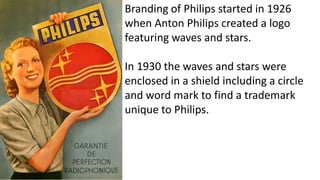
Branding of Philips started in 1926
when Anton Philips created a logo
featuring waves and stars.
In 1930 the waves and stars were
enclosed in a shield including a circle
and word mark to find a trademark
unique to Philips.
• Very well known for its technological
prowess and ability to innovate.
• So far has had more than 165,000
granted patents including X-ray
tubes, radios, pioneering shavers,
very first audio and video cassettes.
• Philips manufactures more than 50,000 products across 100
countries.
• Aims to improve people’s lives through its products.
• Between 1970 and 1995,Philips faced tough
competition from up-and-coming Japanese
electronics companies which cut into its market
share.
• Because of their large automated plants, they
flooded the market with their inexpensive
products
• To survive, Philips had to close its less profitable factories and start creating
larger and more effective units.
• The company also closed its business units in defence and home appliances that
were not directly related to its core business.
• Philips initiated a branding campaign “Lets make things better”, to become a global brand and champion the
idea that technology will improve people’s lives.
• The management however soon realised that the
campaign did not convey the design excellence
or technical superiority of its products.
• Conducted a survey of more than 1,650
consumers and 180 companies to measure
the brand equity and the direction in which
it should head in the future.
• Discovered that its target group consisted of
consumers in the age group of 35-55 who
disliked the unnecessary hassle of new
technology and valued simplicity and
efficiency in all fields.
• And so rebranded itself. The new campaign was called “Sense and Simplicity”.
• The emphasis shifted to the benefits of technology without the hassle of understanding
the technology.
The campaign was based on three
premises
• Products should be consumer oriented
• They should be easy to experience
• They are advanced
• The new brand positioning has been successful and in 2014 the company realized a 5
percent growth in total brand value.
• Created by Mohammed Junaid Iqbal, VIT Vellore, during a marketing internship under Prof Sameer Mathur,
IIM Lucknow.
Sameer Mathur
BuddingMarkets.com
Indian Institute of Management,
Lucknow.
Sameer Mathur
BuddingMarkets.com
Ph.D. and M.S. (Marketing) 2003 – 2009
Indian Institute of Management,
Lucknow
• Created by Mohammed Junaid Iqbal, VIT Vellore, during a marketing internship under Prof Sameer Mathur,
IIM Lucknow.

Philips

  • 4.
    Branding of Philipsstarted in 1926 when Anton Philips created a logo featuring waves and stars. In 1930 the waves and stars were enclosed in a shield including a circle and word mark to find a trademark unique to Philips.
  • 7.
    • Very wellknown for its technological prowess and ability to innovate. • So far has had more than 165,000 granted patents including X-ray tubes, radios, pioneering shavers, very first audio and video cassettes.
  • 8.
    • Philips manufacturesmore than 50,000 products across 100 countries. • Aims to improve people’s lives through its products.
  • 10.
    • Between 1970and 1995,Philips faced tough competition from up-and-coming Japanese electronics companies which cut into its market share. • Because of their large automated plants, they flooded the market with their inexpensive products
  • 11.
    • To survive,Philips had to close its less profitable factories and start creating larger and more effective units. • The company also closed its business units in defence and home appliances that were not directly related to its core business.
  • 12.
    • Philips initiateda branding campaign “Lets make things better”, to become a global brand and champion the idea that technology will improve people’s lives.
  • 13.
    • The managementhowever soon realised that the campaign did not convey the design excellence or technical superiority of its products.
  • 14.
    • Conducted asurvey of more than 1,650 consumers and 180 companies to measure the brand equity and the direction in which it should head in the future.
  • 15.
    • Discovered thatits target group consisted of consumers in the age group of 35-55 who disliked the unnecessary hassle of new technology and valued simplicity and efficiency in all fields.
  • 16.
    • And sorebranded itself. The new campaign was called “Sense and Simplicity”. • The emphasis shifted to the benefits of technology without the hassle of understanding the technology.
  • 17.
    The campaign wasbased on three premises • Products should be consumer oriented • They should be easy to experience • They are advanced
  • 18.
    • The newbrand positioning has been successful and in 2014 the company realized a 5 percent growth in total brand value.
  • 21.
    • Created byMohammed Junaid Iqbal, VIT Vellore, during a marketing internship under Prof Sameer Mathur, IIM Lucknow. Sameer Mathur BuddingMarkets.com Indian Institute of Management, Lucknow.
  • 22.
    Sameer Mathur BuddingMarkets.com Ph.D. andM.S. (Marketing) 2003 – 2009 Indian Institute of Management, Lucknow • Created by Mohammed Junaid Iqbal, VIT Vellore, during a marketing internship under Prof Sameer Mathur, IIM Lucknow.