PHILIPS
sense and simplicity
DIVISIONS
 Philips Consumer Electronics
 Philips Lighting
 Philips Medical Systems
 Philips Domestic Appliances
and Personal Care
 B2B
INDUSTRY ELECTRONICS
Founded Eindhoven, 15 May 1891
Founder Gerard Philips
Frederik Philips
Headquarters Amsterdam, Netherlands
Area served Worldwide
Key people Jeroen van der Veer(Chairman)
Frans van Houten (CEO)
Products Home appliances
Lighting
Medical equipment
Revenue €21.39 billion (2014)
Operating income €486 million (2014)
Profit €415 million (2014)
Total assets €28.35 billion (2014)
Total equity €10.86 billion (2014)
Number of employees 105,365 (2014)
Slogan "Innovation & You"
Website www.philips.com/global
• Royal Philips Electronics of the
Netherlands is a diversified
health and well-being company.
• Headquartered ---Netherlands,
more than 186,000 employees in
more than 60 countries
worldwide.
• Market leader---cardiac care,
acute care and home healthcare,
energy efficient lighting
solutions and new lighting
applications,
• It is also right up there in
lifestyle products for personal
well-being and male shaving
and grooming as well as portable
entertainment and oral
healthcare.
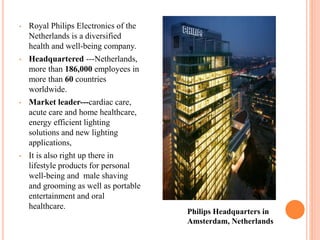
Philips Headquarters in
Amsterdam, Netherlands
(1910 to 1940s)
 Philips Metal Filament Lamp Factory Ltd. was
founded in Eindhoven in 1907.
 That was followed in 1912 by the foundation of
Philips Lightbulb Factories Ltd.
 In 1920s,Philips started to diversify its product
range.
 In the 1920s, the company started to
manufacture other products, such as vacuum
tubes.
 In 1939 they introduced their electric razor, the
Philishave.
 In 1949, the company began selling television
sets.
Vacuum Tubes.
1990 TO 2015
 In may 1990 when company
posted losses of $2.6 billion,top
management launched a major
initiative known as”Operation
Centurion”.
 In 1999,Philips embarked on a
worldwide marketing campaign
and changed their company’s
image to a technology-oriented
company rather than a market –
oriented one.
 In 2001,Philips launched a
company wide restructuring
program called “Towards One
Philips’(TOP) under CEO
Gerard Kleisterlee to foster
greater co-operation.
 The program helped not only in
lowering costs but also promoted a
spirit of collaboration.
 In January 2011 Philips agreed
to acquire the assets of Preethi,
a leading India-based kitchen
appliances company.
 In March 2012 Philips
announced its intention to sell,
or demerge its television
manufacturing operations
to TPV Technology.
 April 2013, Philips announced a
collaboration with Paradox
Engineering for the realization
and implementation of a “pilot
project” on network-connected
street-lighting management
solutions. This project was
endorsed by the San Francisco
Public Utilities
Commission (SFPUC).
 Philips began operations in India in 1930
with the establishment of Philips
Electrical Co. (India) Pvt Ltd in Kolkata .
 In 1948, Philips started manufacturing
radios in Kolkata. In 1959, a second radio
factory was established near Pune.
 In 1970 a new consumer electronics factory
began operations in Pimpri near Pune; the
factory was closed in 2006.
 In 1996, the Philips Software Centre was
established in Bangalore, later renamed the
Philips Innovation Campus.
 In 2008, Philips India entered the water
purifier market.
 In 2014, Philip's was ranked 12th among
India's most trusted brands according to
the Brand Trust Report, a study conducted
by Trust Research Advisory.
PHILIPS INDIA OPERATIONS
REVENUE
• Globally,Philips derives 34 percent of its revenues from lighting ,in
India,the figure is 58 per cent.
• In Health care,the global contribution is 40 per cent.In India it is 18 per cent
• In Consumer lifestyle,the company gets 26 per cent of its overall
revenues,in India,it is 24 per cent.
• Totally the Indian unit closed the fiscal ended march 2012 with revenues of
Rs 5,579 crore,growing at a clip of about 23 per cent per annum.
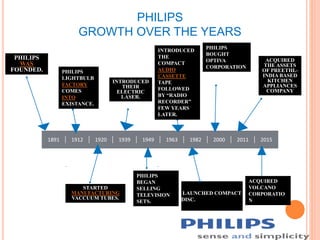
PHILIPS
GROWTH OVER THE YEARS
1891 1912 1920 1939 1949 1963 1982 2000 2011 2015
ACQUIRED
THE ASSETS
OF PREETHI.-
INDIA BASED
KITCHEN
APPLIANCES
COMPANY
LAUNCHED COMPACT
DISC.
.
INTRODUCED
THEIR
ELECTRIC
LASER.
STARTED
MANUFACTURING
VACCUUM TUBES.
.
.
PHILIPS
WAS
FOUNDED. PHILIPS
LIGHTBULB
FACTORY
COMES
INTO
EXISTANCE.
PHILIPS
BEGAN
SELLING
TELEVISION
SETS.
INTRODUCED
THE
COMPACT
AUDIO
CASSETTE
TAPE
FOLLOWED
BY “RADIO
RECORDER”
FEW YEARS
LATER.
PHILIPS
BOUGHT
OPTIVA
CORPORATION
ACQUIRED
VOLCANO
CORPORATIO
N
Solutions
 Philips embarked an improvement
program called BEST (Business
Excellent through Speed and
Teamwork).
 Have several tools and approaches as a
part of BEST.
 Some of them are:
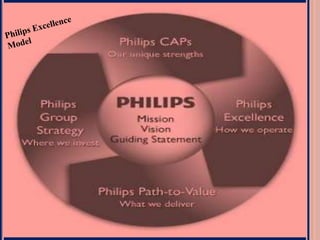
• Philips Business Excellence Model
(PBE)
• Process Survey Tools(PST)
• Balanced Scorecard (BSC).
Problem
 Philips was success since its inception,
but its faced poor financial
performance during the 1990s due to
several reason:
• Fall of market share.
• High Manufacturing Costs.
• Lack of competitive product price
• Growing competition and Rapid
changes in the external environment
PROCESS SURVEY TOOL
BALANCED SCORECARD
STRATEGY OF PHILIPS
• In 1970-80 Philips acquired Magnavox, Signetics, Sylvania,&
Westinghouse
• In 1990 Philips carried out major restructuring program &
changed from localized production to global production
• Another important change was the appointment of Gerad
Kleisterlee as President & Chairman of the company
• Philips started to concentrate on its initial core activities
CONTD.
• Philips primary focus was now on product innovation
• To create brand awareness in European market Philips spent $100 million
on advertisement, sponsorship, movie tie-ins, reail promotion worldwide
• Apart from it Philips spent $600 million to buy Aegis Group’s Carat
International to create a consistent brand experience
• Philips also tried direct marketing and internet marketing to reach to its
consumers
CONTD.
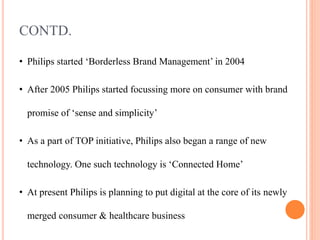
• Philips started ‘Borderless Brand Management’ in 2004
• After 2005 Philips started focussing more on consumer with brand
promise of ‘sense and simplicity’
• As a part of TOP initiative, Philips also began a range of new
technology. One such technology is ‘Connected Home’
• At present Philips is planning to put digital at the core of its newly
merged consumer & healthcare business
…cont’d
RETAIL
Emerging
urbanization ,
population
growth and
new demand.
AUTO
Philips
offers best-
in-class
lightning
solutions in
OEM & OES
e.g. Hyundai
INDUSTRY
Requires better
illumination for
performance
Reduces operating
cost
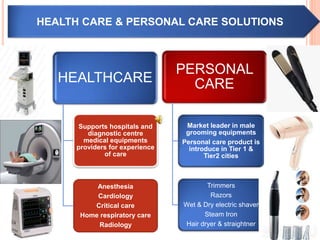
HEALTHCARE
Supports hospitals and
diagnostic centre
medical equipments
providers for experience
of care
Anesthesia
Cardiology
Critical care
Home respiratory care
Radiology
PERSONAL
CARE
Market leader in male
grooming equipments
Personal care product is
introduce in Tier 1 &
Tier2 cities
Trimmers
Razors
Wet & Dry electric shaver
Steam Iron
Hair dryer & straightner
HEALTH CARE & PERSONAL CARE SOLUTIONS
BRAND LICENSING
The Philips brand is one of the most
highly recognized and trusted brands in the world.
Brands cannot be built overnight, and our on-going
investments and marketing efforts have ensured
continued growth of our brand momentum year-on-
year.
 Philips proposes a Brand Licensing
Program to partners that are keen to leverage the
Philips brand to take on the challenge in delighting
consumers with “sense and simplicity”.
 Becoming a Philips brand licensee provides the
access to tap into our worldwide brand advantage.
THANKS TO:
http://www.philips.com
http://www.philips.co.in
Done by
Swananya MUkherjee

Philips

  • 1.
    PHILIPS sense and simplicity DIVISIONS Philips Consumer Electronics  Philips Lighting  Philips Medical Systems  Philips Domestic Appliances and Personal Care  B2B
  • 2.
    INDUSTRY ELECTRONICS Founded Eindhoven,15 May 1891 Founder Gerard Philips Frederik Philips Headquarters Amsterdam, Netherlands Area served Worldwide Key people Jeroen van der Veer(Chairman) Frans van Houten (CEO) Products Home appliances Lighting Medical equipment Revenue €21.39 billion (2014) Operating income €486 million (2014) Profit €415 million (2014) Total assets €28.35 billion (2014) Total equity €10.86 billion (2014) Number of employees 105,365 (2014) Slogan "Innovation & You" Website www.philips.com/global
  • 3.
    • Royal PhilipsElectronics of the Netherlands is a diversified health and well-being company. • Headquartered ---Netherlands, more than 186,000 employees in more than 60 countries worldwide. • Market leader---cardiac care, acute care and home healthcare, energy efficient lighting solutions and new lighting applications, • It is also right up there in lifestyle products for personal well-being and male shaving and grooming as well as portable entertainment and oral healthcare. Philips Headquarters in Amsterdam, Netherlands
  • 5.
    (1910 to 1940s) Philips Metal Filament Lamp Factory Ltd. was founded in Eindhoven in 1907.  That was followed in 1912 by the foundation of Philips Lightbulb Factories Ltd.  In 1920s,Philips started to diversify its product range.  In the 1920s, the company started to manufacture other products, such as vacuum tubes.  In 1939 they introduced their electric razor, the Philishave.  In 1949, the company began selling television sets. Vacuum Tubes.
  • 6.
    1990 TO 2015 In may 1990 when company posted losses of $2.6 billion,top management launched a major initiative known as”Operation Centurion”.  In 1999,Philips embarked on a worldwide marketing campaign and changed their company’s image to a technology-oriented company rather than a market – oriented one.  In 2001,Philips launched a company wide restructuring program called “Towards One Philips’(TOP) under CEO Gerard Kleisterlee to foster greater co-operation.  The program helped not only in lowering costs but also promoted a spirit of collaboration.  In January 2011 Philips agreed to acquire the assets of Preethi, a leading India-based kitchen appliances company.  In March 2012 Philips announced its intention to sell, or demerge its television manufacturing operations to TPV Technology.  April 2013, Philips announced a collaboration with Paradox Engineering for the realization and implementation of a “pilot project” on network-connected street-lighting management solutions. This project was endorsed by the San Francisco Public Utilities Commission (SFPUC).
  • 7.
     Philips beganoperations in India in 1930 with the establishment of Philips Electrical Co. (India) Pvt Ltd in Kolkata .  In 1948, Philips started manufacturing radios in Kolkata. In 1959, a second radio factory was established near Pune.  In 1970 a new consumer electronics factory began operations in Pimpri near Pune; the factory was closed in 2006.  In 1996, the Philips Software Centre was established in Bangalore, later renamed the Philips Innovation Campus.  In 2008, Philips India entered the water purifier market.  In 2014, Philip's was ranked 12th among India's most trusted brands according to the Brand Trust Report, a study conducted by Trust Research Advisory. PHILIPS INDIA OPERATIONS
  • 8.
    REVENUE • Globally,Philips derives34 percent of its revenues from lighting ,in India,the figure is 58 per cent. • In Health care,the global contribution is 40 per cent.In India it is 18 per cent • In Consumer lifestyle,the company gets 26 per cent of its overall revenues,in India,it is 24 per cent. • Totally the Indian unit closed the fiscal ended march 2012 with revenues of Rs 5,579 crore,growing at a clip of about 23 per cent per annum.
  • 9.
    PHILIPS GROWTH OVER THEYEARS 1891 1912 1920 1939 1949 1963 1982 2000 2011 2015 ACQUIRED THE ASSETS OF PREETHI.- INDIA BASED KITCHEN APPLIANCES COMPANY LAUNCHED COMPACT DISC. . INTRODUCED THEIR ELECTRIC LASER. STARTED MANUFACTURING VACCUUM TUBES. . . PHILIPS WAS FOUNDED. PHILIPS LIGHTBULB FACTORY COMES INTO EXISTANCE. PHILIPS BEGAN SELLING TELEVISION SETS. INTRODUCED THE COMPACT AUDIO CASSETTE TAPE FOLLOWED BY “RADIO RECORDER” FEW YEARS LATER. PHILIPS BOUGHT OPTIVA CORPORATION ACQUIRED VOLCANO CORPORATIO N
  • 10.
    Solutions  Philips embarkedan improvement program called BEST (Business Excellent through Speed and Teamwork).  Have several tools and approaches as a part of BEST.  Some of them are: • Philips Business Excellence Model (PBE) • Process Survey Tools(PST) • Balanced Scorecard (BSC). Problem  Philips was success since its inception, but its faced poor financial performance during the 1990s due to several reason: • Fall of market share. • High Manufacturing Costs. • Lack of competitive product price • Growing competition and Rapid changes in the external environment
  • 12.
  • 13.
  • 14.
    STRATEGY OF PHILIPS •In 1970-80 Philips acquired Magnavox, Signetics, Sylvania,& Westinghouse • In 1990 Philips carried out major restructuring program & changed from localized production to global production • Another important change was the appointment of Gerad Kleisterlee as President & Chairman of the company • Philips started to concentrate on its initial core activities
  • 15.
    CONTD. • Philips primaryfocus was now on product innovation • To create brand awareness in European market Philips spent $100 million on advertisement, sponsorship, movie tie-ins, reail promotion worldwide • Apart from it Philips spent $600 million to buy Aegis Group’s Carat International to create a consistent brand experience • Philips also tried direct marketing and internet marketing to reach to its consumers
  • 16.
    CONTD. • Philips started‘Borderless Brand Management’ in 2004 • After 2005 Philips started focussing more on consumer with brand promise of ‘sense and simplicity’ • As a part of TOP initiative, Philips also began a range of new technology. One such technology is ‘Connected Home’ • At present Philips is planning to put digital at the core of its newly merged consumer & healthcare business
  • 18.
    …cont’d RETAIL Emerging urbanization , population growth and newdemand. AUTO Philips offers best- in-class lightning solutions in OEM & OES e.g. Hyundai INDUSTRY Requires better illumination for performance Reduces operating cost
  • 19.
    HEALTHCARE Supports hospitals and diagnosticcentre medical equipments providers for experience of care Anesthesia Cardiology Critical care Home respiratory care Radiology PERSONAL CARE Market leader in male grooming equipments Personal care product is introduce in Tier 1 & Tier2 cities Trimmers Razors Wet & Dry electric shaver Steam Iron Hair dryer & straightner HEALTH CARE & PERSONAL CARE SOLUTIONS
  • 20.
    BRAND LICENSING The Philipsbrand is one of the most highly recognized and trusted brands in the world. Brands cannot be built overnight, and our on-going investments and marketing efforts have ensured continued growth of our brand momentum year-on- year.  Philips proposes a Brand Licensing Program to partners that are keen to leverage the Philips brand to take on the challenge in delighting consumers with “sense and simplicity”.  Becoming a Philips brand licensee provides the access to tap into our worldwide brand advantage.
  • 21.