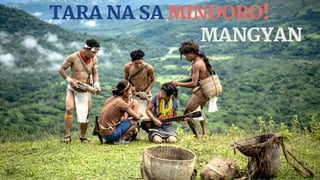
TARA NA SA MINDORO!
MANGYAN
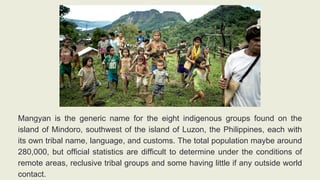
Mangyan is the generic name for the eight indigenous groups found on the
island of Mindoro, southwest of the island of Luzon, the Philippines, each with
its own tribal name, language, and customs. The total population maybe around
280,000, but official statistics are difficult to determine under the conditions of
remote areas, reclusive tribal groups and some having little if any outside world
contact.
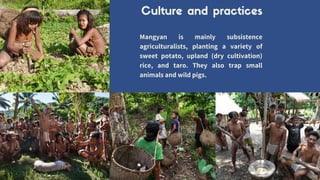
Mangyan is mainly subsistence
agriculturalists, planting a variety of
sweet potato, upland (dry cultivation)
rice, and taro. They also trap small
animals and wild pigs.
Culture and practices
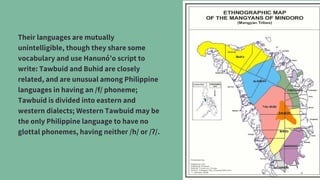
Their languages are mutually
unintelligible, though they share some
vocabulary and use Hanunó’o script to
write: Tawbuid and Buhid are closely
related, and are unusual among Philippine
languages in having an /f/ phoneme;
Tawbuid is divided into eastern and
western dialects; Western Tawbuid may be
the only Philippine language to have no
glottal phonemes, having neither /h/ or /ʔ/.
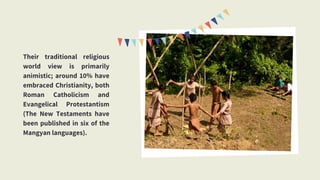
Their traditional religious
world view is primarily
animistic; around 10% have
embraced Christianity, both
Roman Catholicism and
Evangelical Protestantism
(The New Testaments have
been published in six of the
Mangyan languages).
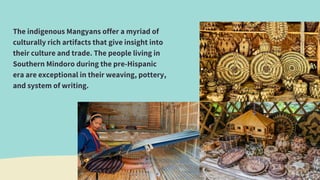
The indigenous Mangyans offer a myriad of
culturally rich artifacts that give insight into
their culture and trade. The people living in
Southern Mindoro during the pre-Hispanic
era are exceptional in their weaving, pottery,
and system of writing.
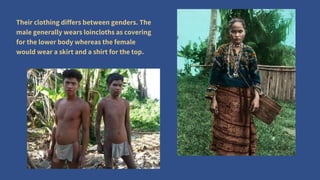
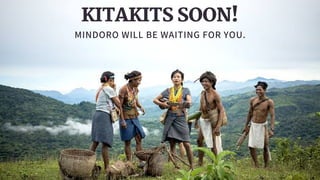
Their clothing differs between genders. The
male generally wears loincloths as covering
for the lower body whereas the female
would wear a skirt and a shirt for the top.
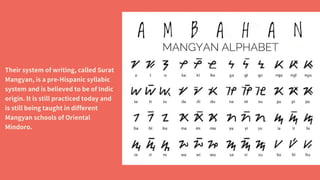
Their system of writing, called Surat
Mangyan, is a pre-Hispanic syllabic
system and is believed to be of Indic
origin. It is still practiced today and
is still being taught in different
Mangyan schools of Oriental
Mindoro.
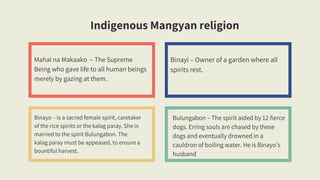
Mahal na Makaako – The Supreme
Being who gave life to all human beings
merely by gazing at them.
Binayi – Owner of a garden where all
spirits rest.
Binayo – Is a sacred female spirit, caretaker
of the rice spirits or the kalag paray. She is
married to the spirit Bulungabon. The
kalag paray must be appeased, to ensure a
bountiful harvest.
Bulungabon – The spirit aided by 12 fierce
dogs. Erring souls are chased by these
dogs and eventually drowned in a
cauldron of boiling water. He is Binayo’s
husband
Indigenous Mangyan religion
KITAKITS SOON!
MINDORO WILL BE WAITING FOR YOU.

Philippine indigenous community MANGYAN .pdf

  • 1.
    TARA NA SAMINDORO! MANGYAN
  • 2.
    Mangyan is thegeneric name for the eight indigenous groups found on the island of Mindoro, southwest of the island of Luzon, the Philippines, each with its own tribal name, language, and customs. The total population maybe around 280,000, but official statistics are difficult to determine under the conditions of remote areas, reclusive tribal groups and some having little if any outside world contact.
  • 3.
    Mangyan is mainlysubsistence agriculturalists, planting a variety of sweet potato, upland (dry cultivation) rice, and taro. They also trap small animals and wild pigs. Culture and practices
  • 4.
    Their languages aremutually unintelligible, though they share some vocabulary and use Hanunó’o script to write: Tawbuid and Buhid are closely related, and are unusual among Philippine languages in having an /f/ phoneme; Tawbuid is divided into eastern and western dialects; Western Tawbuid may be the only Philippine language to have no glottal phonemes, having neither /h/ or /ʔ/.
  • 5.
    Their traditional religious worldview is primarily animistic; around 10% have embraced Christianity, both Roman Catholicism and Evangelical Protestantism (The New Testaments have been published in six of the Mangyan languages).
  • 6.
    The indigenous Mangyansoffer a myriad of culturally rich artifacts that give insight into their culture and trade. The people living in Southern Mindoro during the pre-Hispanic era are exceptional in their weaving, pottery, and system of writing.
  • 7.
    Their clothing differsbetween genders. The male generally wears loincloths as covering for the lower body whereas the female would wear a skirt and a shirt for the top.
  • 8.
    Their system ofwriting, called Surat Mangyan, is a pre-Hispanic syllabic system and is believed to be of Indic origin. It is still practiced today and is still being taught in different Mangyan schools of Oriental Mindoro.
  • 9.
    Mahal na Makaako– The Supreme Being who gave life to all human beings merely by gazing at them. Binayi – Owner of a garden where all spirits rest. Binayo – Is a sacred female spirit, caretaker of the rice spirits or the kalag paray. She is married to the spirit Bulungabon. The kalag paray must be appeased, to ensure a bountiful harvest. Bulungabon – The spirit aided by 12 fierce dogs. Erring souls are chased by these dogs and eventually drowned in a cauldron of boiling water. He is Binayo’s husband Indigenous Mangyan religion
  • 10.
    KITAKITS SOON! MINDORO WILLBE WAITING FOR YOU.