Pheromone traps for the assessment of insecticides efficiency and monitoring
insecticides resistance in insect field strains
Abdallah, M. Albeltagy
Plant Protection Research Institute, Agricultural Research Center, Dokki, Giza, Egypt.
ARTICLE INFO
Article History
Received: 20/ 10 / 2021
Accepted: 22/ 12 /2021
Abstract:
Up to date insecticides are the backbone of agricultural
industry (Agricultural Mass Production) and for public health
protection purposes. Annually, trillions of US $ are lost as a result of
insect infestations and damages in different agric. Crops around the
world , even under the heavy use of insecticidal applications because
of the control failure of many inefficient insecticides , that is happen
because many insect field strains have developed resistance against
these compounds. For the purposes of assaying insecticides
efficiency and resistance in insect field strains, it's required to apply
huge amounts of insecticides in many sequential treatments,
investigate huge amounts of agric. crop fields, collect huge amounts
of crop samples (Vegetation and / or fruit parts), rather than
environmental pollution, human health hazards, using application
equipments which require a lot amounts of effort, time and money.
It's recommended here to use pheromone traps technique for the
assessment of insecticides efficiency, monitoring insecticides
resistance in insect field strains instead of the insecticides
conventional applications to overcome all the above mentioned
problems and to apply an advanced insecticides resistance
management throughout an integrated pest management (IPM) with
a very simple, easy, quick, and efficient technique.
Keywords
Pheromone,
insecticides,
assessment, resistance
and insects.
Introduction
Formulated pesticides are used
in a large scale through the world as a
major mean for pest management and
control. Although pesticides provide
numerous benefits in terms of increased
agricultural production and improve its
quality, but their efficacy may be not
often good because of the development
of insecticide resistance in many pest
species. Resistance to one or more
pesticides has been documented in
more than 447 species of insects and
mites (Roush and McKenzie, 1987).
Pesticide resistance is an increasingly
urgent worldwide problem. Resistance
in vectors of human disease,
particularly malaria-transmitting
mosquitoes, is a serious threat to public
health in many nations. Agricultural
productivity is jeopardized because
widespread resistance in crop and
livestock pests. Serious resistance
problem is also evident in pests of the
urban environment, most notably
cockroaches.
Resistance to insecticides is one
of the most serious problems facing
agriculture today. Many previous
studies revealed the high resistance of
pink bollworm to insecticides in the
cotton fields. In Egypt, several
Egyptian Journal of Plant
Protection Research Institute
www.ejppri.eg.net
Egypt. J. Plant Prot. Res. Inst. (2021), 4 (4): 585 –599
585
pyrethroids and organophosphorus
have been widely used against cotton
pests. However, although pyrethroid
and organophosphorus insecticides
were the most efficient and widely used
against bollworms but the onset of
resistance development to these
compounds in bollworms have been
recently documented (Georghiou,
1983; Haynes et al., 1987; Miller, 1990
and Shekeban, 2000). The major
economic losses due to the pesticide
resistance in the USA were: $1.5 billion
(Pimentel, 2005). The price of
insecticide resistance in lost yields and
higher insect control costs is staggering
- in some years more than 1 billion $ in
cotton for the budworm/bollworm
complex alone. In IPM, pheromones are
considered to be an essential
component because they are used for
detecting the economic threshold levels
of pest populations and for mating
disruption as a direct pest suppression
measure. Pheromones of major pests
have been found to be effective,
economic and eco-friendly in agro-
ecosystems in which cotton is
cultivated (Tamhankar et al., 2000). For
resistance management tactics to be
effective, resistance must be detected in
its early stage (Roush and Miller, 1986)
and early detection necessitates using
one or more techniques that being
accurate, easy, rapid and inexpensive,
which would aid production,
consultants and extension personal in
making informed decisions on adequate
control measures (Mink and Boethel,
1992). Firstly, the traditional approach
uses complete dose-response tests with
4-5 doses that produce 10-90%
mortality. Resistance is expressed in
terms of the ratio of LD50 or LC50 of the
resistant strain to that of the susceptible
strain. Alternatively, an approach called
the discriminating or diagnostic dose
test was used where one dose is often
investigated and the mortality of the
susceptible test strains is compared
(Pasquier and Charmillot, 2003).
Another approach is the
attracticide method which was
developed in summer of 1985 as a rapid
test to determined resistance in pink
bollworm adult in cotton fields. The
attracticide method was full
implementation in 1986 and 1987 as an
effective method to monitor insecticide
resistance to pink bollworm to a wide
range of insecticides (Miller, 1986 and
Haynes et al ,1986 c and 1987).
Detection of changes in response is
needed, especially in the early stages of
resistance development. Monitoring
insecticide resistance in field
population moth is in great importance
in resistance management programs
(Tabashnik and Cushing, 1987). In
Egypt, very few dose mortality studies
using attrcticides resistance monitoring
technique were carried out (Al-Beltagy
et al., 1993). Therefore, it is important
to study efficacy of insecticides against
insect field strains in Nile Basin
countries to establish a program for
controlling and reducing the resistance
level of these pest to insecticides. Such
a program could be efficiently used to
reduce number of insecticide sprays;
cost of insecticides and increases the
crop production per unit.
This review is concentrated on
the use of attracticide resistance
monitoring technique against different
insect field strains and its modified
procedure.
1. Attracticide resistance monitoring
technique (ARMT) review:
Henneberry and Clayton (1982)
conducted studies to determine the
relationship between catches of male
insects in pheromone-baited traps and
crop infestation. Numbers of male
moths of the pink bollworm,
Pectinophora gossypiella (Saunders)
(Lepidoptera: Gelechiidae), caught
daily in cotton fields at the University
of Arizona Cotton Research Center,
Albeltagy , 2021
586
Phoenix, Arizona, in gossyplure-baited
traps were variable. However, average
catches of male moths for 3–7 days
between boll-sampling periods were
strongly correlated with oviposition on
cotton bolls, percentages of infested
bolls and numbers of larvae per boll.
Average weekly numbers of moths
emerging from infested cotton were
also strongly correlated with the
number of males caught. The number of
females emerging was strongly
correlated with oviposition on cotton
bolls. Insecticide applications of
carbaryl and fenvalerate reduced
catches of male moths of pink bollworm
in gossyplure-baited traps compared
with catches in traps in untreated fields
(Average 56%). However, 13–48 male
moths/trap per night were caught in the
treated fields after applications. Thus,
scheduling treatments on the basis of
male moth trap catches, except for the
initial treatment, was not feasible.
Small field sizes, moth immigration
and/or continuing emergence from the
infested cotton in the fields may have
obscured the impact of the insecticide
treatments on adult moth populations.
Riedl et al. (1985) developed a
procedure to screen field population of
codling moth, Cydia pomonella (L)
(Lepidoptera: Tortricidae), directly for
resistance to azinphos-methyl or other
toxicants. Male moths were collected in
the field with pheromone traps and
assayed with azinphos-methyl by
topical application to the insects
directly on the adhesive coated-trap
surface. The LC50 of moths trapped
during the spring flight was somewhat
higher (0.22 µg / moth) than during the
summer (0.08 – 0.16 µg / moth). The
longevity of moths and their
toxicological response was not affected
by the polybutene adhesive which was
applied as a thin uniform film to the trap
surface. Susceptibility to azinphos-
methyl increased considerably with age
in both sexes and was not correlated
with loss in body weight. Haynes et al.
(1986 a) reported that the effectiveness
of combinations of insecticides with
pheromones (attracticides) for control
of the pink bollworm (PBW) P.
gossypiella may depend on, among
other factors, males freely contacting
attracticide source, insecticide-induced
mortality, and sublethal interference
with the male locating sequence in
poisoned males. In flight-tunnel tests,
males readily, contacted pheromone
sources containing permethrin,
fenvalerate, or cypermethrin and
suffered mortality. Moreover, after 24
hr survivors were less likely to
complete the normal behavioral
sequence involved in sex pheromone-
mediated mate location. The latter
sublethal effects may contribute
substantially to the effectiveness of the
attracticide technique at the doses of
insecticides used in the field.
Cypermethrin induced lethal and
sublethal effects at a lower
concentration than other insecticides
tested. Chlordimeform appears to be a
poor candidate for attracticide
formulations because males avoided
contact with this insecticide. Recovery
from sublethal effects of cypermethrin
occurred after 48 hrs. and represents
potential limitations to sublethal
modification of behavior for population
control.
Haynes et al. (1986 b) tested the
use of yellow sticky cards to monitor
resistance by incorporating various
dosages of a selected insecticide into
the sticky material on the cards and then
seeing if reproducible dose–mortality
relationships could be generated from
adults flies caught on the cards. The
technique was tested with laboratory
strains to select the appropriate sticky
material, suitable thickness and best
time for evaluation of mortality. They
found that, the yellow sticky cards are
effective when used in monitoring
populations of many insect species, and
Egypt. J. Plant Prot. Res. Inst. (2021), 4 (4): 585 –599
587
in monitoring resistance levels to
insecticides. Haynes et al. (1986 c)
described a novel pheromone-baited
sticky trap laced with insecticides
proved to be a sample and effective
means of monitoring insecticide
resistance in pink bollworm moth.
Adult males from field treated
frequently with pyrethroid insecticides
showed up to 20–fold resistance to
permethrin and up to 14.5-fold
resistance to fenvalerate. Information
from the resistance-monitoring traps
could be used to time the rotation of
other chemicals. Miller (1986) reported
that a population of tobacco budworm
Heliothis virescens (Fabricius) from the
West Texas cotton fields was found to
have a 15-20 fold resistance to
pyrethroid insecticides. A new method
of measuring resistance in the field, the
attracticide method was perfected for
adults pink bollworm, P. gossypiella. In
the attracticide method adult moths
collects themselves, sex themselves and
dose themselves. The field worker then
collects the traps and counts mortality
after two days without handling the
moths themselves.
Haynes et al. (1987) reported
that a rapid technique using sex
pheromone and insecticide-laced traps
was developed for measuring
insecticide resistance in pink bollworm
moth. This method was developed in
the laboratory by allowing males to fly
up wind to a sex –pheromone source in
a wind tunnel and then trapping them on
sticky cards inserted into standard delta
traps (delta traps are used for trapping
and monitoring Lepidopteran pests or
other good-flyer insect pests. They can
be used to monitor in orchards, large
row crop plantations, small vegetable
plots, indoors, etc. Dimensions 12 x 10
x 18 cm. In orange, yellow, or white).
Using this technique, populations of
adult male P. gossypiella trapped in the
field were shown to be more resistant to
permethrin and fenvalerate in field
frequently treated with pyrethroids than
in fields with little or no exposure to
these insecticides. The new method
eliminates handling of insects that is
involved in other methods of assessing
toxicity and is compatible with the
current practice of monitoring
populations with pheromone traps.
Schouest and Miller (1988) measured
toxicities of fenvalerate and permethrin
on a laboratory strain of adult male of
pink bollworm by attracticide bioassay.
Delta trap was used with a sticky
adhesive- coated cards insert containing
the insecticide concentration placed in
the trap bottom. A rubber septum with
1 mg gossyplure acted as a pheromone
source. The caught moths were placed
in constant temperature chambers. Data
from the attracticide bioassay fit the
probit model well and gave a precise
estimate of a discriminating dose.
Tabashnik et al. (1988) monitored
resistance in diamondback moth larvae
by testing pheromone-attracted males.
Three populations were tested for
mortality and knockdown responses to
fenvalerate, DDT, permethrin and
diazinon. Males and females responded
similarly. Adult mortality and
knockdown were correlated with larval
LC50 ʼs across insecticide – population
combinations, but adults from one
population with DDT- resistant larvae
were not resistant to DDT. Brewer and
Trumble (1989) developed a technique
for monitoring insecticide resistance in
field populations of beet armyworm
Spodoptera exigua (Hubner), and
compared with conventional topical
bioassay. Inescticides were
incorporated into the adhesive of a
pheromone trap thereby combining
insect collection with insecticide
application. This attractant trap
technique (ATT) provided stable LC50 s
with low control mortality when traps
were incubated at 21 ºC for 30-36 hrs.
after insects were captured. LC50ُ s of
a laboratory colony tested with
Albeltagy , 2021
588
fenvalerate, permethrin and methomyl
were 95.6, 142 and 11.5 µg/g of
adhesive, respectively. Slopes of probit
regression for males were similar for
topical and ATT bioassay indicating a
parallel response of the insect to the two
methods. Resistance ratios at LC50
from (ATT) ranged from 3 to 7.3 for
fenvalerate, 1.5 to 2.5 for permethrin
and 7.1 to 33 for methomyl.
Campanhola and Plapp (1989)
conducted tests to detect reasons for the
loss of pyrethroid resistance which
occurs in laboratory and field strains of
the tobacco budworm in the absence of
continuous exposure to pyrethroid
insecticides. Attracticide pheromone
traps were used in these tests. Larvae of
a resistant strain (ICI) maintained in the
laboratory developed more slowly than
larvae of susceptible laboratory strain.
The ICI females were less fertile and
produced fewer eggs per individual
than susceptible females. In addition,
ICI females produced significantly less
pheromone and attracted fewer males
than did susceptible females.
Susceptible males were more attracted
to pheromone traps than resistant males.
Knight and Hull (1989) investigated the
use of sex pheromone traps to monitor
the susceptibility of adult male tufted
apple bud moths to azinophosmethyl in
laboratory experiments and field trials
in a number of apple orchards in South
Central Pennsylvania and West
Virginia. Two techniques were
compared: the topical treatment of
males caught on the trap ُs sticky
surface and the incorporation of the
insecticide directly into the adhesive.
Compared with the laboratory strain,
LD50 ‫ۥ‬s populations from apple orchards
were 2 to 8 times greater in the topical
application bioassays and 6 to 18 times
greater in the adhesive incorporation
assay. Sanderson et al. (1989) used
yellow sticky cards with thin layers of
insecticide – sticker mixture as a
bioassay to determine insecticide
resistance in adult Liriomyza trifolii,
(Burgess) (Diptera: Agromyzidae) ,
mortality was used to estimate the
degree of resistance of a given
population to insecticides. Duration of
exposure to insecticide before mortality
evaluation was standardized at 24 hrs.
Control mortality increased with
increasing amounts of sticker on the
cards and with increasing adult age.
Males were slightly more susceptible to
permethrin and chlorpyrifos
insecticides than females. The sticky
card bioassay a simple procedure that is
accurate repeatable and usable for field
or greenhouse populations. Brewer et
al. (1990) used a field bioassay that
measure adult male susceptibility to
document resistance to fenvalerate,
permethrin and methomyl in beet
armyworm S. exiqua . Susceptibility of
adult males to these insecticides was
monitored in field with technical
insecticide mixed into the adhesive of
pheromone traps. At the LC50, the
highest levels of resistance were
typically found at many sites.
Geographic and temporal variability in
resistance followed this trend: overall
variation among regions > variation
among sampling dated at the same site
within a region ≥ variation among sites
in a region within three consecutive
days. Knight et al. (1990) used sex
pheromone traps coated with
concentrations of azinophosmethyl
impregnated adhesive to test levels of
resistance in adult populations of male
tufted apple bud moth from apple
orchards in seven Eastern States. The
results suggest that the level of
resistance found within an orchard may
be influenced the intensity of fruit
production within a region. Level of
resistance to azinophosmethyl was
positively correlated with current
seasonal carbamate use and was not
significantly correlated with current use
of azinophosmethyl or other
organophosphates. Levels of resistance
Egypt. J. Plant Prot. Res. Inst. (2021), 4 (4): 585 –599
589
and fruit injury were both significantly
correlated with population densities.
Miller (1990) determined the toxicity of
carbamate, organophosphorus and
pyrethroids insecticides by the
attracticide method to field populations
of pink bollworm in cotton growing
areas of Texas, Arizona, California,
Mexico and China. A gradual increase
in tolerance to pyrethroid was
correlated with high use of these
insecticides. A resistance management
program for insecticides used in control
of pink bollworm is now a possibility
and will require considerable
cooperation at the grower level.
Rummel (1990) reported that during
recent years the use of pheromone traps
has enabled significant advances to be
made in survey, detection and sampling
techniques for the boll weevil, pink
bollworm, bollworm Heliothis zea
(Boddie) and tobacco budworm H.
virescens (F) (Lepidoptera: Noctuidae).
Daly (1992) determined the
dose response in different age classes of
adults of H. armigera (H) by exposing
moths to a discriminating dose of
fenvalerate using an adult vial test and
reported a decline in survival with age
so that by 8d after exclusion 60-70% of
resistant females and 97% resistant
males died at the discriminating dose
compared with < 5% of freshly emerged
moths. Prabhaker et al. (1992) detected
resistance in field populations of sweet
potato whitefly, efficiently and
sensitively using a resistance
monitoring technique with yellow
sticky cards sprayed with insecticides.
Thirty–two populations exhibited
various levels of resistance to sulprofos
(Resistance ratio [RR] ranging from 19
to 104 and for cypermethrin (RR
ranging from 14 to 82) indicating that
insecticide resistance is widespread in
the Imperial Valley of California. The
advantages of this new method for
monitoring resistance are discussed in
relation to conventional leaf bioassay.
Sanderson and Roush (1992)
investigated the use of insect trap
coated with insecticides mixed with a
polybutene adhesive as a resistance
monitoring technique for greenhouse
whitefly. The technique provided
accurate estimates of the mortality
response of whiteflies after 24h, with
minimal control mortality. The
technique was used to estimate
diagnostic concentration (LC99 of a
susceptible strain) and then they were
tested against the susceptible and
resistant strains. Bush et al. (1993)
performed a sticky-card bioassay on
adult males captured with traps that
revealed an 8 fold resistance to
parathion in a population of codling
moth C. pomonella . Parathion
resistance in this population was
confirmed with a sticky-card bioassay
where adult males were exposed to a
diagnostic concentration of 120 µg (a.i)
parathion per gram adhesive (The
estimated LC95 for adult males from
susceptible populations). Reduced
nonspecific esterase activity detected in
adult males captured from the
mechanism of codling moth, C.
pomonella resistance to parathion may
be a modified esterase with lower
specificity for naphthyl acetate
substrates.
Horowitz et al. (1993) assayed
the efficacy of the insecticide resistance
management strategy, a long-term
monitoring program in H. armigera was
undertaken to test the response of this
pest to various insecticides. The
monitoring technique was based on the
exposure of pheromone trap-caught
males to groups of insecticides. The
diagnostic concentration, established
on LC 80-90 of a susceptible H. armigera
field population were 0.57 µg
endosulfan, 0.74 µg cypermethrin, 0.38
µg methomyl and 2.0 µg methidathion
per scintillation vials. In general, the
results indicate that the susceptibility of
H. armigera to the test compounds was
Albeltagy , 2021
590
not appreciably altered from 1987 to
1991, although fluctuations during the
season were observed, in most cases,
the resistance levels to the test
compounds fluctuated in a typical V-
shaped curve during the season. The
susceptibility of H. armigera to the
various insecticides observed during the
course of this study is consistent with
proposition that the insecticide
resistance management (IRM) strategy
can be correlated with successful
management of resistance in this pest.
Qureshi et al. (1993) used the male
moth catches in gossyplure-baited traps
to predict larval infestation of pink
bollworm, P. gossypiella , in cotton
fields during 1988 and 1989. The mean
moth catches per trap per night were
positively correlated with percentage
larval infestation. The moth counts in
traps and larval infestation in green
bolls increased with advance in
reproductive stage of the cotton plants.
A mean trap catch of 9–12 pink
bollworm moths per night was
associated with economically damaging
infestation. It is, therefore, inferred that
insecticidal sprays may be scheduled
when 9–12 moths are captured per trap
per night.Varela et al. (1993) surveyed
variation in response to insecticide in
codling moth in California, Oregon,
Utah and Washington using pheromone
traps by two techniques (Topical
application and direct incorporation of
insecticide into the trap adhesive). LC75
from a susceptible population was as a
standard dose and 20 apple and pear
orchards were monitored for resistance
to azinphos-methyl by the topical
application. In laboratory tests, female
moths were monitored as susceptible as
male moths in bioassays with treated
adhesive. Anonymous (1995) used an
attracticide resistance monitoring
technique with a set of key techniques
system of integrated management
against several damage by the cotton
bollworm, H. armigera in Xin Xiang,
China Demonstration Area, Henan, in
the central Yellow River Valley cotton
region in 1992 and 1993.Outbreaks of
H. armigera were effectively
controlled and good harvests were
obtained using these techniques. These
included improved medium term
predication techniques, setting up
action thresholds, measures to use and
conserve natural enemies, systematic
monitoring and management of
insecticide resistance using pest
resistance cotton germplasm and
trapping adult noctuids.
Downham et al. (1995)
described a series of trials examining
the feasibility of an attracticide
technique for control of Spodoptera
littoralis (Boisduval). Those trials were
assessed by monitoring pheromone trap
catches. Similar levels of mating and
trap-catch suppression were observed in
the two treatments. It was concluded
that the mating suppression observed in
attracticide plots was due principally to
disruption of chemical communication
between the sexes, not to male mortality
arising from contact with the insecticide
sources.Al-Beltagy et al. (1996) used
pheromone delta sticky traps as an
attracticide tolerance monitoring
technique in two different locations
having two different control strategies
for the pink bollworm; one depending
on insecticides and the other on
pheromone disruption. The field
recommended dose as its double and
half rates of insecticides dursban and
sumicidin were applied to the
pheromone delta traps with pheromone
sources for the pink bollworm, spiny
bollworm. Pheromone tarps as an
attracticide tolerance monitoring
technique proved to be effective, simple
and quick for assaying the moth field
strains of Lepidoptera for insecticide
resistance. Shekeban ( 2000 ) compare
the efficiency of the attracticide
resistance monitoring technique with
different conventional bioassay
Egypt. J. Plant Prot. Res. Inst. (2021), 4 (4): 585 –599
591
techniques and vial technique. Al-
Beltagy et al. (2001) used attracticide
resistance monitoring technique for
measuring insecticide resistance in pink
bollworm (PBW) male moths, P.
gossypiella (S). This technique
eliminates handling of insect and is
compatible with current practice of
monitoring populations with
pheromone traps. Results showed that,
PBW developed resistance to all
insecticides tested with R.R. of 19 and
12.7 folds for chlorpyrifos, 14.1 and
34.7 folds for delfose, 14.1 and 38.5
folds for empire and 22.6 and 56 folds
for thiodicarb, respectively. This
technique used to estimate
discriminating concentration for tested
insecticides. El-Bassiony (2001) used
the attracticide resistance monitoring
technique to study pyrethroids
resistance under two different pink
bollworm control strategies (
pheromone disruption technique and
insecticides program . El-Armi (2008)
used the attracticide resistance
mentoring technique to study the
development of insecticides resistance
against pink bollworm in two different
geographical strains.
2. Pheromone traps uses:
2.1. For assaying and monitoring insect
pests population density and dynamics
all the year round ( Al-Beltagy et al.,
1991). 2.2. For assaying insect pests
geographical distribution throughout its
regional and seasonal abundance (
Brania and Al-Beltagy, 1996 ). 2.3. For
insect pests mass trapping technique as
a pest control tool (Hamid and Al-
Beltagy,1995 ). 2.4. For assaying
insecticides resistance development in
insect pests field strains (Al-Beltagy et
al., 1996 ; Al-Beltagy et al., 2000 and
Al-Beltagy et al., 2010). 2.5. For
measuring the successful of a
pheromone disruption technique
applied against any insect pest ( Al-
Beltagy et al., 2001a and 2001b ). 2.6.
For triggering biological and / or
chemical control action ( Al-Beltagy,
1999 ). 2.7. For assaying the efficiency
of different insecticides before any
insecticide treatment ( Al-Beltagy et al.,
2011 ).
3. Procedure :
3.1. Attracticide resistance
monitoring technique (ARMT) :
A novel resistance monitoring
method was created and perfected for
pink bollworm by Miller (1986) and
Haynes et al. (1986 a and 1987) and was
modified by Al-Beltagy et al.(1996 )
and Shekeban (2000) under the
Egyptian conditions. This method
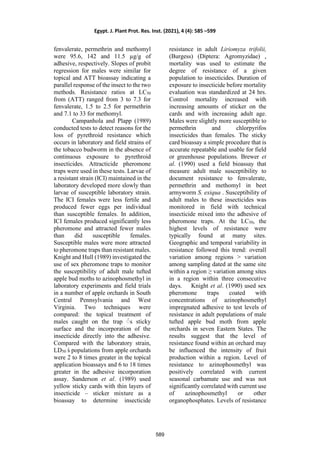
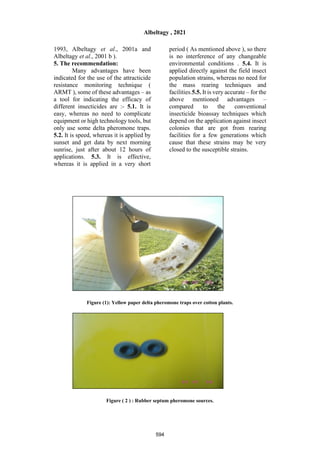
employs pheromone baited delta traps (
Figure 1) that are usually used for
assessment of populations of male
moths. The conventional yellow paper
delta traps supplied by the Ministry of
Agriculture in Egypt are used for the
population assessment in different
cotton fields all over the country.
3.2. Laboratory bioassays:
For ARMT laboratory
bioassays, serial concentrations of each
tested formulated pyrethroid and
organophosphorous are diluted in
acetone and mixed with sticky material.
Condensed petroleum glue, as a trapped
sticker, produced by Agrycins Corp.,
England, and supplied by Ministry of
Agriculture, are used. Two grams of the
sticky adhesive and different insecticide
concentrations for pyrethroids ranged
from 0.05 to 20 ppm and for OP’s ranged
from 1 to 240 ppm. Each concentration
for each insecticide is replicated three
times on separate sheet card. Control
without insecticide is included. Male
moths are transferred from the rearing
facility to the bioassay laboratory. Ten
male moths are captured and sticked to
the yellow sticky card which is treated
before with the insecticide
concentration as mentioned. The insert
cards are kept under constant
conditions of 21 ± 3C and 95 ± 5%
R.H. Adult mortalities are recorded at 6
and 12 h-periods. Mortality is subjected
Albeltagy , 2021
592
for probit analysis to estimate LC50,
LC95 and slope. Resistance ratios (R.R.)
at LC50 (or LC95) are calculated by
dividing each value for field strain, of
each species, by corresponding value of
laboratory reference strain.
3.3. Preparation of insecticide-
pheromone-baited sticky trap:
For preparation of pheromone-
baited sticky trap laced with an
insecticide the following technique is
used: serial concentrations of each tested
pyrethroid and organophosphorous
formulations are diluted in acetone and
mixed with sticky material. Condensed
petroleum glue, as a trapped sticker,
produced by Agrycins Corp., England,
and supplied by Ministry of Agriculture,
is used. Two grams of the sticky adhesive
and an insecticide concentration are
scarped on the trap insect sheet cards
(Inserts) using putty knife starting with
the lowest concentration and ending to
the highest one, every time the putty
knife is washed with kerosene and dried.
Six diluted concentrations from each
insecticide are used, with relative folds
of the field recommended rate (F).
0.125 F, 0.25 F, 0.5 F, 1 F, 1.5 F and 2 F.
These inserts (cards) are secured with
paper for attracticide resistance
monitoring technique (ARMT) field
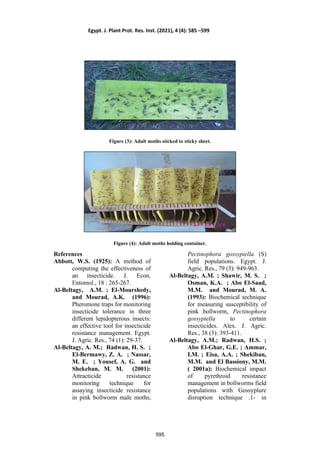
bioassays, the traps are baited with an
appropriate commercially available
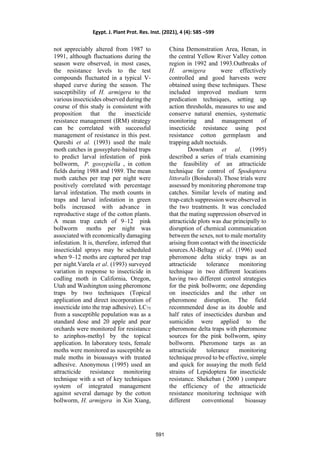
pheromone lures (Figure 2 ) supplied by
the Ministry of Agriculture in Egypt,
for trapping techniques.
3.4. Field experiments:
The field experiments are
carried out twice during the growing
seasons: 1) at the early-season when
plant buds emerged, and 2) at the late-
season when the fruits are up to the
maturity as following steps: - Traps are
hung on stakes higher 20-30 cm above
the canopy of the plants and distributed
by a rate of one trap / five feddans. - The
dosed insert cards and control cards are
placed into the delta traps with a
pheromone source, randomly. All cards
are inserted before sunset.
- Traps are left overnight and collect
quickly in the following morning. - All
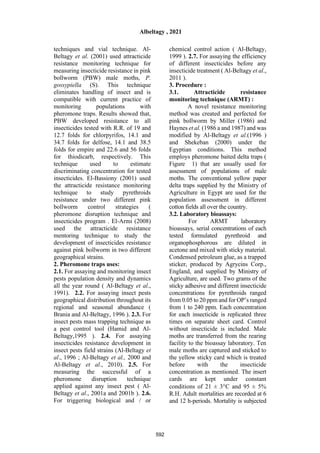
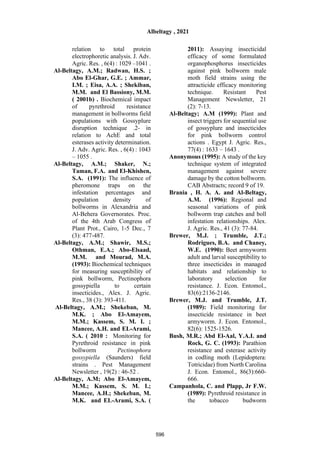
insert cards are collected at dawn with
trapped adult male moths ( Figure 3 )
and checked for mortality %, this
termed the zero time mortality %, then
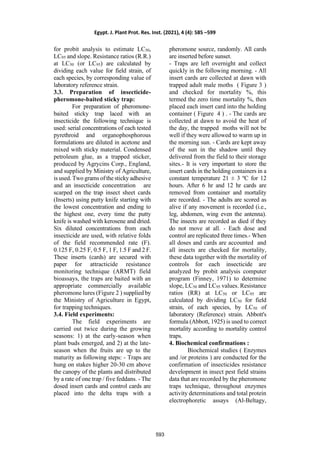
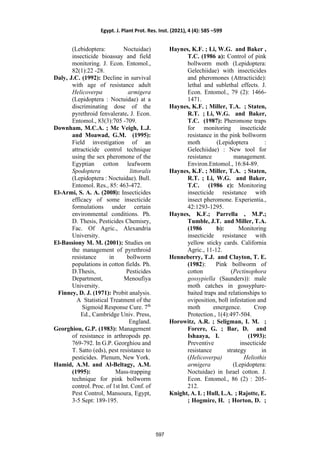
placed each insert card into the holding
container ( Figure 4 ) . - The cards are
collected at dawn to avoid the heat of
the day, the trapped moths will not be
well if they were allowed to warm up in
the morning sun. - Cards are kept away
of the sun in the shadow until they
delivered from the field to their storage
sites.- It is very important to store the
insert cards in the holding containers in a
constant temperature 21 ± 3 ºC for 12
hours. After 6 hr and 12 hr cards are
removed from container and mortality
are recorded. - The adults are scored as
alive if any movement is recorded (i.e.,
leg, abdomen, wing even the antenna).
The insects are recorded as died if they
do not move at all. - Each dose and
control are replicated three times.- When
all doses and cards are accounted and
all insects are checked for mortality,
these data together with the mortality of
controls for each insecticide are
analyzed by probit analysis computer
program (Finney, 1971) to determine
slope, LC50 and LC95 values. Resistance
ratios (RR) at LC50 or LC95 are
calculated by dividing LC50 for field
strain, of each species, by LC50 of
laboratory (Reference) strain. Abbott's
formula (Abbott, 1925) is used to correct
mortality according to mortality control
traps.
4. Biochemical confirmations :
Biochemical studies ( Enzymes
and /or proteins ) are conducted for the
confirmation of insecticides resistance
development in insect pest field strains
data that are recorded by the pheromone
traps technique, throughout enzymes
activity determinations and total protein
electrophoretic assays (Al-Beltagy,
Egypt. J. Plant Prot. Res. Inst. (2021), 4 (4): 585 –599
593
1993, Albeltagy et al., 2001a and
Albeltagy et al., 2001 b ).
5. The recommendation:
Many advantages have been
indicated for the use of the attracticide
resistance monitoring technique (
ARMT ), some of these advantages – as
a tool for indicating the efficacy of
different insecticides are :- 5.1. It is
easy, whereas no need to complicate
equipment or high technology tools, but
only use some delta pheromone traps.
5.2. It is speed, whereas it is applied by
sunset and get data by next morning
sunrise, just after about 12 hours of
applications. 5.3. It is effective,
whereas it is applied in a very short
period ( As mentioned above ), so there
is no interference of any changeable
environmental conditions . 5.4. It is
applied directly against the field insect
population strains, whereas no need for
the mass rearing techniques and
facilities.5.5. It is very accurate – for the
above mentioned advantages –
compared to the conventional
insecticide bioassay techniques which
depend on the application against insect
colonies that are got from rearing
facilities for a few generations which
cause that these strains may be very
closed to the susceptible strains.
Figure (1): Yellow paper delta pheromone traps over cotton plants.
Figure ( 2 ) : Rubber septum pheromone sources.
Albeltagy , 2021
594
Figure (3): Adult moths sticked to sticky sheet.
Figure (4): Adult moths holding container.
References
Abbott, W.S. (1925): A method of
computing the effectiveness of
an insecticide. J. Econ.
Entomol., 18 : 265-267.
Al-Beltagy, A.M. ; El-Mourshedy,
and Mourad, A.K. (1996):
Pheromone traps for monitoring
insecticide tolerance in three
different lepidopterous insects:
an effective tool for insecticide
resistance management. Egypt.
J. Agric. Res., 74 (1): 29-37.
Al-Beltagy, A. M.; Radwan, H. S. ;
El-Bermawy, Z. A. ; Nassar,
M. E. ; Yousef, A. G. and
Shekeban, M. M. (2001):
Attracticide resistance
monitoring technique for
assaying insecticide resistance
in pink bollworm male moths,
Pectinophora gossypiella (S)
field populations. Egypt. J.
Agric. Res., 79 (3): 949-963.
Al-Beltagy, A.M. ; Shawir, M. S. ;
Osman, K.A. ; Abo El-Saad,
M.M. and Mourad, M. A.
(1993): Biochemical technique
for measuring susceptibility of
pink bollworm, Pectinophora
gossypiella to certain
insecticides. Alex. J. Agric.
Res., 38 (3): 393-411.
Al-Beltagy, A.M.; Radwan, H.S. ;
Abo El-Ghar, G.E. ; Ammar,
I.M. ; Eisa, A.A. ; Shekiban,
M.M. and El Bassiony, M.M.
( 2001a): Biochemical impact
of pyrethroid resistance
management in bollworms field
populations with Gossyplure
disruption technique .1- in
Egypt. J. Plant Prot. Res. Inst. (2021), 4 (4): 585 –599
595
relation to total protein
electrophoretic analysis. J. Adv.
Agric. Res. , 6(4) : 1029 –1041 .
Al-Beltagy, A.M.; Radwan, H.S. ;
Abo El-Ghar, G.E. ; Ammar,
I.M. ; Eisa, A.A. ; Shekiban,
M.M. and El Bassiony, M.M.
( 2001b) . Biochemical impact
of pyrethroid resistance
management in bollworms field
populations with Gossyplure
disruption technique .2- in
relation to AchE and total
esterases activity determination.
J. Adv. Agric. Res. , 6(4) : 1043
– 1055 .
Al-Beltagy, A.M.; Shaker, N.;
Taman, F.A. and El-Khishen,
S.A. (1991): The influence of
pheromone traps on the
infestation percentages and
population density of
bollworms in Alexandria and
Al-Behera Governorates. Proc.
of the 4th Arab Congress of
Plant Prot., Cairo, 1-5 Dec., 7
(3): 477-487.
Al-Beltagy, A.M.; Shawir, M.S.;
Othman, E.A.; Abo-Elsaad,
M.M. and Mourad, M.A.
(1993): Biochemical techniques
for measuring susceptibility of
pink bollworm, Pectinophora
gossypiella to certain
insecticides., Alex. J. Agric.
Res., 38 (3): 393-411.
Al-Beltagy, A.M.; Shekeban, M.
M.K. ; Abo El-Amayem,
M.M.; Kassem, S. M. I. ;
Mancee, A.H. and EL-Arami,
S.A. ( 2010 : Monitoring for
Pyrethroid resistance in pink
bollworm Pectinophora
gossypiella (Saunders) field
strains . Pest Management
Newsletter , 19(2) : 46-52 .
Al-Beltagy, A.M; Abo El-Amayem,
M.M.; Kassem, S. M. I.;
Mancee, A.H.; Shekeban, M.
M.K. and EL-Arami, S.A. (
2011): Assaying insecticidal
efficacy of some formulated
organophosphorus insecticides
against pink bollworm male
moth field strains using the
attracticide efficacy monitoring
technique. Resistant Pest
Management Newsletter, 21
(2): 7-13.
Al-Beltagy; A.M (1999): Plant and
insect triggers for sequential use
of gossyplure and insecticides
for pink bollworm control
actions . Egypt J. Agric. Res.,
77(4) : 1633 – 1643 .
Anonymous (1995): A study of the key
technique system of integrated
management against severe
damage by the cotton bollworm.
CAB Abstracts; record 9 of 19.
Brania , H. A. A. and Al-Beltagy,
A.M. (1996): Regional and
seasonal variations of pink
bollworm trap catches and boll
infestation relationships. Alex.
J. Agric. Res., 41 (3): 77-84.
Brewer, M.J. ; Trumble, J.T.;
Rodrigues, B.A. and Chaney,
W.E. (1990): Beet armyworm
adult and larval susceptibility to
three insecticides in managed
habitats and relationship to
laboratory selection for
resistance. J. Econ. Entomol.,
83(6):2136-2146.
Brewer, M.J. and Trumble, J.T.
(1989): Field monitoring for
insecticide resistance in beet
armyworm. J. Econ. Entomol.,
82(6): 1525-1526.
Bush, M.R.; Abd El-Aal, Y.A.I. and
Rock, G. C. (1993): Parathion
resistance and esterase activity
in codling moth (Lepidoptera:
Totricidae) from North Carolina
J. Econ. Entomol., 86(3):660-
666.
Campanhola, C. and Plapp, Jr F.W.
(1989): Pyrethroid resistance in
the tobacco budworm
Albeltagy , 2021
596
(Lebidoptera: Noctuidae)
insecticide bioassay and field
monitoring. J. Econ. Entomol.,
82(1):22 -28.
Daly, J.C. (1992): Decline in survival
with age of resistance adult
Helicoverpa armigera
(Lepidoptera : Noctuidae) at a
discriminating dose of the
pyrethroid fenvalerate. J. Econ.
Entomol., 83(3):705 -709.
Downham, M.C.A. ; Mc Veigh, L.J.
and Moawad, G.M. (1995):
Field investigation of an
attracticide control technique
using the sex pheromone of the
Egyptian cotton leafworm
Spodoptera littoralis
(Lepidoptera : Noctuidae). Bull.
Entomol. Res., 85: 463-472.
El-Armi, S. A. A. (2008): Insecticides
efficacy of some insecticide
formulations under certain
environmental conditions. Ph.
D. Thesis, Pesticides Chemisry,
Fac. Of Agric., Alexandria
University.
El-Bassiony M. M. (2001): Studies on
the management of pyrethroid
resistance in bollworm
populations in cotton fields. Ph.
D.Thesis, Pesticides
Department, Menoufiya
University.
Finney, D. J. (1971): Probit analysis.
A Statistical Treatment of the
Sigmoid Response Cure. 7th
Ed., Cambridge Univ. Press,
England.
Georghiou, G.P. (1983): Management
of resistance in arthropods pp.
769-792. In G.P. Georghiou and
T. Satto (eds), pest resistance to
pesticides. Plenum, New York.
Hamid, A.M. and Al-Beltagy, A.M.
(1995): Mass-trapping
technique for pink bollworm
control. Proc. of 1st Int. Conf. of
Pest Control, Mansoura, Egypt,
3-5 Sept: 189-195.
Haynes, K.F. ; Li, W.G. and Baker ,
T.C. (1986 a): Control of pink
bollworm moth (Lepidoptera:
Gelechiidae) with insecticides
and pheromones (Attracticide):
lethal and sublethal effects. J.
Econ. Entomol., 79 (2): 1466-
1471.
Haynes, K.F. ; Miller, T.A. ; Staten,
R.T. ; Li, W.G. and Baker,
T.C. (1987): Pheromone traps
for monitoring insecticide
resistance in the pink bollworm
moth (Lepidoptera :
Gelechiidae) : New tool for
resistance management.
Environ.Entomol., 16:84-89.
Haynes, K.F. ; Miller, T.A. ; Staten,
R.T. ; Li, W.G. and Baker,
T.C. (1986 c): Monitoring
insecticide resistance with
insect pheromone. Experientia.,
42:1293-1295.
Haynes, K.F.; Parrella , M.P.;
Tumble, J.T. and Miller, T.A.
(1986 b): Monitoring
insecticide resistance with
yellow sticky cards. California
Agric., 11-12.
Henneberry, T.J. and Clayton, T. E.
(1982): Pink bollworm of
cotton (Pectinophora
gossypiella (Saunders)): male
moth catches in gossyplure-
baited traps and relationships to
oviposition, boll infestation and
moth emergence. Crop
Protection., 1(4):497-504.
Horowitz, A.R. ; Seligman, I. M. ;
Forere, G. ; Bar, D. and
Ishaaya, I. (1993):
Preventive insecticide
resistance strategy in
(Helicoverpa) Heliothis
armigera (Lepidoptera:
Noctuidae) in Israel cotton. J.
Econ. Entomol., 86 (2) : 205-
212.
Knight, A. L ; Hull, L.A. ; Rajotte, E.
; Hogmire, H. ; Horton, D. ;
Egypt. J. Plant Prot. Res. Inst. (2021), 4 (4): 585 –599
597
Polk, D. ; Walgenbach, J.;
Weires, R. and Wnalon, J.
(1990): Monitoring azinphos-
methyl resistance in adult male
Platynota idaeusalis.
(Lepidoptera : Tortricidae) in
apple from Georgia to New
York. J. Econ. Entomol.,
83(2):329-334.
Knight, A. L. and Hull, L. A. (1989):
Sex pheromone traps to monitor
azinphosmethyl resistance in
tufted apple bud moth
(Lepidoptera: Tortricidae). J.
Econ. Entomol., 82(4): 1019-
1026 .
Miller, T.A. (1986): Status of
resistance in the cotton insect
complex. Beltwide Cotton
Production Research Conf.,
162-165.
Miller, T.A. (1990): Resistance
monitoring of pink bollworm
California Department of Food
and Agriculture (CDFA), pink
bollworm final report , 146-147.
Mink, J.S. and Boethel, D.J. (1992):
Development of a diagnostic
technique for monitoring
permethrin resistance in
soybean looper larvae
(Lepidoptera : Noctuidae).
J.Econ. Entomol., 85(4):10565-
10620.
Pasquier, D. and Charmillot, P.J.
(2003): Effectiveness of twelve
insecticides applied topically to
diapausing larvae of the codling
moth, Cydia pomonella L. Pest.
Manag. Sci., 60 (3):305–308.
Pimentel, D. (2005): Environmental
and economic costs of the
application of pesticides
primarily in the United States.
Environ. Develop. and Sustain.,
7 (2): 229-252.
Prabhaker, N. ; Toscano, N.C. ;
Perring, T.M. ; Nuessley, G. ;
Kido, K. and Youngman, R.R.
(1992): Resistance monitoring
of the sweet potato whitefly in
the imperial valley of
California. J. Econ. Entomol.,
85 (4):1063-1068.
Qureshi, Z. A. ; Ahmad, N. and
Hussain, T. (1993): Pheromone
trap catches as a means of
predicting damage by pink
bollworm larvae in cotton.
Crop. Protection, 12(8): 597-
600.
Riedl, H. ; Seaman, A. and Henrie, F.
(1985): Monitoring
susceptibility to azinphos-
methyl in field population of the
codling moth (Lepidoptera:
Tortricidae) with pheromone
traps. J. Econ. Entomol., 78 (1)
: 692-699.
Roush, R. T. and McKenzie, J. A.
(1987): Ecological genetics of
insecticide and acaricide
resistance. Ann.Rev. Entomol.,
32: 361-380.
Roush, R.T. and Miller, G.L. (1986):
Considerations for design of
insecticide. J. Econ. Entomol.,
87 (2): 184-192.
Rummel, D.R. (1990): Pheromone in
pest detection and pest
management, CDFA, pink
bollworm final report., 145-
146.
Sanderson, J.P. and Roush, R.T.
(1992): Monitoring insecticide
resistance in green house
whitefly with yellow sticky
cards. J. Econ. Entomol.,
85(3):634-642.
Sanderson, J.P. ; M.P. Parrella and
J.T. Trumble (1989).
Monitoring insecticide
resistance in Liriomyza trifolii
(Diptera : Agromyzidae) with
yellow sticky cards. J. Econ.
Entomol., 82(4):1011-1018.
Schouest, L.P. Jr. and Miller, T.A.
(1988): Factors influencing
pyrethroid toxicity in pink
bollworm (Lepidoptera :
Albeltagy , 2021
598
Gelechiidae) : Implications for
resistance management. J.
Econ. Entomol., 81(2):431-436.
Shekeban, M. M. K. (2000): Studies
on insecticide resistance in
certain major cotton insects
Department of Pesticides,
Faculty of Agriculture,
Menoufiya University.
Tabashnik, B.E. ; Rethwisch, M.D.
and Johnson, M.W. (1988):
Variation in adults mortality and
knockdown caused by
insecticides among populations
of diamondback moth
(Lepidoptera : Plutellidae).
J.Econ. Entomol., 81(2):437-
441.
Tabashnik, B.E. and Cushing, N.L.
(1987): Leaf residues topical
bioassay for assessing
insecticide resistance in the
diamondback moth. FAO plant
Prot. Bull., 35:11-14.
Tamhankar, A.J. ; Gahukar,
R.T. and Rajendran,
T.P. (2000): Pheromones in the
management of major
lepidopterous and coleopterous
pests of cotton. Integr. Pest.
Manag. Rev., 5 (1) :11-23.
Varela, L.G.; Wekter, S.C.; Jones,
V.P.; Brunner, J.F. and Riedl,
H. (1993).: Monitoring and
characterization of insecticide
resistance in codling moth
(Lepidoptera : Torticidae) in
four Western States. J. Econ.
Entomol., 86 (1): 1-10.
Egypt. J. Plant Prot. Res. Inst. (2021), 4 (4): 585 –599
599
Pheromone traps for the estimating insecticides efficacy

Pheromone traps for the estimating insecticides efficacy

  • 1.
    Pheromone traps forthe assessment of insecticides efficiency and monitoring insecticides resistance in insect field strains Abdallah, M. Albeltagy Plant Protection Research Institute, Agricultural Research Center, Dokki, Giza, Egypt. ARTICLE INFO Article History Received: 20/ 10 / 2021 Accepted: 22/ 12 /2021 Abstract: Up to date insecticides are the backbone of agricultural industry (Agricultural Mass Production) and for public health protection purposes. Annually, trillions of US $ are lost as a result of insect infestations and damages in different agric. Crops around the world , even under the heavy use of insecticidal applications because of the control failure of many inefficient insecticides , that is happen because many insect field strains have developed resistance against these compounds. For the purposes of assaying insecticides efficiency and resistance in insect field strains, it's required to apply huge amounts of insecticides in many sequential treatments, investigate huge amounts of agric. crop fields, collect huge amounts of crop samples (Vegetation and / or fruit parts), rather than environmental pollution, human health hazards, using application equipments which require a lot amounts of effort, time and money. It's recommended here to use pheromone traps technique for the assessment of insecticides efficiency, monitoring insecticides resistance in insect field strains instead of the insecticides conventional applications to overcome all the above mentioned problems and to apply an advanced insecticides resistance management throughout an integrated pest management (IPM) with a very simple, easy, quick, and efficient technique. Keywords Pheromone, insecticides, assessment, resistance and insects. Introduction Formulated pesticides are used in a large scale through the world as a major mean for pest management and control. Although pesticides provide numerous benefits in terms of increased agricultural production and improve its quality, but their efficacy may be not often good because of the development of insecticide resistance in many pest species. Resistance to one or more pesticides has been documented in more than 447 species of insects and mites (Roush and McKenzie, 1987). Pesticide resistance is an increasingly urgent worldwide problem. Resistance in vectors of human disease, particularly malaria-transmitting mosquitoes, is a serious threat to public health in many nations. Agricultural productivity is jeopardized because widespread resistance in crop and livestock pests. Serious resistance problem is also evident in pests of the urban environment, most notably cockroaches. Resistance to insecticides is one of the most serious problems facing agriculture today. Many previous studies revealed the high resistance of pink bollworm to insecticides in the cotton fields. In Egypt, several Egyptian Journal of Plant Protection Research Institute www.ejppri.eg.net Egypt. J. Plant Prot. Res. Inst. (2021), 4 (4): 585 –599 585
  • 2.
    pyrethroids and organophosphorus havebeen widely used against cotton pests. However, although pyrethroid and organophosphorus insecticides were the most efficient and widely used against bollworms but the onset of resistance development to these compounds in bollworms have been recently documented (Georghiou, 1983; Haynes et al., 1987; Miller, 1990 and Shekeban, 2000). The major economic losses due to the pesticide resistance in the USA were: $1.5 billion (Pimentel, 2005). The price of insecticide resistance in lost yields and higher insect control costs is staggering - in some years more than 1 billion $ in cotton for the budworm/bollworm complex alone. In IPM, pheromones are considered to be an essential component because they are used for detecting the economic threshold levels of pest populations and for mating disruption as a direct pest suppression measure. Pheromones of major pests have been found to be effective, economic and eco-friendly in agro- ecosystems in which cotton is cultivated (Tamhankar et al., 2000). For resistance management tactics to be effective, resistance must be detected in its early stage (Roush and Miller, 1986) and early detection necessitates using one or more techniques that being accurate, easy, rapid and inexpensive, which would aid production, consultants and extension personal in making informed decisions on adequate control measures (Mink and Boethel, 1992). Firstly, the traditional approach uses complete dose-response tests with 4-5 doses that produce 10-90% mortality. Resistance is expressed in terms of the ratio of LD50 or LC50 of the resistant strain to that of the susceptible strain. Alternatively, an approach called the discriminating or diagnostic dose test was used where one dose is often investigated and the mortality of the susceptible test strains is compared (Pasquier and Charmillot, 2003). Another approach is the attracticide method which was developed in summer of 1985 as a rapid test to determined resistance in pink bollworm adult in cotton fields. The attracticide method was full implementation in 1986 and 1987 as an effective method to monitor insecticide resistance to pink bollworm to a wide range of insecticides (Miller, 1986 and Haynes et al ,1986 c and 1987). Detection of changes in response is needed, especially in the early stages of resistance development. Monitoring insecticide resistance in field population moth is in great importance in resistance management programs (Tabashnik and Cushing, 1987). In Egypt, very few dose mortality studies using attrcticides resistance monitoring technique were carried out (Al-Beltagy et al., 1993). Therefore, it is important to study efficacy of insecticides against insect field strains in Nile Basin countries to establish a program for controlling and reducing the resistance level of these pest to insecticides. Such a program could be efficiently used to reduce number of insecticide sprays; cost of insecticides and increases the crop production per unit. This review is concentrated on the use of attracticide resistance monitoring technique against different insect field strains and its modified procedure. 1. Attracticide resistance monitoring technique (ARMT) review: Henneberry and Clayton (1982) conducted studies to determine the relationship between catches of male insects in pheromone-baited traps and crop infestation. Numbers of male moths of the pink bollworm, Pectinophora gossypiella (Saunders) (Lepidoptera: Gelechiidae), caught daily in cotton fields at the University of Arizona Cotton Research Center, Albeltagy , 2021 586
  • 3.
    Phoenix, Arizona, ingossyplure-baited traps were variable. However, average catches of male moths for 3–7 days between boll-sampling periods were strongly correlated with oviposition on cotton bolls, percentages of infested bolls and numbers of larvae per boll. Average weekly numbers of moths emerging from infested cotton were also strongly correlated with the number of males caught. The number of females emerging was strongly correlated with oviposition on cotton bolls. Insecticide applications of carbaryl and fenvalerate reduced catches of male moths of pink bollworm in gossyplure-baited traps compared with catches in traps in untreated fields (Average 56%). However, 13–48 male moths/trap per night were caught in the treated fields after applications. Thus, scheduling treatments on the basis of male moth trap catches, except for the initial treatment, was not feasible. Small field sizes, moth immigration and/or continuing emergence from the infested cotton in the fields may have obscured the impact of the insecticide treatments on adult moth populations. Riedl et al. (1985) developed a procedure to screen field population of codling moth, Cydia pomonella (L) (Lepidoptera: Tortricidae), directly for resistance to azinphos-methyl or other toxicants. Male moths were collected in the field with pheromone traps and assayed with azinphos-methyl by topical application to the insects directly on the adhesive coated-trap surface. The LC50 of moths trapped during the spring flight was somewhat higher (0.22 µg / moth) than during the summer (0.08 – 0.16 µg / moth). The longevity of moths and their toxicological response was not affected by the polybutene adhesive which was applied as a thin uniform film to the trap surface. Susceptibility to azinphos- methyl increased considerably with age in both sexes and was not correlated with loss in body weight. Haynes et al. (1986 a) reported that the effectiveness of combinations of insecticides with pheromones (attracticides) for control of the pink bollworm (PBW) P. gossypiella may depend on, among other factors, males freely contacting attracticide source, insecticide-induced mortality, and sublethal interference with the male locating sequence in poisoned males. In flight-tunnel tests, males readily, contacted pheromone sources containing permethrin, fenvalerate, or cypermethrin and suffered mortality. Moreover, after 24 hr survivors were less likely to complete the normal behavioral sequence involved in sex pheromone- mediated mate location. The latter sublethal effects may contribute substantially to the effectiveness of the attracticide technique at the doses of insecticides used in the field. Cypermethrin induced lethal and sublethal effects at a lower concentration than other insecticides tested. Chlordimeform appears to be a poor candidate for attracticide formulations because males avoided contact with this insecticide. Recovery from sublethal effects of cypermethrin occurred after 48 hrs. and represents potential limitations to sublethal modification of behavior for population control. Haynes et al. (1986 b) tested the use of yellow sticky cards to monitor resistance by incorporating various dosages of a selected insecticide into the sticky material on the cards and then seeing if reproducible dose–mortality relationships could be generated from adults flies caught on the cards. The technique was tested with laboratory strains to select the appropriate sticky material, suitable thickness and best time for evaluation of mortality. They found that, the yellow sticky cards are effective when used in monitoring populations of many insect species, and Egypt. J. Plant Prot. Res. Inst. (2021), 4 (4): 585 –599 587
  • 4.
    in monitoring resistancelevels to insecticides. Haynes et al. (1986 c) described a novel pheromone-baited sticky trap laced with insecticides proved to be a sample and effective means of monitoring insecticide resistance in pink bollworm moth. Adult males from field treated frequently with pyrethroid insecticides showed up to 20–fold resistance to permethrin and up to 14.5-fold resistance to fenvalerate. Information from the resistance-monitoring traps could be used to time the rotation of other chemicals. Miller (1986) reported that a population of tobacco budworm Heliothis virescens (Fabricius) from the West Texas cotton fields was found to have a 15-20 fold resistance to pyrethroid insecticides. A new method of measuring resistance in the field, the attracticide method was perfected for adults pink bollworm, P. gossypiella. In the attracticide method adult moths collects themselves, sex themselves and dose themselves. The field worker then collects the traps and counts mortality after two days without handling the moths themselves. Haynes et al. (1987) reported that a rapid technique using sex pheromone and insecticide-laced traps was developed for measuring insecticide resistance in pink bollworm moth. This method was developed in the laboratory by allowing males to fly up wind to a sex –pheromone source in a wind tunnel and then trapping them on sticky cards inserted into standard delta traps (delta traps are used for trapping and monitoring Lepidopteran pests or other good-flyer insect pests. They can be used to monitor in orchards, large row crop plantations, small vegetable plots, indoors, etc. Dimensions 12 x 10 x 18 cm. In orange, yellow, or white). Using this technique, populations of adult male P. gossypiella trapped in the field were shown to be more resistant to permethrin and fenvalerate in field frequently treated with pyrethroids than in fields with little or no exposure to these insecticides. The new method eliminates handling of insects that is involved in other methods of assessing toxicity and is compatible with the current practice of monitoring populations with pheromone traps. Schouest and Miller (1988) measured toxicities of fenvalerate and permethrin on a laboratory strain of adult male of pink bollworm by attracticide bioassay. Delta trap was used with a sticky adhesive- coated cards insert containing the insecticide concentration placed in the trap bottom. A rubber septum with 1 mg gossyplure acted as a pheromone source. The caught moths were placed in constant temperature chambers. Data from the attracticide bioassay fit the probit model well and gave a precise estimate of a discriminating dose. Tabashnik et al. (1988) monitored resistance in diamondback moth larvae by testing pheromone-attracted males. Three populations were tested for mortality and knockdown responses to fenvalerate, DDT, permethrin and diazinon. Males and females responded similarly. Adult mortality and knockdown were correlated with larval LC50 ʼs across insecticide – population combinations, but adults from one population with DDT- resistant larvae were not resistant to DDT. Brewer and Trumble (1989) developed a technique for monitoring insecticide resistance in field populations of beet armyworm Spodoptera exigua (Hubner), and compared with conventional topical bioassay. Inescticides were incorporated into the adhesive of a pheromone trap thereby combining insect collection with insecticide application. This attractant trap technique (ATT) provided stable LC50 s with low control mortality when traps were incubated at 21 ºC for 30-36 hrs. after insects were captured. LC50ُ s of a laboratory colony tested with Albeltagy , 2021 588
  • 5.
    fenvalerate, permethrin andmethomyl were 95.6, 142 and 11.5 µg/g of adhesive, respectively. Slopes of probit regression for males were similar for topical and ATT bioassay indicating a parallel response of the insect to the two methods. Resistance ratios at LC50 from (ATT) ranged from 3 to 7.3 for fenvalerate, 1.5 to 2.5 for permethrin and 7.1 to 33 for methomyl. Campanhola and Plapp (1989) conducted tests to detect reasons for the loss of pyrethroid resistance which occurs in laboratory and field strains of the tobacco budworm in the absence of continuous exposure to pyrethroid insecticides. Attracticide pheromone traps were used in these tests. Larvae of a resistant strain (ICI) maintained in the laboratory developed more slowly than larvae of susceptible laboratory strain. The ICI females were less fertile and produced fewer eggs per individual than susceptible females. In addition, ICI females produced significantly less pheromone and attracted fewer males than did susceptible females. Susceptible males were more attracted to pheromone traps than resistant males. Knight and Hull (1989) investigated the use of sex pheromone traps to monitor the susceptibility of adult male tufted apple bud moths to azinophosmethyl in laboratory experiments and field trials in a number of apple orchards in South Central Pennsylvania and West Virginia. Two techniques were compared: the topical treatment of males caught on the trap ُs sticky surface and the incorporation of the insecticide directly into the adhesive. Compared with the laboratory strain, LD50 ‫ۥ‬s populations from apple orchards were 2 to 8 times greater in the topical application bioassays and 6 to 18 times greater in the adhesive incorporation assay. Sanderson et al. (1989) used yellow sticky cards with thin layers of insecticide – sticker mixture as a bioassay to determine insecticide resistance in adult Liriomyza trifolii, (Burgess) (Diptera: Agromyzidae) , mortality was used to estimate the degree of resistance of a given population to insecticides. Duration of exposure to insecticide before mortality evaluation was standardized at 24 hrs. Control mortality increased with increasing amounts of sticker on the cards and with increasing adult age. Males were slightly more susceptible to permethrin and chlorpyrifos insecticides than females. The sticky card bioassay a simple procedure that is accurate repeatable and usable for field or greenhouse populations. Brewer et al. (1990) used a field bioassay that measure adult male susceptibility to document resistance to fenvalerate, permethrin and methomyl in beet armyworm S. exiqua . Susceptibility of adult males to these insecticides was monitored in field with technical insecticide mixed into the adhesive of pheromone traps. At the LC50, the highest levels of resistance were typically found at many sites. Geographic and temporal variability in resistance followed this trend: overall variation among regions > variation among sampling dated at the same site within a region ≥ variation among sites in a region within three consecutive days. Knight et al. (1990) used sex pheromone traps coated with concentrations of azinophosmethyl impregnated adhesive to test levels of resistance in adult populations of male tufted apple bud moth from apple orchards in seven Eastern States. The results suggest that the level of resistance found within an orchard may be influenced the intensity of fruit production within a region. Level of resistance to azinophosmethyl was positively correlated with current seasonal carbamate use and was not significantly correlated with current use of azinophosmethyl or other organophosphates. Levels of resistance Egypt. J. Plant Prot. Res. Inst. (2021), 4 (4): 585 –599 589
  • 6.
    and fruit injurywere both significantly correlated with population densities. Miller (1990) determined the toxicity of carbamate, organophosphorus and pyrethroids insecticides by the attracticide method to field populations of pink bollworm in cotton growing areas of Texas, Arizona, California, Mexico and China. A gradual increase in tolerance to pyrethroid was correlated with high use of these insecticides. A resistance management program for insecticides used in control of pink bollworm is now a possibility and will require considerable cooperation at the grower level. Rummel (1990) reported that during recent years the use of pheromone traps has enabled significant advances to be made in survey, detection and sampling techniques for the boll weevil, pink bollworm, bollworm Heliothis zea (Boddie) and tobacco budworm H. virescens (F) (Lepidoptera: Noctuidae). Daly (1992) determined the dose response in different age classes of adults of H. armigera (H) by exposing moths to a discriminating dose of fenvalerate using an adult vial test and reported a decline in survival with age so that by 8d after exclusion 60-70% of resistant females and 97% resistant males died at the discriminating dose compared with < 5% of freshly emerged moths. Prabhaker et al. (1992) detected resistance in field populations of sweet potato whitefly, efficiently and sensitively using a resistance monitoring technique with yellow sticky cards sprayed with insecticides. Thirty–two populations exhibited various levels of resistance to sulprofos (Resistance ratio [RR] ranging from 19 to 104 and for cypermethrin (RR ranging from 14 to 82) indicating that insecticide resistance is widespread in the Imperial Valley of California. The advantages of this new method for monitoring resistance are discussed in relation to conventional leaf bioassay. Sanderson and Roush (1992) investigated the use of insect trap coated with insecticides mixed with a polybutene adhesive as a resistance monitoring technique for greenhouse whitefly. The technique provided accurate estimates of the mortality response of whiteflies after 24h, with minimal control mortality. The technique was used to estimate diagnostic concentration (LC99 of a susceptible strain) and then they were tested against the susceptible and resistant strains. Bush et al. (1993) performed a sticky-card bioassay on adult males captured with traps that revealed an 8 fold resistance to parathion in a population of codling moth C. pomonella . Parathion resistance in this population was confirmed with a sticky-card bioassay where adult males were exposed to a diagnostic concentration of 120 µg (a.i) parathion per gram adhesive (The estimated LC95 for adult males from susceptible populations). Reduced nonspecific esterase activity detected in adult males captured from the mechanism of codling moth, C. pomonella resistance to parathion may be a modified esterase with lower specificity for naphthyl acetate substrates. Horowitz et al. (1993) assayed the efficacy of the insecticide resistance management strategy, a long-term monitoring program in H. armigera was undertaken to test the response of this pest to various insecticides. The monitoring technique was based on the exposure of pheromone trap-caught males to groups of insecticides. The diagnostic concentration, established on LC 80-90 of a susceptible H. armigera field population were 0.57 µg endosulfan, 0.74 µg cypermethrin, 0.38 µg methomyl and 2.0 µg methidathion per scintillation vials. In general, the results indicate that the susceptibility of H. armigera to the test compounds was Albeltagy , 2021 590
  • 7.
    not appreciably alteredfrom 1987 to 1991, although fluctuations during the season were observed, in most cases, the resistance levels to the test compounds fluctuated in a typical V- shaped curve during the season. The susceptibility of H. armigera to the various insecticides observed during the course of this study is consistent with proposition that the insecticide resistance management (IRM) strategy can be correlated with successful management of resistance in this pest. Qureshi et al. (1993) used the male moth catches in gossyplure-baited traps to predict larval infestation of pink bollworm, P. gossypiella , in cotton fields during 1988 and 1989. The mean moth catches per trap per night were positively correlated with percentage larval infestation. The moth counts in traps and larval infestation in green bolls increased with advance in reproductive stage of the cotton plants. A mean trap catch of 9–12 pink bollworm moths per night was associated with economically damaging infestation. It is, therefore, inferred that insecticidal sprays may be scheduled when 9–12 moths are captured per trap per night.Varela et al. (1993) surveyed variation in response to insecticide in codling moth in California, Oregon, Utah and Washington using pheromone traps by two techniques (Topical application and direct incorporation of insecticide into the trap adhesive). LC75 from a susceptible population was as a standard dose and 20 apple and pear orchards were monitored for resistance to azinphos-methyl by the topical application. In laboratory tests, female moths were monitored as susceptible as male moths in bioassays with treated adhesive. Anonymous (1995) used an attracticide resistance monitoring technique with a set of key techniques system of integrated management against several damage by the cotton bollworm, H. armigera in Xin Xiang, China Demonstration Area, Henan, in the central Yellow River Valley cotton region in 1992 and 1993.Outbreaks of H. armigera were effectively controlled and good harvests were obtained using these techniques. These included improved medium term predication techniques, setting up action thresholds, measures to use and conserve natural enemies, systematic monitoring and management of insecticide resistance using pest resistance cotton germplasm and trapping adult noctuids. Downham et al. (1995) described a series of trials examining the feasibility of an attracticide technique for control of Spodoptera littoralis (Boisduval). Those trials were assessed by monitoring pheromone trap catches. Similar levels of mating and trap-catch suppression were observed in the two treatments. It was concluded that the mating suppression observed in attracticide plots was due principally to disruption of chemical communication between the sexes, not to male mortality arising from contact with the insecticide sources.Al-Beltagy et al. (1996) used pheromone delta sticky traps as an attracticide tolerance monitoring technique in two different locations having two different control strategies for the pink bollworm; one depending on insecticides and the other on pheromone disruption. The field recommended dose as its double and half rates of insecticides dursban and sumicidin were applied to the pheromone delta traps with pheromone sources for the pink bollworm, spiny bollworm. Pheromone tarps as an attracticide tolerance monitoring technique proved to be effective, simple and quick for assaying the moth field strains of Lepidoptera for insecticide resistance. Shekeban ( 2000 ) compare the efficiency of the attracticide resistance monitoring technique with different conventional bioassay Egypt. J. Plant Prot. Res. Inst. (2021), 4 (4): 585 –599 591
  • 8.
    techniques and vialtechnique. Al- Beltagy et al. (2001) used attracticide resistance monitoring technique for measuring insecticide resistance in pink bollworm (PBW) male moths, P. gossypiella (S). This technique eliminates handling of insect and is compatible with current practice of monitoring populations with pheromone traps. Results showed that, PBW developed resistance to all insecticides tested with R.R. of 19 and 12.7 folds for chlorpyrifos, 14.1 and 34.7 folds for delfose, 14.1 and 38.5 folds for empire and 22.6 and 56 folds for thiodicarb, respectively. This technique used to estimate discriminating concentration for tested insecticides. El-Bassiony (2001) used the attracticide resistance monitoring technique to study pyrethroids resistance under two different pink bollworm control strategies ( pheromone disruption technique and insecticides program . El-Armi (2008) used the attracticide resistance mentoring technique to study the development of insecticides resistance against pink bollworm in two different geographical strains. 2. Pheromone traps uses: 2.1. For assaying and monitoring insect pests population density and dynamics all the year round ( Al-Beltagy et al., 1991). 2.2. For assaying insect pests geographical distribution throughout its regional and seasonal abundance ( Brania and Al-Beltagy, 1996 ). 2.3. For insect pests mass trapping technique as a pest control tool (Hamid and Al- Beltagy,1995 ). 2.4. For assaying insecticides resistance development in insect pests field strains (Al-Beltagy et al., 1996 ; Al-Beltagy et al., 2000 and Al-Beltagy et al., 2010). 2.5. For measuring the successful of a pheromone disruption technique applied against any insect pest ( Al- Beltagy et al., 2001a and 2001b ). 2.6. For triggering biological and / or chemical control action ( Al-Beltagy, 1999 ). 2.7. For assaying the efficiency of different insecticides before any insecticide treatment ( Al-Beltagy et al., 2011 ). 3. Procedure : 3.1. Attracticide resistance monitoring technique (ARMT) : A novel resistance monitoring method was created and perfected for pink bollworm by Miller (1986) and Haynes et al. (1986 a and 1987) and was modified by Al-Beltagy et al.(1996 ) and Shekeban (2000) under the Egyptian conditions. This method employs pheromone baited delta traps ( Figure 1) that are usually used for assessment of populations of male moths. The conventional yellow paper delta traps supplied by the Ministry of Agriculture in Egypt are used for the population assessment in different cotton fields all over the country. 3.2. Laboratory bioassays: For ARMT laboratory bioassays, serial concentrations of each tested formulated pyrethroid and organophosphorous are diluted in acetone and mixed with sticky material. Condensed petroleum glue, as a trapped sticker, produced by Agrycins Corp., England, and supplied by Ministry of Agriculture, are used. Two grams of the sticky adhesive and different insecticide concentrations for pyrethroids ranged from 0.05 to 20 ppm and for OP’s ranged from 1 to 240 ppm. Each concentration for each insecticide is replicated three times on separate sheet card. Control without insecticide is included. Male moths are transferred from the rearing facility to the bioassay laboratory. Ten male moths are captured and sticked to the yellow sticky card which is treated before with the insecticide concentration as mentioned. The insert cards are kept under constant conditions of 21 ± 3C and 95 ± 5% R.H. Adult mortalities are recorded at 6 and 12 h-periods. Mortality is subjected Albeltagy , 2021 592
  • 9.
    for probit analysisto estimate LC50, LC95 and slope. Resistance ratios (R.R.) at LC50 (or LC95) are calculated by dividing each value for field strain, of each species, by corresponding value of laboratory reference strain. 3.3. Preparation of insecticide- pheromone-baited sticky trap: For preparation of pheromone- baited sticky trap laced with an insecticide the following technique is used: serial concentrations of each tested pyrethroid and organophosphorous formulations are diluted in acetone and mixed with sticky material. Condensed petroleum glue, as a trapped sticker, produced by Agrycins Corp., England, and supplied by Ministry of Agriculture, is used. Two grams of the sticky adhesive and an insecticide concentration are scarped on the trap insect sheet cards (Inserts) using putty knife starting with the lowest concentration and ending to the highest one, every time the putty knife is washed with kerosene and dried. Six diluted concentrations from each insecticide are used, with relative folds of the field recommended rate (F). 0.125 F, 0.25 F, 0.5 F, 1 F, 1.5 F and 2 F. These inserts (cards) are secured with paper for attracticide resistance monitoring technique (ARMT) field bioassays, the traps are baited with an appropriate commercially available pheromone lures (Figure 2 ) supplied by the Ministry of Agriculture in Egypt, for trapping techniques. 3.4. Field experiments: The field experiments are carried out twice during the growing seasons: 1) at the early-season when plant buds emerged, and 2) at the late- season when the fruits are up to the maturity as following steps: - Traps are hung on stakes higher 20-30 cm above the canopy of the plants and distributed by a rate of one trap / five feddans. - The dosed insert cards and control cards are placed into the delta traps with a pheromone source, randomly. All cards are inserted before sunset. - Traps are left overnight and collect quickly in the following morning. - All insert cards are collected at dawn with trapped adult male moths ( Figure 3 ) and checked for mortality %, this termed the zero time mortality %, then placed each insert card into the holding container ( Figure 4 ) . - The cards are collected at dawn to avoid the heat of the day, the trapped moths will not be well if they were allowed to warm up in the morning sun. - Cards are kept away of the sun in the shadow until they delivered from the field to their storage sites.- It is very important to store the insert cards in the holding containers in a constant temperature 21 ± 3 ºC for 12 hours. After 6 hr and 12 hr cards are removed from container and mortality are recorded. - The adults are scored as alive if any movement is recorded (i.e., leg, abdomen, wing even the antenna). The insects are recorded as died if they do not move at all. - Each dose and control are replicated three times.- When all doses and cards are accounted and all insects are checked for mortality, these data together with the mortality of controls for each insecticide are analyzed by probit analysis computer program (Finney, 1971) to determine slope, LC50 and LC95 values. Resistance ratios (RR) at LC50 or LC95 are calculated by dividing LC50 for field strain, of each species, by LC50 of laboratory (Reference) strain. Abbott's formula (Abbott, 1925) is used to correct mortality according to mortality control traps. 4. Biochemical confirmations : Biochemical studies ( Enzymes and /or proteins ) are conducted for the confirmation of insecticides resistance development in insect pest field strains data that are recorded by the pheromone traps technique, throughout enzymes activity determinations and total protein electrophoretic assays (Al-Beltagy, Egypt. J. Plant Prot. Res. Inst. (2021), 4 (4): 585 –599 593
  • 10.
    1993, Albeltagy etal., 2001a and Albeltagy et al., 2001 b ). 5. The recommendation: Many advantages have been indicated for the use of the attracticide resistance monitoring technique ( ARMT ), some of these advantages – as a tool for indicating the efficacy of different insecticides are :- 5.1. It is easy, whereas no need to complicate equipment or high technology tools, but only use some delta pheromone traps. 5.2. It is speed, whereas it is applied by sunset and get data by next morning sunrise, just after about 12 hours of applications. 5.3. It is effective, whereas it is applied in a very short period ( As mentioned above ), so there is no interference of any changeable environmental conditions . 5.4. It is applied directly against the field insect population strains, whereas no need for the mass rearing techniques and facilities.5.5. It is very accurate – for the above mentioned advantages – compared to the conventional insecticide bioassay techniques which depend on the application against insect colonies that are got from rearing facilities for a few generations which cause that these strains may be very closed to the susceptible strains. Figure (1): Yellow paper delta pheromone traps over cotton plants. Figure ( 2 ) : Rubber septum pheromone sources. Albeltagy , 2021 594
  • 11.
    Figure (3): Adultmoths sticked to sticky sheet. Figure (4): Adult moths holding container. References Abbott, W.S. (1925): A method of computing the effectiveness of an insecticide. J. Econ. Entomol., 18 : 265-267. Al-Beltagy, A.M. ; El-Mourshedy, and Mourad, A.K. (1996): Pheromone traps for monitoring insecticide tolerance in three different lepidopterous insects: an effective tool for insecticide resistance management. Egypt. J. Agric. Res., 74 (1): 29-37. Al-Beltagy, A. M.; Radwan, H. S. ; El-Bermawy, Z. A. ; Nassar, M. E. ; Yousef, A. G. and Shekeban, M. M. (2001): Attracticide resistance monitoring technique for assaying insecticide resistance in pink bollworm male moths, Pectinophora gossypiella (S) field populations. Egypt. J. Agric. Res., 79 (3): 949-963. Al-Beltagy, A.M. ; Shawir, M. S. ; Osman, K.A. ; Abo El-Saad, M.M. and Mourad, M. A. (1993): Biochemical technique for measuring susceptibility of pink bollworm, Pectinophora gossypiella to certain insecticides. Alex. J. Agric. Res., 38 (3): 393-411. Al-Beltagy, A.M.; Radwan, H.S. ; Abo El-Ghar, G.E. ; Ammar, I.M. ; Eisa, A.A. ; Shekiban, M.M. and El Bassiony, M.M. ( 2001a): Biochemical impact of pyrethroid resistance management in bollworms field populations with Gossyplure disruption technique .1- in Egypt. J. Plant Prot. Res. Inst. (2021), 4 (4): 585 –599 595
  • 12.
    relation to totalprotein electrophoretic analysis. J. Adv. Agric. Res. , 6(4) : 1029 –1041 . Al-Beltagy, A.M.; Radwan, H.S. ; Abo El-Ghar, G.E. ; Ammar, I.M. ; Eisa, A.A. ; Shekiban, M.M. and El Bassiony, M.M. ( 2001b) . Biochemical impact of pyrethroid resistance management in bollworms field populations with Gossyplure disruption technique .2- in relation to AchE and total esterases activity determination. J. Adv. Agric. Res. , 6(4) : 1043 – 1055 . Al-Beltagy, A.M.; Shaker, N.; Taman, F.A. and El-Khishen, S.A. (1991): The influence of pheromone traps on the infestation percentages and population density of bollworms in Alexandria and Al-Behera Governorates. Proc. of the 4th Arab Congress of Plant Prot., Cairo, 1-5 Dec., 7 (3): 477-487. Al-Beltagy, A.M.; Shawir, M.S.; Othman, E.A.; Abo-Elsaad, M.M. and Mourad, M.A. (1993): Biochemical techniques for measuring susceptibility of pink bollworm, Pectinophora gossypiella to certain insecticides., Alex. J. Agric. Res., 38 (3): 393-411. Al-Beltagy, A.M.; Shekeban, M. M.K. ; Abo El-Amayem, M.M.; Kassem, S. M. I. ; Mancee, A.H. and EL-Arami, S.A. ( 2010 : Monitoring for Pyrethroid resistance in pink bollworm Pectinophora gossypiella (Saunders) field strains . Pest Management Newsletter , 19(2) : 46-52 . Al-Beltagy, A.M; Abo El-Amayem, M.M.; Kassem, S. M. I.; Mancee, A.H.; Shekeban, M. M.K. and EL-Arami, S.A. ( 2011): Assaying insecticidal efficacy of some formulated organophosphorus insecticides against pink bollworm male moth field strains using the attracticide efficacy monitoring technique. Resistant Pest Management Newsletter, 21 (2): 7-13. Al-Beltagy; A.M (1999): Plant and insect triggers for sequential use of gossyplure and insecticides for pink bollworm control actions . Egypt J. Agric. Res., 77(4) : 1633 – 1643 . Anonymous (1995): A study of the key technique system of integrated management against severe damage by the cotton bollworm. CAB Abstracts; record 9 of 19. Brania , H. A. A. and Al-Beltagy, A.M. (1996): Regional and seasonal variations of pink bollworm trap catches and boll infestation relationships. Alex. J. Agric. Res., 41 (3): 77-84. Brewer, M.J. ; Trumble, J.T.; Rodrigues, B.A. and Chaney, W.E. (1990): Beet armyworm adult and larval susceptibility to three insecticides in managed habitats and relationship to laboratory selection for resistance. J. Econ. Entomol., 83(6):2136-2146. Brewer, M.J. and Trumble, J.T. (1989): Field monitoring for insecticide resistance in beet armyworm. J. Econ. Entomol., 82(6): 1525-1526. Bush, M.R.; Abd El-Aal, Y.A.I. and Rock, G. C. (1993): Parathion resistance and esterase activity in codling moth (Lepidoptera: Totricidae) from North Carolina J. Econ. Entomol., 86(3):660- 666. Campanhola, C. and Plapp, Jr F.W. (1989): Pyrethroid resistance in the tobacco budworm Albeltagy , 2021 596
  • 13.
    (Lebidoptera: Noctuidae) insecticide bioassayand field monitoring. J. Econ. Entomol., 82(1):22 -28. Daly, J.C. (1992): Decline in survival with age of resistance adult Helicoverpa armigera (Lepidoptera : Noctuidae) at a discriminating dose of the pyrethroid fenvalerate. J. Econ. Entomol., 83(3):705 -709. Downham, M.C.A. ; Mc Veigh, L.J. and Moawad, G.M. (1995): Field investigation of an attracticide control technique using the sex pheromone of the Egyptian cotton leafworm Spodoptera littoralis (Lepidoptera : Noctuidae). Bull. Entomol. Res., 85: 463-472. El-Armi, S. A. A. (2008): Insecticides efficacy of some insecticide formulations under certain environmental conditions. Ph. D. Thesis, Pesticides Chemisry, Fac. Of Agric., Alexandria University. El-Bassiony M. M. (2001): Studies on the management of pyrethroid resistance in bollworm populations in cotton fields. Ph. D.Thesis, Pesticides Department, Menoufiya University. Finney, D. J. (1971): Probit analysis. A Statistical Treatment of the Sigmoid Response Cure. 7th Ed., Cambridge Univ. Press, England. Georghiou, G.P. (1983): Management of resistance in arthropods pp. 769-792. In G.P. Georghiou and T. Satto (eds), pest resistance to pesticides. Plenum, New York. Hamid, A.M. and Al-Beltagy, A.M. (1995): Mass-trapping technique for pink bollworm control. Proc. of 1st Int. Conf. of Pest Control, Mansoura, Egypt, 3-5 Sept: 189-195. Haynes, K.F. ; Li, W.G. and Baker , T.C. (1986 a): Control of pink bollworm moth (Lepidoptera: Gelechiidae) with insecticides and pheromones (Attracticide): lethal and sublethal effects. J. Econ. Entomol., 79 (2): 1466- 1471. Haynes, K.F. ; Miller, T.A. ; Staten, R.T. ; Li, W.G. and Baker, T.C. (1987): Pheromone traps for monitoring insecticide resistance in the pink bollworm moth (Lepidoptera : Gelechiidae) : New tool for resistance management. Environ.Entomol., 16:84-89. Haynes, K.F. ; Miller, T.A. ; Staten, R.T. ; Li, W.G. and Baker, T.C. (1986 c): Monitoring insecticide resistance with insect pheromone. Experientia., 42:1293-1295. Haynes, K.F.; Parrella , M.P.; Tumble, J.T. and Miller, T.A. (1986 b): Monitoring insecticide resistance with yellow sticky cards. California Agric., 11-12. Henneberry, T.J. and Clayton, T. E. (1982): Pink bollworm of cotton (Pectinophora gossypiella (Saunders)): male moth catches in gossyplure- baited traps and relationships to oviposition, boll infestation and moth emergence. Crop Protection., 1(4):497-504. Horowitz, A.R. ; Seligman, I. M. ; Forere, G. ; Bar, D. and Ishaaya, I. (1993): Preventive insecticide resistance strategy in (Helicoverpa) Heliothis armigera (Lepidoptera: Noctuidae) in Israel cotton. J. Econ. Entomol., 86 (2) : 205- 212. Knight, A. L ; Hull, L.A. ; Rajotte, E. ; Hogmire, H. ; Horton, D. ; Egypt. J. Plant Prot. Res. Inst. (2021), 4 (4): 585 –599 597
  • 14.
    Polk, D. ;Walgenbach, J.; Weires, R. and Wnalon, J. (1990): Monitoring azinphos- methyl resistance in adult male Platynota idaeusalis. (Lepidoptera : Tortricidae) in apple from Georgia to New York. J. Econ. Entomol., 83(2):329-334. Knight, A. L. and Hull, L. A. (1989): Sex pheromone traps to monitor azinphosmethyl resistance in tufted apple bud moth (Lepidoptera: Tortricidae). J. Econ. Entomol., 82(4): 1019- 1026 . Miller, T.A. (1986): Status of resistance in the cotton insect complex. Beltwide Cotton Production Research Conf., 162-165. Miller, T.A. (1990): Resistance monitoring of pink bollworm California Department of Food and Agriculture (CDFA), pink bollworm final report , 146-147. Mink, J.S. and Boethel, D.J. (1992): Development of a diagnostic technique for monitoring permethrin resistance in soybean looper larvae (Lepidoptera : Noctuidae). J.Econ. Entomol., 85(4):10565- 10620. Pasquier, D. and Charmillot, P.J. (2003): Effectiveness of twelve insecticides applied topically to diapausing larvae of the codling moth, Cydia pomonella L. Pest. Manag. Sci., 60 (3):305–308. Pimentel, D. (2005): Environmental and economic costs of the application of pesticides primarily in the United States. Environ. Develop. and Sustain., 7 (2): 229-252. Prabhaker, N. ; Toscano, N.C. ; Perring, T.M. ; Nuessley, G. ; Kido, K. and Youngman, R.R. (1992): Resistance monitoring of the sweet potato whitefly in the imperial valley of California. J. Econ. Entomol., 85 (4):1063-1068. Qureshi, Z. A. ; Ahmad, N. and Hussain, T. (1993): Pheromone trap catches as a means of predicting damage by pink bollworm larvae in cotton. Crop. Protection, 12(8): 597- 600. Riedl, H. ; Seaman, A. and Henrie, F. (1985): Monitoring susceptibility to azinphos- methyl in field population of the codling moth (Lepidoptera: Tortricidae) with pheromone traps. J. Econ. Entomol., 78 (1) : 692-699. Roush, R. T. and McKenzie, J. A. (1987): Ecological genetics of insecticide and acaricide resistance. Ann.Rev. Entomol., 32: 361-380. Roush, R.T. and Miller, G.L. (1986): Considerations for design of insecticide. J. Econ. Entomol., 87 (2): 184-192. Rummel, D.R. (1990): Pheromone in pest detection and pest management, CDFA, pink bollworm final report., 145- 146. Sanderson, J.P. and Roush, R.T. (1992): Monitoring insecticide resistance in green house whitefly with yellow sticky cards. J. Econ. Entomol., 85(3):634-642. Sanderson, J.P. ; M.P. Parrella and J.T. Trumble (1989). Monitoring insecticide resistance in Liriomyza trifolii (Diptera : Agromyzidae) with yellow sticky cards. J. Econ. Entomol., 82(4):1011-1018. Schouest, L.P. Jr. and Miller, T.A. (1988): Factors influencing pyrethroid toxicity in pink bollworm (Lepidoptera : Albeltagy , 2021 598
  • 15.
    Gelechiidae) : Implicationsfor resistance management. J. Econ. Entomol., 81(2):431-436. Shekeban, M. M. K. (2000): Studies on insecticide resistance in certain major cotton insects Department of Pesticides, Faculty of Agriculture, Menoufiya University. Tabashnik, B.E. ; Rethwisch, M.D. and Johnson, M.W. (1988): Variation in adults mortality and knockdown caused by insecticides among populations of diamondback moth (Lepidoptera : Plutellidae). J.Econ. Entomol., 81(2):437- 441. Tabashnik, B.E. and Cushing, N.L. (1987): Leaf residues topical bioassay for assessing insecticide resistance in the diamondback moth. FAO plant Prot. Bull., 35:11-14. Tamhankar, A.J. ; Gahukar, R.T. and Rajendran, T.P. (2000): Pheromones in the management of major lepidopterous and coleopterous pests of cotton. Integr. Pest. Manag. Rev., 5 (1) :11-23. Varela, L.G.; Wekter, S.C.; Jones, V.P.; Brunner, J.F. and Riedl, H. (1993).: Monitoring and characterization of insecticide resistance in codling moth (Lepidoptera : Torticidae) in four Western States. J. Econ. Entomol., 86 (1): 1-10. Egypt. J. Plant Prot. Res. Inst. (2021), 4 (4): 585 –599 599