1
CONTROL STRATEGIES FOR FORMATION FLIGHT
IN THE VICINITY OF THE LIBRATION POINTS
K.C. Howell and B.G. Marchand
Purdue University
2
Previous Work on Formation Flight
• Multi-S/C Formations in the 2BP
– Small Relative Separation (10 m – 1 km)
• Model Relative Dynamics via the C-W Equations
• Formation Control
– LQR for Time Invariant Systems
– Feedback Linearization
– Lyapunov Based and Adaptive Control
• Multi-S/C Formations in the 3BP
– Consider Wider Separation Range
• Nonlinear model with complex reference motions
– Periodic, Quasi-Periodic, Stable/Unstable Manifolds
• Formation Control via simplified LQR techniques
and “Gain Scheduling”-type methods.
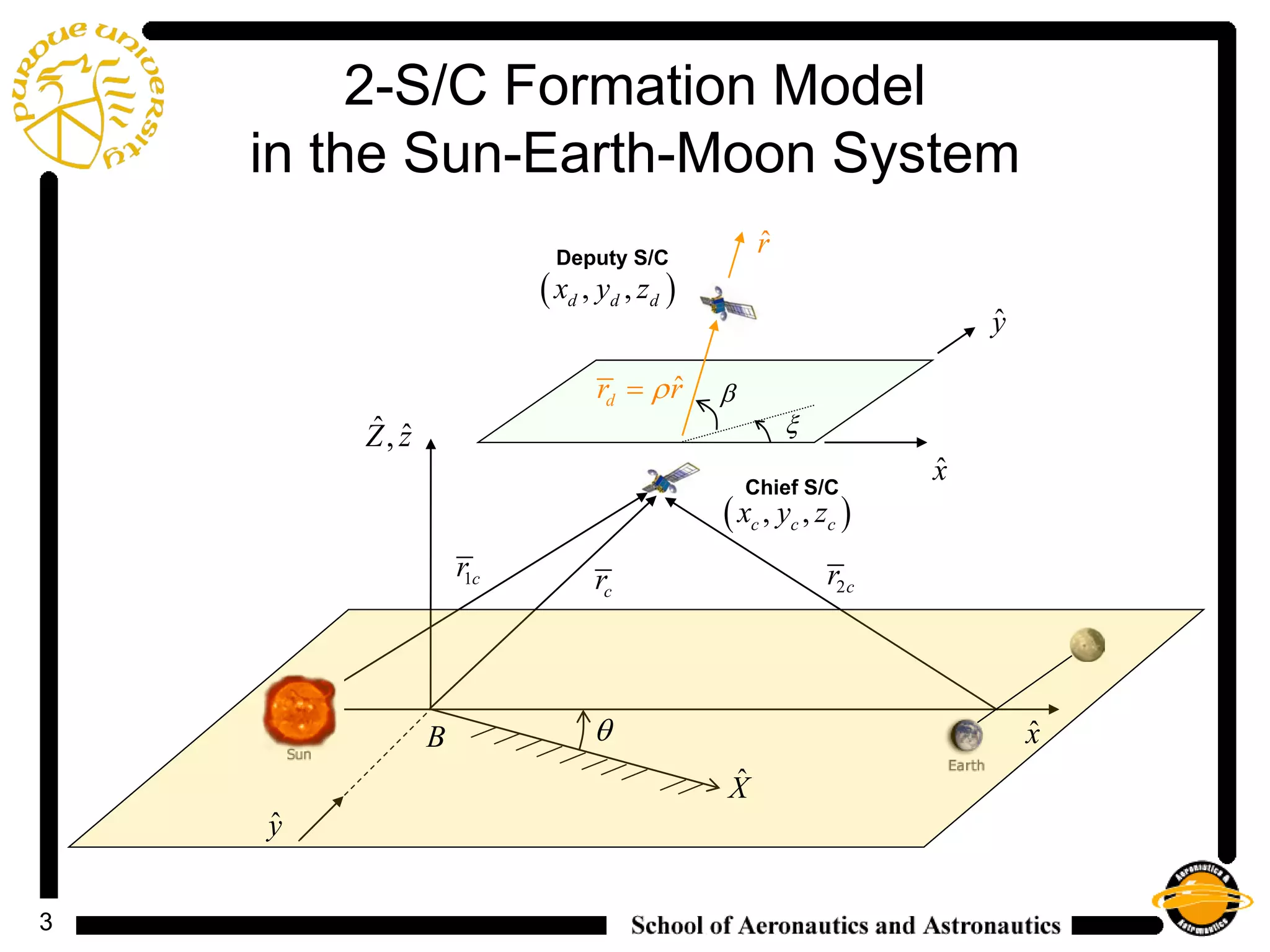
3
Deputy S/C
( ), ,d d dx y z
ˆx
ˆy
2-S/C Formation Model
in the Sun-Earth-Moon System
ˆX
ˆ ˆ,Z z
B
1cr
2crcr
ˆxθ
ˆy
Chief S/C
( ), ,c c cx y z
ˆdr rρ=
ˆr
ξ
β
4
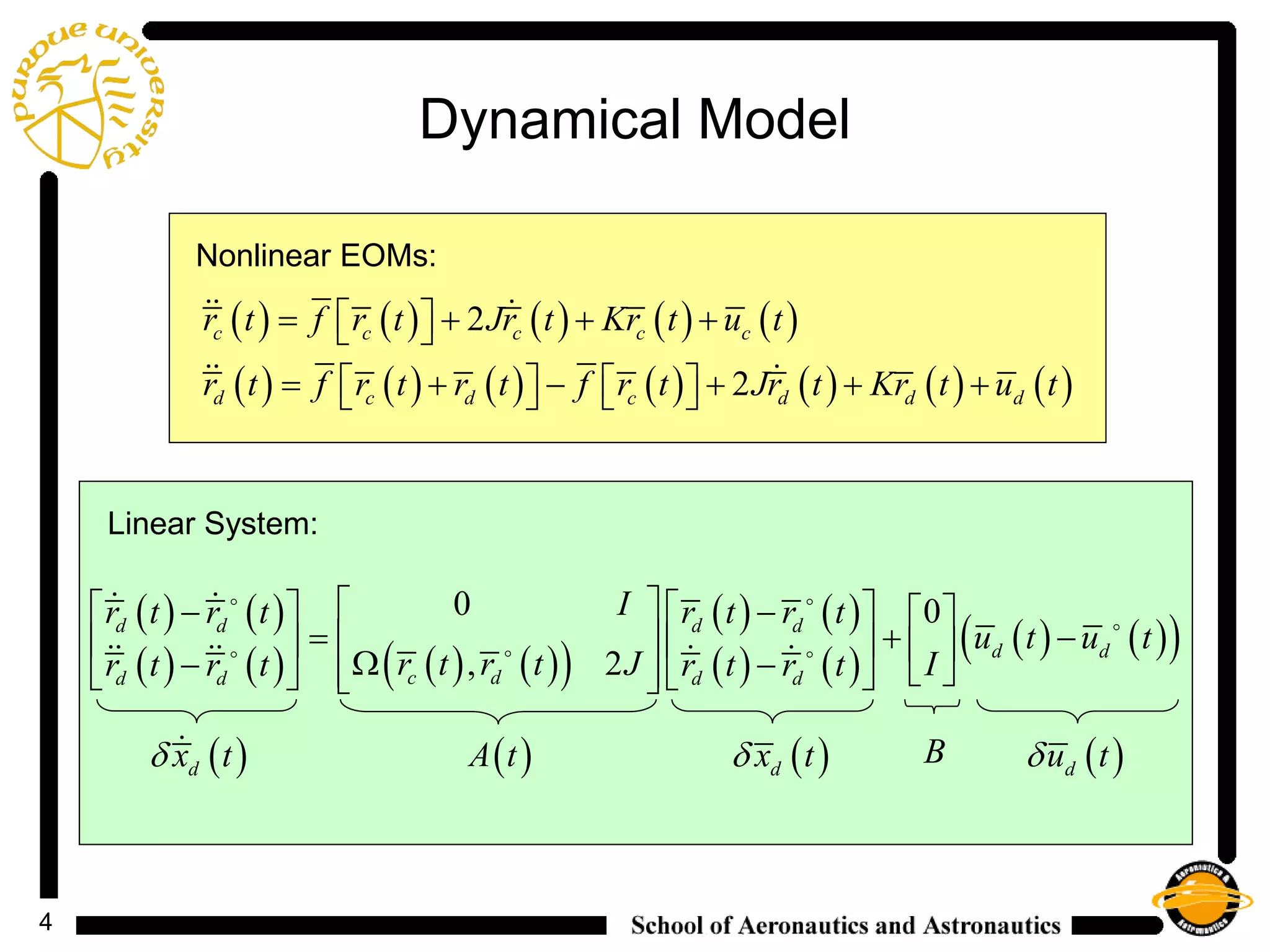
Dynamical Model
( ) ( ) ( ) ( ) ( )
( ) ( ) ( ) ( ) ( ) ( ) ( )
2
2
c c c c c
d c d c d d d
r t f r t Jr t Kr t u t
r t f r t r t f r t Jr t Kr t u t
= + + +  
= + − + + +      
 
 
Nonlinear EOMs:
( ) ( )
( ) ( ) ( ) ( )( )
( ) ( )
( ) ( )
( ) ( )( )
0 0
, 2
d d d d
d d
c dd d d d
Ir t r t r t r t
u t u t
r t r t J Ir t r t r t r t
    − −  
+ −      Ω− −       
 

 
 
   
Linear System:
( )A t B ( )du tδ( )dx tδ( )dx tδ 
5
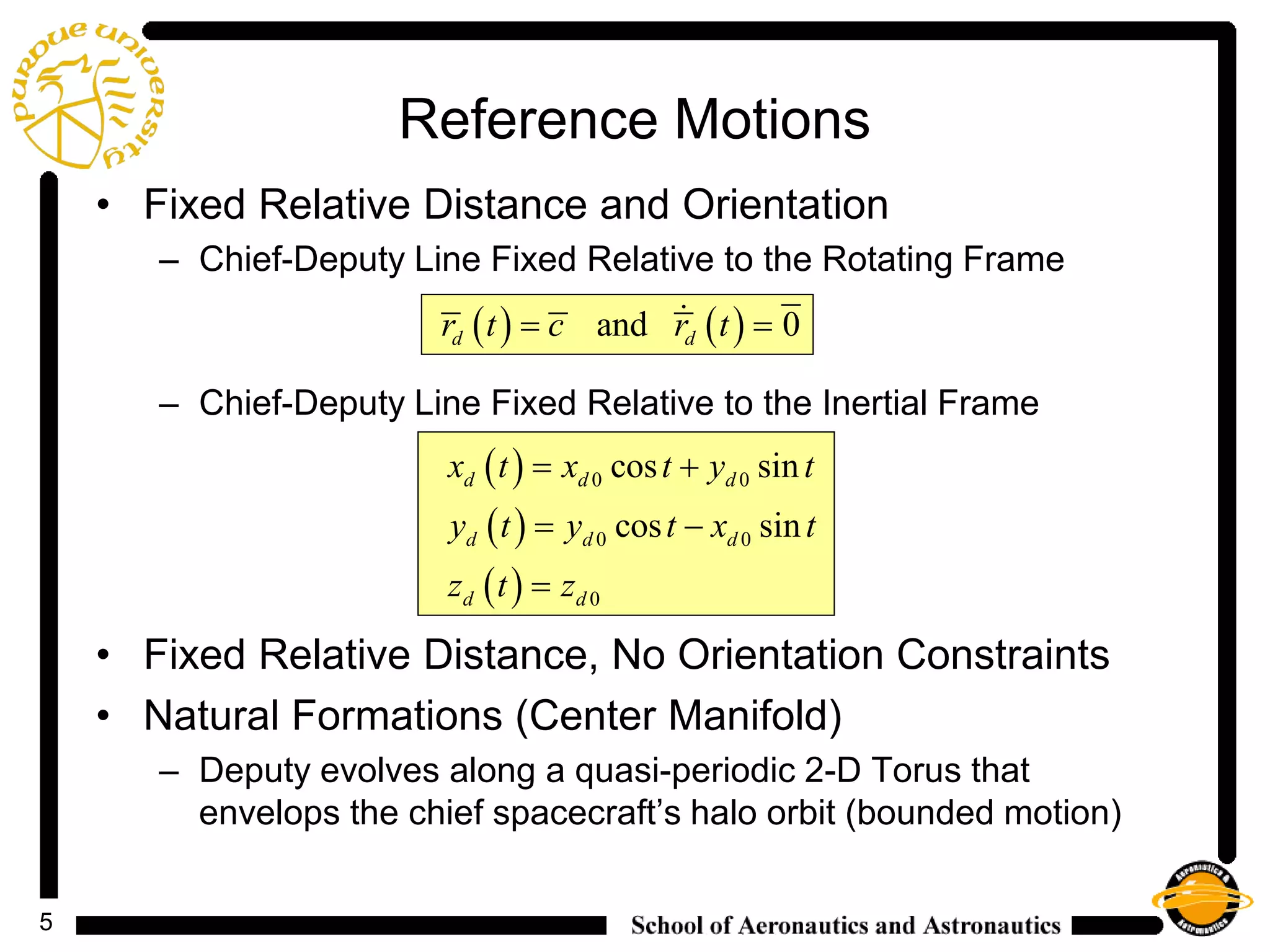
Reference Motions
• Fixed Relative Distance and Orientation
– Chief-Deputy Line Fixed Relative to the Rotating Frame
– Chief-Deputy Line Fixed Relative to the Inertial Frame
• Fixed Relative Distance, No Orientation Constraints
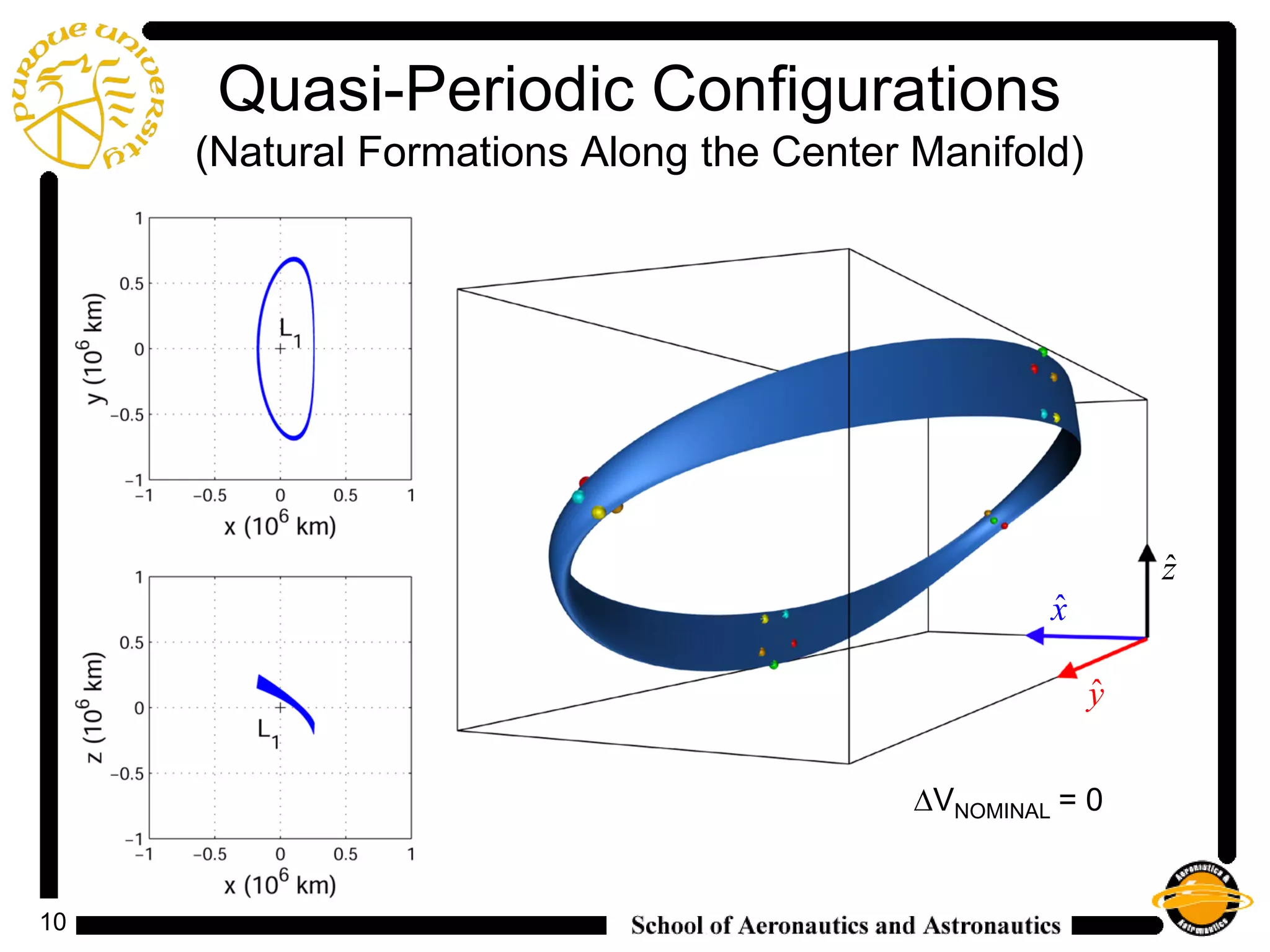
• Natural Formations (Center Manifold)
– Deputy evolves along a quasi-periodic 2-D Torus that
envelops the chief spacecraft’s halo orbit (bounded motion)
( ) ( )and 0d dr t c r t= =
( )
( )
( )
0 0
0 0
0
cos sin
cos sin
d d d
d d d
d d
x t x t y t
y t y t x t
z t z
= +
= −
=
6
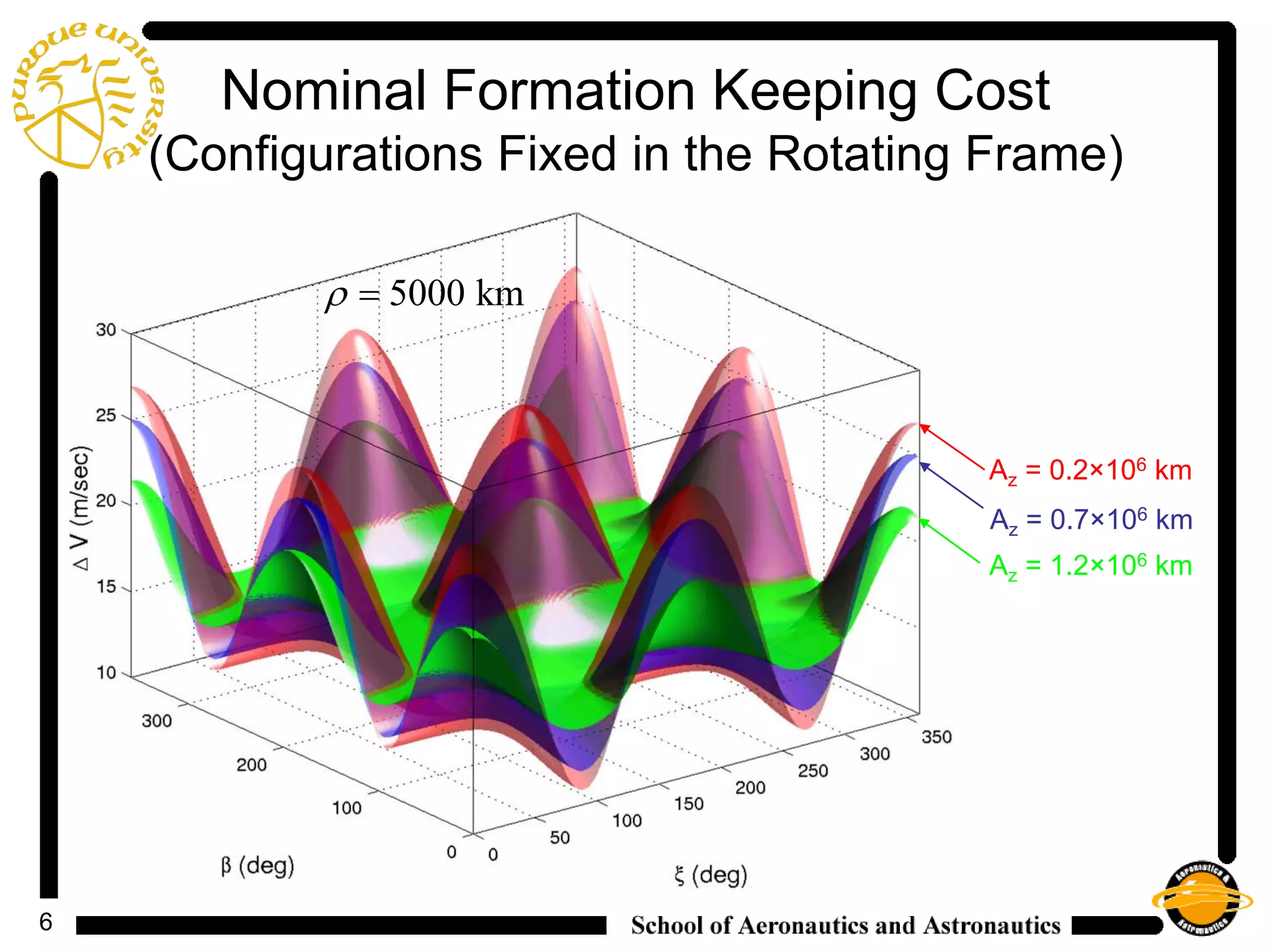
Nominal Formation Keeping Cost
(Configurations Fixed in the Rotating Frame)
Az = 0.2×10⁶ km
Az = 1.2×10⁶ km
Az = 0.7×10⁶ km
5000 kmρ =
7
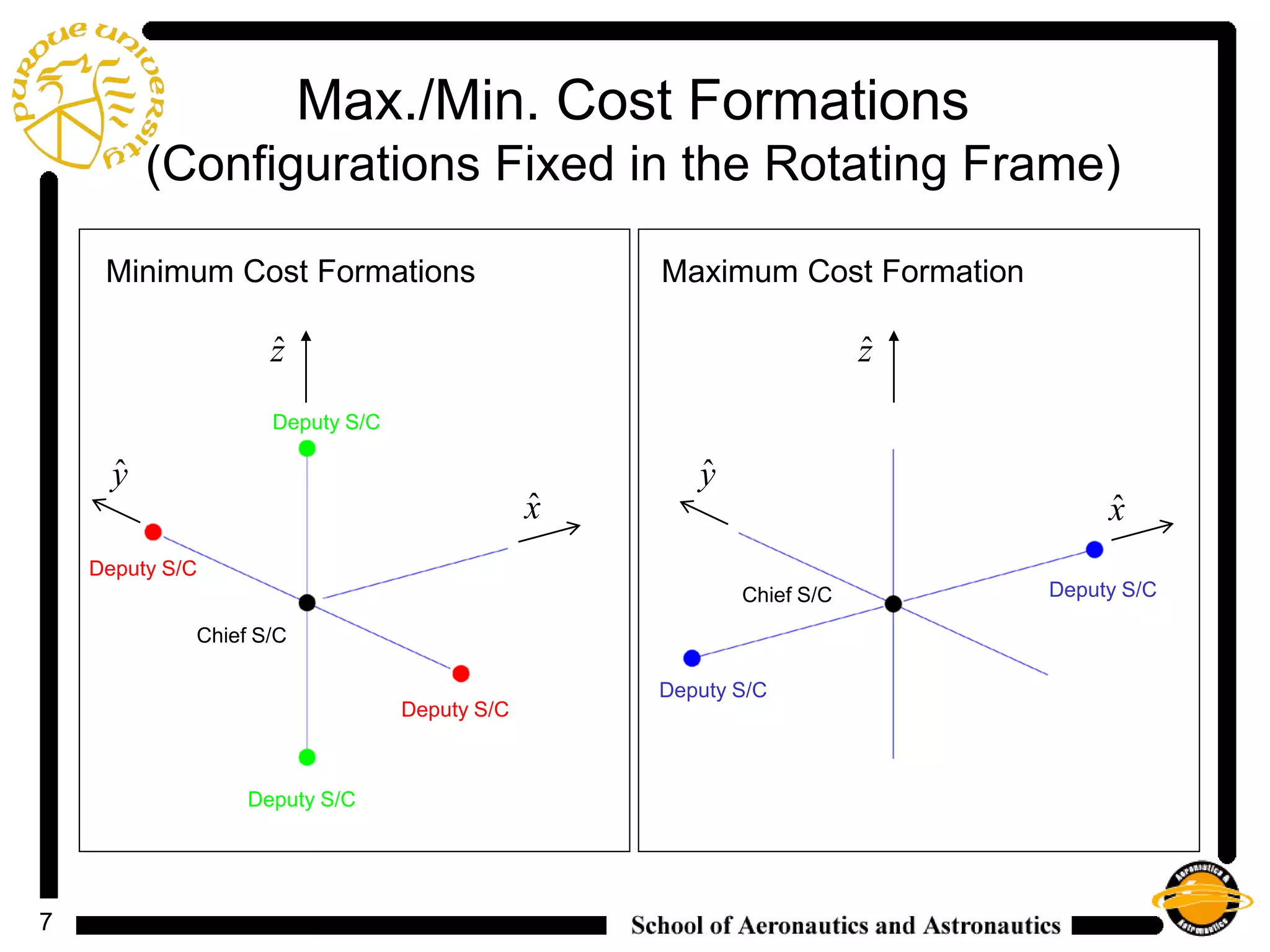
Max./Min. Cost Formations
(Configurations Fixed in the Rotating Frame)
ˆx
Deputy S/C
Deputy S/C
Deputy S/C
Deputy S/C
Chief S/C
ˆy
ˆz
Minimum Cost Formations
ˆz
ˆy
ˆx
Deputy S/C
Deputy S/CChief S/C
Maximum Cost Formation
8
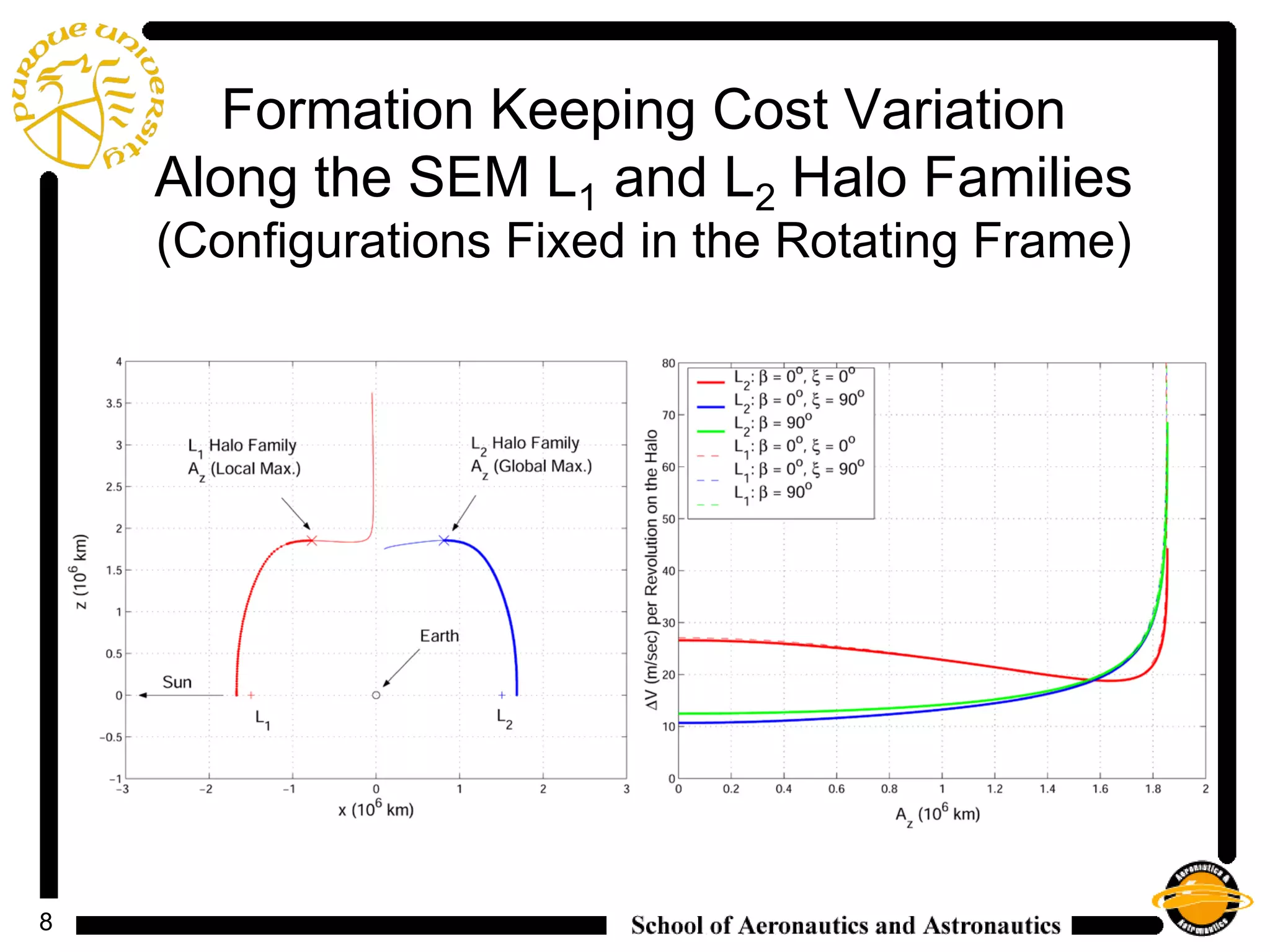
Formation Keeping Cost Variation
Along the SEM L1 and L2 Halo Families
(Configurations Fixed in the Rotating Frame)
9
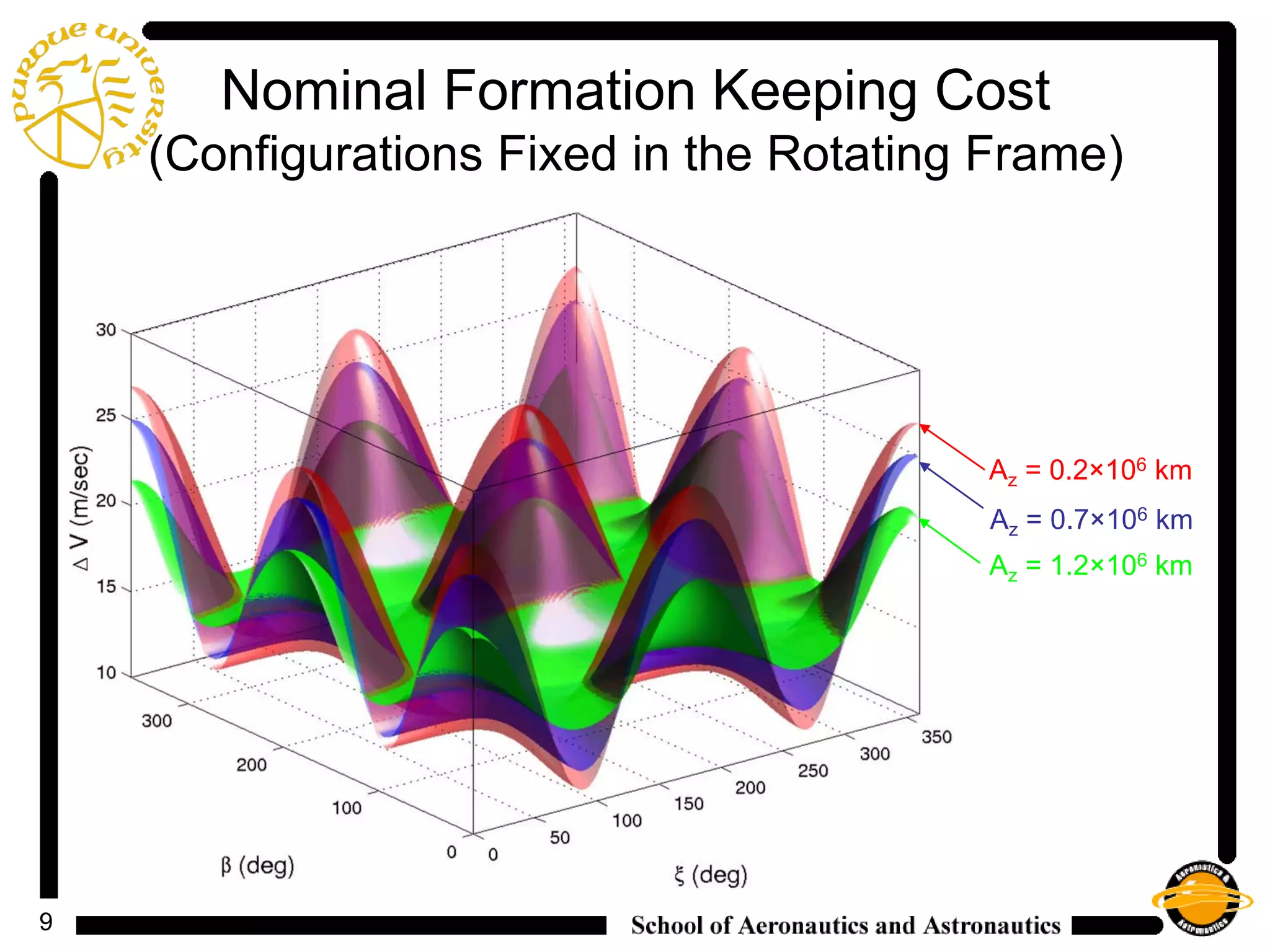
Nominal Formation Keeping Cost
(Configurations Fixed in the Rotating Frame)
Az = 0.2×10⁶ km
Az = 1.2×10⁶ km
Az = 0.7×10⁶ km
10
Quasi-Periodic Configurations
(Natural Formations Along the Center Manifold)
ˆx
ˆy
ˆz
∆VNOMINAL = 0
11
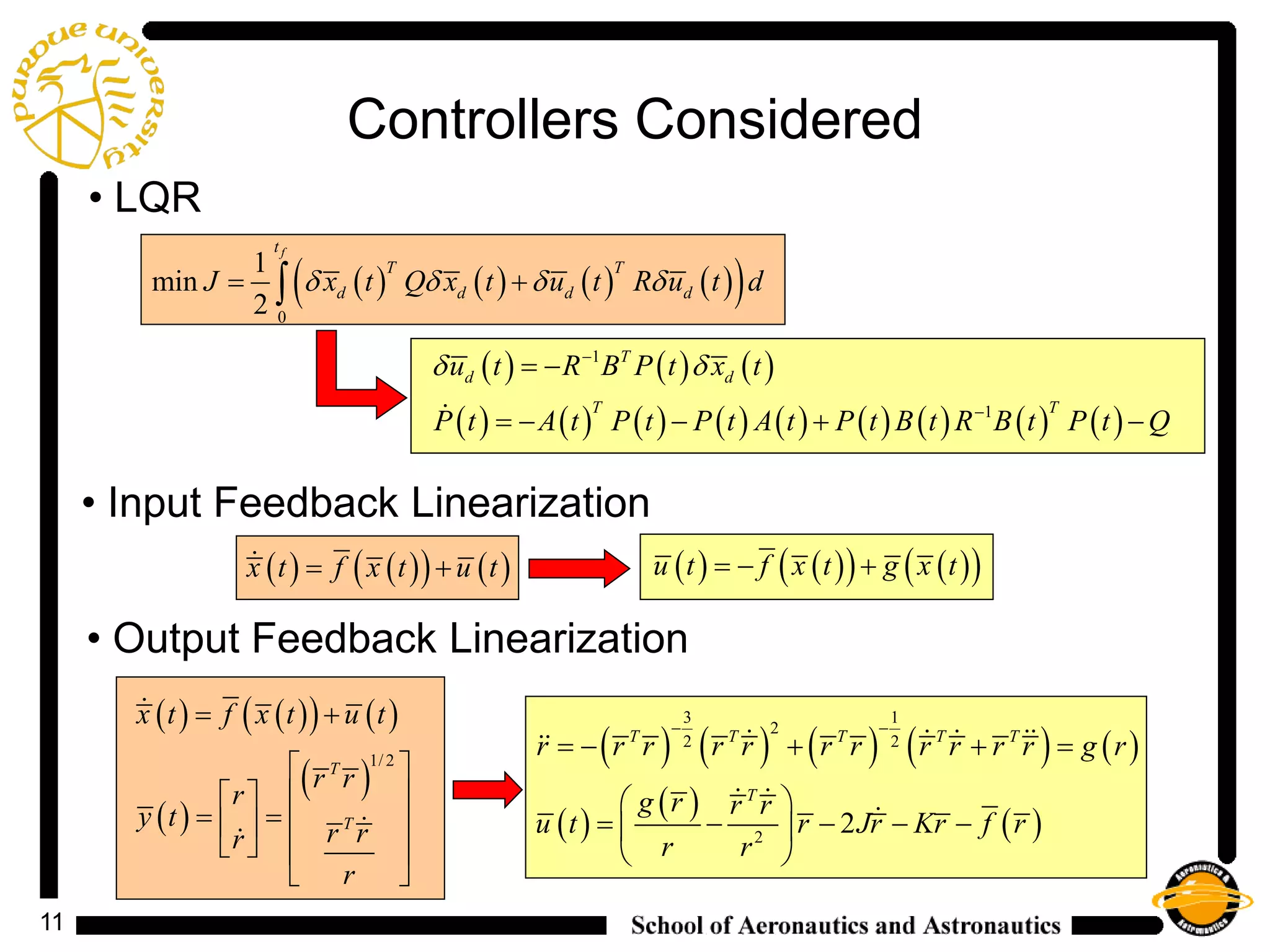
Controllers Considered
( ) ( ) ( ) ( )( )0
1
min
2
ft
T T
d d d dJ x t Q x t u t R u t d tδ δ δ δ+∫
• LQR
( ) ( )( ) ( )x t f x t u t= + ( ) ( )( ) ( )( )u t f x t g x t=− +
• Input Feedback Linearization
( ) ( )( ) ( )
( )
( )
1/2T
T
x t f x t u t
r r
r
y t
r rr
r
= +
 
  
= =   
   
 


( ) ( ) ( ) ( ) ( )
( )
( )
( )
3 1
2
2 2
2
2
T T T T T
T
r r r r r r r r r r r g r
g r r r
u t r Jr Kr f r
r r
− −
=− + + =
 
= − − − − 
 
   
 

• Output Feedback Linearization
( ) ( ) ( )
( ) ( ) ( ) ( ) ( ) ( ) ( ) ( ) ( )
1
1
T
d d
T T
u t R B P t x t
P t A t P t P t A t P t B t R B t P t Q
δ δ−
−
= −
=− − + −
12
Dynamic Response to Injection Error
5000 km, 90 , 0ρ ξ β= = = 
LQR Controller IFL Controller
( ) [ ]0 7 km 5 km 3.5 km 1 mps 1 mps 1 mps
T
xδ =− −
13
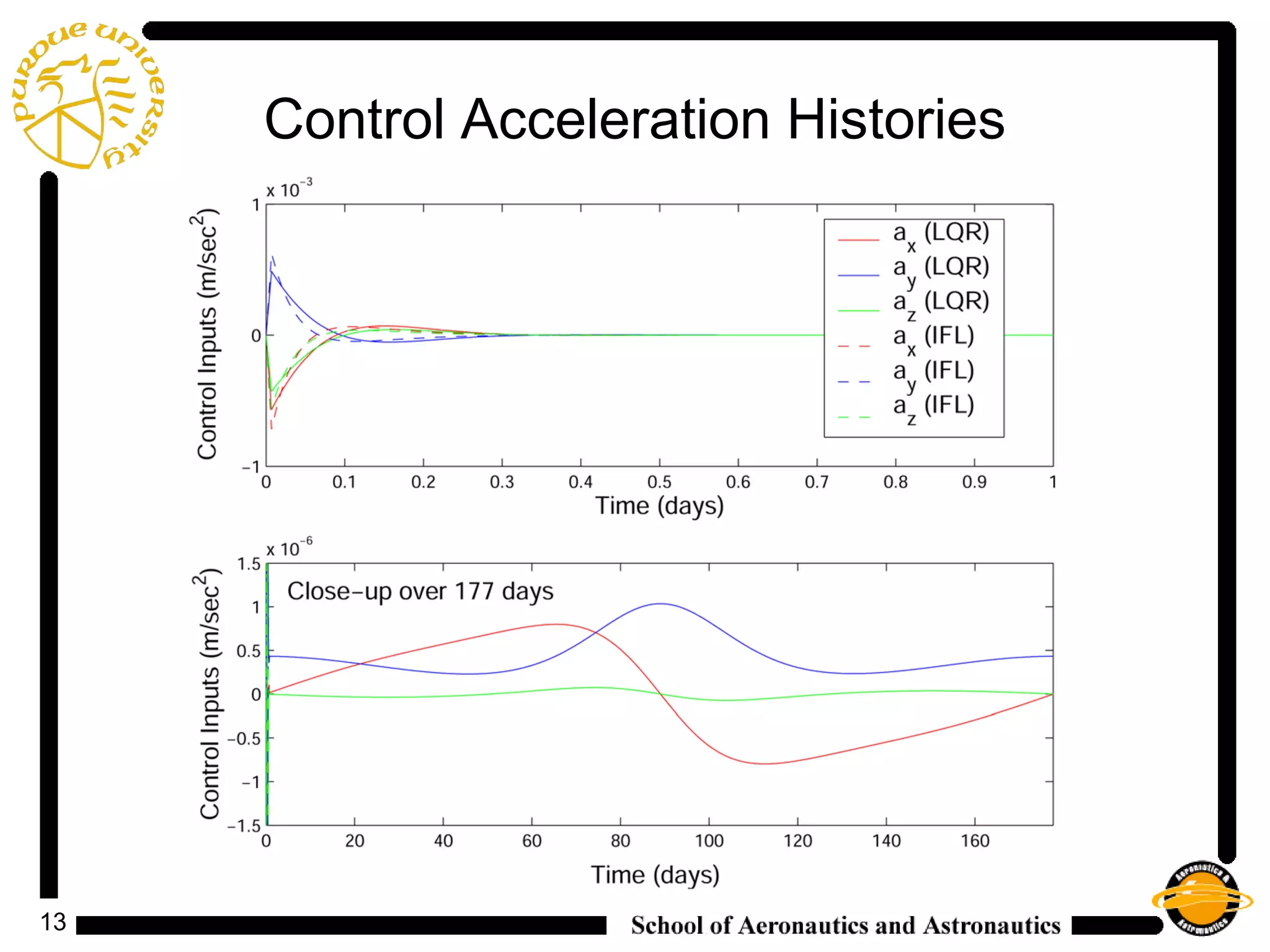
Control Acceleration Histories
14
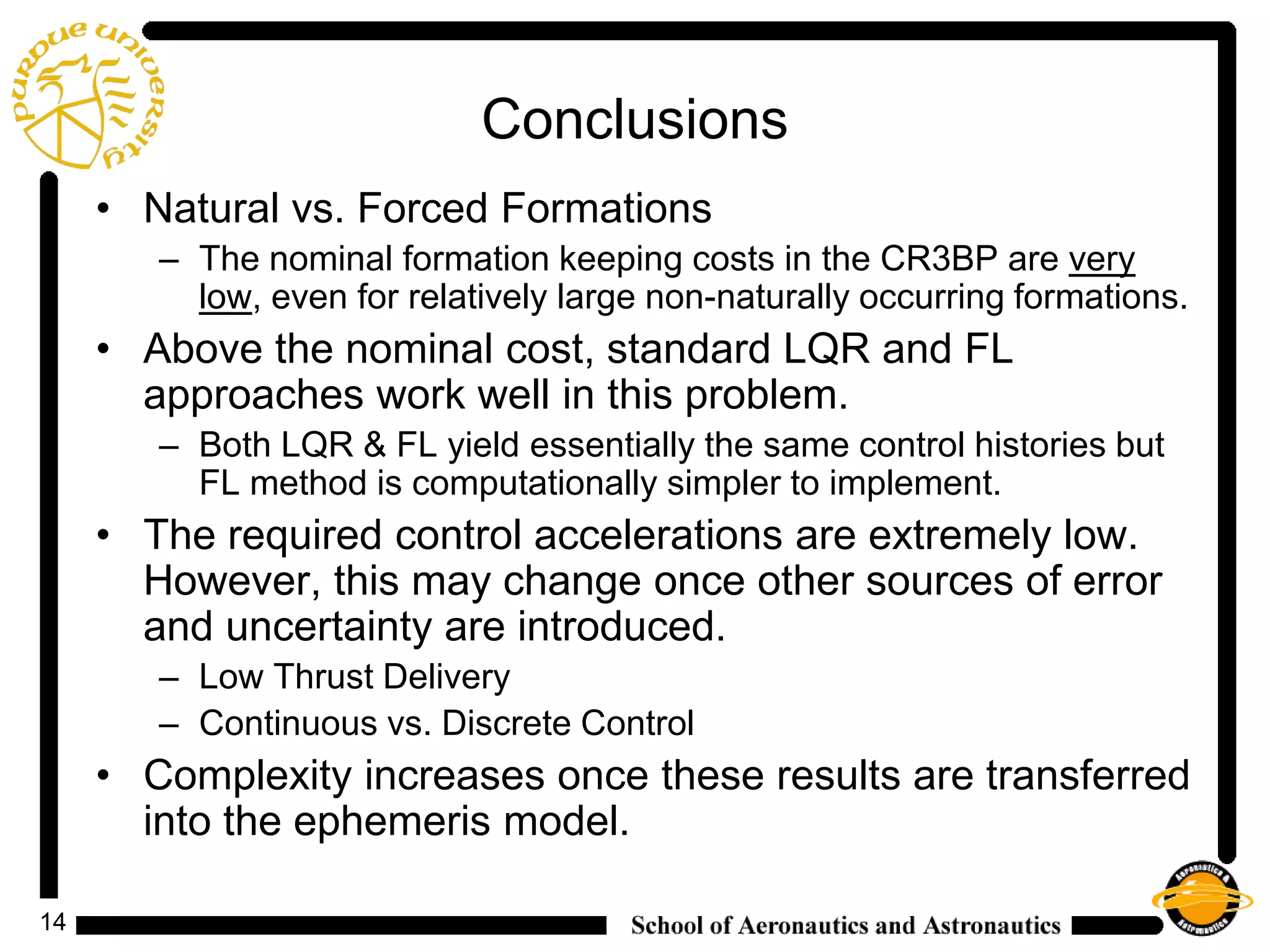
Conclusions
• Natural vs. Forced Formations
– The nominal formation keeping costs in the CR3BP are very
low, even for relatively large non-naturally occurring formations.
• Above the nominal cost, standard LQR and FL
approaches work well in this problem.
– Both LQR & FL yield essentially the same control histories but
FL method is computationally simpler to implement.
• The required control accelerations are extremely low.
However, this may change once other sources of error
and uncertainty are introduced.
– Low Thrust Delivery
– Continuous vs. Discrete Control
• Complexity increases once these results are transferred
into the ephemeris model.

Control Strategies For Formation Flight In The Vicinity Of The Libration Points

  • 1.
    1 CONTROL STRATEGIES FORFORMATION FLIGHT IN THE VICINITY OF THE LIBRATION POINTS K.C. Howell and B.G. Marchand Purdue University
  • 2.
    2 Previous Work onFormation Flight • Multi-S/C Formations in the 2BP – Small Relative Separation (10 m – 1 km) • Model Relative Dynamics via the C-W Equations • Formation Control – LQR for Time Invariant Systems – Feedback Linearization – Lyapunov Based and Adaptive Control • Multi-S/C Formations in the 3BP – Consider Wider Separation Range • Nonlinear model with complex reference motions – Periodic, Quasi-Periodic, Stable/Unstable Manifolds • Formation Control via simplified LQR techniques and “Gain Scheduling”-type methods.
  • 3.
    3 Deputy S/C ( ),,d d dx y z ˆx ˆy 2-S/C Formation Model in the Sun-Earth-Moon System ˆX ˆ ˆ,Z z B 1cr 2crcr ˆxθ ˆy Chief S/C ( ), ,c c cx y z ˆdr rρ= ˆr ξ β
  • 4.
    4 Dynamical Model ( )( ) ( ) ( ) ( ) ( ) ( ) ( ) ( ) ( ) ( ) ( ) 2 2 c c c c c d c d c d d d r t f r t Jr t Kr t u t r t f r t r t f r t Jr t Kr t u t = + + +   = + − + + +           Nonlinear EOMs: ( ) ( ) ( ) ( ) ( ) ( )( ) ( ) ( ) ( ) ( ) ( ) ( )( ) 0 0 , 2 d d d d d d c dd d d d Ir t r t r t r t u t u t r t r t J Ir t r t r t r t     − −   + −      Ω− −                   Linear System: ( )A t B ( )du tδ( )dx tδ( )dx tδ 
  • 5.
    5 Reference Motions • FixedRelative Distance and Orientation – Chief-Deputy Line Fixed Relative to the Rotating Frame – Chief-Deputy Line Fixed Relative to the Inertial Frame • Fixed Relative Distance, No Orientation Constraints • Natural Formations (Center Manifold) – Deputy evolves along a quasi-periodic 2-D Torus that envelops the chief spacecraft’s halo orbit (bounded motion) ( ) ( )and 0d dr t c r t= = ( ) ( ) ( ) 0 0 0 0 0 cos sin cos sin d d d d d d d d x t x t y t y t y t x t z t z = + = − =
  • 6.
    6 Nominal Formation KeepingCost (Configurations Fixed in the Rotating Frame) Az = 0.2×10⁶ km Az = 1.2×10⁶ km Az = 0.7×10⁶ km 5000 kmρ =
  • 7.
    7 Max./Min. Cost Formations (ConfigurationsFixed in the Rotating Frame) ˆx Deputy S/C Deputy S/C Deputy S/C Deputy S/C Chief S/C ˆy ˆz Minimum Cost Formations ˆz ˆy ˆx Deputy S/C Deputy S/CChief S/C Maximum Cost Formation
  • 8.
    8 Formation Keeping CostVariation Along the SEM L1 and L2 Halo Families (Configurations Fixed in the Rotating Frame)
  • 9.
    9 Nominal Formation KeepingCost (Configurations Fixed in the Rotating Frame) Az = 0.2×10⁶ km Az = 1.2×10⁶ km Az = 0.7×10⁶ km
  • 10.
    10 Quasi-Periodic Configurations (Natural FormationsAlong the Center Manifold) ˆx ˆy ˆz ∆VNOMINAL = 0
  • 11.
    11 Controllers Considered ( )( ) ( ) ( )( )0 1 min 2 ft T T d d d dJ x t Q x t u t R u t d tδ δ δ δ+∫ • LQR ( ) ( )( ) ( )x t f x t u t= + ( ) ( )( ) ( )( )u t f x t g x t=− + • Input Feedback Linearization ( ) ( )( ) ( ) ( ) ( ) 1/2T T x t f x t u t r r r y t r rr r = +      = =            ( ) ( ) ( ) ( ) ( ) ( ) ( ) ( ) 3 1 2 2 2 2 2 T T T T T T r r r r r r r r r r r g r g r r r u t r Jr Kr f r r r − − =− + + =   = − − − −           • Output Feedback Linearization ( ) ( ) ( ) ( ) ( ) ( ) ( ) ( ) ( ) ( ) ( ) ( ) 1 1 T d d T T u t R B P t x t P t A t P t P t A t P t B t R B t P t Q δ δ− − = − =− − + −
  • 12.
    12 Dynamic Response toInjection Error 5000 km, 90 , 0ρ ξ β= = =  LQR Controller IFL Controller ( ) [ ]0 7 km 5 km 3.5 km 1 mps 1 mps 1 mps T xδ =− −
  • 13.
  • 14.
    14 Conclusions • Natural vs.Forced Formations – The nominal formation keeping costs in the CR3BP are very low, even for relatively large non-naturally occurring formations. • Above the nominal cost, standard LQR and FL approaches work well in this problem. – Both LQR & FL yield essentially the same control histories but FL method is computationally simpler to implement. • The required control accelerations are extremely low. However, this may change once other sources of error and uncertainty are introduced. – Low Thrust Delivery – Continuous vs. Discrete Control • Complexity increases once these results are transferred into the ephemeris model.