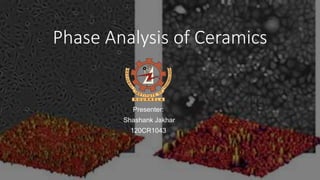
Phase Analysis of Ceramics
Presenter:
Shashank Jakhar
120CR1043
Content
1. Importance of Phase Analysis
2. Methods for Phase Analysis
3. Applications and Implications
Importance of Phase Analysis
Section 1
Significance of Ceramics in Education
01
Enhancing STEM Education
Ceramics play a crucial role in STEM education, providing practical insights into material science, chemistry,
and engineering principles.
02
Real-world Applications
Understanding the phase composition of ceramics helps students relate theoretical concepts to real-world
applications, fostering a deeper appreciation for material analysis.
03
Promoting Research Skills
Introducing phase analysis encourages students to develop critical thinking, problem-solving, and analytical
skills, preparing them for future scientific endeavours.
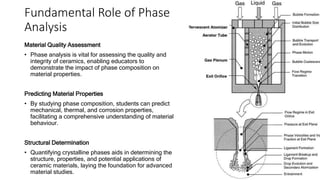
Fundamental Role of Phase
Analysis
Material Quality Assessment
• Phase analysis is vital for assessing the quality and
integrity of ceramics, enabling educators to
demonstrate the impact of phase composition on
material properties.
Predicting Material Properties
• By studying phase composition, students can predict
mechanical, thermal, and corrosion properties,
facilitating a comprehensive understanding of material
behaviour.
Structural Determination
• Quantifying crystalline phases aids in determining the
structure, properties, and potential applications of
ceramic materials, laying the foundation for advanced
material studies.
Educational Case Studies
01
Leaching of Elements
• Exploring the changes in ceramics due to environmental factors, such as leaching of elements, provides a
practical demonstration of phase analysis in real-world
02
Comparative Phase Composition
• Investigating and explaining differences in phase composition and structure of ceramics derived from
municipal bottom ashes offers a tangible case study for phase analysis.
03
Material Development
• Emphasizing the targeted development and optimization of materials through reproducible phase analysis
showcases the practical applications of phase identification in ceramics.
SWOT Analysis of Phase Analysis in Education
Strengths
• Phase analysis enhances practical learning, promotes critical thinking, and bridges the
gap between theory and application.
Weaknesses
• Complex methodologies may pose challenges for students, requiring comprehensive
guidance and support from educators.
Opportunities
• Integration of phase analysis into STEM curricula can foster a deeper understanding of
material science and encourage research-oriented learning.
Threats
• Limited access to advanced phase analysis equipment and resources may hinder
comprehensive practical learning experiences.
Methods for Phase Analysis
Section 2
Quantitative Chemical Phase Identifications
01
Precise Measurements
• Quantitative chemical phase identifications provide accurate insights into the composition and
structure of ceramics, facilitating in-depth material analysis.
02
Environmental Impact
• Understanding changes in ceramics due to environmental factors, such as leaching of elements,
demonstrates the practical applications of quantitative phase identifications.
03
Material Characterization
• The quantification of crystalline phases is fundamental for determining material structure, properties,
and potential applications, offering a comprehensive view of ceramic materials.
Techniques for Phase Analysis
X-ray Diffraction (XRD)
XRD is a widely used technique for phase analysis in ceramics, offering precise quantitative
measurements of crystalline phases and structural information.
Scanning Electron Microscopy (SEM)
SEM provides high-resolution imaging and elemental analysis, enabling the visualization and
identification of phase composition in ceramics.
Energy-Dispersive X-ray Spectroscopy (EDS)
EDS complements SEM by providing elemental analysis, aiding in the identification and
quantification of phases present in ceramic materials.
Advanced Phase Analysis Tools
01
Microstructural Analysis
• Utilizing advanced microscopy techniques, such as transmission electron microscopy
(TEM), allows for detailed examination of phase boundaries and microstructural features
in ceramics.
02
Raman Spectroscopy
• Raman spectroscopy offers non-destructive phase identification and structural analysis,
providing valuable insights into the composition and properties of ceramic materials.
03
Thermal Analysis
• Differential scanning calorimetry (DSC) and thermogravimetric analysis (TGA) aid in
understanding phase transformations and thermal behavior of ceramics, contributing to
comprehensive phase analysis.
SWOT Analysis of Phase Analysis Methods
Strengths
• Advanced techniques offer precise and detailed phase analysis, enhancing students'
practical skills and understanding of material science.
Weaknesses
• Access to advanced equipment and expertise may be limited, requiring collaborative
efforts and resource allocation for comprehensive phase analysis education.
Opportunities
• Integration of advanced phase analysis tools into educational curricula can prepare
students for research and industry applications, fostering a deeper understanding of
material characterization.
Threats
• Complex methodologies and instrumentation may pose challenges for educators and
students, necessitating comprehensive training and support.
Applications and Implications
Section 3
Educational Implications
01
Curricular Integration
• The integration of phase analysis into educational frameworks serves as a practical and
theoretical foundation for material science and chemistry education.
02
Empowering Students
• Phase analysis empowers students with practical skills, critical thinking, and problem-
solving abilities, preparing them for future scientific pursuits.
03
Research Opportunities
• Understanding phase composition opens doors to research projects, encouraging
students to explore the applications and implications of material analysis.
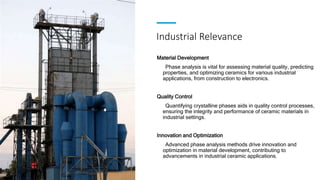
Industrial Relevance
Material Development
Phase analysis is vital for assessing material quality, predicting
properties, and optimizing ceramics for various industrial
applications, from construction to electronics.
Quality Control
Quantifying crystalline phases aids in quality control processes,
ensuring the integrity and performance of ceramic materials in
industrial settings.
Innovation and Optimization
Advanced phase analysis methods drive innovation and
optimization in material development, contributing to
advancements in industrial ceramic applications.
Case Studies and Practical Applications
Environmental Impact Assessment
• Phase analysis in ceramics is crucial for assessing environmental impacts, such as
leaching of elements, and understanding the long-term behaviour of materials in different
conditions.
Mechanical and Thermal Properties
• Quantifying phase composition aids in predicting mechanical, thermal, and corrosion
properties, influencing material selection and design in various industries.
Innovative Research Initiatives
• Collaborative research projects utilizing advanced phase analysis techniques contribute to
the development of new ceramic materials with enhanced properties and applications.
Future Perspectives and Collaborative Initiatives
Interdisciplinary Collaboration
• Collaborative efforts between educational institutions, research organizations, and industry
partners can drive advancements in phase analysis education and research.
Technological Advancements
• Embracing emerging technologies and methodologies for phase analysis can open new
avenues for material science education and industrial applications.
Global Impact
• Understanding the implications of phase analysis in ceramics can foster global collaborations
and initiatives for sustainable material development and environmental stewardship.
Thank You

Phase Analysis of Ceramic Materials.pptx

  • 1.
    Phase Analysis ofCeramics Presenter: Shashank Jakhar 120CR1043
  • 2.
    Content 1. Importance ofPhase Analysis 2. Methods for Phase Analysis 3. Applications and Implications
  • 3.
    Importance of PhaseAnalysis Section 1
  • 4.
    Significance of Ceramicsin Education 01 Enhancing STEM Education Ceramics play a crucial role in STEM education, providing practical insights into material science, chemistry, and engineering principles. 02 Real-world Applications Understanding the phase composition of ceramics helps students relate theoretical concepts to real-world applications, fostering a deeper appreciation for material analysis. 03 Promoting Research Skills Introducing phase analysis encourages students to develop critical thinking, problem-solving, and analytical skills, preparing them for future scientific endeavours.
  • 5.
    Fundamental Role ofPhase Analysis Material Quality Assessment • Phase analysis is vital for assessing the quality and integrity of ceramics, enabling educators to demonstrate the impact of phase composition on material properties. Predicting Material Properties • By studying phase composition, students can predict mechanical, thermal, and corrosion properties, facilitating a comprehensive understanding of material behaviour. Structural Determination • Quantifying crystalline phases aids in determining the structure, properties, and potential applications of ceramic materials, laying the foundation for advanced material studies.
  • 6.
    Educational Case Studies 01 Leachingof Elements • Exploring the changes in ceramics due to environmental factors, such as leaching of elements, provides a practical demonstration of phase analysis in real-world 02 Comparative Phase Composition • Investigating and explaining differences in phase composition and structure of ceramics derived from municipal bottom ashes offers a tangible case study for phase analysis. 03 Material Development • Emphasizing the targeted development and optimization of materials through reproducible phase analysis showcases the practical applications of phase identification in ceramics.
  • 7.
    SWOT Analysis ofPhase Analysis in Education Strengths • Phase analysis enhances practical learning, promotes critical thinking, and bridges the gap between theory and application. Weaknesses • Complex methodologies may pose challenges for students, requiring comprehensive guidance and support from educators. Opportunities • Integration of phase analysis into STEM curricula can foster a deeper understanding of material science and encourage research-oriented learning. Threats • Limited access to advanced phase analysis equipment and resources may hinder comprehensive practical learning experiences.
  • 8.
    Methods for PhaseAnalysis Section 2
  • 9.
    Quantitative Chemical PhaseIdentifications 01 Precise Measurements • Quantitative chemical phase identifications provide accurate insights into the composition and structure of ceramics, facilitating in-depth material analysis. 02 Environmental Impact • Understanding changes in ceramics due to environmental factors, such as leaching of elements, demonstrates the practical applications of quantitative phase identifications. 03 Material Characterization • The quantification of crystalline phases is fundamental for determining material structure, properties, and potential applications, offering a comprehensive view of ceramic materials.
  • 10.
    Techniques for PhaseAnalysis X-ray Diffraction (XRD) XRD is a widely used technique for phase analysis in ceramics, offering precise quantitative measurements of crystalline phases and structural information. Scanning Electron Microscopy (SEM) SEM provides high-resolution imaging and elemental analysis, enabling the visualization and identification of phase composition in ceramics. Energy-Dispersive X-ray Spectroscopy (EDS) EDS complements SEM by providing elemental analysis, aiding in the identification and quantification of phases present in ceramic materials.
  • 11.
    Advanced Phase AnalysisTools 01 Microstructural Analysis • Utilizing advanced microscopy techniques, such as transmission electron microscopy (TEM), allows for detailed examination of phase boundaries and microstructural features in ceramics. 02 Raman Spectroscopy • Raman spectroscopy offers non-destructive phase identification and structural analysis, providing valuable insights into the composition and properties of ceramic materials. 03 Thermal Analysis • Differential scanning calorimetry (DSC) and thermogravimetric analysis (TGA) aid in understanding phase transformations and thermal behavior of ceramics, contributing to comprehensive phase analysis.
  • 12.
    SWOT Analysis ofPhase Analysis Methods Strengths • Advanced techniques offer precise and detailed phase analysis, enhancing students' practical skills and understanding of material science. Weaknesses • Access to advanced equipment and expertise may be limited, requiring collaborative efforts and resource allocation for comprehensive phase analysis education. Opportunities • Integration of advanced phase analysis tools into educational curricula can prepare students for research and industry applications, fostering a deeper understanding of material characterization. Threats • Complex methodologies and instrumentation may pose challenges for educators and students, necessitating comprehensive training and support.
  • 13.
  • 14.
    Educational Implications 01 Curricular Integration •The integration of phase analysis into educational frameworks serves as a practical and theoretical foundation for material science and chemistry education. 02 Empowering Students • Phase analysis empowers students with practical skills, critical thinking, and problem- solving abilities, preparing them for future scientific pursuits. 03 Research Opportunities • Understanding phase composition opens doors to research projects, encouraging students to explore the applications and implications of material analysis.
  • 15.
    Industrial Relevance Material Development Phaseanalysis is vital for assessing material quality, predicting properties, and optimizing ceramics for various industrial applications, from construction to electronics. Quality Control Quantifying crystalline phases aids in quality control processes, ensuring the integrity and performance of ceramic materials in industrial settings. Innovation and Optimization Advanced phase analysis methods drive innovation and optimization in material development, contributing to advancements in industrial ceramic applications.
  • 16.
    Case Studies andPractical Applications Environmental Impact Assessment • Phase analysis in ceramics is crucial for assessing environmental impacts, such as leaching of elements, and understanding the long-term behaviour of materials in different conditions. Mechanical and Thermal Properties • Quantifying phase composition aids in predicting mechanical, thermal, and corrosion properties, influencing material selection and design in various industries. Innovative Research Initiatives • Collaborative research projects utilizing advanced phase analysis techniques contribute to the development of new ceramic materials with enhanced properties and applications.
  • 17.
    Future Perspectives andCollaborative Initiatives Interdisciplinary Collaboration • Collaborative efforts between educational institutions, research organizations, and industry partners can drive advancements in phase analysis education and research. Technological Advancements • Embracing emerging technologies and methodologies for phase analysis can open new avenues for material science education and industrial applications. Global Impact • Understanding the implications of phase analysis in ceramics can foster global collaborations and initiatives for sustainable material development and environmental stewardship.
  • 18.