Phase-I Metabolism
Presented by-
Parimal Hadge
PE/2019/311
PC-610
1
Contents
30-03-2022 2
Drug metabolism is the metabolic breakdown of drugs by living
organisms, usually through specialized enzymatic systems.
Xenobiotic metabolism is the set of metabolic pathways that modify the
chemical structure of xenobiotics, which are compounds foreign to an
organism's normal biochemistry
Significance: The reasons for studying and understanding the various
metabolic pathways is
1)They help in determining the duration and intensity of pharmacological
action of the drug
2)Help in understanding the hazardous drug interactions
3)These pathways are also important in environmental science with the
xenobiotic metabolism of microorganism determining whether a pollutant
will be broken down during bioremediation(treat contaminated media by
altering environmental conditions to stimulate microbe growth and degrade
target pollutant), or persist in the environment
4)Provides opportunity for synthesizing prodrugs.
Introduction
30-03-2022 3
Phase-I(Non-synthetic) drug metabolism
The metabolism of xenobiotics is often divided into three phases:-
modification, conjugation, and excretion.
In phase I, a variety of enzymes act to introduce reactive and polar
groups into their substrates. One of the most common modifications is
hydroxylation catalyzed by the cytochrome P-450-dependent mixed-
function oxidase system. These enzyme complexes act to incorporate
an atom of oxygen into nonactivated hydrocarbons, which can result in
either the introduction of hydroxyl groups or N-, O- and S-dealkylation
of substrates
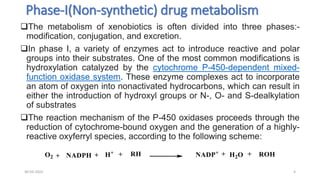
The reaction mechanism of the P-450 oxidases proceeds through the
reduction of cytochrome-bound oxygen and the generation of a highly-
reactive oxyferryl species, according to the following scheme:
30-03-2022 4
Phase I reactions (also termed non-synthetic reactions) may occur
by oxidation, reduction, hydrolysis, cyclization, de-cyclization. The
addition of oxygen or removal of hydrogen, are carried out by mixed
function oxidases, often in the liver. These oxidative reactions typically
involve a cytochrome P450 monooxygenase (often abbreviated CYP),
NADPH and oxygen.
Some of the classes of pharmaceutical drugs that utilize this method for
their metabolism include phenothiazines, paracetamol, and steroids.
If the metabolites of phase I reactions are sufficiently polar, they may
be readily excreted at this point. However, many phase I products are
not eliminated rapidly and undergo a subsequent reaction in which
an endogenous substrate combines with the newly incorporated
functional group to form a highly polar conjugate.
A common Phase I oxidation involves conversion of a C-H bond to a C-
OH. This reaction sometimes converts a pharmacologically inactive
compound (a prodrug) to a pharmacologically active one. By the same
token, Phase I can turn a nontoxic molecule into a poisonous one
(toxification)
30-03-2022 5
• Cytochrome P450(CYPs):
These are a superfamily of enzymes containing heme as a cofactor that
function as monooxygenases. In mammals, these proteins
oxidize steroids, fatty acids, and Xenobiotics, and are important for
the clearance of various compounds, as well as for hormone synthesis
and breakdown.
CYPs are, in general, the terminal oxidase enzymes in electron transfer
chains, broadly categorized as P-450 containing systems.
The term "P450" is derived from the spectrophotometric peak at
the wavelength of the absorption maxima of the enzyme (450 nm) when
it is in the reduced state and complexed with carbon monoxide. Most
CYPs require a protein partner to deliver one or more electrons to
reduce the iron (and eventually molecular oxygen)
30-03-2022 6
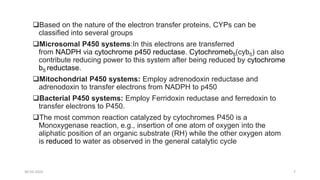
Based on the nature of the electron transfer proteins, CYPs can be
classified into several groups
Microsomal P450 systems:In this electrons are transferred
from NADPH via cytochrome p450 reductase. Cytochromeb5(cyb5) can also
contribute reducing power to this system after being reduced by cytochrome
b5 reductase.
Mitochondrial P450 systems: Employ adrenodoxin reductase and
adrenodoxin to transfer electrons from NADPH to p450
Bacterial P450 systems: Employ Ferridoxin reductase and ferredoxin to
transfer electrons to P450.
The most common reaction catalyzed by cytochromes P450 is a
Monoxygenase reaction, e.g., insertion of one atom of oxygen into the
aliphatic position of an organic substrate (RH) while the other oxygen atom
is reduced to water as observed in the general catalytic cycle
30-03-2022 7
Possible mechanisms for Oxidation of Ethanol and Acetaldehyde by P450 2E1 by FeO3+ H
.‚ Abstraction
30-03-2022 8
Oxidative N-Dealkylation of N-Ethyl N-methylaniline by P450 2B1
30-03-2022 9
CYP 3A4 and 3A5 hydroxylation and oxidation
30-03-2022 10
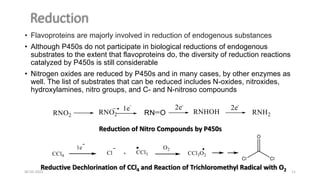
• Flavoproteins are majorly involved in reduction of endogenous substances
• Although P450s do not participate in biological reductions of endogenous
substrates to the extent that flavoproteins do, the diversity of reduction reactions
catalyzed by P450s is still considerable
• Nitrogen oxides are reduced by P450s and in many cases, by other enzymes as
well. The list of substrates that can be reduced includes N-oxides, nitroxides,
hydroxylamines, nitro groups, and C- and N-nitroso compounds
Reduction of Nitro Compounds by P450s
Reductive Dechlorination of CCl4 and Reaction of Trichloromethyl Radical with O2
30-03-2022 11
Reduction of Zonisamide
30-03-2022 12
Hydrolysis
• Esterases, amidases and epoxide hydrolases are some of the enzymes which
catalyze via hydrolytic reactions. These class of enzymes are referred to as
hydrolases
• Esterases: An esterase is a hydrolase enzyme that splits esters into
an acid and an alcohol
• Esterases cleave ester bonds in lipids and phosphatases cleave phosphate
groups off molecules. An example of crucial esterase is acetylcholine esterase,
which assists in transforming the neuron impulse into acetic acid after the
hydrolase breaks the acetylcholine into choline and acetic acid
• Amidases: This enzyme belongs to the family of hydrolases, those acting on
carbon-nitrogen bonds other than peptide bonds, specifically in linear amides
• This enzyme participates in 6 metabolic pathways: urea cycle and metabolism
of amino group, phenylalanine metabolism, tryptophan metabolism,
cyanoamino acid metabolism , benzoate degradation, and styrene degradation
30-03-2022 13
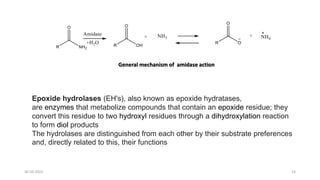
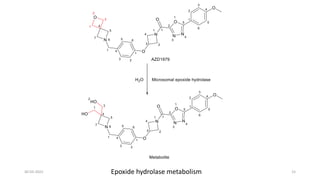
Epoxide hydrolases (EH's), also known as epoxide hydratases,
are enzymes that metabolize compounds that contain an epoxide residue; they
convert this residue to two hydroxyl residues through a dihydroxylation reaction
to form diol products
The hydrolases are distinguished from each other by their substrate preferences
and, directly related to this, their functions
General mechanism of amidase action
30-03-2022 14
Epoxide hydrolase metabolism
30-03-2022 15
References
• Goodman and Gilman, Pharmacological basis of Therapeutics, 12 th
edition , Laurence l. Bruton.
• Essentials of Medical Pharmacology , K.D. Tripathi, 7 th edition JP
publishers, New Delhi.
• Drug metabolism by S.P.Merkey, NIH, accessed on internet on 24-01-
2021.
30-03-2022 16
30-03-2022 17

Phase 1 metabolism.pptx

  • 1.
    Phase-I Metabolism Presented by- ParimalHadge PE/2019/311 PC-610 1
  • 2.
  • 3.
    Drug metabolism isthe metabolic breakdown of drugs by living organisms, usually through specialized enzymatic systems. Xenobiotic metabolism is the set of metabolic pathways that modify the chemical structure of xenobiotics, which are compounds foreign to an organism's normal biochemistry Significance: The reasons for studying and understanding the various metabolic pathways is 1)They help in determining the duration and intensity of pharmacological action of the drug 2)Help in understanding the hazardous drug interactions 3)These pathways are also important in environmental science with the xenobiotic metabolism of microorganism determining whether a pollutant will be broken down during bioremediation(treat contaminated media by altering environmental conditions to stimulate microbe growth and degrade target pollutant), or persist in the environment 4)Provides opportunity for synthesizing prodrugs. Introduction 30-03-2022 3
  • 4.
    Phase-I(Non-synthetic) drug metabolism Themetabolism of xenobiotics is often divided into three phases:- modification, conjugation, and excretion. In phase I, a variety of enzymes act to introduce reactive and polar groups into their substrates. One of the most common modifications is hydroxylation catalyzed by the cytochrome P-450-dependent mixed- function oxidase system. These enzyme complexes act to incorporate an atom of oxygen into nonactivated hydrocarbons, which can result in either the introduction of hydroxyl groups or N-, O- and S-dealkylation of substrates The reaction mechanism of the P-450 oxidases proceeds through the reduction of cytochrome-bound oxygen and the generation of a highly- reactive oxyferryl species, according to the following scheme: 30-03-2022 4
  • 5.
    Phase I reactions(also termed non-synthetic reactions) may occur by oxidation, reduction, hydrolysis, cyclization, de-cyclization. The addition of oxygen or removal of hydrogen, are carried out by mixed function oxidases, often in the liver. These oxidative reactions typically involve a cytochrome P450 monooxygenase (often abbreviated CYP), NADPH and oxygen. Some of the classes of pharmaceutical drugs that utilize this method for their metabolism include phenothiazines, paracetamol, and steroids. If the metabolites of phase I reactions are sufficiently polar, they may be readily excreted at this point. However, many phase I products are not eliminated rapidly and undergo a subsequent reaction in which an endogenous substrate combines with the newly incorporated functional group to form a highly polar conjugate. A common Phase I oxidation involves conversion of a C-H bond to a C- OH. This reaction sometimes converts a pharmacologically inactive compound (a prodrug) to a pharmacologically active one. By the same token, Phase I can turn a nontoxic molecule into a poisonous one (toxification) 30-03-2022 5
  • 6.
    • Cytochrome P450(CYPs): Theseare a superfamily of enzymes containing heme as a cofactor that function as monooxygenases. In mammals, these proteins oxidize steroids, fatty acids, and Xenobiotics, and are important for the clearance of various compounds, as well as for hormone synthesis and breakdown. CYPs are, in general, the terminal oxidase enzymes in electron transfer chains, broadly categorized as P-450 containing systems. The term "P450" is derived from the spectrophotometric peak at the wavelength of the absorption maxima of the enzyme (450 nm) when it is in the reduced state and complexed with carbon monoxide. Most CYPs require a protein partner to deliver one or more electrons to reduce the iron (and eventually molecular oxygen) 30-03-2022 6
  • 7.
    Based on thenature of the electron transfer proteins, CYPs can be classified into several groups Microsomal P450 systems:In this electrons are transferred from NADPH via cytochrome p450 reductase. Cytochromeb5(cyb5) can also contribute reducing power to this system after being reduced by cytochrome b5 reductase. Mitochondrial P450 systems: Employ adrenodoxin reductase and adrenodoxin to transfer electrons from NADPH to p450 Bacterial P450 systems: Employ Ferridoxin reductase and ferredoxin to transfer electrons to P450. The most common reaction catalyzed by cytochromes P450 is a Monoxygenase reaction, e.g., insertion of one atom of oxygen into the aliphatic position of an organic substrate (RH) while the other oxygen atom is reduced to water as observed in the general catalytic cycle 30-03-2022 7
  • 8.
    Possible mechanisms forOxidation of Ethanol and Acetaldehyde by P450 2E1 by FeO3+ H .‚ Abstraction 30-03-2022 8
  • 9.
    Oxidative N-Dealkylation ofN-Ethyl N-methylaniline by P450 2B1 30-03-2022 9
  • 10.
    CYP 3A4 and3A5 hydroxylation and oxidation 30-03-2022 10
  • 11.
    • Flavoproteins aremajorly involved in reduction of endogenous substances • Although P450s do not participate in biological reductions of endogenous substrates to the extent that flavoproteins do, the diversity of reduction reactions catalyzed by P450s is still considerable • Nitrogen oxides are reduced by P450s and in many cases, by other enzymes as well. The list of substrates that can be reduced includes N-oxides, nitroxides, hydroxylamines, nitro groups, and C- and N-nitroso compounds Reduction of Nitro Compounds by P450s Reductive Dechlorination of CCl4 and Reaction of Trichloromethyl Radical with O2 30-03-2022 11
  • 12.
  • 13.
    Hydrolysis • Esterases, amidasesand epoxide hydrolases are some of the enzymes which catalyze via hydrolytic reactions. These class of enzymes are referred to as hydrolases • Esterases: An esterase is a hydrolase enzyme that splits esters into an acid and an alcohol • Esterases cleave ester bonds in lipids and phosphatases cleave phosphate groups off molecules. An example of crucial esterase is acetylcholine esterase, which assists in transforming the neuron impulse into acetic acid after the hydrolase breaks the acetylcholine into choline and acetic acid • Amidases: This enzyme belongs to the family of hydrolases, those acting on carbon-nitrogen bonds other than peptide bonds, specifically in linear amides • This enzyme participates in 6 metabolic pathways: urea cycle and metabolism of amino group, phenylalanine metabolism, tryptophan metabolism, cyanoamino acid metabolism , benzoate degradation, and styrene degradation 30-03-2022 13
  • 14.
    Epoxide hydrolases (EH's),also known as epoxide hydratases, are enzymes that metabolize compounds that contain an epoxide residue; they convert this residue to two hydroxyl residues through a dihydroxylation reaction to form diol products The hydrolases are distinguished from each other by their substrate preferences and, directly related to this, their functions General mechanism of amidase action 30-03-2022 14
  • 15.
  • 16.
    References • Goodman andGilman, Pharmacological basis of Therapeutics, 12 th edition , Laurence l. Bruton. • Essentials of Medical Pharmacology , K.D. Tripathi, 7 th edition JP publishers, New Delhi. • Drug metabolism by S.P.Merkey, NIH, accessed on internet on 24-01- 2021. 30-03-2022 16
  • 17.