PHARMACOKINETICS
โ€œWhat the body does to the drugโ€
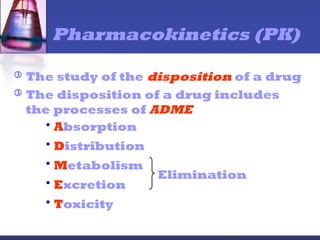
Pharmacokinetics (PK)
๏‚ฎ The study of the disposition of a drug
๏‚ฎ The disposition of a drug includes
the processes of ADME
๏‚ง Absorption
๏‚ง Distribution
๏‚ง Metabolism
๏‚ง Excretion
๏‚ง Toxicity
Elimination
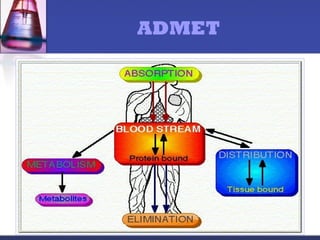
ADMET
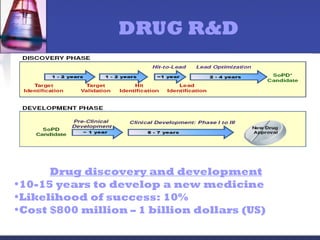
DRUG R&D
Drug discovery and development
โ€ข10-15 years to develop a new medicine
โ€ขLikelihood of success: 10%
โ€ขCost $800 million โ€“ 1 billion dollars (US)
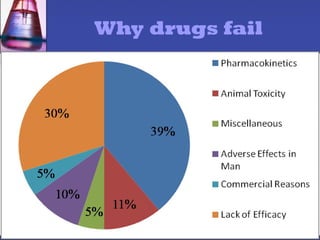
Why drugs fail
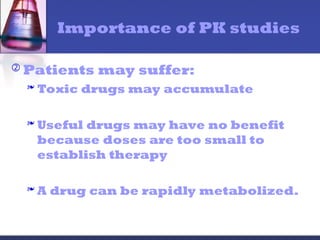
Importance of PK studies
๏‚ญ Patients may suffer:
๏‚ง Toxic drugs may accumulate
๏‚ง Useful drugs may have no benefit
because doses are too small to
establish therapy
๏‚ง A drug can be rapidly metabolized.
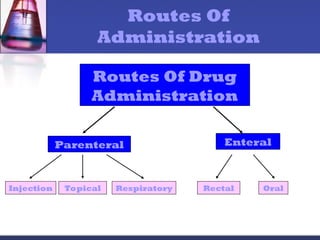
Routes Of
Administration
Routes Of Drug
Administration
Enteral
Parenteral
Oral
Injection Rectal
Respiratory
Topical
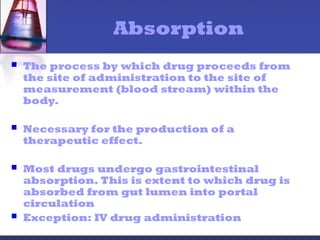
Absorption
๏ฎ The process by which drug proceeds from
the site of administration to the site of
measurement (blood stream) within the
body.
๏ฎ Necessary for the production of a
therapeutic effect.
๏ฎ Most drugs undergo gastrointestinal
absorption. This is extent to which drug is
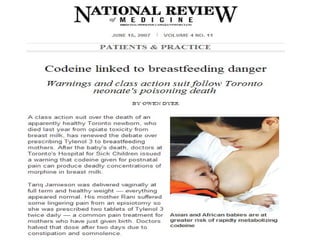
absorbed from gut lumen into portal
circulation
๏ฎ Exception: IV drug administration
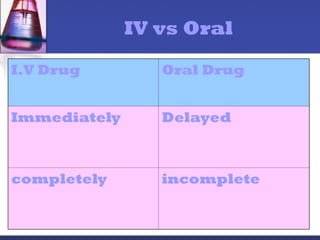
IV vs Oral
I.V Drug Oral Drug
Immediately Delayed
completely incomplete
๏ฎ Absorption relies on
๏ฎ Passage through membranes to reach the
blood
๏ฎ passive diffusion of lipid soluble species.
The Process
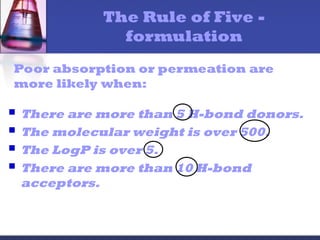
The Rule of Five -
formulation
๏ฎ There are more than 5 H-bond donors.
๏ฎ The molecular weight is over 500.
๏ฎ The LogP is over 5.
๏ฎ There are more than 10 H-bond
acceptors.
Poor absorption or permeation are
more likely when:
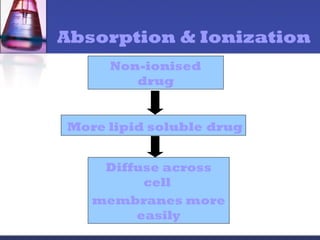
Absorption & Ionization
Non-ionised
drug
More lipid soluble drug
Diffuse across
cell
membranes more
easily
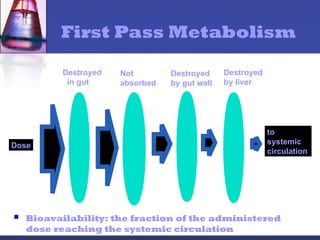
First Pass Metabolism
๏ฎ Bioavailability: the fraction of the administered
dose reaching the systemic circulation
Dose
Destroyed
in gut
Not
absorbed
Destroyed
by gut wall
Destroyed
by liver
to
systemic
circulation
Determination of
bioavailability
๏ฎ A drug given by the
intravenous route will have
an absolute bioavailability
of 1 (F=1 or 100%
bioavavailable)
๏ฎ While drugs given by other
routes usually have an
absolute bioavailability of
less than one.
๏ฎ The absolute bioavailability
is the area under curve (AUC)
non-intravenous divided by
AUC intravenous
.
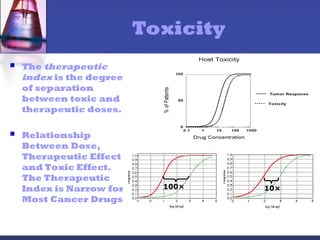
Toxicity
๏ฎ The therapeutic
index is the degree
of separation
between toxic and
therapeutic doses.
๏ฎ Relationship
Between Dose,
Therapeutic Effect
and Toxic Effect.
The Therapeutic
Index is Narrow for
Most Cancer Drugs
100ร— 10ร—
Distribution
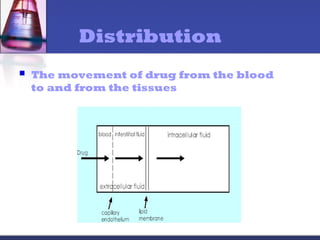
๏ฎ The movement of drug from the blood
to and from the tissues
DISTRIBUTION
๏ฎ Determined by:
๏ฎ โ€ข partitioning across various membranes
๏ฎ โ€ขbinding to tissue components
๏ฎ โ€ขbinding to blood components (RBC,
plasma protein)
๏ฎ โ€ขphysiological volumes
DISTRIBUTION
๏ฎ All of the fluid in the body (referred to as the total
body water), in which a drug can be dissolved, can
be roughly divided into three compartments:
๏ƒ˜ intravascular (blood plasma found within blood
vessels)
๏ƒ˜ interstitial/tissue (fluid surrounding cells)
๏ƒ˜ intracellular (fluid within cells, i.e. cytosol)
๏ฎ The distribution of a drug into these compartments
is dictated by it's physical and chemical properties
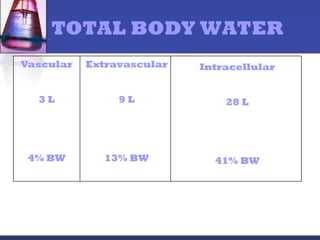
TOTAL BODY WATER
Vascular
3 L
4% BW
Extravascular
9 L
13% BW
Intracellular
28 L
41% BW
Distribution
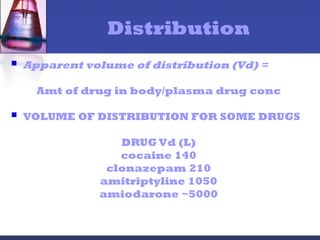
๏ฎ Apparent volume of distribution (Vd) =
Amt of drug in body/plasma drug conc
๏ฎ VOLUME OF DISTRIBUTION FOR SOME DRUGS
DRUG Vd (L)
cocaine 140
clonazepam 210
amitriptyline 1050
amiodarone ~5000
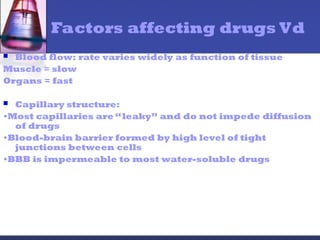
Factors affecting drugs Vd
๏ฎ Blood flow: rate varies widely as function of tissue
Muscle = slow
Organs = fast
๏ฎ Capillary structure:
โ€ขMost capillaries are โ€œleakyโ€ and do not impede diffusion
of drugs
โ€ขBlood-brain barrier formed by high level of tight
junctions between cells
โ€ขBBB is impermeable to most water-soluble drugs
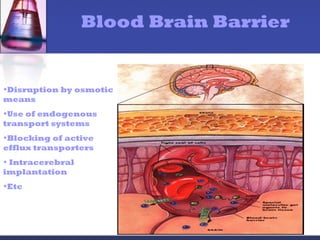
Blood Brain Barrier
โ€ขDisruption by osmotic
means
โ€ขUse of endogenous
transport systems
โ€ขBlocking of active
efflux transporters
โ€ข Intracerebral
implantation
โ€ขEtc
Plasma Protein Binding
๏ฎ Many drugs bind to plasma
proteins in the blood steam
๏ฎ Plasma protein binding limits
distribution.
๏ฎ A drug that binds plasma protein
diffuses less efficiently, than a drug
that doesnโ€™t.
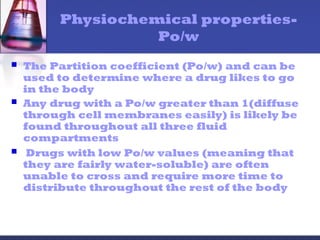
Physiochemical properties-
Po/w
๏ฎ The Partition coefficient (Po/w) and can be
used to determine where a drug likes to go
in the body
๏ฎ Any drug with a Po/w greater than 1(diffuse
through cell membranes easily) is likely be
found throughout all three fluid
compartments
๏ฎ Drugs with low Po/w values (meaning that
they are fairly water-soluble) are often
unable to cross and require more time to
distribute throughout the rest of the body
Physiochemical Properties-
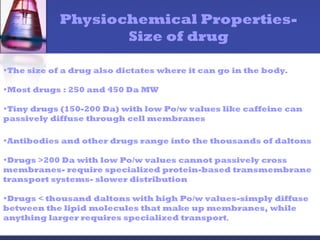
Size of drug
โ€ขThe size of a drug also dictates where it can go in the body.
โ€ขMost drugs : 250 and 450 Da MW
โ€ขTiny drugs (150-200 Da) with low Po/w values like caffeine can
passively diffuse through cell membranes
โ€ขAntibodies and other drugs range into the thousands of daltons
โ€ขDrugs >200 Da with low Po/w values cannot passively cross
membranes- require specialized protein-based transmembrane
transport systems- slower distribution
โ€ขDrugs < thousand daltons with high Po/w values-simply diffuse
between the lipid molecules that make up membranes, while
anything larger requires specialized transport.
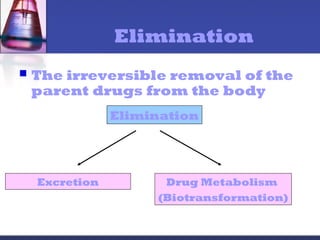
Elimination
๏ฎ The irreversible removal of the
parent drugs from the body
Elimination
Drug Metabolism
(Biotransformation)
Excretion
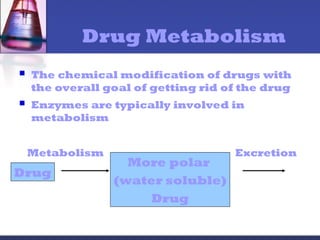
Drug Metabolism
๏ฎ The chemical modification of drugs with
the overall goal of getting rid of the drug
๏ฎ Enzymes are typically involved in
metabolism
Drug
Metabolism
More polar
(water soluble)
Drug
Excretion
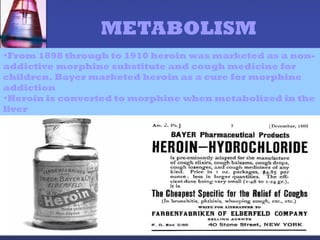
โ€ขFrom 1898 through to 1910 heroin was marketed as a non-
addictive morphine substitute and cough medicine for
children. Bayer marketed heroin as a cure for morphine
addiction
โ€ขHeroin is converted to morphine when metabolized in the
liver
METABOLISM
Phases of Drug Metabolism
๏ฎ Phase I Reactions
๏ฎ Convert parent compound into a more polar
(=hydrophilic) metabolite by adding or
unmasking functional groups (-OH, -SH, -NH2, -
COOH, etc.) eg. oxidation
๏ฎ Often these metabolites are inactive
๏ฎ May be sufficiently polar to be excreted readily
Phases of metabolism
๏ฎ Phase II Reactions
๏ฎ Conjugation with endogenous substrate to
further increase aqueous solubility
๏ฎ Conjugation with glucoronide, sulfate,
acetate, amino acid
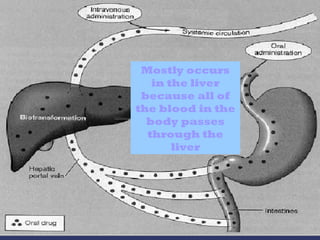
Mostly occurs
in the liver
because all of
the blood in the
body passes
through the
liver
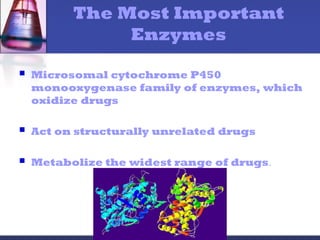
The Most Important
Enzymes
๏ฎ Microsomal cytochrome P450
monooxygenase family of enzymes, which
oxidize drugs
๏ฎ Act on structurally unrelated drugs
๏ฎ Metabolize the widest range of drugs.
๏ฎโ€ข Found in liver, small intestine, lungs, kidneys,
placenta
๏ฎโ€ข Consists of > 50 isoforms
๏ฎโ€ข Major source of catalytic activity for drug oxidation
๏ฎโ€ข Itโ€™s been estimated that 90% or more of human drug
oxidation can be attributed to 6 main enzymes:
๏ฎโ€ข CYP1A2 โ€ข CYP2D6
๏ฎโ€ข CYP2C9 โ€ข CYP2E1
๏ฎโ€ข CYP2C19 โ€ข CYP3A4
๏ฎIn different people and different populations,
activity of CYP oxidases differs.
CYP family of enzymes
Inhibitors and inducers of
microsomal enzymes
๏ฎInhibitors: cimetidine prolongs action of drugs or inhibits
action of those biotransformed to active agents (pro-drugs)
๏ฎInducers: barbiturates, carbamazepine shorten action of
drugs or increase effects of those biotransformed to active
agents
๏ฎBlockers: acting on non-microsomal enzymes (MAOI,
anticholinesterase drugs)
Phase II
๏ฎ Main function of phase I reactions is to
prepare chemicals for phase II
metabolism and subsequent excretion
๏ฎ Phase II is the true โ€œdetoxificationโ€
step in the metabolism process.
Phase II reactions
๏ฎ Conjugation reactions
๏ฎ Glucuronidation (on -OH, -COOH, -NH2, -SH groups)
๏ฎ Sulfation (on -NH2, -SO2NH2, -OH groups)
๏ฎ Acetylation (on -NH2, -SO2NH2, -OH groups)
๏ฎ Amino acid conjugation (on -COOH groups)
๏ฎ Glutathione conjugation (to epoxides or organic
halides)
๏ฎ Fatty acid conjugation (on -OH groups)
๏ฎ Condensation reactions
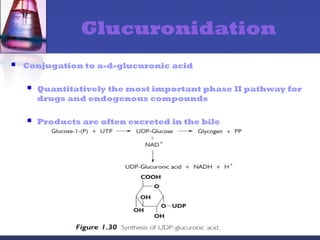
Glucuronidation
๏ฎ Conjugation to a-d-glucuronic acid
๏ฎ Quantitatively the most important phase II pathway for
drugs and endogenous compounds
๏ฎ Products are often excreted in the bile
Phase I and II - Summary
๏ฎ Products are generally more water soluble
๏ฎ These reactions products are ready for (renal) excretion
๏ฎ There are many complementary, sequential and
competing pathways
๏ฎ Phase I and Phase II metabolism are a coupled
interactive system interfacing with endogenous
metabolic pathways
Excretion
๏ฎ The main process that body eliminates
"unwanted" substances.
๏ฎ Most common route - biliary or renal
๏ฎ Other routes - lung (through exhalation),
skin (through perspiration) etc.
๏ฎ Lipophilic drugs may require several
metabolism steps before they are
excreted
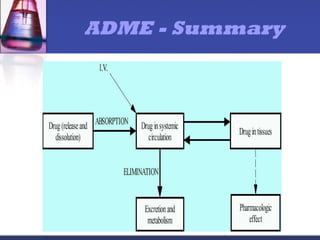
ADME - Summary

Pharmacokineticsddddddddddddddddd (1).ppt

  • 1.
  • 2.
    Pharmacokinetics (PK) ๏‚ฎ Thestudy of the disposition of a drug ๏‚ฎ The disposition of a drug includes the processes of ADME ๏‚ง Absorption ๏‚ง Distribution ๏‚ง Metabolism ๏‚ง Excretion ๏‚ง Toxicity Elimination
  • 3.
  • 4.
    DRUG R&D Drug discoveryand development โ€ข10-15 years to develop a new medicine โ€ขLikelihood of success: 10% โ€ขCost $800 million โ€“ 1 billion dollars (US)
  • 5.
  • 6.
    Importance of PKstudies ๏‚ญ Patients may suffer: ๏‚ง Toxic drugs may accumulate ๏‚ง Useful drugs may have no benefit because doses are too small to establish therapy ๏‚ง A drug can be rapidly metabolized.
  • 7.
    Routes Of Administration Routes OfDrug Administration Enteral Parenteral Oral Injection Rectal Respiratory Topical
  • 8.
    Absorption ๏ฎ The processby which drug proceeds from the site of administration to the site of measurement (blood stream) within the body. ๏ฎ Necessary for the production of a therapeutic effect. ๏ฎ Most drugs undergo gastrointestinal absorption. This is extent to which drug is absorbed from gut lumen into portal circulation ๏ฎ Exception: IV drug administration
  • 9.
    IV vs Oral I.VDrug Oral Drug Immediately Delayed completely incomplete
  • 10.
    ๏ฎ Absorption relieson ๏ฎ Passage through membranes to reach the blood ๏ฎ passive diffusion of lipid soluble species. The Process
  • 11.
    The Rule ofFive - formulation ๏ฎ There are more than 5 H-bond donors. ๏ฎ The molecular weight is over 500. ๏ฎ The LogP is over 5. ๏ฎ There are more than 10 H-bond acceptors. Poor absorption or permeation are more likely when:
  • 12.
    Absorption & Ionization Non-ionised drug Morelipid soluble drug Diffuse across cell membranes more easily
  • 13.
    First Pass Metabolism ๏ฎBioavailability: the fraction of the administered dose reaching the systemic circulation Dose Destroyed in gut Not absorbed Destroyed by gut wall Destroyed by liver to systemic circulation
  • 14.
    Determination of bioavailability ๏ฎ Adrug given by the intravenous route will have an absolute bioavailability of 1 (F=1 or 100% bioavavailable) ๏ฎ While drugs given by other routes usually have an absolute bioavailability of less than one. ๏ฎ The absolute bioavailability is the area under curve (AUC) non-intravenous divided by AUC intravenous .
  • 15.
    Toxicity ๏ฎ The therapeutic indexis the degree of separation between toxic and therapeutic doses. ๏ฎ Relationship Between Dose, Therapeutic Effect and Toxic Effect. The Therapeutic Index is Narrow for Most Cancer Drugs 100ร— 10ร—
  • 16.
    Distribution ๏ฎ The movementof drug from the blood to and from the tissues
  • 17.
    DISTRIBUTION ๏ฎ Determined by: ๏ฎโ€ข partitioning across various membranes ๏ฎ โ€ขbinding to tissue components ๏ฎ โ€ขbinding to blood components (RBC, plasma protein) ๏ฎ โ€ขphysiological volumes
  • 18.
    DISTRIBUTION ๏ฎ All ofthe fluid in the body (referred to as the total body water), in which a drug can be dissolved, can be roughly divided into three compartments: ๏ƒ˜ intravascular (blood plasma found within blood vessels) ๏ƒ˜ interstitial/tissue (fluid surrounding cells) ๏ƒ˜ intracellular (fluid within cells, i.e. cytosol) ๏ฎ The distribution of a drug into these compartments is dictated by it's physical and chemical properties
  • 19.
    TOTAL BODY WATER Vascular 3L 4% BW Extravascular 9 L 13% BW Intracellular 28 L 41% BW
  • 20.
    Distribution ๏ฎ Apparent volumeof distribution (Vd) = Amt of drug in body/plasma drug conc ๏ฎ VOLUME OF DISTRIBUTION FOR SOME DRUGS DRUG Vd (L) cocaine 140 clonazepam 210 amitriptyline 1050 amiodarone ~5000
  • 21.
    Factors affecting drugsVd ๏ฎ Blood flow: rate varies widely as function of tissue Muscle = slow Organs = fast ๏ฎ Capillary structure: โ€ขMost capillaries are โ€œleakyโ€ and do not impede diffusion of drugs โ€ขBlood-brain barrier formed by high level of tight junctions between cells โ€ขBBB is impermeable to most water-soluble drugs
  • 22.
    Blood Brain Barrier โ€ขDisruptionby osmotic means โ€ขUse of endogenous transport systems โ€ขBlocking of active efflux transporters โ€ข Intracerebral implantation โ€ขEtc
  • 23.
    Plasma Protein Binding ๏ฎMany drugs bind to plasma proteins in the blood steam ๏ฎ Plasma protein binding limits distribution. ๏ฎ A drug that binds plasma protein diffuses less efficiently, than a drug that doesnโ€™t.
  • 24.
    Physiochemical properties- Po/w ๏ฎ ThePartition coefficient (Po/w) and can be used to determine where a drug likes to go in the body ๏ฎ Any drug with a Po/w greater than 1(diffuse through cell membranes easily) is likely be found throughout all three fluid compartments ๏ฎ Drugs with low Po/w values (meaning that they are fairly water-soluble) are often unable to cross and require more time to distribute throughout the rest of the body
  • 25.
    Physiochemical Properties- Size ofdrug โ€ขThe size of a drug also dictates where it can go in the body. โ€ขMost drugs : 250 and 450 Da MW โ€ขTiny drugs (150-200 Da) with low Po/w values like caffeine can passively diffuse through cell membranes โ€ขAntibodies and other drugs range into the thousands of daltons โ€ขDrugs >200 Da with low Po/w values cannot passively cross membranes- require specialized protein-based transmembrane transport systems- slower distribution โ€ขDrugs < thousand daltons with high Po/w values-simply diffuse between the lipid molecules that make up membranes, while anything larger requires specialized transport.
  • 26.
    Elimination ๏ฎ The irreversibleremoval of the parent drugs from the body Elimination Drug Metabolism (Biotransformation) Excretion
  • 27.
    Drug Metabolism ๏ฎ Thechemical modification of drugs with the overall goal of getting rid of the drug ๏ฎ Enzymes are typically involved in metabolism Drug Metabolism More polar (water soluble) Drug Excretion
  • 28.
    โ€ขFrom 1898 throughto 1910 heroin was marketed as a non- addictive morphine substitute and cough medicine for children. Bayer marketed heroin as a cure for morphine addiction โ€ขHeroin is converted to morphine when metabolized in the liver METABOLISM
  • 29.
    Phases of DrugMetabolism ๏ฎ Phase I Reactions ๏ฎ Convert parent compound into a more polar (=hydrophilic) metabolite by adding or unmasking functional groups (-OH, -SH, -NH2, - COOH, etc.) eg. oxidation ๏ฎ Often these metabolites are inactive ๏ฎ May be sufficiently polar to be excreted readily
  • 30.
    Phases of metabolism ๏ฎPhase II Reactions ๏ฎ Conjugation with endogenous substrate to further increase aqueous solubility ๏ฎ Conjugation with glucoronide, sulfate, acetate, amino acid
  • 31.
    Mostly occurs in theliver because all of the blood in the body passes through the liver
  • 32.
    The Most Important Enzymes ๏ฎMicrosomal cytochrome P450 monooxygenase family of enzymes, which oxidize drugs ๏ฎ Act on structurally unrelated drugs ๏ฎ Metabolize the widest range of drugs.
  • 33.
    ๏ฎโ€ข Found inliver, small intestine, lungs, kidneys, placenta ๏ฎโ€ข Consists of > 50 isoforms ๏ฎโ€ข Major source of catalytic activity for drug oxidation ๏ฎโ€ข Itโ€™s been estimated that 90% or more of human drug oxidation can be attributed to 6 main enzymes: ๏ฎโ€ข CYP1A2 โ€ข CYP2D6 ๏ฎโ€ข CYP2C9 โ€ข CYP2E1 ๏ฎโ€ข CYP2C19 โ€ข CYP3A4 ๏ฎIn different people and different populations, activity of CYP oxidases differs. CYP family of enzymes
  • 35.
    Inhibitors and inducersof microsomal enzymes ๏ฎInhibitors: cimetidine prolongs action of drugs or inhibits action of those biotransformed to active agents (pro-drugs) ๏ฎInducers: barbiturates, carbamazepine shorten action of drugs or increase effects of those biotransformed to active agents ๏ฎBlockers: acting on non-microsomal enzymes (MAOI, anticholinesterase drugs)
  • 36.
    Phase II ๏ฎ Mainfunction of phase I reactions is to prepare chemicals for phase II metabolism and subsequent excretion ๏ฎ Phase II is the true โ€œdetoxificationโ€ step in the metabolism process.
  • 37.
    Phase II reactions ๏ฎConjugation reactions ๏ฎ Glucuronidation (on -OH, -COOH, -NH2, -SH groups) ๏ฎ Sulfation (on -NH2, -SO2NH2, -OH groups) ๏ฎ Acetylation (on -NH2, -SO2NH2, -OH groups) ๏ฎ Amino acid conjugation (on -COOH groups) ๏ฎ Glutathione conjugation (to epoxides or organic halides) ๏ฎ Fatty acid conjugation (on -OH groups) ๏ฎ Condensation reactions
  • 38.
    Glucuronidation ๏ฎ Conjugation toa-d-glucuronic acid ๏ฎ Quantitatively the most important phase II pathway for drugs and endogenous compounds ๏ฎ Products are often excreted in the bile
  • 39.
    Phase I andII - Summary ๏ฎ Products are generally more water soluble ๏ฎ These reactions products are ready for (renal) excretion ๏ฎ There are many complementary, sequential and competing pathways ๏ฎ Phase I and Phase II metabolism are a coupled interactive system interfacing with endogenous metabolic pathways
  • 40.
    Excretion ๏ฎ The mainprocess that body eliminates "unwanted" substances. ๏ฎ Most common route - biliary or renal ๏ฎ Other routes - lung (through exhalation), skin (through perspiration) etc. ๏ฎ Lipophilic drugs may require several metabolism steps before they are excreted
  • 41.