PHARMACEUTICAL
COUNTERFEITING AND FORENSIC
INVESTIGATION
Vilas Anil Chavan
M.Sc. (Ph. D.), NET, SET, FACT & FACT+(FDE)
Contents
01
Introduction
-A. Definition of Pharmaceutical Counterfeiting
- What constitutes counterfeit medications.
- Global prevalence and impact on public health.
B. Importance of Forensic Investigation
- Role of forensic science in identifying and combating counterfeit drugs.
- The intersection of pharmacy and forensic science in addressing this
issue.
02
Techniques for Detecting Counterfeit Medications
Counterfeit drug detection uses spectroscopy, chromatography, and
mass spectrometry for analysis, advanced imaging for structure, and
digital forensics with blockchain and serialization for secure tracking.
03
Case Studies
High-profile counterfeit drug cases highlight significant incidents and
their investigations, while forensic techniques have played a key role in
identifying and prosecuting counterfeiters.
04
Legal and Ethical Implications
Legal frameworks include international and national regulations, while
ethical issues focus on public health, company responsibilities, and
access vs. security. Pharmacists are essential for detecting counterfeits
and educating patients.
“Did you take your
medicine?”
“Did you complete your
Dose?”
asks a concerned mother.
asks a dilligent doctor.
W h a t i s
P h a r m a c e u t i c a l
C o u n t e r f e i t i n g ?
• Pharmaceutical counterfeiting involves the
production and distribution of medications that are
deliberately mislabeled with respect to identity,
composition, or source.
• These counterfeit drugs may contain incorrect
ingredients, improper dosages, no active ingredient,
or toxic substances.
• According to the World Health Organization (WHO),
counterfeit drugs constitute a significant portion of
the global pharmaceutical market, particularly in
low- and middle-income countries (LMICs).
• The global counterfeit drug market is estimated to
be worth $200 billion annually, posing a severe
threat to public health and safety.
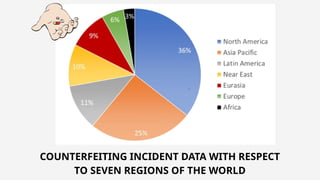
COUNTERFEITING INCIDENT DATA WITH RESPECT
TO SEVEN REGIONS OF THE WORLD
I m p o r t a n c e o f
F o r e n s i c
I n v e s t i g a t i o n
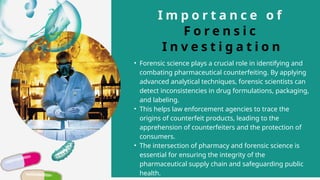
• Forensic science plays a crucial role in identifying and
combating pharmaceutical counterfeiting. By applying
advanced analytical techniques, forensic scientists can
detect inconsistencies in drug formulations, packaging,
and labeling.
• This helps law enforcement agencies to trace the
origins of counterfeit products, leading to the
apprehension of counterfeiters and the protection of
consumers.
• The intersection of pharmacy and forensic science is
essential for ensuring the integrity of the
pharmaceutical supply chain and safeguarding public
health.
Analytical Methods
Spectroscopy UV-Vis
Spectroscopy
Infrared (IR)
Spectroscopy
Raman
Spectroscopy
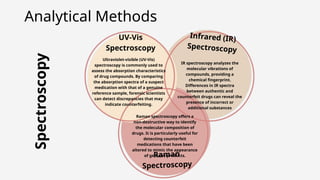
Ultraviolet-visible (UV-Vis)
spectroscopy is commonly used to
assess the absorption characteristics
of drug compounds. By comparing
the absorption spectra of a suspect
medication with that of a genuine
reference sample, forensic scientists
can detect discrepancies that may
indicate counterfeiting.
IR spectroscopy analyzes the
molecular vibrations of
compounds, providing a
chemical fingerprint.
Differences in IR spectra
between authentic and
counterfeit drugs can reveal the
presence of incorrect or
additional substances
Raman spectroscopy offers a
non-destructive way to identify
the molecular composition of
drugs. It is particularly useful for
detecting counterfeit
medications that have been
altered to mimic the appearance
of genuine products.
Analytical Methods
Chromatography
High-Performance Liquid
Chromatography (HPLC)
Gas Chromatography (GC)
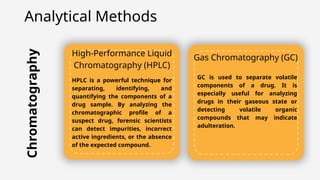
HPLC is a powerful technique for
separating, identifying, and
quantifying the components of a
drug sample. By analyzing the
chromatographic profile of a
suspect drug, forensic scientists
can detect impurities, incorrect
active ingredients, or the absence
of the expected compound.
GC is used to separate volatile
components of a drug. It is
especially useful for analyzing
drugs in their gaseous state or
detecting volatile organic
compounds that may indicate
adulteration.
Mass Spectrometry
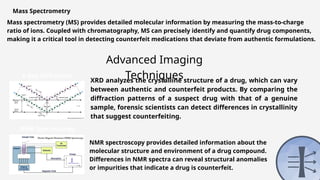
Mass spectrometry (MS) provides detailed molecular information by measuring the mass-to-charge
ratio of ions. Coupled with chromatography, MS can precisely identify and quantify drug components,
making it a critical tool in detecting counterfeit medications that deviate from authentic formulations.
Advanced Imaging
Techniques
X-Ray Diffraction
(XRD)
XRD analyzes the crystalline structure of a drug, which can vary
between authentic and counterfeit products. By comparing the
diffraction patterns of a suspect drug with that of a genuine
sample, forensic scientists can detect differences in crystallinity
that suggest counterfeiting.
NMR Spectroscopy
NMR spectroscopy provides detailed information about the
molecular structure and environment of a drug compound.
Differences in NMR spectra can reveal structural anomalies
or impurities that indicate a drug is counterfeit.
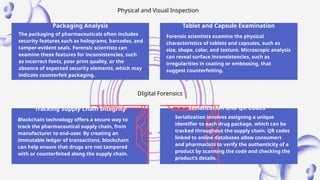
Packaging Analysis Tablet and Capsule Examination
Tracking Supply Chain Integrity
Physical and Visual Inspection
DIgital Forensics
Serialization and QR Codes
The packaging of pharmaceuticals often includes
security features such as holograms, barcodes, and
tamper-evident seals. Forensic scientists can
examine these features for inconsistencies, such
as incorrect fonts, poor print quality, or the
absence of expected security elements, which may
indicate counterfeit packaging.
Forensic scientists examine the physical
characteristics of tablets and capsules, such as
size, shape, color, and texture. Microscopic analysis
can reveal surface inconsistencies, such as
irregularities in coating or embossing, that
suggest counterfeiting.
Blockchain technology offers a secure way to
track the pharmaceutical supply chain, from
manufacturer to end-user. By creating an
immutable ledger of transactions, blockchain
can help ensure that drugs are not tampered
with or counterfeited along the supply chain.
Serialization involves assigning a unique
identifier to each drug package, which can be
tracked throughout the supply chain. QR codes
linked to online databases allow consumers
and pharmacists to verify the authenticity of a
product by scanning the code and checking the
product’s details.
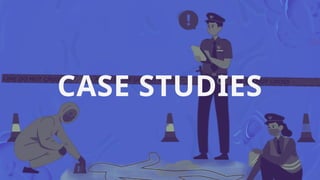
CASE STUDIES
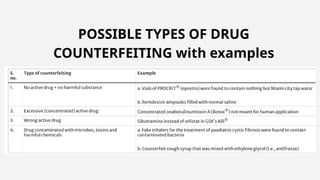
POSSIBLE TYPES OF DRUG
COUNTERFEITING with examples
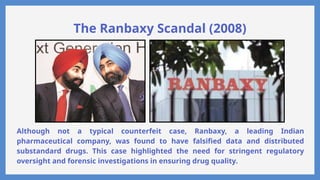
The Ranbaxy Scandal (2008)
Although not a typical counterfeit case, Ranbaxy, a leading Indian
pharmaceutical company, was found to have falsified data and distributed
substandard drugs. This case highlighted the need for stringent regulatory
oversight and forensic investigations in ensuring drug quality.
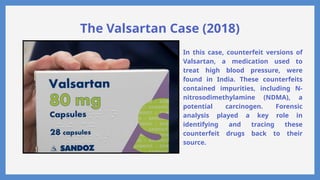
The Valsartan Case (2018)
In this case, counterfeit versions of
Valsartan, a medication used to
treat high blood pressure, were
found in India. These counterfeits
contained impurities, including N-
nitrosodimethylamine (NDMA), a
potential carcinogen. Forensic
analysis played a key role in
identifying and tracing these
counterfeit drugs back to their
source.
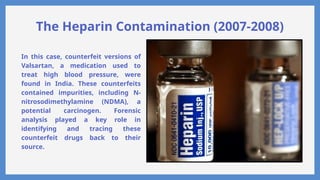
The Heparin Contamination (2007-2008)
In this case, counterfeit versions of
Valsartan, a medication used to
treat high blood pressure, were
found in India. These counterfeits
contained impurities, including N-
nitrosodimethylamine (NDMA), a
potential carcinogen. Forensic
analysis played a key role in
identifying and tracing these
counterfeit drugs back to their
source.
LEGAL FRAMEWORK
International Laws and
Regulations
The WHO’s International Medical Products Anti-
Counterfeiting Taskforce (IMPACT) coordinates global
efforts to combat counterfeit drugs. IMPACT promotes
the harmonization of laws and regulations across
countries to strengthen the fight against
counterfeiting. International treaties, such as the
Trade-Related Aspects of Intellectual Property Rights
(TRIPS) Agreement, also play a crucial role in setting
standards for the protection of intellectual property
in the pharmaceutical industry.
National
Legislation
• The Drugs and Cosmetics Act, 1940 (amended several
times) governs drug quality in India, including penalties
for counterfeiting. Under the Drugs and Magic
Remedies (Objectionable Advertisements) Act, 1954,
strict actions are taken against those involved in the
sale and distribution of counterfeit drugs.
• Despite these laws, enforcement remains challenging
due to the vast size of the Indian pharmaceutical
market and the prevalence of counterfeit drugs in rural
areas.
Section 276 of the Bharatiya Nyaya Sanhita (BNS) of 2023 deals with the
adulteration of drugs and medical preparations :
Whoever adulterates any drug or medical preparation in such a
manner as to lessen the efficacy or change the operation of such
drug or medical preparation, or to make it noxious, intending that it
shall be sold or used for, or knowing it to be likely that it will be sold
or used for, any medicinal purpose, as if it had not undergone such
adulteration, shall be punished with imprisonment of either
description for a term which may extend to one year, or with fine
which may extend to five thousand rupees, or with both.
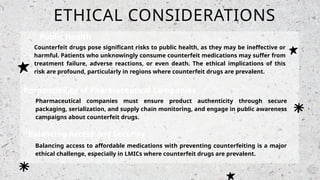
ETHICAL CONSIDERATIONS
Public Health
Risks
Counterfeit drugs pose significant risks to public health, as they may be ineffective or
harmful. Patients who unknowingly consume counterfeit medications may suffer from
treatment failure, adverse reactions, or even death. The ethical implications of this
risk are profound, particularly in regions where counterfeit drugs are prevalent.
Responsibility of Pharmaceutical Companies
Pharmaceutical companies must ensure product authenticity through secure
packaging, serialization, and supply chain monitoring, and engage in public awareness
campaigns about counterfeit drugs.
Balancing Access and Security
Balancing access to affordable medications with preventing counterfeiting is a major
ethical challenge, especially in LMICs where counterfeit drugs are prevalent.
STAKEHOLDER
PHARMACISTS COMPANIES REGULATORS
ROLE OF PHARMACIST
Pharmacists and consumers are crucial in combating
drug counterfeiting. Consumers should buy
medicines from trusted sources and avoid dubious
online pharmacies.
They should report any concerns about a drug's
appearance, taste, or effects to a pharmacist or
doctor.
Pharmacists must purchase from reputable sources
approved by drug regulatory agencies, maintain
records for traceability, and report any suspicious
cases of counterfeiting to the authorities.
ROLE OF Pharmaceutical
companies
Pharmaceutical companies invest heavily in developing and testing drugs,
but counterfeiting undermines their efforts and profits. For example,
Pfizer's Viagra™ and Lipitor are frequently counterfeited across numerous
countries.
To combat this issue, companies must tackle counterfeiting at its source,
including wholesalers, distributors, and pharmacies. Key measures include
raising awareness among pharmacists, doctors, and consumers, ensuring
supply chain integrity, and employing advanced technologies like AI-driven
QR codes, RFID, and NFC for better traceability and product verification.
Implementing these steps helps protect drug authenticity and security
throughout the supply chain.
The International Medical Products Anti-Counterfeiting
Taskforce, formed by WHO in 2006, unites global stakeholders
to fight counterfeit drugs.
Europe's Falsified Medicines Directive (FMD) requires unique
identifiers and anti-tampering features on drug packaging. The
US Drug Supply Chain Security Act (DSCSA) mandates electronic
tracking for prescription medications, overseen by the FDA.
India has introduced unique IDs and barcodes on drug packs for
verification. Despite these measures, drug counterfeiting
remains a pressing issue, especially in developing countries,
highlighting the need for a global strategy.
ROLE OF regulators
Vilas Anil Chavan
THANK YOU
Contact Details
89782 96668
principalforensic@aditya.ac.in
for being patient audience.

Pharmaceutical Counterfeiting and Forensic Investigation

  • 1.
    PHARMACEUTICAL COUNTERFEITING AND FORENSIC INVESTIGATION VilasAnil Chavan M.Sc. (Ph. D.), NET, SET, FACT & FACT+(FDE)
  • 2.
    Contents 01 Introduction -A. Definition ofPharmaceutical Counterfeiting - What constitutes counterfeit medications. - Global prevalence and impact on public health. B. Importance of Forensic Investigation - Role of forensic science in identifying and combating counterfeit drugs. - The intersection of pharmacy and forensic science in addressing this issue. 02 Techniques for Detecting Counterfeit Medications Counterfeit drug detection uses spectroscopy, chromatography, and mass spectrometry for analysis, advanced imaging for structure, and digital forensics with blockchain and serialization for secure tracking. 03 Case Studies High-profile counterfeit drug cases highlight significant incidents and their investigations, while forensic techniques have played a key role in identifying and prosecuting counterfeiters. 04 Legal and Ethical Implications Legal frameworks include international and national regulations, while ethical issues focus on public health, company responsibilities, and access vs. security. Pharmacists are essential for detecting counterfeits and educating patients.
  • 3.
    “Did you takeyour medicine?” “Did you complete your Dose?” asks a concerned mother. asks a dilligent doctor.
  • 4.
    W h at i s P h a r m a c e u t i c a l C o u n t e r f e i t i n g ? • Pharmaceutical counterfeiting involves the production and distribution of medications that are deliberately mislabeled with respect to identity, composition, or source. • These counterfeit drugs may contain incorrect ingredients, improper dosages, no active ingredient, or toxic substances. • According to the World Health Organization (WHO), counterfeit drugs constitute a significant portion of the global pharmaceutical market, particularly in low- and middle-income countries (LMICs). • The global counterfeit drug market is estimated to be worth $200 billion annually, posing a severe threat to public health and safety.
  • 5.
    COUNTERFEITING INCIDENT DATAWITH RESPECT TO SEVEN REGIONS OF THE WORLD
  • 6.
    I m po r t a n c e o f F o r e n s i c I n v e s t i g a t i o n • Forensic science plays a crucial role in identifying and combating pharmaceutical counterfeiting. By applying advanced analytical techniques, forensic scientists can detect inconsistencies in drug formulations, packaging, and labeling. • This helps law enforcement agencies to trace the origins of counterfeit products, leading to the apprehension of counterfeiters and the protection of consumers. • The intersection of pharmacy and forensic science is essential for ensuring the integrity of the pharmaceutical supply chain and safeguarding public health.
  • 7.
    Analytical Methods Spectroscopy UV-Vis Spectroscopy Infrared(IR) Spectroscopy Raman Spectroscopy Ultraviolet-visible (UV-Vis) spectroscopy is commonly used to assess the absorption characteristics of drug compounds. By comparing the absorption spectra of a suspect medication with that of a genuine reference sample, forensic scientists can detect discrepancies that may indicate counterfeiting. IR spectroscopy analyzes the molecular vibrations of compounds, providing a chemical fingerprint. Differences in IR spectra between authentic and counterfeit drugs can reveal the presence of incorrect or additional substances Raman spectroscopy offers a non-destructive way to identify the molecular composition of drugs. It is particularly useful for detecting counterfeit medications that have been altered to mimic the appearance of genuine products.
  • 8.
    Analytical Methods Chromatography High-Performance Liquid Chromatography(HPLC) Gas Chromatography (GC) HPLC is a powerful technique for separating, identifying, and quantifying the components of a drug sample. By analyzing the chromatographic profile of a suspect drug, forensic scientists can detect impurities, incorrect active ingredients, or the absence of the expected compound. GC is used to separate volatile components of a drug. It is especially useful for analyzing drugs in their gaseous state or detecting volatile organic compounds that may indicate adulteration.
  • 9.
    Mass Spectrometry Mass spectrometry(MS) provides detailed molecular information by measuring the mass-to-charge ratio of ions. Coupled with chromatography, MS can precisely identify and quantify drug components, making it a critical tool in detecting counterfeit medications that deviate from authentic formulations. Advanced Imaging Techniques X-Ray Diffraction (XRD) XRD analyzes the crystalline structure of a drug, which can vary between authentic and counterfeit products. By comparing the diffraction patterns of a suspect drug with that of a genuine sample, forensic scientists can detect differences in crystallinity that suggest counterfeiting. NMR Spectroscopy NMR spectroscopy provides detailed information about the molecular structure and environment of a drug compound. Differences in NMR spectra can reveal structural anomalies or impurities that indicate a drug is counterfeit.
  • 10.
    Packaging Analysis Tabletand Capsule Examination Tracking Supply Chain Integrity Physical and Visual Inspection DIgital Forensics Serialization and QR Codes The packaging of pharmaceuticals often includes security features such as holograms, barcodes, and tamper-evident seals. Forensic scientists can examine these features for inconsistencies, such as incorrect fonts, poor print quality, or the absence of expected security elements, which may indicate counterfeit packaging. Forensic scientists examine the physical characteristics of tablets and capsules, such as size, shape, color, and texture. Microscopic analysis can reveal surface inconsistencies, such as irregularities in coating or embossing, that suggest counterfeiting. Blockchain technology offers a secure way to track the pharmaceutical supply chain, from manufacturer to end-user. By creating an immutable ledger of transactions, blockchain can help ensure that drugs are not tampered with or counterfeited along the supply chain. Serialization involves assigning a unique identifier to each drug package, which can be tracked throughout the supply chain. QR codes linked to online databases allow consumers and pharmacists to verify the authenticity of a product by scanning the code and checking the product’s details.
  • 11.
  • 12.
    POSSIBLE TYPES OFDRUG COUNTERFEITING with examples
  • 13.
    The Ranbaxy Scandal(2008) Although not a typical counterfeit case, Ranbaxy, a leading Indian pharmaceutical company, was found to have falsified data and distributed substandard drugs. This case highlighted the need for stringent regulatory oversight and forensic investigations in ensuring drug quality.
  • 14.
    The Valsartan Case(2018) In this case, counterfeit versions of Valsartan, a medication used to treat high blood pressure, were found in India. These counterfeits contained impurities, including N- nitrosodimethylamine (NDMA), a potential carcinogen. Forensic analysis played a key role in identifying and tracing these counterfeit drugs back to their source.
  • 15.
    The Heparin Contamination(2007-2008) In this case, counterfeit versions of Valsartan, a medication used to treat high blood pressure, were found in India. These counterfeits contained impurities, including N- nitrosodimethylamine (NDMA), a potential carcinogen. Forensic analysis played a key role in identifying and tracing these counterfeit drugs back to their source.
  • 16.
    LEGAL FRAMEWORK International Lawsand Regulations The WHO’s International Medical Products Anti- Counterfeiting Taskforce (IMPACT) coordinates global efforts to combat counterfeit drugs. IMPACT promotes the harmonization of laws and regulations across countries to strengthen the fight against counterfeiting. International treaties, such as the Trade-Related Aspects of Intellectual Property Rights (TRIPS) Agreement, also play a crucial role in setting standards for the protection of intellectual property in the pharmaceutical industry.
  • 17.
    National Legislation • The Drugsand Cosmetics Act, 1940 (amended several times) governs drug quality in India, including penalties for counterfeiting. Under the Drugs and Magic Remedies (Objectionable Advertisements) Act, 1954, strict actions are taken against those involved in the sale and distribution of counterfeit drugs. • Despite these laws, enforcement remains challenging due to the vast size of the Indian pharmaceutical market and the prevalence of counterfeit drugs in rural areas.
  • 18.
    Section 276 ofthe Bharatiya Nyaya Sanhita (BNS) of 2023 deals with the adulteration of drugs and medical preparations : Whoever adulterates any drug or medical preparation in such a manner as to lessen the efficacy or change the operation of such drug or medical preparation, or to make it noxious, intending that it shall be sold or used for, or knowing it to be likely that it will be sold or used for, any medicinal purpose, as if it had not undergone such adulteration, shall be punished with imprisonment of either description for a term which may extend to one year, or with fine which may extend to five thousand rupees, or with both.
  • 19.
    ETHICAL CONSIDERATIONS Public Health Risks Counterfeitdrugs pose significant risks to public health, as they may be ineffective or harmful. Patients who unknowingly consume counterfeit medications may suffer from treatment failure, adverse reactions, or even death. The ethical implications of this risk are profound, particularly in regions where counterfeit drugs are prevalent. Responsibility of Pharmaceutical Companies Pharmaceutical companies must ensure product authenticity through secure packaging, serialization, and supply chain monitoring, and engage in public awareness campaigns about counterfeit drugs. Balancing Access and Security Balancing access to affordable medications with preventing counterfeiting is a major ethical challenge, especially in LMICs where counterfeit drugs are prevalent.
  • 20.
  • 21.
    ROLE OF PHARMACIST Pharmacistsand consumers are crucial in combating drug counterfeiting. Consumers should buy medicines from trusted sources and avoid dubious online pharmacies. They should report any concerns about a drug's appearance, taste, or effects to a pharmacist or doctor. Pharmacists must purchase from reputable sources approved by drug regulatory agencies, maintain records for traceability, and report any suspicious cases of counterfeiting to the authorities.
  • 22.
    ROLE OF Pharmaceutical companies Pharmaceuticalcompanies invest heavily in developing and testing drugs, but counterfeiting undermines their efforts and profits. For example, Pfizer's Viagra™ and Lipitor are frequently counterfeited across numerous countries. To combat this issue, companies must tackle counterfeiting at its source, including wholesalers, distributors, and pharmacies. Key measures include raising awareness among pharmacists, doctors, and consumers, ensuring supply chain integrity, and employing advanced technologies like AI-driven QR codes, RFID, and NFC for better traceability and product verification. Implementing these steps helps protect drug authenticity and security throughout the supply chain.
  • 23.
    The International MedicalProducts Anti-Counterfeiting Taskforce, formed by WHO in 2006, unites global stakeholders to fight counterfeit drugs. Europe's Falsified Medicines Directive (FMD) requires unique identifiers and anti-tampering features on drug packaging. The US Drug Supply Chain Security Act (DSCSA) mandates electronic tracking for prescription medications, overseen by the FDA. India has introduced unique IDs and barcodes on drug packs for verification. Despite these measures, drug counterfeiting remains a pressing issue, especially in developing countries, highlighting the need for a global strategy. ROLE OF regulators
  • 24.
    Vilas Anil Chavan THANKYOU Contact Details 89782 96668 principalforensic@aditya.ac.in for being patient audience.