Organization of the PGD
Centre
Overview
of
Preimplantation
Genetic Diagnosis
What is preimplantation genetic
diagnosis (PGD)?
• The embryo is created via in vitro fertilization.
• Typically, a single cell is removed from the embryo at the
8-cell stage (3 days after fertilization).
• Genetic testing is performed.
• The results of testing are used to decide which embryos,
if any, to implant in the prospective mother’s uterus.
PGD:
Pre-implantation Genetic Diagnosis
Schwartz 2011
Jewish News
What % of IVF clinics provide testing for the following reasons?
aneuploidy
autosomal disorders
chromosomal rearrangement
X-linked diseases
non-medical sex selection
avoid adult-onset disease
HLA typing
HLA typing w/o single gene test
Select for a disability
http://www.dnapolicy.org/resources/GeneticTestingofEmbryos.pdf
Public attitudes regarding acceptable uses of PGD:
Fatal HLA match Adult
onset disease
Sex Intelligence/
strength
http://www.dnapolicy.org/resources/2006_Hudson_PGD_public_policy_and_public_attitudes.pdf
Egg Sperm
Remove one cell
On day 3rd
Embryo 8 cell stage
Test DNA or
chromosomes
Test results
Healthy
gen
conditions
Unhealthy
gen
conditions
Embryo
implanted on day
4
Embryo
discarded
Preimplantation Genetic Diagnosis
(PGD)
PGD is a state-of-the-art
procedure used in
conjunction with In Vitro
Fertilization (IVF)
in which the embryo is
tested for certain conditions
prior to being placed in the
womb of the woman.
PGD was first reported in
1990.
PGD combines the recent
advances in molecular
genetics and in assisted
reproductive technology
Indications for PGDChromosomal Disorders
Chromosomal
rearrangements
Inversions
Translocations
Chromosome Deletions
Gender determination for severe X-
linked diseases
Severe monogenic diseases (cystic
fibrosis, ß thalassaemia, sickle cell
anemia, fragile X syndrome,
myopathies)
Recurrent pregnancy loss
Advanced Maternal Age
Couples with >3 IVF failures
Epididymal or Testicular sperm
aspiration with >1 IVF failures.
Benefits of PGD
Increased Implantation
Rate
Reduction in Pregnancy
Losses
Reduction in the Chance
of Having a Child with
Aneuploidy
.Reduces the possibility
of having to choose to
terminate the pregnancy
following a diagnosis of a
probable genetic disorder.
How is PGD performed
Day 5/6, Blastocyst biopsy
Methods of PGD/PGS
 PCR-based
 PCR, real-time-PCR
 QF-PCR
 Sequencing, mini-Sequencing, next-gen
sequencing
 F.I.S.H.
 array-CGH
 SNP-array
13
PGD TimeLine
1970 1980 1990 2000 2010
Implementation of
the FISH into the
cytogenetics
First PCR - PGD
FISH – sex
selection
Implementation of the CGH
into the cytogenetics
arrayCGH reported for clinical genetics
CGH-
PGD
aCGH-
PGD
PCR -PGD for Fresh
ET
SNP-
array
PGD
First delivery
after aCGH-
PGS
aCG
HFirst aCGH-
delivery
What? Where? and When?
15
• PB 1 & 2
• Blastomere (cleavage stage -day 3)
• Trophectoderm (blastocyst – day 5)
Features
PB biopsy Blastomere biopsy TE biopsy
•Indirect data about the
oocyte genotype
•Male factor is not taken
into account
•Mosaicism is not excluded
•Decreasing the embryo
viability
•Subsequent self-correction
of trisomic embryos is not
excluded
•More cells = more DNA = more
accurate diagnostics
•Less mosaicism
•Reduced impact of embryo
biopsy
•Economic factor: less embryos
to be analized
•Facilitates the selective
embryo transfer
•Allows to modify endometrium
if needed
•Ability to blastocyst cultivation
and vitrification are needed
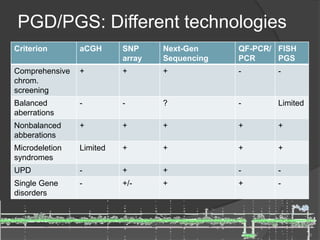
PGD/PGS: Different technologies
Criterion aCGH SNP
array
Next-Gen
Sequencing
QF-PCR/
PCR
FISH
PGS
Comprehensive
chrom.
screening
+ + + - -
Balanced
aberrations
- - ? - Limited
Nonbalanced
abberations
+ + + + +
Microdeletion
syndromes
Limited + + + +
UPD - + + - -
Single Gene
disorders
- +/- + + -
16
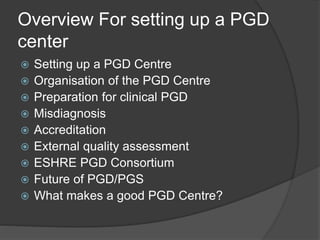
Overview For setting up a PGD
center
 Setting up a PGD Centre
 Organisation of the PGD Centre
 Preparation for clinical PGD
 Misdiagnosis
 Accreditation
 External quality assessment
 ESHRE PGD Consortium
 Future of PGD/PGS
 What makes a good PGD Centre?
Setting up a PGD centre
Two ways
 IVF centre and PGD centre in the same
institute – preferred
 Transport PGD
Organisation of the PGD Centre
 Highly successful IVF unit
 Patients need genetic and specific PGD
counselling
 Biopsy performed by trained embryologist
 Diagnosis performed by molecular
biologist/cytogeneticist
 Accredited lab
 Patient information leaflets and consents
 Excellent communication between IVF centre
and diagnosis lab
 Join the PGD Consortium
Pretreatment workup
 FISH
 Sexing need to check for polymorphisms
 Translocation protocols developed by cytogeneticist
 For PGS – polymorphic sites
 PCR
 Confirmation of mutation on proband and relatives
 Suitable informative markers to detect
contamination
 Experienced molecular biologist
 Arrays
 Depends on if for molecular or cytogenetic
 Validation of WGA and array
 Experienced clinical scientist
Workup of diagnosis
 Validation of method
 Full authorised report
 Protocol logged into lab system
 Prior to cycle – internal quality
assessment of all reagents and
equipment
Clinical cycle
 Full consultation, information leaflets, relevant
consents
 Need good number oocytes/embryos
 Patients must not have unprotected sex
 All cumulus cells removed (maternal contamination)
 ICSI for all molecular diagnosis (paternal
contamination)
 Medium to support blastocyst growth
 Clear identification of biopsied cell and embryo
number
 Ensure correct embryo transferred
 Appropriate witnesses throughout diagnosis
 Full authorised report logged in PGD and IVF centre
Key points for biopsy/diagnosis
lab
 Counselling
 Appropriately trained staff
 Aware of misdiagnosis possibilities
 Quality control
 Records
 ISO/accreditation
Accreditation
 ISO 15189
 Every country has national body
 How can we help?
 QM workshop
 Paper on accreditation of a PGD
laboratory, Harper et al, 2010
 Establish an accreditation advisory panel
 Discussion with national accreditation
bodies
 Offer centres help with accreditation
process
ISO 15189
 •Management requirements
 Organization and quality management
 Quality management system
 Document control
 Review of contracts
 Examination by referral laboratories
 External services and supplies
 Advisory services
 Resolution of complaints
 Identification of control of non conformities
 Corrective action/Preventative action
 Continual improvement
 Quality and technical records
 Internal audits
 Management review
ISO 15189
Technical requirements
 Personnel
 Accommodation and environmental conditions
 Laboratory equipment
 Pre-examination procedures
 Examination procedures
 Assuring quality of examination procedures
 Post-examination procedures
 Reporting results
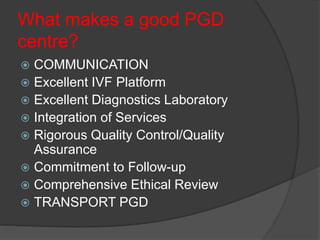
What makes a good PGD
centre?
 COMMUNICATION
 Excellent IVF Platform
 Excellent Diagnostics Laboratory
 Integration of Services
 Rigorous Quality Control/Quality
Assurance
 Commitment to Follow-up
 Comprehensive Ethical Review
 TRANSPORT PGD
• Gain genetic information about an embryo or
unborn fetus.
• Help individuals conceive.
• Allow individuals to select embryos based on their
genetic makeup.
Genetic reproductive technologies
can be used to:
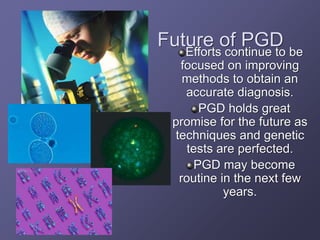
Future of PGDEfforts continue to be
focused on improving
methods to obtain an
accurate diagnosis.
PGD holds great
promise for the future as
techniques and genetic
tests are perfected.
PGD may become
routine in the next few
years.
It’s hard to being a good
embryo
30
But even more difficult to detect
it…

PGD center setup

  • 1.
  • 2.
  • 3.
    What is preimplantationgenetic diagnosis (PGD)? • The embryo is created via in vitro fertilization. • Typically, a single cell is removed from the embryo at the 8-cell stage (3 days after fertilization). • Genetic testing is performed. • The results of testing are used to decide which embryos, if any, to implant in the prospective mother’s uterus.
  • 4.
  • 5.
    What % ofIVF clinics provide testing for the following reasons? aneuploidy autosomal disorders chromosomal rearrangement X-linked diseases non-medical sex selection avoid adult-onset disease HLA typing HLA typing w/o single gene test Select for a disability http://www.dnapolicy.org/resources/GeneticTestingofEmbryos.pdf
  • 6.
    Public attitudes regardingacceptable uses of PGD: Fatal HLA match Adult onset disease Sex Intelligence/ strength http://www.dnapolicy.org/resources/2006_Hudson_PGD_public_policy_and_public_attitudes.pdf
  • 7.
    Egg Sperm Remove onecell On day 3rd Embryo 8 cell stage Test DNA or chromosomes Test results Healthy gen conditions Unhealthy gen conditions Embryo implanted on day 4 Embryo discarded
  • 8.
    Preimplantation Genetic Diagnosis (PGD) PGDis a state-of-the-art procedure used in conjunction with In Vitro Fertilization (IVF) in which the embryo is tested for certain conditions prior to being placed in the womb of the woman. PGD was first reported in 1990. PGD combines the recent advances in molecular genetics and in assisted reproductive technology
  • 9.
    Indications for PGDChromosomalDisorders Chromosomal rearrangements Inversions Translocations Chromosome Deletions Gender determination for severe X- linked diseases Severe monogenic diseases (cystic fibrosis, ß thalassaemia, sickle cell anemia, fragile X syndrome, myopathies) Recurrent pregnancy loss Advanced Maternal Age Couples with >3 IVF failures Epididymal or Testicular sperm aspiration with >1 IVF failures.
  • 10.
    Benefits of PGD IncreasedImplantation Rate Reduction in Pregnancy Losses Reduction in the Chance of Having a Child with Aneuploidy .Reduces the possibility of having to choose to terminate the pregnancy following a diagnosis of a probable genetic disorder.
  • 11.
    How is PGDperformed
  • 12.
  • 13.
    Methods of PGD/PGS PCR-based  PCR, real-time-PCR  QF-PCR  Sequencing, mini-Sequencing, next-gen sequencing  F.I.S.H.  array-CGH  SNP-array 13
  • 14.
    PGD TimeLine 1970 19801990 2000 2010 Implementation of the FISH into the cytogenetics First PCR - PGD FISH – sex selection Implementation of the CGH into the cytogenetics arrayCGH reported for clinical genetics CGH- PGD aCGH- PGD PCR -PGD for Fresh ET SNP- array PGD First delivery after aCGH- PGS aCG HFirst aCGH- delivery
  • 15.
    What? Where? andWhen? 15 • PB 1 & 2 • Blastomere (cleavage stage -day 3) • Trophectoderm (blastocyst – day 5) Features PB biopsy Blastomere biopsy TE biopsy •Indirect data about the oocyte genotype •Male factor is not taken into account •Mosaicism is not excluded •Decreasing the embryo viability •Subsequent self-correction of trisomic embryos is not excluded •More cells = more DNA = more accurate diagnostics •Less mosaicism •Reduced impact of embryo biopsy •Economic factor: less embryos to be analized •Facilitates the selective embryo transfer •Allows to modify endometrium if needed •Ability to blastocyst cultivation and vitrification are needed
  • 16.
    PGD/PGS: Different technologies CriterionaCGH SNP array Next-Gen Sequencing QF-PCR/ PCR FISH PGS Comprehensive chrom. screening + + + - - Balanced aberrations - - ? - Limited Nonbalanced abberations + + + + + Microdeletion syndromes Limited + + + + UPD - + + - - Single Gene disorders - +/- + + - 16
  • 17.
    Overview For settingup a PGD center  Setting up a PGD Centre  Organisation of the PGD Centre  Preparation for clinical PGD  Misdiagnosis  Accreditation  External quality assessment  ESHRE PGD Consortium  Future of PGD/PGS  What makes a good PGD Centre?
  • 18.
    Setting up aPGD centre Two ways  IVF centre and PGD centre in the same institute – preferred  Transport PGD
  • 19.
    Organisation of thePGD Centre  Highly successful IVF unit  Patients need genetic and specific PGD counselling  Biopsy performed by trained embryologist  Diagnosis performed by molecular biologist/cytogeneticist  Accredited lab  Patient information leaflets and consents  Excellent communication between IVF centre and diagnosis lab  Join the PGD Consortium
  • 20.
    Pretreatment workup  FISH Sexing need to check for polymorphisms  Translocation protocols developed by cytogeneticist  For PGS – polymorphic sites  PCR  Confirmation of mutation on proband and relatives  Suitable informative markers to detect contamination  Experienced molecular biologist  Arrays  Depends on if for molecular or cytogenetic  Validation of WGA and array  Experienced clinical scientist
  • 21.
    Workup of diagnosis Validation of method  Full authorised report  Protocol logged into lab system  Prior to cycle – internal quality assessment of all reagents and equipment
  • 22.
    Clinical cycle  Fullconsultation, information leaflets, relevant consents  Need good number oocytes/embryos  Patients must not have unprotected sex  All cumulus cells removed (maternal contamination)  ICSI for all molecular diagnosis (paternal contamination)  Medium to support blastocyst growth  Clear identification of biopsied cell and embryo number  Ensure correct embryo transferred  Appropriate witnesses throughout diagnosis  Full authorised report logged in PGD and IVF centre
  • 23.
    Key points forbiopsy/diagnosis lab  Counselling  Appropriately trained staff  Aware of misdiagnosis possibilities  Quality control  Records  ISO/accreditation
  • 24.
    Accreditation  ISO 15189 Every country has national body  How can we help?  QM workshop  Paper on accreditation of a PGD laboratory, Harper et al, 2010  Establish an accreditation advisory panel  Discussion with national accreditation bodies  Offer centres help with accreditation process
  • 25.
    ISO 15189  •Managementrequirements  Organization and quality management  Quality management system  Document control  Review of contracts  Examination by referral laboratories  External services and supplies  Advisory services  Resolution of complaints  Identification of control of non conformities  Corrective action/Preventative action  Continual improvement  Quality and technical records  Internal audits  Management review
  • 26.
    ISO 15189 Technical requirements Personnel  Accommodation and environmental conditions  Laboratory equipment  Pre-examination procedures  Examination procedures  Assuring quality of examination procedures  Post-examination procedures  Reporting results
  • 27.
    What makes agood PGD centre?  COMMUNICATION  Excellent IVF Platform  Excellent Diagnostics Laboratory  Integration of Services  Rigorous Quality Control/Quality Assurance  Commitment to Follow-up  Comprehensive Ethical Review  TRANSPORT PGD
  • 28.
    • Gain geneticinformation about an embryo or unborn fetus. • Help individuals conceive. • Allow individuals to select embryos based on their genetic makeup. Genetic reproductive technologies can be used to:
  • 29.
    Future of PGDEffortscontinue to be focused on improving methods to obtain an accurate diagnosis. PGD holds great promise for the future as techniques and genetic tests are perfected. PGD may become routine in the next few years.
  • 30.
    It’s hard tobeing a good embryo 30 But even more difficult to detect it…