PFP – Fireproofing Application
& Inspection
CRISP Project, BJCHI Yard Thailand.
2
CONTENTS
1. Scope
2. Introduction
3. Surface Preparation
4. Primers
5. Reinforcement
6. Chartek application
7. Inspections
8. Repairs
Fireproofing Application & Inspection (PFP)
3
1- SCOPE
The content of this presentation is intended for guidelines of PFP application
and inspection activities.
The given application parameters, details etc. are based on general
recommendations which may be subject to change and may not be applicable
to all Chartek products or specific projects.
For application and QC purposes always consult the latest product literature.
This includes the Product Data Sheet(s) and Application Manual, and should be
done in combination with the project specification and AkzoNobel
Fireproofing Application & Inspection (PFP)
4
2- INTRODUCTION
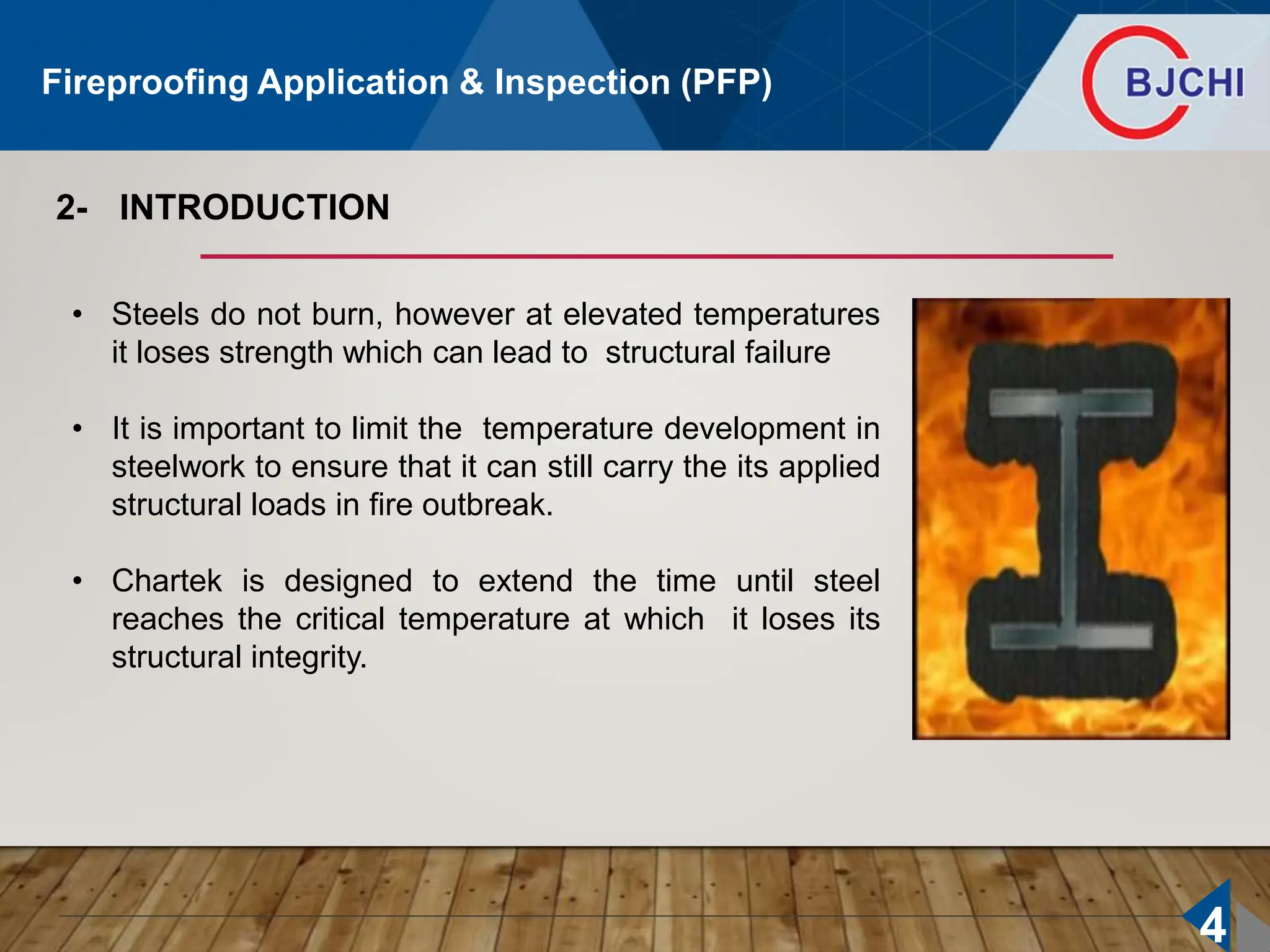
• Steels do not burn, however at elevated temperatures
it loses strength which can lead to structural failure
• It is important to limit the temperature development in
steelwork to ensure that it can still carry the its applied
structural loads in fire outbreak.
• Chartek is designed to extend the time until steel
reaches the critical temperature at which it loses its
structural integrity.
Fireproofing Application & Inspection (PFP)
5
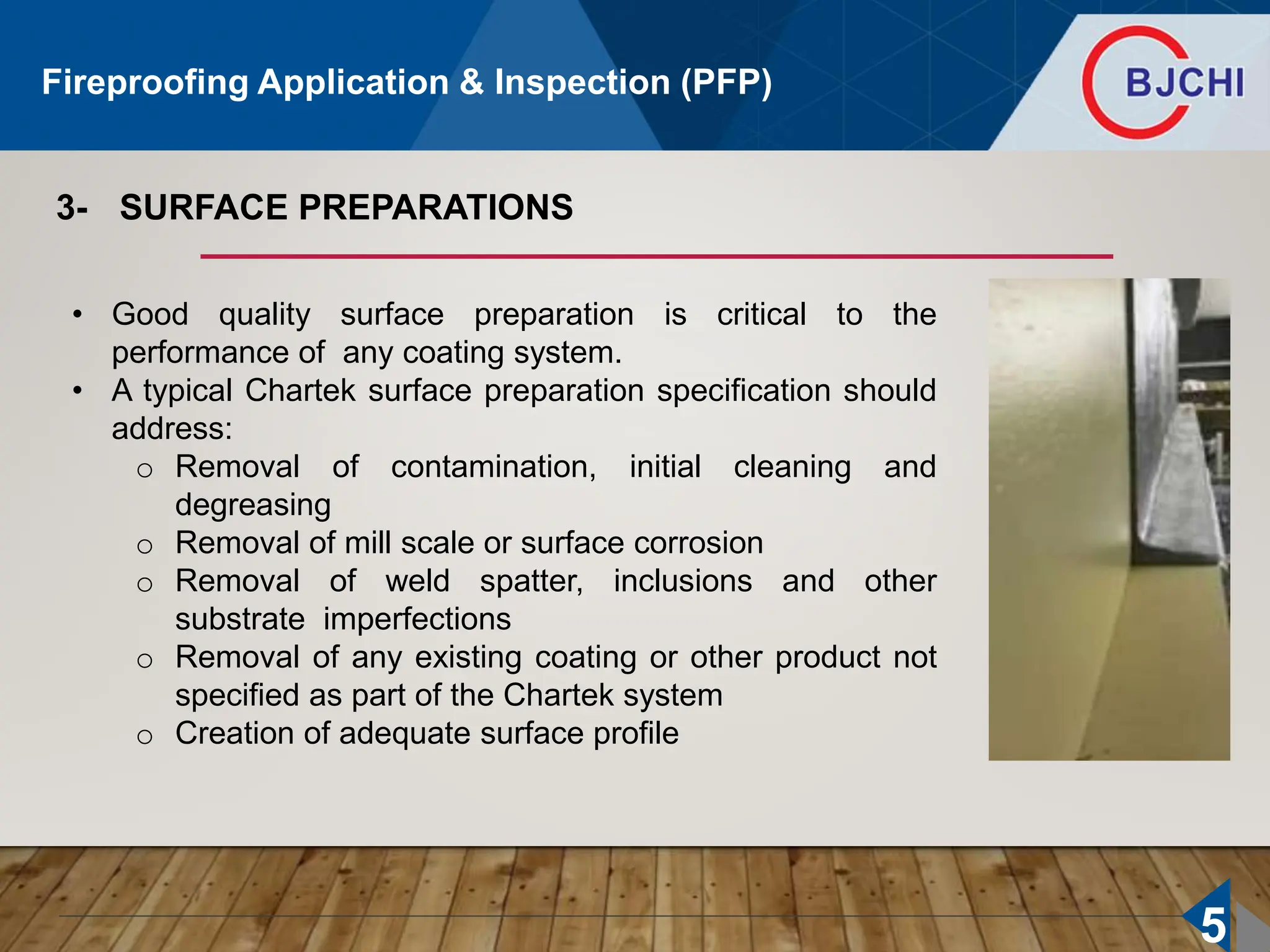
3- SURFACE PREPARATIONS
• Good quality surface preparation is critical to the
performance of any coating system.
• A typical Chartek surface preparation specification should
address:
o Removal of contamination, initial cleaning and
degreasing
o Removal of mill scale or surface corrosion
o Removal of weld spatter, inclusions and other
substrate imperfections
o Removal of any existing coating or other product not
specified as part of the Chartek system
o Creation of adequate surface profile
Fireproofing Application & Inspection (PFP)
6
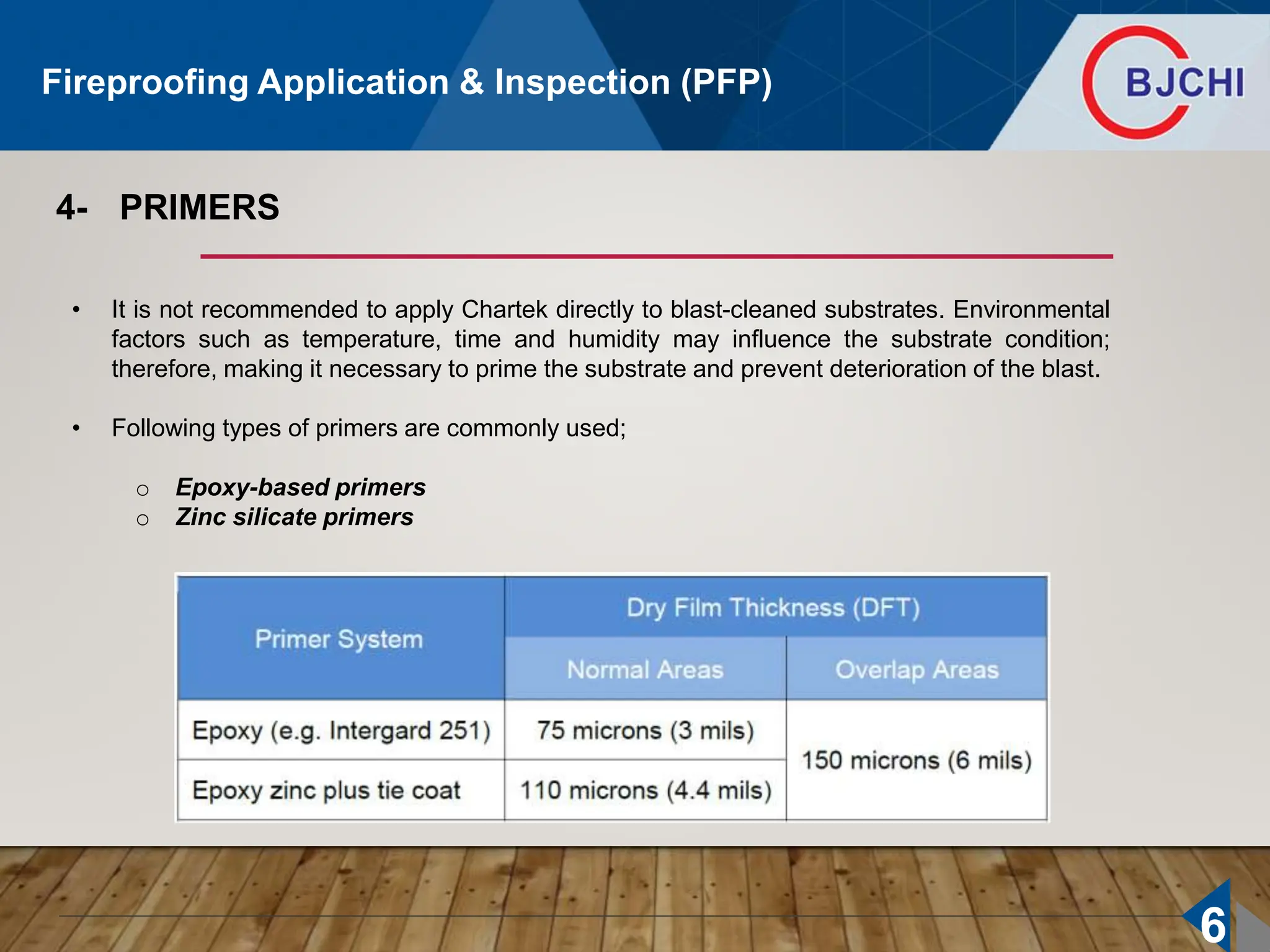
4- PRIMERS
• It is not recommended to apply Chartek directly to blast-cleaned substrates. Environmental
factors such as temperature, time and humidity may influence the substrate condition;
therefore, making it necessary to prime the substrate and prevent deterioration of the blast.
• Following types of primers are commonly used;
o Epoxy-based primers
o Zinc silicate primers
Fireproofing Application & Inspection (PFP)
7
5- REINFORCEMENT
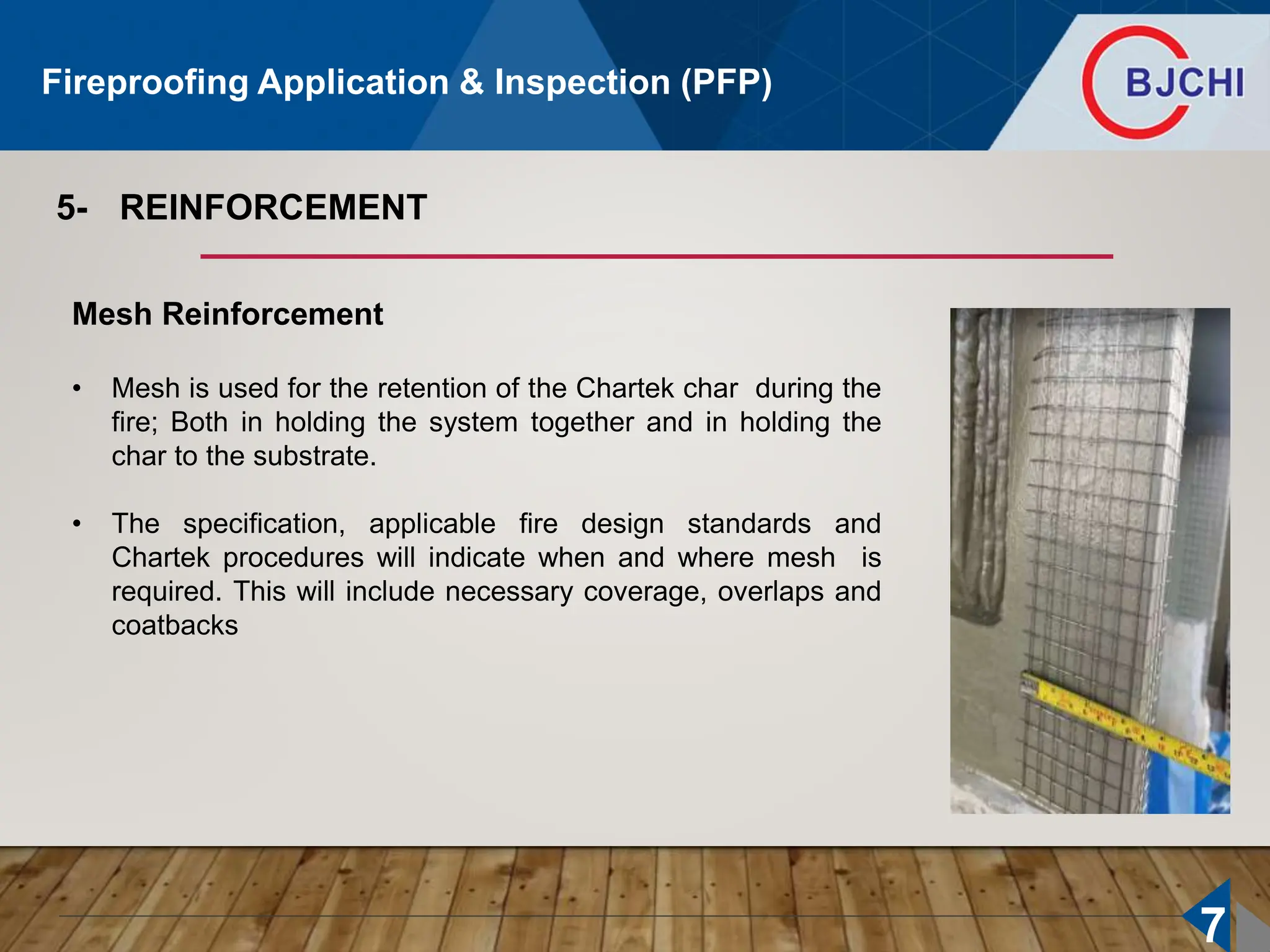
Mesh Reinforcement
• Mesh is used for the retention of the Chartek char during the
fire; Both in holding the system together and in holding the
char to the substrate.
• The specification, applicable fire design standards and
Chartek procedures will indicate when and where mesh is
required. This will include necessary coverage, overlaps and
coatbacks
Fireproofing Application & Inspection (PFP)
8
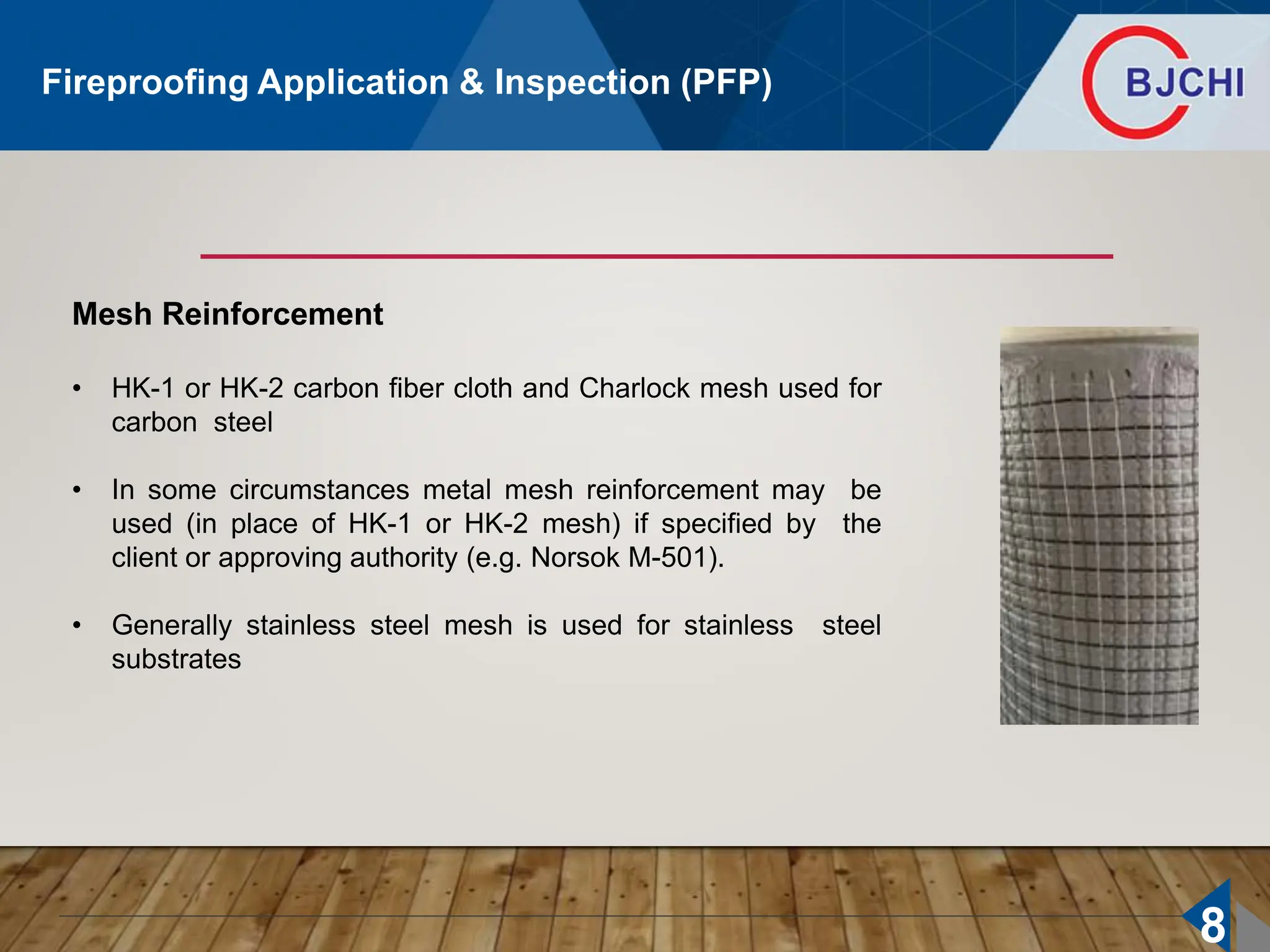
Mesh Reinforcement
• HK-1 or HK-2 carbon fiber cloth and Charlock mesh used for
carbon steel
• In some circumstances metal mesh reinforcement may be
used (in place of HK-1 or HK-2 mesh) if specified by the
client or approving authority (e.g. Norsok M-501).
• Generally stainless steel mesh is used for stainless steel
substrates
Fireproofing Application & Inspection (PFP)
9
6- PFP APPLICATION
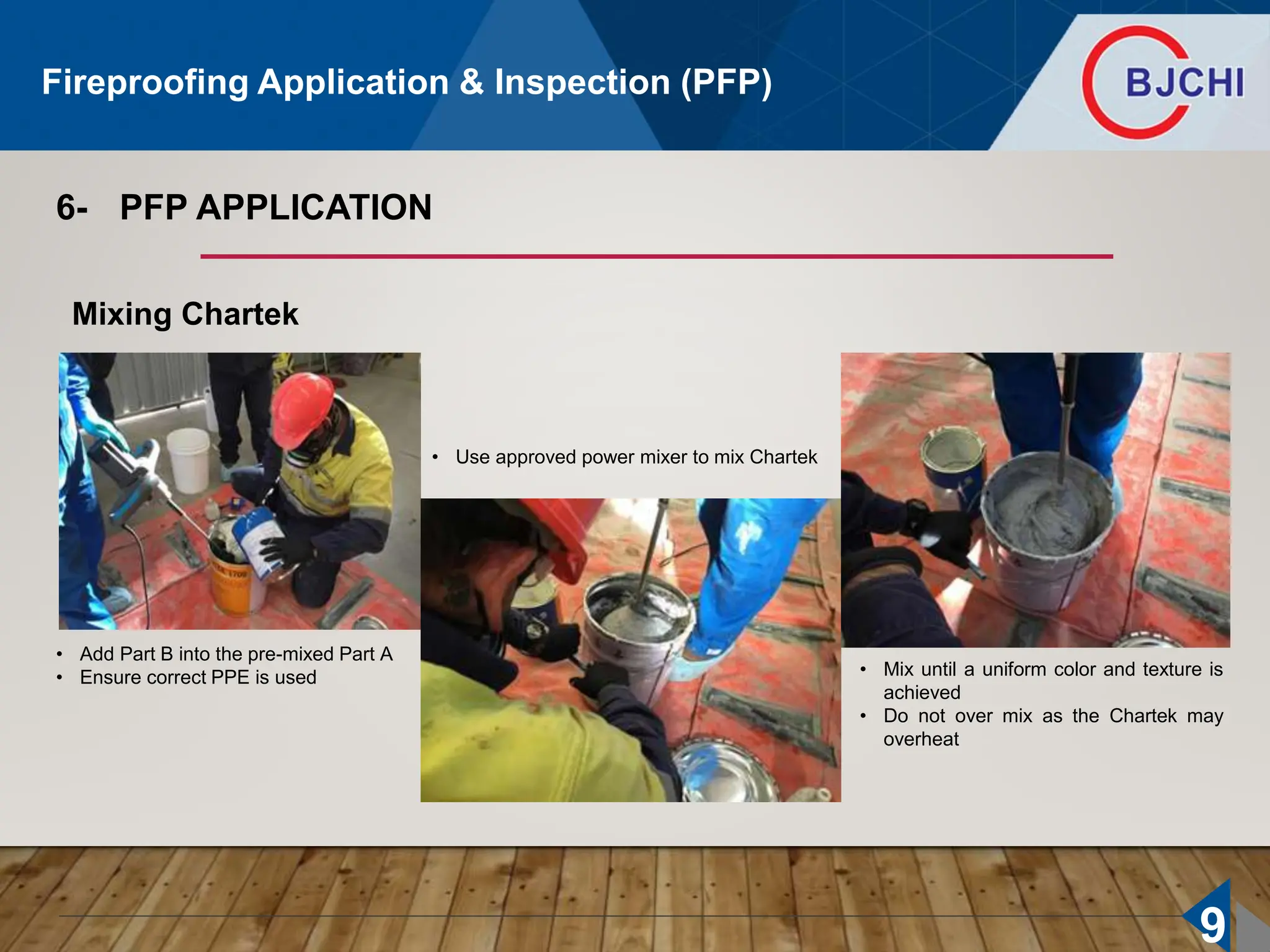
Mixing Chartek
Fireproofing Application & Inspection (PFP)
• Add Part B into the pre-mixed Part A
• Ensure correct PPE is used
• Use approved power mixer to mix Chartek
• Mix until a uniform color and texture is
achieved
• Do not over mix as the Chartek may
overheat
10
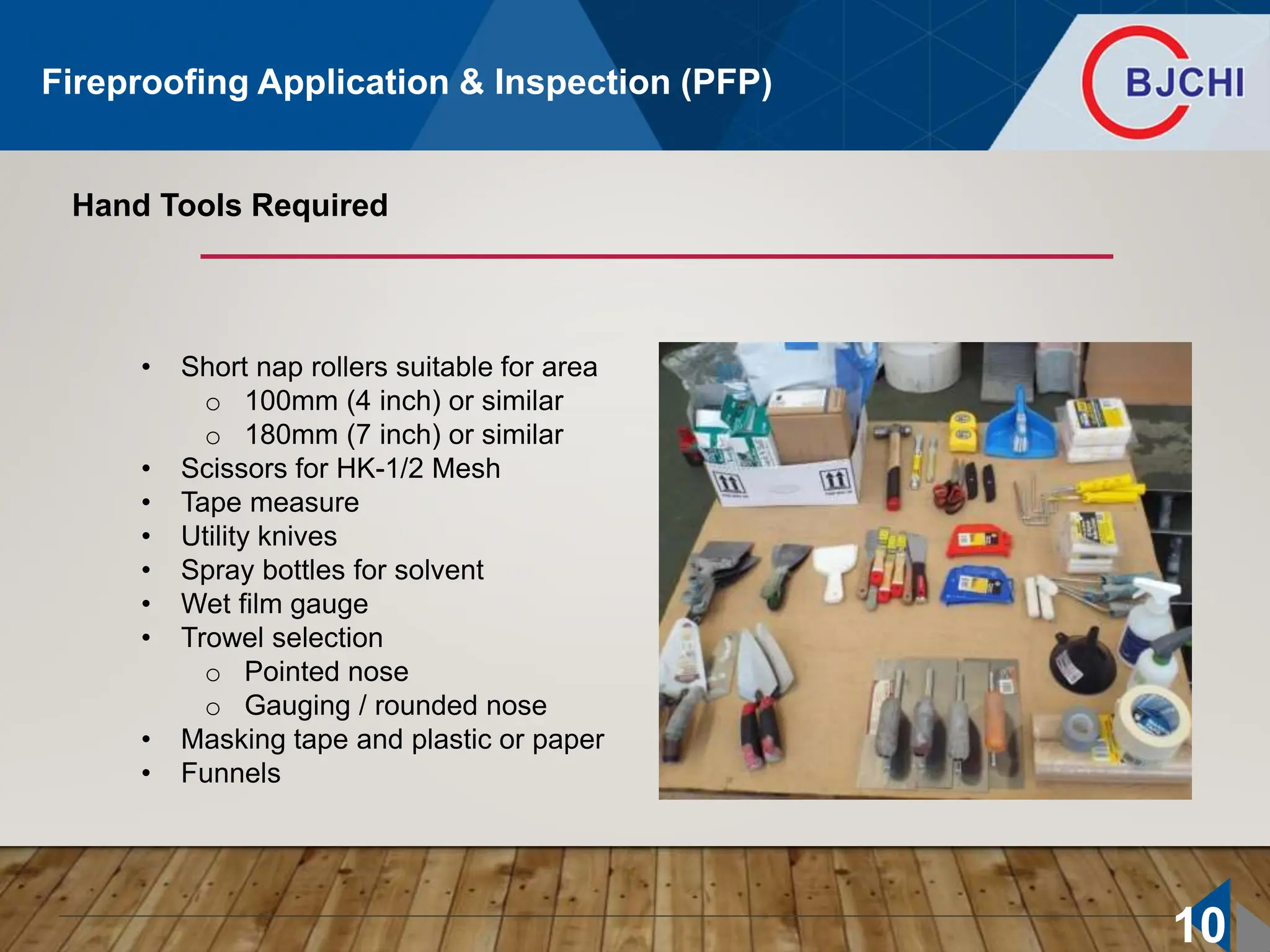
Hand Tools Required
Fireproofing Application & Inspection (PFP)
• Short nap rollers suitable for area
o 100mm (4 inch) or similar
o 180mm (7 inch) or similar
• Scissors for HK-1/2 Mesh
• Tape measure
• Utility knives
• Spray bottles for solvent
• Wet film gauge
• Trowel selection
o Pointed nose
o Gauging / rounded nose
• Masking tape and plastic or paper
• Funnels
11
Methods of Chartek Spray Application
Fireproofing Application & Inspection (PFP)
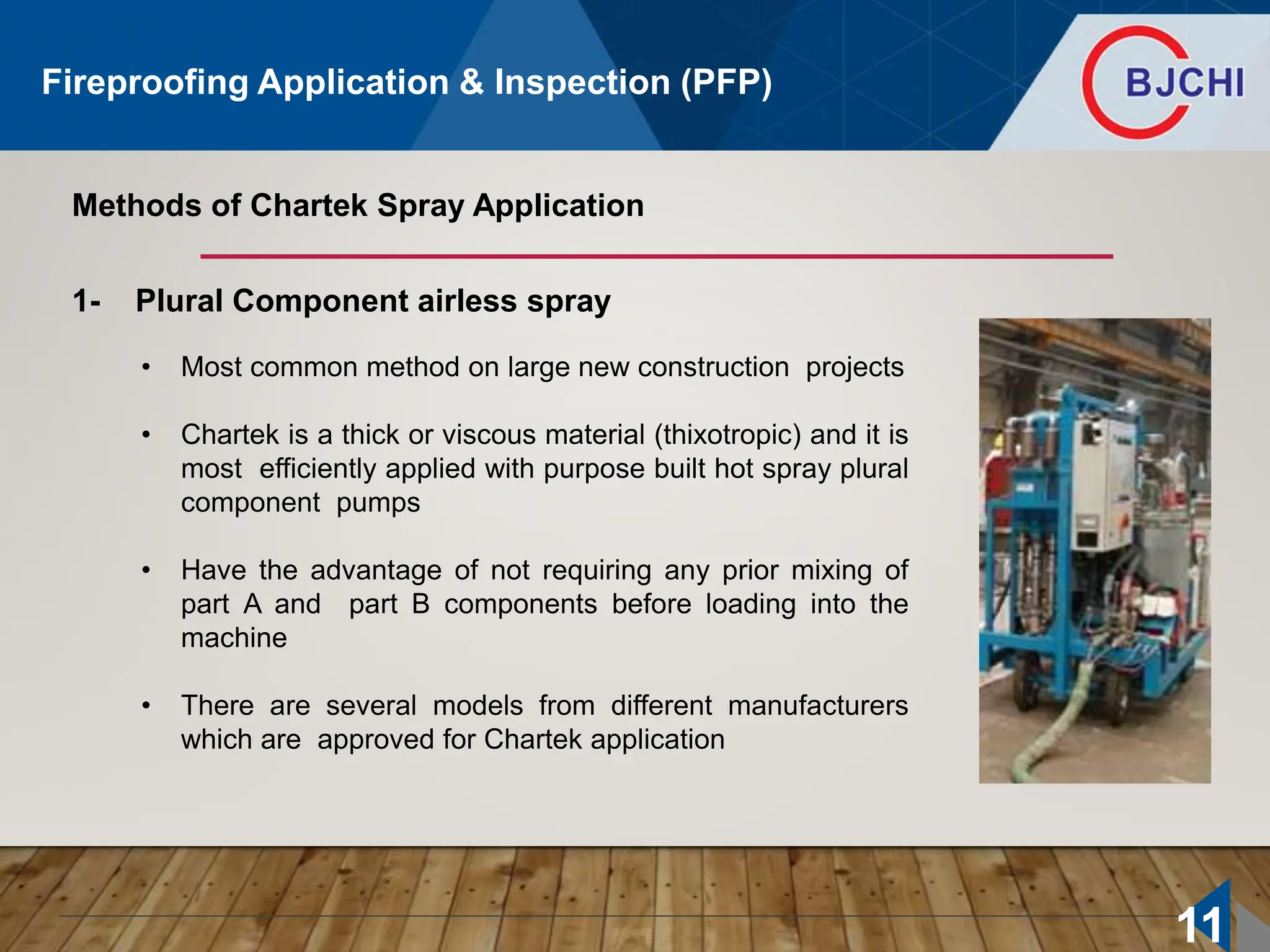
1- Plural Component airless spray
• Most common method on large new construction projects
• Chartek is a thick or viscous material (thixotropic) and it is
most efficiently applied with purpose built hot spray plural
component pumps
• Have the advantage of not requiring any prior mixing of
part A and part B components before loading into the
machine
• There are several models from different manufacturers
which are approved for Chartek application
12
Methods of Chartek Spray Application
Fireproofing Application & Inspection (PFP)
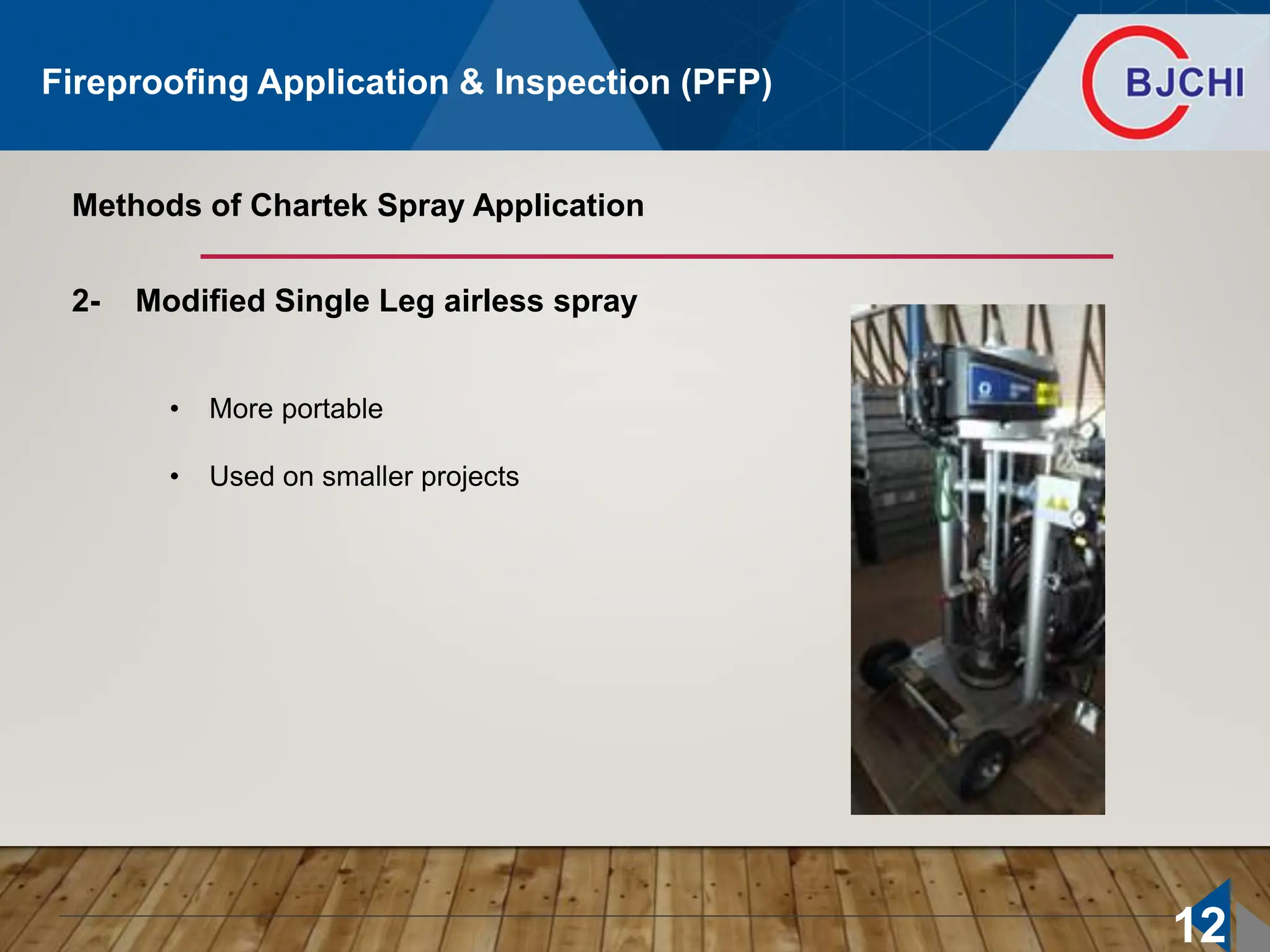
2- Modified Single Leg airless spray
• More portable
• Used on smaller projects
13
7- INSPECTION
Chartek Inspection
Inspection of the Chartek system is a critical activity Inspection or QC must be undertaken
at each stage of the application process. This includes but is not necessarily limited to;
• Cleaning
• Surface preparation
• Primer (WFT and DFT)
• 1st coat Chartek (WFT)
• Mesh
• 1st coat and mesh DFT
• 2nd coat Chartek (WFT)
• Finishing of surface film
• Total system DFT
Fireproofing Application & Inspection (PFP)
14
Fireproofing Application & Inspection (PFP)
Surface Preparation Inspection
15
Fireproofing Application & Inspection (PFP)
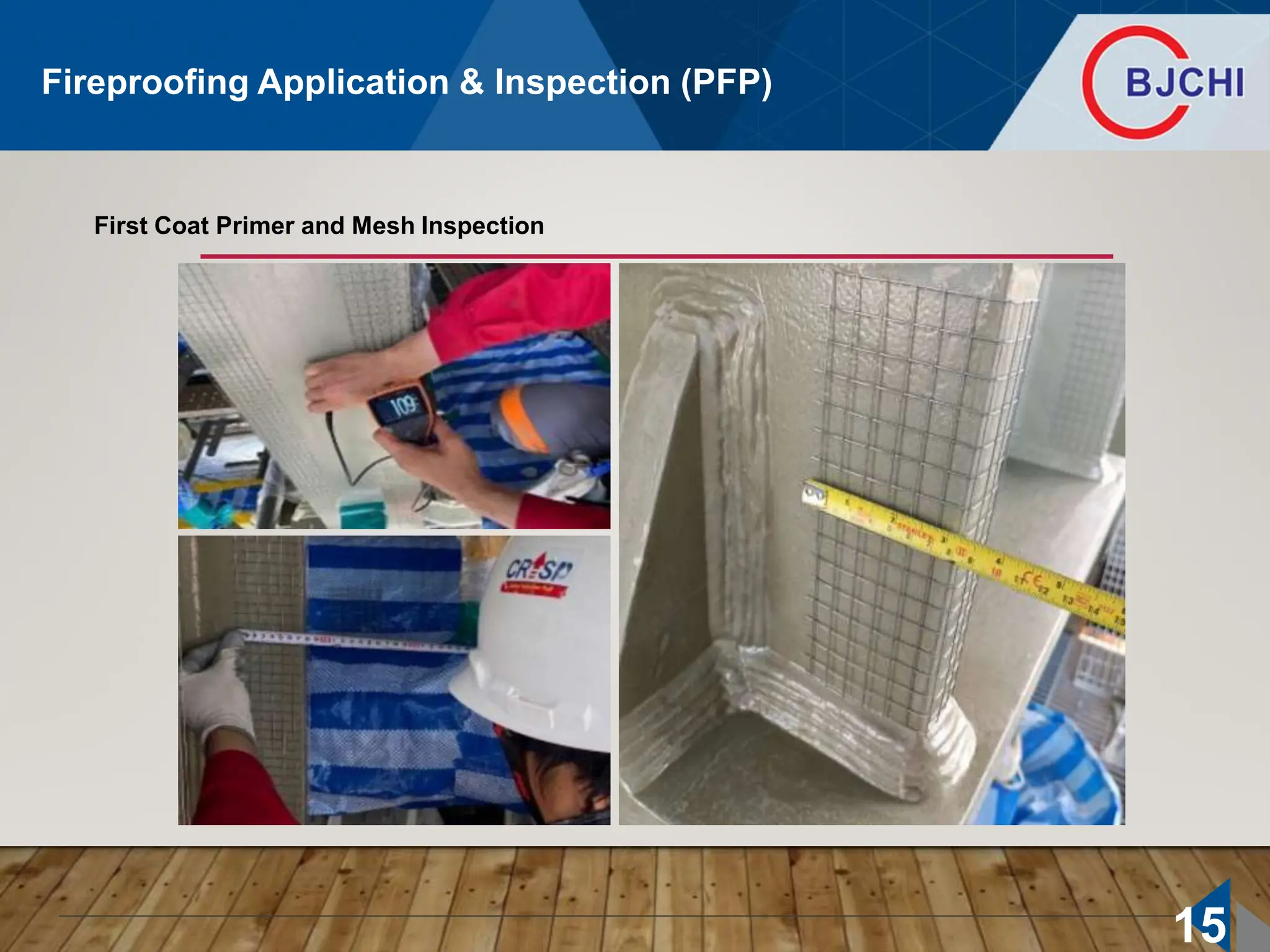
First Coat Primer and Mesh Inspection
16
Fireproofing Application & Inspection (PFP)
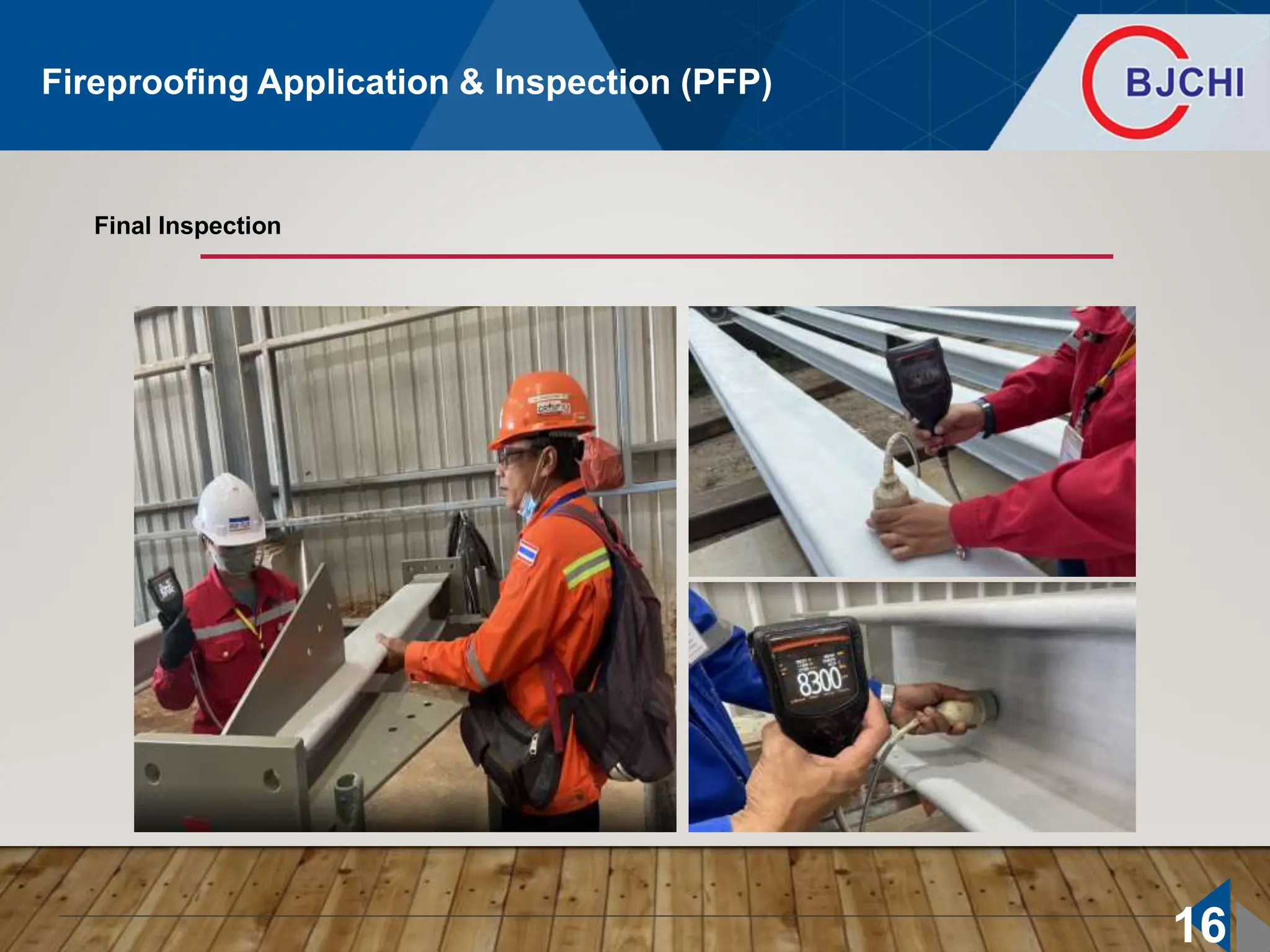
Final Inspection
17
8- PFP REPAIRS
Chartek Repairs
• It is possible to repair or replace Chartek and to tie into pre-existing Chartek materials
• Repairs may be required due to a number of defects;
• Improper Curing
• Mechanical Damage
• Cosmetic Defects
• Water Ponding / Surface Cracks
• Surface Rust / Stains / Contaminants
Fireproofing Application & Inspection (PFP)
18
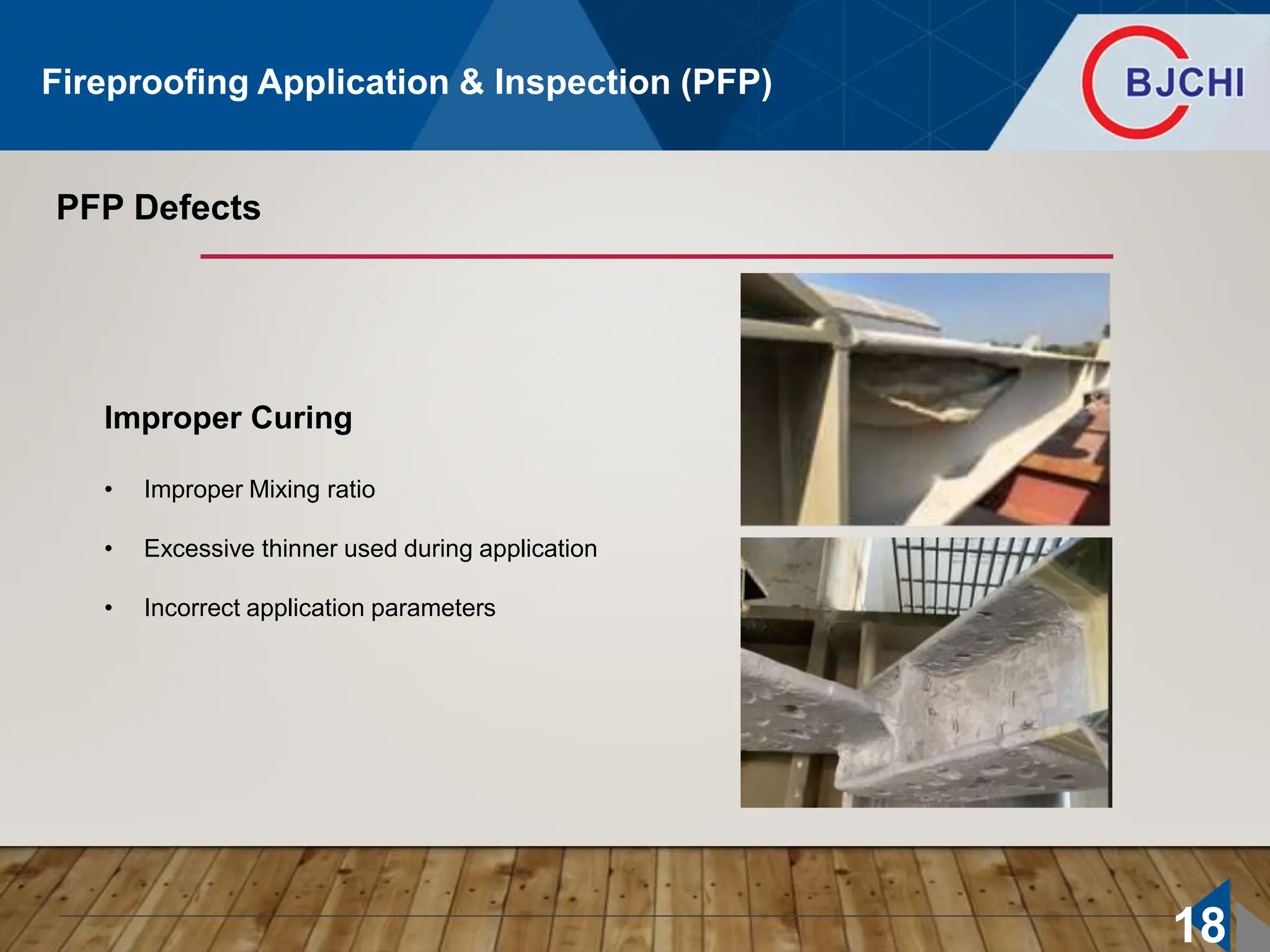
PFP Defects
Improper Curing
• Improper Mixing ratio
• Excessive thinner used during application
• Incorrect application parameters
Fireproofing Application & Inspection (PFP)
19
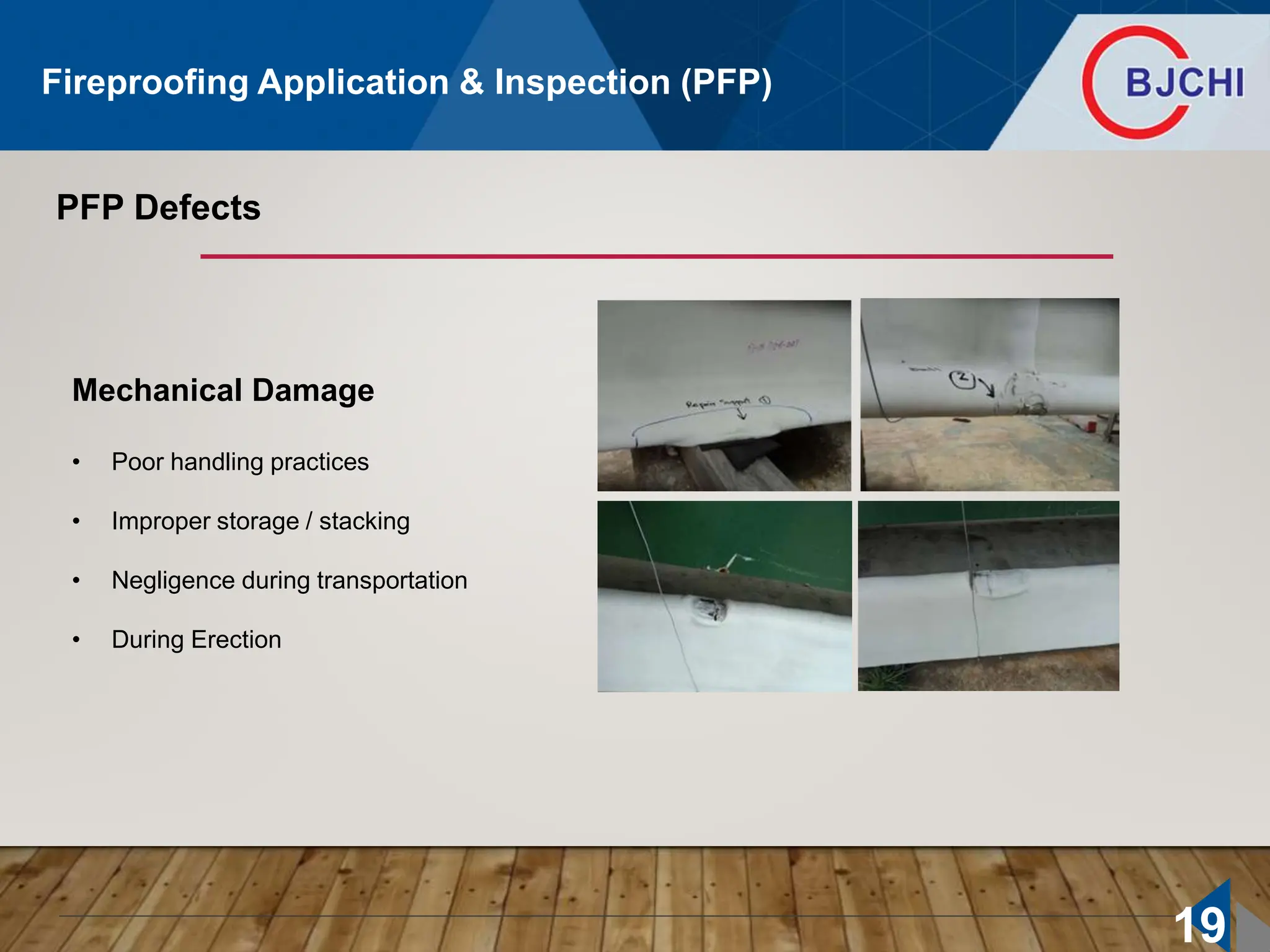
PFP Defects
Mechanical Damage
• Poor handling practices
• Improper storage / stacking
• Negligence during transportation
• During Erection
Fireproofing Application & Inspection (PFP)
20
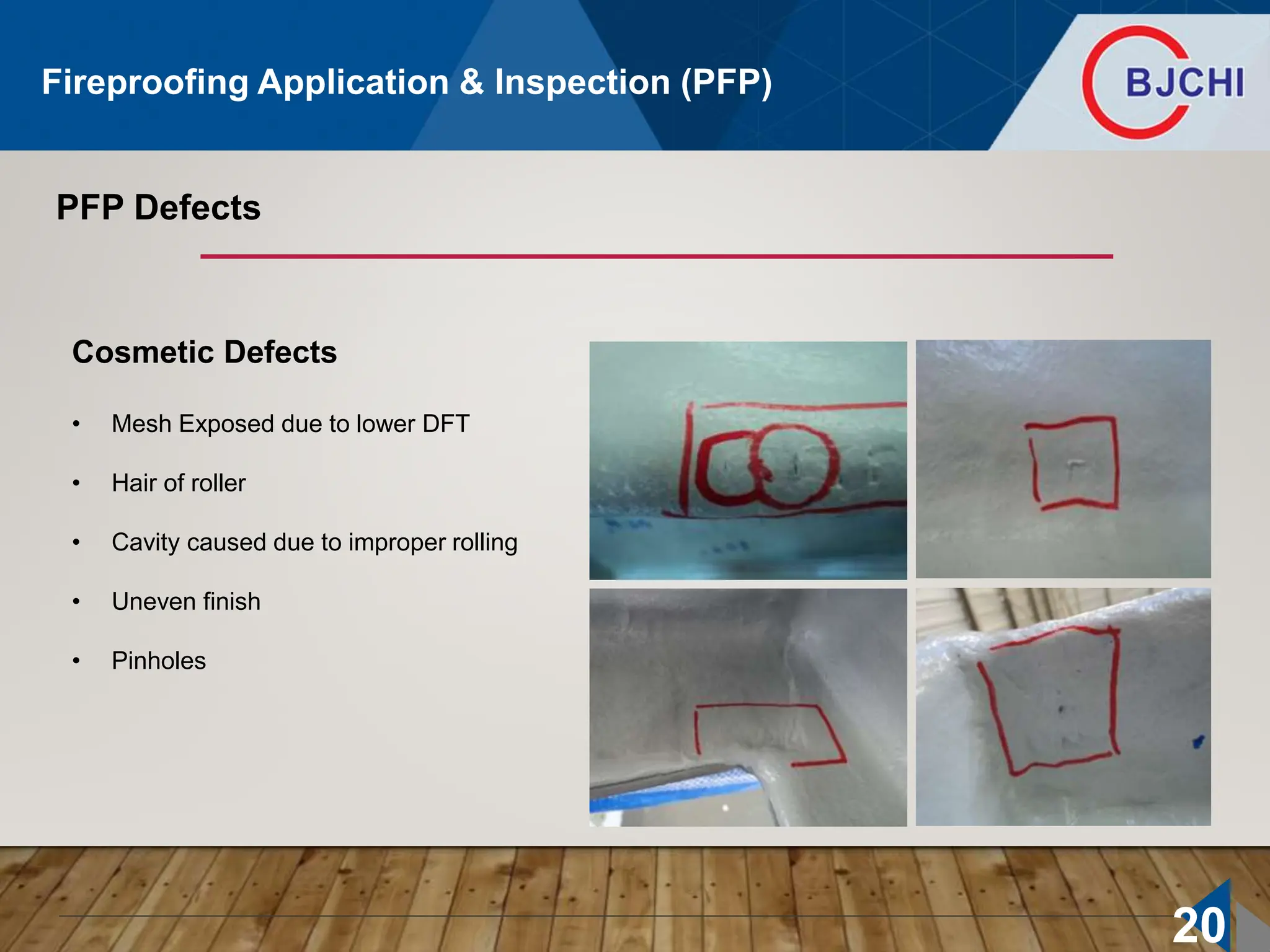
PFP Defects
Cosmetic Defects
• Mesh Exposed due to lower DFT
• Hair of roller
• Cavity caused due to improper rolling
• Uneven finish
• Pinholes
Fireproofing Application & Inspection (PFP)
21
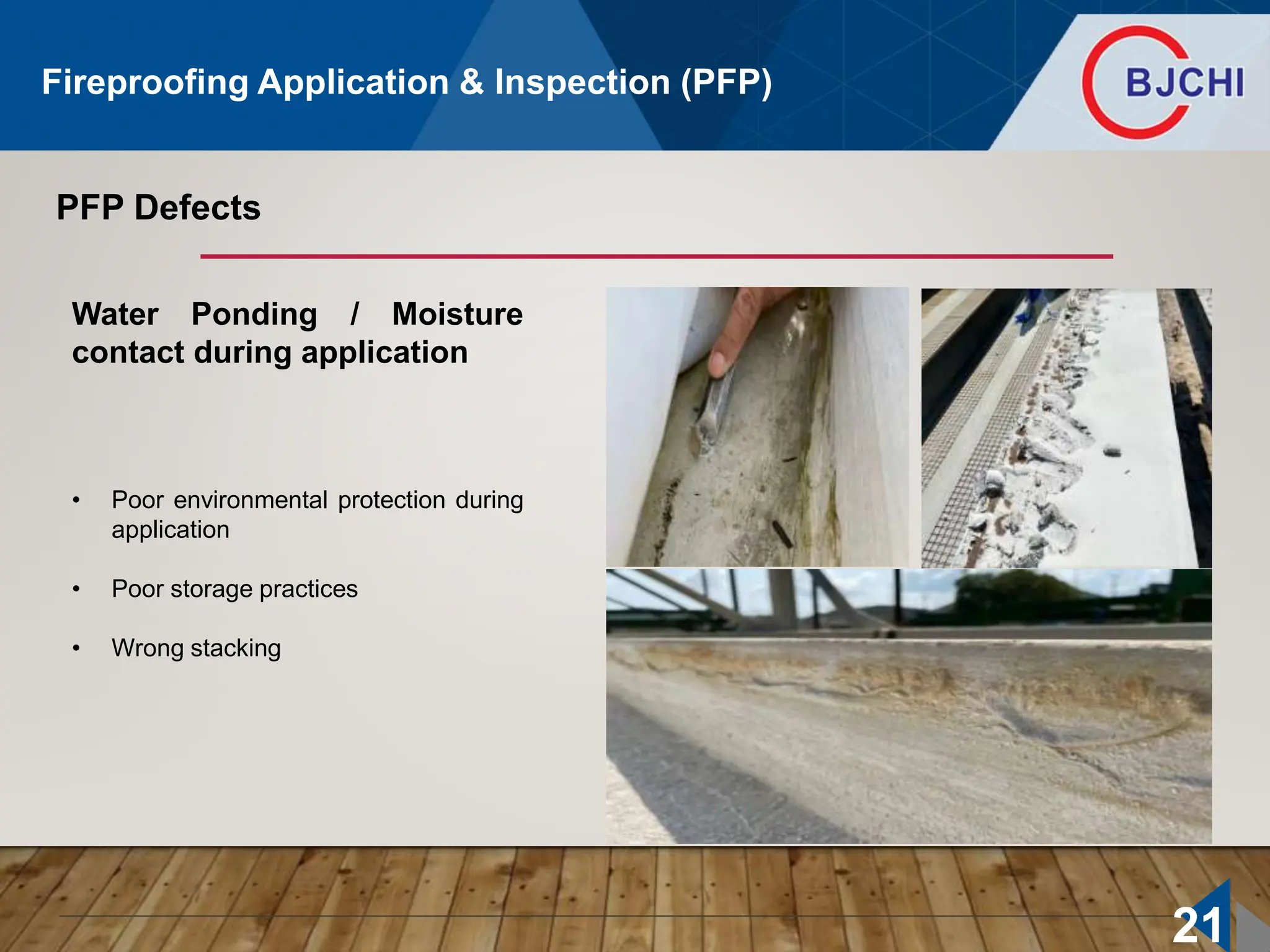
PFP Defects
Water Ponding / Moisture
contact during application
• Poor environmental protection during
application
• Poor storage practices
• Wrong stacking
Fireproofing Application & Inspection (PFP)
22
PFP Defects
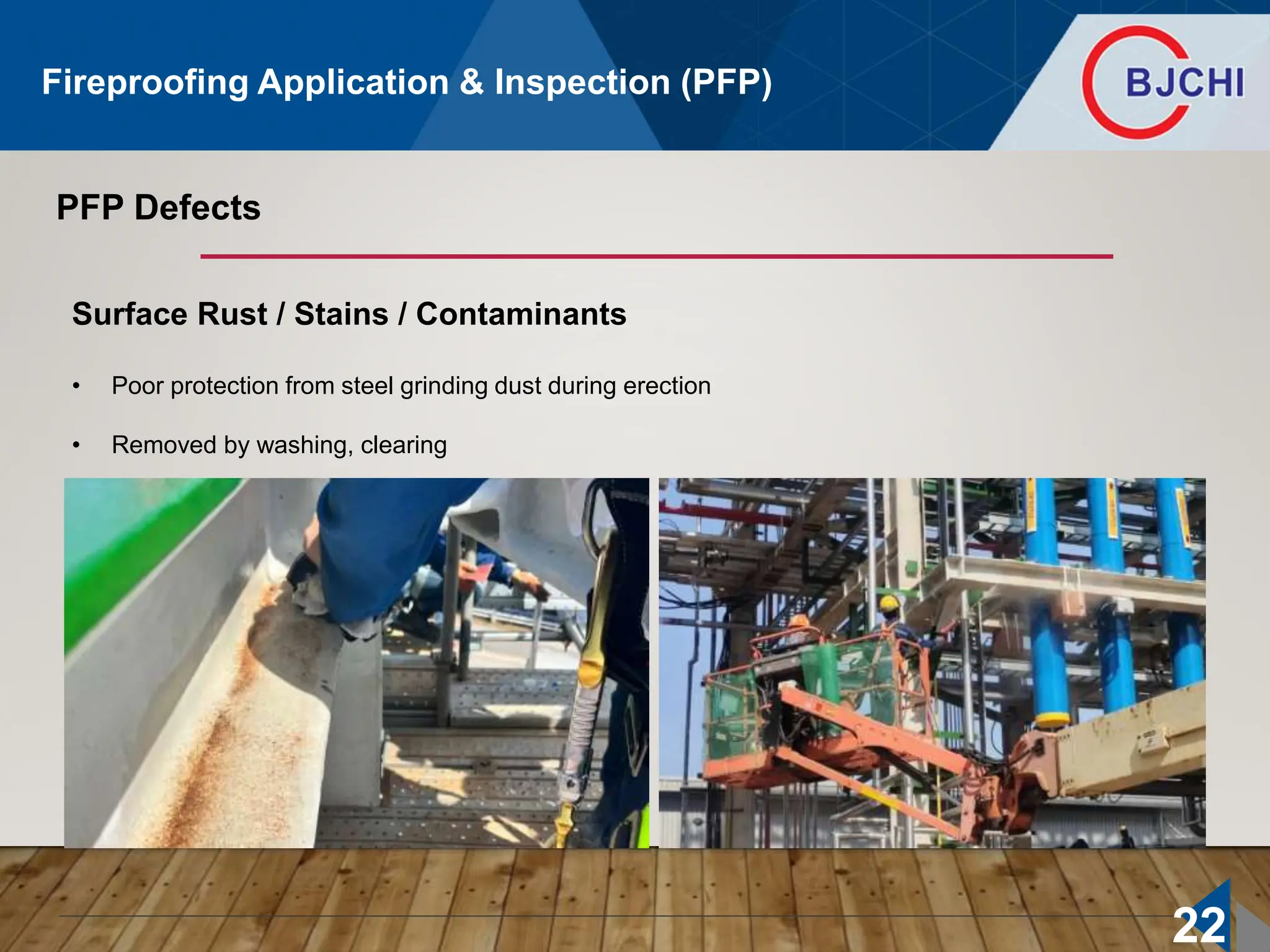
Surface Rust / Stains / Contaminants
• Poor protection from steel grinding dust during erection
• Removed by washing, clearing
Fireproofing Application & Inspection (PFP)
23
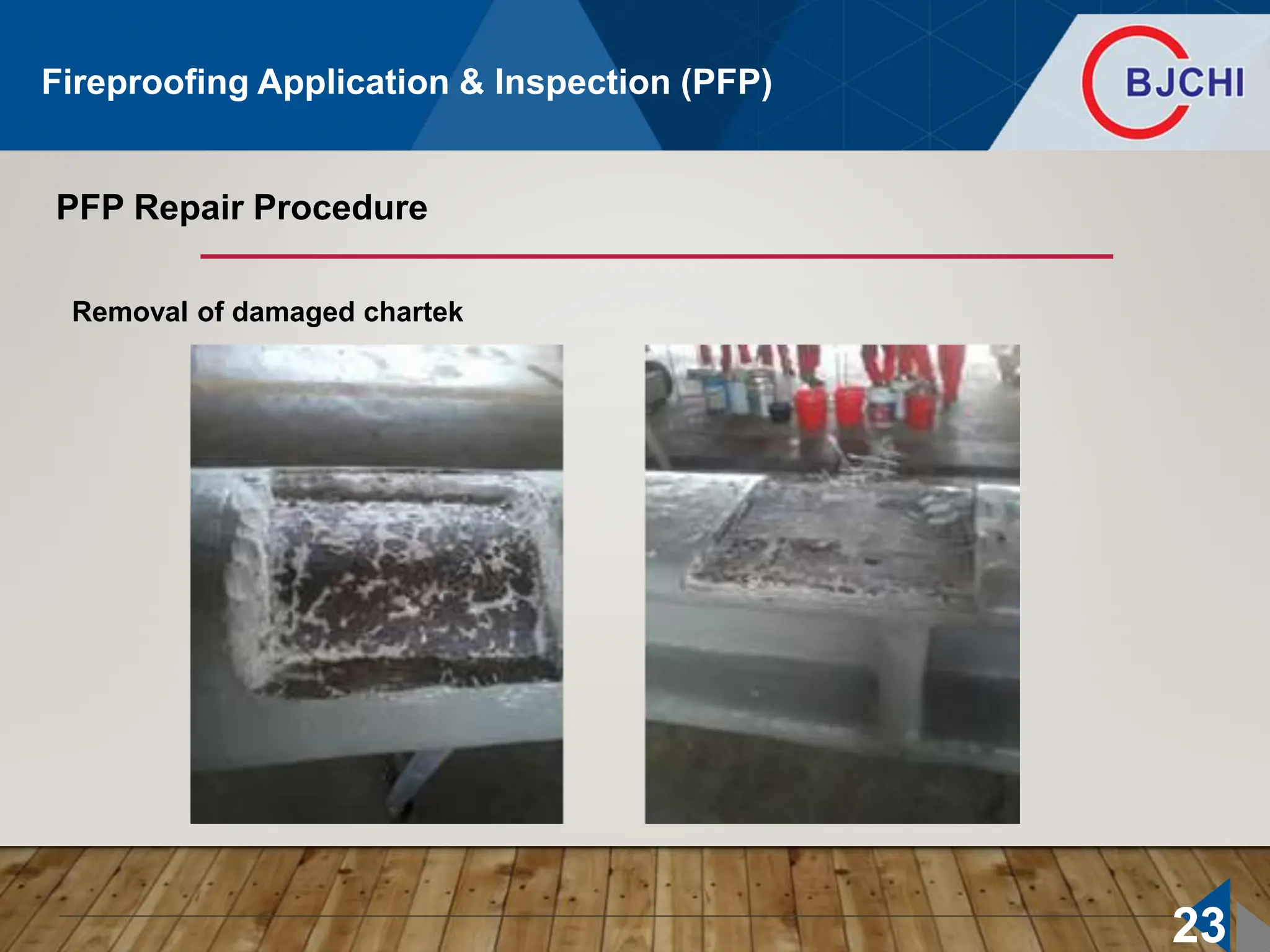
Removal of damaged chartek
Fireproofing Application & Inspection (PFP)
PFP Repair Procedure
24
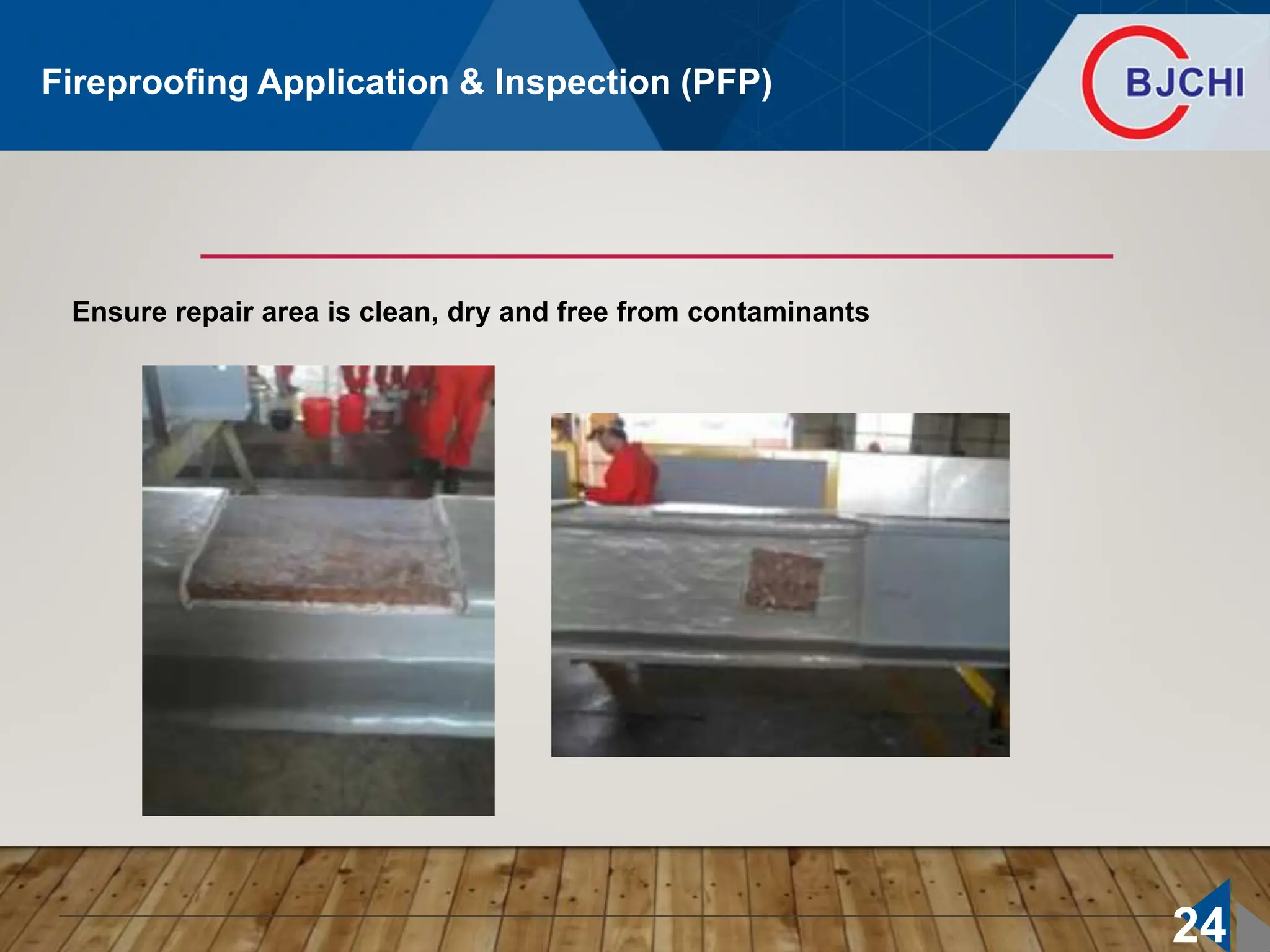
Ensure repair area is clean, dry and free from contaminants
Fireproofing Application & Inspection (PFP)
25
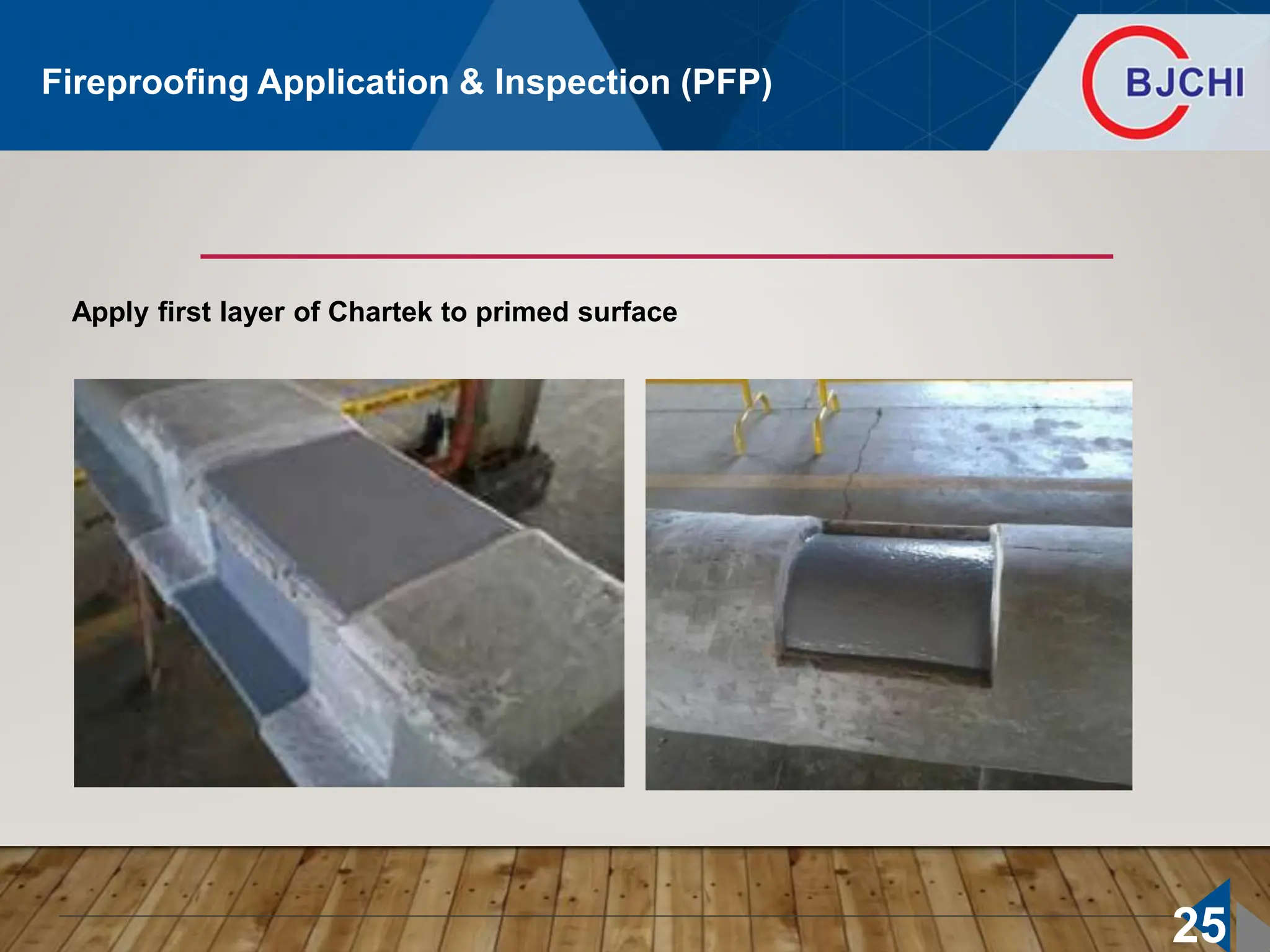
Apply first layer of Chartek to primed surface
Fireproofing Application & Inspection (PFP)
26
Apply mesh as required or as per specification, Ensure 150mm overlap fro jet fire
scenarios
Fireproofing Application & Inspection (PFP)
27
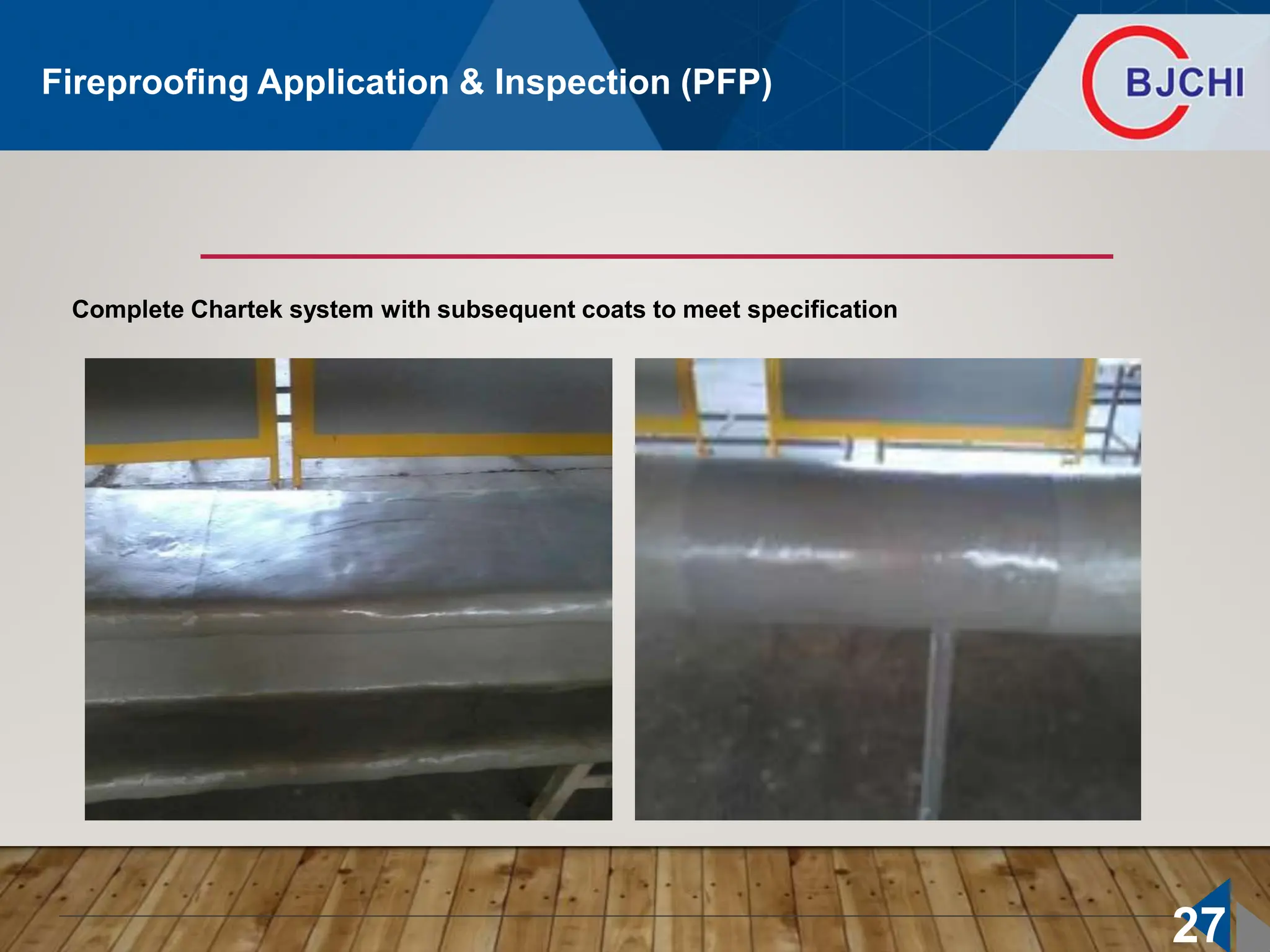
Complete Chartek system with subsequent coats to meet specification
Fireproofing Application & Inspection (PFP)
28
Fireproofing Application & Inspection (PFP)
Thank you!

PFP – Fireproofing Application & Inspection.pptx

  • 1.
    PFP – FireproofingApplication & Inspection CRISP Project, BJCHI Yard Thailand.
  • 2.
    2 CONTENTS 1. Scope 2. Introduction 3.Surface Preparation 4. Primers 5. Reinforcement 6. Chartek application 7. Inspections 8. Repairs Fireproofing Application & Inspection (PFP)
  • 3.
    3 1- SCOPE The contentof this presentation is intended for guidelines of PFP application and inspection activities. The given application parameters, details etc. are based on general recommendations which may be subject to change and may not be applicable to all Chartek products or specific projects. For application and QC purposes always consult the latest product literature. This includes the Product Data Sheet(s) and Application Manual, and should be done in combination with the project specification and AkzoNobel Fireproofing Application & Inspection (PFP)
  • 4.
    4 2- INTRODUCTION • Steelsdo not burn, however at elevated temperatures it loses strength which can lead to structural failure • It is important to limit the temperature development in steelwork to ensure that it can still carry the its applied structural loads in fire outbreak. • Chartek is designed to extend the time until steel reaches the critical temperature at which it loses its structural integrity. Fireproofing Application & Inspection (PFP)
  • 5.
    5 3- SURFACE PREPARATIONS •Good quality surface preparation is critical to the performance of any coating system. • A typical Chartek surface preparation specification should address: o Removal of contamination, initial cleaning and degreasing o Removal of mill scale or surface corrosion o Removal of weld spatter, inclusions and other substrate imperfections o Removal of any existing coating or other product not specified as part of the Chartek system o Creation of adequate surface profile Fireproofing Application & Inspection (PFP)
  • 6.
    6 4- PRIMERS • Itis not recommended to apply Chartek directly to blast-cleaned substrates. Environmental factors such as temperature, time and humidity may influence the substrate condition; therefore, making it necessary to prime the substrate and prevent deterioration of the blast. • Following types of primers are commonly used; o Epoxy-based primers o Zinc silicate primers Fireproofing Application & Inspection (PFP)
  • 7.
    7 5- REINFORCEMENT Mesh Reinforcement •Mesh is used for the retention of the Chartek char during the fire; Both in holding the system together and in holding the char to the substrate. • The specification, applicable fire design standards and Chartek procedures will indicate when and where mesh is required. This will include necessary coverage, overlaps and coatbacks Fireproofing Application & Inspection (PFP)
  • 8.
    8 Mesh Reinforcement • HK-1or HK-2 carbon fiber cloth and Charlock mesh used for carbon steel • In some circumstances metal mesh reinforcement may be used (in place of HK-1 or HK-2 mesh) if specified by the client or approving authority (e.g. Norsok M-501). • Generally stainless steel mesh is used for stainless steel substrates Fireproofing Application & Inspection (PFP)
  • 9.
    9 6- PFP APPLICATION MixingChartek Fireproofing Application & Inspection (PFP) • Add Part B into the pre-mixed Part A • Ensure correct PPE is used • Use approved power mixer to mix Chartek • Mix until a uniform color and texture is achieved • Do not over mix as the Chartek may overheat
  • 10.
    10 Hand Tools Required FireproofingApplication & Inspection (PFP) • Short nap rollers suitable for area o 100mm (4 inch) or similar o 180mm (7 inch) or similar • Scissors for HK-1/2 Mesh • Tape measure • Utility knives • Spray bottles for solvent • Wet film gauge • Trowel selection o Pointed nose o Gauging / rounded nose • Masking tape and plastic or paper • Funnels
  • 11.
    11 Methods of ChartekSpray Application Fireproofing Application & Inspection (PFP) 1- Plural Component airless spray • Most common method on large new construction projects • Chartek is a thick or viscous material (thixotropic) and it is most efficiently applied with purpose built hot spray plural component pumps • Have the advantage of not requiring any prior mixing of part A and part B components before loading into the machine • There are several models from different manufacturers which are approved for Chartek application
  • 12.
    12 Methods of ChartekSpray Application Fireproofing Application & Inspection (PFP) 2- Modified Single Leg airless spray • More portable • Used on smaller projects
  • 13.
    13 7- INSPECTION Chartek Inspection Inspectionof the Chartek system is a critical activity Inspection or QC must be undertaken at each stage of the application process. This includes but is not necessarily limited to; • Cleaning • Surface preparation • Primer (WFT and DFT) • 1st coat Chartek (WFT) • Mesh • 1st coat and mesh DFT • 2nd coat Chartek (WFT) • Finishing of surface film • Total system DFT Fireproofing Application & Inspection (PFP)
  • 14.
    14 Fireproofing Application &Inspection (PFP) Surface Preparation Inspection
  • 15.
    15 Fireproofing Application &Inspection (PFP) First Coat Primer and Mesh Inspection
  • 16.
    16 Fireproofing Application &Inspection (PFP) Final Inspection
  • 17.
    17 8- PFP REPAIRS ChartekRepairs • It is possible to repair or replace Chartek and to tie into pre-existing Chartek materials • Repairs may be required due to a number of defects; • Improper Curing • Mechanical Damage • Cosmetic Defects • Water Ponding / Surface Cracks • Surface Rust / Stains / Contaminants Fireproofing Application & Inspection (PFP)
  • 18.
    18 PFP Defects Improper Curing •Improper Mixing ratio • Excessive thinner used during application • Incorrect application parameters Fireproofing Application & Inspection (PFP)
  • 19.
    19 PFP Defects Mechanical Damage •Poor handling practices • Improper storage / stacking • Negligence during transportation • During Erection Fireproofing Application & Inspection (PFP)
  • 20.
    20 PFP Defects Cosmetic Defects •Mesh Exposed due to lower DFT • Hair of roller • Cavity caused due to improper rolling • Uneven finish • Pinholes Fireproofing Application & Inspection (PFP)
  • 21.
    21 PFP Defects Water Ponding/ Moisture contact during application • Poor environmental protection during application • Poor storage practices • Wrong stacking Fireproofing Application & Inspection (PFP)
  • 22.
    22 PFP Defects Surface Rust/ Stains / Contaminants • Poor protection from steel grinding dust during erection • Removed by washing, clearing Fireproofing Application & Inspection (PFP)
  • 23.
    23 Removal of damagedchartek Fireproofing Application & Inspection (PFP) PFP Repair Procedure
  • 24.
    24 Ensure repair areais clean, dry and free from contaminants Fireproofing Application & Inspection (PFP)
  • 25.
    25 Apply first layerof Chartek to primed surface Fireproofing Application & Inspection (PFP)
  • 26.
    26 Apply mesh asrequired or as per specification, Ensure 150mm overlap fro jet fire scenarios Fireproofing Application & Inspection (PFP)
  • 27.
    27 Complete Chartek systemwith subsequent coats to meet specification Fireproofing Application & Inspection (PFP)
  • 28.
    28 Fireproofing Application &Inspection (PFP) Thank you!