Simon Delay
International Development Department
School of Government and Society
s.e.de-lay@bham.ac.uk
PFM
Public Financial Management
Session 1: Introduction
Why Does Money Matter?
Concepts and Tools
PFM: Introduction slide 1.2
Module Objectives
After attending this module, completing the
associated readings and carrying out the
assigned tasks you should:-
be familiar with the key concepts of financial
management in the public sector
understand the strengths and weaknesses of
different techniques for financial management
be able to participate fully in the strategic financial
management of a public sector organisation
Assessment
 100% Assignment – Due: 9 May
- Review literature on PFM reform
Plus
- EITHER Assess PFM in a country
- OR Assess PFM in an individual public
organisation
- (Details in Handbook)
 Optional Formative Assignment – Due 31 March
- First part of summative assignment
- Indicative grade and feedback provided
PFM: Introduction slide 1.3
Resources on Canvas
 Handbook
- Session outline
- Assignment details
- Detailed reading guidance
 PPT slides/Videos for each session
- Read in advance
 Other supplementary materials
MPM: Introduction slide 1.4
Key reading recommendations
 Text by Schiavo Campo available as ebook
Schiavo-Campo, Salvatore (2017) Government Budgeting and Expenditure
Management: Principles and International Practice. Routledge
 Book by Schick available in full for free on
internet
Schick, Allen (1998) A Contemporary Approach to Public Expenditure
Management (Washington: World Bank)
MPM: Introduction slide 1.5
Issues?
 Is it accounting?
 Is it highly mathematical?
 Is it economics?
 How much help with the assessment?
PFM: Introduction slide 1.6
Contacting Me
 Office Hours (Term-Time) Make appointment:
Tuesdays 11-30- 1.30
Wednesdays 12.30-1.30
 By email
s.e.de-lay@bham.ac.uk
PFM: Introduction slide 1.7
PFM: Introduction slide 1.8
Session Objectives
After attending this session and completing the
associated readings you should:-
understand the special nature of the public sector
in the financial management context
understand the concepts of control, accountability
and responsibility
be familiar with the key stages of financial
management in the public sector
understand the principal-agent conceptual
framework for analysing issues
PFM: Introduction slide 1.9
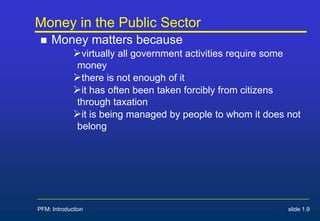
Money in the Public Sector
 Money matters because
virtually all government activities require some
money
there is not enough of it
it has often been taken forcibly from citizens
through taxation
it is being managed by people to whom it does not
belong
PFM: Introduction slide 1.10
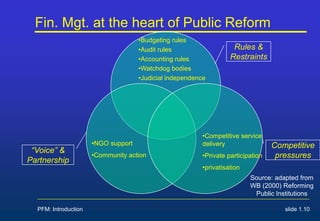
Fin. Mgt. at the heart of Public Reform
•Budgeting rules
•Audit rules
•Accounting rules
•Watchdog bodies
•Judicial independence
•NGO support
•Community action
•Competitive service
delivery
•Private participation
•privatisation
Rules &
Restraints
Competitive
pressures
“Voice” &
Partnership
Source: adapted from
WB (2000) Reforming
Public Institutions
PFM: Introduction slide 1.11
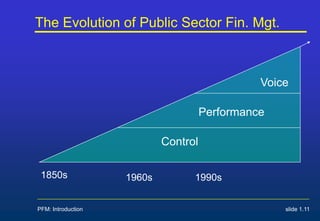
The Evolution of Public Sector Fin. Mgt.
Control
Performance
Voice
1850s 1960s 1990s
PFM: Introduction slide 1.12
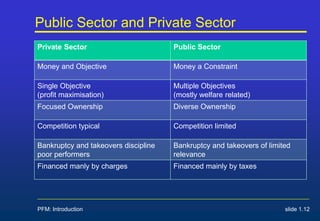
Public Sector and Private Sector
Private Sector Public Sector
Money and Objective Money a Constraint
Single Objective
(profit maximisation)
Multiple Objectives
(mostly welfare related)
Focused Ownership Diverse Ownership
Competition typical Competition limited
Bankruptcy and takeovers discipline
poor performers
Bankruptcy and takeovers of limited
relevance
Financed manly by charges Financed mainly by taxes
PFM: Introduction slide 1.13
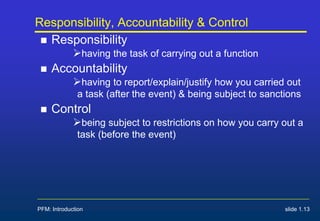
Responsibility, Accountability & Control
 Responsibility
having the task of carrying out a function
 Accountability
having to report/explain/justify how you carried out
a task (after the event) & being subject to sanctions
 Control
being subject to restrictions on how you carry out a
task (before the event)
PFM: Introduction slide 1.14
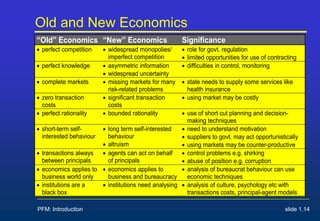
Old and New Economics
“Old” Economics “New” Economics Significance
 perfect competition  widespread monopolies/
imperfect competition
 role for govt. regulation
 limited opportunities for use of contracting
 perfect knowledge  asymmetric information
 widespread uncertainty
 difficulties in control, monitoring
 complete markets  missing markets for many
risk-related problems
 state needs to supply some services like
health insurance
 zero transaction
costs
 significant transaction
costs
 using market may be costly
 perfect rationality  bounded rationality  use of short cut planning and decision-
making techniques
 short-term self-
interested behaviour
 long term self-interested
behaviour
 altruism
 need to understand motivation
 suppliers to govt. may act opportunistically
 using markets may be counter-productive
 transactions always
between principals
 agents can act on behalf
of principals
 control problems e.g. shirking
 abuse of position e.g. corruption
 economics applies to
business world only
 economics applies to
business and bureaucracy
 analysis of bureaucrat behaviour can use
economic techniques
 institutions are a
black box
 institutions need analysing  analysis of culture, psychology etc with
transactions costs, principal-agent models
PFM: Introduction slide 1.15
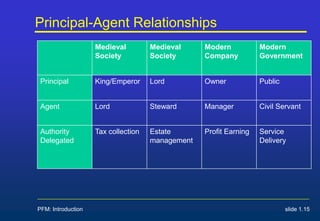
Principal-Agent Relationships
Medieval
Society
Medieval
Society
Modern
Company
Modern
Government
Principal King/Emperor Lord Owner Public
Agent Lord Steward Manager Civil Servant
Authority
Delegated
Tax collection Estate
management
Profit Earning Service
Delivery
PFM: Introduction slide 1.16
Why do Principals need Agents?
 principals lack:-
time
interest
expertise
 agents have these (if they are paid):-
time
Expertise
(interest?)
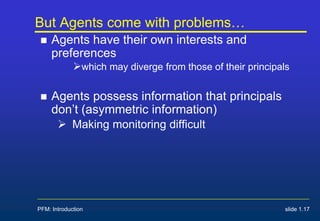
But Agents come with problems…
 Agents have their own interests and
preferences
which may diverge from those of their principals
 Agents possess information that principals
don’t (asymmetric information)
 Making monitoring difficult
PFM: Introduction slide 1.17
PFM: Introduction slide 1.18
Principals and Agents – Divergent Interests
 Shirking
 Stealing etc.
 Different time horizons
 Different risk preferences
PFM: Introduction slide 1.19
Holding Agents to Account
 agents must “present an account” to their
principals
 in traditional principal: agent relationships the
key issue was money - hence the account was
a financial account
– hence “accounting” as a financial term
 in modern public sector the account must
include both:-
money (inputs) and
results (outputs or outcomes)
 principals may wish to employ special agents
(e.g. auditors) to assist them in holding their
normal agents to account
PFM: Introduction slide 1.20
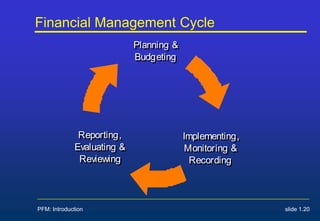
Financial Management Cycle
Planning &
Budgeting
Planning &
Budgeting
Implementing,
Monitoring &
Recording
Implementing,
Monitoring &
Recording
Reporting,
Evaluating &
Reviewing
Reporting,
Evaluating &
Reviewing
In Groups
 Consider the following relationships:
1. A family employing a child-minder
2. A patient going to a dentist
 For each relationship:
 Who is the principal?
 Who is the agent?
 Why might the interests of the principals and
agents differ?
 Who has the most information? Why?
PFM: Introduction slide 1.21
In Groups
 Consider the same relationships
1. A family employing a child-minder
2. A patient going to a dentist
 For each relationship
 What could the principals do to manage the
potential principal-agent problems?
MPM: Introduction slide 1.22
Reflection
 What parallels are there between the
relationships we have talked about and
relationships in PFM?
MPM: Introduction slide 1.23
Before Next Class…
 Read
1. Ch. 1 of Schick (1998) “Contemporary Guide”
https://documents.worldbank.org/en/publication/documents-reports/documentdetail/739061468323718599/a-
contemporary-approach-to-public-expenditure-management
2. Andrews et al. (2014) “This is PFM”
https://research.hks.harvard.edu/publications/getFile.aspx?Id=1083
PFM: Introduction slide 1.24

PFM intro - lec1.pptx

  • 1.
    Simon Delay International DevelopmentDepartment School of Government and Society s.e.de-lay@bham.ac.uk PFM Public Financial Management Session 1: Introduction Why Does Money Matter? Concepts and Tools
  • 2.
    PFM: Introduction slide1.2 Module Objectives After attending this module, completing the associated readings and carrying out the assigned tasks you should:- be familiar with the key concepts of financial management in the public sector understand the strengths and weaknesses of different techniques for financial management be able to participate fully in the strategic financial management of a public sector organisation
  • 3.
    Assessment  100% Assignment– Due: 9 May - Review literature on PFM reform Plus - EITHER Assess PFM in a country - OR Assess PFM in an individual public organisation - (Details in Handbook)  Optional Formative Assignment – Due 31 March - First part of summative assignment - Indicative grade and feedback provided PFM: Introduction slide 1.3
  • 4.
    Resources on Canvas Handbook - Session outline - Assignment details - Detailed reading guidance  PPT slides/Videos for each session - Read in advance  Other supplementary materials MPM: Introduction slide 1.4
  • 5.
    Key reading recommendations Text by Schiavo Campo available as ebook Schiavo-Campo, Salvatore (2017) Government Budgeting and Expenditure Management: Principles and International Practice. Routledge  Book by Schick available in full for free on internet Schick, Allen (1998) A Contemporary Approach to Public Expenditure Management (Washington: World Bank) MPM: Introduction slide 1.5
  • 6.
    Issues?  Is itaccounting?  Is it highly mathematical?  Is it economics?  How much help with the assessment? PFM: Introduction slide 1.6
  • 7.
    Contacting Me  OfficeHours (Term-Time) Make appointment: Tuesdays 11-30- 1.30 Wednesdays 12.30-1.30  By email s.e.de-lay@bham.ac.uk PFM: Introduction slide 1.7
  • 8.
    PFM: Introduction slide1.8 Session Objectives After attending this session and completing the associated readings you should:- understand the special nature of the public sector in the financial management context understand the concepts of control, accountability and responsibility be familiar with the key stages of financial management in the public sector understand the principal-agent conceptual framework for analysing issues
  • 9.
    PFM: Introduction slide1.9 Money in the Public Sector  Money matters because virtually all government activities require some money there is not enough of it it has often been taken forcibly from citizens through taxation it is being managed by people to whom it does not belong
  • 10.
    PFM: Introduction slide1.10 Fin. Mgt. at the heart of Public Reform •Budgeting rules •Audit rules •Accounting rules •Watchdog bodies •Judicial independence •NGO support •Community action •Competitive service delivery •Private participation •privatisation Rules & Restraints Competitive pressures “Voice” & Partnership Source: adapted from WB (2000) Reforming Public Institutions
  • 11.
    PFM: Introduction slide1.11 The Evolution of Public Sector Fin. Mgt. Control Performance Voice 1850s 1960s 1990s
  • 12.
    PFM: Introduction slide1.12 Public Sector and Private Sector Private Sector Public Sector Money and Objective Money a Constraint Single Objective (profit maximisation) Multiple Objectives (mostly welfare related) Focused Ownership Diverse Ownership Competition typical Competition limited Bankruptcy and takeovers discipline poor performers Bankruptcy and takeovers of limited relevance Financed manly by charges Financed mainly by taxes
  • 13.
    PFM: Introduction slide1.13 Responsibility, Accountability & Control  Responsibility having the task of carrying out a function  Accountability having to report/explain/justify how you carried out a task (after the event) & being subject to sanctions  Control being subject to restrictions on how you carry out a task (before the event)
  • 14.
    PFM: Introduction slide1.14 Old and New Economics “Old” Economics “New” Economics Significance  perfect competition  widespread monopolies/ imperfect competition  role for govt. regulation  limited opportunities for use of contracting  perfect knowledge  asymmetric information  widespread uncertainty  difficulties in control, monitoring  complete markets  missing markets for many risk-related problems  state needs to supply some services like health insurance  zero transaction costs  significant transaction costs  using market may be costly  perfect rationality  bounded rationality  use of short cut planning and decision- making techniques  short-term self- interested behaviour  long term self-interested behaviour  altruism  need to understand motivation  suppliers to govt. may act opportunistically  using markets may be counter-productive  transactions always between principals  agents can act on behalf of principals  control problems e.g. shirking  abuse of position e.g. corruption  economics applies to business world only  economics applies to business and bureaucracy  analysis of bureaucrat behaviour can use economic techniques  institutions are a black box  institutions need analysing  analysis of culture, psychology etc with transactions costs, principal-agent models
  • 15.
    PFM: Introduction slide1.15 Principal-Agent Relationships Medieval Society Medieval Society Modern Company Modern Government Principal King/Emperor Lord Owner Public Agent Lord Steward Manager Civil Servant Authority Delegated Tax collection Estate management Profit Earning Service Delivery
  • 16.
    PFM: Introduction slide1.16 Why do Principals need Agents?  principals lack:- time interest expertise  agents have these (if they are paid):- time Expertise (interest?)
  • 17.
    But Agents comewith problems…  Agents have their own interests and preferences which may diverge from those of their principals  Agents possess information that principals don’t (asymmetric information)  Making monitoring difficult PFM: Introduction slide 1.17
  • 18.
    PFM: Introduction slide1.18 Principals and Agents – Divergent Interests  Shirking  Stealing etc.  Different time horizons  Different risk preferences
  • 19.
    PFM: Introduction slide1.19 Holding Agents to Account  agents must “present an account” to their principals  in traditional principal: agent relationships the key issue was money - hence the account was a financial account – hence “accounting” as a financial term  in modern public sector the account must include both:- money (inputs) and results (outputs or outcomes)  principals may wish to employ special agents (e.g. auditors) to assist them in holding their normal agents to account
  • 20.
    PFM: Introduction slide1.20 Financial Management Cycle Planning & Budgeting Planning & Budgeting Implementing, Monitoring & Recording Implementing, Monitoring & Recording Reporting, Evaluating & Reviewing Reporting, Evaluating & Reviewing
  • 21.
    In Groups  Considerthe following relationships: 1. A family employing a child-minder 2. A patient going to a dentist  For each relationship:  Who is the principal?  Who is the agent?  Why might the interests of the principals and agents differ?  Who has the most information? Why? PFM: Introduction slide 1.21
  • 22.
    In Groups  Considerthe same relationships 1. A family employing a child-minder 2. A patient going to a dentist  For each relationship  What could the principals do to manage the potential principal-agent problems? MPM: Introduction slide 1.22
  • 23.
    Reflection  What parallelsare there between the relationships we have talked about and relationships in PFM? MPM: Introduction slide 1.23
  • 24.
    Before Next Class… Read 1. Ch. 1 of Schick (1998) “Contemporary Guide” https://documents.worldbank.org/en/publication/documents-reports/documentdetail/739061468323718599/a- contemporary-approach-to-public-expenditure-management 2. Andrews et al. (2014) “This is PFM” https://research.hks.harvard.edu/publications/getFile.aspx?Id=1083 PFM: Introduction slide 1.24

Editor's Notes