PUBLIC SECTOR ACCOUNTING
Dr. Abdullah Hamoud
International University
of Technology Twintech
Faculty of Business and Finance
Department of Accounting
CHAPTER 1: INTRODUCTION TO PUBLIC
SECTOR ACCOUNTING
What is public sector?
• Public sector is all organizations which are not privately
owned and operated, but established, run and financed
by the government on behalf of the public.
• Public sector consists of organizations where control
lies in the hands of public, as opposed to private
owners.
• The objective of public sector is to provide services to
the public.
• Profit making is not primary to this sector
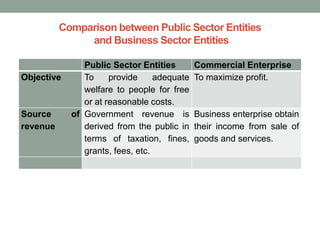
Comparison between Public Sector Entities
and Business Sector Entities
Public Sector Entities Commercial Enterprise
Objective To provide adequate
welfare to people for free
or at reasonable costs.
To maximize profit.
Source of
revenue
Government revenue is
derived from the public in
terms of taxation, fines,
grants, fees, etc.
Business enterprise obtain
their income from sale of
goods and services.
Public Sector Accounting
❑ The main aim of the government is not to make profit but
to render essential services to its citizens.
❑ Since they are not for profit businesses, the accounting for
them is different from accounting for businesses that are
for profit maximization.
❑ Public Sector Accounting is “the systematic process of
recording, communicating, summarizing, analyzing and
interpreting the financial statements and statistics of
Government in aggregate and details. It deals with the
receipts, custody, disbursement and rendering of
stewardship on public funds entrusted”.
Public Sector Accounting
❑ Public Sector Accounting “deals with the allocation of
resources in accordance with the budget constraint of a
public sector organization, especially government. It is a
composite activities of analyzing, summarizing, recording
and interpreting the financial transactions of the
Government Ministries, Departments and Spending
Agencies”.
Public Sector Accounting
❑ Public Sector Accounting is a “process of recording,
communicating, summarizing, analyzing and
interpreting government financial statements and
statistics in aggregate and details; it is concerned with
receipts, custody and disbursement and rendering of
stewardship of public funds entrusted”.
Public Sector Accounting
❑ Public sector accounting can be used to measure
incoming revenue and outgoing expenses of the
government.
❑ It can also be used for budgeting, planning and
forecasting.
❑ Although the main aim of most public sector entities is not
to generate profit, it is still important to know how an
agency is doing financially.
Objectives of Public Sector Accounting
1) Ascertaining the legitimacy of transactions and their
compliance with established norms, regulations and
statutes.
Public sector disbursement should accord with the
provisions, appropriate acts and financial regulations.
There should be due authorizations for all payments so
as to avoid an act of fund misappropriation.
Objectives of Public Sector Accounting
2) Providing evidence of stewardship.
The act rendering stewardship is being able to account
transparently and diligently for the resources entrusted.
Government and public sector operators are obliged to
display due diligence and sense of probity in the
collection and disposal of public funds.
Objectives of Public Sector Accounting
3) Assisting planning and control.
▪ The future faces a lot risks and uncertainties.
Therefore, mapping out plans prevents an organization
from drifting since plan of actions provides the focus of
activities which are being pursued.
▪ The unforeseen circumstance is built into plans so as
to avoid or prevent organization failure.
▪ The public sector establishments should act
accordance with the mandate of the government.
Objectives of Public Sector Accounting
4) Ensuring objective and timely reporting.
▪ Users of public sector accounting information are
anxious to bridge their knowledge gaps on what
government is doing.
▪ They definitely treasure prompt and accurate statistics
to evaluate government performance.
Objectives of Public Sector Accounting
5) Evaluating costs incurred and benefits derived.
▪ In Public sector, it is difficult to measure the costs and
benefits in financial terms in all aspects.
▪ The analysis of cost- benefit assesses the economic
and social advantages (benefits) and disadvantages
(costs) of alternative courses of actions, to ensure that
comfort of the citizens is well catered for.
Objectives of Public Sector Accounting
6) Other objectives are:
▪ Providing basis for decision making highlighting various
sources of revenues receivable and expenditure to be
incurred identifying the source of funds for capital
projects evaluating the economy, efficiency and
effectiveness with which the public sector institutions
pursue their goals and objectives.
▪ Ensuring that costs are matched by at least equivalent
benefits accruing there from.
▪ Providing details of outstanding long term commitments
and financial obligations.
Objectives of Public Sector Accounting
6) Other objectives are:
▪ Providing means by which actual performance may be
compared with the target set.
▪ Eliminating corruption.
▪ Modernization of the financial management system of the
public sector entities.
Financial Reporting of Public Sector
Public Sector (Government) financial reporting is the
process whereby governments report their financial position
and activities to the public at large.
These reports are the standard that citizens, oversight
bodies, and other stakeholders use to judge their
government's efficiency, effectiveness, and overall financial
condition.
The Importance of Public Sector Accounting to the Users
▪ The internal users require the accounting information in
order to ascertain the various levels of regulatory
compliance and whether the actual expenditure is in
accordance with the budget.
▪ Further they would like to ascertain whether or not
adequate safeguards are available for the protection of
public resources.
▪ The external users would need the information to
ascertain the financial viability of a public sector
organizations and the efficiency and effective
management.
Users of Public Sector Accounting Information
a) Internal Users:
▪ President
▪ Cabinet
▪ Governors
▪ Chairman of local Government Council
▪ Management of public sector organizations
▪ Heads of government departments
Users of Public Sector Accounting Information
b) External Users:
▪ Members of the public
▪ Foreign countries
▪ International Financial Institutions such as International
Monetary Fund (IMF), World Bank
▪ Donors and lenders, locally and internationally
▪ Political parties
▪ Trade Unions
▪ Researchers
Constitutional and Regulatory Framework of Public
Sector Accounting
The public sector accounting is regulated by the following:
a) The Constitution
▪ The constitution of the country is one of the legal
frameworks that regulate the receipt and disbursement
of public funds.
▪ Auditor general.
▪ The office of the auditor general is mandated by the
constitution to audit all government ministries and
spending agencies.
▪ This is to ensure that accountability of government
resources is done.
Constitutional and Regulatory Framework of Public
Sector Accounting
▪ The auditor general’s reports are submitted to the
President, or to the Parliament (in Yemen thy are
submitted to both the President and the Parliament).
Constitutional and Regulatory Framework of Public
Sector Accounting
b) Finance Act:
▪ The finance acts of various countries provide guidance
on management and operations of government funds.
▪ The act would regulate on the accounting system, books
of accounts to be kept and the procedures to be
followed in preparation of government financial
statements.
▪ In Yemen the Financial Law was established in 1990
and amended in 1999.
Constitutional and Regulatory Framework of Public
Sector Accounting
c) Financial Regulations:
▪ These are manuals of government Ministries/
government departments which deals with financial and
accounting matters.
▪ The regulations set out the procedures and steps to
followed in treating most of government transactions
Constitutional and Regulatory Framework of Public
Sector Accounting
d) Finance/Treasury Circulars:
▪ These are administrative tools which are used to amend
the existing provisions of Financial Regulations, Public
Service Rules and introduction of new policy guidelines.
▪ The circulars are usually issued by Prim-Ministers or the
Secretary to the Treasury.
▪ In some cases by the Permanent Secretary for Cabinet
office or Ministry of Finance (of course under the
guidance of their superior).
Constitutional and Regulatory Framework of Public
Sector Accounting
e) Public Procurement Act:
▪ This is a procurement Act of each country which guides
on government procurements.
▪ In Yemen, there is a Higher Committee for Procurement,
an Authority mandated to monitor and overseeing public
procurements; standard setting, developing legal
framework and professional capacity for public
procurement in Yemen.
Legal Framework for Public Finance Management
in Yemen
The Constitution of the Republic of Yemen
The Financial Law No. (8) of 1990
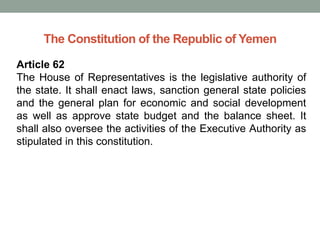
The Constitution of the Republic of Yemen
Article 62
The House of Representatives is the legislative authority of
the state. It shall enact laws, sanction general state policies
and the general plan for economic and social development
as well as approve state budget and the balance sheet. It
shall also oversee the activities of the Executive Authority as
stipulated in this constitution.
The Constitution of the Republic of Yemen
Article 88
a. The proposed general budget shall be submitted to the
House of Representatives at least two months before the
beginning of the fiscal year. A vote shall be taken on each
part of the budget. It shall be enacted by a law. The
House may not change the proposed budget without the
approval of the government. No allocation of revenue for
a specific purpose may be authorized except by a law. If
the budget law is not enacted before the beginning of the
fiscal year, the previous year’s budget shall be followed
until the new budget is approved.
b. The law shall specify the way to prepare and categorize
the general budget as well as specifying the fiscal year.
The Constitution of the Republic of Yemen
Article 89
The transfer of any amount from one section to another of
the general budget must be approved by the House of
Representatives. Every expenditure not provided for in the
budget or any additional revenue shall only be authorized by
law.
Article 90
The law shall specify the rules of the budgets of public
authorities, corporations and companies, their accounts, the
autonomous and supplementary budgets, and their final
accounts. With the exception of the above, these budgets
shall be subject to the approval of the House
The Constitution of the Republic of Yemen
Article 91
The final accounts of the Government’s annual budget shall
be submitted to the House within a period that does not
exceed nine months from the end of the fiscal year. Voting on
the Bill shall be made on a section by section basis and shall
be approved by an enactment of law. Also the annual report
of the organization concerned with the auditing and control of
government accounts shall be submitted to the House,
together with its comments thereon. The House of
Representatives has the right to ask the organization to
submit any supplementary documents or reports.
The Constitution of the Republic of Yemen
Article 137
The Council of Ministers is responsible for the execution of
overall state policies in the political, economic, social,
cultural, and defense fields, according to the Laws and
cabinet’s resolutions. In particular, it shall exercise the
following:
a. ……
b. To prepare drafts of the national economic plan, and the
annual budget, to organize and execute them, and to
prepare the government’s final annual account.
c. …….
Concepts and Principles Applicable to
Public Sector
▪ ACCOUNTING Concepts have been defined as broad
basic assumptions which underlie the preparation of
financial statement of an enterprise.
▪ Public sector accounting is an integral but separate branch
of financial accounting sharing in common many concepts
and principles applicable in the private sector.
▪ These concepts include: Consistency, Materiality
,Periodicity, Historical cost, Going concern etc.
Bases of Public Sector Accounting
There are three bases on which financial statements of
Public Sector Institutions are compiled. These are:
1) The Cash Basis
2) The Accrual Basis
3) The Commitment Basis
Cash Basis
This is a basis of accounting under which revenue is
recorded only when cash is received, and expenditure
recognized only when cash is paid, irrespective of the fact
that the transaction might have occurred in the previous
accounting period
Advantages of Cash Basis
• It is simple to understand
• Its eliminates the existence of debtors and creditors
• It permits easy identification of those who authorize
payments and collect revenue
• It allows for comparison between the amount provided in
the budget and that actually spent.
• It saves time and easy to operate
• It permits the delegation of work in certain circumstances
• The cost of fixed assets is written off in the year of
purchase resulting into fewer accounting entries
Disadvantages of Cash Basis
• It takes unrealistic view of financial transactions as only
the settlement of liabilities recognized.
• It does not provide for depreciation since assets are
written off in the year of purchase
• It does not convey an accurate picture of financial affairs
at the end of year.
• It can not be used for economic decisions since it tends to
hide basic information e.g. missing information relating to
fixed assets, debtors and creditors
• It does accord with ‘matching concept.
Modified Cash Basis
Under this basis books of accounts are left open for a
maximum of three months after the end of year, so as to
capture substantial amount of income or expenses relating to
the year just ended.
Accrual Basis
▪ Under this method, revenue is recognized when earned
and expenditure acknowledged as liabilities when known
or benefits received, notwithstanding the fact that the
receipts or payments of cash has taken place wholly or
partially in other accounting periods.
▪ It based on the principle of matching income and
expenditure to the time a transaction occurs rather than
when payments are made or received.
Accrual Basis
▪ This means that an expense is recorded at the point
goods or services are received by an organization rather
than thirty days later when the invoice for goods is paid.
Similarly, income is recorded at the point the sale is made
▪ The accrual basis is practiced in private sector.
Accrual Basis
▪ The reason private sector uses this method is because
private concern are for profit oriented.
▪ Therefore, it is necessary to estimate the profit made in
each period with the view to keeping investment assets
intact and making periodic distributions to shareholders by
way of dividends.
Advantages of Accrual Basis:
▪ It takes a realistic view of financial transactions
▪ It gives an accurate picture of the state of financial affairs
at the end of the accounting period.
▪ It aligns itself with matching concept.
▪ It can be used for both economic and investment decision-
making as all parameters for performance appraisal are
available.
▪ It gives allowance for depreciation of assets used in
generation revenue for the enterprise
Disadvantages of Accrual Basis
▪ It is difficult to understand ,especially by non accountants.
Commitment Basis
▪ It is a basis that records anticipated expenditure
evidenced by contract or purchase order.
▪ Commitment accounting identifies and reserves funds for
future payment obligations, leaving the uncommitted
balance of budgeted funds available for other
expenditures.
▪ In public sector financing, budgetary and accounting
systems are closely related to commitment basis.
Advantages of Commitment Basis
▪ It is an aid to financial control since it is regarded as a
charge made on budget provision.
▪ It can give a separate payment tabulation when it is
required/requested
▪ It takes a realistic view of financial transactions.
▪ It reveals an accurate picture of state of financial affairs at
the end of accounting period.
Advantages of Commitment Basis
▪ It aligns itself with matching concept.
▪ It can be used for both economic and investment decision-
making as all parameters for performance appraisal are
available.
▪ It gives allowance for depreciation of assets used in
generation revenue for the enterprise
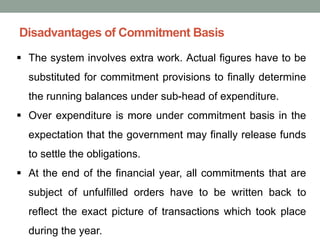
Disadvantages of Commitment Basis
▪ The system involves extra work. Actual figures have to be
substituted for commitment provisions to finally determine
the running balances under sub-head of expenditure.
▪ Over expenditure is more under commitment basis in the
expectation that the government may finally release funds
to settle the obligations.
▪ At the end of the financial year, all commitments that are
subject of unfulfilled orders have to be written back to
reflect the exact picture of transactions which took place
during the year.
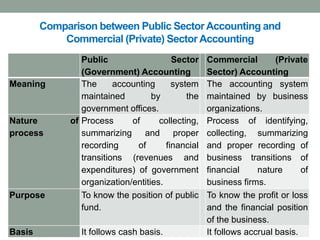
Comparison between Public Sector Accounting and
Commercial (Private) Sector Accounting
Public Sector
(Government) Accounting
Commercial (Private
Sector) Accounting
Meaning The accounting system
maintained by the
government offices.
The accounting system
maintained by business
organizations.
Nature of
process
Process of collecting,
summarizing and proper
recording of financial
transitions (revenues and
expenditures) of government
organization/entities.
Process of identifying,
collecting, summarizing
and proper recording of
business transitions of
financial nature of
business firms.
Purpose To know the position of public
fund.
To know the profit or loss
and the financial position
of the business.
Basis It follows cash basis. It follows accrual basis.
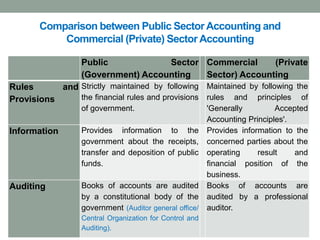
Comparison between Public Sector Accounting and
Commercial (Private) Sector Accounting
Public Sector
(Government) Accounting
Commercial (Private
Sector) Accounting
Rules and
Provisions
Strictly maintained by following
the financial rules and provisions
of government.
Maintained by following the
rules and principles of
'Generally Accepted
Accounting Principles'.
Information Provides information to the
government about the receipts,
transfer and deposition of public
funds.
Provides information to the
concerned parties about the
operating result and
financial position of the
business.
Auditing Books of accounts are audited
by a constitutional body of the
government (Auditor general office/
Central Organization for Control and
Auditing).
Books of accounts are
audited by a professional
auditor.
Disadvantages of Commitment Basis
▪ The system involves extra work. Actual figures have to be
substituted for commitment provisions to finally determine
the running balances under sub-head of expenditure.
▪ Over expenditure is more under commitment basis in the
expectation that the government may finally release funds
to settle the obligations.
▪ At the end of the financial year, all commitments that are
subject of unfulfilled orders have to be written back to
reflect the exact picture of transactions which took place
during the year.

Public Sector Accounting- Lecture.-1.pdf

  • 1.
    PUBLIC SECTOR ACCOUNTING Dr.Abdullah Hamoud International University of Technology Twintech Faculty of Business and Finance Department of Accounting
  • 2.
    CHAPTER 1: INTRODUCTIONTO PUBLIC SECTOR ACCOUNTING
  • 3.
    What is publicsector? • Public sector is all organizations which are not privately owned and operated, but established, run and financed by the government on behalf of the public. • Public sector consists of organizations where control lies in the hands of public, as opposed to private owners. • The objective of public sector is to provide services to the public. • Profit making is not primary to this sector
  • 4.
    Comparison between PublicSector Entities and Business Sector Entities Public Sector Entities Commercial Enterprise Objective To provide adequate welfare to people for free or at reasonable costs. To maximize profit. Source of revenue Government revenue is derived from the public in terms of taxation, fines, grants, fees, etc. Business enterprise obtain their income from sale of goods and services.
  • 5.
    Public Sector Accounting ❑The main aim of the government is not to make profit but to render essential services to its citizens. ❑ Since they are not for profit businesses, the accounting for them is different from accounting for businesses that are for profit maximization. ❑ Public Sector Accounting is “the systematic process of recording, communicating, summarizing, analyzing and interpreting the financial statements and statistics of Government in aggregate and details. It deals with the receipts, custody, disbursement and rendering of stewardship on public funds entrusted”.
  • 6.
    Public Sector Accounting ❑Public Sector Accounting “deals with the allocation of resources in accordance with the budget constraint of a public sector organization, especially government. It is a composite activities of analyzing, summarizing, recording and interpreting the financial transactions of the Government Ministries, Departments and Spending Agencies”.
  • 7.
    Public Sector Accounting ❑Public Sector Accounting is a “process of recording, communicating, summarizing, analyzing and interpreting government financial statements and statistics in aggregate and details; it is concerned with receipts, custody and disbursement and rendering of stewardship of public funds entrusted”.
  • 8.
    Public Sector Accounting ❑Public sector accounting can be used to measure incoming revenue and outgoing expenses of the government. ❑ It can also be used for budgeting, planning and forecasting. ❑ Although the main aim of most public sector entities is not to generate profit, it is still important to know how an agency is doing financially.
  • 9.
    Objectives of PublicSector Accounting 1) Ascertaining the legitimacy of transactions and their compliance with established norms, regulations and statutes. Public sector disbursement should accord with the provisions, appropriate acts and financial regulations. There should be due authorizations for all payments so as to avoid an act of fund misappropriation.
  • 10.
    Objectives of PublicSector Accounting 2) Providing evidence of stewardship. The act rendering stewardship is being able to account transparently and diligently for the resources entrusted. Government and public sector operators are obliged to display due diligence and sense of probity in the collection and disposal of public funds.
  • 11.
    Objectives of PublicSector Accounting 3) Assisting planning and control. ▪ The future faces a lot risks and uncertainties. Therefore, mapping out plans prevents an organization from drifting since plan of actions provides the focus of activities which are being pursued. ▪ The unforeseen circumstance is built into plans so as to avoid or prevent organization failure. ▪ The public sector establishments should act accordance with the mandate of the government.
  • 12.
    Objectives of PublicSector Accounting 4) Ensuring objective and timely reporting. ▪ Users of public sector accounting information are anxious to bridge their knowledge gaps on what government is doing. ▪ They definitely treasure prompt and accurate statistics to evaluate government performance.
  • 13.
    Objectives of PublicSector Accounting 5) Evaluating costs incurred and benefits derived. ▪ In Public sector, it is difficult to measure the costs and benefits in financial terms in all aspects. ▪ The analysis of cost- benefit assesses the economic and social advantages (benefits) and disadvantages (costs) of alternative courses of actions, to ensure that comfort of the citizens is well catered for.
  • 14.
    Objectives of PublicSector Accounting 6) Other objectives are: ▪ Providing basis for decision making highlighting various sources of revenues receivable and expenditure to be incurred identifying the source of funds for capital projects evaluating the economy, efficiency and effectiveness with which the public sector institutions pursue their goals and objectives. ▪ Ensuring that costs are matched by at least equivalent benefits accruing there from. ▪ Providing details of outstanding long term commitments and financial obligations.
  • 15.
    Objectives of PublicSector Accounting 6) Other objectives are: ▪ Providing means by which actual performance may be compared with the target set. ▪ Eliminating corruption. ▪ Modernization of the financial management system of the public sector entities.
  • 16.
    Financial Reporting ofPublic Sector Public Sector (Government) financial reporting is the process whereby governments report their financial position and activities to the public at large. These reports are the standard that citizens, oversight bodies, and other stakeholders use to judge their government's efficiency, effectiveness, and overall financial condition.
  • 17.
    The Importance ofPublic Sector Accounting to the Users ▪ The internal users require the accounting information in order to ascertain the various levels of regulatory compliance and whether the actual expenditure is in accordance with the budget. ▪ Further they would like to ascertain whether or not adequate safeguards are available for the protection of public resources. ▪ The external users would need the information to ascertain the financial viability of a public sector organizations and the efficiency and effective management.
  • 18.
    Users of PublicSector Accounting Information a) Internal Users: ▪ President ▪ Cabinet ▪ Governors ▪ Chairman of local Government Council ▪ Management of public sector organizations ▪ Heads of government departments
  • 19.
    Users of PublicSector Accounting Information b) External Users: ▪ Members of the public ▪ Foreign countries ▪ International Financial Institutions such as International Monetary Fund (IMF), World Bank ▪ Donors and lenders, locally and internationally ▪ Political parties ▪ Trade Unions ▪ Researchers
  • 20.
    Constitutional and RegulatoryFramework of Public Sector Accounting The public sector accounting is regulated by the following: a) The Constitution ▪ The constitution of the country is one of the legal frameworks that regulate the receipt and disbursement of public funds. ▪ Auditor general. ▪ The office of the auditor general is mandated by the constitution to audit all government ministries and spending agencies. ▪ This is to ensure that accountability of government resources is done.
  • 21.
    Constitutional and RegulatoryFramework of Public Sector Accounting ▪ The auditor general’s reports are submitted to the President, or to the Parliament (in Yemen thy are submitted to both the President and the Parliament).
  • 22.
    Constitutional and RegulatoryFramework of Public Sector Accounting b) Finance Act: ▪ The finance acts of various countries provide guidance on management and operations of government funds. ▪ The act would regulate on the accounting system, books of accounts to be kept and the procedures to be followed in preparation of government financial statements. ▪ In Yemen the Financial Law was established in 1990 and amended in 1999.
  • 23.
    Constitutional and RegulatoryFramework of Public Sector Accounting c) Financial Regulations: ▪ These are manuals of government Ministries/ government departments which deals with financial and accounting matters. ▪ The regulations set out the procedures and steps to followed in treating most of government transactions
  • 24.
    Constitutional and RegulatoryFramework of Public Sector Accounting d) Finance/Treasury Circulars: ▪ These are administrative tools which are used to amend the existing provisions of Financial Regulations, Public Service Rules and introduction of new policy guidelines. ▪ The circulars are usually issued by Prim-Ministers or the Secretary to the Treasury. ▪ In some cases by the Permanent Secretary for Cabinet office or Ministry of Finance (of course under the guidance of their superior).
  • 25.
    Constitutional and RegulatoryFramework of Public Sector Accounting e) Public Procurement Act: ▪ This is a procurement Act of each country which guides on government procurements. ▪ In Yemen, there is a Higher Committee for Procurement, an Authority mandated to monitor and overseeing public procurements; standard setting, developing legal framework and professional capacity for public procurement in Yemen.
  • 26.
    Legal Framework forPublic Finance Management in Yemen
  • 27.
    The Constitution ofthe Republic of Yemen
  • 28.
    The Financial LawNo. (8) of 1990
  • 29.
    The Constitution ofthe Republic of Yemen Article 62 The House of Representatives is the legislative authority of the state. It shall enact laws, sanction general state policies and the general plan for economic and social development as well as approve state budget and the balance sheet. It shall also oversee the activities of the Executive Authority as stipulated in this constitution.
  • 30.
    The Constitution ofthe Republic of Yemen Article 88 a. The proposed general budget shall be submitted to the House of Representatives at least two months before the beginning of the fiscal year. A vote shall be taken on each part of the budget. It shall be enacted by a law. The House may not change the proposed budget without the approval of the government. No allocation of revenue for a specific purpose may be authorized except by a law. If the budget law is not enacted before the beginning of the fiscal year, the previous year’s budget shall be followed until the new budget is approved. b. The law shall specify the way to prepare and categorize the general budget as well as specifying the fiscal year.
  • 31.
    The Constitution ofthe Republic of Yemen Article 89 The transfer of any amount from one section to another of the general budget must be approved by the House of Representatives. Every expenditure not provided for in the budget or any additional revenue shall only be authorized by law. Article 90 The law shall specify the rules of the budgets of public authorities, corporations and companies, their accounts, the autonomous and supplementary budgets, and their final accounts. With the exception of the above, these budgets shall be subject to the approval of the House
  • 32.
    The Constitution ofthe Republic of Yemen Article 91 The final accounts of the Government’s annual budget shall be submitted to the House within a period that does not exceed nine months from the end of the fiscal year. Voting on the Bill shall be made on a section by section basis and shall be approved by an enactment of law. Also the annual report of the organization concerned with the auditing and control of government accounts shall be submitted to the House, together with its comments thereon. The House of Representatives has the right to ask the organization to submit any supplementary documents or reports.
  • 33.
    The Constitution ofthe Republic of Yemen Article 137 The Council of Ministers is responsible for the execution of overall state policies in the political, economic, social, cultural, and defense fields, according to the Laws and cabinet’s resolutions. In particular, it shall exercise the following: a. …… b. To prepare drafts of the national economic plan, and the annual budget, to organize and execute them, and to prepare the government’s final annual account. c. …….
  • 34.
    Concepts and PrinciplesApplicable to Public Sector ▪ ACCOUNTING Concepts have been defined as broad basic assumptions which underlie the preparation of financial statement of an enterprise. ▪ Public sector accounting is an integral but separate branch of financial accounting sharing in common many concepts and principles applicable in the private sector. ▪ These concepts include: Consistency, Materiality ,Periodicity, Historical cost, Going concern etc.
  • 35.
    Bases of PublicSector Accounting There are three bases on which financial statements of Public Sector Institutions are compiled. These are: 1) The Cash Basis 2) The Accrual Basis 3) The Commitment Basis
  • 36.
    Cash Basis This isa basis of accounting under which revenue is recorded only when cash is received, and expenditure recognized only when cash is paid, irrespective of the fact that the transaction might have occurred in the previous accounting period
  • 37.
    Advantages of CashBasis • It is simple to understand • Its eliminates the existence of debtors and creditors • It permits easy identification of those who authorize payments and collect revenue • It allows for comparison between the amount provided in the budget and that actually spent. • It saves time and easy to operate • It permits the delegation of work in certain circumstances • The cost of fixed assets is written off in the year of purchase resulting into fewer accounting entries
  • 38.
    Disadvantages of CashBasis • It takes unrealistic view of financial transactions as only the settlement of liabilities recognized. • It does not provide for depreciation since assets are written off in the year of purchase • It does not convey an accurate picture of financial affairs at the end of year. • It can not be used for economic decisions since it tends to hide basic information e.g. missing information relating to fixed assets, debtors and creditors • It does accord with ‘matching concept.
  • 39.
    Modified Cash Basis Underthis basis books of accounts are left open for a maximum of three months after the end of year, so as to capture substantial amount of income or expenses relating to the year just ended.
  • 40.
    Accrual Basis ▪ Underthis method, revenue is recognized when earned and expenditure acknowledged as liabilities when known or benefits received, notwithstanding the fact that the receipts or payments of cash has taken place wholly or partially in other accounting periods. ▪ It based on the principle of matching income and expenditure to the time a transaction occurs rather than when payments are made or received.
  • 41.
    Accrual Basis ▪ Thismeans that an expense is recorded at the point goods or services are received by an organization rather than thirty days later when the invoice for goods is paid. Similarly, income is recorded at the point the sale is made ▪ The accrual basis is practiced in private sector.
  • 42.
    Accrual Basis ▪ Thereason private sector uses this method is because private concern are for profit oriented. ▪ Therefore, it is necessary to estimate the profit made in each period with the view to keeping investment assets intact and making periodic distributions to shareholders by way of dividends.
  • 43.
    Advantages of AccrualBasis: ▪ It takes a realistic view of financial transactions ▪ It gives an accurate picture of the state of financial affairs at the end of the accounting period. ▪ It aligns itself with matching concept. ▪ It can be used for both economic and investment decision- making as all parameters for performance appraisal are available. ▪ It gives allowance for depreciation of assets used in generation revenue for the enterprise
  • 44.
    Disadvantages of AccrualBasis ▪ It is difficult to understand ,especially by non accountants.
  • 45.
    Commitment Basis ▪ Itis a basis that records anticipated expenditure evidenced by contract or purchase order. ▪ Commitment accounting identifies and reserves funds for future payment obligations, leaving the uncommitted balance of budgeted funds available for other expenditures. ▪ In public sector financing, budgetary and accounting systems are closely related to commitment basis.
  • 46.
    Advantages of CommitmentBasis ▪ It is an aid to financial control since it is regarded as a charge made on budget provision. ▪ It can give a separate payment tabulation when it is required/requested ▪ It takes a realistic view of financial transactions. ▪ It reveals an accurate picture of state of financial affairs at the end of accounting period.
  • 47.
    Advantages of CommitmentBasis ▪ It aligns itself with matching concept. ▪ It can be used for both economic and investment decision- making as all parameters for performance appraisal are available. ▪ It gives allowance for depreciation of assets used in generation revenue for the enterprise
  • 48.
    Disadvantages of CommitmentBasis ▪ The system involves extra work. Actual figures have to be substituted for commitment provisions to finally determine the running balances under sub-head of expenditure. ▪ Over expenditure is more under commitment basis in the expectation that the government may finally release funds to settle the obligations. ▪ At the end of the financial year, all commitments that are subject of unfulfilled orders have to be written back to reflect the exact picture of transactions which took place during the year.
  • 49.
    Comparison between PublicSector Accounting and Commercial (Private) Sector Accounting Public Sector (Government) Accounting Commercial (Private Sector) Accounting Meaning The accounting system maintained by the government offices. The accounting system maintained by business organizations. Nature of process Process of collecting, summarizing and proper recording of financial transitions (revenues and expenditures) of government organization/entities. Process of identifying, collecting, summarizing and proper recording of business transitions of financial nature of business firms. Purpose To know the position of public fund. To know the profit or loss and the financial position of the business. Basis It follows cash basis. It follows accrual basis.
  • 50.
    Comparison between PublicSector Accounting and Commercial (Private) Sector Accounting Public Sector (Government) Accounting Commercial (Private Sector) Accounting Rules and Provisions Strictly maintained by following the financial rules and provisions of government. Maintained by following the rules and principles of 'Generally Accepted Accounting Principles'. Information Provides information to the government about the receipts, transfer and deposition of public funds. Provides information to the concerned parties about the operating result and financial position of the business. Auditing Books of accounts are audited by a constitutional body of the government (Auditor general office/ Central Organization for Control and Auditing). Books of accounts are audited by a professional auditor.
  • 51.
    Disadvantages of CommitmentBasis ▪ The system involves extra work. Actual figures have to be substituted for commitment provisions to finally determine the running balances under sub-head of expenditure. ▪ Over expenditure is more under commitment basis in the expectation that the government may finally release funds to settle the obligations. ▪ At the end of the financial year, all commitments that are subject of unfulfilled orders have to be written back to reflect the exact picture of transactions which took place during the year.