Education in the Cloud
Digital Classrooms as Data Factories
What is a “Smart” City?
Learning Ecosystems and the Internet of Things
Blockchain and “The Ledger”
How Austerity Generates Data
Reinventing Education for Impact Investment
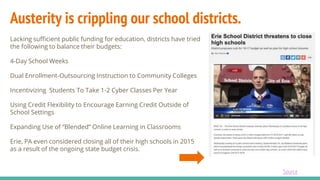
Austerity is crippling our school districts.
Lacking sufficient public funding for education, districts have tried
the following to balance their budgets:
4-Day School Weeks
Dual Enrollment-Outsourcing Instruction to Community Colleges
Incentivizing Students To Take 1-2 Cyber Classes Per Year
Using Credit Flexibility to Encourage Earning Credit Outside of
School Settings
Expanding Use of “Blended” Online Learning in Classrooms
Erie, PA even considered closing all of their high schools in 2015
as a result of the ongoing state budget crisis.
Source
There continues to be pressure for lean production.
From Massachusetts’s New State Education Plan Under ESSA:
“In an era of increasing demands for public services as the state’s population
ages, the education sector will be competing with other public services
for financial resources. Districts must continue to find ways to get more out
of the people, time, and fiscal resources they already have to help
improve outcomes for students, including by reducing inequities in the
allocation of resources to different types of students. To this end, the state
has created a new Office of Resource Allocation Strategy and Planning to
develop new tools and supports for districts to rethink how they use
their resources. Source
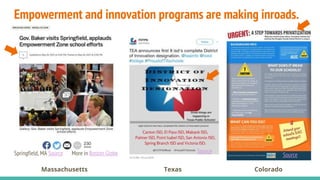
Empowerment and innovation programs are making inroads.
Springfield, MA Source More in Boston Globe Source
TexasMassachusetts Colorado
Source
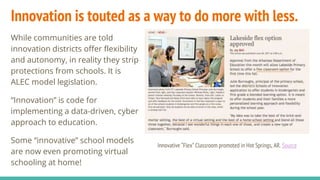
Innovation is touted as a way to do more with less.
While communities are told
innovation districts offer flexibility
and autonomy, in reality they strip
protections from schools. It is
ALEC model legislation.
“Innovation” is code for
implementing a data-driven, cyber
approach to education.
Some “innovative” school models
are now even promoting virtual
schooling at home!
Innovative “Flex” Classroom promoted in Hot Springs, AR. Source
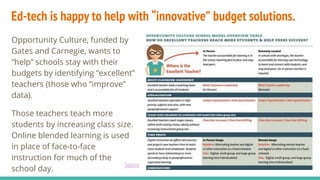
Ed-tech is happy to help with “innovative” budget solutions.
Opportunity Culture, funded by
Gates and Carnegie, wants to
“help” schools stay with their
budgets by identifying “excellent”
teachers (those who “improve”
data).
Those teachers teach more
students by increasing class size.
Online blended learning is used
in place of face-to-face
instruction for much of the
school day.
Source
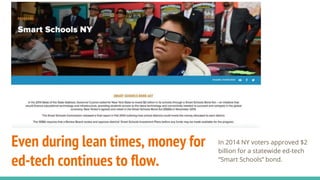
Even during lean times, money for
ed-tech continues to flow.
In 2014 NY voters approved $2
billion for a statewide ed-tech
“Smart Schools” bond.
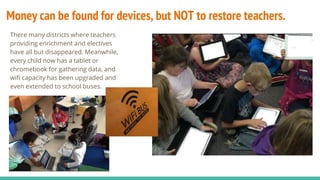
Money can be found for devices, but NOT to restore teachers.
There many districts where teachers
providing enrichment and electives
have all but disappeared. Meanwhile,
every child now has a tablet or
chromebook for gathering data, and
wifi capacity has been upgraded and
even extended to school buses.
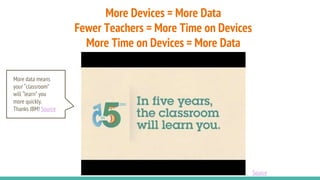
More Devices = More Data
Fewer Teachers = More Time on Devices
More Time on Devices = More Data
Source
More data means
your “classroom”
will “learn” you
more quickly.
Thanks IBM! Source
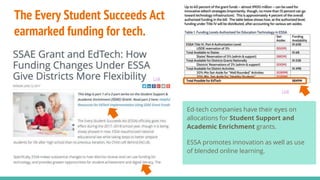
The Every Student Succeeds Act
earmarked funding for tech.
Ed-tech companies have their eyes on
allocations for Student Support and
Academic Enrichment grants.
ESSA promotes innovation as well as use
of blended online learning.
Link
Link
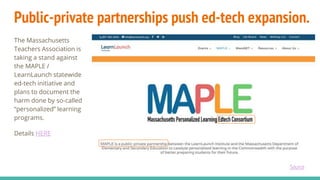
Public-private partnerships push ed-tech expansion.
The Massachusetts
Teachers Association is
taking a stand against
the MAPLE /
LearnLaunch statewide
ed-tech initiative and
plans to document the
harm done by so-called
“personalized” learning
programs.
Details HERE
Source
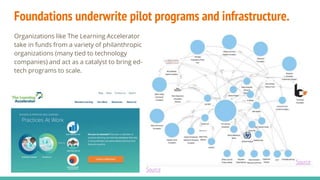
Foundations underwrite pilot programs and infrastructure.
Organizations like The Learning Accelerator
take in funds from a variety of philanthropic
organizations (many tied to technology
companies) and act as a catalyst to bring ed-
tech programs to scale.
Source
Source
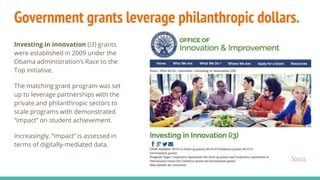
Government grants leverage philanthropic dollars.
Investing in innovation (i3) grants
were established in 2009 under the
Obama administration’s Race to the
Top initiative.
The matching grant program was set
up to leverage partnerships with the
private and philanthropic sectors to
scale programs with demonstrated
“impact” on student achievement.
Increasingly, “impact” is assessed in
terms of digitally-mediated data.
Source
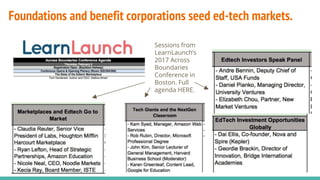
Foundations and benefit corporations seed ed-tech markets.
Sessions from
LearnLaunch’s
2017 Across
Boundaries
Conference in
Boston. Full
agenda HERE.
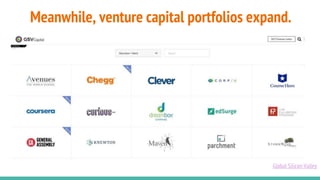
Meanwhile, venture capital portfolios expand.
Global Silicon Valley
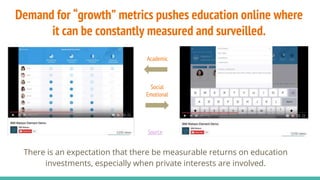
Demand for “growth” metrics pushes education online where
it can be constantly measured and surveilled.
There is an expectation that there be measurable returns on education
investments, especially when private interests are involved.
Source
Academic
Social
Emotional
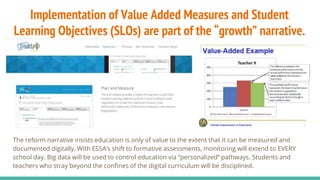
Implementation of Value Added Measures and Student
Learning Objectives (SLOs) are part of the “growth” narrative.
The reform narrative insists education is only of value to the extent that it can be measured and
documented digitally. With ESSA’s shift to formative assessments, monitoring will extend to EVERY
school day. Big data will be used to control education via “personalized” pathways. Students and
teachers who stray beyond the confines of the digital curriculum will be disciplined.
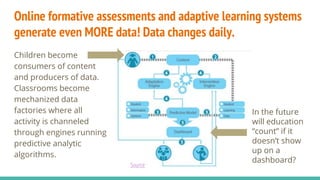
Online formative assessments and adaptive learning systems
generate even MORE data! Data changes daily.
Children become
consumers of content
and producers of data.
Classrooms become
mechanized data
factories where all
activity is channeled
through engines running
predictive analytic
algorithms.
In the future
will education
“count” if it
doesn’t show
up on a
dashboard?
Source
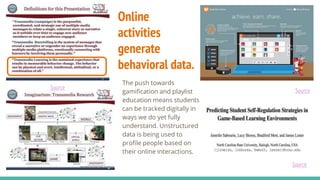
Online
activities
generate
behavioral data.
The push towards
gamification and playlist
education means students
can be tracked digitally in
ways we do yet fully
understand. Unstructured
data is being used to
profile people based on
their online interactions.
Source
Source
Source
Add to that career-oriented data
for students as young as 11.
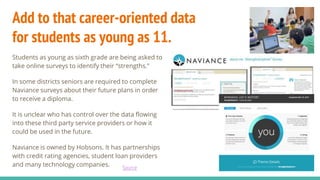
Students as young as sixth grade are being asked to
take online surveys to identify their “strengths.”
In some districts seniors are required to complete
Naviance surveys about their future plans in order
to receive a diploma.
It is unclear who has control over the data flowing
into these third party service providers or how it
could be used in the future.
Naviance is owned by Hobsons. It has partnerships
with credit rating agencies, student loan providers
and many technology companies.
Source
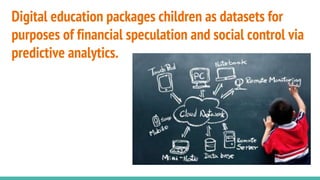
Digital education packages children as datasets for
purposes of financial speculation and social control via
predictive analytics.

How Austerity Generates Data

  • 1.
    Education in theCloud Digital Classrooms as Data Factories What is a “Smart” City? Learning Ecosystems and the Internet of Things Blockchain and “The Ledger” How Austerity Generates Data Reinventing Education for Impact Investment
  • 2.
    Austerity is cripplingour school districts. Lacking sufficient public funding for education, districts have tried the following to balance their budgets: 4-Day School Weeks Dual Enrollment-Outsourcing Instruction to Community Colleges Incentivizing Students To Take 1-2 Cyber Classes Per Year Using Credit Flexibility to Encourage Earning Credit Outside of School Settings Expanding Use of “Blended” Online Learning in Classrooms Erie, PA even considered closing all of their high schools in 2015 as a result of the ongoing state budget crisis. Source
  • 3.
    There continues tobe pressure for lean production. From Massachusetts’s New State Education Plan Under ESSA: “In an era of increasing demands for public services as the state’s population ages, the education sector will be competing with other public services for financial resources. Districts must continue to find ways to get more out of the people, time, and fiscal resources they already have to help improve outcomes for students, including by reducing inequities in the allocation of resources to different types of students. To this end, the state has created a new Office of Resource Allocation Strategy and Planning to develop new tools and supports for districts to rethink how they use their resources. Source
  • 4.
    Empowerment and innovationprograms are making inroads. Springfield, MA Source More in Boston Globe Source TexasMassachusetts Colorado Source
  • 5.
    Innovation is toutedas a way to do more with less. While communities are told innovation districts offer flexibility and autonomy, in reality they strip protections from schools. It is ALEC model legislation. “Innovation” is code for implementing a data-driven, cyber approach to education. Some “innovative” school models are now even promoting virtual schooling at home! Innovative “Flex” Classroom promoted in Hot Springs, AR. Source
  • 6.
    Ed-tech is happyto help with “innovative” budget solutions. Opportunity Culture, funded by Gates and Carnegie, wants to “help” schools stay with their budgets by identifying “excellent” teachers (those who “improve” data). Those teachers teach more students by increasing class size. Online blended learning is used in place of face-to-face instruction for much of the school day. Source
  • 7.
    Even during leantimes, money for ed-tech continues to flow. In 2014 NY voters approved $2 billion for a statewide ed-tech “Smart Schools” bond.
  • 8.
    Money can befound for devices, but NOT to restore teachers. There many districts where teachers providing enrichment and electives have all but disappeared. Meanwhile, every child now has a tablet or chromebook for gathering data, and wifi capacity has been upgraded and even extended to school buses.
  • 9.
    More Devices =More Data Fewer Teachers = More Time on Devices More Time on Devices = More Data Source More data means your “classroom” will “learn” you more quickly. Thanks IBM! Source
  • 10.
    The Every StudentSucceeds Act earmarked funding for tech. Ed-tech companies have their eyes on allocations for Student Support and Academic Enrichment grants. ESSA promotes innovation as well as use of blended online learning. Link Link
  • 11.
    Public-private partnerships pushed-tech expansion. The Massachusetts Teachers Association is taking a stand against the MAPLE / LearnLaunch statewide ed-tech initiative and plans to document the harm done by so-called “personalized” learning programs. Details HERE Source
  • 12.
    Foundations underwrite pilotprograms and infrastructure. Organizations like The Learning Accelerator take in funds from a variety of philanthropic organizations (many tied to technology companies) and act as a catalyst to bring ed- tech programs to scale. Source Source
  • 13.
    Government grants leveragephilanthropic dollars. Investing in innovation (i3) grants were established in 2009 under the Obama administration’s Race to the Top initiative. The matching grant program was set up to leverage partnerships with the private and philanthropic sectors to scale programs with demonstrated “impact” on student achievement. Increasingly, “impact” is assessed in terms of digitally-mediated data. Source
  • 14.
    Foundations and benefitcorporations seed ed-tech markets. Sessions from LearnLaunch’s 2017 Across Boundaries Conference in Boston. Full agenda HERE.
  • 15.
    Meanwhile, venture capitalportfolios expand. Global Silicon Valley
  • 16.
    Demand for “growth”metrics pushes education online where it can be constantly measured and surveilled. There is an expectation that there be measurable returns on education investments, especially when private interests are involved. Source Academic Social Emotional
  • 17.
    Implementation of ValueAdded Measures and Student Learning Objectives (SLOs) are part of the “growth” narrative. The reform narrative insists education is only of value to the extent that it can be measured and documented digitally. With ESSA’s shift to formative assessments, monitoring will extend to EVERY school day. Big data will be used to control education via “personalized” pathways. Students and teachers who stray beyond the confines of the digital curriculum will be disciplined.
  • 18.
    Online formative assessmentsand adaptive learning systems generate even MORE data! Data changes daily. Children become consumers of content and producers of data. Classrooms become mechanized data factories where all activity is channeled through engines running predictive analytic algorithms. In the future will education “count” if it doesn’t show up on a dashboard? Source
  • 19.
    Online activities generate behavioral data. The pushtowards gamification and playlist education means students can be tracked digitally in ways we do yet fully understand. Unstructured data is being used to profile people based on their online interactions. Source Source Source
  • 20.
    Add to thatcareer-oriented data for students as young as 11. Students as young as sixth grade are being asked to take online surveys to identify their “strengths.” In some districts seniors are required to complete Naviance surveys about their future plans in order to receive a diploma. It is unclear who has control over the data flowing into these third party service providers or how it could be used in the future. Naviance is owned by Hobsons. It has partnerships with credit rating agencies, student loan providers and many technology companies. Source
  • 21.
    Digital education packageschildren as datasets for purposes of financial speculation and social control via predictive analytics.