Session overviewSMSF registration and rolloversAcquisition of related party assetsPayment of benefitsContributionsLimited recourse borrowing arrangements In-house assets and sole purposeStronger super – Government response to the Cooper Review.
1. SMSF registration & rollovers
SMSF registration and rollovers  November 2010 – new SMSF member verification system launched by the ATOAPRA letter to APRA regulated super funds – “…requests for additional documentation such as a trust deed should not be necessary.” December 2010 - 30,000 SMSFs re-classified as “Registered – status not determined” December 2010 ATO SMSF newsletter – SMSFs should not register until assets are held by the fundStronger super – fund naming conventions, proof of identity checks, AML/CTF Act to apply to SMSF rollovers  Session 16A – New fund registration and SMSF rollovers – obstacles and best practice guidelines.
2. Acquisition of related party assets
SMSFR 2010/1 – Application of s66(1)    Final ruling released on 25 February 2010Paragraphs 17, 18, 19, 114, 115 and examples 5 and 6If goods and materials, which are not insignificant in value or function, are provided to an SMSF as part of a service provided by a related party, there is an acquisition of assets (being the goods or materials)A SMSF will breach s66 if the fund owns land and it engages a related party to construct a building using goods and materials supplied by the related party Requirement to purchase the goods and materials required to construct the premise directly from the supplierSession 14B – SMSFs and real property applications.
Subsection 66(2A)(a)(i) Paragraphs 43, 44, 163 - 171In-house asset exception in subsection 66(2A)(a)(i) and (ii) is limited to the acquisition of assets that are “investments in” a related party or a related trust of the SMSFThe ATO does not consider that subsection 66(2A) could have been intended to apply more broadly to include real property subject to a lease or lease arrangement with a related party.
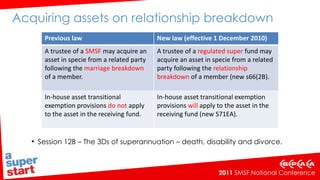
Acquiring assets on relationship breakdown Session 12B – The 3Ds of superannuation – death, disability and divorce. 3. Payment of benefits
Meaning of “cashed” for benefit payment purposes SMSFD 2011/1 released on 19 January 2011A benefit is cashed when the member receives the cheque and the fund, at the time the cheque is received, has the capacity to honour the chequeMust also have an objective intention to immediately transfer funds from the SMSFNo payment where cheque is drawn and re-banked into the fund.
Exempt current pension income Pension standards in Reg 1.06 must be met – no specific scope for the definition of pension to be met where standards have been breachedMay be some administrative scope for the ATO to overlook breaches arising from circumstances that are outside of the trustee’s control – possible release of ATO Practice StatementCan only be considered on a case by case basis.NTLG Superannuation Technical sub-group meeting – 8 December 2010.
Exempt current pension income Emerging issue – SMSF’s failing to obtain the necessary actuarial certificateCan a single bank account or a property be segregated?More guidance on what is required to be done to demonstrate that an asset has been segregated*Session 10B – Asset segregation strategies & accounting for capital lossesSession 20B – Troublesome pensions – what are your options?*NTLG Superannuation Technical sub-group meeting – 9 March 2010.
4. Contributions
Classification of contributions S292-25(2) of the ITAA97 defines a concessional contribution as a contribution made to a fund in respect of you which is included in the assessable income of the fundA contribution is included in the assessable income of the fund if it is to provide super benefits for someone else (unless it is a spouse or Government co-contribution).
5. Limited recourse borrowing arrangements
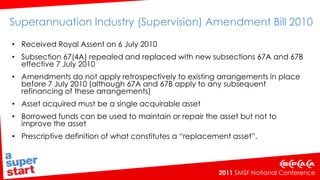
Superannuation Industry (Supervision) Amendment Bill 2010 Received Royal Assent on 6 July 2010Subsection 67(4A) repealed and replaced with new subsections 67A and 67B effective 7 July 2010Amendments do not apply retrospectively to existing arrangements in place before 7 July 2010 (although 67A and 67B apply to any subsequent refinancing of these arrangements)Asset acquired must be a single acquirable assetBorrowed funds can be used to maintain or repair the asset but not to improve the assetPrescriptive definition of what constitutes a “replacement asset”.
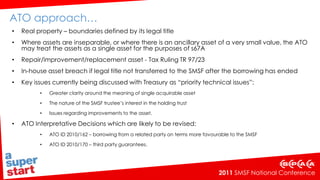
ATO approach… Real property – boundaries defined by its legal titleWhere assets are inseparable, or where there is an ancillary asset of a very small value, the ATO may treat the assets as a single asset for the purposes of s67ARepair/improvement/replacement asset - Tax Ruling TR 97/23In-house asset breach if legal title not transferred to the SMSF after the borrowing has ended   Key issues currently being discussed with Treasury as “priority technical issues”:Greater clarity around the meaning of single acquirable assetThe nature of the SMSF trustee’s interest in the holding trustIssues regarding improvements to the asset.  ATO Interpretative Decisions which are likely to be revised:ATO ID 2010/162 – borrowing from a related party on terms more favourable to the SMSFATO ID 2010/170 – third party guarantees.
Still to come…Borrowing arrangement to be regarded as a financial product – only financial service providers with an AFSL will be able to offer these products   ITAA 1997 amendments - no CGT applicable at the time the last instalment is paid and the SMSF acquires the asset outrightCooper review recommendation 8.10 – borrowing provisions should be reviewed by Government in 2 years time.
Conference sessions Session 5B – Limited recourse borrowing strategiesSession 11A – Limited recourse borrowing - what you need to do to comply.
6. In-house assets and sole purpose
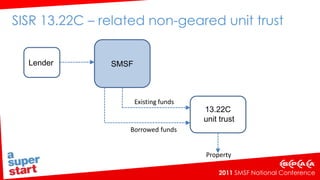
Conversion of a geared trust to a 13.22C trust New units acquired in a pre-99 unit trust will be excluded as an in-house asset if both of the following conditions are satisfied:The unit trust now complies with SISR 13.22CNo event in 13.22D(1) has occurred since 28 June 2000 A 13.22D(1) event includes new borrowing, conducting a business, acquiring an interest in another entitySession 12B – Pre 99 unit trusts and non-geared unit trust strategiesSession 14B – SMSFs and real property applications.NTLG Superannuation Technical sub-group meeting (15 June 2010, 7 September 2010).
Example A SMSF purchased 100 units in a related unit trust in July 1999The unit trust was initially set up as a geared unit trust with a $100,000 loan The original loan was repaid in 2004The unit trust took out a new loan in 2006 which was subsequently repaid in 2010The SMSF now wants to purchase additional units in the unit trustEven though the unit trust now complies with SISR13.22C, an event listed in 13.22(D)(1) has occurred since 28 June 2000 (i.e. the new loan) The purchase of additional units will be classified as an in-house asset. The original 100 units remain excluded from the in-house asset test by virtue of s71A.
SISR 13.22C – related non-geared unit trust     SMSFLenderExisting funds13.22C unit trustBorrowed fundsProperty
Water rights Water access licence which entitles the holder to draw a specified amount of water from a waterway for irrigation purposesLikely application of s71(1)(e) to exclude certain water rights from the in-house assets of superannuation fundsLikely to be an allowable related party acquisition under s66(2A)?   NTLG Superannuation Technical sub-group meeting (8 December 2010).
Government response to the Super System Review  No evidence that in-house asset investments within the current legislative restrictions are detrimental to SMSFsLikely amendment to the in-house asset rules to prohibit an in-house asset where the asset concerned is a “collectable”.
Collectables and personal use assets  Exposure Draft (Tax Laws Amendment (2011 Measures No.2) Bill 2011) released - “Collectables” and “Personal use assets” as defined in ITAA 1997New section 62A to be inserted with effect from 1 July 2011Regulations to apply from 1 July 2011 with a 5 year transition period Should artwork be permitted to be stored, but not displayed, in the premise of a related party?Session 20C – Art, collectables and personal use assets – discussion and practical implications.
Sole purpose test and “carrying on a business”  ATO fact sheet releasedIt is the activities of the trustee that are examined rather than whether a business is being carried on by the SMSFRetention of business profits to fund retirement benefitsEmployment of family members, links to associated trading entities and activities commonly carried out as hobbies - will attract attentionProperty development – should apply for a private ruling if a significant part of the fund’s assetsSession 15B – Swiss Chalets – don’t get caught in yours – a guide to the sole purpose test and in-house assets.
7. Stronger super
Government’s response to the Cooper Review
Meaning of a wholesale client  A financial service provided to the trustee of a SMSF will always be provided to the trustee as a “retail client” unless the fund has net assets of at least $10 million – ASIC QFS 150Trustees of a SMSF cannot be “sophisticated investors” within the meaning of the Corporations Act – ASIC QFS 150Confusion regarding whether “in relation to a superannuation product” in S761G applies to financial services and products made available to the trustee of a super fund Restricts access to wholesale investment markets and reduces the range of investments available to SMSFsJanuary 2011 – options paper released as part of the FOFA reformsNeed to ensure consistency across the Corporations ActSession 6C – The wholesale/retail client distinction – opportunities and risks for Accountants and Planners.
DisclaimerThis presentation is for general information only. Every effort has been made to ensure that it is accurate, however it is not intended to be a complete description of the matters described. The presentation has been prepared without taking into account any personal objectives, financial situation or needs. It does not contain and is not to be taken as containing any securities advice or securities recommendation. Furthermore, it is not intended that it be relied on by recipients for the purpose of making investment decisions and is not a replacement of the requirement for individual research or professional tax advice. This presentation was accompanied by an oral presentation, and is not a complete record of the discussion held. No part of this presentation should be used elsewhere without prior consent from the author.
Peter Burgess

Peter Burgess

  • 1.
    Session overviewSMSF registrationand rolloversAcquisition of related party assetsPayment of benefitsContributionsLimited recourse borrowing arrangements In-house assets and sole purposeStronger super – Government response to the Cooper Review.
  • 2.
  • 3.
    SMSF registration androllovers November 2010 – new SMSF member verification system launched by the ATOAPRA letter to APRA regulated super funds – “…requests for additional documentation such as a trust deed should not be necessary.” December 2010 - 30,000 SMSFs re-classified as “Registered – status not determined” December 2010 ATO SMSF newsletter – SMSFs should not register until assets are held by the fundStronger super – fund naming conventions, proof of identity checks, AML/CTF Act to apply to SMSF rollovers Session 16A – New fund registration and SMSF rollovers – obstacles and best practice guidelines.
  • 4.
    2. Acquisition ofrelated party assets
  • 5.
    SMSFR 2010/1 –Application of s66(1) Final ruling released on 25 February 2010Paragraphs 17, 18, 19, 114, 115 and examples 5 and 6If goods and materials, which are not insignificant in value or function, are provided to an SMSF as part of a service provided by a related party, there is an acquisition of assets (being the goods or materials)A SMSF will breach s66 if the fund owns land and it engages a related party to construct a building using goods and materials supplied by the related party Requirement to purchase the goods and materials required to construct the premise directly from the supplierSession 14B – SMSFs and real property applications.
  • 6.
    Subsection 66(2A)(a)(i) Paragraphs43, 44, 163 - 171In-house asset exception in subsection 66(2A)(a)(i) and (ii) is limited to the acquisition of assets that are “investments in” a related party or a related trust of the SMSFThe ATO does not consider that subsection 66(2A) could have been intended to apply more broadly to include real property subject to a lease or lease arrangement with a related party.
  • 7.
    Acquiring assets onrelationship breakdown Session 12B – The 3Ds of superannuation – death, disability and divorce. 3. Payment of benefits
  • 8.
    Meaning of “cashed”for benefit payment purposes SMSFD 2011/1 released on 19 January 2011A benefit is cashed when the member receives the cheque and the fund, at the time the cheque is received, has the capacity to honour the chequeMust also have an objective intention to immediately transfer funds from the SMSFNo payment where cheque is drawn and re-banked into the fund.
  • 9.
    Exempt current pensionincome Pension standards in Reg 1.06 must be met – no specific scope for the definition of pension to be met where standards have been breachedMay be some administrative scope for the ATO to overlook breaches arising from circumstances that are outside of the trustee’s control – possible release of ATO Practice StatementCan only be considered on a case by case basis.NTLG Superannuation Technical sub-group meeting – 8 December 2010.
  • 10.
    Exempt current pensionincome Emerging issue – SMSF’s failing to obtain the necessary actuarial certificateCan a single bank account or a property be segregated?More guidance on what is required to be done to demonstrate that an asset has been segregated*Session 10B – Asset segregation strategies & accounting for capital lossesSession 20B – Troublesome pensions – what are your options?*NTLG Superannuation Technical sub-group meeting – 9 March 2010.
  • 11.
  • 12.
    Classification of contributionsS292-25(2) of the ITAA97 defines a concessional contribution as a contribution made to a fund in respect of you which is included in the assessable income of the fundA contribution is included in the assessable income of the fund if it is to provide super benefits for someone else (unless it is a spouse or Government co-contribution).
  • 13.
    5. Limited recourseborrowing arrangements
  • 14.
    Superannuation Industry (Supervision)Amendment Bill 2010 Received Royal Assent on 6 July 2010Subsection 67(4A) repealed and replaced with new subsections 67A and 67B effective 7 July 2010Amendments do not apply retrospectively to existing arrangements in place before 7 July 2010 (although 67A and 67B apply to any subsequent refinancing of these arrangements)Asset acquired must be a single acquirable assetBorrowed funds can be used to maintain or repair the asset but not to improve the assetPrescriptive definition of what constitutes a “replacement asset”.
  • 15.
    ATO approach… Realproperty – boundaries defined by its legal titleWhere assets are inseparable, or where there is an ancillary asset of a very small value, the ATO may treat the assets as a single asset for the purposes of s67ARepair/improvement/replacement asset - Tax Ruling TR 97/23In-house asset breach if legal title not transferred to the SMSF after the borrowing has ended Key issues currently being discussed with Treasury as “priority technical issues”:Greater clarity around the meaning of single acquirable assetThe nature of the SMSF trustee’s interest in the holding trustIssues regarding improvements to the asset. ATO Interpretative Decisions which are likely to be revised:ATO ID 2010/162 – borrowing from a related party on terms more favourable to the SMSFATO ID 2010/170 – third party guarantees.
  • 16.
    Still to come…Borrowingarrangement to be regarded as a financial product – only financial service providers with an AFSL will be able to offer these products ITAA 1997 amendments - no CGT applicable at the time the last instalment is paid and the SMSF acquires the asset outrightCooper review recommendation 8.10 – borrowing provisions should be reviewed by Government in 2 years time.
  • 17.
    Conference sessions Session5B – Limited recourse borrowing strategiesSession 11A – Limited recourse borrowing - what you need to do to comply.
  • 18.
    6. In-house assetsand sole purpose
  • 19.
    Conversion of ageared trust to a 13.22C trust New units acquired in a pre-99 unit trust will be excluded as an in-house asset if both of the following conditions are satisfied:The unit trust now complies with SISR 13.22CNo event in 13.22D(1) has occurred since 28 June 2000 A 13.22D(1) event includes new borrowing, conducting a business, acquiring an interest in another entitySession 12B – Pre 99 unit trusts and non-geared unit trust strategiesSession 14B – SMSFs and real property applications.NTLG Superannuation Technical sub-group meeting (15 June 2010, 7 September 2010).
  • 20.
    Example A SMSFpurchased 100 units in a related unit trust in July 1999The unit trust was initially set up as a geared unit trust with a $100,000 loan The original loan was repaid in 2004The unit trust took out a new loan in 2006 which was subsequently repaid in 2010The SMSF now wants to purchase additional units in the unit trustEven though the unit trust now complies with SISR13.22C, an event listed in 13.22(D)(1) has occurred since 28 June 2000 (i.e. the new loan) The purchase of additional units will be classified as an in-house asset. The original 100 units remain excluded from the in-house asset test by virtue of s71A.
  • 21.
    SISR 13.22C –related non-geared unit trust SMSFLenderExisting funds13.22C unit trustBorrowed fundsProperty
  • 22.
    Water rights Wateraccess licence which entitles the holder to draw a specified amount of water from a waterway for irrigation purposesLikely application of s71(1)(e) to exclude certain water rights from the in-house assets of superannuation fundsLikely to be an allowable related party acquisition under s66(2A)? NTLG Superannuation Technical sub-group meeting (8 December 2010).
  • 23.
    Government response tothe Super System Review No evidence that in-house asset investments within the current legislative restrictions are detrimental to SMSFsLikely amendment to the in-house asset rules to prohibit an in-house asset where the asset concerned is a “collectable”.
  • 24.
    Collectables and personaluse assets Exposure Draft (Tax Laws Amendment (2011 Measures No.2) Bill 2011) released - “Collectables” and “Personal use assets” as defined in ITAA 1997New section 62A to be inserted with effect from 1 July 2011Regulations to apply from 1 July 2011 with a 5 year transition period Should artwork be permitted to be stored, but not displayed, in the premise of a related party?Session 20C – Art, collectables and personal use assets – discussion and practical implications.
  • 25.
    Sole purpose testand “carrying on a business” ATO fact sheet releasedIt is the activities of the trustee that are examined rather than whether a business is being carried on by the SMSFRetention of business profits to fund retirement benefitsEmployment of family members, links to associated trading entities and activities commonly carried out as hobbies - will attract attentionProperty development – should apply for a private ruling if a significant part of the fund’s assetsSession 15B – Swiss Chalets – don’t get caught in yours – a guide to the sole purpose test and in-house assets.
  • 26.
  • 27.
  • 28.
    Meaning of awholesale client A financial service provided to the trustee of a SMSF will always be provided to the trustee as a “retail client” unless the fund has net assets of at least $10 million – ASIC QFS 150Trustees of a SMSF cannot be “sophisticated investors” within the meaning of the Corporations Act – ASIC QFS 150Confusion regarding whether “in relation to a superannuation product” in S761G applies to financial services and products made available to the trustee of a super fund Restricts access to wholesale investment markets and reduces the range of investments available to SMSFsJanuary 2011 – options paper released as part of the FOFA reformsNeed to ensure consistency across the Corporations ActSession 6C – The wholesale/retail client distinction – opportunities and risks for Accountants and Planners.
  • 29.
    DisclaimerThis presentation isfor general information only. Every effort has been made to ensure that it is accurate, however it is not intended to be a complete description of the matters described. The presentation has been prepared without taking into account any personal objectives, financial situation or needs. It does not contain and is not to be taken as containing any securities advice or securities recommendation. Furthermore, it is not intended that it be relied on by recipients for the purpose of making investment decisions and is not a replacement of the requirement for individual research or professional tax advice. This presentation was accompanied by an oral presentation, and is not a complete record of the discussion held. No part of this presentation should be used elsewhere without prior consent from the author.