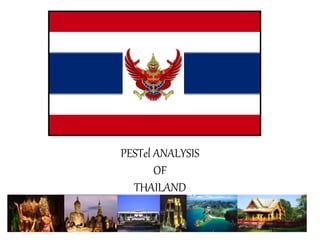
PESTel ANALYSIS
OF
THAILAND
Political
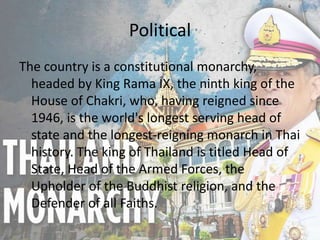
The country is a constitutional monarchy,
headed by King Rama IX, the ninth king of the
House of Chakri, who, having reigned since
1946, is the world's longest serving head of
state and the longest-reigning monarch in Thai
history. The king of Thailand is titled Head of
State, Head of the Armed Forces, the
Upholder of the Buddhist religion, and the
Defender of all Faiths.
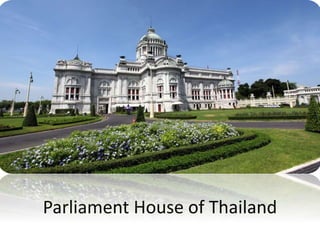
Parliament House of Thailand
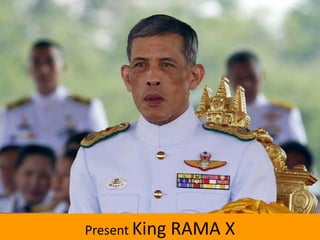
Present King RAMA X
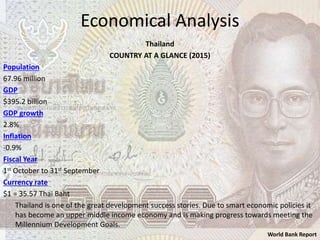
Economical Analysis
Thailand
COUNTRY AT A GLANCE (2015)
Population
67.96 million
GDP
$395.2 billion
GDP growth
2.8%
Inflation
-0.9%
Fiscal Year
1st October to 31st September
Currency rate
$1 = 35.57 Thai Baht
Thailand is one of the great development success stories. Due to smart economic policies it
has become an upper middle income economy and is making progress towards meeting the
Millennium Development Goals.
World Bank Report
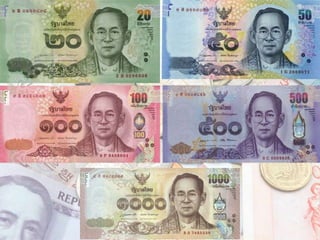
Denomination
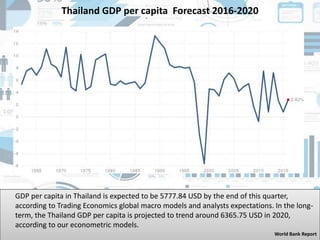
Thailand GDP per capita Forecast 2016-2020
GDP per capita in Thailand is expected to be 5777.84 USD by the end of this quarter,
according to Trading Economics global macro models and analysts expectations. In the long-
term, the Thailand GDP per capita is projected to trend around 6365.75 USD in 2020,
according to our econometric models.
World Bank Report
Over the past two decades, Thailand has made impressive progress in reducing poverty, now at 11% of
the population. As part of End Poverty Day, join the World Bank Thailand team as they discuss some of
the challenges still facing people in Thailand and what can be done to end extreme poverty
World Bank Report
Poverty
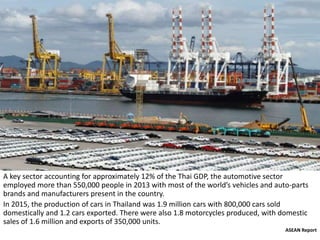
A key sector accounting for approximately 12% of the Thai GDP, the automotive sector
employed more than 550,000 people in 2013 with most of the world’s vehicles and auto-parts
brands and manufacturers present in the country.
In 2015, the production of cars in Thailand was 1.9 million cars with 800,000 cars sold
domestically and 1.2 cars exported. There were also 1.8 motorcycles produced, with domestic
sales of 1.6 million and exports of 350,000 units.
ASEAN Report
International Trade
The Thai economic system places high priority on
economic expansion, resulting in the country’s
dependence on international trade, as a means to
accelerate investment and production in Thailand.
International trade thus plays an important role in
the Thai economic system. The heavy dependence
on exports is evident, as the export industry makes
up about 60% of Thailand’s GDP and is also the
source of foreign currency used in importing
merchandise into Thailand
Top 10 Export Products
1. Vehicles: US$26.6 billion (12.6% of total exports)
2. Medical, technical equipment: $5.2 billion (2.5%)
3. Machines, engines, pumps: $37.1 billion (17.6%)
4. Plastics: $11.7 billion (5.6%)
5. Electronic equipment: $29.3 billion (13.9%)
6. Gems, precious metals, coins: $10.8 billion (5.1%)
7. Meat and seafood preparations: $5.9 billion (2.8%)
8. Cereals: $4.6 billion (2.2%)
9. Oil: $8.3 billion (3.9%)
10. Rubber: $12.3 billion (5.8%)
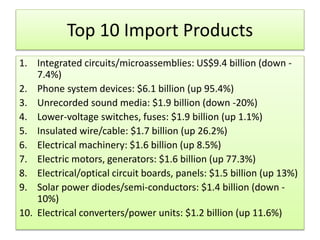
Top 10 Import Products
1. Integrated circuits/microassemblies: US$9.4 billion (down -
7.4%)
2. Phone system devices: $6.1 billion (up 95.4%)
3. Unrecorded sound media: $1.9 billion (down -20%)
4. Lower-voltage switches, fuses: $1.9 billion (up 1.1%)
5. Insulated wire/cable: $1.7 billion (up 26.2%)
6. Electrical machinery: $1.6 billion (up 8.5%)
7. Electric motors, generators: $1.6 billion (up 77.3%)
8. Electrical/optical circuit boards, panels: $1.5 billion (up 13%)
9. Solar power diodes/semi-conductors: $1.4 billion (down -
10%)
10. Electrical converters/power units: $1.2 billion (up 11.6%)
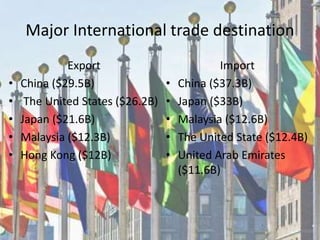
Major International trade destination
Export
• China ($29.5B)
• The United States ($26.2B)
• Japan ($21.6B)
• Malaysia ($12.3B)
• Hong Kong ($12B)
Import
• China ($37.3B)
• Japan ($33B)
• Malaysia ($12.6B)
• The United State ($12.4B)
• United Arab Emirates
($11.6B)
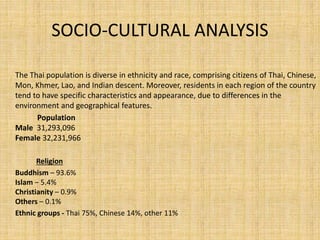
SOCIO-CULTURAL ANALYSIS
The Thai population is diverse in ethnicity and race, comprising citizens of Thai, Chinese,
Mon, Khmer, Lao, and Indian descent. Moreover, residents in each region of the country
tend to have specific characteristics and appearance, due to differences in the
environment and geographical features.
Population
Male 31,293,096
Female 32,231,966
Religion
Buddhism – 93.6%
Islam – 5.4%
Christianity – 0.9%
Others – 0.1%
Ethnic groups - Thai 75%, Chinese 14%, other 11%
National Sport
Muay Thai ("Thai boxing")
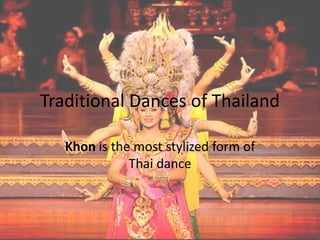
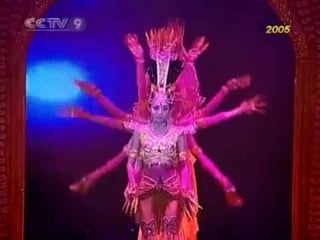
Traditional Dances of Thailand
Khon is the most stylized form of
Thai dance
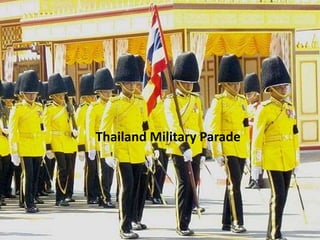
Thailand Military Parade
Thailand famous Food
Tom Yum Goong (Spicy Shrimp Soup)
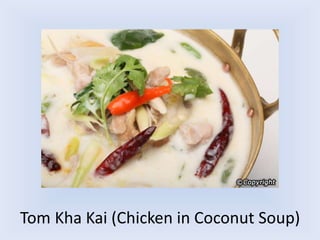
Tom Kha Kai (Chicken in Coconut Soup)
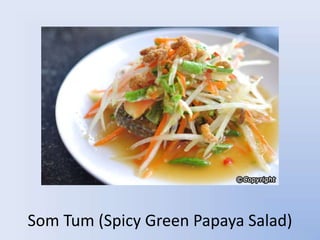
Som Tum (Spicy Green Papaya Salad)
TECHNOLOGICAL ANALYSIS
The government has planned a holistic set of
measures for promoting R&D in the country. For
instance, the Thai Board of Investment has
granted full incentives for the promotion of R&D
investment instead of labor-intensive projects
since 2006. Several businesses are being
encouraged to produce more skilled human
resources to support investment in R&D so as to
create competitive advantages for the country.
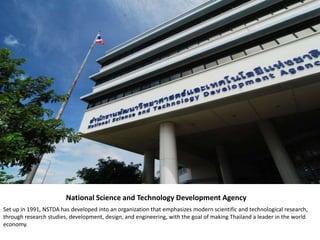
National Science and Technology Development Agency
Set up in 1991, NSTDA has developed into an organization that emphasizes modern scientific and technological research,
through research studies, development, design, and engineering, with the goal of making Thailand a leader in the world
economy.
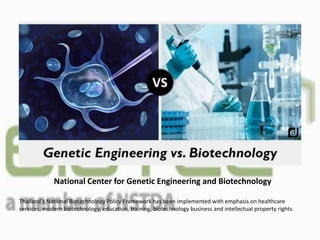
National Center for Genetic Engineering and Biotechnology
Thailand's National Biotechnology Policy Framework has been implemented with emphasis on healthcare
services, modern biotechnology, education, training, biotechnology business and intellectual property rights.
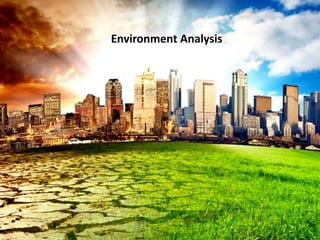
Environment Analysis
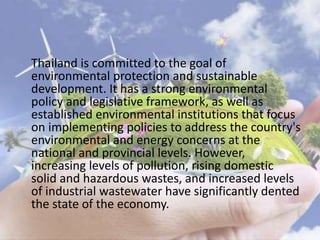
Thailand is committed to the goal of
environmental protection and sustainable
development. It has a strong environmental
policy and legislative framework, as well as
established environmental institutions that focus
on implementing policies to address the country's
environmental and energy concerns at the
national and provincial levels. However,
increasing levels of pollution, rising domestic
solid and hazardous wastes, and increased levels
of industrial wastewater have significantly dented
the state of the economy.
Climate
Most of Thailand has a tropical or savanna climate,
influenced by tropical monsoons most of the year. The
southwestern monsoon results in the rainy season, and
the northeastern monsoon from the South China Sea
brings chilly days.
The temperature in Thailand averages from 18° to 34°
Celsius, with rainfall totaling around 1,500 millimeters
a year; humidity is about 75% in summer with an
average temperature of 34° Celsius, 87% in the rainy
season with 29° Celsius, and in winter a low relative
humidity and 20° Celsius on average.
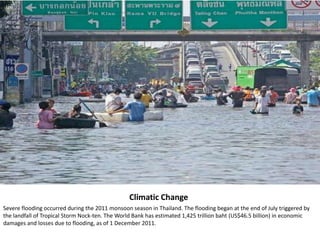
Climatic Change
Severe flooding occurred during the 2011 monsoon season in Thailand. The flooding began at the end of July triggered by
the landfall of Tropical Storm Nock-ten. The World Bank has estimated 1,425 trillion baht (US$46.5 billion) in economic
damages and losses due to flooding, as of 1 December 2011.
Legal Analysis
LAW
Thailand’s legal system combines principles of
traditional Thai and Western laws. The
Constitutional Court is the highest court of appeal,
although its jurisdiction is limited to the clearly
defined constitutional issues. Its members are
nominated by the Senate and appointed by the
King. The Courts of Justice have jurisdiction over
criminal and civil cases and are organized in three
tiers: Courts of First Instance, the Court of Appeals,
and the Supreme Court of Justice. Administrative
courts have jurisdiction over suits between private
parties and the Government, and cases in which one
government entity is suing another.
Trade Regulation
• Thailand's government holds a very liberal attitude towards
international business and trade.
• Membership in World Trade Organization (WTO) and the
Association of Southeast Asian Nations (ASEAN) organizations
commits Thailand to the reduction and eventual removal of tariffs,
duties, and non-tariff barriers to trade in an agreed upon
timeframe.
• The Export-Import Bank of Thailand is active in assisting exporters
by providing them with financing options and the liquidity needed
to expand and develop their markets.
• The government grants certain privileges to foreign and domestic
companies operating and exporting from its designated industrial
zones, which range from reductions in taxation, lowered import
duties to exemption from certain labor laws.
Pestel on Thailand

Pestel on Thailand

  • 1.
  • 2.
    Political The country isa constitutional monarchy, headed by King Rama IX, the ninth king of the House of Chakri, who, having reigned since 1946, is the world's longest serving head of state and the longest-reigning monarch in Thai history. The king of Thailand is titled Head of State, Head of the Armed Forces, the Upholder of the Buddhist religion, and the Defender of all Faiths.
  • 3.
  • 4.
  • 5.
    Economical Analysis Thailand COUNTRY ATA GLANCE (2015) Population 67.96 million GDP $395.2 billion GDP growth 2.8% Inflation -0.9% Fiscal Year 1st October to 31st September Currency rate $1 = 35.57 Thai Baht Thailand is one of the great development success stories. Due to smart economic policies it has become an upper middle income economy and is making progress towards meeting the Millennium Development Goals. World Bank Report
  • 6.
  • 8.
    Thailand GDP percapita Forecast 2016-2020 GDP per capita in Thailand is expected to be 5777.84 USD by the end of this quarter, according to Trading Economics global macro models and analysts expectations. In the long- term, the Thailand GDP per capita is projected to trend around 6365.75 USD in 2020, according to our econometric models. World Bank Report
  • 9.
    Over the pasttwo decades, Thailand has made impressive progress in reducing poverty, now at 11% of the population. As part of End Poverty Day, join the World Bank Thailand team as they discuss some of the challenges still facing people in Thailand and what can be done to end extreme poverty World Bank Report Poverty
  • 10.
    A key sectoraccounting for approximately 12% of the Thai GDP, the automotive sector employed more than 550,000 people in 2013 with most of the world’s vehicles and auto-parts brands and manufacturers present in the country. In 2015, the production of cars in Thailand was 1.9 million cars with 800,000 cars sold domestically and 1.2 cars exported. There were also 1.8 motorcycles produced, with domestic sales of 1.6 million and exports of 350,000 units. ASEAN Report
  • 11.
    International Trade The Thaieconomic system places high priority on economic expansion, resulting in the country’s dependence on international trade, as a means to accelerate investment and production in Thailand. International trade thus plays an important role in the Thai economic system. The heavy dependence on exports is evident, as the export industry makes up about 60% of Thailand’s GDP and is also the source of foreign currency used in importing merchandise into Thailand
  • 12.
    Top 10 ExportProducts 1. Vehicles: US$26.6 billion (12.6% of total exports) 2. Medical, technical equipment: $5.2 billion (2.5%) 3. Machines, engines, pumps: $37.1 billion (17.6%) 4. Plastics: $11.7 billion (5.6%) 5. Electronic equipment: $29.3 billion (13.9%) 6. Gems, precious metals, coins: $10.8 billion (5.1%) 7. Meat and seafood preparations: $5.9 billion (2.8%) 8. Cereals: $4.6 billion (2.2%) 9. Oil: $8.3 billion (3.9%) 10. Rubber: $12.3 billion (5.8%)
  • 13.
    Top 10 ImportProducts 1. Integrated circuits/microassemblies: US$9.4 billion (down - 7.4%) 2. Phone system devices: $6.1 billion (up 95.4%) 3. Unrecorded sound media: $1.9 billion (down -20%) 4. Lower-voltage switches, fuses: $1.9 billion (up 1.1%) 5. Insulated wire/cable: $1.7 billion (up 26.2%) 6. Electrical machinery: $1.6 billion (up 8.5%) 7. Electric motors, generators: $1.6 billion (up 77.3%) 8. Electrical/optical circuit boards, panels: $1.5 billion (up 13%) 9. Solar power diodes/semi-conductors: $1.4 billion (down - 10%) 10. Electrical converters/power units: $1.2 billion (up 11.6%)
  • 14.
    Major International tradedestination Export • China ($29.5B) • The United States ($26.2B) • Japan ($21.6B) • Malaysia ($12.3B) • Hong Kong ($12B) Import • China ($37.3B) • Japan ($33B) • Malaysia ($12.6B) • The United State ($12.4B) • United Arab Emirates ($11.6B)
  • 15.
    SOCIO-CULTURAL ANALYSIS The Thaipopulation is diverse in ethnicity and race, comprising citizens of Thai, Chinese, Mon, Khmer, Lao, and Indian descent. Moreover, residents in each region of the country tend to have specific characteristics and appearance, due to differences in the environment and geographical features. Population Male 31,293,096 Female 32,231,966 Religion Buddhism – 93.6% Islam – 5.4% Christianity – 0.9% Others – 0.1% Ethnic groups - Thai 75%, Chinese 14%, other 11%
  • 16.
    National Sport Muay Thai("Thai boxing")
  • 18.
    Traditional Dances ofThailand Khon is the most stylized form of Thai dance
  • 20.
  • 22.
  • 23.
    Tom Yum Goong(Spicy Shrimp Soup)
  • 24.
    Tom Kha Kai(Chicken in Coconut Soup)
  • 25.
    Som Tum (SpicyGreen Papaya Salad)
  • 26.
    TECHNOLOGICAL ANALYSIS The governmenthas planned a holistic set of measures for promoting R&D in the country. For instance, the Thai Board of Investment has granted full incentives for the promotion of R&D investment instead of labor-intensive projects since 2006. Several businesses are being encouraged to produce more skilled human resources to support investment in R&D so as to create competitive advantages for the country.
  • 27.
    National Science andTechnology Development Agency Set up in 1991, NSTDA has developed into an organization that emphasizes modern scientific and technological research, through research studies, development, design, and engineering, with the goal of making Thailand a leader in the world economy.
  • 28.
    National Center forGenetic Engineering and Biotechnology Thailand's National Biotechnology Policy Framework has been implemented with emphasis on healthcare services, modern biotechnology, education, training, biotechnology business and intellectual property rights.
  • 29.
  • 30.
    Thailand is committedto the goal of environmental protection and sustainable development. It has a strong environmental policy and legislative framework, as well as established environmental institutions that focus on implementing policies to address the country's environmental and energy concerns at the national and provincial levels. However, increasing levels of pollution, rising domestic solid and hazardous wastes, and increased levels of industrial wastewater have significantly dented the state of the economy.
  • 31.
    Climate Most of Thailandhas a tropical or savanna climate, influenced by tropical monsoons most of the year. The southwestern monsoon results in the rainy season, and the northeastern monsoon from the South China Sea brings chilly days. The temperature in Thailand averages from 18° to 34° Celsius, with rainfall totaling around 1,500 millimeters a year; humidity is about 75% in summer with an average temperature of 34° Celsius, 87% in the rainy season with 29° Celsius, and in winter a low relative humidity and 20° Celsius on average.
  • 32.
    Climatic Change Severe floodingoccurred during the 2011 monsoon season in Thailand. The flooding began at the end of July triggered by the landfall of Tropical Storm Nock-ten. The World Bank has estimated 1,425 trillion baht (US$46.5 billion) in economic damages and losses due to flooding, as of 1 December 2011.
  • 33.
  • 34.
    LAW Thailand’s legal systemcombines principles of traditional Thai and Western laws. The Constitutional Court is the highest court of appeal, although its jurisdiction is limited to the clearly defined constitutional issues. Its members are nominated by the Senate and appointed by the King. The Courts of Justice have jurisdiction over criminal and civil cases and are organized in three tiers: Courts of First Instance, the Court of Appeals, and the Supreme Court of Justice. Administrative courts have jurisdiction over suits between private parties and the Government, and cases in which one government entity is suing another.
  • 35.
    Trade Regulation • Thailand'sgovernment holds a very liberal attitude towards international business and trade. • Membership in World Trade Organization (WTO) and the Association of Southeast Asian Nations (ASEAN) organizations commits Thailand to the reduction and eventual removal of tariffs, duties, and non-tariff barriers to trade in an agreed upon timeframe. • The Export-Import Bank of Thailand is active in assisting exporters by providing them with financing options and the liquidity needed to expand and develop their markets. • The government grants certain privileges to foreign and domestic companies operating and exporting from its designated industrial zones, which range from reductions in taxation, lowered import duties to exemption from certain labor laws.