Today, we're goingto play a fun game
called"Baamboozle" We're playing Bamboozle to learn
about Personal Protective Equipment! I've picked a game
for us, and it's on the screen now
Baamboozle Mechanics:
Here's how it works: Each of you will take turns
choosing a number on the game board. That number
will reveal a question. Answer it correctly, and you get
points! Get it wrong, and no points for you.
4.
At the endof the lesson, atleast 85% of the students
should be able to;
a. identify and describe the different
types of PPE used in industrial arts.
b. demonstrate the proper selection, use,
and care of PPE.
c. understanding of the importance of
safety and a positive attitude towards
using PPE.
Objectives
5.
•Find a quietplace to focus.
•Mute your mic when you're not speaking.
•Raise your hand to ask questions.
•Be respectful
•Participate
CLASS RULES
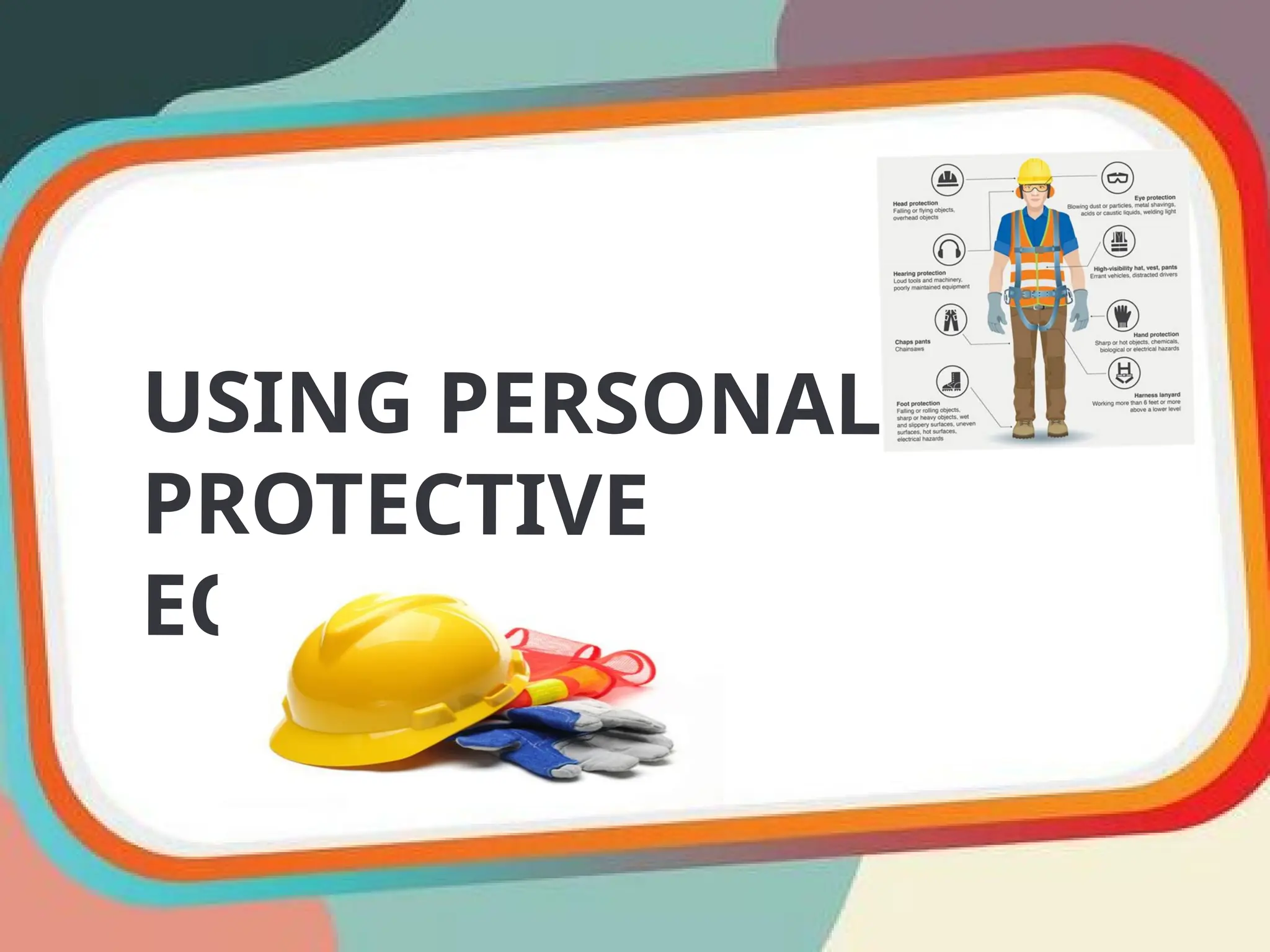
Personal protective equipment(PPE) is
gear you wear to stay safe from hazards
at work. It can include things like hard
hats, safety glasses, gloves, respirators,
and more. PPE helps protect you from
injuries or illnesses caused by things like
chemicals, falling objects, or loud noises.
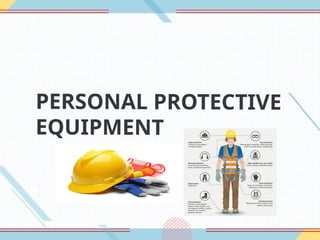
Personal protective equipment
(PPE)is protective clothing,
helmets, goggles, or other garments
or equipment designed to protect
the wearer's body from injury or
infection.
Personal protective equipment(PPE) is important
because it helps keep workers safe from hazards that
could cause injury or illness.
- Prevents Injuries
- Protects Health
- Complies with Regulations
- Increases Confidence
In short, PPE is a vital part of workplace safety,
helping to keep workers healthy and able to do
their jobs safely.
12.
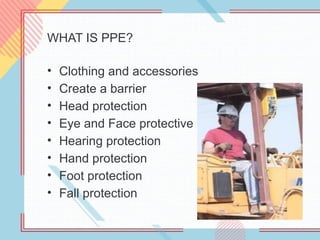
WHAT IS PPE?
•Clothing and accessories
• Create a barrier
• Head protection
• Eye and Face protective
• Hearing protection
• Hand protection
• Foot protection
• Fall protection
13.
Work Practice Controls
Employerscan change the work process
Examples:
• Engineering Controls
• Machine Guarding
• Job Rotation
• House Keeping
• Increase Maintenance
ABOUT PPE
You shouldknow
• Limitations of PPE
• How to use PPE
• When to use PPE
• Inspect PPE before use
• Replacement of PPE
• Cleaning & Storage of PPE
17.
PPE Limitations
PPE actsas a barrier between you and a hazard
PPE will not protect you if it is:
not designed for the specific hazard
damaged or worn
not adjusted properly
18.
Using PPE
ForPPE to be effective in protecting you
Use it in the manner you have been trained
Use it only for the specific hazards for its
design
19.
Inspect before using
Beforeyou use your PPE, inspect it for:
• Worn or damaged parts
• Leaks, cracks or deformities
• Cleanliness
• Correct size
20.
Replace
Replace PPE
• Ifany PPE is damaged or worn
• Get it repaired or replaced immediately
• Do not work without replacement PPE
• Tell your supervisor you need new PPE
21.
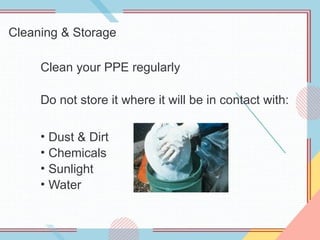
Cleaning & Storage
Cleanyour PPE regularly
Do not store it where it will be in contact with:
• Dust & Dirt
• Chemicals
• Sunlight
• Water
22.
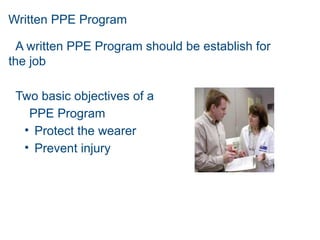
Written PPE Program
Awritten PPE Program should be establish for
the job
Two basic objectives of a
PPE Program
• Protect the wearer
• Prevent injury
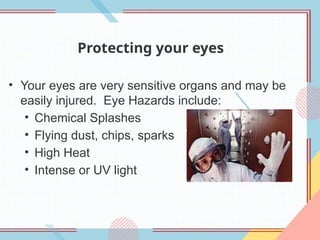
Protecting your eyes
•Your eyes are very sensitive organs and may be
easily injured. Eye Hazards include:
• Chemical Splashes
• Flying dust, chips, sparks
• High Heat
• Intense or UV light
25.
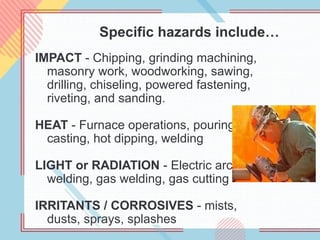
Specific hazards include…
IMPACT- Chipping, grinding machining,
masonry work, woodworking, sawing,
drilling, chiseling, powered fastening,
riveting, and sanding.
HEAT - Furnace operations, pouring,
casting, hot dipping, welding
LIGHT or RADIATION - Electric arc
welding, gas welding, gas cutting
IRRITANTS / CORROSIVES - mists,
dusts, sprays, splashes
26.
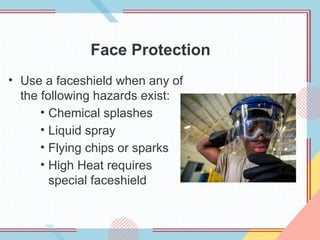
Face Protection
• Usea faceshield when any of
the following hazards exist:
• Chemical splashes
• Liquid spray
• Flying chips or sparks
• High Heat requires
special faceshield
27.
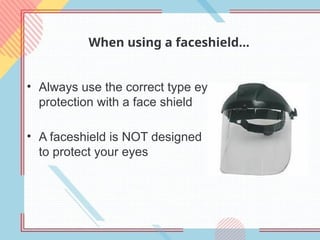
When using afaceshield…
• Always use the correct type eye
protection with a face shield
• A faceshield is NOT designed
to protect your eyes
28.
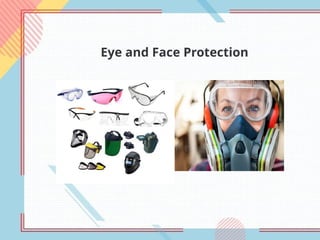
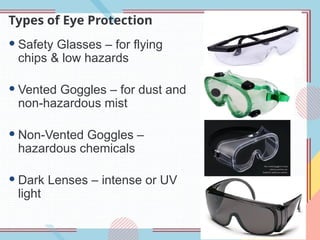
Types of EyeProtection
Safety Glasses – for flying
chips & low hazards
Vented Goggles – for dust and
non-hazardous mist
Non-Vented Goggles –
hazardous chemicals
Dark Lenses – intense or UV
light
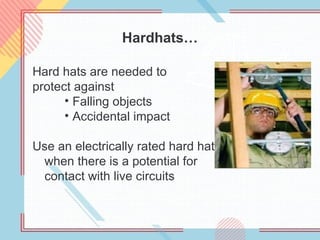
Hardhats…
Hard hats areneeded to
protect against
• Falling objects
• Accidental impact
Use an electrically rated hard hat
when there is a potential for
contact with live circuits
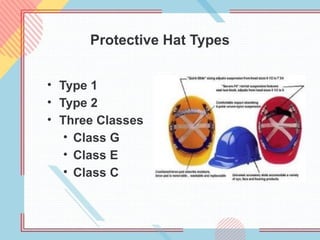
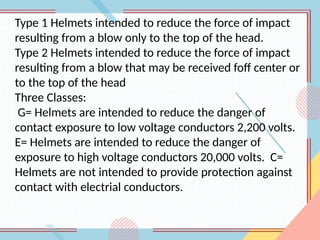
Type 1 Helmetsintended to reduce the force of impact
resulting from a blow only to the top of the head.
Type 2 Helmets intended to reduce the force of impact
resulting from a blow that may be received foff center or
to the top of the head
Three Classes:
G= Helmets are intended to reduce the danger of
contact exposure to low voltage conductors 2,200 volts.
E= Helmets are intended to reduce the danger of
exposure to high voltage conductors 20,000 volts. C=
Helmets are not intended to provide protection against
contact with electrial conductors.
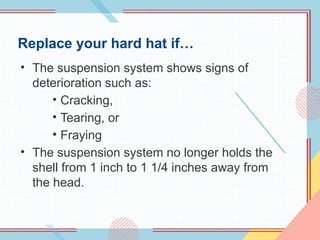
Replace your hardhat if…
• The suspension system shows signs of
deterioration such as:
• Cracking,
• Tearing, or
• Fraying
• The suspension system no longer holds the
shell from 1 inch to 1 1/4 inches away from
the head.
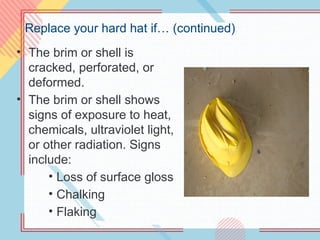
37.
Replace your hardhat if… (continued)
• The brim or shell is
cracked, perforated, or
deformed.
• The brim or shell shows
signs of exposure to heat,
chemicals, ultraviolet light,
or other radiation. Signs
include:
• Loss of surface gloss
• Chalking
• Flaking
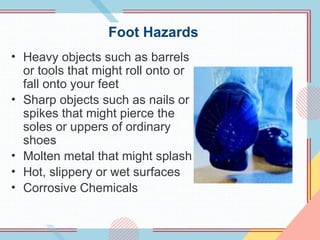
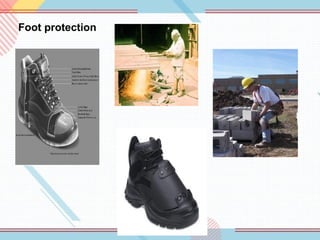
Foot Hazards
• Heavyobjects such as barrels
or tools that might roll onto or
fall onto your feet
• Sharp objects such as nails or
spikes that might pierce the
soles or uppers of ordinary
shoes
• Molten metal that might splash
• Hot, slippery or wet surfaces
• Corrosive Chemicals
41.
Hazardous conditions…
IMPACT -Carrying or handling materials such as
packages, objects, parts or heavy tools which could
be dropped
COMPRESSION - Work activities involving skid trucks,
manual material handling carts, around bulk rolls,
around heavy pipes
PUNCTURE - Sharp object hazards such as nails,
wire, tacks, screws, large staples, & scrap metal
CHEMICAL - Spills, splashes, fumes, corrosives
42.
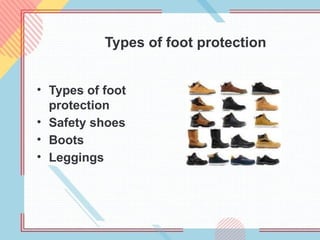
Types of footprotection
• Types of foot
protection
• Safety shoes
• Boots
• Leggings
Inspect footwear daily…
Lookfor
• Cracked, torn or worn uppers
• Wear, holes, tears, cracks, loss of tread
on bottom
• Separation between soles and uppers
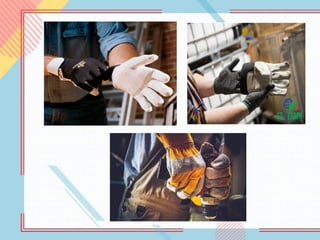
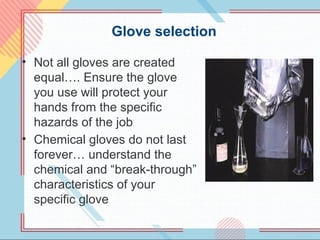
Glove selection
• Notall gloves are created
equal…. Ensure the glove
you use will protect your
hands from the specific
hazards of the job
• Chemical gloves do not last
forever… understand the
chemical and “break-through”
characteristics of your
specific glove
49.
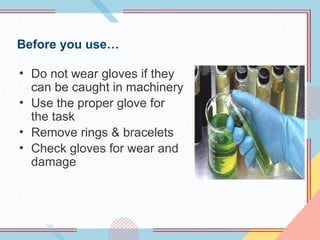
Before you use…
•Do not wear gloves if they
can be caught in machinery
• Use the proper glove for
the task
• Remove rings & bracelets
• Check gloves for wear and
damage
50.
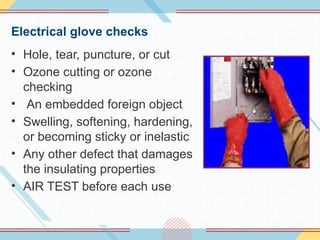
Electrical glove checks
•Hole, tear, puncture, or cut
• Ozone cutting or ozone
checking
• An embedded foreign object
• Swelling, softening, hardening,
or becoming sticky or inelastic
• Any other defect that damages
the insulating properties
• AIR TEST before each use
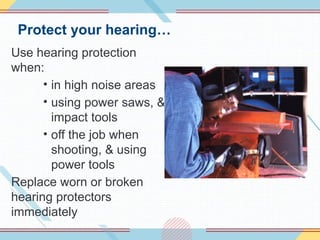
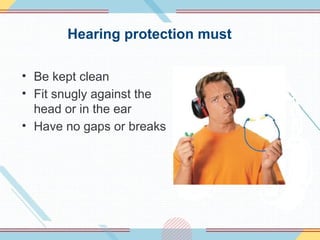
Protect your hearing…
Usehearing protection
when:
• in high noise areas
• using power saws, &
impact tools
• off the job when
shooting, & using
power tools
Replace worn or broken
hearing protectors
immediately
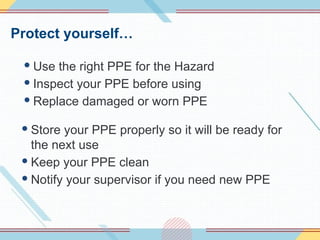
Protect yourself…
Usethe right PPE for the Hazard
Inspect your PPE before using
Replace damaged or worn PPE
Store your PPE properly so it will be ready for
the next use
Keep your PPE clean
Notify your supervisor if you need new PPE
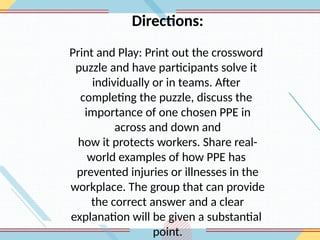
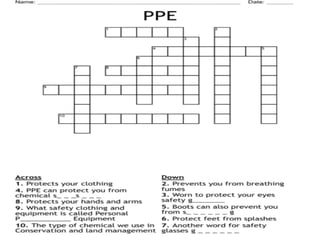
Directions:
Print and Play:Print out the crossword
puzzle and have participants solve it
individually or in teams. After
completing the puzzle, discuss the
importance of one chosen PPE in
across and down and
how it protects workers. Share real-
world examples of how PPE has
prevented injuries or illnesses in the
workplace. The group that can provide
the correct answer and a clear
explanation will be given a substantial
point.
V. Assignment
For youassignment.
1. Draw any kind of PPE in long bond paper
(Activity 1.1)
2. In your own opinion. Why it is very
important to wear PPE when you are
going to work?
(1/2 sheet of paper)
Editor's Notes
#12 The purpose of PPE clothing and equipment is to shield or isolate employees from injury
#13 If employees can be removed from exposure to the potential hzard by changing the way they do their jobs, then the hazard can be eliminated with a work practice control.
#14 Typical job hazards……discuss are there any more?
#16 No single combination of PPE and clothing is capable of protecting against all hazards. Thus PPE should be used in conjunction with other pretective methods.
#17 The use of PPE can itself create significant worker hazards, such as heat stress physical and psychological stress and imparied vision, mobility and communication. In gereal, the greater the level of PPE the greater is the associated risks. For any given situation, PPE should be selected that provide an adequate level of protection. Over portection as well as under protection can be hazardous and should be avoided.
#18 Using PPE improperly or in a manner unsutied to its design and purpose is worse than using no protection at all. W/out any protection, the worker knows they are vulnerable and might take percaustions. With some protection the employee may increase the risk by exposing himself to a hazard thinking they were safe, when in fact they were not. Each employee must be trained in the proper use of PPE and the understanding of when it is required.
#22 Your PPE pgr should be in writing and be reviewed annually. Elements that should be considered in the review inlcude the number of person hurt or injured, level of exposure, adequacy of PPE selected, operational guidelines, effectiveness of training, program costs and improvements needed.
#23 Causes of eye injuries: injurious gases, vapors, and liquids. Workers handling acids or caustics and doing welding are subject to these hazards. Dust or powders fumes and mists. Flying objects or particles and glare from welding.
#24 OSHA requires eye and face protection where there is a reasonable probalitity of preventable injury when such equipment is used. Employers must provide a type of protector suitable for work to be performed and employees must use the protector.
#25 60% of workers who suffered eye injuries were not wearing eye protective equipment. When asked why they were not wearing them workers indicated that was not normally used or practiced in their type of work or it was not required.
#26 Suitable eye protectors must be provided where machines or operations present the hazard of flying objects, glar, liquids, injurioous radiation or a combination of these hazards.
#28 Protectors must provide adequate protection against the particular hazards for which they are designed. They must be reasonably confortable when worn, fit snugly without interfering with the movements or vision of the employee.
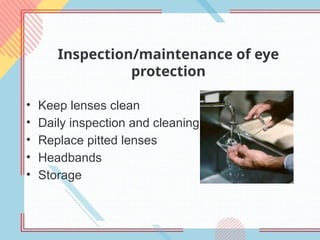
#29 It is essential that the lenses of eye protectors be kept clean. Daily lenses can cause eyestrain often an excuse for not wearing the eye protectors. Daily inspection and cleaning of the lens with soap and hot water or with a cleaning solution and tissue , is recommended. Googles and other eye protectors should be stored in their cases when not in use.
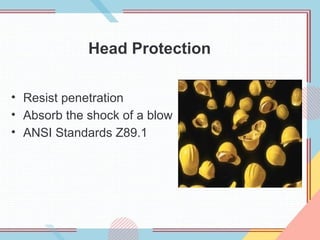
#30 Head injuries are caused by falling or flying objects, or by bumping the head against a fixed object.
#31 Hard hats require a hard outer shell and shock absorbing lining. Look at the inside of any helmet you are considering and you should see a lable showing the manufactures name the ANSI standard it meets and its class. Helmets must be always be worn as designed to be in compliance with ANSI.
#32 In the form of protective hats, must do two things- resist penetration and absorb the shochk of a blow. This is accomplished by making the shell of the hat of amterial hard enough to resist the blos and by utilixing a shock absorbing lining composed of headbands and crown straps to keep the shell away from the warers head. The standards use are located in ANSI =American National Safety Insititute
#33 Type 1 Helmets intended to reduce the force of impact resulting from a blow only to the top of the head.
Type 2 Helmets intended to reduce the force of impact resulting from a blow that may be received foff center or to the top of the head
Three Classes: G= Helmets are intended to reduce the danger of contact exposure to low voltage conductors 2,200 volts. E= Helmets are intended to reduce the danger of exposure to high voltage conductors 20,000 volts. C= Helmets are not intended to provide protection against contact with electrial conductors.
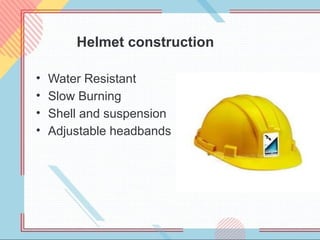
#34 Materials used in helmets should be water resistant and slow burning. Each consists essentially of a shell and suspension ventilation is provided by a space betweeen the headband and the shell. Each helmet should be accompained by instruction on the proper method of adjusting and replacing the suspension and headband.
#35 Materials used in helmets should be water resistant and slow burning. Each consists essentially of a shell and suspension ventilation is provided by a space betweeen the headband and the shell. Each helmet should be accompained by instruction on the proper method of adjusting and replacing the suspension and headband.
#36 Headbands ae adjustable in 1/8 size increments. When the band is adjusted to the right size. It provides sufficient clearance between the shell and the headband . The removable replaceable type seatband should cover a least the forehead protion of the band.
#37 The shell should be of one piece seamless construction and designed to resist the impact of a blow from falling material. The internal cradle of the headband and sweatband forms the suspension. Any part that comes in contact with head must no be irritating to normal skin.
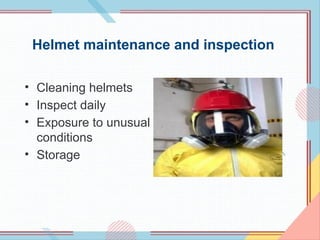
#38 Consult manufacturers ref cleaning of helmets. Most warm water and a good detergent then risined in clear hot water. Inspect daily for any cracks or damage. All componets must be in good working order. Helmets should not be stored or carried on the rear window shelf of a car since suling and extreme heat may and will effect the degree of protection
#40 For protection of feet and legs from falling or rolling objects, sharp objects, molten metal, hot surfaces, and wet slippery surfaces workers should use appropriate foot guards, safety shoes, or boots and leggings.
#41 Footwear must meet the minimum compression and impact performance standards and testing requirements.
#42 Conductive shoes protect against the buildup of static electricity. These shoes ground the employee wearing them. Workers working in explosive and hazardous site must wear these type of shoes in order to reduce the risk. These shoes are not general purpose shoes and must be rmoved upon completion of the specific work.
#43 Safety shoes should be sturdy and have an impact resistant toe. In some shoes, metal insoles protect against puncture wounds. Additional protection such as metatarsal guards, may be found in some types of foot wear. Safety shoes come in a variety of styles and materials, such as leather or rubber boots and oxfords.
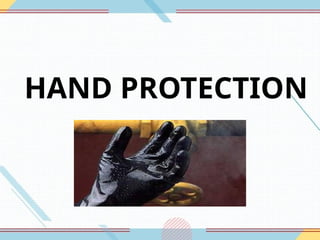
#45 The nature of hazard and the operation to be performed will determine the type of glove to be worn. The variety of potential hand injuries may make selecting the appropriate pair of gloves more difficult than choosing other PPE. Take care to choose gloves designed for the specific hazard. Manufacturers can provide more information relating to your specific needs and requirements.
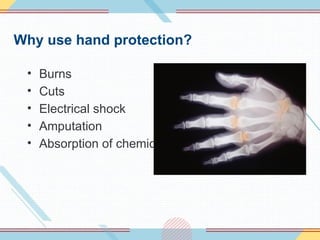
#46 Examples of injuries to arms and hands are burns, cuts, electrical shock, amputation and absorption of chemicals. There is a wide assortment of gloves, hand pads, sleeves, and wristlets for protection from various hazardous situations.
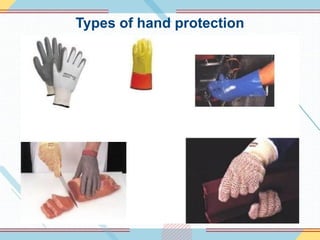
#47 Different types of gloves; general purpose easy to grip gloves, Line man’s glove, Nitrile type gloves liquid and chemical resistant gloves, Stainless steel mesh meating cutting gloves, Kevalr n gloves protect againts cuts, slashes and abrasion. Each used for a specific task. There are many many others. What type of gloves do they wear?
#49 The protective glove should be selected to fit the job. Employees should become acquainted with the limitation of the gloves being used.
#50 Electricians need special protection from shocks and burns. Rubber is considered the best material for insulating gloves and sleeves.
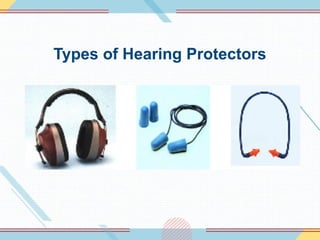
#52 Exposure to high noise levels can cause hearing loss or impairment. It can create phyiscal and psychological stress. There is no cure for noise induced hearing loss, so the prevention of excessive noise exposure is the only way to avoid hearing damage.
#53 Types of hearing protectors: Preformed or molded earplugs, Foam, Disposable earplugs, perfect seal around the ear. Preformed or molded ear plugs should be individually fitted by a professional. Foam ear plugs are self forming, Some earplugs are disposable , to be used one time and then thrown away. The non-disposable type should be cleaned after each use for proper protection. For extremely noisy situation, earmuffs and earplugs should be worn in addition to earmuffs. Ref 1926.52
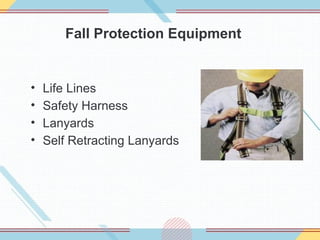
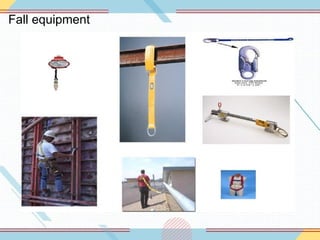
#56 Lifelines, safety harness and lanyards used for fall protection.
#57 Lifelines, safety harness and lanyards must be used only for employee safeguarding. Any life line, safety harness or lanyard actually subjected to in service loading, as distingusihed from static load testing, must be immediately removed from service and not be used again for employees. Life lines shall be secured above the point of operation to an anchorage or structural member capable of supporting a minimum dead weight of 5,400lbs.
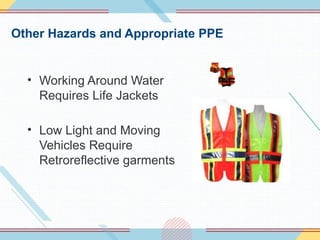
#59 Employees may be working near or over water. They must wear a Coast Guard approved life jacket or buoyant work vest if there is danager of falling into the water. Working in and around traffic requires workers to wear high visibility clothing. ANSI has approved criteria for high visibility worker apprel.