PERSONAL INJURY CASES:
Case Intake and Screening
Rich Mrazik and Mike Young
May 7, 2014
parsonsbehle.com
2
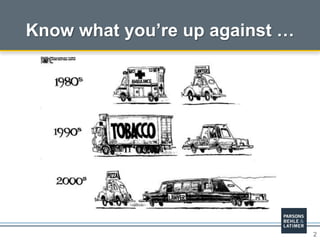
Know what you’re up against …
3
 Get the bare minimum:
– Potential client
– Potential adverse party
– Nature of case
 Then pause . . .
Step One: Client Contact
4
 Perform a conflict check
 Perform initial self-awareness check
– Can I handle a new matter right now?
– Can I handle a new matter like this right now?
Step Two: Initial Risk Management
5
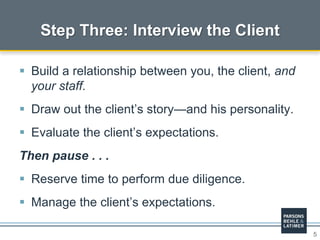
 Build a relationship between you, the client, and
your staff.
 Draw out the client’s story—and his personality.
 Evaluate the client’s expectations.
Then pause . . .
 Reserve time to perform due diligence.
 Manage the client’s expectations.
Step Three: Interview the Client
6
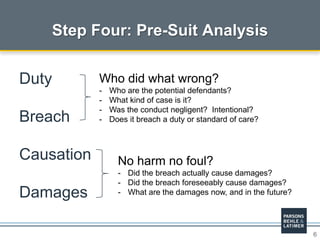
Duty
Breach
Causation
Damages
Step Four: Pre-Suit Analysis
Who did what wrong?
- Who are the potential defendants?
- What kind of case is it?
- Was the conduct negligent? Intentional?
- Does it breach a duty or standard of care?
No harm no foul?
- Did the breach actually cause damages?
- Did the breach foreseeably cause damages?
- What are the damages now, and in the future?
7
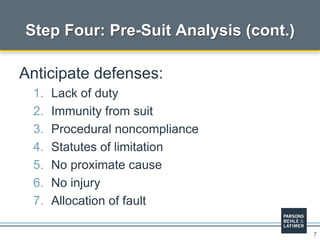
Anticipate defenses:
1. Lack of duty
2. Immunity from suit
3. Procedural noncompliance
4. Statutes of limitation
5. No proximate cause
6. No injury
7. Allocation of fault
Step Four: Pre-Suit Analysis (cont.)
8
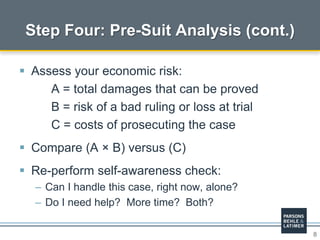
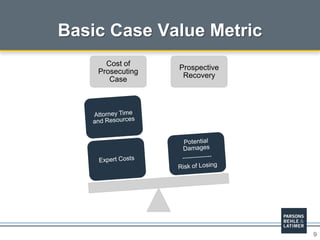
 Assess your economic risk:
A = total damages that can be proved
B = risk of a bad ruling or loss at trial
C = costs of prosecuting the case
 Compare (A × B) versus (C)
 Re-perform self-awareness check:
– Can I handle this case, right now, alone?
– Do I need help? More time? Both?
Step Four: Pre-Suit Analysis (cont.)
9
Basic Case Value Metric
Cost of
Prosecuting
Case
Prospective
Recovery
10
DARE MIGHTY THINGS.
11
 Accept the case
– Communicate with the client
– Get to work!!
 Decline the case
– Communicate with the client
– Don’t second guess your decision
Step Five: Make a Decision
12
 Rich Mrazik
– rmrazik@parsonsbehle.com
– 801.536.6931
 Mike Young
– myoung@parsonsbehle.com
– 801.536.6963
Questions?

Personal Injury Cases: Case Intake and Screening

  • 1.
    PERSONAL INJURY CASES: CaseIntake and Screening Rich Mrazik and Mike Young May 7, 2014 parsonsbehle.com
  • 2.
    2 Know what you’reup against …
  • 3.
    3  Get thebare minimum: – Potential client – Potential adverse party – Nature of case  Then pause . . . Step One: Client Contact
  • 4.
    4  Perform aconflict check  Perform initial self-awareness check – Can I handle a new matter right now? – Can I handle a new matter like this right now? Step Two: Initial Risk Management
  • 5.
    5  Build arelationship between you, the client, and your staff.  Draw out the client’s story—and his personality.  Evaluate the client’s expectations. Then pause . . .  Reserve time to perform due diligence.  Manage the client’s expectations. Step Three: Interview the Client
  • 6.
    6 Duty Breach Causation Damages Step Four: Pre-SuitAnalysis Who did what wrong? - Who are the potential defendants? - What kind of case is it? - Was the conduct negligent? Intentional? - Does it breach a duty or standard of care? No harm no foul? - Did the breach actually cause damages? - Did the breach foreseeably cause damages? - What are the damages now, and in the future?
  • 7.
    7 Anticipate defenses: 1. Lackof duty 2. Immunity from suit 3. Procedural noncompliance 4. Statutes of limitation 5. No proximate cause 6. No injury 7. Allocation of fault Step Four: Pre-Suit Analysis (cont.)
  • 8.
    8  Assess youreconomic risk: A = total damages that can be proved B = risk of a bad ruling or loss at trial C = costs of prosecuting the case  Compare (A × B) versus (C)  Re-perform self-awareness check: – Can I handle this case, right now, alone? – Do I need help? More time? Both? Step Four: Pre-Suit Analysis (cont.)
  • 9.
    9 Basic Case ValueMetric Cost of Prosecuting Case Prospective Recovery
  • 10.
  • 11.
    11  Accept thecase – Communicate with the client – Get to work!!  Decline the case – Communicate with the client – Don’t second guess your decision Step Five: Make a Decision
  • 12.
    12  Rich Mrazik –rmrazik@parsonsbehle.com – 801.536.6931  Mike Young – myoung@parsonsbehle.com – 801.536.6963 Questions?

Editor's Notes

  • #2 REM
  • #3 REMPersonal injury claims are met with automatic skepticism. Plaintiff’s counsel’s case intake and screening must take into account our community’s exposure to tort reform, and aversion to personal injury lawsuits.
  • #4 MWYWe all get really excited when a potential client calls—”they want to hire ME!”—but we need to take a deep breath and perform some basic risk management tasks.
  • #5 MWY
  • #6 MWY
  • #7 REMTHIS MAY REQUIRE ADVICE FROM A CONSULTING EXPERT.
  • #8 REM
  • #9 MWY
  • #10 MWY
  • #11 REM
  • #12 REM