Steps for Effective Case Analysis
Adapted from Harvard Business Publishing
It's useful to think of a case analysis as digging deeper and
deeper into the layers of a case.
You should make sure to follow these general steps in addition
to answering the questions
from the case.
1. You start at the surface, Getting Oriented and examining the
overall case
landscape.
2. Then you begin to dig, Identifying Problems, as well as
possible alternative
solutions.
3. This is the section where you will spend most of your time.
Digging deeper, Performing Analyses you identify information
that exposes the issues,
gather data, perform calculations that might provide insight.
"Analysis" describes the
varied and crucial things you do with information in the case, to
shed light on the problems
and issues you've identified. That might mean calculating and
comparing cumulative
growth rates for different periods from the year-by-year
financials in a case's exhibits. Or it
might mean pulling together seemingly unrelated facts from two
different sections of the
case, and combining them logically to arrive at an important
conclusion or conjecture.
Analysis usually doesn't provide definitive answers. But as you
do more of it, a clearer
picture often starts to emerge, or the preponderance of evidence
begins to point to one
interpretation rather than others. Don't expect a case analysis to
yield a "final answer." If
you're accustomed to doing analysis that ends with a right
answer, coming up with a
possible solution that simply reflects your best judgment might
frustrate you. But
remember that cases, much like real-world business
experiences, rarely reveal an
absolutely correct answer, no matter how deeply you analyze
them. Typically, you'll do
qualitative analysis based on your reading and interpretation of
the case. Ask yourself:
What is fact and what is opinion? Which facts are contributing
to the problem? Which are
the causes?
Qualitative factors should be prioritized and fully developed to
support your argument.
Make notes about your evolving interpretations, always being
careful to list the evidence or
reasons that support them. Qualitative information in a case can
be a mix of objective and
subjective information. For example, you may need to assess the
validity of quotations from
company executives, each of whom has a subjective opinion.
Reports from external
industry analysts or descriptions of what other companies in the
industry have done might
seem more objective; no one in the case has a vested interest in
this information. A
company's internal PowerPoint presentation should be
considered separately and
differently from a newspaper article about the company. Cases
mix firsthand quotations
and opinions with third-person narratives, so you need to
consider the reliability of
sources. As in real life, you shouldn't take all case information
at face value.
Quantitative data—such as amounts of materials, money, time,
and so on-might be
embedded in the text or provided in tabular form in the exhibits
(often both). It can be
difficult to know which calculations to do, what formulas to
apply, and how to interpret the
results. Don't sweat this. Try a few simple calculations such as
ratios and growth rates over
time. If some of those provide insight, great; if not, nothing is
lost but a little time. Use
simple calculations to determine what other things you might
want to assess quantitatively.
Quantitatively rich cases may seem intimidating; some people
don't enjoy calculating or
relying on math to reach conclusions. You might need to
calculate, say, a net present value
in a finance case, or the capacity of a production system to
locate the bottleneck in an
operations case. Don't be fooled into thinking that just applying
those standard analyses is
the point of a case. Be prepared if the professor asks, "How is
that number relevant to this
situation?" or "How would you incorporate it into your decision
in favor of one approach
over another?" or "Is that number even relevant in this
situation?"
As conclusions or evidence in favor or against certain
alternatives begin to emerge, you
might spot connections to principles, frameworks, and theories
that you've already covered
in your program of study. It's often worthwhile to try applying
what seems like a relevant
framework to the raw data or to data that have been transformed
in some way by your
analysis. Once you've begun interpreting your analyses in the
context of a framework,
you'll often start to see more opportunities for analysis,
suggested by the framework itself.
It's usually a good idea to follow these paths, although not all
will prove to be fruitful.
4. Finally, you begin Action Planning to outline short-,
medium-, and long-term well-
defined steps.
Recommended action plans should state what would be
objectively best for the case
company given its goals, resources, and situation. But they
should also outline possible
implementation objectives and hurdles. Action plans should
include short-, medium-,
and long-term steps that will concretely carry out
recommendations like these. Real-life
situations often have hidden agendas and nuances that can affect
how an action plan is
crafted. These elements are also relevant in the analysis of a
full case, except perhaps
for cases that are purely or primarily quantitative. At some
point, you might need to
develop your favored case action plan in a degree of detail that
exceeds that of
alternative plans. If you're operating with space constraints (on
a word-limited case
exam, for instance), you may need to explore just one
alternative in full detail, rather
than developing all alternatives at the same level of detail. The
following are important
steps for your Recommendations section.
Step 1: Identify Tasks
Brainstorm all of the tasks that you need to accomplish your
objective. It's helpful to
start this process at the very beginning. What's the very first
action you'll need to
take? What comes next? Should any steps be prioritized to meet
specific deadlines,
or because of limits on other people's availability?
Step 2: Analyze and Delegate Tasks
Now that you can see the entire project from beginning to end,
look at each task in
greater detail. Are there any steps you could drop without
compromising your
objective? Which tasks could you delegate to someone else on
your team or to a
freelancer? Are there deadlines for specific steps? Do you need
to arrange additional
resources?
Step 3: At this point, stop to list a few possible
recommendations for the case and think
about possible action plans. These deliverables are, after all, the
ultimate objectives
of your analysis. Try not to restrict yourself to one solution.
Let your conclusion
emerge from the evidence; don't force the evidence to fit your
conclusion. Remain
open-minded as you proceed to the next step. List possible
recommendations or
actions based on your analysis of the case.
Typically, you'll need to repeat these four processes multiple
times, and as you do, you'll
discover new analytical directions, evolving your assessment of
the case and conclusion.
Pak Sang LO
Professor Parypinski
English 101
12 May 2019
MONTEREY PARK, CA CRIME ANALYTICS, 2018.
https://www.neighborhoodscout.com/ca/
monterey-park/crime
The source focuses on the crime rates in the neighborhood of
Monterey Park. The
site has its sources based on the FBI crime data, based on 2017
but released in 2018. The
site has structured the findings in both data and description. The
data part is filled with
charts, graphs, and other statistical diagrams to explain the
crime rates in the area. The
descriptive part describes the represented data for easier
understanding. The site is
essential for research as it dwells on one of the biggest
determinants on the image of a
city, its crime rates. It tells us about the crime rates of
Monterey Park and how it
compares to other cities and neighborhoods. It also talks on the
most common types of
crime.
https://www.montereypark.ca.gov/1056/Data-Demographics
This is the Monterey Park official website. It is established by
its government. It
gives firsthand information on data of the city. The information
is also credible as it is
done by the city team, who provide an unbiased review and
data. The site also shows
other basic information such as its government, services,
residents and help to visitors
who are looking to visit the city. The Monterey Park website is
arguably the most
accurate on the city stats. They conduct routine checkups on the
state of the city. This
makes this site an important go to when writing in the city. Its
downside is that it does not
give some necessary information such as its history and culture
events.
Sonksen, Mike. "On Location: Monterey Park" 1 November
2013. https://www.kcet.org/history-
society/on-location-monterey-park
The author is a well know scholar as well as a performer. He
has explored plenty
of Los Angeles history. The article dwells on the history of
Monterey Park, near past and
in the old times. It talks on its start, from when it was known as
the "Mexican Beverly
Hills" to it becoming Monterey Park. It goes deep to how many
roads it started with its
growth. The author also talks about common practices the area
had including agriculture.
It speaks on past relations with its neighbors such as Alhambra
and Pasadena. To write an
article on the city, its history holds high importance. It can help
understand the city more.
https://www.neighborhoodscout.com/ca/monterey-park/crime
https://www.montereypark.ca.gov/1056/Data-Demographics
https://www.kcet.org/history-society/on-location-monterey-park
datausa.io Monterey Park, CA
https://datausa.io/profile/geo/monterey-park-ca/
The page delivers all the relevant data on the city. It has data
ranging from its
economy, health, diversity, education, housing, and living. It is
a long article discussing
in-depth aspects of the focused on elements of the city. It uses
graphs and charts to
further explain the statistical data. Elaborations of the graphs
are also available. This site
is a good option to write on Monterey Park due to its specific
details. The range of details
also covers most aspects of a city that need to be studied. This
makes the article an
important reference to writing in the city.
Brooks, Lorrie. “Guide to the Fun Things to Do in Monterey
Park, CA,” Trip101.com 3 August
2017. https://trip101.com/article/best-things-to-do-in-monterey-
park-california
The author is a degree holder in Bachelor of Journalism. She is
self-employed and
enjoys traveling, leading to the writing of the article. This
article simply is to advise
people on the best activities or best places that can be visited in
Monterey Park. The
activities also can explain the heritage of the city. It ranks the
places and activities from
most satisfying to the general ones. It also explains the nature
of the activities so as to
make it easier for people to decide. This article can be used to
write on Monterey Park as
it explains the city’s main cites. This makes the article
extremely relevant. It helps to
understand the city better.
https://datausa.io/profile/geo/monterey-park-ca/
https://trip101.com/article/best-things-to-do-in-monterey-park-
california
Works Cited
Brooks, Lorrie. “Guide to the Fun Things To Do in Monterey
Park, CA,” Trip101.com 3 August
2017. https://trip101.com/article/best-things-to-do-in-monterey-
park-california
datausa.io Monterey Park, CA
https://datausa.io/profile/geo/monterey-park-ca/
MONTEREY PARK, CA CRIME ANALYTICS, 2018.
https://www.neighborhoodscout.com/ca/
monterey-park/crime
Montereypark.ca.gov
https://www.montereypark.ca.gov/1056/Data-Demographics
Sonksen, Mike. "On Location: Monterey Park" 1 November
2013. https://www.kcet.org/history-
society/on-location-monterey-park
https://trip101.com/article/best-things-to-do-in-monterey-park-
california
https://datausa.io/profile/geo/monterey-park-ca/
https://www.neighborhoodscout.com/ca/monterey-park/crime
https://www.montereypark.ca.gov/1056/Data-Demographics
https://www.kcet.org/history-society/on-location-monterey-park
San Gabriel Valley
Monterey Park
Monterey Park
Cascades Park
Sequoia Park
El Encanto
East Los Angeles College
Cantonese Dim Sum
Mama Lu Dumpling House Mp
Work cited
https://www.tripadvisor.com/Tourism-g32738-
Monterey_Park_California-Vacations.html
https://www.tripadvisor.com/Restaurant_Review-g32738-
d4796693-Reviews-Mama_Lu_Dumpling_House_Mp-
Monterey_Park_California.html
Copyright © 2011 Harvard Business School Publishing This
document is for use only with the Harvard Business
Publishing ‘Case Analysis Coach’.
Case Analysis Worksheet
This form can be used to organize your thoughts about a case.
As you perform your analysis remain
open to the fact that your interpretation of the facts may change
and therefore you should constantly
revisit your answers.
Define the Problem: Describe the type of case and what
problem(s) or issue(s) should be the focus for
your analysis.
List any outside concepts that can be applied: Write down any
principles, frameworks or theories that
can be applied to this case.
List relevant qualitative data: evidence related to or based on
the quality or character of something.
List relevant quantitative data: evidence related to or based on
the amount or number of something.
Describe the results of your analysis: What evidence have you
accumulated that supports one
interpretation over another.
Describe alternative actions: List and prioritize possible
recommendations or actions that come out of
your analysis.
Describe your preferred action plan: Write a clear statement of
what you would recommend including
short, medium and long-term steps to be carried out.
9 - 7 1 1 - 0 1 5
R E V : D E C E M B E R 1 3 , 2 0 1 0
_____________________________________________________
_____________________________________________________
______
Professor Gunnar Trumbull and from HBS Europe Research
Center, Research Associate Elena Corsi and Research Assistant
Andrew Barron
prepared this case. HBS cases are developed solely as the basis
for class discussion. Cases are not intended to serve as
endorsements, sources of
primary data, or illustrations of effective or ineffective
management.
Copyright © 2010 President and Fellows of Harvard College.
To order copies or request permission to reproduce materials,
call 1-800-545-7685,
write Harvard Business School Publishing, Boston, MA 02163,
or go to www.hbsp.harvard.edu/educators. This publication may
not be digitized,
photocopied, or otherwise reproduced, posted, or transmitted,
without the permission of Harvard Business School.
G U N N A R T R U M B U L L
E L E N A C O R S I
A N D R E W B A R R O N
Santander Consumer Finance
Centralization only makes sense if the final result is better than
the simple sum of the parts.
— Magda Salarich, CEO, Santander Consumer Finance
Introduction
On March 25, 2008, Magda Salarich Fernández de Valderrama,
the Chief Executive Officer (CEO)
of Santander Consumer Finance (SCF), a division of Grupo
Santander, looked out across the bank’s
shining new campus, the Ciudad Financiera, just south of
Madrid. Salarich had been appointed CEO
in January 2008 after working for 28 years for the French car
producer Citroën, where she had risen
through the ranks to the position of international marketing and
sales manager for Europe and CEO
for Spain. SCF had grown rapidly in the past five years under
its former CEO, Juan Rodríguez
Inciarte. Salarich’s job would be to chart the way forward for
the next ten years.
While the United States remained the largest market in the
world for consumer finance, the sector
had also been growing in the last 20 years within Europe.
Inciarte had captured this trend. Under his
helm (2002-2008) SCF had grown from a small group of units
operating in Spain, Germany and Italy,
into one of the largest consumer finance companies. Also, since
2006, Inciarte had invested outside
the EU: in the United States, Latin America and Eastern Europe.
In four months, Salarich would have to present a new strategy
and direction for SCF to
Santander’s Chairman and Executive Director, Emilio Botín-
Sanz de Sautuola y García de los Ríos, as
well as to the other members of the group’s Executive
Committee, including Inciarte himself.
Important decisions had to be made. Could the high profitability
of the consumer lending activities
be sustained? Was it time to focus more attention on
consolidation, or should she further invest in
new markets and products? There were also important questions
of organizational strategy to
address. Which functions should be led to national affiliates to
decide, and which should be
centralized at headquarters? What processes should be
standardized, and which left to local
initiatives? And all of these decisions would be set against a
background of growing concern about
the sustainability of household debt levels in Europe and the
United States.
711-015 Santander Consumer Finance
2
History of the Santander Group
The Santander Group was founded in 1857, when the Queen of
Spain authorized through Royal
decree the creation of a bank in the city of Santander, in
Cantabria, northern Spain. Seventy-two local
businessmen subscribed to the bank’s capital. Through the years
the bank increased its business in
Spain and in the 1950’s it opened offices in a few Latin
America countries and in London. Under the
leadership of Emilio Botín, who succeeded his father as
Chairman and CEO of the group in 1986, the
bank reinforced its position in Spain launching products such as
Supercuenta that doubled the bank’s
market share on deposits and with the 1994 acquisition of Banco
Español de Crédito (Banesto) and
the 1999 merger with Banco Central Hispano (BCH). Botín also
expanded to foreign markets,
acquiring banks and opening new offices in Latin America,
Europe and the United States.
To keep pace with its rapid growth, in 2004 the Group re-
located operations from downtown
Madrid to the Ciudad Financiera Santander, a 160-hectare
financial campus in the suburbs, with also
education and training facilities, sports facilities including an
18-hole golf course, on-site childcare
amenities and an art gallery. By 2007, when the Group
celebrated its 150th anniversary, the Santander
Group was one of the largest banks in the world in terms of
market capitalization and net profit. It
operated the largest network of retail banks in the western
world. (See Exhibit 1 for the Group’s
financials and breakdowns by business division.) The Group
also operated in the wholesale banking,
private banking, credit cards, asset management, and insurance
businesses and, through SCF, in the
consumer finance sector.
The History of Santander Consumer Finance
Santander Consumer Finance had its roots in 1987, when
Banco Santander acquired Bankhaus
Centrale Credit AG (CC Bank), a German bank operating since
the 1950s with 51 branches and
specialized in the vehicle financing business. One year later, the
Santander Group partnered with the
Royal Bank of Scotland to jointly control, strengthen and
expand CC Bank. New branches were
opened and in 1994 CC Bank also launched Direkt Bank, a
branchless, direct telephone bank that also
offered credit card services. The shared ownership agreement
with Royal Bank of Scotland continued
until 1996, when Santander bought out its partner and assumed
full control of CC Bank.
Remembering those years, Inciarte, at the time CFO at
Santander, explained:
Under the terms of the shared ownership agreement Emilio
Botín and I sat on Royal Bank
of Scotland’s board. This partnership was very influential on
the development of Santander’s
consumer finance business. It helped us to understand the
growth of the consumer finance
market in the United Kingdom and gave us many useful insights
into this business. What was
happening in the United Kingdom, we believed, could spread to
the rest of Europe.
Subsequent mergers gave them more exposure to consumer
lending. In 1997, Santander entered
the Italian market by assuming joint control with the bank
Banco San Paolo IMI of Finconsumo—a
consumer finance company. In 1999, Santander’s merger with
BCH brought to the group Hispamer
Banco Financiero and Hispamer Financieros. In the meantime,
CC-Bank had expanded into Hungary
and Austria. In 2002, the collection of national consumer
lending groups was brought together under
a new division within Santander, SCF.
Santander Consumer Finance 711-015
3
Expansion of SCF
Under the leadership of Inciarte, Santander Consumer Finance
focused on growth. He recalled,
“When our Chairman and Chief Executive asked me to head up
the new division, I was afraid that
the Group wanted to get rid of me because it was a very small
business. It did not even have a
common global brand.” Inciarte first moved to expand the
business to the major European markets.
He explained:
Germany, the United Kingdom, Spain, France, Italy, and Poland
are the European markets
that count in terms of GDP and population. It’s like in the
United States: if you are not in
Texas, Florida, New York, Chicago and California you are not
there. We wanted to become
European. All Europeans drink Coca Cola, buy furniture from
IKEA, and like cars. It seemed
relatively easy to create a pan-European franchise for financing
consumers. We were already in
Germany and Spain, we looked at Italy, and we bought a stake
in San Paolo IMI in 2003.
Between 2003 and 2006, other acquisitions followed in other
European countries. In 2006, SCF
started investing outside the European Union (EU), first in the
United States with the acquisition of
Drive U.S., then, in 2007, in Mexico and Russia. In 2007
Inciarte also invested in a Greenfield
operation in Chile, which started operations in 2008. (See
Exhibit 2 for a summary of SCF’s
acquisitions.)
As SCF’s geographical coverage expanded, Inciarte turned his
attention to the organization of the
division and the impact of their brand. Javier San Félix, SCF’s
former Chief Operating Officer and
now the head of one of SCF’s business areas, explained:
When I joined in 2004, SCF was a mere sum of different units
placed in different countries,
with different business models, operations, IT platforms and
marketing approaches. We
wanted to make it worth more than the sum of the parts. First
we integrated the different
brands. The SCF brand was not known outside of the
[Santander] Group as each affiliated
company maintained its name. We changed their names into
SCF. Secondly, we centralized the
decisions concerning funding, and thirdly we centralized the
customer data centers.
By June 2008, SCF operated in 20 countries. Within Santander,
SCF accounted for 5% of the
Group’s total workforce and generated almost 8% of the bank’s
total profits. The largest market
remained Germany. (See Exhibit 3 for SCF’s financials.)
The European Market for Consumer Finance
There are still big differences between European countries in
terms of consumer credit market size,
consumer credit to GDP ratios (penetration) and consumer
product mix. These differences are due to different
levels of market maturity, economic developments, local
regulations and cultural factors.
— Salarich
Consumer finance included any kind of lending to finance
consumer’s purchases outside of
mortgage for real estate. It was certainly not an invention of the
20th century. Stores in the 19th century
had offered sales credit to their regular customers; and pawn
shops had been active in Europe since
the middle Ages. But it was the growth of the consumer
durables manufacturing sector in the
interwar and post-World War II era that made consumer credit
an accepted feature of modern
society. Innovations in risk assessment, data processing, and
financing all contributed to a boom in
consumer lending starting in the late 1980s. By the end of 2007,
retail lending to consumers—
excluding mortgages—accounted for $6 trillion in outstanding
balances, of which 51.5% was in the
711-015 Santander Consumer Finance
4
Americas, 30% in Europe and 18.6% in Asia.1 The United
States long had been and remained the
largest market, with $2.5 trillion in outstanding loans. (See
Exhibit 4 for U.S. market figures.)
Since the 1980s, Europe’s consumer lending sector had grown
in economic importance and
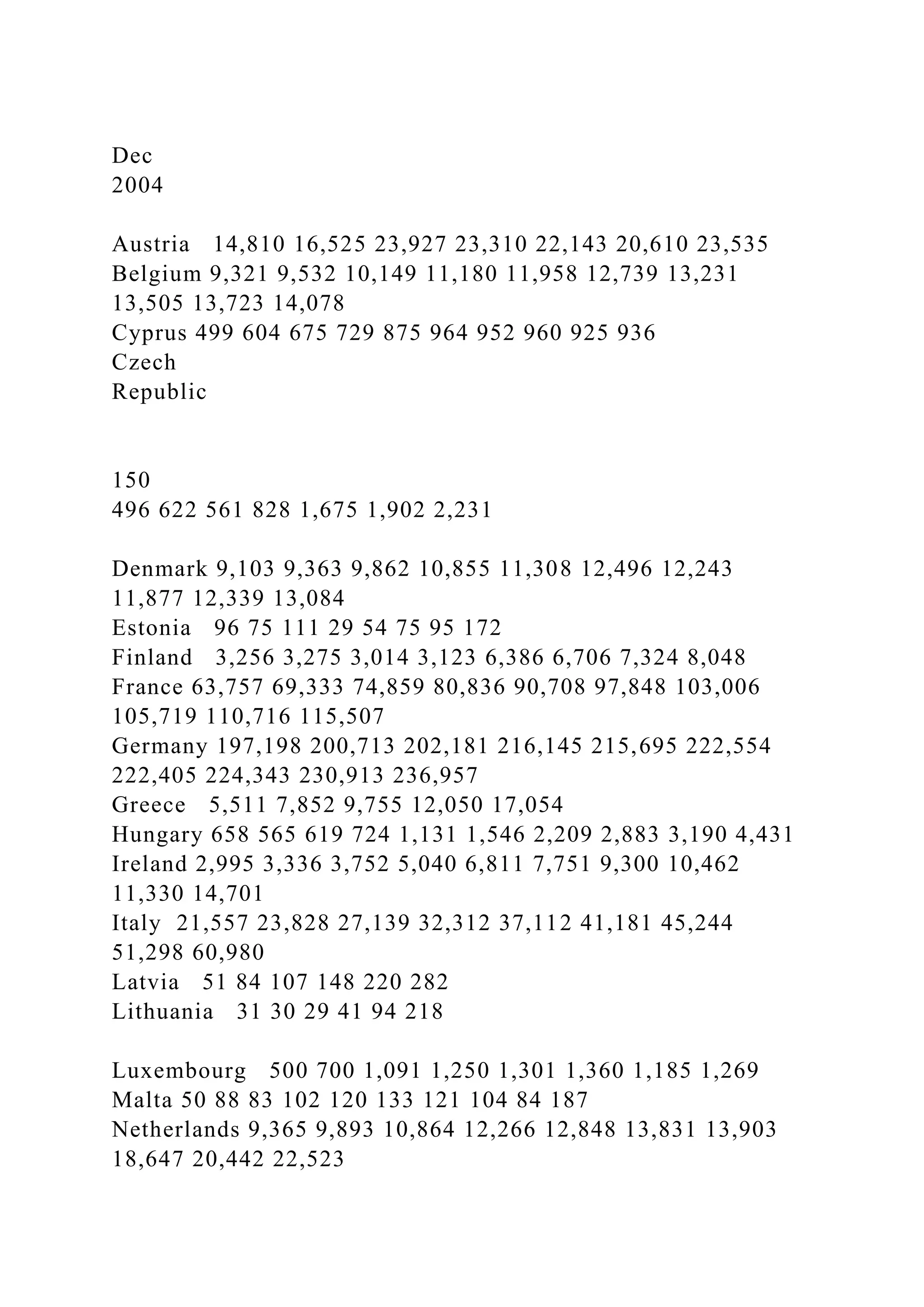
sophistication.2 (See Exhibit 5 on consumer credit in Europe.)
San Félix described this change, “The
main driving force is that Europeans are becoming more like the
Americans in terms of consumption
patterns. We are consuming more and this leads to the growth of
consumer credit. Yet, in Europe the
penetration of consumer lending started from a much lower
level than in the United States. It is hard
to predict if we will reach 100% of America’s levels”. As SCF’s
Director of Investment Analysis,
stressed, “The average American still has more than twice the
amount of consumer debt than the
average European (EU15).”
By the end of 2006, consumer lending in Europe represented
roughly €1 trillion of outstanding
loans.3 While smaller than in the United States, the European
consumer credit market also had
distinctive features that made it qualitatively different. First,
the average default risk on consumer
loans in Europe tended to be lower. One area manager
commented, “Compared to the United States
we are like in a dreamland in Europe. We can sleep well every
night because our risk is very
predictable.”
Second, consumer lending in Europe was based less on sub-
prime borrowers. Interest rates were
not commonly adjusted to account for individual risk, and a
smaller share of lending was on
revolving accounts.i An area manager explained, “Europeans do
not play with interest rates.
Revolving credit tends to be applied only to credit cards and to
current accounts’ overdraft facilities.
Personal loans (and mortgages) tend to have fixed rates. This is
fair to the client. We want to give the
client who has to face 16 months of instalments a clear picture.
We do not want surprises.”
Institutional features of Europe’s national credit markets also
limited the possibilities for
managing risky products. Credit bureaus worked at the national
level, and each country imposed
different standards about how data could be collected,
processed, and distributed. None of the
national bureaus offered credit scores. Some countries, like
France, had centralized credit rating
databases that recorded only negative credit episodes. New
loans could be checked against this ‘black
list’, but no centralized positive data, including total volume of
outstanding loans, was available.
Germany provided slightly more information, but not enough to
assess the riskiness of new
customers. An area manager said, “The agency tells you if the
customer is overdue and if he has not
finished paying his past loans. It does not give us current and
positive information. It is thus hard for
us to adjust the price of the loan to the customer’s risk profile.”
In the United Kingdom, where
consumer lenders provided credit to riskier borrowers than in
most other European countries, three
private credit reference agencies provided lenders with positive
information.4 Yet, by contrast, they
were explicitly banned from creating a lending black list, and
could not themselves process the raw
data to generate a credit score. This left lenders to determine
the riskiness of potential borrowers
based on their own internal risk models.
Other features of national economies drove dramatic differences
in national consumer credit
markets.5 The cost of credit varied from 6% in Finland to 12%
in Portugal; outstanding loans to GDP
ranged from 3% in Hungary, Switzerland, and the Check
Republic to more than 10% in Germany,
Norway, Sweden and the United Kingdom (2004);6 default rates
ranged from around 7% in Eastern
Europe to around 1% in Germany, Denmark, Austria and the
Netherlands.7 While the German and
i Sub prime lending was lending at a higher rate than the prime
rate, a reference interest rate used by banks to lend to clients.
Risk based pricing was the practice of determining the interest
rate on a loan, also by looking at the credit risk profile of the
borrower. Revolving credit was a type of credit which did not
have a fixed number of payments.
Santander Consumer Finance 711-015
5
the UK markets seemed to be approaching maturity, others
markets, in Greece and Scandinavia, were
now booming. (See Exhibit 6 for country comparisons.) A
former SCF Business Area Manager added:
European consumer credit markets are very different from each
other also in terms of
products. For example in Germany there are no credit cards and
Germans tend to rely heavily
on bank overdraft facilities, which are instead rare in Spain and
France where credit cards are
mostly payment cards. In the UK, where debt is more of the
unsecured type (with variable
rates), credit cards are mainly of the revolving type. Italy and
Belgium instead are markets
where credit cards are less used. Here people tend to buy less on
credit and save more.
While the 1992 Single Europe Act formally removed barriers to
capital flows within Europe, cross-
border consumer lending remained tiny; it was estimated at
between 2% and 5% of all European
consumer loans in 2002.8 Banks and institutions that operated
in foreign markets had done so by
acquiring local institutions, opening local branches, or through
joint ventures.
The low level of intra-European lending had been attributed to
cultural, natural and regulatory
barriers.9 On the demand side, customers seemed to place
greater trust in national, proximate
providers with which they shared the same language and
culture. National differences in consumer
protection standards and remedies across Europe reinforced
customers’ preference for local
providers in so far as it raised the uncertainty of comparing
credit offers across different countries.
On the supply side, cross country regulatory differences led to
high market entry costs and
complicated the organization of the business for consumer
credit companies with global aspirations.
One manager explained, “In some countries, like France, the
government sets interest rate caps. Thus
here we would not be able to aggressively promote our personal
loans as we could not compensate
for the higher risks. You need to adapt to the field.”
The Consumer Credit Directive
The sooner the integration process advances the better for us. At
present, we operate in several European
countries and that positioning would allow us to offer... pan
European products.
— Salarich
In an effort to promote integration, in 1987, the European
Commission introduced the first
European Union (EU) consumer credit directive. Its goal was to
set some basic standards regarding
procedures and reporting. In January 2008, after six years of
negotiation, a new and more complete
EU directive on consumer credit was approved. Covering all
types of consumer loans between €500
and €50,000,ii the directive made three steps toward market
integration. It harmonized the method
used for calculating the annual percentage rates (APR) applied
to loans, thereby allowing consumers
easily to compare the cost of one loan with another. It gave
consumers the right to receive
information on fees, monthly repayments and APR before
signing the contract, and the right to
withdraw from any credit contract within the first 14 days. It
banned prepayment fees, which
imposed an additional cost on consumers who wished to repay
loans before they reached maturity.
Finally, it gave consumers the right to withdraw from credit
contracts if the purchase they were
associated with was canceled.
The EU directive generated negative reactions. The Bureau
Européen des Unions de
Consommateurs (BEUC), a European consumer’s organization,
welcomed the steps taken in the
ii Loans secured on property (house purchase or home
improvement) were excluded as they would be dealt with
separately in
a Mortgage Credit Directive.
711-015 Santander Consumer Finance
6
directive to improve transparency, but regretted that it did
nothing to address consumer over-
indebtedness.10 Eurofinas, the European federation representing
the national associations of consumer
credit providers, claimed that the new EU Directive was a
missed opportunity for integration.11 The
European Banking Federation criticized the new legislation as it
introduced a heavy burden of
bureaucracy but did not improve consumer choice.12
The EU directive also received a mixed reaction at SCF. They
were disappointed that it did not do
more to integrate Europe’s credit markets. One manager
remarked, “Since SCF operates in so many
countries, an integrated market for consumer credit would
deliver commercial, tax and operational
benefits. We could establish a single platform for doing
business.” Transparency could only go so far.
The head of the German operation noted:
Providing consumers with more information does not
necessarily improve things. The
consumer wants to know: the prices of his new and old car, the
number of instalments, the
interest rate, the amount of the loan, and perhaps the option of
life insurance. Any other
information does not increase protection, but generates
confusion. You arrive at a situation
where you need to trust that the Porsche you want has 6
cylinders if the salesperson says so.
For the near future, SCF would make its plans based on the
assumption that Europe’s credit
markets would remain fragmented. One former business
manager summarized:
An integrated market remains for now a distant reality. I would
even question the figure
that cross-border lending accounts for 2% of total consumer
lending. It probably only reflects
the lending of English people to buy homes in France or Spain.
I am skeptical about how far
European consumer credit markets can be integrated. Consumer
credit companies need to be
near their customers. Therefore, I really cannot see any capacity
for cross-border activity.
Santander Consumer Finance’s Business Model
Santander Consumer Finance’s largest lending activity was auto
finance: the provision of loans
for car dealer’s clients to acquire cars (i.e. retail car loans),
sometimes tied to loans for dealers to
finance stock. (See Exhibit 7 for a breakdown of SCF’s sales by
product.) In a few markets, SCF
served also retailers by financing credit for their clients (i.e.
durable loans)iii and, sometimes, for their
stock.iv In addition to these core products, and depending on
the market, SCF provided related
financial services: payment-protection insurance, credit and
debit cards, co-branded credit cards, on-
line banking, personal loans, deposits, debt-consolidation
servicesv and mortgages. (See Exhibit 8 for
SCF’s product portfolio by country.)
SCF’s approach to the market varied depending on the product.
For the retail car and consumer
durable loans, SCF used an indirect approach and relied on car
dealers and retailers—including
supermarkets, electronics shops, and jewelers—to attract new
customers and market its credit. This
point of sale (POS) strategy kept SCF one step removed from
individual consumers, but it also placed
a lot of emphasis on their POS clients. One , “It is very
important for us to find good partnerships
iii Consumer durable loans were loans to finance consumer
products that were expected to last at least three years and to be
purchased in a store (such as televisions, fridges and so on).
iv Stock finance loans were loans to finance dealers and
retailers’ inventories of cars or long term (i.e. durable)
consumer
goods.
v Debt-consolidation services enabled consumers to take out a
new personal or secured loan to cover their several existing
debts incurred for example from credit cards, store cards, or
personal loans
Santander Consumer Finance 711-015
7
with car dealers and retailers. First of all it is through them that
we offer our car and durables loans.
It’s the car dealer or the retailer who proposes to the client our
loans, not our sales team. POS clients
do not even know that we are behind their loan.”
For all of their other products, SCF had a direct approach that
relied on its own sales teams. Their
primary strategy was to sell direct products mainly to its
indirect car loan and durable goods loan
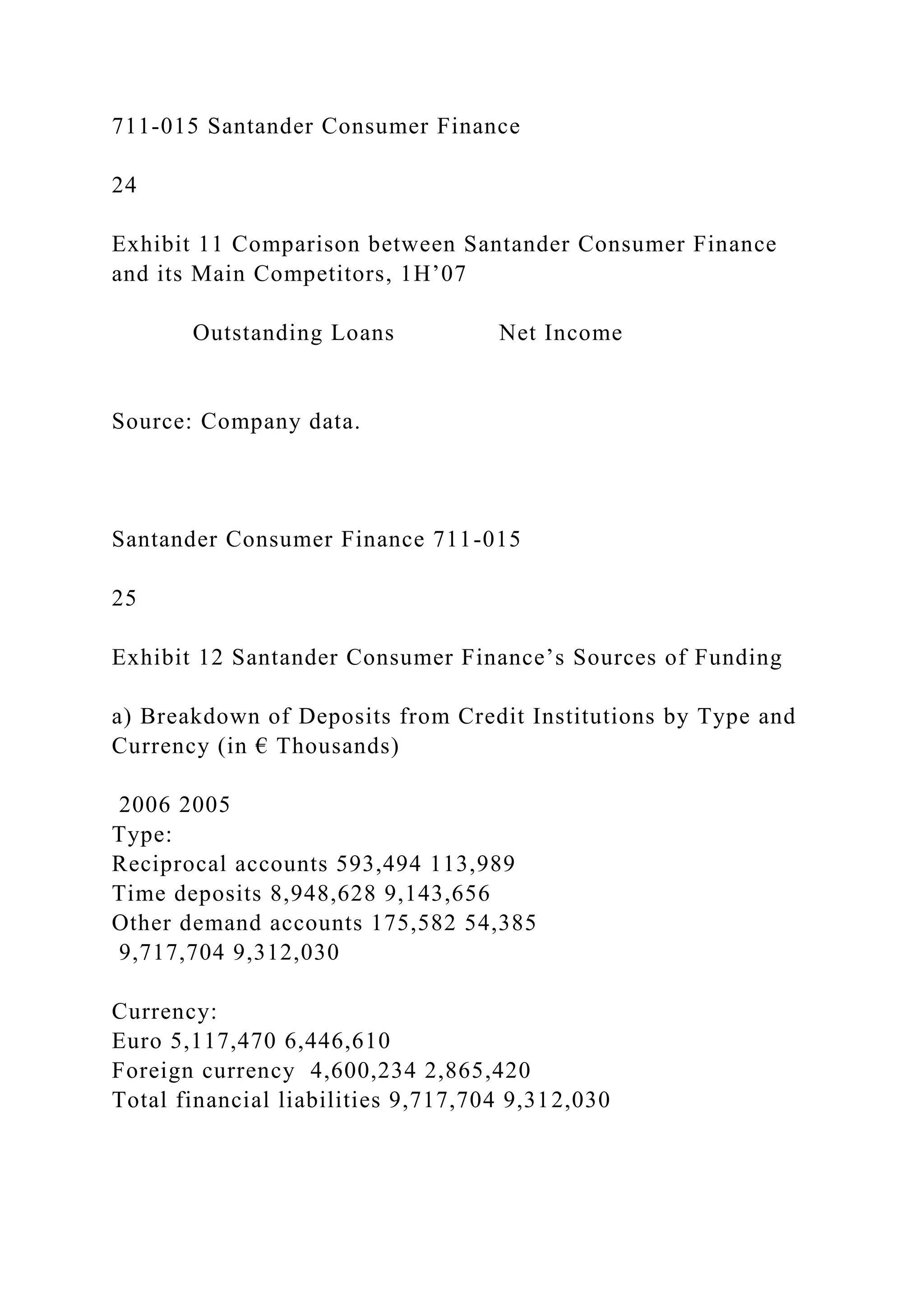
clients. (See Exhibit 9 on SCF’s business model.) SCF referred
to this process as ‘conversion’. “Once
the first (indirect) contact is established,” said José Luis
Castañeda, former SCF’s Director of
Investment Analysis, “then we start contacting the customer to
offer our other products.”
SCF had developed a credit-approval system that car dealers
and retailers could access online. The
process worked in one of two ways. In the first arrangement,
dealers entered information on line
about the client, the purchased car or durable, and the desired
loan. SCF then allowed dealers to view
in real time the commission they would earn from different
variation on loan contracts they might
conclude with the client. In the second approach, SCF and the
dealer agreed only on a baseline
interest rate: if the dealers secured loan agreements with
interest rates exceeding the set baseline, they
received the difference as commission; if it was below, they
paid the difference to SCF.
In both arrangements, SCF paid the commissions upfront. This
created room for manipulation by
dealers. Thomas Hanswillemenke, Director of Importer Business
& Dealer Care Centers in Germany,
commented, “If customers terminate their auto loans early we
bear the losses. If dealers develop a
business model that encourages customers to pay back early, we
ask them to stop or we put an end to
our collaboration.”
Once dealers had filled out their customers’ loan application,
the data was sent to SCF for
processing. Typically, an individual loan request could be
approved or rejected by SCF in just over
three minutes. Francisco J. Gimeno Jiménez, former SCF Chief
Information Officer, explained, “Speed
is crucial in the auto-loan business. If dealers cannot process
loan requests quickly, customers will
walk off their car lots and take their business elsewhere.”
Converting Indirect to Direct business
In a few cases, with the car or durable loan, the car dealer or
retailer would also offer other
complementary products, such as insurance. Yet, explained one
area manager, “Auto dealers and
retailers’ sales personnel sell to their own interests and to their
abilities. We provide them training,
but dealer and lender interests are not always aligned. We need
face-to-face contact with customers.”
In addition, the POS would ask for an extra commission to sell
the other products which were also
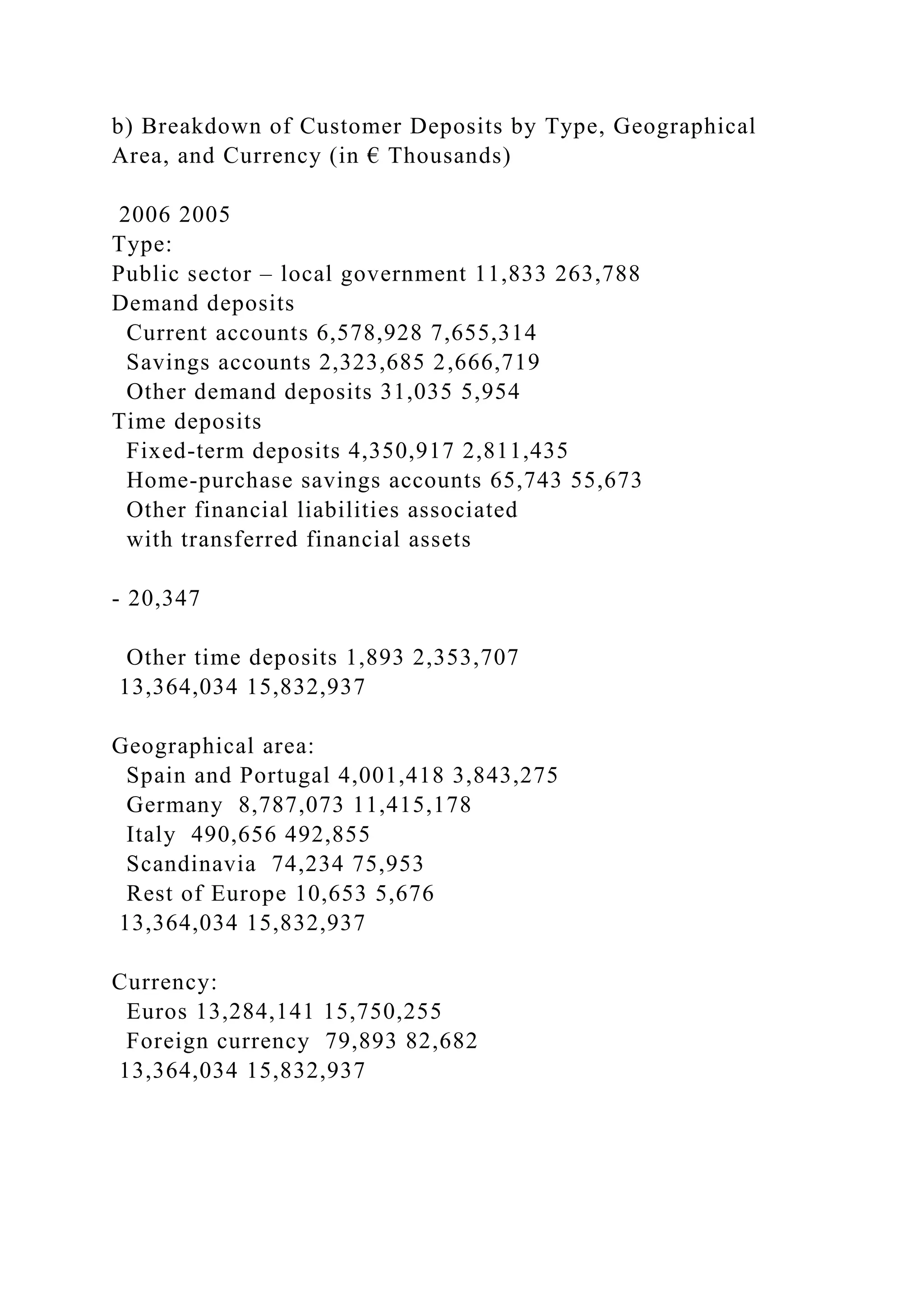
more profitable for SCF. (See Exhibit 10 on the profitability of
SCF’s products.) Castañeda
commented:
Competition in the POS business is very fierce, with dealers
continually demanding higher
commissions. This is why our margins are low there. Thus, once
we have reached the clients
through the POS and tested that they are good clients, we try to
convert them from indirect to
direct ones by proposing our other products with higher
margins.
Once the customer signed the car or durable loan, SCF’s would
start sending promotional
mailings about other products. The former head of the German
operation explained:
Each car dealer or retailer is a multiplier, capable of providing
us with up to 5,000 sales
tickets per year. Through our indirect sales channels, we secure
over 100,000 new clients every
month. We have a clause in the car loan contract asking
permission to send promotional
mailings. If they agree, then we send letters every four to six
weeks to inform the customers
711-015 Santander Consumer Finance
8
about our other products. We send out around 30 million
mailings per year. In the past, we
preferred to have little contact with our clients, as we thought it
increased costs. We were
almost relieved when the loan reached maturity. Today, we see
the typical 60-month lifespan
of a car loan as an opportunity to build a relationship with our
clients.
According to one area manager, it was often easy to decide
which type of complementary
products to offer indirect customers. He said, “For example, if
customers borrow money to buy a TV,
they automatically set themselves out as loan customers. Their
behavior suggests that it would not
make sense to offer them savings products.” Locally-engaged
data analysts also mined the data
collected by dealers and retailers to rate indirect customers as
either prime, near-prime or sub-prime
customers.
In Spain and Germany, SCF was also using their networks of
branches to convert indirect clients
to direct ones. The head of the German group explained, “It is
very important to sit down with
potential customers in one of our 81 branches and give them
face-to-face contact with our sales
personnel.” Other tools were developed to assist the conversion.
In Germany, for example, the
company developed the AutoDispoPlus, a co-branded credit-
card, which provided auto-loan
customers with credit facilities for spare parts, vehicle
inspections, repairs, and insurance and could
also be used to withdraw money. The card was offered as a gift
by the dealer to the less risky clients.
As one manager explained, “The dealer offers the card to the
customers after having filled in the
online loan request. The first time the clients use the card they
become direct customers. We do not
really make money with this card, but we establish a link.
Dealers also see the advantage of
distributing this card”.
Conversion rates differed depending on the business and the
country. “For example, in Germany
we manage to convert roughly three out of every 100 car-loan
customers into direct ones. Among
durables-loan customers, the conversion rate is closer to six out
of 100”.
Main Competitors
SCF’s main competitors in Europe were the American GE
Money, and the French BNP Paribas
(Cetelem), as well as the consumer-finance divisions of Crédit
Agricole (Sofinco and Finaref). (See
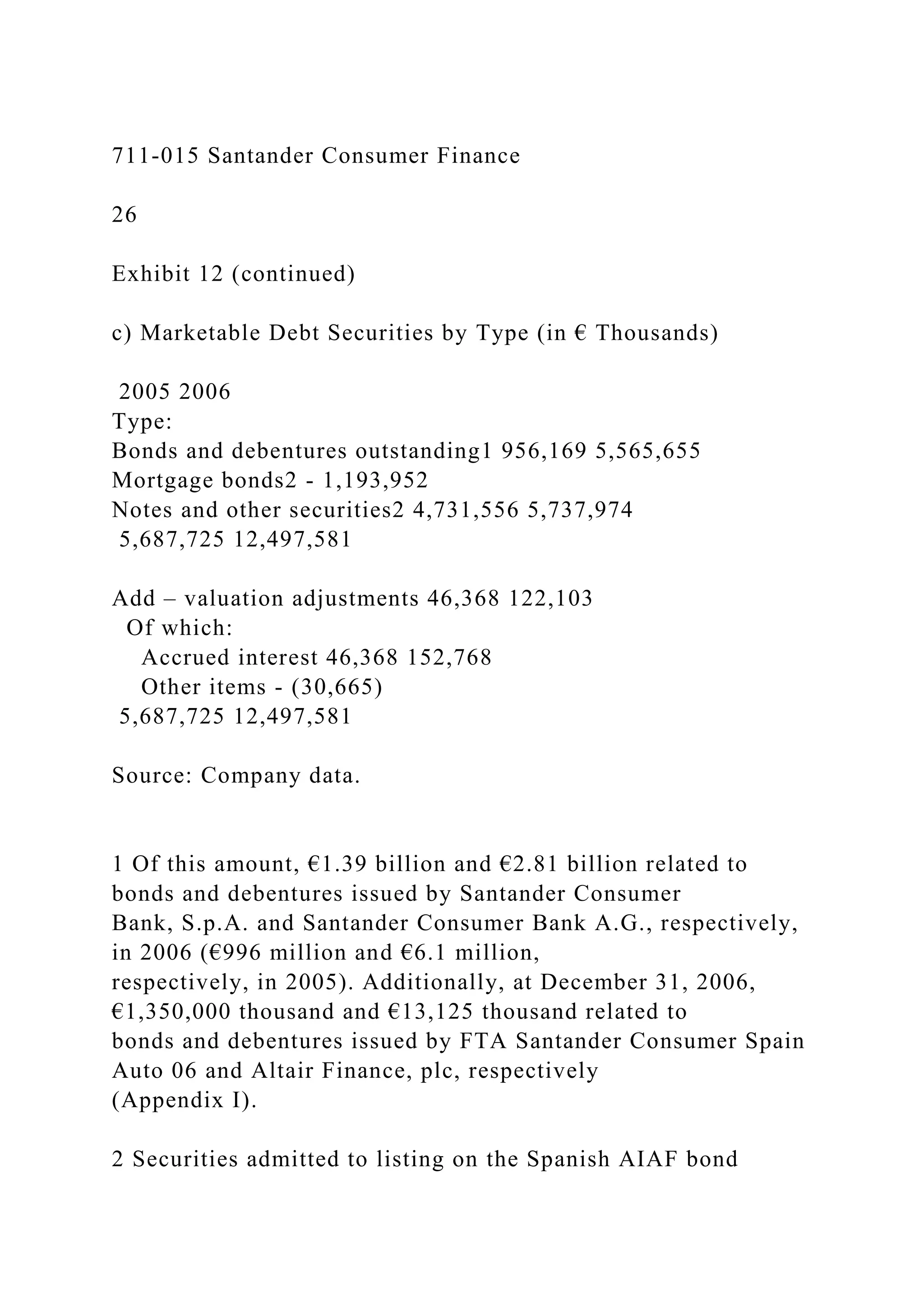
Exhibit 11 on SCF’s competitors.) The division competed also
with local banks and financial
institutions and, in some countries, with Santander’s own
network of retail banks. A former manager
explained, “Nothing prevents a British consumer from obtaining
a loan from Abbey, a bank part of
Santander Group, and using that money to buy a car rather than
securing auto financing from the
British SCF. Similarly, Spanish customers are free to finance
their auto purchases either through SCF
España, or with loans from a Santander retail bank.”
In the auto financing business, the company operated in parallel
with car manufacturer’s
captives—finance companies usually wholly owned by the car
manufacturers and used to provide
credit to car dealers for acquiring stocks and financing
customers (such as Volkswagen Bank, GMAC
Bank, FordBank or Peugeot Financement). Hanswillemenke
explained, “In the car industry, captives
are marketing tools. For the car manufacturers it is very
expensive to reduce capacity in production
or to take back an unsold car. Captives thus provide dealers
with incentives such as cheap loans or
sales premiums to boost sales of new cars or less requested
models.”
Another area manager explained, “Take a Ford dealer that sells
around 500 new cars and 5,000
used cars per year. Each year Ford has to convince the dealer to
buy its new cars and needs to come
up with incentives. Through their captives, car manufacturers
can offer very interesting stock-finance
arrangements to the car dealers.”
Santander Consumer Finance 711-015
9
Faced with this competition, SCF’s goal was not to replace
captives but to be the number two
financer of new cars after captives, and the number one financer
of used cars. One area manager
explained, “We encourage dealers to take full advantage of car
manufacturers’ incentives to finance
their stock of new cars if the offer is economically interesting.
Dealers should turn to us only after
having exploited such incentives, or if they are not interested in
acquiring new cars”. Similarly, SCF
did not compete with captives in the new cars retail financing
business. He continued:
In this business, captives can offer the POS client loans at very
low rates. We cannot
compete against them. This is a sort of subsidized credit. Yet
these offers are usually limited to
specific car models and ask the customer to provide a down
payment. The dealer will present
our offer to a customer who cannot afford the deposit or does
not like that particular car.
In the used car business, SCF competed directly with the
captives. “Car manufacturers are less
interested in this market. Here captives use weapons similar to
ours”.
SCF’s Structure
To be close to the local markets, Santander Consumer Finance
had adopted a decentralized
structure. A manager explained:
We build on the strengths of diversity and avoid a business
model that offers the same
identical product to everyone. From a marketing and pricing
perspective, we need to adjust to
the local territory. Of course, we can supervise, give advice and
provide capital and technology
from Madrid. But a critical factor for success is having people
who understand local needs. It’s
difficult to identify local needs from Madrid.
The importance of focusing on local needs was echoed by a
former manager:
SCF’s growth has been driven by acquisitions and joint ventures
with local companies, with
the result that our national teams are staffed by local
employees. We would not have been able
to grow so quickly if we had headed up our local operations
with Spanish people who would
have needed at least a year to get to grips with the local
environment and regulations.
SCF was organized in four geographical areas, each headed by a
manager: Spain, Portugal, Chile,
and Italy; Eastern Europe and the Scandinavian countries,
United Kingdom and Mexico; Germany
and Austria; and North America. Still, the local branches
enjoyed considerable autonomy.
Each local branch had a person in charge of legal issues to
monitor local regulations and data
collection centers. Recently, SCF had introduced in most of the
local branches a manager in charge of
promoting the insurance business. Local branches were also in
charge of product development. If a
new product entailed new risks, it needed the approval of a
central committee. Collections were
treated differently depending on the setting: “soft” collections
were outsourced in Spain but kept in-
house in Germany and Russia. “Hard” collections, for which
national legal standards differed
considerably, were always outsourced.
Despite the local branches’ large autonomy, certain functions
were centralized: risk management,
cost control, the IT platform, monitoring of customer’s (i.e.
dealers’) satisfaction and funding.
Customer information databases had been partly centralized, but
the process was complicated by
differences in national data privacy standards. Gimeno
remembered, “In 2004, SCF centralized the
European data-center operations by relocating its 11 data
centers to two new locations in Madrid and
London. It took us quite a long time and lots of paper work.”
Provisions of the 1995 EU Data Privacy
711-015 Santander Consumer Finance
10
Directive blocked European companies from sending customer
data to countries without adequate
data protections. This would make it hard for SCF’s Latin
American, U.S. and Russian databases.
Funding
To finance its loans, Santander Consumer Finance drew on a
number of sources, including senior
debt, commercial paper, asset-backed securitization, and
customer deposits. (See Exhibit 12 on the
sources of funding.) When possible, SCF encouraged funding
from local deposits. By 2006, customer
deposits—from banking operations in Germany, Spain, Portugal
and Italy— represented the
division’s largest source of funding. SCF’s Chief Financial
Officer (CFO) explained that, “Local
funding is cheaper because we can avoid doing currency
swaps.”
SCF also securitized pools of car loans, and this was becoming
an increasingly important source of
funding for the division. Here again, though, the European
market remained fragmented. The CFO
explained, “Owing to regulatory restrictions, loans can be
securitized on a country-by-country basis
only; we are not allowed to perform cross-country
securitizations, even if this would be better for us
as it would allow pooling risk across different countries.”
SCF’s country offices also obtained funding from the Santander
Group. The CFO argued,
“Securing funding from the Group provides SCF with an
advantage over our local competitors in
terms of cost of funding. The cost of funding would be higher
for local operations if the branches did
not belong to the Group”. Interest rates for country branches
were adjusted based on business and
country risk criteria: whether it carried the Santander brand
name; the size of the market in relation
to SCF’s business; per capita GDP; and the country’s sovereign
credit rating.
SCF’s Approach to New Countries
Santander Consumer Finance’s wide geographical coverage
allowed it to spread risk. In addition,
SCF hoped to learn from its different businesses. San Félix gave
the example of the United States:
We are exporting know-how from our U.S. operations to
Europe. Not only do we learn how
to price the product to the consumer’s risk, a practice that Drive
has been doing for years and
that it is something that Europeans are starting to do just now.
We also learn that the business
model needs to be well aligned to the needs of the segment of
risk that we are serving. If you
build a business focused on a particular segment of risk-- if you
have clear ideas about your
likely rate of default, the number of cars you are going to
repossess, and how you will
remarket the cars—then you will make a lot of money. If your
business model does not make
sense, even if you price your products high, you stand to lose a
lot, even in the United States.
SCF’s approach had been to cover the main European countries
in terms of GDP per capita and
population. Castañeda explained, “SCF invests in countries with
a large population or with high GDP
per capita growth rates (or good expectations of growth). Of
course countries that meet both of these
prerequisites are better, but here competition is in general
higher.”
A former manager noted that the entrance into the new EU
member states had not posed any
major difficulties for SCF:
In Eastern Europe credit is something new. They still have the
mentality that if you owe
something you have to give it back. In addition, they want to be
part of the EU. They want to
Santander Consumer Finance 711-015
11
catch up and be good citizens. If you go to Poland or the Czech
Republic today, you can see
that they are less rich than Western European countries, but
they’ve adopted a similar financial
culture.
Yet, the fact that credit was new in former communist countries
also meant that some institutions
were missing. He continued, “Institutions as important as
collection agencies did not exist or were
less developed. So in some cases we had to do it in house, like
for example in Poland or Russia. But
just for the first years.”
Efforts to gain a footing in countries outside the EU posed
additional challenges. When Santander
entered Russia, in 2007, the banking sector was still in
transition. Under Russian financial regulation,
the banking authorities had the right to revoke the license of
any bank that lost money for three
consecutive months. For a new consumer lender, this provision
posed clear problems, and Santander
chose to enter Russia as a financial firm rather than a bank.
Despite these challenges, SCF saw Russia as a market with
strong potential. Most Russians owned
their apartment in the wake of post-Communist privatizations.
Salaries were still not high, but the
property gave them a high level of wealth. And borrower risk
seemed to be low.
One manager added, “Each European country presents SCF with
its own specific set of regulatory
constraints. We have to be extremely flexible: we cannot apply
the exact same model in all countries.
When deciding whether or not to enter a country, we consider
what we can and cannot do, and then
work out which business model to apply.” (See Exhibit 13 on
SCF’s product sales by country.) In
Germany for example, SCF was less focused on mortgages.
Hanswillemenke explained, “Mortgages
are not convenient for us. Interest rates are low. Also, they limit
our possibilities to sell other products
as mortgage clients have to pay large installments and for a long
time”.
Looking to the Future
Consumer Finance is a cyclical business. You see that in the US
and in Europe. The consumer business goes
up and down. We are in a down period. We see liquidity
problems worldwide, , automobile sales are flat or
descending and we will soon have a new EU directive. There is
a pressure on margins, decreasing financing
volumes and worsening of credit. But SCF sees good
opportunities vs. competitors in this environment due to
know-how and belonging to a large and solid financial group.
--Salarich
As Salarich contemplated the future of Santander Consumer
Finance, three big questions laid
ahead. The first dealt with expansion. New consumer credit
markets were emerging around the
globe. Should Santander move to operate in these new markets?
A manager at SCF had noted both
the promise and the challenge these new markets might pose for
SCF:
Some people look at GDP per capita to understand where
consumer finance will go. I look
at cars per inhabitant. In Brazil you have 4 times the population
than in Spain but the same
number of cars. Growth will come from emerging countries such
as Brazil, India, and China.
[See Exhibit 14 for some figures]. Yet they are very different
from the countries where we are
now. Before investing here we need to make sure that our core
business is strong enough.
The second challenge was in consolidation. Which functions
should be centralized in order to gain
efficiencies, and which should be left decentralized? A manager
noted:
711-015 Santander Consumer Finance
12
Inciarte managed to find all these new opportunities and make
the bank’s board accept
them. We identified four areas that need to be improved: stock
finance, client’s conversion,
payments’ collection, and insurance. The discussion is how do
we do that? Do we set up a
central department that tells local managers what to do or
should we hire them locally? Some
countries already complain that HQs exercise pressure on them.
Yet, products succeed when
you have someone dedicated to them and we have a lot to learn
at a cross country level.
Finally, Salarich had to decide on SCF’s product mix.
Historically, its strength and competitive
advantage was in the auto loan business, a low risk business but
with lower margins. Yet recent
experiences both in the United States and with non-auto
consumer lending had shown potential for
expanding into higher-return businesses. To what extent should
they move into direct personal
lending? And could they apply the loan pricing strategies they
learned from their US subsidiary,
Drive, to European car markets? Salarich had four more months
to decide.
Santander Consumer Finance 711-015
13
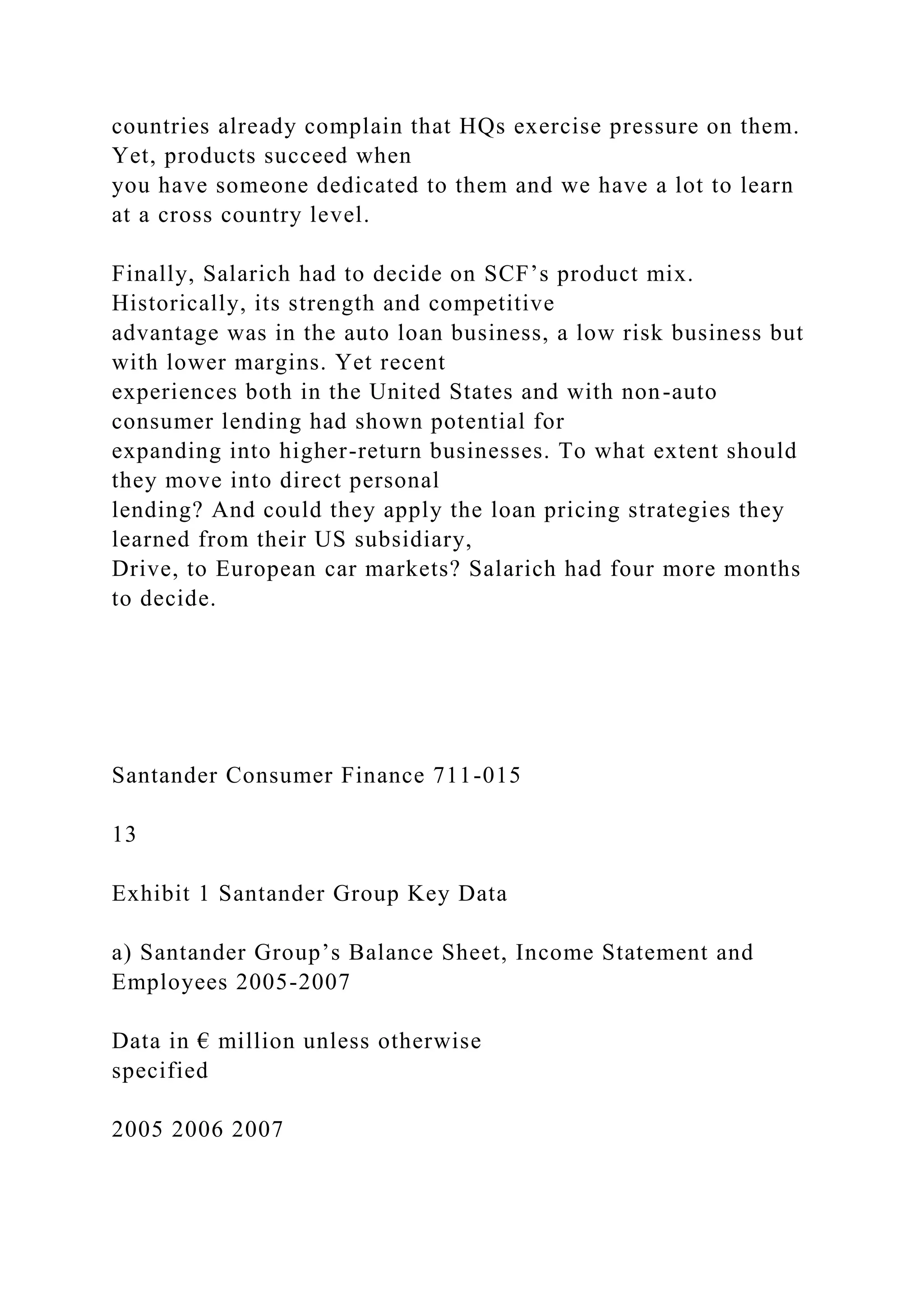
Exhibit 1 Santander Group Key Data
a) Santander Group’s Balance Sheet, Income Statement and
Employees 2005-2007
Data in € million unless otherwise
specified
2005 2006 2007
Total assets 809 107 833,873 912,915
Customer loans 435 829 523,346 565,477
Customer funds under management 651 360 739,223 784,995
Shareholders’ equity 35 841 40,062 51,945
Total managed funds 961 953 1,00,996 1,063,892
Net interest income 10,324 12,076 14,882
Commercial revenue 17,541 20,184 24,096
Gross operating income 19,076 22,333 27,095
Net operating income 8,765 11,218 14,842
Net profit from ordinary activity 5,411 6,674 8,518
Attributable profits to the group 6,220 7,596 9,060
Number of employees 120,047 123,731 131,819
N° Branches in Continental Europe 5,389 5,772 5,976
N° UK 712 712 704
N° Latin America 4,100 4,368 4,498
Total N° of branches 10,201 10,852 11,178
Notes: all data was in € million unless otherwise indicated.
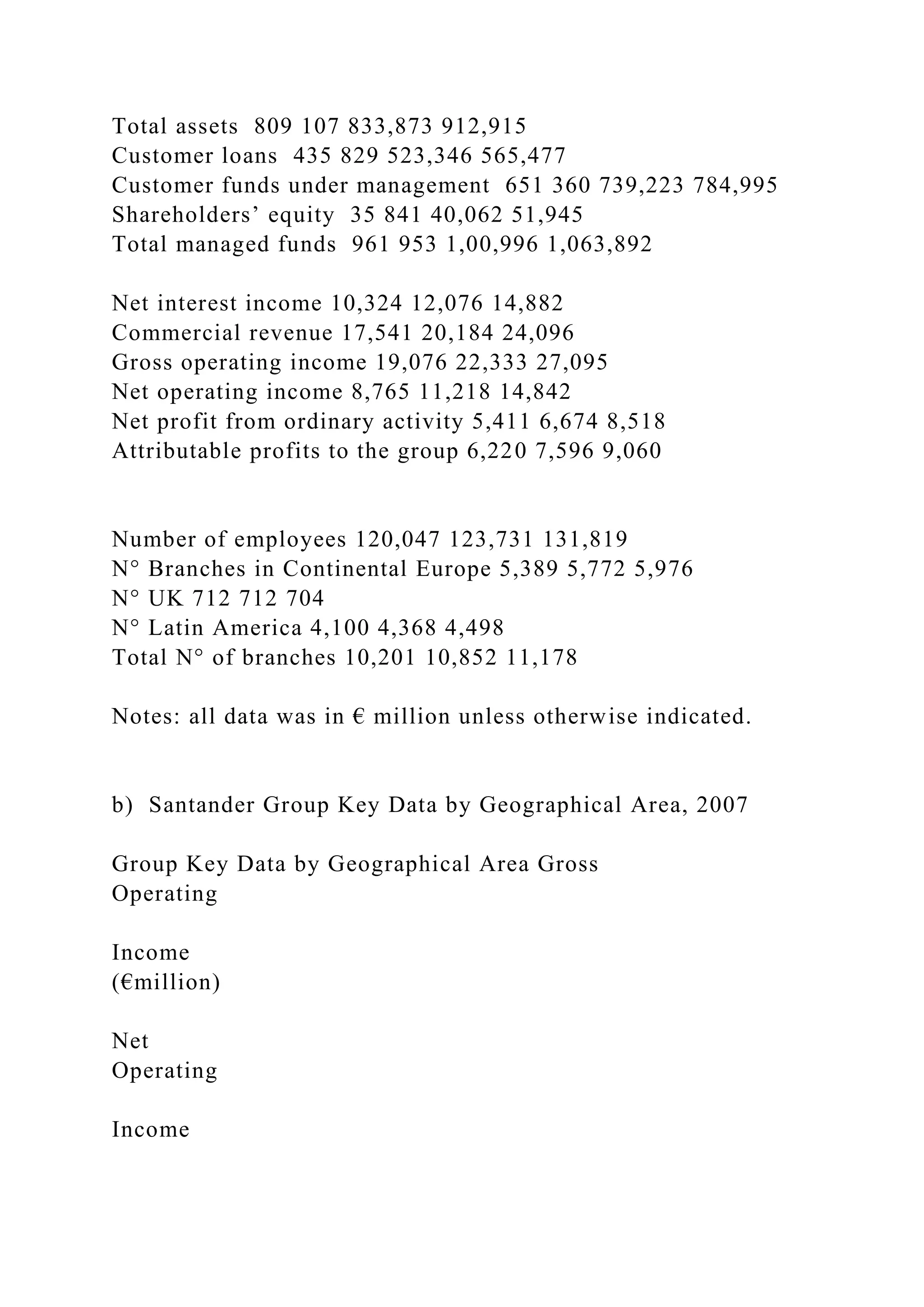
b) Santander Group Key Data by Geographical Area, 2007
Group Key Data by Geographical Area Gross
Operating
Income
(€million)
Net
Operating
Income
Profit to the
Group
Employees Branches ROE
Continental Europe 12,843 7,736 4,423 47,838 5,976 21.3
Santander Branch Network 4,747 2,863 1,806 19,392 2,887
22.7
Banesto 2,282 1,312 668 10,776 1,946 18.3
Santander Consumer Finance 2,638 1,867 719 7,221 285 34.1
Portugal 718 672 511 6,405 763 28.6
United Kingdom (Abbey) 3,780 1,913 1,201 16,827 704 32.3
Latin America 10,386 5,308 2,666 65,628 4,498 29.1
Financial Management and Equity
Stakes
86 (665) (180) 1,526
Total Group 14,842 8,111 131,819 11,178 19.61
Source: Company data.
711-015 Santander Consumer Finance
14
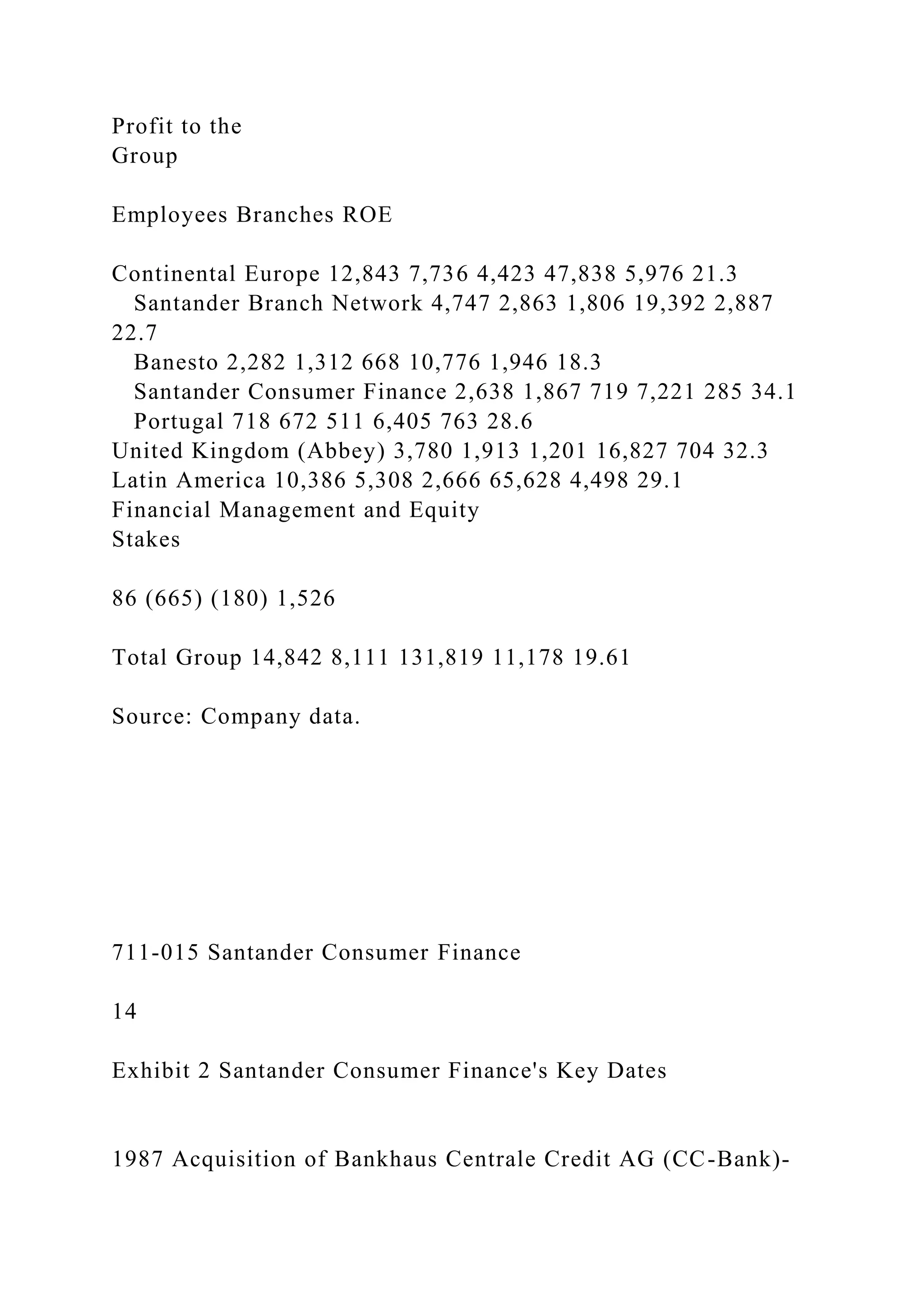
Exhibit 2 Santander Consumer Finance's Key Dates
1987 Acquisition of Bankhaus Centrale Credit AG (CC-Bank)-
Germany
1990 Acquisition of Hispamer following the merger Banco
Santander / Banco Central Hispano
1996 Full control of CC-Bank
1997 Joint ownership of Fininconsumo- Italy- with Banco San
Paolo IMI
2001 Creation of the Santander Consumer Finance Division
from Hispamer, CC Bank and Finconsumo
2002 Acquisition of AKB-Germany
2004 Acquisition of Finconsumo – Italy (remaining 50%)
2004 Acquisition of Elcon & Bankia- Norway
2004 Acquisition of PTF-Poland
2004 Acquisition of Abfin- Netherlands
2005 Acquisition of SC-UK (start-up)
2006 Acquisition of Unifin-Italy
2006 Acquisition of Interbanco- Portugal
2006 Acquisition of Drive-USA
2007 Acquisition of Mexico (start-up)
2007 Acquisition of Extrobank- Russia
2007 Chile (start-up, operative 2008)
Source: Company data.
Santander Consumer Finance 711-015
15
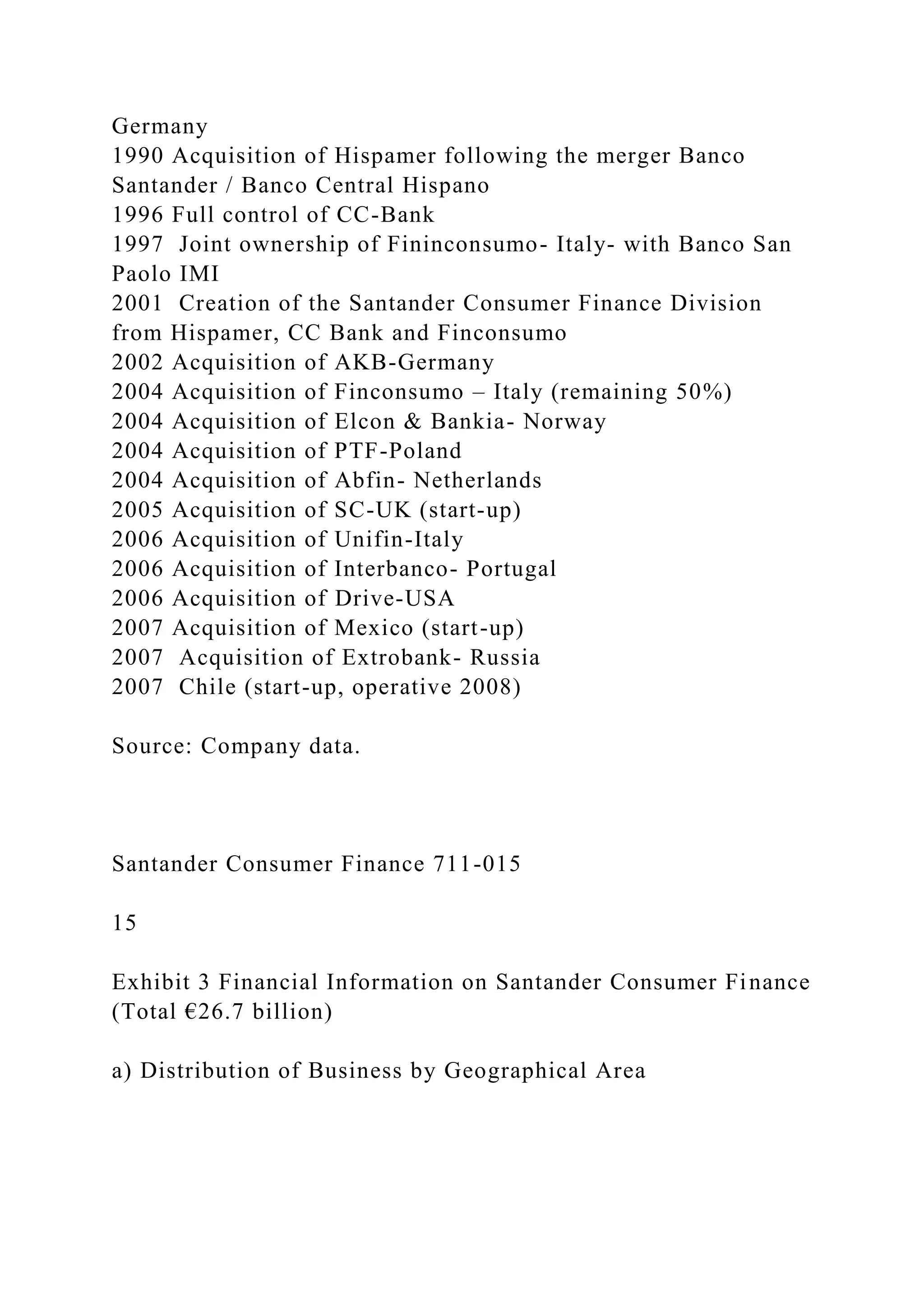
Exhibit 3 Financial Information on Santander Consumer Finance
(Total €26.7 billion)
a) Distribution of Business by Geographical Area
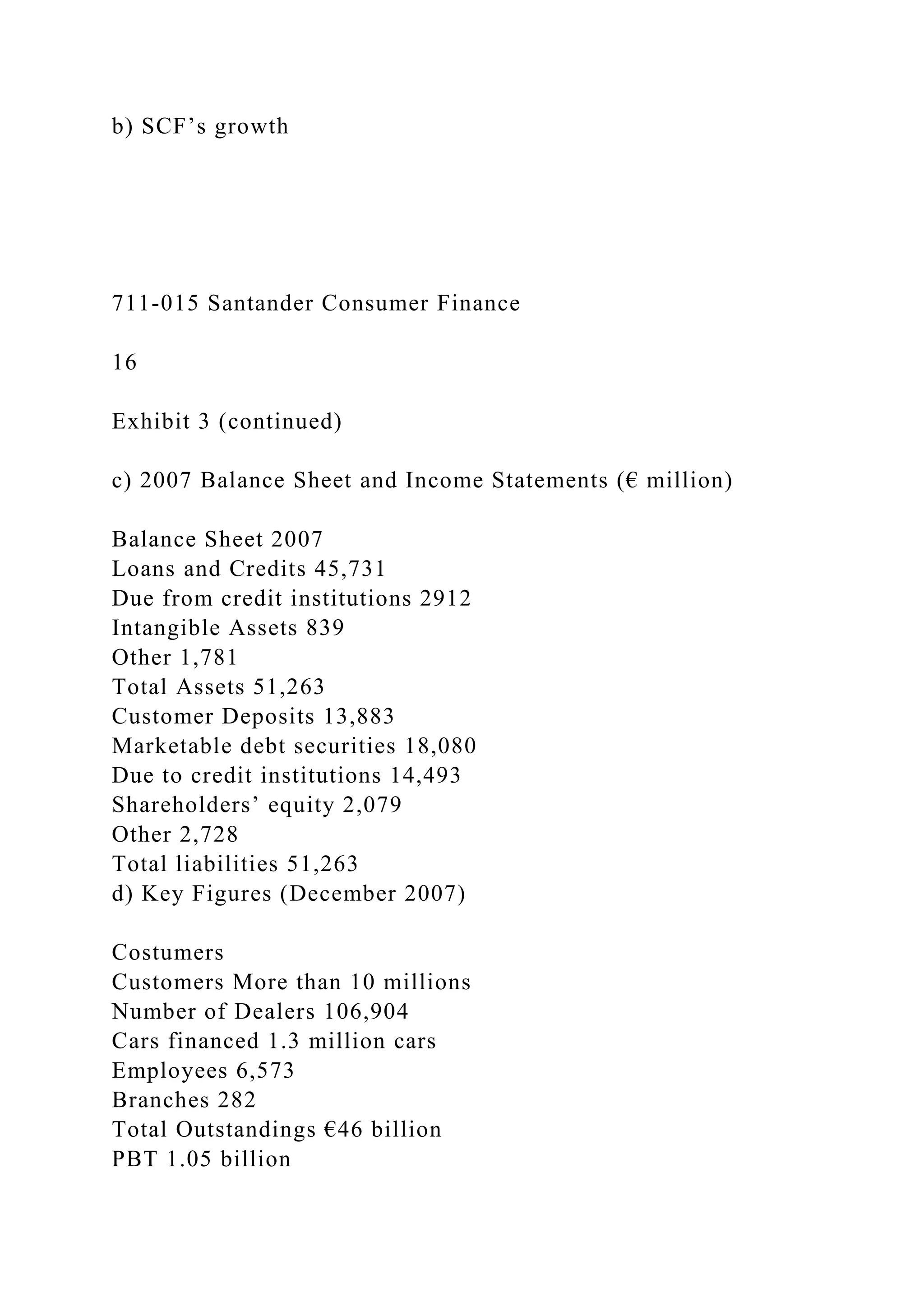
b) SCF’s growth
711-015 Santander Consumer Finance
16
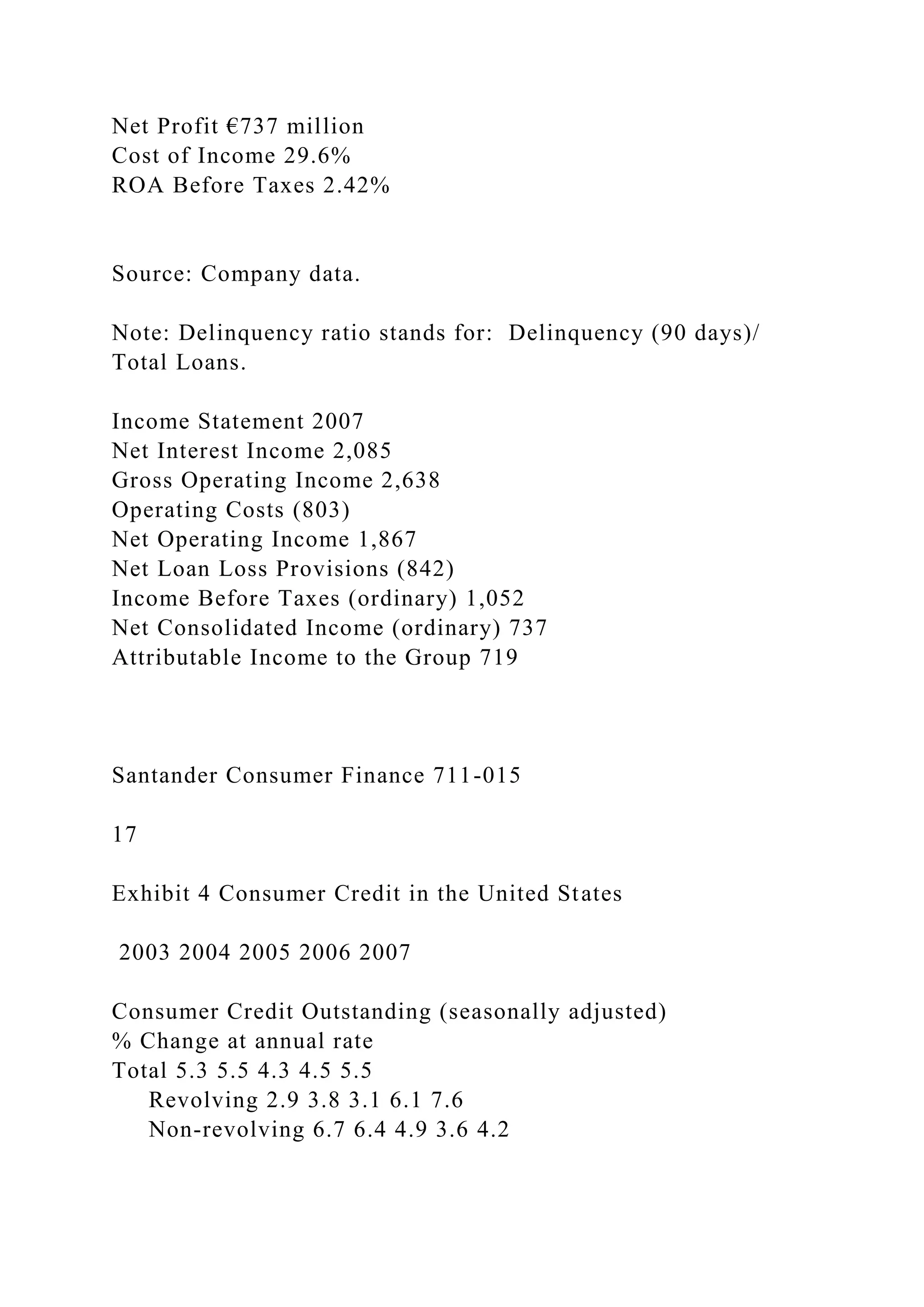
Exhibit 3 (continued)
c) 2007 Balance Sheet and Income Statements (€ million)
Balance Sheet 2007
Loans and Credits 45,731
Due from credit institutions 2912
Intangible Assets 839
Other 1,781
Total Assets 51,263
Customer Deposits 13,883
Marketable debt securities 18,080
Due to credit institutions 14,493
Shareholders’ equity 2,079
Other 2,728
Total liabilities 51,263
d) Key Figures (December 2007)
Costumers
Customers More than 10 millions
Number of Dealers 106,904
Cars financed 1.3 million cars
Employees 6,573
Branches 282
Total Outstandings €46 billion
PBT 1.05 billion
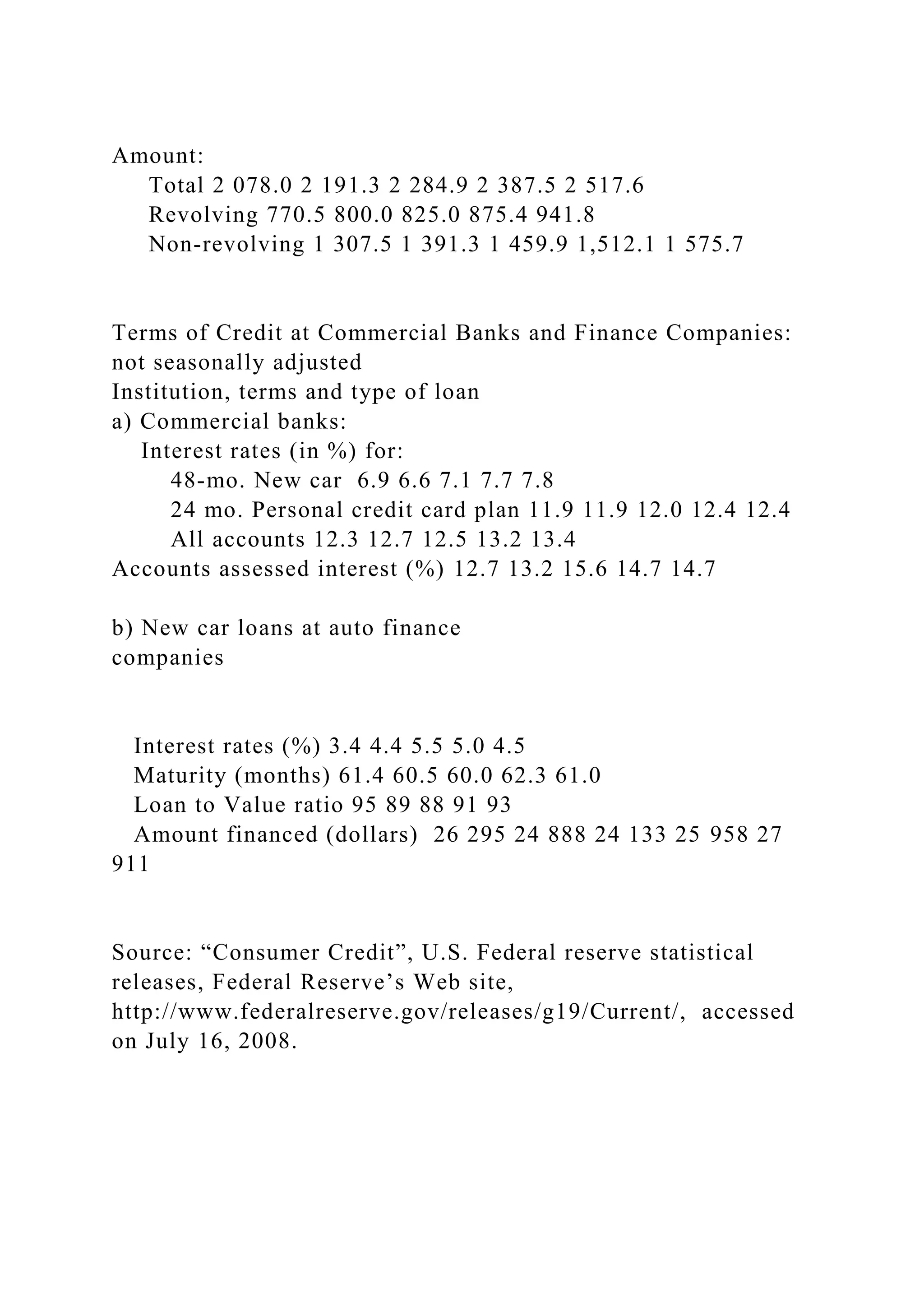
Net Profit €737 million
Cost of Income 29.6%
ROA Before Taxes 2.42%
Source: Company data.
Note: Delinquency ratio stands for: Delinquency (90 days)/
Total Loans.
Income Statement 2007
Net Interest Income 2,085
Gross Operating Income 2,638
Operating Costs (803)
Net Operating Income 1,867
Net Loan Loss Provisions (842)
Income Before Taxes (ordinary) 1,052
Net Consolidated Income (ordinary) 737
Attributable Income to the Group 719
Santander Consumer Finance 711-015
17
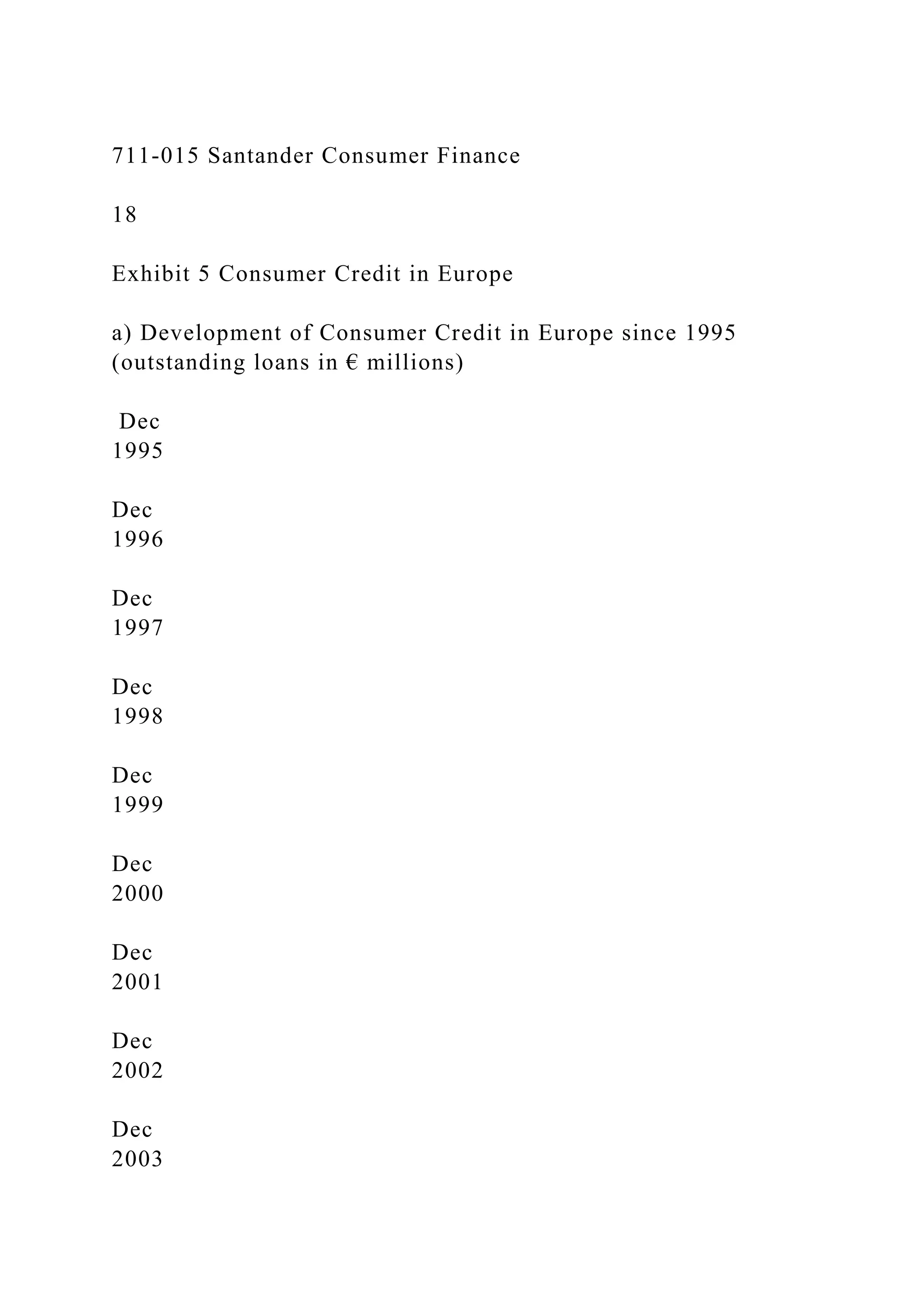
Exhibit 4 Consumer Credit in the United States
2003 2004 2005 2006 2007
Consumer Credit Outstanding (seasonally adjusted)
% Change at annual rate
Total 5.3 5.5 4.3 4.5 5.5
Revolving 2.9 3.8 3.1 6.1 7.6
Non-revolving 6.7 6.4 4.9 3.6 4.2
Amount:
Total 2 078.0 2 191.3 2 284.9 2 387.5 2 517.6
Revolving 770.5 800.0 825.0 875.4 941.8
Non-revolving 1 307.5 1 391.3 1 459.9 1,512.1 1 575.7
Terms of Credit at Commercial Banks and Finance Companies:
not seasonally adjusted
Institution, terms and type of loan
a) Commercial banks:
Interest rates (in %) for:
48-mo. New car 6.9 6.6 7.1 7.7 7.8
24 mo. Personal credit card plan 11.9 11.9 12.0 12.4 12.4
All accounts 12.3 12.7 12.5 13.2 13.4
Accounts assessed interest (%) 12.7 13.2 15.6 14.7 14.7
b) New car loans at auto finance
companies
Interest rates (%) 3.4 4.4 5.5 5.0 4.5
Maturity (months) 61.4 60.5 60.0 62.3 61.0
Loan to Value ratio 95 89 88 91 93
Amount financed (dollars) 26 295 24 888 24 133 25 958 27
911
Source: “Consumer Credit”, U.S. Federal reserve statistical
releases, Federal Reserve’s Web site,
http://www.federalreserve.gov/releases/g19/Current/, accessed
on July 16, 2008.
711-015 Santander Consumer Finance
18
Exhibit 5 Consumer Credit in Europe
a) Development of Consumer Credit in Europe since 1995
(outstanding loans in € millions)
Dec
1995
Dec
1996
Dec
1997
Dec
1998
Dec
1999
Dec
2000
Dec
2001
Dec
2002
Dec
2003
Dec
2004
Austria 14,810 16,525 23,927 23,310 22,143 20,610 23,535
Belgium 9,321 9,532 10,149 11,180 11,958 12,739 13,231
13,505 13,723 14,078
Cyprus 499 604 675 729 875 964 952 960 925 936
Czech
Republic
150
496 622 561 828 1,675 1,902 2,231
Denmark 9,103 9,363 9,862 10,855 11,308 12,496 12,243
11,877 12,339 13,084
Estonia 96 75 111 29 54 75 95 172
Finland 3,256 3,275 3,014 3,123 6,386 6,706 7,324 8,048
France 63,757 69,333 74,859 80,836 90,708 97,848 103,006
105,719 110,716 115,507
Germany 197,198 200,713 202,181 216,145 215,695 222,554
222,405 224,343 230,913 236,957
Greece 5,511 7,852 9,755 12,050 17,054
Hungary 658 565 619 724 1,131 1,546 2,209 2,883 3,190 4,431
Ireland 2,995 3,336 3,752 5,040 6,811 7,751 9,300 10,462
11,330 14,701
Italy 21,557 23,828 27,139 32,312 37,112 41,181 45,244
51,298 60,980
Latvia 51 84 107 148 220 282
Lithuania 31 30 29 41 94 218
Luxembourg 500 700 1,091 1,250 1,301 1,360 1,185 1,269
Malta 50 88 83 102 120 133 121 104 84 187
Netherlands 9,365 9,893 10,864 12,266 12,848 13,831 13,903
18,647 20,442 22,523
Poland 2,926 4,080 5,044 6,878 9,757 11,115 10,369 9,199
11,209
Portugal 5,013 6,191 6,770 8,177 8,074 7,872 8,691 9,059
Slovakia 91 75 119 160 217 509
Slovenia 1,100 1,086 1,073 1,174 1,410
Spain 29,182 36,652 43,326 48,498 48,739 53,733 55,529
62,269
Sweden 22,725 20,992 22,558 22,146 26,310 29,843 29,090
31,828 32,327 34,462
UK 79,186 101,954 130,585 146,134 183,016 209,506 225,388
244,558 239,063 259,987
Source: “Statistics, Consumer Credit in the EU25 by member
states”, European Savings Banks Group (ESBG) Web site,
http://www.esbg.eu/uploadedFiles/Publications_and_Research_(
ESBG_only)/Statistics/08%20Consumer%20credit
%20in%20the%20EU.xls, accessed on July 15, 2008.
Santander Consumer Finance 711-015
19
Exhibit 5 (continued)
b) Consumer Credit per Capita in Selected Developed Countries
in 2007
Source: Company data.
711-015 Santander Consumer Finance
20
Exhibit 6 Consumer Credit in Europe: Country Comparison
a) 2006: Market Penetration per Consumer Credit Product in
Europe
Source: Jean Coumaros, Enrico Sanna and Luca Zuccoli,
Consumer Finance in Europe: Back to Reality, Oliver
Wyman/Santander
Consumer Finance/ EFMA: London, 2008, available at
http://www.oliverwyman.com/ow/pdf_files/
OW_En_FS_2008_ConsumerFinanceInEurope.pdf.pdf, accessed
in September 2010.
b) Country grouped by consumer finance growth rates and type
of regulation
Note: These countries were classified as Dynamic,
Unrestrained, Constrained, Saturated and Dormant according to
their
consumer finance market growth rates and regulations.
Source: Jean Coumaros, Enrico Sanna, Mark Weil and Luca
Zuccoli, Consumer Credit in Europe: Riding the Wave, Mercer
Oliver
Wyman/ European Credit Research Institute: London, 2005, p.6,
http://www.ecri.be/new/system/files/Consumer+
Finance+Report+MercerOliverWyman+ECRI.pdf, accessed on
July 16, 2008.
Santander Consumer Finance 711-015
21
Exhibit 7 Breakdown of SCF’s Sales by Product
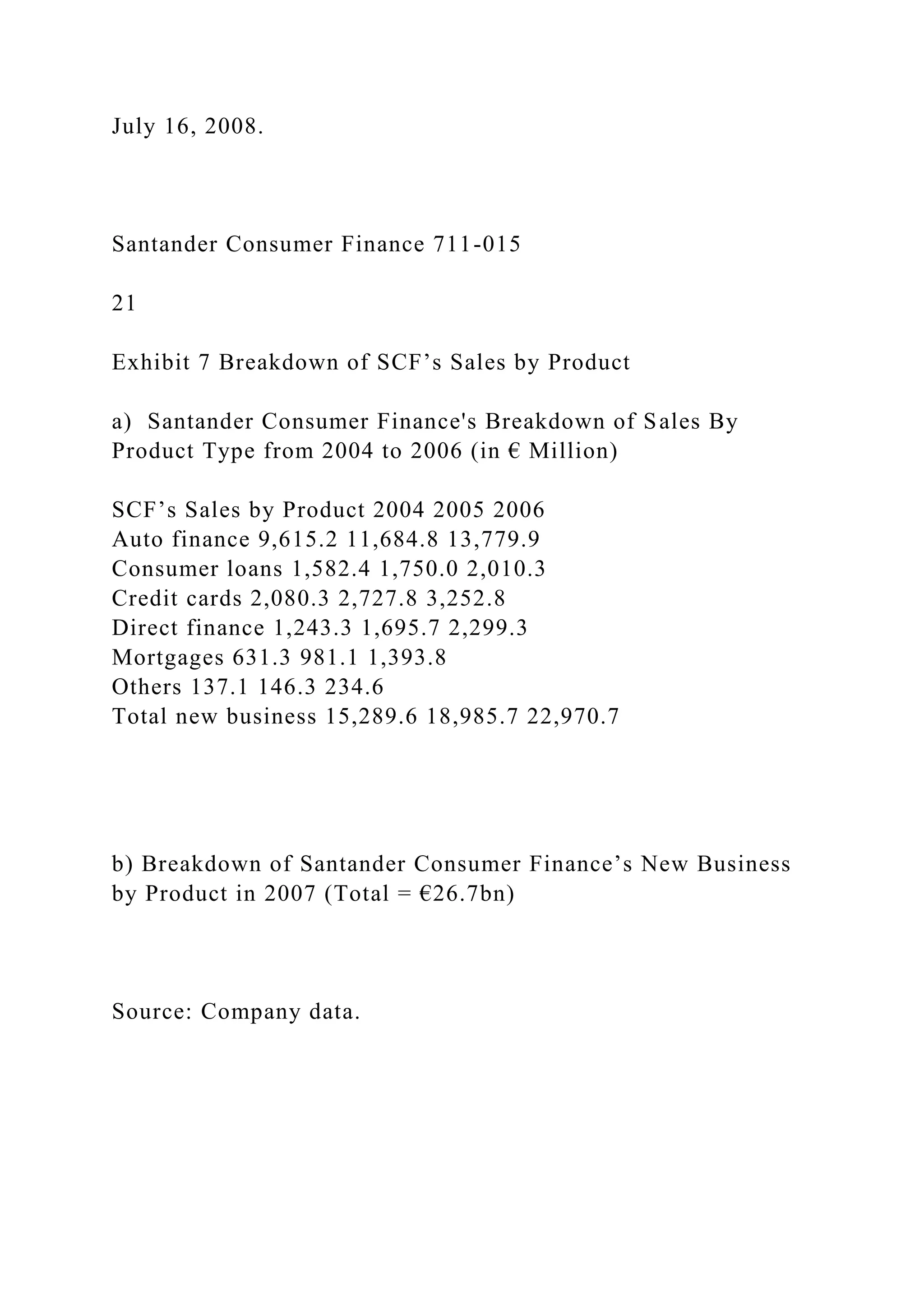
a) Santander Consumer Finance's Breakdown of Sales By
Product Type from 2004 to 2006 (in € Million)
SCF’s Sales by Product 2004 2005 2006
Auto finance 9,615.2 11,684.8 13,779.9
Consumer loans 1,582.4 1,750.0 2,010.3
Credit cards 2,080.3 2,727.8 3,252.8
Direct finance 1,243.3 1,695.7 2,299.3
Mortgages 631.3 981.1 1,393.8
Others 137.1 146.3 234.6
Total new business 15,289.6 18,985.7 22,970.7
b) Breakdown of Santander Consumer Finance’s New Business
by Product in 2007 (Total = €26.7bn)
Source: Company data.
711-015 Santander Consumer Finance
22
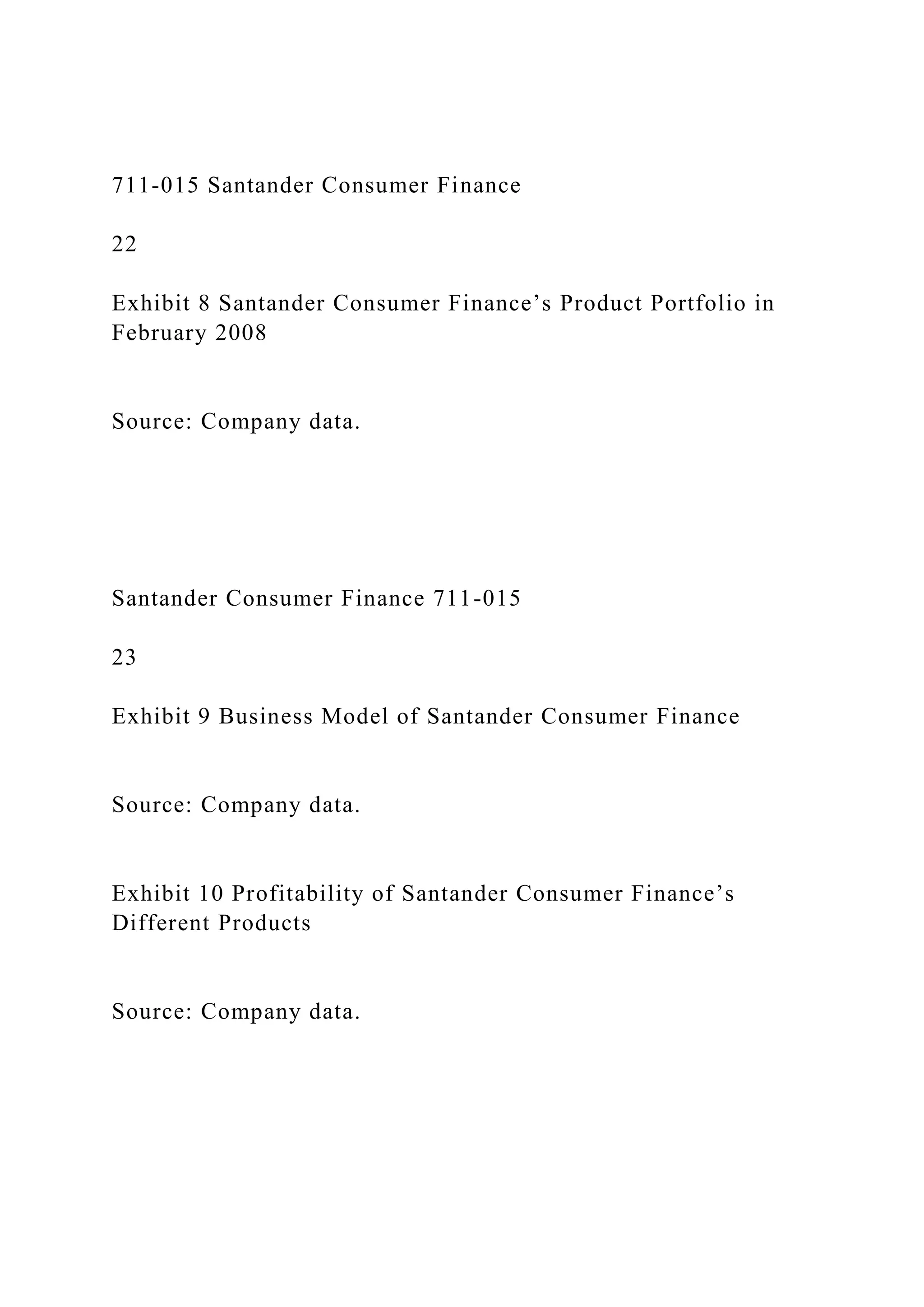
Exhibit 8 Santander Consumer Finance’s Product Portfolio in
February 2008
Source: Company data.
Santander Consumer Finance 711-015
23
Exhibit 9 Business Model of Santander Consumer Finance
Source: Company data.
Exhibit 10 Profitability of Santander Consumer Finance’s
Different Products
Source: Company data.
711-015 Santander Consumer Finance
24
Exhibit 11 Comparison between Santander Consumer Finance
and its Main Competitors, 1H’07
Outstanding Loans Net Income
Source: Company data.
Santander Consumer Finance 711-015
25
Exhibit 12 Santander Consumer Finance’s Sources of Funding
a) Breakdown of Deposits from Credit Institutions by Type and
Currency (in € Thousands)
2006 2005
Type:
Reciprocal accounts 593,494 113,989
Time deposits 8,948,628 9,143,656
Other demand accounts 175,582 54,385
9,717,704 9,312,030
Currency:
Euro 5,117,470 6,446,610
Foreign currency 4,600,234 2,865,420
Total financial liabilities 9,717,704 9,312,030
b) Breakdown of Customer Deposits by Type, Geographical
Area, and Currency (in € Thousands)
2006 2005
Type:
Public sector – local government 11,833 263,788
Demand deposits
Current accounts 6,578,928 7,655,314
Savings accounts 2,323,685 2,666,719
Other demand deposits 31,035 5,954
Time deposits
Fixed-term deposits 4,350,917 2,811,435
Home-purchase savings accounts 65,743 55,673
Other financial liabilities associated
with transferred financial assets
- 20,347
Other time deposits 1,893 2,353,707
13,364,034 15,832,937
Geographical area:
Spain and Portugal 4,001,418 3,843,275
Germany 8,787,073 11,415,178
Italy 490,656 492,855
Scandinavia 74,234 75,953
Rest of Europe 10,653 5,676
13,364,034 15,832,937
Currency:
Euros 13,284,141 15,750,255
Foreign currency 79,893 82,682
13,364,034 15,832,937
711-015 Santander Consumer Finance
26
Exhibit 12 (continued)
c) Marketable Debt Securities by Type (in € Thousands)
2005 2006
Type:
Bonds and debentures outstanding1 956,169 5,565,655
Mortgage bonds2 - 1,193,952
Notes and other securities2 4,731,556 5,737,974
5,687,725 12,497,581
Add – valuation adjustments 46,368 122,103
Of which:
Accrued interest 46,368 152,768
Other items - (30,665)
5,687,725 12,497,581
Source: Company data.
1 Of this amount, €1.39 billion and €2.81 billion related to
bonds and debentures issued by Santander Consumer
Bank, S.p.A. and Santander Consumer Bank A.G., respectively,
in 2006 (€996 million and €6.1 million,
respectively, in 2005). Additionally, at December 31, 2006,
€1,350,000 thousand and €13,125 thousand related to
bonds and debentures issued by FTA Santander Consumer Spain
Auto 06 and Altair Finance, plc, respectively
(Appendix I).
2 Securities admitted to listing on the Spanish AIAF bond
market, fully issued by the Bank. The annual interest
rate on the mortgage bonds is 3.875% and the notes, which were
issued at a discount, bore average annual
interest of 2.80% in 2006.
Santander Consumer Finance 711-015
27
Exhibit 13 Santander Consumer Finance’s Lending per Country
in 2006 ( € millions)
Germany Spain Italy Scandina
via
USA Poland Portugal Other
Units
Total
Total Portfolio 15,988 10,950 5,033 2,831 2,230 1,529 883
1,219 40,663
Auto Finance 10,676 6,101 3,635 2,546 2,230 645 706 950
27,490
New vehicles 4,145 5,520 3,146 1,448 361 385 526 405
15,936
Used vehicles 6,531 581 488 1,098 1,869 261 180 545
11,553
Cons. Loans & Credit Cards 1,054 1,045 544 112 0 0 53 20
2,827
Consumer Loans 937 500 364 0 0 0 44 1 1,845
Credit Cards 117 545 180 112 0 0 9 19 983
Direct 2,631 565 768 18 0 51 0 31 4,065
Mortgages 3 2,478 0 0 0 787 0 38 3,305
Others 108 492 80 155 0 0 1 7 843
Stock Finance 1,517 269 6 0 0 46 123 172 2,133
% of the Total (in %) 39.3 26.9 12.4 7.0 5.5 3.8 2.2 3.0 100
Source: Company data
Exhibit 14 Car sales and Purchasing Power in Emerging
Markets
Source: Company data.
711-015 Santander Consumer Finance
28
Endnotes
1 “Global Consumer Finance”, Industry Profile, Datamonitor,
April 2008, accessed via OneSource on June 8,
2008. The Americas comprised Argentina, Brazil, Canada,
Chile, Colombia, Mexico, Venezuela and the United
States. Europe comprised: Belgium, the Czech Republic,
Denmark, France, Germany, Hungary, Italy, the
Netherlands, Norway, Poland Russia, Spain Sweden and the
United Kingdom. Asia comprised Australia, China,
Japan, India, Singapore, South Korea, and Taiwan.
2 ‘Paying the price of consumerism’, in El Pais, English
Edition, Herald Tribune, 25 July 2005, accessed via
Factiva on June 8, 2008.
3 Jean Coumaros, Enrico Sanna, Mark Weil and Luca Zuccoli,
Consumer Credit in Europe: Riding the Wave,
Mercer Oliver Wyman/ European Credit Research Institute:
London, 2005.
4 These were Experian, Equifax, and Callcredi
5 Karl Lannoo and Almudena de la Mata Muñoz (2003)
Integration of the EU Consumer Credit Market – Proposal
for a More Efficient Regulatory Model, Centre for European
Policy Studies: Brussels
6 Jean Coumaros, Enrico Sanna, Mark Weil and Luca Zuccoli,
Consumer Credit in Europe: Riding the Wave,
Mercer Oliver Wyman/ European Credit Research Institute:
London, 2005
7 Ibid.
8
“Cross-border lending promoted by EU plans”, International
Herald Tribune, January 14, 2008,
at<http://www.iht.com/articles/2008/01/14/business/credit.php>
, accessed April 9, 2008.
9 Karl Lannoo and Almudena de la Mata Muñoz (2004)
Integration of the EU Consumer Credit Market – Proposal
for a More Efficient Regulatory Model, CEPS Working
Document No 213/November 2004, Centre for European Policy
Studies: Brussels, available at
http://aei.pitt.edu/6647/01/1174_213.pdf , accessed July 2008.
10 ‘BEUC Statement on Consumer Credit’, 18 January 2008, at
<http://www.beuc.eu/Content/Default.asp?PageID=701&Langua
geCode=EN>, accessed April 14, 2008.
11 ‘Consumer credit’ EurActiv, January 21, 2008, at
<http://www.euractiv.com/en/financial-
services/consumer-credit/article-146529> , accessed April 14,
2008.
12 Ibid.
<<
/ASCII85EncodePages false
/AllowTransparency false
/AutoPositionEPSFiles true
/AutoRotatePages /None
/Binding /Left
/CalGrayProfile (Gray Gamma 2.2)
/CalRGBProfile (sRGB IEC61966-2.1)
/CalCMYKProfile (U.S. Web Coated 050SWOP051 v2)
/sRGBProfile (sRGB IEC61966-2.1)
/CannotEmbedFontPolicy /Error
/CompatibilityLevel 1.3
/CompressObjects /Off
/CompressPages true
/ConvertImagesToIndexed true
/PassThroughJPEGImages true
/CreateJDFFile false
/CreateJobTicket false
/DefaultRenderingIntent /Default
/DetectBlends true
/DetectCurves 0.0000
/ColorConversionStrategy /LeaveColorUnchanged
/DoThumbnails true
/EmbedAllFonts true
/EmbedOpenType false
/ParseICCProfilesInComments true
/EmbedJobOptions true
/DSCReportingLevel 0
/EmitDSCWarnings false
/EndPage -1
/ImageMemory 1048576
/LockDistillerParams true
/MaxSubsetPct 99
/Optimize true
/OPM 1
/ParseDSCComments true
/ParseDSCCommentsForDocInfo true
/PreserveCopyPage true
/PreserveDICMYKValues true
/PreserveEPSInfo true
/PreserveFlatness true
/PreserveHalftoneInfo false
/PreserveOPIComments false
/PreserveOverprintSettings true
/StartPage 1
/SubsetFonts false
/TransferFunctionInfo /Preserve
/UCRandBGInfo /Remove
/UsePrologue false
/ColorSettingsFile ()
/AlwaysEmbed [ true
/Palatino-Bold
/Palatino-BoldItalic
/Palatino-Italic
/Palatino-Roman
]
/NeverEmbed [ true
]
/AntiAliasColorImages false
/CropColorImages true
/ColorImageMinResolution 150
/ColorImageMinResolutionPolicy /OK
/DownsampleColorImages false
/ColorImageDownsampleType /Average
/ColorImageResolution 600
/ColorImageDepth -1
/ColorImageMinDownsampleDepth 1
/ColorImageDownsampleThreshold 1.50000
/EncodeColorImages false
/ColorImageFilter /DCTEncode
/AutoFilterColorImages false
/ColorImageAutoFilterStrategy /JPEG
/ColorACSImageDict <<
/QFactor 0.15
/HSamples [1 1 1 1] /VSamples [1 1 1 1]
>>
/ColorImageDict <<
/QFactor 0.76
/HSamples [2 1 1 2] /VSamples [2 1 1 2]
>>
/JPEG2000ColorACSImageDict <<
/TileWidth 256
/TileHeight 256
/Quality 15
>>
/JPEG2000ColorImageDict <<
/TileWidth 256
/TileHeight 256
/Quality 15
>>
/AntiAliasGrayImages false
/CropGrayImages true
/GrayImageMinResolution 150
/GrayImageMinResolutionPolicy /OK
/DownsampleGrayImages false
/GrayImageDownsampleType /Average
/GrayImageResolution 600
/GrayImageDepth -1
/GrayImageMinDownsampleDepth 2
/GrayImageDownsampleThreshold 1.00000
/EncodeGrayImages false
/GrayImageFilter /DCTEncode
/AutoFilterGrayImages false
/GrayImageAutoFilterStrategy /JPEG
/GrayACSImageDict <<
/QFactor 0.15
/HSamples [1 1 1 1] /VSamples [1 1 1 1]
>>
/GrayImageDict <<
/QFactor 0.76
/HSamples [2 1 1 2] /VSamples [2 1 1 2]
>>
/JPEG2000GrayACSImageDict <<
/TileWidth 256
/TileHeight 256
/Quality 15
>>
/JPEG2000GrayImageDict <<
/TileWidth 256
/TileHeight 256
/Quality 15
>>
/AntiAliasMonoImages false
/CropMonoImages true
/MonoImageMinResolution 1200
/MonoImageMinResolutionPolicy /OK
/DownsampleMonoImages false
/MonoImageDownsampleType /Average
/MonoImageResolution 600
/MonoImageDepth -1
/MonoImageDownsampleThreshold 1.50000
/EncodeMonoImages false
/MonoImageFilter /CCITTFaxEncode
/MonoImageDict <<
/K -1
>>
/AllowPSXObjects false
/CheckCompliance [
/None
]
/PDFX1aCheck false
/PDFX3Check false
/PDFXCompliantPDFOnly false
/PDFXNoTrimBoxError true
/PDFXTrimBoxToMediaBoxOffset [
0.00000
0.00000
0.00000
0.00000
]
/PDFXSetBleedBoxToMediaBox true
/PDFXBleedBoxToTrimBoxOffset [
0.00000
0.00000
0.00000
0.00000
]
/PDFXOutputIntentProfile (None)
/PDFXOutputConditionIdentifier ()
/PDFXOutputCondition ()
/PDFXRegistryName ()
/PDFXTrapped /False
/Description <<
/CHS
<FEFF4f7f75288fd94e9b8bbe5b9a521b5efa76840020004100640
06f006200650020005000440046002065876863900275284e8e55
464e1a65876863768467e5770b548c62535370300260a853ef4ee5
4f7f75280020004100630072006f0062006100740020548c002000
410064006f0062006500200052006500610064006500720020003
5002e003000204ee553ca66f49ad87248672c676562535f00521b5
efa768400200050004400460020658768633002>
/CHT
<FEFF4f7f752890194e9b8a2d7f6e5efa7acb76840020004100640
06f006200650020005000440046002065874ef69069752865bc66
6e901a554652d965874ef6768467e5770b548c52175370300260a
853ef4ee54f7f75280020004100630072006f00620061007400205
48c002000410064006f0062006500200052006500610064006500
7200200035002e003000204ee553ca66f49ad87248672c4f86958b
555f5df25efa7acb76840020005000440046002065874ef63002>
/DAN
<FEFF004200720075006700200069006e0064007300740069006
c006c0069006e006700650072006e0065002000740069006c0020
006100740020006f0070007200650074007400650020004100640
06f006200650020005000440046002d0064006f006b0075006d00
65006e007400650072002c0020006400650072002000650067006
e006500720020007300690067002000740069006c002000640065
00740061006c006a006500720065007400200073006b00e600720
06d007600690073006e0069006e00670020006f00670020007500
640073006b007200690076006e0069006e0067002000610066002
00066006f0072007200650074006e0069006e006700730064006f
006b0075006d0065006e007400650072002e00200044006500200
06f00700072006500740074006500640065002000500044004600
2d0064006f006b0075006d0065006e0074006500720020006b006
1006e002000e50062006e00650073002000690020004100630072
006f00620061007400200065006c006c006500720020004100630
072006f0062006100740020005200650061006400650072002000
35002e00300020006f00670020006e0079006500720065002e>
/DEU
<FEFF00560065007200770065006e00640065006e00200053006
90065002000640069006500730065002000450069006e00730074
0065006c006c0075006e00670065006e0020007a0075006d00200
0450072007300740065006c006c0065006e00200076006f006e00
2000410064006f006200650020005000440046002d0044006f006
b0075006d0065006e00740065006e002c00200075006d00200065
0069006e00650020007a0075007600650072006c00e4007300730
0690067006500200041006e007a00650069006700650020007500
6e00640020004100750073006700610062006500200076006f006
e00200047006500730063006800e40066007400730064006f006b
0075006d0065006e00740065006e0020007a00750020006500720
07a00690065006c0065006e002e00200044006900650020005000
440046002d0044006f006b0075006d0065006e007400650020006
b00f6006e006e0065006e0020006d006900740020004100630072
006f00620061007400200075006e0064002000520065006100640
065007200200035002e003000200075006e00640020006800f600
680065007200200067006500f600660066006e006500740020007
70065007200640065006e002e>
/ESP
<FEFF005500740069006c0069006300650020006500730074006
100200063006f006e0066006900670075007200610063006900f3
006e0020007000610072006100200063007200650061007200200
064006f00630075006d0065006e0074006f007300200064006500
2000410064006f006200650020005000440046002000610064006
50063007500610064006f00730020007000610072006100200076
0069007300750061006c0069007a00610063006900f3006e00200
06500200069006d0070007200650073006900f3006e0020006400
6500200063006f006e006600690061006e007a006100200064006
500200064006f00630075006d0065006e0074006f007300200063
006f006d00650072006300690061006c00650073002e002000530
065002000700075006500640065006e0020006100620072006900
7200200064006f00630075006d0065006e0074006f00730020005
000440046002000630072006500610064006f007300200063006f
006e0020004100630072006f006200610074002c0020004100640
06f00620065002000520065006100640065007200200035002e00
3000200079002000760065007200730069006f006e00650073002
00070006f00730074006500720069006f007200650073002e>
/FRA
<FEFF005500740069006c006900730065007a002000630065007
30020006f007000740069006f006e00730020006100660069006e
00200064006500200063007200e90065007200200064006500730
0200064006f00630075006d0065006e0074007300200041006400
6f006200650020005000440046002000700072006f00660065007
300730069006f006e006e0065006c007300200066006900610062
006c0065007300200070006f007500720020006c0061002000760
069007300750061006c00690073006100740069006f006e002000
6500740020006c00270069006d007000720065007300730069006
f006e002e0020004c0065007300200064006f00630075006d0065
006e00740073002000500044004600200063007200e900e900730
02000700065007500760065006e0074002000ea00740072006500
20006f007500760065007200740073002000640061006e0073002
0004100630072006f006200610074002c002000610069006e0073
0069002000710075002700410064006f006200650020005200650
06100640065007200200035002e00300020006500740020007600
65007200730069006f006e007300200075006c007400e90072006
900650075007200650073002e>
/ITA (Utilizzare queste impostazioni per creare documenti
Adobe PDF adatti per visualizzare e stampare documenti
aziendali in modo affidabile. I documenti PDF creati possono
essere aperti con Acrobat e Adobe Reader 5.0 e versioni
successive.)
/JPN
<FEFF30d330b830cd30b9658766f8306e8868793a304a30883073
53705237306b90693057305f002000410064006f0062006500200
050004400460020658766f8306e4f5c6210306b4f7f75283057307
e305930023053306e8a2d5b9a30674f5c62103055308c305f00200
05000440046002030d530a130a430eb306f300100410063007200
6f0062006100740020304a30883073002000410064006f0062006
5002000520065006100640065007200200035002e003000204ee5
964d3067958b304f30533068304c3067304d307e3059300230533
06e8a2d5b9a3067306f30d530a930f330c8306e57cb30818fbc307f
3092884c3044307e30593002>
/KOR
<FEFFc7740020c124c815c7440020c0acc6a9d558c5ec0020be44
c988b2c8c2a40020bb38c11cb97c0020c548c815c801c73cb85c00
20bcf4ace00020c778c1c4d558b2940020b3700020ac00c7a50020
c801d569d55c002000410064006f0062006500200050004400460
020bb38c11cb97c0020c791c131d569b2c8b2e4002e0020c774b8
07ac8c0020c791c131b41c00200050004400460020bb38c11cb29
40020004100630072006f0062006100740020bc0f002000410064
006f00620065002000520065006100640065007200200035002e0
0300020c774c0c1c5d0c11c0020c5f40020c2180020c788c2b5b2c
8b2e4002e>
/NLD (Gebruik deze instellingen om Adobe PDF-documenten
te maken waarmee zakelijke documenten betrouwbaar kunnen
worden weergegeven en afgedrukt. De gemaakte PDF-
documenten kunnen worden geopend met Acrobat en Adobe
Reader 5.0 en hoger.)
/NOR
<FEFF004200720075006b0020006400690073007300650020006
9006e006e007300740069006c006c0069006e00670065006e0065
002000740069006c002000e50020006f007000700072006500740
0740065002000410064006f006200650020005000440046002d00
64006f006b0075006d0065006e00740065007200200073006f006
d002000650072002000650067006e0065007400200066006f0072
0020007000e5006c006900740065006c006900670020007600690
073006e0069006e00670020006f00670020007500740073006b00
7200690066007400200061007600200066006f007200720065007
4006e0069006e006700730064006f006b0075006d0065006e0074
00650072002e0020005000440046002d0064006f006b0075006d0
065006e00740065006e00650020006b0061006e002000e5007000
6e00650073002000690020004100630072006f006200610074002
00065006c006c00650072002000410064006f0062006500200052
0065006100640065007200200035002e003000200065006c006c0
0650072002e>
/PTB
<FEFF005500740069006c0069007a00650020006500730073006
1007300200063006f006e00660069006700750072006100e700f5
0065007300200064006500200066006f0072006d0061002000610
0200063007200690061007200200064006f00630075006d006500
6e0074006f0073002000410064006f00620065002000500044004
600200061006400650071007500610064006f0073002000700061
0072006100200061002000760069007300750061006c0069007a0
06100e700e3006f002000650020006100200069006d0070007200
650073007300e3006f00200063006f006e0066006900e10076006
50069007300200064006500200064006f00630075006d0065006e
0074006f007300200063006f006d0065007200630069006100690
073002e0020004f007300200064006f00630075006d0065006e00
74006f00730020005000440046002000630072006900610064006
f007300200070006f00640065006d002000730065007200200061
0062006500720074006f007300200063006f006d0020006f00200
04100630072006f006200610074002000650020006f0020004100
64006f00620065002000520065006100640065007200200035002
e0030002000650020007600650072007300f50065007300200070
006f00730074006500720069006f007200650073002e>
/SUO
<FEFF004b00e40079007400e40020006e00e40069007400e4002
000610073006500740075006b007300690061002c0020006b0075
006e0020006c0075006f0074002000410064006f0062006500200
050004400460020002d0064006f006b0075006d0065006e007400
740065006a0061002c0020006a006f0074006b006100200073006
f0070006900760061007400200079007200690074007900730061
007300690061006b00690072006a006f006a0065006e0020006c0
075006f00740065007400740061007600610061006e0020006e00
e400790074007400e4006d0069007300650065006e0020006a006
1002000740075006c006f007300740061006d0069007300650065
006e002e0020004c0075006f00640075007400200050004400460
02d0064006f006b0075006d0065006e0074006900740020007600
6f0069006400610061006e0020006100760061007400610020004
100630072006f0062006100740069006c006c00610020006a0061
002000410064006f0062006500200052006500610064006500720
0200035002e0030003a006c006c00610020006a00610020007500
7500640065006d006d0069006c006c0061002e>
/SVE
<FEFF0041006e007600e4006e00640020006400650020006800e
4007200200069006e0073007400e4006c006c006e0069006e0067
00610072006e00610020006f006d0020006400750020007600690
06c006c00200073006b006100700061002000410064006f006200
650020005000440046002d0064006f006b0075006d0065006e007
400200073006f006d002000700061007300730061007200200066
00f60072002000740069006c006c006600f60072006c006900740
06c006900670020007600690073006e0069006e00670020006f00
6300680020007500740073006b007200690066007400650072002
000610076002000610066006600e4007200730064006f006b0075
006d0065006e0074002e002000200053006b00610070006100640
0650020005000440046002d0064006f006b0075006d0065006e00
740020006b0061006e002000f600700070006e006100730020006
90020004100630072006f0062006100740020006f006300680020
00410064006f00620065002000520065006100640065007200200
035002e00300020006f00630068002000730065006e0061007200
65002e>
/ENU ()
>>
>> setdistillerparams
<<
/HWResolution [600 600]
/PageSize [612.000 792.000]
>> setpagedevice
Appendix C: Global Orientation SLO Scoring Rubric
Global
Dimensions
Does not meet
requirements ‐ 0
Developing ‐ 1 Adequate ‐ 2 Proficient ‐ 3
Exhibit knowledge
of the major
cultural economic,
social and legal
environments
faced by
multinational
organization
Exhibit little knowledge of
the major cultural,
economic social and legal
environment faced by
multinational organizations
Does not incorporate this
knowledge into analyses
and discussion
Exhibit little knowledge
of the major cultural,
economic social and
legal environment
faced by multinational
organizations
Sporadically
incorporate this
knowledge into
analyses and discussion
Exhibit adequate knowledge
of the major cultural,
economic social and legal
environment faced by
multinational organizations
Incorporate this knowledge
into analyses and discussion
Exhibit a high level of
knowledge of the major
cultural, economic social and
legal environment faced by
multinational organizations
Appropriately incorporate
this knowledge into analyses
and discussion
Identifies and
develops multiple
strategies for the
challenges of
doing business in a
global
environment
Equates expansion into
international markets
simplistically with expansion
nationally
Show some awareness
of the challenges and
differences with
expansion nationally
but does not
appreciate significant
challenges that apply in
doing so
Correctly identifies the scope
and a range of challenges in
expanding into international
markets
Does not fully appreciate the
need to pursue a dynamic
entry strategy that’s based on
learning from initial
experiences
Correctly identifies the scope
and a range of challenges in
expanding into international
markets
Fully appreciate the need for
learning when going in and
to proactively fine tune entry
strategy/strategies from
these initial experiences
Demonstrates
appropriate
responses to
global conditions
and cultural
diversity
Show little understanding of
cultural differences with the
other regions/markets; does
not correctly integrate this
in strategic planning and
operational details
Employs understanding
of a few obvious
cultural differences
with the other
regions/markets into
strategic planning and
operational details
Employ understanding of a
few obvious cultural
differences with the other
regions/markets and includes
this understanding into
strategic planning and
operational details
Employ a deep
understanding of all cultural
differences with the other
regions/markets and
incorporates it into strategic
planning and operational
details
Global
Dimensions
Does not meet
requirements ‐ 0
Developing ‐ 1 Adequate ‐ 2 Proficient ‐ 3
Identifies and
assesses the need
for and justify the
advantages
accruing from
expanding into
international
markets
Does not appreciate the
need from moving into
international markets
proactively
Considers expanding
into international
markets but is able to
realize the full scope
and potential;
generally inclined to a
“me too” strategy
mode
Analyze business
opportunities from global
perspective
Appreciate the need and
advantages of expanding into
international markets but is
conservative in estimates and
likely potential
Analyses business
opportunities from global
perspective
Correctly appreciates the
need and advantages along
with the risks that can
accrue from expanding into
international markets
Outstanding – 9‐12
Acceptable – 5‐8
Unacceptable – 0 ‐ 4
Appendix B: Global Orientation SLO Applied To
Case/Project/Research Report
Assignment
Requirements
GO Dimension 1
Description
GO Dimension 2
Description
GO Dimension 3
Description
GO Dimension 4
Description
Students will-> Exhibit knowledge of
the major cultural
economic, social and
legal environments
faced by organizations
(GL SLO 1)
Develop multiple
strategies for the
challenges of doing
business in a global
environment (GL
SLO 2)
Demonstrate
appropriate responses
to cultural diversity in
a global economy (GL
SLO 3)
Assess the needs and justify
the advantages accruing
from expanding into
international markets (GL
SLO 1, 2, 3)
Question 1 (7%)
Describe and
evaluate the
Country/Political Risk
5% 2%
Question 2 (8%)
1) Describe Santander
Consumer Finance’s
(SCF) lending
strategy.
2) Describe how they
manage risk and how
they finance their
loans.
5% 3%
Question 3 (15%)
Describe how SCF’s
lending strategy differs
from US commercial
banks.
10% 5%
Question 4 (30%)
Obtain, identify and
evaluate the data and
conduct a multi-
perspective analysis of
the evidence to make a
logical recommendation
for solving the problem
with a global perspective.
10% 5% 15%
Question 5 (40%)
Defend your
recommendation and
communicate your beliefs
clearly and accurately.
10% 15% 15%
TOTAL (100%) 20% of grade 30% of grade 20% of grade 30%
of grade

Steps for Effective Case Analysis Adapted from Harvard .docx

  • 1.
    Steps for EffectiveCase Analysis Adapted from Harvard Business Publishing It's useful to think of a case analysis as digging deeper and deeper into the layers of a case. You should make sure to follow these general steps in addition to answering the questions from the case. 1. You start at the surface, Getting Oriented and examining the overall case landscape. 2. Then you begin to dig, Identifying Problems, as well as possible alternative solutions. 3. This is the section where you will spend most of your time. Digging deeper, Performing Analyses you identify information that exposes the issues, gather data, perform calculations that might provide insight. "Analysis" describes the varied and crucial things you do with information in the case, to
  • 2.
    shed light onthe problems and issues you've identified. That might mean calculating and comparing cumulative growth rates for different periods from the year-by-year financials in a case's exhibits. Or it might mean pulling together seemingly unrelated facts from two different sections of the case, and combining them logically to arrive at an important conclusion or conjecture. Analysis usually doesn't provide definitive answers. But as you do more of it, a clearer picture often starts to emerge, or the preponderance of evidence begins to point to one interpretation rather than others. Don't expect a case analysis to yield a "final answer." If you're accustomed to doing analysis that ends with a right answer, coming up with a possible solution that simply reflects your best judgment might frustrate you. But remember that cases, much like real-world business experiences, rarely reveal an absolutely correct answer, no matter how deeply you analyze them. Typically, you'll do qualitative analysis based on your reading and interpretation of the case. Ask yourself: What is fact and what is opinion? Which facts are contributing to the problem? Which are the causes? Qualitative factors should be prioritized and fully developed to support your argument. Make notes about your evolving interpretations, always being careful to list the evidence or reasons that support them. Qualitative information in a case can be a mix of objective and
  • 3.
    subjective information. Forexample, you may need to assess the validity of quotations from company executives, each of whom has a subjective opinion. Reports from external industry analysts or descriptions of what other companies in the industry have done might seem more objective; no one in the case has a vested interest in this information. A company's internal PowerPoint presentation should be considered separately and differently from a newspaper article about the company. Cases mix firsthand quotations and opinions with third-person narratives, so you need to consider the reliability of sources. As in real life, you shouldn't take all case information at face value. Quantitative data—such as amounts of materials, money, time, and so on-might be embedded in the text or provided in tabular form in the exhibits (often both). It can be difficult to know which calculations to do, what formulas to apply, and how to interpret the results. Don't sweat this. Try a few simple calculations such as ratios and growth rates over time. If some of those provide insight, great; if not, nothing is lost but a little time. Use simple calculations to determine what other things you might want to assess quantitatively. Quantitatively rich cases may seem intimidating; some people don't enjoy calculating or relying on math to reach conclusions. You might need to calculate, say, a net present value
  • 4.
    in a financecase, or the capacity of a production system to locate the bottleneck in an operations case. Don't be fooled into thinking that just applying those standard analyses is the point of a case. Be prepared if the professor asks, "How is that number relevant to this situation?" or "How would you incorporate it into your decision in favor of one approach over another?" or "Is that number even relevant in this situation?" As conclusions or evidence in favor or against certain alternatives begin to emerge, you might spot connections to principles, frameworks, and theories that you've already covered in your program of study. It's often worthwhile to try applying what seems like a relevant framework to the raw data or to data that have been transformed in some way by your analysis. Once you've begun interpreting your analyses in the context of a framework, you'll often start to see more opportunities for analysis, suggested by the framework itself. It's usually a good idea to follow these paths, although not all will prove to be fruitful. 4. Finally, you begin Action Planning to outline short-, medium-, and long-term well- defined steps. Recommended action plans should state what would be objectively best for the case company given its goals, resources, and situation. But they should also outline possible
  • 5.
    implementation objectives andhurdles. Action plans should include short-, medium-, and long-term steps that will concretely carry out recommendations like these. Real-life situations often have hidden agendas and nuances that can affect how an action plan is crafted. These elements are also relevant in the analysis of a full case, except perhaps for cases that are purely or primarily quantitative. At some point, you might need to develop your favored case action plan in a degree of detail that exceeds that of alternative plans. If you're operating with space constraints (on a word-limited case exam, for instance), you may need to explore just one alternative in full detail, rather than developing all alternatives at the same level of detail. The following are important steps for your Recommendations section. Step 1: Identify Tasks Brainstorm all of the tasks that you need to accomplish your objective. It's helpful to start this process at the very beginning. What's the very first action you'll need to take? What comes next? Should any steps be prioritized to meet specific deadlines, or because of limits on other people's availability? Step 2: Analyze and Delegate Tasks Now that you can see the entire project from beginning to end,
  • 6.
    look at eachtask in greater detail. Are there any steps you could drop without compromising your objective? Which tasks could you delegate to someone else on your team or to a freelancer? Are there deadlines for specific steps? Do you need to arrange additional resources? Step 3: At this point, stop to list a few possible recommendations for the case and think about possible action plans. These deliverables are, after all, the ultimate objectives of your analysis. Try not to restrict yourself to one solution. Let your conclusion emerge from the evidence; don't force the evidence to fit your conclusion. Remain open-minded as you proceed to the next step. List possible recommendations or actions based on your analysis of the case. Typically, you'll need to repeat these four processes multiple times, and as you do, you'll discover new analytical directions, evolving your assessment of the case and conclusion. Pak Sang LO
  • 7.
    Professor Parypinski English 101 12May 2019 MONTEREY PARK, CA CRIME ANALYTICS, 2018. https://www.neighborhoodscout.com/ca/ monterey-park/crime The source focuses on the crime rates in the neighborhood of Monterey Park. The site has its sources based on the FBI crime data, based on 2017 but released in 2018. The site has structured the findings in both data and description. The data part is filled with charts, graphs, and other statistical diagrams to explain the crime rates in the area. The descriptive part describes the represented data for easier understanding. The site is essential for research as it dwells on one of the biggest determinants on the image of a city, its crime rates. It tells us about the crime rates of Monterey Park and how it compares to other cities and neighborhoods. It also talks on the most common types of crime. https://www.montereypark.ca.gov/1056/Data-Demographics This is the Monterey Park official website. It is established by its government. It gives firsthand information on data of the city. The information is also credible as it is done by the city team, who provide an unbiased review and data. The site also shows other basic information such as its government, services, residents and help to visitors
  • 8.
    who are lookingto visit the city. The Monterey Park website is arguably the most accurate on the city stats. They conduct routine checkups on the state of the city. This makes this site an important go to when writing in the city. Its downside is that it does not give some necessary information such as its history and culture events. Sonksen, Mike. "On Location: Monterey Park" 1 November 2013. https://www.kcet.org/history- society/on-location-monterey-park The author is a well know scholar as well as a performer. He has explored plenty of Los Angeles history. The article dwells on the history of Monterey Park, near past and in the old times. It talks on its start, from when it was known as the "Mexican Beverly Hills" to it becoming Monterey Park. It goes deep to how many roads it started with its growth. The author also talks about common practices the area had including agriculture. It speaks on past relations with its neighbors such as Alhambra and Pasadena. To write an article on the city, its history holds high importance. It can help understand the city more. https://www.neighborhoodscout.com/ca/monterey-park/crime https://www.neighborhoodscout.com/ca/monterey-park/crime https://www.montereypark.ca.gov/1056/Data-Demographics https://www.kcet.org/history-society/on-location-monterey-park https://www.kcet.org/history-society/on-location-monterey-park datausa.io Monterey Park, CA https://datausa.io/profile/geo/monterey-park-ca/
  • 9.
    The page deliversall the relevant data on the city. It has data ranging from its economy, health, diversity, education, housing, and living. It is a long article discussing in-depth aspects of the focused on elements of the city. It uses graphs and charts to further explain the statistical data. Elaborations of the graphs are also available. This site is a good option to write on Monterey Park due to its specific details. The range of details also covers most aspects of a city that need to be studied. This makes the article an important reference to writing in the city. Brooks, Lorrie. “Guide to the Fun Things to Do in Monterey Park, CA,” Trip101.com 3 August 2017. https://trip101.com/article/best-things-to-do-in-monterey- park-california The author is a degree holder in Bachelor of Journalism. She is self-employed and enjoys traveling, leading to the writing of the article. This article simply is to advise people on the best activities or best places that can be visited in Monterey Park. The activities also can explain the heritage of the city. It ranks the places and activities from most satisfying to the general ones. It also explains the nature of the activities so as to make it easier for people to decide. This article can be used to write on Monterey Park as it explains the city’s main cites. This makes the article extremely relevant. It helps to understand the city better. https://datausa.io/profile/geo/monterey-park-ca/ https://trip101.com/article/best-things-to-do-in-monterey-park-
  • 10.
    california Works Cited Brooks, Lorrie.“Guide to the Fun Things To Do in Monterey Park, CA,” Trip101.com 3 August 2017. https://trip101.com/article/best-things-to-do-in-monterey- park-california datausa.io Monterey Park, CA https://datausa.io/profile/geo/monterey-park-ca/ MONTEREY PARK, CA CRIME ANALYTICS, 2018. https://www.neighborhoodscout.com/ca/ monterey-park/crime Montereypark.ca.gov https://www.montereypark.ca.gov/1056/Data-Demographics Sonksen, Mike. "On Location: Monterey Park" 1 November 2013. https://www.kcet.org/history- society/on-location-monterey-park https://trip101.com/article/best-things-to-do-in-monterey-park- california https://datausa.io/profile/geo/monterey-park-ca/ https://www.neighborhoodscout.com/ca/monterey-park/crime https://www.neighborhoodscout.com/ca/monterey-park/crime https://www.montereypark.ca.gov/1056/Data-Demographics https://www.kcet.org/history-society/on-location-monterey-park https://www.kcet.org/history-society/on-location-monterey-park
  • 11.
    San Gabriel Valley MontereyPark Monterey Park Cascades Park Sequoia Park El Encanto East Los Angeles College Cantonese Dim Sum Mama Lu Dumpling House Mp Work cited
  • 12.
    https://www.tripadvisor.com/Tourism-g32738- Monterey_Park_California-Vacations.html https://www.tripadvisor.com/Restaurant_Review-g32738- d4796693-Reviews-Mama_Lu_Dumpling_House_Mp- Monterey_Park_California.html Copyright © 2011Harvard Business School Publishing This document is for use only with the Harvard Business Publishing ‘Case Analysis Coach’. Case Analysis Worksheet This form can be used to organize your thoughts about a case. As you perform your analysis remain open to the fact that your interpretation of the facts may change and therefore you should constantly revisit your answers. Define the Problem: Describe the type of case and what problem(s) or issue(s) should be the focus for your analysis. List any outside concepts that can be applied: Write down any principles, frameworks or theories that can be applied to this case. List relevant qualitative data: evidence related to or based on the quality or character of something.
  • 13.
    List relevant quantitativedata: evidence related to or based on the amount or number of something. Describe the results of your analysis: What evidence have you accumulated that supports one interpretation over another. Describe alternative actions: List and prioritize possible recommendations or actions that come out of your analysis. Describe your preferred action plan: Write a clear statement of what you would recommend including short, medium and long-term steps to be carried out. 9 - 7 1 1 - 0 1 5 R E V : D E C E M B E R 1 3 , 2 0 1 0 _____________________________________________________ _____________________________________________________
  • 14.
    ______ Professor Gunnar Trumbulland from HBS Europe Research Center, Research Associate Elena Corsi and Research Assistant Andrew Barron prepared this case. HBS cases are developed solely as the basis for class discussion. Cases are not intended to serve as endorsements, sources of primary data, or illustrations of effective or ineffective management. Copyright © 2010 President and Fellows of Harvard College. To order copies or request permission to reproduce materials, call 1-800-545-7685, write Harvard Business School Publishing, Boston, MA 02163, or go to www.hbsp.harvard.edu/educators. This publication may not be digitized, photocopied, or otherwise reproduced, posted, or transmitted, without the permission of Harvard Business School. G U N N A R T R U M B U L L E L E N A C O R S I A N D R E W B A R R O N Santander Consumer Finance Centralization only makes sense if the final result is better than the simple sum of the parts. — Magda Salarich, CEO, Santander Consumer Finance Introduction
  • 15.
    On March 25,2008, Magda Salarich Fernández de Valderrama, the Chief Executive Officer (CEO) of Santander Consumer Finance (SCF), a division of Grupo Santander, looked out across the bank’s shining new campus, the Ciudad Financiera, just south of Madrid. Salarich had been appointed CEO in January 2008 after working for 28 years for the French car producer Citroën, where she had risen through the ranks to the position of international marketing and sales manager for Europe and CEO for Spain. SCF had grown rapidly in the past five years under its former CEO, Juan Rodríguez Inciarte. Salarich’s job would be to chart the way forward for the next ten years. While the United States remained the largest market in the world for consumer finance, the sector had also been growing in the last 20 years within Europe. Inciarte had captured this trend. Under his helm (2002-2008) SCF had grown from a small group of units operating in Spain, Germany and Italy, into one of the largest consumer finance companies. Also, since 2006, Inciarte had invested outside the EU: in the United States, Latin America and Eastern Europe. In four months, Salarich would have to present a new strategy and direction for SCF to Santander’s Chairman and Executive Director, Emilio Botín- Sanz de Sautuola y García de los Ríos, as well as to the other members of the group’s Executive Committee, including Inciarte himself. Important decisions had to be made. Could the high profitability of the consumer lending activities be sustained? Was it time to focus more attention on consolidation, or should she further invest in
  • 16.
    new markets andproducts? There were also important questions of organizational strategy to address. Which functions should be led to national affiliates to decide, and which should be centralized at headquarters? What processes should be standardized, and which left to local initiatives? And all of these decisions would be set against a background of growing concern about the sustainability of household debt levels in Europe and the United States. 711-015 Santander Consumer Finance 2 History of the Santander Group The Santander Group was founded in 1857, when the Queen of Spain authorized through Royal decree the creation of a bank in the city of Santander, in Cantabria, northern Spain. Seventy-two local businessmen subscribed to the bank’s capital. Through the years the bank increased its business in Spain and in the 1950’s it opened offices in a few Latin America countries and in London. Under the leadership of Emilio Botín, who succeeded his father as Chairman and CEO of the group in 1986, the bank reinforced its position in Spain launching products such as Supercuenta that doubled the bank’s market share on deposits and with the 1994 acquisition of Banco Español de Crédito (Banesto) and the 1999 merger with Banco Central Hispano (BCH). Botín also expanded to foreign markets, acquiring banks and opening new offices in Latin America,
  • 17.
    Europe and theUnited States. To keep pace with its rapid growth, in 2004 the Group re- located operations from downtown Madrid to the Ciudad Financiera Santander, a 160-hectare financial campus in the suburbs, with also education and training facilities, sports facilities including an 18-hole golf course, on-site childcare amenities and an art gallery. By 2007, when the Group celebrated its 150th anniversary, the Santander Group was one of the largest banks in the world in terms of market capitalization and net profit. It operated the largest network of retail banks in the western world. (See Exhibit 1 for the Group’s financials and breakdowns by business division.) The Group also operated in the wholesale banking, private banking, credit cards, asset management, and insurance businesses and, through SCF, in the consumer finance sector. The History of Santander Consumer Finance Santander Consumer Finance had its roots in 1987, when Banco Santander acquired Bankhaus Centrale Credit AG (CC Bank), a German bank operating since the 1950s with 51 branches and specialized in the vehicle financing business. One year later, the Santander Group partnered with the Royal Bank of Scotland to jointly control, strengthen and expand CC Bank. New branches were opened and in 1994 CC Bank also launched Direkt Bank, a branchless, direct telephone bank that also offered credit card services. The shared ownership agreement with Royal Bank of Scotland continued until 1996, when Santander bought out its partner and assumed full control of CC Bank.
  • 18.
    Remembering those years,Inciarte, at the time CFO at Santander, explained: Under the terms of the shared ownership agreement Emilio Botín and I sat on Royal Bank of Scotland’s board. This partnership was very influential on the development of Santander’s consumer finance business. It helped us to understand the growth of the consumer finance market in the United Kingdom and gave us many useful insights into this business. What was happening in the United Kingdom, we believed, could spread to the rest of Europe. Subsequent mergers gave them more exposure to consumer lending. In 1997, Santander entered the Italian market by assuming joint control with the bank Banco San Paolo IMI of Finconsumo—a consumer finance company. In 1999, Santander’s merger with BCH brought to the group Hispamer Banco Financiero and Hispamer Financieros. In the meantime, CC-Bank had expanded into Hungary and Austria. In 2002, the collection of national consumer lending groups was brought together under a new division within Santander, SCF. Santander Consumer Finance 711-015 3 Expansion of SCF Under the leadership of Inciarte, Santander Consumer Finance focused on growth. He recalled,
  • 19.
    “When our Chairmanand Chief Executive asked me to head up the new division, I was afraid that the Group wanted to get rid of me because it was a very small business. It did not even have a common global brand.” Inciarte first moved to expand the business to the major European markets. He explained: Germany, the United Kingdom, Spain, France, Italy, and Poland are the European markets that count in terms of GDP and population. It’s like in the United States: if you are not in Texas, Florida, New York, Chicago and California you are not there. We wanted to become European. All Europeans drink Coca Cola, buy furniture from IKEA, and like cars. It seemed relatively easy to create a pan-European franchise for financing consumers. We were already in Germany and Spain, we looked at Italy, and we bought a stake in San Paolo IMI in 2003. Between 2003 and 2006, other acquisitions followed in other European countries. In 2006, SCF started investing outside the European Union (EU), first in the United States with the acquisition of Drive U.S., then, in 2007, in Mexico and Russia. In 2007 Inciarte also invested in a Greenfield operation in Chile, which started operations in 2008. (See Exhibit 2 for a summary of SCF’s acquisitions.) As SCF’s geographical coverage expanded, Inciarte turned his attention to the organization of the division and the impact of their brand. Javier San Félix, SCF’s former Chief Operating Officer and now the head of one of SCF’s business areas, explained:
  • 20.
    When I joinedin 2004, SCF was a mere sum of different units placed in different countries, with different business models, operations, IT platforms and marketing approaches. We wanted to make it worth more than the sum of the parts. First we integrated the different brands. The SCF brand was not known outside of the [Santander] Group as each affiliated company maintained its name. We changed their names into SCF. Secondly, we centralized the decisions concerning funding, and thirdly we centralized the customer data centers. By June 2008, SCF operated in 20 countries. Within Santander, SCF accounted for 5% of the Group’s total workforce and generated almost 8% of the bank’s total profits. The largest market remained Germany. (See Exhibit 3 for SCF’s financials.) The European Market for Consumer Finance There are still big differences between European countries in terms of consumer credit market size, consumer credit to GDP ratios (penetration) and consumer product mix. These differences are due to different levels of market maturity, economic developments, local regulations and cultural factors. — Salarich Consumer finance included any kind of lending to finance consumer’s purchases outside of mortgage for real estate. It was certainly not an invention of the 20th century. Stores in the 19th century had offered sales credit to their regular customers; and pawn
  • 21.
    shops had beenactive in Europe since the middle Ages. But it was the growth of the consumer durables manufacturing sector in the interwar and post-World War II era that made consumer credit an accepted feature of modern society. Innovations in risk assessment, data processing, and financing all contributed to a boom in consumer lending starting in the late 1980s. By the end of 2007, retail lending to consumers— excluding mortgages—accounted for $6 trillion in outstanding balances, of which 51.5% was in the 711-015 Santander Consumer Finance 4 Americas, 30% in Europe and 18.6% in Asia.1 The United States long had been and remained the largest market, with $2.5 trillion in outstanding loans. (See Exhibit 4 for U.S. market figures.) Since the 1980s, Europe’s consumer lending sector had grown in economic importance and sophistication.2 (See Exhibit 5 on consumer credit in Europe.) San Félix described this change, “The main driving force is that Europeans are becoming more like the Americans in terms of consumption patterns. We are consuming more and this leads to the growth of consumer credit. Yet, in Europe the penetration of consumer lending started from a much lower level than in the United States. It is hard to predict if we will reach 100% of America’s levels”. As SCF’s Director of Investment Analysis, stressed, “The average American still has more than twice the
  • 22.
    amount of consumerdebt than the average European (EU15).” By the end of 2006, consumer lending in Europe represented roughly €1 trillion of outstanding loans.3 While smaller than in the United States, the European consumer credit market also had distinctive features that made it qualitatively different. First, the average default risk on consumer loans in Europe tended to be lower. One area manager commented, “Compared to the United States we are like in a dreamland in Europe. We can sleep well every night because our risk is very predictable.” Second, consumer lending in Europe was based less on sub- prime borrowers. Interest rates were not commonly adjusted to account for individual risk, and a smaller share of lending was on revolving accounts.i An area manager explained, “Europeans do not play with interest rates. Revolving credit tends to be applied only to credit cards and to current accounts’ overdraft facilities. Personal loans (and mortgages) tend to have fixed rates. This is fair to the client. We want to give the client who has to face 16 months of instalments a clear picture. We do not want surprises.” Institutional features of Europe’s national credit markets also limited the possibilities for managing risky products. Credit bureaus worked at the national level, and each country imposed different standards about how data could be collected, processed, and distributed. None of the national bureaus offered credit scores. Some countries, like France, had centralized credit rating
  • 23.
    databases that recordedonly negative credit episodes. New loans could be checked against this ‘black list’, but no centralized positive data, including total volume of outstanding loans, was available. Germany provided slightly more information, but not enough to assess the riskiness of new customers. An area manager said, “The agency tells you if the customer is overdue and if he has not finished paying his past loans. It does not give us current and positive information. It is thus hard for us to adjust the price of the loan to the customer’s risk profile.” In the United Kingdom, where consumer lenders provided credit to riskier borrowers than in most other European countries, three private credit reference agencies provided lenders with positive information.4 Yet, by contrast, they were explicitly banned from creating a lending black list, and could not themselves process the raw data to generate a credit score. This left lenders to determine the riskiness of potential borrowers based on their own internal risk models. Other features of national economies drove dramatic differences in national consumer credit markets.5 The cost of credit varied from 6% in Finland to 12% in Portugal; outstanding loans to GDP ranged from 3% in Hungary, Switzerland, and the Check Republic to more than 10% in Germany, Norway, Sweden and the United Kingdom (2004);6 default rates ranged from around 7% in Eastern Europe to around 1% in Germany, Denmark, Austria and the Netherlands.7 While the German and i Sub prime lending was lending at a higher rate than the prime rate, a reference interest rate used by banks to lend to clients.
  • 24.
    Risk based pricingwas the practice of determining the interest rate on a loan, also by looking at the credit risk profile of the borrower. Revolving credit was a type of credit which did not have a fixed number of payments. Santander Consumer Finance 711-015 5 the UK markets seemed to be approaching maturity, others markets, in Greece and Scandinavia, were now booming. (See Exhibit 6 for country comparisons.) A former SCF Business Area Manager added: European consumer credit markets are very different from each other also in terms of products. For example in Germany there are no credit cards and Germans tend to rely heavily on bank overdraft facilities, which are instead rare in Spain and France where credit cards are mostly payment cards. In the UK, where debt is more of the unsecured type (with variable rates), credit cards are mainly of the revolving type. Italy and Belgium instead are markets where credit cards are less used. Here people tend to buy less on credit and save more. While the 1992 Single Europe Act formally removed barriers to capital flows within Europe, cross- border consumer lending remained tiny; it was estimated at between 2% and 5% of all European consumer loans in 2002.8 Banks and institutions that operated in foreign markets had done so by acquiring local institutions, opening local branches, or through
  • 25.
    joint ventures. The lowlevel of intra-European lending had been attributed to cultural, natural and regulatory barriers.9 On the demand side, customers seemed to place greater trust in national, proximate providers with which they shared the same language and culture. National differences in consumer protection standards and remedies across Europe reinforced customers’ preference for local providers in so far as it raised the uncertainty of comparing credit offers across different countries. On the supply side, cross country regulatory differences led to high market entry costs and complicated the organization of the business for consumer credit companies with global aspirations. One manager explained, “In some countries, like France, the government sets interest rate caps. Thus here we would not be able to aggressively promote our personal loans as we could not compensate for the higher risks. You need to adapt to the field.” The Consumer Credit Directive The sooner the integration process advances the better for us. At present, we operate in several European countries and that positioning would allow us to offer... pan European products. — Salarich In an effort to promote integration, in 1987, the European Commission introduced the first European Union (EU) consumer credit directive. Its goal was to set some basic standards regarding
  • 26.
    procedures and reporting.In January 2008, after six years of negotiation, a new and more complete EU directive on consumer credit was approved. Covering all types of consumer loans between €500 and €50,000,ii the directive made three steps toward market integration. It harmonized the method used for calculating the annual percentage rates (APR) applied to loans, thereby allowing consumers easily to compare the cost of one loan with another. It gave consumers the right to receive information on fees, monthly repayments and APR before signing the contract, and the right to withdraw from any credit contract within the first 14 days. It banned prepayment fees, which imposed an additional cost on consumers who wished to repay loans before they reached maturity. Finally, it gave consumers the right to withdraw from credit contracts if the purchase they were associated with was canceled. The EU directive generated negative reactions. The Bureau Européen des Unions de Consommateurs (BEUC), a European consumer’s organization, welcomed the steps taken in the ii Loans secured on property (house purchase or home improvement) were excluded as they would be dealt with separately in a Mortgage Credit Directive. 711-015 Santander Consumer Finance 6
  • 27.
    directive to improvetransparency, but regretted that it did nothing to address consumer over- indebtedness.10 Eurofinas, the European federation representing the national associations of consumer credit providers, claimed that the new EU Directive was a missed opportunity for integration.11 The European Banking Federation criticized the new legislation as it introduced a heavy burden of bureaucracy but did not improve consumer choice.12 The EU directive also received a mixed reaction at SCF. They were disappointed that it did not do more to integrate Europe’s credit markets. One manager remarked, “Since SCF operates in so many countries, an integrated market for consumer credit would deliver commercial, tax and operational benefits. We could establish a single platform for doing business.” Transparency could only go so far. The head of the German operation noted: Providing consumers with more information does not necessarily improve things. The consumer wants to know: the prices of his new and old car, the number of instalments, the interest rate, the amount of the loan, and perhaps the option of life insurance. Any other information does not increase protection, but generates confusion. You arrive at a situation where you need to trust that the Porsche you want has 6 cylinders if the salesperson says so. For the near future, SCF would make its plans based on the assumption that Europe’s credit markets would remain fragmented. One former business manager summarized:
  • 28.
    An integrated marketremains for now a distant reality. I would even question the figure that cross-border lending accounts for 2% of total consumer lending. It probably only reflects the lending of English people to buy homes in France or Spain. I am skeptical about how far European consumer credit markets can be integrated. Consumer credit companies need to be near their customers. Therefore, I really cannot see any capacity for cross-border activity. Santander Consumer Finance’s Business Model Santander Consumer Finance’s largest lending activity was auto finance: the provision of loans for car dealer’s clients to acquire cars (i.e. retail car loans), sometimes tied to loans for dealers to finance stock. (See Exhibit 7 for a breakdown of SCF’s sales by product.) In a few markets, SCF served also retailers by financing credit for their clients (i.e. durable loans)iii and, sometimes, for their stock.iv In addition to these core products, and depending on the market, SCF provided related financial services: payment-protection insurance, credit and debit cards, co-branded credit cards, on- line banking, personal loans, deposits, debt-consolidation servicesv and mortgages. (See Exhibit 8 for SCF’s product portfolio by country.) SCF’s approach to the market varied depending on the product. For the retail car and consumer durable loans, SCF used an indirect approach and relied on car dealers and retailers—including supermarkets, electronics shops, and jewelers—to attract new customers and market its credit. This point of sale (POS) strategy kept SCF one step removed from
  • 29.
    individual consumers, butit also placed a lot of emphasis on their POS clients. One , “It is very important for us to find good partnerships iii Consumer durable loans were loans to finance consumer products that were expected to last at least three years and to be purchased in a store (such as televisions, fridges and so on). iv Stock finance loans were loans to finance dealers and retailers’ inventories of cars or long term (i.e. durable) consumer goods. v Debt-consolidation services enabled consumers to take out a new personal or secured loan to cover their several existing debts incurred for example from credit cards, store cards, or personal loans Santander Consumer Finance 711-015 7 with car dealers and retailers. First of all it is through them that we offer our car and durables loans. It’s the car dealer or the retailer who proposes to the client our loans, not our sales team. POS clients do not even know that we are behind their loan.” For all of their other products, SCF had a direct approach that relied on its own sales teams. Their primary strategy was to sell direct products mainly to its indirect car loan and durable goods loan clients. (See Exhibit 9 on SCF’s business model.) SCF referred
  • 30.
    to this processas ‘conversion’. “Once the first (indirect) contact is established,” said José Luis Castañeda, former SCF’s Director of Investment Analysis, “then we start contacting the customer to offer our other products.” SCF had developed a credit-approval system that car dealers and retailers could access online. The process worked in one of two ways. In the first arrangement, dealers entered information on line about the client, the purchased car or durable, and the desired loan. SCF then allowed dealers to view in real time the commission they would earn from different variation on loan contracts they might conclude with the client. In the second approach, SCF and the dealer agreed only on a baseline interest rate: if the dealers secured loan agreements with interest rates exceeding the set baseline, they received the difference as commission; if it was below, they paid the difference to SCF. In both arrangements, SCF paid the commissions upfront. This created room for manipulation by dealers. Thomas Hanswillemenke, Director of Importer Business & Dealer Care Centers in Germany, commented, “If customers terminate their auto loans early we bear the losses. If dealers develop a business model that encourages customers to pay back early, we ask them to stop or we put an end to our collaboration.” Once dealers had filled out their customers’ loan application, the data was sent to SCF for processing. Typically, an individual loan request could be approved or rejected by SCF in just over three minutes. Francisco J. Gimeno Jiménez, former SCF Chief
  • 31.
    Information Officer, explained,“Speed is crucial in the auto-loan business. If dealers cannot process loan requests quickly, customers will walk off their car lots and take their business elsewhere.” Converting Indirect to Direct business In a few cases, with the car or durable loan, the car dealer or retailer would also offer other complementary products, such as insurance. Yet, explained one area manager, “Auto dealers and retailers’ sales personnel sell to their own interests and to their abilities. We provide them training, but dealer and lender interests are not always aligned. We need face-to-face contact with customers.” In addition, the POS would ask for an extra commission to sell the other products which were also more profitable for SCF. (See Exhibit 10 on the profitability of SCF’s products.) Castañeda commented: Competition in the POS business is very fierce, with dealers continually demanding higher commissions. This is why our margins are low there. Thus, once we have reached the clients through the POS and tested that they are good clients, we try to convert them from indirect to direct ones by proposing our other products with higher margins. Once the customer signed the car or durable loan, SCF’s would start sending promotional mailings about other products. The former head of the German operation explained: Each car dealer or retailer is a multiplier, capable of providing
  • 32.
    us with upto 5,000 sales tickets per year. Through our indirect sales channels, we secure over 100,000 new clients every month. We have a clause in the car loan contract asking permission to send promotional mailings. If they agree, then we send letters every four to six weeks to inform the customers 711-015 Santander Consumer Finance 8 about our other products. We send out around 30 million mailings per year. In the past, we preferred to have little contact with our clients, as we thought it increased costs. We were almost relieved when the loan reached maturity. Today, we see the typical 60-month lifespan of a car loan as an opportunity to build a relationship with our clients. According to one area manager, it was often easy to decide which type of complementary products to offer indirect customers. He said, “For example, if customers borrow money to buy a TV, they automatically set themselves out as loan customers. Their behavior suggests that it would not make sense to offer them savings products.” Locally-engaged data analysts also mined the data collected by dealers and retailers to rate indirect customers as either prime, near-prime or sub-prime customers. In Spain and Germany, SCF was also using their networks of
  • 33.
    branches to convertindirect clients to direct ones. The head of the German group explained, “It is very important to sit down with potential customers in one of our 81 branches and give them face-to-face contact with our sales personnel.” Other tools were developed to assist the conversion. In Germany, for example, the company developed the AutoDispoPlus, a co-branded credit- card, which provided auto-loan customers with credit facilities for spare parts, vehicle inspections, repairs, and insurance and could also be used to withdraw money. The card was offered as a gift by the dealer to the less risky clients. As one manager explained, “The dealer offers the card to the customers after having filled in the online loan request. The first time the clients use the card they become direct customers. We do not really make money with this card, but we establish a link. Dealers also see the advantage of distributing this card”. Conversion rates differed depending on the business and the country. “For example, in Germany we manage to convert roughly three out of every 100 car-loan customers into direct ones. Among durables-loan customers, the conversion rate is closer to six out of 100”. Main Competitors SCF’s main competitors in Europe were the American GE Money, and the French BNP Paribas (Cetelem), as well as the consumer-finance divisions of Crédit Agricole (Sofinco and Finaref). (See Exhibit 11 on SCF’s competitors.) The division competed also with local banks and financial
  • 34.
    institutions and, insome countries, with Santander’s own network of retail banks. A former manager explained, “Nothing prevents a British consumer from obtaining a loan from Abbey, a bank part of Santander Group, and using that money to buy a car rather than securing auto financing from the British SCF. Similarly, Spanish customers are free to finance their auto purchases either through SCF España, or with loans from a Santander retail bank.” In the auto financing business, the company operated in parallel with car manufacturer’s captives—finance companies usually wholly owned by the car manufacturers and used to provide credit to car dealers for acquiring stocks and financing customers (such as Volkswagen Bank, GMAC Bank, FordBank or Peugeot Financement). Hanswillemenke explained, “In the car industry, captives are marketing tools. For the car manufacturers it is very expensive to reduce capacity in production or to take back an unsold car. Captives thus provide dealers with incentives such as cheap loans or sales premiums to boost sales of new cars or less requested models.” Another area manager explained, “Take a Ford dealer that sells around 500 new cars and 5,000 used cars per year. Each year Ford has to convince the dealer to buy its new cars and needs to come up with incentives. Through their captives, car manufacturers can offer very interesting stock-finance arrangements to the car dealers.” Santander Consumer Finance 711-015
  • 35.
    9 Faced with thiscompetition, SCF’s goal was not to replace captives but to be the number two financer of new cars after captives, and the number one financer of used cars. One area manager explained, “We encourage dealers to take full advantage of car manufacturers’ incentives to finance their stock of new cars if the offer is economically interesting. Dealers should turn to us only after having exploited such incentives, or if they are not interested in acquiring new cars”. Similarly, SCF did not compete with captives in the new cars retail financing business. He continued: In this business, captives can offer the POS client loans at very low rates. We cannot compete against them. This is a sort of subsidized credit. Yet these offers are usually limited to specific car models and ask the customer to provide a down payment. The dealer will present our offer to a customer who cannot afford the deposit or does not like that particular car. In the used car business, SCF competed directly with the captives. “Car manufacturers are less interested in this market. Here captives use weapons similar to ours”. SCF’s Structure To be close to the local markets, Santander Consumer Finance had adopted a decentralized structure. A manager explained:
  • 36.
    We build onthe strengths of diversity and avoid a business model that offers the same identical product to everyone. From a marketing and pricing perspective, we need to adjust to the local territory. Of course, we can supervise, give advice and provide capital and technology from Madrid. But a critical factor for success is having people who understand local needs. It’s difficult to identify local needs from Madrid. The importance of focusing on local needs was echoed by a former manager: SCF’s growth has been driven by acquisitions and joint ventures with local companies, with the result that our national teams are staffed by local employees. We would not have been able to grow so quickly if we had headed up our local operations with Spanish people who would have needed at least a year to get to grips with the local environment and regulations. SCF was organized in four geographical areas, each headed by a manager: Spain, Portugal, Chile, and Italy; Eastern Europe and the Scandinavian countries, United Kingdom and Mexico; Germany and Austria; and North America. Still, the local branches enjoyed considerable autonomy. Each local branch had a person in charge of legal issues to monitor local regulations and data collection centers. Recently, SCF had introduced in most of the local branches a manager in charge of promoting the insurance business. Local branches were also in charge of product development. If a new product entailed new risks, it needed the approval of a
  • 37.
    central committee. Collectionswere treated differently depending on the setting: “soft” collections were outsourced in Spain but kept in- house in Germany and Russia. “Hard” collections, for which national legal standards differed considerably, were always outsourced. Despite the local branches’ large autonomy, certain functions were centralized: risk management, cost control, the IT platform, monitoring of customer’s (i.e. dealers’) satisfaction and funding. Customer information databases had been partly centralized, but the process was complicated by differences in national data privacy standards. Gimeno remembered, “In 2004, SCF centralized the European data-center operations by relocating its 11 data centers to two new locations in Madrid and London. It took us quite a long time and lots of paper work.” Provisions of the 1995 EU Data Privacy 711-015 Santander Consumer Finance 10 Directive blocked European companies from sending customer data to countries without adequate data protections. This would make it hard for SCF’s Latin American, U.S. and Russian databases. Funding To finance its loans, Santander Consumer Finance drew on a number of sources, including senior debt, commercial paper, asset-backed securitization, and
  • 38.
    customer deposits. (SeeExhibit 12 on the sources of funding.) When possible, SCF encouraged funding from local deposits. By 2006, customer deposits—from banking operations in Germany, Spain, Portugal and Italy— represented the division’s largest source of funding. SCF’s Chief Financial Officer (CFO) explained that, “Local funding is cheaper because we can avoid doing currency swaps.” SCF also securitized pools of car loans, and this was becoming an increasingly important source of funding for the division. Here again, though, the European market remained fragmented. The CFO explained, “Owing to regulatory restrictions, loans can be securitized on a country-by-country basis only; we are not allowed to perform cross-country securitizations, even if this would be better for us as it would allow pooling risk across different countries.” SCF’s country offices also obtained funding from the Santander Group. The CFO argued, “Securing funding from the Group provides SCF with an advantage over our local competitors in terms of cost of funding. The cost of funding would be higher for local operations if the branches did not belong to the Group”. Interest rates for country branches were adjusted based on business and country risk criteria: whether it carried the Santander brand name; the size of the market in relation to SCF’s business; per capita GDP; and the country’s sovereign credit rating. SCF’s Approach to New Countries Santander Consumer Finance’s wide geographical coverage
  • 39.
    allowed it tospread risk. In addition, SCF hoped to learn from its different businesses. San Félix gave the example of the United States: We are exporting know-how from our U.S. operations to Europe. Not only do we learn how to price the product to the consumer’s risk, a practice that Drive has been doing for years and that it is something that Europeans are starting to do just now. We also learn that the business model needs to be well aligned to the needs of the segment of risk that we are serving. If you build a business focused on a particular segment of risk-- if you have clear ideas about your likely rate of default, the number of cars you are going to repossess, and how you will remarket the cars—then you will make a lot of money. If your business model does not make sense, even if you price your products high, you stand to lose a lot, even in the United States. SCF’s approach had been to cover the main European countries in terms of GDP per capita and population. Castañeda explained, “SCF invests in countries with a large population or with high GDP per capita growth rates (or good expectations of growth). Of course countries that meet both of these prerequisites are better, but here competition is in general higher.” A former manager noted that the entrance into the new EU member states had not posed any major difficulties for SCF: In Eastern Europe credit is something new. They still have the mentality that if you owe
  • 40.
    something you haveto give it back. In addition, they want to be part of the EU. They want to Santander Consumer Finance 711-015 11 catch up and be good citizens. If you go to Poland or the Czech Republic today, you can see that they are less rich than Western European countries, but they’ve adopted a similar financial culture. Yet, the fact that credit was new in former communist countries also meant that some institutions were missing. He continued, “Institutions as important as collection agencies did not exist or were less developed. So in some cases we had to do it in house, like for example in Poland or Russia. But just for the first years.” Efforts to gain a footing in countries outside the EU posed additional challenges. When Santander entered Russia, in 2007, the banking sector was still in transition. Under Russian financial regulation, the banking authorities had the right to revoke the license of any bank that lost money for three consecutive months. For a new consumer lender, this provision posed clear problems, and Santander chose to enter Russia as a financial firm rather than a bank. Despite these challenges, SCF saw Russia as a market with strong potential. Most Russians owned their apartment in the wake of post-Communist privatizations.
  • 41.
    Salaries were stillnot high, but the property gave them a high level of wealth. And borrower risk seemed to be low. One manager added, “Each European country presents SCF with its own specific set of regulatory constraints. We have to be extremely flexible: we cannot apply the exact same model in all countries. When deciding whether or not to enter a country, we consider what we can and cannot do, and then work out which business model to apply.” (See Exhibit 13 on SCF’s product sales by country.) In Germany for example, SCF was less focused on mortgages. Hanswillemenke explained, “Mortgages are not convenient for us. Interest rates are low. Also, they limit our possibilities to sell other products as mortgage clients have to pay large installments and for a long time”. Looking to the Future Consumer Finance is a cyclical business. You see that in the US and in Europe. The consumer business goes up and down. We are in a down period. We see liquidity problems worldwide, , automobile sales are flat or descending and we will soon have a new EU directive. There is a pressure on margins, decreasing financing volumes and worsening of credit. But SCF sees good opportunities vs. competitors in this environment due to know-how and belonging to a large and solid financial group. --Salarich As Salarich contemplated the future of Santander Consumer Finance, three big questions laid ahead. The first dealt with expansion. New consumer credit
  • 42.
    markets were emergingaround the globe. Should Santander move to operate in these new markets? A manager at SCF had noted both the promise and the challenge these new markets might pose for SCF: Some people look at GDP per capita to understand where consumer finance will go. I look at cars per inhabitant. In Brazil you have 4 times the population than in Spain but the same number of cars. Growth will come from emerging countries such as Brazil, India, and China. [See Exhibit 14 for some figures]. Yet they are very different from the countries where we are now. Before investing here we need to make sure that our core business is strong enough. The second challenge was in consolidation. Which functions should be centralized in order to gain efficiencies, and which should be left decentralized? A manager noted: 711-015 Santander Consumer Finance 12 Inciarte managed to find all these new opportunities and make the bank’s board accept them. We identified four areas that need to be improved: stock finance, client’s conversion, payments’ collection, and insurance. The discussion is how do we do that? Do we set up a central department that tells local managers what to do or should we hire them locally? Some
  • 43.
    countries already complainthat HQs exercise pressure on them. Yet, products succeed when you have someone dedicated to them and we have a lot to learn at a cross country level. Finally, Salarich had to decide on SCF’s product mix. Historically, its strength and competitive advantage was in the auto loan business, a low risk business but with lower margins. Yet recent experiences both in the United States and with non-auto consumer lending had shown potential for expanding into higher-return businesses. To what extent should they move into direct personal lending? And could they apply the loan pricing strategies they learned from their US subsidiary, Drive, to European car markets? Salarich had four more months to decide. Santander Consumer Finance 711-015 13 Exhibit 1 Santander Group Key Data a) Santander Group’s Balance Sheet, Income Statement and Employees 2005-2007 Data in € million unless otherwise specified 2005 2006 2007
  • 44.
    Total assets 809107 833,873 912,915 Customer loans 435 829 523,346 565,477 Customer funds under management 651 360 739,223 784,995 Shareholders’ equity 35 841 40,062 51,945 Total managed funds 961 953 1,00,996 1,063,892 Net interest income 10,324 12,076 14,882 Commercial revenue 17,541 20,184 24,096 Gross operating income 19,076 22,333 27,095 Net operating income 8,765 11,218 14,842 Net profit from ordinary activity 5,411 6,674 8,518 Attributable profits to the group 6,220 7,596 9,060 Number of employees 120,047 123,731 131,819 N° Branches in Continental Europe 5,389 5,772 5,976 N° UK 712 712 704 N° Latin America 4,100 4,368 4,498 Total N° of branches 10,201 10,852 11,178 Notes: all data was in € million unless otherwise indicated. b) Santander Group Key Data by Geographical Area, 2007 Group Key Data by Geographical Area Gross Operating Income (€million) Net Operating Income
  • 45.
    Profit to the Group EmployeesBranches ROE Continental Europe 12,843 7,736 4,423 47,838 5,976 21.3 Santander Branch Network 4,747 2,863 1,806 19,392 2,887 22.7 Banesto 2,282 1,312 668 10,776 1,946 18.3 Santander Consumer Finance 2,638 1,867 719 7,221 285 34.1 Portugal 718 672 511 6,405 763 28.6 United Kingdom (Abbey) 3,780 1,913 1,201 16,827 704 32.3 Latin America 10,386 5,308 2,666 65,628 4,498 29.1 Financial Management and Equity Stakes 86 (665) (180) 1,526 Total Group 14,842 8,111 131,819 11,178 19.61 Source: Company data. 711-015 Santander Consumer Finance 14 Exhibit 2 Santander Consumer Finance's Key Dates 1987 Acquisition of Bankhaus Centrale Credit AG (CC-Bank)-
  • 46.
    Germany 1990 Acquisition ofHispamer following the merger Banco Santander / Banco Central Hispano 1996 Full control of CC-Bank 1997 Joint ownership of Fininconsumo- Italy- with Banco San Paolo IMI 2001 Creation of the Santander Consumer Finance Division from Hispamer, CC Bank and Finconsumo 2002 Acquisition of AKB-Germany 2004 Acquisition of Finconsumo – Italy (remaining 50%) 2004 Acquisition of Elcon & Bankia- Norway 2004 Acquisition of PTF-Poland 2004 Acquisition of Abfin- Netherlands 2005 Acquisition of SC-UK (start-up) 2006 Acquisition of Unifin-Italy 2006 Acquisition of Interbanco- Portugal 2006 Acquisition of Drive-USA 2007 Acquisition of Mexico (start-up) 2007 Acquisition of Extrobank- Russia 2007 Chile (start-up, operative 2008) Source: Company data. Santander Consumer Finance 711-015 15 Exhibit 3 Financial Information on Santander Consumer Finance (Total €26.7 billion) a) Distribution of Business by Geographical Area
  • 47.
    b) SCF’s growth 711-015Santander Consumer Finance 16 Exhibit 3 (continued) c) 2007 Balance Sheet and Income Statements (€ million) Balance Sheet 2007 Loans and Credits 45,731 Due from credit institutions 2912 Intangible Assets 839 Other 1,781 Total Assets 51,263 Customer Deposits 13,883 Marketable debt securities 18,080 Due to credit institutions 14,493 Shareholders’ equity 2,079 Other 2,728 Total liabilities 51,263 d) Key Figures (December 2007) Costumers Customers More than 10 millions Number of Dealers 106,904 Cars financed 1.3 million cars Employees 6,573 Branches 282 Total Outstandings €46 billion PBT 1.05 billion
  • 48.
    Net Profit €737million Cost of Income 29.6% ROA Before Taxes 2.42% Source: Company data. Note: Delinquency ratio stands for: Delinquency (90 days)/ Total Loans. Income Statement 2007 Net Interest Income 2,085 Gross Operating Income 2,638 Operating Costs (803) Net Operating Income 1,867 Net Loan Loss Provisions (842) Income Before Taxes (ordinary) 1,052 Net Consolidated Income (ordinary) 737 Attributable Income to the Group 719 Santander Consumer Finance 711-015 17 Exhibit 4 Consumer Credit in the United States 2003 2004 2005 2006 2007 Consumer Credit Outstanding (seasonally adjusted) % Change at annual rate Total 5.3 5.5 4.3 4.5 5.5 Revolving 2.9 3.8 3.1 6.1 7.6 Non-revolving 6.7 6.4 4.9 3.6 4.2
  • 49.
    Amount: Total 2 078.02 191.3 2 284.9 2 387.5 2 517.6 Revolving 770.5 800.0 825.0 875.4 941.8 Non-revolving 1 307.5 1 391.3 1 459.9 1,512.1 1 575.7 Terms of Credit at Commercial Banks and Finance Companies: not seasonally adjusted Institution, terms and type of loan a) Commercial banks: Interest rates (in %) for: 48-mo. New car 6.9 6.6 7.1 7.7 7.8 24 mo. Personal credit card plan 11.9 11.9 12.0 12.4 12.4 All accounts 12.3 12.7 12.5 13.2 13.4 Accounts assessed interest (%) 12.7 13.2 15.6 14.7 14.7 b) New car loans at auto finance companies Interest rates (%) 3.4 4.4 5.5 5.0 4.5 Maturity (months) 61.4 60.5 60.0 62.3 61.0 Loan to Value ratio 95 89 88 91 93 Amount financed (dollars) 26 295 24 888 24 133 25 958 27 911 Source: “Consumer Credit”, U.S. Federal reserve statistical releases, Federal Reserve’s Web site, http://www.federalreserve.gov/releases/g19/Current/, accessed on July 16, 2008.
  • 50.
    711-015 Santander ConsumerFinance 18 Exhibit 5 Consumer Credit in Europe a) Development of Consumer Credit in Europe since 1995 (outstanding loans in € millions) Dec 1995 Dec 1996 Dec 1997 Dec 1998 Dec 1999 Dec 2000 Dec 2001 Dec 2002 Dec 2003
  • 51.
    Dec 2004 Austria 14,810 16,52523,927 23,310 22,143 20,610 23,535 Belgium 9,321 9,532 10,149 11,180 11,958 12,739 13,231 13,505 13,723 14,078 Cyprus 499 604 675 729 875 964 952 960 925 936 Czech Republic 150 496 622 561 828 1,675 1,902 2,231 Denmark 9,103 9,363 9,862 10,855 11,308 12,496 12,243 11,877 12,339 13,084 Estonia 96 75 111 29 54 75 95 172 Finland 3,256 3,275 3,014 3,123 6,386 6,706 7,324 8,048 France 63,757 69,333 74,859 80,836 90,708 97,848 103,006 105,719 110,716 115,507 Germany 197,198 200,713 202,181 216,145 215,695 222,554 222,405 224,343 230,913 236,957 Greece 5,511 7,852 9,755 12,050 17,054 Hungary 658 565 619 724 1,131 1,546 2,209 2,883 3,190 4,431 Ireland 2,995 3,336 3,752 5,040 6,811 7,751 9,300 10,462 11,330 14,701 Italy 21,557 23,828 27,139 32,312 37,112 41,181 45,244 51,298 60,980 Latvia 51 84 107 148 220 282 Lithuania 31 30 29 41 94 218 Luxembourg 500 700 1,091 1,250 1,301 1,360 1,185 1,269 Malta 50 88 83 102 120 133 121 104 84 187 Netherlands 9,365 9,893 10,864 12,266 12,848 13,831 13,903 18,647 20,442 22,523
  • 52.
    Poland 2,926 4,0805,044 6,878 9,757 11,115 10,369 9,199 11,209 Portugal 5,013 6,191 6,770 8,177 8,074 7,872 8,691 9,059 Slovakia 91 75 119 160 217 509 Slovenia 1,100 1,086 1,073 1,174 1,410 Spain 29,182 36,652 43,326 48,498 48,739 53,733 55,529 62,269 Sweden 22,725 20,992 22,558 22,146 26,310 29,843 29,090 31,828 32,327 34,462 UK 79,186 101,954 130,585 146,134 183,016 209,506 225,388 244,558 239,063 259,987 Source: “Statistics, Consumer Credit in the EU25 by member states”, European Savings Banks Group (ESBG) Web site, http://www.esbg.eu/uploadedFiles/Publications_and_Research_( ESBG_only)/Statistics/08%20Consumer%20credit %20in%20the%20EU.xls, accessed on July 15, 2008. Santander Consumer Finance 711-015 19 Exhibit 5 (continued) b) Consumer Credit per Capita in Selected Developed Countries in 2007 Source: Company data.
  • 53.
    711-015 Santander ConsumerFinance 20 Exhibit 6 Consumer Credit in Europe: Country Comparison a) 2006: Market Penetration per Consumer Credit Product in Europe Source: Jean Coumaros, Enrico Sanna and Luca Zuccoli, Consumer Finance in Europe: Back to Reality, Oliver Wyman/Santander Consumer Finance/ EFMA: London, 2008, available at http://www.oliverwyman.com/ow/pdf_files/ OW_En_FS_2008_ConsumerFinanceInEurope.pdf.pdf, accessed in September 2010. b) Country grouped by consumer finance growth rates and type of regulation Note: These countries were classified as Dynamic, Unrestrained, Constrained, Saturated and Dormant according to their consumer finance market growth rates and regulations. Source: Jean Coumaros, Enrico Sanna, Mark Weil and Luca Zuccoli, Consumer Credit in Europe: Riding the Wave, Mercer Oliver Wyman/ European Credit Research Institute: London, 2005, p.6, http://www.ecri.be/new/system/files/Consumer+ Finance+Report+MercerOliverWyman+ECRI.pdf, accessed on
  • 54.
    July 16, 2008. SantanderConsumer Finance 711-015 21 Exhibit 7 Breakdown of SCF’s Sales by Product a) Santander Consumer Finance's Breakdown of Sales By Product Type from 2004 to 2006 (in € Million) SCF’s Sales by Product 2004 2005 2006 Auto finance 9,615.2 11,684.8 13,779.9 Consumer loans 1,582.4 1,750.0 2,010.3 Credit cards 2,080.3 2,727.8 3,252.8 Direct finance 1,243.3 1,695.7 2,299.3 Mortgages 631.3 981.1 1,393.8 Others 137.1 146.3 234.6 Total new business 15,289.6 18,985.7 22,970.7 b) Breakdown of Santander Consumer Finance’s New Business by Product in 2007 (Total = €26.7bn) Source: Company data.
  • 55.
    711-015 Santander ConsumerFinance 22 Exhibit 8 Santander Consumer Finance’s Product Portfolio in February 2008 Source: Company data. Santander Consumer Finance 711-015 23 Exhibit 9 Business Model of Santander Consumer Finance Source: Company data. Exhibit 10 Profitability of Santander Consumer Finance’s Different Products Source: Company data.
  • 56.
    711-015 Santander ConsumerFinance 24 Exhibit 11 Comparison between Santander Consumer Finance and its Main Competitors, 1H’07 Outstanding Loans Net Income Source: Company data. Santander Consumer Finance 711-015 25 Exhibit 12 Santander Consumer Finance’s Sources of Funding a) Breakdown of Deposits from Credit Institutions by Type and Currency (in € Thousands) 2006 2005 Type: Reciprocal accounts 593,494 113,989 Time deposits 8,948,628 9,143,656 Other demand accounts 175,582 54,385 9,717,704 9,312,030 Currency: Euro 5,117,470 6,446,610 Foreign currency 4,600,234 2,865,420 Total financial liabilities 9,717,704 9,312,030
  • 57.
    b) Breakdown ofCustomer Deposits by Type, Geographical Area, and Currency (in € Thousands) 2006 2005 Type: Public sector – local government 11,833 263,788 Demand deposits Current accounts 6,578,928 7,655,314 Savings accounts 2,323,685 2,666,719 Other demand deposits 31,035 5,954 Time deposits Fixed-term deposits 4,350,917 2,811,435 Home-purchase savings accounts 65,743 55,673 Other financial liabilities associated with transferred financial assets - 20,347 Other time deposits 1,893 2,353,707 13,364,034 15,832,937 Geographical area: Spain and Portugal 4,001,418 3,843,275 Germany 8,787,073 11,415,178 Italy 490,656 492,855 Scandinavia 74,234 75,953 Rest of Europe 10,653 5,676 13,364,034 15,832,937 Currency: Euros 13,284,141 15,750,255 Foreign currency 79,893 82,682 13,364,034 15,832,937
  • 58.
    711-015 Santander ConsumerFinance 26 Exhibit 12 (continued) c) Marketable Debt Securities by Type (in € Thousands) 2005 2006 Type: Bonds and debentures outstanding1 956,169 5,565,655 Mortgage bonds2 - 1,193,952 Notes and other securities2 4,731,556 5,737,974 5,687,725 12,497,581 Add – valuation adjustments 46,368 122,103 Of which: Accrued interest 46,368 152,768 Other items - (30,665) 5,687,725 12,497,581 Source: Company data. 1 Of this amount, €1.39 billion and €2.81 billion related to bonds and debentures issued by Santander Consumer Bank, S.p.A. and Santander Consumer Bank A.G., respectively, in 2006 (€996 million and €6.1 million, respectively, in 2005). Additionally, at December 31, 2006, €1,350,000 thousand and €13,125 thousand related to bonds and debentures issued by FTA Santander Consumer Spain Auto 06 and Altair Finance, plc, respectively (Appendix I). 2 Securities admitted to listing on the Spanish AIAF bond
  • 59.
    market, fully issuedby the Bank. The annual interest rate on the mortgage bonds is 3.875% and the notes, which were issued at a discount, bore average annual interest of 2.80% in 2006. Santander Consumer Finance 711-015 27 Exhibit 13 Santander Consumer Finance’s Lending per Country in 2006 ( € millions) Germany Spain Italy Scandina via USA Poland Portugal Other Units Total Total Portfolio 15,988 10,950 5,033 2,831 2,230 1,529 883 1,219 40,663 Auto Finance 10,676 6,101 3,635 2,546 2,230 645 706 950 27,490 New vehicles 4,145 5,520 3,146 1,448 361 385 526 405 15,936 Used vehicles 6,531 581 488 1,098 1,869 261 180 545 11,553 Cons. Loans & Credit Cards 1,054 1,045 544 112 0 0 53 20 2,827
  • 60.
    Consumer Loans 937500 364 0 0 0 44 1 1,845 Credit Cards 117 545 180 112 0 0 9 19 983 Direct 2,631 565 768 18 0 51 0 31 4,065 Mortgages 3 2,478 0 0 0 787 0 38 3,305 Others 108 492 80 155 0 0 1 7 843 Stock Finance 1,517 269 6 0 0 46 123 172 2,133 % of the Total (in %) 39.3 26.9 12.4 7.0 5.5 3.8 2.2 3.0 100 Source: Company data Exhibit 14 Car sales and Purchasing Power in Emerging Markets Source: Company data. 711-015 Santander Consumer Finance 28 Endnotes 1 “Global Consumer Finance”, Industry Profile, Datamonitor, April 2008, accessed via OneSource on June 8,
  • 61.
    2008. The Americascomprised Argentina, Brazil, Canada, Chile, Colombia, Mexico, Venezuela and the United States. Europe comprised: Belgium, the Czech Republic, Denmark, France, Germany, Hungary, Italy, the Netherlands, Norway, Poland Russia, Spain Sweden and the United Kingdom. Asia comprised Australia, China, Japan, India, Singapore, South Korea, and Taiwan. 2 ‘Paying the price of consumerism’, in El Pais, English Edition, Herald Tribune, 25 July 2005, accessed via Factiva on June 8, 2008. 3 Jean Coumaros, Enrico Sanna, Mark Weil and Luca Zuccoli, Consumer Credit in Europe: Riding the Wave, Mercer Oliver Wyman/ European Credit Research Institute: London, 2005. 4 These were Experian, Equifax, and Callcredi 5 Karl Lannoo and Almudena de la Mata Muñoz (2003) Integration of the EU Consumer Credit Market – Proposal for a More Efficient Regulatory Model, Centre for European Policy Studies: Brussels 6 Jean Coumaros, Enrico Sanna, Mark Weil and Luca Zuccoli, Consumer Credit in Europe: Riding the Wave, Mercer Oliver Wyman/ European Credit Research Institute: London, 2005 7 Ibid. 8 “Cross-border lending promoted by EU plans”, International Herald Tribune, January 14, 2008, at<http://www.iht.com/articles/2008/01/14/business/credit.php> , accessed April 9, 2008. 9 Karl Lannoo and Almudena de la Mata Muñoz (2004)
  • 62.
    Integration of theEU Consumer Credit Market – Proposal for a More Efficient Regulatory Model, CEPS Working Document No 213/November 2004, Centre for European Policy Studies: Brussels, available at http://aei.pitt.edu/6647/01/1174_213.pdf , accessed July 2008. 10 ‘BEUC Statement on Consumer Credit’, 18 January 2008, at <http://www.beuc.eu/Content/Default.asp?PageID=701&Langua geCode=EN>, accessed April 14, 2008. 11 ‘Consumer credit’ EurActiv, January 21, 2008, at <http://www.euractiv.com/en/financial- services/consumer-credit/article-146529> , accessed April 14, 2008. 12 Ibid. << /ASCII85EncodePages false /AllowTransparency false /AutoPositionEPSFiles true /AutoRotatePages /None /Binding /Left /CalGrayProfile (Gray Gamma 2.2) /CalRGBProfile (sRGB IEC61966-2.1) /CalCMYKProfile (U.S. Web Coated 050SWOP051 v2) /sRGBProfile (sRGB IEC61966-2.1) /CannotEmbedFontPolicy /Error /CompatibilityLevel 1.3 /CompressObjects /Off /CompressPages true /ConvertImagesToIndexed true /PassThroughJPEGImages true /CreateJDFFile false /CreateJobTicket false
  • 63.
    /DefaultRenderingIntent /Default /DetectBlends true /DetectCurves0.0000 /ColorConversionStrategy /LeaveColorUnchanged /DoThumbnails true /EmbedAllFonts true /EmbedOpenType false /ParseICCProfilesInComments true /EmbedJobOptions true /DSCReportingLevel 0 /EmitDSCWarnings false /EndPage -1 /ImageMemory 1048576 /LockDistillerParams true /MaxSubsetPct 99 /Optimize true /OPM 1 /ParseDSCComments true /ParseDSCCommentsForDocInfo true /PreserveCopyPage true /PreserveDICMYKValues true /PreserveEPSInfo true /PreserveFlatness true /PreserveHalftoneInfo false /PreserveOPIComments false /PreserveOverprintSettings true /StartPage 1 /SubsetFonts false /TransferFunctionInfo /Preserve /UCRandBGInfo /Remove /UsePrologue false /ColorSettingsFile () /AlwaysEmbed [ true /Palatino-Bold /Palatino-BoldItalic /Palatino-Italic
  • 64.
    /Palatino-Roman ] /NeverEmbed [ true ] /AntiAliasColorImagesfalse /CropColorImages true /ColorImageMinResolution 150 /ColorImageMinResolutionPolicy /OK /DownsampleColorImages false /ColorImageDownsampleType /Average /ColorImageResolution 600 /ColorImageDepth -1 /ColorImageMinDownsampleDepth 1 /ColorImageDownsampleThreshold 1.50000 /EncodeColorImages false /ColorImageFilter /DCTEncode /AutoFilterColorImages false /ColorImageAutoFilterStrategy /JPEG /ColorACSImageDict << /QFactor 0.15 /HSamples [1 1 1 1] /VSamples [1 1 1 1] >> /ColorImageDict << /QFactor 0.76 /HSamples [2 1 1 2] /VSamples [2 1 1 2] >> /JPEG2000ColorACSImageDict << /TileWidth 256 /TileHeight 256 /Quality 15 >> /JPEG2000ColorImageDict << /TileWidth 256 /TileHeight 256 /Quality 15 >>
  • 65.
    /AntiAliasGrayImages false /CropGrayImages true /GrayImageMinResolution150 /GrayImageMinResolutionPolicy /OK /DownsampleGrayImages false /GrayImageDownsampleType /Average /GrayImageResolution 600 /GrayImageDepth -1 /GrayImageMinDownsampleDepth 2 /GrayImageDownsampleThreshold 1.00000 /EncodeGrayImages false /GrayImageFilter /DCTEncode /AutoFilterGrayImages false /GrayImageAutoFilterStrategy /JPEG /GrayACSImageDict << /QFactor 0.15 /HSamples [1 1 1 1] /VSamples [1 1 1 1] >> /GrayImageDict << /QFactor 0.76 /HSamples [2 1 1 2] /VSamples [2 1 1 2] >> /JPEG2000GrayACSImageDict << /TileWidth 256 /TileHeight 256 /Quality 15 >> /JPEG2000GrayImageDict << /TileWidth 256 /TileHeight 256 /Quality 15 >> /AntiAliasMonoImages false /CropMonoImages true /MonoImageMinResolution 1200 /MonoImageMinResolutionPolicy /OK
  • 66.
    /DownsampleMonoImages false /MonoImageDownsampleType /Average /MonoImageResolution600 /MonoImageDepth -1 /MonoImageDownsampleThreshold 1.50000 /EncodeMonoImages false /MonoImageFilter /CCITTFaxEncode /MonoImageDict << /K -1 >> /AllowPSXObjects false /CheckCompliance [ /None ] /PDFX1aCheck false /PDFX3Check false /PDFXCompliantPDFOnly false /PDFXNoTrimBoxError true /PDFXTrimBoxToMediaBoxOffset [ 0.00000 0.00000 0.00000 0.00000 ] /PDFXSetBleedBoxToMediaBox true /PDFXBleedBoxToTrimBoxOffset [ 0.00000 0.00000 0.00000 0.00000 ] /PDFXOutputIntentProfile (None) /PDFXOutputConditionIdentifier () /PDFXOutputCondition () /PDFXRegistryName () /PDFXTrapped /False
  • 67.
    /Description << /CHS <FEFF4f7f75288fd94e9b8bbe5b9a521b5efa76840020004100640 06f006200650020005000440046002065876863900275284e8e55 464e1a65876863768467e5770b548c62535370300260a853ef4ee5 4f7f75280020004100630072006f0062006100740020548c002000 410064006f0062006500200052006500610064006500720020003 5002e003000204ee553ca66f49ad87248672c676562535f00521b5 efa768400200050004400460020658768633002> /CHT <FEFF4f7f752890194e9b8a2d7f6e5efa7acb76840020004100640 06f006200650020005000440046002065874ef69069752865bc66 6e901a554652d965874ef6768467e5770b548c52175370300260a 853ef4ee54f7f75280020004100630072006f00620061007400205 48c002000410064006f0062006500200052006500610064006500 7200200035002e003000204ee553ca66f49ad87248672c4f86958b 555f5df25efa7acb76840020005000440046002065874ef63002> /DAN <FEFF004200720075006700200069006e0064007300740069006 c006c0069006e006700650072006e0065002000740069006c0020 006100740020006f0070007200650074007400650020004100640 06f006200650020005000440046002d0064006f006b0075006d00 65006e007400650072002c0020006400650072002000650067006 e006500720020007300690067002000740069006c002000640065 00740061006c006a006500720065007400200073006b00e600720 06d007600690073006e0069006e00670020006f00670020007500 640073006b007200690076006e0069006e0067002000610066002 00066006f0072007200650074006e0069006e006700730064006f 006b0075006d0065006e007400650072002e00200044006500200 06f00700072006500740074006500640065002000500044004600 2d0064006f006b0075006d0065006e0074006500720020006b006 1006e002000e50062006e00650073002000690020004100630072 006f00620061007400200065006c006c006500720020004100630 072006f0062006100740020005200650061006400650072002000 35002e00300020006f00670020006e0079006500720065002e>
  • 68.
    /DEU <FEFF00560065007200770065006e00640065006e00200053006 90065002000640069006500730065002000450069006e00730074 0065006c006c0075006e00670065006e0020007a0075006d00200 0450072007300740065006c006c0065006e00200076006f006e00 2000410064006f006200650020005000440046002d0044006f006 b0075006d0065006e00740065006e002c00200075006d00200065 0069006e00650020007a0075007600650072006c00e4007300730 0690067006500200041006e007a00650069006700650020007500 6e00640020004100750073006700610062006500200076006f006 e00200047006500730063006800e40066007400730064006f006b 0075006d0065006e00740065006e0020007a00750020006500720 07a00690065006c0065006e002e00200044006900650020005000 440046002d0044006f006b0075006d0065006e007400650020006 b00f6006e006e0065006e0020006d006900740020004100630072 006f00620061007400200075006e0064002000520065006100640 065007200200035002e003000200075006e00640020006800f600 680065007200200067006500f600660066006e006500740020007 70065007200640065006e002e> /ESP <FEFF005500740069006c0069006300650020006500730074006 100200063006f006e0066006900670075007200610063006900f3 006e0020007000610072006100200063007200650061007200200 064006f00630075006d0065006e0074006f007300200064006500 2000410064006f006200650020005000440046002000610064006 50063007500610064006f00730020007000610072006100200076 0069007300750061006c0069007a00610063006900f3006e00200 06500200069006d0070007200650073006900f3006e0020006400 6500200063006f006e006600690061006e007a006100200064006 500200064006f00630075006d0065006e0074006f007300200063 006f006d00650072006300690061006c00650073002e002000530 065002000700075006500640065006e0020006100620072006900 7200200064006f00630075006d0065006e0074006f00730020005 000440046002000630072006500610064006f007300200063006f 006e0020004100630072006f006200610074002c0020004100640 06f00620065002000520065006100640065007200200035002e00
  • 69.
    3000200079002000760065007200730069006f006e00650073002 00070006f00730074006500720069006f007200650073002e> /FRA <FEFF005500740069006c006900730065007a002000630065007 30020006f007000740069006f006e00730020006100660069006e 00200064006500200063007200e90065007200200064006500730 0200064006f00630075006d0065006e0074007300200041006400 6f006200650020005000440046002000700072006f00660065007 300730069006f006e006e0065006c007300200066006900610062 006c0065007300200070006f007500720020006c0061002000760 069007300750061006c00690073006100740069006f006e002000 6500740020006c00270069006d007000720065007300730069006 f006e002e0020004c0065007300200064006f00630075006d0065 006e00740073002000500044004600200063007200e900e900730 02000700065007500760065006e0074002000ea00740072006500 20006f007500760065007200740073002000640061006e0073002 0004100630072006f006200610074002c002000610069006e0073 0069002000710075002700410064006f006200650020005200650 06100640065007200200035002e00300020006500740020007600 65007200730069006f006e007300200075006c007400e90072006 900650075007200650073002e> /ITA (Utilizzare questeimpostazioni per creare documenti Adobe PDF adatti per visualizzare e stampare documenti aziendali in modo affidabile. I documenti PDF creati possono essere aperti con Acrobat e Adobe Reader 5.0 e versioni successive.) /JPN <FEFF30d330b830cd30b9658766f8306e8868793a304a30883073 53705237306b90693057305f002000410064006f0062006500200 050004400460020658766f8306e4f5c6210306b4f7f75283057307 e305930023053306e8a2d5b9a30674f5c62103055308c305f00200 05000440046002030d530a130a430eb306f300100410063007200 6f0062006100740020304a30883073002000410064006f0062006 5002000520065006100640065007200200035002e003000204ee5 964d3067958b304f30533068304c3067304d307e3059300230533 06e8a2d5b9a3067306f30d530a930f330c8306e57cb30818fbc307f
  • 70.
    3092884c3044307e30593002> /KOR <FEFFc7740020c124c815c7440020c0acc6a9d558c5ec0020be44 c988b2c8c2a40020bb38c11cb97c0020c548c815c801c73cb85c00 20bcf4ace00020c778c1c4d558b2940020b3700020ac00c7a50020 c801d569d55c002000410064006f0062006500200050004400460 020bb38c11cb97c0020c791c131d569b2c8b2e4002e0020c774b8 07ac8c0020c791c131b41c00200050004400460020bb38c11cb29 40020004100630072006f0062006100740020bc0f002000410064 006f00620065002000520065006100640065007200200035002e0 0300020c774c0c1c5d0c11c0020c5f40020c2180020c788c2b5b2c 8b2e4002e> /NLD (Gebruik dezeinstellingen om Adobe PDF-documenten te maken waarmee zakelijke documenten betrouwbaar kunnen worden weergegeven en afgedrukt. De gemaakte PDF- documenten kunnen worden geopend met Acrobat en Adobe Reader 5.0 en hoger.) /NOR <FEFF004200720075006b0020006400690073007300650020006 9006e006e007300740069006c006c0069006e00670065006e0065 002000740069006c002000e50020006f007000700072006500740 0740065002000410064006f006200650020005000440046002d00 64006f006b0075006d0065006e00740065007200200073006f006 d002000650072002000650067006e0065007400200066006f0072 0020007000e5006c006900740065006c006900670020007600690 073006e0069006e00670020006f00670020007500740073006b00 7200690066007400200061007600200066006f007200720065007 4006e0069006e006700730064006f006b0075006d0065006e0074 00650072002e0020005000440046002d0064006f006b0075006d0 065006e00740065006e00650020006b0061006e002000e5007000 6e00650073002000690020004100630072006f006200610074002 00065006c006c00650072002000410064006f0062006500200052 0065006100640065007200200035002e003000200065006c006c0 0650072002e> /PTB <FEFF005500740069006c0069007a00650020006500730073006
  • 71.
    1007300200063006f006e00660069006700750072006100e700f5 0065007300200064006500200066006f0072006d0061002000610 0200063007200690061007200200064006f00630075006d006500 6e0074006f0073002000410064006f00620065002000500044004 600200061006400650071007500610064006f0073002000700061 0072006100200061002000760069007300750061006c0069007a0 06100e700e3006f002000650020006100200069006d0070007200 650073007300e3006f00200063006f006e0066006900e10076006 50069007300200064006500200064006f00630075006d0065006e 0074006f007300200063006f006d0065007200630069006100690 073002e0020004f007300200064006f00630075006d0065006e00 74006f00730020005000440046002000630072006900610064006 f007300200070006f00640065006d002000730065007200200061 0062006500720074006f007300200063006f006d0020006f00200 04100630072006f006200610074002000650020006f0020004100 64006f00620065002000520065006100640065007200200035002 e0030002000650020007600650072007300f50065007300200070 006f00730074006500720069006f007200650073002e> /SUO <FEFF004b00e40079007400e40020006e00e40069007400e4002 000610073006500740075006b007300690061002c0020006b0075 006e0020006c0075006f0074002000410064006f0062006500200 050004400460020002d0064006f006b0075006d0065006e007400 740065006a0061002c0020006a006f0074006b006100200073006 f0070006900760061007400200079007200690074007900730061 007300690061006b00690072006a006f006a0065006e0020006c0 075006f00740065007400740061007600610061006e0020006e00 e400790074007400e4006d0069007300650065006e0020006a006 1002000740075006c006f007300740061006d0069007300650065 006e002e0020004c0075006f00640075007400200050004400460 02d0064006f006b0075006d0065006e0074006900740020007600 6f0069006400610061006e0020006100760061007400610020004 100630072006f0062006100740069006c006c00610020006a0061 002000410064006f0062006500200052006500610064006500720 0200035002e0030003a006c006c00610020006a00610020007500 7500640065006d006d0069006c006c0061002e>
  • 72.
    /SVE <FEFF0041006e007600e4006e00640020006400650020006800e 4007200200069006e0073007400e4006c006c006e0069006e0067 00610072006e00610020006f006d0020006400750020007600690 06c006c00200073006b006100700061002000410064006f006200 650020005000440046002d0064006f006b0075006d0065006e007 400200073006f006d002000700061007300730061007200200066 00f60072002000740069006c006c006600f60072006c006900740 06c006900670020007600690073006e0069006e00670020006f00 6300680020007500740073006b007200690066007400650072002 000610076002000610066006600e4007200730064006f006b0075 006d0065006e0074002e002000200053006b00610070006100640 0650020005000440046002d0064006f006b0075006d0065006e00 740020006b0061006e002000f600700070006e006100730020006 90020004100630072006f0062006100740020006f006300680020 00410064006f00620065002000520065006100640065007200200 035002e00300020006f00630068002000730065006e0061007200 65002e> /ENU () >> >> setdistillerparams << /HWResolution[600 600] /PageSize [612.000 792.000] >> setpagedevice Appendix C: Global Orientation SLO Scoring Rubric Global Dimensions
  • 73.
    Does not meet requirements‐ 0 Developing ‐ 1 Adequate ‐ 2 Proficient ‐ 3 Exhibit knowledge of the major cultural economic, social and legal environments faced by multinational organization Exhibit little knowledge of the major cultural, economic social and legal environment faced by multinational organizations Does not incorporate this knowledge into analyses and discussion Exhibit little knowledge of the major cultural, economic social and legal environment faced by multinational organizations Sporadically incorporate this knowledge into analyses and discussion Exhibit adequate knowledge of the major cultural,
  • 74.
    economic social andlegal environment faced by multinational organizations Incorporate this knowledge into analyses and discussion Exhibit a high level of knowledge of the major cultural, economic social and legal environment faced by multinational organizations Appropriately incorporate this knowledge into analyses and discussion Identifies and develops multiple strategies for the challenges of doing business in a global environment Equates expansion into international markets simplistically with expansion nationally Show some awareness of the challenges and differences with expansion nationally but does not appreciate significant challenges that apply in doing so
  • 75.
    Correctly identifies thescope and a range of challenges in expanding into international markets Does not fully appreciate the need to pursue a dynamic entry strategy that’s based on learning from initial experiences Correctly identifies the scope and a range of challenges in expanding into international markets Fully appreciate the need for learning when going in and to proactively fine tune entry strategy/strategies from these initial experiences Demonstrates appropriate responses to global conditions and cultural diversity Show little understanding of cultural differences with the other regions/markets; does not correctly integrate this in strategic planning and operational details Employs understanding
  • 76.
    of a fewobvious cultural differences with the other regions/markets into strategic planning and operational details Employ understanding of a few obvious cultural differences with the other regions/markets and includes this understanding into strategic planning and operational details Employ a deep understanding of all cultural differences with the other regions/markets and incorporates it into strategic planning and operational details Global Dimensions Does not meet requirements ‐ 0 Developing ‐ 1 Adequate ‐ 2 Proficient ‐ 3
  • 77.
    Identifies and assesses theneed for and justify the advantages accruing from expanding into international markets Does not appreciate the need from moving into international markets proactively Considers expanding into international markets but is able to realize the full scope and potential; generally inclined to a “me too” strategy mode Analyze business opportunities from global perspective Appreciate the need and advantages of expanding into international markets but is conservative in estimates and likely potential Analyses business opportunities from global perspective
  • 78.
    Correctly appreciates the needand advantages along with the risks that can accrue from expanding into international markets Outstanding – 9‐12 Acceptable – 5‐8 Unacceptable – 0 ‐ 4 Appendix B: Global Orientation SLO Applied To Case/Project/Research Report Assignment Requirements GO Dimension 1 Description GO Dimension 2 Description GO Dimension 3 Description GO Dimension 4 Description Students will-> Exhibit knowledge of the major cultural
  • 79.
    economic, social and legalenvironments faced by organizations (GL SLO 1) Develop multiple strategies for the challenges of doing business in a global environment (GL SLO 2) Demonstrate appropriate responses to cultural diversity in a global economy (GL SLO 3) Assess the needs and justify the advantages accruing from expanding into international markets (GL SLO 1, 2, 3) Question 1 (7%) Describe and evaluate the Country/Political Risk 5% 2% Question 2 (8%) 1) Describe Santander
  • 80.
    Consumer Finance’s (SCF) lending strategy. 2)Describe how they manage risk and how they finance their loans. 5% 3% Question 3 (15%) Describe how SCF’s lending strategy differs from US commercial banks. 10% 5% Question 4 (30%) Obtain, identify and evaluate the data and conduct a multi- perspective analysis of the evidence to make a logical recommendation for solving the problem with a global perspective.
  • 81.
    10% 5% 15% Question5 (40%) Defend your recommendation and communicate your beliefs clearly and accurately. 10% 15% 15% TOTAL (100%) 20% of grade 30% of grade 20% of grade 30% of grade