Personal Development
Quarter 1 – Module 1:
Knowing Oneself
Prepared By:
MARY CRISTELLE JOY A. SANTOS
Personal Development Teacher
Learning Objectives:
At the end of this lesson, the student must be able to:
a. explain that knowing yourself can make you accept your own self-
concept, personal effectiveness, strengths, and limitations, and in
dealing with others better, and your uniqueness.
b. determine how characteristics, habits, and experiences
becomes unique to every person
c. share your own unique characteristics, habits, and experiences.
INTRODUCTION
Knowing oneself is an essential journey of self-discovery and introspection. It
involves exploring your values, beliefs, strengths, and weaknesses, as well as
understanding your passions and desires. This process helps you gain clarity
about who you are and what truly matters to you. By looking inward, you
uncover the unique qualities that define you and begin to appreciate your
individuality.
Self-awareness forms the foundation for personal growth and meaningful
connections with others. It enables you to navigate life's challenges with greater
confidence and resilience, as you become more attuned to your true needs and
aspirations. By recognizing your emotional patterns and triggers, you can
better manage your responses and improve your relationships. Understanding
your strengths allows you to leverage them in achieving your goals, while
acknowledging your weaknesses gives you the opportunity to work on them or
seek support.
Embracing the journey of self-knowledge is a continuous process that leads to
deeper insights and personal fulfillment. It empowers you to make authentic
choices aligned with your true self, rather than being swayed by external
influences. This inner clarity not only enhances your decision-making and
problem-solving abilities but also fosters a greater sense of purpose and
direction in life. Ultimately, knowing oneself paves the way for a more
authentic, balanced, and satisfying life.
Imagine yourself looking into a mirror. What do you see? Do you see your
ideal self or your actual self? Your is the self that you ideal self aspire to be. It
is the one that you hope will possess characteristics like that of a mentor or
some other worldly figure. Your however, is the one that you see. It actual self,
is the self that has characteristics that you were nurtured or in some cases,
born to have.
The actual self and the ideal self are two broad categories of self-concept.
Self-concept refers to your awareness of yourself. It is the construct that
negotiates these two selves. In other words, it connotes first the identification
of the ideal self as separate from others and second is that it encompasses all
the behaviors evaluated in the actual self that you engage in to reach the ideal
self.
It is believed that the words “Know Thyself” which were written at the
entry of the oracle at Delphi by seven Greek philosophers, statesmen and
lawgivers became the cornerstone of Western philosophy.
> For Socrates, the most important thing to pursue was self -knowledge
and admitting one’s ignorance is the beginning of true knowledge.
> For Plato, one of Socrates’ students, the beginning of knowledge is self-
knowledge.
> Other ancient philosophers from other culture saw the wisdom in
knowing oneself.
> The ancient Hindu writings Upanishads confirmed “Enquiry into the
truth of the “Self” is knowledge”.
> The Persian poet Rumi ruminated “Who am I in the midst of all this
thought traffic?” and
> The American poet Walt Whitman celebrated his “Self” as a “simple and
separate person.”
The Actual self is built on self-knowledge. Self-knowledge is derived
from a social interaction that provide insight into how others react to you. The
actual self is who we are. It is how we think, how we feel, look, and act. The
actual self can be seen by others but because we have no way of truly knowing
how others view us, the actual self is our self-image.
The Ideal Self, on the other hand, is how we want to be. It ideal self is an
idealized image that we have developed over time based on what we have
learned and experienced. The ideal self could include components of what our
parents have taught us, what we admire in others, what our society promotes,
and what we think best interests us.
How to know oneself? We must define first the concept of the “Self”. In
philosophical terms, it is the being which is the source of a person’s
consciousness. It is the agent responsible for an individual’s thoughts and
actions. Based on this definition, the “Self” is an intangible entity that directs a
person’s thoughts and actions. It is outside the physical realm of the person.
The “Self” is the essence of a person: his thoughts, feelings and actions,
experiences, beliefs, values, principles, and relationships. The “Self’ includes a
person’s life purpose, meaning and aspirations.
If the “Self” is defined as the cognitive and affective representation of
one’s
identity, it is then defined in terms of human characteristics such as
behavior and thought.
Personal Effectiveness
Personal effectiveness means making use of all the personal resources-
talents, skills, energy, and time to enable you to achieve goals.
Our personal effectiveness depends on our innate characteristics-talent
and experience accumulated in the process of personal development. Talents
first are needed to be identified and then developed to be used in a particular
subject area (science, literature, sports, politics, etc.)
Experience includes knowledge and skills that we acquire in the process
of cognitive and practical activities.
Knowledge is required for setting goals and defining an action plan to
achieve them and risk assessment.
Skills also determine whether real actions are performed in accordance
with the plan. If the same ability is used many times in the same situation,
then it becomes a habit that runs automatically, subconsciously.
Here are some skills that will greatly increases the efficiency of any
person who owns them:
1. Determination. It allows you to focus only in achieving a specific goal
without being distracted by less important things or spontaneous desires. It
may be developed with the help of self-discipline exercise.
2. Self-Confidence. It appears in the process of personal development as
a result of getting aware of yourself, your actions and their consequences. Self-
confidence is manifested in speech, appearance, dressing, gait, and physical
condition. To develop it, you need to learn about yourself and your capabilities,
gain positive attitude and believe that by performing right actions and
achieving right goals you will certainly reach success.
3. Persistence. It makes you keep moving forward regardless of emerging
obstaclesproblems, laziness, bad emotional state, etc. It reduces the costs of
overcoming obstacles. It can also be developed with the help of self-discipline
exercise.
4. Managing Stress. It helps combat stress that arises in daily life from
the
environment and other people. Stress arises from the uncertainty in an
unknown situation when a lack of information creates the risk of negative
consequences of your actions. It increases efficiency. In the actively changing
environment.
5. Problem-solving skills. They help cope with the problems encountered
with a lack of experience. It increases efficiency by adopting new ways of
achieving goals when obtaining a new experience.
6. Creativity. It allows to find extraordinary ways to carry out a specific
action that no one has tried to use. It can lead to decrease or an increase of
costs. But usually, the speed of action is greatly increased when using creative
tools.
7. Generating ideas. It helps you achieve goals using new, original,
unconventional ideas. For generating idea, you can use a method of mental
maps which allows you to materialize, visualize and scrutinize all your ideas,
which in turn contributes to the emergence of new ideas.
Build on Your Strengths and Work on Your Weaknesses
Instead of giving up or indulging in self-pity, take action. Go for speech
lessons, get skills upgrading, attend personality development sessions or
whatever appropriate remedies to your perceived weakness.
Instead of simply focusing on your weaknesses, recognize your own
talents and abilities, build on them and utilize them to your greatest
advantage. This is where you can build your name and popularity.
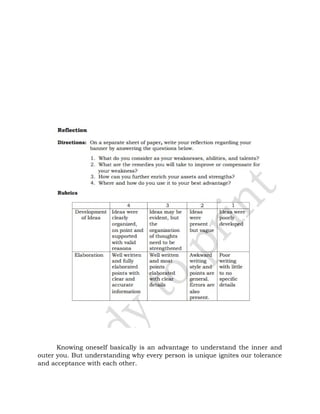
Knowing oneself basically is an advantage to understand the inner and
outer you. But understanding why every person is unique ignites our tolerance
and acceptance with each other.
Uniqueness is defined in different ways and here are some of the collective
definitions:
1. Being the only one or SOLE.
2. A person who has distinct characteristics.
3. The quality of being unique or unusual in some special way.
4. A state or condition wherein someone or something is unlike anything else
in comparison.
These definitions provide us a vivid thought that each of us possesses
peculiarity or differentiation from each other.
Jack Nollan (2020) of A Conscious Rethink.com coined 10 Things that
Make a Person Unique. These include (1) PERSONALITY that stretches from
the day a person started to see and experience life in the world leading to
gathering information, knowledge, acquiring skills, possessing emotional
responses, and making choices differently from other people; (2) ATTITUDE
that becomes the anchor of becoming either positive or negative in life,
perceiving how people act in front of you, and an offshoot of your emotional
landscape; (3) EXPERIENCES that shape you on how you act and behave
today. If you experienced negative, you tend to behave anxious or defensive
however, some would deal with it as a motivator while experiencing positive
that improves your senses in understanding the world; (4) HABITS that
normally we do everyday in our lives such as our eating habit, personal hygiene
practices, meditation exercises, and trying new things. Cliché’ but as they
always say and globally accepted and favored, “You are what you do, not what
you say you’ll do” and that makes you unique from others; (5) such as
CREATIVITY dancing, painting, singing, producing useful things out of scrap
materials, defining beauty in a different way and perspective makes you
unique; (6) PERSPECTIVE saying that no other people understands the world
as you do because they do not live like exactly 24 hours beside you. Your
experience is not the same with others’, your body of knowledge is not the
same as theirs. That is why the gaps are filled from each own unique
perspective to continuously develop and improve; (7) TASTE that is a unique
facet of you because you have different likes and dislikes from other people; (8)
GOALS that are set in different manners depending on how you create steps
and procedures in achieving those; (9) that HOBBIES improves your personal
growth and mental health such as gardening, cooking, and gaming; and (10)
PASSION that provides direction toward a goal or experience that will allow us
to leave a unique mark in this world such as involvement in philanthropic
activities like giving and supporting people in need.
These 10 things that make people unique from others greatly show that
individuals their own set of characteristics that have can be shown to the
world.
Problem arises due to the limitation of widening each horizon in
accepting and facing people worldwide. In the United States of America, some
people who experienced discrimination were reported due to individual
differences such as in race, religion, color of the skin, hobbies, language, and
personality. In the Philippine setting, one of the primary social issues in terms
of difference is the acceptance of what we call as categorized in the LGBTQ
community seeking for equality in work, school, and facilities.
Diversity is also one term that is parallel of being unique. It has been a
major advocacy of some in the world since we differ in culture, tradition, and
belief particularly on how we perceived ourselves individually based on who
nurtured us and the nature or location that we are in.
"Diversity" means more than just acknowledging and/or tolerating difference.
(JPantaleo, 2020) Diversity is a set of conscious practices that involve:
• Understanding and appreciating interdependence of humanity, cultures, and
the natural environment.
• Practicing mutual respect for qualities and experiences that are different from
our own.
• Understanding that diversity includes not only ways of being but also ways of
knowing;
• Recognizing that personal, cultural and institutionalized discrimination
creates and sustains privileges for some while creating and sustaining
disadvantages for others;
• Building alliances across differences so that we can work together to
eradicate all forms of discrimination.
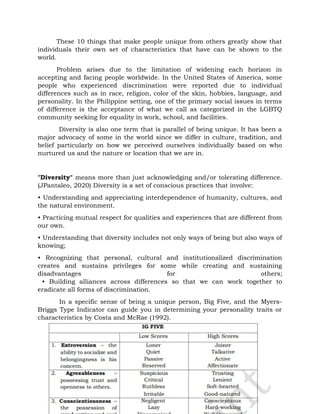
In a specific sense of being a unique person, Big Five, and the Myers-
Briggs Type Indicator can guide you in determining your personality traits or
characteristics by Costa and McRae (1992).
These personality traits as one measurement in determining our own
personal characteristics can be easily memorized and identified with an
acronym of OCEAN. The table is subdivided into 2 scores which include lower
scores and higher scores. Low score means you do not possess the dimension
and high score means you have the dimension as your characteristic. For
example, if you tend to determine if you possess extroversion in a rating of 1-5
with which 1 is the lowest and 5 is the highest, let’s say when you rate yourself
in the score of 1 in this dimension then it shows that you may be identified as
being a lonely person, quiet, passive, or reserved. The same as with other
dimensions. In this manner, you can easily categorize your characteristics as a
person.
The summation of being a unique one has been advantageous not only to
oneself but with other people leading towards Understanding, Tolerance, and
Acceptance. These 3 things fused together to help each other perceive ourselves
as an individual with different characteristics, habits, and experiences.
The basic concept of understanding is when we know ourselves and our
ability to understand the feelings of others, and vice versa, tolerance is
associated with willingness to accept behavior and beliefs that are different
from your own with fair, objective, and permissive attitude toward those whose
opinions, practices, race, religion, nationality, etc. differ from one's own;
freedom from bigotry, although you might not agree with or approve of them
such as in the example of religion where scriptures are not alike with the
religion that you have, and acceptance is simply the process of assenting or
recognizing a process or condition without attempting to change, protest, or
exit. (Fish, Jefferson M. 2014).
With the existence of being a unique one, how could you possibly share
your own characteristics, habits, and experiences confidently? Now, you may
stand in the mirror and reflect after answering the question “Who am I from
the previous lesson?” Now, you can tell to yourself, “I know that I am a sole
being. I know what I am capable of. I know the things that make me relaxed
and comfortable. I know that I am molded because of what I have experienced.
And with these, I understand others.
ASSESSMENT!
Directions: Read the question and write your answer in a separate sheet of
paper. Write only the letter of the best answer for each item.
1. Which of the following skills of efficient person that helps combat stress that
arises in daily life from the environment and other people?
A. Determination B. Generating Ideas
C. Managing Stress D. Problem-Solving Skills
2. Which the following confirmed, “Enquiry into the truth of the “Self” is
knowledge”?
A. The ancient Hindu writings Upanishads
B. The American poet Walt Whitman
C. The Persian poet Rumi
D. Plato, Socrates’ student
3. An awareness of yourself refers to your ____.
A. Beauty B. Emotion C. Knowledge D. Self-concept
4. This includes knowledge and skills that we acquire in the process of
cognitive
and practical activities.
A. Ability B. Experience C. Knowledge D. Skills
5. The following statements are definition of Uniqueness Except:
A. Lack of experience
Being the only one or SOLE. B.
C. A person who has distinct characteristics.
D. The quality of being unique or unusual in some special way.
6. Possessing this may differ depending on how people treat you and with the
situation you are in to.
A. Personality B. Attitude C. Passion D. Habits
7. It becomes our outlet and improves our mental state such as collecting
memorabilia and art craft.
A. Attitude B. Personality C. Taste D. Hobbies
8. How can goals become achievable?
A. If there is vague steps and procedures.
B. If there is clear systems that are being followed.
C. If you already know yourself.
D. If somebody understands you.
9. Which of the following is about being a neurotic TRUE?
A. A person who is imaginative and creative.
B. A person who always go with the flow.
C. A person who always trust somebody else.
D. A person who is emotional in every situation.
10. Which of the following is about being passionate TRUE?
A. You look for materials that would fill the gap of contentment.
B. You look for your correct perspective.
C. You look for activities that make you satisfied when you did.
D. You look for your own likes in wearing clothes and accessories

PERSONAL DVELOPMENT MODULES IN PERDE ONE

  • 1.
    Personal Development Quarter 1– Module 1: Knowing Oneself Prepared By: MARY CRISTELLE JOY A. SANTOS Personal Development Teacher
  • 2.
    Learning Objectives: At theend of this lesson, the student must be able to: a. explain that knowing yourself can make you accept your own self- concept, personal effectiveness, strengths, and limitations, and in dealing with others better, and your uniqueness. b. determine how characteristics, habits, and experiences becomes unique to every person c. share your own unique characteristics, habits, and experiences. INTRODUCTION Knowing oneself is an essential journey of self-discovery and introspection. It involves exploring your values, beliefs, strengths, and weaknesses, as well as understanding your passions and desires. This process helps you gain clarity about who you are and what truly matters to you. By looking inward, you uncover the unique qualities that define you and begin to appreciate your individuality. Self-awareness forms the foundation for personal growth and meaningful connections with others. It enables you to navigate life's challenges with greater confidence and resilience, as you become more attuned to your true needs and aspirations. By recognizing your emotional patterns and triggers, you can better manage your responses and improve your relationships. Understanding your strengths allows you to leverage them in achieving your goals, while acknowledging your weaknesses gives you the opportunity to work on them or seek support. Embracing the journey of self-knowledge is a continuous process that leads to deeper insights and personal fulfillment. It empowers you to make authentic choices aligned with your true self, rather than being swayed by external influences. This inner clarity not only enhances your decision-making and problem-solving abilities but also fosters a greater sense of purpose and direction in life. Ultimately, knowing oneself paves the way for a more authentic, balanced, and satisfying life.
  • 3.
    Imagine yourself lookinginto a mirror. What do you see? Do you see your ideal self or your actual self? Your is the self that you ideal self aspire to be. It is the one that you hope will possess characteristics like that of a mentor or some other worldly figure. Your however, is the one that you see. It actual self, is the self that has characteristics that you were nurtured or in some cases, born to have. The actual self and the ideal self are two broad categories of self-concept. Self-concept refers to your awareness of yourself. It is the construct that negotiates these two selves. In other words, it connotes first the identification of the ideal self as separate from others and second is that it encompasses all the behaviors evaluated in the actual self that you engage in to reach the ideal self. It is believed that the words “Know Thyself” which were written at the entry of the oracle at Delphi by seven Greek philosophers, statesmen and lawgivers became the cornerstone of Western philosophy. > For Socrates, the most important thing to pursue was self -knowledge and admitting one’s ignorance is the beginning of true knowledge. > For Plato, one of Socrates’ students, the beginning of knowledge is self- knowledge. > Other ancient philosophers from other culture saw the wisdom in knowing oneself. > The ancient Hindu writings Upanishads confirmed “Enquiry into the truth of the “Self” is knowledge”. > The Persian poet Rumi ruminated “Who am I in the midst of all this thought traffic?” and > The American poet Walt Whitman celebrated his “Self” as a “simple and separate person.” The Actual self is built on self-knowledge. Self-knowledge is derived from a social interaction that provide insight into how others react to you. The actual self is who we are. It is how we think, how we feel, look, and act. The actual self can be seen by others but because we have no way of truly knowing how others view us, the actual self is our self-image. The Ideal Self, on the other hand, is how we want to be. It ideal self is an idealized image that we have developed over time based on what we have learned and experienced. The ideal self could include components of what our parents have taught us, what we admire in others, what our society promotes, and what we think best interests us. How to know oneself? We must define first the concept of the “Self”. In philosophical terms, it is the being which is the source of a person’s consciousness. It is the agent responsible for an individual’s thoughts and
  • 4.
    actions. Based onthis definition, the “Self” is an intangible entity that directs a person’s thoughts and actions. It is outside the physical realm of the person. The “Self” is the essence of a person: his thoughts, feelings and actions, experiences, beliefs, values, principles, and relationships. The “Self’ includes a person’s life purpose, meaning and aspirations. If the “Self” is defined as the cognitive and affective representation of one’s identity, it is then defined in terms of human characteristics such as behavior and thought. Personal Effectiveness Personal effectiveness means making use of all the personal resources- talents, skills, energy, and time to enable you to achieve goals. Our personal effectiveness depends on our innate characteristics-talent and experience accumulated in the process of personal development. Talents first are needed to be identified and then developed to be used in a particular subject area (science, literature, sports, politics, etc.) Experience includes knowledge and skills that we acquire in the process of cognitive and practical activities. Knowledge is required for setting goals and defining an action plan to achieve them and risk assessment. Skills also determine whether real actions are performed in accordance with the plan. If the same ability is used many times in the same situation, then it becomes a habit that runs automatically, subconsciously. Here are some skills that will greatly increases the efficiency of any person who owns them: 1. Determination. It allows you to focus only in achieving a specific goal without being distracted by less important things or spontaneous desires. It may be developed with the help of self-discipline exercise. 2. Self-Confidence. It appears in the process of personal development as a result of getting aware of yourself, your actions and their consequences. Self- confidence is manifested in speech, appearance, dressing, gait, and physical condition. To develop it, you need to learn about yourself and your capabilities, gain positive attitude and believe that by performing right actions and achieving right goals you will certainly reach success.
  • 5.
    3. Persistence. Itmakes you keep moving forward regardless of emerging obstaclesproblems, laziness, bad emotional state, etc. It reduces the costs of overcoming obstacles. It can also be developed with the help of self-discipline exercise. 4. Managing Stress. It helps combat stress that arises in daily life from the environment and other people. Stress arises from the uncertainty in an unknown situation when a lack of information creates the risk of negative consequences of your actions. It increases efficiency. In the actively changing environment. 5. Problem-solving skills. They help cope with the problems encountered with a lack of experience. It increases efficiency by adopting new ways of achieving goals when obtaining a new experience. 6. Creativity. It allows to find extraordinary ways to carry out a specific action that no one has tried to use. It can lead to decrease or an increase of costs. But usually, the speed of action is greatly increased when using creative tools. 7. Generating ideas. It helps you achieve goals using new, original, unconventional ideas. For generating idea, you can use a method of mental maps which allows you to materialize, visualize and scrutinize all your ideas, which in turn contributes to the emergence of new ideas. Build on Your Strengths and Work on Your Weaknesses Instead of giving up or indulging in self-pity, take action. Go for speech lessons, get skills upgrading, attend personality development sessions or whatever appropriate remedies to your perceived weakness. Instead of simply focusing on your weaknesses, recognize your own talents and abilities, build on them and utilize them to your greatest advantage. This is where you can build your name and popularity.
  • 8.
    Knowing oneself basicallyis an advantage to understand the inner and outer you. But understanding why every person is unique ignites our tolerance and acceptance with each other.
  • 9.
    Uniqueness is definedin different ways and here are some of the collective definitions: 1. Being the only one or SOLE. 2. A person who has distinct characteristics. 3. The quality of being unique or unusual in some special way. 4. A state or condition wherein someone or something is unlike anything else in comparison. These definitions provide us a vivid thought that each of us possesses peculiarity or differentiation from each other. Jack Nollan (2020) of A Conscious Rethink.com coined 10 Things that Make a Person Unique. These include (1) PERSONALITY that stretches from the day a person started to see and experience life in the world leading to gathering information, knowledge, acquiring skills, possessing emotional responses, and making choices differently from other people; (2) ATTITUDE that becomes the anchor of becoming either positive or negative in life, perceiving how people act in front of you, and an offshoot of your emotional landscape; (3) EXPERIENCES that shape you on how you act and behave today. If you experienced negative, you tend to behave anxious or defensive however, some would deal with it as a motivator while experiencing positive that improves your senses in understanding the world; (4) HABITS that normally we do everyday in our lives such as our eating habit, personal hygiene practices, meditation exercises, and trying new things. Cliché’ but as they always say and globally accepted and favored, “You are what you do, not what you say you’ll do” and that makes you unique from others; (5) such as CREATIVITY dancing, painting, singing, producing useful things out of scrap materials, defining beauty in a different way and perspective makes you unique; (6) PERSPECTIVE saying that no other people understands the world as you do because they do not live like exactly 24 hours beside you. Your experience is not the same with others’, your body of knowledge is not the same as theirs. That is why the gaps are filled from each own unique perspective to continuously develop and improve; (7) TASTE that is a unique facet of you because you have different likes and dislikes from other people; (8) GOALS that are set in different manners depending on how you create steps and procedures in achieving those; (9) that HOBBIES improves your personal growth and mental health such as gardening, cooking, and gaming; and (10) PASSION that provides direction toward a goal or experience that will allow us to leave a unique mark in this world such as involvement in philanthropic activities like giving and supporting people in need.
  • 10.
    These 10 thingsthat make people unique from others greatly show that individuals their own set of characteristics that have can be shown to the world. Problem arises due to the limitation of widening each horizon in accepting and facing people worldwide. In the United States of America, some people who experienced discrimination were reported due to individual differences such as in race, religion, color of the skin, hobbies, language, and personality. In the Philippine setting, one of the primary social issues in terms of difference is the acceptance of what we call as categorized in the LGBTQ community seeking for equality in work, school, and facilities. Diversity is also one term that is parallel of being unique. It has been a major advocacy of some in the world since we differ in culture, tradition, and belief particularly on how we perceived ourselves individually based on who nurtured us and the nature or location that we are in. "Diversity" means more than just acknowledging and/or tolerating difference. (JPantaleo, 2020) Diversity is a set of conscious practices that involve: • Understanding and appreciating interdependence of humanity, cultures, and the natural environment. • Practicing mutual respect for qualities and experiences that are different from our own. • Understanding that diversity includes not only ways of being but also ways of knowing; • Recognizing that personal, cultural and institutionalized discrimination creates and sustains privileges for some while creating and sustaining disadvantages for others; • Building alliances across differences so that we can work together to eradicate all forms of discrimination. In a specific sense of being a unique person, Big Five, and the Myers- Briggs Type Indicator can guide you in determining your personality traits or characteristics by Costa and McRae (1992).
  • 11.
    These personality traitsas one measurement in determining our own personal characteristics can be easily memorized and identified with an acronym of OCEAN. The table is subdivided into 2 scores which include lower scores and higher scores. Low score means you do not possess the dimension and high score means you have the dimension as your characteristic. For example, if you tend to determine if you possess extroversion in a rating of 1-5 with which 1 is the lowest and 5 is the highest, let’s say when you rate yourself in the score of 1 in this dimension then it shows that you may be identified as being a lonely person, quiet, passive, or reserved. The same as with other dimensions. In this manner, you can easily categorize your characteristics as a person. The summation of being a unique one has been advantageous not only to oneself but with other people leading towards Understanding, Tolerance, and Acceptance. These 3 things fused together to help each other perceive ourselves as an individual with different characteristics, habits, and experiences. The basic concept of understanding is when we know ourselves and our ability to understand the feelings of others, and vice versa, tolerance is associated with willingness to accept behavior and beliefs that are different from your own with fair, objective, and permissive attitude toward those whose opinions, practices, race, religion, nationality, etc. differ from one's own; freedom from bigotry, although you might not agree with or approve of them such as in the example of religion where scriptures are not alike with the religion that you have, and acceptance is simply the process of assenting or
  • 12.
    recognizing a processor condition without attempting to change, protest, or exit. (Fish, Jefferson M. 2014). With the existence of being a unique one, how could you possibly share your own characteristics, habits, and experiences confidently? Now, you may stand in the mirror and reflect after answering the question “Who am I from the previous lesson?” Now, you can tell to yourself, “I know that I am a sole being. I know what I am capable of. I know the things that make me relaxed and comfortable. I know that I am molded because of what I have experienced. And with these, I understand others.
  • 14.
    ASSESSMENT! Directions: Read thequestion and write your answer in a separate sheet of paper. Write only the letter of the best answer for each item. 1. Which of the following skills of efficient person that helps combat stress that arises in daily life from the environment and other people?
  • 15.
    A. Determination B.Generating Ideas C. Managing Stress D. Problem-Solving Skills 2. Which the following confirmed, “Enquiry into the truth of the “Self” is knowledge”? A. The ancient Hindu writings Upanishads B. The American poet Walt Whitman C. The Persian poet Rumi D. Plato, Socrates’ student 3. An awareness of yourself refers to your ____. A. Beauty B. Emotion C. Knowledge D. Self-concept 4. This includes knowledge and skills that we acquire in the process of cognitive and practical activities. A. Ability B. Experience C. Knowledge D. Skills 5. The following statements are definition of Uniqueness Except: A. Lack of experience Being the only one or SOLE. B. C. A person who has distinct characteristics. D. The quality of being unique or unusual in some special way. 6. Possessing this may differ depending on how people treat you and with the situation you are in to. A. Personality B. Attitude C. Passion D. Habits 7. It becomes our outlet and improves our mental state such as collecting memorabilia and art craft. A. Attitude B. Personality C. Taste D. Hobbies 8. How can goals become achievable? A. If there is vague steps and procedures. B. If there is clear systems that are being followed.
  • 16.
    C. If youalready know yourself. D. If somebody understands you. 9. Which of the following is about being a neurotic TRUE? A. A person who is imaginative and creative. B. A person who always go with the flow. C. A person who always trust somebody else. D. A person who is emotional in every situation. 10. Which of the following is about being passionate TRUE? A. You look for materials that would fill the gap of contentment. B. You look for your correct perspective. C. You look for activities that make you satisfied when you did. D. You look for your own likes in wearing clothes and accessories