KNOWING YOURSELF
• learners can explain that knowing
themselves can make them accept
their strengths and limitations deal
with other people better
• share their unique characteristics,
habits, and expereinces
• maintain a journal
• appreciate and value themsleves
KNOWING YOURSELF
WHO AM I?
DO I REALLY
KNOW MYSELF?
SHOULD I
KNOW MORE ABOUT
MYSELF?
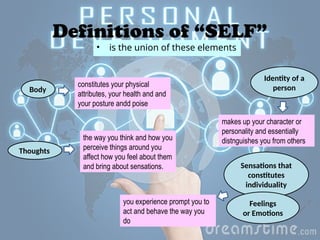
Definitions of “SELF”
• is the union of these elements
Body
Thoughts
Sensations that
constitutes
individuality
Identity of a
person
Feelings
or Emotions
constitutes your physical
attributes, your health and and
your posture andd poise
the way you think and how you
perceive things around you
affect how you feel about them
and bring about sensations.
you experience prompt you to
act and behave the way you
do
makes up your character or
personality and essentially
distnguishes you from others
“If you know the enemy
and know yourself you
need not fear the
results of a hundred
battles”
- Sun Tzu
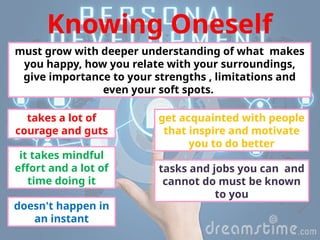
Knowing Oneself
doesn't happen in
an instant
it takes mindful
effort and a lot of
time doing it
takes a lot of
courage and guts
must grow with deeper understanding of what makes
you happy, how you relate with your surroundings,
give importance to your strengths , limitations and
even your soft spots.
get acquainted with people
that inspire and motivate
you to do better
tasks and jobs you can and
cannot do must be known
to you
Knowing Oneself
Discovering yourself is about something much
greater and of higher significance. It is
understanding who you are at your core, what most
concerns you, what makes you come energetic,
what nourishes your soul and what exhausts your
spirit, and how to know the distinction so you
decides well as you go further in life.
Activity time!
On a sheet of bond paper, use crayons to
draw symbols that would best illustrate your
thoughts and feelings about who you are.
You have to work silently and finish your
tasks withi 15 minutes.
When time is called, choose a partner.
Activity time!
In working with your partner, answer the
following:
1. How did you feel about the activity?
2. What symbols, figures, or drawings
best illustrate who you are? Why?
3. What do you think have influenced
such traits or characteristics?
Personality
• Is referred to as the set of behaviors, feelings,
thoughts and motives that identifies an
individual.
• An essence of who we are and is the
embodiment of one’s physical, psychological ,
cognitive and affective and spiritual self.
• Therefore, when we speak of the “SELF”, we
will describe it in personality terms.
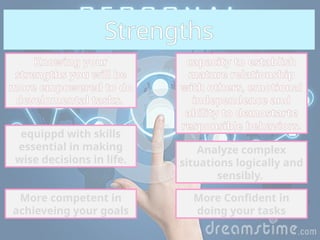
Knowing your
strengths you will be
more empowered to do
develomental tasks.
Strengths
capacity to establish
mature relationship
with others, emotional
independence and
ability to demostarte
responsible behaviors.
Analyze complex
situations logically and
sensibly.
More Confident in
doing your tasks
More competent in
achieveing your goals
equippd with skills
essential in making
wise decisions in life.
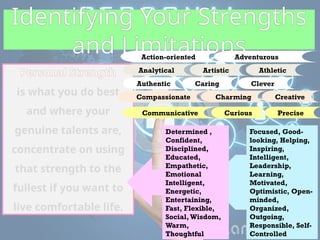
Identifying Your Strengths
and Limitations
Personal Strength
is what you do best
and where your
genuine talents are,
concentrate on using
that strength to the
fullest if you want to
live comfortable life.
Focused, Good-
looking, Helping,
Inspiring,
Intelligent,
Leadership,
Learning,
Motivated,
Optimistic, Open-
minded,
Organized,
Outgoing,
Responsible, Self-
Controlled
Determined ,
Confident,
Disciplined,
Educated,
Empathetic,
Emotional
Intelligent,
Energetic,
Entertaining,
Fast, Flexible,
Social,Wisdom,
Warm,
Thoughtful
Curious Precise
Action-oriented Adventurous
Analytical Artistic Athletic
Authentic
Compassionate Charming Creative
Caring Clever
Curious Precise
Curious
Communicative
Becoming more aware
of your weakenesses is
not the end goal of
self-development;
rather, a starting
point.
limitations
Find ways to enhance
your capabilities
develop positive
atittudes dealing with
life's challenges.
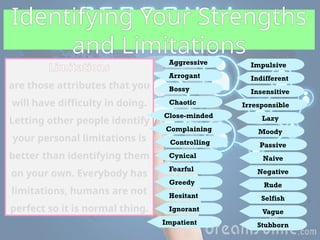
Identifying Your Strengths
and Limitations
Limitations
are those attributes that you
will have difficulty in doing.
Letting other people identify
your personal limitations is
better than identifying them
on your own. Everybody has
limitations, humans are not
perfect so it is normal thing.
Cynical
Ignorant
Fearful
Greedy
Hesitant
Impatient
Chaotic
Aggressive
Arrogant
Bossy
Close-minded
Complaining
Controlling
Impulsive
Passive
Irresponsible
Indifferent
Insensitive
Lazy
Moody
Naive
Negative
Vague
Stubborn
Rude
Selfish
Activity time!
 Form a group with four members
Have a group-sharing activity, share what you have
written about your strengths in the previous activity
with your groupmates.
 Tell each member of your group the positive
attributes that you have observed about them.
ANSWER THE FF:
1. How did you feel about the activity?
2. In one sentence, formulate your own self-
affirmation.
Affirmation: to identify your positiven
traits and allow you to appreciate those
positive traits.
Self-awareness starts with assessing yourslef.
Introspection is your ability to reflect and think about
your own thoughts, feelings, and actions, is essential
in understanding and improving yourself.
Introspection
Also, you have to listen and accept positively
feedback you get from others, as well as their
opinions about you.
Feedbacks : POSITIVE AND CRITICISM
Writing a journal is one way of helping you introspect
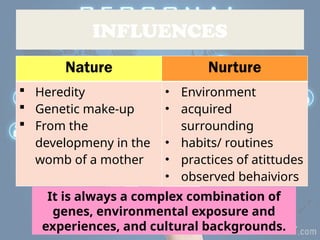
INFLUENCES
Nature Nurture
 Heredity
 Genetic make-up
 From the
developmeny in the
womb of a mother
• Environment
• acquired
surrounding
• habits/ routines
• practices of atittudes
• observed behaiviors
It is always a complex combination of
genes, environmental exposure and
experiences, and cultural backgrounds.
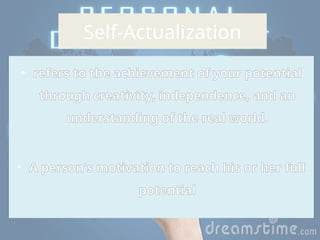
Self-Actualization
• refers to the achievement of your potential
through creativity, independence, and an
understanding of the real world.
• A person's motivation to reach his or her full
potential
wanna help ?
1. Get to know your personality
2. Get to know you core values
3. Get to know your body
4. Get to know your dreams
5. Get to know your likes and dislikes
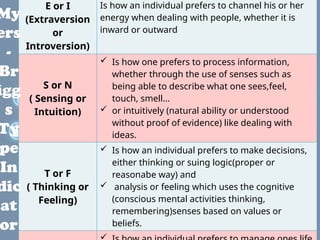
E or I
(Extraversion
or
Introversion)
Is how an individual prefers to channel his or her
energy when dealing with people, whether it is
inward or outward
S or N
( Sensing or
Intuition)
 Is how one prefers to process information,
whether through the use of senses such as
being able to describe what one sees,feel,
touch, smell...
 or intuitively (natural ability or understood
without proof of evidence) like dealing with
ideas.
T or F
( Thinking or
Feeling)
 Is how an individual prefers to make decisions,
either thinking or suing logic(proper or
reasonabe way) and
 analysis or feeling which uses the cognitive
(conscious mental activities thinking,
remembering)senses based on values or
beliefs.
My
ers
-
Br
igg
s
Ty
pe
In
dic
at
or
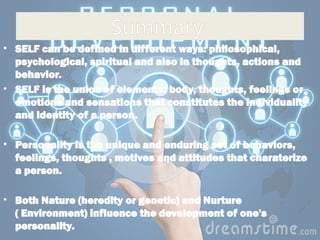
Summary
• SELF can be defined in different ways: philosophical,
psychological, spiritual and also in thoughts, actions and
behavior.
• SELF is the union of elements: body, thoughts, feelings or
emotions and sensations that constitutes the individuality
and identity of a person.
• Personality is the unique and enduring set of behaviors,
feelings, thoughts , motives and attitudes that charaterize
a person.
• Both Nature (heredity or genetic) and Nurture
( Environment) influence the development of one's
personality.

chap2knowingoneself-ppt190630033944.pptx

  • 1.
    KNOWING YOURSELF • learnerscan explain that knowing themselves can make them accept their strengths and limitations deal with other people better • share their unique characteristics, habits, and expereinces • maintain a journal • appreciate and value themsleves
  • 2.
    KNOWING YOURSELF WHO AMI? DO I REALLY KNOW MYSELF? SHOULD I KNOW MORE ABOUT MYSELF?
  • 3.
    Definitions of “SELF” •is the union of these elements Body Thoughts Sensations that constitutes individuality Identity of a person Feelings or Emotions constitutes your physical attributes, your health and and your posture andd poise the way you think and how you perceive things around you affect how you feel about them and bring about sensations. you experience prompt you to act and behave the way you do makes up your character or personality and essentially distnguishes you from others
  • 4.
    “If you knowthe enemy and know yourself you need not fear the results of a hundred battles” - Sun Tzu
  • 5.
    Knowing Oneself doesn't happenin an instant it takes mindful effort and a lot of time doing it takes a lot of courage and guts must grow with deeper understanding of what makes you happy, how you relate with your surroundings, give importance to your strengths , limitations and even your soft spots. get acquainted with people that inspire and motivate you to do better tasks and jobs you can and cannot do must be known to you
  • 6.
    Knowing Oneself Discovering yourselfis about something much greater and of higher significance. It is understanding who you are at your core, what most concerns you, what makes you come energetic, what nourishes your soul and what exhausts your spirit, and how to know the distinction so you decides well as you go further in life.
  • 7.
    Activity time! On asheet of bond paper, use crayons to draw symbols that would best illustrate your thoughts and feelings about who you are. You have to work silently and finish your tasks withi 15 minutes. When time is called, choose a partner.
  • 8.
    Activity time! In workingwith your partner, answer the following: 1. How did you feel about the activity? 2. What symbols, figures, or drawings best illustrate who you are? Why? 3. What do you think have influenced such traits or characteristics?
  • 9.
    Personality • Is referredto as the set of behaviors, feelings, thoughts and motives that identifies an individual. • An essence of who we are and is the embodiment of one’s physical, psychological , cognitive and affective and spiritual self. • Therefore, when we speak of the “SELF”, we will describe it in personality terms.
  • 10.
    Knowing your strengths youwill be more empowered to do develomental tasks. Strengths capacity to establish mature relationship with others, emotional independence and ability to demostarte responsible behaviors. Analyze complex situations logically and sensibly. More Confident in doing your tasks More competent in achieveing your goals equippd with skills essential in making wise decisions in life.
  • 11.
    Identifying Your Strengths andLimitations Personal Strength is what you do best and where your genuine talents are, concentrate on using that strength to the fullest if you want to live comfortable life. Focused, Good- looking, Helping, Inspiring, Intelligent, Leadership, Learning, Motivated, Optimistic, Open- minded, Organized, Outgoing, Responsible, Self- Controlled Determined , Confident, Disciplined, Educated, Empathetic, Emotional Intelligent, Energetic, Entertaining, Fast, Flexible, Social,Wisdom, Warm, Thoughtful Curious Precise Action-oriented Adventurous Analytical Artistic Athletic Authentic Compassionate Charming Creative Caring Clever Curious Precise Curious Communicative
  • 12.
    Becoming more aware ofyour weakenesses is not the end goal of self-development; rather, a starting point. limitations Find ways to enhance your capabilities develop positive atittudes dealing with life's challenges.
  • 13.
    Identifying Your Strengths andLimitations Limitations are those attributes that you will have difficulty in doing. Letting other people identify your personal limitations is better than identifying them on your own. Everybody has limitations, humans are not perfect so it is normal thing. Cynical Ignorant Fearful Greedy Hesitant Impatient Chaotic Aggressive Arrogant Bossy Close-minded Complaining Controlling Impulsive Passive Irresponsible Indifferent Insensitive Lazy Moody Naive Negative Vague Stubborn Rude Selfish
  • 14.
    Activity time!  Forma group with four members Have a group-sharing activity, share what you have written about your strengths in the previous activity with your groupmates.  Tell each member of your group the positive attributes that you have observed about them. ANSWER THE FF: 1. How did you feel about the activity? 2. In one sentence, formulate your own self- affirmation. Affirmation: to identify your positiven traits and allow you to appreciate those positive traits.
  • 15.
    Self-awareness starts withassessing yourslef. Introspection is your ability to reflect and think about your own thoughts, feelings, and actions, is essential in understanding and improving yourself. Introspection Also, you have to listen and accept positively feedback you get from others, as well as their opinions about you. Feedbacks : POSITIVE AND CRITICISM Writing a journal is one way of helping you introspect
  • 16.
    INFLUENCES Nature Nurture  Heredity Genetic make-up  From the developmeny in the womb of a mother • Environment • acquired surrounding • habits/ routines • practices of atittudes • observed behaiviors It is always a complex combination of genes, environmental exposure and experiences, and cultural backgrounds.
  • 17.
    Self-Actualization • refers tothe achievement of your potential through creativity, independence, and an understanding of the real world. • A person's motivation to reach his or her full potential
  • 18.
    wanna help ? 1.Get to know your personality 2. Get to know you core values 3. Get to know your body 4. Get to know your dreams 5. Get to know your likes and dislikes
  • 19.
    E or I (Extraversion or Introversion) Ishow an individual prefers to channel his or her energy when dealing with people, whether it is inward or outward S or N ( Sensing or Intuition)  Is how one prefers to process information, whether through the use of senses such as being able to describe what one sees,feel, touch, smell...  or intuitively (natural ability or understood without proof of evidence) like dealing with ideas. T or F ( Thinking or Feeling)  Is how an individual prefers to make decisions, either thinking or suing logic(proper or reasonabe way) and  analysis or feeling which uses the cognitive (conscious mental activities thinking, remembering)senses based on values or beliefs. My ers - Br igg s Ty pe In dic at or
  • 20.
    Summary • SELF canbe defined in different ways: philosophical, psychological, spiritual and also in thoughts, actions and behavior. • SELF is the union of elements: body, thoughts, feelings or emotions and sensations that constitutes the individuality and identity of a person. • Personality is the unique and enduring set of behaviors, feelings, thoughts , motives and attitudes that charaterize a person. • Both Nature (heredity or genetic) and Nurture ( Environment) influence the development of one's personality.