Personal Development helps
studentsunderstand their own
strengths, weaknesses, values,
emotions, and personality. This
self-knowledge is the foundation
for making informed life decisions.
JOHARI’s WINDOW
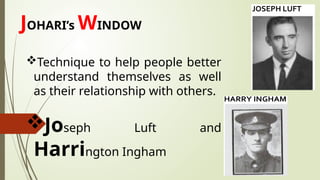
Technique tohelp people better
understand themselves as well
as their relationship with others.
Joseph Luft and
Harrington Ingham
14.
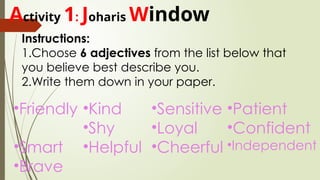
Activity 1: JoharisWindow
Instructions:
1.Choose 6 adjectives from the list below that
you believe best describe you.
2.Write them down in your paper.
•Friendly
•Smart
•Brave
•Kind
•Shy
•Helpful
•Patient
•Confident
•Independent
•Sensitive
•Loyal
•Cheerful
15.
Activity 1: JoharisWindow
3. Ask 3 classmates/friends to
choose 6 adjectives that they think
best describe you from the same
list. They should not see your
answers.
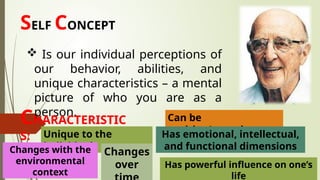
SELF CONCEPT
Isour individual perceptions of
our behavior, abilities, and
unique characteristics – a mental
picture of who you are as a
person.
CHARACTERISTIC
S: Unique to the
individual
Can be
positive/negative
Has emotional, intellectual,
and functional dimensions
Changes with the
environmental
context
Changes
over Has powerful influence on one’s
life
22.
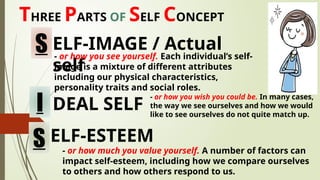
THREE PARTS OFSELF CONCEPT
S ELF-IMAGE / Actual
self
DEAL SELF
I
- or how you see yourself. Each individual’s self-
image is a mixture of different attributes
including our physical characteristics,
personality traits and social roles.
- or how you wish you could be. In many cases,
the way we see ourselves and how we would
like to see ourselves do not quite match up.
ELF-ESTEEM
S - or how much you value yourself. A number of factors can
impact self-esteem, including how we compare ourselves
to others and how others respond to us.
BENEFITS OF SELFCONCEPT
You will be happier when you can express
who you are. Expressing your desires will
make it more likely that you get what you
want.
HAPPINESS
LESS INNER CONFLICT
When your outside actions are in
accordance with inside feelings and values,
you will experience less inner conflict.
25.
BENEFITS OF SELFCONCEPT
When you know yourself, you are able to
make better choices about everything, from
small decisions to big decisions.
SELF-CONTROL
When you know yourself, you understand what
motivates you to resist bad habits and develop
good ones. You’ll have the insight to know
which values and goals activate your willpower.
BETTER DECISION-
MAKING
BENEFITS OF SELFCONCEPT
When you are grounded in your values and
preferences, you are less likely to say “yes” when
you want to say “no”.
TOLERANCE AND UNDERSTANDING OF
OTHERS
Your awareness of your own foibles and
struggles can help you empathize with others.
RESISTANCE TO SOCIAL PRESSURE
VITALITY AND PLEASURE
Being who you truly are helps you feel more alive and
makes your experience of life richer, larger, and more
exciting.
28.
PERSONAL
EFFECTIVENESS
means makinguse of all the personal resources –
talents, skills, energy and time, to enable to achieve life
goals.
our personal effectiveness depends on our innate
characteristics – talent and experience accumulated in
the process of personal development.
29.
SKILLS THAT INCREASEPERSON’S EFFECIENCY
DETERMINATION
SELF-
CONFIDENCE
the commitment to achieve your
goals, regardless of the
challenges you might experience
Self-confidence is an attitude
about your skills and abilities. It
means you accept and trust
yourself and have a sense of
control in your life. You know
your strengths and weakness
well, and have a positive view of
yourself.
30.
SKILLS THAT INCREASEPERSON’S EFFECIENCY
PERSISTENCE
MANAGING
STRESS
continuing to do something or
to try to do something even
though it is difficult or other
people want you to stop.
developing healthy coping
mechanisms to minimize the
negative impacts of stress and
improve overall well-being
31.
SKILLS THAT INCREASEPERSON’S EFFECIENCY
PROBLEM
SOLVING SKILLS
CREATIVITY
GENERATING
IDEAS
an ability of coping with the
problems by increasing
efficiency in adopting ways.
an ability of generating new
ideas
an ability of achieving goals
using new, original, and
unconventional ideas.
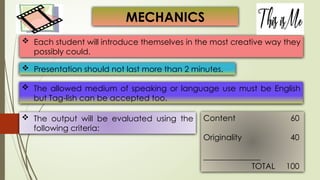
Each studentwill introduce themselves in the most creative way they
possibly could.
Presentation should not last more than 2 minutes.
MECHANICS
The allowed medium of speaking or language use must be English
but Tag-lish can be accepted too.
The output will be evaluated using the
following criteria:
Content 60
Originality 40
TOTAL 100
Editor's Notes
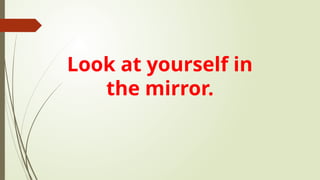
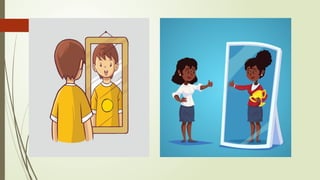
#4 Gaano mo kakilala ang sarili mo? Gaano ka kawilling na madevelop pa ang pagkatao mo?
Kapag tumitingin ka sa salamin, ano ang nakikita mo? Gusto mo ba ang nakikita mo?
#5 Anong nakikita nila sa salamin?
Ganyan din ba ang nakikita mo sa tuwing nagsasalamin ka?
#6 Anong nakikita nila sa salamin?
Ganyan din ba ang nakikita mo sa tuwing nagsasalamin ka?
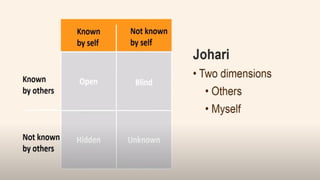
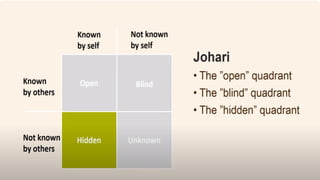
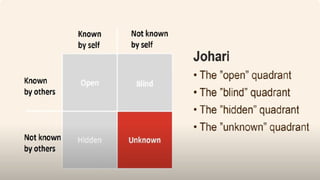
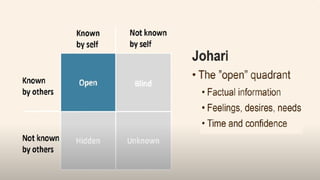
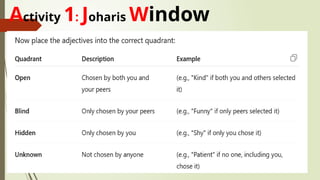
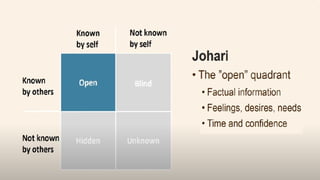
#8 Consist of four quadrants
Others – what is known by others about me, and respectively, what is not known by others!
Myself – known by myself and what is not by myself (ex. I dont like to speech in a large gathering but i am not aware that i am touching my hair when i am speaking)
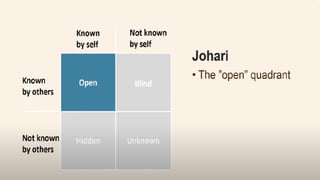
#9 Open Quadrant - is what is known by myself - and known by others
Ex: I Know my name and you know my name. (box 1)
In the begging we know each other, the quadrant is not very large, but the longer we know and confident with each other the window shade will move down or to the right. The more the window shade move to the right or down the more you know about me and the more I know about you.
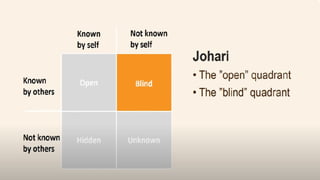
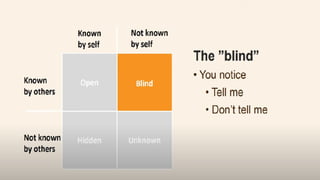
#10 Blind quadrant - is what is known by others but not known by myself
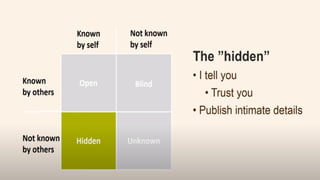
#11 “hidden” quadrant - is what is known by myself but not known by others
#12 unknown” quadrant - is what is not known by myself - and also not known by others
#13 Open Quadrant - is what is known by myself - and known by others
Ex: I Know my name and you know my name. (box 1)
In the begging we know each other, the quadrant is not very large, but the longer we know and confident with each other the window shade will move down or to the right. The more the window shade move to the right or down the more you know about me and the more I know about you.
#17 Open Quadrant - is what is known by myself - and known by others
Ex: I Know my name and you know my name. (box 1)
In the begging we know each other, the quadrant is not very large, but the longer we know and confident with each other the window shade will move down or to the right. The more the window shade move to the right or down the more you know about me and the more I know about you.
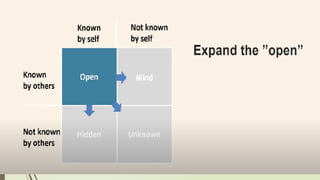
#18 How to expand the open quadrant?
Blind – ask someone how they see you
Hidden – telling something about yourself. (be aware, not everything should be told to someone, choose the person carefully)
Unknown – asks someone.
Ask someone you trust and always remember it is subjective, it means not all of their observations is true.
#19 Tell me – becomes part of open quadrant
Don’t say – remains unknown and stay to blind quadrant, you know it buy I don’t know it.
#20 My secrets
If I tell you it will move into an open quadrant ( known by others and known by self)
If I trust you the more secrets I will tell you, the larger the quadrant will become
Publish intimate details in facebook
#23 A positive self-concept can lead to greater confidence, motivation, and success, while a negative one can hinder personal growth and create challenges in various aspects of life.
#26 BETTER DECISION-MAKING – make better choices
Self – control - understand what motivates you to resist bad habits and develop good ones.