Personal Development
Quarter 1 – Module 1:
Knowing Oneself
Activity 2: Paint Me a Picture
Instruction:
Draw an object, animal or any
representation of yourself. You may
use coloring materials to enhance
your work. Make a short discussion
about your output.
___________________________
Title
___________________________________________________
___________________________________________________
___________________________________________________
_______________________________________
SELF-CONCEPT
Imagine yourself looking into a mirror. What
do you see? Do you see your ideal self or
your actual self? Your ideal self is the self
that you aspire to be. It is the one that you
hope will possess characteristics similar to
that of a mentor or some other worldly
figure. Your actual self, however, is the one
that you actually see. It is the self that has
characteristics that you were nurtured or, in
some cases, born to have.
The actual self and the ideal self are two
broad categories of self-concept. Self-
concept refers to your awareness of
yourself. It is the construct that negotiates
these two selves. In other words, it connotes
first the identification of the ideal self as
separate from others, and second, it
encompasses all the behaviors evaluated in
the actual self that you engage in to reach
the ideal self.
The actual self is built on self-knowledge.
Self-knowledge is derived from social
interactions that provide insight into how
others react to you. The actual self is who
we actually are. It is how we think, how we
feel, look, and act. The actual self can be
seen by others, but because we have no way
of truly knowing how others view us, the
actual self is our self-image.
The ideal self, on the other hand, is
how we want to be. It is an idealized
image that we have developed over
time, based on what we have learned
and experienced. The ideal self could
include components of what our parents
have taught us, what we admire in
others, what our society promotes, and
what we think is in our best interest.
There is negotiation that exists between
the two selves which is complex
because there are numerous exchanges
between the ideal and actual self.
These exchanges are exemplified in
social roles that are adjusted and re-
adjusted, and are derived from
outcomes of social interactions from
infant to adult development. Alignment
is important.
If the way that I am (the actual self) is
aligned with the way that I want to be
(the ideal self), then I will feel a sense
of mental well-being or peace of mind.
If the way that I am is not aligned with
how I want to be, the incongruence, or
lack of alignment, will result in mental
distress or anxiety. The greater the
level of incongruence between the ideal
self and real self, the greater the level
of resulting distress.
Personal development modules ultimate
aim is greater self-knowledge that will
lead to higher alignment between these
two personality domains.
Source:http://study.com/academy/lesson/what-is-self-
concept-in-psychology-definition-lesson-quiz.html;
Process Questions:
1. What is self- concept? Give its
aspects.
2. Differentiate actual self and ideal
self. Cite example to explain.
3. Explain the negotiation between the
two selves.
Activity 3
Abtash cipher is a mono-alphabetic
substitution cipher used for the Hebrew
alphabet. The Atbash Cipher simply reverses
the plaintext alphabet to create the
ciphertext alphabet. Decipher the following
terms that are associated with genetic
engineering. Write your answer on the blank
and corresponding to your answer, write
anything you know about the word. (Try to
recall your prior knowledge and try not to
cheat!
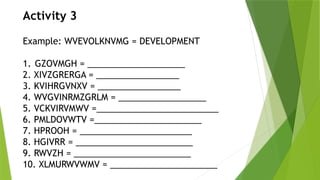
Activity 3
Example: WVEVOLKNVMG = DEVELOPMENT
1. GZOVMGH = ____________________
2. XIVZGRERGA = _________________
3. KVIHRGVNXV = _________________
4. WVGVINRMZGRLM = __________________
5. VCKVIRVMWV =_________________________
6. PMLDOVWTV =______________________
7. HPROOH = _______________________
8. HGIVRR = ________________________
9. RWVZH = ________________________
10. XLMURWVWMV = ______________________
What’s More
PERSONAL EFFECTIVENESS-making use of all the
personal resources – talents, skills, energy and time, to
enable you to achieve life goals.
Your knowledge of yourself and how you manage
yourself impacts directly on your personal
effectiveness. Being self-aware, making the most of
your strengths, learning new skills and techniques and
behavioral flexibility are all keys to improving your
personal performance. Our personal effectiveness
depends on our innate characteristics – talent and
experience accumulated in the process of personal
development.
What’s More
PERSONAL EFFECTIVENESS-making use of all the
personal resources – talents, skills, energy and time, to
enable you to achieve life goals.
Your knowledge of yourself and how you manage
yourself impacts directly on your personal
effectiveness. Being self-aware, making the most of
your strengths, learning new skills and techniques and
behavioral flexibility are all keys to improving your
personal performance. Our personal effectiveness
depends on our innate characteristics – talent and
experience accumulated in the process of personal
development.
What’s More
Talents first are needed to be identified and then
developed to be used in a particular subject area
(science, literature, sports, politics, etc.). Experience
includes knowledge and skills that we acquire in the
process of cognitive and practical activities.
Knowledge is required for setting goals, defining an
action plan to achieve them and risk assessment. Skills
also determine whether real actions are performed in
accordance with the plan. If the same ability is used
many times in the same situation, then it becomes a
habit that runs automatically, subconsciously.
What’s More
Here are some skills that will greatly increase the
efficiency of any person who owns them:
1. Determination. It allows you to focus only on
achieving a specific goal without being
distracted by less important things or
spontaneous desires. It may be developed with
the help of self-discipline exercise.
What’s More
Here are some skills that will greatly increase the
efficiency of any person who owns them:
1. Determination. It allows you to focus only on
achieving a specific goal without being
distracted by less important things or
spontaneous desires. It may be developed with
the help of self-discipline exercise.
What’s More
Here are some skills that will greatly increase the
efficiency of any person who owns them:
2. Self-confidence. It appears in the process of
personal development, as a result of getting aware of
yourself, your actions and their consequences. Self-
confidence is manifested in speech, appearance,
dressing, gait, and physical condition. To develop it,
you need to learn yourself and your capabilities, gain
positive attitude and believe that by performing right
actions and achieving right goals you will certainly
reach success.
What’s More
Here are some skills that will greatly increase the
efficiency of any person who owns them:
3. Persistence. It makes you keep moving forward
regardless of emerging obstacles – problems,
laziness, bad emotional state, etc. It reduces the
costs of overcoming obstacles. It can also be
developed with the help of self- discipline
exercise.
What’s More
Here are some skills that will greatly increase the
efficiency of any person who owns them:
4. Managing stress. It helps combat stress that arises
in daily life from the environment and other
people. Stress arises from the uncertainty in an
unknown situation when a lack of information
creates the risk of negative consequences of your
actions. It increases efficiency in the actively
changing environment.
What’s More
Here are some skills that will greatly increase the
efficiency of any person who owns them:
5. Problem-solving skills. They help cope with the
problems encountered with a lack of experience. It
increases efficiency by adopting new ways of
achieving goals when obtaining a new experience.
What’s More
Here are some skills that will greatly increase the
efficiency of any person who owns them:
6. Creativity. It allows you to find extraordinary ways
to carry out a specific action that no one has tried to
use. It can lead to a decrease or an increase of costs,
but usually the speed of action is greatly increased
when using creative tools.
What’s More
Here are some skills that will greatly increase the
efficiency of any person who owns them:
7. Generating ideas. It helps you achieve goals using
new, original, unconventional ideas. Idea is a mental
image of an object formed by the human mind, which
can be changed before being implemented in the real
world. For generating ideas you can use a method of
mental maps, which allows you to materialize,
visualize and scrutinize all your ideas, which in turn
contributes to the emergence of new ideas.
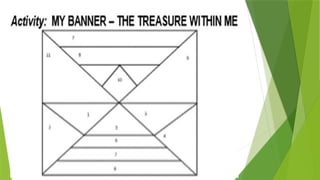
Activity 4. MY BANNER –
THE TREASURE WITHIN
ME
Instruction: Fill in the spaces in
your banner with word/words
following the description below.
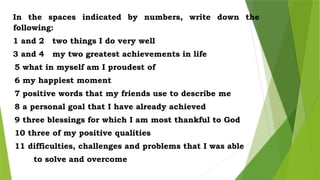
In the spaces indicated by numbers, write down the
following:
1 and 2 two things I do very well
3 and 4 my two greatest achievements in life
5 what in myself am I proudest of
6 my happiest moment
7 positive words that my friends use to describe me
8 a personal goal that I have already achieved
9 three blessings for which I am most thankful to God
10 three of my positive qualities
11 difficulties, challenges and problems that I was able
to solve and overcome
Personal Development_Lesson 1: Knowing Oneself

Personal Development_Lesson 1: Knowing Oneself

  • 1.
    Personal Development Quarter 1– Module 1: Knowing Oneself
  • 2.
    Activity 2: PaintMe a Picture Instruction: Draw an object, animal or any representation of yourself. You may use coloring materials to enhance your work. Make a short discussion about your output.
  • 3.
  • 4.
    SELF-CONCEPT Imagine yourself lookinginto a mirror. What do you see? Do you see your ideal self or your actual self? Your ideal self is the self that you aspire to be. It is the one that you hope will possess characteristics similar to that of a mentor or some other worldly figure. Your actual self, however, is the one that you actually see. It is the self that has characteristics that you were nurtured or, in some cases, born to have.
  • 5.
    The actual selfand the ideal self are two broad categories of self-concept. Self- concept refers to your awareness of yourself. It is the construct that negotiates these two selves. In other words, it connotes first the identification of the ideal self as separate from others, and second, it encompasses all the behaviors evaluated in the actual self that you engage in to reach the ideal self.
  • 6.
    The actual selfis built on self-knowledge. Self-knowledge is derived from social interactions that provide insight into how others react to you. The actual self is who we actually are. It is how we think, how we feel, look, and act. The actual self can be seen by others, but because we have no way of truly knowing how others view us, the actual self is our self-image.
  • 7.
    The ideal self,on the other hand, is how we want to be. It is an idealized image that we have developed over time, based on what we have learned and experienced. The ideal self could include components of what our parents have taught us, what we admire in others, what our society promotes, and what we think is in our best interest.
  • 8.
    There is negotiationthat exists between the two selves which is complex because there are numerous exchanges between the ideal and actual self. These exchanges are exemplified in social roles that are adjusted and re- adjusted, and are derived from outcomes of social interactions from infant to adult development. Alignment is important.
  • 9.
    If the waythat I am (the actual self) is aligned with the way that I want to be (the ideal self), then I will feel a sense of mental well-being or peace of mind. If the way that I am is not aligned with how I want to be, the incongruence, or lack of alignment, will result in mental distress or anxiety. The greater the level of incongruence between the ideal self and real self, the greater the level of resulting distress.
  • 10.
    Personal development modulesultimate aim is greater self-knowledge that will lead to higher alignment between these two personality domains. Source:http://study.com/academy/lesson/what-is-self- concept-in-psychology-definition-lesson-quiz.html;
  • 11.
    Process Questions: 1. Whatis self- concept? Give its aspects. 2. Differentiate actual self and ideal self. Cite example to explain. 3. Explain the negotiation between the two selves.
  • 12.
    Activity 3 Abtash cipheris a mono-alphabetic substitution cipher used for the Hebrew alphabet. The Atbash Cipher simply reverses the plaintext alphabet to create the ciphertext alphabet. Decipher the following terms that are associated with genetic engineering. Write your answer on the blank and corresponding to your answer, write anything you know about the word. (Try to recall your prior knowledge and try not to cheat!
  • 13.
    Activity 3 Example: WVEVOLKNVMG= DEVELOPMENT 1. GZOVMGH = ____________________ 2. XIVZGRERGA = _________________ 3. KVIHRGVNXV = _________________ 4. WVGVINRMZGRLM = __________________ 5. VCKVIRVMWV =_________________________ 6. PMLDOVWTV =______________________ 7. HPROOH = _______________________ 8. HGIVRR = ________________________ 9. RWVZH = ________________________ 10. XLMURWVWMV = ______________________
  • 14.
    What’s More PERSONAL EFFECTIVENESS-makinguse of all the personal resources – talents, skills, energy and time, to enable you to achieve life goals. Your knowledge of yourself and how you manage yourself impacts directly on your personal effectiveness. Being self-aware, making the most of your strengths, learning new skills and techniques and behavioral flexibility are all keys to improving your personal performance. Our personal effectiveness depends on our innate characteristics – talent and experience accumulated in the process of personal development.
  • 15.
    What’s More PERSONAL EFFECTIVENESS-makinguse of all the personal resources – talents, skills, energy and time, to enable you to achieve life goals. Your knowledge of yourself and how you manage yourself impacts directly on your personal effectiveness. Being self-aware, making the most of your strengths, learning new skills and techniques and behavioral flexibility are all keys to improving your personal performance. Our personal effectiveness depends on our innate characteristics – talent and experience accumulated in the process of personal development.
  • 16.
    What’s More Talents firstare needed to be identified and then developed to be used in a particular subject area (science, literature, sports, politics, etc.). Experience includes knowledge and skills that we acquire in the process of cognitive and practical activities. Knowledge is required for setting goals, defining an action plan to achieve them and risk assessment. Skills also determine whether real actions are performed in accordance with the plan. If the same ability is used many times in the same situation, then it becomes a habit that runs automatically, subconsciously.
  • 17.
    What’s More Here aresome skills that will greatly increase the efficiency of any person who owns them: 1. Determination. It allows you to focus only on achieving a specific goal without being distracted by less important things or spontaneous desires. It may be developed with the help of self-discipline exercise.
  • 18.
    What’s More Here aresome skills that will greatly increase the efficiency of any person who owns them: 1. Determination. It allows you to focus only on achieving a specific goal without being distracted by less important things or spontaneous desires. It may be developed with the help of self-discipline exercise.
  • 19.
    What’s More Here aresome skills that will greatly increase the efficiency of any person who owns them: 2. Self-confidence. It appears in the process of personal development, as a result of getting aware of yourself, your actions and their consequences. Self- confidence is manifested in speech, appearance, dressing, gait, and physical condition. To develop it, you need to learn yourself and your capabilities, gain positive attitude and believe that by performing right actions and achieving right goals you will certainly reach success.
  • 20.
    What’s More Here aresome skills that will greatly increase the efficiency of any person who owns them: 3. Persistence. It makes you keep moving forward regardless of emerging obstacles – problems, laziness, bad emotional state, etc. It reduces the costs of overcoming obstacles. It can also be developed with the help of self- discipline exercise.
  • 21.
    What’s More Here aresome skills that will greatly increase the efficiency of any person who owns them: 4. Managing stress. It helps combat stress that arises in daily life from the environment and other people. Stress arises from the uncertainty in an unknown situation when a lack of information creates the risk of negative consequences of your actions. It increases efficiency in the actively changing environment.
  • 22.
    What’s More Here aresome skills that will greatly increase the efficiency of any person who owns them: 5. Problem-solving skills. They help cope with the problems encountered with a lack of experience. It increases efficiency by adopting new ways of achieving goals when obtaining a new experience.
  • 23.
    What’s More Here aresome skills that will greatly increase the efficiency of any person who owns them: 6. Creativity. It allows you to find extraordinary ways to carry out a specific action that no one has tried to use. It can lead to a decrease or an increase of costs, but usually the speed of action is greatly increased when using creative tools.
  • 24.
    What’s More Here aresome skills that will greatly increase the efficiency of any person who owns them: 7. Generating ideas. It helps you achieve goals using new, original, unconventional ideas. Idea is a mental image of an object formed by the human mind, which can be changed before being implemented in the real world. For generating ideas you can use a method of mental maps, which allows you to materialize, visualize and scrutinize all your ideas, which in turn contributes to the emergence of new ideas.
  • 26.
    Activity 4. MYBANNER – THE TREASURE WITHIN ME Instruction: Fill in the spaces in your banner with word/words following the description below.
  • 27.
    In the spacesindicated by numbers, write down the following: 1 and 2 two things I do very well 3 and 4 my two greatest achievements in life 5 what in myself am I proudest of 6 my happiest moment 7 positive words that my friends use to describe me 8 a personal goal that I have already achieved 9 three blessings for which I am most thankful to God 10 three of my positive qualities 11 difficulties, challenges and problems that I was able to solve and overcome