PERSONAL DEVELOPMENT
MODULE 1
★​ Ideal self is the self that you aspire to be. It is the one that you hope will possess
characteristics similar to that of a mentor or some other worldly figure.
★​ Actual self is the one that you actually see. It is the self that has characteristics that
you were nurtured or, in some cases, born to have.
★​ The actual self and the ideal self are two broad categories of self-concept.
★​ Self-concept refers to your awareness of yourself.it connotes first the identification
of the ideal self as separate from others, and second, it encompasses all the
behaviors evaluated in the actual self that you engage in to reach the ideal self
ACTUAL SELF
●​ The actual self is built on self-knowledge.
●​ Self-knowledge is derived from social interactions that provide insight into how
others react to you.
●​ The actual self is who we actually are. It is how we think, how we feel, look, and act.
The actual self can be seen by others, but because we have no way of truly knowing
how others view us, the actual self is our self-image.
IDEAL SELF
●​ The ideal self is how we want to be.
●​ It is an idealized image that we have developed over time, based on what we have
learned and experienced.
●​ The ideal self could include components of what our parents have taught us, what we
admire in others, what our society promotes, and what we think is in our best interest
There is negotiation that exists between the two selves which is complex because
there are numerous exchanges between the ideal and actual self.
These exchanges are exemplified in social roles that are adjusted and re-adjusted,
and are derived from outcomes of social interactions from infant to adult development.
Alignment is important. If the way that I am (the actual self) is aligned with the way that I
want to be (the ideal self), then I will feel a sense of mental well-being or peace of mind.
If the way that I am is not aligned with how I want to be, the incongruence, or lack of
alignment, will result in mental distress or anxiety. The greater the level of incongruence
between the ideal self and real self, the greater the level of resulting distress. Personal
development modules ultimate aim is greater self-knowledge that will lead to higher
alignment between these two personality domains.
PERSONAL EFFECTIVENESS
❖​ means making use of all the personal resources – talents, skills, energy and time, to
enable you to achieve life goals.
❖​ Your knowledge of yourself and how you manage yourself impacts directly on your
personal effectiveness. Being self-aware, making the most of your strengths, learning
new skills and techniques and behavioral flexibility are all keys to improving your
personal performance.
❖​ Skills also determine whether real actions are performed in accordance with the plan.
1.​ Determination. It allows you to focus only on achieving a specific goal without being
distracted by less important things or spontaneous desires. It may be developed with
the help of self-discipline exercise.
2.​ Self-confidence. It appears in the process of personal development, as a result of
getting aware of yourself, your actions and their consequences. Self-confidence is
manifested in speech, appearance, dressing, gait, and physical condition. To develop
it, you need to learn yourself and your capabilities, gain positive attitude and believe
that by performing right actions and achieving right goals you will certainly reach
success.
3.​ Persistence. It makes you keep moving forward regardless of emerging obstacles –
problems, laziness, bad emotional state, etc. It reduces the costs of overcoming
obstacles.
4.​ Managing stress. It helps combat stress that arises in daily life from the environment
and other people. Stress arises from the uncertainty in an unknown situation when a
lack of information creates the risk of negative consequences of your actions.
5.​ Problem-solving skills. They help cope with the problems encountered with a lack
of experience. It increases efficiency by adopting new ways of achieving goals when
obtaining a new experience.
6.​ Creativity. It allows you to find extraordinary ways to carry out a specific action that
no one has tried to use.
7.​ Generating ideas. It helps you achieve goals using new, original, unconventional
ideas. Idea is a mental image of an object formed by the human mind, which can be
changed before being implemented in the real world. For generating ideas you can
use a method of mental maps, which allows you to materialize, visualize and
scrutinize all your ideas, which in turn contributes to the emergence of new ideas.
3 KINDS OF PEOPLE IN THE WORLD
The first is the Moviegoer. This person watches the movie of their lives, admires
some parts and criticizes others. Aside from that, they do nothing else. All she says the
whole day is, “I like this thing and but I don’t like that thing.” The Moviegoer feels she has
absolutely no control of their lives --- except to comment about it. Moviegoers are the most
pathetic, miserable people in the world.
The second is the Actor. This person does not only watch the movie of her life. She
actually realizes she’s the Actor – and can control a big part of her life. She can actually
make or break the movie – by how well she delivers her lines and how she portrays her
character. Actors are a happy bunch, realizing they’re the start of the show and enjoy some
level of control. But many times, they wish the movie would end in another way – but realize
that they have no say in such things.
The third is the Scriptwriter. This person does not only watch, and she doesn’t only
act, but she actually creates the entire movie from her mind. She determines what she will
say, what she will do, and how the movie will end. She realizes she has enormous control
over her life, and sees to it that the movie of her life will turn out beautiful.
MODULE 2
ASPECT OF THE SELF
The self-concept is represented by several aspects of the self. It is conceived as collection of
multiple, context-dependent selves. This construct believes that context activates particular
regions of self-knowledge and self-relevant feedback affects self-evaluations and affect. A
deeper look on the different aspects of self can identify specific areas for self-regulation,
stability and improvement.
1.​ Physical Self.
2.​ Intellectual Self.
3.​ Emotional Self.
4.​ Sensual Self.
5.​ Interactional Self
6.​ Nutritional Self.
7.​ Contextual Self.
8.​ Spiritual Self or Life Force.
MODULE 3
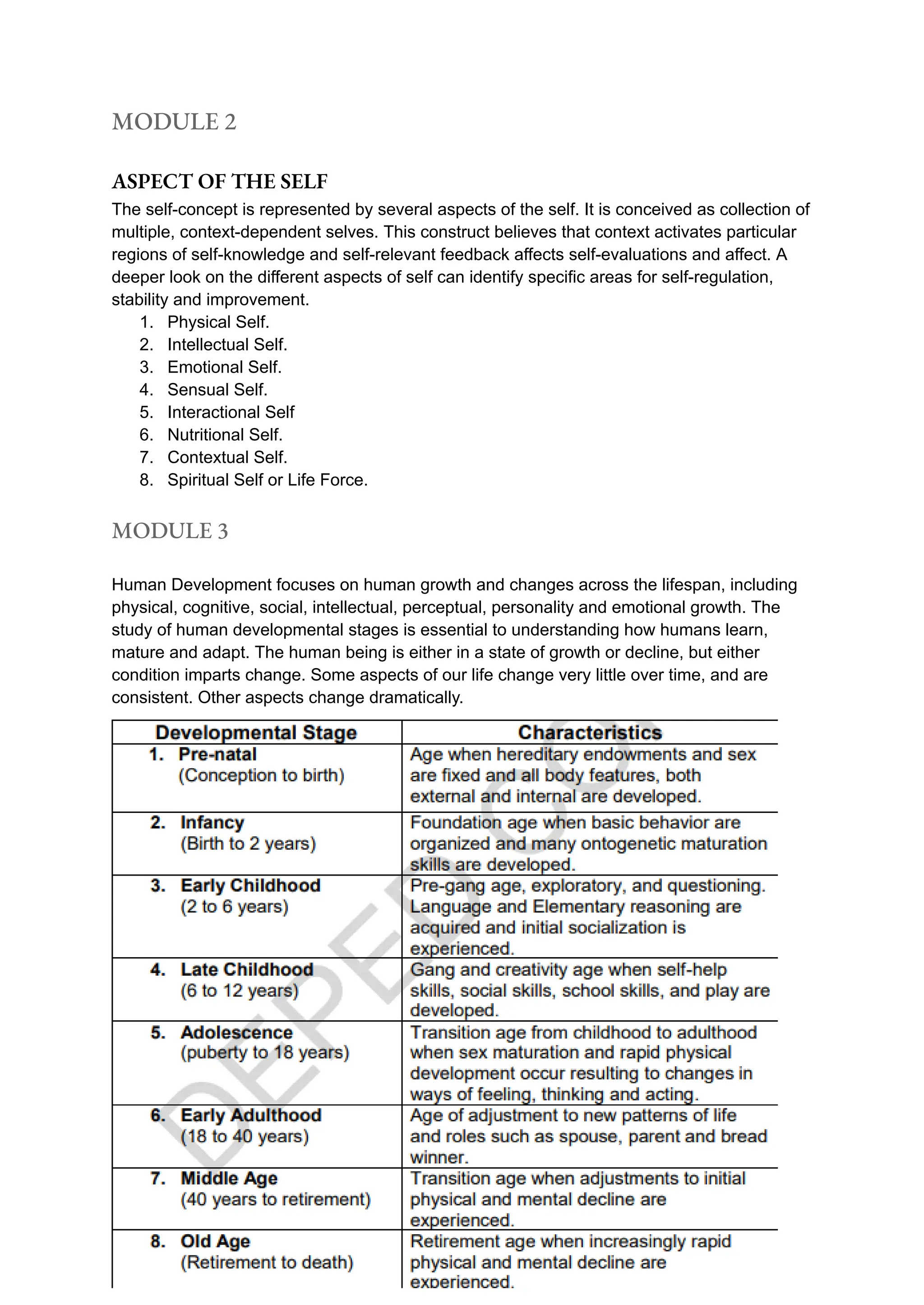
Human Development focuses on human growth and changes across the lifespan, including
physical, cognitive, social, intellectual, perceptual, personality and emotional growth. The
study of human developmental stages is essential to understanding how humans learn,
mature and adapt. The human being is either in a state of growth or decline, but either
condition imparts change. Some aspects of our life change very little over time, and are
consistent. Other aspects change dramatically.
Robert J. Havighurst elaborated on the Developmental Tasks Theory in the most
systematic and extensive manner. His main assertion is that development is continuous
throughout the entire lifespan, occurring in stages, where the individual moves from one
stage to the next by means of successful resolution of problems or performance of
developmental tasks.
PERSONAL DEVELOPMENT and Self Actualization

PERSONAL DEVELOPMENT and Self Actualization

  • 1.
    PERSONAL DEVELOPMENT MODULE 1 ★​Ideal self is the self that you aspire to be. It is the one that you hope will possess characteristics similar to that of a mentor or some other worldly figure. ★​ Actual self is the one that you actually see. It is the self that has characteristics that you were nurtured or, in some cases, born to have. ★​ The actual self and the ideal self are two broad categories of self-concept. ★​ Self-concept refers to your awareness of yourself.it connotes first the identification of the ideal self as separate from others, and second, it encompasses all the behaviors evaluated in the actual self that you engage in to reach the ideal self ACTUAL SELF ●​ The actual self is built on self-knowledge. ●​ Self-knowledge is derived from social interactions that provide insight into how others react to you. ●​ The actual self is who we actually are. It is how we think, how we feel, look, and act. The actual self can be seen by others, but because we have no way of truly knowing how others view us, the actual self is our self-image. IDEAL SELF ●​ The ideal self is how we want to be. ●​ It is an idealized image that we have developed over time, based on what we have learned and experienced. ●​ The ideal self could include components of what our parents have taught us, what we admire in others, what our society promotes, and what we think is in our best interest There is negotiation that exists between the two selves which is complex because there are numerous exchanges between the ideal and actual self. These exchanges are exemplified in social roles that are adjusted and re-adjusted, and are derived from outcomes of social interactions from infant to adult development. Alignment is important. If the way that I am (the actual self) is aligned with the way that I want to be (the ideal self), then I will feel a sense of mental well-being or peace of mind. If the way that I am is not aligned with how I want to be, the incongruence, or lack of alignment, will result in mental distress or anxiety. The greater the level of incongruence between the ideal self and real self, the greater the level of resulting distress. Personal development modules ultimate aim is greater self-knowledge that will lead to higher alignment between these two personality domains. PERSONAL EFFECTIVENESS ❖​ means making use of all the personal resources – talents, skills, energy and time, to enable you to achieve life goals. ❖​ Your knowledge of yourself and how you manage yourself impacts directly on your personal effectiveness. Being self-aware, making the most of your strengths, learning new skills and techniques and behavioral flexibility are all keys to improving your personal performance. ❖​ Skills also determine whether real actions are performed in accordance with the plan.
  • 2.
    1.​ Determination. Itallows you to focus only on achieving a specific goal without being distracted by less important things or spontaneous desires. It may be developed with the help of self-discipline exercise. 2.​ Self-confidence. It appears in the process of personal development, as a result of getting aware of yourself, your actions and their consequences. Self-confidence is manifested in speech, appearance, dressing, gait, and physical condition. To develop it, you need to learn yourself and your capabilities, gain positive attitude and believe that by performing right actions and achieving right goals you will certainly reach success. 3.​ Persistence. It makes you keep moving forward regardless of emerging obstacles – problems, laziness, bad emotional state, etc. It reduces the costs of overcoming obstacles. 4.​ Managing stress. It helps combat stress that arises in daily life from the environment and other people. Stress arises from the uncertainty in an unknown situation when a lack of information creates the risk of negative consequences of your actions. 5.​ Problem-solving skills. They help cope with the problems encountered with a lack of experience. It increases efficiency by adopting new ways of achieving goals when obtaining a new experience. 6.​ Creativity. It allows you to find extraordinary ways to carry out a specific action that no one has tried to use. 7.​ Generating ideas. It helps you achieve goals using new, original, unconventional ideas. Idea is a mental image of an object formed by the human mind, which can be changed before being implemented in the real world. For generating ideas you can use a method of mental maps, which allows you to materialize, visualize and scrutinize all your ideas, which in turn contributes to the emergence of new ideas. 3 KINDS OF PEOPLE IN THE WORLD The first is the Moviegoer. This person watches the movie of their lives, admires some parts and criticizes others. Aside from that, they do nothing else. All she says the whole day is, “I like this thing and but I don’t like that thing.” The Moviegoer feels she has absolutely no control of their lives --- except to comment about it. Moviegoers are the most pathetic, miserable people in the world. The second is the Actor. This person does not only watch the movie of her life. She actually realizes she’s the Actor – and can control a big part of her life. She can actually make or break the movie – by how well she delivers her lines and how she portrays her character. Actors are a happy bunch, realizing they’re the start of the show and enjoy some level of control. But many times, they wish the movie would end in another way – but realize that they have no say in such things. The third is the Scriptwriter. This person does not only watch, and she doesn’t only act, but she actually creates the entire movie from her mind. She determines what she will say, what she will do, and how the movie will end. She realizes she has enormous control over her life, and sees to it that the movie of her life will turn out beautiful.
  • 3.
    MODULE 2 ASPECT OFTHE SELF The self-concept is represented by several aspects of the self. It is conceived as collection of multiple, context-dependent selves. This construct believes that context activates particular regions of self-knowledge and self-relevant feedback affects self-evaluations and affect. A deeper look on the different aspects of self can identify specific areas for self-regulation, stability and improvement. 1.​ Physical Self. 2.​ Intellectual Self. 3.​ Emotional Self. 4.​ Sensual Self. 5.​ Interactional Self 6.​ Nutritional Self. 7.​ Contextual Self. 8.​ Spiritual Self or Life Force. MODULE 3 Human Development focuses on human growth and changes across the lifespan, including physical, cognitive, social, intellectual, perceptual, personality and emotional growth. The study of human developmental stages is essential to understanding how humans learn, mature and adapt. The human being is either in a state of growth or decline, but either condition imparts change. Some aspects of our life change very little over time, and are consistent. Other aspects change dramatically. Robert J. Havighurst elaborated on the Developmental Tasks Theory in the most systematic and extensive manner. His main assertion is that development is continuous throughout the entire lifespan, occurring in stages, where the individual moves from one stage to the next by means of successful resolution of problems or performance of developmental tasks.