Monitoring One’s
Career Development T
Lesson 1: My Goals
At the end of the lesson the students are
able to:
1. explain that thorough understanding of
the concepts of career and life goals can
help in planning his/her career;
2. identify the personal factors influencing
career choices; and
3. take a self-assessment tool to know
his/her personality traits and other
personal factors in relation to his/her life
goals.
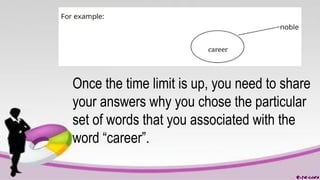
Instructions: On a piece of paper, write the
word “career” at the middle and encircle it.
Then, think of three to four words that you
associate with it. Write these words around the
circle. You can embellish your work by drawing
designs or attaching pictures. You are given a
maximum of three minutes to complete the
task.
Once the time limit is up, you need to share
your answers why you chose the particular
set of words that you associated with the
word “career”.
More often than not, you have been
asked at least once about what you want
to be in the future. The most common
answers would be a doctor, an engineer,
a teacher, and even a soldier. Once you
have reached adolescence, these
answers may either change or remain.
“What is a career?” is a common
question that needs to be answered to
help you in choosing the career path
that suits you.
According to Sigelman and Rider,
there are two factors that you
consider when choosing a career.
These are:
1. Environmental factors
The available opportunities and the
demands of the market constitute this factor.
The varying trends in the environment,
which includes the natural changes in your
surrounding areas, technological discoveries
and advancement, and commercial
demands, make you more practical in
choosing the course that you will take.
2. Personal factors.
Young individuals also take into
consideration their own strengths and
limitations when mapping out their career
plans; their skills, socio-economic status,
their personal values and physical
capabilities are strong indicators of what
their potential career is.
Career: Its Definition and Elements
A career was described by Santos as
having a job that suits the skills, the goals,
and the personality traits that a person has.
It could be a profession that the adolescent
has always aspired for or it can be a means
of earning an income.
A Career Begins with a Plan
A successful career is built along
several components. These
components are:
1. Life goals
Life goals play a key role in determining the
choice of career of an adolescent. Nair
defined them as conditions or states that an
individual wants to achieve, avoid or sustain.
Life goals are created in a conscious manner,
which means that they are easily remembered
by a person.
2. Career planning
It entails the selection of appropriate steps
necessary in meeting specific career
goals. The interests, skills and potential
possessed by a person are matched to the
course that he or she would take.
3. Career development
According to Garcia-Cox, graduating with a
bachelor’s degree is not the ultimate goal of
career development. It includes joining the

professional world, meeting the demands of
the work, enhancing the skills, and
preparing for advancement or promotion.
Hansen in 1976 defined career
development as a lifelong process
dedicated to finding out and processing
information regarding one’s identity, the
educational and occupational opportunities
and alternatives that are available, and
also, the roles and lifestyles that one can
adapt.
Types of Goals
A goal is the instrument of motivation. Imagine
them as the propellers of an airplane. A plane
will have a hard time taking flight if any of the
propellers was damaged. Just like in career
planning, the absence of a good set of goals
makes the road to success rocky and crooked.
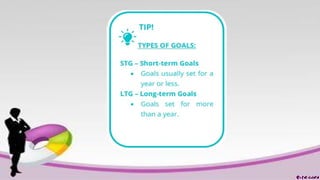
1. Short-term goals
These goals do not involve a long period of
time to achieve. The time allotment for this
type can range from several days to several
months but will not take more than a year.
These goals are very precise. They can also
serve as the stepping stones in achieving the
long-term goals.
2. Long-term goals
Goals that take a long period of time to
accomplish belong under this type.
These goals typically require more than
twelve months for completion and need
careful planning.
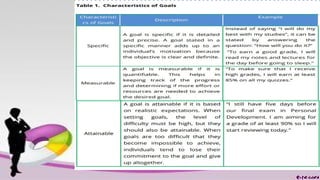
Characteristics of
Achievable Goals
Goals possess characteristics that play
important roles in the success of any
endeavor.
When planning for a career, an adolescent
can apply these characteristics of goals so
the chance of success is imminent.
Collectively, these characteristics are known
as SMART and Michael Aamodt, a leading
psychologist in the field of Industrial
Psychology, discussed each characteristic.
1. In your own understanding, Why is
career development considered as a life-
long process?
Direction:. Write your answer on the
space provided.
In what way does setting up goals
affect how adolescents plan for their
careers?
Personal Development -     My Goals.pptx

Personal Development - My Goals.pptx

  • 1.
  • 2.
    At the endof the lesson the students are able to: 1. explain that thorough understanding of the concepts of career and life goals can help in planning his/her career;
  • 3.
    2. identify thepersonal factors influencing career choices; and 3. take a self-assessment tool to know his/her personality traits and other personal factors in relation to his/her life goals.
  • 4.
    Instructions: On apiece of paper, write the word “career” at the middle and encircle it. Then, think of three to four words that you associate with it. Write these words around the circle. You can embellish your work by drawing designs or attaching pictures. You are given a maximum of three minutes to complete the task.
  • 5.
    Once the timelimit is up, you need to share your answers why you chose the particular set of words that you associated with the word “career”.
  • 6.
    More often thannot, you have been asked at least once about what you want to be in the future. The most common answers would be a doctor, an engineer, a teacher, and even a soldier. Once you have reached adolescence, these answers may either change or remain.
  • 7.
    “What is acareer?” is a common question that needs to be answered to help you in choosing the career path that suits you.
  • 8.
    According to Sigelmanand Rider, there are two factors that you consider when choosing a career. These are:
  • 9.
    1. Environmental factors Theavailable opportunities and the demands of the market constitute this factor. The varying trends in the environment, which includes the natural changes in your surrounding areas, technological discoveries and advancement, and commercial demands, make you more practical in choosing the course that you will take.
  • 10.
    2. Personal factors. Youngindividuals also take into consideration their own strengths and limitations when mapping out their career plans; their skills, socio-economic status, their personal values and physical capabilities are strong indicators of what their potential career is.
  • 11.
    Career: Its Definitionand Elements A career was described by Santos as having a job that suits the skills, the goals, and the personality traits that a person has. It could be a profession that the adolescent has always aspired for or it can be a means of earning an income.
  • 12.
    A Career Beginswith a Plan A successful career is built along several components. These components are:
  • 13.
    1. Life goals Lifegoals play a key role in determining the choice of career of an adolescent. Nair defined them as conditions or states that an individual wants to achieve, avoid or sustain. Life goals are created in a conscious manner, which means that they are easily remembered by a person.
  • 14.
    2. Career planning Itentails the selection of appropriate steps necessary in meeting specific career goals. The interests, skills and potential possessed by a person are matched to the course that he or she would take.
  • 15.
    3. Career development Accordingto Garcia-Cox, graduating with a bachelor’s degree is not the ultimate goal of career development. It includes joining the professional world, meeting the demands of the work, enhancing the skills, and preparing for advancement or promotion.
  • 16.
    Hansen in 1976defined career development as a lifelong process dedicated to finding out and processing information regarding one’s identity, the educational and occupational opportunities and alternatives that are available, and also, the roles and lifestyles that one can adapt.
  • 18.
    Types of Goals Agoal is the instrument of motivation. Imagine them as the propellers of an airplane. A plane will have a hard time taking flight if any of the propellers was damaged. Just like in career planning, the absence of a good set of goals makes the road to success rocky and crooked.
  • 19.
    1. Short-term goals Thesegoals do not involve a long period of time to achieve. The time allotment for this type can range from several days to several months but will not take more than a year. These goals are very precise. They can also serve as the stepping stones in achieving the long-term goals.
  • 20.
    2. Long-term goals Goalsthat take a long period of time to accomplish belong under this type. These goals typically require more than twelve months for completion and need careful planning.
  • 22.
    Characteristics of Achievable Goals Goalspossess characteristics that play important roles in the success of any endeavor.
  • 23.
    When planning fora career, an adolescent can apply these characteristics of goals so the chance of success is imminent. Collectively, these characteristics are known as SMART and Michael Aamodt, a leading psychologist in the field of Industrial Psychology, discussed each characteristic.
  • 27.
    1. In yourown understanding, Why is career development considered as a life- long process?
  • 28.
    Direction:. Write youranswer on the space provided. In what way does setting up goals affect how adolescents plan for their careers?