The Periodic Table
Chapter 8
Copyright © The McGraw-Hill Companies, Inc. Permission required for reproduction or display.
8.1
When the Elements Were Discovered
8.2
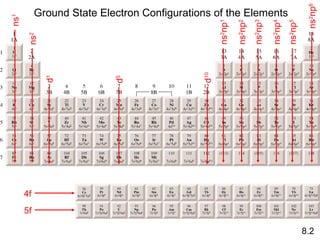
ns1
ns2
ns2
np1
ns2
np2
ns2
np3
ns2
np4
ns2
np5
ns2
np6
d1
d5
d10
4f
5f
Ground State Electron Configurations of the Elements
8.2
Classification of the Elements
Electron Configurations of Cations and Anions
Na [Ne]3s1
Na+
[Ne]
Ca [Ar]4s2
Ca2+
[Ar]
Al [Ne]3s2
3p1
Al3+
[Ne]
Atoms ___________ electrons
so that cation has a noble-gas
outer electron configuration.
H 1s1
H-
1s2
or [He]
F 1s2
2s2
2p5
F-
1s2
2s2
2p6
or [Ne]
O 1s2
2s2
2p4
O2-
1s2
2s2
2p6
or [Ne]
N 1s2
2s2
2p3
N3-
1s2
2s2
2p6
or [Ne]
Atoms ____________
electrons so that anion
has a noble-gas outer
electron configuration.
Of Representative Elements
8.2
+1
+2
+3
-1
-2
-3
Cations and Anions Of Representative Elements
8.2
Na+
: [Ne] Al3+
: [Ne] F-
: 1s2
2s2
2p6
or [Ne]
O2-
: 1s2
2s2
2p6
or [Ne] N3-
: 1s2
2s2
2p6
or [Ne]
Na+
, Al3+
, F-
, O2-
, and N3-
are all ________________ with Ne
What neutral atom is isoelectronic with H-
?
__________________________________
8.2
Electron Configurations of Cations of Transition Metals
8.2
When a ___________________ is formed from an atom of a
_______________________, electrons are always removed
first from the ns orbital and then from the (n – 1)d orbitals.
Fe: [Ar]4s2
3d6
Fe2+
: [Ar]4s0
3d6
or [Ar]3d6
Fe3+
: [Ar]4s0
3d5
or [Ar]3d5
Mn: [Ar]4s2
3d5
Mn2+
: [Ar]4s0
3d5
or [Ar]3d5
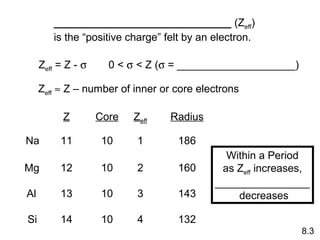
______________________________ (Zeff)
is the “positive charge” felt by an electron.
Na
Mg
Al
Si
11
12
13
14
10
10
10
10
1
2
3
4
186
160
143
132
ZeffCoreZ Radius
Zeff = Z - σ 0 < σ < Z (σ = ____________________)
Zeff ≈ Z – number of inner or core electrons
Within a Period
as Zeff increases,
________________
decreases
8.3
8.3
Atomic Radii
8.3
8.3
Cation is always ________________
than atom from which it is formed.
Anion is always _________________
than atom from which it is formed.
8.3
8.3
______________ is the minimum energy (kJ/mol) required to
remove an electron from a gaseous atom in its ground state.
I1 + X (g) X+
(g) + e-
I2 + X (g) X2+
(g) + e-
I3 + X (g) X3+
(g) + e-
I1 first ionization energy
I2 second ionization energy
I3 third ionization energy
8.4
I1 < I2 < I3
Filled n=1 shell
Filled n=2 shell
Filled n=3 shell
Filled n=4 shell
Filled n=5 shell
8.4
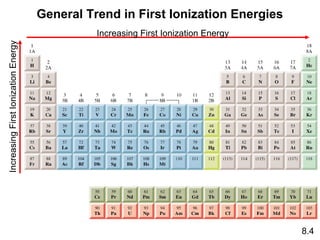
General Trend in First Ionization Energies
8.4
Increasing First Ionization Energy
IncreasingFirstIonizationEnergy
____________________________ is the negative of the
energy change that occurs when an electron is accepted
by an atom in the gaseous state to form an anion.
X (g) + e-
X-
(g)
8.5
F (g) + e-
X-
(g)
O (g) + e-
O-
(g)
∆H = -328 kJ/mol EA = +328 kJ/mol
∆H = -141 kJ/mol EA = +141 kJ/mol
8.5
8.6
Reason: _____________________________________________
Group 1A Elements (ns1
, n ≥ 2)
M M+1
+ 1e-
2M(s) + 2H2O(l) 2MOH(aq) + H2(g)
4M(s) + O2(g) 2M2O(s)
Increasingreactivity
8.6
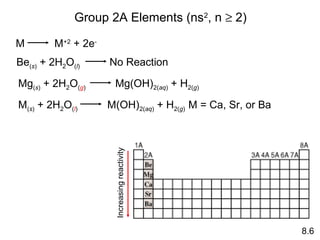
Group 2A Elements (ns2
, n ≥ 2)
M M+2
+ 2e-
Be(s) + 2H2O(l) No Reaction
Increasingreactivity
8.6
Mg(s) + 2H2O(g) Mg(OH)2(aq) + H2(g)
M(s) + 2H2O(l) M(OH)2(aq) + H2(g) M = Ca, Sr, or Ba
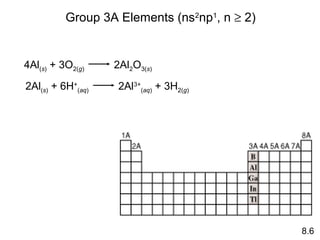
Group 3A Elements (ns2
np1
, n ≥ 2)
8.6
4Al(s) + 3O2(g) 2Al2O3(s)
2Al(s) + 6H+
(aq) 2Al3+
(aq) + 3H2(g)
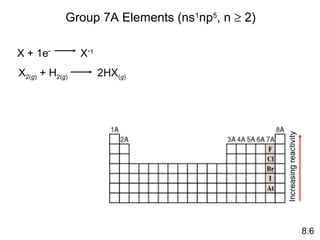
Group 7A Elements (ns1
np5
, n ≥ 2)
X + 1e-
X-1
X2(g) + H2(g) 2HX(g)
Increasingreactivity
8.6

Periodic table

  • 1.
    The Periodic Table Chapter8 Copyright © The McGraw-Hill Companies, Inc. Permission required for reproduction or display.
  • 2.
    8.1 When the ElementsWere Discovered
  • 3.
  • 4.
  • 5.
    Electron Configurations ofCations and Anions Na [Ne]3s1 Na+ [Ne] Ca [Ar]4s2 Ca2+ [Ar] Al [Ne]3s2 3p1 Al3+ [Ne] Atoms ___________ electrons so that cation has a noble-gas outer electron configuration. H 1s1 H- 1s2 or [He] F 1s2 2s2 2p5 F- 1s2 2s2 2p6 or [Ne] O 1s2 2s2 2p4 O2- 1s2 2s2 2p6 or [Ne] N 1s2 2s2 2p3 N3- 1s2 2s2 2p6 or [Ne] Atoms ____________ electrons so that anion has a noble-gas outer electron configuration. Of Representative Elements 8.2
  • 6.
    +1 +2 +3 -1 -2 -3 Cations and AnionsOf Representative Elements 8.2
  • 7.
    Na+ : [Ne] Al3+ :[Ne] F- : 1s2 2s2 2p6 or [Ne] O2- : 1s2 2s2 2p6 or [Ne] N3- : 1s2 2s2 2p6 or [Ne] Na+ , Al3+ , F- , O2- , and N3- are all ________________ with Ne What neutral atom is isoelectronic with H- ? __________________________________ 8.2
  • 8.
    Electron Configurations ofCations of Transition Metals 8.2 When a ___________________ is formed from an atom of a _______________________, electrons are always removed first from the ns orbital and then from the (n – 1)d orbitals. Fe: [Ar]4s2 3d6 Fe2+ : [Ar]4s0 3d6 or [Ar]3d6 Fe3+ : [Ar]4s0 3d5 or [Ar]3d5 Mn: [Ar]4s2 3d5 Mn2+ : [Ar]4s0 3d5 or [Ar]3d5
  • 9.
    ______________________________ (Zeff) is the“positive charge” felt by an electron. Na Mg Al Si 11 12 13 14 10 10 10 10 1 2 3 4 186 160 143 132 ZeffCoreZ Radius Zeff = Z - σ 0 < σ < Z (σ = ____________________) Zeff ≈ Z – number of inner or core electrons Within a Period as Zeff increases, ________________ decreases 8.3
  • 10.
  • 11.
  • 12.
  • 13.
    Cation is always________________ than atom from which it is formed. Anion is always _________________ than atom from which it is formed. 8.3
  • 14.
  • 15.
    ______________ is theminimum energy (kJ/mol) required to remove an electron from a gaseous atom in its ground state. I1 + X (g) X+ (g) + e- I2 + X (g) X2+ (g) + e- I3 + X (g) X3+ (g) + e- I1 first ionization energy I2 second ionization energy I3 third ionization energy 8.4 I1 < I2 < I3
  • 16.
    Filled n=1 shell Filledn=2 shell Filled n=3 shell Filled n=4 shell Filled n=5 shell 8.4
  • 17.
    General Trend inFirst Ionization Energies 8.4 Increasing First Ionization Energy IncreasingFirstIonizationEnergy
  • 18.
    ____________________________ is thenegative of the energy change that occurs when an electron is accepted by an atom in the gaseous state to form an anion. X (g) + e- X- (g) 8.5 F (g) + e- X- (g) O (g) + e- O- (g) ∆H = -328 kJ/mol EA = +328 kJ/mol ∆H = -141 kJ/mol EA = +141 kJ/mol
  • 19.
  • 20.
  • 21.
    Group 1A Elements(ns1 , n ≥ 2) M M+1 + 1e- 2M(s) + 2H2O(l) 2MOH(aq) + H2(g) 4M(s) + O2(g) 2M2O(s) Increasingreactivity 8.6
  • 22.
    Group 2A Elements(ns2 , n ≥ 2) M M+2 + 2e- Be(s) + 2H2O(l) No Reaction Increasingreactivity 8.6 Mg(s) + 2H2O(g) Mg(OH)2(aq) + H2(g) M(s) + 2H2O(l) M(OH)2(aq) + H2(g) M = Ca, Sr, or Ba
  • 23.
    Group 3A Elements(ns2 np1 , n ≥ 2) 8.6 4Al(s) + 3O2(g) 2Al2O3(s) 2Al(s) + 6H+ (aq) 2Al3+ (aq) + 3H2(g)
  • 24.
    Group 7A Elements(ns1 np5 , n ≥ 2) X + 1e- X-1 X2(g) + H2(g) 2HX(g) Increasingreactivity 8.6