Pericyclic
reactions in
Ethers Biofuels
July 31 - August 5, 2016 - Seoul, Korea
Juan-Carlos Lizardo-Huerta, Baptiste Sirjean,
Pierre-Alexandre Glaude, René Fournet
36TH International Symposium on Combustion
Reactions and Chemical Engineering Laboratory, Nancy, France.
36TH International Symposium on Combustion
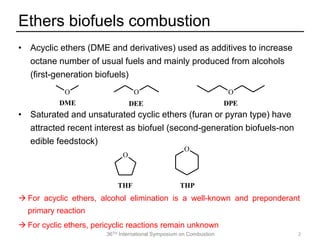
• Acyclic ethers (DME and derivatives) used as additives to increase
octane number of usual fuels and mainly produced from alcohols
(first-generation biofuels)
• Saturated and unsaturated cyclic ethers (furan or pyran type) have
attracted recent interest as biofuel (second-generation biofuels-non
edible feedstock)
Ethers biofuels combustion
2
O
O
THF THP
O O O
DME DEE DPE
 For acyclic ethers, alcohol elimination is a well-known and preponderant
primary reaction
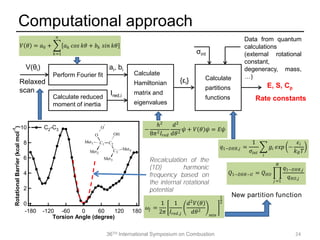
 For cyclic ethers, pericyclic reactions remain unknown
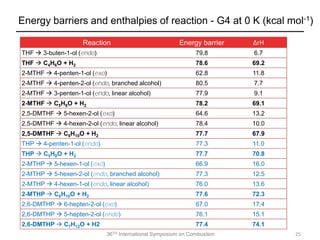
36TH International Symposium on Combustion
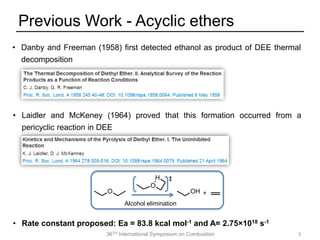
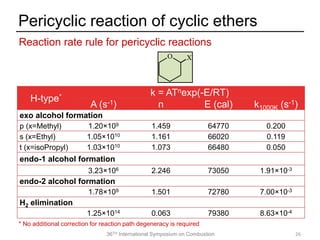
• Laidler and McKeney (1964) proved that this formation occurred from a
pericyclic reaction in DEE
• Rate constant proposed: Ea = 83.8 kcal mol-1 and A= 2.75×10¹⁸ s-1
Previous Work - Acyclic ethers
3
O
O
H
OH
‡
+
Alcohol elimination
• Danby and Freeman (1958) first detected ethanol as product of DEE thermal
decomposition
36TH International Symposium on Combustion
-5.0
-4.0
-3.0
-2.0
logk(s
-1
)
1.351.301.251.201.151.10
1000/(T(K))
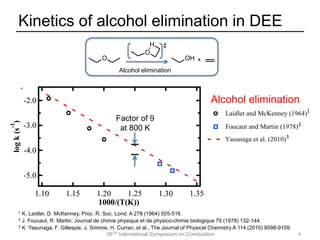
Kinetics of alcohol elimination in DEE
4
Alcohol elimination
O
O
H
OH
‡
+
Alcohol elimination
-5.0
-4.0
-3.0
-2.0
logk(s
-1
)
1.351.301.251.201.151.10
1000/(T(K))
-5.0
-4.0
-3.0
-2.0
logk(s
-1
)
1.351.301.251.201.151.10
1000/(T(K))
-30
-25
-20
-15
-10
-5
0
5
logk(s
-1
)
1.1.00.8
1000/(T(K))
Laidler and McKenney (1964)
Foucaut and Martin (1978)
Yasunaga (2010)
Laidler and McKenney (1964)
Foucaut and Martin (1978)
Seres and Huhn (1986)
Yasunaga (2010)
-30
-25
-20
-15
-10
-5
0
5
logk(s
-1
)
1.1.00.8
1000/(T(K))
Laidler and McKenney (1964)
Foucaut and Martin (1978)
Yasunaga (2010)
Laidler and McKenney (1964)
Foucaut and Martin (1978)
Seres and Huhn (1986)
Yasunaga (2010)
1 K. Laidler, D. McKenney, Proc. R. Soc. Lond. A 278 (1964) 505-516.
2 J. Foucaut, R. Martin, Journal de chimie physique et de physico-chimie biologique 75 (1978) 132-144.
3 K. Yasunaga, F. Gillespie, J. Simmie, H. Curran, et al., The Journal of Physical Chemistry A 114 (2010) 9098-9109.
1
2
3
Factor of 9
at 800 K
-10
-8
-6
-4
-2
0
2
4
6
logk(s
-1
) 1.21.00.8
1000/(T(K))
Yasunaga et al. (2010)
36TH International Symposium on Combustion
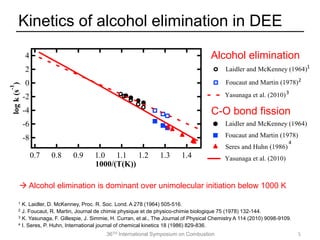
Kinetics of alcohol elimination in DEE
5
 Alcohol elimination is dominant over unimolecular initiation below 1000 K
1 K. Laidler, D. McKenney, Proc. R. Soc. Lond. A 278 (1964) 505-516.
2 J. Foucaut, R. Martin, Journal de chimie physique et de physico-chimie biologique 75 (1978) 132-144.
3 K. Yasunaga, F. Gillespie, J. Simmie, H. Curran, et al., The Journal of Physical Chemistry A 114 (2010) 9098-9109.
4 I. Seres, P. Huhn, International journal of chemical kinetics 18 (1986) 829-836.
4
-8
-6
-4
-2
0
2
4
logk(s
-1
)
1.41.31.21.11.00.90.80.7
1000/(T(K))
C-O bond fission
-30
-25
-20
-15
-10
-5
0
5
logk(s
-1
)
1.1.00.8
1000/(T(K))
Laidler and McKenney (1964)
Foucaut and Martin (1978)
Yasunaga (2010)
Laidler and McKenney (1964)
Foucaut and Martin (1978)
Seres and Huhn (1986)
Yasunaga (2010)
-10
-8
-6
-4
-2
0
2
4
6
logk(s
-1
)
1.21.00.8
1000/(T(K))
Yasunaga et al. (2010)
Alcohol elimination
-30
-25
-20
-15
-10
-5
0
5
logk(s
-1
)
1.1.00.8
1000/(T(K))
Laidler and McKenney (1964)
Foucaut and Martin (1978)
Yasunaga (2010)
Laidler and McKenney (1964)
Foucaut and Martin (1978)
Seres and Huhn (1986)
Yasunaga (2010)
-30
-25
-20
-15
-10
-5
0
5
logk(s
-1
)
1.1.00.8
1000/(T(K))
Laidler and McKenney (1964)
Foucaut and Martin (1978)
Yasunaga (2010)
Laidler and McKenney (1964)
Foucaut and Martin (1978)
Seres and Huhn (1986)
Yasunaga (2010)
1
2
3
-10
-8
-6
-4
-2
0
2
4
logk(s
-1
)
1.21.00.8
1000/(T(K))
Yasunaga et al. (2010)
36TH International Symposium on Combustion
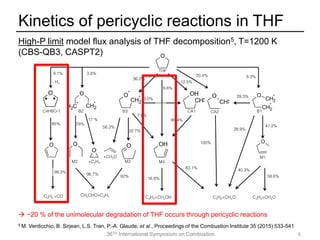
Kinetics of pericyclic reactions in THF
6
5 M. Verdicchio, B. Sirjean, L.S. Tran, P.-A. Glaude, et al., Proceedings of the Combustion Institute 35 (2015) 533-541
 ~20 % of the unimolecular degradation of THF occurs through pericyclic reactions
High-P limit model flux analysis of THF decomposition5, T=1200 K
(CBS-QB3, CASPT2)
36TH International Symposium on Combustion 7
Aims of present work
O R2
R3
R1
R'2
R'3
R'1
O R2R1O R2R1
Acyclic ethers Cyclic ethers
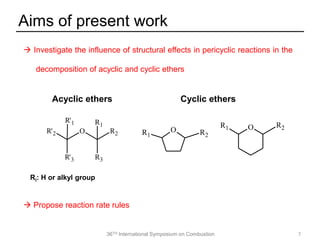
 Investigate the influence of structural effects in pericyclic reactions in the
decomposition of acyclic and cyclic ethers
Ri: H or alkyl group
 Propose reaction rate rules
36TH International Symposium on Combustion
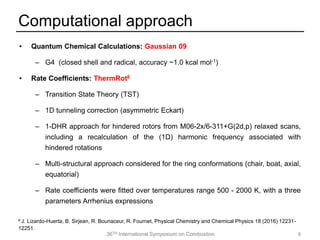
• Quantum Chemical Calculations: Gaussian 09
– G4 (closed shell and radical, accuracy ~1.0 kcal mol-1)
• Rate Coefficients: ThermRot6
– Transition State Theory (TST)
– 1D tunneling correction (asymmetric Eckart)
– 1-DHR approach for hindered rotors from M06-2x/6-311+G(2d,p) relaxed scans,
including a recalculation of the (1D) harmonic frequency associated with
hindered rotations
– Multi-structural approach considered for the ring conformations (chair, boat, axial,
equatorial)
– Rate coefficients were fitted over temperatures range 500 - 2000 K, with a three
parameters Arrhenius expressions
Computational approach
8
6 J. Lizardo-Huerta, B. Sirjean, R. Bounaceur, R. Fournet, Physical Chemistry and Chemical Physics 18 (2016) 12231-
12251.
36TH International Symposium on Combustion
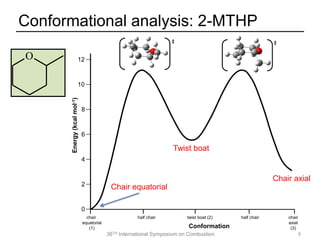
Conformational analysis: 2-MTHP
‡‡
0
2
4
6
8
10
12
chair
equatorial
(1)
half chair half chair chair
axial
(3)
twist boat (2)
Conformation
Energy(kcalmol-1)
9
Chair equatorial
Twist boat
Chair axial
O
36TH International Symposium on Combustion 10
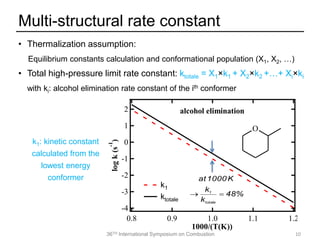
Multi-structural rate constant
• Thermalization assumption:
Equilibrium constants calculation and conformational population (X1, X2, …)
• Total high-pressure limit rate constant: ktotale = X1×k1 + X2×k2 +…+ Xi×ki
with ki: alcohol elimination rate constant of the ith conformer
-4
-3
-2
-1
0
1
2
logk(s
-1
)
1.21.11.00.90.8
1000/(T(K))
k1
ktotale
alcohol elimination
48%
k
k
K1000at
totale
1

O
k1: kinetic constant
calculated from the
lowest energy
conformer
36TH International Symposium on Combustion
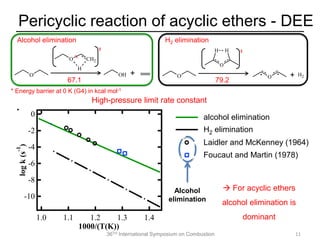
Pericyclic reaction of acyclic ethers - DEE
11
High-pressure limit rate constant
H2 elimination
O• • + H2O
79.2
O
H H ‡
Alcohol elimination
OH +O
67.1
CH2O
H
~
‡
-20
-15
-10
-5
0
logk(s
-1
)
1.41.31.21.11.0
1000/(T(K))
alcohol elimination
H2 elimination
Laidler and McKenney (1964)
Foucaut and Martin (1978)
Yasunaga (2010)
 For acyclic ethers
alcohol elimination is
dominant
-10
-8
-6
-4
-2
0
logk(s
-1
)
1.41.31.21.11.0
1000/(T(K))
-20
-15
-10
-5
0
logk(s
-1
)
1.41.31.21.11.0
1000/(T(K))
alcohol elimination
H2 elimination
Laidler and McKenney (1964)
Foucaut and Martin (1978)
Yasunaga (2010)
Alcohol
elimination
* Energy barrier at 0 K (G4) in kcal mol-1
-10
-8
-6
-4
-2
0
logk(s
-1
)
1.41.31.21.11.0
1000/(T(K))
36TH International Symposium on Combustion
Pericyclic reaction of acyclic ethers
12
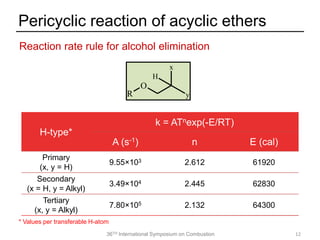
Reaction rate rule for alcohol elimination
H-type*
k = ATnexp(-E/RT)
A (s-1) n E (cal)
Primary
(x, y = H)
9.55×10³ 2.612 61920
Secondary
(x = H, y = Alkyl)
3.49×10⁴ 2.445 62830
Tertiary
(x, y = Alkyl)
7.80×10⁵ 2.132 64300
* Values per transferable H-atom
R
O
y
x
H
36TH International Symposium on Combustion
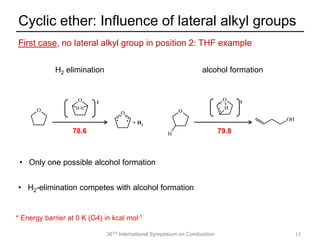
Cyclic ether: Influence of lateral alkyl groups
13
78.6 79.8
H2 elimination
O
O
• • + H2
alcohol formation
OH
O
H
* Energy barrier at 0 K (G4) in kcal mol-1
First case, no lateral alkyl group in position 2: THF example
• H2-elimination competes with alcohol formation
• Only one possible alcohol formation
O
H-H
‡
O
H
~ ‡
36TH International Symposium on Combustion
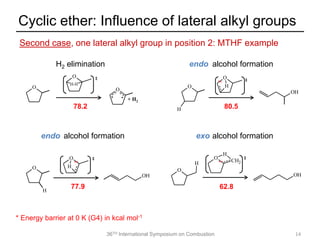
Cyclic ether: Influence of lateral alkyl groups
14
78.2 80.5
62.8
* Energy barrier at 0 K (G4) in kcal mol-1
endo
exo
H2 elimination
O O
• • + H2
O
H-H
‡
O
H
OH
alcohol formation
O CH2
H
~
‡
alcohol formation
OH
O
H
O
H
~ ‡
Second case, one lateral alkyl group in position 2: MTHF example
77.9
O
H
~
‡
alcohol formation
OH
O
H
endo
36TH International Symposium on Combustion
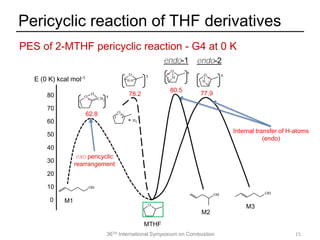
PES of 2-MTHF pericyclic reaction - G4 at 0 K
Pericyclic reaction of THF derivatives
15
0
10
20
30
40
50
60
70
80
OH
O CH2
H
~
‡
O
H-H
‡
O
H
~ ‡
O
H
~
‡
OH OH
O
MTHF
E (0 K) kcal mol-1
M1
M2
M3
O
• •
+ H2
78.2
80.5
77.9
62.8
Internal transfer of H-atoms
(endo)
exo pericyclic
rearrangement
endo-1 endo-2
36TH International Symposium on Combustion
High-pressure limit rate constants
Pericyclic reaction of cyclic ethers
16
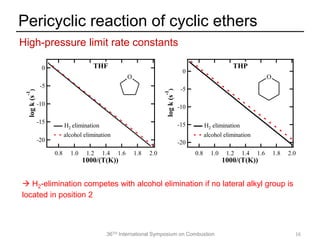
 H2-elimination competes with alcohol elimination if no lateral alkyl group is
located in position 2
-20
-15
-10
-5
0
logk(s
-1
)
2.01.81.61.41.21.00.8
1000/(T(K))
H2 elimination
alcohol elimination
THP
O
-20
-15
-10
-5
0
logk(s
-1
)
2.01.81.61.41.21.00.8
1000/(T(K))
H2 elimination
alcohol elimination
THF
O
36TH International Symposium on Combustion
High-pressure limit rate constants
Pericyclic reaction of cyclic ethers
17
-20
-15
-10
-5
0
logk(s
-1
)
2.01.81.61.41.21.00.8
1000/(T(K))
H2 elim
ROH elim exo
ROH elim endo branched
ROH elim endo linear
MTHP
-20
-15
-10
-5
0
logk(s
-1
)
2.01.81.61.41.21.00.8
1000/(T(K))
H2 elim
ROH elim exo
ROH elim endo branched
ROH elim endo linear
MTHF
O O
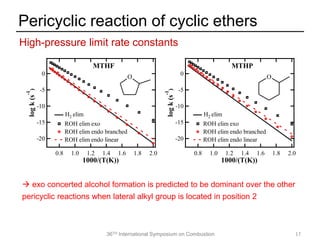
 exo concerted alcohol formation is predicted to be dominant over the other
pericyclic reactions when lateral alkyl group is located in position 2
36TH International Symposium on Combustion
Pericyclic reaction of cyclic ethers
18
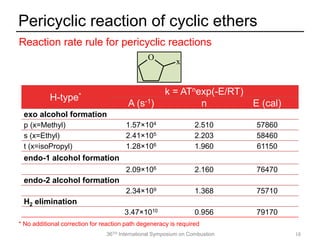
Reaction rate rule for pericyclic reactions
* No additional correction for reaction path degeneracy is required
H-type* k = ATnexp(-E/RT)
A (s-1) n E (cal)
exo alcohol formation
p (x=Methyl) 1.57×10⁴ 2.510 57860
s (x=Ethyl) 2.41×10⁵ 2.203 58460
t (x=isoPropyl) 1.28×10⁶ 1.960 61150
endo-1 alcohol formation
2.09×10⁶ 2.160 76470
endo-2 alcohol formation
2.34×10⁹ 1.368 75710
H2 elimination
3.47×10¹⁰ 0.956 79170
O
x
36TH International Symposium on Combustion 19
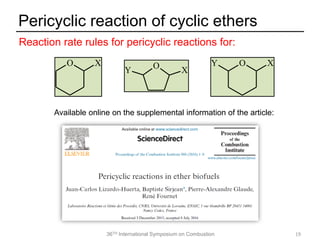
Reaction rate rules for pericyclic reactions for:
Pericyclic reaction of cyclic ethers
O
XY
O X O XY
Available online on the supplemental information of the article:
36TH International Symposium on Combustion
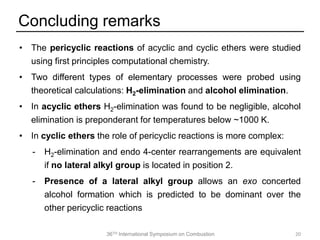
• The pericyclic reactions of acyclic and cyclic ethers were studied
using first principles computational chemistry.
• Two different types of elementary processes were probed using
theoretical calculations: H2-elimination and alcohol elimination.
• In acyclic ethers H2-elimination was found to be negligible, alcohol
elimination is preponderant for temperatures below ~1000 K.
• In cyclic ethers the role of pericyclic reactions is more complex:
- H2-elimination and endo 4-center rearrangements are equivalent
if no lateral alkyl group is located in position 2.
- Presence of a lateral alkyl group allows an exo concerted
alcohol formation which is predicted to be dominant over the
other pericyclic reactions
Concluding remarks
20
36TH International Symposium on Combustion
CINES for the HPC resources under the allocation
2015087249 made by GENCI.
Acknowledgements
Thanks for your attention
Supplemental Material
Pericyclic reactions in Ether
Biofuels
36th International Symposium on Combustion
Juan-Carlos Lizardo-Huerta, Baptiste Sirjean,
Pierre-Alexandre Glaude, René Fournet
Laboratoire Réactions et Génie des Procédés, CNRS, Université de Lorraine, ENSIC,
Nancy, France.
July 31 - August 5, 2016 - Seoul
36TH International Symposium on Combustion
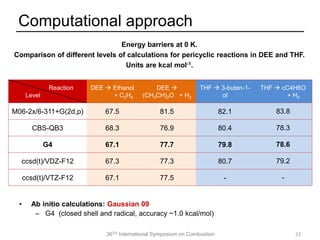
• Ab initio calculations: Gaussian 09
– G4 (closed shell and radical, accuracy ~1.0 kcal/mol)
Computational approach
Reaction
Level
DEE  Ethanol
+ C2H4
DEE 
(CH3CH)2O + H2
THF  3-buten-1-
ol
THF  cC4H6O
+ H2
M06-2x/6-311+G(2d,p) 67.5 81.5 82.1 83.8
CBS-QB3 68.3 76.9 80.4 78.3
G4 67.1 77.7 79.8 78.6
ccsd(t)/VDZ-F12 67.3 77.3 80.7 79.2
ccsd(t)/VTZ-F12 67.1 77.5 - -
Energy barriers at 0 K.
Comparison of different levels of calculations for pericyclic reactions in DEE and THF.
Units are kcal mol-1.
23
36TH International Symposium on Combustion 24
10
8
6
4
2
0
RotationalBarrier(kcalmol
-1
)
-180 -120 -60 0 60 120 180
Torsion Angle (degree)
C2-C3
Perform Fourier fit
Calculate reduced
moment of inertia
V(θi) ai, bi
Ired,i
{εi}
σint
Relaxed
scan
Data from quantum
calculations
(external rotational
constant,
degeneracy, mass,
…)
Calculate
Hamiltonian
matrix and
eigenvalues
Calculate
partitions
functions
E, S, Cp
Rate constants
C1 C2
C3
Met4
O
Met2
Met1
O
OH
Met3
−
ℎ2
8𝜋2 𝐼𝑟𝑒𝑑
𝑑2
𝑑𝜃2
𝜓 + 𝑉 𝜃 𝜓 = 𝐸𝜓
𝑉 𝜃 = 𝑎0 + 𝑎 𝑘 𝑐𝑜𝑠 𝑘𝜃 + 𝑏 𝑘 𝑠𝑖𝑛 𝑘𝜃
𝑛
𝑘=1
𝑞1−𝐷𝐻𝑅,𝑗 =
1
𝜎𝑖𝑛𝑡
𝑔𝑖 𝑒𝑥𝑝 −
𝜖𝑖
𝑘 𝐵 𝑇
𝑖
𝜔𝑗 =
1
2𝜋
1
𝐼𝑟𝑒𝑑 ,𝑗
𝑑2
𝑉 𝜃
𝑑𝜃2
𝑚𝑖𝑛
1
2
Recalculation of the
(1D) harmonic
frequency based on
the internal rotational
potential
𝑄1−𝐷𝐻𝑅−𝑈 = 𝑄 𝐻𝑂
𝑞1−𝐷𝐻𝑅,𝑗
𝑞 𝐻𝑂,𝑗
𝑁
𝑗=1
New partition function
Computational approach
36TH International Symposium on Combustion
Energy barriers and enthalpies of reaction - G4 at 0 K (kcal mol-1)
25
Reaction Energy barrier ΔrH
THF  3-buten-1-ol (endo) 79.8 6.7
THF  C4H6O + H2 78.6 69.2
2-MTHF  4-penten-1-ol (exo) 62.8 11.8
2-MTHF  4-penten-2-ol (endo, branched alcohol) 80.5 7.7
2-MTHF  3-penten-1-ol (endo, linear alcohol) 77.9 9.1
2-MTHF  C5H8O + H2 78.2 69.1
2,5-DMTHF  5-hexen-2-ol (exo) 64.6 13.2
2,5-DMTHF  4-hexen-2-ol (endo, linear alcohol) 78.4 10.0
2,5-DMTHF  C6H10O + H2 77.7 67.9
THP  4-penten-1-ol (endo) 77.3 11.0
THP  C5H8O + H2 77.7 70.8
2-MTHP  5-hexen-1-ol (exo) 66.9 16.0
2-MTHP  5-hexen-2-ol (endo, branched alcohol) 77.3 12.5
2-MTHP  4-hexen-1-ol (endo, linear alcohol) 76.0 13.6
2-MTHP  C6H10O + H2 77.6 72.3
2,6-DMTHP  6-hepten-2-ol (exo) 67.0 17.4
2,6-DMTHP  5-hepten-2-ol (endo) 76.1 15.1
2,6-DMTHP  C7H12O + H2 77.4 74.1
36TH International Symposium on Combustion
Pericyclic reaction of cyclic ethers
26
Reaction rate rule for pericyclic reactions
* No additional correction for reaction path degeneracy is required
H-type* k = ATnexp(-E/RT)
A (s-1) n E (cal) k1000K (s-1)
exo alcohol formation
p (x=Methyl) 1.20×10⁹ 1.459 64770 0.200
s (x=Ethyl) 1.05×10¹⁰ 1.161 66020 0.119
t (x=isoPropyl) 1.03×10¹⁰ 1.073 66480 0.050
endo-1 alcohol formation
3.23×10⁶ 2.246 73050 1.91×10⁻³
endo-2 alcohol formation
1.78×10⁹ 1.501 72780 7.00×10⁻³
H2 elimination
1.25×10¹⁴ 0.063 79380 8.63×10⁻⁴
O X

Pericyclic reactions in ethers biofuels

  • 1.
    Pericyclic reactions in Ethers Biofuels July31 - August 5, 2016 - Seoul, Korea Juan-Carlos Lizardo-Huerta, Baptiste Sirjean, Pierre-Alexandre Glaude, René Fournet 36TH International Symposium on Combustion Reactions and Chemical Engineering Laboratory, Nancy, France.
  • 2.
    36TH International Symposiumon Combustion • Acyclic ethers (DME and derivatives) used as additives to increase octane number of usual fuels and mainly produced from alcohols (first-generation biofuels) • Saturated and unsaturated cyclic ethers (furan or pyran type) have attracted recent interest as biofuel (second-generation biofuels-non edible feedstock) Ethers biofuels combustion 2 O O THF THP O O O DME DEE DPE  For acyclic ethers, alcohol elimination is a well-known and preponderant primary reaction  For cyclic ethers, pericyclic reactions remain unknown
  • 3.
    36TH International Symposiumon Combustion • Laidler and McKeney (1964) proved that this formation occurred from a pericyclic reaction in DEE • Rate constant proposed: Ea = 83.8 kcal mol-1 and A= 2.75×10¹⁸ s-1 Previous Work - Acyclic ethers 3 O O H OH ‡ + Alcohol elimination • Danby and Freeman (1958) first detected ethanol as product of DEE thermal decomposition
  • 4.
    36TH International Symposiumon Combustion -5.0 -4.0 -3.0 -2.0 logk(s -1 ) 1.351.301.251.201.151.10 1000/(T(K)) Kinetics of alcohol elimination in DEE 4 Alcohol elimination O O H OH ‡ + Alcohol elimination -5.0 -4.0 -3.0 -2.0 logk(s -1 ) 1.351.301.251.201.151.10 1000/(T(K)) -5.0 -4.0 -3.0 -2.0 logk(s -1 ) 1.351.301.251.201.151.10 1000/(T(K)) -30 -25 -20 -15 -10 -5 0 5 logk(s -1 ) 1.1.00.8 1000/(T(K)) Laidler and McKenney (1964) Foucaut and Martin (1978) Yasunaga (2010) Laidler and McKenney (1964) Foucaut and Martin (1978) Seres and Huhn (1986) Yasunaga (2010) -30 -25 -20 -15 -10 -5 0 5 logk(s -1 ) 1.1.00.8 1000/(T(K)) Laidler and McKenney (1964) Foucaut and Martin (1978) Yasunaga (2010) Laidler and McKenney (1964) Foucaut and Martin (1978) Seres and Huhn (1986) Yasunaga (2010) 1 K. Laidler, D. McKenney, Proc. R. Soc. Lond. A 278 (1964) 505-516. 2 J. Foucaut, R. Martin, Journal de chimie physique et de physico-chimie biologique 75 (1978) 132-144. 3 K. Yasunaga, F. Gillespie, J. Simmie, H. Curran, et al., The Journal of Physical Chemistry A 114 (2010) 9098-9109. 1 2 3 Factor of 9 at 800 K -10 -8 -6 -4 -2 0 2 4 6 logk(s -1 ) 1.21.00.8 1000/(T(K)) Yasunaga et al. (2010) Yasunaga et al. (2010)
  • 5.
    36TH International Symposiumon Combustion Kinetics of alcohol elimination in DEE 5  Alcohol elimination is dominant over unimolecular initiation below 1000 K 1 K. Laidler, D. McKenney, Proc. R. Soc. Lond. A 278 (1964) 505-516. 2 J. Foucaut, R. Martin, Journal de chimie physique et de physico-chimie biologique 75 (1978) 132-144. 3 K. Yasunaga, F. Gillespie, J. Simmie, H. Curran, et al., The Journal of Physical Chemistry A 114 (2010) 9098-9109. 4 I. Seres, P. Huhn, International journal of chemical kinetics 18 (1986) 829-836. 4 -8 -6 -4 -2 0 2 4 logk(s -1 ) 1.41.31.21.11.00.90.80.7 1000/(T(K)) C-O bond fission -30 -25 -20 -15 -10 -5 0 5 logk(s -1 ) 1.1.00.8 1000/(T(K)) Laidler and McKenney (1964) Foucaut and Martin (1978) Yasunaga (2010) Laidler and McKenney (1964) Foucaut and Martin (1978) Seres and Huhn (1986) Yasunaga (2010) -10 -8 -6 -4 -2 0 2 4 6 logk(s -1 ) 1.21.00.8 1000/(T(K)) Yasunaga et al. (2010) Yasunaga et al. (2010) Alcohol elimination -30 -25 -20 -15 -10 -5 0 5 logk(s -1 ) 1.1.00.8 1000/(T(K)) Laidler and McKenney (1964) Foucaut and Martin (1978) Yasunaga (2010) Laidler and McKenney (1964) Foucaut and Martin (1978) Seres and Huhn (1986) Yasunaga (2010) -30 -25 -20 -15 -10 -5 0 5 logk(s -1 ) 1.1.00.8 1000/(T(K)) Laidler and McKenney (1964) Foucaut and Martin (1978) Yasunaga (2010) Laidler and McKenney (1964) Foucaut and Martin (1978) Seres and Huhn (1986) Yasunaga (2010) 1 2 3 -10 -8 -6 -4 -2 0 2 4 logk(s -1 ) 1.21.00.8 1000/(T(K)) Yasunaga et al. (2010) Yasunaga et al. (2010)
  • 6.
    36TH International Symposiumon Combustion Kinetics of pericyclic reactions in THF 6 5 M. Verdicchio, B. Sirjean, L.S. Tran, P.-A. Glaude, et al., Proceedings of the Combustion Institute 35 (2015) 533-541  ~20 % of the unimolecular degradation of THF occurs through pericyclic reactions High-P limit model flux analysis of THF decomposition5, T=1200 K (CBS-QB3, CASPT2)
  • 7.
    36TH International Symposiumon Combustion 7 Aims of present work O R2 R3 R1 R'2 R'3 R'1 O R2R1O R2R1 Acyclic ethers Cyclic ethers  Investigate the influence of structural effects in pericyclic reactions in the decomposition of acyclic and cyclic ethers Ri: H or alkyl group  Propose reaction rate rules
  • 8.
    36TH International Symposiumon Combustion • Quantum Chemical Calculations: Gaussian 09 – G4 (closed shell and radical, accuracy ~1.0 kcal mol-1) • Rate Coefficients: ThermRot6 – Transition State Theory (TST) – 1D tunneling correction (asymmetric Eckart) – 1-DHR approach for hindered rotors from M06-2x/6-311+G(2d,p) relaxed scans, including a recalculation of the (1D) harmonic frequency associated with hindered rotations – Multi-structural approach considered for the ring conformations (chair, boat, axial, equatorial) – Rate coefficients were fitted over temperatures range 500 - 2000 K, with a three parameters Arrhenius expressions Computational approach 8 6 J. Lizardo-Huerta, B. Sirjean, R. Bounaceur, R. Fournet, Physical Chemistry and Chemical Physics 18 (2016) 12231- 12251.
  • 9.
    36TH International Symposiumon Combustion Conformational analysis: 2-MTHP ‡‡ 0 2 4 6 8 10 12 chair equatorial (1) half chair half chair chair axial (3) twist boat (2) Conformation Energy(kcalmol-1) 9 Chair equatorial Twist boat Chair axial O
  • 10.
    36TH International Symposiumon Combustion 10 Multi-structural rate constant • Thermalization assumption: Equilibrium constants calculation and conformational population (X1, X2, …) • Total high-pressure limit rate constant: ktotale = X1×k1 + X2×k2 +…+ Xi×ki with ki: alcohol elimination rate constant of the ith conformer -4 -3 -2 -1 0 1 2 logk(s -1 ) 1.21.11.00.90.8 1000/(T(K)) k1 ktotale alcohol elimination 48% k k K1000at totale 1  O k1: kinetic constant calculated from the lowest energy conformer
  • 11.
    36TH International Symposiumon Combustion Pericyclic reaction of acyclic ethers - DEE 11 High-pressure limit rate constant H2 elimination O• • + H2O 79.2 O H H ‡ Alcohol elimination OH +O 67.1 CH2O H ~ ‡ -20 -15 -10 -5 0 logk(s -1 ) 1.41.31.21.11.0 1000/(T(K)) alcohol elimination H2 elimination Laidler and McKenney (1964) Foucaut and Martin (1978) Yasunaga (2010)  For acyclic ethers alcohol elimination is dominant -10 -8 -6 -4 -2 0 logk(s -1 ) 1.41.31.21.11.0 1000/(T(K)) -20 -15 -10 -5 0 logk(s -1 ) 1.41.31.21.11.0 1000/(T(K)) alcohol elimination H2 elimination Laidler and McKenney (1964) Foucaut and Martin (1978) Yasunaga (2010) Alcohol elimination * Energy barrier at 0 K (G4) in kcal mol-1 -10 -8 -6 -4 -2 0 logk(s -1 ) 1.41.31.21.11.0 1000/(T(K))
  • 12.
    36TH International Symposiumon Combustion Pericyclic reaction of acyclic ethers 12 Reaction rate rule for alcohol elimination H-type* k = ATnexp(-E/RT) A (s-1) n E (cal) Primary (x, y = H) 9.55×10³ 2.612 61920 Secondary (x = H, y = Alkyl) 3.49×10⁴ 2.445 62830 Tertiary (x, y = Alkyl) 7.80×10⁵ 2.132 64300 * Values per transferable H-atom R O y x H
  • 13.
    36TH International Symposiumon Combustion Cyclic ether: Influence of lateral alkyl groups 13 78.6 79.8 H2 elimination O O • • + H2 alcohol formation OH O H * Energy barrier at 0 K (G4) in kcal mol-1 First case, no lateral alkyl group in position 2: THF example • H2-elimination competes with alcohol formation • Only one possible alcohol formation O H-H ‡ O H ~ ‡
  • 14.
    36TH International Symposiumon Combustion Cyclic ether: Influence of lateral alkyl groups 14 78.2 80.5 62.8 * Energy barrier at 0 K (G4) in kcal mol-1 endo exo H2 elimination O O • • + H2 O H-H ‡ O H OH alcohol formation O CH2 H ~ ‡ alcohol formation OH O H O H ~ ‡ Second case, one lateral alkyl group in position 2: MTHF example 77.9 O H ~ ‡ alcohol formation OH O H endo
  • 15.
    36TH International Symposiumon Combustion PES of 2-MTHF pericyclic reaction - G4 at 0 K Pericyclic reaction of THF derivatives 15 0 10 20 30 40 50 60 70 80 OH O CH2 H ~ ‡ O H-H ‡ O H ~ ‡ O H ~ ‡ OH OH O MTHF E (0 K) kcal mol-1 M1 M2 M3 O • • + H2 78.2 80.5 77.9 62.8 Internal transfer of H-atoms (endo) exo pericyclic rearrangement endo-1 endo-2
  • 16.
    36TH International Symposiumon Combustion High-pressure limit rate constants Pericyclic reaction of cyclic ethers 16  H2-elimination competes with alcohol elimination if no lateral alkyl group is located in position 2 -20 -15 -10 -5 0 logk(s -1 ) 2.01.81.61.41.21.00.8 1000/(T(K)) H2 elimination alcohol elimination THP O -20 -15 -10 -5 0 logk(s -1 ) 2.01.81.61.41.21.00.8 1000/(T(K)) H2 elimination alcohol elimination THF O
  • 17.
    36TH International Symposiumon Combustion High-pressure limit rate constants Pericyclic reaction of cyclic ethers 17 -20 -15 -10 -5 0 logk(s -1 ) 2.01.81.61.41.21.00.8 1000/(T(K)) H2 elim ROH elim exo ROH elim endo branched ROH elim endo linear MTHP -20 -15 -10 -5 0 logk(s -1 ) 2.01.81.61.41.21.00.8 1000/(T(K)) H2 elim ROH elim exo ROH elim endo branched ROH elim endo linear MTHF O O  exo concerted alcohol formation is predicted to be dominant over the other pericyclic reactions when lateral alkyl group is located in position 2
  • 18.
    36TH International Symposiumon Combustion Pericyclic reaction of cyclic ethers 18 Reaction rate rule for pericyclic reactions * No additional correction for reaction path degeneracy is required H-type* k = ATnexp(-E/RT) A (s-1) n E (cal) exo alcohol formation p (x=Methyl) 1.57×10⁴ 2.510 57860 s (x=Ethyl) 2.41×10⁵ 2.203 58460 t (x=isoPropyl) 1.28×10⁶ 1.960 61150 endo-1 alcohol formation 2.09×10⁶ 2.160 76470 endo-2 alcohol formation 2.34×10⁹ 1.368 75710 H2 elimination 3.47×10¹⁰ 0.956 79170 O x
  • 19.
    36TH International Symposiumon Combustion 19 Reaction rate rules for pericyclic reactions for: Pericyclic reaction of cyclic ethers O XY O X O XY Available online on the supplemental information of the article:
  • 20.
    36TH International Symposiumon Combustion • The pericyclic reactions of acyclic and cyclic ethers were studied using first principles computational chemistry. • Two different types of elementary processes were probed using theoretical calculations: H2-elimination and alcohol elimination. • In acyclic ethers H2-elimination was found to be negligible, alcohol elimination is preponderant for temperatures below ~1000 K. • In cyclic ethers the role of pericyclic reactions is more complex: - H2-elimination and endo 4-center rearrangements are equivalent if no lateral alkyl group is located in position 2. - Presence of a lateral alkyl group allows an exo concerted alcohol formation which is predicted to be dominant over the other pericyclic reactions Concluding remarks 20
  • 21.
    36TH International Symposiumon Combustion CINES for the HPC resources under the allocation 2015087249 made by GENCI. Acknowledgements Thanks for your attention
  • 22.
    Supplemental Material Pericyclic reactionsin Ether Biofuels 36th International Symposium on Combustion Juan-Carlos Lizardo-Huerta, Baptiste Sirjean, Pierre-Alexandre Glaude, René Fournet Laboratoire Réactions et Génie des Procédés, CNRS, Université de Lorraine, ENSIC, Nancy, France. July 31 - August 5, 2016 - Seoul
  • 23.
    36TH International Symposiumon Combustion • Ab initio calculations: Gaussian 09 – G4 (closed shell and radical, accuracy ~1.0 kcal/mol) Computational approach Reaction Level DEE  Ethanol + C2H4 DEE  (CH3CH)2O + H2 THF  3-buten-1- ol THF  cC4H6O + H2 M06-2x/6-311+G(2d,p) 67.5 81.5 82.1 83.8 CBS-QB3 68.3 76.9 80.4 78.3 G4 67.1 77.7 79.8 78.6 ccsd(t)/VDZ-F12 67.3 77.3 80.7 79.2 ccsd(t)/VTZ-F12 67.1 77.5 - - Energy barriers at 0 K. Comparison of different levels of calculations for pericyclic reactions in DEE and THF. Units are kcal mol-1. 23
  • 24.
    36TH International Symposiumon Combustion 24 10 8 6 4 2 0 RotationalBarrier(kcalmol -1 ) -180 -120 -60 0 60 120 180 Torsion Angle (degree) C2-C3 Perform Fourier fit Calculate reduced moment of inertia V(θi) ai, bi Ired,i {εi} σint Relaxed scan Data from quantum calculations (external rotational constant, degeneracy, mass, …) Calculate Hamiltonian matrix and eigenvalues Calculate partitions functions E, S, Cp Rate constants C1 C2 C3 Met4 O Met2 Met1 O OH Met3 − ℎ2 8𝜋2 𝐼𝑟𝑒𝑑 𝑑2 𝑑𝜃2 𝜓 + 𝑉 𝜃 𝜓 = 𝐸𝜓 𝑉 𝜃 = 𝑎0 + 𝑎 𝑘 𝑐𝑜𝑠 𝑘𝜃 + 𝑏 𝑘 𝑠𝑖𝑛 𝑘𝜃 𝑛 𝑘=1 𝑞1−𝐷𝐻𝑅,𝑗 = 1 𝜎𝑖𝑛𝑡 𝑔𝑖 𝑒𝑥𝑝 − 𝜖𝑖 𝑘 𝐵 𝑇 𝑖 𝜔𝑗 = 1 2𝜋 1 𝐼𝑟𝑒𝑑 ,𝑗 𝑑2 𝑉 𝜃 𝑑𝜃2 𝑚𝑖𝑛 1 2 Recalculation of the (1D) harmonic frequency based on the internal rotational potential 𝑄1−𝐷𝐻𝑅−𝑈 = 𝑄 𝐻𝑂 𝑞1−𝐷𝐻𝑅,𝑗 𝑞 𝐻𝑂,𝑗 𝑁 𝑗=1 New partition function Computational approach
  • 25.
    36TH International Symposiumon Combustion Energy barriers and enthalpies of reaction - G4 at 0 K (kcal mol-1) 25 Reaction Energy barrier ΔrH THF  3-buten-1-ol (endo) 79.8 6.7 THF  C4H6O + H2 78.6 69.2 2-MTHF  4-penten-1-ol (exo) 62.8 11.8 2-MTHF  4-penten-2-ol (endo, branched alcohol) 80.5 7.7 2-MTHF  3-penten-1-ol (endo, linear alcohol) 77.9 9.1 2-MTHF  C5H8O + H2 78.2 69.1 2,5-DMTHF  5-hexen-2-ol (exo) 64.6 13.2 2,5-DMTHF  4-hexen-2-ol (endo, linear alcohol) 78.4 10.0 2,5-DMTHF  C6H10O + H2 77.7 67.9 THP  4-penten-1-ol (endo) 77.3 11.0 THP  C5H8O + H2 77.7 70.8 2-MTHP  5-hexen-1-ol (exo) 66.9 16.0 2-MTHP  5-hexen-2-ol (endo, branched alcohol) 77.3 12.5 2-MTHP  4-hexen-1-ol (endo, linear alcohol) 76.0 13.6 2-MTHP  C6H10O + H2 77.6 72.3 2,6-DMTHP  6-hepten-2-ol (exo) 67.0 17.4 2,6-DMTHP  5-hepten-2-ol (endo) 76.1 15.1 2,6-DMTHP  C7H12O + H2 77.4 74.1
  • 26.
    36TH International Symposiumon Combustion Pericyclic reaction of cyclic ethers 26 Reaction rate rule for pericyclic reactions * No additional correction for reaction path degeneracy is required H-type* k = ATnexp(-E/RT) A (s-1) n E (cal) k1000K (s-1) exo alcohol formation p (x=Methyl) 1.20×10⁹ 1.459 64770 0.200 s (x=Ethyl) 1.05×10¹⁰ 1.161 66020 0.119 t (x=isoPropyl) 1.03×10¹⁰ 1.073 66480 0.050 endo-1 alcohol formation 3.23×10⁶ 2.246 73050 1.91×10⁻³ endo-2 alcohol formation 1.78×10⁹ 1.501 72780 7.00×10⁻³ H2 elimination 1.25×10¹⁴ 0.063 79380 8.63×10⁻⁴ O X