GRANT AGREEMENT: 601138 | SCHEME FP7 ICT 2011.4.3
Promoting and Enhancing Reuse of Information throughout the Content Lifecycle taking account of Evolving Semantics
[Digital Preservation]
“This project has received funding from the European Union’s Seventh
Framework Programme for research, technological development and
demonstration under grant agreement no601138”.
HOW TO MODEL THE USE CASE OF THE NCDD
NETWORK OF SHARED FACILITIES
Digital Ecosystem Model, EcoBuilder, Modelling strategies
Johannes Biermann, Anna Eggers
State and University Library Göttingen
▶ Digital Ecosystems
◦ Types of Change
◦ Issues of Digital Ecosystems
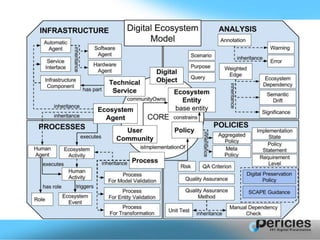
▶ Digital Ecosystem Model
▶ Modelling Strategies
▶ Examples
▶ EcoBuilder
▶ Conclusion
Agenda
interwoven evolving networks of
▶ digital objects,
▶ policies,
▶ processes,
▶ technical services,
▶ and user communities
within constantly changing and interacting
environments influencing digital objects
Digital Ecosystems
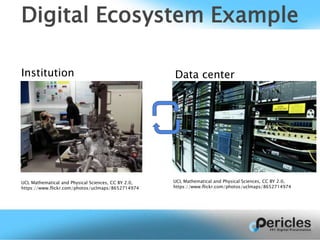
Digital Ecosystem Example
UCL Mathematical and Physical Sciences, CC BY 2.0,
https://www.flickr.com/photos/uclmaps/8652714974
Institution Data center
UCL Mathematical and Physical Sciences, CC BY 2.0,
https://www.flickr.com/photos/uclmaps/8652714974
▶ creation, deletion and change of single entities
▶ change in larger social or cultural contexts
▶ merging and growing user communities
◦ changing expectations, requirements, and
background knowledge of user communities
◦ exchange of digital objects
▶ new policies, processes
▶ technical infrastructure and dependency changes
Planned and Unplanned Digital
Ecosystem change
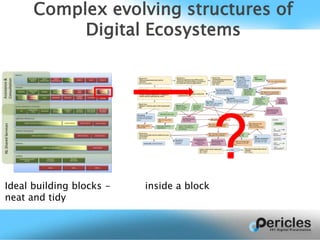
Complex evolving structures of
Digital Ecosystems
Ideal building blocks -
neat and tidy
inside a block
?
Because of the complexity of DEs it hard to
▶ maintain them
▶ describe them
▶ introduce changes
▶ determine impact of change
▶ identify and resolve problems
▶ trace provenance
→ use of ontologies
Issues of Digital Ecosystems
• Flexible formal data structure of knowledge
• Subject - Predicate - Object structure
• Leaf - is part of - a tree
• Reasoning to infer new information
• Ensure consistency of the domain representation
• graph structure
• machine processable
• extendable
Ontologies for handling this
complexity
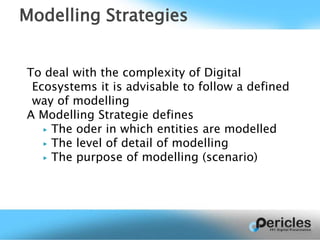
To deal with the complexity of Digital
Ecosystems it is advisable to follow a defined
way of modelling
A Modelling Strategie defines
▶ The oder in which entities are modelled
▶ The level of detail of modelling
▶ The purpose of modelling (scenario)
Modelling Strategies
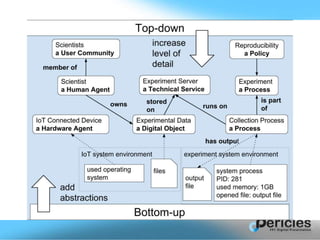
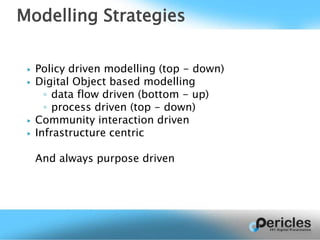
▶ Policy driven modelling (top - down)
▶ Digital Object based modelling
◦ data flow driven (bottom - up)
◦ process driven (top - down)
▶ Community interaction driven
▶ Infrastructure centric
And always purpose driven
Modelling Strategies
▶ simulate impact of change
▶ reveal single point of failures
▶ use in a sheer curation scenario
◦ extraction of significant environment
information
◦ automatic updating of models
▶ analyse provenance
Resulting Model
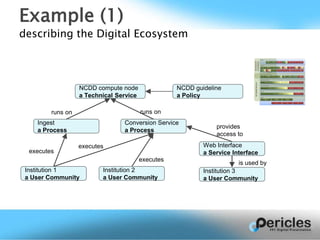
describing the Digital Ecosystem
Example (1)
Institution 1
a User Community
Institution 2
a User Community
Conversion Service
a Process
Ingest
a Process
NCDD compute node
a Technical Service
NCDD guideline
a Policy
Institution 3
a User Community
Web Interface
a Service Interface
runs on runs on
executes
executes
executes
provides
access to
is used by
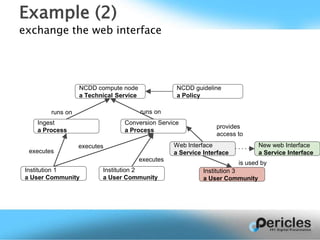
exchange the web interface
Example (2)
Institution 1
a User Community
Institution 2
a User Community
Conversion Service
a Process
Ingest
a Process
NCDD compute node
a Technical Service
NCDD guideline
a Policy
Institution 3
a User Community
Web Interface
a Service Interface
runs on runs on
executes
executes
executes
provides
access to
is used by
New web Interface
a Service Interface
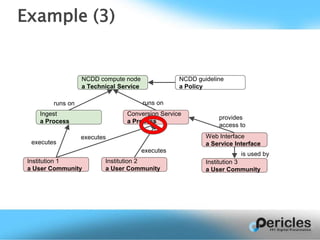
investigate the impact of a failure of the conversion
process
This can be done either
▶ in simulations before any failure happens
▶ or through a static analysis once a failure
occurred
Example (3)
Example (3)
Institution 1
a User Community
Institution 2
a User Community
Conversion Service
a Process
Ingest
a Process
NCDD compute node
a Technical Service
NCDD guideline
a Policy
Institution 3
a User Community
Web Interface
a Service Interface
runs on runs on
executes
executes
executes
provides
access to
is used by
Tool for the creation of Digital Ecosystem Models
▶ GUI
◦ Simplifies the creation of the model
◦ Usable by scenario experts without the
necessity to write ontology or Java sources
▶ Java API
◦ Facilitates integration into workflows
◦ Used by our Mediator Script!
▶ Uses Java Jena API - can output OWL/XML or Turtle
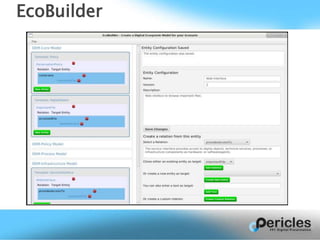
EcoBuilder
EcoBuilder
The DEM and the EcoBuilder are available on GitHub.
(Apache v. 2 open source license)
https://github.com/pericles-project/DEM
https://github.com/pericles-project/EcoBuilder
http://pericles-project.eu/deliverables/75
http://pericles-project.eu/blog/post/EcoBuilder
Any Questions?

PERICLES Ecosystem Modelling (NCDD use case) - Acting on Change 2016

  • 1.
    GRANT AGREEMENT: 601138| SCHEME FP7 ICT 2011.4.3 Promoting and Enhancing Reuse of Information throughout the Content Lifecycle taking account of Evolving Semantics [Digital Preservation] “This project has received funding from the European Union’s Seventh Framework Programme for research, technological development and demonstration under grant agreement no601138”. HOW TO MODEL THE USE CASE OF THE NCDD NETWORK OF SHARED FACILITIES Digital Ecosystem Model, EcoBuilder, Modelling strategies Johannes Biermann, Anna Eggers State and University Library Göttingen
  • 2.
    ▶ Digital Ecosystems ◦Types of Change ◦ Issues of Digital Ecosystems ▶ Digital Ecosystem Model ▶ Modelling Strategies ▶ Examples ▶ EcoBuilder ▶ Conclusion Agenda
  • 3.
    interwoven evolving networksof ▶ digital objects, ▶ policies, ▶ processes, ▶ technical services, ▶ and user communities within constantly changing and interacting environments influencing digital objects Digital Ecosystems
  • 4.
    Digital Ecosystem Example UCLMathematical and Physical Sciences, CC BY 2.0, https://www.flickr.com/photos/uclmaps/8652714974 Institution Data center UCL Mathematical and Physical Sciences, CC BY 2.0, https://www.flickr.com/photos/uclmaps/8652714974
  • 5.
    ▶ creation, deletionand change of single entities ▶ change in larger social or cultural contexts ▶ merging and growing user communities ◦ changing expectations, requirements, and background knowledge of user communities ◦ exchange of digital objects ▶ new policies, processes ▶ technical infrastructure and dependency changes Planned and Unplanned Digital Ecosystem change
  • 6.
    Complex evolving structuresof Digital Ecosystems Ideal building blocks - neat and tidy inside a block ?
  • 7.
    Because of thecomplexity of DEs it hard to ▶ maintain them ▶ describe them ▶ introduce changes ▶ determine impact of change ▶ identify and resolve problems ▶ trace provenance → use of ontologies Issues of Digital Ecosystems
  • 8.
    • Flexible formaldata structure of knowledge • Subject - Predicate - Object structure • Leaf - is part of - a tree • Reasoning to infer new information • Ensure consistency of the domain representation • graph structure • machine processable • extendable Ontologies for handling this complexity
  • 10.
    To deal withthe complexity of Digital Ecosystems it is advisable to follow a defined way of modelling A Modelling Strategie defines ▶ The oder in which entities are modelled ▶ The level of detail of modelling ▶ The purpose of modelling (scenario) Modelling Strategies
  • 12.
    ▶ Policy drivenmodelling (top - down) ▶ Digital Object based modelling ◦ data flow driven (bottom - up) ◦ process driven (top - down) ▶ Community interaction driven ▶ Infrastructure centric And always purpose driven Modelling Strategies
  • 13.
    ▶ simulate impactof change ▶ reveal single point of failures ▶ use in a sheer curation scenario ◦ extraction of significant environment information ◦ automatic updating of models ▶ analyse provenance Resulting Model
  • 14.
    describing the DigitalEcosystem Example (1) Institution 1 a User Community Institution 2 a User Community Conversion Service a Process Ingest a Process NCDD compute node a Technical Service NCDD guideline a Policy Institution 3 a User Community Web Interface a Service Interface runs on runs on executes executes executes provides access to is used by
  • 15.
    exchange the webinterface Example (2) Institution 1 a User Community Institution 2 a User Community Conversion Service a Process Ingest a Process NCDD compute node a Technical Service NCDD guideline a Policy Institution 3 a User Community Web Interface a Service Interface runs on runs on executes executes executes provides access to is used by New web Interface a Service Interface
  • 16.
    investigate the impactof a failure of the conversion process This can be done either ▶ in simulations before any failure happens ▶ or through a static analysis once a failure occurred Example (3)
  • 17.
    Example (3) Institution 1 aUser Community Institution 2 a User Community Conversion Service a Process Ingest a Process NCDD compute node a Technical Service NCDD guideline a Policy Institution 3 a User Community Web Interface a Service Interface runs on runs on executes executes executes provides access to is used by
  • 18.
    Tool for thecreation of Digital Ecosystem Models ▶ GUI ◦ Simplifies the creation of the model ◦ Usable by scenario experts without the necessity to write ontology or Java sources ▶ Java API ◦ Facilitates integration into workflows ◦ Used by our Mediator Script! ▶ Uses Java Jena API - can output OWL/XML or Turtle EcoBuilder
  • 19.
  • 20.
    The DEM andthe EcoBuilder are available on GitHub. (Apache v. 2 open source license) https://github.com/pericles-project/DEM https://github.com/pericles-project/EcoBuilder http://pericles-project.eu/deliverables/75 http://pericles-project.eu/blog/post/EcoBuilder Any Questions?