JMeter
www.novaturetech.co
m
Performance Testing Training with JMeter
Prepared By Prashanth Kumar
Performance Architect
Agenda
www.novaturetech.co
m
Agenda
1.Introduction to performance Testing
2.Get Started With JMeter
3.Introduction to Elements of JMeter Test Plan
4.Building a Web Test Plan
5.Load/Performance Testing of Websites
6.Parameterize with test data
7.Adding Assertions to the test script
8.Handling the dynamic server values
9.Best Practices
1. Introduction to performance Testing
Overview of Performance Testing
Performance testing is an non-functional testing to determine the system
responsiveness
Performance testing is in general   testing performed to determine how 
a system performs in terms of responsiveness and stability under a 
particular workload
Performance testing measures the quality attributes of the system, such as
scalability, reliability and resource usage.
Speed - Determines whether the application responds quickly
Scalability - Determines maximum user load the software application can
handle.
Stability - Determines if the application is stable under varying loads
1. Introduction to performance Testing
Purpose of Performance Testing
1.More importantly, performance testing uncovers what needs to be
improved before the product goes to market.
2. Without performance testing, software is likely to suffer from issues such
as running slow while several users use it simultaneously.
3.Inconsistencies across different operating systems and poor usability
1. Introduction to performance Testing
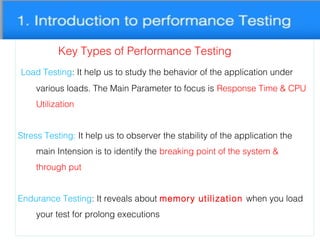
Key Types of Performance Testing
Load Testing: It help us to study the behavior of the application under
various loads. The Main Parameter to focus is Response Time & CPU
Utilization
Stress Testing: It help us to observer the stability of the application the
main Intension is to identify the breaking point of the system &
through put
Endurance Testing: It reveals about memory utilization when you load
your test for prolong executions
1. Introduction to performance Testing
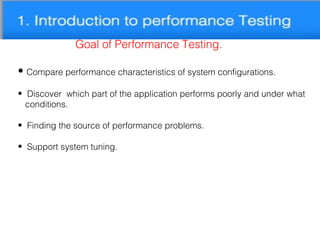
Goal of Performance Testing.
• Compare performance characteristics of system configurations.
• Discover which part of the application performs poorly and under what
conditions.
• Finding the source of performance problems.
• Support system tuning.
1. Introduction to performance Testing
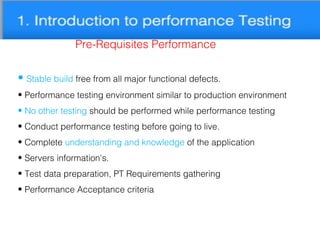
Pre-Requisites Performance
• Stable build free from all major functional defects.
• Performance testing environment similar to production environment
• No other testing should be performed while performance testing
• Conduct performance testing before going to live.
• Complete understanding and knowledge of the application
• Servers information's.
• Test data preparation, PT Requirements gathering
• Performance Acceptance criteria
1. Introduction to performance Testing
Why to use performance Testing tool?
Recommend the tool that best serves the organization’s purpose
to test their web applications before deployment.
Tools such as profilers to measure what parts of a device or
software contribute most to the poor performance, or to establish
throughput levels (and thresholds) for maintained
acceptable response times
1. Introduction to performance Testing
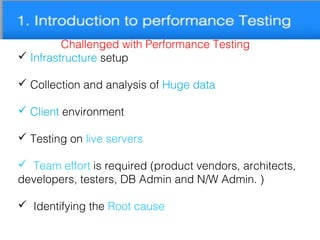
Challenged with Performance Testing
 Infrastructure setup
 Collection and analysis of Huge data
 Client environment
 Testing on live servers
 Team effort is required (product vendors, architects,
developers, testers, DB Admin and N/W Admin. )
 Identifying the Root cause
Contents
 What is JMeter?
 What can you test in JMeter
 Installing JMeter
 Setting up Environment
 Running JMeter
2. Get Started

2. Get Started
www.novaturetech.co
m
What is JMeter?
JMeter is an Apache Jakarta project that can be used as a load testing
tool for analyzing and measuring the performance of a variety of services,
with a focus on web applications
The Apache JMeter is pure Java open source software 
JMeter is fully Multi – threading frame work
Plat form independent and Easy Instillation
Friendly GUI and unlimited testing capabilities.
2. Get Started
www.novaturetech.co
m
What can you test in JMeter
Web: Http, Http’s sites
Web Services: SOAP/XML-RPC
Data Base via JDBC drivers.
Directory: LDAP
Massage oriented services via JMS
Services : SMTP, POP3,FTP services.
2. Get Started
Installing JMeter
 Install java 1.6 or above
 Download JMeter
 http://jmeter.apache.org/download_jmeter.cgi
 Extract the zip file and navigate to JMeter bin double click on
windows batch file
 Run the Jmeter.sh for Linux
2. Get Started
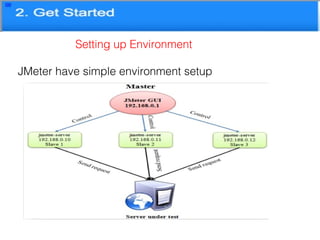
Setting up Environment
JMeter have simple environment setup
2. Get Started
Running JMeter
 Open command prompt (use administrative mode to avoid
unnecessary hassle )
Traverse to [ Jmeter installation path ] bin
 Run Jmeter.bat file or Jmeter.sh
Contents
Test Plan
Thread Group
Controllers
Samplers
Logic Controllers
Listeners & Timers
Assertions
Configuration Elements
Pre &Post-Processor Elements
www.novaturetech.co
m
Test Plan
•Test plan will contain the actual test
•It’s a layout of how and what to test
•Test plan describes a series of steps Jmeter will execute
once the test plan runs
•A Test plan must contain at least one Thread Group
3. Introduction to Elements of JMeter
Test Plan
Thread Group
•Thread group is used for representing users
•There could be one or more Thread Groups in a Test Plan
• Each thread group will execute completely independently
from each other
• Thread group can control
 Number of users simulated
 Ramp up time(How long it will take to start all the threads)
 Number of times to perform the test
3. Introduction to Elements of JMeter Test Plan
Controllers
• Controllers are used for grouping and applying logic to
test items
• We have two types of controllers
 Sampler - will send requests to the server
 Logical Controller - customize the logic while
sending the request
3. Introduction to Elements of
JMeter Test Plan
3. Introduction to Elements of JMeter Test Plan
Samplers
• Used for performing the actual task
• It allows JMeter to send specific types requests to
the server
• List of samplers in JMeter
3. Introduction to Elements of JMeter Test Plan
www.novaturetech.co
m
Logic Controllers
• These allow us to customize the logic the JMeter
will decide when to send the request
• List of logic controllers in JMeter
3. Introduction to Elements of JMeter Test Plan
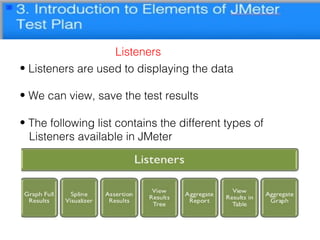
Listeners
• Listeners are used to displaying the data
• We can view, save the test results
• The following list contains the different types of
Listeners available in JMeter
3. Introduction to Elements of JMeter Test Plan
Timers
• Allow JMeter to delay between each request that
a thread makes
• Think time is used for emulating real life scenarios
• The following list contains the different types of
timers available in JMeter
3. Introduction to Elements of JMeter Test Plan
Assertions
• Used for validating test
• Allow user to test that the application is returning the
results you expect it to
• The following list contains the different types of
Assertions available in JMeter
3. Introduction to Elements of JMeter Test Plan
Configuration Elements
• They are used to add or modify request made by
samplers
• They works closely with Sampler request just before
it runs
• Below is the list of Configuration elements in JMeter
3. Introduction to Elements of JMeter Test Plan
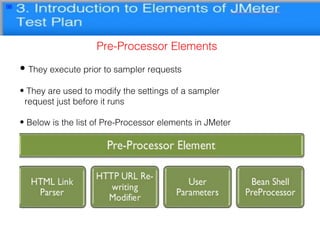
Pre-Processor Elements
• They execute prior to sampler requests
• They are used to modify the settings of a sampler
request just before it runs
• Below is the list of Pre-Processor elements in JMeter
3. Introduction to Elements of JMeter Test Plan
Post-Processor Elements
• They execute some action after sampler request
• It Executes after a request has been made from a
sampler
• Below is the list of Post-Processor elements in
JMeter
4. Building a Web Test Plan
Contents
 
 Recording & Playback
 Adding Users
 Adding Default HTTP Request Properties
 Adding Cookie Support
 Adding HTTP Requests
 Adding a Listener to View/Store the Test Results
4. Building a Web Test Plan
www.novaturetech.co
m
Recording and Playback
•JMeter will act as a proxy server between the
browser and the web recording actions
• This will help in writing the web tests
• To create the scripts we can use
 Proxy server
 Script recording tool(Badboy, Wireshark)
4. Building a Web Test Plan
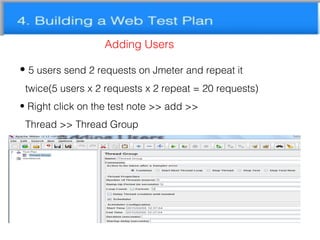
Adding Users
• 5 users send 2 requests on Jmeter and repeat it
twice(5 users x 2 requests x 2 repeat = 20 requests)
• Right click on the test note >> add >>
Thread >> Thread Group
4. Building a Web Test Plan
www.novaturetech.co
mzzz
Adding default HTTP Request Properties
• This will let us define default http parameter for every
request
• We can add this from Add >>Config Element >> HTTP
request default
4. Building a Web Test Plan
www.novaturetech.co
m
Adding HTTP Request
• We can add this from Add >> Sampler >> HTTP
Request
4. Building a Web Test Plan
www.novaturetech.co
m
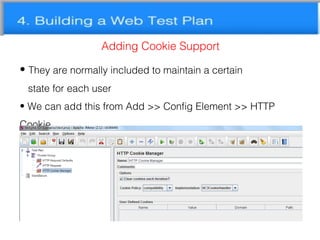
Adding Cookie Support
• They are normally included to maintain a certain
state for each user
• We can add this from Add >> Config Element >> HTTP
Cookie
Manager
4. Building a Web Test Plan
www.novaturetech.co
m
Adding a listener to view or store results
• Listener responsible for storing all the results of our HTTP request
and presenting in Visualize mode
• You can add it from Add >> Listener>> Summary report
5. Load & Performance testing of a web site
www.novaturetech.co
m
Contents
 Preparing for Load Testing
 Need to Know
 Some Helpful Tips to Get Better Results
 Using JMeter Components
 Recording HTTP Requests
 Creating the Test Plan
 Adding Listeners
 Running the Test Plan
 Interpreting the Results
 Monitoring the Server's Performance
 Performance Test Reporting
5. Load & Performance testing of a web site
www.novaturetech.co
m
Preparing for Load Testing
 Need to address a number of concerns with regards to the target
server under test.
 A load test helps to benchmark performance behavior of a server, it
is important to be able to identify the expectations and other
matters that would normally be taken into account in order to carry
out a successful load testing.
5. Load & Performance testing of a web site
www.novaturetech.co
m
Need to Know
 A suitable time to load – test the application, for instance when no
development work is taken place on the server and / or no other users
are accessing the server
The performance metrics, accepted levels, or SLA’s and goals.
Objective of the test.
The internet protocol(s) the application is (are) using (Http, Https.ftp,
etc.)
If your application has a state, the method used to manage it (URL
rewriting, cookies, etc.)
The workload at normal time and peak time.
5. Load & Performance testing of a web site
www.novaturetech.co
m
Some Helpful Tips to Get Better Results
 Use meaningful test scenarios to construct real –life test cases.
 Run JMeter on a machine other than that running the application.
 The machine running JMeter should have sufficient network
bandwidth, memory , CPU to generate load.
 Let JMeter test plan run for long period , hours and days, or for a
large number of iterations.
 Ensure that the application should be stable and optimized for one
user before testing it for concurrent users.
 Incorporate think time or delay using timers in your JMeter test plan
 Keep close watch on the four main things: Processer , memory,
disk and network.
5. Load & Performance testing of a web site
www.novaturetech.co
m
Using JMeter Components
 We will test five key scenario’s:-
 Home page
 Keyword search
 Create account
 Select a title
 Add to cart
These scenarios will be included in a single JMeter test plan, for a
simplicity reasons.
5. Load & Performance testing of a web site
www.novaturetech.co
m
Recording HTTP Requests
 JMeter Proxy can use to record all request sent to server.
 Create test plan with default http testing.
 Add HTTP proxy server under work bench node
 Define the port number of proxy server.
5. Load & Performance testing of a web site
www.novaturetech.co
m
Creating the Test Plan
• Right click on the test plan elements and select Add/ thread group.
• Configure the number of threads to 10, Ramp-up period to 1 second
and
loop count to 50
• Add to the test plan config element / HTTP Request defaults.
• Add pre- Processer/ user parameter element or config element / csv
data
set config.
5. Load & Performance testing of a web site
www.novaturetech.co
m
Adding Listeners
 Right click thread group name >> Add>> Listener.
5. Load & Performance testing of a web site
www.novaturetech.co
m
Running the Test Plan
 When JMeter Scripts get ready .
 Click on “Start.”
5. Load & Performance testing of a web site
www.novaturetech.co
m
Interpreting the Results
 Once the test is completed, we can now retrieve the results we
have save for each controller.
 With the exception of Assertion Result Listener, the saved data can
be viewed in numerous forms.
5. Load & Performance testing of a web site
www.novaturetech.co
m
Monitoring the Server's Performance
 There is a special Listener that allows you to monitor the server
target server’s performance as Sampler make request.
 This monitor Result Listener is designed to work with Apache
tomcat version 5 and above.
 Some server monitor tools.
 Perfmon.
 Blaze meter.
5. Load & Performance testing of a web site
www.novaturetech.co
m
Performance Test Reporting
 Introduction
 Test Environment (software and hardware)
 Goals of this Report.
 Assumption.
 Performance Requirements.
 Workload Scenario.
 Performance testing approach.
 Results.
 Samples response monitoring(Jmeter Results)
Run Date: 2/09/2015
Duration: 1 hour, 40 min, 40 sec.
Ramp up increment: 35 users
Think time: varies
Connection Speed: BroadBand
6. Parameterize with test data
www.novaturetech.co
m
Contents
 
 What is Parameterization
 Why Parameterize
 Identifying the test data on AUT
 Using the CSV Data Config in JMeter Tests
6. Parameterize with test data
www.novaturetech.co
m
What is Parameterization
• It is the way of replacing a hardcoded value in the
script with a parameter which represents a list of
values.
• It is a script that contains the actual values used
during recording and during script enhancement
phase test engineer has to replace the recorded
values with parameters is known as parameter-zing
the script.
6. Parameterize with test data
www.novaturetech.co
m
Why Parameterize
• It allows us to test your script with different values
• Replace the constant values in script with
parameters
• Simulate real user behavior while running the rest
6. Parameterize with test data
www.novaturetech.co
m
Identifying the test data on AUT
• While login “User name” & “Password” are the
parameters for which test data needed
• While registration “First name” , “City” will be the
parameters for which test data is needed
6. Parameterize with test data
www.novaturetech.co
m
Using CSV Data Config in Jmeter Tests
• Create a CSV file with the list of username and
password
• Store in the same folder where we store the tests
• Add CSV data set into the test tree from config
elements
• Add ${username},${password}in request sampler as
parameter
7. Adding Assertions to the test script
www.novaturetech.co
m
Contents
 
 What is Assertion
 Why Assertion
 Types of Assertion in JMeter
 Running the tests and analyzing the Assertion
7. Adding Assertions to the test script
www.novaturetech.co
m
What is Assertion
• Assertion allow you to include some validation test
on the response
• To ensure the response you receive.
7. Adding Assertions to the test script
www.novaturetech.co
m
Why Assertion
• Assertion are used to perform additional checks on
samplers.
• They are processed after every sampler in the same
scope.
7. Adding Assertions to the test script
www.novaturetech.co
m
Types of Assertion in Jmeter
Repsonse Assertion: Compared against various fields of response
Duration Assetrion: Tests each response was received with a given
amount of time
Size Assertion: Tests each response contains the right number of
bytes in it
XML Assertion: Tests response data consists of a formally correct XML
document
Beanshell Assertion: Checking using a Beanshell script
MD5Hex Assertion:Check the MD5 hash of the response data
HTML Assertion:Check HTML syntax of the response
Xpath Assertion:Checks the document for well formedness
XML Schema Assertion:Allows the user to validate a response against
an XML Schema
7. Adding Assertions to the test script
www.novaturetech.co
m
Running the test and analyzing the Assertion results
7. Adding Assertions to the test script
www.novaturetech.co
m
Running the test and analyzing the Assertion results
8. Handling the dynamic server values
www.novaturetech.co
m
Contents
 What is Correlation
 Why Correlation
 Regular Expression
 Using Regular Expression Extractor in JMeter Tests
9. Handling the dynamic server values
www.novaturetech.co
m
What is Correlation
• A Correlation is a connection or association.
• Capturing the dynamic data that is being generated by the
server is called correlation.
• Correlation will be done by regular expression extractor in
JMeter.
9. Handling the dynamic server values
www.novaturetech.co
m
Why is Correlation
• To overcome script fail we need a way which can capture
these dynamically generated session values and pass it
subsequently to any part of the script,
wherever required. This method to identify and set the
dynamic generated value is known as correlation.
• Sample of Regular Expression and Usage:
Session ID = (.+?) -> to correlate the url/dynamic Id.
Ex: Session ID = jkjoujn4348763jh35y9h&OrderID=ikikikii9987kmnhj2
9. Handling the dynamic server values
www.novaturetech.co
m
Regular Expression
• Extract Single string
Suppose we want to match the following portion of a web – page:
name =“file” value=“readme.txt”>
If we want extract readme.txt.. A suitable regular expression will be
name =“file” value=“(.+?)”>
The Special Characters above are
() – enclose the portion of the match string to be returned
. – match any character
+ -- one or more times
? – stop when the first match succeeds
9. Handling the dynamic server values
www.novaturetech.co
m
Regular Expression
• Extract Multiple string
Suppose we want to match the following portion of a web – page:
name =“file” value=“readme.txt”>
If we want extract both file.name and readme.txt..
A suitable regular expression will be
name =“([^”]+)” value=“([^”]+)”>
That would create two groups, which could be used in JMeter Regular
expression extractor template as $1$ and $2$.
For example, assume :
Reference Name : MYREF
Regex: name=“(.+?)” value=“(.+?)”
Template: $1$$2$
9. Handling the dynamic server values
www.novaturetech.co
m
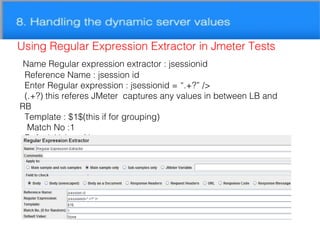
Using Regular Expression Extractor in Jmeter Tests
Name Regular expression extractor : jsessionid
Reference Name : jsession id
Enter Regular expression : jsessionid = “.+?” />
(.+?) this referes JMeter captures any values in between LB and
RB
Template : $1$(this if for grouping)
Match No :1
Default Value : None
9. Best Practices
www.novaturetech.co
m
Content.
 Limit the Number of threads.
 Where to put the cookie manager.
 Where to put the authentication manager
 Reducing the resource requirement
 Distributed testing.
10. Best Practices
www.novaturetech.co
m
Limit the Number of threads.
 This means the total number of threads generated by your test plan
should be less than 300
 The overall number of threads running from BlazeMeter will be the
total number of threads multiplied by the number of JMeter
Engines.
 For example, a test plan with 200 threads and 4 JMeter Engines,
will generate a load of 800 threads.
10. Best Practices
www.novaturetech.co
m
Where to put the cookie manager.
 The cookie manager store and sends cookies just like a web
browser.
 Received cookies can be stored as JMeter thread variables.
 Manually add a cookie to the cookie manager.
10. Best Practices
www.novaturetech.co
m
Where to put the authentication manager
 It’s species one or more user login for web page that are restricted
using server authentication.
10. Best Practices
www.novaturetech.co
m
Reducing the resource requirement
 Don’t use GUI Mode butter to use non- GUI mode.
 Use remote and distributed testing for large load testing.
 Do not load more than 300 threads per Jmeter.
 Use naming convention for all the elements.
 Use as few listeners as possible.
 Don’t use “view results tree” or “view results in table” listeners
during the load test; use them only in scripting phase to debug
purpose script
 Use CSV output rather than xml.
 Only save the data you need.
 Use few assertions as possible.

Performance testing with Jmeter

  • 1.
    JMeter www.novaturetech.co m Performance Testing Trainingwith JMeter Prepared By Prashanth Kumar Performance Architect
  • 2.
    Agenda www.novaturetech.co m Agenda 1.Introduction to performanceTesting 2.Get Started With JMeter 3.Introduction to Elements of JMeter Test Plan 4.Building a Web Test Plan 5.Load/Performance Testing of Websites 6.Parameterize with test data 7.Adding Assertions to the test script 8.Handling the dynamic server values 9.Best Practices
  • 3.
    1. Introduction toperformance Testing Overview of Performance Testing Performance testing is an non-functional testing to determine the system responsiveness Performance testing is in general   testing performed to determine how  a system performs in terms of responsiveness and stability under a  particular workload Performance testing measures the quality attributes of the system, such as scalability, reliability and resource usage. Speed - Determines whether the application responds quickly Scalability - Determines maximum user load the software application can handle. Stability - Determines if the application is stable under varying loads
  • 4.
    1. Introduction toperformance Testing Purpose of Performance Testing 1.More importantly, performance testing uncovers what needs to be improved before the product goes to market. 2. Without performance testing, software is likely to suffer from issues such as running slow while several users use it simultaneously. 3.Inconsistencies across different operating systems and poor usability
  • 5.
    1. Introduction toperformance Testing Key Types of Performance Testing Load Testing: It help us to study the behavior of the application under various loads. The Main Parameter to focus is Response Time & CPU Utilization Stress Testing: It help us to observer the stability of the application the main Intension is to identify the breaking point of the system & through put Endurance Testing: It reveals about memory utilization when you load your test for prolong executions
  • 6.
    1. Introduction toperformance Testing Goal of Performance Testing. • Compare performance characteristics of system configurations. • Discover which part of the application performs poorly and under what conditions. • Finding the source of performance problems. • Support system tuning.
  • 7.
    1. Introduction toperformance Testing Pre-Requisites Performance • Stable build free from all major functional defects. • Performance testing environment similar to production environment • No other testing should be performed while performance testing • Conduct performance testing before going to live. • Complete understanding and knowledge of the application • Servers information's. • Test data preparation, PT Requirements gathering • Performance Acceptance criteria
  • 8.
    1. Introduction toperformance Testing Why to use performance Testing tool? Recommend the tool that best serves the organization’s purpose to test their web applications before deployment. Tools such as profilers to measure what parts of a device or software contribute most to the poor performance, or to establish throughput levels (and thresholds) for maintained acceptable response times
  • 9.
    1. Introduction toperformance Testing Challenged with Performance Testing  Infrastructure setup  Collection and analysis of Huge data  Client environment  Testing on live servers  Team effort is required (product vendors, architects, developers, testers, DB Admin and N/W Admin. )  Identifying the Root cause
  • 10.
    Contents  What isJMeter?  What can you test in JMeter  Installing JMeter  Setting up Environment  Running JMeter 2. Get Started 
  • 11.
    2. Get Started www.novaturetech.co m Whatis JMeter? JMeter is an Apache Jakarta project that can be used as a load testing tool for analyzing and measuring the performance of a variety of services, with a focus on web applications The Apache JMeter is pure Java open source software  JMeter is fully Multi – threading frame work Plat form independent and Easy Instillation Friendly GUI and unlimited testing capabilities.
  • 12.
    2. Get Started www.novaturetech.co m Whatcan you test in JMeter Web: Http, Http’s sites Web Services: SOAP/XML-RPC Data Base via JDBC drivers. Directory: LDAP Massage oriented services via JMS Services : SMTP, POP3,FTP services.
  • 13.
    2. Get Started InstallingJMeter  Install java 1.6 or above  Download JMeter  http://jmeter.apache.org/download_jmeter.cgi  Extract the zip file and navigate to JMeter bin double click on windows batch file  Run the Jmeter.sh for Linux
  • 14.
    2. Get Started Settingup Environment JMeter have simple environment setup
  • 15.
    2. Get Started RunningJMeter  Open command prompt (use administrative mode to avoid unnecessary hassle ) Traverse to [ Jmeter installation path ] bin  Run Jmeter.bat file or Jmeter.sh
  • 16.
    Contents Test Plan Thread Group Controllers Samplers LogicControllers Listeners & Timers Assertions Configuration Elements Pre &Post-Processor Elements
  • 17.
    www.novaturetech.co m Test Plan •Test planwill contain the actual test •It’s a layout of how and what to test •Test plan describes a series of steps Jmeter will execute once the test plan runs •A Test plan must contain at least one Thread Group 3. Introduction to Elements of JMeter Test Plan
  • 18.
    Thread Group •Thread groupis used for representing users •There could be one or more Thread Groups in a Test Plan • Each thread group will execute completely independently from each other • Thread group can control  Number of users simulated  Ramp up time(How long it will take to start all the threads)  Number of times to perform the test 3. Introduction to Elements of JMeter Test Plan
  • 19.
    Controllers • Controllers areused for grouping and applying logic to test items • We have two types of controllers  Sampler - will send requests to the server  Logical Controller - customize the logic while sending the request 3. Introduction to Elements of JMeter Test Plan
  • 20.
    3. Introduction toElements of JMeter Test Plan Samplers • Used for performing the actual task • It allows JMeter to send specific types requests to the server • List of samplers in JMeter
  • 21.
    3. Introduction toElements of JMeter Test Plan www.novaturetech.co m Logic Controllers • These allow us to customize the logic the JMeter will decide when to send the request • List of logic controllers in JMeter
  • 22.
    3. Introduction toElements of JMeter Test Plan Listeners • Listeners are used to displaying the data • We can view, save the test results • The following list contains the different types of Listeners available in JMeter
  • 23.
    3. Introduction toElements of JMeter Test Plan Timers • Allow JMeter to delay between each request that a thread makes • Think time is used for emulating real life scenarios • The following list contains the different types of timers available in JMeter
  • 24.
    3. Introduction toElements of JMeter Test Plan Assertions • Used for validating test • Allow user to test that the application is returning the results you expect it to • The following list contains the different types of Assertions available in JMeter
  • 25.
    3. Introduction toElements of JMeter Test Plan Configuration Elements • They are used to add or modify request made by samplers • They works closely with Sampler request just before it runs • Below is the list of Configuration elements in JMeter
  • 26.
    3. Introduction toElements of JMeter Test Plan Pre-Processor Elements • They execute prior to sampler requests • They are used to modify the settings of a sampler request just before it runs • Below is the list of Pre-Processor elements in JMeter
  • 27.
    3. Introduction toElements of JMeter Test Plan Post-Processor Elements • They execute some action after sampler request • It Executes after a request has been made from a sampler • Below is the list of Post-Processor elements in JMeter
  • 28.
    4. Building aWeb Test Plan Contents    Recording & Playback  Adding Users  Adding Default HTTP Request Properties  Adding Cookie Support  Adding HTTP Requests  Adding a Listener to View/Store the Test Results
  • 29.
    4. Building aWeb Test Plan www.novaturetech.co m Recording and Playback •JMeter will act as a proxy server between the browser and the web recording actions • This will help in writing the web tests • To create the scripts we can use  Proxy server  Script recording tool(Badboy, Wireshark)
  • 30.
    4. Building aWeb Test Plan Adding Users • 5 users send 2 requests on Jmeter and repeat it twice(5 users x 2 requests x 2 repeat = 20 requests) • Right click on the test note >> add >> Thread >> Thread Group
  • 31.
    4. Building aWeb Test Plan www.novaturetech.co mzzz Adding default HTTP Request Properties • This will let us define default http parameter for every request • We can add this from Add >>Config Element >> HTTP request default
  • 32.
    4. Building aWeb Test Plan www.novaturetech.co m Adding HTTP Request • We can add this from Add >> Sampler >> HTTP Request
  • 33.
    4. Building aWeb Test Plan www.novaturetech.co m Adding Cookie Support • They are normally included to maintain a certain state for each user • We can add this from Add >> Config Element >> HTTP Cookie Manager
  • 34.
    4. Building aWeb Test Plan www.novaturetech.co m Adding a listener to view or store results • Listener responsible for storing all the results of our HTTP request and presenting in Visualize mode • You can add it from Add >> Listener>> Summary report
  • 35.
    5. Load &Performance testing of a web site www.novaturetech.co m Contents  Preparing for Load Testing  Need to Know  Some Helpful Tips to Get Better Results  Using JMeter Components  Recording HTTP Requests  Creating the Test Plan  Adding Listeners  Running the Test Plan  Interpreting the Results  Monitoring the Server's Performance  Performance Test Reporting
  • 36.
    5. Load &Performance testing of a web site www.novaturetech.co m Preparing for Load Testing  Need to address a number of concerns with regards to the target server under test.  A load test helps to benchmark performance behavior of a server, it is important to be able to identify the expectations and other matters that would normally be taken into account in order to carry out a successful load testing.
  • 37.
    5. Load &Performance testing of a web site www.novaturetech.co m Need to Know  A suitable time to load – test the application, for instance when no development work is taken place on the server and / or no other users are accessing the server The performance metrics, accepted levels, or SLA’s and goals. Objective of the test. The internet protocol(s) the application is (are) using (Http, Https.ftp, etc.) If your application has a state, the method used to manage it (URL rewriting, cookies, etc.) The workload at normal time and peak time.
  • 38.
    5. Load &Performance testing of a web site www.novaturetech.co m Some Helpful Tips to Get Better Results  Use meaningful test scenarios to construct real –life test cases.  Run JMeter on a machine other than that running the application.  The machine running JMeter should have sufficient network bandwidth, memory , CPU to generate load.  Let JMeter test plan run for long period , hours and days, or for a large number of iterations.  Ensure that the application should be stable and optimized for one user before testing it for concurrent users.  Incorporate think time or delay using timers in your JMeter test plan  Keep close watch on the four main things: Processer , memory, disk and network.
  • 39.
    5. Load &Performance testing of a web site www.novaturetech.co m Using JMeter Components  We will test five key scenario’s:-  Home page  Keyword search  Create account  Select a title  Add to cart These scenarios will be included in a single JMeter test plan, for a simplicity reasons.
  • 40.
    5. Load &Performance testing of a web site www.novaturetech.co m Recording HTTP Requests  JMeter Proxy can use to record all request sent to server.  Create test plan with default http testing.  Add HTTP proxy server under work bench node  Define the port number of proxy server.
  • 41.
    5. Load &Performance testing of a web site www.novaturetech.co m Creating the Test Plan • Right click on the test plan elements and select Add/ thread group. • Configure the number of threads to 10, Ramp-up period to 1 second and loop count to 50 • Add to the test plan config element / HTTP Request defaults. • Add pre- Processer/ user parameter element or config element / csv data set config.
  • 42.
    5. Load &Performance testing of a web site www.novaturetech.co m Adding Listeners  Right click thread group name >> Add>> Listener.
  • 43.
    5. Load &Performance testing of a web site www.novaturetech.co m Running the Test Plan  When JMeter Scripts get ready .  Click on “Start.”
  • 44.
    5. Load &Performance testing of a web site www.novaturetech.co m Interpreting the Results  Once the test is completed, we can now retrieve the results we have save for each controller.  With the exception of Assertion Result Listener, the saved data can be viewed in numerous forms.
  • 45.
    5. Load &Performance testing of a web site www.novaturetech.co m Monitoring the Server's Performance  There is a special Listener that allows you to monitor the server target server’s performance as Sampler make request.  This monitor Result Listener is designed to work with Apache tomcat version 5 and above.  Some server monitor tools.  Perfmon.  Blaze meter.
  • 46.
    5. Load &Performance testing of a web site www.novaturetech.co m Performance Test Reporting  Introduction  Test Environment (software and hardware)  Goals of this Report.  Assumption.  Performance Requirements.  Workload Scenario.  Performance testing approach.  Results.  Samples response monitoring(Jmeter Results) Run Date: 2/09/2015 Duration: 1 hour, 40 min, 40 sec. Ramp up increment: 35 users Think time: varies Connection Speed: BroadBand
  • 47.
    6. Parameterize withtest data www.novaturetech.co m Contents    What is Parameterization  Why Parameterize  Identifying the test data on AUT  Using the CSV Data Config in JMeter Tests
  • 48.
    6. Parameterize withtest data www.novaturetech.co m What is Parameterization • It is the way of replacing a hardcoded value in the script with a parameter which represents a list of values. • It is a script that contains the actual values used during recording and during script enhancement phase test engineer has to replace the recorded values with parameters is known as parameter-zing the script.
  • 49.
    6. Parameterize withtest data www.novaturetech.co m Why Parameterize • It allows us to test your script with different values • Replace the constant values in script with parameters • Simulate real user behavior while running the rest
  • 50.
    6. Parameterize withtest data www.novaturetech.co m Identifying the test data on AUT • While login “User name” & “Password” are the parameters for which test data needed • While registration “First name” , “City” will be the parameters for which test data is needed
  • 51.
    6. Parameterize withtest data www.novaturetech.co m Using CSV Data Config in Jmeter Tests • Create a CSV file with the list of username and password • Store in the same folder where we store the tests • Add CSV data set into the test tree from config elements • Add ${username},${password}in request sampler as parameter
  • 52.
    7. Adding Assertionsto the test script www.novaturetech.co m Contents    What is Assertion  Why Assertion  Types of Assertion in JMeter  Running the tests and analyzing the Assertion
  • 53.
    7. Adding Assertionsto the test script www.novaturetech.co m What is Assertion • Assertion allow you to include some validation test on the response • To ensure the response you receive.
  • 54.
    7. Adding Assertionsto the test script www.novaturetech.co m Why Assertion • Assertion are used to perform additional checks on samplers. • They are processed after every sampler in the same scope.
  • 55.
    7. Adding Assertionsto the test script www.novaturetech.co m Types of Assertion in Jmeter Repsonse Assertion: Compared against various fields of response Duration Assetrion: Tests each response was received with a given amount of time Size Assertion: Tests each response contains the right number of bytes in it XML Assertion: Tests response data consists of a formally correct XML document Beanshell Assertion: Checking using a Beanshell script MD5Hex Assertion:Check the MD5 hash of the response data HTML Assertion:Check HTML syntax of the response Xpath Assertion:Checks the document for well formedness XML Schema Assertion:Allows the user to validate a response against an XML Schema
  • 56.
    7. Adding Assertionsto the test script www.novaturetech.co m Running the test and analyzing the Assertion results
  • 57.
    7. Adding Assertionsto the test script www.novaturetech.co m Running the test and analyzing the Assertion results
  • 58.
    8. Handling thedynamic server values www.novaturetech.co m Contents  What is Correlation  Why Correlation  Regular Expression  Using Regular Expression Extractor in JMeter Tests
  • 59.
    9. Handling thedynamic server values www.novaturetech.co m What is Correlation • A Correlation is a connection or association. • Capturing the dynamic data that is being generated by the server is called correlation. • Correlation will be done by regular expression extractor in JMeter.
  • 60.
    9. Handling thedynamic server values www.novaturetech.co m Why is Correlation • To overcome script fail we need a way which can capture these dynamically generated session values and pass it subsequently to any part of the script, wherever required. This method to identify and set the dynamic generated value is known as correlation. • Sample of Regular Expression and Usage: Session ID = (.+?) -> to correlate the url/dynamic Id. Ex: Session ID = jkjoujn4348763jh35y9h&OrderID=ikikikii9987kmnhj2
  • 61.
    9. Handling thedynamic server values www.novaturetech.co m Regular Expression • Extract Single string Suppose we want to match the following portion of a web – page: name =“file” value=“readme.txt”> If we want extract readme.txt.. A suitable regular expression will be name =“file” value=“(.+?)”> The Special Characters above are () – enclose the portion of the match string to be returned . – match any character + -- one or more times ? – stop when the first match succeeds
  • 62.
    9. Handling thedynamic server values www.novaturetech.co m Regular Expression • Extract Multiple string Suppose we want to match the following portion of a web – page: name =“file” value=“readme.txt”> If we want extract both file.name and readme.txt.. A suitable regular expression will be name =“([^”]+)” value=“([^”]+)”> That would create two groups, which could be used in JMeter Regular expression extractor template as $1$ and $2$. For example, assume : Reference Name : MYREF Regex: name=“(.+?)” value=“(.+?)” Template: $1$$2$
  • 63.
    9. Handling thedynamic server values www.novaturetech.co m Using Regular Expression Extractor in Jmeter Tests Name Regular expression extractor : jsessionid Reference Name : jsession id Enter Regular expression : jsessionid = “.+?” /> (.+?) this referes JMeter captures any values in between LB and RB Template : $1$(this if for grouping) Match No :1 Default Value : None
  • 64.
    9. Best Practices www.novaturetech.co m Content. Limit the Number of threads.  Where to put the cookie manager.  Where to put the authentication manager  Reducing the resource requirement  Distributed testing.
  • 65.
    10. Best Practices www.novaturetech.co m Limitthe Number of threads.  This means the total number of threads generated by your test plan should be less than 300  The overall number of threads running from BlazeMeter will be the total number of threads multiplied by the number of JMeter Engines.  For example, a test plan with 200 threads and 4 JMeter Engines, will generate a load of 800 threads.
  • 66.
    10. Best Practices www.novaturetech.co m Whereto put the cookie manager.  The cookie manager store and sends cookies just like a web browser.  Received cookies can be stored as JMeter thread variables.  Manually add a cookie to the cookie manager.
  • 67.
    10. Best Practices www.novaturetech.co m Whereto put the authentication manager  It’s species one or more user login for web page that are restricted using server authentication.
  • 68.
    10. Best Practices www.novaturetech.co m Reducingthe resource requirement  Don’t use GUI Mode butter to use non- GUI mode.  Use remote and distributed testing for large load testing.  Do not load more than 300 threads per Jmeter.  Use naming convention for all the elements.  Use as few listeners as possible.  Don’t use “view results tree” or “view results in table” listeners during the load test; use them only in scripting phase to debug purpose script  Use CSV output rather than xml.  Only save the data you need.  Use few assertions as possible.