International Journal of Trend in Scientific Research and Development (IJTSRD)
Volume 5 Issue 6, September-October 2021 Available Online: www.ijtsrd.com e-ISSN: 2456 – 6470
@ IJTSRD | Unique Paper ID – IJTSRD46356 | Volume – 5 | Issue – 6 | Sep-Oct 2021 Page 52
Performance Evolution of Modified
Bituminous Concrete Mix Using Waste Plastic
Pankaj Singh1
, Dr. Rajeev Singh Parihar2
, Abhay Kumar Jha2
, Barun Kumar3
1
PG Student, 2
Associate Professor, 3
Assistant Professor,
1,2,3
Department of Civil Engineering Lakshmi Narain College of Technology, Bhopal, Madhya Pradesh, India
ABSTRACT
Generally a bituminous mixture is a mixture of coarse aggregate, fine
aggregate, filler and binder. A Hot Mix Asphalt is a bituminous
mixture where all constituents are mixed, placed and compacted at
high temperature. HMA can be Dense Graded mixes (DGM) known
as Bituminous Concrete (BC). Bituminous mix is generally used as a
surface course and wearing course in flexible pavements since it is
necessary that the wearing course must provide a smooth riding
surface that is dense and at the same time take up wear and tear due
to traffic. The development of transportation plays an important role
in the development of nation. With flexible pavements being widely
used in India, steps must be taken to increase the life of the
bituminous pavements. Flexible pavements are often plagued with
problems of cracking and rutting due to repeated traffic loads. Hence
one needs to address these problems in order to improve the
performance of flexible pavements.
KEYWORDS: bituminous, mixture, Graded, Concrete, Asphalt,
flexible
How to cite this paper: Pankaj Singh |
Dr. Rajeev Singh Parihar |Abhay Kumar
Jha | Barun Kumar "Performance
Evolution of Modified Bituminous
Concrete Mix Using Waste Plastic"
Published in
International Journal
of Trend in
Scientific Research
and Development
(ijtsrd), ISSN: 2456-
6470, Volume-5 |
Issue-6, October
2021, pp.52-55, URL:
www.ijtsrd.com/papers/ijtsrd46356.pdf
Copyright © 2021 by author (s) and
International Journal of Trend in
Scientific Research and Development
Journal. This is an
Open Access article
distributed under the
terms of the Creative Commons
Attribution License (CC BY 4.0)
(http://creativecommons.org/licenses/by/4.0)
INTRODUCTION
Roadways are considered one of the most important
elements of infrastructure and they play an essential
role in our daily lives. Pavement is most important
component of highway section. Therefore the overall
functioning of highway system is greatly relying on
performance of its pavement. In India, bituminous
pavement is commonly used for highways. Due to
increasing traffic intensity, distress such as rutting
and cracking of pavements are very common in
Indian roads. Under varying seasonal temperature
flexible pavement tend to become soft in summer and
brittle in winter. In India almost 90 percent road
network is occupied by bituminous pavement only
which are constructed and maintained by using
naturally available road aggregates and bitumen, a
petroleum product, which being mixed at high
temperatures to produce hot mix asphalt.
Investigations revealed that properties of bitumen can
be improved with the incorporation of modifiers. In
this study, bitumen of grade VG30 is selected and
improved its properties by the addition of modifiers.
Marshall Stability value of modified bitumen is also
improved when compared to the selected raw
bitumen. Construction of highway involves huge
outlay of investment. A precise engineering design
may save considerable investment as well a reliable
performance of the in service highway can be
achieved. Two things are of major consideration in
flexible pavement engineering – pavement design and
the mix design. Mix design for the different layers of
the pavement can have a major impact on the
performance, cost and sustainability of the
bituminous surfaces.
A good design of bituminous mix is expected to result
in a mix which is adequately
strong
durable
resistive to fatigue and permanent deformation
environment friendly
economical
IJTSRD46356
International Journal of Trend in Scientific Research and Development @ www.ijtsrd.com eISSN: 2456-6470
@ IJTSRD | Unique Paper ID – IJTSRD46356 | Volume – 5 | Issue – 6 | Sep-Oct 2021 Page 53
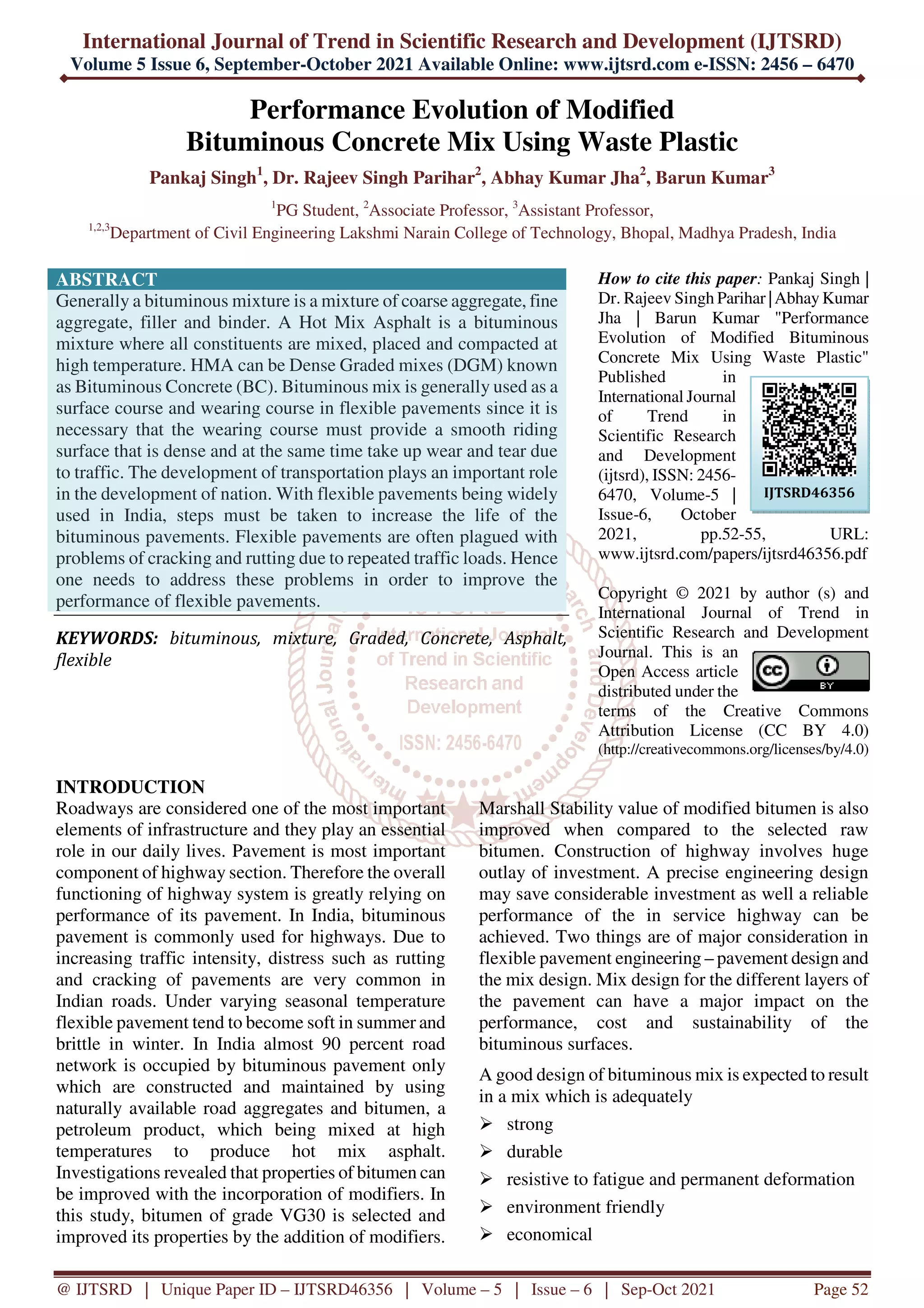
A mix designer tries to achieve these requirements through a number of tests on the mix with varied proportions
and finalizes with the best one.
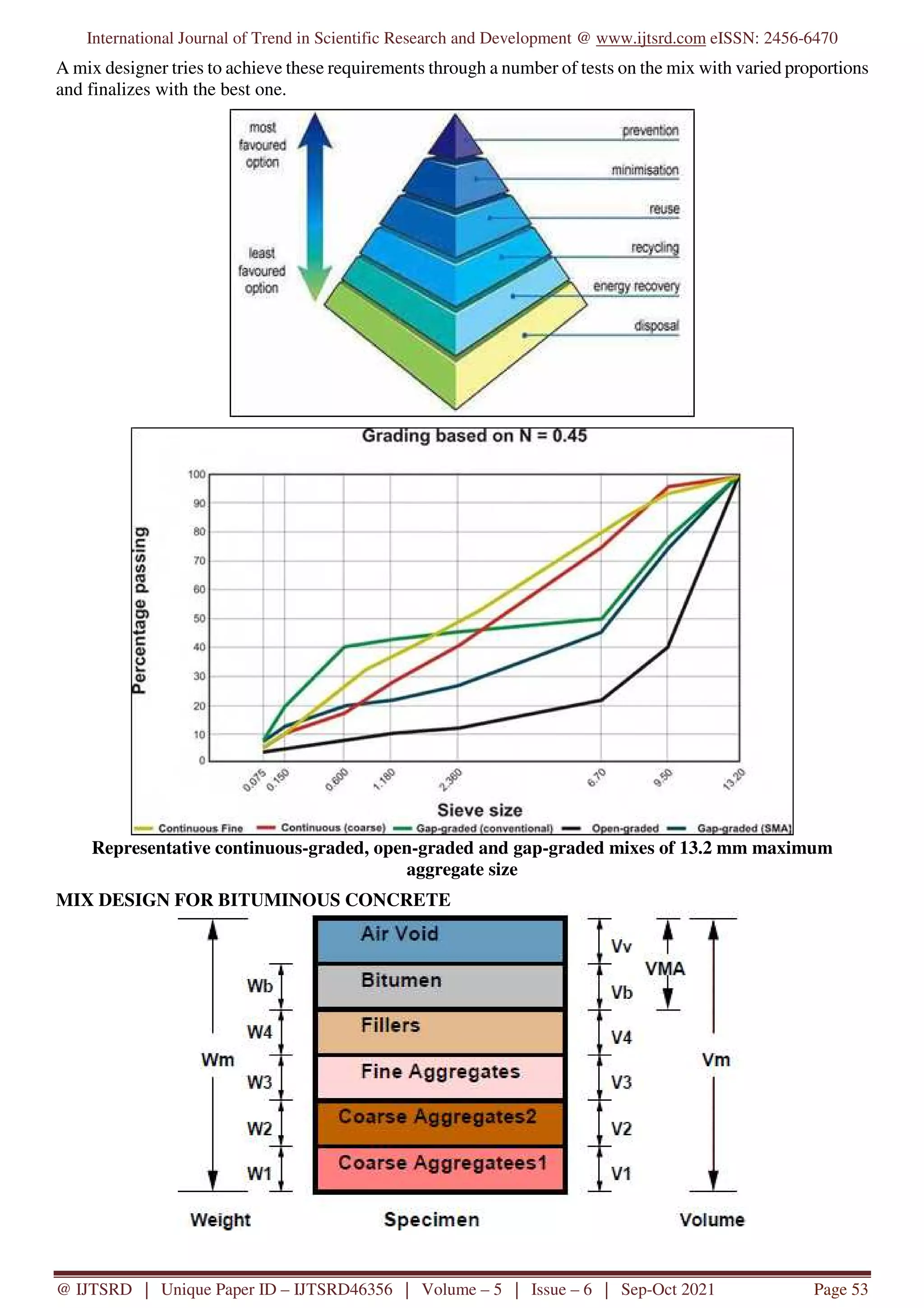
Representative continuous-graded, open-graded and gap-graded mixes of 13.2 mm maximum
aggregate size
MIX DESIGN FOR BITUMINOUS CONCRETE
International Journal of Trend in Scientific Research and Development @ www.ijtsrd.com eISSN: 2456-6470
@ IJTSRD | Unique Paper ID – IJTSRD46356 | Volume – 5 | Issue – 6 | Sep-Oct 2021 Page 54
RESULTS
Test results of the ingredient aggregates
Property Results Specifications
Aggregate Impact Value, % 19 Maximum 27
Abrasion value% 27 Maximum 35
Flakiness and Elongation Indices, %, (Combined) 29 Maximum 30
Water Absorption, % 1.5 Maximum 2
Specific Gravity 2.665
Design gradation of aggregates
CONCLUSION
Based on the results and discussion of experimental
investigation carried out on Bituminous concrete mix
following conclusion are drawn.
1. From the results and discussions on the BC mix it
can be concluded that stability of the mix can be
improved by the addition of different waste
material in OBC by weight of bitumen and also
the flow criteria as given by the MORTH can be
satisfied also .
2. The optimum binder content for BC grade 2 is
6%
3. The Marshall Stability value of the mix is
increased by the addition of all the different waste
material in OBC used in this experimental work.
However increase in stabilityvalue is different for
different material and for different percentages.
4. The Marshall stability value of BC grade 2 is
increased by 10.67% by the addition of 10 %
waste plastic in OBC, also the flow criteria as
specified by the MORTH is satisfied by the
addition of 10% waste plastic in OBC.
5. Adition of waste plastic by 10% in OBC has the
highest Marshall Stability value.
REFERENCES
[1] Ahmadinia, E. et al., 2011. Using waste plastic
bottles as additive for stone mastic asphalt.
Materials and Design, 32(10), p. 4844-4849.
[2] Airey, G. D., Collop, A. C. & Singleton, T. M.,
2001. Rheological and cohesive properties of
bitumen cured in crumb rubber. UK, University
of Dundee.
[3] Airey, G., Rahman, M. & Collop, A. C., 2004.
Crumb Rubber and Bitumen Interaction as a
Function of Crude Source and Bitumen
Viscosity. Road Materials and Pavement
Design, 5(4), p. 453-475.
International Journal of Trend in Scientific Research and Development @ www.ijtsrd.com eISSN: 2456-6470
@ IJTSRD | Unique Paper ID – IJTSRD46356 | Volume – 5 | Issue – 6 | Sep-Oct 2021 Page 55
[4] Al-Hadidy, A. I., Yi-Qiu & Tan, 2009. Effect
of polyethylene on life of flexible pavements.
Construction and Building Materials, 23(3), p.
1456-1464.
[5] Alonso, S., Medina-Torres, L., Zitzumbo, R. &
Avolos, F., 2010. Rheology of asphalt and
styrene–butadiene blends. Journal of Materials
Science, 45(10), p. 2591-2597.
[6] Bahia, H. U. & Perdomo, D., 1996. Current
practices for modification of paving asphalts.
The Asphalt Institute, 41(4), p. 1192-1198.
[7] Cao, W., 2007. Study on properties of recycled
tire rubber modified asphalt mixtures using dry
process. Construction and Building Materials,
21(5), p. 1011–1015.
[8] Chen, J. -S., Liao, M. -C. & Lin, C. -H., 2003.
Determination of polymer content in modified
bitumen. Materials and Structures, 36(9), p.
594-598.
[9] Department of Environmental Affairs, 2005.
National Waste Management Strategy
Implementation South Africa: Waste Stream
Analysis and Prioritisation for Recycling,
Pretoria, South Africa: Department of
Environmental Affairs.
[10] Flynn, L., 1993. Recycled plastic finds home in
asphalt binder. Transportation Research Board,
31(3), p. 41-47.

Performance Evolution of Modified Bituminous Concrete Mix Using Waste Plastic

  • 1.
    International Journal ofTrend in Scientific Research and Development (IJTSRD) Volume 5 Issue 6, September-October 2021 Available Online: www.ijtsrd.com e-ISSN: 2456 – 6470 @ IJTSRD | Unique Paper ID – IJTSRD46356 | Volume – 5 | Issue – 6 | Sep-Oct 2021 Page 52 Performance Evolution of Modified Bituminous Concrete Mix Using Waste Plastic Pankaj Singh1 , Dr. Rajeev Singh Parihar2 , Abhay Kumar Jha2 , Barun Kumar3 1 PG Student, 2 Associate Professor, 3 Assistant Professor, 1,2,3 Department of Civil Engineering Lakshmi Narain College of Technology, Bhopal, Madhya Pradesh, India ABSTRACT Generally a bituminous mixture is a mixture of coarse aggregate, fine aggregate, filler and binder. A Hot Mix Asphalt is a bituminous mixture where all constituents are mixed, placed and compacted at high temperature. HMA can be Dense Graded mixes (DGM) known as Bituminous Concrete (BC). Bituminous mix is generally used as a surface course and wearing course in flexible pavements since it is necessary that the wearing course must provide a smooth riding surface that is dense and at the same time take up wear and tear due to traffic. The development of transportation plays an important role in the development of nation. With flexible pavements being widely used in India, steps must be taken to increase the life of the bituminous pavements. Flexible pavements are often plagued with problems of cracking and rutting due to repeated traffic loads. Hence one needs to address these problems in order to improve the performance of flexible pavements. KEYWORDS: bituminous, mixture, Graded, Concrete, Asphalt, flexible How to cite this paper: Pankaj Singh | Dr. Rajeev Singh Parihar |Abhay Kumar Jha | Barun Kumar "Performance Evolution of Modified Bituminous Concrete Mix Using Waste Plastic" Published in International Journal of Trend in Scientific Research and Development (ijtsrd), ISSN: 2456- 6470, Volume-5 | Issue-6, October 2021, pp.52-55, URL: www.ijtsrd.com/papers/ijtsrd46356.pdf Copyright © 2021 by author (s) and International Journal of Trend in Scientific Research and Development Journal. This is an Open Access article distributed under the terms of the Creative Commons Attribution License (CC BY 4.0) (http://creativecommons.org/licenses/by/4.0) INTRODUCTION Roadways are considered one of the most important elements of infrastructure and they play an essential role in our daily lives. Pavement is most important component of highway section. Therefore the overall functioning of highway system is greatly relying on performance of its pavement. In India, bituminous pavement is commonly used for highways. Due to increasing traffic intensity, distress such as rutting and cracking of pavements are very common in Indian roads. Under varying seasonal temperature flexible pavement tend to become soft in summer and brittle in winter. In India almost 90 percent road network is occupied by bituminous pavement only which are constructed and maintained by using naturally available road aggregates and bitumen, a petroleum product, which being mixed at high temperatures to produce hot mix asphalt. Investigations revealed that properties of bitumen can be improved with the incorporation of modifiers. In this study, bitumen of grade VG30 is selected and improved its properties by the addition of modifiers. Marshall Stability value of modified bitumen is also improved when compared to the selected raw bitumen. Construction of highway involves huge outlay of investment. A precise engineering design may save considerable investment as well a reliable performance of the in service highway can be achieved. Two things are of major consideration in flexible pavement engineering – pavement design and the mix design. Mix design for the different layers of the pavement can have a major impact on the performance, cost and sustainability of the bituminous surfaces. A good design of bituminous mix is expected to result in a mix which is adequately strong durable resistive to fatigue and permanent deformation environment friendly economical IJTSRD46356
  • 2.
    International Journal ofTrend in Scientific Research and Development @ www.ijtsrd.com eISSN: 2456-6470 @ IJTSRD | Unique Paper ID – IJTSRD46356 | Volume – 5 | Issue – 6 | Sep-Oct 2021 Page 53 A mix designer tries to achieve these requirements through a number of tests on the mix with varied proportions and finalizes with the best one. Representative continuous-graded, open-graded and gap-graded mixes of 13.2 mm maximum aggregate size MIX DESIGN FOR BITUMINOUS CONCRETE
  • 3.
    International Journal ofTrend in Scientific Research and Development @ www.ijtsrd.com eISSN: 2456-6470 @ IJTSRD | Unique Paper ID – IJTSRD46356 | Volume – 5 | Issue – 6 | Sep-Oct 2021 Page 54 RESULTS Test results of the ingredient aggregates Property Results Specifications Aggregate Impact Value, % 19 Maximum 27 Abrasion value% 27 Maximum 35 Flakiness and Elongation Indices, %, (Combined) 29 Maximum 30 Water Absorption, % 1.5 Maximum 2 Specific Gravity 2.665 Design gradation of aggregates CONCLUSION Based on the results and discussion of experimental investigation carried out on Bituminous concrete mix following conclusion are drawn. 1. From the results and discussions on the BC mix it can be concluded that stability of the mix can be improved by the addition of different waste material in OBC by weight of bitumen and also the flow criteria as given by the MORTH can be satisfied also . 2. The optimum binder content for BC grade 2 is 6% 3. The Marshall Stability value of the mix is increased by the addition of all the different waste material in OBC used in this experimental work. However increase in stabilityvalue is different for different material and for different percentages. 4. The Marshall stability value of BC grade 2 is increased by 10.67% by the addition of 10 % waste plastic in OBC, also the flow criteria as specified by the MORTH is satisfied by the addition of 10% waste plastic in OBC. 5. Adition of waste plastic by 10% in OBC has the highest Marshall Stability value. REFERENCES [1] Ahmadinia, E. et al., 2011. Using waste plastic bottles as additive for stone mastic asphalt. Materials and Design, 32(10), p. 4844-4849. [2] Airey, G. D., Collop, A. C. & Singleton, T. M., 2001. Rheological and cohesive properties of bitumen cured in crumb rubber. UK, University of Dundee. [3] Airey, G., Rahman, M. & Collop, A. C., 2004. Crumb Rubber and Bitumen Interaction as a Function of Crude Source and Bitumen Viscosity. Road Materials and Pavement Design, 5(4), p. 453-475.
  • 4.
    International Journal ofTrend in Scientific Research and Development @ www.ijtsrd.com eISSN: 2456-6470 @ IJTSRD | Unique Paper ID – IJTSRD46356 | Volume – 5 | Issue – 6 | Sep-Oct 2021 Page 55 [4] Al-Hadidy, A. I., Yi-Qiu & Tan, 2009. Effect of polyethylene on life of flexible pavements. Construction and Building Materials, 23(3), p. 1456-1464. [5] Alonso, S., Medina-Torres, L., Zitzumbo, R. & Avolos, F., 2010. Rheology of asphalt and styrene–butadiene blends. Journal of Materials Science, 45(10), p. 2591-2597. [6] Bahia, H. U. & Perdomo, D., 1996. Current practices for modification of paving asphalts. The Asphalt Institute, 41(4), p. 1192-1198. [7] Cao, W., 2007. Study on properties of recycled tire rubber modified asphalt mixtures using dry process. Construction and Building Materials, 21(5), p. 1011–1015. [8] Chen, J. -S., Liao, M. -C. & Lin, C. -H., 2003. Determination of polymer content in modified bitumen. Materials and Structures, 36(9), p. 594-598. [9] Department of Environmental Affairs, 2005. National Waste Management Strategy Implementation South Africa: Waste Stream Analysis and Prioritisation for Recycling, Pretoria, South Africa: Department of Environmental Affairs. [10] Flynn, L., 1993. Recycled plastic finds home in asphalt binder. Transportation Research Board, 31(3), p. 41-47.