Performance Appraisal


   Ben Dattner, Ph.D.
Performance appraisal


    Setting goals for the appraisal system
    Developing criteria for successful performance
    Creating metrics for evaluating performance
    Selecting reviewees and reviewers
    Considering the timing of feedback
    Organizing logistics for the report and meeting
    Giving candid and constructive feedback
    Following up to ensure that the system works


© 2010 Dattner Consulting, LLC
                                                      2
 Setting goals
                                                                        • Developing criteria
     Setting goals                                                      • Creating metrics
                                                                        • Selecting reviewees
                                                                          and reviewers
                                                                        • Considering timing
                                                                        • Organizing logistics
                                                                        • Giving feedback
                                                                        • Following up

    Well-designed Performance Appraisal systems:
           •      Recognize and record an employee’s contributions
           •      Give employees useful performance feedback
           •      Enable a more effective and equitable reward system
           •      Develop the professional capabilities of employees
           •      Communicate the organization’s values and culture
           •      Help the organization make evidence-based, legally
                  defensible personnel decisions


© 2010 Dattner Consulting, LLC
                                                                                                 3
 Setting goals
                                                                   • Developing criteria
     Setting goals                                                 • Creating metrics
                                                                   • Selecting reviewees
                                                                     and reviewers
                                                                   • Considering timing
                                                                   • Organizing logistics
                                                                   • Giving feedback
                                                                   • Following up

    Evaluation
           •      Prediction of future performance based on past
                  performance
           •      Retention decisions and succession planning
           •      Compensation


    Development
           •      Assessment for training and development
           •      Career planning


© 2010 Dattner Consulting, LLC
                                                                                            4
• Setting goals
                                                             Developing criteria
     Developing criteria                                    • Creating metrics
                                                            • Selecting reviewees
                                                              and reviewers
                                                            • Considering timing
                                                            • Organizing logistics
                                                            • Giving feedback
                                                            • Following up

    Criteria should be:
           •      Aligned with organizational goals
           •      Relevant to given roles
           •      Specific and measurable
           •      Under employees’ control
           •      Understood and accepted by participants


© 2010 Dattner Consulting, LLC
                                                                                     5
• Setting goals
                                                             Developing criteria
     Developing criteria                                    • Creating metrics
                                                            • Selecting reviewees
                                                              and reviewers
                                                            • Considering timing
                                                            • Organizing logistics
                                                            • Giving feedback
                                                            • Following up


    Criteria can be based on:
           •      Quantitative and/or qualitative factors
           •      Competencies and/or performance
           •      Effort and/or results
           •      Frequency of behaviors


© 2010 Dattner Consulting, LLC
                                                                                     6
• Setting goals
                                                             • Developing criteria
     Creating metrics                                         Creating Metrics
                                                             • Selecting reviewees
                                                               and reviewers
                                                             • Considering timing
                                                             • Organizing logistics
                                                             • Giving feedback
                                                             • Following up

    Ratings can be on the basis of:
           • General or specific standards or expectations
           • Improvement on past performance
           • Rankings or comparison to others


© 2010 Dattner Consulting, LLC
                                                                                      7
• Setting goals
                                                      • Developing criteria
     Creating metrics                                  Creating Metrics
                                                      • Selecting reviewees
                                                        and reviewers
                                                      • Considering timing
                                                      • Organizing logistics
                                                      • Giving feedback
                                                      • Following up


    Rating scales differ in terms of:
           •      Definition of ratings
           •      Number of possible ratings
           •      Presence or absence of a midpoint


© 2010 Dattner Consulting, LLC
                                                                               8
• Setting goals
                                                          • Developing criteria
     Creating metrics                                      Creating Metrics
                                                          • Selecting reviewees
                                                            and reviewers
                                                          • Considering timing
                                                          • Organizing logistics
                                                          • Giving feedback
                                                          • Following up


    Types of rating scales:

                           • Graphic Rating Scales
           • Ranking
           • Forced Distribution
           • Behaviorally Anchored Rating Scales (BARS)


© 2010 Dattner Consulting, LLC
                                                                                   9
• Setting goals
                                           • Developing criteria
     Selecting reviewees and reviewers     • Creating metrics
                                            Selecting reviewees
                                             and reviewers
                                           • Considering timing
                                           • Organizing logistics
                                           • Giving feedback
                                           • Following up

    Reviewees can be:
    • Everyone in the organization
    • Assigned by managers
    • Selected by level
    • Selected by division or department
    • Self-selected


© 2010 Dattner Consulting, LLC
                                                                   10
• Setting goals
                                      • Developing criteria
     Participants (Continued)         • Creating metrics
                                       Selecting reviewees
                                        and reviewers
                                      • Considering timing
                                      • Organizing logistics
                                      • Giving feedback
                                      • Follow up


    Reviewers can be designated by:
    • Manager
    • Human Resources
    • Reviewee


© 2010 Dattner Consulting, LLC
                                                              11
• Setting goals
                                 • Developing criteria
     Participants (Continued)    • Creating metrics
                                  Selecting reviewees
                                   and reviewers
                                 • Considering timing
                                 • Organizing logistics
                                 • Giving feedback
                                 • Follow up


    Reviewers can include:
    • Reviewee
    • Manager
    • Peers
    • Subordinates
    • Clients or customers


© 2010 Dattner Consulting, LLC
                                                         12
• Setting goals
                                        • Developing criteria
     Considering timing                 • Creating metrics
                                        • Selecting reviewees
                                          and reviewers
                                         Considering timing
                                        • Organizing logistics
                                        • Giving feedback
                                        • Following up


    Performance can be appraised:
    • After each project is completed
    • After a milestone is reached
    • Quarterly
    • Semi-annually
    • Annually


© 2010 Dattner Consulting, LLC
                                                                13
• Setting goals
                                     • Developing criteria
     Organizing logistics            • Creating metrics
                                     • Selecting reviewees
                                       and reviewers
                                     • Considering timing
                                      Organizing logistics
                                     • Giving feedback
                                     • Following up

    Data can be gathered by or in:
    • Written surveys
    • Intranet or internet
    • Individual discussions
    • Group meetings


© 2010 Dattner Consulting, LLC
                                                             14
• Setting goals
                                         • Developing criteria
     Organizing logistics                • Creating metrics
                                         • Selecting reviewees
                                           and reviewers
                                         • Considering timing
                                          Organizing logistics
                                         • Giving feedback
                                         • Following up

    The process can be coordinated by:
    • Employee
    • Manager
    • Human Resources
    • An outside vendor


© 2010 Dattner Consulting, LLC
                                                                 15
• Setting goals
                                               • Developing criteria
     Giving feedback                           • Creating metrics
                                               • Selecting reviewees
                                                 and reviewers
                                               • Considering timing
                                               • Organizing logistics
                                                Giving feedback

    Feedback reports can include:              • Following up


    • Attributed ratings and comments
    • Anonymous ratings and comments
    • Statistics and comparisons
    • Weighted or unweighted ratings
           •      By competency
           •      By reviewer
    • Competencies necessary for advancement


© 2010 Dattner Consulting, LLC
                                                                       16
• Setting goals
                                           • Developing criteria
     Giving feedback                       • Creating metrics
                                           • Selecting reviewees
                                             and reviewers
                                           • Considering timing
                                           • Organizing logistics
                                            Giving feedback
                                           • Following up

    Feedback reports can be (or not be):
    • Filtered or summarized by manager
    • For an employee’s file
    • Shared with others
    • Reviewed and approved by others
    • Inclusive of tables or graphics


© 2010 Dattner Consulting, LLC
                                                                   17
• Setting goals
                                             • Developing criteria
     Giving feedback                         • Creating metrics
                                             • Selecting reviewees
                                               and reviewers
                                             • Considering timing
                                             • Organizing logistics
                                              Giving feedback
                                             • Following up

    Feedback is least useful when it is:
    • Inaccurate or untrue
    • Biased due to favoritism or politics
    • Insensitive and unduly critical
    • Not specific or actionable
    • Constituted by orders or ultimatums


© 2010 Dattner Consulting, LLC
                                                                     18
• Setting goals
                                                         • Developing criteria
     Giving feedback                                     • Creating metrics
                                                         • Selecting reviewees
                                                           and reviewers
                                                         • Considering timing
                                                         • Organizing logistics
                                                          Giving feedback

    Feedback is most useful when it is:                  • Following up


    • Candid and honest
    • Specific and actionable
    • Based on more than one incident or example
    • Based on more than one person’s view
    • Framed positively and constructively
    • Behaviorally based rather than personality based
    • Summarized and integrated into key themes


© 2010 Dattner Consulting, LLC
                                                                                 19
• Setting goals
                                                      • Developing criteria
     Giving feedback                                  • Creating metrics
                                                      • Selecting reviewees
                                                        and reviewers
                                                      • Considering timing
                                                      • Organizing logistics
                                                       Giving feedback
                                                      • Following up

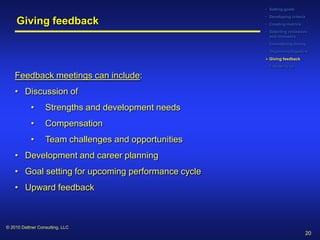
    Feedback meetings can include:
    • Discussion of
           •      Strengths and development needs
           •      Compensation
           •      Team challenges and opportunities
    • Development and career planning
    • Goal setting for upcoming performance cycle
    • Upward feedback


© 2010 Dattner Consulting, LLC
                                                                           20
• Setting goals


     Following up                                        • Developing criteria
                                                         • Creating metrics
                                                         • Selecting reviewees
                                                           and reviewers
                                                         • Considering timing
                                                         • Organizing logistics
                                                         • Giving feedback

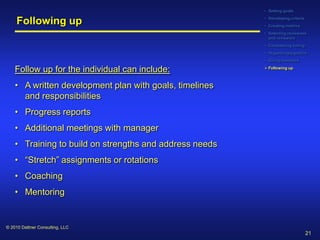
    Follow up for the individual can include:             Following up


    • A written development plan with goals, timelines
      and responsibilities
    • Progress reports
    • Additional meetings with manager
    • Training to build on strengths and address needs
    • “Stretch” assignments or rotations
    • Coaching
    • Mentoring


© 2010 Dattner Consulting, LLC
                                                                                 21
• Setting goals

     Follow up                                                    • Developing criteria
                                                                  • Creating metrics
                                                                  • Selecting reviewees
                                                                    and reviewers
                                                                  • Considering timing
                                                                  • Organizing logistics
                                                                  • Giving feedback
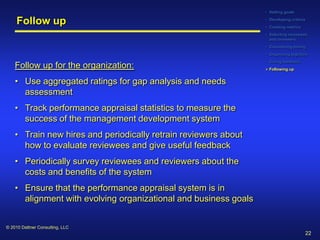
    Follow up for the organization:                                Following up


    • Use aggregated ratings for gap analysis and needs
      assessment
    • Track performance appraisal statistics to measure the
      success of the management development system
    • Train new hires and periodically retrain reviewers about
      how to evaluate reviewees and give useful feedback
    • Periodically survey reviewees and reviewers about the
      costs and benefits of the system
    • Ensure that the performance appraisal system is in
      alignment with evolving organizational and business goals


© 2010 Dattner Consulting, LLC
                                                                                          22
Conclusion


              A well-designed performance appraisal system supports
              an integrated human resource strategy which enables the
              attainment of organizational and business goals


© 2010 Dattner Consulting, LLC
                                                                        23
Ben Dattner, Ph.D.
     ben@dattnerconsulting.com
     212-501-8945

     www.dattnerconsulting.com


© 2010 Dattner Consulting, LLC
                                 24

Performance Apraisal Guide

  • 1.
    Performance Appraisal Ben Dattner, Ph.D.
  • 2.
    Performance appraisal Setting goals for the appraisal system Developing criteria for successful performance Creating metrics for evaluating performance Selecting reviewees and reviewers Considering the timing of feedback Organizing logistics for the report and meeting Giving candid and constructive feedback Following up to ensure that the system works © 2010 Dattner Consulting, LLC 2
  • 3.
     Setting goals • Developing criteria Setting goals • Creating metrics • Selecting reviewees and reviewers • Considering timing • Organizing logistics • Giving feedback • Following up Well-designed Performance Appraisal systems: • Recognize and record an employee’s contributions • Give employees useful performance feedback • Enable a more effective and equitable reward system • Develop the professional capabilities of employees • Communicate the organization’s values and culture • Help the organization make evidence-based, legally defensible personnel decisions © 2010 Dattner Consulting, LLC 3
  • 4.
     Setting goals • Developing criteria Setting goals • Creating metrics • Selecting reviewees and reviewers • Considering timing • Organizing logistics • Giving feedback • Following up Evaluation • Prediction of future performance based on past performance • Retention decisions and succession planning • Compensation Development • Assessment for training and development • Career planning © 2010 Dattner Consulting, LLC 4
  • 5.
    • Setting goals  Developing criteria Developing criteria • Creating metrics • Selecting reviewees and reviewers • Considering timing • Organizing logistics • Giving feedback • Following up Criteria should be: • Aligned with organizational goals • Relevant to given roles • Specific and measurable • Under employees’ control • Understood and accepted by participants © 2010 Dattner Consulting, LLC 5
  • 6.
    • Setting goals  Developing criteria Developing criteria • Creating metrics • Selecting reviewees and reviewers • Considering timing • Organizing logistics • Giving feedback • Following up Criteria can be based on: • Quantitative and/or qualitative factors • Competencies and/or performance • Effort and/or results • Frequency of behaviors © 2010 Dattner Consulting, LLC 6
  • 7.
    • Setting goals • Developing criteria Creating metrics  Creating Metrics • Selecting reviewees and reviewers • Considering timing • Organizing logistics • Giving feedback • Following up Ratings can be on the basis of: • General or specific standards or expectations • Improvement on past performance • Rankings or comparison to others © 2010 Dattner Consulting, LLC 7
  • 8.
    • Setting goals • Developing criteria Creating metrics  Creating Metrics • Selecting reviewees and reviewers • Considering timing • Organizing logistics • Giving feedback • Following up Rating scales differ in terms of: • Definition of ratings • Number of possible ratings • Presence or absence of a midpoint © 2010 Dattner Consulting, LLC 8
  • 9.
    • Setting goals • Developing criteria Creating metrics  Creating Metrics • Selecting reviewees and reviewers • Considering timing • Organizing logistics • Giving feedback • Following up Types of rating scales: • Graphic Rating Scales • Ranking • Forced Distribution • Behaviorally Anchored Rating Scales (BARS) © 2010 Dattner Consulting, LLC 9
  • 10.
    • Setting goals • Developing criteria Selecting reviewees and reviewers • Creating metrics  Selecting reviewees and reviewers • Considering timing • Organizing logistics • Giving feedback • Following up Reviewees can be: • Everyone in the organization • Assigned by managers • Selected by level • Selected by division or department • Self-selected © 2010 Dattner Consulting, LLC 10
  • 11.
    • Setting goals • Developing criteria Participants (Continued) • Creating metrics  Selecting reviewees and reviewers • Considering timing • Organizing logistics • Giving feedback • Follow up Reviewers can be designated by: • Manager • Human Resources • Reviewee © 2010 Dattner Consulting, LLC 11
  • 12.
    • Setting goals • Developing criteria Participants (Continued) • Creating metrics  Selecting reviewees and reviewers • Considering timing • Organizing logistics • Giving feedback • Follow up Reviewers can include: • Reviewee • Manager • Peers • Subordinates • Clients or customers © 2010 Dattner Consulting, LLC 12
  • 13.
    • Setting goals • Developing criteria Considering timing • Creating metrics • Selecting reviewees and reviewers  Considering timing • Organizing logistics • Giving feedback • Following up Performance can be appraised: • After each project is completed • After a milestone is reached • Quarterly • Semi-annually • Annually © 2010 Dattner Consulting, LLC 13
  • 14.
    • Setting goals • Developing criteria Organizing logistics • Creating metrics • Selecting reviewees and reviewers • Considering timing  Organizing logistics • Giving feedback • Following up Data can be gathered by or in: • Written surveys • Intranet or internet • Individual discussions • Group meetings © 2010 Dattner Consulting, LLC 14
  • 15.
    • Setting goals • Developing criteria Organizing logistics • Creating metrics • Selecting reviewees and reviewers • Considering timing  Organizing logistics • Giving feedback • Following up The process can be coordinated by: • Employee • Manager • Human Resources • An outside vendor © 2010 Dattner Consulting, LLC 15
  • 16.
    • Setting goals • Developing criteria Giving feedback • Creating metrics • Selecting reviewees and reviewers • Considering timing • Organizing logistics  Giving feedback Feedback reports can include: • Following up • Attributed ratings and comments • Anonymous ratings and comments • Statistics and comparisons • Weighted or unweighted ratings • By competency • By reviewer • Competencies necessary for advancement © 2010 Dattner Consulting, LLC 16
  • 17.
    • Setting goals • Developing criteria Giving feedback • Creating metrics • Selecting reviewees and reviewers • Considering timing • Organizing logistics  Giving feedback • Following up Feedback reports can be (or not be): • Filtered or summarized by manager • For an employee’s file • Shared with others • Reviewed and approved by others • Inclusive of tables or graphics © 2010 Dattner Consulting, LLC 17
  • 18.
    • Setting goals • Developing criteria Giving feedback • Creating metrics • Selecting reviewees and reviewers • Considering timing • Organizing logistics  Giving feedback • Following up Feedback is least useful when it is: • Inaccurate or untrue • Biased due to favoritism or politics • Insensitive and unduly critical • Not specific or actionable • Constituted by orders or ultimatums © 2010 Dattner Consulting, LLC 18
  • 19.
    • Setting goals • Developing criteria Giving feedback • Creating metrics • Selecting reviewees and reviewers • Considering timing • Organizing logistics  Giving feedback Feedback is most useful when it is: • Following up • Candid and honest • Specific and actionable • Based on more than one incident or example • Based on more than one person’s view • Framed positively and constructively • Behaviorally based rather than personality based • Summarized and integrated into key themes © 2010 Dattner Consulting, LLC 19
  • 20.
    • Setting goals • Developing criteria Giving feedback • Creating metrics • Selecting reviewees and reviewers • Considering timing • Organizing logistics  Giving feedback • Following up Feedback meetings can include: • Discussion of • Strengths and development needs • Compensation • Team challenges and opportunities • Development and career planning • Goal setting for upcoming performance cycle • Upward feedback © 2010 Dattner Consulting, LLC 20
  • 21.
    • Setting goals Following up • Developing criteria • Creating metrics • Selecting reviewees and reviewers • Considering timing • Organizing logistics • Giving feedback Follow up for the individual can include:  Following up • A written development plan with goals, timelines and responsibilities • Progress reports • Additional meetings with manager • Training to build on strengths and address needs • “Stretch” assignments or rotations • Coaching • Mentoring © 2010 Dattner Consulting, LLC 21
  • 22.
    • Setting goals Follow up • Developing criteria • Creating metrics • Selecting reviewees and reviewers • Considering timing • Organizing logistics • Giving feedback Follow up for the organization:  Following up • Use aggregated ratings for gap analysis and needs assessment • Track performance appraisal statistics to measure the success of the management development system • Train new hires and periodically retrain reviewers about how to evaluate reviewees and give useful feedback • Periodically survey reviewees and reviewers about the costs and benefits of the system • Ensure that the performance appraisal system is in alignment with evolving organizational and business goals © 2010 Dattner Consulting, LLC 22
  • 23.
    Conclusion A well-designed performance appraisal system supports an integrated human resource strategy which enables the attainment of organizational and business goals © 2010 Dattner Consulting, LLC 23
  • 24.
    Ben Dattner, Ph.D. ben@dattnerconsulting.com 212-501-8945 www.dattnerconsulting.com © 2010 Dattner Consulting, LLC 24