Performance appraisal for managers
In this file, you can ref useful information about performance appraisal for managers such as
performance appraisal for managers methods, performance appraisal for managers tips,
performance appraisal for managers forms, performance appraisal for managers phrases … If
you need more assistant for performance appraisal for managers, please leave your comment at
the end of file.
Other useful material for you:
• performanceappraisal123.com/1125-free-performance-review-phrases
• performanceappraisal123.com/free-28-performance-appraisal-forms
• performanceappraisal123.com/free-ebook-11-methods-for-performance-appraisal
I. Contents of getting performance appraisal for managers
==================
Writing a manger’s performance appraisal requires more work than, for example, preparing a
performance evaluation for front-line employees. Managers’ evaluations usually require
narrative responses, as well as goal-setting for identifying milestones that coincide with
organizational goals and objectives. Managers have two primary job functions – overseeing
departmental processes and managing the employees in their departments. Therefore,
performance appraisals for managers must address both areas with equal attention to past
performance and future performance and development goals.
Step 1
Obtain the manager’s employment file and review past performance appraisals as well as interim
feedback from directors throughout the evaluation period. If your performance management
system incorporates the use of 360-degree feedback, take into consideration feedback that
employees provide. The purpose of 360-degree feedback is to obtain input from employees at
every level of the organization who have frequent interaction with managers, including
employees who are direct reports.
Step 2
Review the manager’s compensation records for information related to cash bonuses, incentives
or other rewards for outstanding performance. Determine whether the manager is under contract
of employment. Most employees are subject to the provisions of employment at-will but some
managers may have employment contracts that should to be reviewed prior to writing a
performance appraisal.
Step 3
Gather employee responses from workplace surveys that relate to organizational leadership.
Determine if there exist any comments about the manager’s performance that were submitted
anonymously through employee opinion surveys.
Step 4
Read the manager’s job description and highlight specific activities for which she is responsible.
Make a list of job duties in the two primary areas of leadership: overseeing department functions
and managing employees. These are the two basic functions managers perform.
Step 5
Access all records necessary for a complete evaluation of the manager’s departmental
productivity, including employee work logs, attendance records, disciplinary review and
corrective action. Assess the level of productivity within the manager’s department to determine
whether he meets the company’s expectations in terms of performance standards related to
departmental functions.
Step 6
Draft a narrative about three areas of performance – functional expertise, core competencies and
professional traits. Functional expertise refers to job knowledge and the manager’s ability to
perform the actual functions of her job, such as a human resources manager who must be
knowledgeable about labor and employment law. Core competencies are the basic qualifications
a manager must have to perform her job functions. Examples of core competencies are analytical
and critical thinking processes, decision-making capabilities and written communication skills.
Professional traits include characteristics such as integrity, commitment and a strong work ethic.
Step 7
Prepare a list of suggested performance goals to present to the manager during the performance
appraisal meeting. The goals should align management duties with organizational goals. Jot
down ideas for professional development such as refresher training on leadership skills or
continuing education in management principles or functional areas of the manager’s job
description.
==================
III. Performance appraisal methods
1.Ranking Method
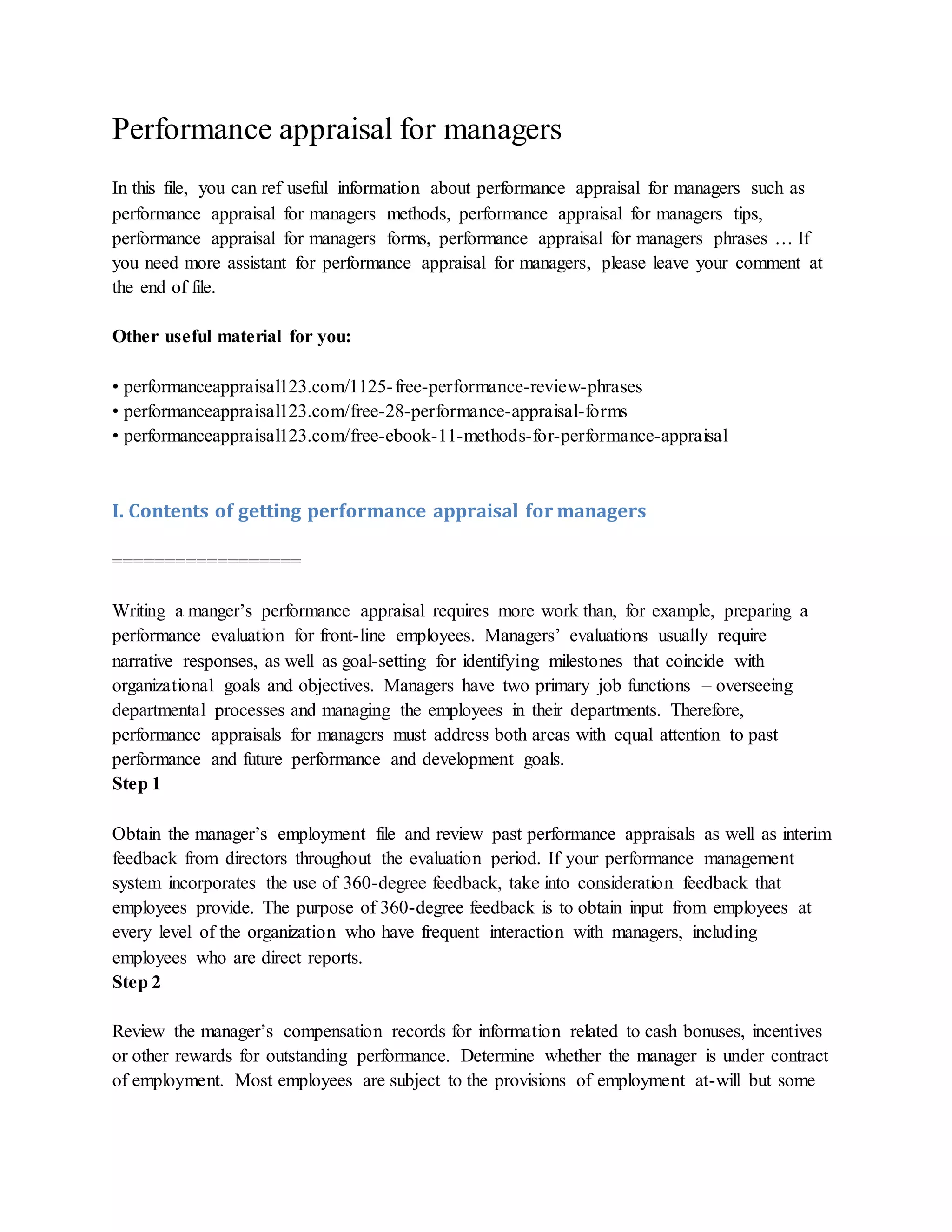
The ranking system requires the rater to rank his
subordinates on overall performance. This consists in
simply putting a man in a rank order. Under this method,
the ranking of an employee in a work group is done
against that of another employee. The relative position of
each employee is tested in terms of his numerical rank. It
may also be done by ranking a person on his job
performance against another member of the competitive
group.
Advantages of Ranking Method
i. Employees are ranked according to their performance
levels.
ii. It is easier to rank the best and the worst employee.
Limitations of Ranking Method
i. The “whole man” is compared with another “whole man”
in this method. In practice, it is very difficult to compare
individuals possessing various individual traits.
ii. This method speaks only of the position where an
employee stands in his group. It does not test anything
about how much better or how much worse an employee
is when compared to another employee.
iii. When a large number of employees are working, ranking
of individuals become a difficult issue.
iv. There is no systematic procedure for ranking individuals
in the organization. The ranking system does not eliminate
the possibility of snap judgements.
2. Rating Scale
Rating scales consists of several numerical scales
representing job related performance criterions such as
dependability, initiative, output, attendance, attitude etc.
Each scales ranges from excellent to poor. The total
numerical scores are computed and final conclusions are
derived. Advantages – Adaptability, easy to use, low cost,
every type of job can be evaluated, large number of
employees covered, no formal training required.
Disadvantages – Rater’s biases
3. Checklist method
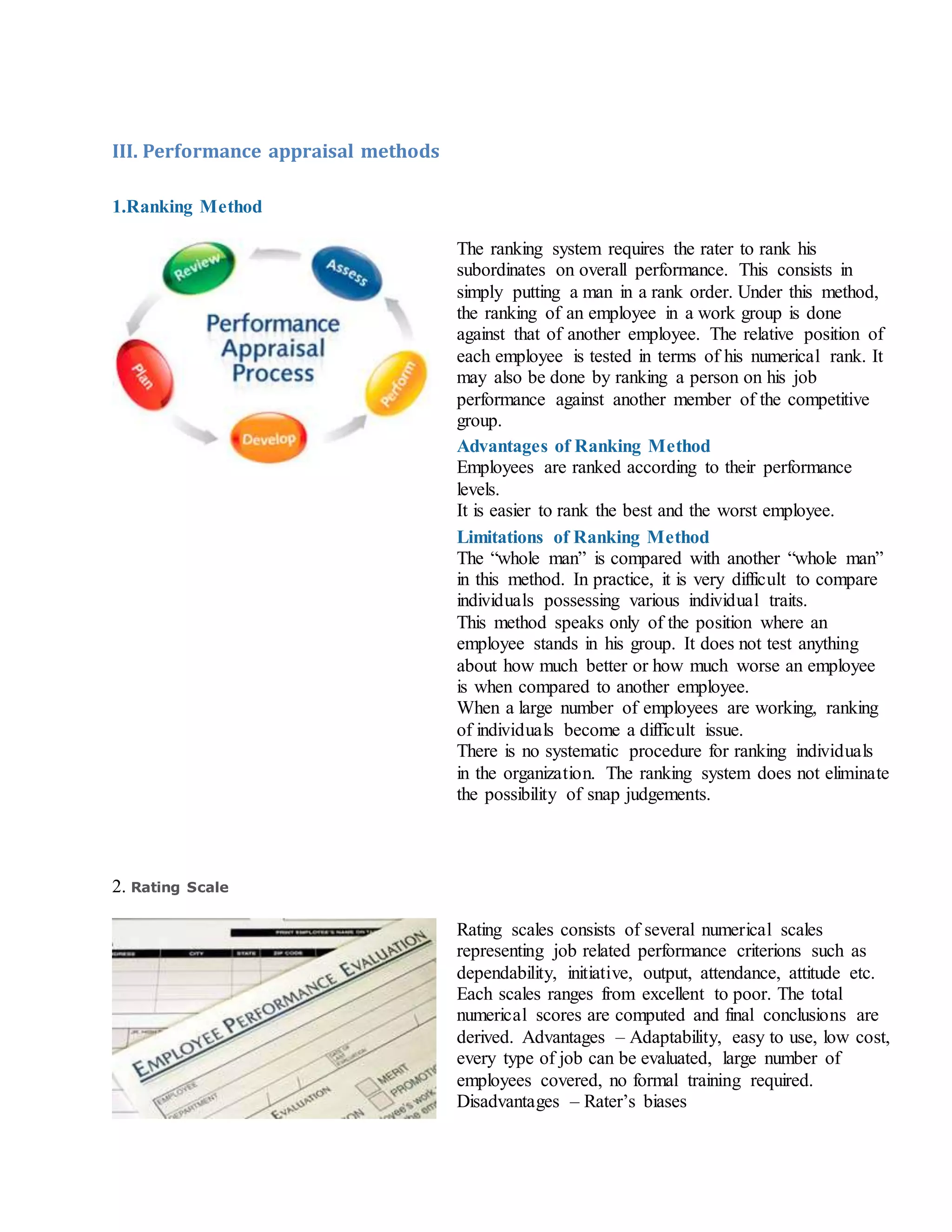
Under this method, checklist of statements of traits of
employee in the form of Yes or No based questions is
prepared. Here the rater only does the reporting or
checking and HR department does the actual evaluation.
Advantages – economy, ease of administration, limited
training required, standardization. Disadvantages – Raters
biases, use of improper weighs by HR, does not allow
rater to give relative ratings
4. Critical Incidents Method
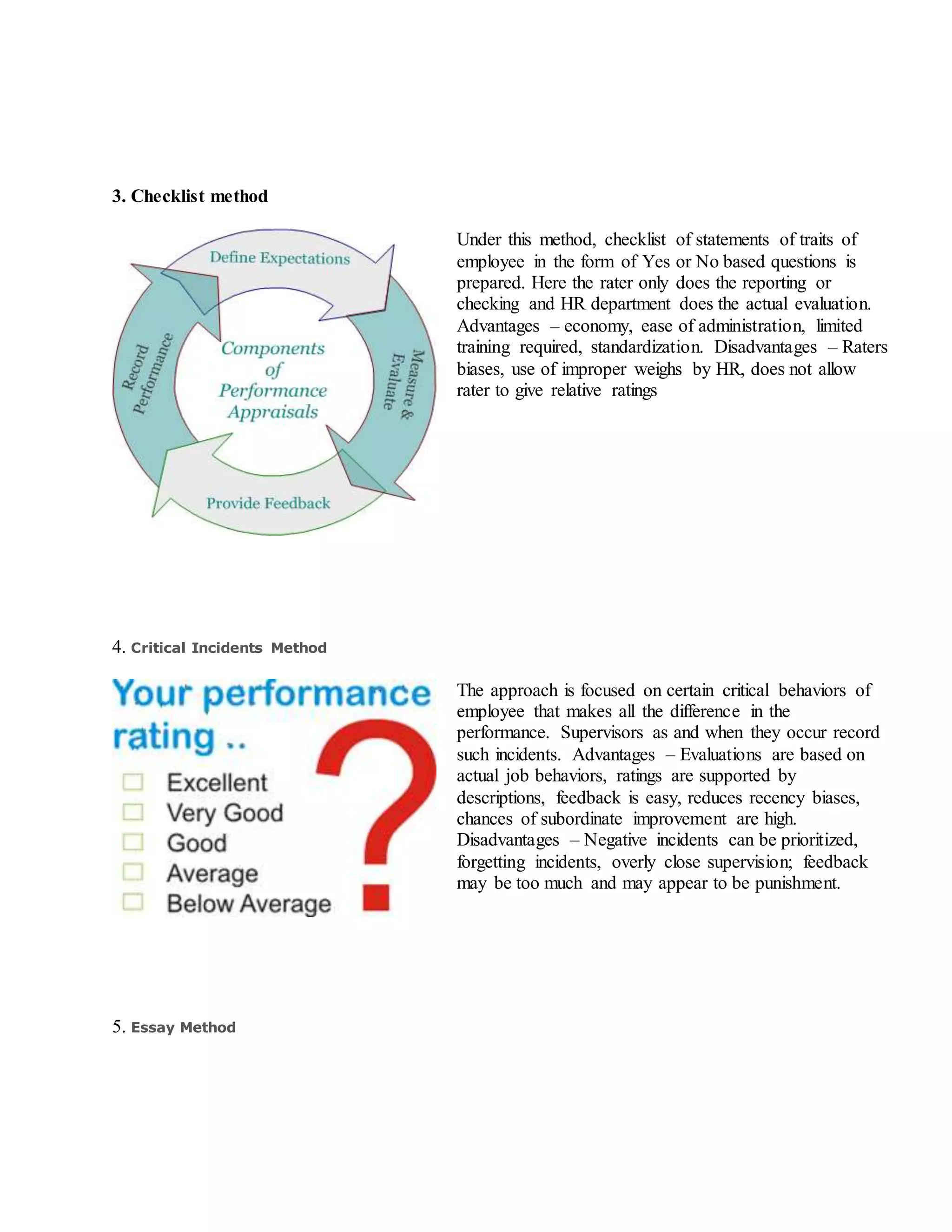
The approach is focused on certain critical behaviors of
employee that makes all the difference in the
performance. Supervisors as and when they occur record
such incidents. Advantages – Evaluations are based on
actual job behaviors, ratings are supported by
descriptions, feedback is easy, reduces recency biases,
chances of subordinate improvement are high.
Disadvantages – Negative incidents can be prioritized,
forgetting incidents, overly close supervision; feedback
may be too much and may appear to be punishment.
5. Essay Method
In this method the rater writes down the employee
description in detail within a number of broad categories
like, overall impression of performance, promoteability
of employee, existing capabilities and qualifications of
performing jobs, strengths and weaknesses and training
needs of the employee. Advantage – It is extremely
useful in filing information gaps about the employees
that often occur in a better-structured checklist.
Disadvantages – It its highly dependent upon the writing
skills of rater and most of them are not good writers.
They may get confused success depends on the memory
power of raters.
6. Behaviorally Anchored Rating Scales
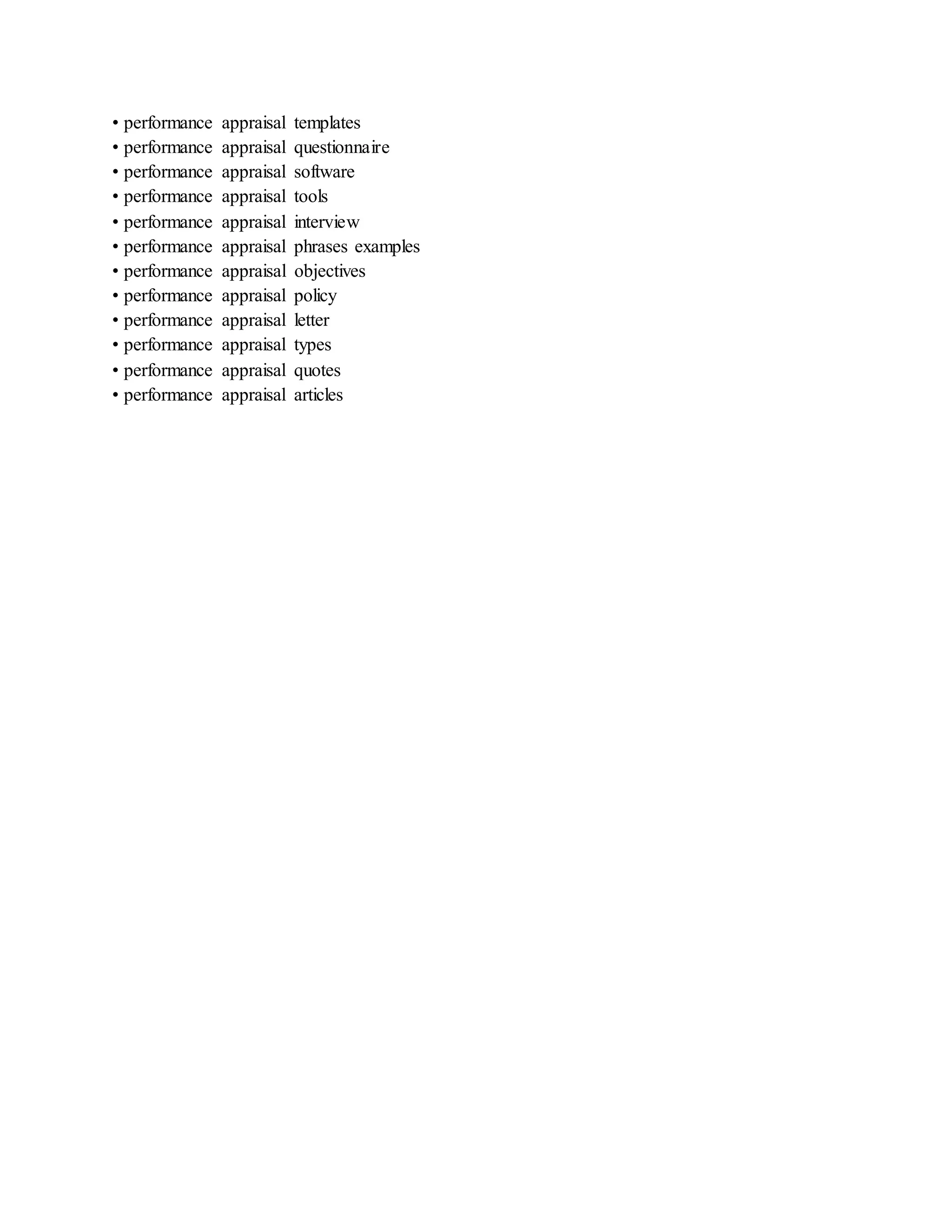
statements of effective and ineffective behaviors
determine the points. They are said to be
behaviorally anchored. The rater is supposed to
say, which behavior describes the employee
performance. Advantages – helps overcome rating
errors. Disadvantages – Suffers from distortions
inherent in most rating techniques.
III. Other topics related to Performance appraisal for managers (pdf
download)
• Top 28 performance appraisal forms
• performance appraisal comments
• 11 performance appraisal methods
• 25 performance appraisal examples
• performance appraisal phrases
• performance appraisal process
• performance appraisal template
• performance appraisal system
• performance appraisal answers
• performance appraisal questions
• performance appraisal techniques
• performance appraisal format
• performance appraisal templates
• performance appraisal questionnaire
• performance appraisal software
• performance appraisal tools
• performance appraisal interview
• performance appraisal phrases examples
• performance appraisal objectives
• performance appraisal policy
• performance appraisal letter
• performance appraisal types
• performance appraisal quotes
• performance appraisal articles

Performance appraisal for managers

  • 1.
    Performance appraisal formanagers In this file, you can ref useful information about performance appraisal for managers such as performance appraisal for managers methods, performance appraisal for managers tips, performance appraisal for managers forms, performance appraisal for managers phrases … If you need more assistant for performance appraisal for managers, please leave your comment at the end of file. Other useful material for you: • performanceappraisal123.com/1125-free-performance-review-phrases • performanceappraisal123.com/free-28-performance-appraisal-forms • performanceappraisal123.com/free-ebook-11-methods-for-performance-appraisal I. Contents of getting performance appraisal for managers ================== Writing a manger’s performance appraisal requires more work than, for example, preparing a performance evaluation for front-line employees. Managers’ evaluations usually require narrative responses, as well as goal-setting for identifying milestones that coincide with organizational goals and objectives. Managers have two primary job functions – overseeing departmental processes and managing the employees in their departments. Therefore, performance appraisals for managers must address both areas with equal attention to past performance and future performance and development goals. Step 1 Obtain the manager’s employment file and review past performance appraisals as well as interim feedback from directors throughout the evaluation period. If your performance management system incorporates the use of 360-degree feedback, take into consideration feedback that employees provide. The purpose of 360-degree feedback is to obtain input from employees at every level of the organization who have frequent interaction with managers, including employees who are direct reports. Step 2 Review the manager’s compensation records for information related to cash bonuses, incentives or other rewards for outstanding performance. Determine whether the manager is under contract of employment. Most employees are subject to the provisions of employment at-will but some
  • 2.
    managers may haveemployment contracts that should to be reviewed prior to writing a performance appraisal. Step 3 Gather employee responses from workplace surveys that relate to organizational leadership. Determine if there exist any comments about the manager’s performance that were submitted anonymously through employee opinion surveys. Step 4 Read the manager’s job description and highlight specific activities for which she is responsible. Make a list of job duties in the two primary areas of leadership: overseeing department functions and managing employees. These are the two basic functions managers perform. Step 5 Access all records necessary for a complete evaluation of the manager’s departmental productivity, including employee work logs, attendance records, disciplinary review and corrective action. Assess the level of productivity within the manager’s department to determine whether he meets the company’s expectations in terms of performance standards related to departmental functions. Step 6 Draft a narrative about three areas of performance – functional expertise, core competencies and professional traits. Functional expertise refers to job knowledge and the manager’s ability to perform the actual functions of her job, such as a human resources manager who must be knowledgeable about labor and employment law. Core competencies are the basic qualifications a manager must have to perform her job functions. Examples of core competencies are analytical and critical thinking processes, decision-making capabilities and written communication skills. Professional traits include characteristics such as integrity, commitment and a strong work ethic. Step 7 Prepare a list of suggested performance goals to present to the manager during the performance appraisal meeting. The goals should align management duties with organizational goals. Jot down ideas for professional development such as refresher training on leadership skills or continuing education in management principles or functional areas of the manager’s job description. ==================
  • 3.
    III. Performance appraisalmethods 1.Ranking Method The ranking system requires the rater to rank his subordinates on overall performance. This consists in simply putting a man in a rank order. Under this method, the ranking of an employee in a work group is done against that of another employee. The relative position of each employee is tested in terms of his numerical rank. It may also be done by ranking a person on his job performance against another member of the competitive group. Advantages of Ranking Method i. Employees are ranked according to their performance levels. ii. It is easier to rank the best and the worst employee. Limitations of Ranking Method i. The “whole man” is compared with another “whole man” in this method. In practice, it is very difficult to compare individuals possessing various individual traits. ii. This method speaks only of the position where an employee stands in his group. It does not test anything about how much better or how much worse an employee is when compared to another employee. iii. When a large number of employees are working, ranking of individuals become a difficult issue. iv. There is no systematic procedure for ranking individuals in the organization. The ranking system does not eliminate the possibility of snap judgements. 2. Rating Scale Rating scales consists of several numerical scales representing job related performance criterions such as dependability, initiative, output, attendance, attitude etc. Each scales ranges from excellent to poor. The total numerical scores are computed and final conclusions are derived. Advantages – Adaptability, easy to use, low cost, every type of job can be evaluated, large number of employees covered, no formal training required. Disadvantages – Rater’s biases
  • 4.
    3. Checklist method Underthis method, checklist of statements of traits of employee in the form of Yes or No based questions is prepared. Here the rater only does the reporting or checking and HR department does the actual evaluation. Advantages – economy, ease of administration, limited training required, standardization. Disadvantages – Raters biases, use of improper weighs by HR, does not allow rater to give relative ratings 4. Critical Incidents Method The approach is focused on certain critical behaviors of employee that makes all the difference in the performance. Supervisors as and when they occur record such incidents. Advantages – Evaluations are based on actual job behaviors, ratings are supported by descriptions, feedback is easy, reduces recency biases, chances of subordinate improvement are high. Disadvantages – Negative incidents can be prioritized, forgetting incidents, overly close supervision; feedback may be too much and may appear to be punishment. 5. Essay Method
  • 5.
    In this methodthe rater writes down the employee description in detail within a number of broad categories like, overall impression of performance, promoteability of employee, existing capabilities and qualifications of performing jobs, strengths and weaknesses and training needs of the employee. Advantage – It is extremely useful in filing information gaps about the employees that often occur in a better-structured checklist. Disadvantages – It its highly dependent upon the writing skills of rater and most of them are not good writers. They may get confused success depends on the memory power of raters. 6. Behaviorally Anchored Rating Scales statements of effective and ineffective behaviors determine the points. They are said to be behaviorally anchored. The rater is supposed to say, which behavior describes the employee performance. Advantages – helps overcome rating errors. Disadvantages – Suffers from distortions inherent in most rating techniques. III. Other topics related to Performance appraisal for managers (pdf download) • Top 28 performance appraisal forms • performance appraisal comments • 11 performance appraisal methods • 25 performance appraisal examples • performance appraisal phrases • performance appraisal process • performance appraisal template • performance appraisal system • performance appraisal answers • performance appraisal questions • performance appraisal techniques • performance appraisal format
  • 6.
    • performance appraisaltemplates • performance appraisal questionnaire • performance appraisal software • performance appraisal tools • performance appraisal interview • performance appraisal phrases examples • performance appraisal objectives • performance appraisal policy • performance appraisal letter • performance appraisal types • performance appraisal quotes • performance appraisal articles