1
Pharmacotherapy of Epilepsy:
Pathology and Seizure Types
Stephen Kelley, PhD, FHEA, FBPhS
University of Dundee
s.p.kelley@dundee.ac.uk
These lectures on epilepsy
should help you meet the following learning outcomes:
• Develop a knowledge of the pathophysiology of epilepsy.
• Develop an understanding of the current and proposed
classification of seizures and epilepsy.
2
Terms
Seizure- a clinical symptom that is caused by
abnormal electrical activity within the brain that
interferes with normal brain function.
Epilepsy- the clinical condition of recurring seizures
or a predisposition for further seizures.
Up to ⅓ of all epilepsies may be due to genetic or
early developmental causes (idiopathic epilepsy). The
remainder is due to tumours, traumatic head injury,
stroke, alcohol abuse (symptomatic epilepsy)
3
4
Useful information about epilepsy
• Everyone's brain has the ability to produce a seizure under the
right conditions
• 1 person in 20 will have an epileptic seizure at some time in
their life
• 1 person in 50 will have epilepsy at some time in their life
• Around 450,000 people in the UK have epilepsy (40 million
people worldwide)
• Epilepsy can develop at any age. However, it is diagnosed most
often before the age of 20 and after the age of 60
• The first drug to be used to treat epilepsy was phenobarbital
(phenobarbitone) in 1912. There are now around 17 drugs
available
• With the appropriate treatment, up to 70% of people could be
seizure free
• Surgery may help a small number of people with epilepsy
whose seizures do not respond to medication
• There are over 40 different types of seizure
From the Epilepsy Society
http://www.epilepsysociety.org.uk/
Cause of the epilepsy can determine
the seizure type.
• Genetic causes (e.g., ion channel mutations)
can predispose an individual to primary
generalized seizures, such as childhood
absence seizures or tonic-clonic seizures.
• Discreet brain injury may lead to focal seizures
which can progress to secondary generalized
seizures
5
Management of Epilepsy
• Identification of the underlying cause of the epilepsy
• Educating the patient about epilepsy and counselling the
patient about avoiding harm (e.g., driving)
• Avoiding precipitating factors (e.g., sleep deprivation,
alcohol consumption)
• Identifying natural body rhythms that might increase the
likelihood of a seizure (e.g., menstruation)
• Anti-epileptic drugs (AEDs)
• Possible surgical intervention for refractory epilepsy
• Acute and appropriate treatment for generalized convulsive
seizures
(Bentley, P and Sharma, P 2012. Clinical Pharmacology, Chapter 21, 11th edn, Churchill Livingstone,
London) 6
7
Classification of Seizures
• Seizures can be classified into two
categories: Focal and generalized
• This simple classification has proved
extremely useful- the effectiveness of anti-
convulsant medication depends upon the type
of seizure
• Note that the International League Against
Epilepsy (ILAE) has proposed a revision of
the seizure classifications in 2017
8
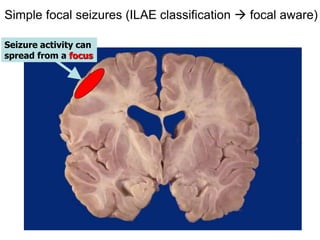
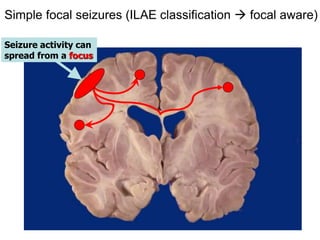
• Focal seizures originate in a small group
of neurons that constitute the seizure
focus
• Simple focal seizures
– Motor seizures
– Sensory seizures
– Autonomic seizures
– Psychic seizures
• New ILAE classification  focal onset
Focal Seizures (sometimes referred to
as partial seizures)
Dr Kelley 9
Simple focal seizures (ILAE classification  focal aware)
Seizure activity can
spread from a focus
Dr Kelley 10
Seizure activity can
spread from a focus
Simple focal seizures (ILAE classification  focal aware)
11
Simple focal seizure:
https://www.youtube.com/watch?v=X3_pv6us8A0
Epilepsy Society (https://www.epilepsysociety.org.uk/)
Simple focal seizures (ILAE classification  focal aware)
12
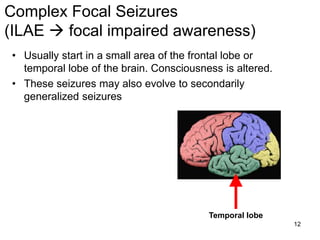
• Usually start in a small area of the frontal lobe or
temporal lobe of the brain. Consciousness is altered.
• These seizures may also evolve to secondarily
generalized seizures
Complex Focal Seizures
(ILAE  focal impaired awareness)
Temporal lobe
13
Complex focal seizure:
https://www.youtube.com/watch?v=N34Un6uYejU
Epilepsy Society (https://www.epilepsysociety.org.uk/)
Complex Focal Seizures
(ILAE classification  focal impaired awareness)
14
Secondary Generalized Tonic-Clonic Seizures
(ILAE  focal to bilateral tonic-clonic seizure)
 Focal seizures spread- involving both hemispheres
 May begin with an aura
 Person becomes unconscious
 Initial stiffening of the muscles (tonic phase).
 Presence of bloody saliva if the tongue and/or the cheek are
bitten.
 Clonic phase follows the tonic phase. Limbs begin to jerk
rapidly and rhythmically for 1-2 minutes then stop.
 Bladder or bowel control is sometimes lost
 These seizures generally last 1 to 3 minutes (seizures
lasting longer than 5 minutes are a medical emergency
 status epilepticus).
Dr Kelley 15
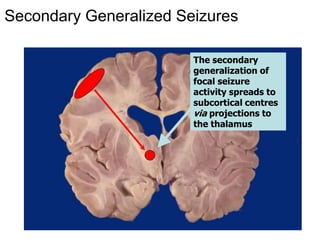
The secondary
generalization of
focal seizure
activity spreads to
subcortical centres
via projections to
the thalamus
Secondary Generalized Seizures
Dr Kelley 16
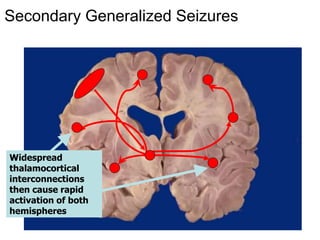
Secondary Generalized Seizures
Widespread
thalamocortical
interconnections
then cause rapid
activation of both
hemispheres
17
Myoclonic Seizures (myo = muscle, clonic = jerk)
 Part of the body, such as a arm or leg, suddenly jerks.
 Myoclonic seizures often occur in clusters early in the
morning.
 Can be focal or generalized
• Juvenile myoclonic epilepsy- begins around puberty or early
adulthood
• Progressive myoclonic epilepsy - rare syndrome that is
characterized by a combination of myoclonic seizures and tonic-
clonic seizures.
• Lennox-Gastaut syndrome- rare syndrome that presents in early
childhood
18
Myoclonic Seizures
An acted video depicting an myoclonic seizure:
http://www.youtube.com/watch?v=zPNVYFRhthg
Epilepsy Society (https://www.epilepsysociety.org.uk/)
19
Primary Generalized Seizures
(ILAE  Generalized Onset)
• Begin without preceding aura or focal
seizure
• Involve both hemispheres from the onset
• Can be convulsive or non-convulsive
20
• Tonic-clonic (grand mal) - sequence of tonic and
clonic phases
• Absence (petit mal seizures) – brief interruption of
consciousness- last less than 10 seconds
– Childhood absence seizures
– Juvenile absence seizures
• Myoclonic - sudden involuntary muscle contraction
• Atonic - sudden loss of muscle tone
Primary Generalized Seizures
(ILAE  Generalized Onset)
21
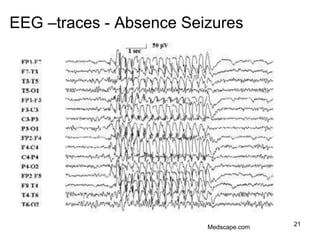
EEG –traces - Absence Seizures
Adapted from Rang et al., 2005
Medscape.com
22
Absence Seizure
Adapted from Rang et al., 2005
An acted video depicting an absence seizure:
https://www.youtube.com/watch?v=PFJ48aYRGnw
Epilepsy Society (https://www.epilepsysociety.org.uk/)
23
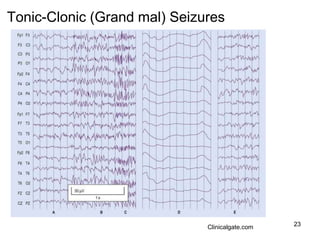
Tonic-Clonic (Grand mal) Seizures
Adapted from Rang et al., 2005
Clinicalgate.com
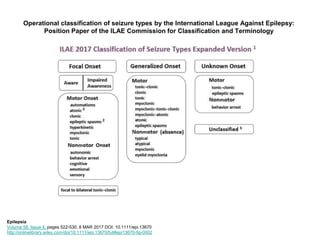
Operational classification of seizure types by the International League Against Epilepsy:
Position Paper of the ILAE Commission for Classification and Terminology
Epilepsia
Volume 58, Issue 4, pages 522-530, 8 MAR 2017 DOI: 10.1111/epi.13670
http://onlinelibrary.wiley.com/doi/10.1111/epi.13670/full#epi13670-fig-0002
First Aid for tonic-clonic seizures
• What to do
• Stay calm.
• Look around - is the person in a dangerous place? If not, don't move them. Move objects
like furniture away from them.
• Note the time the seizure starts.
• Stay with them. If they don't collapse but seem blank or confused, gently guide them
away from any danger. Speak quietly and calmly.
• Cushion their head with something soft if they have collapsed to the ground.
• Don't hold them down.
• Don't put anything in their mouth.
• Check the time again. If a convulsive (shaking) seizure doesn't stop after 5 minutes, call
for an ambulance (dial 999).
• After the seizure has stopped, put them into recovery position, check that their breathing
is returning to normal. Gently check their mouth to see that nothing is blocking their airway
such as food or false teeth. If their breathing sounds difficult after the seizure has stopped,
call for an ambulance.
• Stay with them until they are fully recovered.
• If they are injured, or they have another seizure without recovering fully from the first
seizure, call for an ambulance.
25www.epilepsysociety.org.uk
Pregnancy and epilepsy
• Teratogenicity (neural tube defects) a possible side
effect of anti-epileptic drug therapy
• Sodium Valproate, phenytoin and phenobarbital
(phenobarbitone) have the greatest risk of
teratogenicity
• January 2015: MHRA has strengthened its
warnings on the use of valproate in women of
childbearing potential
• Risk must be weighed against the potential harm
caused by the seizures
• Folic acid, 5 mg/daily given several months in
advance to reduce risk 26
27
Further Reading:
Rang and Dale. Pharmacology 8th Edition
Chapter 45- Anti-epileptic drugs
Useful websites:
Epilepsy Society
www.epilepsysociety.org.uk
Epilepsy Ontario
http://www.epilepsyontario.org/
Epilepsy Research UK
http://www.epilepsyresearch.org.uk/
Excellent website- World Health Organisation
http://www.who.int/topics/epilepsy/en/

Pep epilepsy part 1

  • 1.
    1 Pharmacotherapy of Epilepsy: Pathologyand Seizure Types Stephen Kelley, PhD, FHEA, FBPhS University of Dundee s.p.kelley@dundee.ac.uk
  • 2.
    These lectures onepilepsy should help you meet the following learning outcomes: • Develop a knowledge of the pathophysiology of epilepsy. • Develop an understanding of the current and proposed classification of seizures and epilepsy. 2
  • 3.
    Terms Seizure- a clinicalsymptom that is caused by abnormal electrical activity within the brain that interferes with normal brain function. Epilepsy- the clinical condition of recurring seizures or a predisposition for further seizures. Up to ⅓ of all epilepsies may be due to genetic or early developmental causes (idiopathic epilepsy). The remainder is due to tumours, traumatic head injury, stroke, alcohol abuse (symptomatic epilepsy) 3
  • 4.
    4 Useful information aboutepilepsy • Everyone's brain has the ability to produce a seizure under the right conditions • 1 person in 20 will have an epileptic seizure at some time in their life • 1 person in 50 will have epilepsy at some time in their life • Around 450,000 people in the UK have epilepsy (40 million people worldwide) • Epilepsy can develop at any age. However, it is diagnosed most often before the age of 20 and after the age of 60 • The first drug to be used to treat epilepsy was phenobarbital (phenobarbitone) in 1912. There are now around 17 drugs available • With the appropriate treatment, up to 70% of people could be seizure free • Surgery may help a small number of people with epilepsy whose seizures do not respond to medication • There are over 40 different types of seizure From the Epilepsy Society http://www.epilepsysociety.org.uk/
  • 5.
    Cause of theepilepsy can determine the seizure type. • Genetic causes (e.g., ion channel mutations) can predispose an individual to primary generalized seizures, such as childhood absence seizures or tonic-clonic seizures. • Discreet brain injury may lead to focal seizures which can progress to secondary generalized seizures 5
  • 6.
    Management of Epilepsy •Identification of the underlying cause of the epilepsy • Educating the patient about epilepsy and counselling the patient about avoiding harm (e.g., driving) • Avoiding precipitating factors (e.g., sleep deprivation, alcohol consumption) • Identifying natural body rhythms that might increase the likelihood of a seizure (e.g., menstruation) • Anti-epileptic drugs (AEDs) • Possible surgical intervention for refractory epilepsy • Acute and appropriate treatment for generalized convulsive seizures (Bentley, P and Sharma, P 2012. Clinical Pharmacology, Chapter 21, 11th edn, Churchill Livingstone, London) 6
  • 7.
    7 Classification of Seizures •Seizures can be classified into two categories: Focal and generalized • This simple classification has proved extremely useful- the effectiveness of anti- convulsant medication depends upon the type of seizure • Note that the International League Against Epilepsy (ILAE) has proposed a revision of the seizure classifications in 2017
  • 8.
    8 • Focal seizuresoriginate in a small group of neurons that constitute the seizure focus • Simple focal seizures – Motor seizures – Sensory seizures – Autonomic seizures – Psychic seizures • New ILAE classification  focal onset Focal Seizures (sometimes referred to as partial seizures)
  • 9.
    Dr Kelley 9 Simplefocal seizures (ILAE classification  focal aware) Seizure activity can spread from a focus
  • 10.
    Dr Kelley 10 Seizureactivity can spread from a focus Simple focal seizures (ILAE classification  focal aware)
  • 11.
    11 Simple focal seizure: https://www.youtube.com/watch?v=X3_pv6us8A0 EpilepsySociety (https://www.epilepsysociety.org.uk/) Simple focal seizures (ILAE classification  focal aware)
  • 12.
    12 • Usually startin a small area of the frontal lobe or temporal lobe of the brain. Consciousness is altered. • These seizures may also evolve to secondarily generalized seizures Complex Focal Seizures (ILAE  focal impaired awareness) Temporal lobe
  • 13.
    13 Complex focal seizure: https://www.youtube.com/watch?v=N34Un6uYejU EpilepsySociety (https://www.epilepsysociety.org.uk/) Complex Focal Seizures (ILAE classification  focal impaired awareness)
  • 14.
    14 Secondary Generalized Tonic-ClonicSeizures (ILAE  focal to bilateral tonic-clonic seizure)  Focal seizures spread- involving both hemispheres  May begin with an aura  Person becomes unconscious  Initial stiffening of the muscles (tonic phase).  Presence of bloody saliva if the tongue and/or the cheek are bitten.  Clonic phase follows the tonic phase. Limbs begin to jerk rapidly and rhythmically for 1-2 minutes then stop.  Bladder or bowel control is sometimes lost  These seizures generally last 1 to 3 minutes (seizures lasting longer than 5 minutes are a medical emergency  status epilepticus).
  • 15.
    Dr Kelley 15 Thesecondary generalization of focal seizure activity spreads to subcortical centres via projections to the thalamus Secondary Generalized Seizures
  • 16.
    Dr Kelley 16 SecondaryGeneralized Seizures Widespread thalamocortical interconnections then cause rapid activation of both hemispheres
  • 17.
    17 Myoclonic Seizures (myo= muscle, clonic = jerk)  Part of the body, such as a arm or leg, suddenly jerks.  Myoclonic seizures often occur in clusters early in the morning.  Can be focal or generalized • Juvenile myoclonic epilepsy- begins around puberty or early adulthood • Progressive myoclonic epilepsy - rare syndrome that is characterized by a combination of myoclonic seizures and tonic- clonic seizures. • Lennox-Gastaut syndrome- rare syndrome that presents in early childhood
  • 18.
    18 Myoclonic Seizures An actedvideo depicting an myoclonic seizure: http://www.youtube.com/watch?v=zPNVYFRhthg Epilepsy Society (https://www.epilepsysociety.org.uk/)
  • 19.
    19 Primary Generalized Seizures (ILAE Generalized Onset) • Begin without preceding aura or focal seizure • Involve both hemispheres from the onset • Can be convulsive or non-convulsive
  • 20.
    20 • Tonic-clonic (grandmal) - sequence of tonic and clonic phases • Absence (petit mal seizures) – brief interruption of consciousness- last less than 10 seconds – Childhood absence seizures – Juvenile absence seizures • Myoclonic - sudden involuntary muscle contraction • Atonic - sudden loss of muscle tone Primary Generalized Seizures (ILAE  Generalized Onset)
  • 21.
    21 EEG –traces -Absence Seizures Adapted from Rang et al., 2005 Medscape.com
  • 22.
    22 Absence Seizure Adapted fromRang et al., 2005 An acted video depicting an absence seizure: https://www.youtube.com/watch?v=PFJ48aYRGnw Epilepsy Society (https://www.epilepsysociety.org.uk/)
  • 23.
    23 Tonic-Clonic (Grand mal)Seizures Adapted from Rang et al., 2005 Clinicalgate.com
  • 24.
    Operational classification ofseizure types by the International League Against Epilepsy: Position Paper of the ILAE Commission for Classification and Terminology Epilepsia Volume 58, Issue 4, pages 522-530, 8 MAR 2017 DOI: 10.1111/epi.13670 http://onlinelibrary.wiley.com/doi/10.1111/epi.13670/full#epi13670-fig-0002
  • 25.
    First Aid fortonic-clonic seizures • What to do • Stay calm. • Look around - is the person in a dangerous place? If not, don't move them. Move objects like furniture away from them. • Note the time the seizure starts. • Stay with them. If they don't collapse but seem blank or confused, gently guide them away from any danger. Speak quietly and calmly. • Cushion their head with something soft if they have collapsed to the ground. • Don't hold them down. • Don't put anything in their mouth. • Check the time again. If a convulsive (shaking) seizure doesn't stop after 5 minutes, call for an ambulance (dial 999). • After the seizure has stopped, put them into recovery position, check that their breathing is returning to normal. Gently check their mouth to see that nothing is blocking their airway such as food or false teeth. If their breathing sounds difficult after the seizure has stopped, call for an ambulance. • Stay with them until they are fully recovered. • If they are injured, or they have another seizure without recovering fully from the first seizure, call for an ambulance. 25www.epilepsysociety.org.uk
  • 26.
    Pregnancy and epilepsy •Teratogenicity (neural tube defects) a possible side effect of anti-epileptic drug therapy • Sodium Valproate, phenytoin and phenobarbital (phenobarbitone) have the greatest risk of teratogenicity • January 2015: MHRA has strengthened its warnings on the use of valproate in women of childbearing potential • Risk must be weighed against the potential harm caused by the seizures • Folic acid, 5 mg/daily given several months in advance to reduce risk 26
  • 27.
    27 Further Reading: Rang andDale. Pharmacology 8th Edition Chapter 45- Anti-epileptic drugs Useful websites: Epilepsy Society www.epilepsysociety.org.uk Epilepsy Ontario http://www.epilepsyontario.org/ Epilepsy Research UK http://www.epilepsyresearch.org.uk/ Excellent website- World Health Organisation http://www.who.int/topics/epilepsy/en/