People on the Move
Indo-European Migrations
1800 BC- 250 BC
Unit Two
Global Studies
What is Migration?
 denotes any movement by humans from
one district to another, sometimes over long
distances or in large groups.
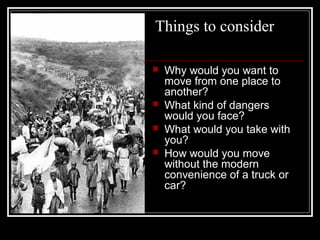
Things to consider
 Why would you want to
move from one place to
another?
 What kind of dangers
would you face?
 What would you take with
you?
 How would you move
without the modern
convenience of a truck or
car?
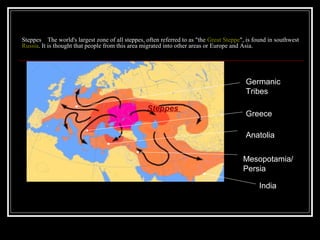
Steppes The world's largest zone of all steppes, often referred to as "the Great Steppe", is found in southwest
Russia. It is thought that people from this area migrated into other areas or Europe and Asia.
India
Anatolia
Greece
Germanic
Tribes
Steppes
Mesopotamia/
Persia
Indo-European Empires 2000BC- 300 AD
 Hittites
 Phoenicians
 Hebrews
 Aryans
 Assyrians
 Persians
 Greeks
Capital of Hittite
Empire
Hittite Empire
Hittites
 The Hittites were an ancient Anatolian people who spoke a
language of the Anatolian branch of the
Indo-European language family and established a kingdom
centered at Hattusa in north-central Anatolia (on the Central
Anatolian plateau) ca. the 18th century BC. The Hittite empire
reached its height ca. the 14th century BC, encompassing a
large part of Anatolia, north-western Syria about as far south
as the mouth of the Litani River (a territory known as Amqu),
and eastward into upper Mesopotamia. After ca. 1180 BC,
the empire disintegrated into several independent "Neo-Hittite
" city-states, some surviving until as late as the 8th century
BC
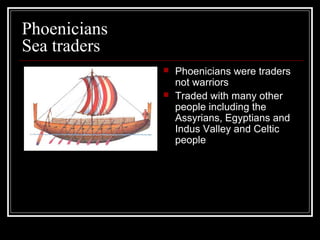
Phoenicians
Sea traders
 Phoenicians were traders
not warriors
 Traded with many other
people including the
Assyrians, Egyptians and
Indus Valley and Celtic
people
Phoenician Territory
Phoenician Colonies
Phoenician Trade Routes
Hebrews
 Hebrews are known as the ancestors of the Israelites,
who used the Hebrew language. Israelites were the
writers of the Hebrew Bible. They are also the
theological and historical ancestors of the Christians and
Muslims. In the Bible and in current language, the word
Hebrews is often used as a synonym for Israelites, and
sometimes for the users of the Hebrew language (Jews
and Israelis).
 The Hebrews were nomads and soon moved to Egypt.
They were then enslaved by the Egyptian Pharaoh.
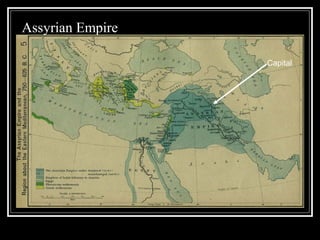
Assyrian Empire
Capital
 Assyria was a political state centered on the Upper Tigris river, in
Mesopotamia (Iraq), that came to rule regional empires a number of
times in history.
 It was named for its original capital, the ancient city of Assur which
developed rapidly into a centre for trade, and trade routes led from
the city to Anatolia, where merchants from Assur established
trading colonies.
 These Assyrian colonies in Asia Minor were called kârum, and
traded mostly with tin and wool (see Kültepe). In the city of Assur,
the first great temples to the city god Assur and the weather god
Adad were erected. The first fortifications were also began in this
period
 Later the capital was moved to Nineveh
Aryans
Nomadic tribe
invaded Pakistan
and India
 Nomadic Aryans invaded India
ca. 1500 BC destroying the
Indus valley civilization and
exterminating the Indus
inhabitants. Thus ended the
most brilliant civilization of the
ancient world. Subsequent to
this invasion, India was
plunged into 2000 years of the
Vedic Dark Ages. When cities
were built again, it was under
Scytho-Greek influence. The
ziggurat of the Indus
disappeared forever.
 The Vedic Period (or
Vedic Age) is the period
during which the Vedas,
the oldest sacred texts of
the Indo-Aryans, were
being composed.
Scholars place the Vedic
period in the second and
first millennia BCE
continuing up to the
6th century BCE based
on literary evidence.
Northern India
Greece
Athens
Sparta
Mount Olympus
 Ancient Greece was very important to us.
 Advances in medicine, the arts, literature
and government.
 Greek history is broken down into several
era’s
 Greece is made up of over 2000 islands.
Including Crete
 Minoan civilization 2000BC thrived on the
island of Crete, Trade by sea flourished.
 Mycenaean thrives on the mainland of
Greece 1250 BC
 Trojan war 1200 BC
 Classic Greek Culture begins with Olympic
games 776BC
 Hellenistic Era 332BC to 146 BC
Minoans
 The Minoans were primarily a mercantile people engaged in
overseas trade. Their culture, from 1700 BC onward, shows a
high degree of organization.
 Many historians and archaeologists believe[who?] that the
Minoans were involved in the Bronze Age's important tin trade:
tin, alloyed with copper apparently from Cyprus, was used to
make bronze. The decline of Minoan civilization and the decline
in use of bronze tools in favor of iron ones seem to be
correlated.
 A volcanic explosion on the island of Thera off the eastern coast
of Crete cause a tsunami that could have flooded most of the
coastline of Crete. Leaving the Minoans in disarray and allowed
the Mycenaean's to conquer Crete.
Mycenaean Greece
 Contact between the Minoans of Crete and Mainland Greeks primarily the main
city of the time Mycenae had a profound effect. Greeks started building ships
and trading with other cultures in the Mediterranean Cyprus, Egypt, Syria and
Anatolia.
 Greece conquered the Minoans
 The Mycenaean’s adapted the writing system to the Greek Language and
decorated vases with Minoan designs

Greek City states or polis was the functional political unit of ancient Greece.
 A Polis was made up of the city and surrounding lands and villages. The city
controlled between 50 and 500 square miles surrounding the city itself.
 Each city state had slightly different ways of rule. Some where Monarchy while
others were a aristocracy. Still others were an oligarchy.
Forms of Government
 Monarchy - monarchy is a form of government in which supreme power is
absolutely or nominally lodged with an individual, who is the head of state, often
for life or until abdication, and "is wholly set apart from all other members of the
state."[1] The person who heads a monarchy is called a monarch. It was a
common form of government in the world during the ancient and medieval
times.
 Aristocracy is a form of government, in which a few of the most prominent citizens rule.
This may be a hereditary elite, or it may be by a system of cooption where a council of
prominent citizens add leading soldiers, merchants, land owners, priests, and lawyers to
their number. See Aristocracy for the historical roots of the term.
 Oligarchy (Greek λιγαρχία,Ὀ Oligarkhía) is a form of government where power
effectively rests with a small elite segment of society distinguished by royalty,
wealth, family, military influence or religious hegemony. The word oligarchy is
from the Greek words for "few" ( λίγος olígos) and "rule" ( ρχή arkhēὀ ἀ ).
 What is an Epic
poem?
 An epic poem is a long poem
narrating the heroic exploits of an
individual in a way
central to the beliefs and culture
of his society.
 Examples of an epic
poem is the Iliad and the
Odyssey by Homer.
 Historians are not sure
if Homer was an actual
person. He is referred
to as an old blind man.
Trojan War 1200s BC
 Greek mythology, the Trojan War was waged against the city of Troy by
the Achaeans after Paris of Troy stole Helen from her husband Menelaus,
the king of Sparta. The war is among the most important events in Greek
mythology, and was narrated in many works of Greek literature, including
the Iliad and the Odyssey by Homer. The Iliad relates a part of the last year
of the siege of Troy, while the Odyssey describes the journey home of
Odysseus, one of the Achaean leaders. Other parts of the war were told in
a cycle of epic poems, which has only survived in fragments.
 Ancient Greeks did not write down the poems they were told orally and
passed on from one person to another.. Each time they were told they were
changed slightly. Historians are not entirely sure if the Trojan war was
actually fought. But excavations in Turkey have uncovered evidence that
the war might have been factual.
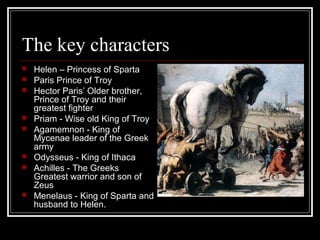
The key characters
 Helen – Princess of Sparta
 Paris Prince of Troy
 Hector Paris’ Older brother,
Prince of Troy and their
greatest fighter
 Priam - Wise old King of Troy
 Agamemnon - King of
Mycenae leader of the Greek
army
 Odysseus - King of Ithaca
 Achilles - The Greeks
Greatest warrior and son of
Zeus
 Menelaus - King of Sparta and
husband to Helen.
 Helen was enchanted by Aphrodite to fall in love with Paris
 Paris took Helen back to Troy with him
 Agamemnon and the other kings of Greece raised an army and perused the Trojans
 Over 1000 ships were needed to transport the warriors to Troy
 They laid siege to the city of Troy for 10 years
 Homer’s epic Poem the Iliad was written about the last year of the siege.
 Achilles and Hector the two greatest warriors fought. Achilles ended up the victor.
 Odysseus came up with a plan. They took wood from the ships and made a huge wooden
horse and left it by the beach. They moved their ships and had some soldiers hide in the
horse.
 The Trojans saw this as a sign that the Greeks had given up and took the Horse into the
city. When the Trojans were sleeping. The Greeks inside emerged and opened the city
gates
Zeus King of the Gods
Hera Queen of the Gods
Apollo God of Light
Athena Goddess of Wisdom
Aphrodite Goddess of
Love/Beautuy
Ares God of War
Artimus Goddess of the Hunt
Hades God the Underworld
Demeter Goddess of Grain/Crops
Posiedon King of the Sea
The Arts, Medicine and Literature
 The classic era of Greek History is most
beneficial to us in modern times. The works
of Homer, The logic of Socrates and the
medicine of Hippocrates.
Homer
 Homer (Ancient Greek: μηροςὍ , Hómēros) is
traditionally held to be the author of the ancient
Greek epic poems the Iliad and the Odyssey, as
well as of the Homeric Hymns. Today the hymns
are considered to be later works but many still
regard Homer as the author or compiler of the
epics. The ancient Greeks generally believed that
Homer was a historical individual, but some
modern scholars are skeptical
Hippocrates
 He is referred to as the "father of medicine in
recognition of his lasting contributions to the field
as the founder of the Hippocratic school of
medicine. This intellectual school revolutionized
medicine in ancient Greece, establishing it as a
discipline distinct from other fields that it had
traditionally been associated with (notably theurgy
and philosophy), thus making medicine a
profession
Socrates
 Socrates (pronounced /ˈs krəti zɒ ː /; Greek:
Σωκράτης, Sōkrátēs; c. 469 BC–399 BC) was a
Classical Greek philosopher. Credited as one of
the founders of Western philosophy, he is an
enigmatic figure known only through the classical
accounts of his students. Plato's dialogues are the
most comprehensive accounts of Socrates to
survive from antiquity
Olympic Games
 Athletic contests to show tribute to the gods
 Events included running, wrestling, boxing,
Chariot races, Javelin and Discus.
 A truce was called so no armies could enter
Olympia when the games were held.
 The games lasted from 776 BC to 393 AD
 Our modern Olympic games are based on
them
Greeks war with each other
 Peloponnesian War
430-404 BC
Athens and Sparta
become enemies
The Persian Wars

The Persian Empire
extended from the Indus
river valley in Asia to
Egypt in Africa and north
to eastern Europe
 Darius I wanted to
invade Greece to
increase his lands
 There were several small
battles
 At the Battle of Marathon
the Persians were
defeated. A messenger
ran the 26 miles between
Athens and marathon to
announce the victory.
Alexander the Great
 Alexander (356 – 323 BC ),assumed the kingship of Macedon
following the death of his father Philip II, who had unified[6]
most of the city-states of mainland Greece under
Macedonian hegemony in a federation called the League of
Corinth. After reconfirming Macedonian rule by quashing a
rebellion of southern Greek city-states and staging a short
but bloody excursion against Macedon's northern neighbors,
Alexander set out east against the Persian Empire, which he
defeated and overthrew. His conquests included Anatolia, the
Levant, Egypt, Bactria and Mesopotamia, and he extended
the boundaries of his own empire as far as Punjab, India.
People On The Move

People On The Move

  • 1.
    People on theMove Indo-European Migrations 1800 BC- 250 BC Unit Two Global Studies
  • 2.
    What is Migration? denotes any movement by humans from one district to another, sometimes over long distances or in large groups.
  • 3.
    Things to consider Why would you want to move from one place to another?  What kind of dangers would you face?  What would you take with you?  How would you move without the modern convenience of a truck or car?
  • 4.
    Steppes The world'slargest zone of all steppes, often referred to as "the Great Steppe", is found in southwest Russia. It is thought that people from this area migrated into other areas or Europe and Asia. India Anatolia Greece Germanic Tribes Steppes Mesopotamia/ Persia
  • 5.
    Indo-European Empires 2000BC-300 AD  Hittites  Phoenicians  Hebrews  Aryans  Assyrians  Persians  Greeks
  • 6.
  • 7.
    Hittites  The Hittiteswere an ancient Anatolian people who spoke a language of the Anatolian branch of the Indo-European language family and established a kingdom centered at Hattusa in north-central Anatolia (on the Central Anatolian plateau) ca. the 18th century BC. The Hittite empire reached its height ca. the 14th century BC, encompassing a large part of Anatolia, north-western Syria about as far south as the mouth of the Litani River (a territory known as Amqu), and eastward into upper Mesopotamia. After ca. 1180 BC, the empire disintegrated into several independent "Neo-Hittite " city-states, some surviving until as late as the 8th century BC
  • 8.
    Phoenicians Sea traders  Phoenicianswere traders not warriors  Traded with many other people including the Assyrians, Egyptians and Indus Valley and Celtic people
  • 9.
  • 10.
  • 11.
    Hebrews  Hebrews areknown as the ancestors of the Israelites, who used the Hebrew language. Israelites were the writers of the Hebrew Bible. They are also the theological and historical ancestors of the Christians and Muslims. In the Bible and in current language, the word Hebrews is often used as a synonym for Israelites, and sometimes for the users of the Hebrew language (Jews and Israelis).  The Hebrews were nomads and soon moved to Egypt. They were then enslaved by the Egyptian Pharaoh.
  • 12.
  • 13.
     Assyria wasa political state centered on the Upper Tigris river, in Mesopotamia (Iraq), that came to rule regional empires a number of times in history.  It was named for its original capital, the ancient city of Assur which developed rapidly into a centre for trade, and trade routes led from the city to Anatolia, where merchants from Assur established trading colonies.  These Assyrian colonies in Asia Minor were called kârum, and traded mostly with tin and wool (see Kültepe). In the city of Assur, the first great temples to the city god Assur and the weather god Adad were erected. The first fortifications were also began in this period  Later the capital was moved to Nineveh
  • 14.
  • 15.
     Nomadic Aryansinvaded India ca. 1500 BC destroying the Indus valley civilization and exterminating the Indus inhabitants. Thus ended the most brilliant civilization of the ancient world. Subsequent to this invasion, India was plunged into 2000 years of the Vedic Dark Ages. When cities were built again, it was under Scytho-Greek influence. The ziggurat of the Indus disappeared forever.  The Vedic Period (or Vedic Age) is the period during which the Vedas, the oldest sacred texts of the Indo-Aryans, were being composed. Scholars place the Vedic period in the second and first millennia BCE continuing up to the 6th century BCE based on literary evidence.
  • 16.
  • 17.
  • 18.
     Ancient Greecewas very important to us.  Advances in medicine, the arts, literature and government.  Greek history is broken down into several era’s  Greece is made up of over 2000 islands. Including Crete
  • 19.
     Minoan civilization2000BC thrived on the island of Crete, Trade by sea flourished.  Mycenaean thrives on the mainland of Greece 1250 BC  Trojan war 1200 BC  Classic Greek Culture begins with Olympic games 776BC  Hellenistic Era 332BC to 146 BC
  • 20.
  • 21.
     The Minoanswere primarily a mercantile people engaged in overseas trade. Their culture, from 1700 BC onward, shows a high degree of organization.  Many historians and archaeologists believe[who?] that the Minoans were involved in the Bronze Age's important tin trade: tin, alloyed with copper apparently from Cyprus, was used to make bronze. The decline of Minoan civilization and the decline in use of bronze tools in favor of iron ones seem to be correlated.  A volcanic explosion on the island of Thera off the eastern coast of Crete cause a tsunami that could have flooded most of the coastline of Crete. Leaving the Minoans in disarray and allowed the Mycenaean's to conquer Crete.
  • 22.
    Mycenaean Greece  Contactbetween the Minoans of Crete and Mainland Greeks primarily the main city of the time Mycenae had a profound effect. Greeks started building ships and trading with other cultures in the Mediterranean Cyprus, Egypt, Syria and Anatolia.  Greece conquered the Minoans  The Mycenaean’s adapted the writing system to the Greek Language and decorated vases with Minoan designs  Greek City states or polis was the functional political unit of ancient Greece.  A Polis was made up of the city and surrounding lands and villages. The city controlled between 50 and 500 square miles surrounding the city itself.  Each city state had slightly different ways of rule. Some where Monarchy while others were a aristocracy. Still others were an oligarchy.
  • 23.
    Forms of Government Monarchy - monarchy is a form of government in which supreme power is absolutely or nominally lodged with an individual, who is the head of state, often for life or until abdication, and "is wholly set apart from all other members of the state."[1] The person who heads a monarchy is called a monarch. It was a common form of government in the world during the ancient and medieval times.  Aristocracy is a form of government, in which a few of the most prominent citizens rule. This may be a hereditary elite, or it may be by a system of cooption where a council of prominent citizens add leading soldiers, merchants, land owners, priests, and lawyers to their number. See Aristocracy for the historical roots of the term.  Oligarchy (Greek λιγαρχία,Ὀ Oligarkhía) is a form of government where power effectively rests with a small elite segment of society distinguished by royalty, wealth, family, military influence or religious hegemony. The word oligarchy is from the Greek words for "few" ( λίγος olígos) and "rule" ( ρχή arkhēὀ ἀ ).
  • 24.
     What isan Epic poem?  An epic poem is a long poem narrating the heroic exploits of an individual in a way central to the beliefs and culture of his society.  Examples of an epic poem is the Iliad and the Odyssey by Homer.  Historians are not sure if Homer was an actual person. He is referred to as an old blind man.
  • 25.
    Trojan War 1200sBC  Greek mythology, the Trojan War was waged against the city of Troy by the Achaeans after Paris of Troy stole Helen from her husband Menelaus, the king of Sparta. The war is among the most important events in Greek mythology, and was narrated in many works of Greek literature, including the Iliad and the Odyssey by Homer. The Iliad relates a part of the last year of the siege of Troy, while the Odyssey describes the journey home of Odysseus, one of the Achaean leaders. Other parts of the war were told in a cycle of epic poems, which has only survived in fragments.  Ancient Greeks did not write down the poems they were told orally and passed on from one person to another.. Each time they were told they were changed slightly. Historians are not entirely sure if the Trojan war was actually fought. But excavations in Turkey have uncovered evidence that the war might have been factual.
  • 26.
    The key characters Helen – Princess of Sparta  Paris Prince of Troy  Hector Paris’ Older brother, Prince of Troy and their greatest fighter  Priam - Wise old King of Troy  Agamemnon - King of Mycenae leader of the Greek army  Odysseus - King of Ithaca  Achilles - The Greeks Greatest warrior and son of Zeus  Menelaus - King of Sparta and husband to Helen.
  • 27.
     Helen wasenchanted by Aphrodite to fall in love with Paris  Paris took Helen back to Troy with him  Agamemnon and the other kings of Greece raised an army and perused the Trojans  Over 1000 ships were needed to transport the warriors to Troy  They laid siege to the city of Troy for 10 years  Homer’s epic Poem the Iliad was written about the last year of the siege.  Achilles and Hector the two greatest warriors fought. Achilles ended up the victor.  Odysseus came up with a plan. They took wood from the ships and made a huge wooden horse and left it by the beach. They moved their ships and had some soldiers hide in the horse.  The Trojans saw this as a sign that the Greeks had given up and took the Horse into the city. When the Trojans were sleeping. The Greeks inside emerged and opened the city gates
  • 28.
    Zeus King ofthe Gods Hera Queen of the Gods Apollo God of Light Athena Goddess of Wisdom Aphrodite Goddess of Love/Beautuy Ares God of War Artimus Goddess of the Hunt Hades God the Underworld Demeter Goddess of Grain/Crops Posiedon King of the Sea
  • 29.
    The Arts, Medicineand Literature  The classic era of Greek History is most beneficial to us in modern times. The works of Homer, The logic of Socrates and the medicine of Hippocrates.
  • 30.
    Homer  Homer (AncientGreek: μηροςὍ , Hómēros) is traditionally held to be the author of the ancient Greek epic poems the Iliad and the Odyssey, as well as of the Homeric Hymns. Today the hymns are considered to be later works but many still regard Homer as the author or compiler of the epics. The ancient Greeks generally believed that Homer was a historical individual, but some modern scholars are skeptical
  • 31.
    Hippocrates  He isreferred to as the "father of medicine in recognition of his lasting contributions to the field as the founder of the Hippocratic school of medicine. This intellectual school revolutionized medicine in ancient Greece, establishing it as a discipline distinct from other fields that it had traditionally been associated with (notably theurgy and philosophy), thus making medicine a profession
  • 32.
    Socrates  Socrates (pronounced/ˈs krəti zɒ ː /; Greek: Σωκράτης, Sōkrátēs; c. 469 BC–399 BC) was a Classical Greek philosopher. Credited as one of the founders of Western philosophy, he is an enigmatic figure known only through the classical accounts of his students. Plato's dialogues are the most comprehensive accounts of Socrates to survive from antiquity
  • 33.
    Olympic Games  Athleticcontests to show tribute to the gods  Events included running, wrestling, boxing, Chariot races, Javelin and Discus.  A truce was called so no armies could enter Olympia when the games were held.  The games lasted from 776 BC to 393 AD  Our modern Olympic games are based on them
  • 34.
    Greeks war witheach other  Peloponnesian War 430-404 BC Athens and Sparta become enemies
  • 35.
    The Persian Wars  ThePersian Empire extended from the Indus river valley in Asia to Egypt in Africa and north to eastern Europe  Darius I wanted to invade Greece to increase his lands  There were several small battles  At the Battle of Marathon the Persians were defeated. A messenger ran the 26 miles between Athens and marathon to announce the victory.
  • 36.
    Alexander the Great Alexander (356 – 323 BC ),assumed the kingship of Macedon following the death of his father Philip II, who had unified[6] most of the city-states of mainland Greece under Macedonian hegemony in a federation called the League of Corinth. After reconfirming Macedonian rule by quashing a rebellion of southern Greek city-states and staging a short but bloody excursion against Macedon's northern neighbors, Alexander set out east against the Persian Empire, which he defeated and overthrew. His conquests included Anatolia, the Levant, Egypt, Bactria and Mesopotamia, and he extended the boundaries of his own empire as far as Punjab, India.