SIS Institute of NDT 1
Penetrant Testing
Introduction and Principles
SIS Institute of NDT 2
Principle
Capillary Action
SIS Institute of NDT 3
Methodology
 Precleaning
 Application of penetrant
 Penetration Time
 Removal of excess surface
penetrant
 Application of Developer
 Interpretation under normal or
ultra-violet radiation
 Post cleaning
SIS Institute of NDT 4
Advantages
 Relatively simple process
 Low capital cost
 Suitable for both metals and non-metals
 Establishment of procedures and
standards, less difficult
 Complex shapes and sizes can be
inspected
 Arrangement of discontinuities is not a
limitation
SIS Institute of NDT 5
Disadvantages
 Only surface defects can be
determined
 Less sensitivity compared to tother
NDT methods
 Not suitable for low density
metallurgical parts
 Low reliability
 Requires high degree of personnel
skill
SIS Institute of NDT 6
Procedure
 Follow the supplier's directions
 Standards specify test methods, eg
ASTM E165, ASME Section V, ISO 3879,
AS 2062
 All materials (penetrant, remover and
developer) should be from one supplier
as a kit
 Parts must be clean and dry and at the
correct temperature
 Precleaning requires removal of all oil,
grease, dirt, paint, slag, spatter
 Dry after cleaning by warming
SIS Institute of NDT 7
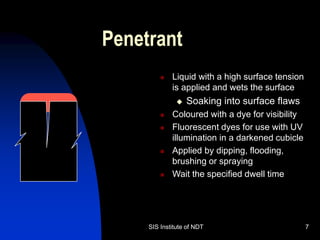
Penetrant
 Liquid with a high surface tension
is applied and wets the surface
 Soaking into surface flaws
 Coloured with a dye for visibility
 Fluorescent dyes for use with UV
illumination in a darkened cubicle
 Applied by dipping, flooding,
brushing or spraying
 Wait the specified dwell time
SIS Institute of NDT 8
Removing surplus
penetrant
 Water washable penetrants
are flushed with water
 Post emulsifiable penetrants
require the emulsifier to be
applied by dipping, flooding
or spraying
 Solvent removable
penetrants are first wiped up
with dry rags then with a rag
dampened with the solvent
SIS Institute of NDT 9
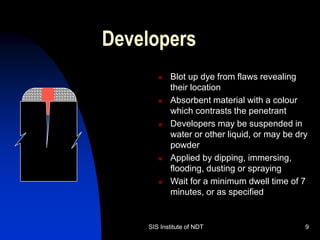
Developers
 Blot up dye from flaws revealing
their location
 Absorbent material with a colour
which contrasts the penetrant
 Developers may be suspended in
water or other liquid, or may be dry
powder
 Applied by dipping, immersing,
flooding, dusting or spraying
 Wait for a minimum dwell time of 7
minutes, or as specified
SIS Institute of NDT 10
Defects found by DPI
 Most are cracks, which can be
exceedingly fine
 Also finds inadequate penetration,
incomplete fusion, and pores that
are open to the surface
 Does not find buried flaws
 Overlap and undercut best seen by
visual inspection
SIS Institute of NDT 11
Precleaning
 What is Precleaning?
 Need for Precleaning?
 Methods of Precleaning
 Extent of Precleaning
SIS Institute of NDT 12
What is Precleaning?
 Cleaning before the actual
penetrant inspection
 The surface preparation is
mandatory as per the codes
SIS Institute of NDT 13
Need for Precleaning?
 Discontinuities may be closed
 Contaminant may retain some
amount of penetrant
 Contaminant may allow partial
penetration of penetrant
SIS Institute of NDT 14
Methods
 Mechanical Methods
 Chemical Methods
 Solvent methods
 Special methods
SIS Institute of NDT 15
Results of Improper
Precleaning
 No indications
 False Indications
 Cannot accurately determine the
extent of flaw

PENETRANT TESTING.ppt

  • 1.
    SIS Institute ofNDT 1 Penetrant Testing Introduction and Principles
  • 2.
    SIS Institute ofNDT 2 Principle Capillary Action
  • 3.
    SIS Institute ofNDT 3 Methodology  Precleaning  Application of penetrant  Penetration Time  Removal of excess surface penetrant  Application of Developer  Interpretation under normal or ultra-violet radiation  Post cleaning
  • 4.
    SIS Institute ofNDT 4 Advantages  Relatively simple process  Low capital cost  Suitable for both metals and non-metals  Establishment of procedures and standards, less difficult  Complex shapes and sizes can be inspected  Arrangement of discontinuities is not a limitation
  • 5.
    SIS Institute ofNDT 5 Disadvantages  Only surface defects can be determined  Less sensitivity compared to tother NDT methods  Not suitable for low density metallurgical parts  Low reliability  Requires high degree of personnel skill
  • 6.
    SIS Institute ofNDT 6 Procedure  Follow the supplier's directions  Standards specify test methods, eg ASTM E165, ASME Section V, ISO 3879, AS 2062  All materials (penetrant, remover and developer) should be from one supplier as a kit  Parts must be clean and dry and at the correct temperature  Precleaning requires removal of all oil, grease, dirt, paint, slag, spatter  Dry after cleaning by warming
  • 7.
    SIS Institute ofNDT 7 Penetrant  Liquid with a high surface tension is applied and wets the surface  Soaking into surface flaws  Coloured with a dye for visibility  Fluorescent dyes for use with UV illumination in a darkened cubicle  Applied by dipping, flooding, brushing or spraying  Wait the specified dwell time
  • 8.
    SIS Institute ofNDT 8 Removing surplus penetrant  Water washable penetrants are flushed with water  Post emulsifiable penetrants require the emulsifier to be applied by dipping, flooding or spraying  Solvent removable penetrants are first wiped up with dry rags then with a rag dampened with the solvent
  • 9.
    SIS Institute ofNDT 9 Developers  Blot up dye from flaws revealing their location  Absorbent material with a colour which contrasts the penetrant  Developers may be suspended in water or other liquid, or may be dry powder  Applied by dipping, immersing, flooding, dusting or spraying  Wait for a minimum dwell time of 7 minutes, or as specified
  • 10.
    SIS Institute ofNDT 10 Defects found by DPI  Most are cracks, which can be exceedingly fine  Also finds inadequate penetration, incomplete fusion, and pores that are open to the surface  Does not find buried flaws  Overlap and undercut best seen by visual inspection
  • 11.
    SIS Institute ofNDT 11 Precleaning  What is Precleaning?  Need for Precleaning?  Methods of Precleaning  Extent of Precleaning
  • 12.
    SIS Institute ofNDT 12 What is Precleaning?  Cleaning before the actual penetrant inspection  The surface preparation is mandatory as per the codes
  • 13.
    SIS Institute ofNDT 13 Need for Precleaning?  Discontinuities may be closed  Contaminant may retain some amount of penetrant  Contaminant may allow partial penetration of penetrant
  • 14.
    SIS Institute ofNDT 14 Methods  Mechanical Methods  Chemical Methods  Solvent methods  Special methods
  • 15.
    SIS Institute ofNDT 15 Results of Improper Precleaning  No indications  False Indications  Cannot accurately determine the extent of flaw