
Linking Sustainable Forest
Product Supply Chains
through Asia
PEFC Stakeholder Dialogue 2013
14-15th November, Kuala Lumpur

1
Timber Certification and the Role
of ITTO
Emmanuel ZE MEKA, Executive Director
International Tropical Timber Organisation

2
PEFC Week, Kuala Lumpur,
November 2013

State of forestry in the
Asia-Pacific Region
Bruno Cammaert
FAO Regional Office for Asia and the Pacific
Bangkok
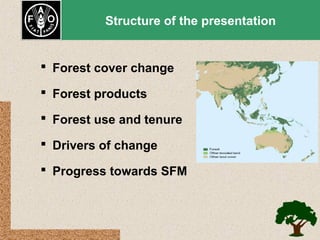
Structure of the presentation

 Forest cover change
 Forest products
 Forest use and tenure
 Drivers of change
 Progress towards SFM
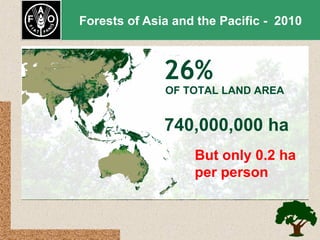
Forests of Asia and the Pacific - 2010

26%

OF TOTAL LAND AREA

740,000,000 ha
But only 0.2 ha
per person
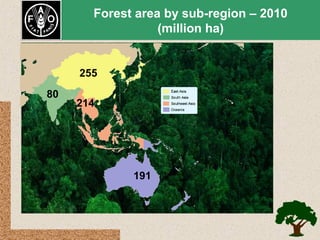
Forest area by sub-region – 2010
(million ha)

255
80

214

191
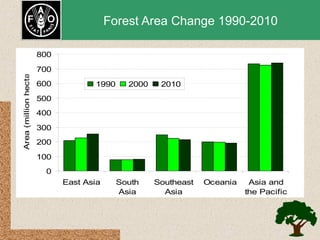
Area (million hectares).

Forest Area Change 1990-2010
800
700
600

1990

2000

2010

500
400
300
200
100
0
East Asia

South
Asia

Southeast
Asia

Oceania

Asia and
the Pacific
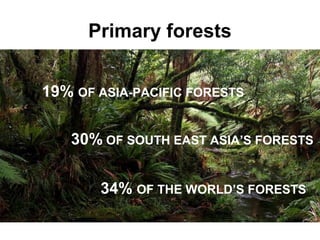
Primary forests
19% OF ASIA-PACIFIC FORESTS
30% OF SOUTH EAST ASIA’S FORESTS
34% OF THE WORLD’S FORESTS
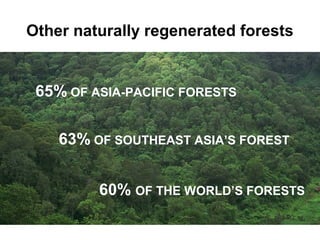
Other naturally regenerated forests

65% OF ASIA-PACIFIC FORESTS
63% OF SOUTHEAST ASIA’S FOREST
60% OF THE WORLD’S FORESTS
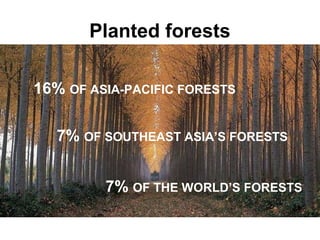
Planted forests
16% OF ASIA-PACIFIC FORESTS
7% OF SOUTHEAST ASIA’S FORESTS
7% OF THE WORLD’S FORESTS
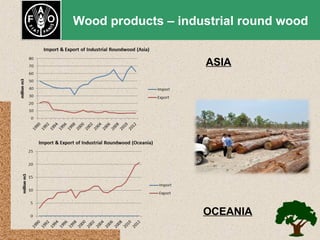
Wood products – industrial round wood
ASIA

OCEANIA
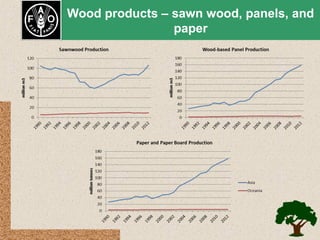
Wood products – sawn wood, panels, and
paper
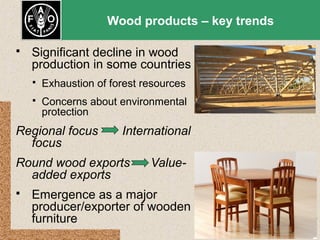
Wood products – key trends


Significant decline in wood
production in some countries


Exhaustion of forest resources



Concerns about environmental
protection

Regional focus
focus

International

Round wood exports
added exports


Value-

Emergence as a major
producer/exporter of wooden
furniture
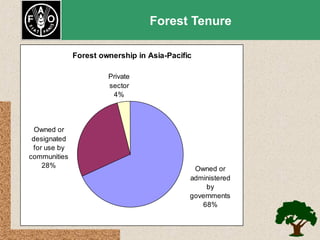
Forest Tenure
Forest ownership in Asia-Pacific
Private
sector
4%

Owned or
designated
for use by
communities
28%

Owned or
administered
by
governments
68%
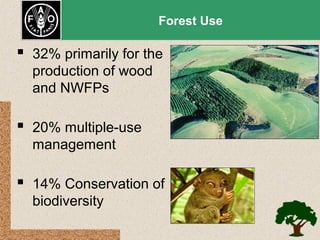
Forest Use

 32% primarily for the
production of wood
and NWFPs

 20% multiple-use
management

 14% Conservation of
biodiversity
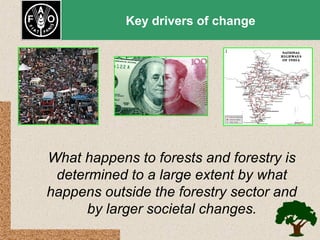
Key drivers of change

What happens to forests and forestry is
determined to a large extent by what
happens outside the forestry sector and
by larger societal changes.
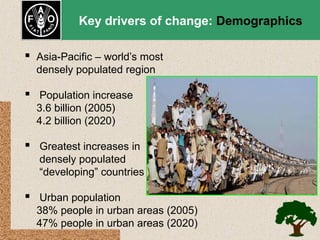
Key drivers of change: Demographics

 Asia-Pacific – world’s most
densely populated region

 Population increase
3.6 billion (2005)
4.2 billion (2020)

 Greatest increases in
densely populated
“developing” countries

 Urban population
38% people in urban areas (2005)
47% people in urban areas (2020)
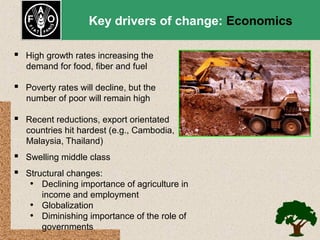
Key drivers of change: Economics
 High growth rates increasing the
demand for food, fiber and fuel

 Poverty rates will decline, but the
number of poor will remain high

 Recent reductions, export orientated
countries hit hardest (e.g., Cambodia,
Malaysia, Thailand)

 Swelling middle class
 Structural changes:
• Declining importance of agriculture in
income and employment
• Globalization
• Diminishing importance of the role of
governments
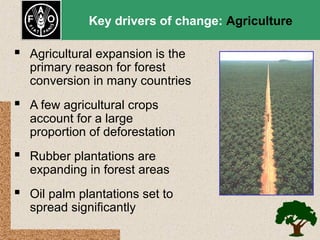
Key drivers of change: Agriculture

 Agricultural expansion is the

primary reason for forest
conversion in many countries

 A few agricultural crops

account for a large
proportion of deforestation

 Rubber plantations are

expanding in forest areas

 Oil palm plantations set to
spread significantly
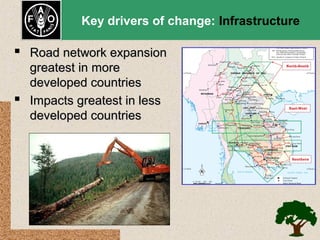
Key drivers of change: Infrastructure

 Road network expansion
greatest in more
developed countries
 Impacts greatest in less
developed countries
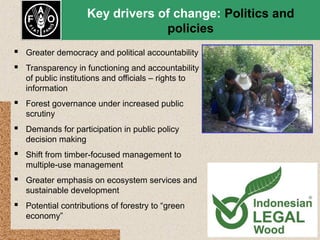
Key drivers of change: Politics and
policies
 Greater democracy and political accountability
 Transparency in functioning and accountability
of public institutions and officials – rights to
information

 Forest governance under increased public
scrutiny

 Demands for participation in public policy
decision making

 Shift from timber-focused management to
multiple-use management

 Greater emphasis on ecosystem services and
sustainable development

 Potential contributions of forestry to “green
economy”
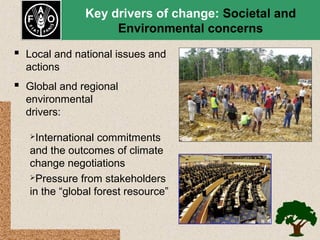
Key drivers of change: Societal and
Environmental concerns
 Local and national issues and
actions

 Global and regional
environmental
drivers:
International

commitments
and the outcomes of climate
change negotiations
Pressure from stakeholders
in the “global forest resource”
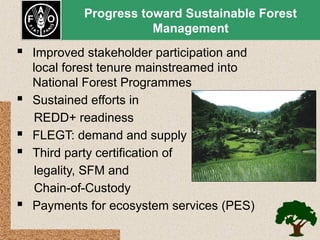
Progress toward Sustainable Forest
Management

 Improved stakeholder participation and






local forest tenure mainstreamed into
National Forest Programmes
Sustained efforts in
REDD+ readiness
FLEGT: demand and supply
Third party certification of
legality, SFM and
Chain-of-Custody
Payments for ecosystem services (PES)
Thank you
Snapshot of Forest Certification
in the Asia region
Ben Gunneberg, Secretary General
PEFC Council

25
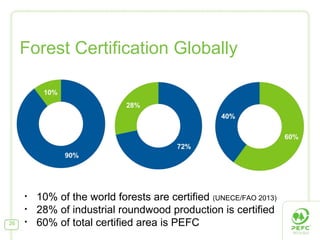
Forest Certification Globally

•
•
26

•

10% of the world forests are certified (UNECE/FAO 2013)
28% of industrial roundwood production is certified
60% of total certified area is PEFC
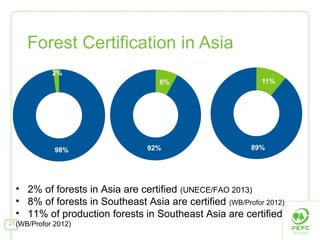
Forest Certification in Asia

• 2% of forests in Asia are certified (UNECE/FAO 2013)
• 8% of forests in Southeast Asia are certified (WB/Profor 2012)
• 11% of production forests in Southeast Asia are certified
27 (WB/Profor

2012)
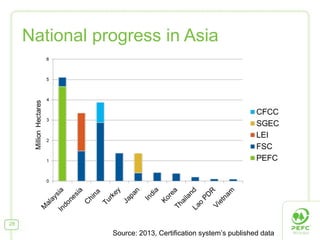
National progress in Asia

28

Source: 2013, Certification system’s published data
Markets – Chain of Custody

•

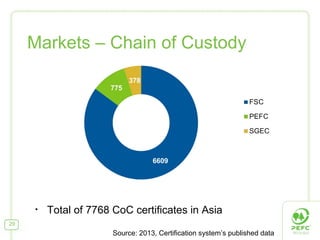
Total of 7768 CoC certificates in Asia

29

Source: 2013, Certification system’s published data
Reasons for optimism?


Legality & Governance issues being addresses at the highest
levels



FSC actively promoting certification in many countries
throughout the region – results are evident



PEFC working to scale up its Asia Promotions Initiative and
expand our presence in the region



Number of national certification organizations emerging with the
potential to achieve wider uptake in forests & markets



Companies continuing to make commitments to sourcing
sustainable products – driving up demand signals


30

WBCSD Declaration, Consumer Goods Forum, Unilever, etc
THANK YOU
PEFC International
10 Route de l’Aéroport, 1215 Geneva, Switzerland
www.pefc.org
info@pefc.org
31
Linking Sustainable Forest
Product Supply Chains
through Asia
PEFC Stakeholder Dialogue 2013
14-15th November, Kuala Lumpur

32
PEFC Stakeholder Dialogue 2013

The EU FLEGT Action Plan –
lnfluencing Forest Industry
Transformation
EFI FLEGT Facility
Asia Regional Office
Kuala Lumpur, Malaysia
14 November 2013
33
EU FLEGT Action Plan – 2003
Objective:

Address the driving forces of illegal logging both on the
demand side as well as in the timber producing
countries.
Course of Action/Main Instruments
Public Procurement Policies (demand)
Voluntary Partnership Agreements (supply)

EU Timber Regulation (demand and supply )

34
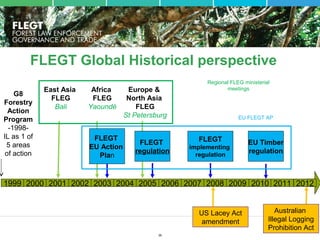
FLEGT Global Historical perspective
G8
Forestry
Action
Program
-1998IL as 1 of
5 areas
of action

East Asia
FLEG
Bali

Africa
FLEG
Yaoundé

FLEGT
EU Action
Plan

Europe &
North Asia
FLEG
St Petersburg

FLEGT
regulation

Regional FLEG ministerial
meetings

EU FLEGT AP

FLEGT
implementing
regulation

EU Timber
regulation

1999 2000 2001 2002 2003 2004 2005 2006 2007 2008 2009 2010 2011 2012

US Lacey Act
amendment
35

Australian
Illegal Logging
Prohibition Act
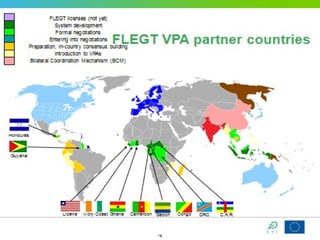
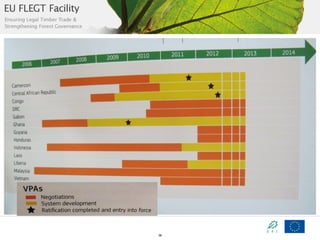
What is a Voluntary Partnership Agreement?
Legally-binding bilateral treaty (not “voluntary” once
agreed)
Timber-producing countries agree to licence their
timber exports as legal
EU agrees to accept only licensed imports
Backed by EU trade legislation (2005 FLEGT
Regulation)
Legality assured through an agreed Timber Legality
Assurance System (TLAS)
Supported where necessary with development
cooperation
36
37
38
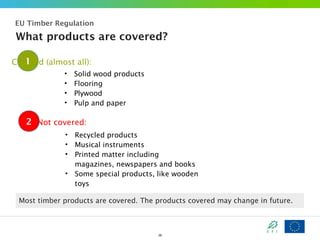
EU Timber Regulation

What products are covered?
1
Covered (almost all):
•
•
•
•

Solid wood products
Flooring
Plywood
Pulp and paper

2 Not covered:
•
•
•
•

Recycled products
Musical instruments
Printed matter including
magazines, newspapers and books
Some special products, like wooden
toys

Most timber products are covered. The products covered may change in future.

39
40
How do businesses comply with the EU Timber
Regulation?
Full implementation of VPA : Producing country’s timber
accompanied by FLEGT-license which attests to its legality.
•

Private sector initiatives :Timber certified under the main
forest certification schemes is still subject to due diligence
requirements.

Other means of providing information on legality

41
42
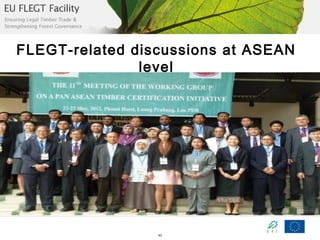
FLEGT-related discussions at ASEAN
level

43
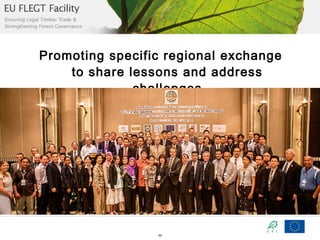
Promoting specific regional exchange
to share lessons and address
challenges

44
45
46
47
48
49
50
51
52
Thank you
EU FLEGT Facility
Tomi Tuomasjukka
00358 50 433 9049
Tomi.tuomasjukka@efi.int
www.euflegt.efi.int

53
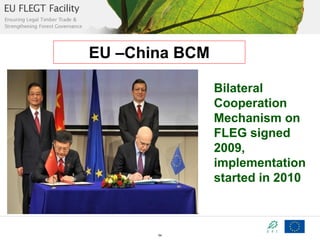
EU –China BCM
Bilateral
Cooperation
Mechanism on
FLEG signed
2009,
implementation
started in 2010

54
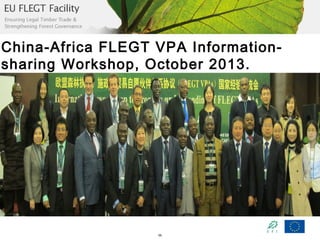
China-Africa FLEGT VPA Informationsharing Workshop, October 2013.

55
56
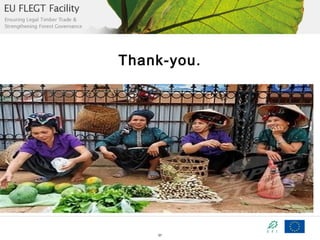
Thank-you.

57
Linking Sustainable Forest
Product Supply Chains
through Asia
PEFC Stakeholder Dialogue 2013
14-15th November, Kuala Lumpur

58
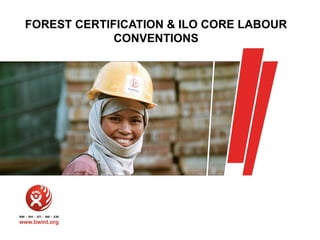
FOREST CERTIFICATION & ILO CORE LABOUR
CONVENTIONS
BWI – BUILDING WOOD WORKER’S INTERNATIONAL
WHO WE ARE
The BWI (www.bwint.org) :

•

Global union Federations on Wood, Forestry,
Construction and Building Material Sectors;

•

328 Free and Democratic Trade Unions around the
world, 89 of them in Asia-Pacific Region;

•

Representing more than 12 million members around the
world;

•

Number of International Framework Agreements (IFA’s):

•

Mission: to promote the development of trade unions
in our sectors throughout the world and to promote
and enforce workers rights in the context of
sustainable development.
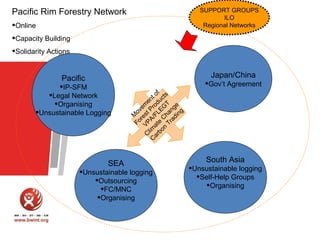
Pacific Rim Forestry Network

SUPPORT GROUPS
ILO
Regional Networks

•Online
•Capacity Building
•Solidarity Actions

Japan/China

Pacific

•IP-SFM

•Legal Network
•Organising

•Unsustainable Logging

SEA

f
t o cts
en du T
m o
e
ve t Pr LEG ang g
o
M res /F Ch din
A
a
Fo VP ate Tr
n
lim rbo
C a
C

•Unsustainable logging
•Outsourcing
•FC/MNC
•Organising

•Gov’t Agreement

South Asia

•Unsustainable logging
•Self-Help Groups
•Organising
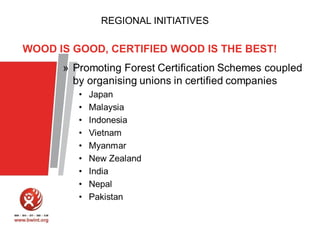
REGIONAL INITIATIVES

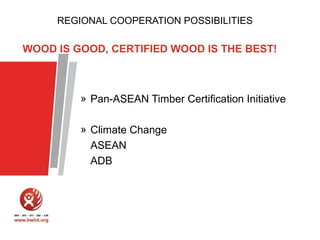
WOOD IS GOOD, CERTIFIED WOOD IS THE BEST!
REGIONAL COOPERATION POSSIBILITIES

WOOD IS GOOD, CERTIFIED WOOD IS THE BEST!

» Pan-ASEAN Timber Certification Initiative
» Climate Change
ASEAN
ADB
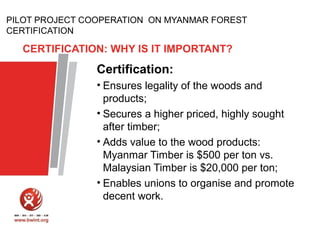
PILOT PROJECT COOPERATION ON MYANMAR FOREST
CERTIFICATION

CERTIFICATION: WHY IS IT IMPORTANT?

Certification:
• Ensures legality of the woods and
products;
• Secures a higher priced, highly sought
after timber;
• Adds value to the wood products:
Myanmar Timber is $500 per ton vs.
Malaysian Timber is $20,000 per ton;
• Enables unions to organise and promote
decent work.
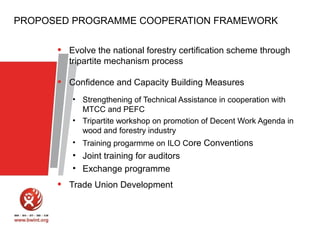
PROPOSED PROGRAMME COOPERATION FRAMEWORK

•

Evolve the national forestry certification scheme through
tripartite mechanism process

•

Confidence and Capacity Building Measures
• Strengthening of Technical Assistance in cooperation with
MTCC and PEFC
• Tripartite workshop on promotion of Decent Work Agenda in
wood and forestry industry
• Training progarmme on ILO Core Conventions

• Joint training for auditors
• Exchange programme

•

Trade Union Development
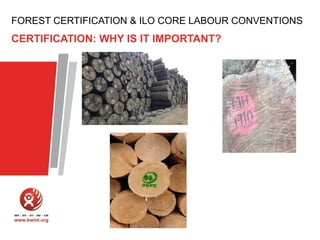
FOREST CERTIFICATION & ILO CORE LABOUR CONVENTIONS

CERTIFICATION: WHY IS IT IMPORTANT?
Linking Sustainable Forest
Product Supply Chains
through Asia
PEFC Stakeholder Dialogue 2013
14-15th November, Kuala Lumpur

69
Responsible Asia Forestry and Trade
A partnership for strengthening capacity and sharing knowledge
Chen Hin Keong, Forest Trade Programme Leader, TRAFFIC
Andrew Ingles, Chief Technical Adviser, TNC
November 2013
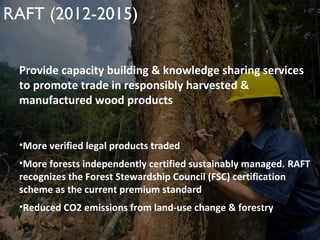
RAFT (2012-2015)
Provide capacity building & knowledge sharing services
to promote trade in responsibly harvested &
manufactured wood products

•More verified legal products traded
•More forests independently certified sustainably managed. RAFT
recognizes the Forest Stewardship Council (FSC) certification
scheme as the current premium standard
•Reduced CO2 emissions from land-use change & forestry
RAFT Partners
Institute for Global Environmental Strategies (IGES)
•
•
•
•

Analytical inputs on timber legality and sustainable forest management
certification
Conducted a RAFT study on the potential role of Customs Authorities
Produced the first draft of the ASEAN chain of custody guidelines for timber
Undertaking a comprehensive review of timber legality issues in PNG

TFT (The Forest Trust)
•
•
•

RAFT work in Indonesia, Vietnam, Lao PDR & China
Develops industry guidance documents for producers, processors &
exporters on how to meet legality requirements
Provides in-person practical training to:
• improve the level of legality compliance
• make progress towards credible certification standards in the factory &
forest
RAFT Partners
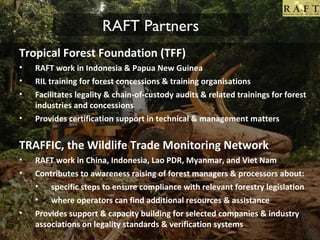
• Tropical Forest Foundation (TFF)
•
•
•
•

RAFT work in Indonesia & Papua New Guinea
RIL training for forest concessions & training organisations
Facilitates legality & chain-of-custody audits & related trainings for forest
industries and concessions
Provides certification support in technical & management matters

TRAFFIC, the Wildlife Trade Monitoring Network
•
•

•

RAFT work in China, Indonesia, Lao PDR, Myanmar, and Viet Nam
Contributes to awareness raising of forest managers & processors about:
• specific steps to ensure compliance with relevant forestry legislation
• where operators can find additional resources & assistance
Provides support & capacity building for selected companies & industry
associations on legality standards & verification systems
RAFT Partners
WWF Global Forest & Trade Network (GFTN)
•

Alongside TRAFFIC, developing practical guidance for establishing legality
verification systems including:
•

updating GFTN’s “Guide to Legal and Responsible Sourcing and
Exporting in a Shifting Legal Landscape”

•

raising awareness and understanding of legality issues

•

Providing technical assistance to selected tree growers, companies, industry
associations & training institutions regarding legal compliance

•

Providing support to forest management companies for mainstreaming
legal & responsible forest management using GFTN’s existing model, tools
and learning
RAFT Partners
The Nature Conservancy (TNC)
•

Provides strategic coordination for the RAFT Partnership as a whole

•

Implements activities at the regional level and in China, Indonesia & PNG

•

Supports policy and systems development governing land management &
spatial planning

•

Provides technical support to national timber legality verification systems
in China and Indonesia

•

Pioneering logging practices that reduce carbon emissions

•

Helping roll out community-based natural resource management in PNG
.

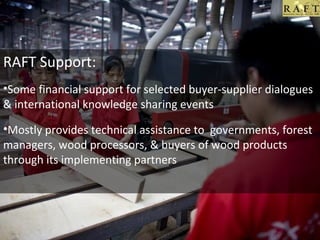
RAFT Support:
•Some financial support for selected buyer-supplier dialogues
& international knowledge sharing events
•Mostly provides technical assistance to governments, forest
managers, wood processors, & buyers of wood products
through its implementing partners
www.responsibleasia.org
Linking Sustainable Forest
Product Supply Chains
through Asia
PEFC Stakeholder Dialogue 2013
14-15th November, Kuala Lumpur

78
RECOFTC’s Regional Experiences
with Forest Smallholders

Martin Greijmans
14 November 2013
PEFC Stakeholder Dialogue, Kuala Lumpur
Brief Organizational Background
•Mission: Local communities and indigenous people are
actively engaged in sustainable management of forest
landscapes
•Vision: Capacity development for optimum social,
economic, and environmental benefits
•Engages with various stakeholders, including
governments, NGOs, private sector and local communities
•Since its foundation in 1987, has trained over 25,000
people from more than 27 countries
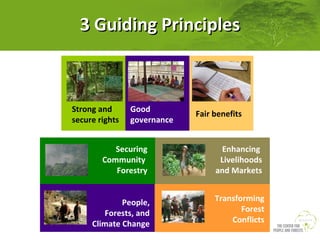
3 Guiding Principles

Strong and
secure rights

Good
governance

Fair benefits

Securing
Community
Forestry

Enhancing
Livelihoods
and Markets

People,
Forests, and
Climate Change

Transforming
Forest
Conflicts
RECOFTC’s Functional Approach
Capacity Development Cycle
Training and
learning
networks

Piloting and
demonstrating

RECOFTC
Knowledge
Hub

Strategic
communication

Research,
analysis and
synthesis
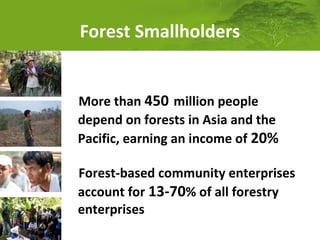
Forest Smallholders
More than 450 million people
depend on forests in Asia and the
Pacific, earning an income of 20%
Forest-based community enterprises
account for 13-70% of all forestry
enterprises
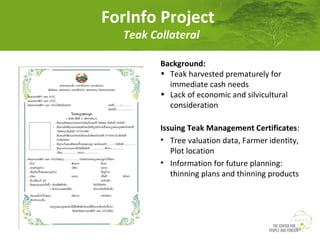
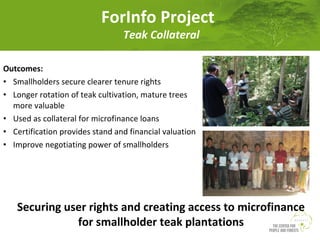
ForInfo Project
Teak Collateral

Background:
• Teak harvested prematurely for
immediate cash needs
• Lack of economic and silvicultural
consideration
Issuing Teak Management Certificates:
• Tree valuation data, Farmer identity,
Plot location
• Information for future planning:
thinning plans and thinning products

84
ForInfo Project
Teak Collateral

Outcomes:
• Smallholders secure clearer tenure rights
• Longer rotation of teak cultivation, mature trees
more valuable
• Used as collateral for microfinance loans
• Certification provides stand and financial valuation
• Improve negotiating power of smallholders

Securing user rights and creating access to microfinance
for smallholder teak plantations
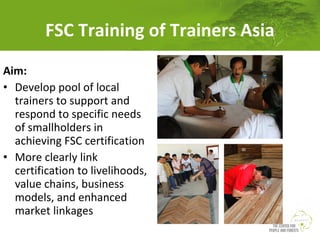
FSC Training of Trainers Asia
Aim:
• Develop pool of local
trainers to support and
respond to specific needs
of smallholders in
achieving FSC certification
• More clearly link
certification to livelihoods,
value chains, business
models, and enhanced
market linkages
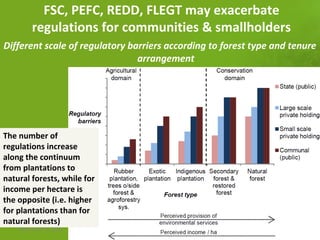
FSC, PEFC, REDD, FLEGT may exacerbate
regulations for communities & smallholders
Different scale of regulatory barriers according to forest type and tenure
arrangement

The number of
regulations increase
along the continuum
from plantations to
natural forests, while for
income per hectare is
the opposite (i.e. higher
for plantations than for
natural forests)
November 22, 2013

87
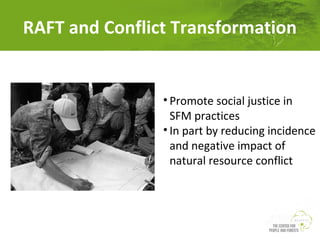
RAFT and Conflict Transformation

• Promote social justice in
SFM practices
• In part by reducing incidence
and negative impact of
natural resource conflict
RAFT and Conflict Transformation
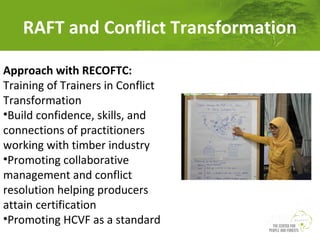
Approach with RECOFTC:
Training of Trainers in Conflict
Transformation
•Build confidence, skills, and
connections of practitioners
working with timber industry
•Promoting collaborative
management and conflict
resolution helping producers
attain certification
•Promoting HCVF as a standard
FLEGT & RECOFTC Thailand
• In Thailand FLEGT allows for renewed claim
for communities to play a role and become a
respected actor in the timber sector
• RECOFTC is raising awareness of the CF
Networks and CSOs about VPA process
– Enabling them to participate actively future
government-led consultations
What’s Next?
• Beyond the forest:
– Broad landscape approach
– Link with agriculture and energy policies
• Improve capacity of small entrepreneurs
– Business planning & development skills
– Links to markets, finance, policy processes
• Ex: Rights and Resources Initiative (RRI) collaboration,
• Ongoing efforts to engage communities and improve role in
forest sector
– RECOFTC brokering PPP processes: collaboration with private
sector with increased understanding, mutual gain
– Ex: Stora Enso
Asia

Forest Connect Asia
• Support smallholder enterprises
to connect to each other, policies
and markets
• FCA to build enterprise capacity,
facilitating and broker linkages,
pilot and document best practices
in their specific context
Thank You

For further information, please contact

Martin Greijmans
martin.greijmans@recoftc.org
www.recoftc.org
Linking Sustainable Forest
Product Supply Chains
through Asia
PEFC Stakeholder Dialogue 2013
14-15th November, Kuala Lumpur

94
Investors supporting
transformation towards
sustainability in the forestry
sector

Adam Grant
Manager, Certification and Environmental Markets
PEFC
Kuala Lumpur, Malaysia
November 2013
Important Note
© New Forests 2013. This publication is the property of New Forests. This material may not be reproduced or used in any form or medium
without express written permission.
The information contained in this publication is of a general nature and is intended for discussion purposes only. The information does not
constitute financial product advice or provides a recommendation to enter into any investment. This presentation has been prepared
without taking account of any person’s objectives, financial situation or needs. This is not an offer to buy or sell, nor a solicitation of an offer
to buy or sell any security or other financial instrument. Past performance is not a guide to future performance. Past performance is not a
reliable indicator of future performance. You should consider obtaining independent professional advice before making any financial
decisions. The terms set forth herein are based on information obtained from sources that New Forests believes to be reliable, but New
Forests makes no representations as to, and accepts no responsibility or liability for, the accuracy, reliability or completeness of the
information. Except insofar as liability under any statute cannot be excluded, New Forests, including all companies within the New Forests
group, and all directors, employees and consultants, do not accept any liability for any loss or damage (whether direct, indirect,
consequential or otherwise) arising from the use of this presentation.
The information contained in this publication may include financial and business projections that are based on a large number of
assumptions, any of which could prove to be significantly incorrect. New Forests notes that all projections, valuations, and statistical analyses
are subjective illustrations based on one or more among many alternative methodologies that may produce different results. Projections,
valuations, and statistical analyses included herein should not be viewed as facts, predictions or the only possible outcome. Before
considering any investment, potential investors should conduct such enquiries and investigations as the investor deems necessary and
consult with its own legal, accounting and tax advisors in order to make an independent determination of the suitability, risk and merits of
any investment.
New Forests Advisory Pty Limited (ACN 114 545 274) is the holder of AFSL No 301556. New Forests Asset Management Pty Limited (ACN 114
545 283) is registered with the Australian Securities and Investments Commission and is an Authorised Representative of New Forests
Advisory Pty Limited (ACN 114 545 274, AFSL 301556). New Forests Inc. has filed as an exempt reporting adviser with the Securities and
Exchange Commission.

Slide 96
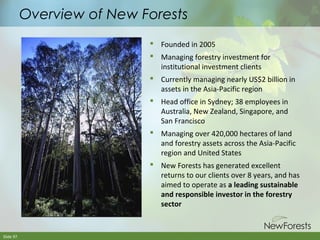
Overview of New Forests
 Founded in 2005
 Managing forestry investment for
institutional investment clients
 Currently managing nearly US$2 billion in
assets in the Asia-Pacific region
 Head office in Sydney; 38 employees in
Australia, New Zealand, Singapore, and
San Francisco
 Managing over 420,000 hectares of land
and forestry assets across the Asia-Pacific
region and United States
 New Forests has generated excellent
returns to our clients over 8 years, and has
aimed to operate as a leading sustainable
and responsible investor in the forestry
sector

Slide 97
What Differentiates New Forests?
Strategically, New Forests is…
1. Focused on Asia Pacific opportunities

Unique for a TIMO—headquartered in Sydney with an office in Singapore
 Largest forestland owner in Australia and active in markets throughout
Australia, New Zealand, and Asia

Providing investors with exposure to the integrated Asia Pacific regional
timber trade–extensive experience in domestic and export markets
1. A leader in sustainable forest management
 Investment team experienced in sustainable forest management and
environmental markets; company-wide Social and Environmental
Management System

Member of Forest Stewardship Council (FSC) International and FSC
Australia

Signatory to United Nations Principles for Responsible Investment (PRI)
3. Forward Thinking

Engaged with international NGOs, and participating in global initiatives
including World Economic Forum Global Council, Aspen Institute, etc.

Slide 98
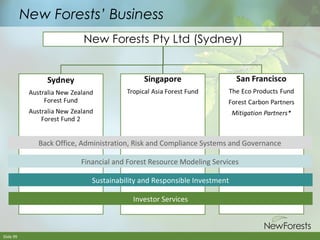
New Forests’ Business

Back Office, Administration, Risk and Compliance Systems and Governance
Financial and Forest Resource Modeling Services
Sustainability and Responsible Investment
Investor Services

Slide 99
Tropical Asia Forest Fund - TAFF
TAFF is a commingled fund investing in tropical timber plantations in South
East Asia with US$171 million in commitments. Clients include pension
funds and development banks.
Forestry in Asia is changing:
Originated from logging concessions in natural forests
Low cost of timber from these concessions meant attractive returns were possible without
operating efficiently or sustainably
Natural forest timber has been largely depleted
Global concern over rainforest logging and a demand for certification and sustainable forest
management models are on the rise
Fast-growing, high-quality managed timber plantation estates are emerging as the basis for the
future of the industry, which will require significant capital

TAFF will:
Invest in existing forestry enterprises or assets
Upgrade and expand those businesses
Help Implement modern forestry systems and practices
Obtain certification and where possible, access environmental markets
Exit after 10-15 years of investment

Slide 100
The Changing Forestry Landscape
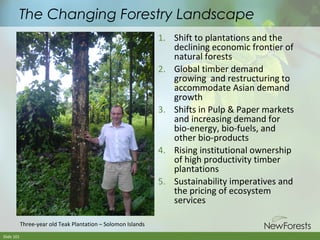
1. Shift to plantations and the
declining economic frontier of
natural forests
2. Global timber demand
growing and restructuring to
accommodate Asian demand
growth
3. Shifts in Pulp & Paper markets
and increasing demand for
bio-energy, bio-fuels, and
other bio-products
4. Rising institutional ownership
of high productivity timber
plantations
5. Sustainability imperatives and
the pricing of ecosystem
services
Three-year old Teak Plantation – Solomon Islands
Slide 101
Natural Forest Harvest in SE Asia in Decline
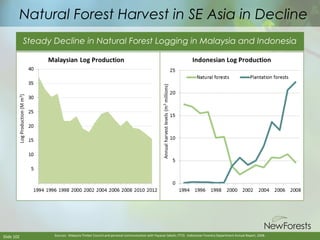
Steady Decline in Natural Forest Logging in Malaysia and Indonesia

Slide 102

Sources: Malaysia Timber Council and personal communication with Yayasan Sabah; ITTO; Indonesian Forestry Department Annual Report, 2008.
Limited Plantation Investment
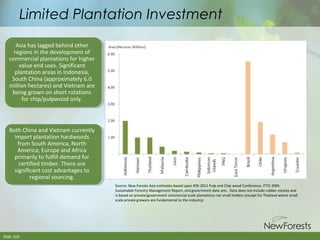
Asia has lagged behind other
regions in the development of
commercial plantations for higher
value end uses. Significant
plantation areas in Indonesia,
South China (approximately 6.0
million hectares) and Vietnam are
being grown on short rotations
for chip/pulpwood only.

Both China and Vietnam currently
import plantation hardwoods
from South America, North
America, Europe and Africa
primarily to fulfill demand for
certified timber. There are
significant cost advantages to
regional sourcing.
Source: New Forests Asia estimates based upon RISI 2011 Pulp and Chip wood Conference, ITTO 2005
Sustainable Forestry Management Report, and government data sets. Data does not include rubber estates and
is based on private/government commercial scale plantations not small holders (except for Thailand where small
scale private growers are fundamental to the industry)

Slide 103
Opportunities for TAFF

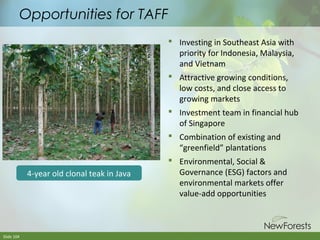
4-year old clonal teak in Java

Slide 104

 Investing in Southeast Asia with
priority for Indonesia, Malaysia,
and Vietnam
 Attractive growing conditions,
low costs, and close access to
growing markets
 Investment team in financial hub
of Singapore
 Combination of existing and
“greenfield” plantations
 Environmental, Social &
Governance (ESG) factors and
environmental markets offer
value-add opportunities
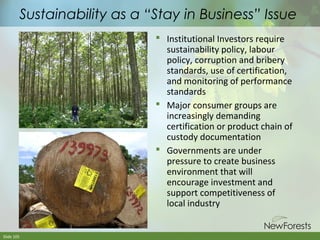
Sustainability as a “Stay in Business” Issue
 Institutional Investors require
sustainability policy, labour
policy, corruption and bribery
standards, use of certification,
and monitoring of performance
standards
 Major consumer groups are
increasingly demanding
certification or product chain of
custody documentation
 Governments are under
pressure to create business
environment that will
encourage investment and
support competitiveness of
local industry

Slide 105
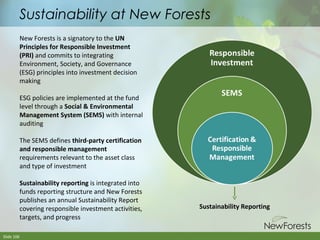
Sustainability at New Forests
New Forests is a signatory to the UN
Principles for Responsible Investment
(PRI) and commits to integrating
Environment, Society, and Governance
(ESG) principles into investment decision
making
ESG policies are implemented at the fund
level through a Social & Environmental
Management System (SEMS) with internal
auditing
The SEMS defines third-party certification
and responsible management
requirements relevant to the asset class
and type of investment
Sustainability reporting is integrated into
funds reporting structure and New Forests
publishes an annual Sustainability Report
covering responsible investment activities,
targets, and progress
Slide 106

Sustainability Reporting
TAFF Sustainability Goals
New Forests is committed to sustainable management of TAFF investments
 Environmental, social and governance best practice will ensure TAFF
contributes to:





Reduced greenhouse gas emissions and other forms of pollution
Maintenance or enhancement of high conservation value forests and biodiversity
Improvements in local livelihoods and safe working conditions
Recognition of indigenous rights

 Third-party verified sustainable forest management will add significant value:









Slide 107

Price premiums and better market access for certain products
Lower project and political risk through reduced social conflicts
Improved asset liquidity and lower risk-adjusted discount rates on exit
Lower cost of debt capital and better debt access, especially from development banks
Improved access to licences, operating permits or additional assets from host countries
Reputational risk reduction for fund investors
Opportunities for increasing operating efficiencies through better management
Opportunities for environmental market products from areas set aside from production
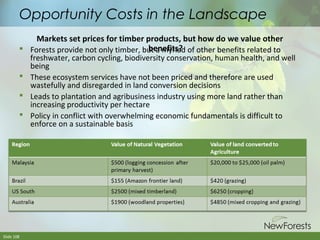
Opportunity Costs in the Landscape
Markets set prices for timber products, but how do we value other
benefits?
 Forests provide not only timber, but a myriad of other benefits related to

freshwater, carbon cycling, biodiversity conservation, human health, and well
being
 These ecosystem services have not been priced and therefore are used
wastefully and disregarded in land conversion decisions
 Leads to plantation and agribusiness industry using more land rather than
increasing productivity per hectare
 Policy in conflict with overwhelming economic fundamentals is difficult to
enforce on a sustainable basis

Slide 108
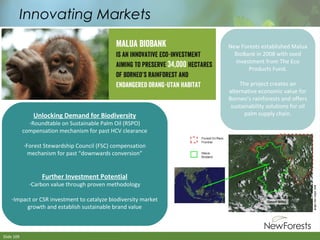
Innovating Markets
New Forests established Malua
BioBank in 2008 with seed
investment from The Eco
Products Fund.

Unlocking Demand for Biodiversity

-Roundtable on Sustainable Palm Oil (RSPO)
compensation mechanism for past HCV clearance
-Forest Stewardship Council (FSC) compensation
mechanism for past “downwards conversion”

Further Investment Potential

-Carbon value through proven methodology
-Impact or CSR investment to catalyze biodiversity market
growth and establish sustainable brand value

Slide 109

The project creates an
alternative economic value for
Borneo’s rainforests and offers
sustainability solutions for oil
palm supply chain.
Environmental Markets Lessons Learned
 Price signals work







SO2 market drove changes in fuel from high to low sulphur coal
EU Emissions Trading Scheme (ETS) drove $ billions into carbon funds and carbon
companies
Australian water market restructured agriculture to increased efficiency and more
valuable cropping
US Mitigation Banking is a $billion+ turnover industry

 The finance and investment sector can facilitate change




Investment funds sprang up related to the EU ETS, Australian Water market, and
Mitigation banking industry—creates liquidity to meet market needs
Markets create transparency in pricing; futures and options create stability; water
rights as collateral for investment in water use efficiency

 Stability is necessary, but fine-tuning is also necessary



Meddling by Government killed the SO2 markets
Excessive allocations and unexpectedly huge offset supply have made the EU ETS
unstable

 It needs to cost more to remain outside rather than inside a scheme



Slide 110

Lack of price premium has hampered most voluntary certification schemes
REDD has struggled to have impact because private sector is disengaged and
continues to operate on a business as usual basis
Towards the Future
Can forestry represent a “natural infrastructure” asset class?


Projections are that global industrial roundwood demand will begin to plateau around 2.3-2.5
billion m3 per annum in 2030.



100 to 150 million hectares of commercial plantation area (2.5-3.75% of world forest cover)
could supply most of this timber, while timber production from frontier regions (Canada,
Russia, tropical natural forests) will stabilize or decline. Biomass demand may double this.




Slide 111

Large scale ‘deals’ like NZ, Australia,
Indonesia-Norway, Boreal Canada,
etc.



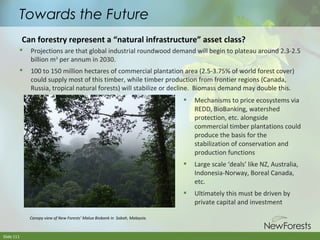
Canopy view of New Forests’ Malua Biobank in Sabah, Malaysia.

Mechanisms to price ecosystems via
REDD, BioBanking, watershed
protection, etc. alongside
commercial timber plantations could
produce the basis for the
stabilization of conservation and
production functions

Ultimately this must be driven by
private capital and investment
Key Points & Conclusions












Slide 112

World timber demand will continue to rise, markets will evolve to
encompass Asian demand growth
Supply increases will primarily come from timber plantations, rather
than further expansion of the economic margin in primary forests
Increases in plantation area are more difficult to achieve than increases
in productivity of existing plantation base—land competition will also
rise among food, energy, and fibre crops
Institutional portfolios have gone from 5% real assets in 2000 to 15%
real assets today, and likely will reach 25-30% by 2025—huge inflow of
capital for real estate, infrastructure, agriculture, forestry, etc.
Need fopr a financing source for conservation as well as production—
this could include REDD+, biobanking, water rights, no net loss supply
chains, etc.
Social and community integration via benefit sharing, consultation, and
governance models, and respect for traditional and legal rights will be
core to sustainable outcomes
www.newforests.com.au
Appendices
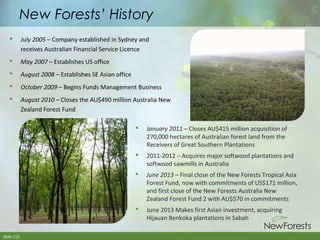
New Forests’ History


July 2005 – Company established in Sydney and
receives Australian Financial Service Licence



May 2007 – Establishes US office



August 2008 – Establishes SE Asian office



October 2009 – Begins Funds Management Business



August 2010 – Closes the AU$490 million Australia New
Zealand Forest Fund




2011-2012 – Acquires major softwood plantations and
softwood sawmills in Australia



June 2013 – Final close of the New Forests Tropical Asia
Forest Fund, now with commitments of US$171 million,
and first close of the New Forests Australia New
Zealand Forest Fund 2 with AU$570 in commitments



Slide 115

January 2011 – Closes AU$415 million acquisition of
270,000 hectares of Australian forest land from the
Receivers of Great Southern Plantations

June 2013 Makes first Asian investment, acquiring
Hijauan Benkoka plantations in Sabah
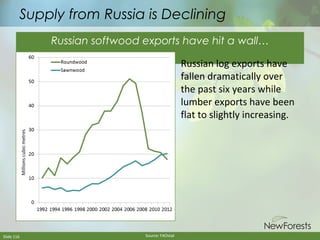
Supply from Russia is Declining
Russian softwood exports have hit a wall…
Russian log exports have
fallen dramatically over
the past six years while
lumber exports have been
flat to slightly increasing.

Slide 116

Source: FAOstat
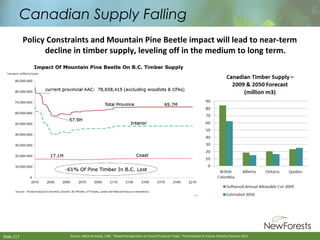
Canadian Supply Falling
Policy Constraints and Mountain Pine Beetle impact will lead to near-term
decline in timber supply, leveling off in the medium to long term.

Slide 117

Source: Mark Kennedy, CIBC. “Global Perspectives on Forest Products Trade.” Presentation to Future Forestry Finance 2012.
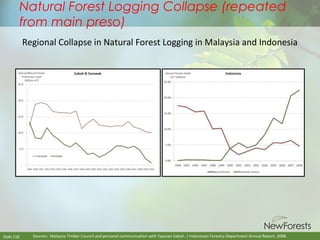
Natural Forest Logging Collapse (repeated
from main preso)
Regional Collapse in Natural Forest Logging in Malaysia and Indonesia

Slide 118

Sources: Malaysia Timber Council and personal communication with Yayasan Sabah. / Indonesian Forestry Department Annual Report, 2008.
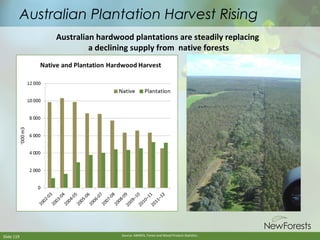
Australian Plantation Harvest Rising
Australian hardwood plantations are steadily replacing
a declining supply from native forests

Slide 119

Source: ABARES, Forest and Wood Product Statistics.
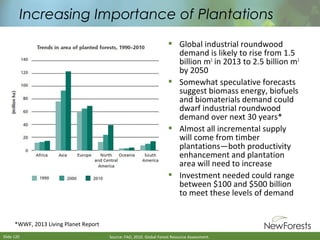
Increasing Importance of Plantations
 Global industrial roundwood
demand is likely to rise from 1.5
billion m3 in 2013 to 2.5 billion m3
by 2050
 Somewhat speculative forecasts
suggest biomass energy, biofuels
and biomaterials demand could
dwarf industrial roundwood
demand over next 30 years*
 Almost all incremental supply
will come from timber
plantations—both productivity
enhancement and plantation
area will need to increase
 Investment needed could range
between $100 and $500 billion
to meet these levels of demand

*WWF, 2013 Living Planet Report
Slide 120

Source: FAO, 2010. Global Forest Resource Assessment.
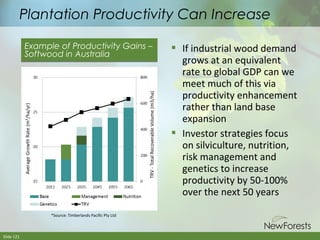
Plantation Productivity Can Increase
Example of Productivity Gains –
Softwood in Australia

*Source: Timberlands Pacific Pty Ltd

Slide 121

 If industrial wood demand
grows at an equivalent
rate to global GDP can we
meet much of this via
productivity enhancement
rather than land base
expansion
 Investor strategies focus
on silviculture, nutrition,
risk management and
genetics to increase
productivity by 50-100%
over the next 50 years
What Government Policies are Needed?
A modern forest policy framework needs to address wood
supply, forest conservation and sustainability issues

 Future wood supply growth will largely be delivered by
plantations—this will be from existing plantations managed
more intensively and expansion of plantation area—
expansion is a key policy challenge
 As timber plantations take on increasing share of wood
supply, innovation is needed in financial mechanisms for
forest conservation—REDD, biobanks, supply chain initiatives
 Social outcomes need to balance multiple stakeholders and
conflicting interests and rights. Innovations around
consultation/governance models, sharing in economic
benefits, community benefits are needed
Slide 122
TAFF Certification & Sustainability
New Forests is committed to sustainable management of TAFF investments
 Third-party verified sustainable forest management will add significant value:









Price premiums and better market access for certain products
Lower project and political risk through reduced social conflicts
Improved asset liquidity and lower risk-adjusted discount rates on exit
Lower cost of debt capital and better debt access, especially from development banks
Improved access to licences, operating permits, or additional assets from host countries
Reputational risk reduction for fund investors
Opportunities for increasing operating efficiencies through better management
Opportunities for environmental market products from areas set aside from production

 TAFF Certification Policy:






Slide 123

Achieve compliance against IFC Performance Standards within three years of acquisition on all
assets including plantations, natural forests, and processing facilities
Achieve FSC certification on all natural forests within three years of acquisition if the asset
meets all FSC eligibility criteria
Where plantation assets do not meet all FSC eligibility criteria, engage an FSC-accredited
certification body to undertake third-party verification of compliance with all applicable FSC
requirements and, depending on market requirements, pursue additional third-party
certification against an alternative certification system depending on market demands such as
PEFC, LEI, FSC controlled wood, VLO, and/or VLC or other future standard that may be
developed
External Motivations
 New Forests designed its Social and Environmental Management
System (“SEMS”) in 2010 and began full implementation in 2011.
 The SEMS is designed to systematically identify, manage, and report
on social and environmental issues and potential impacts.
 The SEMS helps us win clients:






English pension fund manager said, “You’re the only manager we’ve seen
who can show how they manage assets sustainably.”
Dutch pension fund manager said, “FSC certification is absolutely required
for us as a target and your SEMS shows us how you pursue that.”
Provides a reference point and tool for due diligence

 The SEMS helps us provide client services and meet requests:



Current clients ask to see audit reports
Streamlines responses to client inquiries

 Risk management and continual improvement.
Slide 124
Linking Sustainable Forest
Product Supply Chains
through Asia
PEFC Stakeholder Dialogue 2013
14-15th November, Kuala Lumpur

125

PEFC Forest Certification Week 2013: Stakeholder Dialogue

  • 1.
    Linking Sustainable Forest ProductSupply Chains through Asia PEFC Stakeholder Dialogue 2013 14-15th November, Kuala Lumpur 1
  • 2.
    Timber Certification andthe Role of ITTO Emmanuel ZE MEKA, Executive Director International Tropical Timber Organisation 2
  • 3.
    PEFC Week, KualaLumpur, November 2013 State of forestry in the Asia-Pacific Region Bruno Cammaert FAO Regional Office for Asia and the Pacific Bangkok
  • 4.
    Structure of thepresentation  Forest cover change  Forest products  Forest use and tenure  Drivers of change  Progress towards SFM
  • 5.
    Forests of Asiaand the Pacific - 2010 26% OF TOTAL LAND AREA 740,000,000 ha But only 0.2 ha per person
  • 6.
    Forest area bysub-region – 2010 (million ha) 255 80 214 191
  • 7.
    Area (million hectares). ForestArea Change 1990-2010 800 700 600 1990 2000 2010 500 400 300 200 100 0 East Asia South Asia Southeast Asia Oceania Asia and the Pacific
  • 8.
    Primary forests 19% OFASIA-PACIFIC FORESTS 30% OF SOUTH EAST ASIA’S FORESTS 34% OF THE WORLD’S FORESTS
  • 9.
    Other naturally regeneratedforests 65% OF ASIA-PACIFIC FORESTS 63% OF SOUTHEAST ASIA’S FOREST 60% OF THE WORLD’S FORESTS
  • 10.
    Planted forests 16% OFASIA-PACIFIC FORESTS 7% OF SOUTHEAST ASIA’S FORESTS 7% OF THE WORLD’S FORESTS
  • 11.
    Wood products –industrial round wood ASIA OCEANIA
  • 12.
    Wood products –sawn wood, panels, and paper
  • 13.
    Wood products –key trends  Significant decline in wood production in some countries  Exhaustion of forest resources  Concerns about environmental protection Regional focus focus International Round wood exports added exports  Value- Emergence as a major producer/exporter of wooden furniture
  • 14.
    Forest Tenure Forest ownershipin Asia-Pacific Private sector 4% Owned or designated for use by communities 28% Owned or administered by governments 68%
  • 15.
    Forest Use  32%primarily for the production of wood and NWFPs  20% multiple-use management  14% Conservation of biodiversity
  • 16.
    Key drivers ofchange What happens to forests and forestry is determined to a large extent by what happens outside the forestry sector and by larger societal changes.
  • 17.
    Key drivers ofchange: Demographics  Asia-Pacific – world’s most densely populated region  Population increase 3.6 billion (2005) 4.2 billion (2020)  Greatest increases in densely populated “developing” countries  Urban population 38% people in urban areas (2005) 47% people in urban areas (2020)
  • 18.
    Key drivers ofchange: Economics  High growth rates increasing the demand for food, fiber and fuel  Poverty rates will decline, but the number of poor will remain high  Recent reductions, export orientated countries hit hardest (e.g., Cambodia, Malaysia, Thailand)  Swelling middle class  Structural changes: • Declining importance of agriculture in income and employment • Globalization • Diminishing importance of the role of governments
  • 19.
    Key drivers ofchange: Agriculture  Agricultural expansion is the primary reason for forest conversion in many countries  A few agricultural crops account for a large proportion of deforestation  Rubber plantations are expanding in forest areas  Oil palm plantations set to spread significantly
  • 20.
    Key drivers ofchange: Infrastructure  Road network expansion greatest in more developed countries  Impacts greatest in less developed countries
  • 21.
    Key drivers ofchange: Politics and policies  Greater democracy and political accountability  Transparency in functioning and accountability of public institutions and officials – rights to information  Forest governance under increased public scrutiny  Demands for participation in public policy decision making  Shift from timber-focused management to multiple-use management  Greater emphasis on ecosystem services and sustainable development  Potential contributions of forestry to “green economy”
  • 22.
    Key drivers ofchange: Societal and Environmental concerns  Local and national issues and actions  Global and regional environmental drivers: International commitments and the outcomes of climate change negotiations Pressure from stakeholders in the “global forest resource”
  • 23.
    Progress toward SustainableForest Management  Improved stakeholder participation and     local forest tenure mainstreamed into National Forest Programmes Sustained efforts in REDD+ readiness FLEGT: demand and supply Third party certification of legality, SFM and Chain-of-Custody Payments for ecosystem services (PES)
  • 24.
  • 25.
    Snapshot of ForestCertification in the Asia region Ben Gunneberg, Secretary General PEFC Council 25
  • 26.
    Forest Certification Globally • • 26 • 10%of the world forests are certified (UNECE/FAO 2013) 28% of industrial roundwood production is certified 60% of total certified area is PEFC
  • 27.
    Forest Certification inAsia • 2% of forests in Asia are certified (UNECE/FAO 2013) • 8% of forests in Southeast Asia are certified (WB/Profor 2012) • 11% of production forests in Southeast Asia are certified 27 (WB/Profor 2012)
  • 28.
    National progress inAsia 28 Source: 2013, Certification system’s published data
  • 29.
    Markets – Chainof Custody • Total of 7768 CoC certificates in Asia 29 Source: 2013, Certification system’s published data
  • 30.
    Reasons for optimism?  Legality& Governance issues being addresses at the highest levels  FSC actively promoting certification in many countries throughout the region – results are evident  PEFC working to scale up its Asia Promotions Initiative and expand our presence in the region  Number of national certification organizations emerging with the potential to achieve wider uptake in forests & markets  Companies continuing to make commitments to sourcing sustainable products – driving up demand signals  30 WBCSD Declaration, Consumer Goods Forum, Unilever, etc
  • 31.
    THANK YOU PEFC International 10Route de l’Aéroport, 1215 Geneva, Switzerland www.pefc.org info@pefc.org 31
  • 32.
    Linking Sustainable Forest ProductSupply Chains through Asia PEFC Stakeholder Dialogue 2013 14-15th November, Kuala Lumpur 32
  • 33.
    PEFC Stakeholder Dialogue2013 The EU FLEGT Action Plan – lnfluencing Forest Industry Transformation EFI FLEGT Facility Asia Regional Office Kuala Lumpur, Malaysia 14 November 2013 33
  • 34.
    EU FLEGT ActionPlan – 2003 Objective: Address the driving forces of illegal logging both on the demand side as well as in the timber producing countries. Course of Action/Main Instruments Public Procurement Policies (demand) Voluntary Partnership Agreements (supply) EU Timber Regulation (demand and supply ) 34
  • 35.
    FLEGT Global Historicalperspective G8 Forestry Action Program -1998IL as 1 of 5 areas of action East Asia FLEG Bali Africa FLEG Yaoundé FLEGT EU Action Plan Europe & North Asia FLEG St Petersburg FLEGT regulation Regional FLEG ministerial meetings EU FLEGT AP FLEGT implementing regulation EU Timber regulation 1999 2000 2001 2002 2003 2004 2005 2006 2007 2008 2009 2010 2011 2012 US Lacey Act amendment 35 Australian Illegal Logging Prohibition Act
  • 36.
    What is aVoluntary Partnership Agreement? Legally-binding bilateral treaty (not “voluntary” once agreed) Timber-producing countries agree to licence their timber exports as legal EU agrees to accept only licensed imports Backed by EU trade legislation (2005 FLEGT Regulation) Legality assured through an agreed Timber Legality Assurance System (TLAS) Supported where necessary with development cooperation 36
  • 37.
  • 38.
  • 39.
    EU Timber Regulation Whatproducts are covered? 1 Covered (almost all): • • • • Solid wood products Flooring Plywood Pulp and paper 2 Not covered: • • • • Recycled products Musical instruments Printed matter including magazines, newspapers and books Some special products, like wooden toys Most timber products are covered. The products covered may change in future. 39
  • 40.
  • 41.
    How do businessescomply with the EU Timber Regulation? Full implementation of VPA : Producing country’s timber accompanied by FLEGT-license which attests to its legality. • Private sector initiatives :Timber certified under the main forest certification schemes is still subject to due diligence requirements. Other means of providing information on legality 41
  • 42.
  • 43.
  • 44.
    Promoting specific regionalexchange to share lessons and address challenges 44
  • 45.
  • 46.
  • 47.
  • 48.
  • 49.
  • 50.
  • 51.
  • 52.
  • 53.
    Thank you EU FLEGTFacility Tomi Tuomasjukka 00358 50 433 9049 Tomi.tuomasjukka@efi.int www.euflegt.efi.int 53
  • 54.
    EU –China BCM Bilateral Cooperation Mechanismon FLEG signed 2009, implementation started in 2010 54
  • 55.
    China-Africa FLEGT VPAInformationsharing Workshop, October 2013. 55
  • 56.
  • 57.
  • 58.
    Linking Sustainable Forest ProductSupply Chains through Asia PEFC Stakeholder Dialogue 2013 14-15th November, Kuala Lumpur 58
  • 59.
    FOREST CERTIFICATION &ILO CORE LABOUR CONVENTIONS
  • 60.
    BWI – BUILDINGWOOD WORKER’S INTERNATIONAL WHO WE ARE The BWI (www.bwint.org) : • Global union Federations on Wood, Forestry, Construction and Building Material Sectors; • 328 Free and Democratic Trade Unions around the world, 89 of them in Asia-Pacific Region; • Representing more than 12 million members around the world; • Number of International Framework Agreements (IFA’s): • Mission: to promote the development of trade unions in our sectors throughout the world and to promote and enforce workers rights in the context of sustainable development.
  • 61.
    Pacific Rim ForestryNetwork SUPPORT GROUPS ILO Regional Networks •Online •Capacity Building •Solidarity Actions Japan/China Pacific •IP-SFM •Legal Network •Organising •Unsustainable Logging SEA f t o cts en du T m o e ve t Pr LEG ang g o M res /F Ch din A a Fo VP ate Tr n lim rbo C a C •Unsustainable logging •Outsourcing •FC/MNC •Organising •Gov’t Agreement South Asia •Unsustainable logging •Self-Help Groups •Organising
  • 62.
    REGIONAL INITIATIVES WOOD ISGOOD, CERTIFIED WOOD IS THE BEST!
  • 65.
    REGIONAL COOPERATION POSSIBILITIES WOODIS GOOD, CERTIFIED WOOD IS THE BEST! » Pan-ASEAN Timber Certification Initiative » Climate Change ASEAN ADB
  • 66.
    PILOT PROJECT COOPERATIONON MYANMAR FOREST CERTIFICATION CERTIFICATION: WHY IS IT IMPORTANT? Certification: • Ensures legality of the woods and products; • Secures a higher priced, highly sought after timber; • Adds value to the wood products: Myanmar Timber is $500 per ton vs. Malaysian Timber is $20,000 per ton; • Enables unions to organise and promote decent work.
  • 67.
    PROPOSED PROGRAMME COOPERATIONFRAMEWORK • Evolve the national forestry certification scheme through tripartite mechanism process • Confidence and Capacity Building Measures • Strengthening of Technical Assistance in cooperation with MTCC and PEFC • Tripartite workshop on promotion of Decent Work Agenda in wood and forestry industry • Training progarmme on ILO Core Conventions • Joint training for auditors • Exchange programme • Trade Union Development
  • 68.
    FOREST CERTIFICATION &ILO CORE LABOUR CONVENTIONS CERTIFICATION: WHY IS IT IMPORTANT?
  • 69.
    Linking Sustainable Forest ProductSupply Chains through Asia PEFC Stakeholder Dialogue 2013 14-15th November, Kuala Lumpur 69
  • 70.
    Responsible Asia Forestryand Trade A partnership for strengthening capacity and sharing knowledge Chen Hin Keong, Forest Trade Programme Leader, TRAFFIC Andrew Ingles, Chief Technical Adviser, TNC November 2013
  • 71.
    RAFT (2012-2015) Provide capacitybuilding & knowledge sharing services to promote trade in responsibly harvested & manufactured wood products •More verified legal products traded •More forests independently certified sustainably managed. RAFT recognizes the Forest Stewardship Council (FSC) certification scheme as the current premium standard •Reduced CO2 emissions from land-use change & forestry
  • 72.
    RAFT Partners Institute forGlobal Environmental Strategies (IGES) • • • • Analytical inputs on timber legality and sustainable forest management certification Conducted a RAFT study on the potential role of Customs Authorities Produced the first draft of the ASEAN chain of custody guidelines for timber Undertaking a comprehensive review of timber legality issues in PNG TFT (The Forest Trust) • • • RAFT work in Indonesia, Vietnam, Lao PDR & China Develops industry guidance documents for producers, processors & exporters on how to meet legality requirements Provides in-person practical training to: • improve the level of legality compliance • make progress towards credible certification standards in the factory & forest
  • 73.
    RAFT Partners • TropicalForest Foundation (TFF) • • • • RAFT work in Indonesia & Papua New Guinea RIL training for forest concessions & training organisations Facilitates legality & chain-of-custody audits & related trainings for forest industries and concessions Provides certification support in technical & management matters TRAFFIC, the Wildlife Trade Monitoring Network • • • RAFT work in China, Indonesia, Lao PDR, Myanmar, and Viet Nam Contributes to awareness raising of forest managers & processors about: • specific steps to ensure compliance with relevant forestry legislation • where operators can find additional resources & assistance Provides support & capacity building for selected companies & industry associations on legality standards & verification systems
  • 74.
    RAFT Partners WWF GlobalForest & Trade Network (GFTN) • Alongside TRAFFIC, developing practical guidance for establishing legality verification systems including: • updating GFTN’s “Guide to Legal and Responsible Sourcing and Exporting in a Shifting Legal Landscape” • raising awareness and understanding of legality issues • Providing technical assistance to selected tree growers, companies, industry associations & training institutions regarding legal compliance • Providing support to forest management companies for mainstreaming legal & responsible forest management using GFTN’s existing model, tools and learning
  • 75.
    RAFT Partners The NatureConservancy (TNC) • Provides strategic coordination for the RAFT Partnership as a whole • Implements activities at the regional level and in China, Indonesia & PNG • Supports policy and systems development governing land management & spatial planning • Provides technical support to national timber legality verification systems in China and Indonesia • Pioneering logging practices that reduce carbon emissions • Helping roll out community-based natural resource management in PNG
  • 76.
    . RAFT Support: •Some financialsupport for selected buyer-supplier dialogues & international knowledge sharing events •Mostly provides technical assistance to governments, forest managers, wood processors, & buyers of wood products through its implementing partners
  • 77.
  • 78.
    Linking Sustainable Forest ProductSupply Chains through Asia PEFC Stakeholder Dialogue 2013 14-15th November, Kuala Lumpur 78
  • 79.
    RECOFTC’s Regional Experiences withForest Smallholders Martin Greijmans 14 November 2013 PEFC Stakeholder Dialogue, Kuala Lumpur
  • 80.
    Brief Organizational Background •Mission:Local communities and indigenous people are actively engaged in sustainable management of forest landscapes •Vision: Capacity development for optimum social, economic, and environmental benefits •Engages with various stakeholders, including governments, NGOs, private sector and local communities •Since its foundation in 1987, has trained over 25,000 people from more than 27 countries
  • 81.
    3 Guiding Principles Strongand secure rights Good governance Fair benefits Securing Community Forestry Enhancing Livelihoods and Markets People, Forests, and Climate Change Transforming Forest Conflicts
  • 82.
    RECOFTC’s Functional Approach CapacityDevelopment Cycle Training and learning networks Piloting and demonstrating RECOFTC Knowledge Hub Strategic communication Research, analysis and synthesis
  • 83.
    Forest Smallholders More than450 million people depend on forests in Asia and the Pacific, earning an income of 20% Forest-based community enterprises account for 13-70% of all forestry enterprises
  • 84.
    ForInfo Project Teak Collateral Background: •Teak harvested prematurely for immediate cash needs • Lack of economic and silvicultural consideration Issuing Teak Management Certificates: • Tree valuation data, Farmer identity, Plot location • Information for future planning: thinning plans and thinning products 84
  • 85.
    ForInfo Project Teak Collateral Outcomes: •Smallholders secure clearer tenure rights • Longer rotation of teak cultivation, mature trees more valuable • Used as collateral for microfinance loans • Certification provides stand and financial valuation • Improve negotiating power of smallholders Securing user rights and creating access to microfinance for smallholder teak plantations
  • 86.
    FSC Training ofTrainers Asia Aim: • Develop pool of local trainers to support and respond to specific needs of smallholders in achieving FSC certification • More clearly link certification to livelihoods, value chains, business models, and enhanced market linkages
  • 87.
    FSC, PEFC, REDD,FLEGT may exacerbate regulations for communities & smallholders Different scale of regulatory barriers according to forest type and tenure arrangement The number of regulations increase along the continuum from plantations to natural forests, while for income per hectare is the opposite (i.e. higher for plantations than for natural forests) November 22, 2013 87
  • 88.
    RAFT and ConflictTransformation • Promote social justice in SFM practices • In part by reducing incidence and negative impact of natural resource conflict
  • 89.
    RAFT and ConflictTransformation Approach with RECOFTC: Training of Trainers in Conflict Transformation •Build confidence, skills, and connections of practitioners working with timber industry •Promoting collaborative management and conflict resolution helping producers attain certification •Promoting HCVF as a standard
  • 90.
    FLEGT & RECOFTCThailand • In Thailand FLEGT allows for renewed claim for communities to play a role and become a respected actor in the timber sector • RECOFTC is raising awareness of the CF Networks and CSOs about VPA process – Enabling them to participate actively future government-led consultations
  • 91.
    What’s Next? • Beyondthe forest: – Broad landscape approach – Link with agriculture and energy policies • Improve capacity of small entrepreneurs – Business planning & development skills – Links to markets, finance, policy processes • Ex: Rights and Resources Initiative (RRI) collaboration, • Ongoing efforts to engage communities and improve role in forest sector – RECOFTC brokering PPP processes: collaboration with private sector with increased understanding, mutual gain – Ex: Stora Enso
  • 92.
    Asia Forest Connect Asia •Support smallholder enterprises to connect to each other, policies and markets • FCA to build enterprise capacity, facilitating and broker linkages, pilot and document best practices in their specific context
  • 93.
    Thank You For furtherinformation, please contact Martin Greijmans martin.greijmans@recoftc.org www.recoftc.org
  • 94.
    Linking Sustainable Forest ProductSupply Chains through Asia PEFC Stakeholder Dialogue 2013 14-15th November, Kuala Lumpur 94
  • 95.
    Investors supporting transformation towards sustainabilityin the forestry sector Adam Grant Manager, Certification and Environmental Markets PEFC Kuala Lumpur, Malaysia November 2013
  • 96.
    Important Note © NewForests 2013. This publication is the property of New Forests. This material may not be reproduced or used in any form or medium without express written permission. The information contained in this publication is of a general nature and is intended for discussion purposes only. The information does not constitute financial product advice or provides a recommendation to enter into any investment. This presentation has been prepared without taking account of any person’s objectives, financial situation or needs. This is not an offer to buy or sell, nor a solicitation of an offer to buy or sell any security or other financial instrument. Past performance is not a guide to future performance. Past performance is not a reliable indicator of future performance. You should consider obtaining independent professional advice before making any financial decisions. The terms set forth herein are based on information obtained from sources that New Forests believes to be reliable, but New Forests makes no representations as to, and accepts no responsibility or liability for, the accuracy, reliability or completeness of the information. Except insofar as liability under any statute cannot be excluded, New Forests, including all companies within the New Forests group, and all directors, employees and consultants, do not accept any liability for any loss or damage (whether direct, indirect, consequential or otherwise) arising from the use of this presentation. The information contained in this publication may include financial and business projections that are based on a large number of assumptions, any of which could prove to be significantly incorrect. New Forests notes that all projections, valuations, and statistical analyses are subjective illustrations based on one or more among many alternative methodologies that may produce different results. Projections, valuations, and statistical analyses included herein should not be viewed as facts, predictions or the only possible outcome. Before considering any investment, potential investors should conduct such enquiries and investigations as the investor deems necessary and consult with its own legal, accounting and tax advisors in order to make an independent determination of the suitability, risk and merits of any investment. New Forests Advisory Pty Limited (ACN 114 545 274) is the holder of AFSL No 301556. New Forests Asset Management Pty Limited (ACN 114 545 283) is registered with the Australian Securities and Investments Commission and is an Authorised Representative of New Forests Advisory Pty Limited (ACN 114 545 274, AFSL 301556). New Forests Inc. has filed as an exempt reporting adviser with the Securities and Exchange Commission. Slide 96
  • 97.
    Overview of NewForests  Founded in 2005  Managing forestry investment for institutional investment clients  Currently managing nearly US$2 billion in assets in the Asia-Pacific region  Head office in Sydney; 38 employees in Australia, New Zealand, Singapore, and San Francisco  Managing over 420,000 hectares of land and forestry assets across the Asia-Pacific region and United States  New Forests has generated excellent returns to our clients over 8 years, and has aimed to operate as a leading sustainable and responsible investor in the forestry sector Slide 97
  • 98.
    What Differentiates NewForests? Strategically, New Forests is… 1. Focused on Asia Pacific opportunities  Unique for a TIMO—headquartered in Sydney with an office in Singapore  Largest forestland owner in Australia and active in markets throughout Australia, New Zealand, and Asia  Providing investors with exposure to the integrated Asia Pacific regional timber trade–extensive experience in domestic and export markets 1. A leader in sustainable forest management  Investment team experienced in sustainable forest management and environmental markets; company-wide Social and Environmental Management System  Member of Forest Stewardship Council (FSC) International and FSC Australia  Signatory to United Nations Principles for Responsible Investment (PRI) 3. Forward Thinking  Engaged with international NGOs, and participating in global initiatives including World Economic Forum Global Council, Aspen Institute, etc. Slide 98
  • 99.
    New Forests’ Business BackOffice, Administration, Risk and Compliance Systems and Governance Financial and Forest Resource Modeling Services Sustainability and Responsible Investment Investor Services Slide 99
  • 100.
    Tropical Asia ForestFund - TAFF TAFF is a commingled fund investing in tropical timber plantations in South East Asia with US$171 million in commitments. Clients include pension funds and development banks. Forestry in Asia is changing: Originated from logging concessions in natural forests Low cost of timber from these concessions meant attractive returns were possible without operating efficiently or sustainably Natural forest timber has been largely depleted Global concern over rainforest logging and a demand for certification and sustainable forest management models are on the rise Fast-growing, high-quality managed timber plantation estates are emerging as the basis for the future of the industry, which will require significant capital TAFF will: Invest in existing forestry enterprises or assets Upgrade and expand those businesses Help Implement modern forestry systems and practices Obtain certification and where possible, access environmental markets Exit after 10-15 years of investment Slide 100
  • 101.
    The Changing ForestryLandscape 1. Shift to plantations and the declining economic frontier of natural forests 2. Global timber demand growing and restructuring to accommodate Asian demand growth 3. Shifts in Pulp & Paper markets and increasing demand for bio-energy, bio-fuels, and other bio-products 4. Rising institutional ownership of high productivity timber plantations 5. Sustainability imperatives and the pricing of ecosystem services Three-year old Teak Plantation – Solomon Islands Slide 101
  • 102.
    Natural Forest Harvestin SE Asia in Decline Steady Decline in Natural Forest Logging in Malaysia and Indonesia Slide 102 Sources: Malaysia Timber Council and personal communication with Yayasan Sabah; ITTO; Indonesian Forestry Department Annual Report, 2008.
  • 103.
    Limited Plantation Investment Asiahas lagged behind other regions in the development of commercial plantations for higher value end uses. Significant plantation areas in Indonesia, South China (approximately 6.0 million hectares) and Vietnam are being grown on short rotations for chip/pulpwood only. Both China and Vietnam currently import plantation hardwoods from South America, North America, Europe and Africa primarily to fulfill demand for certified timber. There are significant cost advantages to regional sourcing. Source: New Forests Asia estimates based upon RISI 2011 Pulp and Chip wood Conference, ITTO 2005 Sustainable Forestry Management Report, and government data sets. Data does not include rubber estates and is based on private/government commercial scale plantations not small holders (except for Thailand where small scale private growers are fundamental to the industry) Slide 103
  • 104.
    Opportunities for TAFF 4-yearold clonal teak in Java Slide 104  Investing in Southeast Asia with priority for Indonesia, Malaysia, and Vietnam  Attractive growing conditions, low costs, and close access to growing markets  Investment team in financial hub of Singapore  Combination of existing and “greenfield” plantations  Environmental, Social & Governance (ESG) factors and environmental markets offer value-add opportunities
  • 105.
    Sustainability as a“Stay in Business” Issue  Institutional Investors require sustainability policy, labour policy, corruption and bribery standards, use of certification, and monitoring of performance standards  Major consumer groups are increasingly demanding certification or product chain of custody documentation  Governments are under pressure to create business environment that will encourage investment and support competitiveness of local industry Slide 105
  • 106.
    Sustainability at NewForests New Forests is a signatory to the UN Principles for Responsible Investment (PRI) and commits to integrating Environment, Society, and Governance (ESG) principles into investment decision making ESG policies are implemented at the fund level through a Social & Environmental Management System (SEMS) with internal auditing The SEMS defines third-party certification and responsible management requirements relevant to the asset class and type of investment Sustainability reporting is integrated into funds reporting structure and New Forests publishes an annual Sustainability Report covering responsible investment activities, targets, and progress Slide 106 Sustainability Reporting
  • 107.
    TAFF Sustainability Goals NewForests is committed to sustainable management of TAFF investments  Environmental, social and governance best practice will ensure TAFF contributes to:     Reduced greenhouse gas emissions and other forms of pollution Maintenance or enhancement of high conservation value forests and biodiversity Improvements in local livelihoods and safe working conditions Recognition of indigenous rights  Third-party verified sustainable forest management will add significant value:         Slide 107 Price premiums and better market access for certain products Lower project and political risk through reduced social conflicts Improved asset liquidity and lower risk-adjusted discount rates on exit Lower cost of debt capital and better debt access, especially from development banks Improved access to licences, operating permits or additional assets from host countries Reputational risk reduction for fund investors Opportunities for increasing operating efficiencies through better management Opportunities for environmental market products from areas set aside from production
  • 108.
    Opportunity Costs inthe Landscape Markets set prices for timber products, but how do we value other benefits?  Forests provide not only timber, but a myriad of other benefits related to freshwater, carbon cycling, biodiversity conservation, human health, and well being  These ecosystem services have not been priced and therefore are used wastefully and disregarded in land conversion decisions  Leads to plantation and agribusiness industry using more land rather than increasing productivity per hectare  Policy in conflict with overwhelming economic fundamentals is difficult to enforce on a sustainable basis Slide 108
  • 109.
    Innovating Markets New Forestsestablished Malua BioBank in 2008 with seed investment from The Eco Products Fund. Unlocking Demand for Biodiversity -Roundtable on Sustainable Palm Oil (RSPO) compensation mechanism for past HCV clearance -Forest Stewardship Council (FSC) compensation mechanism for past “downwards conversion” Further Investment Potential -Carbon value through proven methodology -Impact or CSR investment to catalyze biodiversity market growth and establish sustainable brand value Slide 109 The project creates an alternative economic value for Borneo’s rainforests and offers sustainability solutions for oil palm supply chain.
  • 110.
    Environmental Markets LessonsLearned  Price signals work     SO2 market drove changes in fuel from high to low sulphur coal EU Emissions Trading Scheme (ETS) drove $ billions into carbon funds and carbon companies Australian water market restructured agriculture to increased efficiency and more valuable cropping US Mitigation Banking is a $billion+ turnover industry  The finance and investment sector can facilitate change   Investment funds sprang up related to the EU ETS, Australian Water market, and Mitigation banking industry—creates liquidity to meet market needs Markets create transparency in pricing; futures and options create stability; water rights as collateral for investment in water use efficiency  Stability is necessary, but fine-tuning is also necessary   Meddling by Government killed the SO2 markets Excessive allocations and unexpectedly huge offset supply have made the EU ETS unstable  It needs to cost more to remain outside rather than inside a scheme   Slide 110 Lack of price premium has hampered most voluntary certification schemes REDD has struggled to have impact because private sector is disengaged and continues to operate on a business as usual basis
  • 111.
    Towards the Future Canforestry represent a “natural infrastructure” asset class?  Projections are that global industrial roundwood demand will begin to plateau around 2.3-2.5 billion m3 per annum in 2030.  100 to 150 million hectares of commercial plantation area (2.5-3.75% of world forest cover) could supply most of this timber, while timber production from frontier regions (Canada, Russia, tropical natural forests) will stabilize or decline. Biomass demand may double this.   Slide 111 Large scale ‘deals’ like NZ, Australia, Indonesia-Norway, Boreal Canada, etc.  Canopy view of New Forests’ Malua Biobank in Sabah, Malaysia. Mechanisms to price ecosystems via REDD, BioBanking, watershed protection, etc. alongside commercial timber plantations could produce the basis for the stabilization of conservation and production functions Ultimately this must be driven by private capital and investment
  • 112.
    Key Points &Conclusions       Slide 112 World timber demand will continue to rise, markets will evolve to encompass Asian demand growth Supply increases will primarily come from timber plantations, rather than further expansion of the economic margin in primary forests Increases in plantation area are more difficult to achieve than increases in productivity of existing plantation base—land competition will also rise among food, energy, and fibre crops Institutional portfolios have gone from 5% real assets in 2000 to 15% real assets today, and likely will reach 25-30% by 2025—huge inflow of capital for real estate, infrastructure, agriculture, forestry, etc. Need fopr a financing source for conservation as well as production— this could include REDD+, biobanking, water rights, no net loss supply chains, etc. Social and community integration via benefit sharing, consultation, and governance models, and respect for traditional and legal rights will be core to sustainable outcomes
  • 113.
  • 114.
  • 115.
    New Forests’ History  July2005 – Company established in Sydney and receives Australian Financial Service Licence  May 2007 – Establishes US office  August 2008 – Establishes SE Asian office  October 2009 – Begins Funds Management Business  August 2010 – Closes the AU$490 million Australia New Zealand Forest Fund   2011-2012 – Acquires major softwood plantations and softwood sawmills in Australia  June 2013 – Final close of the New Forests Tropical Asia Forest Fund, now with commitments of US$171 million, and first close of the New Forests Australia New Zealand Forest Fund 2 with AU$570 in commitments  Slide 115 January 2011 – Closes AU$415 million acquisition of 270,000 hectares of Australian forest land from the Receivers of Great Southern Plantations June 2013 Makes first Asian investment, acquiring Hijauan Benkoka plantations in Sabah
  • 116.
    Supply from Russiais Declining Russian softwood exports have hit a wall… Russian log exports have fallen dramatically over the past six years while lumber exports have been flat to slightly increasing. Slide 116 Source: FAOstat
  • 117.
    Canadian Supply Falling PolicyConstraints and Mountain Pine Beetle impact will lead to near-term decline in timber supply, leveling off in the medium to long term. Slide 117 Source: Mark Kennedy, CIBC. “Global Perspectives on Forest Products Trade.” Presentation to Future Forestry Finance 2012.
  • 118.
    Natural Forest LoggingCollapse (repeated from main preso) Regional Collapse in Natural Forest Logging in Malaysia and Indonesia Slide 118 Sources: Malaysia Timber Council and personal communication with Yayasan Sabah. / Indonesian Forestry Department Annual Report, 2008.
  • 119.
    Australian Plantation HarvestRising Australian hardwood plantations are steadily replacing a declining supply from native forests Slide 119 Source: ABARES, Forest and Wood Product Statistics.
  • 120.
    Increasing Importance ofPlantations  Global industrial roundwood demand is likely to rise from 1.5 billion m3 in 2013 to 2.5 billion m3 by 2050  Somewhat speculative forecasts suggest biomass energy, biofuels and biomaterials demand could dwarf industrial roundwood demand over next 30 years*  Almost all incremental supply will come from timber plantations—both productivity enhancement and plantation area will need to increase  Investment needed could range between $100 and $500 billion to meet these levels of demand *WWF, 2013 Living Planet Report Slide 120 Source: FAO, 2010. Global Forest Resource Assessment.
  • 121.
    Plantation Productivity CanIncrease Example of Productivity Gains – Softwood in Australia *Source: Timberlands Pacific Pty Ltd Slide 121  If industrial wood demand grows at an equivalent rate to global GDP can we meet much of this via productivity enhancement rather than land base expansion  Investor strategies focus on silviculture, nutrition, risk management and genetics to increase productivity by 50-100% over the next 50 years
  • 122.
    What Government Policiesare Needed? A modern forest policy framework needs to address wood supply, forest conservation and sustainability issues  Future wood supply growth will largely be delivered by plantations—this will be from existing plantations managed more intensively and expansion of plantation area— expansion is a key policy challenge  As timber plantations take on increasing share of wood supply, innovation is needed in financial mechanisms for forest conservation—REDD, biobanks, supply chain initiatives  Social outcomes need to balance multiple stakeholders and conflicting interests and rights. Innovations around consultation/governance models, sharing in economic benefits, community benefits are needed Slide 122
  • 123.
    TAFF Certification &Sustainability New Forests is committed to sustainable management of TAFF investments  Third-party verified sustainable forest management will add significant value:         Price premiums and better market access for certain products Lower project and political risk through reduced social conflicts Improved asset liquidity and lower risk-adjusted discount rates on exit Lower cost of debt capital and better debt access, especially from development banks Improved access to licences, operating permits, or additional assets from host countries Reputational risk reduction for fund investors Opportunities for increasing operating efficiencies through better management Opportunities for environmental market products from areas set aside from production  TAFF Certification Policy:    Slide 123 Achieve compliance against IFC Performance Standards within three years of acquisition on all assets including plantations, natural forests, and processing facilities Achieve FSC certification on all natural forests within three years of acquisition if the asset meets all FSC eligibility criteria Where plantation assets do not meet all FSC eligibility criteria, engage an FSC-accredited certification body to undertake third-party verification of compliance with all applicable FSC requirements and, depending on market requirements, pursue additional third-party certification against an alternative certification system depending on market demands such as PEFC, LEI, FSC controlled wood, VLO, and/or VLC or other future standard that may be developed
  • 124.
    External Motivations  NewForests designed its Social and Environmental Management System (“SEMS”) in 2010 and began full implementation in 2011.  The SEMS is designed to systematically identify, manage, and report on social and environmental issues and potential impacts.  The SEMS helps us win clients:    English pension fund manager said, “You’re the only manager we’ve seen who can show how they manage assets sustainably.” Dutch pension fund manager said, “FSC certification is absolutely required for us as a target and your SEMS shows us how you pursue that.” Provides a reference point and tool for due diligence  The SEMS helps us provide client services and meet requests:   Current clients ask to see audit reports Streamlines responses to client inquiries  Risk management and continual improvement. Slide 124
  • 125.
    Linking Sustainable Forest ProductSupply Chains through Asia PEFC Stakeholder Dialogue 2013 14-15th November, Kuala Lumpur 125

Editor's Notes

  • #29 To get a real sense of progress, of course we have to look at each country specifically. There are encouraging signs. Like here in ML – where estimated 40% of production forests have achieved certification. Indonesia, also showing great signs of prgress – and we are optimistic that will continue to grow through the establishment of IFCC. (FYI for Ben – I don’t adjust for dual certification in this data – so I’m not sure how much area is both FSC and LEI certified in Indonesia; SGEC/FSC in Japan). SO numbers reflect in absolute terms the data from each systems individually.
  • #30 So highlighting certificates. But to quickly put this into perspective: Compared to how many millions of companies?? (FYI – there are an additional 6 certificates LEI and 5 CFCC CoC – so not included here but just FYI)
  • #31 Legality & Governance issues being addresses at the highest levels --- this changes the business as usual scenario and can help make certification more competitive. PEFC working to scale up its Asia Promotions Initiative and expand our presence in the region -- we’ve been working since 2007 in China and Japan….but now real demands and interests from actors in asia for PEFC. We need to expand our support to the region. Looking for additional partners… We’ll hear more about these and other initiatives throughout the day.
  • #62 WWF website: 40-61% of timber production in Indonesia is believed to stem from illegal logging 25% of Russia's timber exports originate from illegal logging. In Gabon, 70% of harvested timber is considered illegal. In estimated €10–15 billion is lost through illegal logging globally each year The European Union causes almost €3 billion of this loss due to its trade with countries in the Amazon Basin, the Baltic States, the Congo Basin, east Africa, Indonesia and Russia. The World Bank states that the annual global market loses US$10 billion annually from illegal logging, with governments losing an additional US$5 billion in revenues.
  • #71 I will present a brief overview of the Responsible Asia Forest and Trade (RAFT) Program. Launched in 2007 Designed to help Asia Pacific suppliers meet the growing demand for verifiably responsible wood products that benefit local and global economies, while preserving the environment and mitigating against climate change. RAFT has been providing capacity building services, technical support and networking opportunities, to help bridge the gap between market and policy signals for responsible forestry and trade and the current standards found along key timber supply chains in the Asia Pacific Region. So far RAFT has invested more than US $18 million in this work. Financed originally by USAID in phase 1 and phase 2 by Australian government and US Department of State. We thank the US and Australian Governments for their significant support over the years. RAFT’s work on the ground has been concentrated so far in 6 countries: China, Indonesia, Lao PDR, Malaysia, Papua New Guinea and Vietnam, with others involved through regional dialogues and learning exchanges Directed by TNC and implemented by a group of partner NGOs. The partnership angle is critical because addressing these issues, in our view, requires working across the supply chain, linking public policy, corporate practice and community engagement across a large geographic expanse. This is an issue that is bigger than something a single organization can undertake and so the right partners are indeed necessary.
  • #72 The goal shared by RAFT partners is : “To increase the proportion of internationally traded, legally verified wood products….. where those products are derived from responsibly managed forests, yielding reduced carbon dioxide emissions from land management and land-use change, compared to the ‘business as usual’ scenario” By the end of 2015, we want to see a 25% increase in forest products derived from legal sources, a 25% increase in land under independently certified sustainable management practices, and a 35% reduction in CO2 emissions from forest management & land-use change in affected areas compared to the business as usual scenario.
  • #73 IGES: is an independent think tank and strategic policy research institute that contributes to sustainable development solutions in the Asia-Pacific region, and other parts of the globe. The IGES headquarters are in Hayama, Japan, and it maintains a regional centre in Bangkok and an office in Beijing. IGES partners with many international organisations, governments, research institutions, the private sector, environmental and social NGOs, and other groups on a wide range of issues, including climate change mitigation and adaptation, forest and biodiversity conservation, water resource management, sustainable consumption and production, sustainable business, and land and resource use competition. Its work for RAFT involves ....(see slide) TFT: Established in 1999, a global non-profit that helps businesses bring responsible products to market, products that improve people's lives and respect the environment at all stages of the product lifecycle. TFT helps more than 90 members worldwide build responsible supply chains, by identifying and addressing embedded social and environmental issues. Having established a strong record of achievement in timber supply chains, TFT has expanded its work into palm oil, leather, stone, sugar, coconut and charcoal. TFT has offices in 15 countries and an on-the-ground presence in many more. Its work for RAFT involves ....(see slide)
  • #74 Tropical Forest Foundation (TFF) The Tropical Forest Foundation (TFF) is an international association of forest industry leaders, NGO’s, and academic institutions committed to the concept of promoting and training of sustainable forest management with particular focus on reduced impact logging (RIL). TFF-Indonesia runs the SE Asia-Pacific program of TFF International and offers a suite of interrelated services to the Indonesian forestry sector and engages with the forest industry in the wider SE Asia Region. Its work for RAFT involves ....(see slide) TRAFFIC, the Wildlife Trade Monitoring Network TRAFFIC was established in 1976 and has developed into a global network that is research-driven and action-oriented, committed to delivering innovative and practical conservation solutions. TRAFFIC strives to ensure that trade in wild plants and animals is not a threat to the conservation of nature. It employs around 100 staff based in nearly 30 countries. TRAFFIC’s partner organisations are WWF and IUCN and its central aim is to contribute to the wildlife trade-related priorities of these partners. Timber and non-timber forest products are included in its work programs. Its work for RAFT involves ....(see slide)
  • #75 WWF Global Forest & Trade Network (GFTN) GFTN is one of WWF’s leading initiatives to combat illegal logging and drive improvements in forest management while transforming the global marketplace into a force for saving the world’s valuable and threatened forests. It was established in 1991, and is now the world’s longest-running and largest forest and trade program of its kind, providing structured support for a wide range of players involved in forest product markets. GFTN mirrors the global forest industry through its global-to-local, on-the-ground presence in over 30 countries. It currently has more than 200 participants managing nearly 20 million hectares of credibly certified forests, and its trade participants trade more than 340 million m3 of timber and fibre per year. Its work within RAFT includes (see slide)
  • #76 The Nature Conservancy (TNC) Founded in 1951, TNC has protected over 48 million ha of land and 8,000 km of rivers and operates more than 100 marine conservation projects worldwide. TNC now has more than 1 million members, over 4,000 staff and works in over 30 countries. TNC addresses threats to conservation involving climate change, wildfires, fresh water, forestry, invasive species, and marine ecosystems using a science-based approach, with over 700 scientists on staff. In every place TNC works, we pursue non-confrontational, pragmatic solutions to conservation challenges. Role in RAFT includes (see slide)
  • #77 RAFT provides some financial support for selected buyer-supplier dialogues and international knowledge sharing events, but mostly provides technical assistance to governments, forest managers, wood processors, and buyers of wood products through its implementing partners that I have just described.
  • #78 You can visit our website to find out more about what we do, or come talk to me later today. Thank you.
  • #82 All of RECOFTC’s work is based on these principles…
  • #83 FUNCTIONAL APPROACH
  • #87 Forest Stewardship Council
  • #88 Based on work is based on an analysis of the regulatory barriers in 6 Cambodia, Indonesia, Nepal, Philippines, PNG & Vietnam and Mexico. Literature and policy review focusing on whether the timber regulations are fit for purpose; Experts’ workshops to examine the issues (e.g. costs & implications) related to barriers facing local communities and smallholders harvesting and selling timber, Focus group meetings (2 per country) Heavier burden for small landowners and communities managing natural forests. Especially now that their tenure rights have been increasingly recognized, at least in the books. Local communities should consequently be able to make a better living from selling timber So Why are local people in South East Asia unable to make a better living from the sale of timber and timber products?
  • #89 Responsible Asia Forestry and Trade (RAFT) program
  • #90 All of RECOFTC’s work is based on these principles…
  • #91 Forest Law EnforcementGovernance andTrade
  • #92 There is no one size fits all for how the regulatory barriers should be addressed: each country has a unique context. Informal barriers (e.g. corruption and arbitrary interpretation of the laws) are as much of a problem as formal barriers. If community forestry is to be a viable economic endeavor for communities, regulations and the way they are implemented must recognize the capacity that communities and the government possess (and those that they lack)