What is the EU
FLEGT?
The EU FLEGT is the
European Union’s response
to the global problem of
illegal logging and the trade
in timber products.

It stands for:
Forest Law Enforcement
Governance and Trade
The campaigning NGO for greater
environmental and social justice, with a
focus on forests and forest peoples rights in
the policies and practices of the EU
EU FLEGT – a history
• In 1998, the G8 foreign ministers’ launched an
“action programme on forests”.
• In April 2002, the European Commission hosted
an international workshop to discuss how the EU
should combat illegal logging.
• In December 2002, FERN and the Royal Institute
of International Affairs presented a blueprint for
an EU Action Plan, called Options for Europe.
• On 21 May 2003, the Commission presented its
FLEGT Action Plan, adopted by the Council in
October 2003 with a set of conclusions.
The campaigning NGO for greater environmental and social justice, with a focus on forests and
forest peoples rights in the policies and practices of the EU. Visit us as www.fern.org
The EU FLEGT Action Plan
The action plan sets out a range of measures that
aim to combat the problem of illegal
logging, including:
1. Government Procurement Policies
2. Financial due diligence
3. Voluntary Partnership Agreements (VPAs)
between the EU and timber producing countries
4. Illegal timber regulation (additional legislative
options to control importation of illegal timber)
1. Government Procurement Policies
• The Action Plan encourages EU Member States to address illegal
logging via procurement policies to promote the use of legal and
sustainably produced timber

• There are at least six Member States that have adopted social
and environmental criteria into their procurement policies
(Belgium, Denmark, France, Germany, the Netherlands and the
UK)
• The EU has just adopted a new procurement directive which is
stronger in terms of social criteria. The EU Ecolabel for timber
products as its requirements are lower than those of the six
Member States.
See EU Ecolabel allows forest destruction.
More information can be found in the FERN report:
Buying a sustainable future: timber procurement policies in the EU
2. Financial Due Diligence
• The FLEGT Action Plan states banks, financial
institutions and specifically ECAs should ensure
risk assessments and due diligence to ensure that
large scale investment in the forestry sector does
not increase illegal logging. See: Exporting
destruction.
• The Plan also mentions that EU Money
Laundering Directives should treat illegal logging
as a serious offence. There is no an attempt to
include environmental crime, which would
include illegal logging, into new EU AMLD.
3. Voluntary Partnership Agreements
• Legally binding bilateral trade
agreements between timber
producing countries (FLEGT
Partner Countries) and the EU,
mostly known as VPAs.
• VPAs set out the commitments
and actions of both parties to
tackle illegal logging, including
measures to increase
participation of non-state
stakeholders and rights
holders, recognise rights of
communities to the land and
address corruption.

VPAs should have the buy-in of national
stakeholders, including NGOs, local
communities, indigenous peoples, and the
timber industry. They consist of three key steps:
a) Defining legality, or deciding which laws will
be enforced
b) Designing a Legality Assurance System (LAS)
(including timber tracking, government
legality controls and external verification
systems)
c) Independent audits of the whole system.
a) Defining legality
• The legality definition outlines the set of laws that will be
enforced and monitored in the context of the FLEGT agreement.
• ‘Legality’ is based on the laws and procedures of the timber
producing country in question, and must include laws addressing
social, environmental and economic issues.
• Definition must be developed through extensive participation
of all stakeholders and rightsholders. All six VPAs signed to date
have been adopted with NGO stakeholder consent.
Once there is an agreement on which laws should be
checked, a Legality Assurance System (LAS) is defined
to trace legal timber and ensure it is not mixed with
illegal timber before export.
b) Legality Assurance Systems (LAS)
The LAS consists of:
• The "legality grid": A matrix which outlines the laws and the verifiers
and indicators that will be used to monitor whether those laws are
enforced.
• Chain of custody: Control of the supply chain, or systems tracing wood
products to ensure that timber from unverified operations does not
enter the production chain
• Verification of legal compliance: (Governmental or third party)
verification of both legal compliance and traceability systems
• Licensing: A FLEGT licence will be issued on the basis of evidence
provided through chain of custody and verification
• Independent audits to ensure the system is working. In some countries,
independent monitoring complements audit by providing information on
governance failures
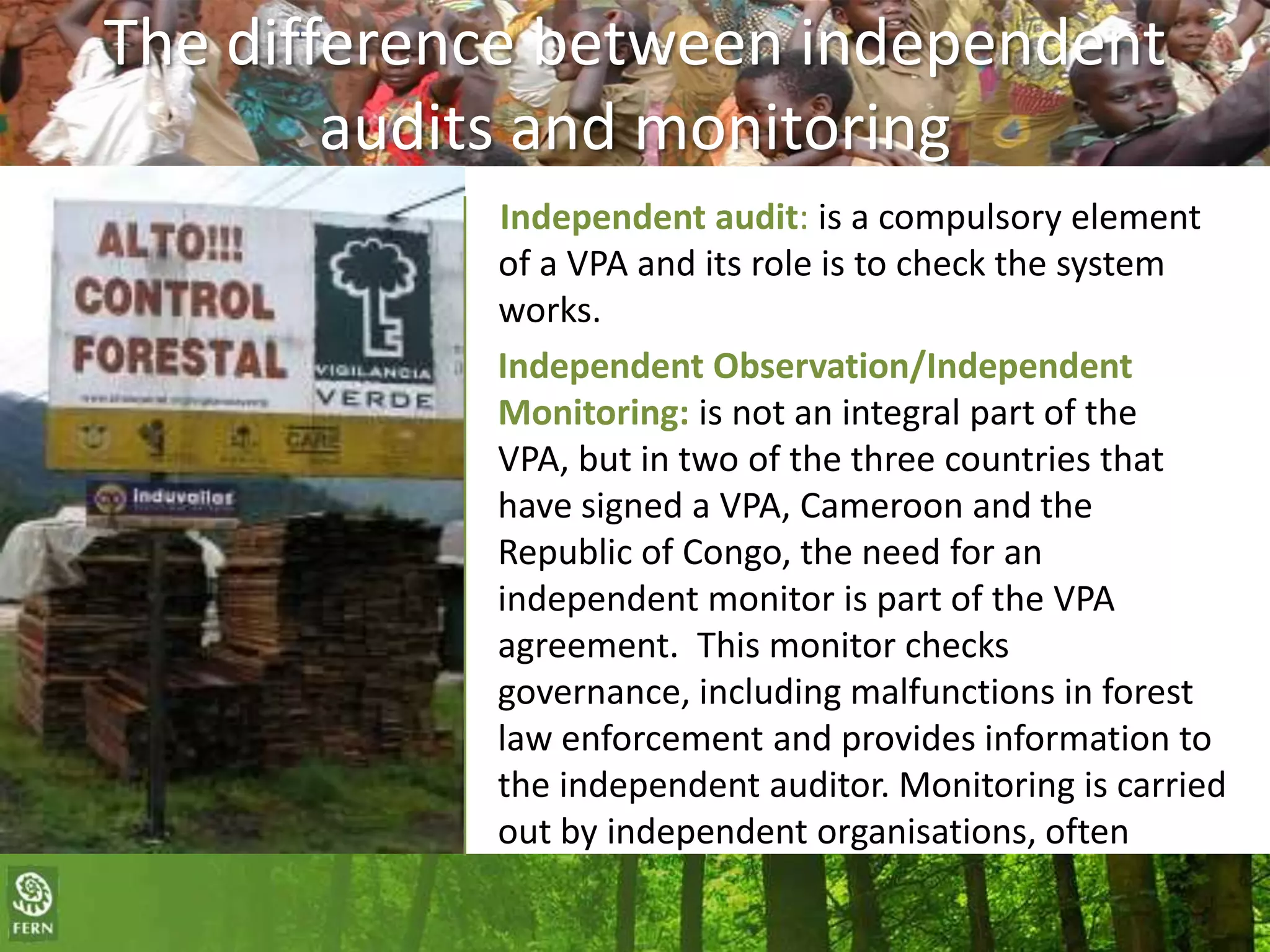
The difference between independent
audits and monitoring
Independent audit: is a compulsory element
of a VPA and its role is to check the system
works.
Independent Observation/Independent
Monitoring: is not an integral part of the
VPA, but in two of the three countries that
have signed a VPA, Cameroon and the
Republic of Congo, the need for an
independent monitor is part of the VPA
agreement. This monitor checks
governance, including malfunctions in forest
law enforcement and provides information to
the independent auditor. Monitoring is carried
out by independent organisations, often
NGOs.
4. EU Timber Regulation
In order to deal with the danger of
illegally harvested timber entering
the EU from countries that do not
have a VPA, the EU has adopted
the EU Timber Regulation which
became operational in March
2013, and includes a set of
procedures that companies need
to meet for timber and timber
products to be legally traded in
the EU.

Key points of the regulation include:
• It is a criminal offence to put
illegally sourced timber on the EU
market. All operators must operate
a due diligence system to track and
monitor all sales and purchases of
timber: the diligence system must
provide information about the
source of supply, species, quantity
and details of the operator
including evidence of compliance
with the country of origins law.
• Traders are required to keep
records of all their sales and
purchases for a period of five years.

The campaigning NGO for greater environmental and social justice, with a focus on forests and
forest peoples rights in the policies and practices of the EU. Visit us as www.fern.org
You will also find more information about
FLEGT and other related issues at
http://www.fern.org/campaign/forest-law-andgovernance
http://loggoff.info
If you would like further information about
the FLEGT action plan and how it is being
implemented, please contact
Saskia Ozinga
t +44 (0)1608 652895
e saskia@fern.org

The campaigning NGO for greater environmental and social justice, with a focus on forests and
forest peoples rights in the policies and practices of the EU

What is EU FLEGT 2014

  • 1.
    What is theEU FLEGT? The EU FLEGT is the European Union’s response to the global problem of illegal logging and the trade in timber products. It stands for: Forest Law Enforcement Governance and Trade The campaigning NGO for greater environmental and social justice, with a focus on forests and forest peoples rights in the policies and practices of the EU
  • 2.
    EU FLEGT –a history • In 1998, the G8 foreign ministers’ launched an “action programme on forests”. • In April 2002, the European Commission hosted an international workshop to discuss how the EU should combat illegal logging. • In December 2002, FERN and the Royal Institute of International Affairs presented a blueprint for an EU Action Plan, called Options for Europe. • On 21 May 2003, the Commission presented its FLEGT Action Plan, adopted by the Council in October 2003 with a set of conclusions. The campaigning NGO for greater environmental and social justice, with a focus on forests and forest peoples rights in the policies and practices of the EU. Visit us as www.fern.org
  • 3.
    The EU FLEGTAction Plan The action plan sets out a range of measures that aim to combat the problem of illegal logging, including: 1. Government Procurement Policies 2. Financial due diligence 3. Voluntary Partnership Agreements (VPAs) between the EU and timber producing countries 4. Illegal timber regulation (additional legislative options to control importation of illegal timber)
  • 4.
    1. Government ProcurementPolicies • The Action Plan encourages EU Member States to address illegal logging via procurement policies to promote the use of legal and sustainably produced timber • There are at least six Member States that have adopted social and environmental criteria into their procurement policies (Belgium, Denmark, France, Germany, the Netherlands and the UK) • The EU has just adopted a new procurement directive which is stronger in terms of social criteria. The EU Ecolabel for timber products as its requirements are lower than those of the six Member States. See EU Ecolabel allows forest destruction. More information can be found in the FERN report: Buying a sustainable future: timber procurement policies in the EU
  • 5.
    2. Financial DueDiligence • The FLEGT Action Plan states banks, financial institutions and specifically ECAs should ensure risk assessments and due diligence to ensure that large scale investment in the forestry sector does not increase illegal logging. See: Exporting destruction. • The Plan also mentions that EU Money Laundering Directives should treat illegal logging as a serious offence. There is no an attempt to include environmental crime, which would include illegal logging, into new EU AMLD.
  • 6.
    3. Voluntary PartnershipAgreements • Legally binding bilateral trade agreements between timber producing countries (FLEGT Partner Countries) and the EU, mostly known as VPAs. • VPAs set out the commitments and actions of both parties to tackle illegal logging, including measures to increase participation of non-state stakeholders and rights holders, recognise rights of communities to the land and address corruption. VPAs should have the buy-in of national stakeholders, including NGOs, local communities, indigenous peoples, and the timber industry. They consist of three key steps: a) Defining legality, or deciding which laws will be enforced b) Designing a Legality Assurance System (LAS) (including timber tracking, government legality controls and external verification systems) c) Independent audits of the whole system.
  • 7.
    a) Defining legality •The legality definition outlines the set of laws that will be enforced and monitored in the context of the FLEGT agreement. • ‘Legality’ is based on the laws and procedures of the timber producing country in question, and must include laws addressing social, environmental and economic issues. • Definition must be developed through extensive participation of all stakeholders and rightsholders. All six VPAs signed to date have been adopted with NGO stakeholder consent. Once there is an agreement on which laws should be checked, a Legality Assurance System (LAS) is defined to trace legal timber and ensure it is not mixed with illegal timber before export.
  • 8.
    b) Legality AssuranceSystems (LAS) The LAS consists of: • The "legality grid": A matrix which outlines the laws and the verifiers and indicators that will be used to monitor whether those laws are enforced. • Chain of custody: Control of the supply chain, or systems tracing wood products to ensure that timber from unverified operations does not enter the production chain • Verification of legal compliance: (Governmental or third party) verification of both legal compliance and traceability systems • Licensing: A FLEGT licence will be issued on the basis of evidence provided through chain of custody and verification • Independent audits to ensure the system is working. In some countries, independent monitoring complements audit by providing information on governance failures
  • 9.
    The difference betweenindependent audits and monitoring Independent audit: is a compulsory element of a VPA and its role is to check the system works. Independent Observation/Independent Monitoring: is not an integral part of the VPA, but in two of the three countries that have signed a VPA, Cameroon and the Republic of Congo, the need for an independent monitor is part of the VPA agreement. This monitor checks governance, including malfunctions in forest law enforcement and provides information to the independent auditor. Monitoring is carried out by independent organisations, often NGOs.
  • 10.
    4. EU TimberRegulation In order to deal with the danger of illegally harvested timber entering the EU from countries that do not have a VPA, the EU has adopted the EU Timber Regulation which became operational in March 2013, and includes a set of procedures that companies need to meet for timber and timber products to be legally traded in the EU. Key points of the regulation include: • It is a criminal offence to put illegally sourced timber on the EU market. All operators must operate a due diligence system to track and monitor all sales and purchases of timber: the diligence system must provide information about the source of supply, species, quantity and details of the operator including evidence of compliance with the country of origins law. • Traders are required to keep records of all their sales and purchases for a period of five years. The campaigning NGO for greater environmental and social justice, with a focus on forests and forest peoples rights in the policies and practices of the EU. Visit us as www.fern.org
  • 11.
    You will alsofind more information about FLEGT and other related issues at http://www.fern.org/campaign/forest-law-andgovernance http://loggoff.info If you would like further information about the FLEGT action plan and how it is being implemented, please contact Saskia Ozinga t +44 (0)1608 652895 e saskia@fern.org The campaigning NGO for greater environmental and social justice, with a focus on forests and forest peoples rights in the policies and practices of the EU