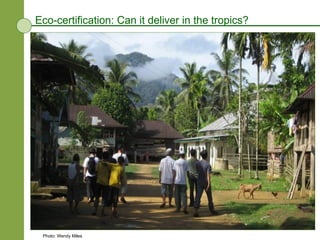
Photo: Wendy Miles Eco-certification: Can it deliver in the tropics?
Topics Eco-services of jungle rubber Eco-certification promises and problems Changes that could help
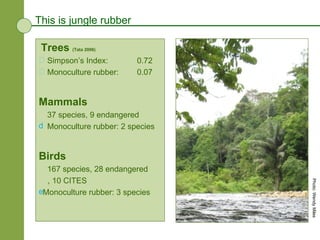
This is jungle rubber Trees  (Tata 2006) Simpson’s Index:  0.72 Monoculture rubber:   0.07 Mammals 37 species, 9 endangered Monoculture rubber: 2 species Birds 167 species, 28 endangered , 10 CITES Monoculture rubber: 3 species Photo: Wendy Miles
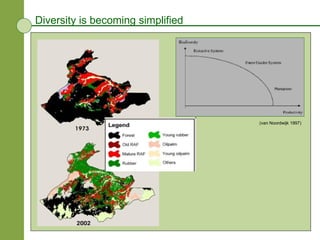
Diversity is becoming simplified (van Noordwijk 1997)
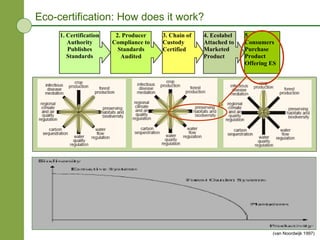
Eco-certification: How does it work? (van Noordwijk 1997)
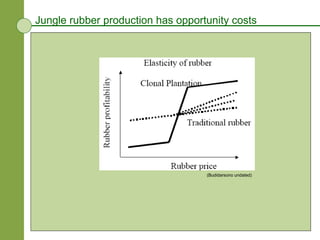
Jungle rubber production has opportunity costs (Budidarsono undated)
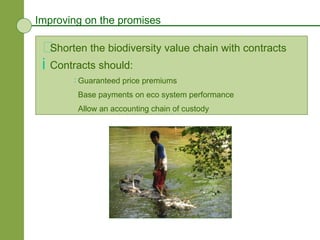
Improving on the promises Shorten the biodiversity value chain with contracts  Contracts should: Guaranteed price premiums Base payments on eco system performance Allow an accounting chain of custody
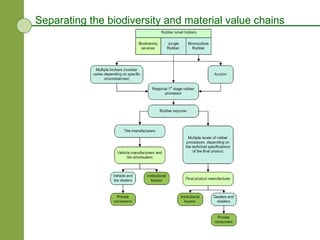
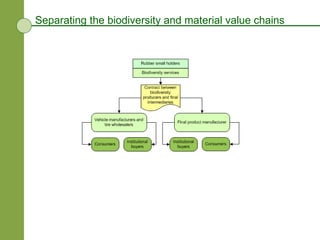
Separating the biodiversity and material value chains
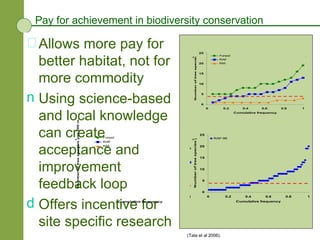
Pay for achievement in biodiversity conservation Allows more pay for better habitat, not for more commodity Using science-based and local knowledge can create acceptance and improvement feedback loop Offers incentive for site specific research (Tata et al 2006).
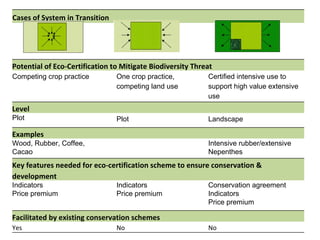
Cases of System in Transition Potential of Eco-Certification to Mitigate Biodiversity Threat Competing crop practice One crop practice, competing land use Certified intensive use to support high value extensive use  Level  Plot Plot Landscape Examples Wood, Rubber, Coffee, Cacao Intensive rubber/extensive Nepenthes Key features needed for eco-certification scheme to ensure conservation & development Indicators Price premium Indicators Price premium Conservation agreement Indicators Price premium Facilitated by existing conservation schemes Yes No No
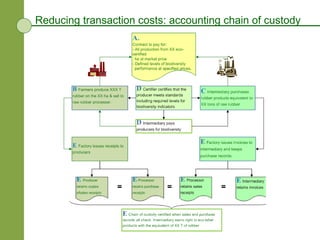
Reducing transaction costs: accounting chain of custody
Thank you
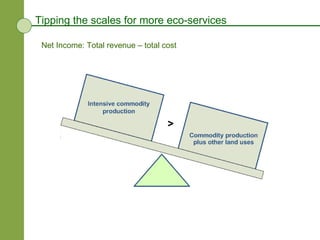
Tipping the scales for more eco-services Net Income: Total revenue – total cost
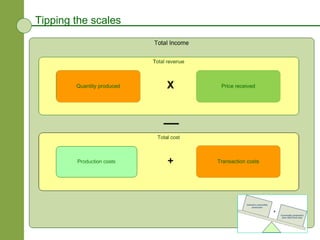
Tipping the scales

Mica Bennett - Eco-certification: Can it deliver in the tropics? - Aug 2009

  • 1.
    Photo: Wendy MilesEco-certification: Can it deliver in the tropics?
  • 2.
    Topics Eco-services ofjungle rubber Eco-certification promises and problems Changes that could help
  • 3.
    This is junglerubber Trees (Tata 2006) Simpson’s Index: 0.72 Monoculture rubber: 0.07 Mammals 37 species, 9 endangered Monoculture rubber: 2 species Birds 167 species, 28 endangered , 10 CITES Monoculture rubber: 3 species Photo: Wendy Miles
  • 4.
    Diversity is becomingsimplified (van Noordwijk 1997)
  • 5.
    Eco-certification: How doesit work? (van Noordwijk 1997)
  • 6.
    Jungle rubber productionhas opportunity costs (Budidarsono undated)
  • 7.
    Improving on thepromises Shorten the biodiversity value chain with contracts Contracts should: Guaranteed price premiums Base payments on eco system performance Allow an accounting chain of custody
  • 8.
    Separating the biodiversityand material value chains
  • 9.
    Separating the biodiversityand material value chains
  • 10.
    Pay for achievementin biodiversity conservation Allows more pay for better habitat, not for more commodity Using science-based and local knowledge can create acceptance and improvement feedback loop Offers incentive for site specific research (Tata et al 2006).
  • 11.
    Cases of Systemin Transition Potential of Eco-Certification to Mitigate Biodiversity Threat Competing crop practice One crop practice, competing land use Certified intensive use to support high value extensive use Level Plot Plot Landscape Examples Wood, Rubber, Coffee, Cacao Intensive rubber/extensive Nepenthes Key features needed for eco-certification scheme to ensure conservation & development Indicators Price premium Indicators Price premium Conservation agreement Indicators Price premium Facilitated by existing conservation schemes Yes No No
  • 12.
    Reducing transaction costs:accounting chain of custody
  • 13.
  • 14.
    Tipping the scalesfor more eco-services Net Income: Total revenue – total cost
  • 15.

Editor's Notes

  • #4 The island of Sumatra, Indonesia, is recognized as a biodiversity hot spot both for species irreplaceability and the high degree of threat. (Myers 2000) In Indonesia there is little choice but for people and species to share the same land. Indonesia is the world’s 4th most populous country, while ranking only 16th in land area. Nearly 50 percent of Indonesians earn less than $2 per day and 72 percent of these poor work in agriculture. Jungle rubber is a traditional agroforestry practice that facilitates land sharing. Farmers clear jungle, plant rubber, and then allow natural vegetation to reclaim the space around the trees.   In time, jungle rubber develops a complex, multi-strata canopy that resembles natural secondary forest and shares up to 70% percent of the species in natural forest . It covers around 2 million hectares in Indonesia.
  • #5 In the last decade or so as ecosystems untouched by humans have dwindled, researchers have shifted from viewing this matrix as a barren sea between islands of biodiversity to seeing it as an important resource for conserving biodiversity. However, even this type of matrix is disappearing with many areas sliding down the curve pictured from extensive, biodiverse agriculture systems to intensive, low diversity ones. For example, Landsat images of Sumatra’s Jambi Province show that in 1973, more than 90 percent of the land had forest or jungle rubber cover while only 2 percent of land cover came from oil palm or rubber monocultures. However, by 30 year later, forest and jungle rubber accounted for only around 40 percent of land cover while oil palm and rubber moncultures accounted for 41.
  • #6 Eco-certification is one option ICRAF investigated to see if it could stop the slide toward species simplification and offer additional income for poor farmers. Ecocert emerged in 1993 when a group of environmental organizations, and other allies formed the FSC. The FSC established forestry standards intended to preserve some degree of ecosystem services. They also required third party verification that the producers met the standards and the products reached consumers through channels that guaranteed only products produced according to standards were sold under a certification label. The last step offers buyers the option to in effect purchase biodiversity conservation. These flower diagrams illustrate concept. The first one shows the case for the top of the trade-off curve where extensively managed systems provide lower yields of crop production, but delivers greater levels of other services. The last diagram equates to the bottom of the trade-off curve with high crop production, but low levels of other services., the middle diagram shows land-uses that provide a full range of services. If consumers pay an extra price for an environmental service it to signals market demand and generates income for those meeting it. We can view the price premium as a kind of fund that buys the conservation services directly from farmers.
  • #7 However, things have not worked completely as envisioned. By 2005 more than 50 forest certification schemes had appeared around the world, certifying more than 250 million hectares. However, only about 22 million hectares (or just under 9 percent) of the world’s tropical forests were certified. Research to date finds as key culprits the lack of price premium for producers coupled with high cost in the tropics for changing management practices to meet standards and to pay for certification transaction costs. (Gullison 2003; Cashore 2006) In Jambi, farmers are currently bearing significant opportunity costs in growing jungle rubber. Jungle rubber yields about one-third as much raw rubber per hectare as monoculture rubber. However, the picture becomes more complex in looking at profitability. This chart shows jungle rubber is actually more profitable than monoculture rubber when prices are low, but monoculture rubber gains in profitability as prices increase. Jungle rubber provides farmers with a multitude of products with value internal to their households such as building materials, medicines, foods to eat and sell, environmental services such as water supply regulation that ensures supplies for micro-hydropower plants and fish, and risk-buffering against the price volatility of the global rubber market. (Budidarsono not dated )   However, even with these additional values, achieving sufficiently high prices to maintain jungle rubber appears very challenging. 
  • #8 The rest of the presentation looks at some ideas that could be tested to see if they could help certification tip land-use decisions toward providing ecosystem services as well as agricultural products. These depictions descriptive than rather thanprescriptive, designed to focus attention on the possibilities and to start addressing any short-comings in the idea. Also, presentations by Howard and Ed Millerd have suggested that certification schemes and buyers are evolve and some do have some characteristics described.
  • #9 The evolution of ecocertification resulted in the biodiversity product be held prisoner by the raw material value chain. In wood, which represents the lion’s share of eco-certified products, this may contribute to lack of price premiums reaching producers. It also adds costs and has not necessarily maximized conservation benefits.   A value chain consists of all the intermediaries that transform or add value to a product. As this value chain for rubber shows, it can have many intermediaries. In most current eco-certification schemes, any price premiums that consumers pay for biodiversity services must be transmitted through all the intermediaries in the chain to reach the rubber farmer. Furthermore, with wood, powerful retailers/end market manufacturers have sourcing policies stating they will buy eco-certified materials whenever possible. But products are not actively marketed in stores as having eco-services, so consumers do not really have an opportunity to show demand for such products – and the opportunity is lost for these companies to use their enormous marketing budgets in making consumers aware of the issues. Finally, there is evidence these companies use their power to pass the costs the eco-certification up value chain to producers without also passing along any price premium that materialize. However few of these intermediaries do anything to transform or add value to the biodiversity. The ones that do are in light green – the producers and those that
  • #10 Direct contracts between the producers and the retailer/ end manufactured biodiversity intermediaries would, in effect, separate the biodiversity value chain from the value chain for raw materials . With direct contracts that included price premiums, retailers/end market manufactures could be sure that the premium would reach the farmers rather than be absorbed somewhere else along the chain. This approach has worked with fair trade certification. Also, the price premium would not be amplified by standard percentage mark ups at each intermediary. To recoup their investment in biodiversity services, the biodiversity intermediaries must figure out how translate consumer demand into payment for the service. This possibly could become a competitive advantage as Howard suggested – allowing them to gain market share and consumer loyalty while being able to pass the costs onto consumers
  • #11 Contracts executed directly between producers and retailers/end manufacturers could help maximize conservation results by making biodiversity performance be the basis for price premiums. For example, ICRAF developed a set of jungle rubber indicators by evaluating data on composition associated with higher and lower biodiversity systems. The indicator shown here is that ….. A contract for eco-certified rubber could specify that the company would pay market price for the rubber produced from the certified area but would pay additional amounts upon verification that the indicators were met. through the producers’ practices. This set-up could eliminate the possibility of perverse incentives. Bird-friendly coffee schemes offer an example of how perverse incentives could operate. These schemes certify coffee as bird friendly if it has a shade canopy that meets density and composition requirments that are good for birds. But farmers get their income from this service by selling coffee . If habitat improvements reduced their coffee production, they would actually get less money for producing more habitat, encouraging farmers to go for the minimum requirements. A sliding scale.
  • #13 Making payments based on indicators directly to farmers from end- product intermediaries could possibly diminish another barrier to adoption of eco-certification by small holders in less developed countries – the need for chain of custody. Chain of custody provides a vital function ensuring consumers that when they pay for eco-labelled goods the goods they or not getting ordinary products pawned off as eco-certified by unscrupulous actors. However, as currently designed it also imposes costs and creates barriers to participation in eco-certification schemes, particularly for small producers without adding anything to biodiversity services. To become FSC certified every intermediary performing any transformation or taking physical or legal ownership of the certified product must document and maintain a control system that ensures inputs to its processes have valid chains of custody. In an accounting chain of custody, the amount that producers received would depend on verification of the biodiversity indicators. Purchasing records showing that producers sold a quantity of rubber (consistent with average production quantities for that land) and that end market manufacturers made purchases that would cover that this quantity would give the retailer/manufacturer the right to market that amount of rubber as ecocertified. As represented, it would not require any changes in supply chain and would allow production departments to continue to source materials without altering their practices.
  • #15 One of the key questions for making eco-certification work is how much farmers need to get to tip their decision scales toward maintaining jungle rubber.