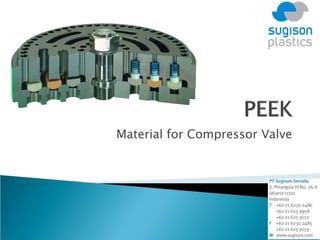
Material for Compressor Valve
Reciprocating Compressor

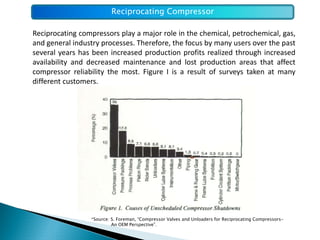
Reciprocating compressors play a major role in the chemical, petrochemical, gas,
and general industry processes. Therefore, the focus by many users over the past
several years has been increased production profits realized through increased
availability and decreased maintenance and lost production areas that affect
compressor reliability the most. Figure I is a result of surveys taken at many
different customers.


                 *Source: S. Foreman, “Compressor Valves and Unloaders for Reciprocating Compressors-
                          An OEM Perspective”.
As illustrated, compressor valves, pressure packing, piston rings and rider bands
were identified to be the top causes of unscheduled reciprocating compressor
shutdowns. The valves have the greatest effect on the operation of a
reciprocating compressor in terms of its efficiency and mechanical performance.

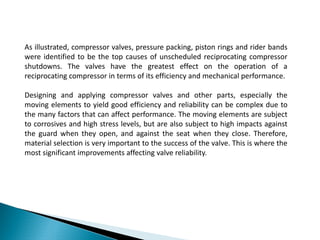
Designing and applying compressor valves and other parts, especially the
moving elements to yield good efficiency and reliability can be complex due to
the many factors that can affect performance. The moving elements are subject
to corrosives and high stress levels, but are also subject to high impacts against
the guard when they open, and against the seat when they close. Therefore,
material selection is very important to the success of the valve. This is where the
most significant improvements affecting valve reliability.
Metallic Valves Failure


  Early valve designs used metallic plates which are inexpensive, able to
  withstand high differential pressures, and are not affected by high
  temperatures. However, these desirable properties are outweighed by the
  disadvantages of metallic elements. They are prone to impact fatigue,
  susceptible to corrosion damage and are very unforgiving of dirt and debris.


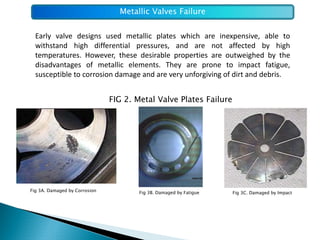
                               FIG 2. Metal Valve Plates Failure


Fig 3A. Damaged by Corrosion           Fig 3B. Damaged by Fatigue   Fig 3C. Damaged by Impact
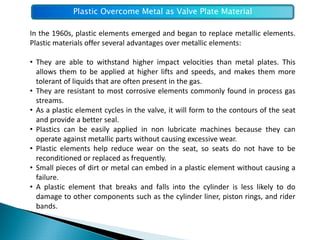
Plastic Overcome Metal as Valve Plate Material

In the 1960s, plastic elements emerged and began to replace metallic elements.
Plastic materials offer several advantages over metallic elements:

• They are able to withstand higher impact velocities than metal plates. This
  allows them to be applied at higher lifts and speeds, and makes them more
  tolerant of liquids that are often present in the gas.
• They are resistant to most corrosive elements commonly found in process gas
  streams.
• As a plastic element cycles in the valve, it will form to the contours of the seat
  and provide a better seal.
• Plastics can be easily applied in non lubricate machines because they can
  operate against metallic parts without causing excessive wear.
• Plastic elements help reduce wear on the seat, so seats do not have to be
  reconditioned or replaced as frequently.
• Small pieces of dirt or metal can embed in a plastic element without causing a
  failure.
• A plastic element that breaks and falls into the cylinder is less likely to do
  damage to other components such as the cylinder liner, piston rings, and rider
  bands.
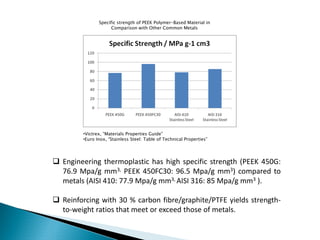
Specific strength of PEEK Polymer-Based Material in
                   Comparison with Other Common Metals


      •Victrex, “Materials Properties Guide”
      •Euro Inox, “Stainless Steel: Table of Technical Properties”


Engineering thermoplastic has high specific strength (PEEK 450G:
76.9 Mpa/g mm3, PEEK 450FC30: 96.5 Mpa/g mm3) compared to
metals (AISI 410: 77.9 Mpa/g mm3, AISI 316: 85 Mpa/g mm3 ).

Reinforcing with 30 % carbon fibre/graphite/PTFE yields strength‐
to‐weight ratios that meet or exceed those of metals.
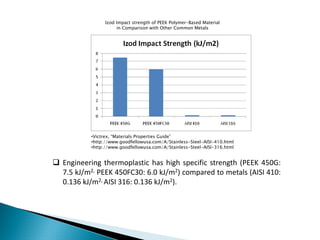
Izod Impact strength of PEEK Polymer-Based Material
                  in Comparison with Other Common Metals


        •Victrex, “Materials Properties Guide”
        •http://www.goodfellowusa.com/A/Stainless-Steel-AISI-410.html
        •http://www.goodfellowusa.com/A/Stainless-Steel-AISI-316.html


Engineering thermoplastic has high specific strength (PEEK 450G:
7.5 kJ/m2, PEEK 450FC30: 6.0 kJ/m2) compared to metals (AISI 410:
0.136 kJ/m2, AISI 316: 0.136 kJ/m2).
Plastic Material Comparison & Choices for Valve Plate
  POLYAMIDE (PA)

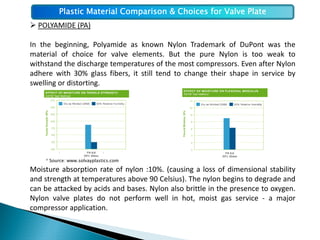
In the beginning, Polyamide as known Nylon Trademark of DuPont was the
material of choice for valve elements. But the pure Nylon is too weak to
withstand the discharge temperatures of the most compressors. Even after Nylon
adhere with 30% glass fibers, it still tend to change their shape in service by
swelling or distorting.


    * Source: www.solvayplastics.com

Moisture absorption rate of nylon :10%. (causing a loss of dimensional stability
and strength at temperatures above 90 Celsius). The nylon begins to degrade and
can be attacked by acids and bases. Nylon also brittle in the presence to oxygen.
Nylon valve plates do not perform well in hot, moist gas service ‐ a major
compressor application.
Plastic Material Comparison & Choices for Valve Plate


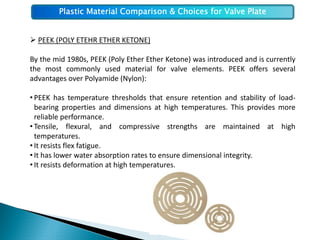
  PEEK (POLY ETEHR ETHER KETONE)

By the mid 1980s, PEEK (Poly Ether Ether Ketone) was introduced and is currently
the most commonly used material for valve elements. PEEK offers several
advantages over Polyamide (Nylon):

• PEEK has temperature thresholds that ensure retention and stability of load‐
  bearing properties and dimensions at high temperatures. This provides more
  reliable performance.
• Tensile, flexural, and compressive strengths are maintained at high
  temperatures.
• It resists flex fatigue.
• It has lower water absorption rates to ensure dimensional integrity.
• It resists deformation at high temperatures.
PEEK as Ultimate Valve Plate Material

Poly Ether Ether Ketone (PEEK) is one of the few polymers that can be considered for
use as a true metal replacement for high temperature applications.
PEEK has the most excellent heat resistance, abrasion resistance, flame resistance,
hydrolysis resistance and excellent chemical resistance.

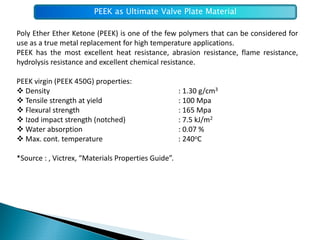
PEEK virgin (PEEK 450G) properties:
  Density                                            : 1.30 g/cm3
  Tensile strength at yield                          : 100 Mpa
  Flexural strength                                  : 165 Mpa
  Izod impact strength (notched)                     : 7.5 kJ/m2
  Water absorption                                   : 0.07 %
  Max. cont. temperature                             : 240oC

*Source : , Victrex, “Materials Properties Guide”.
THANK
 YOU

Peek for material compressor valve

  • 1.
  • 2.
    Reciprocating Compressor Reciprocating compressorsplay a major role in the chemical, petrochemical, gas, and general industry processes. Therefore, the focus by many users over the past several years has been increased production profits realized through increased availability and decreased maintenance and lost production areas that affect compressor reliability the most. Figure I is a result of surveys taken at many different customers. *Source: S. Foreman, “Compressor Valves and Unloaders for Reciprocating Compressors- An OEM Perspective”.
  • 3.
    As illustrated, compressorvalves, pressure packing, piston rings and rider bands were identified to be the top causes of unscheduled reciprocating compressor shutdowns. The valves have the greatest effect on the operation of a reciprocating compressor in terms of its efficiency and mechanical performance. Designing and applying compressor valves and other parts, especially the moving elements to yield good efficiency and reliability can be complex due to the many factors that can affect performance. The moving elements are subject to corrosives and high stress levels, but are also subject to high impacts against the guard when they open, and against the seat when they close. Therefore, material selection is very important to the success of the valve. This is where the most significant improvements affecting valve reliability.
  • 4.
    Metallic Valves Failure Early valve designs used metallic plates which are inexpensive, able to withstand high differential pressures, and are not affected by high temperatures. However, these desirable properties are outweighed by the disadvantages of metallic elements. They are prone to impact fatigue, susceptible to corrosion damage and are very unforgiving of dirt and debris. FIG 2. Metal Valve Plates Failure Fig 3A. Damaged by Corrosion Fig 3B. Damaged by Fatigue Fig 3C. Damaged by Impact
  • 5.
    Plastic Overcome Metalas Valve Plate Material In the 1960s, plastic elements emerged and began to replace metallic elements. Plastic materials offer several advantages over metallic elements: • They are able to withstand higher impact velocities than metal plates. This allows them to be applied at higher lifts and speeds, and makes them more tolerant of liquids that are often present in the gas. • They are resistant to most corrosive elements commonly found in process gas streams. • As a plastic element cycles in the valve, it will form to the contours of the seat and provide a better seal. • Plastics can be easily applied in non lubricate machines because they can operate against metallic parts without causing excessive wear. • Plastic elements help reduce wear on the seat, so seats do not have to be reconditioned or replaced as frequently. • Small pieces of dirt or metal can embed in a plastic element without causing a failure. • A plastic element that breaks and falls into the cylinder is less likely to do damage to other components such as the cylinder liner, piston rings, and rider bands.
  • 6.
    Specific strength ofPEEK Polymer-Based Material in Comparison with Other Common Metals •Victrex, “Materials Properties Guide” •Euro Inox, “Stainless Steel: Table of Technical Properties” Engineering thermoplastic has high specific strength (PEEK 450G: 76.9 Mpa/g mm3, PEEK 450FC30: 96.5 Mpa/g mm3) compared to metals (AISI 410: 77.9 Mpa/g mm3, AISI 316: 85 Mpa/g mm3 ). Reinforcing with 30 % carbon fibre/graphite/PTFE yields strength‐ to‐weight ratios that meet or exceed those of metals.
  • 7.
    Izod Impact strengthof PEEK Polymer-Based Material in Comparison with Other Common Metals •Victrex, “Materials Properties Guide” •http://www.goodfellowusa.com/A/Stainless-Steel-AISI-410.html •http://www.goodfellowusa.com/A/Stainless-Steel-AISI-316.html Engineering thermoplastic has high specific strength (PEEK 450G: 7.5 kJ/m2, PEEK 450FC30: 6.0 kJ/m2) compared to metals (AISI 410: 0.136 kJ/m2, AISI 316: 0.136 kJ/m2).
  • 8.
    Plastic Material Comparison& Choices for Valve Plate POLYAMIDE (PA) In the beginning, Polyamide as known Nylon Trademark of DuPont was the material of choice for valve elements. But the pure Nylon is too weak to withstand the discharge temperatures of the most compressors. Even after Nylon adhere with 30% glass fibers, it still tend to change their shape in service by swelling or distorting. * Source: www.solvayplastics.com Moisture absorption rate of nylon :10%. (causing a loss of dimensional stability and strength at temperatures above 90 Celsius). The nylon begins to degrade and can be attacked by acids and bases. Nylon also brittle in the presence to oxygen. Nylon valve plates do not perform well in hot, moist gas service ‐ a major compressor application.
  • 9.
    Plastic Material Comparison& Choices for Valve Plate PEEK (POLY ETEHR ETHER KETONE) By the mid 1980s, PEEK (Poly Ether Ether Ketone) was introduced and is currently the most commonly used material for valve elements. PEEK offers several advantages over Polyamide (Nylon): • PEEK has temperature thresholds that ensure retention and stability of load‐ bearing properties and dimensions at high temperatures. This provides more reliable performance. • Tensile, flexural, and compressive strengths are maintained at high temperatures. • It resists flex fatigue. • It has lower water absorption rates to ensure dimensional integrity. • It resists deformation at high temperatures.
  • 10.
    PEEK as UltimateValve Plate Material Poly Ether Ether Ketone (PEEK) is one of the few polymers that can be considered for use as a true metal replacement for high temperature applications. PEEK has the most excellent heat resistance, abrasion resistance, flame resistance, hydrolysis resistance and excellent chemical resistance. PEEK virgin (PEEK 450G) properties: Density : 1.30 g/cm3 Tensile strength at yield : 100 Mpa Flexural strength : 165 Mpa Izod impact strength (notched) : 7.5 kJ/m2 Water absorption : 0.07 % Max. cont. temperature : 240oC *Source : , Victrex, “Materials Properties Guide”.
  • 11.