Plastic Lined Trunnion Ball Valve
CLBV-09
Cam-Line
®
www.engvalves.com
Contents Page
Introduction ..................................................................................2
Features ........................................................................................3
Lining Material, Seats, Testing ......................................................4
Cutaway Illustration ......................................................................5
Technical Data................................................................................6
Pressure/Temperature Curves
Operating Torques
Flow Coefficients (Cv Values)
PVDF Coatings ..............................................................................6
Cam-Line®
Options ........................................................................7
Actuated Valves ..........................................................................8-9
Materials of Construction ............................................................10
Dimensions
Manual Valves ..........................................................................10
Actuator Mounting....................................................................11
Service Guide..........................................................................12-16
Ordering Information ..................................................................17
Terms and Conditions of Sale ......................................................18
1
2
Introduction
ITT Industries, Engineered Valves Group (EVG)
has been an innovator and producer of valves
for over fifty years. These valves have gained
extensive usage in many industries including
power generation, pulp and paper, refineries,
chemical process, pharmaceutical/bioprocessing
and pollution control. As a recognized leader in
the valve business, our heritage stems from
diaphragm valves.
Through the years, our product offering has
grown extensively. Our corrosion handling
expertise has provided the impetus for the
design of quarter-turn valve products like our
Cam-Line®
Ball Valve.
By developing products such as the Cam-Line
that address specific problems encountered in
industry, we continue to expand our commit-
ment to remain a leader in flow control.
The performance of our products is surpassed
only by the care taken in the many facets of
manufacturing. Excellence in quality assurance,
product reliability, and product safety will
always remain paramount.
3
New Generation of Plastic Lined Valve
The Cam-Line trunnion ball valve was designed to
overcome problems inherent in conventional lined
plug and ball valves. The design objective was to
produce a lined quarter-turn valve with positive
shut off at high and low pressures, a valve with a
stem seal that seals, and a valve that is conve-
nient and safe to operate.
Design innovation has resulted in the valve we
proudly call the Cam-Line. The Cam-Line ball valve
combines the proven, patented sealing technolo-
gy of the Cam-Tite ball valve with a trunnion
mounting. The result is tight shut off, reliable
stem seal performance, and a dramatic torque
reduction never before possible in a plastic lined
quarter-turn valve.
The sealing mechanism begins as a sphere with a
trunnion running through its vertical center. A
waterway (port) passes through the center of the
sphere. Around the edge of the waterway the
spherical surface is cut away, forming a bevel that
passes completely around the edge of the water-
way. This is a very important feature of the design
since it is the difference in the effective distance
across the beveled surfaces and the distance
across the spherical surface that actually energizes
the seat when the valve is closed.
When the valve is open the seats rest against the
beveled surfaces. Sealing takes place during clo-
sure of the valve when the spherical surface of
the ball engages the seats.
Sealing is the result of designed seat compression,
not the result of pressure or of crushing compo-
nents together. The resultant seal is positive at
both high and low pressures. And, since load on
the seats is minimized when the valve is in the
open position, cold flow of the seat material is
dramatically reduced, prolonging seat life. With
the sealing load on the seats controlled by the
geometry of the components (not external adjust-
ments as in lined plug valves), the Cam-Line is a
safe and convenient valve to operate. A 6" Cam-
Line requires less than 1,250 inch pounds to oper-
ate. No gears or cheaters required here!
An important consideration when using plastics in
valves is the dimensional stability of the plastic
elements. Reliable performance is dependent upon
maintaining design dimensions. The objective is to
get two or more components to meet each other
so that nothing can get by them. Dimensional sta-
bility of the lining in the seal area is thus of prime
importance. Conventional plug and ball valves
place high loads on the plastic linings to get a
seal, but often at the expense of valve life and
operating ease.
To maximize valve life, the Cam-Line ball valve uses
a trunnion not only to support and center the ball,
but also as a method to distribute excess hydraulic
load into the valve body in non-critical areas,
rather than through the seating area. Result? The
Cam-Line performs better and Ionger, even in ther-
mal cycling applications.
The trunnion also aids the stem seal at the top of
the valve. The long trunnion shaft reduces the
effects of lateral loading found in conventional
ball valves and when coupled with the low operat-
ing torques, produces a seal that proves a lined
valve can have a good stem seal.
Design innovation didn’t stop with the basic valve.
The choice of plastics and plastic processes has a
direct effect on performance. So we engineered
those, too. Our unique glass reinforced RTFE seats,
along with a high stability TEFZEL®
thermoplastic
lining, complete the package.
The Cam-Line®
is an innovative design that gives:
Positive Shut Off
Reliable Stem Sealing
Low Operating Torque
Convenient and Safe Operation
Long Service Life
And, to make it easy for you to use, the Cam Line®
ball valve features ANSI 150# flanges with stan-
dard laying lengths and flange pad mounting.
Open Closed
4
Material Processing for Better Results
All PTFE Seats are not
Created Equal
All Cam-Line seats are reinforced PTFE. The fin-
ished reinforced seats, when compared to virgin
PTFE, exhibit the following performance advan-
tages:
1. Improved dimensional stability
2. More uniform quality
3. Improved sealing characteristics
These properties, obtained through the reinforc-
ing process, result in better sealing and longer
seat life. Cam-Line reinforced PTFE seats, com-
bined with the unique beveled edge ball design,
result in superior shut-off performance.
Plastic Lining
All wetted parts of the Cam-Line are lined with
plastic. Cam-Line linings are injection molded at
high pressure. With injection molding we actually
“build” a corrosion resistant plastic valve within
the strong metal valve body. With injection mold-
ing, wall thickness can be varied to suit the
mechanical requirements of the various valve sec-
tions, while minimum wall thickness is strictly
controlled. In fact, all Cam-Line linings have a
3/16" minimum wall thickness. Cam-Line linings
are “keyed” to the valve bore for extra stability.
The one piece trunnion/ball of the Cam-Line is
fully encapsulated with the plastic lining. The
metal core is recessed and keyed to lock the lining
in place. With the one-piece trunnion/ball design,
the joint between the ball and stem as found in
conventional lined ball valves is completely elimi-
nated. You can be sure that the ball is in the posi-
tion indicated by the top of the trunnion.
Experience Counts
Injection molding of plastic linings is not new to
Engineered Valves Group (EVG). Initially intro-
duced with its diaphragm valve product line, EVG
has been molding plastic lined valves for the past
fifty years. This experience and expertise led to
the development of the patented “Boteler”
method of injection molding valve linings in
1968. Over the years, thousands upon thousands
of ball valves and diaphragm valves have been
lined using this time proven method.
Testing
Every valve is tested prior to shipment. Both
hydrostatic and seat tests (in accordance with
MSS-SP-72) are performed to insure a high
integrity, tight sealing valve. In addition, all plastic
lined components are 100% spark tested prior to
assembly to assure lining integrity.
TEFZEL®
Lining
TEFZEL®
can best be described as a rugged ther-
moplastic with an outstanding balance of proper-
ties. TEFZEL®
can perform successfully in applica-
tions where other materials are lacking in
mechanical toughness, broad thermal capability,
and the ability to meet severe environmental con-
ditions.
Chemically, TEFZEL®
is a co-polymer of ethylene
and tetrafluoroethylene. Mechanically, TEFZEL®
is
tough, exhibits high tensile strength and hard-
ness, and is more creep resistant than Teflon®
PTFE, FEP or PFA fluorocarbon resins. The TEFZEL®
used in the Cam-Line is reinforced with glass,
yielding a tensile strength approaching 12,000
PSI. TEFZEL®
has outstanding resistance to attack
by chemicals and solvents that often cause rapid
deterioration of other plastic materials. TEFZEL®
is
inert to strong mineral acids, inorganic bases,
halogens, and metal salt solutions. Carboxylic
acids, anhydrides, aromatic and aliphatic hydro-
carbons, alcohols, aldehydes, ketones, ethers,
chlorocarbons, and classic polymer solvents have
little effect on the material.
5
Low operating torque for conve-
nient, safe operation. Gear opera-
tors are not required!
Standard PVDF coated
gland follower provides
corrosion resistance
ANSI 150# flanges,
drilled and tapped
as standard
Rugged, ductile iron body, cover
and handle (PVDF and epoxy
coatings available)
Tough TEFZEL®
lining
Reinforced PTFE Seats
for long service life
Patented ball geometry
provides positive shut off
Trunnion design to control
stress on lining
Plastic Lined Trunnion Ball Valve
Live loaded multi-ring stem packing
From its inception the Cam-Line ball valve has
utilized an emission reduction stem packing
design. Multiple V-rings are placed in a deep
stuffing box and are loaded via the gland follow-
er using adjustable cap screws. Belleville spring
washers are employed to maintain packing com-
pression and to adjust for service variables.
6
For ultimate exterior corrosion protection in
aggressive chemical environments, Cam-Line ball
valves can be externally coated with PVDF. A pop-
ular feature of the Dia-Flo®
Diaphragm Valve, this
optional 6-8 mil coating is applied to all ductile
iron components of the Cam-Line prior to the
valve being lined. The result is a mechanically
tough coating that is resistant to spills, splash,
and corrosive atmospheres at temperatures to
200°F. TEFZEL®
lined Cam-Line ball valves coated
with PVDF are equipped with stainless steel fas-
teners to enhance total corrosion resistance.
The actual amount of torque required to operate
a valve is dependent upon many variables, such as
line pressure, temperature, type of fluid, frequen-
cy of operation, etc. The following tables are
based on average breakaway torque requirements
for a valve handling a clean, particle free liquid
such as water. The torque values listed should be
adjusted for special service conditions. For fluids
with high solids or abrasive content, consult fac-
tory for recommendations.
When sizing an actuator for automatic operation,
it is recommended not to exceed the Maximum
Stem Torque as noted below. This will avoid per-
manent damage to the valve stem as a result of a
blocked valve and an over-sized operator.
Pressure/Temperature
Curve for Tefzel Lining
Reinforced PTFE Seats
3/4"-1" 30
11/2
" 73
2" 160
3" 355
4" 751
6" 800
Flow Coefficients (Cv)
Operating Torques/Flow
Coefficients (Cv)
Cam-Line®
Technical Data
External Protection with Corrosion Resistant PVDF
Cam-Line®
Options
Torque (in lbs.) Max. Stem Torque (in lbs.)Size
3/4"-1" 120 709
11/2
" 130 1870
2" 280 1870
3" 500 3030
4" 800 5740
6" 1250 24500
Based on water flowing at 68°F
7
Cavity Vents/Chlorine
Service
When specified, Cam-Line ball valves can be pro-
vided with a vented seat to relieve excess pressure
within the body cavity. Such valves are unidirec-
tional and include an external tag with an arrow
to indicate the direction of seat tightness. Use suf-
fix “V” in the configuration number to specify a
vented cavity only. Use “CLV” to specify a vented
valve prepared for chlorine service. Note: As the
Cam-Line is an ANSI 150# design, Engineered
Valves Group (EVG) only recommends the valve
for Class 1 dry chlorine gas service.
Grounding Devices
Upon request Cam-Line ball valves can be
equipped with a grounding strap to provide elec-
trical continuity between all metal components.
Grounded valves receive a continuity test prior to
shipment to assure a resistance reading less than
5 ohms. Use suffix “G” in the configuration num-
ber to specify a grounding device.
Oxygen Service
Cam-Line ball valves can be prepared for oxygen
service. Oxygen preparation includes special clean-
ing, assembly, testing, and packaging. Valves pre-
pared for oxygen service are lubricated with
Krytox®
206 and are equipped as standard with a
grounding strap. Use suffix “OX” in the configura-
tion number to specify oxygen preparation.
Cam-Line®
Options (continued)
Locking Devices
When required, Cam-Line ball valves can be sup-
plied with a locking handle device to provide
lockout in both the open and closed positions.
These locking devices, designed to meet the
requirements of OSHA 1910.147, can be supplied
with new valves or can be retrofit to existing
valves which have drilled and tapped flange pads.
Stainless steel is the standard material of con-
struction for the Cam-Line locking device. Use suf-
fix “LDS” in the configuration number to specify
this lockout feature.
Handle Options
The unique low torque design of the Cam-Line
allows the use of lever handles throughout the
entire size range. In addition to the standard lever
handles, the following handle options can be sup-
plied:
• Oval Safety Handwheels (through 2")
• 45° T Handles for chain operation
(specify valve in vertical or horizontal position)
• Extended Handles (specify extension length)
For additional information on how to order the
above options, see page 16 of the catalog. For
additional technical information, contact your
Engineered Valves Group (EVG) Technical Sales
Representative.
8
Available Operating Air
Valve Size DN Double Acting Spring Return-Fail Closed
60 psi / 4 bar 80 psi / 5.5 bar 60 psi / 4 bar 80 psi / 5.5 bar
3/4”-1” 15-25 C20DA C15DA C25-2A2B C25-2C
1.5 40 C20DA C15DA C25-2A2B C25-2C
2 50 C25DA C25DA C35-2A2B C30-2C
3 80 C30DA C25DA C45-2A2B C35-2C
4 100 C35DA C30DA C60-2A2B C45-2C
6 150 C45DA C35DA C60-2A2B C60-2C
Actuated Valves
With its simple, 90 degree rotation, the Cam-Line
ball valve can be easily supplied with a variety of
quarter-turn operators for automated valve ser-
vice. Utilizing flange pads for actuator mounting,
the low torque design of the Cam-Line allows
smaller, less costly actuation devices to be
employed.
Another advantage of actuating the Cam-Line
comes from the camming action of the ball. Since
there is virtually no load on the seats when the
valve is in the open position, there is no high
“breakaway torque” associated with beginning
the closing cycle. The actuator is able to start
motion from the open position with little resis-
tance. Only when the valve is essentially closed
does the actuator see the design torque of the
valve. This operation is extremely beneficial for
“fail closed” valves in hostile service conditions.
The Cam-Line ball valve can be equipped with a
wide range of actuator types (pneumatic and elec-
tric) and can be packaged with an assortment of
accessory components, such as solenoid valves
and limit switches.
Compact Actuator
The Compact quarter-turn pneumatic actuator has
been developed to be a simple, reliable, and effi-
cient valve operator by utilizing a patented rack
and pinion design. Four separate racks, each dri-
ven by its own piston, develop torque around the
centrally located pinion. The four rack concept
permits operating air pressure to be applied to
four pistons simultaneously, increasing torque
output and reducing piston diameter and overall
actuator size, compared to single and double rack
designs. Symmetrically spaced at 90 degree
angles around the central pinion, the Compact’s
four racks also achieve a more uniform load dis-
tribution between the rack and pinion, greatly
reducing gear wear at these contact points and
curbing stress on the pinion and piston seals. The
result is a high cycle actuator design.
A look at the design of the Compact reveals sev-
eral other important product advantages:
• Minimal air consumption
• Energy efficiency
• Fast response
• Compact, lightweight shape.
The table below shows the Compact actuator siz-
ing for Cam-Line ball valves. This table is based
on standard operating torques for a valve han-
dling a clean, particle-free liquid such as water.
For dirty fluids or media with high solids or abra-
sive contents, consult the factory for sizing rec-
ommendations.
Notes: 1. Actuator sizing based on 20% safety factor.
2. Use higher safety factor when handling gases, viscous liquids and crystallizing media -
consult factory.
Cam-Line Ball Valve
Compact Spring Return or Double Acting
Valve Size “A” “B” “C” “D” “E” “F” “G” “H” “J” “K” Weight-Lbs
3/4”
5.00 4.72 6.50 0.75 2.03 4.25
2.75
2.81
*
4
8.7
1” 3.12 0.62 9.5
1-1/2” 6.50 5.06
8.50
1.12 2.59 5.00 3.88 3.00 0.62 17.5
2” 7.00 5.38 1.50 3.03 6.00 4.75 3.12 0.75 24.0
3” 8.00 6.47
13.50
2.25 3.91 7.50 6.00 4.31 *0.75 49.5
4” 9.00 7.38 3.00 4.72 9.00 7.50 4.88 *0.75
8
71.0
6” 10.50 9.06 16.56 4.00 6.21 11.00 9.50 6.12 *0.88 148.0
9
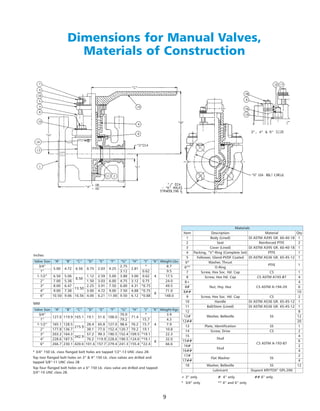
Dimensions for Manual Valves,
Materials of Construction
Valve Size “A” “B” “C” “D” “E” “F” “G” “H” “J” “K” Weight-Kgs
3/4”
127.0 119.9 165.1 19.1 51.6 108.0
70.0
71.4
*
4
3.9
1” 79.2 15.7 4.3
1-1/2” 165.1 128.5
215.9
28.4 65.8 127.0 98.6 76.2 15.7 7.9
2” 177.8 136.7 38.1 77.0 152.4 120.7 79.2 19.1 10.8
3” 203.2 164.3
342.9
57.2 99.3 190.5 152.4 109.5 *19.1 22.3
4” 228.6 187.5 76.2 119.9 228.6 190.5 124.0 *19.1
8
32.0
6” 266.7 230.1 420.6 101.6 157.7 279.4 241.3 155.4 *22.4 66.6
Materials
Item Description Material Qty
1 Body (Lined) DI ASTM A395 GR. 60-40-18 1
2 Seat Reinforced PTFE 2
3 Cover (Lined) DI ASTM A395 GR. 60-40-18 1
4 Packing, “V”-Ring (Complete Set) PTFE 1
5 Follower, Gland-PVDF Coated DI ASTM A536 GR. 65-45-12 1
6* Washer, Thrust
PTFE 1
6** O-Ring
7 Screw, Hex Soc. Hd. Cap CS 1
8 Screw, Hex Hd. Cap CS ASTM A193-B7 4
8+
Nut, Hvy. Hex CS ASTM A-194-2H
4
8# 6
8## 10
9 Screw, Hex Soc. Hd. Cap CS 2
10 Handle DI ASTM A536 GR. 65-45-12 1
11 Ball/Stem (Lined) DI ASTM A536 GR. 65-45-12 1
12
Washer, Belleville SS
8
12# 12
12## 20
13 Plate, Identification SS 1
14 Screw, Drive CS 2
15
Stud
CS ASTM A-193-B7
4
15## 6
16#
Stud
2
16## 4
17#
Flat Washer SS
2
17## 4
18 Washer, Belleville SS 12
Lubricant Dupont KRYTOX®
GPL-206
* 3/4” 150 Lb. class flanged bolt holes are tapped 1/2”-13 UNC class 2B.
Top two flanged bolt holes on 3” & 4” 150 Lb. class valves are drilled and
tapped 5/8”-11 UNC class 2B
Top four flanged bolt holes on a 6” 150 Lb. class valve are drilled and tapped
3/4”-10 UNC class 2B.
Inches
MM
+ 3” only # 4” only ## 6” only
* 3/4” only ** 4” and 6” only
10
Dimensions for Actuator Mounting
Valve Size “A” “B” “C” “D” “E” “F” “G” “H” “J” “K” “L” “M” “N” “P” “R” “S” “T” “U” “V” “W”
3/4” & 1” 4.88 .46 1.19 1.88 3.06 3.72 4.56 2.20 2.81 1.84 2.98 .62 .367/.363 2.469 2.10 4.19 .87 1.75 5/16-18UNC .62
1-1/2” 6.38 .58 1.44 2.06 3.25 4.06 4.88 2.54 3.00 2.16 3.83 .88 .492/.488 3.062 2.81 5.62 .87 1.75 5/16-18UNC .62
2” 6.88 .64 2.03 2.53 3.59 4.53 5.22 3.04 3.12 2.16 3.83 .88 .492/.488 3.062 3.10 6.19 1.12 2.25 5/16-18UNC .62
3” 7.88 .78 1.94 3.12 4.31 5.25 6.16 4.06 4.31 2.81 5.07 1.00 .617/.613 4.062 3.56 7.12 1.75 3.50 3/8-16UNC .75
4” 8.88 .97 2.19 3.62 5.09 5.97 7.09 4.38 4.88 2.69 5.07 1.25 .742/.738 4.062 4.00 8.00 2.00 4.00 7/16-14UNC 1.00
6” 10.38 1.03 2.41 5.03 6.44 7.69 8.82 5.88 6.12 3.81 6.19 2.00 1.242/1.238 5.188 4.66 9.31 2.56 5.12 7/16-14UNC 1.00
Valve Size “A” “B” “C” “D” “E” “F” “G” “H” “J” “K” “L” “M” “N” “P” “R” “S” “T” “U” “V” “W”
3/4” & 1” 124.0 11.7 30.2 47.8 77.7 94.5 115.8 55.9 71.4 46.7 75.7 15.8 9.32/9.22 62.7 53.3 106.4 22.1 44.4 5/16-18UNC 15.8
1-1/2” 162.1 14.7 36.6 52.3 82.6 103.1 124.0 64.5 76.2 54.9 97.3 22.4 12.50/12.40 77.8 71.4 142.8 22.1 44.4 5/16-18UNC 15.8
2” 174.8 16.3 51.6 64.3 91.2 115.1 132.6 77.2 79.2 54.9 97.3 22.4 12.50/12.40 77.8 78.7 157.2 28.4 57.2 5/16-18UNC 15.8
3” 200.2 19.8 49.3 79.2 109.5 133.4 156.5 103.1 109.5 71.4 128.8 25.4 15.67/15.57 103.2 90.4 180.8 44.4 88.9 3/8-16UNC 19.0
4” 225.6 24.6 55.6 91.9 129.3 151.6 180.1 111.2 124.0 68.3 128.8 31.8 18.85/18.75 103.2 101.6 203.2 50.8 101.6 7/16-14UNC 25.4
6” 263.7 26.2 61.2 127.8 163.6 195.3 224.0 149.4 155.4 96.8 157.2 50.8 31.55/31.45 131.8 118.4 236.5 65.0 130.0 7/16-14UNC 25.4
Inches
MM
11
Service Guide
Data, recommendations, and suggestions con-
tained herein are based on experiences in actual
field applications as well as common corrosion
data. However, because of so many possible vari-
ances in practices from plant to plant, these rec-
ommendations are intended for use only as a
guide and should not be interpreted as a guaran-
tee.
Selections in the following pages have been made
with safety and serviceability as the foremost con-
siderations.
Many variables enter into the question of service-
ability. Factors such as concentration, temperature,
pressure, velocity, percent solids, temperature
cycling, vacuum, cleaning practices, etc. are all
important in determining whether or not a partic-
ular material will give satisfactory service.
Of the endless number of chemical compounds
many are insoluble in water and would conse-
quently cause no corrosion problems when in
water. However, some of these simple services can
become difficult when it is necessary to make such
materials soluble through use of some other sol-
vent. For example, sulfuric acid is commonly used
as a solvent for silver chloride. Then the recom-
mendation must take into account both silver
chloride and sulfuric acid. As a general rule, it is
recommended that pipeline or tank material be
used for the valve body whenever possible.
Max Use Temp.
Chemical o
F o
C
Acetaldehyde 200 95
Acetamide 250 120
Acetic Acid (50%) 250 120
Acetic Acid (Glacial) 230 110
Acetic Anhydride 300 150
Acetone 150 65
Acetone (50% H20) 150 65
Acetonitrile 150 65
Acetophenone 300 150
Acetylchloride 150 65
Acetylene 250 120
Acetylene Tetrabromide 300 150
Acetylene Tetrachloride 300 150
Acrylonitrile 150 65
Adipic Acid 275 135
Air 300 150
Allyl Alcohol 212 100
Allyl Chloride 212 100
Aluminum Ammonium Sulfate 300 150
Aluminum Chloride 300 150
Aluminum Fluoride 300 150
Aluminum Hydroxide 300 150
Aluminum Nitrate 300 150
Aluminum Oxychloride 300 150
Aluminum Potassium Sulfate 300 150
Amino Acids (H20) 212 100
Ammonia (Anhydrous) 300 150
Ammonia (Aqueous 30%) 230 110
Ammonium Bifluoride 300 150
Ammonium Bromide (50%) 275 135
Ammonium Carbonate 300 150
Ammonium Chloride 300 150
Ammonium Dichromate 275 135
Ammonium Fluoride 300 150
Ammonium Hydroxide 300 150
Ammonium Nitrate (Conc.) 230 110
Max Use Temp.
Chemical o
F o
C
Ammonium Perchlorate 275 135
Ammonium Persulfate 150 65
Ammonium Phosphate 300 150
Ammonium Sulfate 300 150
Ammonium Sulfide 300 150
Ammonium Thiocyanate 300 150
Amyl Acetate 250 120
Amyl Alcohol 300 150
Amyl Chloride 300 150
Aniline 230 110
Aniline Hydrochloride (10%) 150 65
Anthraquinone 275 135
Anthraquinone-Sulfonic Acid 275 135
Antimony Trichloride 212 100
Aqua Regia 212 100
Arsenic Acid 300 150
Barium Carbonate 300 150
Barium Chloride 300 150
Barium Hydroxide 300 150
Barium Sulfate 300 150
Barium Sulfide 300 150
Battery Acid 250 120
Benzaldehyde 212 100
Benzene 212 100
Benzene Sulfonic Acid 212 100
Benzoic Acid 275 135
Benzoyl Chloride 150 65
Benzyl Alcohol 300 150
Barium Sulfate 300 150
Barium Sulfide 300 150
Battery Acid 250 120
Benzaldehyde 212 100
Benzene 212 100
Benzene Sulfonic Acid 212 100
Benzoic Acid 275 135
Benzoyl Chloride 150 65
Benzyl Alcohol 300 150
B
A
12
Max Use Temp.
Chemical o
F o
C
Benzyl Chloride 300 150
Bismuth Carbonate 300 150
Black Liquor 300 150
Bleach (12.5% Cl2) 212 100
Borax 300 150
Boric Acid 300 150
Brine 300 150
Bromic Acid 250 120
Bromine (Dry) 150 65
Bromine Water (10%) 230 110
mono-Bromobenzene 212 100
Bromoform 212 100
m-Bromotoluene 212 100
Butadiene 250 120
Butane 300 150
Butanediol 275 135
Butyl Acetate 230 110
Butyl Acrylate 230 110
n-Butyl Alcohol 300 150
sec-Butyl Alcohol 300 150
tert-Butyl Alcohol 300 150
n-Butylamine 120 50
sec-Butylamine 120 50
tert-Butylamine 120 50
di-n-Butyl Amine 230 110
tri-n-Butyl Amine 230 110
Butylene 300 150
Butyl Bromide 300 150
Butyl Chloride 300 150
n-Butyl Mercaptan 300 150
Butyl Phenol 230 110
Butyl Phthalate 150 65
Butyraldehyde 212 100
Butyric Acid 250 120
Calcium Bisulfate 300 150
Calcium Bisulfide 300 150
Calcium Carbonate 300 150
Calcium Chlorate 300 150
Calcium Chloride 300 150
Calcium Hydroxide 300 150
Calcium Hypochlorite 300 150
Calcium Nitrate 300 150
Calcium Oxide 275 135
Calcium Sulfate 300 150
Calcium Sulfide 250 120
Caprylic Acid 212 100
Carbon Dioxide (Dry) 300 150
Carbon Dioxide (Wet) 300 150
Carbon Disulfide 150 65
Carbon Monoxide 300 150
Carbon Tetrachloride 150 65
Carbonic Acid 300 150
Max Use Temp.
Chemical o
F o
C
Castor Oil 300 150
Caustic Potash (10 and 50%) 212 100
Caustic Soda (10 and 50%) 212 100
Cellosolve®
300 150
Chloral Hydrate 212 100
Chlorinated Brine 250 120
Chlorinated Phenol 212 100
Chlorine (Dry) 212 100
Chlorine (Wet) 250 120
Chlorine Dioxide 250 120
Chloroacetic Acid (50% H20) 230 110
Chlorobenzene 212 100
Chlorobenzyl Chloride 150 65
Chloroform 212 100
Chlorohydrin (Liquid) 150 65
Chlorosulphonic Acid 75 25
Chromic Acid (50%) 150 65
Chromic Chloride 212 100
Chromyl Chloride 212 100
Clorox Bleach Solution (5-1/2% Cl2) 212 100
Coal Gas 212 100
Copper Chloride 300 150
Copper Cyanide 300 150
Copper Fluoride 300 150
Copper Nitrate 300 150
Copper Sulfate 300 150
Cresol 275 135
Cresylic Acid 275 135
Croton aldehyde 212 100
Crude Oil 300 150
Cyclohexane 300 150
Cyclohexanol 250 120
Cyclohexanone 300 150
DDT 212 100
Decalin 250 120
Decane 300 150
Dextrin 300 150
Diacetone Alcohol 212 100
1,2-Dibromopropane 200 95
Dibutyl Phthalate 150 65
Dichloroacetic Acid 150 65
o-Dichlorobenzene 150 65
Dichloroethylene 150 65
Dichloropropionic Acid 150 65
Diesel Fuels 300 150
Diethyl Benzene 275 135
Diethyl Cellosolve 300 150
Diethyl Ether 212 100
Diethylamine 230 110
Diglycolic Acid 212 100
Diisobutyl Ketone 230 110
Diisobutylene 275 135
C
D
13
Max Use Temp.
Chemical o
F o
C
Glycerol 300 150
Glycol 275 135
Glycolic Acid 250 120
Heptane 300 150
Hexane 300 150
Hydrazine 100 40
Hydrazine Dihydrochloride 125 50
Hydriodic Acid 300 150
Hydrobromic Acid (50%) 300 150
Hydrochloric Acid (20%) 300 150
Hydrochloric Acid (Conc.) 300 150
Hydrochloric Acid (Gas) 300 150
Hydrocyanic Acid 300 150
Hydrofluoric Acid (35%) 275 135
Hydrofluoric Acid (70%) 250 120
Hydrofluoric Acid (100%) 230 110
Hydrofluorosilicic Acid 300 150
Hydrogen 300 150
Hydrogen Cyanide 300 150
Hydrogen Peroxide (30%) 250 120
Hydrogen Peroxide (90%) 150 65
Hydrogen Phosphide 150 65
Hydrogen Sulfide (Dry) 300 150
Hydrogen Sulfide (Wet) 300 150
Hydroquinone 250 120
Hypochlorous Acid 300 150
Inert Gases 300 150
Iodine (Dry) 230 110
Iodine (Wet) 230 110
Iodoform 230 110
Isobutyl Alcohol 275 135
Isopropylamine 120 50
Jet Fuel-JP4 230 110
Jet Fuel-JP5 230 110
Lactic Acid 250 120
Lard Oil 300 150
Lauric Acid 250 120
Lauryl Chloride 275 135
Lauryl Sulfate 250 120
Lead Acetate 300 150
Linoleic Acid 275 135
Linseed Oil 300 150
Lithium Bromide (Saturated) 250 120
Lithium Hydroxide 300 150
Lubricating Oil 300 150
Magnesium Carbonate 300 150
Magnesium Chloride 300 150
Magnesium Hydroxide 300 150
Magnesium Nitrate 300 150
Magnesium Sulfate 300 150
Maleic Acid 275 135
Maleic Anhydride 200 95
Max Use Temp.
Chemical o
F o
C
Dimethyl Formamide 250 120
Dimethyl Phthalate 212 100
Dimethyl Sulfate 150 65
Dimethyl Sulfoxide 212 100
Dimethylamine 120 50
Dimethylaniline 275 135
Dioctyl Phthalate 150 65
p-Dioxane 150 65
Diphenyl Ether 175 80
Divinyl Benzene 175 80
Epichlorhydrin 150 65
Ethyl Acetate 150 65
Ethyl Acrylate 212 100
Ethyl Alcohol 300 150
Ethyl Chloride 300 150
Ethyl Chloroacetate 212 100
Ethyl Cyanoacetate 212 100
Ethylacetoacetate 150 65
Ethylamine 100 40
Ethylene Bromide 300 150
Ethylene Chloride 300 150
Ethylene Chlorohydrin 150 65
Ethylene Diamine 120 50
Ethylene Glycol 300 150
Ethylene Oxide 230 110
Fatty Acids 300 150
Ferric Chloride (50% in H20) 300 150
Ferric Hydroxide 300 150
Ferric Nitrate 300 150
Ferric Sulfate 300 150
Ferrous Chloride 300 150
Ferrous Hydroxide 300 150
Ferrous Nitrate 300 150
Ferrous Sulfate 300 150
Fluorine (Gaseous) 100 40
Fluoroboric Acid 275 135
Fluosilicic Acid 275 135
Formaldehyde (37% in H20) 230 110
Formic Acid 275 135
FREON®
11 230 110
FREON®
12 230 110
FREON®
22 230 110
Fuel Oil 300 150
Fumaric Acid 200 95
Furane 150 65
Furfural 212 100
Gallic Acid 212 100
Gas-Manufactured 300 150
Gas-Natural 300 150
Gasoline-Leaded 300 150
Gasoline-Sour 300 150
Gasoline-Unleaded 300 150
E
F
G
H
I
J
L
M
14
Max Use Temp.
Chemical o
F o
C
Palmitic Acid 275 135
Perchlorethylene 275 135
Perchloric Acid (10%) 230 110
Perchloric Acid (72%) 150 65
Petrolatum 300 150
Petroleum 300 150
Petroleum Ether 212 100
Phenol (10%) 230 110
Phenol (100%) 212 100
Phenolsulfonic Acid 212 100
Phenylhydrazine 212 100
Phenylhydrazine Hydrochloride 212 100
o-Phenylphenol 212 100
Phosgene 212 100
Phosphoric Acid (30%) 300 150
Phosphoric Acid (85%) 275 135
Phosphorus Oxychloride 221 100
Phosphorus Pentachloride 212 100
Phosphorus Pentoxide 230 110
Phosphorus Trichloride 250 120
Phthalic Acid 212 100
Phthalic Anhydride 212 100
Picric Acid 125 50
Polyvinyl Acetate 300 150
Polyvinyl Alcohol 300 150
Potassium Aluminum Chloride 300 150
Potassium Aluminum Sulfate (50%) 300 150
Potassium Bicarbonate 300 150
Potassium Borate 300 150
Potassium Bromate 300 150
Potassium Bromide 300 150
Potassium Carbonate 300 150
Potassium Chlorate 300 150
Potassium Chloride 300 150
Potassium Chromate 300 150
Potassium Cyanide 300 150
Potassium Dichromate 300 150
Potassium Ferrocyanide 300 150
Potassium Fluoride 300 150
Potassium Hydroxide (50%) 212 100
Potassium Hypochlorite 275 135
Potassium Nitrate 300 150
Potassium Perborate 275 135
Potassium Perchlorate 212 100
Potassium Permanganate 300 150
Potassium Persulfate 150 65
Potassium Sulfate 300 150
Potassium Sulfide 300 150
Propane 275 135
Propionic Acid 212 100
Propyl Alcohol 300 150
Propylene Dibromide 212 100
Max Use Temp.
Chemical o
F o
C
Malic Acid 275 135
Mercuric Chloride 275 135
Mercuric Cyanide 275 135
Mercuric Nitrate 275 135
Mercury 275 135
Methacrylic Acid 200 95
Methane 250 120
Methane Sulfonic Acid (50%) 230 110
Methyl Alcohol 300 150
n-Methylaniline 250 120
Methyl Benzoate 250 120
Methyl Bromide 300 150
Methyl Cellosolve®
300 150
Methyl Chloride 200 95
Methyl Chloroform 150 65
Methyl Chloromethyl Ether 175 80
Methyl Cyanoacetate 175 80
Methyl Ethyl Ketone 230 110
Methyl Isobutyl Ketone 230 110
Methyl Methacrylate 175 80
Methyl Salicylate 200 95
Methyl Sulfuric Acid 212 100
Methyl Trichlorosilane 200 95
Methylene Bromide 212 100
Methylene Chloride 212 100
Methylene Iodide 212 100
Mineral Oil 300 150
Monochlorobenzene 230 110
Monoethanolamine 150 65
Morpholine 150 65
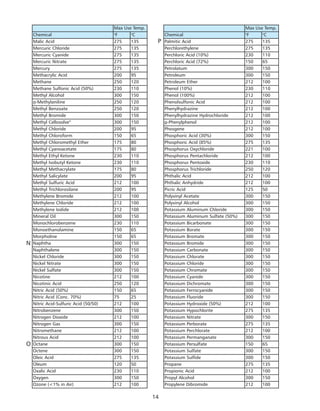
Naphtha 300 150
Naphthalene 300 150
Nickel Chloride 300 150
Nickel Nitrate 300 150
Nickel Sulfate 300 150
Nicotine 212 100
Nicotinic Acid 250 120
Nitric Acid (50%) 150 65
Nitric Acid (Conc. 70%) 75 25
Nitric Acid-Sulfuric Acid (50/50) 212 100
Nitrobenzene 300 150
Nitrogen Dioxide 212 100
Nitrogen Gas 300 150
Nitromethane 212 100
Nitrous Acid 212 100
Octane 300 150
Octene 300 150
Oleic Acid 275 135
Oleum 120 50
Oxalic Acid 230 110
Oxygen 300 150
Ozone (<1% in Air) 212 100
N
O
P
15
Max Use Temp.
Chemical o
F o
C
Sour Crude Oil 300 150
Stannic Chloride 300 150
Stannous Chloride 300 150
Stannous Fluoride 250 120
Stearic Acid 300 150
Stoddard’s Solvent 275 135
Styrene Monomer 212 100
Succinic Acid 275 135
Sulfamic Acid 212 100
Sulfur (Molten) 250 120
Sulfur Dioxide 230 110
Sulfur Trioxide (Liquid) 75 25
Sulfuric Acid (60%) 300 150
Sulfuric Acid (Conc.) 300 150
Sulfuric Acid (Fuming-Oleum) 120 50
Sulfurous Acid 230 110
Tall Oil 300 150
Tannic Acid 275 135
Tartaric Acid 275 135
2,3,4,6-Tetrachlorophenol 212 100
Tetraethyl Lead 300 150
Tetrahydrofuran 212 100
Tetramethyl Ammonium
Hydroxide (50%) 212 100
Thionyl Chloride 212 100
Tin Tetrachloride 230 110
Titanium Dioxide 300 150
Titanium Tetrachloride 212 100
Toluene 250 120
Tributyl Phosphate 150 65
Trichloracetic Acid 212 100
Trichloroethylene 275 135
Trichloromethane 212 100
2,4,5-Trichlorophenol 212 100
Triethylamine 230 110
Trisodium Phosphate 275 135
Turpentine 275 135
UDMH-Hydrazine (50/50) 120 50
Urea (50% H20) 275 135
Varsol 275 135
Vinyl Acetate 275 135
Vinyl Chloride (Monomer) 150 65
Water 300 150
Water Sewage 275 135
Wax 300 150
Xylene 250 120
Zinc Acetate 250 120
Zinc Chloride 300 150
Zinc Hydrosulfite (10%) 250 120
Zinc Nitrate 300 150
Zinc Sulfate 300 150
Zinc Sulfide 300 150
Max Use Temp.
Chemical o
F o
C
Propylene Dichloride 212 100
Propylene Glycol Methyl Ether 212 100
Propylene Oxide 150 65
Pyridine 150 65
Pyrogallol 150 65
Salicylaldehyde 212 100
Salicylic Acid 250 120
Salt Brine 300 150
Sea Water 300 150
Silicon Tetrachloride 250 120
Silver Chloride 300 150
Silver Cyanide 300 150
Silver Nitrate 300 150
Sodium Acetate 300 150
Sodium Benzene-Sulfonate 300 150
Sodium Benzoate 300 150
Sodium Bicarbonate 300 150
Sodium Bisulfate 300 150
Sodium Bisulfite 300 150
Sodium Borate 212 100
Sodium Bromide 300 150
Sodium Carbonate 300 150
Sodium Chlorate 300 150
Sodium Chloride 300 150
Sodium Chromate 300 150
Sodium Cyanide 300 150
Sodium Dichromate (Alkaline) 212 100
Sodium Ferricyanide 300 150
Sodium Ferrocyanide 300 150
Sodium Fluoride 300 150
Sodium Glutamate 275 135
Sodium Hydroxide (10%) 230 110
Sodium Hydroxide (50%) 230 110
Sodium Hypochlorite 300 150
Sodium Hyposulfite 300 150
Sodium Iodide 300 150
Sodium Lignosulfonate 300 150
Sodium Metasilicate 300 150
Sodium Nitrate 300 150
Sodium Nitrite 300 150
Sodium Perborate 212 100
Sodium Perchlorate 150 65
Sodium Peroxide 300 150
Sodium Persulfate 175 80
Sodium Phosphate 300 150
Sodium Silicate 300 150
Sodium Silicofluoride 300 150
Sodium Sulfate 300 150
Sodium Sulfide 300 150
Sodium Sulfite 300 150
Sodium Thiosulfate 300 150
Sorbic Acid 275 135
S
T
U
V
W
X
Z
16
How to Order: Valves
XXX - XXXX - XXX - XXX - XXX - XXX - XXXXXX
Valve Size (Block A)
Base Body (Block B1)
Handle Options (Block E)
Locking Device (Block F)
Optional Preparation (Block K)
Actuation (Block N1)
Additional Options
Figure Numbers:
Flanged Ends - Lined
Cam-Line Ball Valves (Block B1)
Code Lining Material
DUCTILE IRON - 150#
1059 Tefzel
1159 Tefzel Lined (PVDF Coated)
Extended Stem (Block D2)
Code Extension Length
CAST STEEL
EXTSP Stem Extension w/out Bracket
EXTSPBR Stem Extionsion with Bracket
Exterior Trim (Block D3)
Code Material
ET1 Stainless Steel
ET2 Carbon Steel
Handle Options (Block E)
Code Description
OVAL HANDWHEEL
HD2 Carbon Steel
HD3 Stainless Steel
HD4 None Provided
CHAINWHEEL
HD5 Carbon Steel Horizontal Line
HD6 Carbon Steel Vertical Line
HD7 Stainless Steel Horizontal Line
HD8 Stainless Steel Vertical Line
Locking Device (Block F)
Code Material
LDS Stainless Steel
Grounding Strap (Block F1)
Code Description
G Grounding Strap
Optional Coatings (Block G)
Code Coating
C1 White Epoxy
C2 Sherwin Williams Polane Blue
CSpec Special Coating
Optional Preparation (Block K)
Code Preparation
OX Oxygen Preparation
CL Halogen Service w/o Venting
CLV Dry Chlorine Gas w/ Vented
Seats
V Vented Seats
Compact Actuator (Block N1)
Code Actuator Model
C15 C15
C20 C20
C25 C25
C30 C30
C35 C35
C45 C45
C60 C60
Compact Actuator Mode
(Block N2)
Code Actuator Model
DA Double Acting
SR Spring Return
GR Gear/Manual or Electric
Compact Actuator
Springs (Block N3)
Code Actuator Springs
DA DA
2A2B 2A2B
2C 2C
Compact Actuator
Failure Position (Block N4)
Code Failure Position
FO Fail Open
FC Fail Closed
Solenoid Valve (Block N5)
Code Description
SV1 Asco EF8320G184
SV2 Asco EF8320G184
SV3 Asco EF8345G1
SV4 Asco EF8345G1
SV5 Asco EF8320G194
SV6 Asco EFHT8320G184
Actuator
Limit Switches (Block N7)
Code Description
LS1 Westlock 1065
LS2 Westlock 1040
LS3 Westlock 2004BY
LS4 Westlock 2007XBY
LS5 Posiflex F30A-A-A
LS7 Posiflex F30A-C-A
LS9 Westlock 3030BY
LS10 Westlock 9479BY
LS11 GO 41-2U000-000
LS12 Westlock 360-BY-M6
LS13 Westlock E360-BY-M6
Filter Regulator (Block N1R)
Code Description
RF1 Fischer 67CFR
RF2 Conoflow GFH60XTKEX3G
Speed Control (Block N1C)
Code Description
SC Schrader 337-1001
Cam-Line®
17
Teflon®
is a registered trademark of DuPont
TEFZEL®
is a registered trademark of DuPont
KRYTOX®
is a registered trademark of DuPont
Cam-Line®
is a registered trademark of ITT Industries
Cam-Tite®
is a registered trademark of ITT Industries
Dia-Flo®
is a registered trademark of ITT Industries
STANDARD TERMS AND CONDITIONS of
ITT INDUSTRIAL PROCESS (IP)
(hereinafter referred to as Seller)
WARRANTY - Company warrants title to the product(s) and, except as
noted with respect to items not of Company's manufacturer, also war-
rants the product(s) on date of shipment to Purchaser, to be of the
kind and quality described herein, and free of defects in workmanship
and material. This warranty is expressly in lieu of all other warranties,
including but not limited to implied warranties of merchantability and
fitness, and constitutes the only warranty of the company with respect
to the product(s).
If within one year from date of initial operation, but not more than
eighteen months from date of shipment by Company of any item of
product(s), Purchaser discovers that such item was not as warranted
above and promptly notifies Company in writing thereof. Company
shall remedy such nonconformance by, at Company's option, adjust-
ment or repair or replacement of the item and any affected part of the
product(s). Purchaser shall assume all responsibility and expense for
removal, reinstallation, and freight in connection with the foregoing
remedies. The same obligations and conditions shall extend to
replacement parts furnished by Company hereunder. Company shall
have the right of disposal of parts replaced by it. Purchaser agrees to
notify Company, in writing, of any apparent defects in design, material
or workmanship, prior to performing any corrective action back
chargeable to the Company. Purchaser shall provide a detailed esti-
mate of the material, labor costs associated with proposed remedy for
expeditious review and approval by the Company.
Seller neither assumes, nor authorizes any person to assume for it,
any other obligation in connection with the sale of its engineering
designs or products. This warranty shall not apply to any products or
parts of products which (a) have been repaired or altered outside of
Seller’s factories or authorized service centers, in any manner; or (b)
have been subjected to misuse, negligence or accidents; or (c) have
been used in a manner contrary to Seller’s instructions or recommen-
dations. Seller shall not be responsible for design errors due to inac-
curate or incomplete information supplied by Buyer or its representa-
tives.
Any separately listed item of the product(s) which is not manufactured
by the company is not warranted by the company and shall be cov-
ered only by the express warranty, if any, of the manufacturer thereof.
This states purchaser’s exclusive remedy against company and its
suppliers relating to the product(s), whether in contract or in tort or
under any other legal theory, and whether arising out of warranties,
representations, instructions, installations or defects from any cause.
Company and its suppliers shall have no obligation as to any product
which has been improperly stored or handled, or which has not been
operated or maintained according to instructions in Company or sup-
plier furnished manuals.
LIMITATION OF LIABILITY - Neither Company nor its suppliers shall
be liable, whether in contract or in tort or under any other legal theory,
for loss of use, revenue or profit, or for cost of capital or of substitute
use or performance, or for incidental, indirect, or special or conse-
quential damages, or for any other loss or cost of similar type, or for
claims by Purchaser for damages of Purchaser's customers. Likewise,
Company shall not, under any circumstances, be liable for the fault,
negligence, or wrongful acts of Purchaser or Purchaser's employees,
or Purchaser's other contractors or suppliers.
In no event shall company be liable in excess of the sales price of the
part(s) or product found defective.
GENERAL - (a) Company will comply with all laws applicable to
Company. Compliance with OSHA or similar federal, state or local
laws during any operation or use of the product(s) is the sole respon-
sibility of Purchaser. (b) The laws of the State of New York shall gov-
ern the validity, interpretation and enforcement of any contract of
which these provisions are a part, without giving effect to any rules
governing the conflict of laws. (c) This document and any other docu-
ments specifically referred to as being a part hereof, constitute the
entire contract on the subject mater, and it shall not be modified
except in writing signed by both parties, Unless otherwise specified,
any reference to Purchaser's order is for identification only.
Assignment may be made only with written consent of both parties.
ACCEPTANCE - The determination of compliance with performance
guarantees will be based on results of factory tests under controlled
conditions with calibrated instruments and tested per standards of the
Hydraulic Institute, ISO standards, API standards, or other nationally
recognized accreditation standards mutually acceptable to Company
and Purchaser.
SHIPMENT - The term "shipment" means delivery to the initial carrier
in accordance with the delivery terms of this order. Company may
make partial shipments. Company shall select method of transporta-
tion and route, unless terms are f.o.b. point of shipment and
Purchaser specifies the method and route and is to pay the freight
costs in addition to the price, When terms are f.o.b. destination or
freight allowed to destination, "destination" means common carrier
delivery point (within the continental United States, excluding Alaska)
nearest the destination. For movement outside the United States,
company shall arrange for inland carriage to port of exit and shall
cooperate with Purchaser's agents in making necessary arrangements
for overseas carriage and preparing necessary documents.
SPECIAL SHIPPING DEVICES - On shipments to a destination in the
continental United States or Canada, Company has the right to add to
the invoice, as a separate item, the value of any special shipping
device (barrel, reel, tarpaulin, cradle, crib and the like) used to contain
or protect the product(s) invoiced, while in transit. Full credit will be
given on the return to Company of the device in a reusable condition,
f.o.b. destination, freight prepaid.
DELAYS - If Company suffers delay in performance due to any cause
beyond its control, including but not limited to act of God, war, act or
failure to act of government, act or omission of Purchaser, fire, flood,
strike or labor troubles, sabotage, or delay in obtaining from others
suitable services, materials, components, equipment or transporta-
tion, the time of performance shall be extended a period of time equal
to the period of the delay and its consequences. Company will give to
Purchaser notice in writing within a reasonable time after Company
becomes aware of any such delay.
NONCANCELLATION - Purchaser may not cancel or terminate for con-
venience, or direct suspension of manufacture, except on mutually
acceptable terms.
STORAGE - Any item of the product(s) on which manufacture or ship-
ment is delayed by causes within Purchaser’s control, or by causes
which affect Purchaser's ability to receive the product(s), may be
placed in storage by Company for Purchaser's account and risk.
TITLE AND INSURANCE - Title to the product(s) and risk of loss or
damage shall pass to Purchaser at the f.o.b. point, except that a secu-
rity interest in the product(s) and proceeds and any replacement shall
remain in Company, regardless of mode of attachment to realty or
other property, until the full price has been paid in cash. Purchaser
agrees to do all acts necessary to perfect and maintain said security
interest, and to protect Company's interest by adequately insuring the
product(s) against loss or damage from any external cause with
Company named as insured or co-insured.
For additional information on the products as referenced,
Call 1-800-366-1111
Or visit us on the Web at www.engvalves.com
CAM-TITE®
Metal Ball Valves
DIA-FLO®
Diaphragm Valves
FABRI-VALVE®
Knife Gate and Special
Fabricated Valves
PURE-FLO®
Hygienic
Diaphragm Valves
For more information write to:
Engineered Valves Group
33 Centerville Road, P.O. Box 6164,
Lancaster, PA 17603-2064 USA
or call: (800) 366-1111
(717) 509-2200
Fax: (717) 509-2336
Web site: www.engvalves.com
E-mail: engvalves.custserv@.itt.com
©2004 ITT Corporation
Engineered Valves Group
SKOTCH®
Burner
Shut-Off Valves
Swanson Flo
151 Cheshire Lane N.,
Suite 700
Plymouth, MN 55441
Phone: 800.288.7926
Fax: 763.383.4772
Web: www.swansonflo.com

Cam-Line ITT Engineered Valve

  • 1.
    Plastic Lined TrunnionBall Valve CLBV-09 Cam-Line ® www.engvalves.com
  • 2.
    Contents Page Introduction ..................................................................................2 Features........................................................................................3 Lining Material, Seats, Testing ......................................................4 Cutaway Illustration ......................................................................5 Technical Data................................................................................6 Pressure/Temperature Curves Operating Torques Flow Coefficients (Cv Values) PVDF Coatings ..............................................................................6 Cam-Line® Options ........................................................................7 Actuated Valves ..........................................................................8-9 Materials of Construction ............................................................10 Dimensions Manual Valves ..........................................................................10 Actuator Mounting....................................................................11 Service Guide..........................................................................12-16 Ordering Information ..................................................................17 Terms and Conditions of Sale ......................................................18 1
  • 3.
    2 Introduction ITT Industries, EngineeredValves Group (EVG) has been an innovator and producer of valves for over fifty years. These valves have gained extensive usage in many industries including power generation, pulp and paper, refineries, chemical process, pharmaceutical/bioprocessing and pollution control. As a recognized leader in the valve business, our heritage stems from diaphragm valves. Through the years, our product offering has grown extensively. Our corrosion handling expertise has provided the impetus for the design of quarter-turn valve products like our Cam-Line® Ball Valve. By developing products such as the Cam-Line that address specific problems encountered in industry, we continue to expand our commit- ment to remain a leader in flow control. The performance of our products is surpassed only by the care taken in the many facets of manufacturing. Excellence in quality assurance, product reliability, and product safety will always remain paramount.
  • 4.
    3 New Generation ofPlastic Lined Valve The Cam-Line trunnion ball valve was designed to overcome problems inherent in conventional lined plug and ball valves. The design objective was to produce a lined quarter-turn valve with positive shut off at high and low pressures, a valve with a stem seal that seals, and a valve that is conve- nient and safe to operate. Design innovation has resulted in the valve we proudly call the Cam-Line. The Cam-Line ball valve combines the proven, patented sealing technolo- gy of the Cam-Tite ball valve with a trunnion mounting. The result is tight shut off, reliable stem seal performance, and a dramatic torque reduction never before possible in a plastic lined quarter-turn valve. The sealing mechanism begins as a sphere with a trunnion running through its vertical center. A waterway (port) passes through the center of the sphere. Around the edge of the waterway the spherical surface is cut away, forming a bevel that passes completely around the edge of the water- way. This is a very important feature of the design since it is the difference in the effective distance across the beveled surfaces and the distance across the spherical surface that actually energizes the seat when the valve is closed. When the valve is open the seats rest against the beveled surfaces. Sealing takes place during clo- sure of the valve when the spherical surface of the ball engages the seats. Sealing is the result of designed seat compression, not the result of pressure or of crushing compo- nents together. The resultant seal is positive at both high and low pressures. And, since load on the seats is minimized when the valve is in the open position, cold flow of the seat material is dramatically reduced, prolonging seat life. With the sealing load on the seats controlled by the geometry of the components (not external adjust- ments as in lined plug valves), the Cam-Line is a safe and convenient valve to operate. A 6" Cam- Line requires less than 1,250 inch pounds to oper- ate. No gears or cheaters required here! An important consideration when using plastics in valves is the dimensional stability of the plastic elements. Reliable performance is dependent upon maintaining design dimensions. The objective is to get two or more components to meet each other so that nothing can get by them. Dimensional sta- bility of the lining in the seal area is thus of prime importance. Conventional plug and ball valves place high loads on the plastic linings to get a seal, but often at the expense of valve life and operating ease. To maximize valve life, the Cam-Line ball valve uses a trunnion not only to support and center the ball, but also as a method to distribute excess hydraulic load into the valve body in non-critical areas, rather than through the seating area. Result? The Cam-Line performs better and Ionger, even in ther- mal cycling applications. The trunnion also aids the stem seal at the top of the valve. The long trunnion shaft reduces the effects of lateral loading found in conventional ball valves and when coupled with the low operat- ing torques, produces a seal that proves a lined valve can have a good stem seal. Design innovation didn’t stop with the basic valve. The choice of plastics and plastic processes has a direct effect on performance. So we engineered those, too. Our unique glass reinforced RTFE seats, along with a high stability TEFZEL® thermoplastic lining, complete the package. The Cam-Line® is an innovative design that gives: Positive Shut Off Reliable Stem Sealing Low Operating Torque Convenient and Safe Operation Long Service Life And, to make it easy for you to use, the Cam Line® ball valve features ANSI 150# flanges with stan- dard laying lengths and flange pad mounting. Open Closed
  • 5.
    4 Material Processing forBetter Results All PTFE Seats are not Created Equal All Cam-Line seats are reinforced PTFE. The fin- ished reinforced seats, when compared to virgin PTFE, exhibit the following performance advan- tages: 1. Improved dimensional stability 2. More uniform quality 3. Improved sealing characteristics These properties, obtained through the reinforc- ing process, result in better sealing and longer seat life. Cam-Line reinforced PTFE seats, com- bined with the unique beveled edge ball design, result in superior shut-off performance. Plastic Lining All wetted parts of the Cam-Line are lined with plastic. Cam-Line linings are injection molded at high pressure. With injection molding we actually “build” a corrosion resistant plastic valve within the strong metal valve body. With injection mold- ing, wall thickness can be varied to suit the mechanical requirements of the various valve sec- tions, while minimum wall thickness is strictly controlled. In fact, all Cam-Line linings have a 3/16" minimum wall thickness. Cam-Line linings are “keyed” to the valve bore for extra stability. The one piece trunnion/ball of the Cam-Line is fully encapsulated with the plastic lining. The metal core is recessed and keyed to lock the lining in place. With the one-piece trunnion/ball design, the joint between the ball and stem as found in conventional lined ball valves is completely elimi- nated. You can be sure that the ball is in the posi- tion indicated by the top of the trunnion. Experience Counts Injection molding of plastic linings is not new to Engineered Valves Group (EVG). Initially intro- duced with its diaphragm valve product line, EVG has been molding plastic lined valves for the past fifty years. This experience and expertise led to the development of the patented “Boteler” method of injection molding valve linings in 1968. Over the years, thousands upon thousands of ball valves and diaphragm valves have been lined using this time proven method. Testing Every valve is tested prior to shipment. Both hydrostatic and seat tests (in accordance with MSS-SP-72) are performed to insure a high integrity, tight sealing valve. In addition, all plastic lined components are 100% spark tested prior to assembly to assure lining integrity. TEFZEL® Lining TEFZEL® can best be described as a rugged ther- moplastic with an outstanding balance of proper- ties. TEFZEL® can perform successfully in applica- tions where other materials are lacking in mechanical toughness, broad thermal capability, and the ability to meet severe environmental con- ditions. Chemically, TEFZEL® is a co-polymer of ethylene and tetrafluoroethylene. Mechanically, TEFZEL® is tough, exhibits high tensile strength and hard- ness, and is more creep resistant than Teflon® PTFE, FEP or PFA fluorocarbon resins. The TEFZEL® used in the Cam-Line is reinforced with glass, yielding a tensile strength approaching 12,000 PSI. TEFZEL® has outstanding resistance to attack by chemicals and solvents that often cause rapid deterioration of other plastic materials. TEFZEL® is inert to strong mineral acids, inorganic bases, halogens, and metal salt solutions. Carboxylic acids, anhydrides, aromatic and aliphatic hydro- carbons, alcohols, aldehydes, ketones, ethers, chlorocarbons, and classic polymer solvents have little effect on the material.
  • 6.
    5 Low operating torquefor conve- nient, safe operation. Gear opera- tors are not required! Standard PVDF coated gland follower provides corrosion resistance ANSI 150# flanges, drilled and tapped as standard Rugged, ductile iron body, cover and handle (PVDF and epoxy coatings available) Tough TEFZEL® lining Reinforced PTFE Seats for long service life Patented ball geometry provides positive shut off Trunnion design to control stress on lining Plastic Lined Trunnion Ball Valve Live loaded multi-ring stem packing From its inception the Cam-Line ball valve has utilized an emission reduction stem packing design. Multiple V-rings are placed in a deep stuffing box and are loaded via the gland follow- er using adjustable cap screws. Belleville spring washers are employed to maintain packing com- pression and to adjust for service variables.
  • 7.
    6 For ultimate exteriorcorrosion protection in aggressive chemical environments, Cam-Line ball valves can be externally coated with PVDF. A pop- ular feature of the Dia-Flo® Diaphragm Valve, this optional 6-8 mil coating is applied to all ductile iron components of the Cam-Line prior to the valve being lined. The result is a mechanically tough coating that is resistant to spills, splash, and corrosive atmospheres at temperatures to 200°F. TEFZEL® lined Cam-Line ball valves coated with PVDF are equipped with stainless steel fas- teners to enhance total corrosion resistance. The actual amount of torque required to operate a valve is dependent upon many variables, such as line pressure, temperature, type of fluid, frequen- cy of operation, etc. The following tables are based on average breakaway torque requirements for a valve handling a clean, particle free liquid such as water. The torque values listed should be adjusted for special service conditions. For fluids with high solids or abrasive content, consult fac- tory for recommendations. When sizing an actuator for automatic operation, it is recommended not to exceed the Maximum Stem Torque as noted below. This will avoid per- manent damage to the valve stem as a result of a blocked valve and an over-sized operator. Pressure/Temperature Curve for Tefzel Lining Reinforced PTFE Seats 3/4"-1" 30 11/2 " 73 2" 160 3" 355 4" 751 6" 800 Flow Coefficients (Cv) Operating Torques/Flow Coefficients (Cv) Cam-Line® Technical Data External Protection with Corrosion Resistant PVDF Cam-Line® Options Torque (in lbs.) Max. Stem Torque (in lbs.)Size 3/4"-1" 120 709 11/2 " 130 1870 2" 280 1870 3" 500 3030 4" 800 5740 6" 1250 24500 Based on water flowing at 68°F
  • 8.
    7 Cavity Vents/Chlorine Service When specified,Cam-Line ball valves can be pro- vided with a vented seat to relieve excess pressure within the body cavity. Such valves are unidirec- tional and include an external tag with an arrow to indicate the direction of seat tightness. Use suf- fix “V” in the configuration number to specify a vented cavity only. Use “CLV” to specify a vented valve prepared for chlorine service. Note: As the Cam-Line is an ANSI 150# design, Engineered Valves Group (EVG) only recommends the valve for Class 1 dry chlorine gas service. Grounding Devices Upon request Cam-Line ball valves can be equipped with a grounding strap to provide elec- trical continuity between all metal components. Grounded valves receive a continuity test prior to shipment to assure a resistance reading less than 5 ohms. Use suffix “G” in the configuration num- ber to specify a grounding device. Oxygen Service Cam-Line ball valves can be prepared for oxygen service. Oxygen preparation includes special clean- ing, assembly, testing, and packaging. Valves pre- pared for oxygen service are lubricated with Krytox® 206 and are equipped as standard with a grounding strap. Use suffix “OX” in the configura- tion number to specify oxygen preparation. Cam-Line® Options (continued) Locking Devices When required, Cam-Line ball valves can be sup- plied with a locking handle device to provide lockout in both the open and closed positions. These locking devices, designed to meet the requirements of OSHA 1910.147, can be supplied with new valves or can be retrofit to existing valves which have drilled and tapped flange pads. Stainless steel is the standard material of con- struction for the Cam-Line locking device. Use suf- fix “LDS” in the configuration number to specify this lockout feature. Handle Options The unique low torque design of the Cam-Line allows the use of lever handles throughout the entire size range. In addition to the standard lever handles, the following handle options can be sup- plied: • Oval Safety Handwheels (through 2") • 45° T Handles for chain operation (specify valve in vertical or horizontal position) • Extended Handles (specify extension length) For additional information on how to order the above options, see page 16 of the catalog. For additional technical information, contact your Engineered Valves Group (EVG) Technical Sales Representative.
  • 9.
    8 Available Operating Air ValveSize DN Double Acting Spring Return-Fail Closed 60 psi / 4 bar 80 psi / 5.5 bar 60 psi / 4 bar 80 psi / 5.5 bar 3/4”-1” 15-25 C20DA C15DA C25-2A2B C25-2C 1.5 40 C20DA C15DA C25-2A2B C25-2C 2 50 C25DA C25DA C35-2A2B C30-2C 3 80 C30DA C25DA C45-2A2B C35-2C 4 100 C35DA C30DA C60-2A2B C45-2C 6 150 C45DA C35DA C60-2A2B C60-2C Actuated Valves With its simple, 90 degree rotation, the Cam-Line ball valve can be easily supplied with a variety of quarter-turn operators for automated valve ser- vice. Utilizing flange pads for actuator mounting, the low torque design of the Cam-Line allows smaller, less costly actuation devices to be employed. Another advantage of actuating the Cam-Line comes from the camming action of the ball. Since there is virtually no load on the seats when the valve is in the open position, there is no high “breakaway torque” associated with beginning the closing cycle. The actuator is able to start motion from the open position with little resis- tance. Only when the valve is essentially closed does the actuator see the design torque of the valve. This operation is extremely beneficial for “fail closed” valves in hostile service conditions. The Cam-Line ball valve can be equipped with a wide range of actuator types (pneumatic and elec- tric) and can be packaged with an assortment of accessory components, such as solenoid valves and limit switches. Compact Actuator The Compact quarter-turn pneumatic actuator has been developed to be a simple, reliable, and effi- cient valve operator by utilizing a patented rack and pinion design. Four separate racks, each dri- ven by its own piston, develop torque around the centrally located pinion. The four rack concept permits operating air pressure to be applied to four pistons simultaneously, increasing torque output and reducing piston diameter and overall actuator size, compared to single and double rack designs. Symmetrically spaced at 90 degree angles around the central pinion, the Compact’s four racks also achieve a more uniform load dis- tribution between the rack and pinion, greatly reducing gear wear at these contact points and curbing stress on the pinion and piston seals. The result is a high cycle actuator design. A look at the design of the Compact reveals sev- eral other important product advantages: • Minimal air consumption • Energy efficiency • Fast response • Compact, lightweight shape. The table below shows the Compact actuator siz- ing for Cam-Line ball valves. This table is based on standard operating torques for a valve han- dling a clean, particle-free liquid such as water. For dirty fluids or media with high solids or abra- sive contents, consult the factory for sizing rec- ommendations. Notes: 1. Actuator sizing based on 20% safety factor. 2. Use higher safety factor when handling gases, viscous liquids and crystallizing media - consult factory. Cam-Line Ball Valve Compact Spring Return or Double Acting
  • 10.
    Valve Size “A”“B” “C” “D” “E” “F” “G” “H” “J” “K” Weight-Lbs 3/4” 5.00 4.72 6.50 0.75 2.03 4.25 2.75 2.81 * 4 8.7 1” 3.12 0.62 9.5 1-1/2” 6.50 5.06 8.50 1.12 2.59 5.00 3.88 3.00 0.62 17.5 2” 7.00 5.38 1.50 3.03 6.00 4.75 3.12 0.75 24.0 3” 8.00 6.47 13.50 2.25 3.91 7.50 6.00 4.31 *0.75 49.5 4” 9.00 7.38 3.00 4.72 9.00 7.50 4.88 *0.75 8 71.0 6” 10.50 9.06 16.56 4.00 6.21 11.00 9.50 6.12 *0.88 148.0 9 Dimensions for Manual Valves, Materials of Construction Valve Size “A” “B” “C” “D” “E” “F” “G” “H” “J” “K” Weight-Kgs 3/4” 127.0 119.9 165.1 19.1 51.6 108.0 70.0 71.4 * 4 3.9 1” 79.2 15.7 4.3 1-1/2” 165.1 128.5 215.9 28.4 65.8 127.0 98.6 76.2 15.7 7.9 2” 177.8 136.7 38.1 77.0 152.4 120.7 79.2 19.1 10.8 3” 203.2 164.3 342.9 57.2 99.3 190.5 152.4 109.5 *19.1 22.3 4” 228.6 187.5 76.2 119.9 228.6 190.5 124.0 *19.1 8 32.0 6” 266.7 230.1 420.6 101.6 157.7 279.4 241.3 155.4 *22.4 66.6 Materials Item Description Material Qty 1 Body (Lined) DI ASTM A395 GR. 60-40-18 1 2 Seat Reinforced PTFE 2 3 Cover (Lined) DI ASTM A395 GR. 60-40-18 1 4 Packing, “V”-Ring (Complete Set) PTFE 1 5 Follower, Gland-PVDF Coated DI ASTM A536 GR. 65-45-12 1 6* Washer, Thrust PTFE 1 6** O-Ring 7 Screw, Hex Soc. Hd. Cap CS 1 8 Screw, Hex Hd. Cap CS ASTM A193-B7 4 8+ Nut, Hvy. Hex CS ASTM A-194-2H 4 8# 6 8## 10 9 Screw, Hex Soc. Hd. Cap CS 2 10 Handle DI ASTM A536 GR. 65-45-12 1 11 Ball/Stem (Lined) DI ASTM A536 GR. 65-45-12 1 12 Washer, Belleville SS 8 12# 12 12## 20 13 Plate, Identification SS 1 14 Screw, Drive CS 2 15 Stud CS ASTM A-193-B7 4 15## 6 16# Stud 2 16## 4 17# Flat Washer SS 2 17## 4 18 Washer, Belleville SS 12 Lubricant Dupont KRYTOX® GPL-206 * 3/4” 150 Lb. class flanged bolt holes are tapped 1/2”-13 UNC class 2B. Top two flanged bolt holes on 3” & 4” 150 Lb. class valves are drilled and tapped 5/8”-11 UNC class 2B Top four flanged bolt holes on a 6” 150 Lb. class valve are drilled and tapped 3/4”-10 UNC class 2B. Inches MM + 3” only # 4” only ## 6” only * 3/4” only ** 4” and 6” only
  • 11.
    10 Dimensions for ActuatorMounting Valve Size “A” “B” “C” “D” “E” “F” “G” “H” “J” “K” “L” “M” “N” “P” “R” “S” “T” “U” “V” “W” 3/4” & 1” 4.88 .46 1.19 1.88 3.06 3.72 4.56 2.20 2.81 1.84 2.98 .62 .367/.363 2.469 2.10 4.19 .87 1.75 5/16-18UNC .62 1-1/2” 6.38 .58 1.44 2.06 3.25 4.06 4.88 2.54 3.00 2.16 3.83 .88 .492/.488 3.062 2.81 5.62 .87 1.75 5/16-18UNC .62 2” 6.88 .64 2.03 2.53 3.59 4.53 5.22 3.04 3.12 2.16 3.83 .88 .492/.488 3.062 3.10 6.19 1.12 2.25 5/16-18UNC .62 3” 7.88 .78 1.94 3.12 4.31 5.25 6.16 4.06 4.31 2.81 5.07 1.00 .617/.613 4.062 3.56 7.12 1.75 3.50 3/8-16UNC .75 4” 8.88 .97 2.19 3.62 5.09 5.97 7.09 4.38 4.88 2.69 5.07 1.25 .742/.738 4.062 4.00 8.00 2.00 4.00 7/16-14UNC 1.00 6” 10.38 1.03 2.41 5.03 6.44 7.69 8.82 5.88 6.12 3.81 6.19 2.00 1.242/1.238 5.188 4.66 9.31 2.56 5.12 7/16-14UNC 1.00 Valve Size “A” “B” “C” “D” “E” “F” “G” “H” “J” “K” “L” “M” “N” “P” “R” “S” “T” “U” “V” “W” 3/4” & 1” 124.0 11.7 30.2 47.8 77.7 94.5 115.8 55.9 71.4 46.7 75.7 15.8 9.32/9.22 62.7 53.3 106.4 22.1 44.4 5/16-18UNC 15.8 1-1/2” 162.1 14.7 36.6 52.3 82.6 103.1 124.0 64.5 76.2 54.9 97.3 22.4 12.50/12.40 77.8 71.4 142.8 22.1 44.4 5/16-18UNC 15.8 2” 174.8 16.3 51.6 64.3 91.2 115.1 132.6 77.2 79.2 54.9 97.3 22.4 12.50/12.40 77.8 78.7 157.2 28.4 57.2 5/16-18UNC 15.8 3” 200.2 19.8 49.3 79.2 109.5 133.4 156.5 103.1 109.5 71.4 128.8 25.4 15.67/15.57 103.2 90.4 180.8 44.4 88.9 3/8-16UNC 19.0 4” 225.6 24.6 55.6 91.9 129.3 151.6 180.1 111.2 124.0 68.3 128.8 31.8 18.85/18.75 103.2 101.6 203.2 50.8 101.6 7/16-14UNC 25.4 6” 263.7 26.2 61.2 127.8 163.6 195.3 224.0 149.4 155.4 96.8 157.2 50.8 31.55/31.45 131.8 118.4 236.5 65.0 130.0 7/16-14UNC 25.4 Inches MM
  • 12.
    11 Service Guide Data, recommendations,and suggestions con- tained herein are based on experiences in actual field applications as well as common corrosion data. However, because of so many possible vari- ances in practices from plant to plant, these rec- ommendations are intended for use only as a guide and should not be interpreted as a guaran- tee. Selections in the following pages have been made with safety and serviceability as the foremost con- siderations. Many variables enter into the question of service- ability. Factors such as concentration, temperature, pressure, velocity, percent solids, temperature cycling, vacuum, cleaning practices, etc. are all important in determining whether or not a partic- ular material will give satisfactory service. Of the endless number of chemical compounds many are insoluble in water and would conse- quently cause no corrosion problems when in water. However, some of these simple services can become difficult when it is necessary to make such materials soluble through use of some other sol- vent. For example, sulfuric acid is commonly used as a solvent for silver chloride. Then the recom- mendation must take into account both silver chloride and sulfuric acid. As a general rule, it is recommended that pipeline or tank material be used for the valve body whenever possible. Max Use Temp. Chemical o F o C Acetaldehyde 200 95 Acetamide 250 120 Acetic Acid (50%) 250 120 Acetic Acid (Glacial) 230 110 Acetic Anhydride 300 150 Acetone 150 65 Acetone (50% H20) 150 65 Acetonitrile 150 65 Acetophenone 300 150 Acetylchloride 150 65 Acetylene 250 120 Acetylene Tetrabromide 300 150 Acetylene Tetrachloride 300 150 Acrylonitrile 150 65 Adipic Acid 275 135 Air 300 150 Allyl Alcohol 212 100 Allyl Chloride 212 100 Aluminum Ammonium Sulfate 300 150 Aluminum Chloride 300 150 Aluminum Fluoride 300 150 Aluminum Hydroxide 300 150 Aluminum Nitrate 300 150 Aluminum Oxychloride 300 150 Aluminum Potassium Sulfate 300 150 Amino Acids (H20) 212 100 Ammonia (Anhydrous) 300 150 Ammonia (Aqueous 30%) 230 110 Ammonium Bifluoride 300 150 Ammonium Bromide (50%) 275 135 Ammonium Carbonate 300 150 Ammonium Chloride 300 150 Ammonium Dichromate 275 135 Ammonium Dichromate 275 135 Ammonium Fluoride 300 150 Ammonium Hydroxide 300 150 Ammonium Nitrate (Conc.) 230 110 Max Use Temp. Chemical o F o C Ammonium Perchlorate 275 135 Ammonium Persulfate 150 65 Ammonium Phosphate 300 150 Ammonium Sulfate 300 150 Ammonium Sulfide 300 150 Ammonium Thiocyanate 300 150 Amyl Acetate 250 120 Amyl Alcohol 300 150 Amyl Chloride 300 150 Aniline 230 110 Aniline Hydrochloride (10%) 150 65 Anthraquinone 275 135 Anthraquinone-Sulfonic Acid 275 135 Antimony Trichloride 212 100 Aqua Regia 212 100 Arsenic Acid 300 150 Barium Carbonate 300 150 Barium Chloride 300 150 Barium Hydroxide 300 150 Barium Sulfate 300 150 Barium Sulfide 300 150 Battery Acid 250 120 Benzaldehyde 212 100 Benzene 212 100 Benzene Sulfonic Acid 212 100 Benzoic Acid 275 135 Benzoyl Chloride 150 65 Benzyl Alcohol 300 150 Barium Sulfate 300 150 Barium Sulfide 300 150 Battery Acid 250 120 Benzaldehyde 212 100 Benzene 212 100 Benzene Sulfonic Acid 212 100 Benzoic Acid 275 135 Benzoyl Chloride 150 65 Benzyl Alcohol 300 150 B A
  • 13.
    12 Max Use Temp. Chemicalo F o C Benzyl Chloride 300 150 Bismuth Carbonate 300 150 Black Liquor 300 150 Bleach (12.5% Cl2) 212 100 Borax 300 150 Boric Acid 300 150 Brine 300 150 Bromic Acid 250 120 Bromine (Dry) 150 65 Bromine Water (10%) 230 110 mono-Bromobenzene 212 100 Bromoform 212 100 m-Bromotoluene 212 100 Butadiene 250 120 Butane 300 150 Butanediol 275 135 Butyl Acetate 230 110 Butyl Acrylate 230 110 n-Butyl Alcohol 300 150 sec-Butyl Alcohol 300 150 tert-Butyl Alcohol 300 150 n-Butylamine 120 50 sec-Butylamine 120 50 tert-Butylamine 120 50 di-n-Butyl Amine 230 110 tri-n-Butyl Amine 230 110 Butylene 300 150 Butyl Bromide 300 150 Butyl Chloride 300 150 n-Butyl Mercaptan 300 150 Butyl Phenol 230 110 Butyl Phthalate 150 65 Butyraldehyde 212 100 Butyric Acid 250 120 Calcium Bisulfate 300 150 Calcium Bisulfide 300 150 Calcium Carbonate 300 150 Calcium Chlorate 300 150 Calcium Chloride 300 150 Calcium Hydroxide 300 150 Calcium Hypochlorite 300 150 Calcium Nitrate 300 150 Calcium Oxide 275 135 Calcium Sulfate 300 150 Calcium Sulfide 250 120 Caprylic Acid 212 100 Carbon Dioxide (Dry) 300 150 Carbon Dioxide (Wet) 300 150 Carbon Disulfide 150 65 Carbon Monoxide 300 150 Carbon Tetrachloride 150 65 Carbonic Acid 300 150 Max Use Temp. Chemical o F o C Castor Oil 300 150 Caustic Potash (10 and 50%) 212 100 Caustic Soda (10 and 50%) 212 100 Cellosolve® 300 150 Chloral Hydrate 212 100 Chlorinated Brine 250 120 Chlorinated Phenol 212 100 Chlorine (Dry) 212 100 Chlorine (Wet) 250 120 Chlorine Dioxide 250 120 Chloroacetic Acid (50% H20) 230 110 Chlorobenzene 212 100 Chlorobenzyl Chloride 150 65 Chloroform 212 100 Chlorohydrin (Liquid) 150 65 Chlorosulphonic Acid 75 25 Chromic Acid (50%) 150 65 Chromic Chloride 212 100 Chromyl Chloride 212 100 Clorox Bleach Solution (5-1/2% Cl2) 212 100 Coal Gas 212 100 Copper Chloride 300 150 Copper Cyanide 300 150 Copper Fluoride 300 150 Copper Nitrate 300 150 Copper Sulfate 300 150 Cresol 275 135 Cresylic Acid 275 135 Croton aldehyde 212 100 Crude Oil 300 150 Cyclohexane 300 150 Cyclohexanol 250 120 Cyclohexanone 300 150 DDT 212 100 Decalin 250 120 Decane 300 150 Dextrin 300 150 Diacetone Alcohol 212 100 1,2-Dibromopropane 200 95 Dibutyl Phthalate 150 65 Dichloroacetic Acid 150 65 o-Dichlorobenzene 150 65 Dichloroethylene 150 65 Dichloropropionic Acid 150 65 Diesel Fuels 300 150 Diethyl Benzene 275 135 Diethyl Cellosolve 300 150 Diethyl Ether 212 100 Diethylamine 230 110 Diglycolic Acid 212 100 Diisobutyl Ketone 230 110 Diisobutylene 275 135 C D
  • 14.
    13 Max Use Temp. Chemicalo F o C Glycerol 300 150 Glycol 275 135 Glycolic Acid 250 120 Heptane 300 150 Hexane 300 150 Hydrazine 100 40 Hydrazine Dihydrochloride 125 50 Hydriodic Acid 300 150 Hydrobromic Acid (50%) 300 150 Hydrochloric Acid (20%) 300 150 Hydrochloric Acid (Conc.) 300 150 Hydrochloric Acid (Gas) 300 150 Hydrocyanic Acid 300 150 Hydrofluoric Acid (35%) 275 135 Hydrofluoric Acid (70%) 250 120 Hydrofluoric Acid (100%) 230 110 Hydrofluorosilicic Acid 300 150 Hydrogen 300 150 Hydrogen Cyanide 300 150 Hydrogen Peroxide (30%) 250 120 Hydrogen Peroxide (90%) 150 65 Hydrogen Phosphide 150 65 Hydrogen Sulfide (Dry) 300 150 Hydrogen Sulfide (Wet) 300 150 Hydroquinone 250 120 Hypochlorous Acid 300 150 Inert Gases 300 150 Iodine (Dry) 230 110 Iodine (Wet) 230 110 Iodoform 230 110 Isobutyl Alcohol 275 135 Isopropylamine 120 50 Jet Fuel-JP4 230 110 Jet Fuel-JP5 230 110 Lactic Acid 250 120 Lard Oil 300 150 Lauric Acid 250 120 Lauryl Chloride 275 135 Lauryl Sulfate 250 120 Lead Acetate 300 150 Linoleic Acid 275 135 Linseed Oil 300 150 Lithium Bromide (Saturated) 250 120 Lithium Hydroxide 300 150 Lubricating Oil 300 150 Magnesium Carbonate 300 150 Magnesium Chloride 300 150 Magnesium Hydroxide 300 150 Magnesium Nitrate 300 150 Magnesium Sulfate 300 150 Maleic Acid 275 135 Maleic Anhydride 200 95 Max Use Temp. Chemical o F o C Dimethyl Formamide 250 120 Dimethyl Phthalate 212 100 Dimethyl Sulfate 150 65 Dimethyl Sulfoxide 212 100 Dimethylamine 120 50 Dimethylaniline 275 135 Dioctyl Phthalate 150 65 p-Dioxane 150 65 Diphenyl Ether 175 80 Divinyl Benzene 175 80 Epichlorhydrin 150 65 Ethyl Acetate 150 65 Ethyl Acrylate 212 100 Ethyl Alcohol 300 150 Ethyl Chloride 300 150 Ethyl Chloroacetate 212 100 Ethyl Cyanoacetate 212 100 Ethylacetoacetate 150 65 Ethylamine 100 40 Ethylene Bromide 300 150 Ethylene Chloride 300 150 Ethylene Chlorohydrin 150 65 Ethylene Diamine 120 50 Ethylene Glycol 300 150 Ethylene Oxide 230 110 Fatty Acids 300 150 Ferric Chloride (50% in H20) 300 150 Ferric Hydroxide 300 150 Ferric Nitrate 300 150 Ferric Sulfate 300 150 Ferrous Chloride 300 150 Ferrous Hydroxide 300 150 Ferrous Nitrate 300 150 Ferrous Sulfate 300 150 Fluorine (Gaseous) 100 40 Fluoroboric Acid 275 135 Fluosilicic Acid 275 135 Formaldehyde (37% in H20) 230 110 Formic Acid 275 135 FREON® 11 230 110 FREON® 12 230 110 FREON® 22 230 110 Fuel Oil 300 150 Fumaric Acid 200 95 Furane 150 65 Furfural 212 100 Gallic Acid 212 100 Gas-Manufactured 300 150 Gas-Natural 300 150 Gasoline-Leaded 300 150 Gasoline-Sour 300 150 Gasoline-Unleaded 300 150 E F G H I J L M
  • 15.
    14 Max Use Temp. Chemicalo F o C Palmitic Acid 275 135 Perchlorethylene 275 135 Perchloric Acid (10%) 230 110 Perchloric Acid (72%) 150 65 Petrolatum 300 150 Petroleum 300 150 Petroleum Ether 212 100 Phenol (10%) 230 110 Phenol (100%) 212 100 Phenolsulfonic Acid 212 100 Phenylhydrazine 212 100 Phenylhydrazine Hydrochloride 212 100 o-Phenylphenol 212 100 Phosgene 212 100 Phosphoric Acid (30%) 300 150 Phosphoric Acid (85%) 275 135 Phosphorus Oxychloride 221 100 Phosphorus Pentachloride 212 100 Phosphorus Pentoxide 230 110 Phosphorus Trichloride 250 120 Phthalic Acid 212 100 Phthalic Anhydride 212 100 Picric Acid 125 50 Polyvinyl Acetate 300 150 Polyvinyl Alcohol 300 150 Potassium Aluminum Chloride 300 150 Potassium Aluminum Sulfate (50%) 300 150 Potassium Bicarbonate 300 150 Potassium Borate 300 150 Potassium Bromate 300 150 Potassium Bromide 300 150 Potassium Carbonate 300 150 Potassium Chlorate 300 150 Potassium Chloride 300 150 Potassium Chromate 300 150 Potassium Cyanide 300 150 Potassium Dichromate 300 150 Potassium Ferrocyanide 300 150 Potassium Fluoride 300 150 Potassium Hydroxide (50%) 212 100 Potassium Hypochlorite 275 135 Potassium Nitrate 300 150 Potassium Perborate 275 135 Potassium Perchlorate 212 100 Potassium Permanganate 300 150 Potassium Persulfate 150 65 Potassium Sulfate 300 150 Potassium Sulfide 300 150 Propane 275 135 Propionic Acid 212 100 Propyl Alcohol 300 150 Propylene Dibromide 212 100 Max Use Temp. Chemical o F o C Malic Acid 275 135 Mercuric Chloride 275 135 Mercuric Cyanide 275 135 Mercuric Nitrate 275 135 Mercury 275 135 Methacrylic Acid 200 95 Methane 250 120 Methane Sulfonic Acid (50%) 230 110 Methyl Alcohol 300 150 n-Methylaniline 250 120 Methyl Benzoate 250 120 Methyl Bromide 300 150 Methyl Cellosolve® 300 150 Methyl Chloride 200 95 Methyl Chloroform 150 65 Methyl Chloromethyl Ether 175 80 Methyl Cyanoacetate 175 80 Methyl Ethyl Ketone 230 110 Methyl Isobutyl Ketone 230 110 Methyl Methacrylate 175 80 Methyl Salicylate 200 95 Methyl Sulfuric Acid 212 100 Methyl Trichlorosilane 200 95 Methylene Bromide 212 100 Methylene Chloride 212 100 Methylene Iodide 212 100 Mineral Oil 300 150 Monochlorobenzene 230 110 Monoethanolamine 150 65 Morpholine 150 65 Naphtha 300 150 Naphthalene 300 150 Nickel Chloride 300 150 Nickel Nitrate 300 150 Nickel Sulfate 300 150 Nicotine 212 100 Nicotinic Acid 250 120 Nitric Acid (50%) 150 65 Nitric Acid (Conc. 70%) 75 25 Nitric Acid-Sulfuric Acid (50/50) 212 100 Nitrobenzene 300 150 Nitrogen Dioxide 212 100 Nitrogen Gas 300 150 Nitromethane 212 100 Nitrous Acid 212 100 Octane 300 150 Octene 300 150 Oleic Acid 275 135 Oleum 120 50 Oxalic Acid 230 110 Oxygen 300 150 Ozone (<1% in Air) 212 100 N O P
  • 16.
    15 Max Use Temp. Chemicalo F o C Sour Crude Oil 300 150 Stannic Chloride 300 150 Stannous Chloride 300 150 Stannous Fluoride 250 120 Stearic Acid 300 150 Stoddard’s Solvent 275 135 Styrene Monomer 212 100 Succinic Acid 275 135 Sulfamic Acid 212 100 Sulfur (Molten) 250 120 Sulfur Dioxide 230 110 Sulfur Trioxide (Liquid) 75 25 Sulfuric Acid (60%) 300 150 Sulfuric Acid (Conc.) 300 150 Sulfuric Acid (Fuming-Oleum) 120 50 Sulfurous Acid 230 110 Tall Oil 300 150 Tannic Acid 275 135 Tartaric Acid 275 135 2,3,4,6-Tetrachlorophenol 212 100 Tetraethyl Lead 300 150 Tetrahydrofuran 212 100 Tetramethyl Ammonium Hydroxide (50%) 212 100 Thionyl Chloride 212 100 Tin Tetrachloride 230 110 Titanium Dioxide 300 150 Titanium Tetrachloride 212 100 Toluene 250 120 Tributyl Phosphate 150 65 Trichloracetic Acid 212 100 Trichloroethylene 275 135 Trichloromethane 212 100 2,4,5-Trichlorophenol 212 100 Triethylamine 230 110 Trisodium Phosphate 275 135 Turpentine 275 135 UDMH-Hydrazine (50/50) 120 50 Urea (50% H20) 275 135 Varsol 275 135 Vinyl Acetate 275 135 Vinyl Chloride (Monomer) 150 65 Water 300 150 Water Sewage 275 135 Wax 300 150 Xylene 250 120 Zinc Acetate 250 120 Zinc Chloride 300 150 Zinc Hydrosulfite (10%) 250 120 Zinc Nitrate 300 150 Zinc Sulfate 300 150 Zinc Sulfide 300 150 Max Use Temp. Chemical o F o C Propylene Dichloride 212 100 Propylene Glycol Methyl Ether 212 100 Propylene Oxide 150 65 Pyridine 150 65 Pyrogallol 150 65 Salicylaldehyde 212 100 Salicylic Acid 250 120 Salt Brine 300 150 Sea Water 300 150 Silicon Tetrachloride 250 120 Silver Chloride 300 150 Silver Cyanide 300 150 Silver Nitrate 300 150 Sodium Acetate 300 150 Sodium Benzene-Sulfonate 300 150 Sodium Benzoate 300 150 Sodium Bicarbonate 300 150 Sodium Bisulfate 300 150 Sodium Bisulfite 300 150 Sodium Borate 212 100 Sodium Bromide 300 150 Sodium Carbonate 300 150 Sodium Chlorate 300 150 Sodium Chloride 300 150 Sodium Chromate 300 150 Sodium Cyanide 300 150 Sodium Dichromate (Alkaline) 212 100 Sodium Ferricyanide 300 150 Sodium Ferrocyanide 300 150 Sodium Fluoride 300 150 Sodium Glutamate 275 135 Sodium Hydroxide (10%) 230 110 Sodium Hydroxide (50%) 230 110 Sodium Hypochlorite 300 150 Sodium Hyposulfite 300 150 Sodium Iodide 300 150 Sodium Lignosulfonate 300 150 Sodium Metasilicate 300 150 Sodium Nitrate 300 150 Sodium Nitrite 300 150 Sodium Perborate 212 100 Sodium Perchlorate 150 65 Sodium Peroxide 300 150 Sodium Persulfate 175 80 Sodium Phosphate 300 150 Sodium Silicate 300 150 Sodium Silicofluoride 300 150 Sodium Sulfate 300 150 Sodium Sulfide 300 150 Sodium Sulfite 300 150 Sodium Thiosulfate 300 150 Sorbic Acid 275 135 S T U V W X Z
  • 17.
    16 How to Order:Valves XXX - XXXX - XXX - XXX - XXX - XXX - XXXXXX Valve Size (Block A) Base Body (Block B1) Handle Options (Block E) Locking Device (Block F) Optional Preparation (Block K) Actuation (Block N1) Additional Options Figure Numbers: Flanged Ends - Lined Cam-Line Ball Valves (Block B1) Code Lining Material DUCTILE IRON - 150# 1059 Tefzel 1159 Tefzel Lined (PVDF Coated) Extended Stem (Block D2) Code Extension Length CAST STEEL EXTSP Stem Extension w/out Bracket EXTSPBR Stem Extionsion with Bracket Exterior Trim (Block D3) Code Material ET1 Stainless Steel ET2 Carbon Steel Handle Options (Block E) Code Description OVAL HANDWHEEL HD2 Carbon Steel HD3 Stainless Steel HD4 None Provided CHAINWHEEL HD5 Carbon Steel Horizontal Line HD6 Carbon Steel Vertical Line HD7 Stainless Steel Horizontal Line HD8 Stainless Steel Vertical Line Locking Device (Block F) Code Material LDS Stainless Steel Grounding Strap (Block F1) Code Description G Grounding Strap Optional Coatings (Block G) Code Coating C1 White Epoxy C2 Sherwin Williams Polane Blue CSpec Special Coating Optional Preparation (Block K) Code Preparation OX Oxygen Preparation CL Halogen Service w/o Venting CLV Dry Chlorine Gas w/ Vented Seats V Vented Seats Compact Actuator (Block N1) Code Actuator Model C15 C15 C20 C20 C25 C25 C30 C30 C35 C35 C45 C45 C60 C60 Compact Actuator Mode (Block N2) Code Actuator Model DA Double Acting SR Spring Return GR Gear/Manual or Electric Compact Actuator Springs (Block N3) Code Actuator Springs DA DA 2A2B 2A2B 2C 2C Compact Actuator Failure Position (Block N4) Code Failure Position FO Fail Open FC Fail Closed Solenoid Valve (Block N5) Code Description SV1 Asco EF8320G184 SV2 Asco EF8320G184 SV3 Asco EF8345G1 SV4 Asco EF8345G1 SV5 Asco EF8320G194 SV6 Asco EFHT8320G184 Actuator Limit Switches (Block N7) Code Description LS1 Westlock 1065 LS2 Westlock 1040 LS3 Westlock 2004BY LS4 Westlock 2007XBY LS5 Posiflex F30A-A-A LS7 Posiflex F30A-C-A LS9 Westlock 3030BY LS10 Westlock 9479BY LS11 GO 41-2U000-000 LS12 Westlock 360-BY-M6 LS13 Westlock E360-BY-M6 Filter Regulator (Block N1R) Code Description RF1 Fischer 67CFR RF2 Conoflow GFH60XTKEX3G Speed Control (Block N1C) Code Description SC Schrader 337-1001 Cam-Line®
  • 18.
    17 Teflon® is a registeredtrademark of DuPont TEFZEL® is a registered trademark of DuPont KRYTOX® is a registered trademark of DuPont Cam-Line® is a registered trademark of ITT Industries Cam-Tite® is a registered trademark of ITT Industries Dia-Flo® is a registered trademark of ITT Industries STANDARD TERMS AND CONDITIONS of ITT INDUSTRIAL PROCESS (IP) (hereinafter referred to as Seller) WARRANTY - Company warrants title to the product(s) and, except as noted with respect to items not of Company's manufacturer, also war- rants the product(s) on date of shipment to Purchaser, to be of the kind and quality described herein, and free of defects in workmanship and material. This warranty is expressly in lieu of all other warranties, including but not limited to implied warranties of merchantability and fitness, and constitutes the only warranty of the company with respect to the product(s). If within one year from date of initial operation, but not more than eighteen months from date of shipment by Company of any item of product(s), Purchaser discovers that such item was not as warranted above and promptly notifies Company in writing thereof. Company shall remedy such nonconformance by, at Company's option, adjust- ment or repair or replacement of the item and any affected part of the product(s). Purchaser shall assume all responsibility and expense for removal, reinstallation, and freight in connection with the foregoing remedies. The same obligations and conditions shall extend to replacement parts furnished by Company hereunder. Company shall have the right of disposal of parts replaced by it. Purchaser agrees to notify Company, in writing, of any apparent defects in design, material or workmanship, prior to performing any corrective action back chargeable to the Company. Purchaser shall provide a detailed esti- mate of the material, labor costs associated with proposed remedy for expeditious review and approval by the Company. Seller neither assumes, nor authorizes any person to assume for it, any other obligation in connection with the sale of its engineering designs or products. This warranty shall not apply to any products or parts of products which (a) have been repaired or altered outside of Seller’s factories or authorized service centers, in any manner; or (b) have been subjected to misuse, negligence or accidents; or (c) have been used in a manner contrary to Seller’s instructions or recommen- dations. Seller shall not be responsible for design errors due to inac- curate or incomplete information supplied by Buyer or its representa- tives. Any separately listed item of the product(s) which is not manufactured by the company is not warranted by the company and shall be cov- ered only by the express warranty, if any, of the manufacturer thereof. This states purchaser’s exclusive remedy against company and its suppliers relating to the product(s), whether in contract or in tort or under any other legal theory, and whether arising out of warranties, representations, instructions, installations or defects from any cause. Company and its suppliers shall have no obligation as to any product which has been improperly stored or handled, or which has not been operated or maintained according to instructions in Company or sup- plier furnished manuals. LIMITATION OF LIABILITY - Neither Company nor its suppliers shall be liable, whether in contract or in tort or under any other legal theory, for loss of use, revenue or profit, or for cost of capital or of substitute use or performance, or for incidental, indirect, or special or conse- quential damages, or for any other loss or cost of similar type, or for claims by Purchaser for damages of Purchaser's customers. Likewise, Company shall not, under any circumstances, be liable for the fault, negligence, or wrongful acts of Purchaser or Purchaser's employees, or Purchaser's other contractors or suppliers. In no event shall company be liable in excess of the sales price of the part(s) or product found defective. GENERAL - (a) Company will comply with all laws applicable to Company. Compliance with OSHA or similar federal, state or local laws during any operation or use of the product(s) is the sole respon- sibility of Purchaser. (b) The laws of the State of New York shall gov- ern the validity, interpretation and enforcement of any contract of which these provisions are a part, without giving effect to any rules governing the conflict of laws. (c) This document and any other docu- ments specifically referred to as being a part hereof, constitute the entire contract on the subject mater, and it shall not be modified except in writing signed by both parties, Unless otherwise specified, any reference to Purchaser's order is for identification only. Assignment may be made only with written consent of both parties. ACCEPTANCE - The determination of compliance with performance guarantees will be based on results of factory tests under controlled conditions with calibrated instruments and tested per standards of the Hydraulic Institute, ISO standards, API standards, or other nationally recognized accreditation standards mutually acceptable to Company and Purchaser. SHIPMENT - The term "shipment" means delivery to the initial carrier in accordance with the delivery terms of this order. Company may make partial shipments. Company shall select method of transporta- tion and route, unless terms are f.o.b. point of shipment and Purchaser specifies the method and route and is to pay the freight costs in addition to the price, When terms are f.o.b. destination or freight allowed to destination, "destination" means common carrier delivery point (within the continental United States, excluding Alaska) nearest the destination. For movement outside the United States, company shall arrange for inland carriage to port of exit and shall cooperate with Purchaser's agents in making necessary arrangements for overseas carriage and preparing necessary documents. SPECIAL SHIPPING DEVICES - On shipments to a destination in the continental United States or Canada, Company has the right to add to the invoice, as a separate item, the value of any special shipping device (barrel, reel, tarpaulin, cradle, crib and the like) used to contain or protect the product(s) invoiced, while in transit. Full credit will be given on the return to Company of the device in a reusable condition, f.o.b. destination, freight prepaid. DELAYS - If Company suffers delay in performance due to any cause beyond its control, including but not limited to act of God, war, act or failure to act of government, act or omission of Purchaser, fire, flood, strike or labor troubles, sabotage, or delay in obtaining from others suitable services, materials, components, equipment or transporta- tion, the time of performance shall be extended a period of time equal to the period of the delay and its consequences. Company will give to Purchaser notice in writing within a reasonable time after Company becomes aware of any such delay. NONCANCELLATION - Purchaser may not cancel or terminate for con- venience, or direct suspension of manufacture, except on mutually acceptable terms. STORAGE - Any item of the product(s) on which manufacture or ship- ment is delayed by causes within Purchaser’s control, or by causes which affect Purchaser's ability to receive the product(s), may be placed in storage by Company for Purchaser's account and risk. TITLE AND INSURANCE - Title to the product(s) and risk of loss or damage shall pass to Purchaser at the f.o.b. point, except that a secu- rity interest in the product(s) and proceeds and any replacement shall remain in Company, regardless of mode of attachment to realty or other property, until the full price has been paid in cash. Purchaser agrees to do all acts necessary to perfect and maintain said security interest, and to protect Company's interest by adequately insuring the product(s) against loss or damage from any external cause with Company named as insured or co-insured.
  • 19.
    For additional informationon the products as referenced, Call 1-800-366-1111 Or visit us on the Web at www.engvalves.com CAM-TITE® Metal Ball Valves DIA-FLO® Diaphragm Valves FABRI-VALVE® Knife Gate and Special Fabricated Valves PURE-FLO® Hygienic Diaphragm Valves For more information write to: Engineered Valves Group 33 Centerville Road, P.O. Box 6164, Lancaster, PA 17603-2064 USA or call: (800) 366-1111 (717) 509-2200 Fax: (717) 509-2336 Web site: www.engvalves.com E-mail: engvalves.custserv@.itt.com ©2004 ITT Corporation Engineered Valves Group SKOTCH® Burner Shut-Off Valves Swanson Flo 151 Cheshire Lane N., Suite 700 Plymouth, MN 55441 Phone: 800.288.7926 Fax: 763.383.4772 Web: www.swansonflo.com