가톨릭 의대
김상훈
Evaluation of hematuria in children
 Hematuria is one of the most important signs of renal or bladder disease,
but, proteinuria is a more important diagnostic and prognostic finding,
except in the case of calculi or malignancies.
 Hematuria is almost never a cause of anemia.
 49% ; either confirmed or suspected UTI,
only 4% ; renal parenchymal disease.
Introduction
 The physician should
ensure that serious conditions are not overlooked,
avoid unnecessary and often expensive laboratory studies,
reassure the family,
provide guidelines for additional studies if there is a change in
the child’s course
 an approach to the evaluation of hematuria in a child
No consensus
Introduction
 Gross (Macroscopic) hematuria
→ blood that can be seen with the naked eye
urinary tract ; bright-red, visible clots, or crystals with normal-
looking RBCs
glomerular; Cola-colored, RBC casts, and dysmorphic RBCs
 Microscopic hematuria
→ detected by a dipstick test during a routine exam.
; should be confirmed by microscopic examination
10 ml of urine, spun at 2000 rpm for 5 min → 9 ml, decanted
→ sediment, resuspended and examined by microscopy by Hpf (x 400)
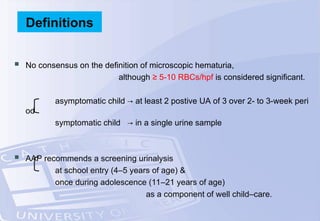
Definitions
 No consensus on the definition of microscopic hematuria,
although ≥ 5-10 RBCs/hpf is considered significant.
asymptomatic child → at least 2 postive UA of 3 over 2- to 3-week peri
od
symptomatic child → in a single urine sample
 AAP recommends a screening urinalysis
at school entry (4–5 years of age) &
once during adolescence (11–21 years of age)
as a component of well child–care.
Definitions
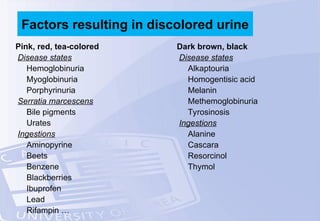
Pink, red, tea-colored
Disease states
Hemoglobinuria
Myoglobinuria
Porphyrinuria
Serratia marcescens
Bile pigments
Urates
Ingestions
Aminopyrine
Beets
Benzene
Blackberries
Ibuprofen
Lead
Rifampin …
Factors resulting in discolored urine
Dark brown, black
Disease states
Alkaptouria
Homogentisic acid
Melanin
Methemoglobinuria
Tyrosinosis
Ingestions
Alanine
Cascara
Resorcinol
Thymol
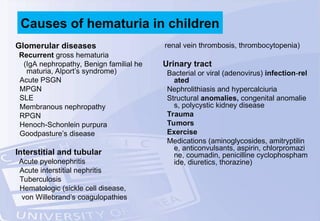
Glomerular diseases
Recurrent gross hematuria
(IgA nephropathy, Benign familial he
maturia, Alport’s syndrome)
Acute PSGN
MPGN
SLE
Membranous nephropathy
RPGN
Henoch-Schonlein purpura
Goodpasture’s disease
Interstitial and tubular
Acute pyelonephritis
Acute interstitial nephritis
Tuberculosis
Hematologic (sickle cell disease,
von Willebrand’s coagulopathies
renal vein thrombosis, thrombocytopenia)
Urinary tract
Bacterial or viral (adenovirus) infection-rel
ated
Nephrolithiasis and hypercalciuria
Structural anomalies, congenital anomalie
s, polycystic kidney disease
Trauma
Tumors
Exercise
Medications (aminoglycosides, amitryptilin
e, anticonvulsants, aspirin, chlorpromazi
ne, coumadin, penicilline cyclophospham
ide, diuretics, thorazine)
Causes of hematuria in children
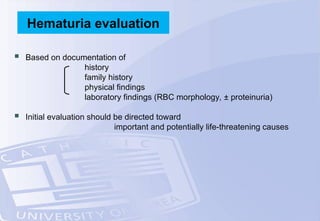
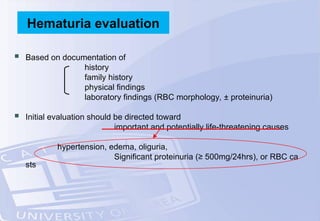
 Based on documentation of
history
family history
physical findings
laboratory findings (RBC morphology, ± proteinuria)
 Initial evaluation should be directed toward
important and potentially life-threatening causes
Hematuria evaluation
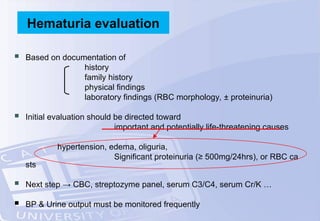
 Based on documentation of
history
family history
physical findings
laboratory findings (RBC morphology, ± proteinuria)
 Initial evaluation should be directed toward
important and potentially life-threatening causes
hypertension, edema, oliguria,
Significant proteinuria (≥ 500mg/24hrs), or RBC ca
sts
Hematuria evaluation
 Based on documentation of
history
family history
physical findings
laboratory findings (RBC morphology, ± proteinuria)
 Initial evaluation should be directed toward
important and potentially life-threatening causes
hypertension, edema, oliguria,
Significant proteinuria (≥ 500mg/24hrs), or RBC ca
sts
 Next step → CBC, streptozyme panel, serum C3/C4, serum Cr/K …
 BP & Urine output must be monitored frequently
Hematuria evaluation
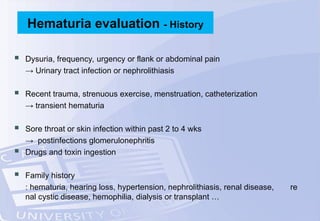
 Dysuria, frequency, urgency or flank or abdominal pain
→ Urinary tract infection or nephrolithiasis
 Recent trauma, strenuous exercise, menstruation, catheterization
→ transient hematuria
 Sore throat or skin infection within past 2 to 4 wks
→ postinfections glomerulonephritis
 Drugs and toxin ingestion
 Family history
: hematuria, hearing loss, hypertension, nephrolithiasis, renal disease, re
nal cystic disease, hemophilia, dialysis or transplant …
Hematuria evaluation - History
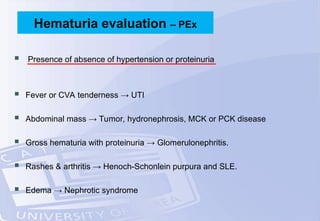
 Presence of absence of hypertension or proteinuria
 Fever or CVA tenderness → UTI
 Abdominal mass → Tumor, hydronephrosis, MCK or PCK disease
 Gross hematuria with proteinuria → Glomerulonephritis.
 Rashes & arthritis → Henoch-Schonlein purpura and SLE.
 Edema → Nephrotic syndrome
Hematuria evaluation – PEx
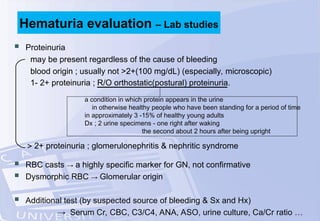
 Proteinuria
may be present regardless of the cause of bleeding
blood origin ; usually not >2+(100 mg/dL) (especially, microscopic)
1- 2+ proteinuria ; R/O orthostatic(postural) proteinuria.
a condition in which protein appears in the urine
in otherwise healthy people who have been standing for a period of time
in approximately 3 -15% of healthy young adults
Dx ; 2 urine specimens - one right after waking
the second about 2 hours after being upright
 2+ proteinuria ; glomerulonephritis & nephritic syndrome
 RBC casts → a highly specific marker for GN, not confirmative
 Dysmorphic RBC → Glomerular origin
 Additional test (by suspected source of bleeding & Sx and Hx)
→ Serum Cr, CBC, C3/C4, ANA, ASO, urine culture, Ca/Cr ratio …
Hematuria evaluation – Lab studies
 By history, physical examination and simple laboratory tests
 Tailoring the evaluation can reduce the discomfort and cost
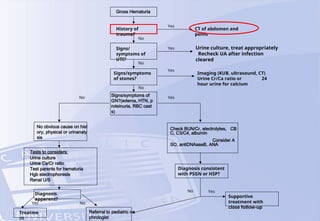
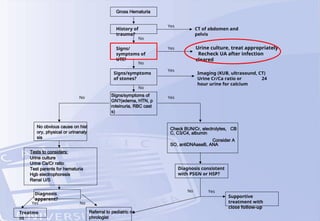
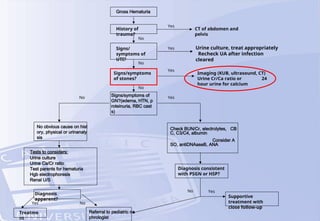
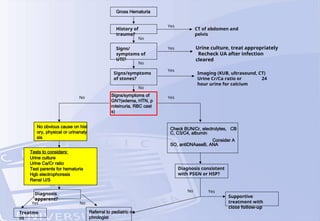
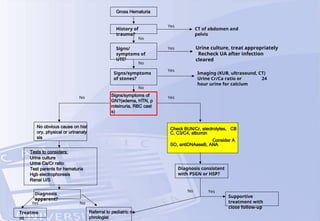
 Diagnostic algorithms for hematuria
Gross hematuria
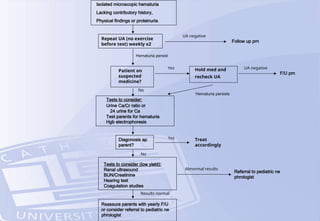
Microscopic hematuria without abnormal findings
Microscopic hematuria with abnormal findings
Diagnostic approach to hematuria
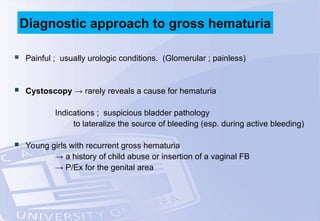
 Painful ; usually urologic conditions. (Glomerular ; painless)
 Cystoscopy → rarely reveals a cause for hematuria
Indications ; suspicious bladder pathology
to lateralize the source of bleeding (esp. during active bleeding)
 Young girls with recurrent gross hematuria
→ a history of child abuse or insertion of a vaginal FB
→ P/Ex for the genital area
Diagnostic approach to gross hematuria
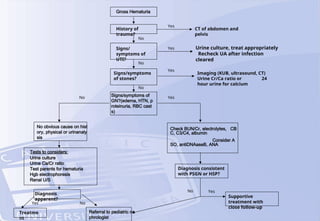
Gross Hematuria
History of
trauma?
Signs/
symptoms of
UTI?
Signs/symptoms
of stones?
Signs/symptoms of
GN?(edema, HTN, p
roteinuria, RBC cast
s)
No Yes
No
No
No
CT of abdomen and
pelvis
Urine culture, treat appropriately
Recheck UA after infection
cleared
Imaging (KUB, ultrasound, CT)
Urine Cr/Ca ratio or 24
hour urine for calcium
Yes
Yes
Yes
No obvious cause on hist
ory, physical or urinanaly
sis
Check BUN/Cr, electrolytes, CB
C, C3/C4, albumin
Consider A
SO, antiDNAaseB, ANA
Tests to considers:
Urine culture
Urine Ca/Cr ratio
Test parents for hematuria
Hgb electrophoresis
Renal U/S
Diagnosis
apparent?
Treatme
nt
Referral to pediatric ne
phrologist
Diagnosis consistent
with PSGN or HSP?
Supportive
treatment with
close follow-up
Yes No
No Yes
Gross Hematuria
History of
trauma?
Signs/
symptoms of
UTI?
Signs/symptoms
of stones?
Signs/symptoms of
GN?(edema, HTN, p
roteinuria, RBC cast
s)
No Yes
No
No
No
CT of abdomen and
pelvis
Urine culture, treat appropriately
Recheck UA after infection
cleared
Imaging (KUB, ultrasound, CT)
Urine Cr/Ca ratio or 24
hour urine for calcium
Yes
Yes
Yes
No obvious cause on hist
ory, physical or urinanaly
sis
Check BUN/Cr, electrolytes, CB
C, C3/C4, albumin
Consider A
SO, antiDNAaseB, ANA
Tests to considers:
Urine culture
Urine Ca/Cr ratio
Test parents for hematuria
Hgb electrophoresis
Renal U/S
Diagnosis
apparent?
Treatme
nt
Referral to pediatric ne
phrologist
Diagnosis consistent
with PSGN or HSP?
Supportive
treatment with
close follow-up
Yes No
No Yes
Gross Hematuria
History of
trauma?
Signs/
symptoms of
UTI?
Signs/symptoms
of stones?
Signs/symptoms of
GN?(edema, HTN, p
roteinuria, RBC cast
s)
No Yes
No
No
No
CT of abdomen and
pelvis
Urine culture, treat appropriately
Recheck UA after infection
cleared
Imaging (KUB, ultrasound, CT)
Urine Cr/Ca ratio or 24
hour urine for calcium
Yes
Yes
Yes
No obvious cause on hist
ory, physical or urinanaly
sis
Check BUN/Cr, electrolytes, CB
C, C3/C4, albumin
Consider A
SO, antiDNAaseB, ANA
Tests to considers:
Urine culture
Urine Ca/Cr ratio
Test parents for hematuria
Hgb electrophoresis
Renal U/S
Diagnosis
apparent?
Treatme
nt
Referral to pediatric ne
phrologist
Diagnosis consistent
with PSGN or HSP?
Supportive
treatment with
close follow-up
Yes No
No Yes
Gross Hematuria
History of
trauma?
Signs/
symptoms of
UTI?
Signs/symptoms
of stones?
Signs/symptoms of
GN?(edema, HTN, p
roteinuria, RBC cast
s)
No Yes
No
No
No
CT of abdomen and
pelvis
Urine culture, treat appropriately
Recheck UA after infection
cleared
Imaging (KUB, ultrasound, CT)
Urine Cr/Ca ratio or 24
hour urine for calcium
Yes
Yes
Yes
No obvious cause on hist
ory, physical or urinanaly
sis
Check BUN/Cr, electrolytes, CB
C, C3/C4, albumin
Consider A
SO, antiDNAaseB, ANA
Tests to considers:
Urine culture
Urine Ca/Cr ratio
Test parents for hematuria
Hgb electrophoresis
Renal U/S
Diagnosis
apparent?
Treatme
nt
Referral to pediatric ne
phrologist
Diagnosis consistent
with PSGN or HSP?
Supportive
treatment with
close follow-up
Yes No
No Yes
Gross Hematuria
History of
trauma?
Signs/
symptoms of
UTI?
Signs/symptoms
of stones?
Signs/symptoms of
GN?(edema, HTN, p
roteinuria, RBC cast
s)
No Yes
No
No
No
CT of abdomen and
pelvis
Urine culture, treat appropriately
Recheck UA after infection
cleared
Imaging (KUB, ultrasound, CT)
Urine Cr/Ca ratio or 24
hour urine for calcium
Yes
Yes
Yes
No obvious cause on hist
ory, physical or urinanaly
sis
Check BUN/Cr, electrolytes, CB
C, C3/C4, albumin
Consider A
SO, antiDNAaseB, ANA
Tests to considers:
Urine culture
Urine Ca/Cr ratio
Test parents for hematuria
Hgb electrophoresis
Renal U/S
Diagnosis
apparent?
Treatme
nt
Referral to pediatric ne
phrologist
Diagnosis consistent
with PSGN or HSP?
Supportive
treatment with
close follow-up
Yes No
No Yes
Gross Hematuria
History of
trauma?
Signs/
symptoms of
UTI?
Signs/symptoms
of stones?
Signs/symptoms of
GN?(edema, HTN, p
roteinuria, RBC cast
s)
No Yes
No
No
No
CT of abdomen and
pelvis
Urine culture, treat appropriately
Recheck UA after infection
cleared
Imaging (KUB, ultrasound, CT)
Urine Cr/Ca ratio or 24
hour urine for calcium
Yes
Yes
Yes
No obvious cause on hist
ory, physical or urinanaly
sis
Check BUN/Cr, electrolytes, CB
C, C3/C4, albumin
Consider A
SO, antiDNAaseB, ANA
Tests to considers:
Urine culture
Urine Ca/Cr ratio
Test parents for hematuria
Hgb electrophoresis
Renal U/S
Diagnosis
apparent?
Treatme
nt
Referral to pediatric ne
phrologist
Diagnosis consistent
with PSGN or HSP?
Supportive
treatment with
close follow-up
Yes No
No Yes
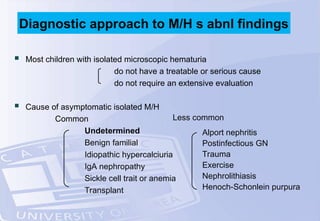
 Most children with isolated microscopic hematuria
do not have a treatable or serious cause
do not require an extensive evaluation
 Cause of asymptomatic isolated M/H
Common
Undetermined
Benign familial
Idiopathic hypercalciuria
IgA nephropathy
Sickle cell trait or anemia
Transplant
Diagnostic approach to M/H s abnl findings
Less common
Alport nephritis
Postinfectious GN
Trauma
Exercise
Nephrolithiasis
Henoch-Schonlein purpura
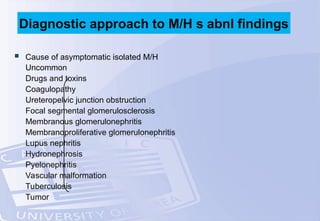
 Cause of asymptomatic isolated M/H
Uncommon
Drugs and toxins
Coagulopathy
Ureteropelvic junction obstruction
Focal segmental glomerulosclerosis
Membranous glomerulonephritis
Membranoproliferative glomerulonephritis
Lupus nephritis
Hydronephrosis
Pyelonephritis
Vascular malformation
Tuberculosis
Tumor
Diagnostic approach to M/H s abnl findings
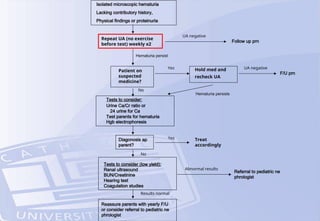
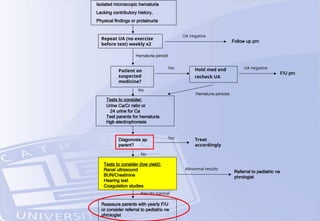
Isolated microscopic hematuria
Lacking contributory history,
Physical findings or proteinuria
Repeat UA (no exercise
before test) weekly x2
Hematuria persist
Follow up prn
UA negative
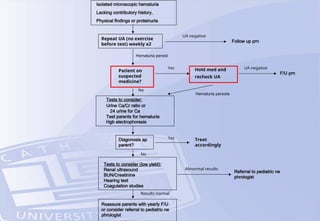
Patient on
suspected
medicine?
Yes Hold med and
recheck UA
F/U prn
UA negative
No
Hematuria persists
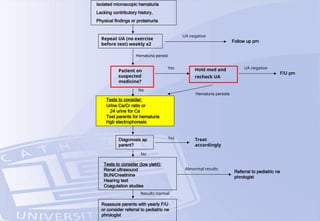
Tests to consider:
Urine Ca/Cr ratio or
24 urine for Ca
Test parents for hematuria
Hgb electrophoresis
Tests to consider (low yield):
Renal ultrasound
BUN/Creatinine
Hearing test
Coagulation studies
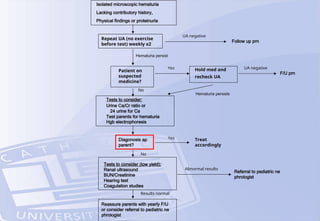
Diagonosis ap
parent?
Reassure parents with yearly F/U
or consider referral to pediatric ne
phrologist
Treat
accordingly
No
Yes
Referral to pediatric ne
phrologist
Abnormal results
Results normal
Isolated microscopic hematuria
Lacking contributory history,
Physical findings or proteinuria
Repeat UA (no exercise
before test) weekly x2
Hematuria persist
Follow up prn
UA negative
Patient on
suspected
medicine?
Yes Hold med and
recheck UA
F/U prn
UA negative
No
Hematuria persists
Tests to consider:
Urine Ca/Cr ratio or
24 urine for Ca
Test parents for hematuria
Hgb electrophoresis
Tests to consider (low yield):
Renal ultrasound
BUN/Creatinine
Hearing test
Coagulation studies
Diagonosis ap
parent?
Reassure parents with yearly F/U
or consider referral to pediatric ne
phrologist
Treat
accordingly
No
Yes
Referral to pediatric ne
phrologist
Abnormal results
Results normal
Isolated microscopic hematuria
Lacking contributory history,
Physical findings or proteinuria
Repeat UA (no exercise
before test) weekly x2
Hematuria persist
Follow up prn
UA negative
Patient on
suspected
medicine?
Yes Hold med and
recheck UA
F/U prn
UA negative
No
Hematuria persists
Tests to consider:
Urine Ca/Cr ratio or
24 urine for Ca
Test parents for hematuria
Hgb electrophoresis
Tests to consider (low yield):
Renal ultrasound
BUN/Creatinine
Hearing test
Coagulation studies
Diagonosis ap
parent?
Reassure parents with yearly F/U
or consider referral to pediatric ne
phrologist
Treat
accordingly
No
Yes
Referral to pediatric ne
phrologist
Abnormal results
Results normal
Isolated microscopic hematuria
Lacking contributory history,
Physical findings or proteinuria
Repeat UA (no exercise
before test) weekly x2
Hematuria persist
Follow up prn
UA negative
Patient on
suspected
medicine?
Yes Hold med and
recheck UA
F/U prn
UA negative
No
Hematuria persists
Tests to consider:
Urine Ca/Cr ratio or
24 urine for Ca
Test parents for hematuria
Hgb electrophoresis
Tests to consider (low yield):
Renal ultrasound
BUN/Creatinine
Hearing test
Coagulation studies
Diagonosis ap
parent?
Reassure parents with yearly F/U
or consider referral to pediatric ne
phrologist
Treat
accordingly
No
Yes
Referral to pediatric ne
phrologist
Abnormal results
Results normal
Isolated microscopic hematuria
Lacking contributory history,
Physical findings or proteinuria
Repeat UA (no exercise
before test) weekly x2
Hematuria persist
Follow up prn
UA negative
Patient on
suspected
medicine?
Yes Hold med and
recheck UA
F/U prn
UA negative
No
Hematuria persists
Tests to consider:
Urine Ca/Cr ratio or
24 urine for Ca
Test parents for hematuria
Hgb electrophoresis
Tests to consider (low yield):
Renal ultrasound
BUN/Creatinine
Hearing test
Coagulation studies
Diagonosis ap
parent?
Reassure parents with yearly F/U
or consider referral to pediatric ne
phrologist
Treat
accordingly
No
Yes
Referral to pediatric ne
phrologist
Abnormal results
Results normal
Isolated microscopic hematuria
Lacking contributory history,
Physical findings or proteinuria
Repeat UA (no exercise
before test) weekly x2
Hematuria persist
Follow up prn
UA negative
Patient on
suspected
medicine?
Yes Hold med and
recheck UA
F/U prn
UA negative
No
Hematuria persists
Tests to consider:
Urine Ca/Cr ratio or
24 urine for Ca
Test parents for hematuria
Hgb electrophoresis
Tests to consider (low yield):
Renal ultrasound
BUN/Creatinine
Hearing test
Coagulation studies
Diagonosis ap
parent?
Reassure parents with yearly F/U
or consider referral to pediatric ne
phrologist
Treat
accordingly
No
Yes
Referral to pediatric ne
phrologist
Abnormal results
Results normal
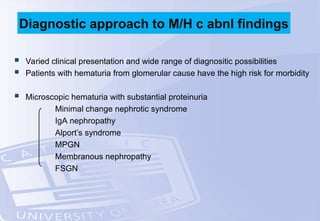
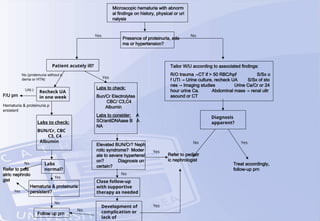
 Varied clinical presentation and wide range of diagnositic possibilities
 Patients with hematuria from glomerular cause have the high risk for morbidity
 Microscopic hematuria with substantial proteinuria
Minimal change nephrotic syndrome
IgA nephropathy
Alport’s syndrome
MPGN
Membranous nephropathy
FSGN
Diagnostic approach to M/H c abnl findings
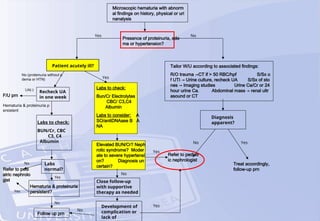
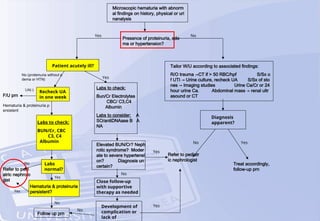
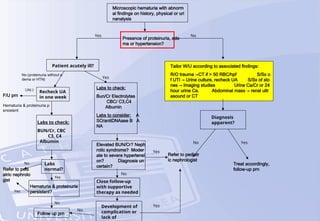
Microscopic hematuria with abnorm
al findings on history, physical or uri
nalysis
Presence of proteinuria, ede
ma or hypertension?
Patient acutely ill?
Recheck UA
in one week
F/U prn
UA(-)
No (proteinuria without e
dema or HTN) Yes
Labs to check:
Bun/Cr Electrolytes
CBC/ C3,C4
Albumin
Labs to consider: A
SO/antiDNAase B A
NA
Refer to pedi
atric nephrolo
gist
Labs to check:
BUN/Cr, CBC
C3, C4
Albumin
Labs
normal?
Hematuria & proteinuria
persistent?
Hematuria & proteinuria p
ersistent
Yes
No
Yes
No
Follow up prn
Elevated BUN/Cr? Neph
rotic syndrome? Moder
ate to severe hypertensi
on? Diagnosis un
certain?
Close follow-up
with supportive
therapy as needed
No
No
Development of
complication or
lack of
Refer to pediatr
ic nephrologist
Treat accordingly,
follow-up prn
Diagnosis
apparent?
Yes No
Yes
Yes
No Yes
Tailor W/U according to associated findings:
R/O trauma →CT if > 50 RBC/hpf S/Sx o
f UTI → Urine culture, recheck UA S/Sx of sto
nes → Imaging studies Urine Ca/Cr or 24
hour urine Ca. Abdominal mass → renal ultr
asound or CT
Microscopic hematuria with abnorm
al findings on history, physical or uri
nanalysis
Presence of proteinuria, ede
ma or hypertension?
Patient acutely ill?
Recheck UA
in one week
F/U prn
UA(-)
No (proteinuria without e
dema or HTN) Yes
Labs to check:
Bun/Cr Electrolytes
CBC/ C3,C4
Albumin
Labs to consider: A
SO/antiDNAase B A
NA
Refer to pedi
atric nephrolo
gist
Labs to check:
BUN/Cr, CBC
C3, C4
Albumin
Labs
normal?
Hematuria & proteinuria
persistent?
Hematuria & proteinuria p
ersistent
Yes
No
Yes
No
Follow up prn
Elevated BUN/Cr? Neph
rotic syndrome? Moder
ate to severe hypertensi
on? Diagnosis un
certain?
Close follow-up
with supportive
therapy as needed
No
No
Development of
complication or
lack of
Refer to pediatr
ic nephrologist
Treat accordingly,
follow-up prn
Diagnosis
apparent?
Yes No
Yes
Yes
No Yes
Tailor W/U according to associated findings:
R/O trauma →CT if > 50 RBC/hpf S/Sx o
f UTI → Urine culture, recheck UA S/Sx of sto
nes → Imaging studies Urine Ca/Cr or 24
hour urine Ca. Abdominal mass → renal ultr
asound or CT
Microscopic hematuria with abnorm
al findings on history, physical or uri
nanalysis
Presence of proteinuria, ede
ma or hypertension?
Patient acutely ill?
Recheck UA
in one week
F/U prn
UA(-)
No (proteinuria without e
dema or HTN) Yes
Labs to check:
Bun/Cr Electrolytes
CBC/ C3,C4
Albumin
Labs to consider: A
SO/antiDNAase B A
NA
Refer to pedi
atric nephrolo
gist
Labs to check:
BUN/Cr, CBC
C3, C4
Albumin
Labs
normal?
Hematuria & proteinuria
persistent?
Hematuria & proteinuria p
ersistent
Yes
No
Yes
No
Follow up prn
Elevated BUN/Cr? Neph
rotic syndrome? Moder
ate to severe hypertensi
on? Diagnosis un
certain?
Close follow-up
with supportive
therapy as needed
No
No
Development of
complication or
lack of
Refer to pediatr
ic nephrologist
Treat accordingly,
follow-up prn
Diagnosis
apparent?
Yes No
Yes
Yes
No Yes
Tailor W/U according to associated findings:
R/O trauma →CT if > 50 RBC/hpf S/Sx o
f UTI → Urine culture, recheck UA S/Sx of sto
nes → Imaging studies Urine Ca/Cr or 24
hour urine Ca. Abdominal mass → renal ultr
asound or CT
Microscopic hematuria with abnorm
al findings on history, physical or uri
nanalysis
Presence of proteinuria, ede
ma or hypertension?
Patient acutely ill?
Recheck UA
in one week
F/U prn
UA(-)
No (proteinuria without e
dema or HTN) Yes
Labs to check:
Bun/Cr Electrolytes
CBC/ C3,C4
Albumin
Labs to consider: A
SO/antiDNAase B A
NA
Refer to pedi
atric nephrolo
gist
Labs to check:
BUN/Cr, CBC
C3, C4
Albumin
Labs
normal?
Hematuria & proteinuria
persistent?
Hematuria & proteinuria p
ersistent
Yes
No
Yes
No
Follow up prn
Elevated BUN/Cr? Neph
rotic syndrome? Moder
ate to severe hypertensi
on? Diagnosis un
certain?
Close follow-up
with supportive
therapy as needed
No
No
Development of
complication or
lack of
Refer to pediatr
ic nephrologist
Treat accordingly,
follow-up prn
Diagnosis
apparent?
Yes No
Yes
Yes
No Yes
Tailor W/U according to associated findings:
R/O trauma →CT if > 50 RBC/hpf S/Sx o
f UTI → Urine culture, recheck UA S/Sx of sto
nes → Imaging studies Urine Ca/Cr or 24
hour urine Ca. Abdominal mass → renal ultr
asound or CT
Microscopic hematuria with abnorm
al findings on history, physical or uri
nanalysis
Presence of proteinuria, ede
ma or hypertension?
Patient acutely ill?
Recheck UA
in one week
F/U prn
UA(-)
No (proteinuria without e
dema or HTN) Yes
Labs to check:
Bun/Cr Electrolytes
CBC/ C3,C4
Albumin
Labs to consider: A
SO/antiDNAase B A
NA
Refer to pedi
atric nephrolo
gist
Labs to check:
BUN/Cr, CBC
C3, C4
Albumin
Labs
normal?
Hematuria & proteinuria
persistent?
Hematuria & proteinuria p
ersistent
Yes
No
Yes
No
Follow up prn
Elevated BUN/Cr? Neph
rotic syndrome? Moder
ate to severe hypertensi
on? Diagnosis un
certain?
Close follow-up
with supportive
therapy as needed
No
No
Development of
complication or
lack of
Refer to pediatr
ic nephrologist
Treat accordingly,
follow-up prn
Diagnosis
apparent?
Yes No
Yes
Yes
No Yes
Tailor W/U according to associated findings:
R/O trauma →CT if > 50 RBC/hpf S/Sx o
f UTI → Urine culture, recheck UA S/Sx of sto
nes → Imaging studies Urine Ca/Cr or 24
hour urine Ca. Abdominal mass → renal ultr
asound or CT
Microscopic hematuria with abnorm
al findings on history, physical or uri
nanalysis
Presence of proteinuria, ede
ma or hypertension?
Patient acutely ill?
Recheck UA
in one week
F/U prn
UA(-)
No (proteinuria without e
dema or HTN) Yes
Labs to check:
Bun/Cr Electrolytes
CBC/ C3,C4
Albumin
Labs to consider: A
SO/antiDNAase B A
NA
Refer to pedi
atric nephrolo
gist
Labs to check:
BUN/Cr, CBC
C3, C4
Albumin
Labs
normal?
Hematuria & proteinuria
persistent?
Hematuria & proteinuria p
ersistent
Yes
No
Yes
No
Follow up prn
Elevated BUN/Cr? Neph
rotic syndrome? Moder
ate to severe hypertensi
on? Diagnosis un
certain?
Close follow-up
with supportive
therapy as needed
No
No
Development of
complication or
lack of
Refer to pediatr
ic nephrologist
Treat accordingly,
follow-up prn
Diagnosis
apparent?
Yes No
Yes
Yes
No Yes
Tailor W/U according to associated findings:
R/O trauma →CT if > 50 RBC/hpf S/Sx o
f UTI → Urine culture, recheck UA S/Sx of sto
nes → Imaging studies Urine Ca/Cr or 24
hour urine Ca. Abdominal mass → renal ultr
asound or CT
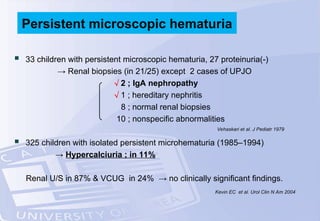
 33 children with persistent microscopic hematuria, 27 proteinuria(-)
→ Renal biopsies (in 21/25) except 2 cases of UPJO
 2 ; IgA nephropathy
 1 ; hereditary nephritis
8 ; normal renal biopsies
10 ; nonspecific abnormalities
 325 children with isolated persistent microhematuria (1985–1994)
→ Hypercalciuria ; in 11%
Renal U/S in 87% & VCUG in 24% → no clinically significant findings.
Persistent microscopic hematuria
Vehaskari et al. J Pediatr 1979
Kevin EC et al. Urol Clin N Am 2004
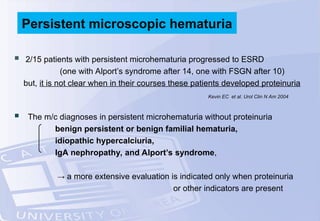
 2/15 patients with persistent microhematuria progressed to ESRD
(one with Alport’s syndrome after 14, one with FSGN after 10)
but, it is not clear when in their courses these patients developed proteinuria
 The m/c diagnoses in persistent microhematuria without proteinuria
benign persistent or benign familial hematuria,
idiopathic hypercalciuria,
IgA nephropathy, and Alport’s syndrome,
→ a more extensive evaluation is indicated only when proteinuria
or other indicators are present
Persistent microscopic hematuria
Kevin EC et al. Urol Clin N Am 2004
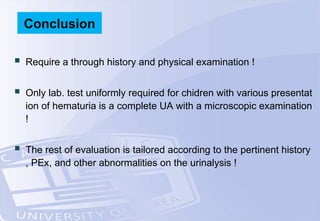
 Require a through history and physical examination !
 Only lab. test uniformly required for chidren with various presentat
ion of hematuria is a complete UA with a microscopic examination
!
 The rest of evaluation is tailored according to the pertinent history
, PEx, and other abnormalities on the urinalysis !
Conclusion
Thank you for your attention
!

Pediatric hematuria evaluation........ppt

  • 1.
  • 2.
     Hematuria isone of the most important signs of renal or bladder disease, but, proteinuria is a more important diagnostic and prognostic finding, except in the case of calculi or malignancies.  Hematuria is almost never a cause of anemia.  49% ; either confirmed or suspected UTI, only 4% ; renal parenchymal disease. Introduction
  • 3.
     The physicianshould ensure that serious conditions are not overlooked, avoid unnecessary and often expensive laboratory studies, reassure the family, provide guidelines for additional studies if there is a change in the child’s course  an approach to the evaluation of hematuria in a child No consensus Introduction
  • 4.
     Gross (Macroscopic)hematuria → blood that can be seen with the naked eye urinary tract ; bright-red, visible clots, or crystals with normal- looking RBCs glomerular; Cola-colored, RBC casts, and dysmorphic RBCs  Microscopic hematuria → detected by a dipstick test during a routine exam. ; should be confirmed by microscopic examination 10 ml of urine, spun at 2000 rpm for 5 min → 9 ml, decanted → sediment, resuspended and examined by microscopy by Hpf (x 400) Definitions
  • 5.
     No consensuson the definition of microscopic hematuria, although ≥ 5-10 RBCs/hpf is considered significant. asymptomatic child → at least 2 postive UA of 3 over 2- to 3-week peri od symptomatic child → in a single urine sample  AAP recommends a screening urinalysis at school entry (4–5 years of age) & once during adolescence (11–21 years of age) as a component of well child–care. Definitions
  • 6.
    Pink, red, tea-colored Diseasestates Hemoglobinuria Myoglobinuria Porphyrinuria Serratia marcescens Bile pigments Urates Ingestions Aminopyrine Beets Benzene Blackberries Ibuprofen Lead Rifampin … Factors resulting in discolored urine Dark brown, black Disease states Alkaptouria Homogentisic acid Melanin Methemoglobinuria Tyrosinosis Ingestions Alanine Cascara Resorcinol Thymol
  • 7.
    Glomerular diseases Recurrent grosshematuria (IgA nephropathy, Benign familial he maturia, Alport’s syndrome) Acute PSGN MPGN SLE Membranous nephropathy RPGN Henoch-Schonlein purpura Goodpasture’s disease Interstitial and tubular Acute pyelonephritis Acute interstitial nephritis Tuberculosis Hematologic (sickle cell disease, von Willebrand’s coagulopathies renal vein thrombosis, thrombocytopenia) Urinary tract Bacterial or viral (adenovirus) infection-rel ated Nephrolithiasis and hypercalciuria Structural anomalies, congenital anomalie s, polycystic kidney disease Trauma Tumors Exercise Medications (aminoglycosides, amitryptilin e, anticonvulsants, aspirin, chlorpromazi ne, coumadin, penicilline cyclophospham ide, diuretics, thorazine) Causes of hematuria in children
  • 8.
     Based ondocumentation of history family history physical findings laboratory findings (RBC morphology, ± proteinuria)  Initial evaluation should be directed toward important and potentially life-threatening causes Hematuria evaluation
  • 9.
     Based ondocumentation of history family history physical findings laboratory findings (RBC morphology, ± proteinuria)  Initial evaluation should be directed toward important and potentially life-threatening causes hypertension, edema, oliguria, Significant proteinuria (≥ 500mg/24hrs), or RBC ca sts Hematuria evaluation
  • 10.
     Based ondocumentation of history family history physical findings laboratory findings (RBC morphology, ± proteinuria)  Initial evaluation should be directed toward important and potentially life-threatening causes hypertension, edema, oliguria, Significant proteinuria (≥ 500mg/24hrs), or RBC ca sts  Next step → CBC, streptozyme panel, serum C3/C4, serum Cr/K …  BP & Urine output must be monitored frequently Hematuria evaluation
  • 11.
     Dysuria, frequency,urgency or flank or abdominal pain → Urinary tract infection or nephrolithiasis  Recent trauma, strenuous exercise, menstruation, catheterization → transient hematuria  Sore throat or skin infection within past 2 to 4 wks → postinfections glomerulonephritis  Drugs and toxin ingestion  Family history : hematuria, hearing loss, hypertension, nephrolithiasis, renal disease, re nal cystic disease, hemophilia, dialysis or transplant … Hematuria evaluation - History
  • 12.
     Presence ofabsence of hypertension or proteinuria  Fever or CVA tenderness → UTI  Abdominal mass → Tumor, hydronephrosis, MCK or PCK disease  Gross hematuria with proteinuria → Glomerulonephritis.  Rashes & arthritis → Henoch-Schonlein purpura and SLE.  Edema → Nephrotic syndrome Hematuria evaluation – PEx
  • 13.
     Proteinuria may bepresent regardless of the cause of bleeding blood origin ; usually not >2+(100 mg/dL) (especially, microscopic) 1- 2+ proteinuria ; R/O orthostatic(postural) proteinuria. a condition in which protein appears in the urine in otherwise healthy people who have been standing for a period of time in approximately 3 -15% of healthy young adults Dx ; 2 urine specimens - one right after waking the second about 2 hours after being upright  2+ proteinuria ; glomerulonephritis & nephritic syndrome  RBC casts → a highly specific marker for GN, not confirmative  Dysmorphic RBC → Glomerular origin  Additional test (by suspected source of bleeding & Sx and Hx) → Serum Cr, CBC, C3/C4, ANA, ASO, urine culture, Ca/Cr ratio … Hematuria evaluation – Lab studies
  • 14.
     By history,physical examination and simple laboratory tests  Tailoring the evaluation can reduce the discomfort and cost  Diagnostic algorithms for hematuria Gross hematuria Microscopic hematuria without abnormal findings Microscopic hematuria with abnormal findings Diagnostic approach to hematuria
  • 15.
     Painful ;usually urologic conditions. (Glomerular ; painless)  Cystoscopy → rarely reveals a cause for hematuria Indications ; suspicious bladder pathology to lateralize the source of bleeding (esp. during active bleeding)  Young girls with recurrent gross hematuria → a history of child abuse or insertion of a vaginal FB → P/Ex for the genital area Diagnostic approach to gross hematuria
  • 16.
    Gross Hematuria History of trauma? Signs/ symptomsof UTI? Signs/symptoms of stones? Signs/symptoms of GN?(edema, HTN, p roteinuria, RBC cast s) No Yes No No No CT of abdomen and pelvis Urine culture, treat appropriately Recheck UA after infection cleared Imaging (KUB, ultrasound, CT) Urine Cr/Ca ratio or 24 hour urine for calcium Yes Yes Yes No obvious cause on hist ory, physical or urinanaly sis Check BUN/Cr, electrolytes, CB C, C3/C4, albumin Consider A SO, antiDNAaseB, ANA Tests to considers: Urine culture Urine Ca/Cr ratio Test parents for hematuria Hgb electrophoresis Renal U/S Diagnosis apparent? Treatme nt Referral to pediatric ne phrologist Diagnosis consistent with PSGN or HSP? Supportive treatment with close follow-up Yes No No Yes
  • 17.
    Gross Hematuria History of trauma? Signs/ symptomsof UTI? Signs/symptoms of stones? Signs/symptoms of GN?(edema, HTN, p roteinuria, RBC cast s) No Yes No No No CT of abdomen and pelvis Urine culture, treat appropriately Recheck UA after infection cleared Imaging (KUB, ultrasound, CT) Urine Cr/Ca ratio or 24 hour urine for calcium Yes Yes Yes No obvious cause on hist ory, physical or urinanaly sis Check BUN/Cr, electrolytes, CB C, C3/C4, albumin Consider A SO, antiDNAaseB, ANA Tests to considers: Urine culture Urine Ca/Cr ratio Test parents for hematuria Hgb electrophoresis Renal U/S Diagnosis apparent? Treatme nt Referral to pediatric ne phrologist Diagnosis consistent with PSGN or HSP? Supportive treatment with close follow-up Yes No No Yes
  • 18.
    Gross Hematuria History of trauma? Signs/ symptomsof UTI? Signs/symptoms of stones? Signs/symptoms of GN?(edema, HTN, p roteinuria, RBC cast s) No Yes No No No CT of abdomen and pelvis Urine culture, treat appropriately Recheck UA after infection cleared Imaging (KUB, ultrasound, CT) Urine Cr/Ca ratio or 24 hour urine for calcium Yes Yes Yes No obvious cause on hist ory, physical or urinanaly sis Check BUN/Cr, electrolytes, CB C, C3/C4, albumin Consider A SO, antiDNAaseB, ANA Tests to considers: Urine culture Urine Ca/Cr ratio Test parents for hematuria Hgb electrophoresis Renal U/S Diagnosis apparent? Treatme nt Referral to pediatric ne phrologist Diagnosis consistent with PSGN or HSP? Supportive treatment with close follow-up Yes No No Yes
  • 19.
    Gross Hematuria History of trauma? Signs/ symptomsof UTI? Signs/symptoms of stones? Signs/symptoms of GN?(edema, HTN, p roteinuria, RBC cast s) No Yes No No No CT of abdomen and pelvis Urine culture, treat appropriately Recheck UA after infection cleared Imaging (KUB, ultrasound, CT) Urine Cr/Ca ratio or 24 hour urine for calcium Yes Yes Yes No obvious cause on hist ory, physical or urinanaly sis Check BUN/Cr, electrolytes, CB C, C3/C4, albumin Consider A SO, antiDNAaseB, ANA Tests to considers: Urine culture Urine Ca/Cr ratio Test parents for hematuria Hgb electrophoresis Renal U/S Diagnosis apparent? Treatme nt Referral to pediatric ne phrologist Diagnosis consistent with PSGN or HSP? Supportive treatment with close follow-up Yes No No Yes
  • 20.
    Gross Hematuria History of trauma? Signs/ symptomsof UTI? Signs/symptoms of stones? Signs/symptoms of GN?(edema, HTN, p roteinuria, RBC cast s) No Yes No No No CT of abdomen and pelvis Urine culture, treat appropriately Recheck UA after infection cleared Imaging (KUB, ultrasound, CT) Urine Cr/Ca ratio or 24 hour urine for calcium Yes Yes Yes No obvious cause on hist ory, physical or urinanaly sis Check BUN/Cr, electrolytes, CB C, C3/C4, albumin Consider A SO, antiDNAaseB, ANA Tests to considers: Urine culture Urine Ca/Cr ratio Test parents for hematuria Hgb electrophoresis Renal U/S Diagnosis apparent? Treatme nt Referral to pediatric ne phrologist Diagnosis consistent with PSGN or HSP? Supportive treatment with close follow-up Yes No No Yes
  • 21.
    Gross Hematuria History of trauma? Signs/ symptomsof UTI? Signs/symptoms of stones? Signs/symptoms of GN?(edema, HTN, p roteinuria, RBC cast s) No Yes No No No CT of abdomen and pelvis Urine culture, treat appropriately Recheck UA after infection cleared Imaging (KUB, ultrasound, CT) Urine Cr/Ca ratio or 24 hour urine for calcium Yes Yes Yes No obvious cause on hist ory, physical or urinanaly sis Check BUN/Cr, electrolytes, CB C, C3/C4, albumin Consider A SO, antiDNAaseB, ANA Tests to considers: Urine culture Urine Ca/Cr ratio Test parents for hematuria Hgb electrophoresis Renal U/S Diagnosis apparent? Treatme nt Referral to pediatric ne phrologist Diagnosis consistent with PSGN or HSP? Supportive treatment with close follow-up Yes No No Yes
  • 22.
     Most childrenwith isolated microscopic hematuria do not have a treatable or serious cause do not require an extensive evaluation  Cause of asymptomatic isolated M/H Common Undetermined Benign familial Idiopathic hypercalciuria IgA nephropathy Sickle cell trait or anemia Transplant Diagnostic approach to M/H s abnl findings Less common Alport nephritis Postinfectious GN Trauma Exercise Nephrolithiasis Henoch-Schonlein purpura
  • 23.
     Cause ofasymptomatic isolated M/H Uncommon Drugs and toxins Coagulopathy Ureteropelvic junction obstruction Focal segmental glomerulosclerosis Membranous glomerulonephritis Membranoproliferative glomerulonephritis Lupus nephritis Hydronephrosis Pyelonephritis Vascular malformation Tuberculosis Tumor Diagnostic approach to M/H s abnl findings
  • 24.
    Isolated microscopic hematuria Lackingcontributory history, Physical findings or proteinuria Repeat UA (no exercise before test) weekly x2 Hematuria persist Follow up prn UA negative Patient on suspected medicine? Yes Hold med and recheck UA F/U prn UA negative No Hematuria persists Tests to consider: Urine Ca/Cr ratio or 24 urine for Ca Test parents for hematuria Hgb electrophoresis Tests to consider (low yield): Renal ultrasound BUN/Creatinine Hearing test Coagulation studies Diagonosis ap parent? Reassure parents with yearly F/U or consider referral to pediatric ne phrologist Treat accordingly No Yes Referral to pediatric ne phrologist Abnormal results Results normal
  • 25.
    Isolated microscopic hematuria Lackingcontributory history, Physical findings or proteinuria Repeat UA (no exercise before test) weekly x2 Hematuria persist Follow up prn UA negative Patient on suspected medicine? Yes Hold med and recheck UA F/U prn UA negative No Hematuria persists Tests to consider: Urine Ca/Cr ratio or 24 urine for Ca Test parents for hematuria Hgb electrophoresis Tests to consider (low yield): Renal ultrasound BUN/Creatinine Hearing test Coagulation studies Diagonosis ap parent? Reassure parents with yearly F/U or consider referral to pediatric ne phrologist Treat accordingly No Yes Referral to pediatric ne phrologist Abnormal results Results normal
  • 26.
    Isolated microscopic hematuria Lackingcontributory history, Physical findings or proteinuria Repeat UA (no exercise before test) weekly x2 Hematuria persist Follow up prn UA negative Patient on suspected medicine? Yes Hold med and recheck UA F/U prn UA negative No Hematuria persists Tests to consider: Urine Ca/Cr ratio or 24 urine for Ca Test parents for hematuria Hgb electrophoresis Tests to consider (low yield): Renal ultrasound BUN/Creatinine Hearing test Coagulation studies Diagonosis ap parent? Reassure parents with yearly F/U or consider referral to pediatric ne phrologist Treat accordingly No Yes Referral to pediatric ne phrologist Abnormal results Results normal
  • 27.
    Isolated microscopic hematuria Lackingcontributory history, Physical findings or proteinuria Repeat UA (no exercise before test) weekly x2 Hematuria persist Follow up prn UA negative Patient on suspected medicine? Yes Hold med and recheck UA F/U prn UA negative No Hematuria persists Tests to consider: Urine Ca/Cr ratio or 24 urine for Ca Test parents for hematuria Hgb electrophoresis Tests to consider (low yield): Renal ultrasound BUN/Creatinine Hearing test Coagulation studies Diagonosis ap parent? Reassure parents with yearly F/U or consider referral to pediatric ne phrologist Treat accordingly No Yes Referral to pediatric ne phrologist Abnormal results Results normal
  • 28.
    Isolated microscopic hematuria Lackingcontributory history, Physical findings or proteinuria Repeat UA (no exercise before test) weekly x2 Hematuria persist Follow up prn UA negative Patient on suspected medicine? Yes Hold med and recheck UA F/U prn UA negative No Hematuria persists Tests to consider: Urine Ca/Cr ratio or 24 urine for Ca Test parents for hematuria Hgb electrophoresis Tests to consider (low yield): Renal ultrasound BUN/Creatinine Hearing test Coagulation studies Diagonosis ap parent? Reassure parents with yearly F/U or consider referral to pediatric ne phrologist Treat accordingly No Yes Referral to pediatric ne phrologist Abnormal results Results normal
  • 29.
    Isolated microscopic hematuria Lackingcontributory history, Physical findings or proteinuria Repeat UA (no exercise before test) weekly x2 Hematuria persist Follow up prn UA negative Patient on suspected medicine? Yes Hold med and recheck UA F/U prn UA negative No Hematuria persists Tests to consider: Urine Ca/Cr ratio or 24 urine for Ca Test parents for hematuria Hgb electrophoresis Tests to consider (low yield): Renal ultrasound BUN/Creatinine Hearing test Coagulation studies Diagonosis ap parent? Reassure parents with yearly F/U or consider referral to pediatric ne phrologist Treat accordingly No Yes Referral to pediatric ne phrologist Abnormal results Results normal
  • 30.
     Varied clinicalpresentation and wide range of diagnositic possibilities  Patients with hematuria from glomerular cause have the high risk for morbidity  Microscopic hematuria with substantial proteinuria Minimal change nephrotic syndrome IgA nephropathy Alport’s syndrome MPGN Membranous nephropathy FSGN Diagnostic approach to M/H c abnl findings
  • 31.
    Microscopic hematuria withabnorm al findings on history, physical or uri nalysis Presence of proteinuria, ede ma or hypertension? Patient acutely ill? Recheck UA in one week F/U prn UA(-) No (proteinuria without e dema or HTN) Yes Labs to check: Bun/Cr Electrolytes CBC/ C3,C4 Albumin Labs to consider: A SO/antiDNAase B A NA Refer to pedi atric nephrolo gist Labs to check: BUN/Cr, CBC C3, C4 Albumin Labs normal? Hematuria & proteinuria persistent? Hematuria & proteinuria p ersistent Yes No Yes No Follow up prn Elevated BUN/Cr? Neph rotic syndrome? Moder ate to severe hypertensi on? Diagnosis un certain? Close follow-up with supportive therapy as needed No No Development of complication or lack of Refer to pediatr ic nephrologist Treat accordingly, follow-up prn Diagnosis apparent? Yes No Yes Yes No Yes Tailor W/U according to associated findings: R/O trauma →CT if > 50 RBC/hpf S/Sx o f UTI → Urine culture, recheck UA S/Sx of sto nes → Imaging studies Urine Ca/Cr or 24 hour urine Ca. Abdominal mass → renal ultr asound or CT
  • 32.
    Microscopic hematuria withabnorm al findings on history, physical or uri nanalysis Presence of proteinuria, ede ma or hypertension? Patient acutely ill? Recheck UA in one week F/U prn UA(-) No (proteinuria without e dema or HTN) Yes Labs to check: Bun/Cr Electrolytes CBC/ C3,C4 Albumin Labs to consider: A SO/antiDNAase B A NA Refer to pedi atric nephrolo gist Labs to check: BUN/Cr, CBC C3, C4 Albumin Labs normal? Hematuria & proteinuria persistent? Hematuria & proteinuria p ersistent Yes No Yes No Follow up prn Elevated BUN/Cr? Neph rotic syndrome? Moder ate to severe hypertensi on? Diagnosis un certain? Close follow-up with supportive therapy as needed No No Development of complication or lack of Refer to pediatr ic nephrologist Treat accordingly, follow-up prn Diagnosis apparent? Yes No Yes Yes No Yes Tailor W/U according to associated findings: R/O trauma →CT if > 50 RBC/hpf S/Sx o f UTI → Urine culture, recheck UA S/Sx of sto nes → Imaging studies Urine Ca/Cr or 24 hour urine Ca. Abdominal mass → renal ultr asound or CT
  • 33.
    Microscopic hematuria withabnorm al findings on history, physical or uri nanalysis Presence of proteinuria, ede ma or hypertension? Patient acutely ill? Recheck UA in one week F/U prn UA(-) No (proteinuria without e dema or HTN) Yes Labs to check: Bun/Cr Electrolytes CBC/ C3,C4 Albumin Labs to consider: A SO/antiDNAase B A NA Refer to pedi atric nephrolo gist Labs to check: BUN/Cr, CBC C3, C4 Albumin Labs normal? Hematuria & proteinuria persistent? Hematuria & proteinuria p ersistent Yes No Yes No Follow up prn Elevated BUN/Cr? Neph rotic syndrome? Moder ate to severe hypertensi on? Diagnosis un certain? Close follow-up with supportive therapy as needed No No Development of complication or lack of Refer to pediatr ic nephrologist Treat accordingly, follow-up prn Diagnosis apparent? Yes No Yes Yes No Yes Tailor W/U according to associated findings: R/O trauma →CT if > 50 RBC/hpf S/Sx o f UTI → Urine culture, recheck UA S/Sx of sto nes → Imaging studies Urine Ca/Cr or 24 hour urine Ca. Abdominal mass → renal ultr asound or CT
  • 34.
    Microscopic hematuria withabnorm al findings on history, physical or uri nanalysis Presence of proteinuria, ede ma or hypertension? Patient acutely ill? Recheck UA in one week F/U prn UA(-) No (proteinuria without e dema or HTN) Yes Labs to check: Bun/Cr Electrolytes CBC/ C3,C4 Albumin Labs to consider: A SO/antiDNAase B A NA Refer to pedi atric nephrolo gist Labs to check: BUN/Cr, CBC C3, C4 Albumin Labs normal? Hematuria & proteinuria persistent? Hematuria & proteinuria p ersistent Yes No Yes No Follow up prn Elevated BUN/Cr? Neph rotic syndrome? Moder ate to severe hypertensi on? Diagnosis un certain? Close follow-up with supportive therapy as needed No No Development of complication or lack of Refer to pediatr ic nephrologist Treat accordingly, follow-up prn Diagnosis apparent? Yes No Yes Yes No Yes Tailor W/U according to associated findings: R/O trauma →CT if > 50 RBC/hpf S/Sx o f UTI → Urine culture, recheck UA S/Sx of sto nes → Imaging studies Urine Ca/Cr or 24 hour urine Ca. Abdominal mass → renal ultr asound or CT
  • 35.
    Microscopic hematuria withabnorm al findings on history, physical or uri nanalysis Presence of proteinuria, ede ma or hypertension? Patient acutely ill? Recheck UA in one week F/U prn UA(-) No (proteinuria without e dema or HTN) Yes Labs to check: Bun/Cr Electrolytes CBC/ C3,C4 Albumin Labs to consider: A SO/antiDNAase B A NA Refer to pedi atric nephrolo gist Labs to check: BUN/Cr, CBC C3, C4 Albumin Labs normal? Hematuria & proteinuria persistent? Hematuria & proteinuria p ersistent Yes No Yes No Follow up prn Elevated BUN/Cr? Neph rotic syndrome? Moder ate to severe hypertensi on? Diagnosis un certain? Close follow-up with supportive therapy as needed No No Development of complication or lack of Refer to pediatr ic nephrologist Treat accordingly, follow-up prn Diagnosis apparent? Yes No Yes Yes No Yes Tailor W/U according to associated findings: R/O trauma →CT if > 50 RBC/hpf S/Sx o f UTI → Urine culture, recheck UA S/Sx of sto nes → Imaging studies Urine Ca/Cr or 24 hour urine Ca. Abdominal mass → renal ultr asound or CT
  • 36.
    Microscopic hematuria withabnorm al findings on history, physical or uri nanalysis Presence of proteinuria, ede ma or hypertension? Patient acutely ill? Recheck UA in one week F/U prn UA(-) No (proteinuria without e dema or HTN) Yes Labs to check: Bun/Cr Electrolytes CBC/ C3,C4 Albumin Labs to consider: A SO/antiDNAase B A NA Refer to pedi atric nephrolo gist Labs to check: BUN/Cr, CBC C3, C4 Albumin Labs normal? Hematuria & proteinuria persistent? Hematuria & proteinuria p ersistent Yes No Yes No Follow up prn Elevated BUN/Cr? Neph rotic syndrome? Moder ate to severe hypertensi on? Diagnosis un certain? Close follow-up with supportive therapy as needed No No Development of complication or lack of Refer to pediatr ic nephrologist Treat accordingly, follow-up prn Diagnosis apparent? Yes No Yes Yes No Yes Tailor W/U according to associated findings: R/O trauma →CT if > 50 RBC/hpf S/Sx o f UTI → Urine culture, recheck UA S/Sx of sto nes → Imaging studies Urine Ca/Cr or 24 hour urine Ca. Abdominal mass → renal ultr asound or CT
  • 37.
     33 childrenwith persistent microscopic hematuria, 27 proteinuria(-) → Renal biopsies (in 21/25) except 2 cases of UPJO  2 ; IgA nephropathy  1 ; hereditary nephritis 8 ; normal renal biopsies 10 ; nonspecific abnormalities  325 children with isolated persistent microhematuria (1985–1994) → Hypercalciuria ; in 11% Renal U/S in 87% & VCUG in 24% → no clinically significant findings. Persistent microscopic hematuria Vehaskari et al. J Pediatr 1979 Kevin EC et al. Urol Clin N Am 2004
  • 38.
     2/15 patientswith persistent microhematuria progressed to ESRD (one with Alport’s syndrome after 14, one with FSGN after 10) but, it is not clear when in their courses these patients developed proteinuria  The m/c diagnoses in persistent microhematuria without proteinuria benign persistent or benign familial hematuria, idiopathic hypercalciuria, IgA nephropathy, and Alport’s syndrome, → a more extensive evaluation is indicated only when proteinuria or other indicators are present Persistent microscopic hematuria Kevin EC et al. Urol Clin N Am 2004
  • 39.
     Require athrough history and physical examination !  Only lab. test uniformly required for chidren with various presentat ion of hematuria is a complete UA with a microscopic examination !  The rest of evaluation is tailored according to the pertinent history , PEx, and other abnormalities on the urinalysis ! Conclusion
  • 40.
    Thank you foryour attention !

Editor's Notes

  • #8 The initial evaluation should be directed toward important and potentially life-threatening causes of hematuria in any child who has any of the following in addition to hematuria: hypertension, edema oliguria, significant proteinuria (more than 500 mg per 24 hours), or RBC casts. These causes include acute postinfectious glomerulonephritis (PIGN), Henoch-Schonlien purpura (HSP), hemolytic-uremic syndrome, membranoproliferative glomerulonephritis, IgA nephropathy, and focal segmental glomerulosclerosis. This initial evaluation should include a complete blood count (hemolytic-uremic syndrome), throat culture, streptozyme panel and serum C3 concentration (acute poststreptococcal glomerulonephritis), and serum creatinine and potassium concentrations (if there is renal insufficiency). All children with macroscopic hematuria require renal ultrasound upon presentation. Pending the results of these tests, the child’s blood pressure and urine output must be monitored frequently.
  • #9 The initial evaluation should be directed toward important and potentially life-threatening causes of hematuria in any child who has any of the following in addition to hematuria: hypertension, edema oliguria, significant proteinuria (more than 500 mg per 24 hours), or RBC casts. These causes include acute postinfectious glomerulonephritis (PIGN), Henoch-Schonlien purpura (HSP), hemolytic-uremic syndrome, membranoproliferative glomerulonephritis, IgA nephropathy, and focal segmental glomerulosclerosis. This initial evaluation should include a complete blood count (hemolytic-uremic syndrome), throat culture, streptozyme panel and serum C3 concentration (acute poststreptococcal glomerulonephritis), and serum creatinine and potassium concentrations (if there is renal insufficiency). All children with macroscopic hematuria require renal ultrasound upon presentation. Pending the results of these tests, the child’s blood pressure and urine output must be monitored frequently.
  • #10 The initial evaluation should be directed toward important and potentially life-threatening causes of hematuria in any child who has any of the following in addition to hematuria: hypertension, edema oliguria, significant proteinuria (more than 500 mg per 24 hours), or RBC casts. These causes include acute postinfectious glomerulonephritis (PIGN), Henoch-Schonlien purpura (HSP), hemolytic-uremic syndrome, membranoproliferative glomerulonephritis, IgA nephropathy, and focal segmental glomerulosclerosis. This initial evaluation should include a complete blood count (hemolytic-uremic syndrome), throat culture, streptozyme panel and serum C3 concentration (acute poststreptococcal glomerulonephritis), and serum creatinine and potassium concentrations (if there is renal insufficiency). All children with macroscopic hematuria require renal ultrasound upon presentation. Pending the results of these tests, the child’s blood pressure and urine output must be monitored frequently.
  • #11 The initial evaluation should be directed toward important and potentially life-threatening causes of hematuria in any child who has any of the following in addition to hematuria: hypertension, edema oliguria, significant proteinuria (more than 500 mg per 24 hours), or RBC casts. These causes include acute postinfectious glomerulonephritis (PIGN), Henoch-Schonlien purpura (HSP), hemolytic-uremic syndrome, membranoproliferative glomerulonephritis, IgA nephropathy, and focal segmental glomerulosclerosis. This initial evaluation should include a complete blood count (hemolytic-uremic syndrome), throat culture, streptozyme panel and serum C3 concentration (acute poststreptococcal glomerulonephritis), and serum creatinine and potassium concentrations (if there is renal insufficiency). All children with macroscopic hematuria require renal ultrasound upon presentation. Pending the results of these tests, the child’s blood pressure and urine output must be monitored frequently.
  • #12 If the blood pressure is normal and the patient is passing normal amounts of urine, it is unlikely that microscopic hematuria, whatever its cause, warrants immediate treatment.
  • #13 Only two diagnostic tests are required for a child with microscopic hematuria: (1) a test for proteinuria and (2) a microscopic examination of the urine for RBCs and RBC casts Additional test by suspected source of bleeding and patient symptom and history
  • #14 If the blood pressure is normal and the patient is passing normal amounts of urine, it is unlikely that microscopic hematuria, whatever its cause, warrants immediate treatment.
  • #15 If the blood pressure is normal and the patient is passing normal amounts of urine, it is unlikely that microscopic hematuria, whatever its cause, warrants immediate treatment.
  • #22 If the blood pressure is normal and the patient is passing normal amounts of urine, it is unlikely that microscopic hematuria, whatever its cause, warrants immediate treatment.
  • #23 If the blood pressure is normal and the patient is passing normal amounts of urine, it is unlikely that microscopic hematuria, whatever its cause, warrants immediate treatment.
  • #30 If the blood pressure is normal and the patient is passing normal amounts of urine, it is unlikely that microscopic hematuria, whatever its cause, warrants immediate treatment.