PEAK OIL
How does the theory of declining global oil production affect
           the large integrated oil companies?


             Chris Tringham | Dan Fisico
FADING INDUSTRY?

• Cheaper   alternatives
• Higher   prices
• Government        intervention
 • UK April   1 petrol duty increased, $1.89 per litre
WHAT IS IT?

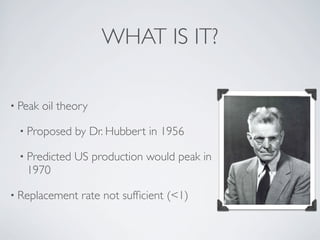
• Peak   oil theory

 • Proposed     by Dr. Hubbert in 1956

 • Predicted    US production would peak in
   1970

• Replacement    rate not sufficient (<1)
HUBBERT CURVE
PROVE IT


* Bespoke Investment Group
MEXICAN OIL
FORECAST
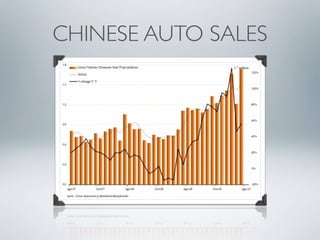
CHINESE AUTO SALES
* International Energy Agency Key Stats 2009 Report
THE ‘SUPERMAJORS’
THE MULTINATIONAL
             ENTERPRISES
NGO’s                      Government Owned
Supermajors                Non “OECD” companies
• ExxonMobil               • Saudi Aramco (Saudi Arabia)
• Royal Dutch Shell        • JSC Gazprom (Russia)
• British Petroleum (BP)   • CNPC (China)
• Chevron                  • NIOC (Iran)
• Conoco Phillips          • PDVSA (Venezuela)
• Total S.A.               • Petrobras (Brazil)
                           • Petronas (Malaysia)
OECD                       OPEC
MNE ACTIONS
• NGO’shave condensed as companies merge to benefit from
 economies of scale and hedge price volatility

• Diversification   and shift of core competencies
 • Renewable     energy developments

 • New   extraction technologies

 • Development     of alternate fuel sources (biofuels, ethanol)

• Prevailing   importance of lobbying
STRATEGIC DECISIONS
• Resource seeking

  – Resources becoming more scarce, looking for new deposits –
    prevailing strategy

• Strategic asset seeking

  – Companies favour locations because they benefit from government
    support. Ex. China in Africa

• Efficiency seeking

  – Development of more efficient extraction technologies and
    methods
• Positive   Impacts

 • Encouraging   the development of cleaner alternative sources of
   energy

 • Developing    new technologies that can have applications in other
   fields

• Negative    Impacts

 • Aggressive, self-interested   behavior by companies to secure their
   future

 • Overstating   reserves and overvaluing prices
PORTER’S 5 FORCES
• Threat of suppliers – high

  – Backward integration has connected directly with natural
    resources. Can’t move back any further.

• Threat of substitutes – high

  – Alternative energy sources are growing in variety, abundance and
    efficiency	


  – Total S.A. announced in 2008 they were shifting more focus to
    nuclear production
PORTER’S 5 FORCES
• Threat of competitors – low to medium

  – Sharing oligopolistic price-setting powers
  – Potential Co-operation & mergers increase powers
• Threat of new entrants – low

  – Astronomical start-up and capital costs

• Threat of buyers – low to medium

  – Buyers highly dependent on product, but many efforts underway to
    reduce dependency
CHINA IN AFRICA
• Cooperation     between MNE, host and home nations

 • China   takes little moral responsibility

 • Necessity   because of growth at home?

 • Confusion   in China because of state owned enterprises

• Supermajors    subject to laws of home country

 • MNE’swilling to sacrifice morals to agree with host country, but
  home country is not
CHINA IN AFRICA
• No   evidence of long-term sustainability
  •   Aimed at securing natural resources.
  •   Creating mini China’s throughout Africa
  •   Thus hostility among locals
• Researchwould indicate exploitation of host nation by MNE is
 counter productive
  • Inward   investment
      - Supports local economy - raises labor skill and productivity
      - Expands scale of production
CANADIAN IMPLICATIONS
Oil as a valuable commodity

 • Privatization   vs. Nationalization
 • Short-term    gains vs. long-term stability
 • Sinopec    – Chinese state companies
     • Willing   to pay premium prices for a stake
       -   50% partners in Northern Lights Project
       -   9% stake in Syncrude Canada Ltd.
       -   Several other Chinese investments
THANK YOU


ANY QUESTIONS?

Peak oil

  • 1.
    PEAK OIL How doesthe theory of declining global oil production affect the large integrated oil companies? Chris Tringham | Dan Fisico
  • 2.
    FADING INDUSTRY? • Cheaper alternatives • Higher prices • Government intervention • UK April 1 petrol duty increased, $1.89 per litre
  • 3.
    WHAT IS IT? •Peak oil theory • Proposed by Dr. Hubbert in 1956 • Predicted US production would peak in 1970 • Replacement rate not sufficient (<1)
  • 4.
  • 6.
    PROVE IT * BespokeInvestment Group
  • 7.
  • 8.
  • 9.
  • 10.
    * International EnergyAgency Key Stats 2009 Report
  • 11.
    * International EnergyAgency Key Stats 2009 Report
  • 13.
  • 14.
    THE MULTINATIONAL ENTERPRISES NGO’s Government Owned Supermajors Non “OECD” companies • ExxonMobil • Saudi Aramco (Saudi Arabia) • Royal Dutch Shell • JSC Gazprom (Russia) • British Petroleum (BP) • CNPC (China) • Chevron • NIOC (Iran) • Conoco Phillips • PDVSA (Venezuela) • Total S.A. • Petrobras (Brazil) • Petronas (Malaysia) OECD OPEC
  • 15.
    MNE ACTIONS • NGO’shavecondensed as companies merge to benefit from economies of scale and hedge price volatility • Diversification and shift of core competencies • Renewable energy developments • New extraction technologies • Development of alternate fuel sources (biofuels, ethanol) • Prevailing importance of lobbying
  • 16.
    STRATEGIC DECISIONS • Resourceseeking – Resources becoming more scarce, looking for new deposits – prevailing strategy • Strategic asset seeking – Companies favour locations because they benefit from government support. Ex. China in Africa • Efficiency seeking – Development of more efficient extraction technologies and methods
  • 17.
    • Positive Impacts • Encouraging the development of cleaner alternative sources of energy • Developing new technologies that can have applications in other fields • Negative Impacts • Aggressive, self-interested behavior by companies to secure their future • Overstating reserves and overvaluing prices
  • 18.
    PORTER’S 5 FORCES •Threat of suppliers – high – Backward integration has connected directly with natural resources. Can’t move back any further. • Threat of substitutes – high – Alternative energy sources are growing in variety, abundance and efficiency – Total S.A. announced in 2008 they were shifting more focus to nuclear production
  • 19.
    PORTER’S 5 FORCES •Threat of competitors – low to medium – Sharing oligopolistic price-setting powers – Potential Co-operation & mergers increase powers • Threat of new entrants – low – Astronomical start-up and capital costs • Threat of buyers – low to medium – Buyers highly dependent on product, but many efforts underway to reduce dependency
  • 20.
    CHINA IN AFRICA •Cooperation between MNE, host and home nations • China takes little moral responsibility • Necessity because of growth at home? • Confusion in China because of state owned enterprises • Supermajors subject to laws of home country • MNE’swilling to sacrifice morals to agree with host country, but home country is not
  • 21.
    CHINA IN AFRICA •No evidence of long-term sustainability • Aimed at securing natural resources. • Creating mini China’s throughout Africa • Thus hostility among locals • Researchwould indicate exploitation of host nation by MNE is counter productive • Inward investment - Supports local economy - raises labor skill and productivity - Expands scale of production
  • 22.
    CANADIAN IMPLICATIONS Oil asa valuable commodity • Privatization vs. Nationalization • Short-term gains vs. long-term stability • Sinopec – Chinese state companies • Willing to pay premium prices for a stake - 50% partners in Northern Lights Project - 9% stake in Syncrude Canada Ltd. - Several other Chinese investments
  • 23.