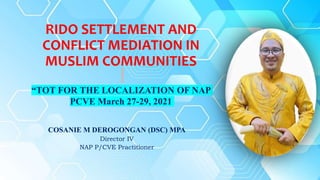
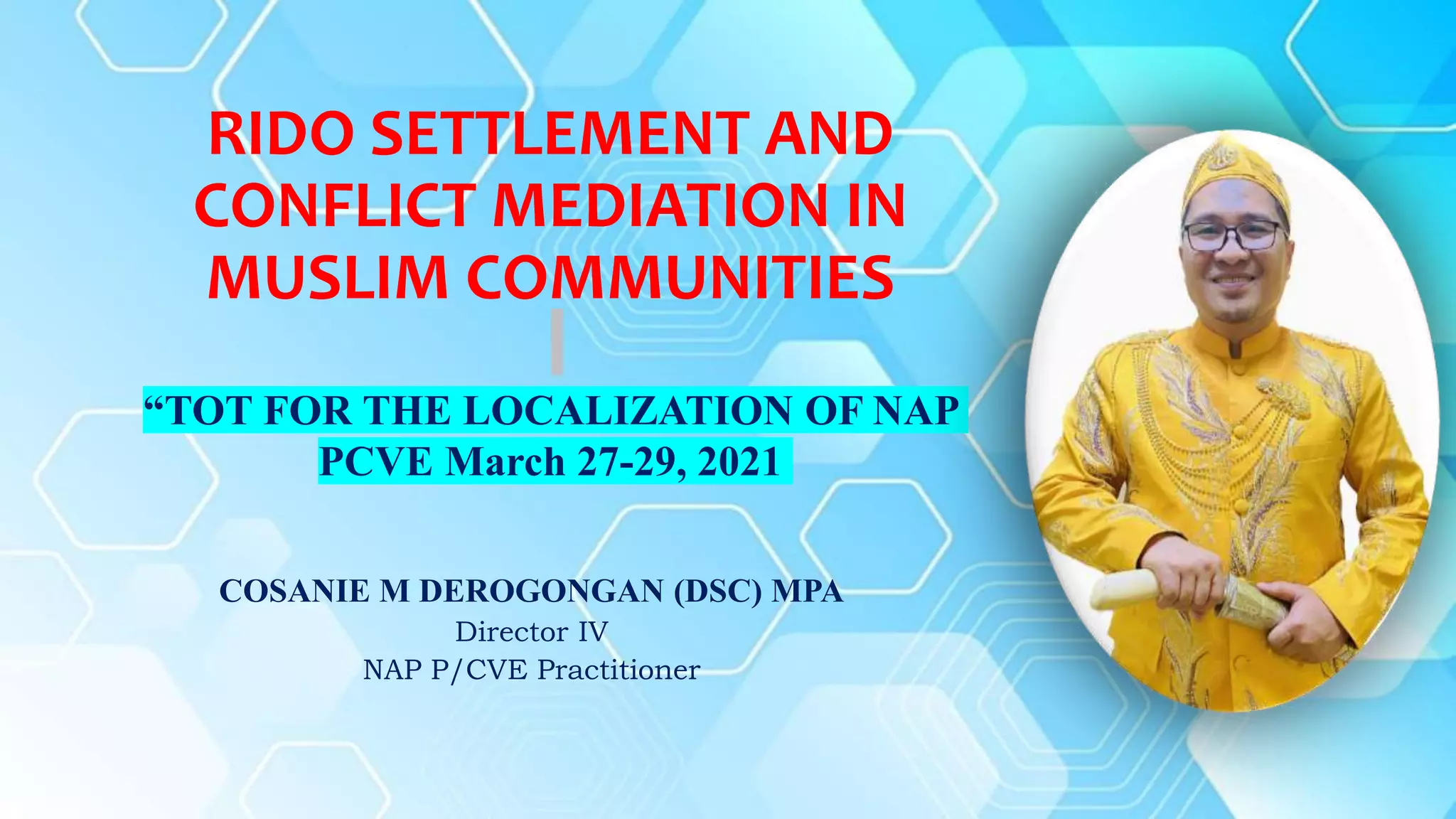
RIDO SETTLEMENT AND
CONFLICT MEDIATION IN
MUSLIM COMMUNITIES
“TOT FOR THE LOCALIZATION OF NAP
PCVE March 27-29, 2021
COSANIE M DEROGONGAN (DSC) MPA
Director IV
NAP P/CVE Practitioner
‫وبركاته‬ ‫هللا‬ ‫ورحمة‬ ‫عليكم‬ ‫السالم‬
May Peace and Blessings from the Almighty Be
Upon Us All.
“Verily, PEACE is among the
names of Allah he has placed on
the earth, so spread it between
yourselves” Hadith
Objectives
 Provide an overview of family feud (RIDO).
 Understand the causes of family feuds (RIDO)
 Examine the traditional approach in resolving RIDO disputes.
 Assess the effectiveness and limitations of existing methods of
family feud settlement and conflict mediation.
Identify best practices and challenges in promoting alternative
dispute resolution mechanisms
 Recommend practical strategies for enhancing conflict resolution
skills.
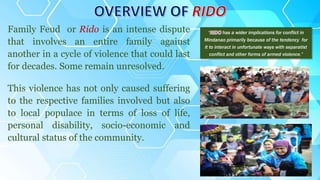
Family Feud or Rido is an intense dispute
that involves an entire family against
another in a cycle of violence that could last
for decades. Some remain unresolved.
This violence has not only caused suffering
to the respective families involved but also
to local populace in terms of loss of life,
personal disability, socio-economic and
cultural status of the community.
“ has a wider implications for conflict in
Mindanao primarily because of the tendency for
it to interact in unfortunate ways with separatist
conflict and other forms of armed violence.”
Meaning
Causes
Consequences
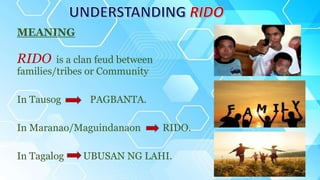
RIDO is a clan feud between
families/tribes or Community
In Tausog PAGBANTA.
In Maranao/Maguindanaon RIDO.
In Tagalog UBUSAN NG LAHI.
MEANING
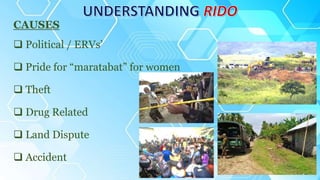
 Political / ERVs’
 Pride for “maratabat” for women
 Theft
 Drug Related
 Land Dispute
 Accident
CAUSES
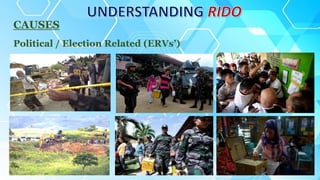
Political / Election Related (ERVs’)
CAUSES
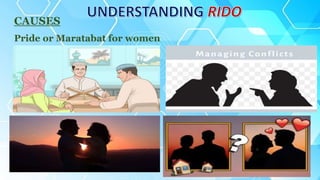
Pride or Maratabat for women
CAUSES
Theft
CAUSES
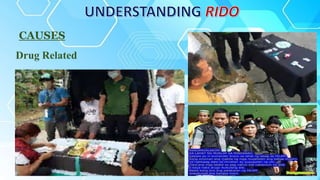
Drug Related
CAUSES
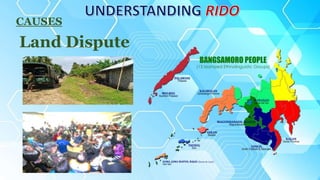
Land Dispute
CAUSES
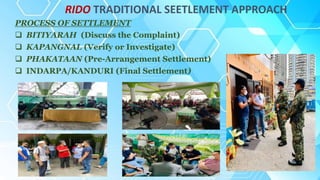
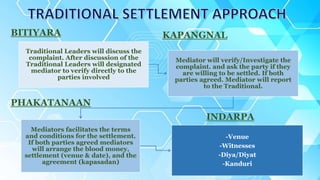
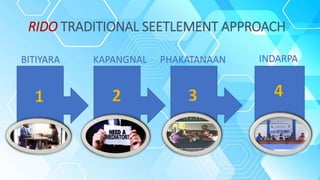
PROCESS OF SETTLEMENT
 BITIYARAH (Discuss the Complaint)
 KAPANGNAL (Verify or Investigate)
 PHAKATAAN (Pre-Arrangement Settlement)
 INDARPA/KANDURI (Final Settlement)
RIDO TRADITIONAL SEETLEMENT APPROACH
Traditional Leaders will discuss the
complaint. After discussion of the
Traditional Leaders will designated
mediator to verify directly to the
parties involved
Mediator will verify/Investigate the
complaint. and ask the party if they
are willing to be settled. If both
parties agreed. Mediator will report
to the Traditional.
Mediators facilitates the terms
and conditions for the settlement.
If both parties agreed mediators
will arrange the blood money,
settlement (venue & date), and the
agreement (kapasadan)
-Venue
-Witnesses
-Diya/Diyat
-Kanduri
PHAKATANAAN
KAPANGNAL
BITIYARA
INDARPA
RIDO TRADITIONAL SEETLEMENT APPROACH
ssss
PHAKATANAAN
BITIYARA KAPANGNAL INDARPA
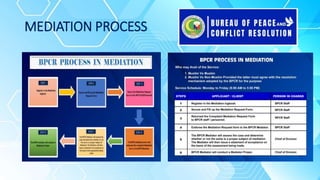
MEDIATION PROCESS
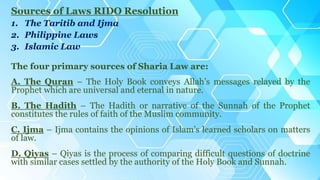
Sources of Laws RIDO Resolution
1. The Taritib and Ijma
2. Philippine Laws
3. Islamic Law
The four primary sources of Sharia Law are:
A. The Quran – The Holy Book conveys Allah’s messages relayed by the
Prophet which are universal and eternal in nature.
B. The Hadith – The Hadith or narrative of the Sunnah of the Prophet
constitutes the rules of faith of the Muslim community.
C. Ijma – Ijma contains the opinions of Islam’s learned scholars on matters
of law.
D. Qiyas – Qiyas is the process of comparing difficult questions of doctrine
with similar cases settled by the authority of the Holy Book and Sunnah.
Indeed, Allah commands you to render trusts to whom they are due and when you judge between people to judge with
justice. Excellent is that which Allah instructs you. Indeed, Allah is ever Hearing and Seeing. (Qur’an 4:58)
The Qur’an is “a guidance for mankind… and the distinction (between right and wrong).” (Qur’an 2:185)
“Do not boycott one another, do not turn away from one another, do not hate one another and do not envy one
another. Be slaves of Allah, brothers. And it is not allowed for a Muslim to avoid another for more than three
days.”
“Whoever forsakes his brother for a year, it is as if he has shed his blood.”
“One of the things which brings forgiveness is making your fellow Muslim happy.” (Ali Abi Talib R.A)
“Whoever made peace between two, Allah gives him for every word the [reward of] freeing a slave.” (Anas R.A)
"None of you will believe until you love for your brother what you love for yourself."
HADITH
QUR’AN
Primary sources of Sharia Law
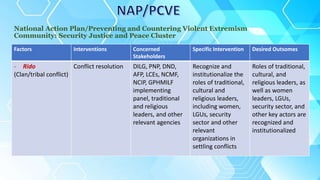
National Action Plan/Preventing and Countering Violent Extremism
Community: Security Justice and Peace Cluster
Factors Interventions Concerned
Stakeholders
Specific Intervention Desired Outsomes
- Rido
(Clan/tribal conflict)
Conflict resolution DILG, PNP, DND,
AFP, LCEs, NCMF,
NCIP, GPHMILF
implementing
panel, traditional
and religious
leaders, and other
relevant agencies
Recognize and
institutionalize the
roles of traditional,
cultural and
religious leaders,
including women,
LGUs, security
sector and other
relevant
organizations in
settling conflicts
Roles of traditional,
cultural, and
religious leaders, as
well as women
leaders, LGUs,
security sector, and
other key actors are
recognized and
institutionalized
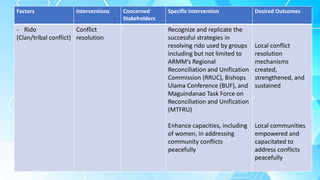
Factors Interventions Concerned
Stakeholders
Specific Intervention Desired Outcomes
- Rido
(Clan/tribal conflict)
Conflict
resolution
Recognize and replicate the
successful strategies in
resolving rido used by groups
including but not limited to
ARMM’s Regional
Reconciliation and Unification
Commission (RRUC), Bishops
Ulama Conference (BUF), and
Maguindanao Task Force on
Reconciliation and Unification
(MTFRU)
Enhance capacities, including
of women, in addressing
community conflicts
peacefully
Local conflict
resolution
mechanisms
created,
strengthened, and
sustained
Local communities
empowered and
capacitated to
address conflicts
peacefully
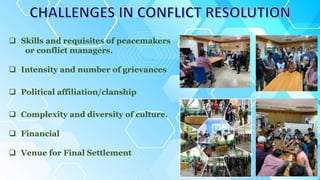
 Skills and requisites of peacemakers
or conflict managers.
 Intensity and number of grievances
 Political affiliation/clanship
 Complexity and diversity of culture.
 Financial
 Venue for Final Settlement
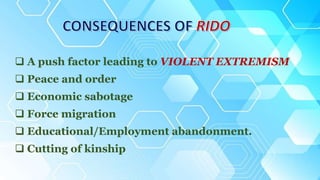
 A push factor leading to VIOLENT EXTREMISM
 Peace and order
 Economic sabotage
 Force migration
 Educational/Employment abandonment.
 Cutting of kinship
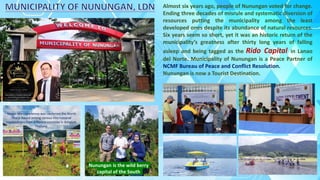
Almost six years ago, people of Nunungan voted for change.
Ending three decades of misrule and systematic diversion of
resources putting the municipality among the least
developed ones despite its abundance of natural resources.
Six years seem so short, yet it was an historic return of the
municipality’s greatness after thirty long years of falling
asleep and being tagged as the Rido Capital in Lanao
del Norte. Municipality of Nunungan is a Peace Partner of
NCMF Bureau of Peace and Conflict Resolution.
Nunungan is now a Tourist Destination.
Nunungan is the wild berry
capital of the South
Mayor Marcos Mamay was conferred the World
Peace Award among various international
organizations from different countries in Bangkok,
Thailand.
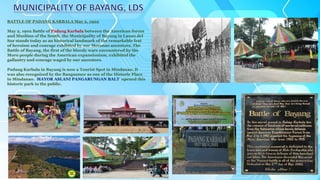
BATTLE OF PADANG KARBALA May 2, 1902
May 2, 1902 Battle of Padang Karbala between the American forces
and Muslims of the South, the Municipality of Bayang in Lanao del
Sur stands today as an historical landmark of the remarkable feat
of heroism and courage exhibited by our Meranao ancestors. The
Battle of Bayang, the first of the bloody wars encountered by the
Moro people during the American expansionism, exhibited the
gallantry and courage waged by our ancestors.
Padang Karbala in Bayang is now a Tourist Spot in Mindanao. It
was also recognized by the Bangsamor as one of the Historic Place
in Mindanao. MAYOR ASLANI PANGARUNGAN BALT opened this
historic park to the public.
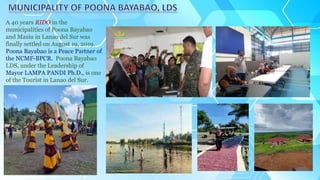
A 40 years RIDO in the
municipalities of Poona Bayabao
and Masiu in Lanao del Sur was
finally settled on August 19, 2019.
Poona Bayabao is a Peace Partner of
the NCMF-BPCR. Poona Bayabao
LDS, under the Leadership of
Mayor LAMPA PANDI Ph.D., is one
of the Tourist in Lanao del Sur.
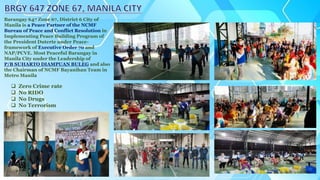
Barangay 647 Zone 67, District 6 City of
Manila is a Peace Partner of the NCMF
Bureau of Peace and Conflict Resolution in
Implementing Peace Building Program of
the President Duterte under Peace-
framework of Executive Order 70 and
NAP/PCVE. Most Peaceful Barangay in
Manila City under the Leadership of
P/B SUHARTO DIAMPUAN BULEG and also
the Chairman of NCMF Bayanihan Team in
Metro Manila
 Zero Crime rate
 No RIDO
 No Drugs
 No Terrorism
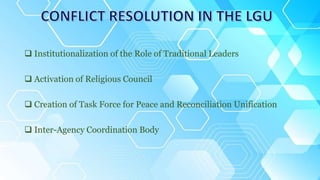
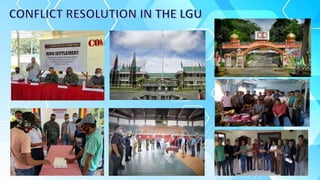
 Institutionalization of the Role of Traditional Leaders
 Activation of Religious Council
 Creation of Task Force for Peace and Reconciliation Unification
 Inter-Agency Coordination Body
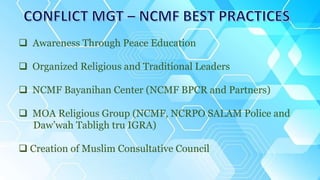
 Awareness Through Peace Education
 Organized Religious and Traditional Leaders
 NCMF Bayanihan Center (NCMF BPCR and Partners)
 MOA Religious Group (NCMF, NCRPO SALAM Police and
Daw’wah Tabligh tru IGRA)
 Creation of Muslim Consultative Council
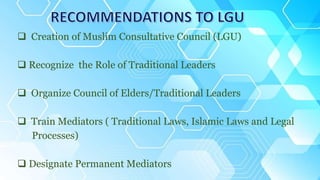
 Creation of Muslim Consultative Council (LGU)
 Recognize the Role of Traditional Leaders
 Organize Council of Elders/Traditional Leaders
 Train Mediators ( Traditional Laws, Islamic Laws and Legal
Processes)
 Designate Permanent Mediators
JazzakAllahu Khairan..
The roots of RIDO, including socio-economic
marginalization, poverty, and lack of education,
provide an environment in which extremist groups
can exploit and manipulate individuals or groups
seeking out alternative ways to address their
grievances. Family feuds can be an avenue or push
factor to radicalization leading to violent extremism.
When rido result in violent extremism, national
security is at risk. Extremist groups use the
opportunity to infiltrate communities, promising to
provide justice and even using it as a recruiting tool.
The presence of extremist groups can threaten the
stability and security of the region, as well as impact
the social and economic well-being of the
population.
COSANIE M DEROGONGAN (DSC) MPA
Director IV
Sultan a Masiricampo

PCVE RIDO LECTURES.pptx

  • 1.
    RIDO SETTLEMENT AND CONFLICTMEDIATION IN MUSLIM COMMUNITIES “TOT FOR THE LOCALIZATION OF NAP PCVE March 27-29, 2021 COSANIE M DEROGONGAN (DSC) MPA Director IV NAP P/CVE Practitioner
  • 2.
    ‫وبركاته‬ ‫هللا‬ ‫ورحمة‬‫عليكم‬ ‫السالم‬ May Peace and Blessings from the Almighty Be Upon Us All. “Verily, PEACE is among the names of Allah he has placed on the earth, so spread it between yourselves” Hadith
  • 3.
    Objectives  Provide anoverview of family feud (RIDO).  Understand the causes of family feuds (RIDO)  Examine the traditional approach in resolving RIDO disputes.  Assess the effectiveness and limitations of existing methods of family feud settlement and conflict mediation. Identify best practices and challenges in promoting alternative dispute resolution mechanisms  Recommend practical strategies for enhancing conflict resolution skills.
  • 5.
    Family Feud orRido is an intense dispute that involves an entire family against another in a cycle of violence that could last for decades. Some remain unresolved. This violence has not only caused suffering to the respective families involved but also to local populace in terms of loss of life, personal disability, socio-economic and cultural status of the community. “ has a wider implications for conflict in Mindanao primarily because of the tendency for it to interact in unfortunate ways with separatist conflict and other forms of armed violence.”
  • 6.
  • 7.
    RIDO is aclan feud between families/tribes or Community In Tausog PAGBANTA. In Maranao/Maguindanaon RIDO. In Tagalog UBUSAN NG LAHI. MEANING
  • 8.
     Political /ERVs’  Pride for “maratabat” for women  Theft  Drug Related  Land Dispute  Accident CAUSES
  • 9.
    Political / ElectionRelated (ERVs’) CAUSES
  • 10.
    Pride or Maratabatfor women CAUSES
  • 11.
  • 12.
  • 13.
  • 14.
    PROCESS OF SETTLEMENT BITIYARAH (Discuss the Complaint)  KAPANGNAL (Verify or Investigate)  PHAKATAAN (Pre-Arrangement Settlement)  INDARPA/KANDURI (Final Settlement) RIDO TRADITIONAL SEETLEMENT APPROACH
  • 15.
    Traditional Leaders willdiscuss the complaint. After discussion of the Traditional Leaders will designated mediator to verify directly to the parties involved Mediator will verify/Investigate the complaint. and ask the party if they are willing to be settled. If both parties agreed. Mediator will report to the Traditional. Mediators facilitates the terms and conditions for the settlement. If both parties agreed mediators will arrange the blood money, settlement (venue & date), and the agreement (kapasadan) -Venue -Witnesses -Diya/Diyat -Kanduri PHAKATANAAN KAPANGNAL BITIYARA INDARPA
  • 16.
    RIDO TRADITIONAL SEETLEMENTAPPROACH ssss PHAKATANAAN BITIYARA KAPANGNAL INDARPA
  • 17.
  • 18.
    Sources of LawsRIDO Resolution 1. The Taritib and Ijma 2. Philippine Laws 3. Islamic Law The four primary sources of Sharia Law are: A. The Quran – The Holy Book conveys Allah’s messages relayed by the Prophet which are universal and eternal in nature. B. The Hadith – The Hadith or narrative of the Sunnah of the Prophet constitutes the rules of faith of the Muslim community. C. Ijma – Ijma contains the opinions of Islam’s learned scholars on matters of law. D. Qiyas – Qiyas is the process of comparing difficult questions of doctrine with similar cases settled by the authority of the Holy Book and Sunnah.
  • 19.
    Indeed, Allah commandsyou to render trusts to whom they are due and when you judge between people to judge with justice. Excellent is that which Allah instructs you. Indeed, Allah is ever Hearing and Seeing. (Qur’an 4:58) The Qur’an is “a guidance for mankind… and the distinction (between right and wrong).” (Qur’an 2:185) “Do not boycott one another, do not turn away from one another, do not hate one another and do not envy one another. Be slaves of Allah, brothers. And it is not allowed for a Muslim to avoid another for more than three days.” “Whoever forsakes his brother for a year, it is as if he has shed his blood.” “One of the things which brings forgiveness is making your fellow Muslim happy.” (Ali Abi Talib R.A) “Whoever made peace between two, Allah gives him for every word the [reward of] freeing a slave.” (Anas R.A) "None of you will believe until you love for your brother what you love for yourself." HADITH QUR’AN Primary sources of Sharia Law
  • 20.
    National Action Plan/Preventingand Countering Violent Extremism Community: Security Justice and Peace Cluster Factors Interventions Concerned Stakeholders Specific Intervention Desired Outsomes - Rido (Clan/tribal conflict) Conflict resolution DILG, PNP, DND, AFP, LCEs, NCMF, NCIP, GPHMILF implementing panel, traditional and religious leaders, and other relevant agencies Recognize and institutionalize the roles of traditional, cultural and religious leaders, including women, LGUs, security sector and other relevant organizations in settling conflicts Roles of traditional, cultural, and religious leaders, as well as women leaders, LGUs, security sector, and other key actors are recognized and institutionalized
  • 21.
    Factors Interventions Concerned Stakeholders SpecificIntervention Desired Outcomes - Rido (Clan/tribal conflict) Conflict resolution Recognize and replicate the successful strategies in resolving rido used by groups including but not limited to ARMM’s Regional Reconciliation and Unification Commission (RRUC), Bishops Ulama Conference (BUF), and Maguindanao Task Force on Reconciliation and Unification (MTFRU) Enhance capacities, including of women, in addressing community conflicts peacefully Local conflict resolution mechanisms created, strengthened, and sustained Local communities empowered and capacitated to address conflicts peacefully
  • 22.
     Skills andrequisites of peacemakers or conflict managers.  Intensity and number of grievances  Political affiliation/clanship  Complexity and diversity of culture.  Financial  Venue for Final Settlement
  • 23.
     A pushfactor leading to VIOLENT EXTREMISM  Peace and order  Economic sabotage  Force migration  Educational/Employment abandonment.  Cutting of kinship
  • 24.
    Almost six yearsago, people of Nunungan voted for change. Ending three decades of misrule and systematic diversion of resources putting the municipality among the least developed ones despite its abundance of natural resources. Six years seem so short, yet it was an historic return of the municipality’s greatness after thirty long years of falling asleep and being tagged as the Rido Capital in Lanao del Norte. Municipality of Nunungan is a Peace Partner of NCMF Bureau of Peace and Conflict Resolution. Nunungan is now a Tourist Destination. Nunungan is the wild berry capital of the South Mayor Marcos Mamay was conferred the World Peace Award among various international organizations from different countries in Bangkok, Thailand.
  • 25.
    BATTLE OF PADANGKARBALA May 2, 1902 May 2, 1902 Battle of Padang Karbala between the American forces and Muslims of the South, the Municipality of Bayang in Lanao del Sur stands today as an historical landmark of the remarkable feat of heroism and courage exhibited by our Meranao ancestors. The Battle of Bayang, the first of the bloody wars encountered by the Moro people during the American expansionism, exhibited the gallantry and courage waged by our ancestors. Padang Karbala in Bayang is now a Tourist Spot in Mindanao. It was also recognized by the Bangsamor as one of the Historic Place in Mindanao. MAYOR ASLANI PANGARUNGAN BALT opened this historic park to the public.
  • 26.
    A 40 yearsRIDO in the municipalities of Poona Bayabao and Masiu in Lanao del Sur was finally settled on August 19, 2019. Poona Bayabao is a Peace Partner of the NCMF-BPCR. Poona Bayabao LDS, under the Leadership of Mayor LAMPA PANDI Ph.D., is one of the Tourist in Lanao del Sur.
  • 27.
    Barangay 647 Zone67, District 6 City of Manila is a Peace Partner of the NCMF Bureau of Peace and Conflict Resolution in Implementing Peace Building Program of the President Duterte under Peace- framework of Executive Order 70 and NAP/PCVE. Most Peaceful Barangay in Manila City under the Leadership of P/B SUHARTO DIAMPUAN BULEG and also the Chairman of NCMF Bayanihan Team in Metro Manila  Zero Crime rate  No RIDO  No Drugs  No Terrorism
  • 28.
     Institutionalization ofthe Role of Traditional Leaders  Activation of Religious Council  Creation of Task Force for Peace and Reconciliation Unification  Inter-Agency Coordination Body
  • 29.
     Awareness ThroughPeace Education  Organized Religious and Traditional Leaders  NCMF Bayanihan Center (NCMF BPCR and Partners)  MOA Religious Group (NCMF, NCRPO SALAM Police and Daw’wah Tabligh tru IGRA)  Creation of Muslim Consultative Council
  • 31.
     Creation ofMuslim Consultative Council (LGU)  Recognize the Role of Traditional Leaders  Organize Council of Elders/Traditional Leaders  Train Mediators ( Traditional Laws, Islamic Laws and Legal Processes)  Designate Permanent Mediators
  • 32.
  • 33.
    The roots ofRIDO, including socio-economic marginalization, poverty, and lack of education, provide an environment in which extremist groups can exploit and manipulate individuals or groups seeking out alternative ways to address their grievances. Family feuds can be an avenue or push factor to radicalization leading to violent extremism. When rido result in violent extremism, national security is at risk. Extremist groups use the opportunity to infiltrate communities, promising to provide justice and even using it as a recruiting tool. The presence of extremist groups can threaten the stability and security of the region, as well as impact the social and economic well-being of the population. COSANIE M DEROGONGAN (DSC) MPA Director IV Sultan a Masiricampo