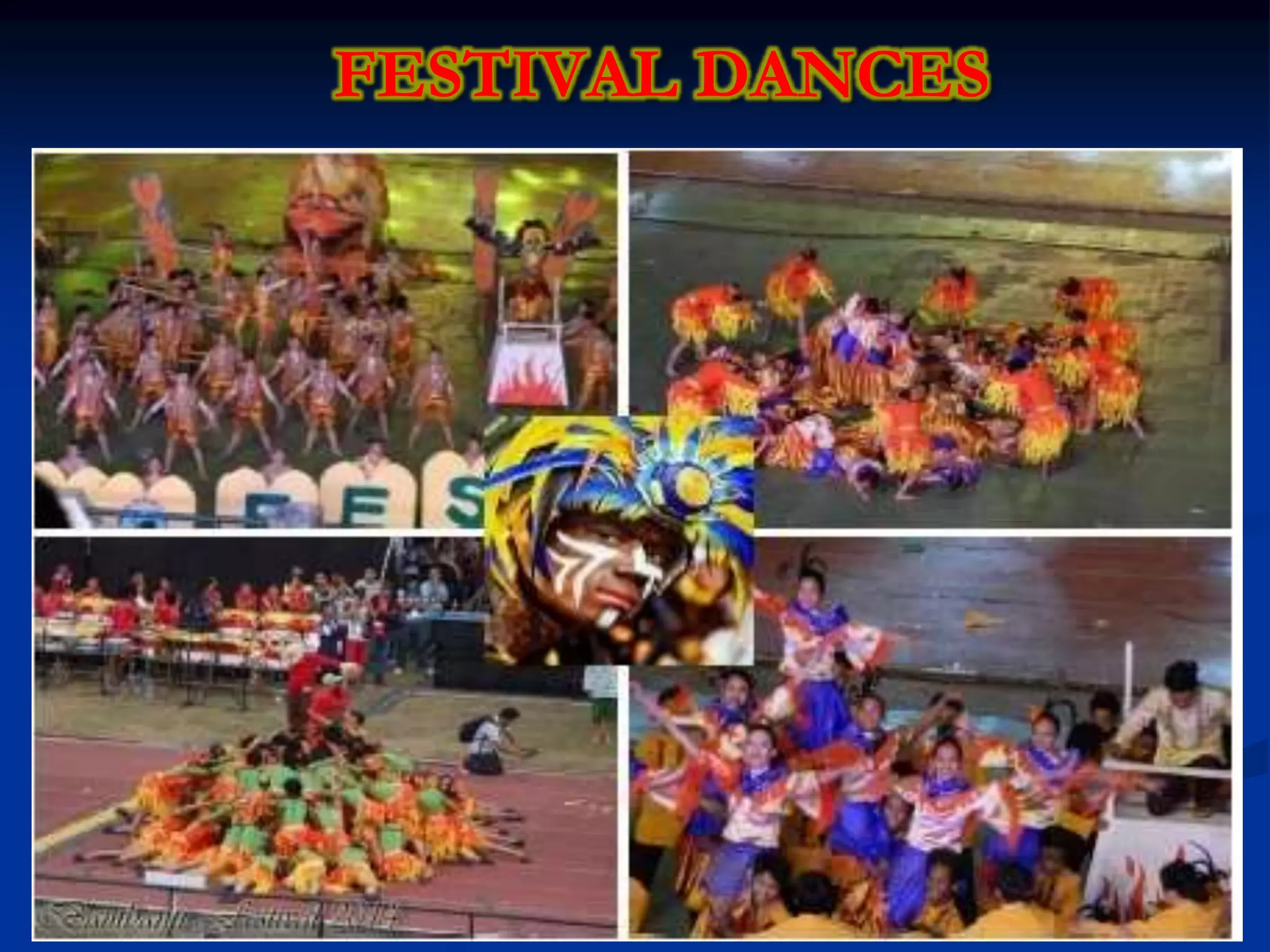
FESTIVAL DANCES
Pre- Assessment Activity
Direction: Below is the survey questionnaire that
reveals learners’ involvement or participation in
festival dances. Let learners copy it in their
worksheets and accomplish by putting check
mark (/) corresponding to their response in each
item.
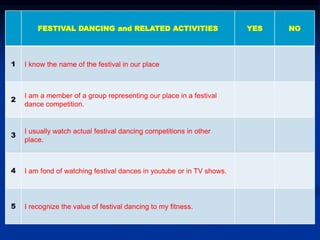
FESTIVAL DANCING and RELATED ACTIVITIES YES NO
1 I know the name of the festival in our place
2
I am a member of a group representing our place in a festival
dance competition.
3
I usually watch actual festival dancing competitions in other
place.
4 I am fond of watching festival dances in youtube or in TV shows.
5 I recognize the value of festival dancing to my fitness.
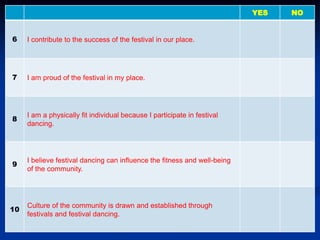
YES NO
6 I contribute to the success of the festival in our place.
7 I am proud of the festival in my place.
8
I am a physically fit individual because I participate in festival
dancing.
9
I believe festival dancing can influence the fitness and well-being
of the community.
10
Culture of the community is drawn and established through
festivals and festival dancing.
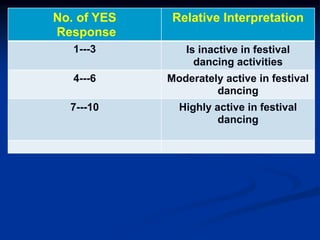
No. of YES
Response
Relative Interpretation
1---3 Is inactive in festival
dancing activities
4---6 Moderately active in festival
dancing
7---10 Highly active in festival
dancing
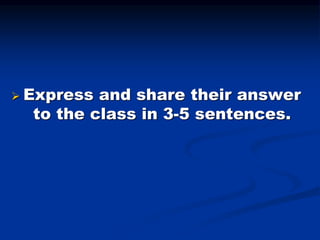
 Express and share their answer
to the class in 3-5 sentences.
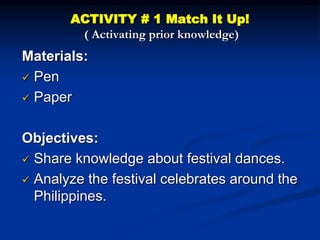
ACTIVITY # 1 Match It Up!
( Activating prior knowledge)
Materials:
 Pen
 Paper
Objectives:
 Share knowledge about festival dances.
 Analyze the festival celebrates around the
Philippines.
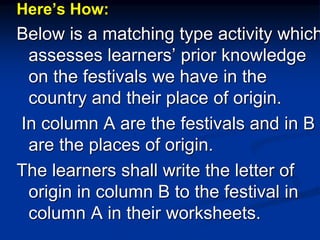
Here’s How:
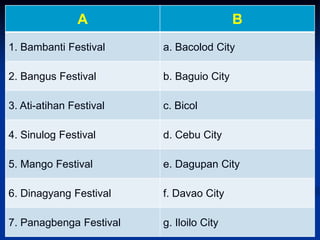
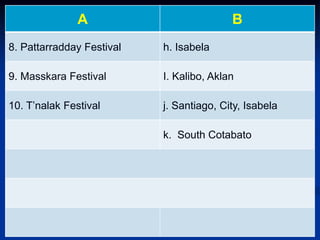
Below is a matching type activity which
assesses learners’ prior knowledge
on the festivals we have in the
country and their place of origin.
In column A are the festivals and in B
are the places of origin.
The learners shall write the letter of
origin in column B to the festival in
column A in their worksheets.
A B
1. Bambanti Festival a. Bacolod City
2. Bangus Festival b. Baguio City
3. Ati-atihan Festival c. Bicol
4. Sinulog Festival d. Cebu City
5. Mango Festival e. Dagupan City
6. Dinagyang Festival f. Davao City
7. Panagbenga Festival g. Iloilo City
A B
8. Pattarradday Festival h. Isabela
9. Masskara Festival I. Kalibo, Aklan
10. T’nalak Festival j. Santiago, City, Isabela
k. South Cotabato
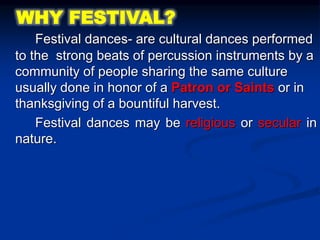
Festival dances- are cultural dances performed
to the strong beats of percussion instruments by a
community of people sharing the same culture
usually done in honor of a Patron or Saints or in
thanksgiving of a bountiful harvest.
Festival dances may be religious or secular in
nature.
WHY FESTIVAL?
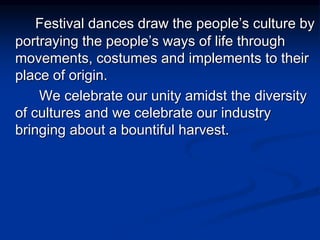
Festival dances draw the people’s culture by
portraying the people’s ways of life through
movements, costumes and implements to their
place of origin.
We celebrate our unity amidst the diversity
of cultures and we celebrate our industry
bringing about a bountiful harvest.
Festivals are a formof
entertainment that attracts foreign
and domestic tourist to visit a
place eventually leading to the
elevation of the Filipino’s quality
life.
RELIGIOUS
and
SECULAR Festivals
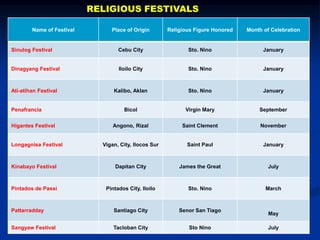
Name of Festival Place of Origin Religious Figure Honored Month of Celebration
Sinulog Festival Cebu City Sto. Nino January
Dinagyang Festival Iloilo City Sto. Nino January
Ati-atihan Festival Kalibo, Aklan Sto. Nino January
Penafrancia Bicol Virgin Mary September
Higantes Festival Angono, Rizal Saint Clement November
Longagnisa Festival Vigan, City, Ilocos Sur Saint Paul January
Kinabayo Festival Dapitan City James the Great July
Pintados de Passi Pintados City, Iloilo Sto. Nino March
Pattarradday Santiago City Senor San Tiago
May
Sangyaw Festival Tacloban City Sto Nino July
RELIGIOUS FESTIVALS
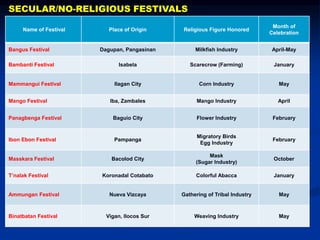
Name of Festival Place of Origin Religious Figure Honored
Month of
Celebration
Bangus Festival Dagupan, Pangasinan Milkfish Industry April-May
Bambanti Festival Isabela Scarecrow (Farming) January
Mammangui Festival Ilagan City Corn Industry May
Mango Festival Iba, Zambales Mango Industry April
Panagbenga Festival Baguio City Flower Industry February
Ibon Ebon Festival Pampanga
Migratory Birds
Egg Industry
February
Masskara Festival Bacolod City
Mask
(Sugar Industry)
October
T’nalak Festival Koronadal Cotabato Colorful Abacca January
Ammungan Festival Nueva Vizcaya Gathering of Tribal Industry May
Binatbatan Festival Vigan, Ilocos Sur Weaving Industry May
SECULAR/NO-RELIGIOUS FESTIVALS
Processing Questions
1. Why is there a need for festivals? Festival
dances?
2. How do you think can festival dances help
you in enhancing your fitness?
3. What value do festival dances develop in
community fitness?
Locomotor Movements
- these are movements that alllow the
body to move from one point in space to
another. It is came from two words, “Locos”
which means place and “Motor”which
means movement.
Basic Movements
Preparatory Movement:
Non-Locomotor Movements
- These are movements that are performed in one
point in space without transferring to another point.
Thesemovements include:
Flexion- It is the act of decreasing the angle of a joint.
Another term flexion is to bend.
Extension- This the opposite of flexion. You are
extending if you are increasing the angle of a joint.
Contraction- A muscle movement done when it
shortens, narrows and tightens using sufficient
amount of energy in the execution.
Release- A muscle movement opposite to contraction
done when it let goes or let looses of being held into
a shortening movement.
Collapse- To deliberate drop the exertion of energy
into a body segment.
Rotation- To rotate is to move a
body segment allowing it to
complete a circle with its motion.
Rotation can also be done in
wrist, waist, knees and ankles.
Twist- To move a body segment
from an axis halfway front or back
or quarter to the right or left as in
twisting of the neck allowing the
head to face right

PE1-PHYSICAL FITNESS-revised.pptx

  • 1.
  • 2.
    Pre- Assessment Activity Direction:Below is the survey questionnaire that reveals learners’ involvement or participation in festival dances. Let learners copy it in their worksheets and accomplish by putting check mark (/) corresponding to their response in each item.
  • 3.
    FESTIVAL DANCING andRELATED ACTIVITIES YES NO 1 I know the name of the festival in our place 2 I am a member of a group representing our place in a festival dance competition. 3 I usually watch actual festival dancing competitions in other place. 4 I am fond of watching festival dances in youtube or in TV shows. 5 I recognize the value of festival dancing to my fitness.
  • 4.
    YES NO 6 Icontribute to the success of the festival in our place. 7 I am proud of the festival in my place. 8 I am a physically fit individual because I participate in festival dancing. 9 I believe festival dancing can influence the fitness and well-being of the community. 10 Culture of the community is drawn and established through festivals and festival dancing.
  • 5.
    No. of YES Response RelativeInterpretation 1---3 Is inactive in festival dancing activities 4---6 Moderately active in festival dancing 7---10 Highly active in festival dancing
  • 6.
     Express andshare their answer to the class in 3-5 sentences.
  • 7.
    ACTIVITY # 1Match It Up! ( Activating prior knowledge) Materials:  Pen  Paper Objectives:  Share knowledge about festival dances.  Analyze the festival celebrates around the Philippines.
  • 8.
    Here’s How: Below isa matching type activity which assesses learners’ prior knowledge on the festivals we have in the country and their place of origin. In column A are the festivals and in B are the places of origin. The learners shall write the letter of origin in column B to the festival in column A in their worksheets.
  • 9.
    A B 1. BambantiFestival a. Bacolod City 2. Bangus Festival b. Baguio City 3. Ati-atihan Festival c. Bicol 4. Sinulog Festival d. Cebu City 5. Mango Festival e. Dagupan City 6. Dinagyang Festival f. Davao City 7. Panagbenga Festival g. Iloilo City
  • 10.
    A B 8. PattarraddayFestival h. Isabela 9. Masskara Festival I. Kalibo, Aklan 10. T’nalak Festival j. Santiago, City, Isabela k. South Cotabato
  • 11.
    Festival dances- arecultural dances performed to the strong beats of percussion instruments by a community of people sharing the same culture usually done in honor of a Patron or Saints or in thanksgiving of a bountiful harvest. Festival dances may be religious or secular in nature. WHY FESTIVAL?
  • 12.
    Festival dances drawthe people’s culture by portraying the people’s ways of life through movements, costumes and implements to their place of origin. We celebrate our unity amidst the diversity of cultures and we celebrate our industry bringing about a bountiful harvest.
  • 13.
    Festivals are aformof entertainment that attracts foreign and domestic tourist to visit a place eventually leading to the elevation of the Filipino’s quality life.
  • 14.
  • 15.
    Name of FestivalPlace of Origin Religious Figure Honored Month of Celebration Sinulog Festival Cebu City Sto. Nino January Dinagyang Festival Iloilo City Sto. Nino January Ati-atihan Festival Kalibo, Aklan Sto. Nino January Penafrancia Bicol Virgin Mary September Higantes Festival Angono, Rizal Saint Clement November Longagnisa Festival Vigan, City, Ilocos Sur Saint Paul January Kinabayo Festival Dapitan City James the Great July Pintados de Passi Pintados City, Iloilo Sto. Nino March Pattarradday Santiago City Senor San Tiago May Sangyaw Festival Tacloban City Sto Nino July RELIGIOUS FESTIVALS
  • 16.
    Name of FestivalPlace of Origin Religious Figure Honored Month of Celebration Bangus Festival Dagupan, Pangasinan Milkfish Industry April-May Bambanti Festival Isabela Scarecrow (Farming) January Mammangui Festival Ilagan City Corn Industry May Mango Festival Iba, Zambales Mango Industry April Panagbenga Festival Baguio City Flower Industry February Ibon Ebon Festival Pampanga Migratory Birds Egg Industry February Masskara Festival Bacolod City Mask (Sugar Industry) October T’nalak Festival Koronadal Cotabato Colorful Abacca January Ammungan Festival Nueva Vizcaya Gathering of Tribal Industry May Binatbatan Festival Vigan, Ilocos Sur Weaving Industry May SECULAR/NO-RELIGIOUS FESTIVALS
  • 17.
    Processing Questions 1. Whyis there a need for festivals? Festival dances? 2. How do you think can festival dances help you in enhancing your fitness? 3. What value do festival dances develop in community fitness?
  • 18.
    Locomotor Movements - theseare movements that alllow the body to move from one point in space to another. It is came from two words, “Locos” which means place and “Motor”which means movement. Basic Movements
  • 19.
  • 21.
    Non-Locomotor Movements - Theseare movements that are performed in one point in space without transferring to another point. Thesemovements include: Flexion- It is the act of decreasing the angle of a joint. Another term flexion is to bend. Extension- This the opposite of flexion. You are extending if you are increasing the angle of a joint.
  • 22.
    Contraction- A musclemovement done when it shortens, narrows and tightens using sufficient amount of energy in the execution. Release- A muscle movement opposite to contraction done when it let goes or let looses of being held into a shortening movement. Collapse- To deliberate drop the exertion of energy into a body segment.
  • 23.
    Rotation- To rotateis to move a body segment allowing it to complete a circle with its motion. Rotation can also be done in wrist, waist, knees and ankles.
  • 24.
    Twist- To movea body segment from an axis halfway front or back or quarter to the right or left as in twisting of the neck allowing the head to face right