Festival Dances
LAS 2
At the end of this session I will be showing you the
activities you need to do.
• Grab your pen and paper. And let’s begin
Learning Target
• Executes the skills involved in the dance
How well do you know your festivals?
• Here’s a survey questionnaire that will reveal your participation or
involvement in festival dances
• All you have to do is to honestly answer all the statements with a Yes
or No
• Write your answer to your activity notebook
• And later we will show the meaning of your responses
1. I know the festival in our place.
2. I am proud of the festival in my place
3. I recognize the value of festival dancing to my fitness
4. I contribute to the success of festival in our place
5. I am fun of watching festivals dances in youtube or in tv shows
6. I usually watch actually festival dancing competition in other places
7. I am a member of a group representing our place in a festival dance competition
8. I am a physically fit individual because I participate in festival dancing
9. I believe the festival dancing can influence the fitness and well-being of the
community
10. Culture of the community is drawn and established through festival and festival
dancing
Festival Dance
Festival dances are cultural dances/ performed to the strong beats of
percussion instruments/ by a community of people sharing the same
culture/ usually done /in honor of a Patron Saint/ or in thanksgiving of
a bountiful harvest.
Festival dances draw the people’s culture/ by portraying the people’s
way of life /through movements, costumes, and implements inherent
to their place of origin
Festivals in the Philippines are generally some of the most-awaited
events of the year. As communities celebrate religious and secular/non-
religious festivals, this can be considered as an instrument in giving
honor to their respective Patron Saints and thanksgiving for a bountiful
harvest.
Religious and Secular Festivals
VO: Festival dances may be religious or secular
Religious Festivals – are done in honor of a certain religious icon or
saint of a particular place
Secular Festivals – celebrated in thanksgiving or celebration of people’s
industry and bountiful harvest.
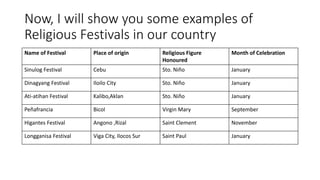
Now, I will show you some examples of
Religious Festivals in our country
Name of Festival Place of origin Religious Figure
Honoured
Month of Celebration
Sinulog Festival Cebu Sto. Niño January
Dinagyang Festival Iloilo City Sto. Niño January
Ati-atihan Festival Kalibo,Aklan Sto. Niño January
Peñafrancia Bicol Virgin Mary September
Higantes Festival Angono ,Rizal Saint Clement November
Longganisa Festival Viga City, Ilocos Sur Saint Paul January
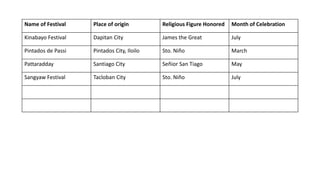
Name of Festival Place of origin Religious Figure Honored Month of Celebration
Kinabayo Festival Dapitan City James the Great July
Pintados de Passi Pintados City, Iloilo Sto. Niño March
Pattaradday Santiago City Señior San Tiago May
Sangyaw Festival Tacloban City Sto. Niño July
Secular Festivals
Name of Festival Place of origin Religious Figure
Honoured
Month of Celebration
Bangus Festival Dagupan,Pangasinan Milkfish Industry April to May
Bambanti Festival Isabela Scarecrow (Farming) January
Mammangui Festival City of Ilagan Corn Industry May
Mango Festival Iba, Zambales Mango Industry April
Panagbenga Festival Baguio City Flower Industry February
Ibon Ebon Festival Pampanga Migratory Birds Egg
industry
February
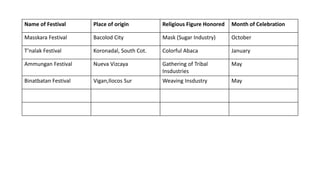
Name of Festival Place of origin Religious Figure Honored Month of Celebration
Masskara Festival Bacolod City Mask (Sugar Industry) October
T’nalak Festival Koronadal, South Cot. Colorful Abaca January
Ammungan Festival Nueva Vizcaya Gathering of Tribal
Insdustries
May
Binatbatan Festival Vigan,Ilocos Sur Weaving Insdustry May
• Direction: Choose one festival dance that you want to perform that
were mentioned above. Record a video and send it to your teacher.
Below is the scoring rubric as your guide and on how your teacher
rate your performance.
Let us answer these matching type activity
• In your activity notebook
• Write the letter

Festival Dances.pptx

  • 1.
  • 2.
    At the endof this session I will be showing you the activities you need to do. • Grab your pen and paper. And let’s begin
  • 3.
    Learning Target • Executesthe skills involved in the dance
  • 4.
    How well doyou know your festivals? • Here’s a survey questionnaire that will reveal your participation or involvement in festival dances • All you have to do is to honestly answer all the statements with a Yes or No • Write your answer to your activity notebook • And later we will show the meaning of your responses
  • 5.
    1. I knowthe festival in our place. 2. I am proud of the festival in my place 3. I recognize the value of festival dancing to my fitness 4. I contribute to the success of festival in our place 5. I am fun of watching festivals dances in youtube or in tv shows 6. I usually watch actually festival dancing competition in other places 7. I am a member of a group representing our place in a festival dance competition 8. I am a physically fit individual because I participate in festival dancing 9. I believe the festival dancing can influence the fitness and well-being of the community 10. Culture of the community is drawn and established through festival and festival dancing
  • 6.
    Festival Dance Festival dancesare cultural dances/ performed to the strong beats of percussion instruments/ by a community of people sharing the same culture/ usually done /in honor of a Patron Saint/ or in thanksgiving of a bountiful harvest. Festival dances draw the people’s culture/ by portraying the people’s way of life /through movements, costumes, and implements inherent to their place of origin
  • 7.
    Festivals in thePhilippines are generally some of the most-awaited events of the year. As communities celebrate religious and secular/non- religious festivals, this can be considered as an instrument in giving honor to their respective Patron Saints and thanksgiving for a bountiful harvest.
  • 8.
    Religious and SecularFestivals VO: Festival dances may be religious or secular Religious Festivals – are done in honor of a certain religious icon or saint of a particular place Secular Festivals – celebrated in thanksgiving or celebration of people’s industry and bountiful harvest.
  • 9.
    Now, I willshow you some examples of Religious Festivals in our country Name of Festival Place of origin Religious Figure Honoured Month of Celebration Sinulog Festival Cebu Sto. Niño January Dinagyang Festival Iloilo City Sto. Niño January Ati-atihan Festival Kalibo,Aklan Sto. Niño January Peñafrancia Bicol Virgin Mary September Higantes Festival Angono ,Rizal Saint Clement November Longganisa Festival Viga City, Ilocos Sur Saint Paul January
  • 10.
    Name of FestivalPlace of origin Religious Figure Honored Month of Celebration Kinabayo Festival Dapitan City James the Great July Pintados de Passi Pintados City, Iloilo Sto. Niño March Pattaradday Santiago City Señior San Tiago May Sangyaw Festival Tacloban City Sto. Niño July
  • 11.
    Secular Festivals Name ofFestival Place of origin Religious Figure Honoured Month of Celebration Bangus Festival Dagupan,Pangasinan Milkfish Industry April to May Bambanti Festival Isabela Scarecrow (Farming) January Mammangui Festival City of Ilagan Corn Industry May Mango Festival Iba, Zambales Mango Industry April Panagbenga Festival Baguio City Flower Industry February Ibon Ebon Festival Pampanga Migratory Birds Egg industry February
  • 12.
    Name of FestivalPlace of origin Religious Figure Honored Month of Celebration Masskara Festival Bacolod City Mask (Sugar Industry) October T’nalak Festival Koronadal, South Cot. Colorful Abaca January Ammungan Festival Nueva Vizcaya Gathering of Tribal Insdustries May Binatbatan Festival Vigan,Ilocos Sur Weaving Insdustry May
  • 13.
    • Direction: Chooseone festival dance that you want to perform that were mentioned above. Record a video and send it to your teacher. Below is the scoring rubric as your guide and on how your teacher rate your performance.
  • 14.
    Let us answerthese matching type activity • In your activity notebook • Write the letter