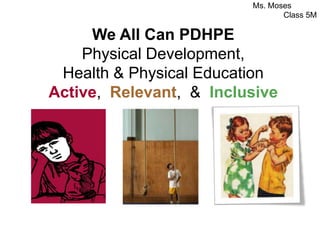
We All Can PDHPE
Physical Development,
Health & Physical Education
Active, Relevant, & Inclusive
Ms. Moses
Class 5M
PDHPE is NOT about sitting still or being bored.
Sit still. Pay attention.
Students have many opportunities to be SEDENTARY in
class, at home, in the car.
http://amorebeautifulquestion.com/wp-content/uploads/2013/11/BoredKidsStandupDesk.png
(Lou, 2014)
PDHPE
is NOT
about facing
your fears
alone or
developing
specific
athletic
skills.
http://corbiscrave.com/wp-
content/uploads/2013/02/Tim-Pannell-4
25932829-2048x1324.jpg
• Up to two hours each week to
face challenges directly, with
the support of your teacher and,
(most importantly) to have FUN!
• Rehearsal of skills that can be
used in daily life and into
adulthood.
• Cooperative learning and team
interaction.
(Board of Studies New South Wales, 2007)
PDHPE offers
PDHPE is NOT just for sporty
types, the strong ones or, for
admiring others who get
involved.
(Knijnik and Curry, 2014)
http://envisioningtheamericandream.com/2013/10/28/candy-is-dandy/
PDHPE offers
opportunities to
• Participate regardless of
physical ability
• Understand and challenge
our physical, social and
emotional differences
• Value these differences
• Develop positive
relationships
(Board of Studies New South Wales, 2007)
Students develop life-long
physical, cognitive & emotional skills.
Inclusive & imaginative
games to get you moving &
thinking. (Light, 2006)
Communicating with others
to create game rules and
exchange ideas.
Cooperating to
achieve group goals
Problem solving
with peers.
Thinking before acting
(Board of Studies New South
Wales, 2007)
How does a
PDHPE teacher fit
in?
Not a sports coach
Empowers students to
investigate options and
THINK!
Students’
Ideas
Teacher’s
Guidance
Students bring their own
strengths, capabilities and
ways of understanding
themselves and others.
PDPHE provides
opportunities to develop
and extend existing
strenghts.
Shared
Path
http://interiordesignschools.org/uploads/digital_asset/file/1613/choosing-schools_600x315.jpg
Moll, Amanti, Neff & Gonzalez, 1992),
(ACARA, 2014)
References
Australian Curriculum Assessment and Reporting Authority (ACARA). (2014). The Australian curriculum: Health
and physical education (F-10). Sydney, Australia: Australian Curriculum Assessment and Reporting
Authority.
Board of Studies New South Wales. (Ed.). (2007). Personal development, health and physical education K-6
syllabus. Sydney, Australia: Board of Studies NSW.
Light, R. (2006). Game sense: Innovation or just good coaching? Journal of Physical Education New Zealand,
39(1), 8-19.
Lou, D. (2014). Sedentary behaviors and youth: Current trends and the impact on health. Active Living Research.
Retrieved from http://activelivingresearch.org/files/ALR_Brief_SedentaryBehaviors_Jan2014.
Moll, L. C., Amanti, C., Neff, D. and Gonzalez, N. (1992). Funds of knowledge for teaching: Using a qualitative
approach to connect homes and classrooms. Theory Into Practice, 31(2), 132-141.
doi:10.1080/00405849209543534
Knijnik, J. and Curry, C. (2014). “I know PE is important but I don’t feel confident teaching it”: Australian
primary pre-service teachers’ feelings and thoughts about teaching physical education. International
Journal of Sport Studies, 4 (3), 289-296.

Pdhpe rationale presentation 2

  • 1.
    We All CanPDHPE Physical Development, Health & Physical Education Active, Relevant, & Inclusive Ms. Moses Class 5M
  • 2.
    PDHPE is NOTabout sitting still or being bored. Sit still. Pay attention. Students have many opportunities to be SEDENTARY in class, at home, in the car. http://amorebeautifulquestion.com/wp-content/uploads/2013/11/BoredKidsStandupDesk.png (Lou, 2014)
  • 3.
    PDHPE is NOT about facing yourfears alone or developing specific athletic skills. http://corbiscrave.com/wp- content/uploads/2013/02/Tim-Pannell-4 25932829-2048x1324.jpg • Up to two hours each week to face challenges directly, with the support of your teacher and, (most importantly) to have FUN! • Rehearsal of skills that can be used in daily life and into adulthood. • Cooperative learning and team interaction. (Board of Studies New South Wales, 2007) PDHPE offers
  • 4.
    PDHPE is NOTjust for sporty types, the strong ones or, for admiring others who get involved. (Knijnik and Curry, 2014) http://envisioningtheamericandream.com/2013/10/28/candy-is-dandy/ PDHPE offers opportunities to • Participate regardless of physical ability • Understand and challenge our physical, social and emotional differences • Value these differences • Develop positive relationships (Board of Studies New South Wales, 2007)
  • 5.
    Students develop life-long physical,cognitive & emotional skills. Inclusive & imaginative games to get you moving & thinking. (Light, 2006) Communicating with others to create game rules and exchange ideas. Cooperating to achieve group goals Problem solving with peers. Thinking before acting (Board of Studies New South Wales, 2007)
  • 6.
    How does a PDHPEteacher fit in? Not a sports coach Empowers students to investigate options and THINK! Students’ Ideas Teacher’s Guidance Students bring their own strengths, capabilities and ways of understanding themselves and others. PDPHE provides opportunities to develop and extend existing strenghts. Shared Path http://interiordesignschools.org/uploads/digital_asset/file/1613/choosing-schools_600x315.jpg Moll, Amanti, Neff & Gonzalez, 1992), (ACARA, 2014)
  • 7.
    References Australian Curriculum Assessmentand Reporting Authority (ACARA). (2014). The Australian curriculum: Health and physical education (F-10). Sydney, Australia: Australian Curriculum Assessment and Reporting Authority. Board of Studies New South Wales. (Ed.). (2007). Personal development, health and physical education K-6 syllabus. Sydney, Australia: Board of Studies NSW. Light, R. (2006). Game sense: Innovation or just good coaching? Journal of Physical Education New Zealand, 39(1), 8-19. Lou, D. (2014). Sedentary behaviors and youth: Current trends and the impact on health. Active Living Research. Retrieved from http://activelivingresearch.org/files/ALR_Brief_SedentaryBehaviors_Jan2014. Moll, L. C., Amanti, C., Neff, D. and Gonzalez, N. (1992). Funds of knowledge for teaching: Using a qualitative approach to connect homes and classrooms. Theory Into Practice, 31(2), 132-141. doi:10.1080/00405849209543534 Knijnik, J. and Curry, C. (2014). “I know PE is important but I don’t feel confident teaching it”: Australian primary pre-service teachers’ feelings and thoughts about teaching physical education. International Journal of Sport Studies, 4 (3), 289-296.

Editor's Notes

  • #3 PDHPE is the only curriculum area that encourages MOVEMENT whilst MAKING DECISIONS.
  • #4 http://corbiscrave.com/wp-content/uploads/2013/02/Tim-Pannell-42-25932829-2048x1324.jpg
  • #5 Vintage ads illustration from Carnation Milk ad 1942 http://envisioningtheamericandream.com/2013/10/28/candy-is-dandy/
  • #6 http://chrismcneilgamesresource.weebly.com/uploads/7/0/3/4/7034317/302058660.jpg?216 - Movinghttp://educationarticle.net/wp-content/uploads/2012/10/Team-building-games-for-kids.jpg – Problem Solving - Cube Gamehttp://www.southcolonieschools.org/galleries/2010_2011/LishaKill/Jumpropeheart/jumpropeheart.cfm – Jump Rope - Interractinghttp://www.abc.net.au/news/image/5337314-3x2-940x627.jpg - Chess - Decision Makinghttp://hurstvillesouthps.com.au/5g - Communicating
  • #7 http://interiordesignschools.org/uploads/digital_asset/file/1613/choosing-schools_600x315.jpg