STATES OF MIND
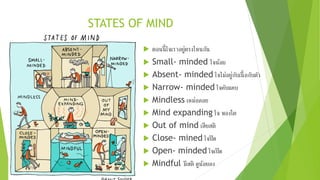
ตอนนี้ใจเราอยู่ตรงไหนกัน
Small- minded ใจน้อย
Absent- minded ใจไม่อยู่กับเนื้อกับตัว
Narrow- minded ใจคับแคบ
Mindless เหม่อลอย
Mind expanding ใจ พองโต
Out of mind เสียสติ
Close- mined ใจปิด
Open- minded ใจเปิด
Mindful มีสติ ดูน้อยลง
3.
ฝึกหัด คิดจากไทย พูดเป็นอังกฤษ
In Basic Sitting Exercise
Be mindful of the
movement of the
abdomen in two stages.
When the abdomen
rises, say in mind
‘Rising’ and when it
falls, say in mind,
‘Falling’.
ในการปฏิบัตินั่งภาวนา/กรรมฐาน
เบื้องต้น
ให้มีสติรู้ถึงการเคลื่อนไหวของหน้าท้อง2
ขั้น ตอนเมื่อหน้าท้องพอง ให้ดูในใจ/
กําหนดว่า พองหนอ และเมื่อหน้าท้อง
หยุบ ให้ดู ในใจ/กําหนดว่าหยุบ หนอ
4.
Do not tryto
control the
movements but be
aware of the
movements as they
occurs naturally.
พยายามไม่ให้บังคับอาการเคลื่อนไหว แต่ให้มี
สติรู้ถึงการเคลื่อนไหว ตามที่อาการเคลื่อนไหว
นั้นเกิดขึ้นตามธรรมชาติ
5.
It isvery easy to fall into
a chant and to lose track
of the movements.
If this happens, at the
point where awareness
returns, say in mind
‘Knowing, Knowing,
Knowing’ and return your
attention to the
movements of the
abdomen.
การตกอยู่ในภาวะสวดบ่น และไม่ได้
ตามติดอาการ เคลื่อนไหวนั้นจะเป็น
สิงที่เกิดขึ้นได้ง่ายๆ ถ้าอาการแบบนี้
เกิดขึ้นขณะที่สติกลับคืนมา ให้พูดใน
ใจว่า รู้หนอ รู้หนอ รู้หนอ และสติ
กลับ ไปกําหนดที่อาการ เคลื่อนไหว
ของท้อง(พอง-หยุบ )
6.
The word"object" has a
special meaning in Vipassana
practice. It does not refer to a
three-dimensional thing like
a desk or a bicycle.
An object means something
that is known by the mind
(something you're aware of)
in the present moment, as
opposed to the subject that is
knowing it. The subject is the
mind or "knower.”
คําว่า “อารมณ์” มีความหมายพิเศษในการ
ปฏิบัติวิปัสสนา อารมณ์ ไม่ได้หมายถึงวัตถุ
สามมิติ เช่น โต๊ะหรือจักรยาน
อารมณ์ หมายถึง บางอย่างที่จิตรับทราบ
(บางอย่างที่รู้เท่าทัน) ปัจจุบันขณะ ตรงข้าม
กับตัวประธานที่รับทราบ ประธานได้แก่
จิต หรือผู้รับรู้
7.
When nothoughts or
other secondary objects
distract you, your
attention should stay
with the primary
meditation object.
เมื่อความคิดหรืออารมณ์รองทําให้ฟุ้ง
ความตั้งใจ/จดจ่อของผู้ปฏิบัติควรอยู่
กับ อารมณ์หลัก
8.
In Vipassana,an object of
awareness can be either
material or mental.
Practically speaking, a
"material object" refers to a
sense-impression: color,
sound, odor, tactile sensation
(including bodily movement),
and flavor. A mental object
refers to such things as
pleasant or unpleasant
feeling, desire, anxiety,
peacefulness, anger, thought,
and so on.
ในการปฏิบัติวิปัสสนาอารมณ์ของสติ
สามารถเป็นได้ทางรูปธรรมและ นามธรรม
กล่าวในทางปฏิบัติอารมณ์ที่เป็นรูปธรรม
หมายถึงสิ่งที่มากระทบผัสสะ: สีเสียงกลิ่น
โผฏฐัพพะและรส อารมณ์ที่เป็นนามธรรม
หมายถึงอารมณ์น่าปรารถนาหรือไม่น่า
ปรารถนา ความอยาก ความกังวล ความสุข
9.
While you'reobserving the
rising-falling movements other
phenomena will be appearing
and disappearing. You might be
aware of sounds. Sometimes
you'll experience emotions and
thoughts. You might feel itches,
numbness or discomfort in the
body, or you might feel very
peaceful. All of these are
secondary objects. In short, a
secondary object is anything
you're aware of that is not the
primary meditation object.
เมื่อกําหนดอาการเคลื่อนไหวพอง-ยุบ
ปรากฏการณ์/สภาวะอารมณ์อื่นจะปรากฏขั้นหรือ
หายไป. ผู้ปฏิบัติอาจกําหนดรู้เสียง. บางครั้งผู้ปฏิบัติ
อาจประสบกับ อารมณ์ไม่น่าพอใจและความคิด
ต่างๆ อาจรู้สึกคัน ชาและไม่สบายตัว หรืออาจรู้สึก
มีความสงบมาก ทั้งหมดนี้คือ อารมณ์รอง /อารมณ์
จร
กล่าวโดยสรุปอารมณ์รอง คืออารมณ์ที่ผู้ปฏิบัติรู้ตัว
10.
In Vipassanaor Insight
meditation we/one
should make effort to
maintain mindfulness at
all times whatever is
being done?
ในการปฏิบัติวิปัสสนาภาวนา
ผู้ปฏิบัติจะต้องพยายามมีสติตลอดเวลา ไม่
ว่าจะทําอะไร
11.
If themeditator is opening a
door, for example, he or she
attempts to be aware of the
tension inherent in the body
accompanying the intention
to open the door
ยกตัวอย่างเช่น
ถ้าผู้ปฏิบัติ/โยคีกําลัง เปิดประตู จะต้อง
พยายามรู้ตัวทั่วพร้อมกําหนดอาการ
อยาก เปิดประตู
12.
The meditatormakes the
mental acknowledgement
‘intending to open the door’:
as he or she reaches out the
handle is being touched.
When the meditator is
cleaning his or her teeth,
eating, drinking, getting
dressed, going up or down
stairs or making any other
movement, he or she tries to
move slowly and mindfully at
all times.
เมื่อผู้ปฏิบัติธรรมกําหนดว่าอยาก
เปิด ประตูหนอผู้ปฏิบัติเอือมมือไป
ที่ลูกบิดกําลังสมผัส
เมื่อผู้ปฏิบัติกําลังทําความสะอาด
ฟัน/แปรงฟัน ทานอาหารดื่มนํ้า
แต่งตัว ขึ้น-ลงบันไดหรือกําลัง
เคลื่อนไหวอื่นๆ ผู้ปฏิบัติพยายาม
13.
If asound occurs, focus your
attention on the sound and
acknowledge it saying in mind
‘HEARING: HEARING:
HEARING’ try to maintain bare
awareness, not allowing yourself
to be drawn by the sound or to
feel aversion to it.
Deal with other sensations,
feelings or thought in the same
way. Mindfully notice them as
they arise, come into being and
pass away, Acknowledge them
without partiality or prejudice,
maintain an attitude of equanimity
at all time.
ถ้าเสียงดังขึ้น/ปรากฏขั้น ให้จดจ่อ/กําหนดที่
เสียง และกําหนดพูด ในใจว่า ยินหนอ ยิน
หนอ ยินหนอ พยามมีสติรู้ตัว ทั่วพร้อมไม่ให้
เสียงดังไปหรือ รู้สึกขัด ใจ/ไม่พอใจต่อเสียง
นั้น
ให้ปฏิบัติกับเวทนาทั้งหลาย ความคิดทั้งหลาย
ในทํานองเดียวกัน /เช่นกัน มีสติกําหนดสิงทั้ง
หลายที่เกิดขึ้น ‘เกิดขั้นและดับไป’ ให้กําหนด